


Abstract
Background: Hepatic dysfunction is associated with adverse outcomes in patients receiving venoarterial extracorporeal membrane oxygenation (VA-ECMO). However, the clinical significance of ischemic hepatitis (IH) identified before versus during ECMO support remains uncertain. We investigated the association between IH categories and in-hospital outcomes in patients receiving VA-ECMO. Methods: We retrospectively analyzed 182 adult patients receiving VA-ECMO between 2019 and 2025, including 159 surgical and 23 nonsurgical patients. Patients were classified as having no IH (n = 71), pre-ECMO IH (n = 47), or on-ECMO IH (n = 64). The primary outcome was in-hospital mortality. Results: In-hospital mortality was 71.8%, 85.1%, and 89.1% in the no IH, pre-ECMO IH, and on-ECMO IH groups, respectively (overall p = 0.028). ECMO weaning success rates were 57.7%, 27.7%, and 34.4%, respectively (p = 0.002). In multivariable logistic regression adjusted for age, hypertension, baseline left ventricular ejection fraction, and estimated glomerular filtration rate, on-ECMO IH was associated with higher odds of in-hospital mortality compared with no IH (adjusted OR 4.019, 95% CI 1.453–11.112; p = 0.007). The corresponding association for pre-ECMO IH was not statistically significant (adjusted OR 2.213, 95% CI 0.785–6.241; p = 0.133). However, the direct adjusted comparison between on-ECMO IH and pre-ECMO IH was not statistically significant (adjusted OR 1.816, 95% CI 0.543–6.072; p = 0.333). Conclusions: Ischemic hepatitis identified during VA-ECMO support was associated with increased in-hospital mortality compared with the absence of IH. However, no statistically significant difference was demonstrated between pre-ECMO and on-ECMO IH. These findings should be interpreted cautiously given the retrospective classification of IH and potential temporal bias.
1. Introduction
Postcardiotomy cardiogenic shock remains one of the most catastrophic complications following cardiac surgery and continues to be associated with substantial morbidity and mortality despite advances in perioperative management and temporary mechanical circulatory support strategies. Venoarterial extracorporeal membrane oxygenation (VA-ECMO) has become an established rescue therapy for refractory circulatory collapse in patients who fail to respond to conventional treatment. However, mortality rates among VA-ECMO patients remain exceedingly high. Recent systematic reviews and meta-analyses have reported substantial mortality among adults receiving VA-ECMO for cardiogenic shock or cardiac arrest, highlighting the poor outcomes associated with severe circulatory failure despite advances in mechanical circulatory support [1,2].
Among extracardiac complications, hepatic dysfunction has emerged as an increasingly recognized marker of disease severity and systemic hypoperfusion during ECMO support. Ischemic hepatitis (IH), also referred to as hypoxic hepatitis or shock liver, is characterized by acute hepatocellular injury resulting from impaired hepatic oxygen delivery in the setting of low cardiac output, venous congestion, vasopressor exposure, and ischemia–reperfusion injury. In addition, extracorporeal circulation itself may contribute to hepatic injury through systemic inflammatory activation, hemolysis, altered pulsatile flow, and microcirculatory disturbances. Consequently, liver injury during VA-ECMO likely reflects not only baseline shock severity but also the adequacy of ongoing end-organ perfusion during mechanical circulatory support [3,4]. Recent studies have demonstrated a strong association between liver dysfunction and adverse outcomes in ECMO-supported patients. In particular, Dobrilovic et al. reported that elevated bilirubin levels and liver dysfunction during ECMO support were independently associated with increased in-hospital mortality in adult ECMO patients [3]. Similarly, Sandrio et al. reported an association between pre-ECMO liver impairment and adverse outcomes in patients with acute respiratory distress syndrome receiving venovenous ECMO [5]. Furthermore, MELD-based scoring systems, particularly MELD-XI, have increasingly been recognized as practical prognostic tools because they incorporate both hepatic and renal dysfunction while minimizing confounding related to anticoagulation-associated INR alterations [6].
Previous studies have demonstrated the prognostic relevance of hepatic dysfunction during ECMO support, including the assessment of serial liver-related biomarkers and MELD-XI scores [6,7]. However, the classification of ischemic hepatitis according to its first documented occurrence before or during VA-ECMO support has received comparatively limited attention. This distinction may provide additional clinical information beyond longitudinal changes in hepatic function scores, although its independent prognostic relevance remains uncertain.
Therefore, the present study aimed to investigate the clinical characteristics and in-hospital outcomes of patients receiving VA-ECMO support according to the first documented occurrence of ischemic hepatitis relative to ECMO initiation. Specifically, we compared patients without IH, those with IH identified before ECMO initiation, and those who first developed IH during ECMO support, and evaluated the associations of these categories with in-hospital mortality and secondary clinical outcomes.
2. Methods
2.1. Study Design and Patient Population
This retrospective observational study included 182 consecutive adult patients who required venoarterial extracorporeal membrane oxygenation (VA-ECMO) support at a tertiary referral center between October 2019 and October 2025. Of these, 159 patients underwent cardiac surgery, whereas 23 received VA-ECMO for nonsurgical indications. Patients younger than 18 years of age and those with preexisting chronic liver failure or incomplete clinical data were excluded from the analysis.
ECMO indications were classified according to the underlying surgical procedure or primary clinical condition. The cardiogenic shock category included patients with congestive heart failure (CHF) or acute myocardial infarction (AMI), including those who required surgical intervention for AMI-related complications.
In surgical patients, VA-ECMO support was initiated either intraoperatively or postoperatively, depending on the patient’s clinical condition and the need for circulatory support. Patients receiving VA-ECMO during ongoing cardiopulmonary resuscitation (extracorporeal cardiopulmonary resuscitation, ECPR) were also included in the study cohort. These patients were classified into IH groups according to the first documented occurrence of IH relative to ECMO initiation, using the same criteria as the remaining patients.
Cannulation strategies were classified as central, femoral–femoral, or femoral–jugular. In the femoral–jugular configuration, venous drainage was established through the internal jugular vein, while arterial return was provided through the femoral artery.
Clinical, laboratory, operative, and ECMO-related data were retrospectively obtained from institutional electronic medical records and the ECMO database.
The study protocol was approved by the local Clinical Research Ethics Committee (Approval No: E-28001928-604.01.01-305933990). The study was conducted in accordance with the Declaration of Helsinki, and the requirement for informed consent was waived because of its retrospective design.
2.2. Definition of Ischemic Hepatitis and Study Groups
Ischemic hepatitis (IH) was operationally defined as an elevation of either aspartate aminotransferase (AST) above 640 U/L or alanine aminotransferase (ALT) above 660 U/L, corresponding to more than 20 times the laboratory-specific upper limits of normal (32 U/L for AST and 33 U/L for ALT), in the clinical context of circulatory failure or systemic hypoperfusion.
The diagnosis was further supported by an ALT-to-lactate dehydrogenase (LDH) ratio below 1.5; this ratio was not required for IH classification. Alternative causes of aminotransferase elevation, including drug-induced liver injury, rhabdomyolysis, and hemolysis, were evaluated and excluded based on the available clinical and laboratory findings [8,9].
Liver biochemical tests were obtained at least daily during ECMO support. The timing of IH was determined by the first documented laboratory measurement meeting the diagnostic threshold relative to VA-ECMO initiation. This measurement was used to classify IH as first identified before or during ECMO support.
Patients were categorized into three groups according to the timing of ischemic hepatitis development:
- No IH group: Patients who did not develop ischemic hepatitis before or during ECMO support.
- Pre-ECMO IH group: Patients with ischemic hepatitis diagnosed before ECMO initiation.
- On-ECMO IH group: Patients who developed ischemic hepatitis during ECMO support after ECMO initiation.
Group assignment was based on the initial occurrence of IH and remained unchanged throughout ECMO support. Accordingly, patients with pre-ECMO IH remained in the pre-ECMO IH group even if aminotransferase elevations persisted or recurred during ECMO support.
2.3. Data Collection
Baseline demographic and clinical characteristics, including age, sex, body mass index (BMI), hypertension, diabetes mellitus, chronic kidney disease, chronic obstructive pulmonary disease, left ventricular ejection fraction (LVEF), estimated glomerular filtration rate (eGFR), hematocrit, and baseline liver biochemical parameters, were retrospectively recorded. Baseline eGFR and LVEF were obtained before VA-ECMO initiation. In surgical patients, preoperative measurements were used, whereas in nonsurgical patients, measurements obtained during the initial clinical assessment before ECMO initiation were considered. These variables were included in the multivariable mortality model as baseline covariates.
Surgical variables included cardiopulmonary bypass duration and aortic cross-clamp time, where applicable. ECMO-related variables included the primary indication for ECMO support, cannulation strategy, intra-aortic balloon pump (IABP) use, and ECMO duration. Additional clinical variables included mechanical ventilation duration, intensive care unit (ICU) and hospital lengths of stay, renal replacement therapy requirement, peak aminotransferase levels, bilirubin, lactate dehydrogenase (LDH), international normalized ratio (INR), and MELD-XI scores.
Baseline AST and ALT measurements were obtained preoperatively in patients undergoing elective cardiac surgery. In patients requiring emergency surgery, blood samples were collected at the earliest clinically feasible time. For patients receiving VA-ECMO for nonsurgical indications, including acute myocardial infarction or congestive heart failure, baseline measurements were obtained on the first day of ICU admission. These baseline measurements were distinguished from the serial aminotransferase measurements used to determine the first documented occurrence of IH relative to ECMO initiation.
The MELD-XI score, which excludes the international normalized ratio (INR), was calculated using bilirubin and creatinine measurements obtained within the first 24 h after VA-ECMO initiation. The score was used as a descriptive measure of hepatic and renal dysfunction and was not included in the multivariable mortality model.
MELD-XI = 5.11 × ln(total bilirubin) + 11.76 × ln(serum creatinine) + 9.44.
2.4. Outcomes
The primary outcome was in-hospital mortality. The association between IH category and in-hospital mortality was evaluated by comparing patients without IH, those with IH first documented before ECMO initiation, and those with IH first documented during ECMO support.
Secondary outcomes included successful ECMO weaning, requirement for renal replacement therapy, intensive care unit (ICU) length of stay, hospital length of stay, and the severity of hepatic dysfunction as assessed by peak liver biochemical parameters and MELD-XI scores.
Successful ECMO weaning was defined as discontinuation of VA-ECMO support following adequate recovery of native cardiac function and hemodynamic stability. Patients who died while receiving ECMO support, including those who died before a weaning attempt, were classified as having unsuccessful weaning. Patients who were successfully weaned from ECMO but subsequently died during hospitalization were classified as having successful weaning, because ECMO weaning success and in-hospital survival were evaluated as separate outcomes.
2.5. Statistical Analysis
Statistical analyses were performed using IBM SPSS Statistics for Mac, version 29.0 (IBM Corp., Armonk, NY, USA). The normality of continuous variables was assessed using the Kolmogorov–Smirnov and Shapiro–Wilk tests. Continuous variables were expressed as median and interquartile range (IQR, 25th–75th percentile) or mean ± standard deviation, as appropriate. Comparisons across the three IH categories were performed using the Kruskal–Wallis test or one-way analysis of variance (ANOVA) for continuous variables and the chi-square test or Fisher’s exact test for categorical variables, as appropriate.
A parsimonious multivariable logistic regression model was constructed to evaluate the association between IH category and in-hospital mortality. IH was entered as a categorical variable, with the no IH group serving as the reference category. Age, hypertension, baseline left ventricular ejection fraction (LVEF), and baseline estimated glomerular filtration rate (eGFR) were selected on the basis of clinical relevance while limiting the number of estimated parameters. All covariates were entered simultaneously into the model.
Baseline eGFR was included to represent renal function, whereas MELD-XI was excluded because it was calculated using measurements obtained during the first 24 h of ECMO support and could reflect evolving organ dysfunction. Cardiopulmonary bypass and aortic cross-clamp durations were excluded because these variables were not applicable to all patients.
Adjusted odds ratios (ORs) and 95% confidence intervals (CIs) were calculated. A direct adjusted comparison between the on-ECMO IH and pre-ECMO IH groups was also performed. A sensitivity analysis was conducted with additional adjustment for surgical status (surgical versus nonsurgical VA-ECMO).
Missing covariate data were handled using complete-case analysis. The final multivariable model included 177 of 182 patients (97.3%); five patients had missing baseline eGFR data. Model discrimination was evaluated using the area under the receiver operating characteristic curve (AUC), with a 95% confidence interval, and calibration was assessed using the Hosmer–Lemeshow goodness-of-fit test.
To assess the robustness of the findings and the potential influence of nonsurgical patients, a sensitivity analysis was performed by restricting the cohort to patients who underwent cardiac surgery. The multivariable logistic regression model was repeated using the same covariates as the primary analysis, including IH category, age, hypertension, baseline eGFR, and baseline LVEF. Surgical status was not included as a covariate because all patients in this subgroup had undergone cardiac surgery. Complete-case analysis was applied to patients with available data for all model variables.
A two-sided p-value < 0.05 was considered statistically significant.
3. Results
A total of 182 patients receiving VA-ECMO support were included in the study. Of these, 159 patients (87.4%) underwent cardiac surgery, whereas 23 patients (12.6%) received VA-ECMO for nonsurgical indications. According to the first documented occurrence of IH relative to ECMO initiation, 71 patients (39.0%) were classified as having no IH, 47 patients (25.8%) as having pre-ECMO IH, and 64 patients (35.2%) as having on-ECMO IH.
Baseline characteristics according to IH category are summarized in Table 1. Age, body mass index, and most comorbidities did not differ significantly across groups. The proportion of male patients was numerically higher in the on-ECMO IH group, although the overall difference was not statistically significant (81.3% vs. 66.2% and 63.8%; p = 0.074). Baseline eGFR differed significantly across IH categories (p = 0.013). Baseline AST and ALT concentrations were also significantly different across groups, with the highest median values observed in the pre-ECMO IH group (both p < 0.001).
Table 1.
Patient characteristics, clinical variables, and outcomes according to ischemic hepatitis category.
Among patients undergoing cardiopulmonary bypass, CPB duration and aortic cross-clamp time differed significantly across IH categories (overall p = 0.005 and p < 0.001, respectively). ECMO indication and cannulation strategy did not differ significantly across groups (p = 0.131 and p = 0.371, respectively). Similarly, ECMO duration and intra-aortic balloon pump use showed no statistically significant differences across IH categories.
Clinical outcomes and liver-related variables are presented in Table 1. Renal replacement therapy was more frequently required in patients with IH than in those without IH (overall p < 0.001). Peak AST, ALT, bilirubin, LDH, and INR values differed significantly across IH categories (all p ≤ 0.003). However, these parameters did not demonstrate a consistent gradient across the pre-ECMO and on-ECMO IH groups. MELD-XI scores, calculated within the first 24 h of ECMO support, differed significantly across IH categories, with the highest median observed in the pre-ECMO IH group (21.47 [15.06–25.72]), followed by the on-ECMO IH group (20.88 [15.78–26.34]) and the no IH group (15.66 [12.09–20.28]; overall p < 0.001).
Although in-hospital mortality was numerically highest in the on-ECMO IH group, other markers of clinical severity did not follow a uniform pattern across IH categories. Five patients died within the first 24 h after ECMO initiation; all five were classified in the on-ECMO IH group.
Peak bilirubin and LDH levels were numerically higher in the pre-ECMO IH group than in the on-ECMO IH group, while successful ECMO weaning was less frequent in the pre-ECMO IH group (27.7% vs. 34.4%). These findings indicate that the distribution of hepatic biochemical abnormalities and clinical outcomes differed across IH categories without a consistent gradient of severity.
Detailed ECMO indications according to IH category are presented in Table 2. Although the overall distribution of ECMO indications did not differ significantly across groups, acute myocardial infarction-related ECMO was numerically more frequent in the pre-ECMO IH group, whereas combined CABG and valve procedures were numerically more frequent in the on-ECMO IH group.
Table 2.
Indications for ECMO according to ischemic hepatitis timing.
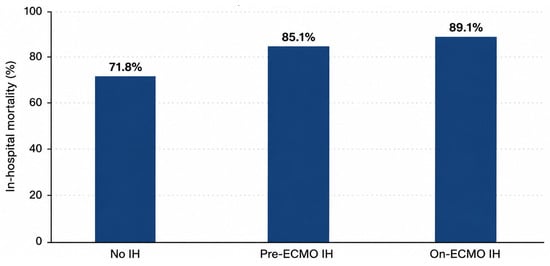
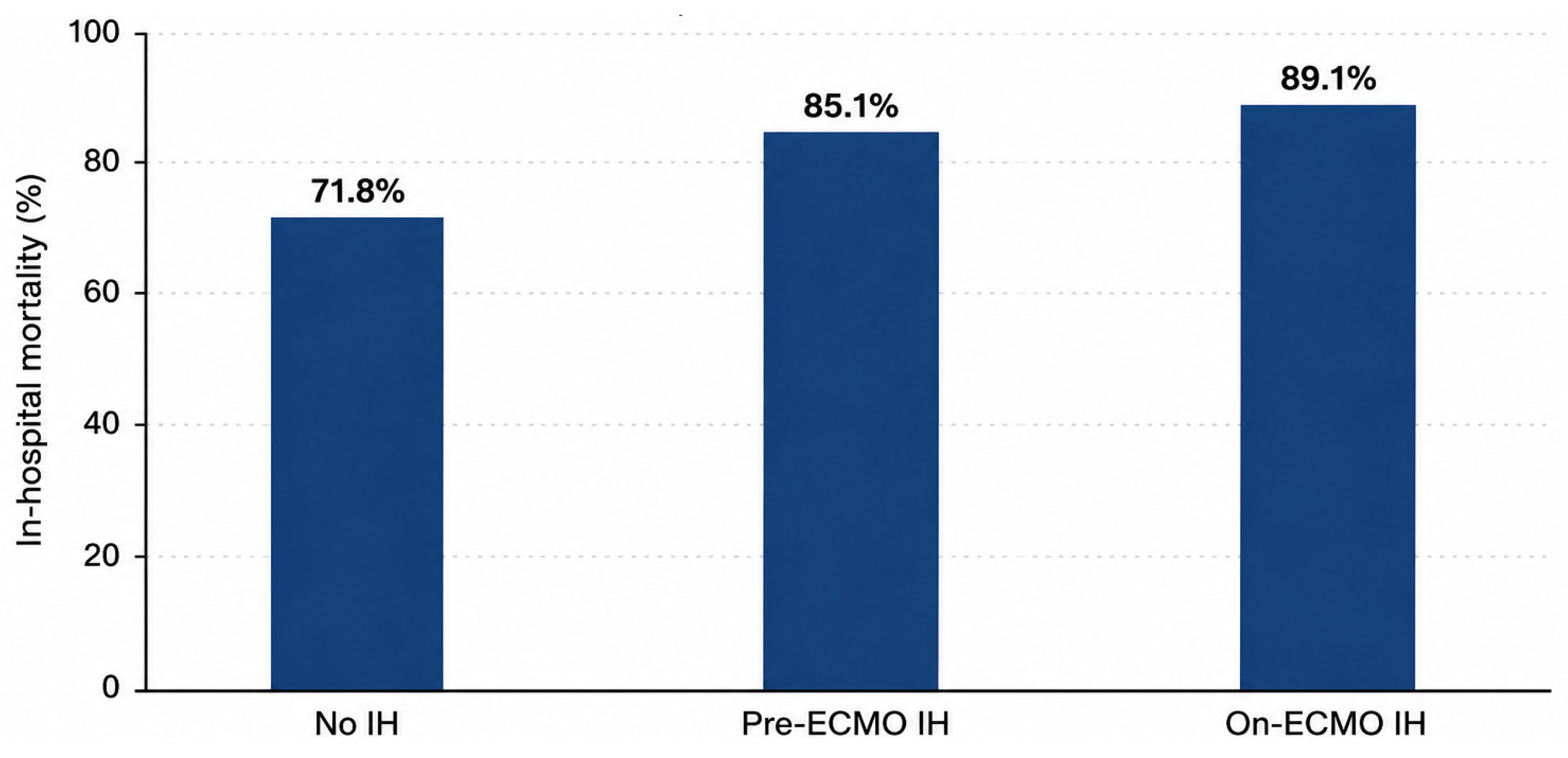
In-hospital mortality rates were 71.8%, 85.1%, and 89.1% in the no IH, pre-ECMO IH, and on-ECMO IH groups, respectively (overall p = 0.028) (Figure 1). ECMO weaning success also differed significantly across groups, with rates of 57.7%, 27.7%, and 34.4%, respectively (overall p = 0.002).
Figure 1.
In-hospital mortality according to ischemic hepatitis category. Mortality rates were 71.8%, 85.1%, and 89.1% in the no IH, pre-ECMO IH, and on-ECMO IH groups, respectively (overall p = 0.028). IH: ischemic hepatitis; ECMO: extracorporeal membrane oxygenation.
Multivariable logistic regression analysis was performed in 177 patients with complete covariate data (97.3% of the study cohort). In the parsimonious model adjusted for age, hypertension, baseline left ventricular ejection fraction, and baseline estimated glomerular filtration rate (eGFR), the ischemic hepatitis (IH) category was significantly associated with in-hospital mortality (overall Wald χ2 = 7.685, p = 0.021). Compared with patients without IH, those developing IH during ECMO support had significantly higher odds of in-hospital mortality (adjusted OR 4.02, 95% CI 1.45–11.11; p = 0.007), whereas the association for pre-ECMO IH was not statistically significant (adjusted OR 2.21, 95% CI 0.79–6.24; p = 0.133).
Importantly, a direct adjusted comparison between the on-ECMO IH and pre-ECMO IH groups did not demonstrate a statistically significant difference in mortality odds (adjusted OR 1.82, 95% CI 0.54–6.07; p = 0.333). Baseline eGFR was also significantly associated with mortality (adjusted OR 0.986, 95% CI 0.975–0.997; p = 0.013), whereas age, hypertension, and baseline left ventricular ejection fraction were not statistically significant in the adjusted model. The model demonstrated moderate discrimination for in-hospital mortality, with an AUC of 0.746 (95% CI 0.652–0.841). The Hosmer–Lemeshow goodness-of-fit test did not indicate significant model misfit (χ2 = 3.318, p = 0.913) (Table 3).
Table 3.
Multivariable logistic regression analysis for in-hospital mortality.
In the sensitivity analysis restricted to the 159 patients who underwent cardiac surgery, 156 patients (98.1%) had complete covariate data and were included in the multivariable logistic regression model. Compared with patients without IH, on-ECMO IH remained significantly associated with in-hospital mortality (adjusted OR 4.15, 95% CI 1.40–12.24; p = 0.010), whereas pre-ECMO IH was not significantly associated with mortality (adjusted OR 2.66, 95% CI 0.82–8.59; p = 0.103). The direct comparison between on-ECMO IH and pre-ECMO IH was not statistically significant (adjusted OR 1.56, 95% CI 0.40–6.14; p = 0.524). The overall association of IH category with mortality remained statistically significant (Wald χ2 = 7.588, p = 0.023). These findings were broadly consistent with those of the primary analysis. Detailed results are provided in Supplementary Table S1.
4. Discussion
In this retrospective cohort of 182 patients receiving VA-ECMO support, ischemic hepatitis (IH) categories defined according to the first documented occurrence of liver injury relative to ECMO initiation were associated with differences in in-hospital mortality and clinical outcomes. Mortality was 71.8% among patients without IH, 85.1% among those with pre-ECMO IH, and 89.1% among those with on-ECMO IH. In the adjusted analysis, on-ECMO IH was associated with higher mortality odds compared with no IH (adjusted OR 4.02, 95% CI 1.45–11.11), whereas the corresponding association for pre-ECMO IH was not statistically significant. Importantly, the direct adjusted comparison between on-ECMO and pre-ECMO IH did not demonstrate a statistically significant difference (adjusted OR 1.82, 95% CI 0.54–6.07). Thus, although the overall findings support an association between IH category and adverse outcomes, they do not establish that IH first documented during ECMO carries a greater mortality risk than IH already present before ECMO initiation.
Hepatic dysfunction is increasingly recognized as an important component of multiorgan injury in patients requiring extracorporeal circulatory support. Previous investigations have associated liver dysfunction, hyperbilirubinemia, and elevated MELD-based scores with adverse outcomes in ECMO populations [3,7,10,11]. Moreover, large observational VA-ECMO cohorts have documented substantial mortality and morbidity despite the availability of advanced mechanical circulatory support [4,12]. Ayers et al. demonstrated the prognostic relevance of MELD-XI in patients receiving VA-ECMO, while Sommerfeld et al. evaluated serial MELD scores in postcardiotomy ECMO patients, emphasizing the potential importance of changes in hepatorenal dysfunction during extracorporeal support [6,7]. Sandrio et al. also reported associations between pre-ECMO liver impairment and outcomes in patients with acute respiratory distress syndrome receiving predominantly venovenous ECMO, although differences in ECMO configuration and underlying disease limit direct comparisons with VA-ECMO cohorts [5]. In this context, the present study adds a complementary perspective by examining IH categories based on whether the diagnostic criteria were first documented before or after VA-ECMO initiation. Unlike studies evaluating serial MELD-based scores, however, our classification was based on the first documented qualifying liver enzyme measurements rather than longitudinal trajectories of hepatic dysfunction.
The pathophysiology of hypoxic or ischemic hepatitis is multifactorial and involves impaired hepatic oxygen delivery, reduced perfusion, and frequently concomitant hepatic venous congestion [13]. Although VA-ECMO provides systemic circulatory support, restoration of macrocirculatory flow does not necessarily guarantee adequate tissue-level oxygen delivery. Potential contributors to hepatic injury during ECMO include persistent circulatory dysfunction, right-sided congestion, vasoplegia, systemic inflammatory activation, and ischemia–reperfusion injury [9,13]. Consequently, IH first documented during ECMO may coexist with ongoing hemodynamic instability or multiorgan dysfunction. Nevertheless, these mechanisms remain hypotheses in the present cohort because detailed longitudinal hemodynamic measurements, lactate clearance, hepatic congestion parameters, and microcirculatory assessments were not consistently available. Furthermore, the first laboratory documentation of IH may occur after the actual onset of hepatic injury, and an on-ECMO classification does not necessarily imply that the underlying hepatic insult began after ECMO initiation.
The patterns of biochemical abnormalities and clinical outcomes in our cohort also warrant careful interpretation. Patients with IH had higher peak aminotransferase levels and more frequent renal replacement therapy than patients without IH. MELD-XI scores obtained during the first 24 h of ECMO support were highest in the pre-ECMO IH group when expressed as median values. However, the distribution of liver-related abnormalities was not uniform: peak bilirubin and LDH levels were numerically higher in the pre-ECMO IH group, while ECMO weaning success was lowest in this group. These findings suggest that the IH categories were associated with different patterns of organ dysfunction rather than a consistent progression in severity from no IH to pre-ECMO IH and then to on-ECMO IH. Moreover, because MELD-XI was calculated after ECMO initiation, it may reflect early evolving organ dysfunction and should not be interpreted as a purely pre-ECMO baseline characteristic or as evidence of serial deterioration.
Renal function was another relevant finding. Lower baseline eGFR was associated with higher in-hospital mortality odds in the adjusted model (adjusted OR 0.986 per mL/min/1.73 m2 increase, 95% CI 0.975–0.997). This association is clinically plausible in a population exposed to severe circulatory failure, although the observational design does not establish the underlying mechanism. Baseline eGFR was selected for the multivariable model instead of MELD-XI because it more directly represented renal function before the ECMO-related observation period, whereas MELD-XI incorporated measurements obtained during the first 24 h of support. The exclusion of cardiopulmonary bypass and aortic cross-clamp durations from the principal model also allowed inclusion of patients receiving VA-ECMO for nonsurgical indications. Nevertheless, residual confounding related to operative complexity, shock severity, and other unmeasured factors cannot be excluded. The multifactorial nature of mortality risk in VA-ECMO patients is also reflected in previously developed prognostic models, including the PREDICT VA-ECMO score, which incorporates multiple clinical variables rather than relying on a single measure of organ dysfunction [14].
An important distinction concerns the interpretation of the adjusted IH comparisons. Although on-ECMO IH was significantly associated with mortality relative to the no IH reference group, the absence of statistical significance for pre-ECMO IH does not itself establish a significant difference between the two IH categories. The direct comparison did not demonstrate such a difference, and its confidence interval was wide. Therefore, the present findings should not be interpreted as evidence that on-ECMO IH is intrinsically more harmful than pre-ECMO IH. The numerically different mortality rates may reflect several overlapping factors, including differences in underlying disease, circulatory failure severity, timing of laboratory measurements, and survival long enough for IH to be documented during ECMO support.
Contemporary extracorporeal life support registry data highlight the substantial clinical burden associated with ECMO support and the importance of ongoing outcome assessment in this critically ill population [15]. From a clinical perspective, these observations support continued attention to hepatic and renal dysfunction in patients receiving VA-ECMO. Marked aminotransferase elevation during extracorporeal support should prompt assessment of the overall clinical context, including systemic perfusion, ventricular function, venous congestion, ECMO flow, and alternative causes of acute liver injury [9,13]. Serial laboratory monitoring may help characterize the course of organ dysfunction and inform bedside reassessment, consistent with the clinical relevance of repeated hepatorenal assessments reported in previous ECMO studies [6,7]. However, the present study did not test whether interventions triggered by IH detection improve survival, and its findings should not be used to establish a specific therapeutic escalation threshold. Prospective investigations incorporating standardized serial liver measurements and detailed hemodynamic data are needed to determine whether the timing and evolution of hepatic injury provide prognostic information beyond established measures of shock severity and organ dysfunction.
Limitations
This study has several limitations. First, its retrospective, single-center design and relatively modest sample size limit generalizability and increase the possibility of residual confounding. The number of survivors was particularly limited, restricting the complexity of multivariable modeling. Although a parsimonious model was used, the precision and stability of adjusted estimates remain important considerations. Second, IH was identified using an operational biochemical definition, and different aminotransferase thresholds or diagnostic criteria could lead to different classifications [13]. Laboratory sampling and retrospective ascertainment may also have affected the recorded timing of IH.
Third, and most importantly, the classification of IH according to its first documentation before or during ECMO introduces potential immortal-time and other time-related biases. Patients assigned to the on-ECMO IH category were classified using information obtained after ECMO initiation, whereas mortality risk was evaluated from the ECMO treatment period. Although all five patients who died within the first 24 h after ECMO initiation were classified in the on-ECMO IH group, this observation does not eliminate bias associated with post-baseline exposure ascertainment. Exact patient-level IH onset intervals were unavailable, preventing reliable time-dependent exposure modeling or landmark analysis. Accordingly, the observed associations cannot establish a causal effect of IH timing or demonstrate that the development of IH during ECMO independently predicts subsequent mortality.
Fourth, detailed longitudinal measurements of hemodynamic status, lactate clearance, ventricular unloading, hepatic congestion, and microcirculatory perfusion were not consistently available. These omissions limit the ability to distinguish persistent hypoperfusion from other mechanisms of hepatic injury. Fifth, the cohort included both surgical and nonsurgical VA-ECMO patients, introducing clinical heterogeneity. Although adjustment for surgical status yielded similar findings in a sensitivity analysis, differences in indication and disease severity may not have been fully captured. Sixth, although cannulation configuration was not significantly associated with mortality in the univariable analysis, potential confounding related to cannulation strategy, ECMO management, and associated hemodynamic differences cannot be excluded.
Finally, external validation was not performed, and the findings should be regarded as hypothesis-generating.
5. Conclusions
In patients receiving VA-ECMO, IH categories based on the first documented occurrence of liver injury relative to ECMO initiation were associated with differences in in-hospital mortality and clinical outcomes. On-ECMO IH was associated with higher adjusted mortality odds compared with no IH, but the direct comparison between on-ECMO and pre-ECMO IH was not statistically significant. Because of retrospective exposure classification and potential time-related bias, these findings should be interpreted as exploratory associations rather than evidence that the timing of IH independently determines mortality risk. Prospective studies with standardized serial hepatic assessments and time-dependent analyses are warranted to clarify the prognostic significance of hepatic injury during VA-ECMO support.
Supplementary Materials
The following supporting information can be downloaded at https://www.mdpi.com/article/10.3390/jcdd13110583/s1. Table S1: Multivariable logistic regression analysis of in-hospital mortality restricted to patients undergoing cardiac surgery.
Author Contributions
G.T.: Concept and design, data collection, data interpretation, manuscript drafting, critical revision, final approval. Z.E.D.: Data analysis and interpretation, manuscript drafting, critical revision, final approval. M.E.E.: Data collection, data interpretation, critical revision, final approval. Ş.Y.: Study supervision, critical revision, final approval. All authors have read and agreed to the published version of the manuscript.
Funding
This research received no external funding.
Institutional Review Board Statement
The study protocol was approved by the Clinical Research Ethics Committee of Dr. Siyami Ersek Thoracic and Cardiovascular Surgery Education Research Hospital (Approval No: E-28001928-604.01.01-305933990) on 20 February 2026 and conducted in accordance with the principles of the Declaration of Helsinki.
Informed Consent Statement
The requirement for informed consent was waived because of the retrospective design of the study.
Data Availability Statement
The original contributions presented in this study are included in the article/Supplementary Material. Further inquiries can be directed to the corresponding author.
Acknowledgments
The authors acknowledge the contributions of the ECMO team, perfusionists, intensive care unit staff, and operating room personnel of Siyami Ersek Thoracic and Cardiovascular Surgery Training and Research Hospital for their dedication to patient care and support of the institutional ECMO program.
Conflicts of Interest
The authors declare no conflicts of interest.
References
- Son, Y.J.; Hyun Park, S.; Lee, Y.; Lee, H.J. Prevalence and risk factors for in-hospital mortality of adult patients on veno-arterial extracorporeal membrane oxygenation for cardiogenic shock and cardiac arrest: A systematic review and meta-analysis. Intensive Crit. Care Nurs. 2024, 85, 103756. [Google Scholar] [CrossRef] [Scilit] [PubMed]
- Wilson-Smith, A.R.; Bogdanova, Y.; Roydhouse, S.; Phan, K.; Tian, D.H.; Yan, T.D.; Loforte, A. Outcomes of venoarterial extracorporeal membrane oxygenation for refractory cardiogenic shock: Systematic review and meta-analysis. Ann. Cardiothorac. Surg. 2019, 8, 1–8. [Google Scholar] [CrossRef] [Scilit] [PubMed]
- Dobrilovic, N.; March, R.; Yin, K.; Lateef, O.; Alimohamed, M.; Bak, E.; Delibasic, M.; Karlson, K.; Edwards, N.; Raman, J. Liver Dysfunction Associated with In-Hospital Mortality in Adult Extracorporeal Membrane Oxygenation Support. Crit. Care Explor. 2021, 3, e0484. [Google Scholar] [CrossRef] [Scilit] [PubMed]
- Rajsic, S.; Treml, B.; Jadzic, D.; Breitkopf, R.; Oberleitner, C.; Krneta, M.P.; Bukumiric, Z. Extracorporeal membrane oxygenation for cardiogenic shock: A meta-analysis of mortality and complications. Ann. Intensive Care 2022, 12, 93. [Google Scholar] [CrossRef] [Scilit] [PubMed]
- Sandrio, S.; Thiel, M.; Krebs, J. The Outcome Relevance of Pre-ECMO Liver Impairment in Adults with Acute Respiratory Distress Syndrome. J. Clin. Med. 2023, 12, 4860. [Google Scholar] [CrossRef] [Scilit] [PubMed]
- Sommerfeld, O.; Neumann, C.; Pfeifer, M.D.; Faerber, G.; Kirov, H.; von Loeffelholz, C.; Doenst, T.; Sponholz, C. Predictive Value of Serial Model of End-Stage Liver Disease Score Determination in Patients with Postcardiotomy Extracorporeal Membrane Oxygenation. J. Clin. Med. 2024, 13, 1856. [Google Scholar] [CrossRef] [Scilit] [PubMed]
- Ayers, B.; Wood, K.; Melvin, A.; Prasad, S.; Gosev, I. MELD-XI is predictive of mortality in venoarterial extracorporeal membrane oxygenation. J. Card. Surg. 2020, 35, 1275–1282. [Google Scholar] [CrossRef] [Scilit] [PubMed]
- Gao, Y.B.; Shi, J.H.; Yu, D.X.; Huang, H.B. Hypoxic hepatitis in survivors of cardiac arrest: A systematic review and meta-analysis. Resusc. Plus 2024, 20, 100834. [Google Scholar] [CrossRef] [Scilit]
- Beer, B.N.; Besch, L.; Weimann, J.; Surendra, K.; Roedl, K.; Grensemann, J.; Sundermeyer, J.; Dettling, A.; Kluge, S.; Kirchhof, P.; et al. Incidence of hypoxic hepatitis in patients with cardiogenic shock and association with mortality. Eur. Heart J. Acute Cardiovasc. Care 2023, 12, 663–670. [Google Scholar] [CrossRef] [Scilit] [PubMed]
- Zaaqoq, A.M.; Tsang, S.; Curley, J.; Beller, J.; Money, D.; Clouse, B.; Brannigan, L.; Cho, S.-M.; Mazzeffi, M. Outcomes of Adult Patients With Acute Liver Dysfunction and Chronic Liver Disease Supported by Extracorporeal Membrane Oxygenation. ASAIO J. 2026. [Google Scholar] [CrossRef] [Scilit] [PubMed]
- Karnib, M.; Haraf, R.; Tashtish, N.; Zanath, E.; Elshazly, T.; Garcia, R.A.; Billings, S.; Fetros, M.; Bradigan, A.; Zacharias, M.; et al. MELD score is predictive of 90-day mortality after veno-arterial extracorporeal membrane oxygenation support. Int. J. Artif. Organs 2021, 45, 404–411. [Google Scholar] [CrossRef] [Scilit] [PubMed]
- Zhigalov, K.; Sá, M.P.B.O.; Safonov, D.; Zagitov, I.; Alofesh, A.; Pavlova, V.; Easo, J.; Eichstaedt, H.C.; Ennker, J.; Ruhparwar, A.; et al. Clinical outcomes of venoarterial extracorporeal life support in 462 patients: Single-center experience. Artif. Organs 2020, 44, 620–627. [Google Scholar] [CrossRef] [Scilit]
- Waseem, N.; Chen, P.H. Hypoxic Hepatitis: A Review and Clinical Update. J. Clin. Transl. Hepatol. 2016, 4, 263–268. [Google Scholar] [CrossRef] [Scilit] [PubMed]
- Wengenmayer, T.; Duerschmied, D.; Graf, E.; Chiabudini, M.; Benk, C.; Mühlschlegel, S.; Philipp, A.; Lubnow, M.; Bode, C.; Staudacher, D.L. Development and validation of a prognostic model for survival in patients treated with venoarterial extracorporeal membrane oxygenation: The PREDICT VA-ECMO score. Eur. Heart J. Acute Cardiovasc. Care 2018, 8, 350–359. [Google Scholar] [CrossRef] [Scilit] [PubMed]
- Extracorporeal Life Support Organization (ELSO). ELSO Registry Dashboard Report. 2024. Available online: https://www.elso.org/registry.aspx (accessed on 27 October 2026).

Disclaimer/Publisher’s Note: The statements, opinions and data contained in all publications are solely those of the individual author(s) and contributor(s) and not of MDPI and/or the editor(s). MDPI and/or the editor(s) disclaim responsibility for any injury to people or property resulting from any ideas, methods, instructions or products referred to in the content. |
© 2026 by the authors. Licensee MDPI, Basel, Switzerland. This article is an open access article distributed under the terms and conditions of the Creative Commons Attribution (CC BY) license.