


Abstract
Background/Objectives: Frailty, a multidimensional syndrome characterized by decreased physiological reserve reducing recovery from stressors including surgery, is associated with increased postoperative morbidity and mortality. Preoperative frailty screening and multidisciplinary management of frail persons undergoing elective surgery improves postoperative outcomes. Preoperative screening and management of frail persons is not routinely performed at our facility. We developed and piloted a preoperative frailty assessment pathway using the validated Clinical Risk Analysis Index (RAI-C) questionnaire to evaluate the feasibility of preoperative frailty screening and referral for preoperative optimization. Methods: Persons 65 years and older presenting to the orthopedics clinic for total hip or knee arthroplasty evaluation were screened for frailty using RAI-C. Providers referred participants to physical therapy, nutrition, or geriatric medicine for preoperative optimization based on an established referral pathway categorizing three levels of frailty (robust, prefrail, and frail). Provider ability to screen eligible persons and correctly follow the referral algorithm was evaluated. Results: Fifty percent of persons 65 years and older presenting for total hip or knee arthroplasty evaluation were screened consistently. Screening rate was best (61%) when a nurse champion reminded providers to perform screening in clinic. Providers followed the referral pathway accurately for participants found to be robust (RAI-C < 30) or frail (RAI-C ≥ 37). However, they were less accurate following the referral pathway for prefrail persons (RAI-C 30–36) most of whom were not referred for preoperative optimization. Conclusions: Screening of presurgical persons to identify those at risk for frailty is feasible using the RAI-C; however, overall screening remained low, underscoring the need for dedicated clinical champions to promote consistent and sustained implementation. Future efforts should focus on improving the accuracy of provider referrals for prefrail persons, who would arguably benefit the most from preoperative rehabilitative services, and evaluating post-referral outcomes associated with improvements in frailty management.
1. Introduction
Frailty, a multidimensional syndrome characterized by decreased physiological reserve reducing recovery from stressors including surgery, is associated with postoperative morbidity and mortality [1,2]. Within surgical populations, there has been increased use of the Clinical Risk Analysis Index (RAI-C) for identifying and categorizing frailty. RAI-C is a 14-item validated and easily administered screening tool in preoperative clinics to distinguish between frail and robust persons considering elective surgery [3,4]. It calculates a score based on prospective information provided by a person or surrogate within multiple domains of health (e.g., chronic disease diagnoses) and functioning (e.g., independence in activities of daily living). Scores range from 0–81 with scores ≥ 37 indicating significant frailty [4].
RAI-C has been shown to effectively identify persons who may benefit from presurgical rehabilitation services and can facilitate referral to those programs [5]. Higher RAI-C scores have been associated with higher mortality after noncardiac surgery regardless of the operative stress [2]. Several studies have shown improved postoperative morbidity and mortality through optimization of frail persons with rehabilitative services [6,7,8]. Perioperative optimization of frail persons has also been associated with shorter lengths of stay, lower readmission rates, and fewer postoperative complications [9,10]. Additionally, preoperative interventions, including strength and coordination training, respiratory muscle training, aerobic conditioning, and nutritional coaching and supplementation, can be feasibly implemented within four to six weeks prior to surgery. These interventions have been associated with improved functional performance, which may positively impact postoperative outcomes and recovery [11]. Therefore, frailty screening and optimization is strongly recommended for all older adults considering elective surgery and is part of ‘Best Practice Guidelines’ supported by the American College of Surgeons and American Geriatrics Society [12].
Frailty is present in 4–16% of the population 65 years and older and up to 40% in those 80 years and older [13]. The 2022 United States Department of Veterans Affairs (VA) report to the Asset and Infrastructure Review Committee projects a 5–10% increase in Veteran enrollment in Western Washington State by 2030. Additionally, the number of local enrollees aged 85 years and older is expected to increase threefold over the next 20 years [14]. With this projected growth, demand for surgical services at our VA facility is anticipated to rise by more than 60% by 2030 [14]. Despite this expected increase in the number of older, frail surgical persons, we currently lack a standard approach for presurgical frailty screening or optimization based on frailty risk.
Therefore, the aim of this quality improvement program was to evaluate the feasibility of screening 100% of eligible participants in an orthopedic clinic using the RAI-C and referring at least 75% of those identified as prefrail or frail through an established care pathway. By examining both the barriers and facilitators to frailty screening and subsequent interventions, we aimed to develop strategies to sustain these screening practices and determine the need for local post-screening optimization interventions.
2. Materials and Methods
Context: Our surgical department consists of 11 subspecialties, performing approximately 13,400 surgeries including 1966 orthopedic surgeries between fiscal years 2022 and 2025. Surgery providers do not routinely assess persons for presence of frailty or cognitive impairment before surgery.
We used the Model for Understanding Success in Quality (MUSIQ) as a framework to guide implementation of this quality improvement program in an outpatient, orthopedic clinic [15]. The MUSIQ Excel Calculator, developed by Cincinnati Children’s Hospital Medical Center and used in this project, is licensed under a Creative Commons Attribution-NonCommercial-ShareAlike 3.0 Unported License. Senior leadership support, microsystem QI culture, QI team skills, and physician involvement supported the implementation. The revised Standards for Quality Improvement Reporting Excellence 2.0 guidelines were followed for this manuscript [16]. We evaluated orthopedic providers’ ability to complete frailty screening using an electronic health record (EHR)-embedded RAI-C and to make appropriate presurgical referrals based on the participants’ frailty classification. Participants classified as robust (RAI-C < 30) would not require referral for presurgical optimization. Those classified as prefrail (RAI-C 30–36) without cognitive impairment (Mini-Cog© ≥ 3) should be referred to physical therapy and nutrition. Participants classified as frail (RAI-C ≥ 37), as well as those with cognitive impairment (Mini-Cog© < 3) regardless of the RAI-C score, should be referred to geriatric medicine. The referral pathway is outlined in Supplemental Figure S1.
Patient data was uploaded and maintained in secure servers within the Corporate Data Warehouse (CDW).
Intervention: We integrated the RAI-C calculator into a newly created EHR frailty screening note template to facilitate screening and documentation of scores and trained orthopedic providers (attending physicians, physician assistants, and surgical residents) on its use. Providers were instructed to screen persons 65 years and older presenting for total joint (hip or knee) arthroplasty (TJA) evaluation using RAI-C and Mini-Cog©, a validated cognitive screening tool combining three-item word memory and clock drawing [17]. Scores range from 0–5 with scores < 3 indicating significant risk for dementia [18]. Individuals younger than 65 years and those presenting for orthopedic procedures other than primary TJA, including revision of total hip or knee arthroplasty, were excluded. We also developed and instructed providers to use a post-screening referral pathway for persons who were identified as prefrail or frail based on recommendations from the Society for Perioperative Assessment and Quality Improvement (Supplemental Figure S1) [19]. EHR-integrated links to presurgical optimization services, including physical therapy, nutrition, and geriatric medicine, were embedded in the EHR Frailty Screening Note template to facilitate placement of post-screening referrals based on participants’ frailty levels.
Study of Intervention: Our primary outcome was rate of frailty screening in persons 65 years and older presenting for preoperative evaluation of elective TJA. Our secondary outcome was accuracy of referral of prefrail persons to rehabilitative services (i.e., physical therapy, nutrition) and frail persons or those with significant risk of dementia to geriatric medicine. We used a Plan-Study-Do-Act (PDSA) process to review outcome measurements and adapt screening processes as needed.
Measurements and Analysis: Barriers and facilitators to screening and post-screening optimization were assessed through tracking of screening rate, chart review of post-screening referral orders including documentation of reasons for not placing indicated referrals per the referral pathway, gathering feedback from orthopedic providers, and making informal observations of process improvement adaptations. Frailty screening rate was measured by comparing the number of RAI-C scores documented with the number of persons 65 years and older presenting for elective TJA evaluation each week. EHR-documented RAI-C scores were reviewed to assess the percentage of appropriate post-screening referral placements. Additionally, we surveyed providers to evaluate the usability of the screening procedures, EHR tools and post-screening referral algorithm. Participant demographics (i.e., age, gender, and race), measures of comorbidity complexity (i.e., Charleston Comorbidity Index, CCI, and Veterans Affairs Frailty Index, VA-FI), and Mini-Cog© scores were obtained from CDW or chart review and are shown in Table 1. We used the Chi-Squared test for categorical variables and the One-way Analysis of Variance (ANOVA) for continuous variables to assess differences between groups.
Table 1.
Baseline demographics and characteristics of participants.
Ethical Considerations: This project was conducted as a QI initiative and was reviewed and deemed a non-research operations activity. Therefore, institutional review board approval was not required.
3. Results
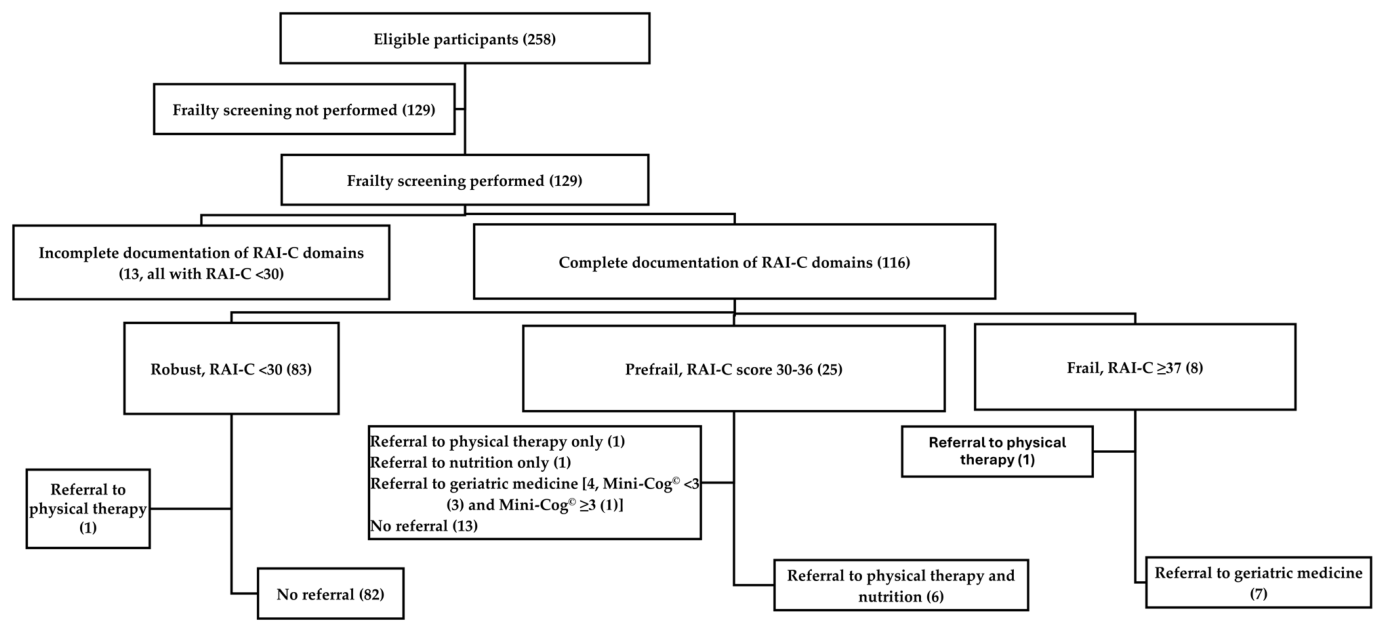
Over a 34-month period, from November 2021 through September 2025, a total of 258 individuals 65 years and older presented to the orthopedic clinic for evaluation of elective TJA. Two thirds of participants were evaluated for elective total knee (65%) and one third for total hip (35%) arthroplasty. Overall, 129 (50%) participants underwent frailty screening. Figure 1 outlines the flow of participants through the frailty screening and referral process.
Figure 1.
Participant flow through the frailty screening and referral process.
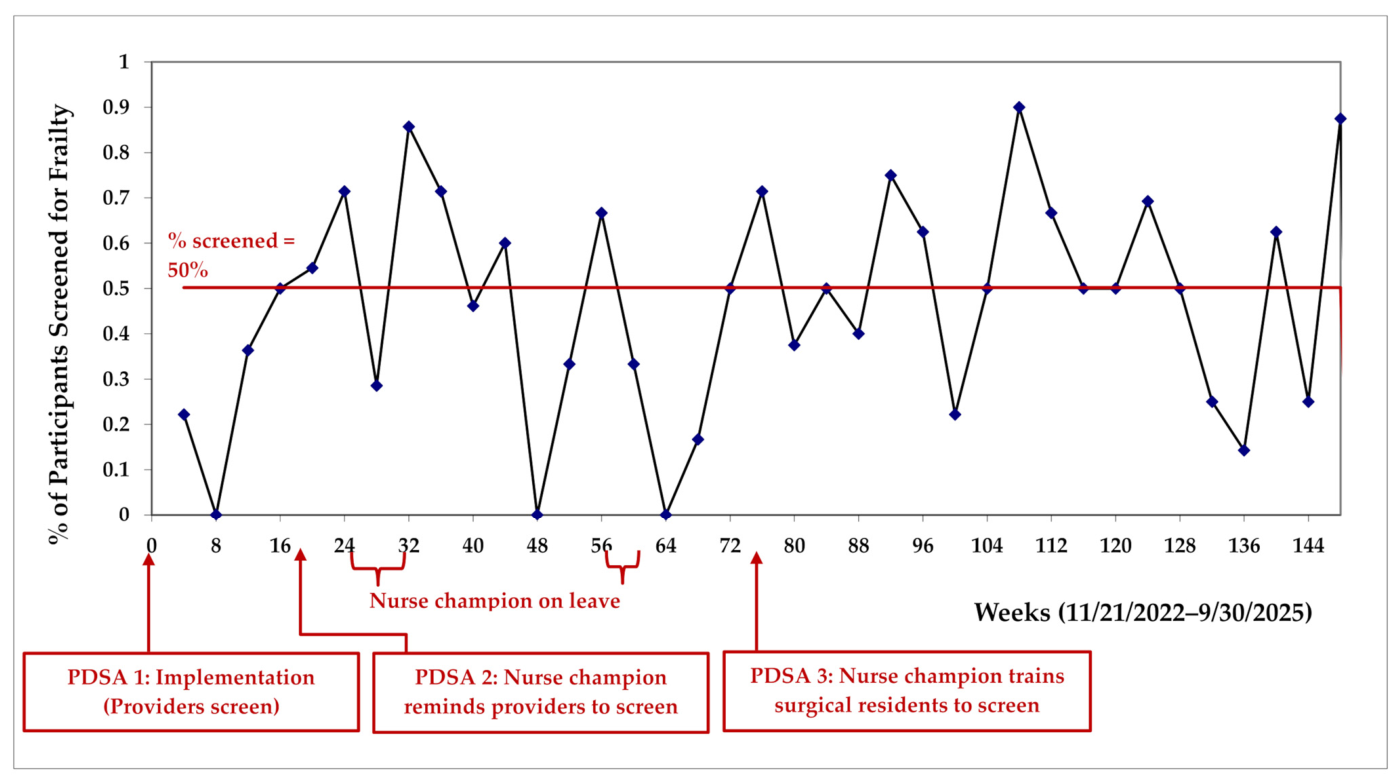
Screening rate was lowest during the first PDSA cycle (28%; weeks 0–18) after implementation of frailty screening and referral protocols. For the second PDSA cycle, a nurse champion reminded providers to perform screening, initially improving the screening rate (61%; weeks 19–24). Over the weeks following, screening rate declined again during nurse champion absences (47%, weeks 25–74). During the third and final PDSA cycle, the nurse champion provided training to the residents at the start of their two-month rotation in the orthopedic clinic. This training focused on how to perform screening; however, the screening rate did not show a notable improvement compared with the preceding period (56%, weeks 75–148). Table 2 summarizes the PDSA cycles and Figure 2 illustrates a run chart of these iterations.
Table 2.
Summary of Plan-Do-Study-Act (PDSA) cycles for implementation of preoperative frailty screening using the Clinical Risk Analysis Index (RAI-C).
Figure 2.
Percentage of participants 65 years and older presenting for total joint arthroplasty who were screened for frailty over time (N = 258).
Complete documentation was available for 116 (90%) of individuals screened and indicated good functional ability and cognitive function with moderate comorbidity per Charlston Comorbidity Index. Thirteen screened participants (10%) had incomplete documentation of the RAI-C domains and were therefore excluded from the analysis. No statistically significant differences were observed between participants with complete vs. incomplete documentation, except in the proportion classified as robust based on the total RAI-C scores < 30 (72% vs. 100%, respectively; p = 0.026). Thus, incomplete documentation was unlikely to have affected the descriptive results presented in Table 3. Other participant characteristics are found in Table 1. Of those screened with complete documentation, 94% were men with an average age of 74 years. Eighty-three (72%) were robust (RAI-C < 30), 25 (21%) were prefrail (RAI-C 30–36), and 8 (7%) were frail (RAI-C ≥ 37). The Mini-Cog© score was 3 or greater in 92% of participants. Most participants were independent in performing their ADLs, did not have risk factors for malnutrition, and reported no history of kidney disease, heart failure, shortness of breath at rest, or a cancer diagnosis. Given the relatively low prevalence of complex medical comorbidities, the overall surgical risk profile of the participants was low. RAI-C total scores and individual domain response frequencies are shown in Table 1 and Table 3.
Table 3.
Participant responses to the Clinical Risk Analysis Index (RAI-C) domains.
As outlined in Figure 1, among the twenty-two pre-frail participants with complete RAI-C screening documentation and Mini-Cog© score ≥ 3, only 27% (n = 6) were appropriately referred to both physical therapy and nutrition services. One additional participant was referred to physical therapy only, and another was referred to nutrition services only. Additionally, one of these prefrail participants was inappropriately referred for geriatric consultation. The remaining 13 participants were not referred at all. In contrast, 88% (n = 7) of frail participants (RAI-C ≥ 37) appropriately referred for geriatric consultation while only one participant was inappropriately referred to physical therapy. Of the nine participants with a Mini-Cog© score < 3, five (56%) were appropriately referred for geriatric consultation, whereas the remaining four, all of whom had RAI-C scores < 37, were not referred for any services.
Providers (N = 5) felt that the training material was helpful and screening procedures were clear and easy to use. They believed screening for frailty prior to planning TJA was helpful to their clinical practice and impacted patient care positively by allowing them to identify and address barriers to a successful postoperative recovery before surgery. However, they identified clinic workflow constraints, high patient volumes, and the bimonthly rotation of resident schedules as challenges contributing to the underutilization of frailty screening.
4. Discussion
Identification of frailty before elective surgery has the potential to improve post-surgical outcomes by increasing the awareness of perioperative rehabilitative, nutritional, and psychosocial needs. Given the rising population of older persons, especially those with multiple chronic conditions, frailty will be more prevalent in all aspects of medical care, including surgery [20,21]. Recognizing presurgical frailty and addressing modifiable factors contributing to frailty will be essential for prevention of postoperative geriatric syndromes (i.e., delirium and falls) that contribute to institutionalization and increased length of hospital stay and improvement of health care aligned with older adult priorities [20,21].
Frailty is a complex syndrome influenced by several internal and external factors. Though frailty increases with age, not all older adults become frail [22]. Physiologic age-related changes impact biological reserve and decrease resilience to insults such as disease, hospitalizations and medical interventions such as surgery [23,24]. Additionally, non-physiological domains, including social determinants of health and health inequalities, contribute to and are affected by the presence of frailty [25]. The likelihood of developing frailty increases with the presence of more contributing factors (i.e., poverty, falls, presence of functional or cognitive disability, or living with multiple chronic conditions) and a frail state in turn negatively impacts the degree to which a person can recover after an insult like surgery [25,26]. Therefore, a quick and user-friendly tool, such as the RAI-C, which assesses frailty in multiple physiological and psychosocial domains, is important for the preoperative setting.
Our QI program explored barriers and facilitators for frailty screening and needs for presurgical optimization services with the RAI-C and follow through with post-screening referrals in an outpatient orthopedic clinic. We found that provider training and nurse champion oversight was imperative to maintain consistency of frailty screening and referral processes. At the time our QI initiative launched in November 2021, the concept of frailty in surgery was still emerging and less emphasized. While the American College of Surgeons began QI efforts for older surgical patients in 2015, the Geriatric Surgery Verification (GSV) Program was only formally established in July 2019. Notably, the second phase of GSV began in September 2021, just two months before our initiative, to refine and disseminate best practices, leading to the publication of the Guide to Recognition for GSV Hospitals in June of 2022 [27]. Increased frailty awareness in presurgical evaluations, as promoted by these initiatives, may additionally help improve frailty screening and preoperative referrals for optimization.
Despite relatively low medical complexity and high functional status in our older orthopedic patient population, reflected by mean RAI-C score 28 (robust) and mean VA-FI score 0.18 (prefrail), the mean CCI score was elevated at 6. Discrepancies among these measures are expected as they assess different dimensions of medical complexity, morbidity, and frailty using distinct determinants. The discordance may reflect differences in how frailty is conceptualized (e.g., phenotypic vs. deficit-accumulation models) and assessed (e.g., through patient report, direct assessment, EHR data, or EHR diagnoses) [28,29]. Although these tools have not been directly compared, their inclusion provides a more comprehensive assessment of the complexity of our population. The elevated mean CCI score in our population suggests a substantial burden of multimorbidity that may not be fully captured by RAI-C screening alone. This finding further underscores the importance of referring prefrail and frail individuals identified by the RAI-C for preoperative optimization through prehabilitative services, to mitigate potential postoperative risks associated with underlying multimorbidity.
Finally, one in five of our elective orthopedic surgery patients were found to be prefrail, with nearly another one in sixteen identified as frail. Based on these observed rates and an average of 100 TJA surgeries annually, we anticipate approximately 20 referrals per year for physical therapy and nutrition services, and about ten referrals to geriatric medicine for preoperative optimization. These projected referral volumes should be manageable and are unlikely to place significant strain on our institutional resources.
Limitations: Our program has several limitations. First, this was a QI program limited in scope and population. Our observations, experiences and findings regarding screening best practices may not be generalizable to other clinical settings, health systems or geographical locations. Additionally, our ability to evaluate contributors to better or worse process outcomes was limited by the variables that could feasibly be measured in a dynamic clinical environment involving multiple provider types and trainees. These circumstances also contributed to PDSA cycles of varying lengths. For example, cycle 2 was prolonged to assess the impact of nurse champion absences, whereas cycle 3 continued through the end of the study period. Furthermore, our evaluation focus was purely on frailty screening rates and post-screening referral patterns, not the impact of frailty identification and referral completion on post-surgical outcomes. We also observed a significant difference in the proportion of patients who declined to report their race, categorized as having an unknown race, among the groups with complete screening documentation, incomplete screening documentation, and no screening documentation (p = 0.008). This difference may have implications for data interpretation. However, because the groups did not differ significantly in the distribution of the self-reported racial categories, we believe that the racial composition of patients with unknown race was likely comparable to that of the overall study population. Finally, complete documentation of the individual RAI-C domains was available for 90% screened participants. However, missing data are unlikely to have substantially affected our understanding of the determinants of frailty in this population, as all participants with incomplete RAI-C documentation were classified as robust with expected negative responses across the domains.
5. Conclusions
The prevalence of frailty in our presurgical population is high and anticipated to increase over the next decades. Screening of presurgical persons to identify those at risk for frailty is feasible using the RAI-C; however, overall screening rates remained low, underscoring the need for dedicated clinical champions to promote consistent and sustained implementation. EHR-based clinical decision support tools, such as best practice alerts, may provide a less resource-intensive approach to improving referral rates by offering real-time guidance and promoting adherence to established care pathways [30]. However, this functionality is not currently available in our EHR system. Additionally, integrating automated EHR order sets or action bundles aligned with the referral pathway could further improve referral rates by streamlining provider workflows. Future efforts should examine potential biases and misconceptions about frailty that may contribute to its over- or underreporting. Qualitative evaluation of providers’ screening and referrals practices could further elucidate these perceptions and identify opportunities to improve the accuracy of provider referrals for prefrail and frail persons. Future studies should also evaluate post-referral outcomes associated with improved frailty management, including reductions in post-operative delirium, length of hospital stay, postoperative morbidity, and mortality.
Supplementary Materials
The following supporting information can be downloaded at: https://www.mdpi.com/article/10.3390/geriatrics11060175/s1, Figure S1: Referral pathway for adults 65 years and older undergoing elective total joint arthroplasty, based on clinical Risk Analysis Index (RAI-C) score.
Author Contributions
All authors contributed sufficiently to the project and preparation of this manuscript. Conceptualization, M.K. and K.C.R.; methodology, M.K., K.C.R. and E.M.; formal analysis, M.K., K.C.R., A.V.P. and B.H.M.; data curation, M.K., A.V.P. and B.H.M.; validation, M.K. and K.C.R.; visualization, M.K. and K.C.R.; writing—original draft preparation, M.K. and A.V.P.; writing—review and editing, M.K., A.V.P., K.C.R. and B.H.M.; supervision, K.C.R.; project administration, E.M.; funding acquisition, K.C.R. All authors have read and agreed to the published version of the manuscript.
Funding
This project was funded by the office of Geriatrics and Extended Care and the legacy Veterans Integrated Service Network (VISN) 20.
Institutional Review Board Statement
The Human Research Protection Program, Associate Chief of Staff for Research and Development, and Quality, Safety, and Values department reviewed this project in accordance with the Veterans Health Administration Program Guide 1200.21 and determined that it was a non-research operations activity. Thus, approval by an institutional review board was not needed. The authors declare no competing interests.
Informed Consent Statement
Patient consent was waived for this project because it was determined to be a non-research quality improvement initiative aimed at evaluating and enhancing clinical processes; as such, it did not require individual informed consent under institutional review guidelines.
Data Availability Statement
The original contributions presented in this study are included in the article. Further inquiries on raw data supporting the conclusions of this article can be directed to the corresponding author.
Conflicts of Interest
The authors declare no conflicts of interest.
References
- Shinall, M.C.; Arya, S.; Youk, A.; Varley, P.; Shah, R.; Massarweh, N.N.; Shireman, P.K.; Johanning, J.M.; Brown, A.J.; Christie, N.A.; et al. Association of Preoperative Patient Frailty and Operative Stress With Postoperative Mortality. JAMA Surg. 2020, 155, e194620. [Google Scholar] [CrossRef] [Scilit]
- George, E.L.; Hall, D.E.; Youk, A.; Chen, R.; Kashikar, A.; Trickey, A.W.; Varley, P.R.; Shireman, P.K.; Shinall, M.C.; Massarweh, N.N.; et al. Association Between Patient Frailty and Postoperative Mortality Across Multiple Noncardiac Surgical Specialties. JAMA Surg. 2021, 156, e205152. [Google Scholar] [CrossRef] [Scilit]
- Shah, R.; Borrebach, J.D.; Hodges, J.C.; Varley, P.R.; Wisniewski, M.K.; Shinall, M.C.; Arya, S.; Johnson, J.; Nelson, J.B.; Youk, A.; et al. Validation of the Risk Analysis Index for Evaluating Frailty in Ambulatory Patients. J. Am. Geriatr. Soc. 2020, 68, 1818–1824. [Google Scholar] [CrossRef] [Scilit]
- Hall, D.E.; Arya, S.; Schmid, K.K.; Blaser, C.; Carlson, M.A.; Bailey, T.L.; Purviance, G.; Bockman, T.; Lynch, T.G.; Johanning, J. Development and Initial Validation of the Risk Analysis Index for Measuring Frailty in Surgical Populations. JAMA Surg. 2017, 152, 175–182. [Google Scholar] [CrossRef] [Scilit]
- Varley, P.R.M.; Borrebach, J.D.; Arya, S.; Massarweh, N.N.; Bilderback, A.L.; Wisniewski, M.K.M.; Nelson, J.B.; Johnson, J.T.; Johanning, J.M.; Hall, D.E.M. Clinical Utility of the Risk Analysis Index as a Prospective Frailty Screening Tool within a Multi-practice, Multi-hospital Integrated Healthcare System. Ann. Surg. 2021, 274, e1230–e1237. [Google Scholar] [CrossRef] [Scilit]
- Howard, R.; Yin, Y.S.; McCandless, L.; Wang, S.; Englesbe, M.; Machado-Aranda, D. Taking Control of Your Surgery: Impact of a Prehabilitation Program on Major Abdominal Surgery. J. Am. Coll. Surg. 2019, 228, 72–80. [Google Scholar] [CrossRef] [Scilit]
- Cabilan, C.J.; Hines, S.; Munday, J. The effectiveness of prehabilitation or preoperative exercise for surgical patients: A systematic review. JBI Database Syst. Rev. Implement. Rep. 2015, 13, 146–187. [Google Scholar] [CrossRef] [Scilit]
- Pouwels, S.; Stokmans, R.A.; Willigendael, E.M.; Nienhuijs, S.W.; Rosman, C.; van Ramshorst, B.; Teijink, J.A. Preoperative exercise therapy for elective major abdominal surgery: A systematic review. Int. J. Surg. Lond. Engl. 2014, 12, 134–140. [Google Scholar] [CrossRef] [Scilit]
- McDonald, S.R.; Heflin, M.T.; Whitson, H.E.; Dalton, T.O.; Lidsky, M.E.; Liu, P.; Poer, C.M.; Sloane, R.; Thacker, J.K.; White, H.K.; et al. Association of Integrated Care Coordination With Postsurgical Outcomes in High-Risk Older Adults: The Perioperative Optimization of Senior Health (POSH) Initiative. JAMA Surg. 2018, 153, 454–462. [Google Scholar] [CrossRef] [Scilit]
- McIsaac, D.I.; Kidd, G.; Gillis, C.; Branje, K.; Al-Bayati, M.; Baxi, A.; Grudzinski, A.L.; Boland, L.; Veroniki, A.-A.; Wolfe, D.; et al. Relative efficacy of prehabilitation interventions and their components: Systematic review with network and component network meta-analyses of randomised controlled trials. BMJ 2025, 388, e081164. [Google Scholar] [CrossRef] [Scilit]
- Hall, D.E.; Youk, A.; Allsup, K.; Kennedy, K.; Byard, T.D.; Dhupar, R.; Chu, D.; Rahman, A.M.; Wilson, M.; Cahalin, L.P.; et al. Preoperative Rehabilitation Is Feasible in the Weeks Prior to Surgery and Significantly Improves Functional Performance. J. Frailty Aging 2023, 12, 267–276. [Google Scholar] [CrossRef] [Scilit]
- Optimal Perioperative Management of the Geriatric Patient: Best Practices Guideline from ACS NSQIP/American Geriatrics Society. Available online: https://www.facs.org/media/y5efmgox/acs-nsqip-geriatric-2016-guidelines.pdf (accessed on 27 January 2026).
- Collard, R.M.; Boter, H.; Schoevers, R.A.; Oude Voshaar, R.C. Prevalence of frailty in community-dwelling older persons: A systematic review. J. Am. Geriatr. Soc. 2012, 60, 1487–1492. [Google Scholar] [CrossRef] [Scilit]
- US Department of Veterans Affairs, Veterans Health Administration. VA.gov|Veterans Affairs. Available online: https://www.va.gov/aircommissionreport/ (accessed on 25 June 2024).
- Kaplan, H.C.; Provost, L.P.; Froehle, C.M.; Margolis, P.A. The Model for Understanding Success in Quality (MUSIQ): Building a theory of context in healthcare quality improvement. BMJ Qual. Saf. 2012, 21, 13–20. [Google Scholar] [CrossRef] [Scilit]
- Ogrinc, G.; Davies, L.; Goodman, D.; Batalden, P.; Davidoff, F.; Stevens, D. SQUIRE 2.0 (Standards for QUality Improvement Reporting Excellence): Revised publication guidelines from a detailed consensus process. BMJ Qual. Saf. 2016, 25, 986–992. [Google Scholar] [CrossRef] [Scilit]
- Borson, S.; Scanlan, J.M.; Chen, P.; Ganguli, M. The Mini-Cog as a screen for dementia: Validation in a population-based sample. J. Am. Geriatr. Soc. 2003, 51, 1451–1454. [Google Scholar] [CrossRef] [Scilit]
- Borson, S.; Scanlan, J.; Brush, M.; Vitaliano, P.; Dokmak, A. The mini-cog: A cognitive “vital signs” measure for dementia screening in multi-lingual elderly. Int. J. Geriatr. Psychiatry 2000, 15, 1021–1027. [Google Scholar] [CrossRef] [Scilit]
- Alvarez-Nebreda, M.L.; Bentov, N.; Urman, R.D.; Setia, S.; Huang, J.C.-S.; Pfeifer, K.; Bennett, K.; Ong, T.D.; Richman, D.; Gollapudi, D.; et al. Recommendations for Preoperative Management of Frailty from the Society for Perioperative Assessment and Quality Improvement (SPAQI). J. Clin. Anesth. 2018, 47, 33–42. [Google Scholar] [CrossRef] [Scilit]
- Mate, K.; Fulmer, T.; Pelton, L.; Berman, A.; Bonner, A.; Huang, W.; Zhang, J. Evidence for the 4Ms: Interactions and Outcomes across the Care Continuum. J. Aging Health 2021, 33, 469–481. [Google Scholar] [CrossRef] [Scilit]
- Hoogendijk, E.O.; Afilalo, J.; Ensrud, K.E.; Kowal, P.; Onder, G.; Fried, L.P. Frailty: Implications for clinical practice and public health. Lancet Lond. Engl. 2019, 394, 1365–1375. [Google Scholar] [CrossRef] [Scilit]
- Schuurmans, H.; Steverink, N.; Lindenberg, S.; Frieswijk, N.; Slaets, J.P.J. Old or frail: What tells us more? J. Gerontol. A Biol. Sci. Med. Sci. 2004, 59, M962–M965. [Google Scholar] [CrossRef] [Scilit]
- Dent, E.; Martin, F.C.; Bergman, H.; Woo, J.; Romero-Ortuno, R.; Walston, J.D. Management of frailty: Opportunities, challenges, and future directions. Lancet Lond. Engl. 2019, 394, 1376–1386. [Google Scholar] [CrossRef] [Scilit]
- Michel, J.P.; Beattie, B.L.; Martin, F.C.; Walston, J. Oxford Textbook of Geriatric Medicine, 3rd ed.; Oxford University Press: Oxford, UK, 2017. [Google Scholar] [CrossRef] [Scilit]
- Hale, M.; Shah, S.; Clegg, A. Frailty, inequality and resilience. Clin. Med. Lond. Engl. 2019, 19, 219–223. [Google Scholar] [CrossRef] [Scilit]
- Haapanen, M.J.; Perälä, M.M.; Salonen, M.K.; Kajantie, E.; Simonen, M.; Pohjolainen, P.; Eriksson, J.G.; von Bonsdorff, M.B. Early life determinants of frailty in old age: The Helsinki Birth Cohort Study. Age Ageing 2018, 47, 569–575. [Google Scholar] [CrossRef] [Scilit]
- Culbert, J. Age-Friendly Health Systems: Guide to Recognition for Geriatric Surgery Verified Sites. Published Online June 2022. Available online: https://forms.ihi.org/hubfs/Guide%20To%20Recognition%20for%20GSV%20Sites_FINAL.pdf (accessed on 16 April 2026).
- Orkaby, A.R.; Huan, T.; Intrator, O.; Cai, S.; Schwartz, A.W.; Wieland, D.; E Hall, D.; Figueroa, J.F.; Strom, J.B.; Kim, D.H.; et al. Comparison of Claims-Based Frailty Indices in U.S. Veterans 65 and Older for Prediction of Long-Term Institutionalization and Mortality. J. Gerontol. A Biol. Sci. Med. Sci. 2023, 78, 2136–2144, Correction in J. Gerontol. A Biol. Sci. Med. Sci. 2024, 79, glad246. https://doi.org/10.1093/gerona/glad246. [Google Scholar] [CrossRef] [Scilit]
- Assessing the Performance of Validated Frailty Instruments in Veterans with Rheumatoid Arthritis (RA). ACR Meeting Abstracts. Available online: https://acrabstracts.org/abstract/assessing-the-performance-of-validated-frailty-instruments-in-veterans-with-rheumatoid-arthritis-ra/ (accessed on 14 October 2026).
- Barnes, G.D.; Spranger, E.; Sippola, E.; Renner, E.; Ruff, A.; Sales, A.E.; Kurlander, J.E. Assessment of a Best Practice Alert and Referral Process for Preprocedure Antithrombotic Medication Management for Patients Undergoing Gastrointestinal Endoscopic Procedures. JAMA Netw. Open 2020, 3, e1920548. [Google Scholar] [CrossRef] [Scilit]

Disclaimer/Publisher’s Note: The statements, opinions and data contained in all publications are solely those of the individual author(s) and contributor(s) and not of MDPI and/or the editor(s). MDPI and/or the editor(s) disclaim responsibility for any injury to people or property resulting from any ideas, methods, instructions or products referred to in the content. |
© 2026 by the authors. Licensee MDPI, Basel, Switzerland. This article is an open access article distributed under the terms and conditions of the Creative Commons Attribution (CC BY) license.