


Abstract
Background/Objectives: As mounting numbers of older people consider surgery, the importance of aligning treatments with patient values and goals is paramount. This has led to the growth of POPS (Perioperative care of Older Patients) services internationally and across Australia. An observational pilot evaluation of the Melbourne Health POPS service was conducted throughout 2022, with the aims of describing the population, measuring patient-reported outcomes and comparing postoperative outcomes to a matched historical cohort. Methods: Data were sourced from clinical review, electronic medical records and health intelligence. Patients who pursued surgery were matched 2:1 with a 2020 control cohort on up to 10 characteristics ranked on clinical judgement. Patient-reported outcomes were collected at 3 months post-surgery or at the clinic in consenting participants. Results: There were 128 participants, of whom 64 (50%) pursued non-surgical management. Participants were older (median 79 [13] years), frail (median CFS 5 [2]), and multimorbid (median CCI 5 [2.25]). Despite increased perioperative risk amongst the POPS surgical group (ASA-4 23.4% vs. 5.5%, p < 0.001), increased incidence of postoperative delirium (15% vs. 5.8%, p = 0.042) and ICU admission (21.7% vs. 7.5%, p = 0.006) compared to the control group, median length of stay was similar (4.3 [6.7] vs. 4.3 [5.1] days, p = 0.537). Patient-reported outcomes were similar between surgical and non-surgical POPS groups (90.7% vs. 88.1% would make the same surgical decision, p = 0.697). Conclusions: Patients attending POPS were multimorbid with geriatric syndromes and elevated perioperative risk. A high proportion pursued non-operative care. Patient-reported feedback was high with low decisional regret.
1. Introduction
Older people are increasingly undergoing elective surgery year on year for the purposes of longevity and symptom relief. This observation is expected to increase into the future due to an ageing population living longer with morbidity amenable to surgery, advances in perioperative care, and evolving community expectations regarding healthcare provision in later life [1,2,3]. Older people acquire age-related physiological changes [4] and are more likely to exhibit geriatric syndromes, including frailty, multimorbidity, polypharmacy, and cognitive and functional decline [5]. It is, therefore, not surprising that older patients are more likely to die and suffer medical complications and functional decline after surgery, resulting in prolonged recovery and an increased likelihood of requiring supported accommodation on discharge [6,7].
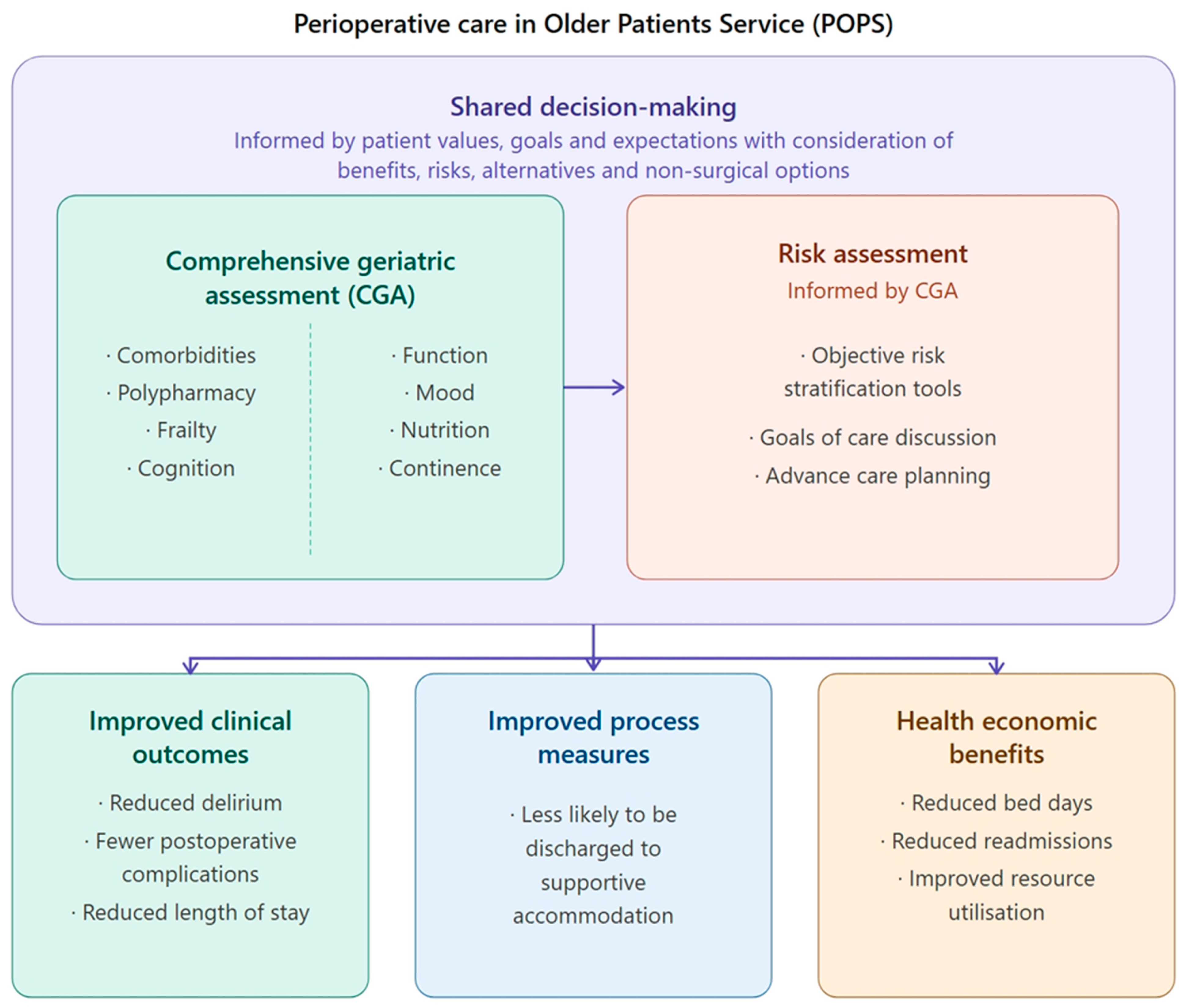
The specialised needs of older surgical patients have been increasingly recognised over the past decade, leading to the introduction of new models of care, establishment of special interest perioperative groups, and exponential publication of relevant research and guidelines [8,9]. Many Australian service models have taken learnings from the well-established Perioperative care of Older Patients undergoing Surgery (POPS) service based at Guy’s and St Thomas’ Hospital in London [1]. POPS utilises Geriatrician-led Comprehensive Geriatric Assessment (CGA) and management in the perioperative setting, which can be defined as a patient-centred and individualised multidimensional assessment including the evaluation and optimisation of medical comorbidities, medications, social history, function, cognition, mood and nutrition [10,11]. Shared decision-making is a key overarching principle applied within this approach, whereby estimated benefits and risks of surgery and its alternatives can be considered based on patient values and goals (Figure 1) [1,8,9,10,11].
A randomized control trial of POPS in 176 older elective vascular patients found preoperative CGA led to reduced hospital length of stay (geometric mean 3.3 vs. 5.5 days, p < 0.001), postoperative delirium (11% vs. 24%, p = 0.018), constipation (28% vs. 48%, p = 0.026), and cardiac complications (8% vs. 27%, p = 0.001), with a trend of reduced likelihood of discharge to supported accommodation (5% vs. 13%, p = 0.051) [12]. Subsequent economic evaluation of this trial also demonstrated cost-effectiveness [13]. In addition to RCT data, many observational studies and systematic reviews of perioperative CGA for older patients have demonstrated positive clinician-reported outcomes (Figure 1) [14,15].
Given these favourable published outcomes and an identified growing local need, the Melbourne Health POPS clinic was implemented in early 2021. The initial team consisted of a Geriatrician, Anaesthetist, and Physiotherapist conducting a one-hour or more comprehensive review. Patients from all surgical subspecialties, considering all procedures, were welcomed. Older patients aged 65 years and older were targeted; however, younger patients with geriatric syndromes or with perceived benefit were accepted. The POPS clinic was awarded a hospital Health Services Improvement Grant, which funded a research assistant to aid data collection for a pilot evaluation of the service in 2022.
The study aims were to, firstly, describe the Melbourne Health POPS cohort, secondly, to compare clinician-reported outcomes in those who pursued surgery to a historical matched pre-POPS group, and thirdly, to evaluate 3-month follow-up patient-reported outcomes.
Figure 1.
Perioperative care of Older Patients Service. Created with the assistance of Claude Sonnet 4.6 (Anthropic, 2025), USA (San Francisco, CA, USA) [16].
2. Materials and Methods
A prospective observational cohort study of a POPS pilot group was conducted at the Royal Melbourne Hospital, Victoria, Australia.
2.1. Setting and Participants
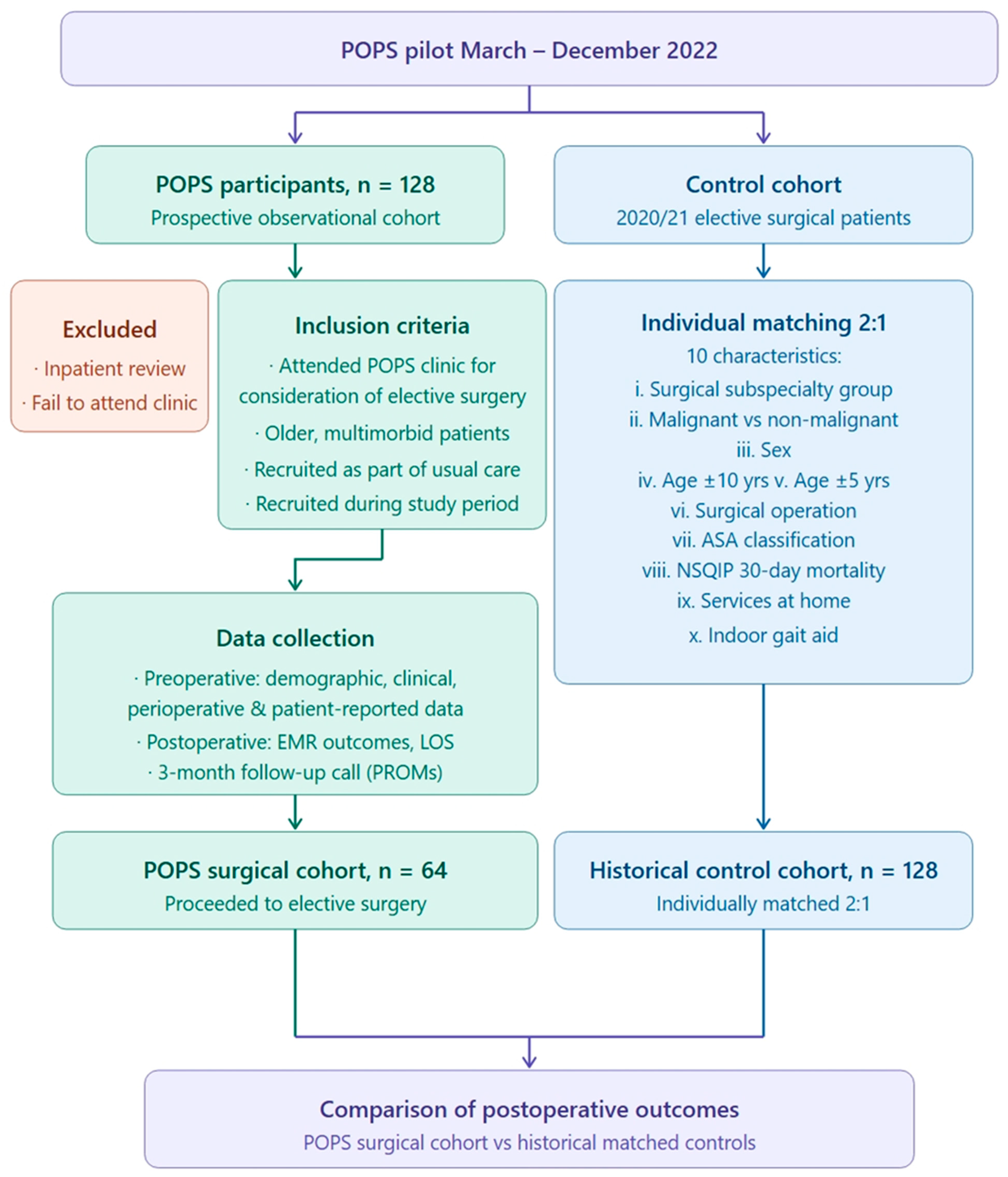
The POPS clinic is a geriatrician-led multidisciplinary clinic providing preoperative comprehensive geriatric assessment for predominantly older, multimorbid patients who commonly have geriatric syndromes such as frailty and cognitive and functional impairment. All patients who attended the POPS clinic for consideration of elective surgery were included in the study as part of usual care during the recruitment period, March–December 2022. A waiver of consent was obtained for all POPS attendees, and verbal consent for a 3-month follow-up phone call was discussed and documented during the clinic.
2.2. Data Collection
Preoperative demographic, clinical, perioperative, and patient-reported data were collected at the POPS clinic by the geriatrician, anaesthetist, and physiotherapist team, supported by a research assistant. Where telehealth was necessary in a minority of cases, cognitive and bedside functional tools were incomplete. Perioperative process measures and postoperative outcomes for those who pursued surgery were collected from electronic medical records. Length of stay was calculated with assistance from the hospital Health Intelligence Unit. Consenting patients also received a follow-up phone call 3 months after surgery or the final POPS clinic in those who chose non-surgical management, for the purposes of collecting patient-reported quality of life and experience data. All data were stored in a secure REDCap database.
2.3. Matched Control Group
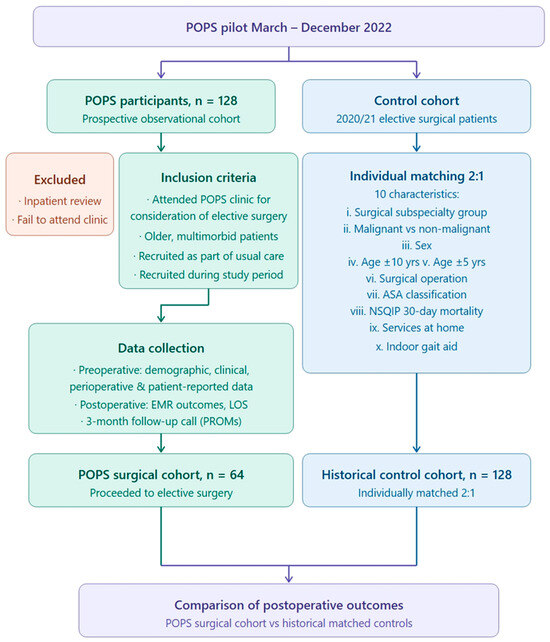
A historical matched control group was sought for comparison of perioperative process measures and clinician-reported outcomes. Controls were individually matched 2:1 via manual selection from a list of 2020 elective surgical patients provided by the Health Intelligence Unit. Matching was performed using 10 characteristics ranked in order of perceived clinical importance: (i) surgical subspecialty group; (ii) malignant vs. non-malignant surgical issue; (iii) sex; (iv) age within 10 years; (v) age within 5 years; (vi) surgical operation (vii) American Society of Anaesthesiologists Classification (ASA); (viii) National Surgical Quality Improvement Program (NSQIP) 30 day mortality; (ix) services at home; (x) indoor gait aid (Figure 2).
Figure 2.
Schematic representation of study design. Created with the assistance of Claude Sonet 4.6 (Anthropic, 2025) [16].
2.4. Outcome Measures
The primary outcome of this study was the proportion of POPS patients pursuing a non-surgical management pathway. Secondary outcomes comprised surgical vs. non-surgical patient-reported outcomes at 3 months and clinician-measured outcomes in surgical POPS patients compared to the historical matched cohort, including mortality, complications, length of stay, and discharge destination.
2.5. Statistical Analysis and Ethics
Descriptive statistical analysis was performed using JASP (Version 0.95.3) software [17]. The Chi-square test was used to compare categorical variables, whereas the Mann–Whitney U test was used to compare continuous non-parametric data using median and interquartile range. Statistical significance was defined as p < 0.05 for all analyses. This protocol was assessed by the Royal Melbourne Hospital Human Research Ethics Committee as appropriate for a quality assurance project and assigned reference QA2021131, approved 9 February 2022. Infographic Figure 1 and Figure 2 were created with assistance from Claude Sonnet 4.6 (Anthropic, 2025), USA (San Francisco, CA, USA) a generative AI tool. Both figures were reviewed and edited by the authors for accuracy.
3. Results
3.1. Demographics and Clinical Characteristics
There were 128 participants who attended the POPS preoperative clinic throughout the data collection period. The cohort was older (median age 79 [13]) and more likely to be male (59.4%) and have English as a second language (56.3%), such that 32.8% used an interpreter. A high proportion used a gait aid (outdoor gait aid 62.5%), and 10.9% resided in supported accommodation. The POPS group were highly comorbid (CCI median 5 [2.25]) and frail (median CFS 5 [2]). A total of 11.7% had diagnosed dementia and 26.6% a history of delirium, with poor median functional reserve (DASI 9.95 (12.6)) and timed up and go 17.3 [11.2] seconds. This correlates with the high observed proportion of ASA-3 (69.5%) and ASA-4 (25.8%) classification (Table 1).
Table 1.
Patient characteristics.
3.2. Perioperative Process Measures
The POPS cohort included a wide spectrum of nine or more surgical specialties, of which gastrointestinal (31.3%) and orthopaedic (25.3%) were the most common. A total of 23.4% of patients were considering surgery for the purpose of cancer treatment. A total of 73.4% received a single POPS preoperative review, and 23.4% underwent two reviews. Overall, 50% ultimately pursued a non-operative management strategy. A total of 4 (6.3%) made this decision pre-POPS, 32 (50.8%) during the period of POPS assessment, and 27 (43.9%) post-POPS.
3.3. Control Group Matching
The 2020 control cohort was well matched at a 2:1 ratio on the majority of 10 nominated variables, including age, sex, operation type, and home supports (see Table S1). Despite this, the control group was markedly less comorbid (CCI 4 [1] vs. 5 [2], p = 0.002), had a lower number of medications (7 [4.3] vs. 9 [7], p < 0.001), was less likely to have dementia (0.8% vs. 6.3%, p = 0.025), and was less likely to be ASA-4 (5.5% vs. 23.4%, p < 0.001), conferring significantly lower control group perioperative risk.
3.4. Clinical Outcomes in POPS Surgical Cohort
A total of 60 POPS patients from the original cohort proceeded to surgery at the Royal Melbourne Hospital, whereas 4 had surgery elsewhere, such that clinician-measured outcomes were unavailable. Within these 60, a higher rate of postoperative complications measured by Clavien–Dindo scale (CD ≥ III 15% vs. 5.8%, p = 0.042) and postoperative delirium (15% vs. 5.8%, p = 0.042) was observed compared to the matched control group. POPS patients were also more likely to require postoperative ICU admission (21.7% vs. 7.5%, p = 0.006) and readmission to the hospital within 30 days (18.3% vs. 3.3%, p < 0.001). Despite these findings, acute length of stay was statistically similar between both groups (median 4.26 [6.71] vs. 4.25 [5.07] days, p = 0.537), and results must be interpreted with acknowledgement of residual study and control group perioperative risk differences (Table 2).
Table 2.
Clinician-measured outcomes: POPS surgical group vs. matched control group.
3.5. Patient-Reported Outcomes
Health-related quality of life scores were moderate at baseline with a median EQ-5D-5L index of 0.65 [0.47] and a median self-rated health visual analogue scale (VAS) of 50 [35] (Table 3). There was minimal change at the time of follow-up across both surgical and non-surgical groups, although a trend towards better results in the surgical group was observed. The surgical cohort also had a higher Katz measure of functional independence on follow-up (median 6 [1.7] vs. 5 [3], p = 0.017); however, similar proportions were residing at home. When patients were asked to reflect on their experience attending POPS and their subsequent perioperative journey, including decisional regret, the value of POPS and overall perioperative experience, ratings were generally high and similar between both follow-up groups (see corresponding results in Table 3). Informal subjective feedback reported to the research assistant ranged between trouble remembering the POPS clinic, finding explanation of risk assessment unpleasant and unhelpful, and high satisfaction and engagement in shared decision-making, with many stating they appreciated the time spent listening to their values and needs.
Table 3.
Patient-reported outcomes.
4. Discussion
This observational pilot study sought to evaluate the recently implemented Melbourne Health POPS service, including a comprehensive description of the cohort with cognitive screening, physiotherapy-led bedside functional tests, perioperative process measures, and patient-reported outcomes. The patient cohort can be identified as a highly vulnerable group characterised by advanced age, multimorbidity, frailty, and functional impairment, reflective of the complexity of patients increasingly encountered in contemporary elective surgical practice. A high proportion of patients cited a culturally and linguistically diverse background (56.3% English second language), which poses further healthcare provision challenges. High rates of cognitive vulnerability (11.7% dementia; 26.6% prior delirium), polypharmacy (median 9 [6] medications), impaired mobility (62.5% using an outdoor gait aid), and elevated anaesthetic risk (>95% ASA 3–4) additionally highlight the potential benefit of a geriatrician-led multidisciplinary comprehensive geriatric assessment (CGA) model in this setting. The striking result of 50% of patients choosing to pursue a non-operative pathway is higher than figures previously described in local and international literature [18]. Explanations for this incongruence are beyond the scope of this study; however, it is suspected that the selection of a markedly frail and comorbid population compared to what has been described elsewhere has contributed. It also suggests that dedicated risk assessment and shared decision-making aimed at aligning treatment with individual values can significantly impact patient outcomes.
Despite careful individual matching on ten clinically relevant variables, the historical control group was less comorbid, was less frail, and had lower perioperative risk profiles, including lower proportion of ASA-4 (5.5% vs. 23.4%, p < 0.001) and predicted NSQIP 30-day mortality (0.5 vs. 1.3%, p < 0.001) compared to the POPS surgical cohort. Factors hypothesised as contributing to this finding include the change in surgical practice during the COVID-19 pandemic in 2020, impacting the control group data, and a markedly frail and comorbid group referred to the recently implemented POPS service post-COVID. When interpreted in this context, the comparable median acute length of stay between the groups (4.3 [6.7] vs. 4.3 [5.1] days) may in fact represent a relative success, as one might otherwise predict a longer admission in the more comorbid POPS cohort. Similarly, rates of inpatient mortality and discharge to supported accommodation were relatively low and not statistically different between the two groups. In contrast to findings from earlier UK-based studies of preoperative CGA [12,15], we did not observe reductions in delirium or major complications, and instead, the POPS cohort exhibited higher rates of delirium, Clavien–Dindo ≥III complications, ICU admission, and 30-day readmission. Again, the impact of selection bias towards a frail, comorbid group with high functional and cognitive burden (11.7% dementia; 26.6% prior delirium) must be considered when interpreting this result. Overall, these mixed findings emphasise the complexity of evaluating geriatric perioperative services using conventional surgical outcome measures alone.
Attempts to describe patient-reported outcomes in the highly culturally and linguistically diverse, cognitively impaired and vulnerable, and unwell POPS population were challenging, reflected by the low data completion rate. However, this aspect of study design was thought to offer highly valuable insights into patient symptom burden, quality of life, and experience and hence pursued. At three months, the majority of patients remained living at home, and health-related quality of life as measured by EQ-5D-5L was stable or modestly improved, particularly amongst those undergoing surgery. Importantly, nearly 90% of all POPS patients reported they would make the same surgical decision again, and over 80% perceived that POPS added value to their care, with high overall perioperative experience ratings (median 9/10). As might be predicted, the surgical group had a higher functional state at three months compared to the non-operative group (median Katz 6 [1.7] vs. 5 [3], p = 0.017). These findings serve as a reminder that patient-centred metrics, including decisional satisfaction and perceived value, can capture the benefits of preoperative CGA in addition to clinician measures alone.
This study had several limitations that should be considered when interpreting the findings. Firstly, the observational design and relatively small sample size reduce statistical power to detect differences in clinically significant infrequent outcomes such as mortality and major complications. Secondly, there is potential for selection bias given the non-standardised referral pathway to POPS targeting those with a higher perceived perioperative risk. In addition, the inherently heterogeneous POPS group and intervention with variability in number of consultations, disciplines involved, and optimisation strategies employed limit the ability to attribute observed outcomes to specific components of care. Patient-reported outcome data were incomplete and subject to response bias, compounded by language barriers, cognitive impairment, health literacy, medical illness, and lengthy times awaiting surgery in some cases. Finally, the generalizability of the findings observed in this single-centre tertiary hospital service may not extend to other healthcare settings.
Future research aimed at evaluating the POPS model of care should remain prospective, include an increased number of older patients, and ideally use contemporaneous comparison groups using matched objective risk assessment tools such as frailty. Given the high proportion of patients who pursued non-operative management in this pilot study, further investigation into this cohort is warranted, including clinical trajectory, healthcare utilisation, and longer-term quality of life measures. Ongoing emphasis on patient-reported outcomes, including functional independence, discharge destination, and decisional regret, is a vital component of this research given the fundamental goal of aligning treatment decisions with patient values and goals. Formal health economic analysis is also required to determine the cost-effectiveness and sustainability of POPS within the Australian healthcare system.
5. Conclusions
This evaluation of POPS at an Australian tertiary centre demonstrates the complexity and elevated perioperative risk in older people contemplating surgery for the purposes of symptom relief and longevity. When offered comprehensive geriatric assessment, risk assessment, shared decision-making, and in some cases, optimisation, 50% of this cohort ultimately pursued non-surgical care. Matching this high-risk group to a historical cohort proved challenging and may have impacted postoperative outcomes. Patient-reported feedback was high with low decisional regret, highlighting the importance of aligning treatment with underlying values and goals.
Supplementary Materials
The following supporting information can be downloaded at: https://www.mdpi.com/article/10.3390/geriatrics11030055/s1, Table S1: Control cohort matching on 10 variables (n = 120).
Author Contributions
This research study and manuscript preparation was completed by listed authors with the following contributions: Conceptualisation: R.A., K.G., M.P., R.B., J.T., N.D., J.W., C.-W.L., J.D. and W.K.L.; Methodology: R.A., A.G., J.T. and W.K.L.; Data collection: R.A., K.G., M.P., R.B., A.G. and J.T.; Formal analysis: R.A.; Writing—original draft preparation: R.A.; Writing—review and editing: K.G., M.P., R.B., J.T., N.D., J.W., C.-W.L., J.D. and W.K.L.; Project administration: R.A., K.G., A.G. and W.K.L. All authors have read and agreed to the published version of the manuscript.
Funding
This research received no external funding.
Institutional Review Board Statement
This study was conducted in accordance with the Declaration of Helsinki and approved by the Ethics Committee of the Royal Melbourne Hospital (QA2-21131 approved 9 February 2022).
Informed Consent Statement
Patient consent was waived due to data collected as part of usual care. Informed verbal consent was obtained to complete a follow-up phone call.
Data Availability Statement
The original contributions presented in this study are included in the article/Supplementary Materials. Further inquiries can be directed to the corresponding author.
Conflicts of Interest
The authors declare no conflict of interest.
Abbreviations
The following abbreviations are used in this manuscript:
| POPS | Perioperative care of Older Patients Service |
| CFS | Clinical Frailty Scale |
| CCI | Charlson Comorbidity Index |
| ICU | Intensive Care Unit |
| CGA | Comprehensive Geriatric Assessment |
| RCT | Randomised Control Trial |
| ASA | Americal Society of Anaesthesiologists Classification |
| NSQIP | National Surgical Quality Improvement Program |
| DASI | Duke Activity Status Index |
| IQR | Interquartile Range |
| ATSI | Aboriginal and Torres Strait Islander |
| EFS | Edmonton Frailty Scale |
| BMI | Body Mass Index |
| MUST | Malnutrition Universal Screening Tool |
| MMSE | Mini-Mental State Examination |
| RUDAS | Rowland Universal Dementia Assessment Scale |
| TUGT | Timed Up and Go test |
| DEMMI | De Morton Mobility Index |
| CD | Clavien–Dindo classification |
| AMI | Acute Myocardial Infarction |
| AKI | Acute Kidney Injury |
| UTI | Urinary Tract Infection |
| VTE | Venous Thromboembolism |
| EQ-5D-5L | EruoQol 5-dimension 5-level questionnaire |
| VAS | Visual Analogue Scale |
References
- Partridge, J.; Sbai, M.; Dhesi, J. Proactive care of older people undergoing surgery. Aging Clin. Exp. Res. 2018, 30, 253–257. [Google Scholar] [CrossRef] [Scilit] [PubMed]
- Bettelli, G.; Maggi, S. Decision-making about surgery in the elderly. Aging Clin. Exp. Res. 2018, 30, 225–227. [Google Scholar] [CrossRef] [Scilit] [PubMed]
- Partridge, J.S.L.; Moonesinghe, S.R.; Lees, N.; Dhesi, J.K. Perioperative care for older people. Age Ageing 2022, 51, afac194. [Google Scholar] [CrossRef] [Scilit] [PubMed]
- Aalami, O.O.; Fang, T.D.; Song, H.M.; Nacamuli, R.P. Physiological features of aging persons. Arch. Surg. 2003, 138, 1068–1076. [Google Scholar] [CrossRef] [Scilit] [PubMed]
- Shipway, D.H.J.; Harari, D.; Dhesi, J.K. Peri-Operative management of older people undergoing surgery. Rev. Clin. Gerontol. 2014, 24, 78–92. [Google Scholar] [CrossRef] [Scilit]
- Lin, H.; Watts, J.N.; Peel, N.M.; Hubbard, R.E. Frailty and post-operative outcomes in older surgical patients: A systematic review. BMC Geriatr. 2016, 16, 157. [Google Scholar] [CrossRef] [Scilit] [PubMed]
- Hamel, M.B.; Henderson, W.G.; Khuri, S.F.; Daley, J. Surgical outcomes for patients aged 80 and older: Morbidity and mortality from major noncardiac surgery. J. Am. Geriatr. Soc. 2005, 53, 424–429. [Google Scholar] [CrossRef] [Scilit] [PubMed]
- Centre for Perioperative Care and British Geriatrics Society. Guideline for Perioperative Care for People Living with Frailty Undergoing Elective and Emergency Surgery, September 2021, London. Available online: https://www.bgs.org.uk/sites/default/files/content/attachment/2021-09-28/Guideline%20for%20Perioperative%20Care%20for%20People%20Living%20with%20Frailty%20Undergoing%20Elective%20and%20Emergency%20Surgery.pdf (accessed on 5 October 2021).
- Australian and New Zealand College of Anaesthetists (ANZCA). A Framework for Perioperative Care in Australia and New Zealand. November 2023. Available online: https://www.anzca.edu.au/getContentAsset/6959c2b4-64dc-4e7f-8341-8f74b72f1a14/80feb437-d24d-46b8-a858-4a2a28b9b970/The-Perioperative-Care-Framework.pdf?language=en (accessed on 20 February 2026).
- Trundle, S.; Gooneratne, M.; Rogerson, A.; Dhesi, J.K. Perioperative Comprehensive Geriatric Assessment: What do we need to know? Br. J. Hosp. Med. 2019, 80, 258–262. [Google Scholar] [CrossRef] [Scilit] [PubMed]
- Ibitoye, S.; Braude, P. Perioperative care of older adults. Medicine 2024, 52, 696–700. [Google Scholar] [CrossRef] [Scilit]
- Partridge, J.S.L.; Harari, D.; Martin, F.C.; Peacock, J.L.; Bell, R.; Mohammed, A.; Dhesi, J.K. Randomised clinical trial of comprehensive geriatric assessment and optimisation in vascular surgery. Br. J. Surg. 2017, 104, 679–687. [Google Scholar] [CrossRef] [Scilit] [PubMed]
- Partridge, J.S.L.; Healey, A.; Modarai, B.; Harari, D.; Martin, F.C.; Dhesi, J.K. Preoperative comprehensive geriatric assessment and optimisation prior to elective arterial vascular surgery: A health economic analysis. Age Ageing 2021, 50, 1770–1777. [Google Scholar] [CrossRef] [Scilit] [PubMed]
- Partridge, J.S.L.; Harari, D.; Martin, F.C.; Dhesi, J.K. The impact of preoperative comprehensive geriatric assessment on postoperative outcomes in older patients undergoing scheduled surgery: A systematic review. Anaesthesia 2014, 69, 9. [Google Scholar] [CrossRef] [Scilit] [PubMed]
- Eamer, G.; Taheri, A.; Chen, S.S.; Daviduck, Q.; Chambers, T.; Shi, X.; Khadaroo, R.G. Comprehensive geriatric assessment for older people admitted to a surgical service (Review). Cochrane Database Syst. Rev. 2018, CDO12485. [Google Scholar] [CrossRef] [Scilit]
- Anthropic. Claude Sonnet 4.6 [Large Language Model]. (San Francisco, CA, USA). 2025. Available online: https://www.anthropic.com/news/claude-sonnet-4-6 (accessed on 9 April 2026).
- JASP Team. JASP (Version 0.95.3) [Computer Software]. 2025. Available online: https://jasp-stats.org/previous-versions/ (accessed on 2 February 2026).
- Shahab, R.; Lochrie, N.; Moppett, I.K.; Dasgupta, P.; Partridge, J.S.L.; Dhesi, J.K. A Description of Interventions Prompted by Preoperative Comprehensive Geriatric Assessment and Optimization in Older Elective Noncardiac Surgical Patients. J. Am. Med. Dir. Assoc. 2022, 23, 1948–1954.e4. [Google Scholar] [CrossRef] [Scilit] [PubMed]

Disclaimer/Publisher’s Note: The statements, opinions and data contained in all publications are solely those of the individual author(s) and contributor(s) and not of MDPI and/or the editor(s). MDPI and/or the editor(s) disclaim responsibility for any injury to people or property resulting from any ideas, methods, instructions or products referred to in the content. |
© 2026 by the authors. Licensee MDPI, Basel, Switzerland. This article is an open access article distributed under the terms and conditions of the Creative Commons Attribution (CC BY) license.