

Association Between Serum Symmetric Dimethylarginine and Tooth Resorption in Cats: An Exploratory Study on the Oral-Renal Axis
by
 , , ,
, , ,
Kurtuluş Parlak
1,*,
Murat Kaan Durgut
2,
Hilmican Ergin
1,
Elgin Orçum Uzunlu
3,
Selman Pulat
1 and
Furkan Çağrı Beşoluk
4 1
Department of Surgery, Faculty of Veterinary Medicine, Selcuk University, Selçuklu, Konya 42130, Türkiye
2
Department of Internal Medicine, Faculty of Veterinary Medicine, Selcuk University, Selçuklu, Konya 42130, Türkiye
3
Department of Wild Animal Diseases and Ecology, Faculty of Veterinary Medicine, Dicle University, Sur, Diyarbakir 21280, Türkiye
4
Department of Veterinary Biostatistics, Faculty of Veterinary Medicine, Selcuk University, Selçuklu, Konya 42130, Türkiye
*
Author to whom correspondence should be addressed.
Vet. Sci. 2026, 13(3), 233; https://doi.org/10.3390/vetsci13030233
Submission received: 8 January 2026
/
Revised: 18 February 2026
/
Accepted: 26 February 2026
/
Published: 28 February 2026
(This article belongs to the Section Veterinary Surgery)
Simple Summary
Tooth resorption is a prevalent and painful dental condition in cats characterized by the breakdown of tooth structure. While currently treated primarily as a localized oral disease, its potential impact on the cat’s overall health, particularly kidney function, has not been fully explored. This study aimed to evaluate the relationship between tooth resorption and kidney health by measuring serum symmetric dimethylarginine, a sensitive biomarker for early kidney function decline. We analyzed this association in a group of cats, carefully balancing for age and sex to ensure accurate results. The study indicates a significant connection between oral health and renal function, suggesting that cats with tooth resorption experience chronic systemic inflammation. We conclude that tooth resorption should be viewed not merely as a dental issue but as a condition with measurable effects on the whole body. These findings are valuable for cat owners and veterinarians as they highlight the importance of monitoring kidney health in feline dental patients to ensure comprehensive medical care.
Abstract
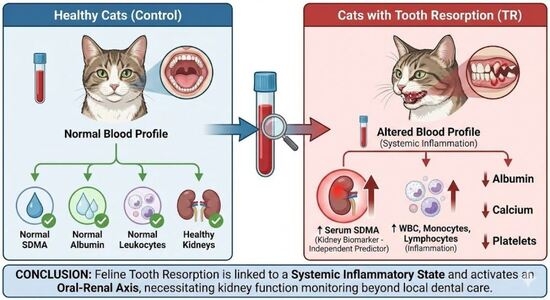
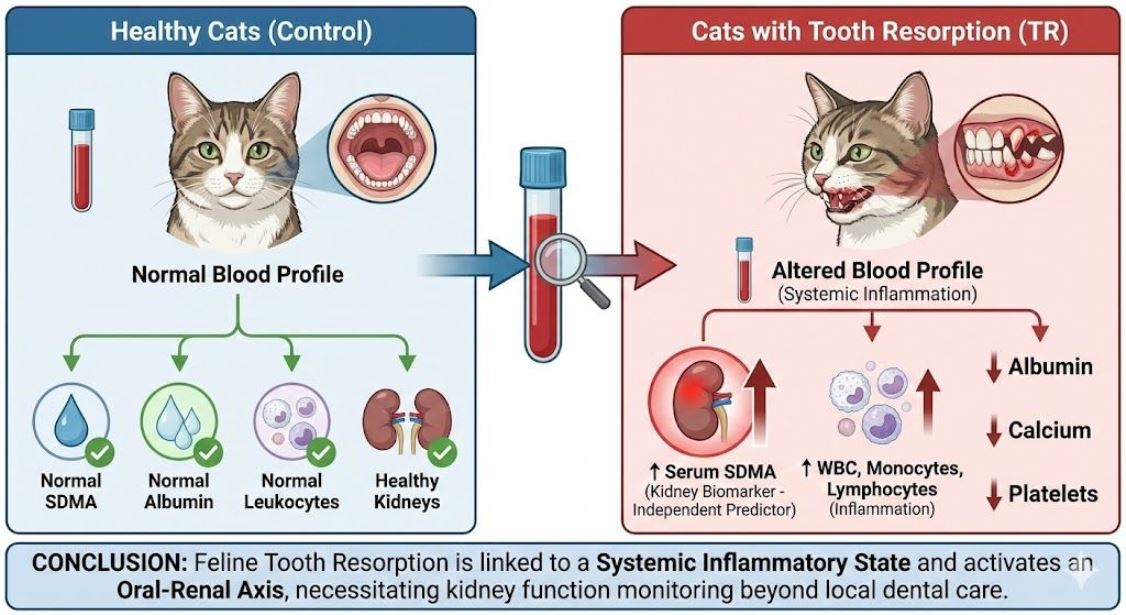
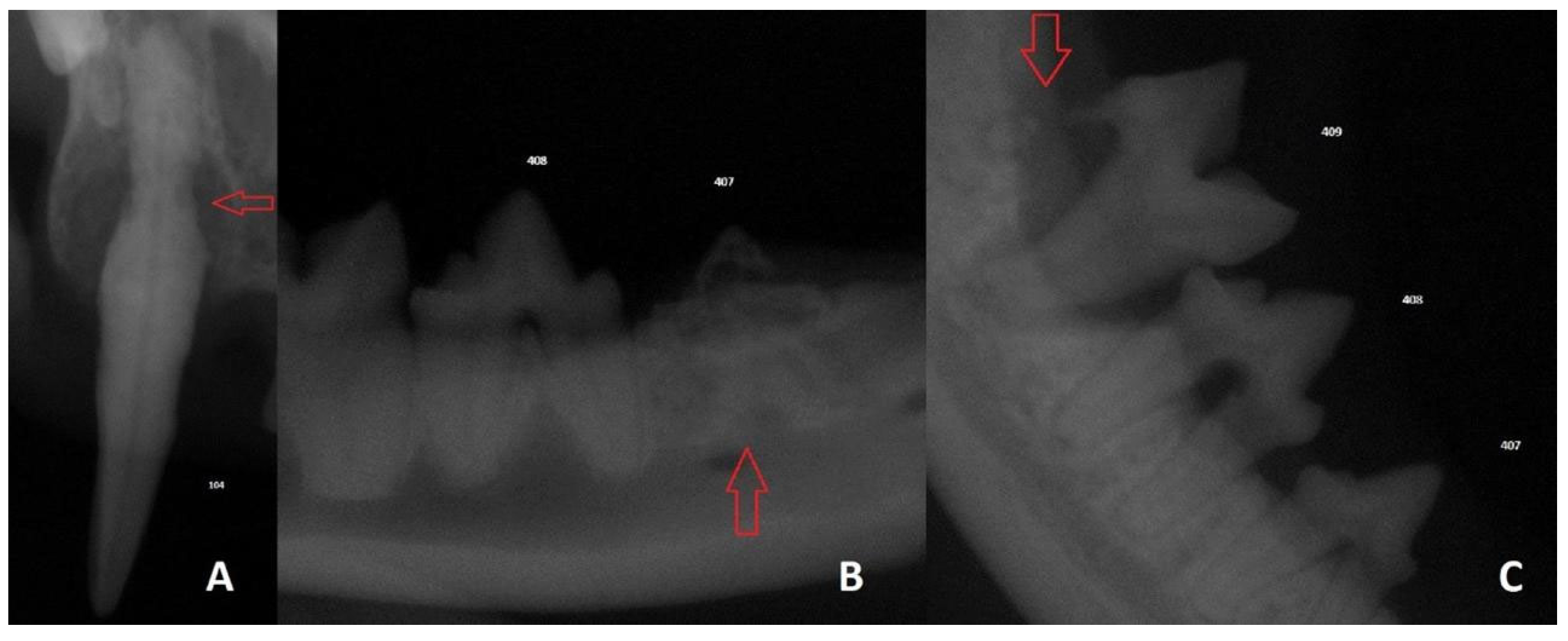
Background: Tooth resorption (TR) is a prevalent dental condition with under-investigated systemic implications, particularly regarding renal health. This study aimed to evaluate renal biomarkers, specifically symmetric dimethylarginine (SDMA), and the association between TR and blood parameters. Methods: Thirty-six cats (24 TR; 12 controls) were evaluated via intraoral radiography and blood analysis. Multivariable logistic regression was performed to identify independent predictors for TR, adjusting for age and sex. Results: Tooth resorption was diagnosed in 66.7% of the cats, predominantly affecting the mandibular first molars (409) and fourth premolars (108). A strong association was identified between TR stages and lesion types (p < 0.001). Cats with TR exhibited significantly higher serum SDMA concentrations (p = 0.011) and significantly lower albumin levels (p < 0.001) compared to controls. Hematological analysis revealed marked leukocytosis and monocytosis (p < 0.001) in the TR group. Most importantly, multivariable logistic regression identified SDMA as a predictor with TR presence (p = 0.012), with each unit increase in SDMA associated with a 3.5-fold increase in the likelihood of having resorptive lesions, independent of age and sex. Conclusions: Our findings regarding the oral-renal axis emphasize that feline TR involves chronic systemic inflammation. Consequently, it should be managed as a condition with measurable systemic impacts rather than merely a localized disease.
Keywords:
feline tooth resorption; SDMA; oral-renal axis; systemic inflammation