


Simple Summary
Frozen semen is widely used in dairy goat breeding, but sperm quality can decline during cooling, freezing, and thawing. This study sequentially screened several practical cryopreservation conditions in Saanen bucks and selected a working combination consisting of artificial vagina collection, a 200 mL water bath, 2.5 h of equilibration, a 9 cm liquid nitrogen vapor distance, and two-step dilution. This combination performed favorably among the conditions tested but should not be considered a fully optimized or validated cryopreservation protocol. Using this procedure, pooled semen from adult bucks showed better fresh and post-thaw sperm quality outcomes than pooled semen from young bucks. Differences in post-thaw redox-related measurements were also observed between the two age groups. Metabolomic analysis of individual samples identified several nominal differences, but none remained statistically significant after correction for multiple testing. Overall, the results identify practical conditions for further cryopreservation validation and suggest differences in semen characteristics between young and adult bucks. Further studies using larger numbers of independent biological samples and fertility testing are needed to confirm these observations and determine their biological significance.
Abstract
Semen cryopreservation is widely used to disseminate valuable genetics in dairy goats, yet cryoinjury can substantially compromise sperm function, and the influence of male age on cryotolerance remains incompletely understood. This study aimed to identify a practical cryopreservation working combination for Saanen buck semen and to characterize age group differences in sperm quality, redox-related traits, and metabolomic profiles. Cryopreservation conditions were sequentially screened using independently prepared pooled semen batches by evaluating water bath volume, equilibration time, semen collection method, liquid nitrogen vapor distance, and dilution strategy. Artificial vagina collection, a 200 mL water bath, 2.5 h equilibration, a 9 cm vapor distance, and two-step dilution showed favorable performance among the conditions tested and were selected as the working combination. Using these conditions, semen quality and post-thaw redox-related measurements were compared between young (10–14 months) and adult (≥24 months) bucks using three independently prepared pooled batches per age group. Adult group pooled semen exhibited better fresh and post-thaw sperm quality outcomes, with post-thaw motility of 66.36 ± 7.81% compared with 60.18 ± 9.81% in the young group, together with higher plasma membrane and acrosomal integrity. Post-thaw adult group samples also exhibited higher SOD and GSH-Px activities and lower DCFH-DA-derived oxidant-sensitive fluorescence and MDA levels. Untargeted metabolomics was subsequently performed on individually processed ejaculates from 10 bucks per age group. Although 26 metabolic features met the nominal fold-change, p-value, and VIP screening criteria, none remained significant after Benjamini–Hochberg false discovery rate correction, and the PLS-DA model showed limited predictive performance (Q2 = −0.22). Collectively, this study identifies a practical cryopreservation working combination for Saanen buck semen and reveals age group differences in post-thaw sperm quality and redox-related characteristics. The metabolomic findings remain exploratory and require validation in larger independent cohorts.
1. Introduction
Frozen semen is central to artificial insemination and genetic improvement programs because it enables long-term preservation, wide geographic distribution, and efficient use of elite male germplasm. In dairy goats, however, spermatozoa are particularly vulnerable to chilling, osmotic stress, cryoprotectant exposure, and oxidative injury during freezing and thawing. Goat studies have therefore examined extender composition, cholesterol manipulation, antioxidant supplementation, and other approaches to preserve post-thaw motility and membrane function [1,2,3]. These studies demonstrate that cryosurvival is modifiable, but their protocols vary substantially in extender formulation and laboratory conditions, which limits direct transfer of a single procedure across production settings.
During freezing and thawing, sperm cells are challenged by cold shock, ice crystal formation, osmotic changes, and oxidant-generating processes. These insults can destabilize the plasma membrane, alter lipid organization, impair mitochondrial function, and reduce motility and acrosomal integrity [4,5]. Recent goat lipidomic and metabolomic studies further show that cryopreservation is accompanied by changes in lipid and energy-related chemical profiles [6,7]. Such biochemical profiling can complement conventional semen quality assessment, but interpretation depends strongly on sample preparation and whether signals can be assigned specifically to spermatozoa rather than seminal plasma or extender components.
Practical freezing performance is influenced not only by extender composition but also by cooling rate, equilibration duration, collection method, liquid nitrogen vapor geometry, dilution sequence, and thawing conditions. Previous work has shown effects of vapor freezing height and thawing-related variables on sperm motility and structural integrity [8,9,10]. Nevertheless, studies differ in species or breed, extender formulation, packaging, freezing geometry, and laboratory workflow; consequently, a universally transferable dairy goat protocol cannot be assumed. In particular, evidence integrating several operational steps within the same Saanen production setting remains limited.
Age represents a second source of biological variation. The present age categories were selected to contrast young post-pubertal bucks (10–14 months) with reproductively mature adult bucks (≥24 months) within the same herd. Young males may have less fully stabilized testicular, epididymal, endocrine, and antioxidant functions, which provides a biological rationale for examining whether their semen differs in cryoresilience from that of adult bucks. Published work in other mammalian models indicates age-associated changes in sperm function and metabolism [11], but comparable integrated data for Saanen bucks remain scarce.
Metabolomics offers a complementary approach for characterizing the biochemical state of the male reproductive system and identifying molecular features related to fertility, semen quality, and sperm cryotolerance. Seminal plasma metabolomics has revealed fertility-associated metabolic patterns in bulls [12], and metabolomic approaches are increasingly being applied to male reproductive research and semen quality assessment [13,14,15]. Nevertheless, the metabolic characteristics of frozen–thawed semen from Saanen bucks, particularly in relation to male age and post-thaw sperm characteristics, remain poorly understood. Moreover, because cryopreservation alters the biochemical environment to which spermatozoa are exposed, interpretation of metabolomic profiles from frozen–thawed samples requires consideration of potential contributions from the cryopreservation medium as well as biological variation. Characterizing these relationships may therefore provide a broader biochemical context for understanding age group differences in semen characteristics following cryopreservation.
Accordingly, this study aimed to (i) sequentially evaluate key procedural factors affecting Saanen dairy goat semen cryopreservation and identify a practical working combination among the conditions tested; (ii) compare fresh and post-thaw sperm quality traits and selected post-thaw redox-related measurements between pooled semen from young and adult bucks; and (iii) explore age-related differences in the metabolomic profiles of individually processed, unpooled frozen–thawed semen samples. We hypothesized that adult bucks would exhibit better post-thaw sperm quality characteristics than young bucks, accompanied by differences in redox-related measurements and metabolic profiles. By combining cryopreservation screening with functional, redox-related, and metabolomic assessments, this study sought to provide a practical and biochemical framework for further investigation of age-related variation in the cryotolerance of Saanen buck semen.
2. Materials and Methods
2.1. Animals and Experimental Design
The experiment was conducted at Qianyang Breeding Sheep Farm, Shaanxi Province, China, during the breeding season. Twenty clinically healthy Saanen dairy goat bucks with normal testicular development and libido and a body condition score of 3.5–4.0 were included. The animals were maintained under the same nutritional, housing, and general management conditions. Ten young bucks (10–14 months old) and ten adult bucks (≥24 months old) were used to represent young post-pubertal and reproductively mature animals, respectively. Bucks in both age groups underwent a 2-month period of sexual abstinence before semen collection and were sampled contemporaneously under the same collection schedule.
The experiment consisted of three stages. In the first stage, ejaculates were collected from the young and adult bucks, and only ejaculates with initial CASA-determined sperm motility > 80% were included; the CASA procedure and motility classification criteria are described in Section 2.3. For each pooled batch, one ejaculate was collected from each of the 10 bucks in the corresponding age group, and equal semen volumes from the 10 qualified ejaculates were combined. Thus, each pooled batch comprised 10 ejaculates from 10 individual bucks, with all 10 bucks represented. Each buck contributed one ejaculate to each pooled batch on each of the three separate collection occasions, but no buck contributed more than one ejaculate within the same pool. Across the three pooled batches, 30 ejaculates were collected per age group, and all met the CASA motility > 80% eligibility criterion; therefore, no ejaculates were excluded. Three independent pooled semen batches were prepared on separate collection occasions and used as biological replicates. Within each replicate, the pooled semen was divided among the relevant treatment groups to sequentially evaluate the cryopreservation factors described in Section 2.2. This screening was used to identify a practical working combination for the subsequent experiments.
In the second stage, the selected cryopreservation conditions were applied to newly prepared pooled semen batches from the young and adult groups. Fresh and post-thaw sperm quality characteristics were evaluated, and selected redox-related measurements were performed on post-thaw samples. Three independently prepared pooled batches per age group served as the biological replicates (n = 3 per age group), with the pooled batch, rather than the individual donor buck or technical measurement, defined as the experimental unit.
In the third stage, ejaculates were newly collected from the same 10 young and 10 adult bucks and processed individually without pooling for untargeted metabolomic profiling. Each buck represented one independent biological sample, resulting in 10 biological replicates per age group (n = 10). Technical measurements, where applicable, were averaged within the corresponding biological replicate before statistical analysis.
All experimental procedures were approved by the Institutional Animal Care and Use Committee of Northwest A&F University (approval No. 24-522; approved on 10 September 2024).
2.2. Extender Preparation and Semen Cryopreservation
The basal extender consisted of Tris (58.08 g/L), citric acid (32.16 g/L), bovine serum albumin (1920 mg/L), ATP (720 mg/L), vitamin C (6 g/L), D-fructose (24 g/L), trehalose (6 g/L), penicillin (2.88 g/L), and egg yolk (480 mL/L). Fresh egg yolk was obtained from chicken eggs laid on the day of extender preparation and sourced from a poultry farm. The final extender had a pH of 6.9 and an osmolality of 320 mOsm/kg. The glycerol-containing second extender fraction contained 12% (v/v) glycerol, resulting in a final glycerol concentration of 6% (v/v) after two-step dilution. In the two-step procedure, 4 mL of the respective extender fraction was added at each step, with a 1 min interval between additions. Qualified semen was cooled to 4 °C over 1.5–2 h and equilibrated for the designated period. The diluted semen was then loaded into 0.25 mL straws, exposed horizontally to liquid nitrogen vapor at the designated distance for 8 min, and subsequently plunged into liquid nitrogen for storage. For post-thaw evaluation, frozen straws were thawed in a 37 °C water bath for 15 s.
Five procedural factors were evaluated sequentially: water bath volume (50, 100, 150, 200, and 250 mL), equilibration time (0, 0.5, 1.5, 2.5, and 3.5 h), semen collection method (artificial vagina or electroejaculation), liquid nitrogen vapor distance (4, 6.5, and 9 cm), and dilution strategy (one-step or two-step dilution). A sequential one-factor-at-a-time screening design was used whereby the condition selected at each step was carried forward to the subsequent evaluation; consequently, interactions among procedural factors were not assessed. For each of three independent repetitions, a newly prepared pooled semen batch was divided among the treatment groups evaluated at the corresponding screening step. The selected working combination consisted of artificial vagina collection, a 200 mL water bath, 2.5 h equilibration, a 9 cm liquid nitrogen vapor distance, and two-step dilution. This working combination was subsequently applied to the pooled semen quality and redox-related experiments and the individually processed samples used for metabolomic profiling. Before straw filling, semen was standardized to approximately 50 × 106 spermatozoa per 0.25 mL straw.
2.3. Sperm Quality Assessment
Sperm motion was evaluated using a computer-assisted sperm analysis system (CASA; SJ-TMDI810(I), Mailang, China) equipped with an ML-117 microscope (40× negative phase contrast objective; total magnification 400×), an MD0210B CCD imaging module, an MD0305 temperature-controlled stage (37 °C), and an ML-CASA10 counting chamber (10 μm depth). The system ran on ML-CASA software (v10.0, Mailang). Fresh goat semen was diluted 1:5 with pre-warmed (37 °C) extender. Slides, coverslips, and the chamber were pre-warmed to 37 °C. A 5 μL aliquot was loaded, yielding 20–50 spermatozoa per field. Frames were acquired at 25 fps; five non-overlapping fields were recorded per sample (1 s per field, 25 consecutive frames), with at least 400 spermatozoa tracked per sample. Head size gating was 20–40 μm2. Track recognition required ≥10 consecutive frames per spermatozoon, with low- and high-speed cutoffs of 10 and 200 μm/s, respectively. Motility was identified through automatic recognition with visual verification. Viability was determined automatically by ML-CASA software according to the manufacturer’s predefined viability classification criterion and expressed as the percentage of spermatozoa classified as viable among the total spermatozoa analyzed; no separate dye exclusion or fluorescence live/dead staining assay was used. The same five non-overlapping fields and at least 400 spermatozoa per sample were used for the CASA-derived viability assessment. Spermatozoa were classified as motile when VCL ≥ 10 μm/s and as progressive when VAP ≥ 50 μm/s, VSL ≥ 25 μm/s, and LIN (VSL/VCL × 100%) ≥ 45%. Kinematic parameters (VSL, VCL, ALH, WOB, and BCF) were computed automatically using the software definitions. Field-level results were averaged within the applicable experimental unit.
Sperm concentration was determined with a hemocytometer after dilution in 3% NaCl. Five chamber squares were counted, and concentration was calculated from C = N × DF/Vcounted, where N is the total number of spermatozoa counted, DF is the dilution factor, and Vcounted is the total chamber volume represented by the five counted squares; results were expressed as spermatozoa/mL and reported in the tables as ×108/mL. Sperm abnormality was assessed after smear preparation, fixation in 95% ethanol for 5 min, and blue ink staining for 10 min. At least 500 spermatozoa were evaluated per sample, and the abnormal sperm percentage was calculated as abnormal spermatozoa divided by the total number counted ×100. The archived dataset contains only the aggregate abnormal sperm percentage and does not retain subtype-specific counts; therefore, head, midpiece, and tail defect frequencies cannot be reconstructed retrospectively.
Plasma membrane integrity was assessed through the hypo-osmotic swelling test (HOST) using a laboratory-prepared solution containing 13.5 g/L of fructose and 7.35 g/L of sodium citrate dihydrate in distilled water (final osmolarity 100 mOsm/L, pH 7.0–7.2). Semen (20 μL) was mixed with 200 μL of the pre-warmed (37 °C) hypo-osmotic solution (1:10 ratio) and incubated at 37 °C for 30 min. After incubation, an 8 μL aliquot was placed on a glass slide, covered with a coverslip, and immediately examined under a light microscope at 400× magnification. At least 400 spermatozoa per sample were counted; spermatozoa exhibiting any degree of tail swelling or coiling were classified as having an intact functional plasma membrane.
Acrosome integrity was evaluated through PSA–FITC staining using an Induced Sperm Acrosome Reaction Detection Kit (BRED-001; Borui De Biotech, Shenzhen, China). Fresh semen (20 μL) was mixed with 20 μL of PSA–FITC working solution, incubated in the dark for 3 min at room temperature, and fixed with 8 μL of 12.5% glutaraldehyde. Samples were examined under a fluorescence microscope at 400× magnification using 450–490 nm excitation. At least 400 spermatozoa were assessed per sample. Spermatozoa with uniform bright green fluorescence over the acrosomal cap were considered acrosome-intact, whereas those lacking acrosomal fluorescence or showing fluorescence only in the equatorial region were classified as non-intact. Acrosome integrity was expressed as the percentage of spermatozoa with intact acrosomes.
2.4. Selected Redox-Related Assays
Redox-related assays were performed on post-thaw pooled semen samples from three independently prepared pooled batches per age group. Before freezing, semen was standardized to approximately 50 × 106 spermatozoa per 0.25 mL straw, and the same number of straws and aliquot volume were processed for each group. For SOD analysis, samples were washed once with PBS (600× g, 5 min), lysed, and centrifuged at 12,000× g for 5 min at 4 °C. SOD activity was determined using a commercial assay kit (BC0170; Beijing Solarbio Science & Technology Co., Ltd., Beijing, China) at 450 nm. GSH-Px activity was measured using kit BC1195 at 412 nm and expressed relative to protein concentration. For DCFH-DA-derived oxidant-sensitive fluorescence, sperm concentration was adjusted to 1 × 10⁶–2 × 10⁷ spermatozoa/mL, and samples were incubated with 10 μmol/L DCFH-DA (CA1410) at 37 °C for 30 min. Samples were subsequently washed three times with PBS to remove extracellular probe, and fluorescence was measured at excitation and emission wavelengths of 488 and 525 nm, respectively, and reported in arbitrary fluorescence units. For MDA analysis, samples were lysed and centrifuged at 12,000× g for 10 min at 4 °C. MDA was measured using kit BC0025 at 532 and 600 nm and expressed relative to protein concentration.
2.5. Untargeted Metabolomic Profiling
Untargeted metabolomic profiling was performed on individually processed frozen–thawed semen samples from young and adult bucks. Ten biological samples were analyzed per age group (n = 10), with each biological replicate consisting of one qualified ejaculate from one individual buck. Samples were processed and analyzed individually without pooling. Because metabolomic analysis was performed on frozen–thawed semen, potential contributions of residual cryopreservation-extender components to the detected chemical features were considered when interpreting the metabolomic profiles.
For lipid metabolite extraction, 20 μL of each frozen–thawed semen sample was mixed with 120 μL of precooled lipid extraction buffer (IPA:ACN: H2O = 2:1:1, v/v/v), vortexed for 1 min, incubated at room temperature for 10 min, and stored overnight at −20 °C. After centrifugation at 4000× g for 20 min, the supernatant was transferred to a 96-well plate and stored at −80 °C before LC-MS analysis. Pooled QC samples were prepared by combining 10 μL of each sample extract and injected after every 10 samples to monitor LC-MS stability.
Chromatographic separation was performed using an ACQUITY UPLC system (Waters, Milford, MA, USA) with a Kinetex UPLC C18 column (100 mm × 2.1 mm, 100 Å; Phenomenex). The column oven was maintained at 55 °C, and the flow rate was 0.3 mL/min. The mobile phases consisted of solvent A (ACN:H2O = 6:4, v/v, with 0.1% formic acid) and solvent B (IPA:ACN = 9:1, v/v, with 0.1% formic acid). The gradient was as follows: 0–0.4 min, 30% B; 0.4–1 min, 30–45% B; 1–3 min, 45–60% B; 3.5–5 min, 60–75% B; 5–7 min, 75–90% B; 7–8.5 min, 90–100% B; 8.5–8.6 min, 100% B; 8.6–8.61 min, 100–30% B; and 8.61–10 min, 30% B. Mass spectrometry was performed on a Q-Exactive Plus high-resolution mass spectrometer in both positive and negative ion modes. Precursor spectra were collected over m/z 70–1050 at a resolution of 70,000, with an AGC target of 3 × 10⁶ and a maximum injection time of 100 ms. Data-dependent MS/MS acquisition used a top-3 method at a resolution of 17,500, with an AGC target of 1 × 10⁵ and a maximum injection time of 80 ms.
Raw LC-MS files were converted to mzXML format and processed using XCMS, CAMERA and metaX implemented in R (version 4.0.0) for peak picking, grouping, retention time correction, isotope/adduct annotation, and generation of a peak intensity matrix. The main XCMS parameters were centWave, minfrac = 0.5, snthr = 6, ppm = 30, peakwidth = 5–25, bw = 5, mzwid = 0.015, mzdiff = 0.01, and profStep = 0.1. Features were putatively annotated by matching accurate m/z and retention time information against KEGG, HMDB, LipidMaps, LipidBlast, and an in-house MS/MS spectral library. Database annotation used a mass tolerance of <10 ppm; MS/MS-supported annotation used MS1 and MS2 tolerances of 0.01 and 0.05 Da, respectively, with a spectral score cutoff of 70%.
2.6. Statistical Analysis
For the pooled semen experiments, the independently prepared pooled semen batch was defined as the biological experimental unit, with three independent pooled batches included per treatment or age group (n = 3). Technical measurements were averaged within each pooled batch before statistical analysis and were not treated as independent observations. For the sequential cryopreservation screening, comparisons among more than two conditions were performed using one-way analysis of variance (ANOVA) followed by Duncan’s multiple-range test. Comparisons between the young and adult pooled semen groups were also performed using one-way ANOVA. Data are presented as mean ± SD, and exact p values are reported where applicable. Statistical analyses were conducted using SPSS Statistics 26.0 (IBM Corp., Armonk, NY, USA), with p < 0.05 considered statistically significant. Because the sequential screening involved division of each independently prepared pooled batch among the corresponding treatment conditions, observations within a batch were not fully independent; batch was not explicitly included as a blocking factor in the ANOVA. Accordingly, statistical comparisons from the sequential screening were interpreted as exploratory.
For untargeted metabolomic analysis, features with missing values in >50% of quality control samples or >80% of biological samples were excluded. The remaining data were median-normalized, missing values were imputed using the minimum observed value, and signal intensities were log2-transformed. Principal component analysis (PCA) and partial least-squares discriminant analysis (PLS-DA) were performed after mean centering and unit variance scaling. The PLS-DA model was assessed through 200-permutation testing and used for exploratory visualization and feature screening. Hierarchical clustering was performed using the R package pheatmap. Univariate comparisons between age groups were conducted using Student’s t-test, and p values were adjusted for multiple testing using the Benjamini–Hochberg false discovery rate (FDR) procedure. Features meeting all three nominal screening criteria—fold change ≥1.2 or ≤1/1.2, nominal p < 0.05, and variable importance in projection (VIP) ≥1—were retained for descriptive follow-up and Kyoto Encyclopedia of Genes and Genomes (KEGG) pathway enrichment. Pathway enrichment was evaluated using the hypergeometric test. Because pathway analysis was based on the nominally screened feature set, the resulting pathway-level p values were considered exploratory rather than confirmatory evidence.
3. Results
3.1. Sequential Screening of Semen Cryopreservation Conditions
Water bath volume altered the cooling rate and post-cooling sperm quality (Table 1). The 200 mL treatment yielded the highest viability (93.22 ± 1.95%) and motility (76.88 ± 2.11%). Viability at 200 mL did not differ from that at 250 mL, whereas motility at 200 mL was significantly higher than in all other groups (p < 0.05). Because motility was considered the primary practical endpoint for artificial insemination, followed by viability and abnormal sperm percentage, 200 mL was selected for the subsequent optimization step.
Table 1.
Effects of water bath volume on Saanen dairy goat semen quality.
Equilibration time affected viability, motility, VSL, and VCL (Table 2). The 2.5 h treatment produced the highest motility (68.47 ± 0.24%) and was significantly higher than all other equilibration periods (p < 0.05). Viability at 2.5 h was higher than at 0 and 3.5 h, while VSL and VCL did not differ among the 1.5, 2.5, and 3.5 h treatments. Therefore, 2.5 h was selected for the next screening step.
Table 2.
Effects of equilibration time on Saanen dairy goat semen quality.
The remaining procedural factors are summarized in Table 3. Electroejaculation produced greater ejaculate volume, whereas artificial vagina collection produced a lower abnormal sperm percentage; viability, motility, and sperm concentration did not differ detectably between collection methods under the original analysis. A 9 cm liquid nitrogen vapor distance showed the highest motility and VSL among the tested distances and was carried forward. Two-step dilution showed higher motility and a lower abnormal sperm percentage than one-step dilution (p < 0.05). The successive selections were assembled as a practical working cryopreservation combination.
Table 3.
Effects of collection method, liquid nitrogen vapor distance, and dilution step.
3.2. Semen Quality and Antioxidant Capacity in Young and Adult Group Pooled Semen
In fresh pooled semen samples, the adult group showed greater ejaculate volume and sperm motility and a lower proportion of abnormal spermatozoa than the young group (p < 0.05), whereas sperm viability and original ejaculate sperm concentration did not differ significantly between age groups (Table 4). After thawing, the adult group pooled samples maintained higher sperm motility and lower abnormal sperm percentages than the young group pooled samples (p < 0.05), while post-thaw viability showed no significant difference between groups.
Table 4.
Fresh and frozen–thawed semen quality in young and adult Saanen dairy goat bucks.
Frozen–thawed pooled semen samples from the adult group exhibited higher VSL, VCL, ALH, plasma-membrane integrity, and acrosome integrity than those from the young group (p < 0.05), whereas WOB and BCF showed no significant differences between groups (Table 5). Antioxidant-related indices, including SOD, GSH-Px, ROS, and MDA, also differed between the adult and young group pooled samples (Table 5). Compared with fresh pooled semen, sperm motility decreased after thawing in both age groups, with a greater numerical reduction in the young group (approximately 13.0%) than in the adult group (approximately 9.2%).
Table 5.
Kinematic parameters, structural integrity, and selected redox-related indices of post-thaw pooled semen.
3.3. Exploratory Untargeted Metabolomic Profiling
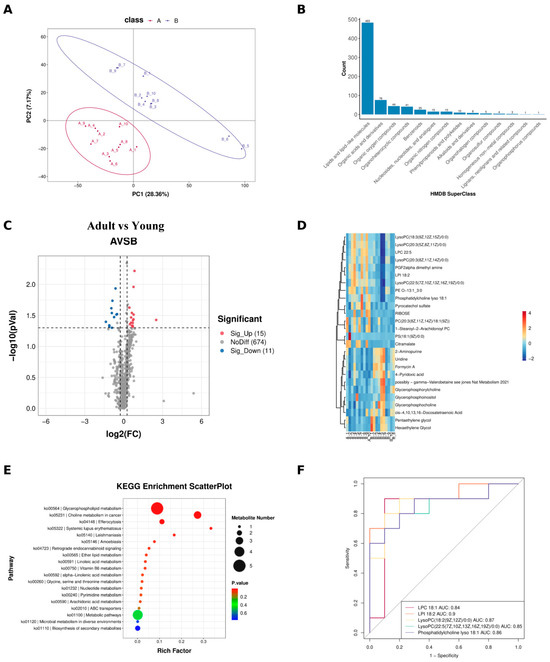
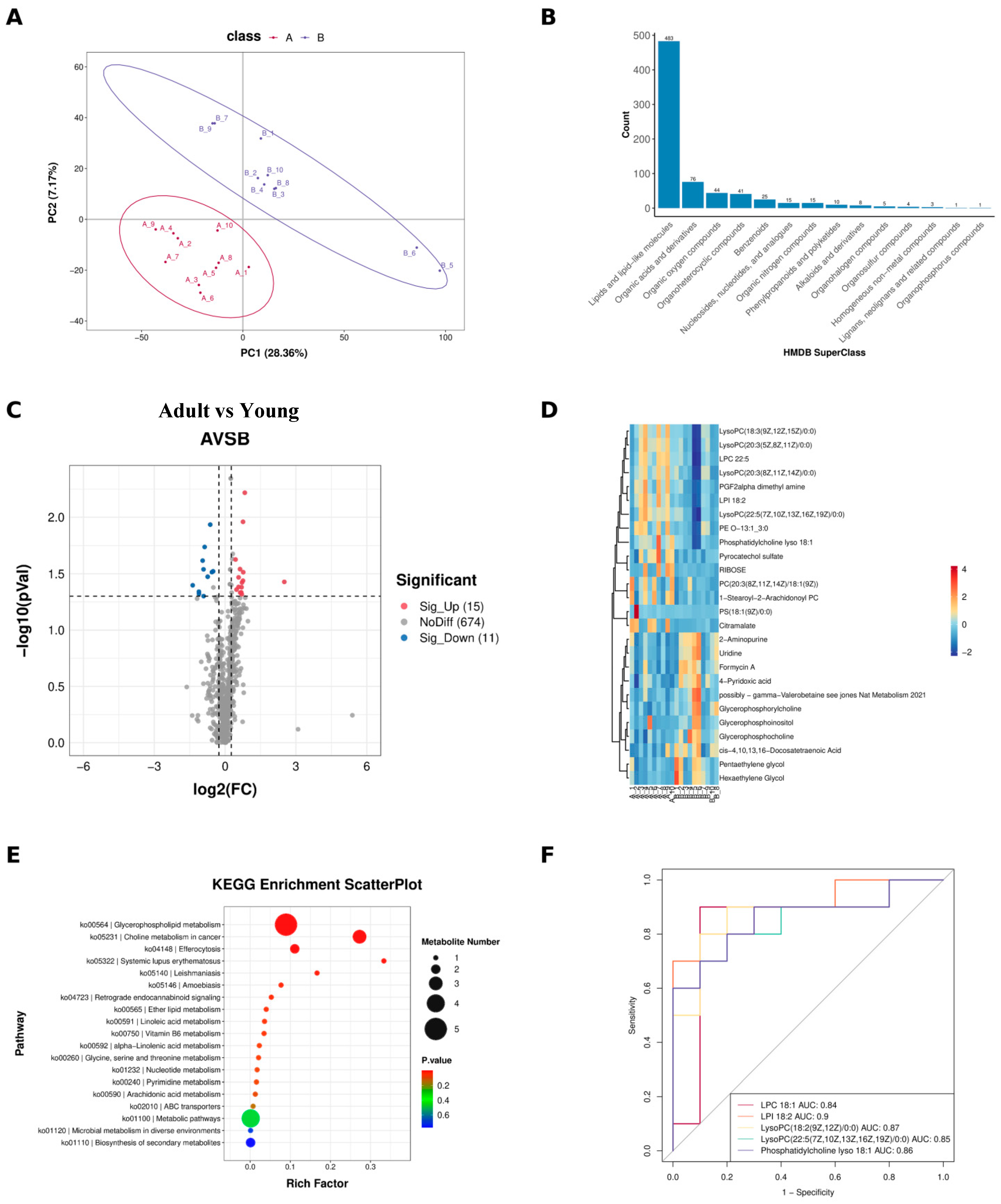
Quality control samples showed high analytical consistency, with Pearson correlation coefficients >0.99. The PLS-DA score plot showed different sample distribution patterns between young and adult groups (Figure 1A), but the negative model Q indicated limited predictive performance; the panel is therefore used only as exploratory visualization. Among putatively annotated features, lipids and lipid-like molecules represented the predominant HMDB superclass, followed by organic acids and derivatives, organoheterocyclic compounds, and organic oxygen compounds (Figure 1B).
Figure 1.
Exploratory untargeted metabolomic analysis of individually collected frozen–thawed semen extender samples from adult and young Saanen dairy-goat bucks. (A) PLS-DA score plot; A denotes adult samples and B denotes young samples. The model had limited predictive performance (overall R2 = 0.93; Q2 = −0.22) and is shown only for exploratory visualization. (B) HMDB superclass distribution of putatively annotated IDMS2 features. (C) Volcano plot for the adult versus young comparison; the software label “Significant” denotes features meeting nominal exploratory screening thresholds and does not indicate FDR significance. (D) Hierarchical clustering heatmap of the top 30 VIP-ranked features shown as a separate exploratory display. (E) KEGG pathway enrichment bubble plot based on nominal screening results. (F) ROC curves generated in the discovery cohort without external validation.
Based on the predefined nominal exploratory criteria of fold change, p value, and VIP, 26 features were retained for descriptive follow-up. Fifteen had higher and eleven had lower relative abundance in the frozen–thawed semen extender matrix from adult bucks than from young bucks (Figure 1C). None of the feature-level comparisons remained significant after Benjamini–Hochberg correction; all had q = 0.6535. The heatmap in Figure 1D displays the top 30 VIP-ranked features as a separate exploratory visualization and does not represent a set of FDR-significant metabolites.
Several phosphatidylcholine-related compounds, adenosine, and pyrocatechol sulfate were among the putatively annotated exploratory features. Glycerophospholipid metabolism had the lowest nominal p value in the pathway enrichment output (Figure 1E), but the pathway result is hypothesis-generating because the input features did not remain significant after FDR correction and the pathway p values were not used as confirmatory multiplicity-adjusted evidence. ROC curves for selected features are shown descriptively in Figure 1F and were generated in the discovery cohort without independent validation.
4. Discussion
This study combined sequential cryopreservation screening with age group comparisons of semen quality, redox-related characteristics, and untargeted metabolomic profiles in Saanen bucks. Sequential evaluation of key procedural factors identified a practical working combination comprising artificial vagina collection, a 200 mL water bath, 2.5 h of equilibration, a 9 cm liquid nitrogen vapor distance, and two-step dilution. When this combination was applied in subsequent experiments, pooled semen from adult bucks generally exhibited better fresh and post-thaw sperm quality characteristics than pooled semen from young bucks, including higher post-thaw motility, plasma membrane integrity, and acrosomal integrity. These differences were accompanied by higher SOD and GSH-Px activities and lower DCFH-DA-derived oxidant-sensitive fluorescence and MDA levels in post-thaw adult group samples. Untargeted metabolomic profiling of individual semen samples further identified nominal age group differences in several metabolic features, although none remained significant after false discovery rate correction. Collectively, these findings provide a practical basis for further evaluation of the selected cryopreservation conditions and indicate age group differences in sperm cryotolerance and associated post-thaw redox-related characteristics, while the metabolomic observations provide exploratory leads for future investigation.
Controlled cooling and equilibration are central to sperm cryosurvival because abrupt temperature changes alter membrane lipid organization, promote osmotic imbalance, and compromise motility and structural integrity [1,2,4]. In this study, the 200 mL water bath produced a slower cooling rate and the highest mean viability and motility among the tested volumes in the descriptive sequential screening. Greater thermal mass could plausibly reduce short-term temperature fluctuation and provide a more uniform transition to 4 °C. Equilibration for 2.5 h produced the highest motility, whereas 3.5 h provided no additional improvement. These interpretations are physiologically plausible, but the one-factor-at-a-time design did not test interactions among water bath volume, equilibration, or the other procedural factors.
Liquid nitrogen vapor distance showed descriptive differences in post-thaw sperm performance within the tested conditions. A 9 cm distance had the highest mean motility and VSL among the tested distances. Vapor height influences heat removal, and inappropriate freezing rates can promote intracellular ice formation or excessive dehydration [8,16]. Two-step dilution also showed higher mean motility and a lower mean abnormal sperm percentage than one-step dilution. Gradual introduction of the glycerol-containing fraction is a plausible explanation because it may reduce abrupt osmotic and chemical stress [17], but the present experiment did not directly measure osmotic injury. The selected settings should therefore be interpreted as a practical working combination within this experimental system rather than a proven global optimum.
Semen collection methods showed descriptive differences in ejaculate characteristics. Electroejaculation had a greater mean ejaculate volume, whereas artificial vagina collection had a lower mean abnormal sperm percentage. The literature attributes collection method differences to accessory gland secretions, collection-associated stress, and contamination by urine or other fluids [18]. Artificial vagina collection was carried forward because of its lower abnormal sperm percentage in this study. Electroejaculation nevertheless remains a practical alternative when bucks cannot be trained for artificial vagina collection or when field collection is required; the present data do not establish universal superiority of one method.
Adult group pooled batches showed higher motility and a lower abnormal sperm percentage before freezing and retained higher motility, VSL, VCL, ALH, plasma membrane integrity, and acrosome integrity after thawing. More complete reproductive maturation, membrane stability, and seminal plasma composition are plausible biological explanations supported by the literature on epididymal extracellular vesicles, seminal plasma proteins, and age-related sperm function [11,19,20]. However, these mechanisms were not directly measured. Because ejaculates were pooled within age groups, the results estimate differences among independently prepared pooled batches rather than individual buck variability. Although all 10 bucks contributed equal semen volumes to each pooled batch, pooling necessarily obscures individual donor variation.
Differences in post-thaw redox-related measurements were also observed between the two age groups. Adult group pooled samples exhibited higher SOD and GSH-Px activities together with lower DCFH-DA-derived oxidant-sensitive fluorescence and MDA levels than young group samples. SOD and GSH-Px constitute important components of the antioxidant defense system, whereas excessive oxidant generation and lipid peroxidation have been associated with impaired sperm membrane integrity, motility, and functional competence during semen cryopreservation [21,22,23,24]. In this context, the redox-related differences observed in the adult group samples occurred alongside their better post-thaw sperm quality characteristics. However, these measurements do not establish a mechanistic relationship between redox status and the observed age group differences in sperm quality. DCFH-DA provides a broad oxidant-sensitive fluorescence signal rather than a specific quantitative measure of reactive oxygen species, and MDA represents a surrogate index related to lipid peroxidation. Moreover, the assays were performed only after thawing and used assay-specific sample preparation and normalization procedures; GSH-Px activity and MDA content were expressed relative to protein concentration, whereas none of the measurements were normalized to the number of viable spermatozoa. Consequently, the observed differences may reflect a combination of pre-existing age group characteristics, differential responses to freezing and thawing, variation in post-thaw cell integrity and sample composition, and contributions from damaged spermatozoa or residual extracellular components. Given the limited biological replication of the pooled semen experiment (n = 3 pooled batches per age group), these findings should therefore be regarded as exploratory post-thaw redox-related observations rather than evidence of a causal redox mechanism underlying age-related differences in sperm cryotolerance.
Untargeted metabolomics retained 26 features that met nominal exploratory criteria. Lipids and lipid-like molecules constituted the predominant putatively annotated superclass, consistent with evidence that freezing and thawing can alter sperm-associated lipid and energy profiles [6,7,25]. Membrane lipid composition provides a plausible biological context for the phosphatidylcholine-related annotations and nominal glycerophospholipid enrichment [26,27,28]. Nevertheless, none of the feature-level comparisons survived FDR correction, the PLS-DA model had a negative Q value, and pathway and ROC analyses were not independently validated. In addition, residual egg yolk extender may contribute phospholipid-derived signals. The findings therefore describe hypothesis-generating patterns in the semen extender matrix and should not be presented as confirmed sperm biomarkers, definitive metabolite identifications, or established age-related mechanisms.
Several limitations should be considered when interpreting these findings. The semen quality and redox-related comparisons were based on a limited number of independently prepared pooled semen batches, which precluded assessment of individual variation and warrants cautious interpretation of the age group differences. In addition, the sequential screening design did not evaluate interactions among cryopreservation factors, and the selected working combination was not compared with an established reference protocol. The redox-related measurements were restricted to post-thaw samples and therefore cannot establish whether the observed differences preceded cryopreservation or arose during the freezing–thawing process. The metabolomic findings also remain exploratory, as no metabolic features remained significant after FDR correction and residual extender components may have contributed to the detected chemical profiles. Finally, the biological relevance of the observed laboratory differences requires confirmation through fertility-related outcomes. Future studies incorporating larger individual-level cohorts, factorial evaluation, and independent validation of cryopreservation conditions, paired fresh and post-thaw analyses and in vivo fertility assessment will be important for extending these findings. Nevertheless, the present study provides a practical foundation for further refinement of Saanen buck semen cryopreservation and investigating age-related differences in semen cryotolerance.
5. Conclusions
This study identified a practical working combination for Saanen buck semen cryopreservation through sequential evaluation of key procedural factors comprising artificial vagina collection, a 200 mL water bath, 2.5 h of equilibration, a 9 cm liquid nitrogen vapor distance, and two-step dilution. Under these conditions, pooled semen from adult bucks exhibited better fresh and post-thaw sperm quality characteristics than pooled semen from young bucks, while separate differences were observed in post-thaw antioxidant enzyme activities, oxidant-sensitive fluorescence, and MDA levels. Untargeted metabolomic profiling of individual samples identified nominal age group differences in several metabolic features; however, none remained significant after FDR correction, indicating that these metabolic observations require further validation. Collectively, the findings establish a practical basis for further evaluation of Saanen buck semen cryopreservation and highlight age group differences in semen characteristics following cryopreservation. Further studies using larger individual-level cohorts, independent validation of the selected cryopreservation conditions, and in vivo fertility assessment are warranted to determine the biological and reproductive significance of these findings.
Supplementary Materials
The following supporting information can be downloaded at https://www.mdpi.com/article/10.3390/vetsci13111183/s1, Table S1: raw_intensity; Table S2: AVSB_diff_MS2_metabolites.
Author Contributions
J.Z.: methodology, investigation and sample collection, data analysis, writing—original draft; Y.M., L.L., and J.K.: methodology, investigation and sample collection; W.W.: data analysis, review and supervision; J.L.: conceptualization and review. All authors have read and agreed to the published version of the manuscript.
Funding
This work was supported by Shaanxi Kangyuan Goat Dairy Products Innovation Center Co., Ltd. (SXKY25-01) and the National Key Research and Development Program of China (2021YFD1600704).
Institutional Review Board Statement
All experimental procedures were approved by the Institutional Animal Care and Use Committee of Northwest A&F University (approval No. 24-522; approved on 10 September 2024).
Informed Consent Statement
Informed consent was obtained from all subjects involved in the study.
Data Availability Statement
The original contributions presented in this study are included in the article/supplementary material. Further inquiries can be directed to the corresponding author.
Acknowledgments
The authors thank the laboratory members and farm staff who assisted with semen collection, cryopreservation, and sample analysis.
Conflicts of Interest
The authors declare no conflicts of interest. The funders had no role in the design of the study; in the collection, analyses, or interpretation of data; in the writing of the manuscript; or in the decision to publish the results.
Abbreviations
The following abbreviations are used in this manuscript:
| Abbreviation | Definition |
| AI | Artificial insemination |
| ALH | Amplitude of lateral head displacement |
| BCF | Beat-cross frequency |
| GSH-Px | Glutathione peroxidase |
| HOST | Hypo-osmotic swelling test |
| LC-MS | Liquid chromatography-mass spectrometry |
| MDA | Malondialdehyde |
| PLS-DA | Partial least-squares discriminant analysis |
| QC | Quality control |
| ROS | Reactive oxygen species |
| SOD | Superoxide dismutase |
| VCL | Curvilinear velocity |
| VSL | Straight-line velocity |
| WOB | Wobble |
References
- Rezaei, Z.; Zeynodini, S.; Baghshahi, H.; Towhidi, A.; Faraji, S. The effect of adding pyridoxine to soybean lecithin-based extender on goat semen quality parameters after the freeze-thawing process. Iran. J. Vet. Res. 2021, 22, 234–238. [Google Scholar] [CrossRef] [Scilit]
- Salmon, V.M.; Leclerc, P.; Bailey, J.L. Cholesterol-loaded cyclodextrin increases the cholesterol content of goat sperm to improve cold and osmotic resistance and maintain sperm function after cryopreservation. Biol. Reprod. 2016, 94, 85. [Google Scholar] [CrossRef] [Scilit]
- Akhtarshenas, B.; Karami Shabankareh, H.; Hajarian, H.; Bucak, M.N.; Abdolmohammadi, A.R.; Dashtizad, M. The protease inhibitor antipain has a beneficial synergistic effect with trehalose for ram semen cryopreservation. Reprod. Domest. Anim. 2018, 53, 1359–1366. [Google Scholar] [CrossRef] [Scilit]
- Hungerford, A.; Bakos, H.W.; Aitken, R.J. Sperm cryopreservation: Current status and future developments. Reprod. Fertil. Dev. 2023, 35, 265–281. [Google Scholar] [CrossRef] [Scilit]
- Yi, X.; Qiu, Y.; Tang, X.; Lei, Y.; Pan, Y.; Raza, S.H.A.; Althobaiti, N.A.; Albalawi, A.E.; Al Abdulmonem, W.; Makhlof, R.T.M.; et al. Effect of five different antioxidants on the effectiveness of goat semen cryopreservation. Reprod. Sci. 2024, 31, 1958–1972. [Google Scholar] [CrossRef] [Scilit]
- Xu, B.; Wang, R.; Wang, Z.; Liu, H.; Wang, Z.; Zhang, W.; Zhang, Y.; Su, R.; Liu, Z.; Liu, Y.; et al. Evaluation of lipidomic change in goat sperm after cryopreservation. Front. Vet. Sci. 2022, 9, 1004683. [Google Scholar] [CrossRef] [Scilit]
- Li, C.; Lv, C.; Larbi, A.; Liang, J.; Yang, Q.; Wu, G.; Quan, G. Revisiting the injury mechanism of goat sperm caused by the cryopreservation process from a perspective of sperm metabolite profiles. Int. J. Mol. Sci. 2024, 25, 9112. [Google Scholar] [CrossRef] [Scilit]
- Zhang, L.; Wang, X.; Jiang, C.; Sun, Y.; Sohail, T.; Sun, X.; Wang, J.; Li, Y. Effect of fumigation height and time on cryopreservation of ram semen. Sci. Rep. 2024, 14, 10944. [Google Scholar] [CrossRef] [Scilit]
- Mosca, F.; Zaniboni, L.; Sayed, A.A.; Iaffaldano, N.; Soglia, D.; Schiavone, A.; Cerolini, S. Effect of N-methylacetamide concentration and thawing rate on chicken sperm quality after cryopreservation. Animals 2020, 10, 824. [Google Scholar] [CrossRef] [Scilit]
- Nishijima, K.; Kitajima, S.; Matsuhisa, F.; Niimi, M.; Wang, C.; Fan, J. Strategies for highly efficient rabbit sperm cryopreservation. Animals 2021, 11, 1220. [Google Scholar] [CrossRef] [Scilit]
- Zhou, Y.; Wei, Z.; Tan, J.; Sun, H.; Jiang, H.; Gao, Y.; Zhang, H.; Schroyen, M. Alginate oligosaccharide extends the service lifespan by improving the sperm metabolome and gut microbiota in an aging Duroc boars model. Front. Cell. Infect. Microbiol. 2023, 13, 1308484. [Google Scholar] [CrossRef] [Scilit]
- Velho, A.L.C.; Menezes, E.; Dinh, T.; Kaya, A.; Topper, E.; Moura, A.A.; Memili, E. Metabolomic markers of fertility in bull seminal plasma. PLoS ONE 2018, 13, e0195279. [Google Scholar] [CrossRef] [Scilit]
- Mehrparavar, B.; Minai-Tehrani, A.; Arjmand, B.; Gilany, K. Metabolomics of male infertility: A new tool for diagnostic tests. J. Reprod. Infertil. 2019, 20, 64–69. [Google Scholar]
- Michalek, K.; Oberska, P.; Malkowska, P.; Bartkiene, E. In search of new potential markers for male fertility and semen quality control: Aquaporins in reproductive system and metabolomic profiling of semen. J. Physiol. Pharmacol. 2021, 72, 309–319. [Google Scholar] [CrossRef] [Scilit]
- Guo, Y.; Li, X.; Wang, X.; Li, H.; Luo, G.; Si, Y.; Wu, X.; Li, Y. Seminal plasma metabolomics and lipidomics profiling to identify signatures of pituitary stalk interruption syndrome. Orphanet J. Rare Dis. 2022, 17, 267. [Google Scholar] [CrossRef] [Scilit]
- Mofadel, H.A.; Hussein, H.A.; Abd-Elhafee, H.H.; El-Sherry, T.M. Impact of various cryopreservation steps on sperm rheotaxis and sperm kinematics in bull. Sci. Rep. 2024, 14, 11403. [Google Scholar] [CrossRef] [Scilit]
- Ibrahim, S.; Hamad Talha, N.A.; Cho, J.; Jeon, Y.; Yu, I.J. Dog sperm cryopreservation using cryovials and different dilution steps. CryoLetters 2024, 45, 16–27. [Google Scholar] [CrossRef] [Scilit]
- Nadaf, S.M.; Ramesh, V.; Mech, M.; Khan, M.H.; Ahmed, F.A.; Ponraj, P.; Mitra, A. Comparative ejaculatory response, fresh and frozen semen quality and fertility to artificial vagina vs. electroejaculation method of semen collection in mithun bulls. Andrologia 2022, 54, e14330. [Google Scholar] [CrossRef] [Scilit]
- Rowlison, T.; Ottinger, M.A.; Comizzoli, P. Exposure to epididymal extracellular vesicles enhances immature sperm function and sustains vitality of cryopreserved spermatozoa in the domestic cat model. J. Assist. Reprod. Genet. 2021, 38, 2061–2071. [Google Scholar] [CrossRef] [Scilit]
- Carvajal-Serna, M.; Fatnassi, M.; Torres-Ruda, F.; Cardozo, J.A.; Grajales-Lombana, H.; Hammadi, M.; Abecia, J.A.; Muino-Blanco, T.; Perez-Pe, R.; Cebrian-Perez, J.A.; et al. Vasectomy and photoperiodic regimen modify the protein profile, hormonal content and antioxidant enzyme activity of ram seminal plasma. Int. J. Mol. Sci. 2020, 21, 8063. [Google Scholar] [CrossRef] [Scilit]
- Hassan, S.A.; Khalil, W.A.; Hassan, M.A.E.; Yousif, A.I.; Sabry, O.M.; Wink, M.; Sobeh, M. Antioxidant and antiapoptotic effects of a Turraea fischeri leaf extract on cryopreserved goat sperm. Animals 2021, 11, 2840. [Google Scholar] [CrossRef] [Scilit]
- Liu, H.; Sun, Y.; Zhao, J.; Dong, W.; Yang, G. Effect of zinc supplementation on semen quality, sperm antioxidant ability, and seminal and blood plasma mineral profiles in cashmere goats. Biol. Trace Elem. Res. 2020, 196, 438–445. [Google Scholar] [CrossRef] [Scilit]
- Avila, C.; Vinay, J.I.; Arese, M.; Saso, L.; Rodrigo, R. Antioxidant intervention against male infertility: Time to design novel strategies. Biomedicines 2022, 10, 3058. [Google Scholar] [CrossRef] [Scilit]
- Jurado-Campos, A.; Soria-Meneses, P.J.; Arenas-Moreira, M.; Alonso-Moreno, C.; Rodriguez-Robledo, V.; Soler, A.J.; Garde, J.J.; Fernandez-Santos, M.R. Minimizing sperm oxidative stress using nanotechnology for breeding programs in rams. J. Anim. Sci. Biotechnol. 2023, 14, 106. [Google Scholar] [CrossRef] [Scilit]
- Jiang, L.; Zhang, Y.; Jia, S.; Li, G.; Cui, J.; Ma, Y.; Wang, X.; Zhang, X.; Song, Y.; Zhang, L. Comparative metabolomic analysis of East Friesian dairy sheep semen before and after freezing. Anim. Husb. Vet. Med. 2024, 56, 7–14. (In Chinese) [Google Scholar]
- Varela, E.; Rojas, M.; Restrepo, G. Membrane stability and mitochondrial activity of bovine sperm frozen with low-density lipoproteins and trehalose. Reprod. Domest. Anim. 2020, 55, 146–153. [Google Scholar] [CrossRef] [Scilit]
- Hu, J.; Wu, H.; Xue, C.; Gu, Z.; Wang, R.; Pan, J.; Gao, Y.; Liu, Y.; Fang, F.; Zhang, Y.; et al. Effects of cholesterol and phosphatidylcholine on cryopreservation of goat semen. Jiangsu Agric. Sci. 2022, 50, 159–165. (In Chinese) [Google Scholar]
- Hossain, M.S.; Afrose, S.; Sawada, T.; Hamano, K.I.; Tsujii, H. Metabolism of exogenous fatty acids, fatty acid-mediated cholesterol efflux, PKA and PKC pathways in boar sperm acrosome reaction. Reprod. Med. Biol. 2010, 9, 23–31. [Google Scholar] [CrossRef] [Scilit]

Disclaimer/Publisher’s Note: The statements, opinions and data contained in all publications are solely those of the individual author(s) and contributor(s) and not of MDPI and/or the editor(s). MDPI and/or the editor(s) disclaim responsibility for any injury to people or property resulting from any ideas, methods, instructions or products referred to in the content. |
© 2026 by the authors. Licensee MDPI, Basel, Switzerland. This article is an open access article distributed under the terms and conditions of the Creative Commons Attribution (CC BY) license.