


Simple Summary
An Alcaligenes faecalis MT02 strain, isolated from mouse tail tissue, demonstrated broad-spectrum bactericidal activity against clinically relevant non-tuberculous mycobacteria (NTM) species. This antibacterial effect depends on hydroxylamine secreted by MT02 rather than on extracellular serine protease (ESP). MT02 produces hydroxylamine through carbon source-dependent and temperature-dependent mechanisms, and the production of hydroxylamine is correlated with the expression level of dnfABC. This study elucidates a novel antagonistic mechanism against NTM and also provides a new and worthy reference strategy for preventing the spread of NTM from environment to animals or humans.
Abstract
Non-tuberculous mycobacteria (NTM) are opportunistic pathogens that pose a continuous public health risk, and new control strategies are urgently needed. Alcaligenes faecalis is an environmental bacterium with broad antagonistic activity against various microorganisms, but the mechanism underlying its antagonism against NTM remains unclear. In this study, we isolated A. faecalis strain MT02 from mouse tail tissue and investigated its anti-NTM activity using inhibition zone assays, time–kill curves, hydroxylamine (HA) quantification, dialysis, recombinant extracellular serine protease (ESP) purification, RT-qPCR, and whole-genome sequencing. MT02 exhibited broad-spectrum antagonism against Mycobacterium smegmatis, M. abscessus, M. marinum, and M. avium. HA concentration was spatially correlated with the inhibition zone, and MT02 supernatant showed bactericidal effects similar to those of pure HA. Dialysis of the supernatant removed HA and markedly reduced its bactericidal activity, whereas purified ESP had no significant effect against M. smegmatis. HA production was carbon source-dependent, with fatty acids supporting the highest yield, and was also temperature-dependent: at 37 °C, HA production and dnfABC expression were significantly reduced compared with 30 °C. Whole-genome sequencing revealed in silico-predicted potential antibiotic resistance genes and virulence factors. Together, these results indicate that HA is a major effector molecule mediating the anti-NTM activity of A. faecalis MT02, and its production is regulated by both carbon source and temperature. This study provides new insights into the antagonistic mechanism of A. faecalis against NTM.
1. Introduction
Antagonism is a ubiquitous phenomenon in natural microbial communities [1]. Microorganisms use antagonism to compete for limited nutrients and space to achieve growth advantage [2]. Bacterial antagonism encompasses chemical, mechanical, and biological mechanisms [3]. For contact-independent antagonism, bacteria secrete proteins, peptides, and small soluble molecules into surrounding environments and mediate interactions between bacterial cells [4]. Antibiotics, originally discovered and isolated from antagonistic microorganisms of pathogenic bacteria, have been a powerful weapon to defeat infectious diseases [5]. The recently discovered lariocidin is a lasso peptide antibiotic, produced by Paenibacillus sp. M2, that has broad-spectrum activity against a range of bacterial pathogens by targeting ribosomes and interfering with protein synthesis [6]. This suggested that screening antagonistic microorganisms and isolating the active ingredients are still the main way to discover new antibiotics [7,8].
Non-tuberculous mycobacteria (NTM) are ubiquitous environmental organisms that can cause chronic pulmonary and extrapulmonary infections, particularly in immunocompromised individuals [9]. Many NTM species are zoonotic or have zoonotic potential, and they can infect both humans and animals, causing disease in farmed aquatic animals and wildlife and leading to significant economic losses in aquaculture [10]. Mycobacterium abscessus, Mycobacterium marinum, and Mycobacterium avium are waterborne pathogens commonly found in natural and man-made water systems, including wastewater and aquaculture environments [9,11]. Their transmission across the environment–animal–human interface is increasingly recognized as a critical factor in NTM epidemiology and control [12]. The spread of these opportunistic pathogens through water sources poses a continuous public health risk, and treatment is complicated by their intrinsic resistance to many antibiotics [11]. Therefore, new strategies to control NTM in environmental reservoirs are urgently needed.
Alcaligenes faecalis (A. faecalis) is Gram-negative rod-shaped, alkali-tolerant and motile. As an environmental microorganism, it can be isolated from soil, water environment and animal gut [13,14,15]. In 1964, it was reported that A. faecalis has inhibitory effect against Salmonella, Escherichia, Serratia, Proteus, Staphylococcus and Gram-positive aerobic bacilli [16]. Many studies also showed that A. faecalis has broad inhibitory effects against both Gram-positive and Gram-negative [17,18,19]. In addition, A. faecalis shows nematocidal effect by secreting extracellular serine protease [20]. More recently, hydroxylamine (HA) was identified as a major product of nitrification in A. faecalis [21], and Alcaligenes ammonioxydans was shown to antagonize Bacillus velezensis via extracellular HA production [22]. However, whether HA contributes to the anti-NTM activity of A. faecalis remains unknown. Although A. faecalis has been reported to inhibit certain NTM species [23], the underlying mechanism and the key effector molecules are still elusive. In addition, other antimicrobial metabolites, such as ectoine, bacillibactin, quinolobactin, and burkholderic acid, have been tentatively identified in A. faecalis by LC/MS and metagenomic sequencing [15], but their individual anti-mycobacterial activities have not been validated.
In this study, we isolated a novel strain, A. faecalis MT02, from mouse tail tissue and demonstrated that it exerts broad-spectrum bactericidal activity against clinically relevant NTM species, including M. smegmatis, M. abscessus, M. marinum, and M. avium. We identified HA as the key effector molecule and showed that its production is regulated by both carbon source and temperature, with fatty acids significantly enhancing HA yield via upregulation of the dnfABC gene cluster. Furthermore, whole-genome sequencing revealed the genetic basis of its antagonistic potential and raised safety considerations. Our findings not only elucidate a novel antagonistic mechanism against NTM but also suggest potential ecological and biotechnological applications, particularly in aquaculture and wastewater management.
2. Methodology
2.1. Bacteria and Medium
A. faecalis MT02 was isolated from mouse tail tissue as described previously [24]. Briefly, tail tissue homogenate was spread on 7H10+OADC agar and incubated at 30 °C. A single colony showing a clear inhibition zone against M. marinum was picked, streaked for purification, and designated as MT02. The strain was stored in 20% glycerol at −80 °C. The strain has been deposited in the China Center for Type Culture Collection (CCTCC), Wuhan, China, under accession number CCTCC No. M20262136.
The Mycobacterium smegmatis MC2155 strain, Mycobacterium abscessus ATCC19977 strain, Mycobacterium marinum M strain, Mycobacterium avium ATCC25291 strain and Alcaligenes faecalis MT02 were cultured in Middlebrook 7H9 broth supplemented with 0.2% glycerol and 10% ADC, or on 7H10 agar supplemented with 0.5% glycerol and 10% OADC. All experiments involving the aforementioned bacteria were conducted in BSL2.
2.2. Molecular Identification
To identify the species of strain MT02, the 16S rRNA gene fragment of this strain was amplified using primers 27F (5′-AGAGTTTGATCCTGGCTCAG-3′) and 1492R (5′-GGTTACCTTGTTACGACTT-3′) and sequenced by nanopore sequencing technology. The obtained sequences (1498 bp) were aligned with corresponding sequences of closely related Alcaligenes type strains using the NCBI rRNA BLAST tool (https://blast.ncbi.nlm.nih.gov/Blast.cgi, accessed on 26 October 2026). The analysis involved 16 nucleotide sequences, including A. faecalis MT02 (marked with a triangle) and other strains of the genus Alcaligenes. The evolutionary history was inferred using the Maximum Likelihood method based on the Kimura 2-parameter model [25]. The tree with the highest log likelihood value (−2776.44) is presented in this study. The percentage of trees in which the associated taxa clustered together was shown next to the branches, based on 1000 bootstrap replicates, with only values > 50% displayed.
Initial trees for the heuristic search were obtained by applying the Neighbor-Joining and BioNJ algorithms to a matrix of pairwise distances estimated using the Maximum Composite Likelihood (MCL) approach, and then selecting the topology with the superior log likelihood value. The tree was drawn to scale, with branch lengths measured in the number of substitutions per site. All positions with less than 95% site coverage were eliminated, allowing fewer than 5% alignment gaps, missing data, and ambiguous bases at any position. The final dataset comprised a total of 1018 positions. The 16S rRNA gene sequence accession numbers of each strain are indicated after the species names. The 16S rRNA sequence of Alcaligenes faecalis MT02 has been uploaded to GenBank with accession number PX149969. Evolutionary analyses were conducted in MEGA7 [26].
All prokaryotic scientific names had been verified using the List of Prokaryotic Names with Standing in Nomenclature (LPSN) (https://lpsn.dsmz.de/, accessed on 20 August 2025).
2.3. Whole Genome Sequencing of Alcaligenes faecalis MT02
The methods of genomic DNA extraction, library construction, genome sequencing, assembly, and annotation were the same as in a previous study [27]. Briefly, the liquid-cultured A. faecalis MT02 was harvested with centrifuge. The genomic DNA of bacteria was extracted with a Wizard® Genomic DNA Purification Kit (Promega, Madison, WI, USA) according to the manufacturer’s protocol. High-quality genome DNA (OD260/280 ≥ 1.5, ≥150 ng) was sequenced using Illumina NovaSeq6000 sequencing platform (MajorBio Co., Shanghai, China) and it was assembled with SOPA de novo version 2.04. Putative antibiotic resistance genes (ARGs) and virulence factors (VFs) were predicted in silico from the predicted proteome of A. faecalis MT02. Protein sequences were aligned against the Comprehensive Antibiotic Resistance Database (CARD, v3.2.9) and the Virulence Factor Database (VFDB, v20240301) using Diamond 5.1. Hits were retained using a stringent E-value cutoff of ≤1 × 10⁻⁵. Such predictions are database-dependent and may contain false positives owing to database redundancy, partial homology, horizontal gene transfer, or lack of expression under the tested conditions. All of analyses were performed with the free online Majorbio Cloud Platform (www.majorbio.com) from Shanghai Majorbio Bio-pharm Technology Co., Ltd.
2.4. Hydroxylamine Measurement
The 1,10-phenanthroline-Fe (III) spectrophotometric method was used to indirectly measure the concentration of hydroxylamine [28]. Under acidic conditions, NH2OH can be stabilized as NH3OH+. The spectrophotometric method employed in this study relied on the oxidation of NH2OH to N2O by Fe (III), using ferric ammonium sulfate (NH4Fe(SO4)2, FAS) as the oxidizing agent. The quantification of NH2OH was achieved by measuring the formation of ferroin, a red-colored tris-(1,10-phenanthroline)-iron (II) complex at 510 nm within a pH range of 2–9. For each reaction, 30 μL acetic acid-potassium acetate buffer (1 M acetic acid-1 M potassium acetate), 30 μL FAS solution (4 mM) and 30 μL 1,10-phenanthroline solution (10 mM in ethanol) were added to 500 μL liquid sample, mixed well and incubated at 25 °C for 30 min, then measured the value of OD510 with spectrophotometer. Hydroxylamine hydrochloride (purity > 99.99%) was used to construct a standard curve. Standard curves were constructed in each corresponding carbon-source medium (7H9 alone, or 7H9 supplemented with glucose, glycerol, fatty acid mixture, cholesterol, or ethanol). The regression equations and R2 values are summarized in Figure S1 and Table S1.
For agar block sampling, agar blocks were excised at defined distances from the center of the inhibition zone, weighed, and homogenized in a fixed volume of 7H9 medium (1:10, wt/vol). The homogenate was centrifuged, and the supernatant was used for HA measurement. HA concentrations in agar blocks were expressed as mg/kg agar and converted to mg/L using the homogenization ratio.
2.5. Growth Curve and CFU Counting
For growth on defined carbon sources, A. faecalis MT02 strains were grown in 7H9 medium containing either 0.1% glycerol (vol/vol), 0.2% glucose (wt/vol), 0.01% cholesterol (wt/vol), 0.001% fatty acid mix (wt/vol), 0.1% or 1% ethanol (vol/vol). 1% cholesterol (wt/vol) was dissolved in absolute ethanol and diluted 100-fold when used; 1% palmitic acid (wt/vol),1% stearic acid (wt/vol) and 1% oleic acid (vol/vol) were dissolved in ethanol to form 1% fatty acid mix and diluted 1000-fold when used. The OD600 value was measured with spectrophotometer at indicated time. The CFU was calculated using a ten-fold gradient dilution method on LB plates. CFU/mL was calculated as CFU/mL = (number of colonies × dilution factor)/volume plated.
2.6. Time–Kill Curve Analysis
To determine the bactericidal effect of HA and MT02 supernatant against NTM, 60 μg/mL (mg/L) HA was added to M. smegmatis, M. abscessus, M. marinum and M. avium (logarithmic growth phase, OD600 = 0.6–0.8). MT02 supernatant was collected from fatty acid carbon source medium culture at 16 h. To avoid HA degradation, NTM bacteria were resuspended in fresh HA or MT02 supernatant every 24 h. The CFU of NTM was calculated using a ten-fold gradient dilution method on 7H10 plates.
For dialysis, MT02 supernatant collected from 7H9 medium supplemented with fatty acids (FA) at 16 h was dialyzed against sterile 7H9+FA medium using a 14 kDa MWCO dialysis membrane at 4 °C for 24 h with five buffer changes (sample-to-buffer ratio 1:1000). HA concentration in the dialyzed supernatant was measured as described above. The bactericidal activity of non-dialyzed supernatant, dialyzed supernatant, and fresh 7H9+FA medium was compared against M. smegmatis.
For ESP expression and purification, the ORF of ESP was amplified from the genomic DNA of A. faecalis MT02 using the primers ESP-F (5′-CAGCAAATGGGTCGCATGTCGAACAAAAAACGCAGCAC-3′) and ESP-R (5′-TGGTGGTGGTGGTGCGAAACGGACCTTCATGAACAAGG-3′). The amplified fragment was inserted into the pET-28a vector linearized with BamHI and XhoI, generating pET-28a-ESP with 6×His tag. The recombinant plasmid was transformed into E. coli BL21(DE3) competent cells. Protein expression was induced with 1 mM IPTG at 16 °C for 16–20 h. Cells were harvested by centrifugation and disrupted by sonication. After centrifugation, the soluble fraction was purified using a Ni-NTA-Sepharose Resin 6FF protein purification kit (Sangon Biotech, Shanghai, China) according to the manufacturer’s instructions. The purity of the recombinant ESP was confirmed by SDS-PAGE, and the protein concentration was determined using a BCA protein assay kit.
The purified ESP was filter-sterilized (0.22 μm) and added to M. smegmatis cultures (logarithmic growth phase, OD600 = 0.6–0.8) at final concentrations of 0, 50, 100, 200, and 400 μg/mL. The cultures were incubated at 30 °C, and CFU were determined at 0, 1, 2, and 3 days by plating serial dilutions on 7H10 agar.
2.7. RT-qPCR
For temperature-dependent expression analysis, MT02 was cultured in 7H9 medium with fatty acids at 30 °C or 37 °C, and samples were collected at 4 h. For carbon-source-dependent expression analysis, MT02 was cultured in 7H9 medium with different carbon sources and sampled at 16 h. Total RNA of A. faecalis MT02 cultivated with different carbon sources was extracted using the TRIzol reagent. Residual genomic DNA was eliminated by DNase I treatment and reverse-transcribed using Hifair® II 1st Strand cDNA Synthesis SuperMix (Yeasen Biotech, Shanghai, China) according to the manufacturer’s instructions. qPCR was performed on ABI-7500 using ChamQ Universal SYBR qPCR Master Mix (Vazyme Biotech, Nanjing, China). Target genes dnfA, dnfB, dnfC and reference gene 16S rRNA were amplified with specific primers (Table 1). The relative transcription levels of target genes were calculated using the method. All experiments were conducted in three biological replicates.
Table 1.
Primer sequences used for RT-qPCR.
2.8. Statistical Analysis
All experiments were performed in at least three independent biological replicates. Data are presented as mean ± standard deviation (SD). Normality and homogeneity of variance were assessed using the Shapiro–Wilk test and Levene’s test, respectively. Comparisons between two groups were performed using Student’s t-test, and comparisons among multiple groups were performed using one-way or two-way ANOVA followed by Tukey’s or Dunnett’s multiple comparisons test. A p-value < 0.05 was considered statistically significant. All statistical analyses were performed using GraphPad Prism v10. The specific statistical tests used for each experiment are indicated in the corresponding figure legends.
3. Results
3.1. Alcaligenes faecalis MT02 Antagonizes Non-Tuberculosis Mycobacteria
In a previous study, we used a mouse model to assess M. marinum load in the tail tissue. Incidentally, we observed that a contaminated colony formed a clear zone of inhibition against M. marinum on 7H10 plate. This colony was picked and streaked for isolation on 7H10 agar and named MT02. This bacterium formed milky white, round colonies with a smooth surface on 7H10 plate.
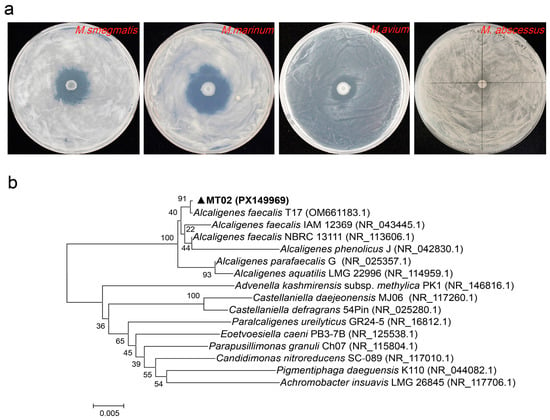
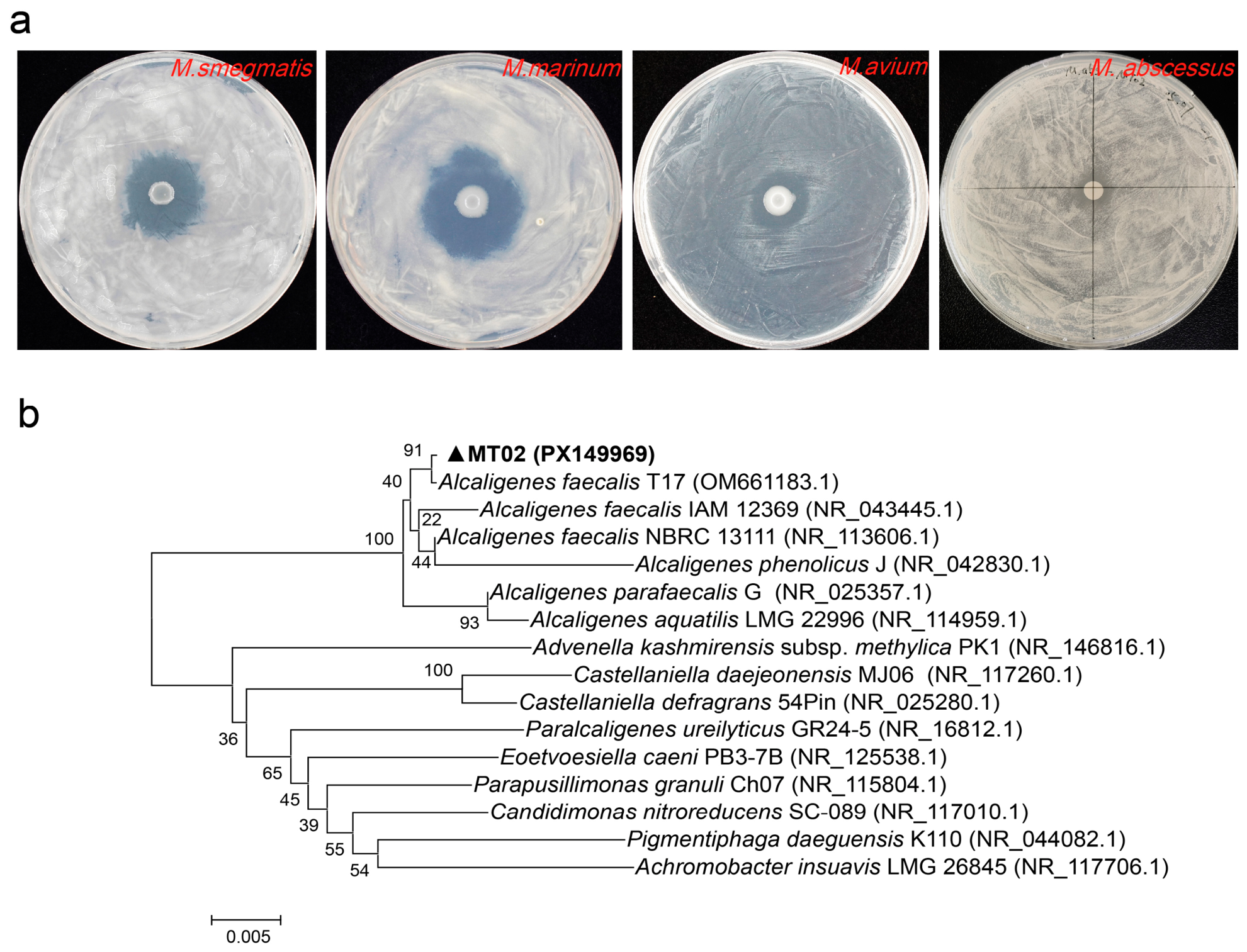
To test whether this strain antagonizes other NTM, 106 bacteria of M. smegmatis, M. abscessus, M. avium or M. marinum were spread on 7H10 plates, and 1 μL of MT02 (logarithmic growth phase, OD600 = 0.6–1.0) was seeded in the center of the plate. At first, only M. marinum plates showed a clear inhibition zone of 32.3 ± 1.5 mm in diameter. However, when other NTM plates were grown at 30 °C, M. smegmatis plates showed a clear inhibition zone of 21.7 ± 0.6 mm in diameter, M. avium plates showed a clear inhibition zone of 19.3 ± 1.5 mm in diameter, and M. abscessus showed a clear inhibition zone of 9.7 ± 1.5 mm in diameter (Figure 1a). These results suggesting that MT02 exhibited antagonism against NTM, and this antagonism was temperature-sensitive.
Figure 1.
Antagonistic activity and phylogenetic identification of A. faecalis MT02. (a) Inhibition zones of MT02 against M. smegmatis, M. marinum, M. avium, and M. abscessus on 7H10 plates. Approximately 106 bacteria of each NTM were spread on the plate, and 1 μL of MT02 (logarithmic growth phase, OD600 = 0.6–1.0) was spotted in the center. Plates were incubated at 30 °C. Plate diameter, 9 cm. (b) Maximum-likelihood phylogenetic tree based on 16S rRNA gene sequences showing the position of strain MT02 (indicated by a triangle) within the genus Alcaligenes. Bootstrap values (>50%) from 1000 replicates are shown at the nodes. Scale bar, 0.005 substitutions per site. Accession numbers are indicated after species names.
With the NCBI BLAST tool, the 16S rRNA gene sequence of MT02 was found to be 100% identical to Alcaligenes faecalis strain T17 (OM661183.1) (Figure 1b) and 99.93% identical to reference strain Alcaligenes faecalis ZD02 (CP013119.1). This finding indicated that strain MT02 belongs to the species Alcaligenes faecalis.
3.2. MT02 Supernatant Had Same Antibacterial Pattern with Hydroxylamine
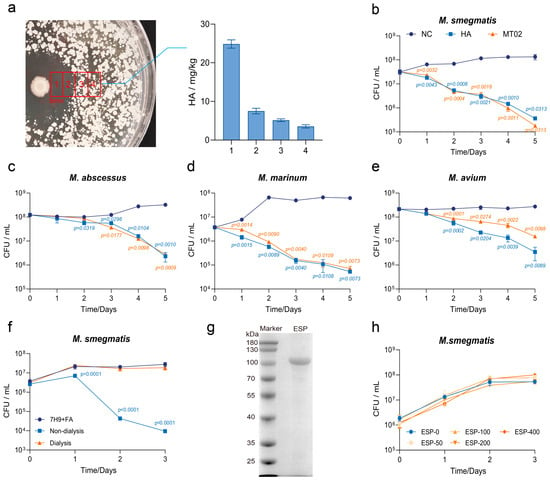
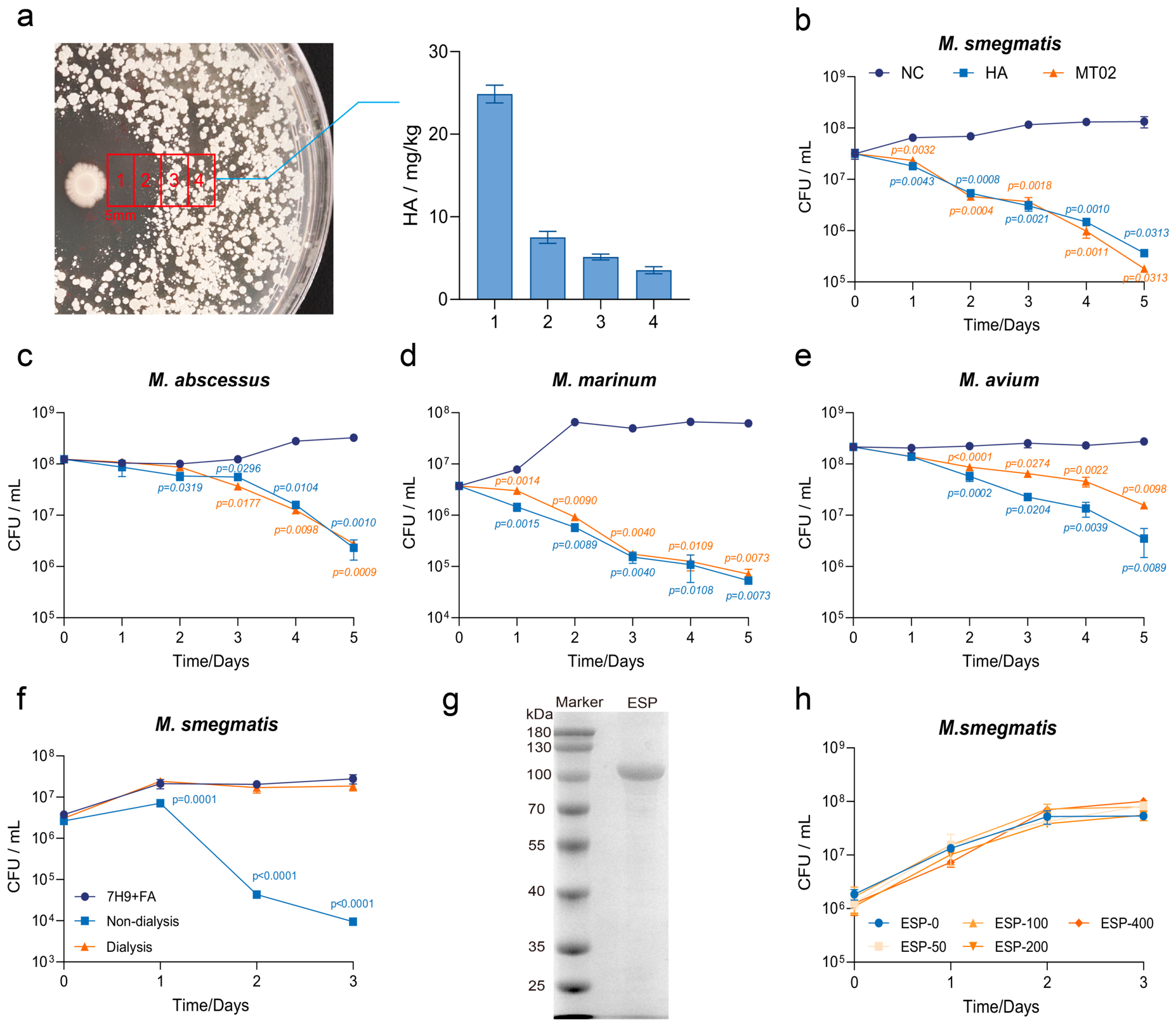
To determine whether the anti-NTM activity of MT02 is associated with HA production, agar blocks were excised at increasing distances from the center of the inhibition zone and homogenized, and the HA concentration was measured using the 1,10-phenanthroline-Fe (III) spectrophotometric method. At the center of the inhibition zone, the HA concentration reached 24.8 ± 1.0 mg/kg and gradually decreased with increasing distance (Figure 2a). These results indicated that A. faecalis MT02 secretes HA, and that the HA concentration is positively correlated with the antibacterial effect.
Figure 2.
Hydroxylamine is the major effector mediating the anti-NTM activity of MT02. (a) Spatial distribution of HA around the inhibition zone. Agar blocks were excised at 5 mm intervals from the center (zones 1–4), homogenized, and HA concentration was measured using the 1,10-phenanthroline–Fe (III) method. Data are presented as mean ± SD (n = 3). (b–e) Time–kill curves of HA (60 mg/L) and MT02 supernatant against M. smegmatis (b), M. abscessus (c), M. marinum (d), and M. avium (e). NTM were resuspended in fresh HA or MT02 supernatant every 24 h. Data are presented as mean ± SD (n = 3). p values were determined by two-way ANOVA followed by Dunnett’s multiple comparisons test. (f) Time–kill curve of non-dialyzed supernatant, dialyzed supernatant, and fresh 7H9+FA medium against M. smegmatis. Dialysis was performed using a 14 kDa MWCO membrane. Data are presented as mean ± SD (n = 3). p values were determined by two-way ANOVA followed by Dunnett’s test. (g) SDS-PAGE analysis of purified recombinant extracellular serine protease (ESP). Molecular weight markers (kDa) are indicated on the left. (h) Time–kill curve of M. smegmatis treated with purified ESP at 0, 50, 100, 200, and 400 μg/mL. Data are presented as mean ± SD (n = 3). No significant difference was observed among groups (two-way ANOVA followed by Dunnett’s test).
At 30 °C, both MT02 supernatant and HA exhibited similar bactericidal effects against NTM, killing 99% of M. smegmatis, M. abscessus, and M. marinum within 5 days (Figure 2b–d), and 90% of M. avium (Figure 2e).
To further confirm that the bactericidal activity of MT02 supernatant was attributable to small molecules rather than secreted proteins, the supernatant collected from 7H9 medium supplemented with fatty acids at 16 h was dialyzed against sterile 7H9+FA medium using a 14 kDa MWCO dialysis membrane. The HA concentration in the dialyzed supernatant decreased to 1.4 ± 0.7 mg/L, whereas the non-dialyzed supernatant retained a high HA concentration (48.6 ± 3.9 mg/L). Consistently, in the time–kill assay against M. smegmatis, the non-dialyzed supernatant significantly reduced the CFU from approximately 107 CFU/mL to 104 CFU/mL within 3 days, whereas the dialyzed supernatant showed markedly reduced bactericidal activity, with CFU levels comparable to those of fresh 7H9+FA medium (Figure 2f). These results suggest that the anti-NTM activity of MT02 supernatant is mainly mediated by small molecules that can pass through the 14 kDa dialysis membrane, among which HA is the major effector.
To further test whether secreted proteins contribute to anti-NTM activity, the extracellular serine protease (ESP) of A. faecalis MT02 was recombinantly expressed and purified. The purified ESP appeared as a single band on SDS-PAGE (Figure 2g) and was added to M. smegmatis cultures at final concentrations of 0, 50, 100, 200, and 400 μg/mL. No significant reduction in CFU was observed at any tested concentration during the 3-day incubation (Figure 2h), indicating that ESP is not the primary anti-NTM effector in MT02 supernatant.
3.3. The Hydroxylamine Secretion of A. faecalis MT02 Is Carbon Source-Dependent and Correlates with dnf Gene Expression
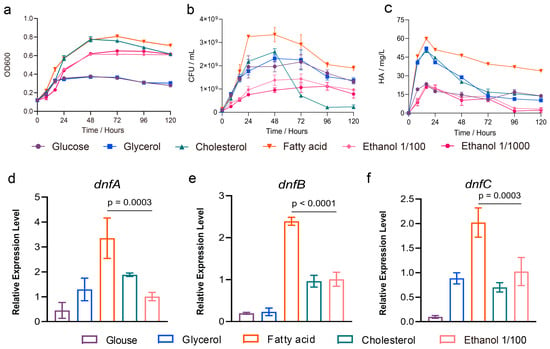
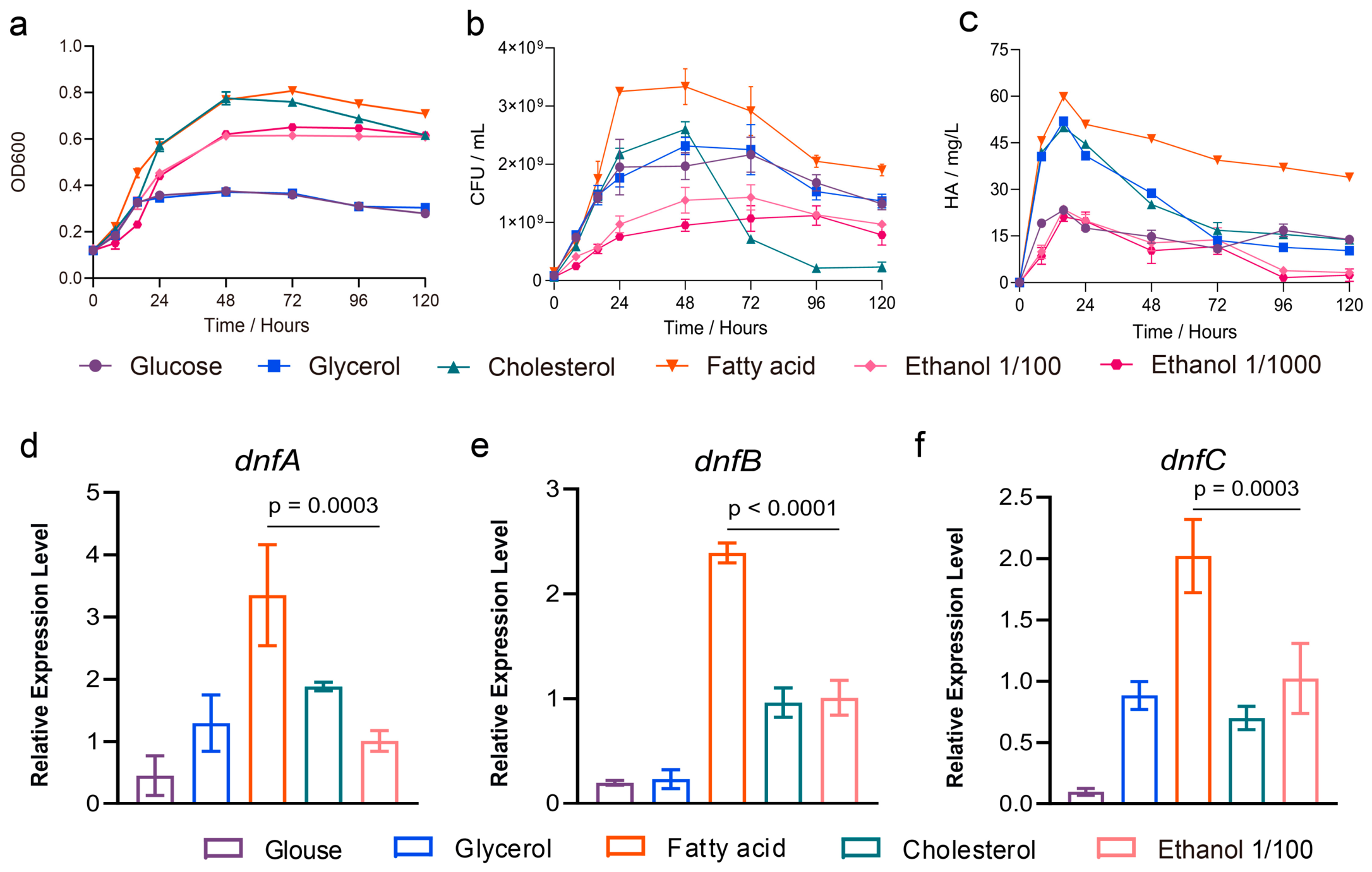
To determine the optimal conditions for HA production, we investigated the effect of different carbon sources on MT02. Bacteria were cultured in 7H9 medium with glucose, glycerol, fatty acids, or cholesterol as the sole carbon source. MT02 showed the fastest growth in fatty acid and cholesterol (Figure 3a). At 24 and 48 h, the CFU of MT02 in fatty acids was 1.8- and 1.6-fold higher than that in glucose, respectively (Figure 3b). Crucially, HA production was highest in fatty acids, reaching a maximum of ~60 mg/L at 16 h and maintaining a concentration above 30 mg/L until 120 h (Figure 3c). Glycerol and cholesterol supported moderate HA production (peaking at approximately 52 mg/L and 50 mg/L, respectively), while glucose and ethanol resulted in the lowest yields (approximately 23 mg/L).
Figure 3.
Carbon source-dependent HA production and dnfABC expression in A. faecalis MT02. (a) Growth curves of MT02 in 7H9 medium supplemented with different carbon sources. (b) CFU counts of MT02 at indicated time points. (c) HA production by MT02 cultured with different carbon sources over time. (d–f) Relative expression of dnfA (d), dnfB (e), and dnfC (f) in MT02 cultured with different carbon sources for 16 h, measured by RT-qPCR. The 16S rRNA gene was used as the reference. Data are presented as mean ± SD (n = 3). Statistical significance was evaluated using multiple t-tests.
To exclude potential matrix interference from complex medium components (e.g., glycerol, Tween, and fatty acids) on the Fe (III)-phenanthroline assay, standard curves were constructed in each corresponding carbon-source medium. All six standard curves showed excellent linearity (R2 ≥ 0.9998), and the differences in slope and intercept among media confirmed the necessity of matrix-matched calibration for accurate HA quantification (Figure S1 and Table S1).
To elucidate the molecular basis of this carbon source dependency, we examined the transcriptional levels of the dnfA, dnfB, and dnfC genes, which are essential for HA biosynthesis. RT-qPCR analysis revealed that the fatty acid group exhibited a significant and coordinated upregulation of all three genes, with expression levels increasing by 3.35-, 2.39-, and 2.02-fold, respectively, compared to the ethanol control (Figure 3d–f). In contrast, while cholesterol upregulated dnfA (1.89-fold), it did not significantly affect dnfB or dnfC. Glycerol and glucose groups showed minimal to no upregulation of these genes. This pattern indicates that the superior HA production with fatty acids is associated with the specific and coordinated transcriptional activation of the dnfABC gene cluster. These results demonstrate that HA production in A. faecalis MT02 is carbon source-dependent, with fatty acids being the most suitable carbon source for promoting rapid growth and maximizing HA production through the upregulation of the dnf gene cluster.
3.4. Temperature-Dependent Hydroxylamine Production and Stability
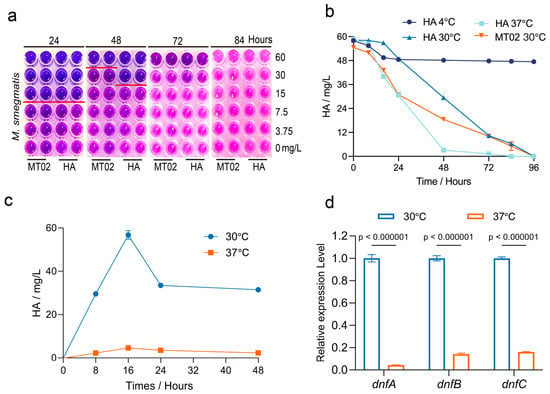
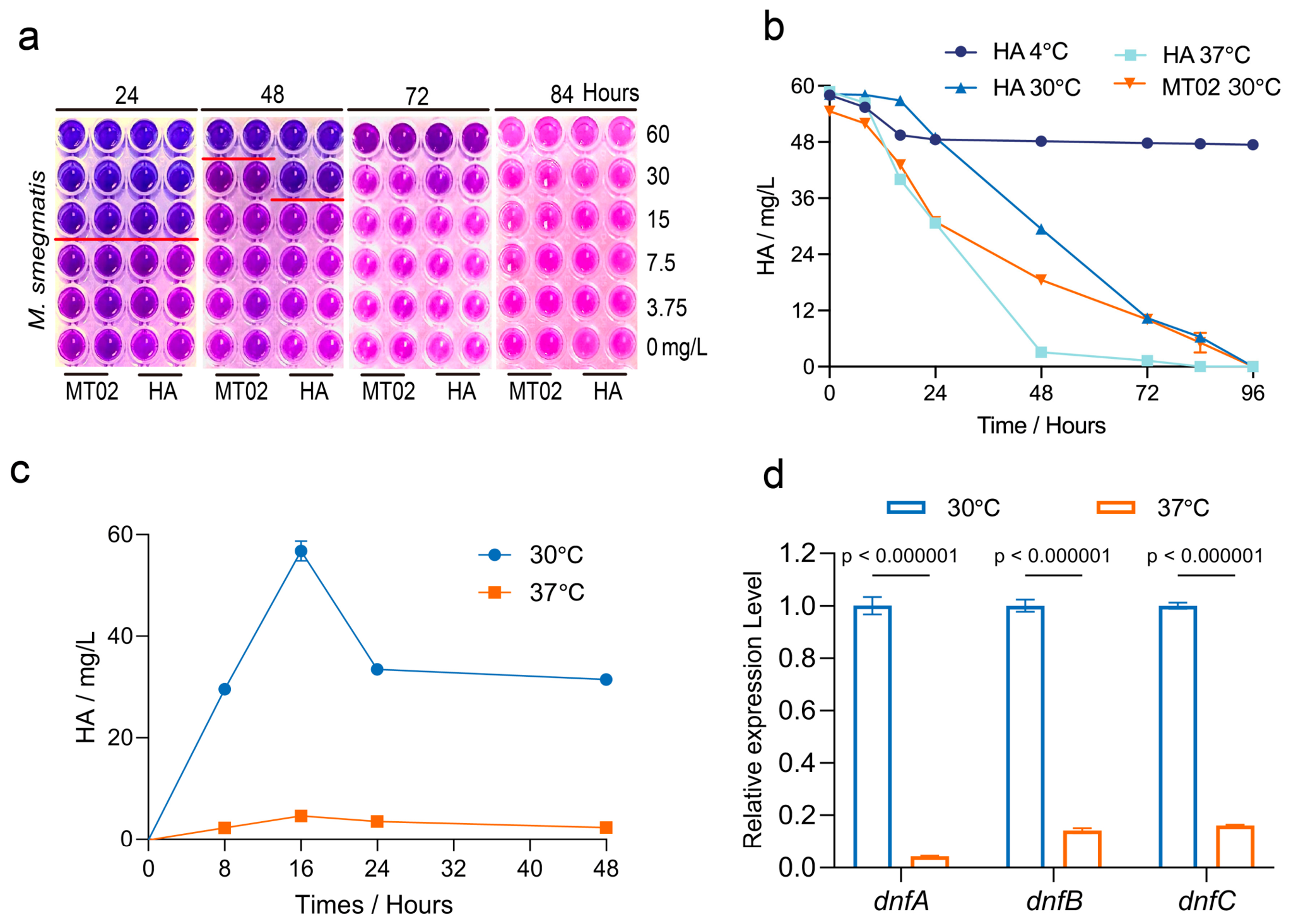
To determine the stability of HA and its contribution to the inhibitory effect over time, MT02 supernatant was harvested from fatty acid cultures at 16 h; hydroxylamine hydrochloride at 60 mg/L was used as a control. Both samples were then serially diluted 2-fold in 7H9 medium. Alamar blue was added immediately after the experiment. MT02 supernatant had the same inhibitory effect as hydroxylamine hydrochloride at 24 h. However, this inhibitory effect gradually diminished with time until it disappeared completely at 72 h (Figure 4a). This time-dependent loss of inhibitory activity prompted us to examine the stability of HA directly. As shown in Figure 4b, HA in MT02 supernatant and hydroxylamine hydrochloride both degraded over time at 30 °C, and pure HA degraded rapidly at 37 °C but remained relatively stable at 4 °C and 30 °C. These results indicate that HA is chemically unstable, especially at 37 °C, and that its degradation contributes to the time-dependent loss of antibacterial activity.
Figure 4.
Temperature-dependent HA production, stability, and dnfABC expression. (a) Alamar blue assay showing the inhibitory effects of MT02 supernatant (harvested from fatty acid cultures at 16 h) and hydroxylamine hydrochloride (60 mg/L) against M. smegmatis after 2-fold serial dilution at 24, 48, 72, and 84 h. Red lines indicate the boundary between growth and no growth. Blue: no growth; pink or purple: growth. (b) Degradation curves of HA in MT02 supernatant and hydroxylamine hydrochloride at 4 °C, 30 °C, and 37 °C. (c) HA production by MT02 cultured in 7H9 medium with fatty acids at 30 °C and 37 °C. (d) Relative expression of dnfA, dnfB, and dnfC in MT02 cultured at 30 °C and 37 °C for 4 h. Data are presented as mean ± SD (n = 3). p values were determined by two-way ANOVA followed by Dunnett’s test (a–c) or multiple t-tests (d).
In addition, we examined HA production and dnfABC expression at 30 °C and 37 °C. MT02 was cultured in 7H9 medium with fatty acids at 30 °C or 37 °C, and HA production was monitored over time. At 30 °C, HA accumulated rapidly and peaked at approximately 55–60 mg/L at 16 h, remaining above 30 mg/L until 48 h. In contrast, at 37 °C, HA production was markedly lower, with the concentration remaining below 5 mg/L throughout the entire culture period (Figure 4c). These results indicate that MT02 produces much less HA at 37 °C than at 30 °C. The transcription of all three dnfABC genes was downregulated at 37 °C compared with 30 °C after 4 h, with relative expression levels reduced by more than 85% for each gene (Figure 4d). This finding suggests that the temperature sensitivity of MT02 antagonism is primarily caused by reduced dnfABC expression and consequently lower HA synthesis at 37 °C, rather than by faster HA degradation alone.
3.5. Whole Genome Sequencing of Alcaligenes faecalis MT02
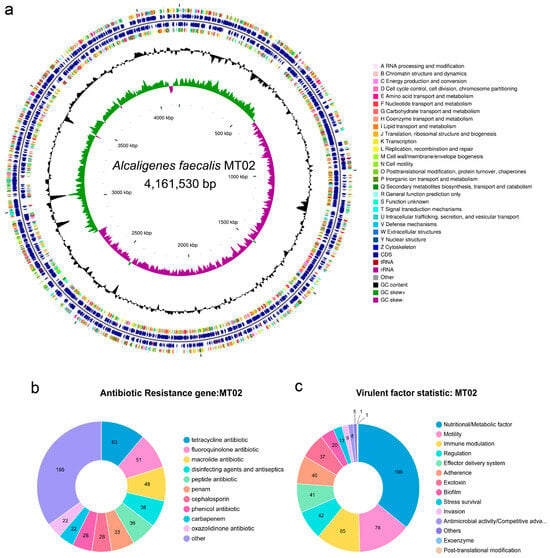
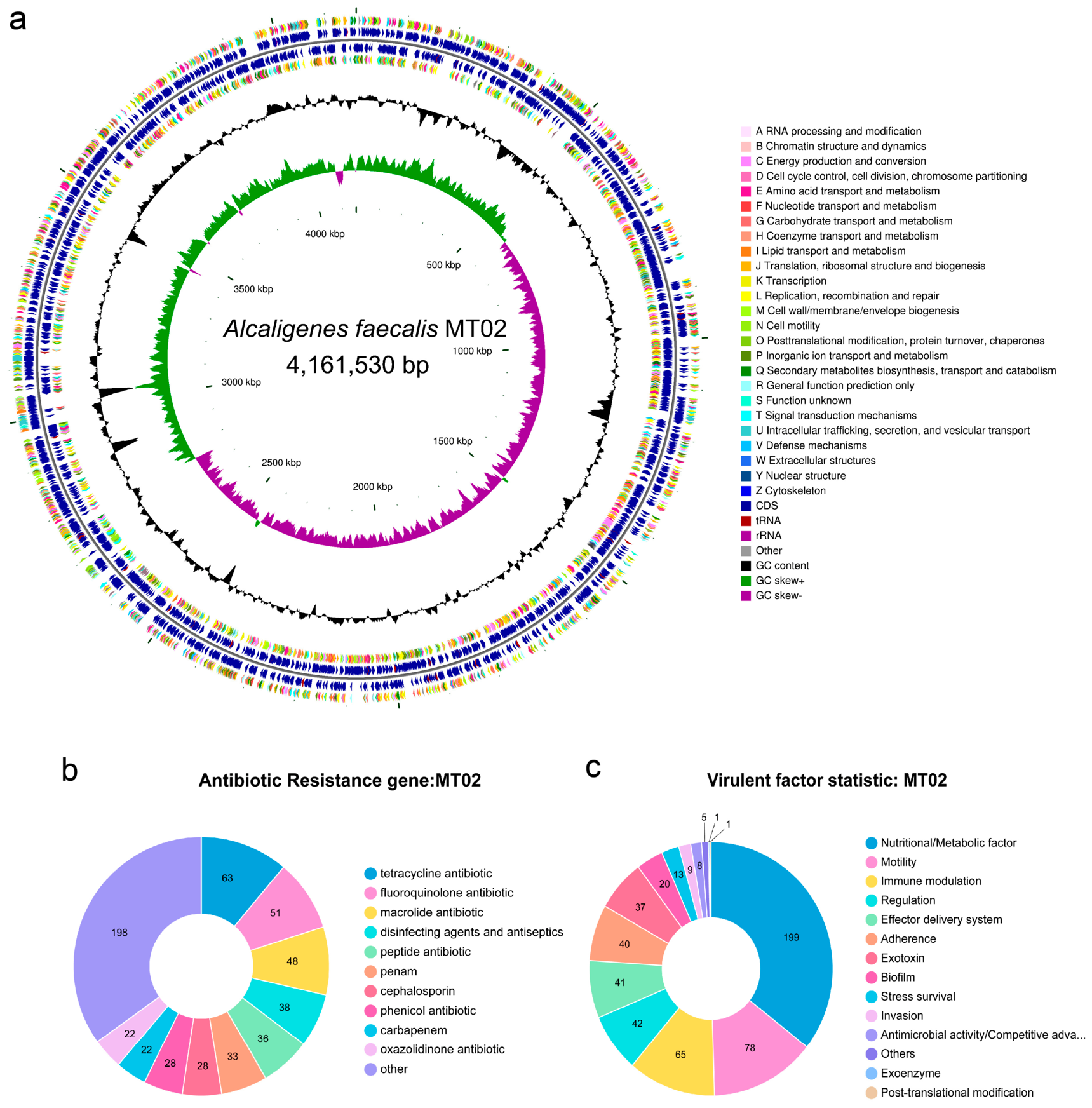
The complete genome of MT02 was sequenced by next generation sequencing (NGS). A total of 7,323,058 raw reads with 1,105,781,758 bp raw bases were obtained, and the genome coverage was 265×. We obtained a total of 7,088,212 clean reads with 1,069,235,251 bp clean bases after quality trimming. After de novo assembly, 22 scaffolds were obtained; the largest scaffold had 1,652,011 bp. The genome assembly was assessed for completeness using Benchmarking Universal Single-Copy Orthologs (BUSCO v6.0.0) and CheckM v1.1.6 [29], both of which indicated 100% completeness. The draft genome obtained had a total length of 4,161,530 bp, with a GC content of 56.69% (Figure 5a). The scaffold N50 and N75 values were 1,103,769 bp and 350,523 bp, respectively. There was no presence of plasmids. We found 3797 CDS, 2 rRNA, 55 tRNA, 1 16sRNA, 26 sRNA, 31 house-keeping genes, 7 DNA transposon and 87 tandem repeats in the MT02 genome. By comparing the Comprehensive Antibiotic Resistance Database (CARD, https://card.mcmaster.ca/, accessed on 25 November 2024.), 286 potential antibiotic resistance genes were predicted in silico (Figure 5b). By comparing the Virulence Factor Database (VFDB, https://www.mgc.ac.cn/VFs/, accessed on 25 November 2024.), 559 potential virulence factors were predicted in silico (Figure 5c).
Figure 5.
Whole-genome sequencing of A. faecalis MT02. (a) Circular genome map of MT02. The genome consists of a 4,161,530 bp chromosome with a GC content of 56.69%. (b) Distribution of potential antibiotic resistance genes in silico predicted by comparison with the Comprehensive Antibiotic Resistance Database (CARD). (c) Distribution of potential virulence factors in silico predicted by comparison with the Virulence Factor Database (VFDB).
The taxonomic affiliation of the draft genome sequence of strain MT02 was determined using GTDB-Tk v2.3.0 against the GTDB R214 database [30]. Strain MT02 was unambiguously classified as Alcaligenes faecalis. The ANI value between MT02 genome and Alcaligenes faecalis DSM 30030 (accession number: GCF_002443155.1), was 97.54%, significantly exceeding the 95% species threshold. This result further supports MT02 assignment to Alcaligenes faecalis.
The raw sequence data reported in this paper have been deposited in the Genome Sequence Archive in the National Genomics Data Center [31], China National Center for Bioinformation/Beijing Institute of Genomics, Chinese Academy of Sciences (GSA: CRA025924), which are publicly accessible at https://ngdc.cncb.ac.cn/gsa, accessed on 26 October 2026. The Sequence Read Archive (SRA) data of MT02 genome have also been deposited in NCBI with accession number PRJNA1308543.
4. Discussion
In this study, we demonstrate that A. faecalis MT02, isolated from mouse tail tissue, exerts a broad-spectrum antagonistic effect against clinically relevant NTM species, including M. smegmatis, M. abscessus, M. marinum, and M. avium. Our investigation provides comprehensive evidence that this antagonism is mainly mediated by the secretion of hydroxylamine (HA). The evidence includes (i) the spatial correlation between HA concentration and the inhibition zone, (ii) the functional equivalence of MT02 supernatant and pure HA in time–kill assays, (iii) the loss of bactericidal activity after dialysis-mediated removal of small molecules, including HA, and (iv) the temperature-dependent reduction in HA production and dnfABC expression at 37 °C. These findings are consistent with previous studies on Alcaligenes ammonioxydans HO-1 and establish HA as a key effector molecule in the A. faecalis antagonistic repertoire [22].
Several antimicrobial metabolites, including ectoine, bacillibactin, quinolobactin, and burkholderic acid, have been tentatively identified in A. faecalis by LC/MS and metagenomic sequencing [15], but their individual antimicrobial activities were not validated. It has been reported that M. smegmatis synthesizes ectoine and hydroxyectoine to protect itself against elevated salinity [32]. This further argues against the role of ectoine in MT02-mediated NTM inhibition, as ectoine functions as a compatible solute rather than an antimicrobial agent. Bacillibactin has been reported to inhibit M. smegmatis with an MIC of 22.15 μM, corresponding to approximately 19.6 μg/mL based on its molecular weight [33]. However, in Eltokhy et al., the peak corresponding to bacillibactin (peak 53 in Figure 1) was not a major metabolite peak, making it unlikely that its natural concentration reached 22.15 μM under their fermentation conditions [15]. In addition, bacillibactin biosynthesis is tightly regulated by iron availability: its production is repressed when environmental iron is sufficient and is induced only under iron limitation [34,35]. In our experiments, the 7H9 medium contained approximately 5–6 μM iron, which would be sufficient to suppress bacillibactin production. Furthermore, bacillibactin biosynthesis has been characterized in Parageobacillus sp. KH3-4, a thermophilic bacterium that grows at 65 °C [36], indicating that this compound is relatively thermostable. This thermostability is inconsistent with the temperature-sensitive antagonistic phenotype observed in our study. For the remaining two compounds, quinolobactin and burkholderic acid, no anti-mycobacterial activity has been reported to date. Nonetheless, whether these metabolites inhibit NTM, or whether they can accumulate to effective inhibitory concentrations under the fermentation conditions used in this study, remains to be further investigated.
The role of secreted proteins in MT02 antagonism was also examined. Dialysis of MT02 supernatant using a 14 kDa MWCO membrane removed HA and markedly reduced bactericidal activity, whereas the non-dialyzed supernatant retained potent activity. This suggests that small molecules, rather than large proteins, are the main contributors to anti-NTM activity. To specifically test the contribution of the extracellular serine protease (ESP), recombinant ESP was purified and tested against M. smegmatis at concentrations up to 400 μg/mL. No significant reduction in CFU was observed, indicating that ESP is not the primary anti-NTM effector under the tested conditions. These results are consistent with the dialysis experiment and support HA as the major effector molecule. However, synergistic effects between HA and other minor metabolites cannot be completely excluded, and further fractionation and combination studies would be needed to fully address this possibility.
M. abscessus, M. marinum, and M. avium are waterborne pathogens commonly found in natural and man-made water systems, including wastewater and aquaculture environments [9]. The spread of these opportunistic pathogens through water sources poses a continuous public health risk [11]. Interestingly, A. faecalis is also a common inhabitant of these environments and is known for its role in the degradation of organic matter and pollutants in waste treatment [37]. Our results raise the intriguing possibility that A. faecalis plays a dual role in such ecosystems: it not only contributes to waste decomposition but may also actively suppress the survival and dissemination of waterborne NTM through HA secretion. This suggests a potential ecological role for A. faecalis in biocontrol, particularly in managing pathogenic mycobacteria in wastewater and agricultural settings [23]. However, no environmental assays or field-relevant models were included in this study, and these ecological claims should be considered speculative at this stage.
The reduced HA production and rapid degradation at 37 °C, as demonstrated in our temperature-dependent assays, suggest that its efficacy would be compromised in homeothermic hosts like mammals, limiting its potential as a therapeutic agent for internal infections. However, this limitation does not preclude its utility in other contexts. The potent bactericidal activity observed at 30 °C is particularly relevant for poikilothermic animals, such as fish and other aquatic organisms, which are susceptible to M. marinum infections. Given that Alcaligenes species have been studied as probiotics in aquaculture [38], our findings suggest that A. faecalis MT02, or its HA-producing capability, holds considerable promise as a biocontrol strategy in aquaculture to combat mycobacteriosis, a disease that causes significant economic losses [10]. Nevertheless, these applications remain hypothetical, as no in vivo validation or dose–response analysis was performed in this study. Future work should include dose–response experiments for HA, evaluation of its stability under relevant environmental conditions, and in vivo efficacy and safety testing in suitable animal models.
While the application potential is evident, the safety of applying live A. faecalis MT02 is a significant concern. Our whole-genome sequencing analysis predicted in silico 286 potential antibiotic resistance genes and 559 potential virulence factors, which is consistent with the known opportunistic pathogenicity of A. faecalis in immunocompromised individuals [39]. No phenotypic validation was performed in this study. Therefore, these annotations are reported as in silico predicted potential ARGs/VFs, rather than as confirmed resistance or virulence determinants. Experimental validation, such as antimicrobial susceptibility testing and virulence assays, is required before any functional conclusion can be drawn. This genomic signature presents a substantial hurdle for its direct use as a live biocontrol agent. Previous studies have successfully cloned and expressed the dnfABC gene cluster, which is responsible for HA production, in Escherichia coli [40]. This genetic engineering approach offers a clear pathway to circumvent the safety issues associated with the native A. faecalis strain. By transferring the minimal genetic machinery for HA production into a well-characterized, non-pathogenic, and non-resistant host like E. coli, we could potentially harness the potent antimicrobial activity of HA without the genetic risks of resistance transfer or virulence. Such a genetically engineered strain could be a safe and highly effective platform for producing HA or for direct application in a controlled manner. A further limitation of this study is that the cytotoxicity of HA/MT02 and its impact on host or environmental microbial communities was not evaluated. However, these safety implications remain hypothetical, as no functional assays or risk evaluation were performed in this study. Future work should include cytotoxicity testing, host-range determination, and stability assessment of HA production in heterologous hosts before any application can be considered.
Beyond the ecological and application perspectives, our investigation into carbon source dependency provides insights into the metabolic regulation of HA production. Fatty acids not only supported the fastest growth but also uniquely enabled coordinated upregulation of all three genes in the dnfABC cluster. Degraded via β-oxidation, fatty acids generate substantial pools of NADH and FADH2, providing the reducing power required by the DnfA–DnfB coupled monooxygenase system [41,42]. This ensures that electron transfer from NAD(P)H to DnfA is not rate-limiting, allowing enhanced dnfABC transcription to be translated into high HA yields. In contrast, the poor performance of glucose can be explained by carbon catabolite repression (CCR). Glucose, as a preferred carbon source, suppresses genes involved in the utilization of less preferred substrates and secondary metabolic pathways [43]. The dnfABC cluster, linked to nitrogen metabolism and secondary metabolite production, appears subject to this global regulation [21,41,42]. Glucose metabolism directs flux primarily towards biomass and energy generation, simultaneously repressing dnf transcription [44,45], which explains why the glucose group showed moderate growth but the lowest HA titers and minimal dnf expression.
It should be noted, however, that the causal relationship between dnfABC and HA production in MT02 is currently supported mainly by transcriptional correlation rather than genetic evidence. Notably, in A. faecalis JQ135, deletion and complementation of dnfABC demonstrated that this cluster is responsible for ammonia oxidation to N2 via HA [41], supporting a biochemically defined link between dnfABC and HA production; however, this was not genetically tested in MT02. In the present study, no dnfABC knockout or silencing strain was constructed for MT02, and DnfA/B/C protein levels and enzyme activities were not determined. In addition, glycerol and cholesterol supported moderate HA production (51.9 ± 0.4 mg/L and 49.9 ± 0.7 mg/L, respectively) without coordinated upregulation of all three dnf genes; the cholesterol group even showed a 1.89-fold increase in dnfA but no significant change in dnfB or dnfC. These discrepancies suggest that alternative routes, such as the pyruvic oxime dioxygenase (POD) bypass pathway [46], may partially contribute to HA production under certain carbon sources, although POD gene expression and enzyme activity were not measured and this possibility remains speculative. Overall, our results indicate that carbon source selection determines HA production by modulating both the reducing-equivalent pool and the transcription of core biosynthetic genes, with fatty acids being optimal for maximizing dnfABC expression and HA output. The precise regulatory network and the potential contribution of alternative pathways nonetheless require further investigation.
In conclusion, this study advances our understanding of the antagonistic mechanism of A. faecalis against NTM, identifies HA as the principal effector molecule, and underscores that HA production is regulated by both carbon source and temperature. The work highlights the potential ecological role of A. faecalis in controlling waterborne mycobacteria and suggests a promising, but indirect, application in aquaculture. The safety concerns raised by the genome sequence can be addressed through synthetic biology approaches, such as engineering the dnf pathway into safe production hosts. Future research should focus on optimizing this heterologous expression system and evaluating the efficacy and safety of the engineered strains in relevant in vivo models.
Supplementary Materials
The following supporting information can be downloaded at https://www.mdpi.com/article/10.3390/vetsci13111158/s1, Figure S1: Standard curves for HA quantification in different carbon-source media; Table S1: Standard curves for hydroxylamine quantification in different carbon-source media.
Author Contributions
Conceptualization, L.W. and Z.W.; Methodology, L.W., M.H., J.J. and Z.W.; Software, L.W.; Validation, L.W., M.H., J.J. and Z.W.; Formal analysis, L.W., M.H., J.J. and Z.W.; Investigation, L.W., M.H., J.J., K.X. and Z.W.; Resources, Z.W.; Data curation, M.H., J.J. and K.X.; Writing—original draft, L.W. and Z.W.; Writing—review and editing, L.W. and Z.W.; Visualization, L.W. and M.H.; Supervision, Z.W.; Project administration, L.W. and Z.W.; Funding acquisition, Z.W. All authors have read and agreed to the published version of the manuscript.
Funding
This research was supported by grants from the National Natural Science Foundation of China (No. 32673973 and No. 32070128), the Science and Technology for Agriculture Key Project of the Shanghai Municipal Commission of Agriculture and Rural Affairs (No. 2025-02-08-00-12-F00031), and the National Key Research and Development Plans of China (No. 2021YFD1800401).
Institutional Review Board Statement
Not applicable.
Informed Consent Statement
Not applicable.
Data Availability Statement
The original contributions presented in this study are included in the article/Supplementary Materials. Further inquiries can be directed to the corresponding author.
Conflicts of Interest
The authors declare no conflicts of interest.
References
- Granato, E.T.; Meiller-Legrand, T.A.; Foster, K.R. The Evolution and Ecology of Bacterial Warfare. Curr. Biol. 2019, 29, R521–R537. [Google Scholar] [CrossRef] [Scilit] [PubMed]
- Lin, H.-H.; Filloux, A.; Lai, E.-M. Role of Recipient Susceptibility Factors During Contact-Dependent Interbacterial Competition. Front. Microbiol. 2020, 11, 603652. [Google Scholar] [CrossRef] [Scilit] [PubMed]
- Klein, T.A.; Ahmad, S.; Whitney, J.C. Contact-Dependent Interbacterial Antagonism Mediated by Protein Secretion Machines. Trends Microbiol. 2020, 28, 387–400. [Google Scholar] [CrossRef] [Scilit] [PubMed]
- Yim, S.S.; Wang, H.H. Exploiting Interbacterial Antagonism for Microbiome Engineering. Curr. Opin. Biomed. Eng. 2021, 19, 100307. [Google Scholar] [CrossRef] [Scilit] [PubMed]
- Katz, L.; Baltz, R.H. Natural Product Discovery: Past, Present, and Future. J. Ind. Microbiol. Biotechnol. 2016, 43, 155–176. [Google Scholar] [CrossRef] [Scilit] [PubMed]
- Jangra, M.; Travin, D.Y.; Aleksandrova, E.V.; Kaur, M.; Darwish, L.; Koteva, K.; Klepacki, D.; Wang, W.; Tiffany, M.; Sokaribo, A.; et al. A Broad-Spectrum Lasso Peptide Antibiotic Targeting the Bacterial Ribosome. Nature 2025, 640, 1022–1030, Correction in Nature 2025, 645, E11. [Google Scholar] [CrossRef] [Scilit] [PubMed]
- Hover, B.M.; Kim, S.-H.; Katz, M.; Charlop-Powers, Z.; Owen, J.G.; Ternei, M.A.; Maniko, J.; Estrela, A.B.; Molina, H.; Park, S.; et al. Culture-Independent Discovery of the Malacidins as Calcium-Dependent Antibiotics with Activity against Multidrug-Resistant Gram-Positive Pathogens. Nat. Microbiol. 2018, 3, 415–422. [Google Scholar] [CrossRef] [Scilit] [PubMed]
- Freire-Moran, L.; Aronsson, B.; Manz, C.; Gyssens, I.C.; So, A.D.; Monnet, D.L.; Cars, O.; ECDC-EMA Working Group. Critical Shortage of New Antibiotics in Development against Multidrug-Resistant Bacteria-Time to React Is Now. Drug Resist. Updat. 2011, 14, 118–124. [Google Scholar] [CrossRef] [Scilit] [PubMed]
- Honda, J.R.; Virdi, R.; Chan, E.D. Global Environmental Nontuberculous Mycobacteria and Their Contemporaneous Man-Made and Natural Niches. Front. Microbiol. 2018, 9, 2029. [Google Scholar] [CrossRef] [Scilit] [PubMed]
- Gcebe, N.; Michel, A.L.; Hlokwe, T.M. Non-Tuberculous Mycobacterium Species Causing Mycobacteriosis in Farmed Aquatic Animals of South Africa. BMC Microbiol. 2018, 18, 32. [Google Scholar] [CrossRef] [Scilit] [PubMed]
- LeChevallier, M.W.; Prosser, T.; Stevens, M. Opportunistic Pathogens in Drinking Water Distribution Systems—A Review. Microorganisms 2024, 12, 916. [Google Scholar] [CrossRef] [Scilit] [PubMed]
- Reil, I.; Špičić, S.; Duvnjak, S.; Zdelar-Tuk, M.; Naletilić, Š.; Kompes, G.; Dopuđ, M. Non-Tuberculous Mycobacteria at the Human–Animal–Environment Interface: Antimicrobial Resistance, Environmental Persistence and Cross-Species Exposure Risks. Antibiotics 2026, 15, 467. [Google Scholar] [CrossRef] [Scilit] [PubMed]
- Zheng, J.; Zhou, C.; Li, Z.; Jin, X.; Zou, Y.; Bai, S.; Zheng, H.; Ling, W.; Zhao, Y.; Wang, Y.; et al. Alcaligenes Faecalis Promotes Colitis to Colorectal Cancer Transition through IgA+ B Cell Suppression and Vinculin Acetylation. Gut Microbes 2025, 17, 2473511. [Google Scholar] [CrossRef] [Scilit] [PubMed]
- Abdelgalil, S.A.; Attia, A.R.; Reyed, R.M.; Soliman, N.A. Partial Purification and Biochemical Characterization of a New Highly Acidic NYSO Laccase from Alcaligenes Faecalis. J. Genet. Eng. Biotechnol. 2020, 18, 79. [Google Scholar] [CrossRef] [Scilit] [PubMed]
- Eltokhy, M.A.; Saad, B.T.; Eltayeb, W.N.; El-Ansary, M.R.; Aboshanab, K.M.; Ashour, M.S.E. A Metagenomic Nanopore Sequence Analysis Combined with Conventional Screening and Spectroscopic Methods for Deciphering the Antimicrobial Metabolites Produced by Alcaligenes Faecalis Soil Isolate MZ921504. Antibiotics 2021, 10, 1382. [Google Scholar] [CrossRef] [Scilit] [PubMed]
- Maré, I.J.; Coetzee, J.N. Antibiotics of Alcaligenes Faecalis. Nature 1964, 203, 430–431. [Google Scholar] [CrossRef] [Scilit] [PubMed]
- Ilham, Z.; Abdellah, H.; Wifak, B.; Mohammed, I.; Saad, I. A Novel Alcaligenes Faecalis Antibacterial-Producing Strain Isolated from a Moroccan Tannery Waste. Afr. J. Microbiol. Res. 2013, 7, 5314–5323. [Google Scholar] [CrossRef] [Scilit]
- Kapley, A.; Tanksale, H.; Sagarkar, S.; Prasad, A.R.; Kumar, R.A.; Sharma, N.; Qureshi, A.; Purohit, H.J. Antimicrobial Activity of Alcaligenes Sp. HPC 1271 against Multidrug Resistant Bacteria. Funct. Integr. Genom. 2016, 16, 57–65. [Google Scholar] [CrossRef] [Scilit] [PubMed]
- El-Sayed, S.E.; Abdelaziz, N.A.; Alshahrani, M.Y.; El-Housseiny, G.S.; Aboshanab, K.M. Biologically Active Metabolites of Alcaligenes Faecalis: Diversity, Statistical Optimization, and Future Perspectives. Future Sci. OA 2024, 10, 2430452. [Google Scholar] [CrossRef] [Scilit] [PubMed]
- Ju, S.; Lin, J.; Zheng, J.; Wang, S.; Zhou, H.; Sun, M. Alcaligenes Faecalis ZD02, a Novel Nematicidal Bacterium with an Extracellular Serine Protease Virulence Factor. Appl. Environ. Microbiol. 2016, 82, 2112–2120. [Google Scholar] [CrossRef] [Scilit] [PubMed]
- Lenferink, W.B.; Bakken, L.R.; Jetten, M.S.M.; van Kessel, M.A.H.J.; Lücker, S. Hydroxylamine Production by Alcaligenes Faecalis Challenges the Paradigm of Heterotrophic Nitrification. Sci. Adv. 2024, 10, eadl3587. [Google Scholar] [CrossRef] [Scilit] [PubMed]
- Gao, X.-Y.; Xie, W.; Liu, Y.; Ma, L.; Liu, Z.-P. Alcaligenes Ammonioxydans HO-1 Antagonizes Bacillus Velezensis via Hydroxylamine-Triggered Population Response. Front. Microbiol. 2022, 13, 920052. [Google Scholar] [CrossRef] [Scilit] [PubMed]
- Fernandes, H.M.Z.; Conceição, E.C.; da Silva, S.P.; Machado, E.; Sisco, M.C.; Sharma, A.; Lima, K.V.B.; da Conceição, M.L.; da Silva Carvalho, A.C.; Miranda, K.R.; et al. Whole-Genome Sequencing of Alcaligenes Faecalis HZ01, with Potential to Inhibit Nontuberculous Mycobacterial Growth. Microbiol. Resour. Announc. 2021, 10, e0052121. [Google Scholar] [CrossRef] [Scilit] [PubMed]
- Carlsson, F.; Kim, J.; Dumitru, C.; Barck, K.H.; Carano, R.A.D.; Sun, M.; Diehl, L.; Brown, E.J. Host-Detrimental Role of Esx-1-Mediated Inflammasome Activation in Mycobacterial Infection. PLoS Pathog. 2010, 6, e1000895. [Google Scholar] [CrossRef] [Scilit] [PubMed]
- Kimura, M. A Simple Method for Estimating Evolutionary Rates of Base Substitutions through Comparative Studies of Nucleotide Sequences. J. Mol. Evol. 1980, 16, 111–120. [Google Scholar] [CrossRef] [Scilit] [PubMed]
- Kumar, S.; Stecher, G.; Tamura, K. MEGA7: Molecular Evolutionary Genetics Analysis Version 7.0 for Bigger Datasets. Mol. Biol. Evol. 2016, 33, 1870–1874. [Google Scholar] [CrossRef] [Scilit] [PubMed]
- Wang, L.; Xu, Y.; Wang, Z. Identification of Novel Mutations Associated with Bedaquiline Resistance in Mycobacterium marinum. Zoonoses 2023, 3, 993. [Google Scholar] [CrossRef] [Scilit]
- Hu, B.; Tian, X.L.; Shi, W.N.; Zhao, J.Q.; Wu, P.; Mei, S.T. Spectrophotometric Determination of Hydroxylamine in Biological Wastewater Treatment Processes. Int. J. Environ. Sci. Technol. 2018, 15, 323–332. [Google Scholar] [CrossRef] [Scilit]
- Parks, D.H.; Imelfort, M.; Skennerton, C.T.; Hugenholtz, P.; Tyson, G.W. CheckM: Assessing the Quality of Microbial Genomes Recovered from Isolates, Single Cells, and Metagenomes. Genome Res. 2015, 25, 1043–1055. [Google Scholar] [CrossRef] [Scilit] [PubMed]
- Chaumeil, P.-A.; Mussig, A.J.; Hugenholtz, P.; Parks, D.H. GTDB-Tk: A Toolkit to Classify Genomes with the Genome Taxonomy Database. Bioinformatics 2019, 36, 1925–1927. [Google Scholar] [CrossRef] [Scilit] [PubMed]
- CNCB-NGDC Members and Partners Database Resources of the National Genomics Data Center, China National Center for Bioinformation in 2022. Nucleic Acids Res. 2022, 50, D27–D38. [Google Scholar] [CrossRef] [Scilit] [PubMed]
- Ofer, N.; Wishkautzan, M.; Meijler, M.; Wang, Y.; Speer, A.; Niederweis, M.; Gur, E. Ectoine Biosynthesis in Mycobacterium Smegmatis. Appl. Environ. Microbiol. 2012, 78, 7483–7486. [Google Scholar] [CrossRef] [Scilit] [PubMed]
- Nalli, Y.; Singh, S.; Gajjar, A.; Mahizhaveni, B.; Dusthackeer, V.N.A.; Shinde, P.B. Bacillibactin Class Siderophores Produced by the Endophyte Bacillus Subtilis NPROOT3 as Antimycobacterial Agents. Lett. Appl. Microbiol. 2023, 76, ovac026. [Google Scholar] [CrossRef] [Scilit] [PubMed]
- Hoffmann, T.; Schütz, A.; Brosius, M.; Völker, A.; Völker, U.; Bremer, E. High-Salinity-Induced Iron Limitation in Bacillus Subtilis. J. Bacteriol. 2002, 184, 718–727. [Google Scholar] [CrossRef] [Scilit] [PubMed]
- Lee, J.Y.; Passalacqua, K.D.; Hanna, P.C.; Sherman, D.H. Regulation of Petrobactin and Bacillibactin Biosynthesis in Bacillus Anthracis under Iron and Oxygen Variation. PLoS ONE 2011, 6, e20777. [Google Scholar] [CrossRef] [Scilit] [PubMed]
- Izumi, M.; Tomita, H.; Miyazaki, K.; Otsuka, R.; Honda, K. Biosynthetic Characterization of Bacillibactin in Thermophilic Bacillaceae and Its Potential for in Vitro Mutational Synthesis. ChemBioChem 2025, 26, e202400836. [Google Scholar] [CrossRef] [Scilit] [PubMed]
- Maliehe, T.S.; Basson, A.K.; Dlamini, N.G. Removal of Pollutants in Mine Wastewater by a Non-Cytotoxic Polymeric Bioflocculant from Alcaligenes Faecalis HCB2. Int. J. Environ. Res. Public Health 2019, 16, 4001. [Google Scholar] [CrossRef] [Scilit] [PubMed]
- Gutiérrez-Falcón, A.I.; Ramos-Nuez, A.M.; de los Monteros y Zayas, A.E.; Castillo, D.F.P.; García-Laorden, M.I.; Chamizo-López, F.J.; Real Valcárcel, F.; Campelo, F.A.; Benítez, A.B.; Salgueiro, P.N.; et al. Probiotic Properties of Alcaligenes Faecalis Isolated from Argyrosomus Regius in Experimental Peritonitis (Rat Model). Probiotics Antimicrob. Proteins 2021, 13, 1326–1337. [Google Scholar] [CrossRef] [Scilit] [PubMed]
- Huang, C. Extensively Drug-Resistant Alcaligenes Faecalis Infection. BMC Infect. Dis. 2020, 20, 833. [Google Scholar] [CrossRef] [Scilit] [PubMed]
- Jia, W.; Jiang, T.; Huang, Y.; Deng, W.; Chen, X.; Xu, M. Microbial Ammonia Oxidation-Driven Hydroxyl Radical Generation Enables Efficient Degradation of Antibiotic Resistance Genes. Environ. Res. 2026, 306, 125318. [Google Scholar] [CrossRef] [Scilit] [PubMed]
- Xu, S.-Q.; Qian, X.-X.; Jiang, Y.-H.; Qin, Y.-L.; Zhang, F.-Y.; Zhang, K.-Y.; Hong, Q.; He, J.; Miao, L.-L.; Liu, Z.-P.; et al. Genetic Foundations of Direct Ammonia Oxidation (Dirammox) to N2 and MocR-Like Transcriptional Regulator DnfR in Alcaligenes Faecalis Strain JQ135. Appl. Environ. Microbiol. 2022, 88, e0226121. [Google Scholar] [CrossRef] [Scilit] [PubMed]
- Qin, Y.-L.; Liang, Z.-L.; Ai, G.-M.; Liu, W.-F.; Tao, Y.; Jiang, C.-Y.; Liu, S.-J.; Li, D.-F. Heterotrophic Nitrification by Alcaligenes Faecalis Links Organic and Inorganic Nitrogen Metabolism. ISME J. 2024, 18, wrae174. [Google Scholar] [CrossRef] [Scilit] [PubMed]
- Sonnleitner, E. A Comparative Analysis: Molecular Mechanisms of Carbon Catabolite Repression in Bacteria. Annu. Rev. Microbiol. 2025, 79, 241–262. [Google Scholar] [CrossRef] [Scilit] [PubMed]
- Ruiz-Villafán, B.; Cruz-Bautista, R.; Manzo-Ruiz, M.; Passari, A.K.; Villarreal-Gómez, K.; Rodríguez-Sanoja, R.; Sánchez, S. Carbon Catabolite Regulation of Secondary Metabolite Formation, an Old but Not Well-established Regulatory System. Microb. Biotechnol. 2022, 15, 1058–1072. [Google Scholar] [CrossRef] [Scilit] [PubMed]
- Cruz-Bautista, R.; Zelarayan-Agüero, A.; Ruiz-Villafán, B.; Escalante-Lozada, A.; Rodríguez-Sanoja, R.; Sánchez, S. An Overview of the Two-Component System GarR/GarS Role on Antibiotic Production in Streptomyces coelicolor. Appl. Microbiol. Biotechnol. 2024, 108, 306. [Google Scholar] [CrossRef] [Scilit] [PubMed]
- Tsujino, S.; Uematsu, C.; Dohra, H.; Fujiwara, T. Pyruvic Oxime Dioxygenase from Heterotrophic Nitrifier Alcaligenes Faecalis Is a Nonheme Fe(II)-Dependent Enzyme Homologous to Class II Aldolase. Sci. Rep. 2017, 7, 39991. [Google Scholar] [CrossRef] [Scilit] [PubMed]

Disclaimer/Publisher’s Note: The statements, opinions and data contained in all publications are solely those of the individual author(s) and contributor(s) and not of MDPI and/or the editor(s). MDPI and/or the editor(s) disclaim responsibility for any injury to people or property resulting from any ideas, methods, instructions or products referred to in the content. |
© 2026 by the authors. Licensee MDPI, Basel, Switzerland. This article is an open access article distributed under the terms and conditions of the Creative Commons Attribution (CC BY) license.