


Abstract
In this study, we report the draft genome sequence of Pseudomonas aeruginosa strain ASK-80, a multidrug-resistant bacterium isolated from municipal wastewater in Baddi, district Solan, Himachal Pradesh, India. The whole genome was sequenced through Illumina MiSeq sequencing (150 bp paired-end). The size of the assembled genome was 6,261,345 bp, and the genome annotation revealed 5834 genes, including 5778 CDSs, 5748 protein-coding genes, 56 RNA genes and 30 pseudo genes. Genomic characterization revealed the occurrence of multiple antibiotic resistance genes (blaOXA-396, blaOXA-486, blaOXA-494, blaPAO, blaPDC-8, aph(3′)-IIb, catB7, fosA and others), virulence genes (algB, chpA, clpV1, exsA, flgA, pilB, pvcA, toxA, tse1, and waaA), insertion sequences, transposable elements and phage sequences. This genome data may serve as a valuable resource for comparative genomics of P. aeruginosa and research on the antibiotic resistance surveillance of wastewater.
Dataset: The raw Illumina genome sequencing data were submitted to the NCBI Sequence Read Archive under BioSample accession number SAMN55291369 and BioProject accession number PRJNA1421991. The assembled genome has been deposited in NCBI under GenBank accession number JBVAPH000000000.
Dataset License: CC0
1. Summary
Pseudomonas aeruginosa is a Gram-negative bacterium which is frequently associated with biofilm production and hospital-acquired infections [1,2,3]. Its occurrence has been reported from both clinical settings and environmental habitats. The World Health Organization has listed P. aeruginosa as a high-priority pathogen belonging to the ESKAPEE group due to its growing multidrug resistance [3,4]. It has developed resistance to many commonly used antibiotics, including β-lactams, fluoroquinolones, aminoglycosides, macrolides, tetracyclines, and phenicols. The antibiotic resistance in P. aeruginosa is manifested through the production of β-lactamases, target alternation, antibiotic inactivation, and the over-expression of efflux pump genes [3,5]. Wastewater from households, hospitals, and healthcare serve as a reservoir of multidrug-resistant P. aeruginosa and play a role in transmission and dissemination of antibiotic resistance determinants among other environmental bacteria [6,7]. Therefore, the elucidation of underlying mechanisms and genetic determinants associated with multidrug antibiotic resistance in P. aeruginosa remains a critical priority in understanding its pathogenic potential and implementing the effective antimicrobial interventions.
2. Data Description
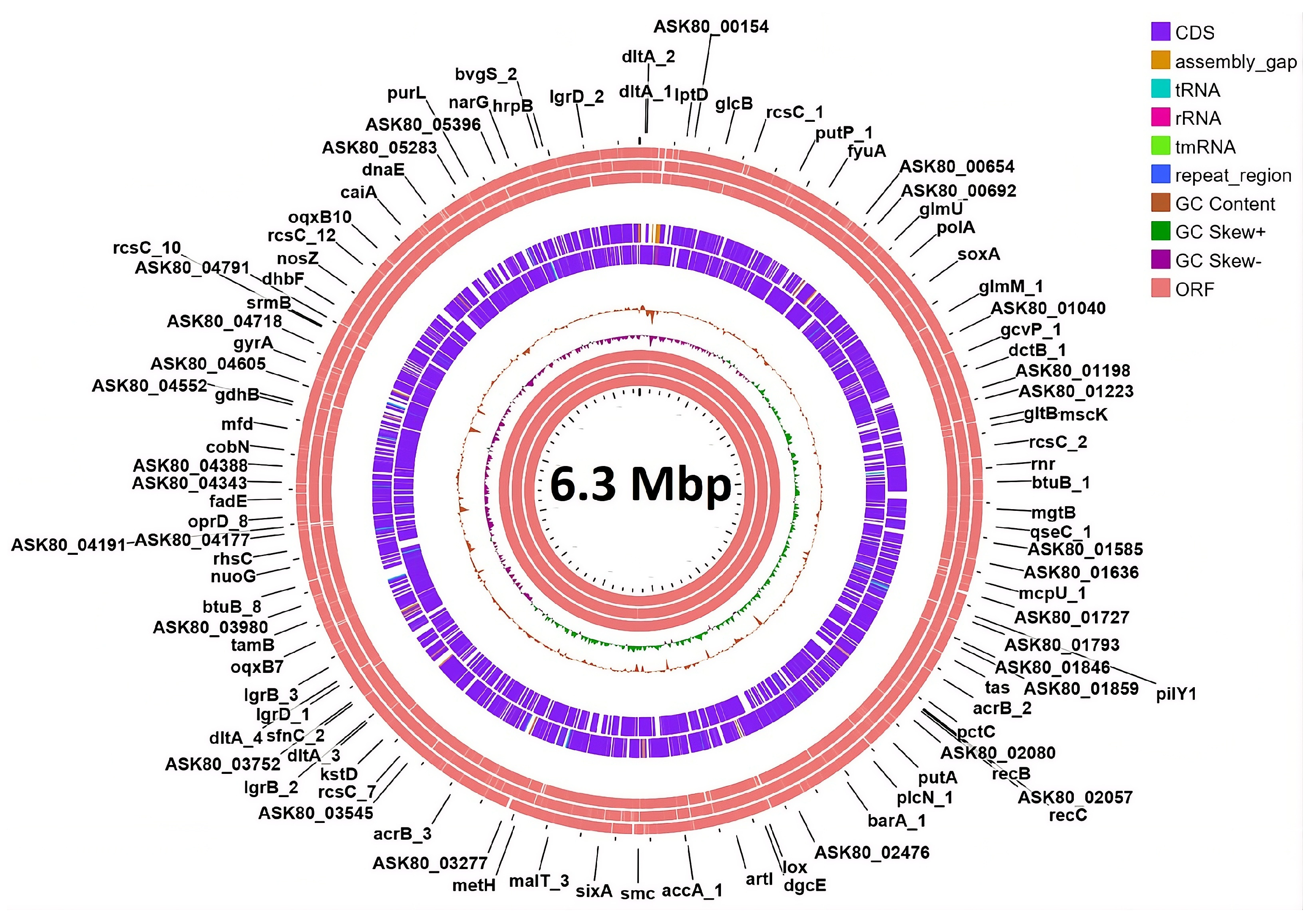
P. aeruginosa strain ASK-80, isolated from municipal wastewater from Baddi, district Solan, Himachal Pradesh, exhibited a multiple resistance phenotype, as it was resistant to penicillins, cephalosporins, quinolones, aminoglycosides, tetracyclines, sulphonamides and macrolides (Supplementary Table S1). The genome size of P. aeruginosa strain ASK-80 was 6,261,345 bp (Table 1). Its secondary assembly had two contigs, and the genome completeness and genome coverage were 98.9% and 333.09x, respectively. Genome annotation carried out by NCBI PGAP revealed a total of 5834 genes, which includef 5778 CDSs, 5748 protein-coding genes, 56 RNA genes, and 30 pseudo genes (Table 1). Genomic analysis using CARD and ResFinder predicted 47 unique antibiotic resistance genes. Genes conferring resistance to β-lactams (blaOXA-396, blaOXA-486, blaOXA-494, blaPAO, blaPDC-8), aminoglycosides (aph(3′)-IIb), phosphonic antibiotics (fosA), and phenolics (catB7) were detected. Additionally, strain ASK-80 carried antibiotic efflux pump genes as well as the genes associated with antibiotic target alteration (Figure 1, Table 2).
Table 1.
The genomic characteristics of multidrug-resistant P. aeruginosa strain ASK-80.
Figure 1.
Genome map showing gene annotation for antibiotic resistance genes, virulence genes and mobile genetic elements in the genome assembly of P. aeruginosa strain ASK−80. The map was generated using Proksee [8].
Table 2.
The antibiotic resistance genes predicted in draft genome assembly of P. aeruginosa strain ASK-80.
Virulence genes predicted by VFDB analysis revealed the genes associated with alginate biosynthesis, type IV pili, the type III secretion system, the type VI secretion system, flagellar proteins, quorum sensing, salicylate biosynthesis, pyocyanin, pyoverdine, exotoxin A precursor, lipopolysaccharides and the secretion pathway protein (Table 3, Supplementary Table S3). The determination of this diverse array of virulence genes indicates the significant pathogenic potential of strain ASK-80. ISFinder analysis identified diverse types of insertion sequences in the genome of P. aeruginosa strain ASK-80, as shown in Table 3 and Supplementary Table S2. Notably, no plasmid replicons were detected in the MGEFinder analysis. TnCentral analysis revealed transposable elements viz. Tn6010, TnAs1.1, Tn_pKP04VIM, TnEc1, Tn7114.1, In_Tn6162, Tn4662a.2, Tn5501.8, and TnOtChr.1 (Table 3) in the genome of this strain. The diverse resistome, mobile genetic elements and phage sequences of multidrug-resistant P. aeruginosa strain ASK-80 highlight its potential as a reservoir of antibiotic resistance genes and its possible role in their dissemination from aquatic environments to human populations.
Table 3.
Supportive characteristics of draft genome of P. aeruginosa strain ASK-80 in relation to selected virulence traits, dispersed elements, and phage sequences.
3. Methods
3.1. Sample Collection and Isolation of P. aeruginosa Strain ASK-80
The wastewater sample was collected from Baddi, district Solan, Himachal Pradesh, India (coordinates 30.923927° N, 76.800494° E), on 11.06.2024. About 1 L of wastewater (composite sample) was collected in sterile screw-capped polystyrene bottles and transported to the laboratory in an insulated box for microbiological analysis. About 1.0 mL of sample was plated on MacConkey agar (HiMedia Laboratories, Mumbai, India) and incubated at 35–37 °C for 24 h, and pure cultures were obtained as described earlier [9]. The antibiotic susceptibility of P. aeruginosa strain ASK-80 was determined against different classes of antibiotics using the Kirby–Bauer disc diffusion method in accordance with standard guidelines of Clinical Laboratory Standards Institute CLSI [10] and Drieux et al. [11]. The results were interpreted as resistant, intermediate, and susceptible according to CLSI breakpoints (Supplementary Table S1).
3.2. DNA Isolation, Genome Sequencing, Assembly and Annotation
The bacterial isolate was grown in nutrient broth at 37 °C for 24 h, and its genomic DNA was extracted using the Xploregen DNA extraction kit (Xploregen, Bengaluru, India). The quantity of the extracted DNA was measured using a Qubit 3 fluorometer (Thermo Fisher Scientific, Newark, DE, USA) to ensure sufficient concentration for sequencing. For library preparation, 100 ng of genomic DNA was enzymatically fragmented to obtain DNA fragments of approximately 200–300 bp in length. These fragments were then subjected to end repair and 3′ adenylation. Loop adapters were ligated to the prepared fragments, followed by cleavage using an uracil-specific excision reagent enzyme. The adapter-ligated DNA was purified using AMPure beads and enriched through six cycles of PCR amplification using NEBNext Ultra II Q5 master mix and Illumina-specific primers. The final sequencing library was again quantified using the Qubit 3 fluorometer (Thermo Fisher Scientific, DE, USA), and fragment size distribution was assessed using Agilent 2100 Bioanalyzer (Agilent Technologies Inc., Santa Clara, CA, USA). The prepared libraries were then sequenced on the Illumina MiSeq platform using 150 bp paired-end reads [9,12,13].
The quality of the raw sequencing reads was first evaluated using FastQC v0.12.1 [14]. High-quality reads were then assembled into a draft genome using Unicycler v0.5.1 [15]. Genome completeness was assessed using BUSCO v6.0.0 to ensure that most expected conserved genes were present in the assembly [16]. The generated contigs were further arranged and oriented using the scaffolding tool Multi-CSAR v1.0 [17]. Genome annotation was performed using the NCBI Prokaryotic Genome Annotation Pipeline (PGAP v6.10) to identify coding sequences and other genomic features [18]. Antibiotic resistance genes were detected using the Comprehensive Antibiotic Resistance Database (CARD v4.0.1) [19] and ResFinder v4.7.2 [20]. Only “perfect hits” (100% identity and coverage) and “strict hits” (≥95% identity and ≥80–90% coverage) were considered for analysis. Virulence genes were predicted using the virulence factor database (VFDB) [21]. For the prediction of interspersed repeat sequences (insertion sequences and transposable elements), MGEfinder v1.0.3 [22], ISFinder [23], and TnCentral v2.0 [24] were used. The phage sequences or Viral Orthologous Groups (VOGs) in the genome of P. aeruginosa strain ASK-80 were identified using the Phigaro database [25]. All analyses with various databases were conducted using default settings unless stated otherwise.
Supplementary Materials
The following supporting information can be downloaded at: https://www.mdpi.com/article/10.3390/data11050096/s1, Table S1: Antibiotic susceptibility profile of Pseudomonas aeruginosa strain ASK-80; Table S2: List of virulence genes predicted in genome sequence of Pseudomonas aeruginosa strain ASK-80 by Virulence Factors Database (VFDB); Table S3: List of insertion sequences predicted in the genome of Pseudomonas aeruginosa strain ASK-80.
Author Contributions
Conceptualization, N.S. and P.P.C.; methodology, S.K., S.S. and A.U.A.; formal analysis, N.S. and S.K.; investigation, N.S., S.K., S.S. and A.U.A.; resources, N.S.; writing—original draft preparation, S.K., S.S., A.U.A., P.P.C. and N.S.; writing—review and editing, N.S., S.K., S.S., P.P.C. and A.U.A.; supervision, N.S. All authors have read and agreed to the published version of the manuscript.
Funding
This research received no external funding.
Institutional Review Board Statement
Not applicable.
Informed Consent Statement
Not applicable.
Data Availability Statement
The genome sequence data of P. aeruginosa ASK-80 have been submitted to the NCBI Sequence Read Archive (SRA) under BioSample accession number SAMN55291369 and BioProject accession number PRJNA1421991. The assembled genome has been deposited in NCBI under Genome accession number JBVAPH000000000. Raw sequencing reads are available in the Sequence Read Archive under the accession number SRR37194518.
Acknowledgments
The authors are also thankful to Chancellor, Eternal University for providing the necessary facilities and support for the research study. The findings and conclusions presented in this paper are those of the author(s) and do not necessarily reflect the views of the NIH or the U.S. Department of Health and Human Services. The authors would like to thank the team of Biokart India Pvt. Ltd., Bengaluru, India for providing the WGS services.
Conflicts of Interest
The authors declare no conflicts of interest.
Abbreviations
The following abbreviations are used in this manuscript:
| WGS | Whole-genome sequencing |
| AMR | Antimicrobial resistance |
| MDR | Multidrug-resistant |
| ARGs | Antibiotic resistance genes |
| CLSI | Clinical and Laboratory Standards Institute |
| CDS | Coding DNA Sequences |
| SRA | Sequence Read Archive |
| CARD | Comprehensive Antibiotic Resistance Database |
References
- Krell, T.; Matilla, M.A. Pseudomonas aeruginosa. Trends Microbiol. 2024, 32, 216–218. [Google Scholar] [CrossRef] [Scilit]
- La Rosa, M.C.; Maugeri, A.; Favara, G.; La Mastra, C.; Magnano San Lio, R.; Barchitta, M.; Agodi, A. The impact of wastewater on antimicrobial resistance: A scoping review of transmission pathways and contributing factors. Antibiotics 2025, 14, 131. [Google Scholar] [CrossRef] [Scilit]
- Yan, B.; Yan, C.; Ding, Y.; Cai, S.; Wang, Y.; Agbo, E.; Xu, X.; Qin, K.; Fu, Q. Multidrug-resistant Pseudomonas aeruginosa infections: Current status, challenges, and prospects of phage therapy. Front. Microbiol. 2026, 16, 1723885. [Google Scholar] [CrossRef] [Scilit]
- Jesudason, T. WHO publishes updated list of bacterial priority pathogens. Lancet Microbe 2024, 5, 100940. [Google Scholar] [CrossRef] [Scilit]
- Glen, K.A.; Lamont, I.L. β-lactam resistance in Pseudomonas aeruginosa: Current status, future prospects. Pathogens 2021, 10, 1638. [Google Scholar] [CrossRef] [Scilit] [PubMed]
- Meradji, S.; Basher, N.S.; Sassi, A.; Ibrahim, N.A.; Idres, T.; Touati, A. The role of water as a reservoir for antibiotic-resistant bacteria. Antibiotics 2025, 14, 763. [Google Scholar] [CrossRef] [Scilit] [PubMed]
- Mohanty, S.; Mishra, S.; Saswat, S.; Mohanty, B. Interconnected reservoirs and escalating resistance in multidrug-resistant Pseudomonas aeruginosa: A One Health review. Microb. Pathog. 2026, 215, 108478. [Google Scholar] [CrossRef] [Scilit] [PubMed]
- Grant, J.R.; Enns, E.; Marinier, E.; Mandal, A.; Herman, E.K.; Chen, C.Y.; Graham, M.; Van Domselaar, G.; Stothard, P. Proksee: In-depth characterization and visualization of bacterial genomes. Nucleic Acids Res. 2023, 51, W484–W492. [Google Scholar] [CrossRef] [Scilit] [PubMed]
- Kour, S.; Sharma, S.; Avatsingh, A.U.; Chaudhary, P.P.; Singh, N. Draft genome sequence of multidrug-resistant Escherichia coli strain ASK-30 from wastewater in northern India. Microbiol. Resour. Announc. 2026, 15, e0000926. [Google Scholar] [CrossRef] [Scilit]
- CLSI M100-S30; Performance Standards for Antimicrobial Susceptibility Testing, Approved Standard. 31st ed. Clinical and Laboratory Standards Institute: Wayne, PA, USA, 2021.
- Drieux, L.; Brossier, F.; Sougakoff, W.; Jarlier, V. Phenotypic detection of extended-spectrum beta-lactamase production in Enterobacteriaceae: Review and bench guide. Clin. Microbiol. Infect. 2008, 14, 90–103. [Google Scholar] [CrossRef] [Scilit]
- Barbian, K.; Bruno, D.; Sykora, L.; Ricklefs, S.; Chaudhary, P.P.; Beare, P.A.; Myles, I.A.; Martens, C.M. De novo assembly of Roseomonas mucosa isolates from healthy human volunteers used to treat atopic dermatitis. Microbiol. Resour. Announc. 2023, 12, e0052023. [Google Scholar] [CrossRef] [Scilit]
- Barbian, K.; Bruno, D.; Sykora, L.; Ricklefs, S.; Chaudhary, P.P.; Beare, P.A.; Myles, I.A.; Martens, C.M. De novo assembly of Roseomonas mucosa isolated from patients with atopic dermatitis. Microbiol. Resour. Announc. 2023, 12, e0052123. [Google Scholar] [CrossRef] [Scilit]
- Andrews, S. FastQC: A Quality Control Tool for High Throughput Sequence Data. 2010. Available online: http://www.bioinformatics.babraham.ac.uk/projects/fastqc (accessed on 1 June 2025).
- Wick, R.R.; Judd, L.M.; Gorrie, C.L.; Holt, K.E. Unicycler: Resolving bacterial genome assemblies from short and long sequencing reads. PLoS Comput. Biol. 2017, 13, e1005595. [Google Scholar] [CrossRef] [Scilit]
- Tegenfeldt, F.; Kuznetsov, D.; Manni, M.; Berkeley, M.; Zdobnov, E.M.; Kriventseva, E.V. OrthoDB and BUSCO update: Annotation of orthologs with wider sampling of genomes. Nucleic Acids Res. 2025, 53, D516–D522. [Google Scholar] [CrossRef] [Scilit]
- Liu, S.C.; Ju, Y.R.; Lu, C.L. Multi-CSAR: A web server for scaffolding contigs using multiple reference genomes. Nucleic Acids Res. 2022, 50, W500–W509. [Google Scholar] [CrossRef] [Scilit]
- Tatusova, T.; DiCuccio, M.; Badretdin, A.; Chetvernin, V.; Nawrocki, E.P.; Zaslavsky, L.; Lomsadze, A.; Pruitt, K.D.; Borodovsky, M.; Ostell, J. NCBI prokaryotic genome annotation pipeline. Nucleic Acids Res. 2016, 44, 6614–6624. [Google Scholar] [CrossRef] [Scilit] [PubMed]
- Alcock, B.P.; Huynh, W.; Chalil, R.; Smith, K.W.; Raphenya, A.R.; Wlodarski, M.A.; Edalatmand, A.; Petkau, A.; Syed, S.A.; Tsang, K.K.; et al. CARD 2023: Expanded curation, support for machine learning, and resistome prediction at the Comprehensive Antibiotic Resistance Database. Nucleic Acids Res. 2023, 51, D690–D699. [Google Scholar] [CrossRef] [Scilit]
- Florensa, A.F.; Kaas, R.S.; Clausen, P.T.L.C.; Aytan-Aktug, D.; Aarestrup, F.M. ResFinder—An open online resource for identification of antimicrobial resistance genes in next-generation sequencing data and prediction of phenotypes from genotypes. Microb. Genom. 2022, 8, e000748. [Google Scholar] [CrossRef] [Scilit] [PubMed]
- Chen, L.; Yang, J.; Yu, J.; Yao, Z.; Sun, L.; Shen, Y.; Jin, Q. VFDB: A reference database for bacterial virulence factors. Nucleic Acids Res. 2005, 33, D325–D328. [Google Scholar] [CrossRef] [Scilit] [PubMed]
- Johansson, M.H.K.; Bortolaia, V.; Tansirichaiya, S.; Aarestrup, F.M.; Roberts, A.P.; Petersen, T.N. Detection of mobile genetic elements associated with antibiotic resistance in Salmonella enterica using a newly developed web tool: MobileElementFinder. J. Antimicrob. Chemother. 2021, 76, 101–109. [Google Scholar] [CrossRef] [Scilit]
- Siguier, P.; Perochon, J.; Lestrade, L.; Mahillon, J.; Chandler, M. ISfinder: The reference centre for bacterial insertion sequences. Nucleic Acids Res. 2006, 34, D32–D36. [Google Scholar] [CrossRef] [Scilit] [PubMed]
- Ross, K.; Varani, A.M.; Snesrud, E.; Huang, H.; Alvarenga, D.O.; Zhang, J.; Wu, C.; McGann, P.; Chandler, M. TnCentral: A prokaryotic transposable element database and web portal for transposon analysis. mBio 2021, 12, e0206021. [Google Scholar] [CrossRef] [Scilit] [PubMed]
- Starikova, E.V.; Tikhonova, P.O.; Prianichnikov, N.A.; Rands, C.M.; Zdobnov, E.M.; Ilina, E.N.; Govorun, V.M. Phigaro: High-throughput prophage sequence annotation. Bioinformatics 2020, 36, 3882–3884. [Google Scholar] [CrossRef] [Scilit] [PubMed]

Disclaimer/Publisher’s Note: The statements, opinions and data contained in all publications are solely those of the individual author(s) and contributor(s) and not of MDPI and/or the editor(s). MDPI and/or the editor(s) disclaim responsibility for any injury to people or property resulting from any ideas, methods, instructions or products referred to in the content. |
© 2026 by the authors. Licensee MDPI, Basel, Switzerland. This article is an open access article distributed under the terms and conditions of the Creative Commons Attribution (CC BY) license.