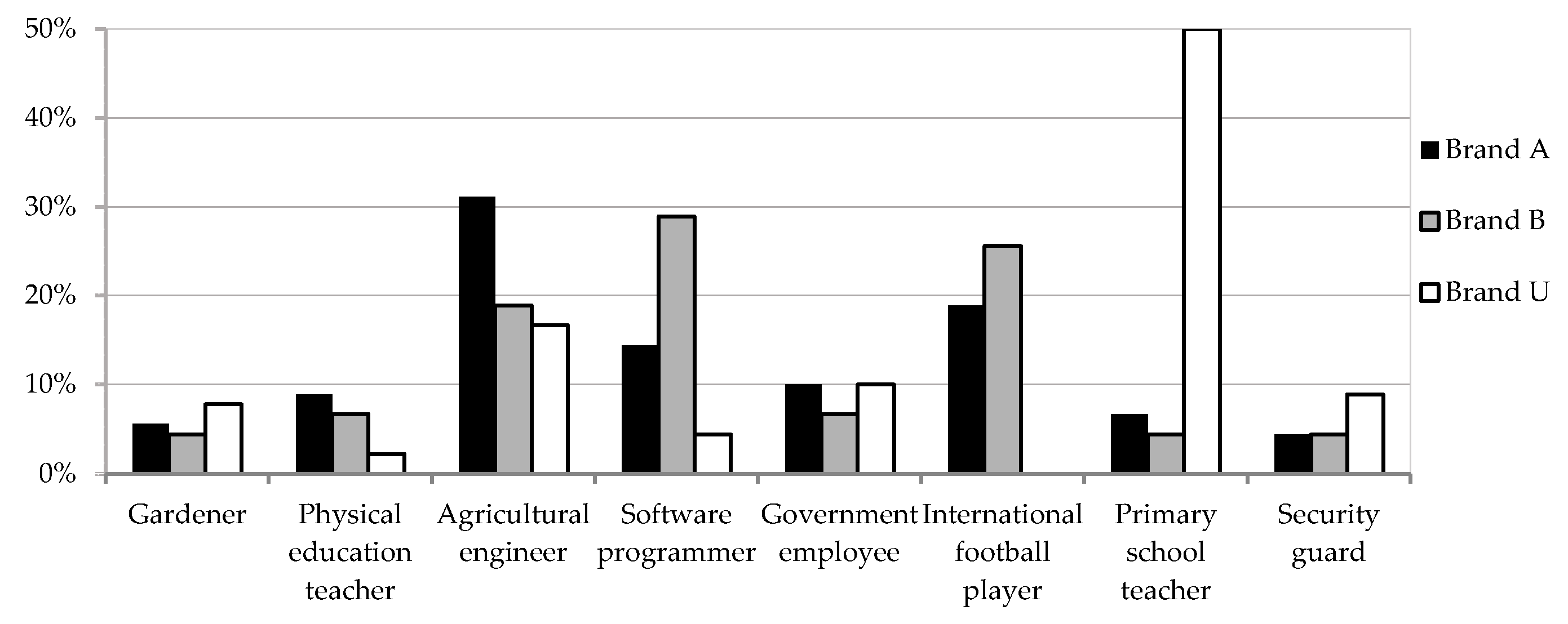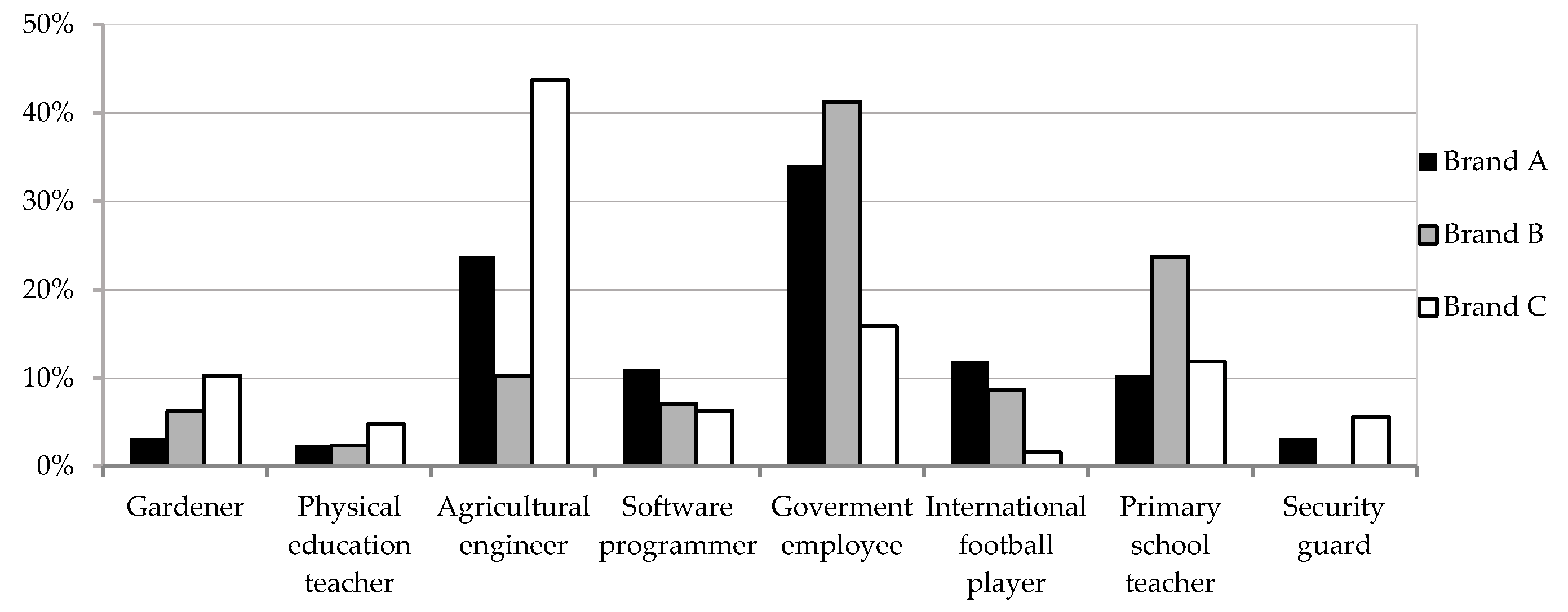


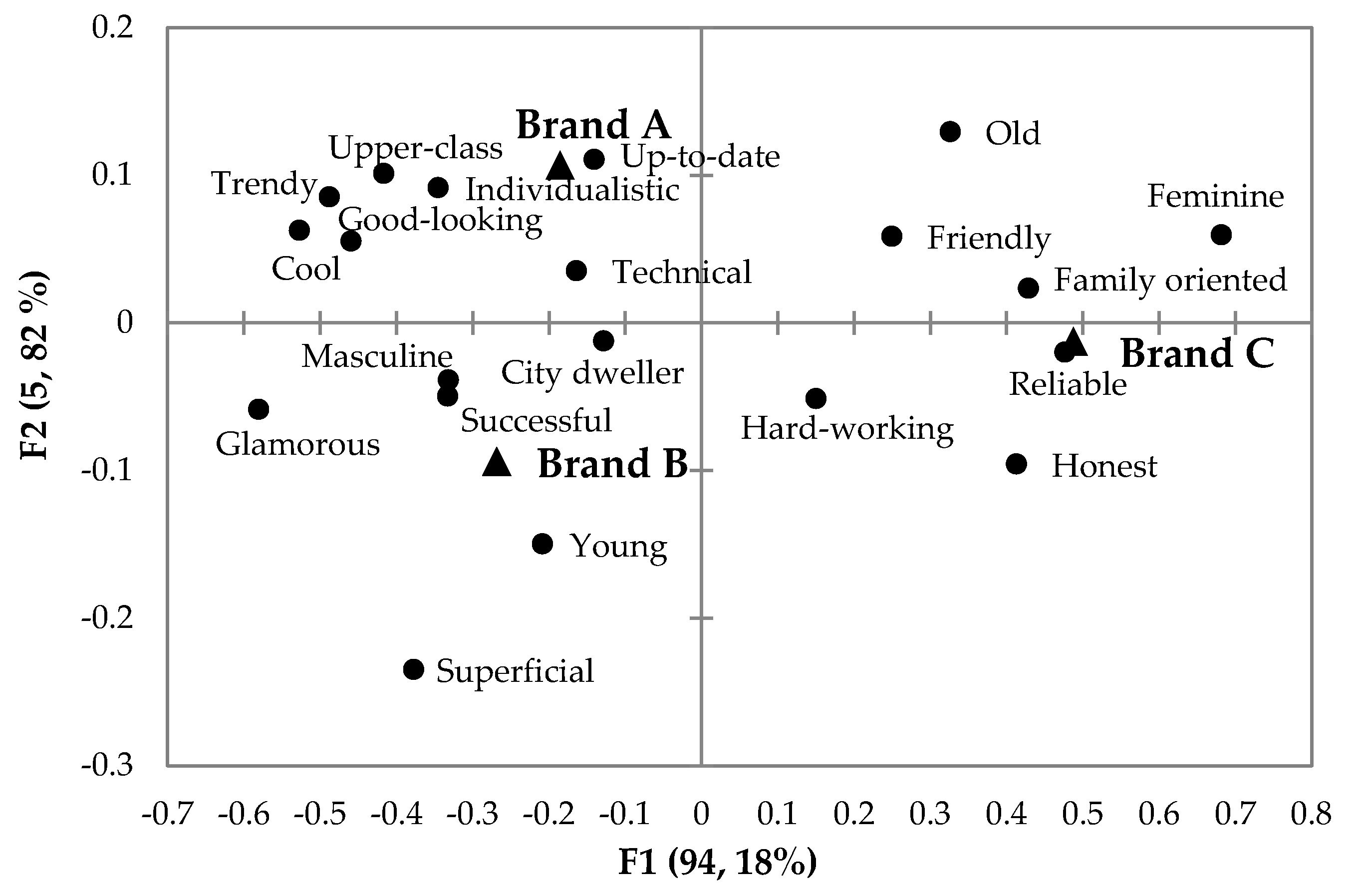
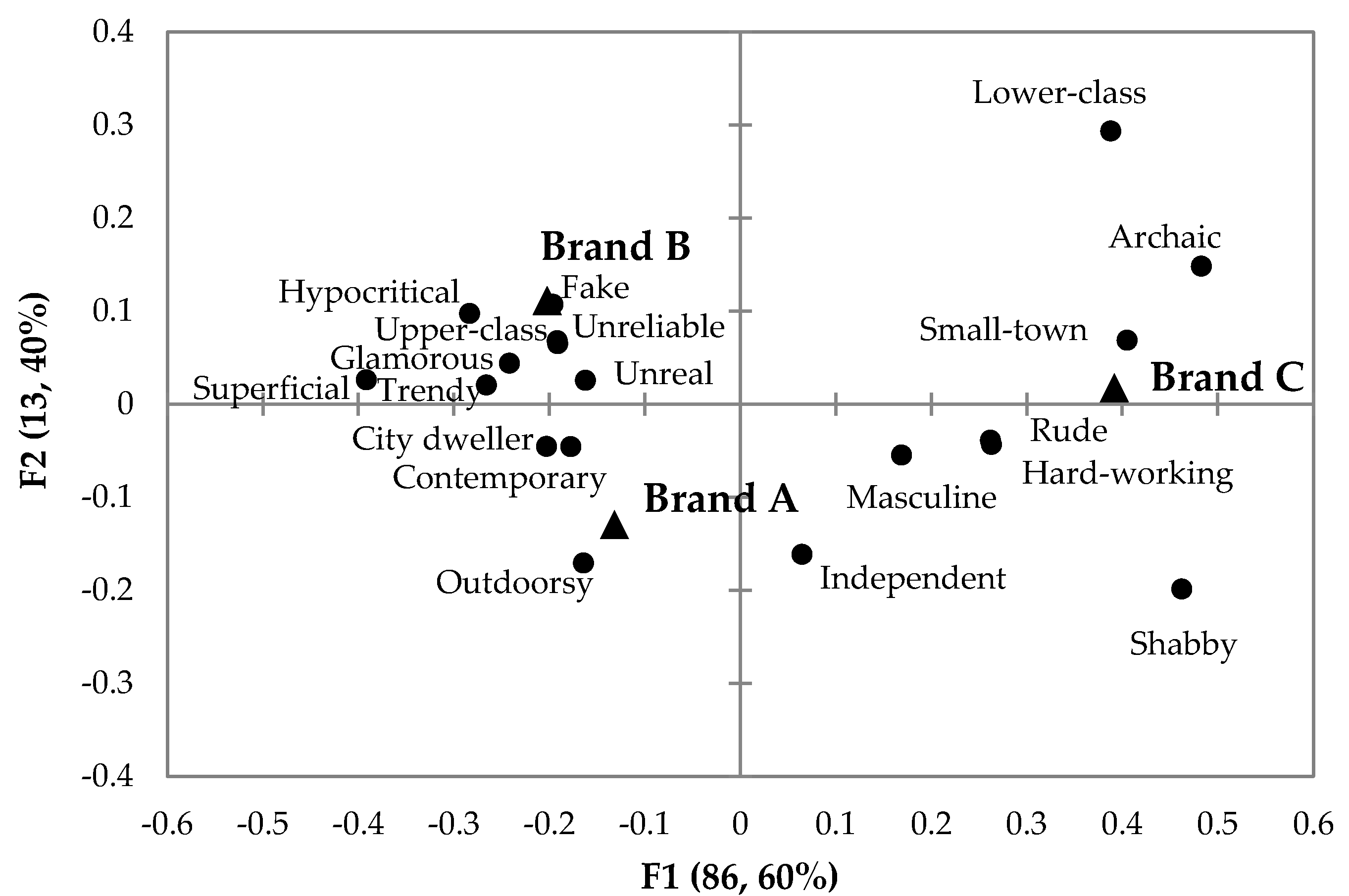
Job-Sorting Assignment to Assess Cream Liqueur Brand Image

Abstract
:1. Introduction
2. Materials and Methods
2.1. Construction of Measuring Instrument—Occupation Selection for Job-Sorting Technique
2.2. Brand Personality Trait Selection
2.3. Consumer Sample
2.4. Products
2.5. Procedure
2.6. Data Analysis
3. Results
4. Discussion
5. Conclusions
Author Contributions
Conflicts of Interest
References
- Hudson, S.; Huang, L.; Roth, M.S.; Madden, T.J. The influence of social media interactions on consumer–brand relationships: A three-country study of brand perceptions and marketing behaviors. Int. J. Res. Mark. 2016, 33, 27–41. [Google Scholar] [CrossRef]
- Budac, C.; Baltador, L. The Value of Brand Equity. Procedia Econ. Financ. 2013, 6, 444–448. [Google Scholar] [CrossRef]
- Fournier, S. Consumers and their brands: Developing relationship theory in consumer research. J. Consum. Res. 1998, 24, 343–353. [Google Scholar] [CrossRef]
- Hussey, M.; Duncombe, N. Projecting the right image: Using projective techniques to measure brand image. Qual. Market Res. Int. J. 1999, 2, 22–30. [Google Scholar] [CrossRef]
- McDonagh, D.; Bruseberg, A.; Haslam, C. Visual product evaluation: Exploring users’ emotional relationships with products. Appl. Ergon. 2002, 33, 231–240. [Google Scholar] [CrossRef]
- Cian, L.; Cervai, S. The Multi-Sensory Sort (MuSeS): A new projective technique to investigate and improve the brand image. Qual. Market Res. Int. J. 2011, 14, 138–159. [Google Scholar] [CrossRef]
- Greenwald, A.G.; Banaji, M.R. Implicit social cognition: Attitudes, self-esteem, and stereotypes. Psychol. Rev. 1995, 102, 4–27. [Google Scholar] [CrossRef] [PubMed]
- Bruseberg, A.; McDonagh-Philp, D. New product development by eliciting user experience and aspirations. Int. J. Hum.-Comput. Stud. 2001, 55, 435–452. [Google Scholar] [CrossRef]
- Knight, S. NLP at Work: Neuro Linguistic Programming, 3rd ed.; Nicholas Brealey Publishing: London, UK, 2009. [Google Scholar]
- Donoghue, S. Projective techniques in consumer research. J. Fam. Ecol. Consum. Sci. 2000, 28, 47–53. [Google Scholar] [CrossRef]
- Hofstede, A.; van Hoof, J.; Walenberg, N.; de Jong, M. Projective techniques for brand image research. Qual. Market Res. Int. J. 2007, 10, 300–309. [Google Scholar] [CrossRef]
- Vidal, L.; Ares, G.; Giménez, A. Projective techniques to uncover consumer perception: Application of three methodologies to ready-to-eat salads. Food Qual. Preference 2013, 28, 1–7. [Google Scholar] [CrossRef]
- Catterall, M.; Ibbotson, P. Using projective techniques in education research. Br. Educ. Res. J. 2000, 26, 245–256. [Google Scholar] [CrossRef]
- Boddy, C. A look at the evidence for the usefulness, reliability and validity of projective techniques in market research. Int. J. Market Res. 2005, 47, 239–254. [Google Scholar]
- Kinnear, T.C.; Taylor, J.R. Investigación de Mercados: Un Enfoque Aplicado, 1st ed.; McGraw-Hill: Mexico City, México, 1993. [Google Scholar]
- Guerrero, L.; Claret, A.; Verbeke, W.; Enderli, G.; Zakowska-Biemans, S.; Vanhonacker, F.; Hersleth, M. Perception of traditional food products in six European regions using free word association. Food Qual. Preference 2010, 21, 225–233. [Google Scholar] [CrossRef]
- Caprara, G.V.; Barbaranelli, C.; Guido, G. Brand personality: How to make the metaphor fit? J. Econ. Psychol. 2001, 22, 377–395. [Google Scholar] [CrossRef]
- Upadhyaya, M. Projective techniques for brand image dimensionality and using various techniques to investigate and improve the brand personality. Pol. J. Manag. Stud. 2012, 6, 89–100. [Google Scholar]
- Aaker, J.L. Dimensions of Brand Personality. J. Mark. Res. 1997, 34, 347–356. [Google Scholar] [CrossRef]
- Eisend, M.; Langer, A. The Impact of Brand Personality Dimensions on Brand Performance. In Proceedings of American Marketing Association Winter Educators’ Conference, Chicago, IL, USA, 2007; pp. 168–169.
- Van den Berge, E. Brand Personality along the Yardstick; SWOCC: Amsterdam, The Netherlands, 2002. [Google Scholar]
- Azoulay, A.; Kapferer, J.N. Do brand personality scales really measure brand personality? J. Brand Manag. 2003, 11, 143–155. [Google Scholar] [CrossRef]
- Austin, J.R.; Siguaw, J.A.; Mattila, A.S. A re-examination of the generalizability of the Aaker brand personality measurement framework. J. Strateg. Mark. 2003, 11, 77–92. [Google Scholar] [CrossRef]
- George, S.L.; Charles, W.L. The measurement and dimensionality of brand associations. J. Prod. Brand Manag. 2000, 9, 350–370. [Google Scholar]
- Geuens, M.; Weijters, B.; De Wulf, K. A new measure of brand personality. Int. J. Market Res. 2009, 26, 97–107. [Google Scholar] [CrossRef]
- Ferrandi, J.M.; Falcy, S.; Kreziack, D.; Valette-Florence, P. Aaker’s brand personality scale: A replication and a double methodological validation in a French setting. In Proceedings of the 3rd International Research Seminar on Marketing Communications and Consumer Behavior, Aix-en-Provence, France, 1999.
- Brislin, R.W. The wording and translation of research instruments. In Field Methods in Cross-Cultural Research; Lonner, W.J.E., Berry, J.W.E., Eds.; Cross-Cultural Research and Methodology Series; Sage Publications, Inc.: Thousand Oaks, CA, USA, 1986; Volume 8, p. 368. [Google Scholar]
- Costa, F.P.B.S.; Borges, L.P.; Peréz, C. Os Sentidos da África nas Expressões da Marca Amarula. Pensam. Real. 2010, 25, 55–73. [Google Scholar]



| Job | Intellectual Complexity | Salary | Physical Load |
|---|---|---|---|
| Security guard | Low | Low | Low |
| Government employee | Low | High | Low |
| Gardener | Low | Low | High |
| International football player | Low | High | High |
| Primary school teacher | High | Low | Low |
| Software programmer | High | High | Low |
| Physical education teacher | High | Low | High |
| Agricultural engineer | High | High | High |
| Personality Trait | Opposite Trait | Personality Trait | Opposite Trait |
|---|---|---|---|
| Up-to-date/Actualizado | Out-of-date/Desactualizado | Imaginative/Imaginativo | Unimaginative/Sin imaginación |
| Cheerful/Alegre | Sad/Triste | Independent/Independiente | Dependent/Dependiente |
| Friendly/Amigable | Unfriendly/No amigable | Intelligent/Inteligente | Dumb/Tonto |
| Cool/Atractivo | Uncool/Cobarde | Young/Joven | Old/Viejo |
| Daring/Audaz | Unnoticed/Desapercibido | Leader/Líder | Follower/Seguidor |
| Real/Auténtico | Unreal/No auténtico | Masculine/Masculino | Effeminate/Afeminado |
| Upper-class/Clase alta | Lower-class/Clase baja | Western/Occidental | Eastern/Oriental |
| Confident/Confiado | Unconfident/Desconfiado | Family-oriented/Orientado a la familia | Not family-oriented/No orientado a la familia |
| Contemporary/Contemporaneo | Old-fashioned/Anticuado | Small-town/Provinciano | City dweller/Citadino |
| Corporate/Corporativo | Individualistic/Individualista | Down-to-earth/Realista | Dreamer/Soñador |
| Trendy/De moda | Archaic/Antiguo | Wholesome/Saludable | Unwholesome/Enfermizo |
| Outdoorsy/De puertas para afuera | Indoorsy/De puertas para adentro | Secure/Seguro | Insecure/Inseguro |
| Reliable/Digno de confianza | Unreliable/Poco digno de confianza | Sentimental/Sentimental | Hardened/Duro |
| Tough/Tenaz | Weak/Flojo | Sincere/Sincero | Hypocritical/Hipócrita |
| Exciting/Emocionante | Unexciting/No emocionante | Technical/Técnico | Unskilled/Inexperto |
| Charming/Encantador | Unappealing/Antipático | Hard-working/Trabajador | Lazy/Vago |
| Spirited/Entusiasta | Dull/Apagado | Smooth/Afable | Rude/Descortés |
| Successful/Exitoso | Unsuccessful/Fracasado | Unique/Único | Commonplace/Corriente |
| Feminine/Femenino | Manly/Macho | Rugged/Violento | Calm/Tranquilo |
| Glamorous/Glamoroso | Shabby/Andrajoso | Original/Original | Fake/Falso |
| Good-looking/Guapo | Ugly/Feo | Charismatic/Carismático | Bland/Soso |
| Honest/Honesto | Dishonest/Deshonesto | Superficial/Superficial | Profound/Profundo |
| Personality Item | Frequency of Mention | ||
|---|---|---|---|
| Brand A | Brand B | Brand U | |
| Down-to-earth ns | 31.1 | 32.2 | 30.0 |
| Dreamer ns | 38.9 | 34.4 | 26.7 |
| Family oriented *** | 28.9 | 23.3 | 55.6 |
| Not family-oriented ns | 8.9 | 14.4 | 5.6 |
| Small-town ns | 20.0 | 15.6 | 20.0 |
| City dweller ** | 25.6 | 30.0 | 11.1 |
| Honest *** | 25.6 | 31.1 | 60.0 |
| Sincere ns | 17.8 | 16.7 | 25.6 |
| Original ns | 20.0 | 18.9 | 26.7 |
| Wholesome ns | 40.0 | 37.8 | 32.2 |
| Real ns | 27.8 | 18.9 | 20.0 |
| Cheerful ns | 30.0 | 31.1 | 37.8 |
| Sentimental ns | 16.7 | 13.3 | 20.0 |
| Hardened ns | 12.2 | 20.0 | 17.8 |
| Friendly ** | 43.3 | 34.4 | 58.9 |
| Unfriendly ns | 7.8 | 11.1 | 6.7 |
| Good-looking ** | 14.4 | 14.4 | 2.2 |
| Ugly ns | 11.1 | 6.7 | 6.7 |
| Calm ns | 44.4 | 45.6 | 52.2 |
| Rugged ns | 3.3 | 12.2 | 3.3 |
| Western ns | 16.7 | 11.1 | 11.1 |
| Charismatic ns | 27.8 | 32.2 | 40.0 |
| Unnoticeable ns | 15.6 | 20.0 | 11.1 |
| Daring ns | 37.8 | 37.8 | 26.7 |
| Trendy *** | 23.3 | 22.2 | 4.4 |
| Old-fashioned ns | 8.9 | 11.1 | 16.7 |
| Exciting ns | 17.8 | 20.0 | 14.4 |
| Unexciting ns | 3.3 | 12.2 | 12.2 |
| Spirited ns | 35.6 | 23.3 | 31.1 |
| Dull ns | 8.9 | 14.4 | 8.9 |
| Cool * | 14.4 | 14.4 | 3.3 |
| Young ** | 33.3 | 48.9 | 24.4 |
| Old * | 20.0 | 12.2 | 27.8 |
| Imaginative ns | 37.8 | 41.1 | 46.7 |
| Unique ns | 14.4 | 12.2 | 5.6 |
| Commonplace ns | 12.2 | 10.0 | 16.7 |
| Up-to-date * | 50.0 | 41.1 | 30.0 |
| Independent ns | 37.8 | 35.6 | 25.6 |
| Contemporary ns | 23.3 | 25.6 | 16.7 |
| Archaic ns | 8.9 | 7.8 | 15.6 |
| Charming ns | 14.4 | 11.1 | 11.1 |
| Outdoorsy ns | 15.6 | 14.4 | 11.1 |
| Indoorsy ns | 17.8 | 18.9 | 13.3 |
| Tough ns | 24.4 | 28.9 | 28.9 |
| Superficial ** | 13.3 | 23.3 | 6.7 |
| Profound ns | 11.1 | 13.3 | 16.7 |
| Reliable *** | 26.7 | 24.4 | 60.0 |
| Hard-working * | 46.7 | 52.2 | 63.3 |
| Lazy ns | 6.7 | 10.0 | 2.2 |
| Secure ns | 41.1 | 36.7 | 41.1 |
| Intelligent ns | 43.3 | 42.2 | 41.1 |
| Technical * | 44.4 | 43.3 | 27.8 |
| Corporate ns | 7.8 | 14.4 | 12.2 |
| Individualistic ** | 25.6 | 23.3 | 8.9 |
| Successful ** | 27.8 | 33.3 | 12.2 |
| Leader ns | 25.6 | 17.8 | 22.2 |
| Follower ns | 11.1 | 10.0 | 8.9 |
| Confident ns | 28.9 | 30.0 | 24.4 |
| Upper-class ** | 25.6 | 23.3 | 6.7 |
| Lower-class ns | 11.1 | 7.8 | 17.8 |
| Glamorous ** | 8.9 | 11.1 | 1.1 |
| Feminine *** | 10.0 | 5.6 | 26.7 |
| Masculine ** | 61.1 | 65.6 | 44.4 |
| Manly ns | 14.4 | 14.4 | 10.0 |
| Rude ns | 20.0 | 25.6 | 16.7 |
| Smooth ns | 4.4 | 4.4 | 12.2 |
| Personality Item | Frequency of Mention | ||
|---|---|---|---|
| Brand A | Brand B | Brand C | |
| Down-to-earth ns | 32.2 | 28.9 | 45.6 |
| Dreamer ns | 41.1 | 34.4 | 32.2 |
| Family oriented ns | 34.4 | 44.4 | 46.7 |
| Not family-oriented ns | 18.9 | 20.0 | 15.6 |
| Small-town ** | 22.2 | 24.4 | 44.4 |
| City dweller ** | 47.8 | 46.7 | 24.4 |
| Honest ns | 40.0 | 35.6 | 50.0 |
| Dishonest ns | 28.9 | 33.3 | 20.0 |
| Sincere ns | 35.6 | 26.7 | 43.3 |
| Hypocritical ** | 26.7 | 35.6 | 13.3 |
| Original ns | 36.7 | 30.0 | 38.9 |
| Fake * | 22.2 | 30.0 | 14.4 |
| Wholesome ns | 54.4 | 48.9 | 56.7 |
| Real ns | 34.4 | 25.6 | 37.8 |
| Unreal * | 23.3 | 28.9 | 14.4 |
| Cheerful ns | 54.4 | 51.1 | 55.6 |
| Sentimental ns | 13.3 | 17.8 | 13.3 |
| Hardened ns | 33.3 | 28.9 | 35.6 |
| Friendly ns | 47.8 | 57.8 | 55.6 |
| Unfriendly ns | 14.4 | 13.3 | 10.0 |
| Good-looking ns | 17.8 | 14.4 | 10.0 |
| Ugly ns | 16.7 | 20.0 | 20.0 |
| Calm ns | 43.3 | 48.9 | 54.4 |
| Rugged ns | 8.9 | 11.1 | 3.3 |
| Western ns | 33.3 | 35.6 | 34.4 |
| Charismatic ns | 57.8 | 51.1 | 46.7 |
| Unnoticeable ns | 13.3 | 14.4 | 13.3 |
| Daring ns | 48.9 | 45.6 | 46.7 |
| Trendy *** | 25.6 | 30.0 | 7.8 |
| Old-fashioned ns | 14.4 | 15.6 | 24.4 |
| Exciting ns | 24.4 | 16.7 | 18.9 |
| Unexciting ns | 16.7 | 26.7 | 24.4 |
| Spirited ns | 40.0 | 45.6 | 53.3 |
| Dull ns | 10.0 | 11.1 | 10.0 |
| Cool ns | 14.4 | 16.7 | 15.6 |
| Bland ns | 16.7 | 14.4 | 16.7 |
| Young ns | 34.4 | 32.2 | 32.2 |
| Old ns | 30.0 | 33.3 | 35.6 |
| Imaginative ns | 40.0 | 41.1 | 45.6 |
| Unimaginative ns | 11.1 | 15.6 | 11.1 |
| Unique ns | 15.6 | 16.7 | 15.6 |
| Commonplace ns | 18.9 | 23.3 | 18.9 |
| Up-to-date ns | 52.2 | 47.8 | 45.6 |
| Out-of-date ns | 8.9 | 13.3 | 16.7 |
| Independent * | 47.8 | 32.2 | 37.8 |
| Dependent ns | 11.1 | 16.7 | 12.2 |
| Contemporary ** | 36.7 | 35.6 | 20.0 |
| Archaic * | 7.8 | 11.1 | 21.1 |
| Charming ns | 17.8 | 21.1 | 21.1 |
| Unappealing ns | 13.3 | 15.6 | 11.1 |
| Outdoorsy * | 30.0 | 22.2 | 14.4 |
| Indoorsy ns | 11.1 | 12.2 | 12.2 |
| Tough ns | 45.6 | 35.6 | 45.6 |
| Weak ns | 10.0 | 17.8 | 13.3 |
| Superficial ** | 33.3 | 37.8 | 15.6 |
| Profound ns | 18.9 | 8.9 | 18.9 |
| Reliable ns | 30.0 | 25.6 | 40.0 |
| Unreliable * | 28.9 | 35.6 | 17.8 |
| Hard-working ** | 48.9 | 41.1 | 64.4 |
| Lazy ns | 22.2 | 30.0 | 18.9 |
| Secure ns | 54,4 | 40.0 | 51.1 |
| Insecure ns | 6.7 | 6.7 | 12.2 |
| Intelligent ns | 53.3 | 56.7 | 56.7 |
| Dumb ns | 11.1 | 10.0 | 6.7 |
| Technical ns | 51.1 | 45.6 | 53.3 |
| Corporate ns | 24.4 | 17.8 | 13.3 |
| Individualistic ns | 30.0 | 37.8 | 34.4 |
| Successful ns | 50.0 | 44.4 | 40.0 |
| Leader ns | 43.3 | 47.8 | 37.8 |
| Follower ns | 15.6 | 21.1 | 20.0 |
| Confident ns | 33.3 | 30.0 | 28.9 |
| Unconfident ns | 13.3 | 13.3 | 8.9 |
| Upper-class ** | 44.4 | 50.0 | 27.8 |
| Lower-class *** | 10.0 | 24.4 | 33.3 |
| Glamorous ** | 30.0 | 35.6 | 15.6 |
| Shabby * | 13.3 | 5.6 | 18.9 |
| Feminine ns | 11.1 | 22.2 | 13.3 |
| Masculine * | 55.6 | 46.7 | 61.1 |
| Manly ns | 32.2 | 31.1 | 38.9 |
| Rude * | 32.2 | 26.7 | 42.2 |
| Smooth ns | 12.2 | 17.8 | 11.1 |
© 2017 by the authors; licensee MDPI, Basel, Switzerland. This article is an open access article distributed under the terms and conditions of the Creative Commons Attribution (CC BY) license (http://creativecommons.org/licenses/by/4.0/).
Share and Cite
Gámbaro, A.; Ivankovich, C.; Roascio, A.; Amarillo, M.; Miraballes, M.; Araya-Quesada, Y. Job-Sorting Assignment to Assess Cream Liqueur Brand Image. Beverages 2017, 3, 11. https://doi.org/10.3390/beverages3010011
Gámbaro A, Ivankovich C, Roascio A, Amarillo M, Miraballes M, Araya-Quesada Y. Job-Sorting Assignment to Assess Cream Liqueur Brand Image. Beverages. 2017; 3(1):11. https://doi.org/10.3390/beverages3010011
Chicago/Turabian StyleGámbaro, Adriana, Carmen Ivankovich, Antonella Roascio, Miguel Amarillo, Marcelo Miraballes, and Yorleny Araya-Quesada. 2017. "Job-Sorting Assignment to Assess Cream Liqueur Brand Image" Beverages 3, no. 1: 11. https://doi.org/10.3390/beverages3010011
APA StyleGámbaro, A., Ivankovich, C., Roascio, A., Amarillo, M., Miraballes, M., & Araya-Quesada, Y. (2017). Job-Sorting Assignment to Assess Cream Liqueur Brand Image. Beverages, 3(1), 11. https://doi.org/10.3390/beverages3010011