


Highlights
- A tropical mixed beverage was tailored to the nutritional and safety needs of older adults with dysphagia.
- The beverage achieved high sensory acceptance and a safe IDDSI Level 3 texture.
- Vitamin C showed high bioaccessibility in digestion models adapted for the elderly.
- The processes of ultrasound and sterilization optimized the delivery of bioactive compounds in the beverage.
Abstract
A mixed functional beverage was developed using mango, pineapple, and acerola pulps combined with Brazil nut extract, targeting the nutritional and physiological needs of the elderly. The formulation was designed to deliver vitamin C and carotenoids, while maintaining viscosity compatible with level 3 of the IDDSI scale, ensuring safe consumption for individuals with dysphagia. The product underwent different processing treatments, including thermal pasteurization, sterilization, and non-thermal ultrasound processing, to evaluate their effects on bioactive compounds and in vitro bioaccessibility. Vitamin C content and total phenolic compounds decreased by 15.4% and 12.7% after pasteurization, respectively, and by 41.6% and 79.1% after ultrasound treatment. In contrast, sterilization did not result in a significant difference in vitamin C content compared with the control. Conversely, total carotenoid content increased significantly across all processing treatments, while antioxidant capacity remained stable across the different processing conditions evaluated. In addition, a 95% increase in selenium content was observed after pasteurization, indicating enhanced solubilization of mineral fractions in the Brazil nut extract. Vitamin C bioaccessibility reached 53.24% after ultrasound treatment and 38.58% after sterilization, outperforming the control (34.59%). For carotenoids, sterilization resulted in the highest bioaccessibility (28.33%), followed by ultrasound (17.21%) and pasteurization (15.24%). The beverage also showed good sensory acceptance among elderly consumers, demonstrating that the formulation successfully combines nutritional adequacy and acceptance. These findings support its potential as a functional beverage that promotes safe nutrition and hydration in older adults, including those with dysphagia.
1. Introduction
Population aging represents one of the most significant demographic transitions of the 21st century and affects health systems and nutritional demands worldwide. Physiological changes associated with aging, such as increased gastric pH, reduced secretion of digestive enzymes, and delayed gastric emptying, may compromise the digestion and absorption of nutrients and bioactive compounds, including vitamin C and carotenoids, essential for antioxidant defense and immune system modulation [1,2,3]. These modifications, combined with reduced food intake and the presence of chronic diseases, increase the risk of dehydration and nutritional deficiencies among the elderly. Even mild dehydration can impair cognitive function, balance, and quality of life, highlighting the need for beverages and dietary strategies tailored to this population [4].
The consistency and viscosity of beverages intended for the elderly are critical factors for swallowing safety, especially in individuals with dysphagia, a common condition in this age group. Adequate texture reduces the risk of aspiration, facilitating oral control of liquids, and ensuring safe hydration and nutrient intake [5,6]. To address this need, the International Dysphagia Diet Standardisation Initiative (IDDSI) established an international framework that classifies foods and beverages according to standardized thickness level. The IDDSI Flow Test, based on a simple syringe method, enables practical and reproducible classification of liquid consistency across domestic, clinical, and hospital settings [7,8].
Older adults tend to associate “well-being” and “healthiness” with natural and minimally processed foods, showing a preference for plant-based products and mixed beverages that combine sensory pleasure with nutritional benefits [9]. Functional foods and beverages have emerged to improve nutrient intake and quality of life in the elderly population [10]. Tropical fruits such as mango (Mangifera indica L.), pineapple (Ananas comosus), and acerola (Malpighia emarginata DC) are notable sources of carotenoids and vitamin C. In addition to these nutrients, phenolic compounds naturally present in fruits contribute significantly to the antioxidant capacity of beverages by scavenging free radicals and protecting against cellular oxidative damage [10].
Selenium is an essential micronutrient with well-established antioxidant properties [11,12]. It plays a crucial role in the synthesis of selenoproteins involved in antioxidant defense, thyroid hormone metabolism, and immune function, being particularly relevant for the regulation of oxidative stress in older adults [13]. In this sense, Brazil nut (Bertholletia excelsa) extracts can enrich formulations with selenium, even if used in very little amounts.
Despite existing studies on the nutritional composition and stability of mixed tropical fruit beverages, limited information is available regarding the bioaccessibility of bioactive compounds under conditions that simulate the digestive system of elderly individuals. Bioaccessibility is defined as the fraction of a nutrient released from the food matrix during digestion and made available for intestinal absorption, representing a key parameter for estimating the actual nutritional potential of a food [14]. This parameter is strongly influenced by the technological processes applied during manufacturing, particularly thermal and non-thermal treatments that can alter the structure and stability of sensitive compounds [15].
Thermal processes such as pasteurization and sterilization are commonly applied to ensure microbiological safety. However, they may promote the degradation of bioactive compounds, such as ascorbic acid, or modify the food matrix in ways that affect nutrient release [16,17]. In contrast, non-thermal technologies, such as high-intensity ultrasound, have emerged as promising alternatives due to their ability to preserve bioactive compounds and enhance phytochemical release while maintaining sensory quality [18,19,20].
Some studies have reported that ultrasound processing can increase the availability of bioactive compounds in fruit juices, whereas thermal treatments may lead to reductions [21,22]. Nevertheless, the extent of these effects depends on the food matrix, fruit combinations, and processing conditions. To date, few studies have investigated the influence of different technological processes on the bioaccessibility of bioactive compounds in selenium-enriched mixed beverages, particularly under digestion conditions tailored to elderly. Therefore, this study aimed to evaluate the in vitro bioaccessibility of vitamin C and carotenoids in a mixed beverage formulated with mango, pineapple, acerola, and Brazil nut extract, subjected to ultrasound, pasteurization, and sterilization.
2. Materials and Methods
2.1. Materials
Commercial pulps (De Marchi, Jundiaí, Brazil) of mango (Mangifera indica L.), pineapple (Ananas comosus L. Merr.), and acerola (Malpighia emarginata DC) were kept frozen (−18 °C) until use. The selection of pulps considered the nutritional and sensory contribution of each fruit to the development of a sugar-free beverage with functional value. Pineapple provided natural sweetness, acerola supplied vitamin C, and mango contributed with carotenoids and fiber.
The Brazil nut (Bertholletia excelsa) extract was obtained by aqueous extraction from partially defatted cake, at Embrapa Amazônia Oriental, and kept frozen (−18 °C) until use.
2.2. Formulation of the Mixed Fruit Beverage
The functional mixed beverage was formulated by mixing 60% mango pulp, 20% pineapple pulp, 19.9% acerola pulp, and 0.1% Brazil nut extract, without the addition of sugar or water, followed by manual homogenization and freezing for later evaluations.
The pulp proportions were defined based on preliminary tests, sensory analysis, and the functional and nutritional characteristics of each fruit. Mango pulp was used in higher proportion due to its high content of soluble fiber and pectins, which increase beverage viscosity and colloidal stability, facilitating compliance with IDDSI level 3 for individuals with dysphagia. Pineapple pulp was added in lower amounts to balance flavor, given its higher acidity and soluble solids content, without compromising the final texture. Acerola pulp was incorporated to increase vitamin C and phenolic compound levels, thereby enhancing the antioxidant potential.
2.3. Thermal and Non-Thermal Treatment of the Mixed Fruit Beverage
The mixed fruit beverage underwent three types of processing: pasteurization, sterilization, and ultrasound. Unprocessed mixed juice was considered as the control.
The non-thermal treatment was performed using ultrasound in a continuous flow recirculation system, according to Ahmad et al. (2020) [23] and Nadeem et al. (2022) [24], with modifications, using a UIP1000hdT processor (Hielscher Ultrasonics, Teltow, Germany) equipped with a BS2d18 sonotrode (tip area = 2.5 cm2). The operating frequency was 20 kHz and power was 360 W. Each experiment used 2.0 L of juice, continuously recirculated for 30 min, with temperature kept below 43 °C by a refrigeration bath. The samples were cooled and frozen at −18 °C for later analysis.
Pasteurization was conducted in a water bath (Memmert WNB 45, Schwabach, Germany) under continuous agitation (70 rpm) at 70 ± 2 °C for 25 min. The beverages (150 mL) were packaged in sanitized glass bottles and capped with metal screw caps. After the process, the samples were rapidly cooled in an ice bath (0 °C) and stored frozen at −18 °C until analysis.
Sterilization was performed in 100 mL pouches, thermally sealed and subjected to an autoclave Steriflow® S4088 (Stiriflow SAS, Clichy, France). The cycle was programmed for a thermal lethality value (F0) = 5.7 min, equivalent to exposure to 121 °C for 5.7 min, according to commercial sterilization parameters. During the cycle, a pouch containing a thermocouple positioned at the geometric center of the sample monitored the internal temperature and calculated the F0 value in real time. After the process, the samples were cooled to 4 °C and stored frozen at −18 °C until analysis.
2.4. Fluidity, Viscosity, and Sensory Acceptance of a Mixed Fruit Beverage
Fluidity was assessed by the syringe test according to the International Dysphagia Diet Standardisation Initiative (IDDSI) protocol [8]. For each sample, 10 mL of the liquid were transferred to a 10 mL syringe (EverCare®, Stockholm, Sweden), allowing free flow for 10 s. The remaining volume in the syringe was recorded, and the thickening level classification was assigned according to the IDDSI criteria [8]. Each determination was performed in triplicate.
The apparent viscosity of the samples was determined using a Rotavisc lo-vi rotational viscometer (IKA®, Staufen, Germany), operating at 100 rpm, with a cylindrical SP-4 spindle. Measurements were conducted in triplicate, at a temperature of 10 ± 1 °C, corresponding to the usual refrigeration temperature for beverages.
The acceptance test was conducted exclusively with people over 60 years of age, with the aim of evaluating the acceptance of the mixed fruit and Brazil nut extract beverage (control sample) by the target audience. Seventy-three elderly people of both sexes, aged between 60 and 90 years, participated in the study. All participants were previously informed about the objectives of the study and signed a free and informed consent form, in accordance with the ethical principles for research involving human beings.
The test was conducted in a long-term care institution (Retiro dos Artistas) and in a supermarket located in the Santa Cruz neighborhood, both in the city of Rio de Janeiro, encompassing different profiles of elderly consumers.
The evaluation was carried out using a structured 9-point hedonic scale, where 9 corresponded to “I liked it extremely”, 5 to “I neither liked nor disliked it” and 1 to “I disliked it extremely” [25]. The sample was served at a temperature of 5 ± 1 °C in 50 mL white plastic cups, accompanied by a glass of water and a sensory evaluation form.
2.5. In Vitro Gastrointestinal Digestion of the Mixed Fruit Beverage
The in vitro digestion method was performed according to the INFOGEST protocol adapted for elderly individuals [26]. The model considered the physiological changes associated with aging, such as increased gastric pH, reduced enzyme secretion, and delayed gastric emptying.
The in vitro digestion simulation was conducted in three sequential phases. In the oral phase, 5 g of the sample was mixed (1:1 w/v) with simulated salivary fluid containing amylase (1500 U/mL, pH 7.0) and incubated at 37 °C for 2 min. In the gastric phase, simulated gastric fluid (1:1 v/v) containing pepsin (1200 U/mL, pH 3.7) was added and incubated at 37 °C for 3 h. Finally, in the intestinal phase, simulated intestinal fluid (1:1 v/v) with bile (6.7 mM/L) and pancreatin (80 U/mL, pH 7.0) was applied and incubated at 37 °C for 2 h. After digestion, the samples were centrifuged (4000 rpm, 10 min, 4 °C) to obtain the supernatant, representing the potentially absorbable fraction. The supernatant was separated to calculate vitamin C and carotenoid levels.
The bioaccessibility of vitamin C and carotenoids was determined by the ratio between the concentration of the digested compound and the initial concentration before digestion. The result was expressed as a percentage.
2.6. Analytical Evaluations
Vitamin C was quantified by high-performance liquid chromatography (HPLC) using an Aminex® HPX-87H column ( Bio-Rad, Hercules, CA, USA) and detection at 254 nm, according to Rosa et al. (2007) [27]. The results were expressed in mg/100 g of sample.
The total carotenoid content was determined according to Rodrigues-Amaya (1999) [28]. The samples were subjected to extraction with acetone and petroleum ether, and quantification was performed by spectrophotometry at 453 nm, using an extinction coefficient of 2592.
The total phenolic compound content was quantified by the Folin–Ciocalteu method, according to Singleton & Rossi (1965) [29] and Georgé et al. (2005) [30], with results expressed in mg of gallic acid equivalents (GAE)/100 g of sample. Antioxidant activity was evaluated using the ABTS+ [31] and DPPH [32] methods. Results were expressed in µmol of Trolox/g of sample.
Selenium concentration was determined by microwave-assisted mineralization in a closed cavity, according to AOAC (2010) [33], with results expressed in µg/100 g of sample.
Moisture content was determined by the gravimetric method using a vacuum oven at 70 °C until constant weight. Ash content was determined by incineration of the samples in a muffle furnace at 550 °C until complete combustion of the organic matter and attainment of a constant mineral residue. Protein content was determined by the Kjeldahl method through quantification of total nitrogen, using a conversion factor of 5.75, appropriate for foods of plant origin. Total lipids (ether extract) were determined according to AOAC method 922.06 (2010) [33], based on acid hydrolysis followed by extraction with an organic solvent. Total dietary fiber was quantified using the enzymatic–gravimetric method, involving sequential digestion with thermostable α-amylase, protease, and amyloglucosidase to remove starch and proteins, leaving only the fibrous material. Total carbohydrate content was estimated by difference. All results were expressed as g/100 g of sample.
2.7. Statistical Analysis
All analysis in this study was performed in triplicate. The experimental results were given as mean value ± standard deviation. Means were compared by analysis of variance (ANOVA) with Tukey’s test (α = 0.05). Statistical treatment was performed using Statistica v.8.0 software (StatSoft Inc., Tulsa, OK, USA).
3. Results and Discussion
3.1. Proximate Composition, Fluidity, Viscosity, and Sensory Acceptance of the Mixed Beverage Before Processing
Table 1 presents the results of the proximate composition analysis of the mixed fruit beverage, including moisture, ash, protein, lipid, fiber, and carbohydrate contents.
Table 1.
Proximate composition of a mixed fruit drink.
The high moisture content (86.40 ± 0.03 g/100 g) reflects the elevated water content characteristic of tropical fruit juices and pulps and is consistent with values reported in the literature for similar beverages [34]. The ash content (0.35 ± 0.01 g/100 g) indicates the presence of minerals derived from fruits, such as calcium, potassium, and magnesium, at levels comparable to those described for tropical fruit beverages [35]. The low protein content (0.06 g/100 g) was expected for this type of product and falls within the range reported in the literature [36].
The ether extract (0.44 ± 0.11 g/100 g) mainly reflects the lipid contribution from the Brazil nut extract, a source of unsaturated fatty acids of nutritional interest [37]. The dietary fiber content (1.00 g/100 g), primarily derived from pectins and soluble fibers in mango and acerola, contributes to the beverage’s viscosity and colloidal stability, supporting its suitability for IDDSI level 3, in addition to providing relevant nutritional benefits, particularly for the elderly population [34].
The total carbohydrate content (11.47 g/100 g) is consistent with values reported for mixed tropical fruit beverages and is mainly associated with the presence of natural sugars, such as fructose and glucose, which also contribute to the beverage’s sensory characteristics [38].
The fluidity and viscosity of the mixed fruit beverage were evaluated to verify its suitability to the recommendations of the International Dysphagia Diet Standardisation Initiative [8], which establishes consistency levels for liquids intended for individuals with dysphagia. In the syringe flow test, the beverage presented an average remaining volume of 9.40 ± 0.10 mL after 10 s of flow at 10 ± 1 °C. According to IDDSI criteria, liquids retaining between 8 and 10 mL are classified as Level 3—Moderately Thick, a category recommended for people with mild to moderate dysphagia due to the improved oral control and swallowing safety it provides.
The average apparent viscosity was 432.6 cP, which is consistent with moderately thick liquids and confirms its classification within the same IDDSI level. This rheological behavior is directly related to the beverage’s composition. Mango, which is rich in soluble fiber and pectins, plays a key role in increasing viscosity by promoting the formation of a colloidal network that contributes to stability [39]. Pineapple and acerola pulps complement this matrix, contributing to a balanced texture and acidity and resulting in a beverage with adequate fluidity, homogeneous texture, and good physical stability.
These results indicate that the mixed fruit beverage has a safe and appropriate consistency for elderly individuals, particularly those with reduced swallowing function. The flow behavior observed experimentally aligns with the viscosity range recommended by the IDDSI, supporting safety and comfort during ingestion [40].
As fluidity and viscosity are key determinants of mouthfeel and swallowing comfort, these instrumental results were complemented by a sensory acceptance test to assess how the beverage was perceived by the elderly population.
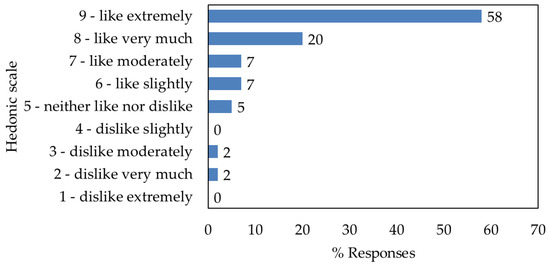
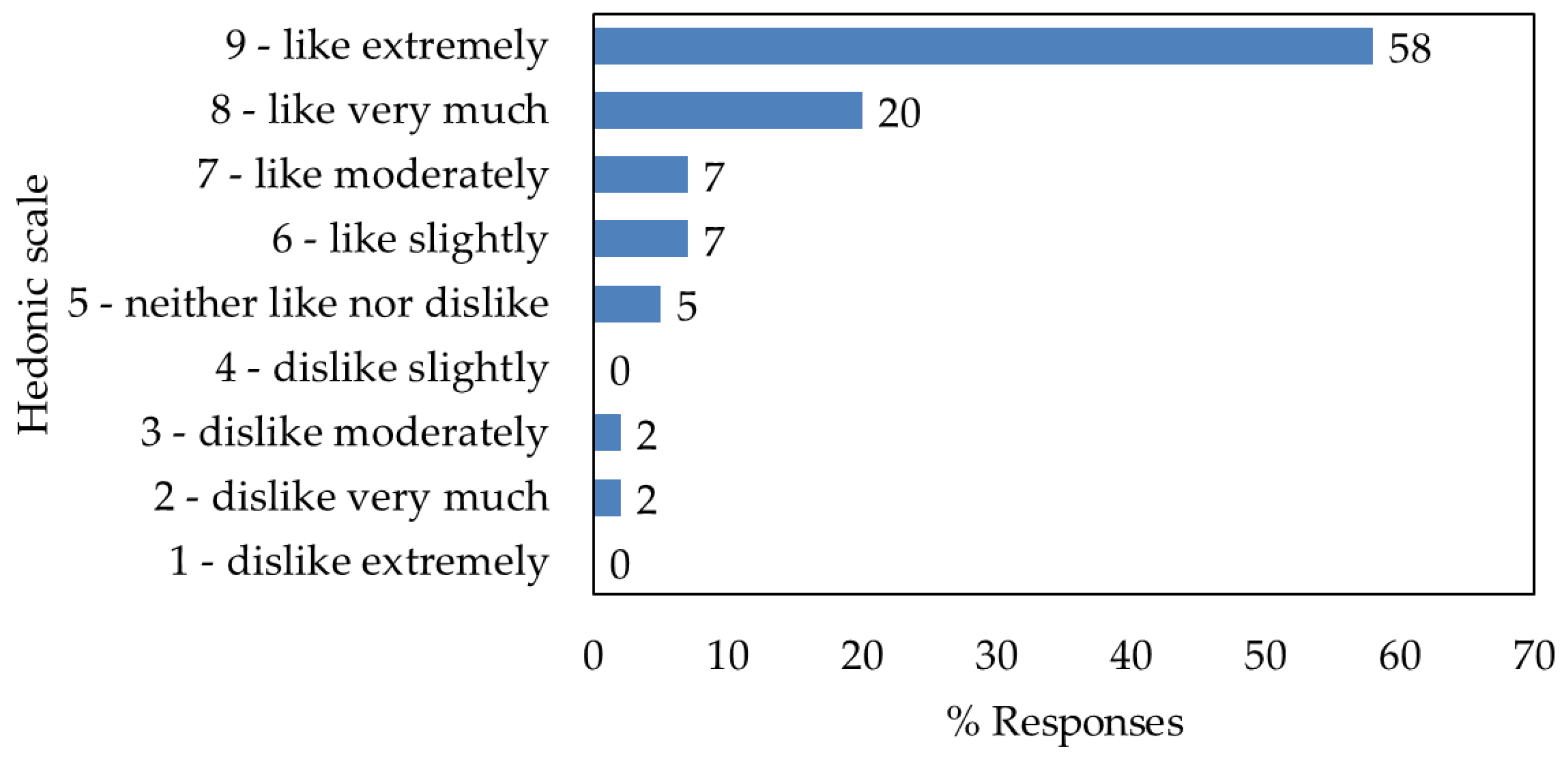
The sensory acceptance test, conducted with 73 elderly participants aged 60 to 89 years, demonstrated high acceptance of the product using a nine-point hedonic scale (Figure 1). A total of 78% of participants assigned scores above 8 for overall impression. The average hedonic score was 8.11, corresponding to an acceptance rate of 90.1%. According to the classification proposed by Huey et al. (2024) [41], which considers acceptance rates above 70% as indicative of good acceptance, the mixed beverage achieved excellent sensory acceptance. This favorable perception is further strengthened by the absence of added sugar and the beverage’s natural sensory profile.
Figure 1.
Distribution of Hedonic Scores for Sensory Acceptance of the Beverage.
Qualitative feedback from participants supported the hedonic results. Comments such as “I could taste the pineapple and mango more”, “easy to swallow”, “full-bodied”, “denser and more refined taste”, “it doesn’t contain sugar”, and “it’s very good” illustrate the appreciation for the beverage’s body, natural flavor, and ease of swallowing, an essential characteristic for oral comfort among the elderly [42].
The frequent mention of ease of swallowing aligns with the instrumental analyses that classified the product as a “moderately thick” liquid. This convergence between objective measurements and sensory perception confirms that the mixed fruit beverage presents an adequate consistency, safety for swallowing, and high overall acceptance. Therefore, the product brings together functional, nutritional, and sensory qualities that make it a safe and well-accepted option for the elderly population, including those with dysphagia.
3.2. Bioactive Compounds, Antioxidant Capacity, and Selenium Content in the Beverage Subjected to Thermal and Non-Thermal Treatments
Table 2 presents the levels of bioactive compounds, selenium, and antioxidant capacity of the mixed beverage subjected to different technological processing methods (pasteurization, sterilization, and ultrasound). The treatments affected the analyzed compounds in distinct ways, reflecting the influence of technological intensity and the chemical nature of each constituent.
Table 2.
Bioactive compounds, antioxidant capacity, and selenium content of a mixed fruit beverage with Brazil nut extract under different processing conditions.
Pasteurization caused a significant reduction in vitamin C content, decreasing from 175.62 ± 5.35 to 148.66 ± 4.80 mg/100 g, corresponding to an approximate loss of 15%. This behavior reflects the high thermal and oxidative sensitivity of ascorbic acid, which acts as a primary antioxidant and is readily oxidized to protect other bioactive compounds, such as carotenoids [43]. Similar reductions have been reported for pasteurized fruit juices processed under comparable conditions [44]. These findings confirm that even mild thermal treatments may promote relevant vitamin C losses in oxygen-rich fruit matrices.
Ultrasound treatment led to the most pronounced reduction in vitamin C among all samples, with losses reaching 41.6%. This sharp decrease is mainly associated with the formation of reactive radical species during acoustic cavitation, particularly hydroxyl radicals, which rapidly oxidize the unstable enediol structure of ascorbic acid [45,46]. In addition, increased oxygen availability due to processing conditions, such as glass packaging and recirculation systems, may have intensified oxidative degradation. Overall, vitamin C stability was strongly influenced by processing intensity and environmental factors, including temperature, oxygen exposure, and processing time [47].
In contrast, sterilization did not significantly affect vitamin C content, yielding values similar to the control. This preservation may be attributed to the combination of high temperature and short effective exposure time, which rapidly inactivates oxidative enzymes while limiting prolonged thermal degradation. The use of metallic packaging may have further contributed to vitamin C retention by promoting uniform heat transfer and limiting light and oxygen exposure [48,49].
All processing treatments resulted in a significant increase in total carotenoid content compared with the control. Pasteurization increased carotenoid content from 1.96 ± 0.03 to 2.21 ± 0.02 mg/100 g, while sterilization and ultrasound processing produced similar increases. These results indicate that both thermal energy and acoustic cavitation enhance pigment release by disrupting the plant cell matrix. Thermal treatments weaken cell walls through pectin degradation and chromoplast fragmentation, whereas ultrasound promotes mechanical disruption via cavitation, facilitating carotenoid diffusion into the juice [50,51,52,53]. Consequently, carotenoid availability increased regardless of the processing method.
Pasteurization did not significantly affect the initial phenolic content, suggesting a protective effect of matrix components such as carbohydrates and proteins, which may limit phenolic exposure to oxygen and reactive species during heating [54]. Conversely, the sharper reduction following sterilization suggests that higher temperatures promote phenolic degradation, particularly for structurally less stable compounds [55].
The most pronounced reduction in total phenolics was observed after ultrasound processing. This behavior is attributed to radical species generated during cavitation, which may directly oxidize phenolic molecules or promote polymerization reactions, resulting in the formation of high-molecular-weight or insoluble structures that are not efficiently detected by the Folin–Ciocalteu assay [45,56,57].
Despite reductions in total phenolics and vitamin C, particularly after ultrasound processing, the antioxidant capacity evaluated by ABTS and DPPH assays did not differ significantly among treatments or in comparison with the control. This apparent stability likely reflects compensatory effects, including the increased contribution of carotenoids and the formation of phenolic polymers with enhanced antioxidant activity, which can exhibit substantially higher radical-scavenging capacity than their monomeric counterparts [58]. Thus, processing-induced molecular rearrangements preserved the overall antioxidant potential of the beverage.
The increase in selenium content observed after processing may be associated with partial disruption of the food matrix, which enhances the solubilization of selenium fractions bound to proteins or colloidal particles [59]. Pasteurization appeared more efficient than sterilization, possibly due to its lower thermal severity, as higher temperatures can promote the formation of less soluble selenium–protein complexes, limiting selenium availability [60]. Moreover, selenium stability depends on its chemical form, with organic species such as selenomethionine being more soluble and thermally stable than inorganic forms during food processing [61,62].
3.3. Effect of In Vitro Digestion on Vitamin C and Carotenoid Levels
The bioaccessibility of vitamin C and carotenoids was evaluated using an in vitro gastrointestinal digestion model simulating elderly physiological conditions. Table 3 presents the post-digestion concentrations, bioaccessibility and recommended dietary allowance (RDA) percentages of these compounds in the mixed juice. In addition to bioaccessibility, the nutritional relevance of the beverage was assessed by the percentage of the recommended dietary allowance (RDA), calculated for a standardized 100 g serving using international reference values for adult men [63].
Table 3.
Bioaccessibility of vitamin C and total carotenoids in a mixed beverage subjected to different processing methods.
The initial vitamin C content in the control sample was 175.6 mg/100 g, with bioaccessibility ranging from 27.13% to 53.24%, the highest value being observed after ultrasound treatment. Considering the bioaccessible fraction, vitamin C showed a high contribution to the RDA across all treatments, reaching more than 60% of the daily requirement in the control and sterilized samples and exceeding this value in the ultrasound-treated juice. These results indicate that the mixed fruit beverage represents a nutritionally relevant dietary source of vitamin C, even after simulated gastrointestinal digestion under elderly physiological conditions.
For total carotenoids, bioaccessibility ranged from 10.65% to 28.33%, with the highest value recorded after sterilization. All processing treatments significantly affected carotenoid bioaccessibility compared to the control, whereas only sterilization showed no significant effect on vitamin C. When expressed as RDA, carotenoids contributed less than 10% of the daily requirement per 100 g, reflecting both their lower bioaccessibility and the physiological constraints associated with their lipophilic nature. Although these values do not characterize the beverage as a major dietary source of vitamin A, they highlight its role as a complementary contributor to vitamin A intake, particularly when processing strategies enhance carotenoid release.
Food matrix composition strongly influences the stability and release of this antioxidant. Multifruit matrices can enhance vitamin C retention and bioaccessibility during in vitro digestion [64,65].
Vitamin C degradation during digestion is mainly associated with intestinal conditions, particularly higher pH, oxygen exposure, and enzymatic activity, which promote ascorbic acid oxidation [66]. At higher pH values, the formation of the more reactive dianionic species (A2−) increases susceptibility to auto-oxidation [67]. In our study, ultrasound treatment resulted in the highest vitamin C bioaccessibility (53.24%), likely due to acoustic cavitation, which promotes cell disruption and matrix disorganization, facilitating compound release [68]. Cavitation-induced structural changes limited oxygen diffusion and the activity of oxidative enzymes, contributing to the preservation of ascorbic acid [20].
Carotenoids showed significant reductions after digestion, attributed to the instability of their polyenic structure under variable pH, oxygen exposure, and enzymatic action, which favor isomerization and oxidative degradation [69,70]. As lipophilic compounds, carotenoids require micellization for absorption. The lower bile salt concentration used in the elderly-adapted digestion model (6.7 mM/L) likely limited this process, contributing to their lower bioaccessibility compared to vitamin C [71].
Table 3 also provides a direct comparison between the bioaccessibility of vitamin C and carotenoids. In all treatments, vitamin C exhibited higher bioaccessibility values than carotenoids, explained by its hydrophilic nature, allowing greater dispersion in the intestinal medium. In contrast, carotenoids, due to their lipophilic character, depend on efficient micelle formation and interactions with dietary lipids to become available for absorption [71].
The higher bioaccessibility of vitamin C is therefore associated with its high aqueous solubility and low molecular weight, which facilitate rapid diffusion in the intestinal environment. Conversely, carotenoids, characterized by higher molecular weight and lipophilicity, require the formation of mixed micelles mediated by bile salts, lipids, and pancreatic enzymes to enable absorption. In our study, the reduced bile salt concentration in the elderly-adapted digestion model likely limited micelle formation, contributing to the lower bioaccessibility observed for carotenoids.
4. Limitations
From an analytical standpoint, the assessment focused on total carotenoid content, without chromatographic identification of individual compounds. Although this approach is suitable for evaluating processing effects on the carotenoid class as a whole, further studies targeting specific pigments could provide additional insights into compound-specific stability and bioaccessibility. In addition, while total selenium content was quantified, its bioaccessibility was not assessed. Therefore, the nutritional contribution of selenium is discussed based on its content rather than on its bioaccessible fraction. Future investigations addressing selenium speciation and bioaccessibility would help to further clarify its physiological relevance.
5. Conclusions
A mixed beverage, formulated with mango, pineapple, and acerola pulps and enriched with Brazil nut extract as a natural source of selenium, exhibited high nutritional value, high sensory acceptance, and appropriate consistency for individuals with dysphagia (IDDSI Level 3). The vitamin C and selenium contents meet the nutritional needs of adults aged 60+, contributing to immune support, hydration, and safe intake, highlighting the potential of this product as a functional beverage for healthy aging.
The thermal and non-thermal treatments produced distinct effects on physicochemical properties, vitamin C, carotenoids, phenolic compounds, antioxidant capacity, and selenium, depending on processing intensity. Overall, sterilization and ultrasound enhanced the stability and availability of antioxidant compounds. Therefore, the controlled application of thermal and non-thermal technologies proved effective for developing functional beverages with improved nutritional utilization and bioactive compound stability.
Author Contributions
Conceptualization, R.V.T., V.M.d.M. and L.M.C.C.; Methodology, R.V.T., L.M.C.C., F.d.S.G., D.D.G.C.F.d.S. and V.M.d.M.; Formal analysis, R.d.S.L.C. and L.C.C.-F.; Investigation, F.d.S.G., R.d.S.L.C. and L.C.C.-F.; Writing—original draft preparation, R.d.S.L.C.; Writing—review and editing, R.V.T., F.d.S.G., L.C.C.-F. and L.M.C.C.; Supervision, F.d.S.G., V.M.d.M. and L.M.C.C.; Project administration, R.V.T., V.M.d.M. and L.M.C.C.; Funding acquisition, L.M.C.C. All authors have read and agreed to the published version of the manuscript.
Funding
This study was supported by FAPERJ (Carlos Chagas Filho Foundation for Research Support of the State of Rio de Janeiro, Grant E-26/204.362/2021, E-26/211.379/2021 and E-26/200.368/2023) and the Coordination for the Improvement of Higher Education Personnel (CAPES financial code 001).
Institutional Review Board Statement
The study was conducted in accordance with the Declaration of Helsinki and approved by the Research Committee of Estácio de Sá University (UNESA) (protocol code 84210824.0.0000.5284 and date of approval 2 June 2025).
Informed Consent Statement
Informed consent was obtained from all subjects involved in the study.
Data Availability Statement
All the data are presented in the manuscript, and further inquiries can be directed to the corresponding author.
Conflicts of Interest
The authors declare no conflicts of interest.
References
- Damo, C.C.; Doring, M.; Alves, A.L.S.A.; Portella, M.R. Risk of Malnutrition and Associated Factors in Institutionalized Elderly Persons. Braz. J. Geriatr. Gerontol. 2018, 21, 711–717. [Google Scholar] [CrossRef] [Scilit]
- Capelari, S.; Budni, J. Dysphagia in Aging Is Associated with Malnutrition and the Onset of Mental Disorders. Rev. Inova Saúde 2019, 9, 142–154. [Google Scholar] [CrossRef] [Scilit]
- Azzolino, D.; Passarelli, P.C.; De Angelis, P.; Piccirillo, G.B.; D’Addona, A.; Cesari, M. Poor Oral Health as a Determinant of Malnutrition and Sarcopenia. Nutrients 2019, 11, 2898. [Google Scholar] [CrossRef] [Scilit]
- Pepa, A.; Malisova, O.; Apostolaki, I.; Magriplis, E.; Galanaki, C.; Chamos, A.; Grammatikopoulou, M.G.; Kapsokefalou, M. Total Water Intake and Beverage Variety in Older Adults: A Cross-Sectional Study on Social Capital and Quality of Life in Greece. Beverages 2025, 11, 132. [Google Scholar] [CrossRef] [Scilit]
- Maieves, H.A.; Teixeira, G.L.; Soares, L.G.; Gehling, D.P.; Ewerling, M.; Silva, B.V.d.; Sánchez-Mata, M.d.C.; Morales, P. How Thickener Type, Concentration, and Non-Standard Syringes Affect IDDSI Flow Test Evaluation of Thickened Plant-Based and Dairy Beverages. Beverages 2025, 11, 159. [Google Scholar] [CrossRef] [Scilit]
- de Sire, A.; Ferrillo, M.; Lippi, L.; Agostini, F.; de Sire, R.; Ferrara, P.E.; Raguso, G.; Riso, S.; Roccuzzo, A.; Ronconi, G.; et al. Sarcopenic Dysphagia, Malnutrition, and Oral Frailty in Elderly: A Comprehensive Review. Nutrients 2022, 14, 982. [Google Scholar] [CrossRef] [Scilit] [PubMed]
- Cichero, J.A.Y.; Lam, P.; Steele, C.M.; Hanson, B.; Chen, J.; Dantas, R.O.; Duivestein, J.; Kayashita, J.; Lecko, C.; Murray, J.; et al. Development of International Terminology and Definitions for Texture-Modified Foods and Thickened Fluids Used in Dysphagia Management: The IDDSI Framework. Dysphagia 2016, 32, 293–314. [Google Scholar] [CrossRef] [Scilit]
- International Dysphagia Diet Standardisation Initiative Complete IDDSI Framework Detailed Definitions 2.0. Available online: http://iddsi.org/framework/ (accessed on 14 December 2025).
- Martins, I.B.A.; Alcantara, M.; Torrezan, R.; Tonon, R.V.; da Matta, V.M.; Deliza, R. Investigating the Eating Patterns and Expectations for the 60+: Insights for the Development of New “Ready-to-Eat” Products. Food Qual. Prefer. 2025, 126, 105423. [Google Scholar] [CrossRef] [Scilit]
- Denev, P.; Pencheva, D.; Teneva, D.; Ognyanov, M.; Todorova, Z. Development of Functional Fruit, Vegetable, and Herbal Beverages Enriched with Gamma-Aminobutyric Acid and Polyphenols: Is It Feasible? Beverages 2025, 11, 176. [Google Scholar] [CrossRef] [Scilit]
- Lenucci, M.S.; Tornese, R.; Mita, G.; Durante, M. Bioactive Compounds and Antioxidant Activities in Different Fractions of Mango Fruits (Mangifera indica L., Cultivar Tommy Atkins and Keitt). Antioxidants 2022, 11, 484. [Google Scholar] [CrossRef] [Scilit]
- Esperança, V.J.d.R.; Castro, I.P.L.d.; Couto, C.d.C.; Macedo, A.V.d.M.; Freitas de Sá, D.d.G.C.; Lima, J.P.; Freitas-Silva, O. Elderly People’s Evaluation and Understanding of Vegetable Beverages Based on Brazil Nuts (Betholletia excelsa). Beverages 2025, 11, 127. [Google Scholar] [CrossRef] [Scilit]
- Labunskyy, V.M.; Hatfield, D.L.; Gladyshev, V.N. Selenoproteins: Molecular Pathways and Physiological Roles. Physiol. Rev. 2014, 94, 739–777. [Google Scholar] [CrossRef] [Scilit]
- Parys, W.; Dołowy, M.; Pyka-Pająk, A. Current Strategies for Studying the Natural and Synthetic Bioactive Compounds in Food by Chromatographic Separation Techniques. Processes 2021, 9, 1100. [Google Scholar] [CrossRef] [Scilit]
- Bianchini, C.B.; Arriola, N.D.A.; Seraglio, S.K.T.; Costa, A.C.d.O.; Ribeiro, D.H.B.; Komatsu, R.A.; Machado, B.D.; Amboni, R.D.d.M.C.; Fritzen-Freire, C.B. Influence of Pasteurization on the Chemical, Physical and Microbiological Characteristics of Uvaia Pulp (Eugenia pyriformis Cambess). Res. Soc. Dev. 2020, 9, e993975192. [Google Scholar] [CrossRef] [Scilit]
- Freitas, V.V.; Rodrigues Borges, L.L.; Dias Castro, G.A.; Henrique dos Santos, M.; Teixeira Ribeiro Vidigal, M.C.; Fernandes, S.A.; Stringheta, P.C. Impact of Different Roasting Conditions on the Chemical Composition, Antioxidant Activities, and Color of Coffea canephora and Coffea arabica L. Samples. Heliyon 2023, 9, e19580. [Google Scholar] [CrossRef] [Scilit]
- Odriozola-Serrano, I.; Bellí, G.; Puigpinós, J.; Herrero, E.; Martín-Belloso, O. Screening the Antioxidant Activity of Thermal or Non-Thermally Treated Fruit Juices by In Vitro and In Vivo Assays. Beverages 2022, 8, 36. [Google Scholar] [CrossRef] [Scilit]
- Rojas, M.L.; Kubo, M.T.K.; Caetano-Silva, M.E.; Augusto, P.E.D. Ultrasound Processing of Fruits and Vegetables, Structural Modification and Impact on Nutrient and Bioactive Compounds: A Review. Int. J. Food Sci. Technol. 2021, 56, 4376–4395. [Google Scholar] [CrossRef] [Scilit]
- Rojas, M.L.; Kubo, M.T.; Miano, A.C.; Augusto, P.E. Ultrasound Processing to Enhance the Functionality of Plant-Based Beverages and Proteins. Curr. Opin. Food Sci. 2022, 48, 100939. [Google Scholar] [CrossRef] [Scilit]
- Fonteles, T.V.; Leite, A.K.F.; Silva, A.R.A.; Carneiro, A.P.G.; Miguel, E.D.C.; Cavada, B.S.; Fernandes, F.A.N.; Rodrigues, S. Ultrasound Processing to Enhance Drying of Cashew Apple Bagasse Puree: Influence on Antioxidant Properties and in Vitro Bioaccessibility of Bioactive Compounds. Ultrason. Sonochem. 2016, 31, 237–249. [Google Scholar] [CrossRef] [Scilit]
- Cárcel, J.A.; García-Pérez, J.V.; Benedito, J.; Mulet, A. Food Process Innovation through New Technologies: Use of Ultrasound. J. Food Eng. 2012, 110, 200–207. [Google Scholar] [CrossRef] [Scilit]
- Zhang, L.; Zha, M.; Li, S.; Zong, W. Investigation on the Effect of Thermal Sterilization versus Non-Thermal Sterilization on the Quality Parameters of Jujube Juice Fermented by Lactobacillus Plantarum. J. Food Sci. Technol. 2022, 59, 3765–3774. [Google Scholar] [CrossRef] [Scilit]
- Ahmad, K.; Imran, M.; Ahmad, T.; Ahmad, M.H.; Khan, M.K. Impact of Ultrasound Processing on Physicochemical and Bioactive Attributes of Grape Based Optimized Fruit Beverage. Pakistan J. Agric. Sci. 2020, 57, 1117–1124. [Google Scholar]
- Nadeem, M.; Ranjha, M.M.A.N.; Ameer, K.; Ainee, A.; Yasmin, Z.; Javaria, S.; Teferra, T.F. Effect of Sonication on the Functional Properties of Different Citrus Fruit Juices. Int. J. Fruit Sci. 2022, 22, 568–580. [Google Scholar] [CrossRef] [Scilit]
- Meilgaard, M.C.; Carr, B.T.; Civille, G.V. Sensory Evaluation Techniques; CRC Press: Boca Raton, FL, USA, 1999. [Google Scholar] [CrossRef] [Scilit]
- Menard, O.; Lesmes, U.; Shani-Levi, C.S.; Araiza Calahorra, A.; Lavoisier, A.; Morzel, M.; Rieder, A.; Feron, G.; Nebbia, S.; Mashiah, L.; et al. Static in Vitro Digestion Model Adapted to the General Older Adult Population: An INFOGEST International Consensus. Food Funct. 2023, 14, 4569–4582. [Google Scholar] [CrossRef] [Scilit]
- Da Rosa, J.S.; Godoy, R.L.D.O.; Oiano Neto, J.; Campos, R.D.S.; Da Matta, V.M.; Freire, C.A.; Da Silva, A.S.; De Souza, R.S. Development of a Method for Vitamin C Analysis in Food Using High Performance Liquid Chromatography and Ion Exclusion. Food Sci. Technol. 2007, 27, 837–846. [Google Scholar] [CrossRef] [Scilit]
- Rodriguez-Amaya, D.B. A Guide to Carotenoid Analysis in Foods; ILSI Human Nutrition Institute: Washington, DC, USA, 1999. [Google Scholar]
- Singleton, V.L.; Rossi, J.A. Colorimetry of Total Phenolics with Phosphomolybdic-Phosphotungstic Acid Reagents. Am. J. Enol. Vitic. 1965, 16, 144–158. [Google Scholar] [CrossRef] [Scilit]
- Georgé, S.; Brat, P.; Alter, P.; Amiot, M.J. Rapid Determination of Polyphenols and Vitamin C in Plant-Derived Products. J. Agric. Food Chem. 2005, 53, 1370–1373. [Google Scholar] [CrossRef] [Scilit] [PubMed]
- Re, R.; Pellegrini, N.; Proteggente, A.; Pannala, A.; Yang, M.; Rice-Evans, C. Antioxidant Activity Applying an Improved ABTS Radical Cation Decolorization Assay. Free Radic. Biol. Med. 1999, 26, 1231–1237. [Google Scholar] [CrossRef] [Scilit]
- Brand-Williams, W.; Cuvelier, M.-E.; Berset, C. Use of a Free Radical Method to Evaluate Antioxidant Activity. LWT-Food Sci. Technol. 1995, 28, 25–30. [Google Scholar] [CrossRef] [Scilit]
- Aoac, I. Official Methods of Analysis of AOAC International, 18th ed.; AOAC International: Rockville, MD, USA, 2010; Volume 6, pp. 90022–90025. [Google Scholar]
- Oladipo, I.C.; Oyelami, R.; Ogundeji, K.D.; Akinteye, E.O.; Adewoyin, A.G.; Oladipo, A.O. Microbial Quality, Vitamin, Mineral and Proximate Composition of Some Fresh Fruit Juice Samples. Eur. J. Biol. Biotechnol. 2022, 3, 25–29. [Google Scholar] [CrossRef] [Scilit]
- Ukonze, J.A.; Ogu, E.; Onu, F.M.; Dimelu, I.; Ifeanyieze, F.O.; Ejiofor, T.E. Impact of Clarification Process on the Nutritional, Mineral and Vitamin Composition of Cashew (Anacardium occidentale) Apple Juice. Afr. J. Biotechnol. 2018, 17, 337–342. [Google Scholar] [CrossRef] [Scilit]
- Tian, M.; Zhang, Q.; Zeng, X.; Rui, X.; Jiang, M.; Chen, X. The Differences in Protein Degradation and Sensitization Reduction of Mangoes between Juices and Pieces Fermentation. Foods 2023, 12, 3465. [Google Scholar] [CrossRef] [Scilit] [PubMed]
- Vasquez-Rojas, W.V.; Martín, D.; Miralles, B.; Recio, I.; Fornari, T.; Cano, M.P. Composition of Brazil Nut (Bertholletia excels HBK), Its Beverage and by-Products: A Healthy Food and Potential Source of Ingredients. Foods 2021, 10, 3007. [Google Scholar] [CrossRef] [Scilit]
- Mohammad Saeed Awan, P.; Ali, S.; Ali, A.; Hussain, A.; Ali Qazalbash, M.; Bio, J.; Sci, E. A Comparative Study of Barberry Fruits in Terms of Its Nutritive and Medicinal Contents from CKNP Region. J. Biodivers. Environ. Sci. 2014, 9, 9–17. [Google Scholar]
- Cárdenas-Pérez, S.; Chanona-Pérez, J.J.; Güemes-Vera, N.; Cybulska, J.; Szymanska-Chargot, M.; Chylinska, M.; Kozioł, A.; Gawkowska, D.; Pieczywek, P.M.; Zdunek, A. Structural, Mechanical and Enzymatic Study of Pectin and Cellulose during Mango Ripening. Carbohydr. Polym. 2018, 196, 313–321. [Google Scholar] [CrossRef] [Scilit]
- Garcia, J.M.; Chambers, E. Managing Dysphagia through Diet Modifications. Am. J. Nurs. 2010, 110, 26–33. [Google Scholar] [CrossRef] [Scilit]
- Huey, S.L.; Bhargava, A.; Friesen, V.M.; Konieczynski, E.M.; Krisher, J.T.; Mbuya, M.N.N.; Mehta, N.H.; Monterrosa, E.; Nyangaresi, A.M.; Mehta, S. Sensory Acceptability of Biofortified Foods and Food Products: A Systematic Review. Nutr. Rev. 2024, 82, 892–912. [Google Scholar] [CrossRef] [Scilit] [PubMed]
- De Andrade, G.K.P.; Pohlmann, J.B.C.; Haddad, M.T. Nutritional Care for Geriatric Patients, 1st ed.; Atheneu: Rio de Janeiro, Brazil, 2020. [Google Scholar]
- Zylinska, L.; Lisek, M.; Guo, F.; Boczek, T. Vitamin C Modes of Action in Calcium-Involved Signaling in the Brain. Antioxidants 2023, 12, 231. [Google Scholar] [CrossRef] [Scilit] [PubMed]
- Mandha, J.; Shumoy, H.; Matemu, A.O.; Raes, K. Characterization of Fruit Juices and Effect of Pasteurization and Storage Conditions on Their Microbial, Physicochemical, and Nutritional Quality. Food Biosci. 2023, 51, 102335. [Google Scholar] [CrossRef] [Scilit]
- Pinelo, M.; Rubilar, M.; Jerez, M.; Sineiro, J.; Núñez, M.J. Effect of Solvent, Temperature, and Solvent-to-Solid Ratio on the Total Phenolic Content and Antiradical Activity of Extracts from Different Components of Grape Pomace. J. Agric. Food Chem. 2005, 53, 2111–2117. [Google Scholar] [CrossRef] [Scilit]
- Belwal, T.; Bhatt, I.D.; Cravotto, G. Effect of Ultrasound on Extraction and Stability of Polyphenols from Berberis Jaeschkeana C.K. Schneid Fruits: A Comparative Study. Sustain. Chem. Pharm. 2022, 27, 100649. [Google Scholar] [CrossRef] [Scilit]
- Feszterová, M.; Kowalska, M.; Mišiaková, M. Stability of Vitamin C Content in Plant and Vegetable Juices under Different Storing Conditions. Appl. Sci. 2023, 13, 10640. [Google Scholar] [CrossRef] [Scilit]
- Santos, A.; Silva, T.S.e.; Cruz, F.; Valente, B.; Cristianini, M.; de Alvarenga Freire, M.T.; Petrus, R. Processing of Vitamin C-Fortified Sugarcane Juice: The Combined Effect of High Hydrostatic Pressure and Heat Treatment. J. Food Meas. Charact. 2025, 19, 5459–5474. [Google Scholar] [CrossRef] [Scilit]
- Beltrán-González, F.; Pérez-López, A.J.; López-Nicolás, J.M.; Carbonell-Barrachina, Á.A. Effect of Packaging Materials on Color, Vitamin C and Sensory Quality of Refrigerated Mandarin Juice. J. Food Qual. 2008, 31, 596–611. [Google Scholar] [CrossRef] [Scilit]
- Zhang, Z.; Wei, Q.; Nie, M.; Jiang, N.; Liu, C.; Liu, C.; Li, D.; Xu, L. Microstructure and Bioaccessibility of Different Carotenoid Species as Affected by Hot Air Drying: Study on Carrot, Sweet Potato, Yellow Bell Pepper and Broccoli. LWT 2018, 96, 357–363. [Google Scholar] [CrossRef] [Scilit]
- González-Peña, M.A.; Ortega-Regules, A.E.; Anaya de Parrodi, C.; Lozada-Ramírez, J.D. Chemistry, Occurrence, Properties, Applications, and Encapsulation of Carotenoids—A Review. Plants 2023, 12, 313. [Google Scholar] [CrossRef] [Scilit]
- Ranganathan, K.; Subramanian, V.; Shanmugam, N. Effect of Thermal and Nonthermal Processing on Textural Quality of Plant Tissues. Crit. Rev. Food Sci. Nutr. 2016, 56, 2665–2694. [Google Scholar] [CrossRef] [Scilit]
- Rodríguez-Rico, D.; Sáenz-Esqueda, M.d.l.Á.; Meza-Velázquez, J.A.; Martínez-García, J.J.; Quezada-Rivera, J.J.; Umaña, M.M.; Minjares-Fuentes, R. High-Intensity Ultrasound Processing Enhances the Bioactive Compounds, Antioxidant Capacity and Microbiological Quality of Melon (Cucumis melo) Juice. Foods 2022, 11, 2648. [Google Scholar] [CrossRef] [Scilit]
- Pasquet, P.L.; Julien-David, D.; Zhao, M.; Villain-Gambier, M.; Trébouet, D. Stability and Preservation of Phenolic Compounds and Related Antioxidant Capacity from Agro-Food Matrix: Effect of PH and Atmosphere. Food Biosci. 2024, 57, 103586. [Google Scholar] [CrossRef] [Scilit]
- Villota, N.; Camarero, L.M.; Lomas, J.M.; Perez, J. Changes of Turbidity during the Phenol Oxidation by Photo-Fenton Treatment. Environ. Sci. Pollut. Res. 2014, 21, 12208–12216. [Google Scholar] [CrossRef] [Scilit]
- Suslick, K.S. Sonochemistry. Science 1990, 247, 1439–1445. [Google Scholar] [CrossRef] [Scilit] [PubMed]
- Yasui, K. Production of O Radicals from Cavitation Bubbles under Ultrasound. Molecules 2022, 27, 4788. [Google Scholar] [CrossRef] [Scilit] [PubMed]
- Sánchez-Mundo, M.L.; Escobedo-Crisantes, V.M.; Mendoza-Arvizu, S.; Jaramillo-Flores, M.E. Polymerization of Phenolic Compounds by Bell Pepper Polyphenol Oxidase with an Increase in Their Antioxidant Capacity. CyTA J. Food 2016, 14, 594–603. [Google Scholar] [CrossRef] [Scilit]
- Mezeyová, I.; Mezey, J.; Šlosár, M.; Hegedusová, A.; Rosa, R. Selenization and Its Impact on Quantitative and Qualitative Parameters of Carrot Juice. Food Biosci. 2024, 59, 103933. [Google Scholar] [CrossRef] [Scilit]
- Teixeira, J.L.d.P.; Milani, R.F.; Morgano, M.A. Selenium in Plant-Based Beverages: How Can in Vitro Bioaccessibility Contribute to an Accurate Daily Intake? J. Trace Elem. Miner. 2024, 8, 100124. [Google Scholar] [CrossRef] [Scilit]
- Khanam, A.; Platel, K. Bioaccessibility of Selenium, Selenomethionine and Selenocysteine from Foods and Influence of Heat Processing on the Same. Food Chem. 2016, 194, 1293–1299. [Google Scholar] [CrossRef] [Scilit]
- Peng, S.-J.; Ye, D.-T.; Zheng, J.; Xue, Y.-R.; Lin, L.; Zhao, Y.-D.; Miao, W.-H.; Song, Y.; Wen, Z.-S.; Zheng, B. Synthesis, Characterization of Low Molecular Weight Chitosan Selenium Nanoparticles and Its Effect on DSS-Induced Ulcerative Colitis in Mice. Int. J. Mol. Sci. 2022, 23, 15527. [Google Scholar] [CrossRef] [Scilit]
- Institute of Medicine (US). Panel on Dietary Antioxidants and Related Compounds Dietary Reference Intakes for Vitamin C, Vitamin E, Selenium, and Carotenoids; National Academies Press: Washington, DC, USA, 2000. [Google Scholar] [CrossRef] [Scilit]
- Desseva, I.; Mihaylova, D. Influence of in Vitro Gastrointestinal Digestion on Phytochemicals in Pomegranate Juice. Food Sci. Technol. 2020, 40, 211–216. [Google Scholar] [CrossRef] [Scilit]
- Andaç Öztürk, S.; Yaman, M. Investigation of Bioaccessibility of Vitamin C in Various Fruits and Vegetables under in Vitro Gastrointestinal Digestion System. J. Food Meas. Charact. 2022, 16, 3735–3742. [Google Scholar] [CrossRef] [Scilit]
- Yaman, M.; Çatak, J.; Uğur, H.; Gürbüz, M.; Belli, İ.; Tanyıldız, S.N.; Yıldırım, H.; Cengiz, S.; Yavuz, B.B.; Kişmiroğlu, C.; et al. The Bioaccessibility of Water-Soluble Vitamins: A Review. Trends Food Sci. Technol. 2021, 109, 552–563. [Google Scholar] [CrossRef] [Scilit]
- Yin, X.; Chen, K.; Cheng, H.; Chen, X.; Feng, S.; Song, Y.; Liang, L. Chemical Stability of Ascorbic Acid Integrated into Commercial Products: A Review on Bioactivity and Delivery Technology. Antioxidants 2022, 11, 153. [Google Scholar] [CrossRef] [Scilit]
- Mieszczakowska-Frąc, M.; Celejewska, K.; Płocharski, W. Impact of Innovative Technologies on the Content of Vitamin C and Its Bioavailability from Processed Fruit and Vegetable Products. Antioxidants 2021, 10, 54. [Google Scholar] [CrossRef] [Scilit]
- Barba, F.J.; Mariutti, L.R.B.; Bragagnolo, N.; Mercadante, A.Z.; Barbosa-Cánovas, G.V.; Orlien, V. Bioaccessibility of Bioactive Compounds from Fruits and Vegetables after Thermal and Nonthermal Processing. Trends Food Sci. Technol. 2017, 67, 195–206. [Google Scholar] [CrossRef] [Scilit]
- Etzbach, L.; Stolle, R.; Anheuser, K.; Herdegen, V.; Schieber, A.; Weber, F. Impact of Different Pasteurization Techniques and Subsequent Ultrasonication on the In Vitro Bioaccessibility of Carotenoids in Valencia Orange (Citrus sinensis (L.) Osbeck) Juice. Antioxidants 2020, 9, 534. [Google Scholar] [CrossRef] [Scilit] [PubMed]
- Böhm, V.; Lietz, G.; Olmedilla-Alonso, B.; Phelan, D.; Reboul, E.; Bánati, D.; Borel, P.; Corte-Real, J.; De Lera, A.R.; Desmarchelier, C.; et al. From Carotenoid Intake to Carotenoid Blood and Tissue Concentrations—Implications for Dietary Intake Recommendations. Nutr. Rev. 2021, 79, 544–573. [Google Scholar] [CrossRef] [Scilit] [PubMed]

Disclaimer/Publisher’s Note: The statements, opinions and data contained in all publications are solely those of the individual author(s) and contributor(s) and not of MDPI and/or the editor(s). MDPI and/or the editor(s) disclaim responsibility for any injury to people or property resulting from any ideas, methods, instructions or products referred to in the content. |
© 2026 by the authors. Licensee MDPI, Basel, Switzerland. This article is an open access article distributed under the terms and conditions of the Creative Commons Attribution (CC BY) license.