Abstract
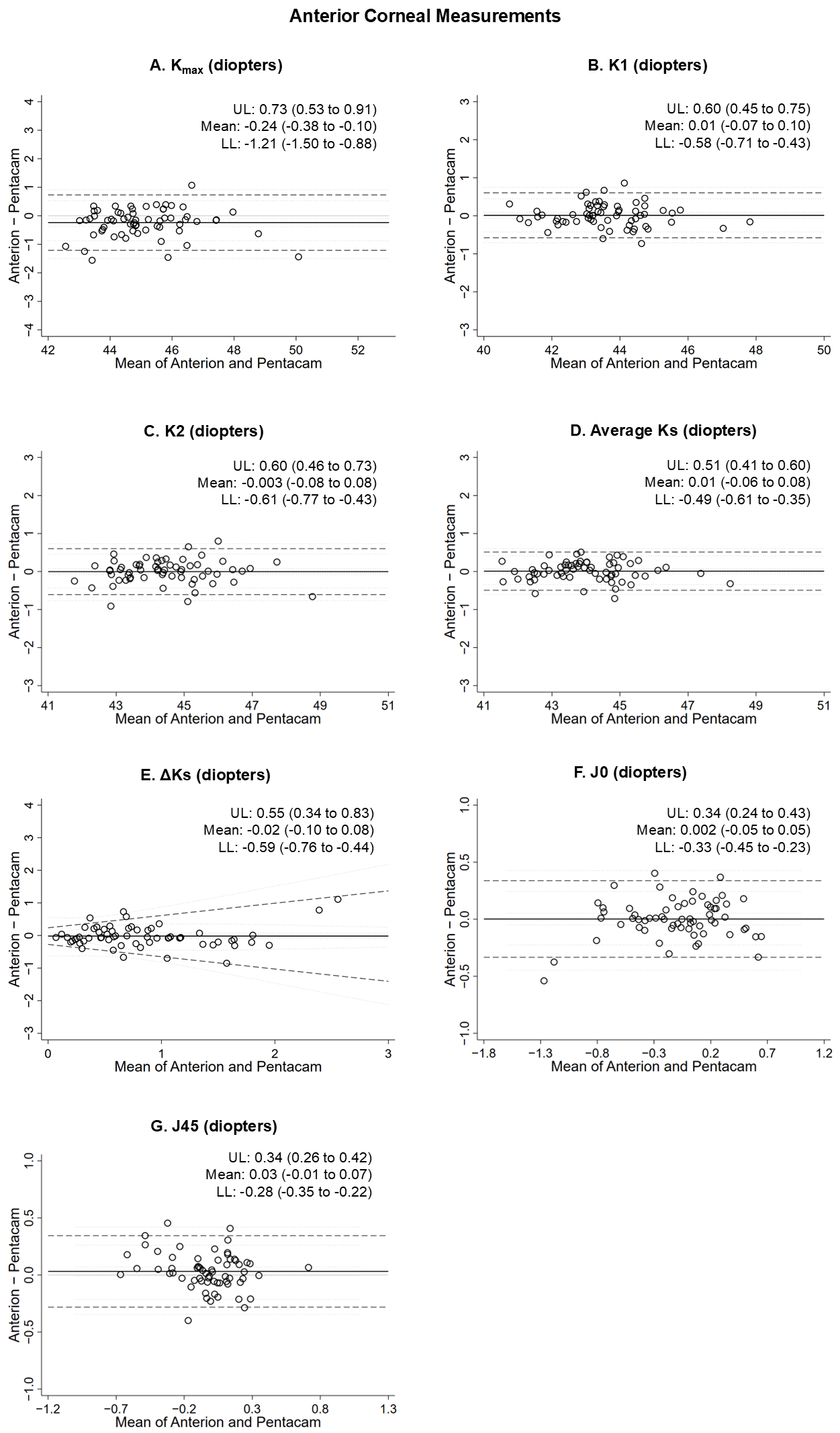
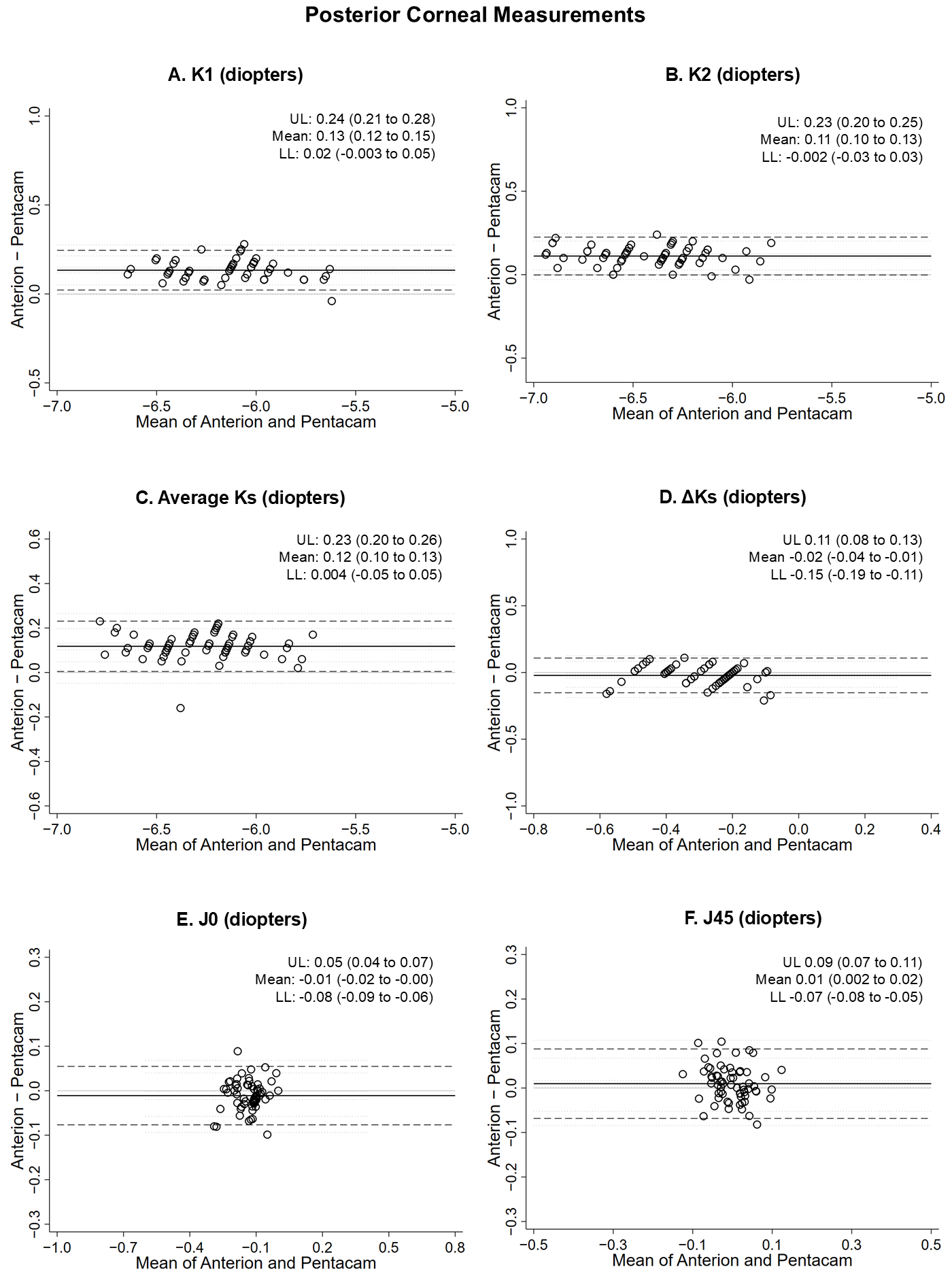
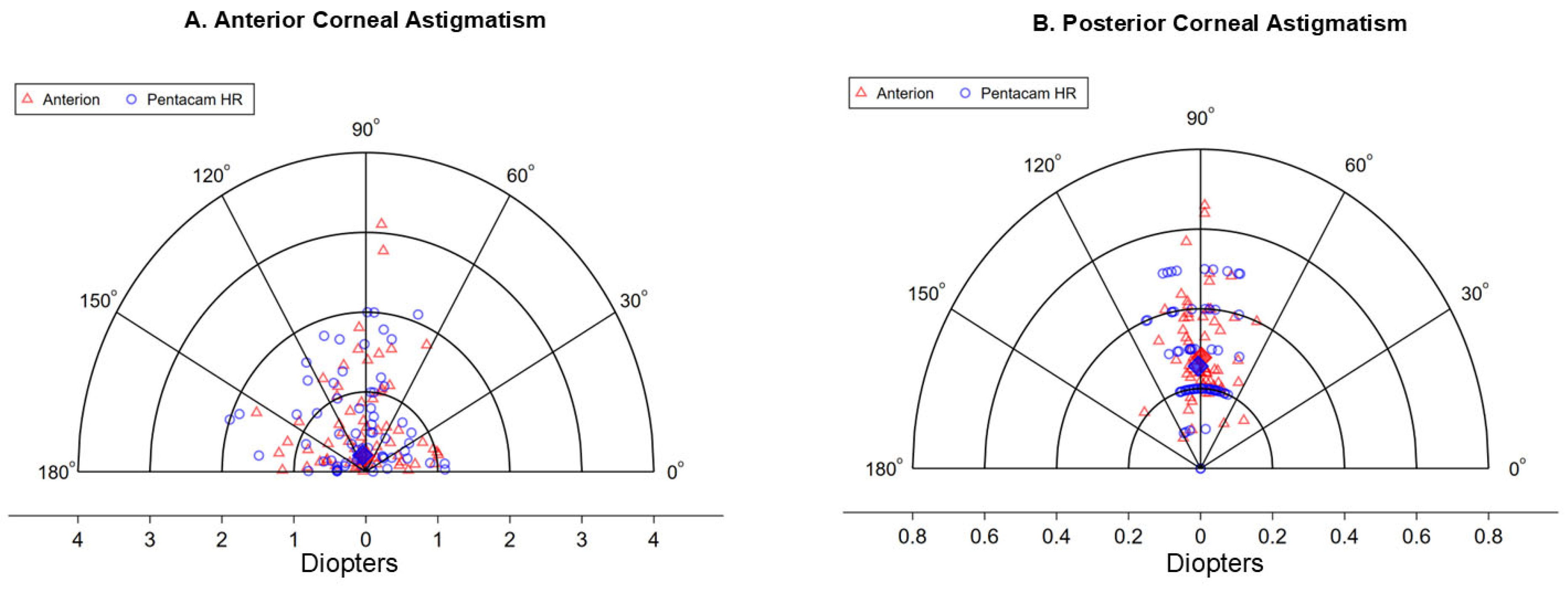
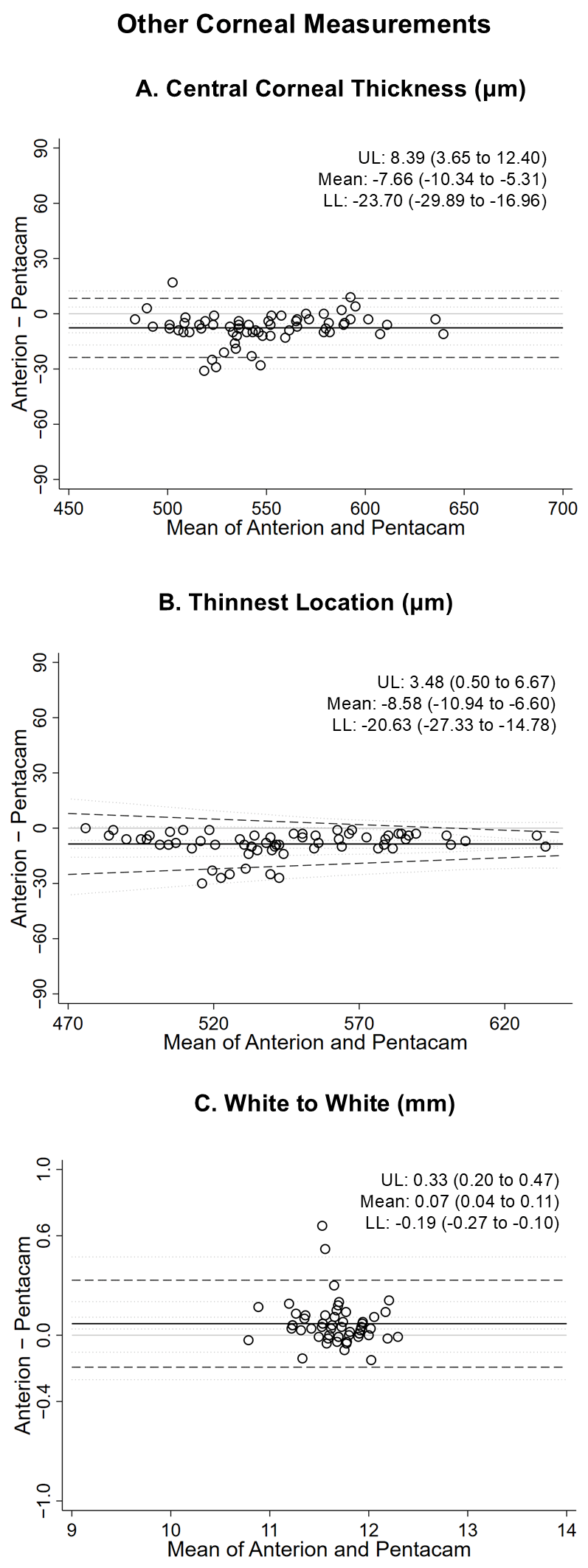
Purpose: To compare concordance of corneal tomographic measurements obtained using Anterion versus Pentacam HR. Setting: Outpatient ophthalmology clinic. Design: Retrospective cross-sectional study. Methods: Eyes without corneal abnormalities underwent tomography using the Anterion Cornea App and Pentacam HR. Measurements included anterior keratometry (K1, K2, ΔK, average K, Kmax), posterior keratometry (K1, K2, ΔK, and average K), astigmatism power-vector components (J0, J45) for both surfaces, central corneal thickness (CCT), white-to-white (WTW), and thinnest pachymetric point (TP). We assessed agreement using Pearson correlation coefficients (ρ), Lin’s concordance correlation coefficient (CCC), and Bland–Altman analysis. Generalized estimating equation models were used to assess measurement differences between devices. Results: A total of 64 eyes of 41 patients underwent corneal tomography with both devices. Anterion and Pentacam HR showed strong linear correlations for all measurements (ρ > 0.700), with concordance ranging from satisfactory to excellent (CCC 0.704–0.981). No statistically significant mean inter-device differences were found for anterior K1 (0.01 diopters [D], p = 0.775), K2 (−0.003 D, p = 0.951), average K (0.01 D, p = 0.801), ΔK (−0.02 D, p = 0.693), or the anterior astigmatism vectors J0 (0.002 D, p = 0.936) and J45 (0.03 D, p = 0.129). Mean posterior K1, K2, and average K measurements were flatter with Anterion than Pentacam HR, with mean inter-device differences of 0.13 D (p < 0.001), 0.11 D (p < 0.001), and 0.12 D (p < 0.001), respectively. The mean inter-device difference for posterior ΔK was −0.02 D (p = 0.018). Statistically significant mean inter-device differences were also found for posterior J0 (−0.01 D, p = 0.018) and J45 (0.01 D, p = 0.007). Anterion measured lower values than Pentacam HR for anterior Kmax, CCT, and TP, with mean inter-device differences of −0.24 D (p = 0.002), −7.66 μm (p < 0.001), and −8.58 μm (p < 0.001), respectively, and a higher mean WTW, with a mean inter-device difference of 0.07 mm (p < 0.001). Conclusions: Anterion and Pentacam HR showed satisfactory-to-excellent measurement concordance, with negligible mean inter-device biases for most anterior keratometry measurements and anterior astigmatism vectors. However, individual-eye differences could approach 0.49–0.61 D for anterior keratometry and exceed 20 μm for pachymetry. These differences may become relevant in borderline cases and during longitudinal disease monitoring, warranting parameter-specific caution.