


Abstract
Microbial fuel cells (MFCs) are promising bioelectrochemical systems for converting the chemical energy contained in organic matter into electrical energy, with potential applications in wastewater treatment, waste valorisation, and environmental energy recovery. However, their practical implementation is still limited by their relatively low electrical output, making the development of high-performance electrode materials an important research priority. In this study, femtosecond laser ablation was used to modify the surface of a carbon cloth anode for application in a single-chamber, open-air MFC. The laser treatment was designed to alter the surface structure of the carbon cloth and potentially improve its interaction with the electroactive microbial community. The electrical performance of the MFC equipped with the modified anode was compared with that of a system containing an unmodified carbon cloth electrode. The laser-modified anode resulted in a maximum power output of 217.6 µW at an external resistance of 1 kΩ, whereas the MFC equipped with the unmodified anode reached 85.6 µW under the same conditions. Therefore, the modified anode provided an approximately 2.5-fold increase in power generation. These results indicate that femtosecond laser ablation may represent a promising strategy for tailoring carbon cloth surfaces and improving the electrical performance of MFCs. Although further studies are required to assess electrode stability and performance with real wastewater or waste-derived substrates, the proposed approach provides a useful basis for the development of modified anodes for future environmental MFC applications.
1. Introduction
The global rise in population and industry has intensified the demand for energy, exacerbating the challenge of limited fuel resources [1,2]. This escalation poses a heightened risk of worldwide energy crises, adversely affecting both the environment and human health. The confluence of issues related to energy crises, environmental degradation, and climate change motivates scientists worldwide to pursue innovative, sustainable, and renewable energy solutions [3,4]. In this context, bioelectrochemical systems (BESs) have attracted increasing attention because they exploit the metabolic activity of microorganisms to couple the conversion of organic matter with electrochemical processes [5,6]. Among the different BES configurations, microbial fuel cells (MFCs) and microbial electrolysis cells (MECs) represent two important and closely related systems. Both technologies rely on the activity of electroactive microorganisms, the development of a biofilm on the anode, and the transfer of electrons generated during microbial metabolism to an electrode [7,8]. However, their operational objectives differ: MFCs directly convert part of the chemical energy stored in organic substrates into electrical energy, whereas MECs generally require an external electrical input to drive the production of valuable compounds, such as biohydrogen, at the cathode [9,10]. Both configurations have been investigated for the treatment and valorisation of organic-rich waste streams, including wastewater [11,12]. Recent studies have explored MECs for biohydrogen production from wastewater, brewery wastewater, and synthetic and real organic waste-derived substrates, highlighting the potential of BESs to combine waste treatment with energy or resource recovery [13,14]. Also, MFCs have attracted particular interest in environmental applications because they can couple the removal of organic matter from wastewater or other waste-derived substrates with the generation of electrical energy [15,16]. Their potential integration into wastewater treatment, waste valorisation, and environmental energy-recovery strategies has stimulated research into reactor configuration, microbial activity, electrode materials, and operating conditions [17,18,19]. However, despite their potential, the relatively low voltage and power output of MFCs still represent major limitations to their broader application and scale-up, making the development of high-performance electrode materials an important research priority [20,21].
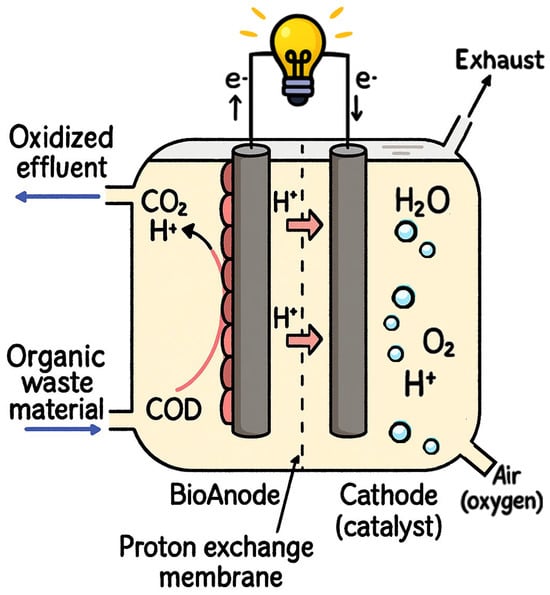
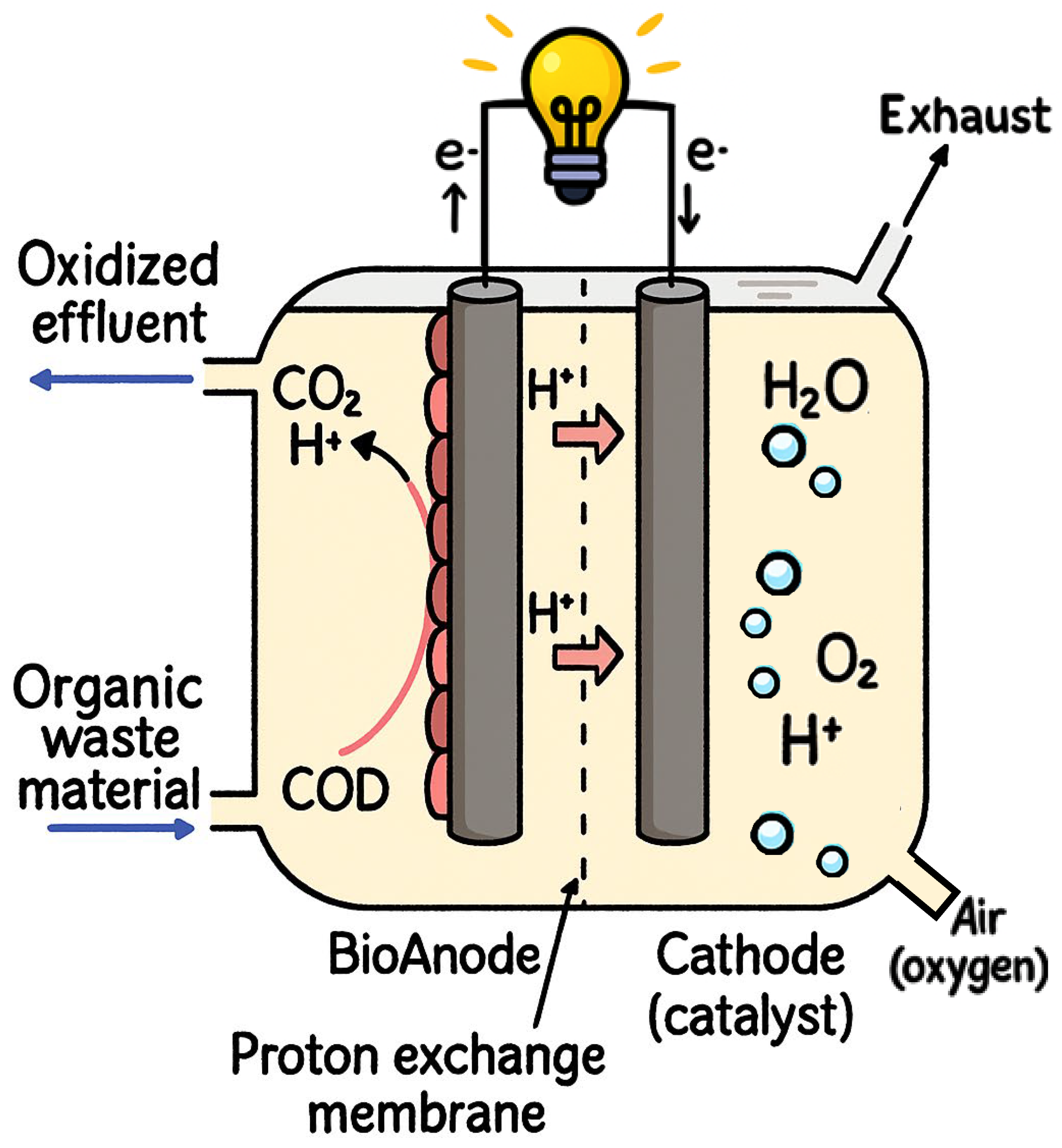
In this view, aside from reducing the costs of MFCs by replacing its key components (anode, proton exchange membrane, and cathode) with inexpensive materials like carbon fabric [22], their superficial modification is currently gathering a great deal of attention due to the possibility to control the electricity production process itself. The electrical generation process in MFCs relies on the oxidation of organic compounds by electroactive microorganisms at the anode. The electrons released during microbial metabolism are transferred to the anode and subsequently flow through an external electrical circuit toward the cathode, where they participate in the reduction reaction [23]. A schematic representation is given in Figure 1.
Figure 1.
Schematic diagram of MFC unit. The large red arrows indicate the passage of H+ ions from the anode chamber to the cathode chamber through the exchange membrane, whilst the black arrows indicate the passage of electrons through the external electrical circuit.
Recent advances in sustainable waste management have also highlighted the importance of recovering valuable components from secondary resources through targeted recycling and material regeneration strategies. For instance, Zhang et al. [24] demonstrated an approach for selectively recovering manganese and lithium from spent LiMn2O4 cathode materials and regenerating them into high-performance single-crystal cathodes, emphasizing the potential of resource recovery and material reutilization in supporting circular economy principles.
However, the anode represents a key component of the system, as it provides the interface between the electroactive biofilm and the external circuit. Its electrical conductivity, accessible surface area, porosity, surface morphology, and ability to promote microbial attachment can strongly influence extracellular electron transfer (EET) and, consequently, the overall electrical performance of the MFC [25]. Carbon-based materials, including carbon cloth and carbon fabric, are widely considered promising electrode substrates because of their conductivity, porous structure, chemical stability, and suitability for biofilm development. Nevertheless, further improvements in the interaction between the electrode surface and electroactive microorganisms are required to enhance extracellular EET mechanisms, current generation and power production [26].
Electrode Modification Strategies
Several strategies have been investigated to improve the physicochemical and electrochemical properties of carbon-based anodes for MFC applications. Conventional approaches may involve chemical etching, redox grafting, or other treatments requiring chemical reagents, which can potentially generate additional waste or introduce environmental concerns, resulting in chemical vapor deposition or producing hazardous detriments for the environment [27]. Chemical and electrochemical treatments, including acid oxidation and surface functionalization, have been widely explored to introduce oxygen- and nitrogen-containing functional groups, improve electrode wettability, and facilitate microbial attachment and extracellular electron transfer [28,29]. Alternatively, coating and deposition approaches have been employed to incorporate conductive or electrochemically active materials, such as polyaniline, carbon nanotubes, and reduced graphene oxide, onto carbon-based substrates [30,31]. These approaches can enhance the effective surface area, electrical conductivity, and interaction between the electrode and the electroactive microbial community, although their effectiveness may depend on the nature of the deposited material, coating stability, and electrode preparation procedures.
More recently, laser-based techniques have also been explored for the fabrication and modification of electrodes for MFCs. For instance, Khare et al. [32] employed laser ablation to fabricate three-dimensional micropillar structures on Ni- and N-enriched carbon films, subsequently decorated with carbon nanofibers through chemical vapour deposition. The resulting hierarchical architecture provided an increased interfacial area for biofilm development and contributed to enhanced MFC performance. More recently, Senthilkumar et al. [33] investigated laser-induced graphene as a cathode catalyst in MFCs, demonstrating the potential of laser-assisted material synthesis for improving electrode functionality. In addition, femtosecond laser treatment has recently been investigated for the direct functionalization of monolithic carbon electrodes, allowing simultaneous modifications of surface morphology and chemical composition [34].
Laser ablation can alter the surface structure and roughness of carbon-based materials, potentially improve their electrochemical activity and facilitate microbial attachment [35]. Similar approaches have also been investigated for the construction of structured surfaces designed to promote cell adhesion and interaction with engineered substrates [36,37]. Femtosecond laser ablation is a surface-engineering technique that uses ultrashort laser pulses to locally remove or modify a material with high spatial precision and limited thermal damage to the surrounding surface. A remarkable example is provided by Lee et al. [38], who demonstrated that femtosecond laser ablation can be used to create holes in scaffolds fabricated from electrospun membranes while preserving their overall structural integrity and improving cell infiltration. In particular, the diameter of the scaffold holes increased logarithmically with increasing laser energy, whereas their depth increased linearly with the number of laser pulses. Control over the scaffold geometry promoted both endothelial cell ingrowth and macrophage infiltration [38]. These findings suggest that a similar strategy could be applied to carbon fabric, a yarn-constructed material, to generate tailored surface patterns that may promote the attachment and development of electroactive microorganisms, namely microorganisms capable of transferring electrons generated during their metabolic activity to an electrode.
Despite these advances, the application of femtosecond laser ablation directly to carbon cloth anodes for MFCs remains insufficiently explored. Unlike approaches based on the deposition of additional conductive or catalytic materials, the strategy investigated in the present study aims to directly modify the surface of an existing carbon cloth electrode through localized laser irradiation, without requiring the deposition of an additional coating layer and without relying on conventional wet-chemical treatments [39]. This approach may offer an alternative route for tailoring the surface characteristics of carbon-based bioanodes while retaining the original electrode substrate. Accordingly, in the present study, femtosecond laser ablation was used to modify the surface of a carbon cloth anode for application in a single-chamber, open-air MFC. Spiral patterns were fabricated on the carbon cloth with the aim of modifying the electrode surface and enhancing its interaction with the electroactive microbial community. The electrical performance of MFCs equipped with laser-modified and unmodified carbon cloth anodes was subsequently compared. This study provides an assessment of the potential of laser-induced surface modification to improve MFC power generation and contributes to the development of alternative electrode-engineering strategies for future environmental and resource-recovery applications.
2. Materials and Methods
2.1. MFC Design and Setup
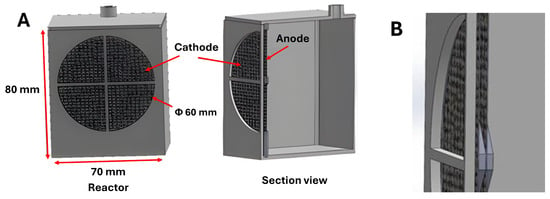
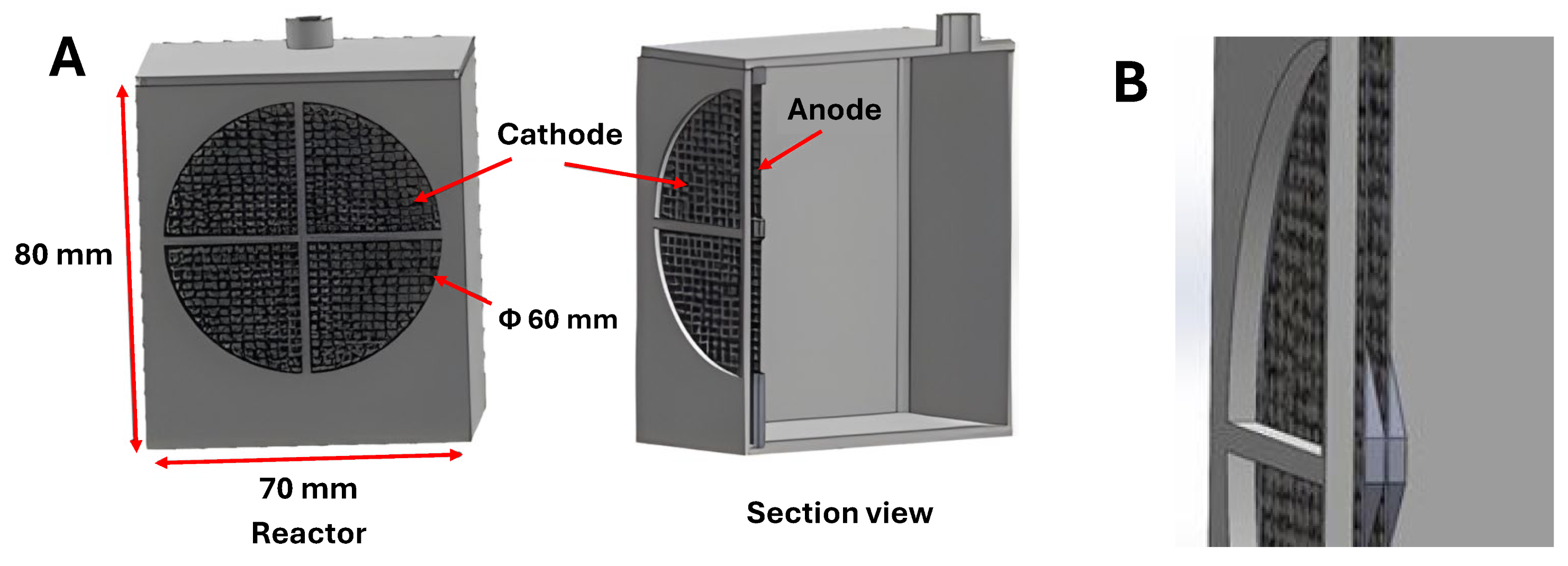
Considering the experimental studies in the field, a vertical design of single-chambered MFC was adopted, as shown in Figure 2. Such disposition allows a simplified feeding of the wastewater as fuel and easy access to the anode chamber to replace the anode with superficially modified carbon fabric. Two MFC units were developed with different dimensions (MFC1 of 2 cm of diameter and MFC2 with 6 cm of diameter) by using a 3D printer (Prusa i3 MK3S, Prusa Research, Prague, Czech Republic). Each unit was replicated in a version with the modified anode and another with an unmodified anode. MFC1 was a preliminary prototype to test the functionality and the water leaks issues. The purpose was to evaluate the impact of anode’s surface modification on MFC electrical behaviour. A Form 3+ printer from Formlabs (Formlabs Inc., Somerville, MA, USA), a vat photopolymerization 3D printer, was utilized to manufacture all the components of the designed reactor. The chosen resin for vat photopolymerization was the High-Temperature Resin (FLHTAM-02, Formlabs Inc., Somerville, MA, USA), selected to ensure compatibility with living bacteria, rendering it suitable for producing rigid devices designed for the reactor. The reactor parts are designed using mechanical engineering CAD 24.0 software. Following the 3D printing process, the samples undergo a rinse with isopropanol alcohol to remove resin residues. Subsequently, they undergo thermal post-curing under UV light for 60 min at 80 °C to enhance their mechanical properties.
Figure 2.
Schematic design of single-chambered MFC employed (A). Details of electrodes in the single-chambered microbial fuel cell employed (B).
2.2. Anode’s Surface Modification
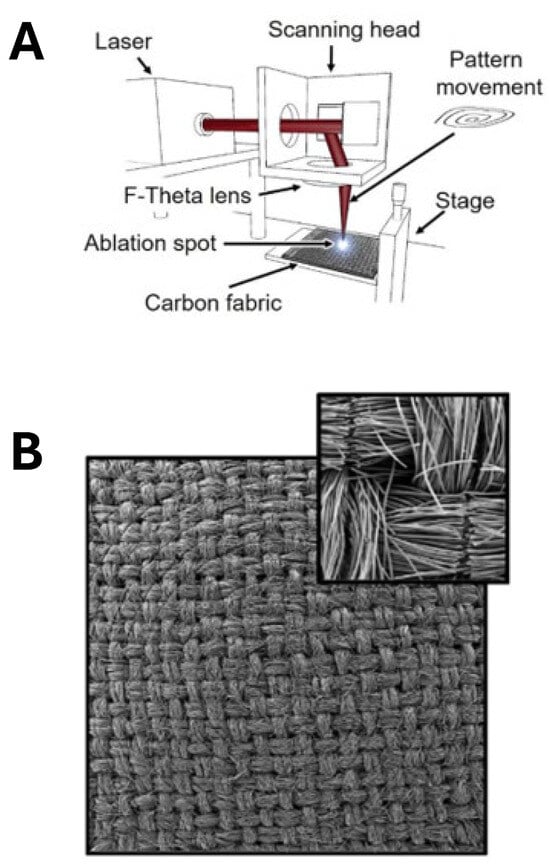
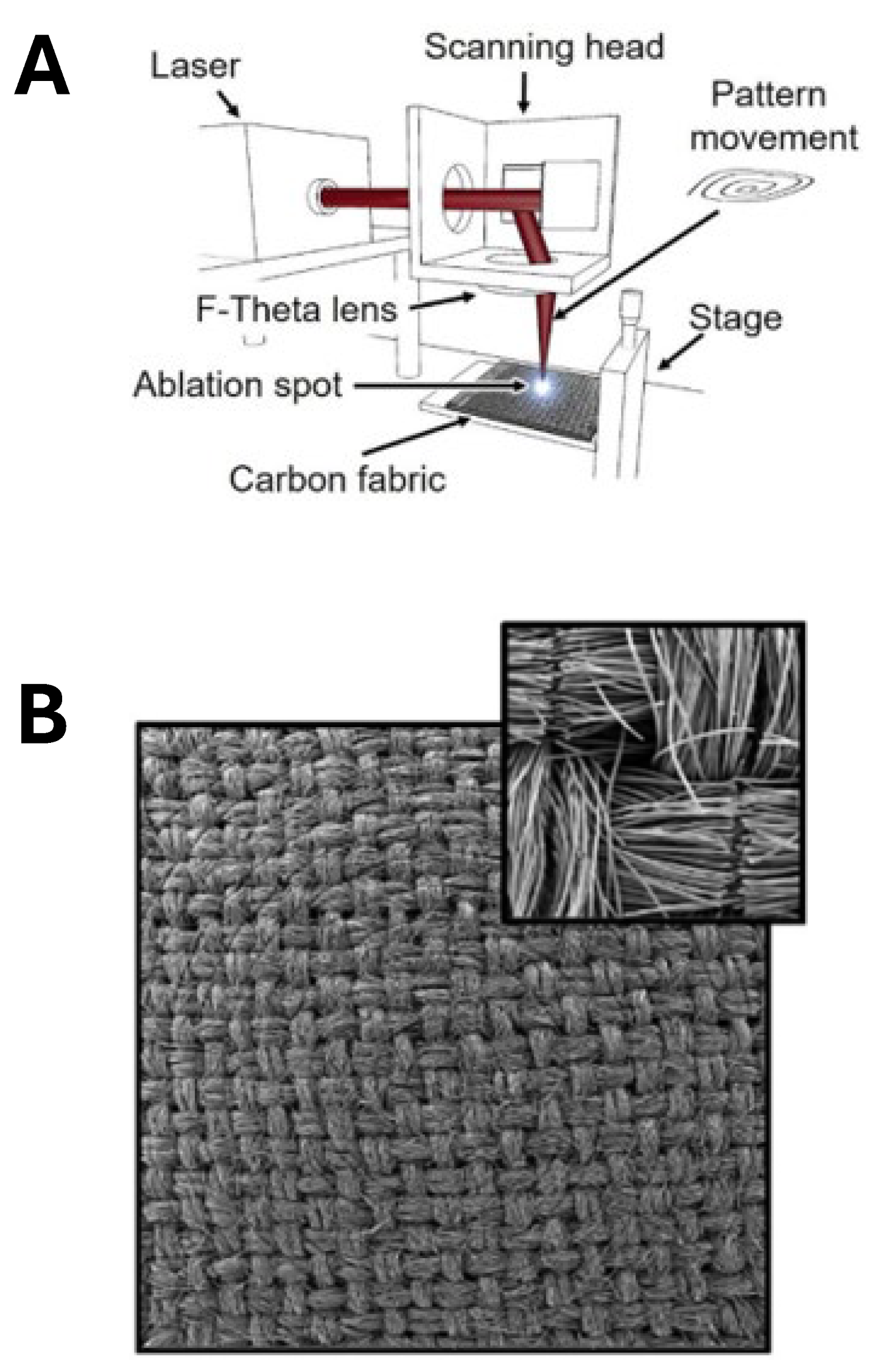
Spiral patterns which can improve physical trapping of bacteria and make it more difficult for them to be dislodged [40] were carved over the carbon fabric by employing an industrial femtosecond laser (Onefive Origami XP-S, NKT Photonics (formerly Onefive), Zurich, Switzerland), which has a pulse duration of 400 fs, a repetition rate of 1 MHz, wavelength centered at 1030 nm, and a maximum output average power of 5.1 W. The laser beam was moved by means of a galvanometric scanner head (intelliSCAN 14, SCANLAB, GmbH, Puchheim, Germany), moving in 2-axis at a speed of 0.5 m/s. Before reaching the samples’ surface, the beam was focused by an F-Theta lens with a focal length of 160 mm, which can preserve the focal position of the beam through a single focal plane (Figure 3). According to previous studies [41], a pulse from the employed laser should be enough to produce sublimation in carbonaceous surfaces enabling the fabric’s ablation. Moreover, since the ablation mechanism is electronically promoted, the heat transfer often associated with the ablation processes was minimized, resulting in the precise micromachining of the desired patterns. Two different sizes were considered for the anodes consisting of squares of carbon fabric: 2 cm × 2 cm and 6 cm × 6 cm. These anodes were then incorporated into the corresponding MFCs directly after irradiation.
Figure 3.
Artwork representing the superficial modification of the carbon fabric by laser ablation (A) and spiral pattern engraved on the carbon fabric at different magnifications (B), showing the overall pattern (15.18 × 15.18 mm) and a magnified view of the patterned region (695 × 695 µm).
2.3. MFC Measurement System
The system used to analyse the electrical performance of the cells was a dedicated custom measurement system developed specifically for the electrical characterisation of the single microbial fuel cell and BESs [42]. A total of eight individual MFC reactors were investigated in this study, comprising two different reactor configurations (MFC1 and MFC2, with diameters of 2 and 6 cm, respectively). For each configuration, two reactors were equipped with laser-modified carbon cloth anodes, while two corresponding reference reactors were equipped with unmodified carbon cloth anodes. Therefore, each experimental condition was evaluated using two independent reactor replicates (n = 2). All reactors were inoculated using the same activated sludge source and subjected to the same inoculation and acclimatization procedure. The MFCs were inoculated with a microbial inoculum collected from the activated sludge tank of a municipal wastewater treatment plant in Lyon, France. Before being introduced into the MFC reactors, the sludge was subjected to aeration to reduce the residual biodegradable organic matter content. Subsequently, the pretreated inoculum was added to the MFC systems together with sodium acetate (1 g L−1), used as a synthetic substrate to support microbial activity and the development of electroactive biofilms. An acclimatization period of 7 days was allowed following inoculation. During this period, an increase in the current produced by the reactors was observed, indicating the establishment of electroactive activity and suggesting the development of electroactive biofilms on the anode surfaces. Following this acclimatization phase, the electrical characterization of the MFCs was initiated by applying external resistive loads ranging from 100 to 2000 Ω using the custom-built measurement board described above. To perform high precision measurements, a dedicated data acquisition system was employed. Specifically designed to accurately measure the power output of MFCs, the system integrates sigma–delta analog-to-digital converters and transimpedance amplifiers to precisely acquire the voltage and current signals generated by the MFCs units. This customized, automated system ensures high measurement accuracy and low noise levels while enabling continuous, long-term data acquisition.
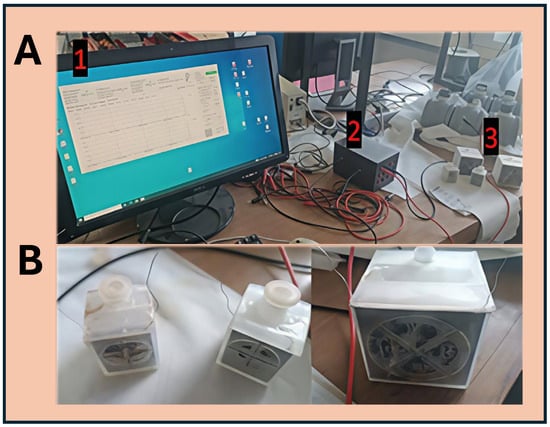
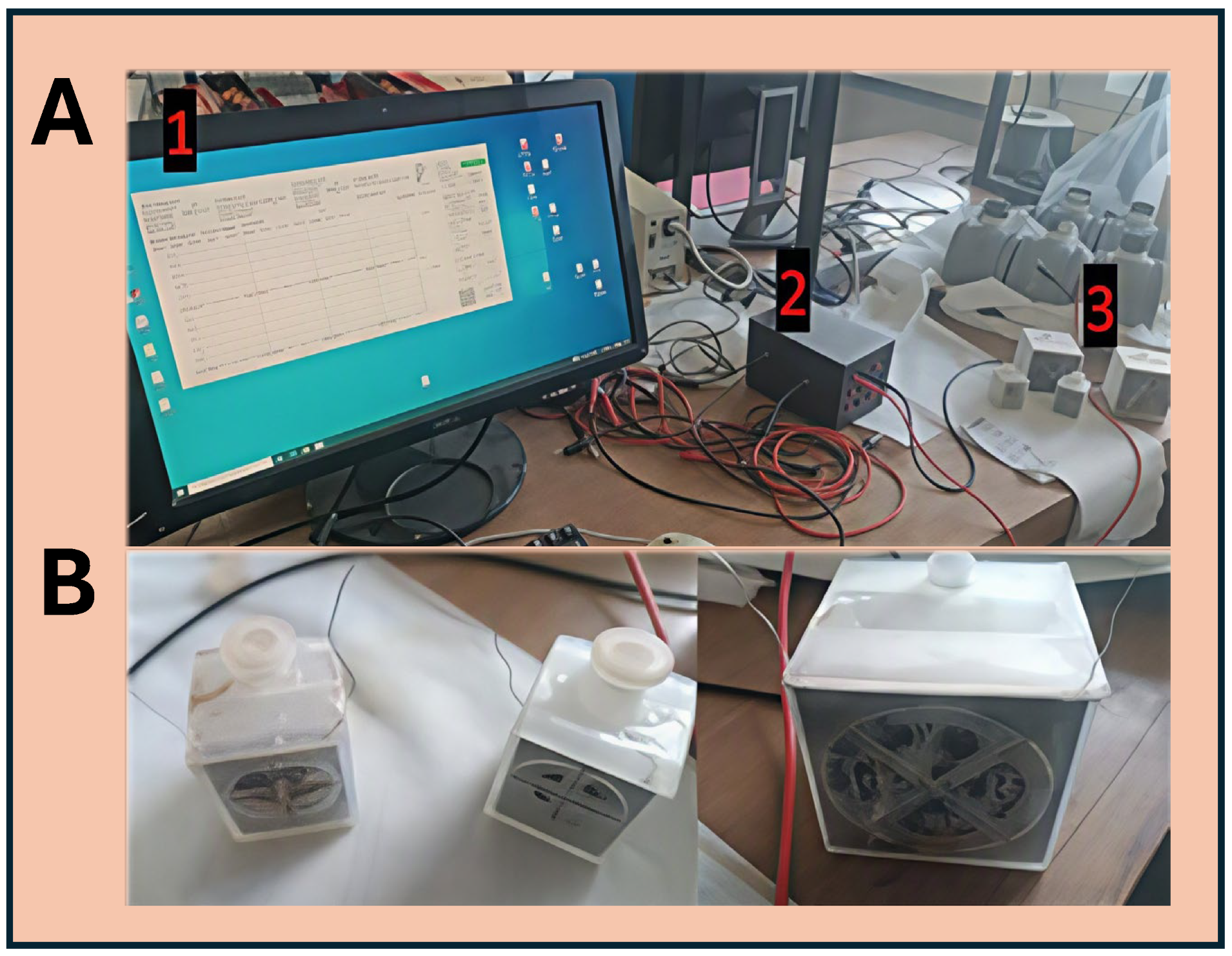
The measuring board can perform multi-step discharge protocols to accurately measure the power output of MFCs. Indeed, it includes a various set of loads which can be applied to the reactors to perform current and power measurement. The measuring board was able to perform multi-step discharge protocols to accurately measure the power output of MFCs. In addition, the system permits set up the time step of samples, the starting and end time of the measurements which can be alternate in current and voltage measurement and the measurement time (3 s time step intervals) of each cycle (current or voltage measurements). A complete electrical characterization of the reactor units was performed using the measurement board, a workstation, and the necessary connection as shown in Figure 4. All MFC reactors were tested simultaneously using the multiple channels (up to six) available in the measurement system. The electrical characterization was carried out over a period of three months. Following the identification of 1 kΩ as the optimal external resistance, long-term operational stability tests were performed under this fixed load. Specifically, three consecutive monitoring periods, each lasting three weeks, were conducted. During each period, the electrical output of all MFCs was continuously monitored while maintaining an external resistance of 1 kΩ. The results showed that the power output remained stable during the first 12 days, followed by a gradual decrease until the end of the third week. At the end of each monitoring period, acetate was replenished to restore substrate availability, and a subsequent monitoring cycle was initiated.
Figure 4.
Experimental set up for electric characterisation of reactors: 1—Computer with user interface, 2—Measurement instrument, 3—MFC units under measurement: two MFC1 and two MFC2s with and without modified anodes (A). MFC1 (2 cm diameter, left image) and MFC2 (6 cm diameter, right image) (B).
3. Results and Discussion
3.1. Modified Anode Performance of the MFC Units and Potential Applications
The preliminary results obtained from the reactors’ electrical characterization were consistent with the expected systems’ behaviour. Both MFC configurations exhibited improved electrical performance when equipped with the laser-modified anode compared with the corresponding reactors containing an unmodified electrode. This trend was observed for both MFC1s, with a diameter of 2 cm, and MFC2s, with a diameter of 6 cm, suggesting that the surface modification has a beneficial effect on the electrical output of the MFCs independently of the reactor size. One possible explanation for this improvement is the modification of the electrode surface morphology following laser ablation. In particular, the scarved pattern may provide additional sites for microbial attachment, thereby promoting the development of an electroactive biofilm. However, further investigations are needed to assess the extent to which laser-engineered surface morphology influences microbial colonization.
Among the two configurations, MFC2, with a diameter of 6 cm, exhibited better electrical performance than MFC1, with a diameter of 2 cm. This difference may be associated with the larger dimensions of the reactor and its components, including the electrodes, as well as with differences in the available electrode surface area and reactor volume. Conversely, the smaller configuration may be more strongly affected by internal resistance and other limitations associated with miniaturization. These factors can influence electron transfer through the external circuit and the overall electrical output of the system. However, in MFC1, the reactor equipped with the modified electrode reached an OCV of 531.5 mV, whereas the reactor containing the unmodified anode exhibited an OCV of 175.0 mV. The higher OCV observed for the modified configuration indicates a substantial difference in the electrical response of the two systems under open-circuit conditions. Nevertheless, disentangling the individual contributions of reactor geometry, electrode dimensions, and internal resistance to the observed performance differences falls beyond the scope of the present study.
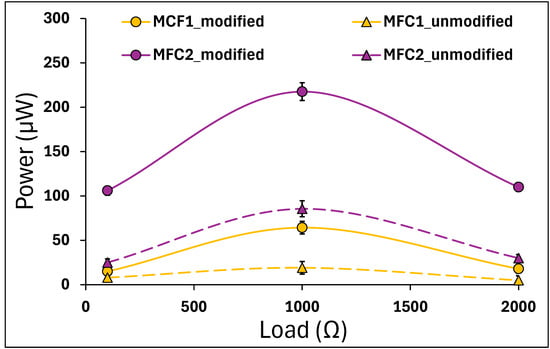
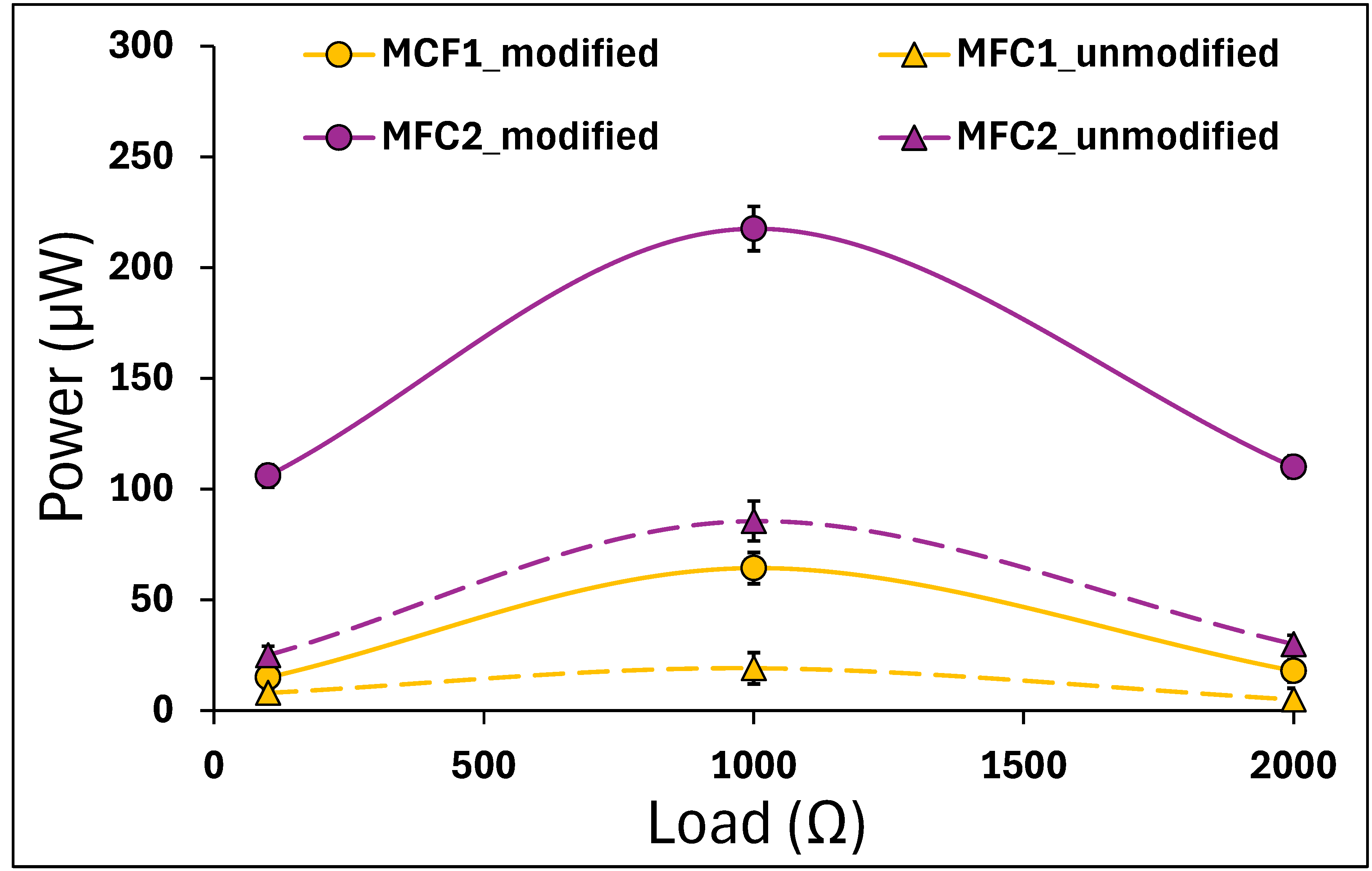
Figure 5 shows the power output obtained for the different MFC configurations as a function of the applied external resistance. For all configurations, the maximum power output was observed at an external resistance of 1000 Ω. In particular, MFC2 equipped with the laser-modified anode achieved the highest power output of 217.6 ± 10.0 µW, compared with 85.6 ± 9.0 µW for the corresponding unmodified anode. A similar trend was observed for MFC1, where the modified anode also exhibited higher power output than the unmodified reference. Overall, these results indicate that the electrical performance enhancement associated with laser treatment was observed in both reactor configurations.
Figure 5.
Average power output as a function of external resistance for all MFC systems with modified and unmodified anodes.
The results obtained for MFC1 and MFC2 equipped with modified and unmodified anodes are summarized in Table 1, which reports the values obtained for power output (at MPP), current, and open-circuit voltage (OCV). The electrical characterization was performed by recording the current response at 3 s time step intervals while applying a series of external resistive loads ranging from 100 to 2000 Ω, with increments of 100 Ω. This procedure enabled the reactors’ electrical response to be evaluated under different external load conditions and allowed the maximum power output to be identified. The comparison between the two MFC configurations highlights the beneficial effect associated with the laser-modified anode. However, OCV alone does not provide a complete assessment of the energy-generating capability of an MFC, and its interpretation should therefore be considered alongside the current and power measurements obtained under external loads. Testing the reactors under a range of external loads made it possible to determine the maximum power point (MPP), which is reached when the external load matches the internal resistance of the system. In both cases, the MPP was reached at an external load of 1 kΩ.
Table 1.
Results of characterisation of MFC1 and MFC2 units with and without modified anodes.
The internal resistance of the reactors was approximately 1 kΩ in both configurations. This value is slightly higher than the typical internal resistance reported for MFCs. Further improvements in reactor design and configuration could reduce the internal resistance value, potentially leading to better electrical performance. Beyond their performance as electricity-generating systems, MFCs may also offer opportunities for powering electronic devices that require very low levels of energy. The continuing miniaturization of electronic components has enabled the development of compact sensors, microcontrollers, and wireless communication devices designed to operate with limited power requirements. In this context, MFCs could potentially serve as alternative energy sources for selected low-power electronic applications, particularly where organic substrates are continuously available, and energy generation can be coupled with environmental monitoring. The reactors investigated in this study may therefore provide a starting point for exploring the use of bioelectrochemical systems as energy sources for small-scale monitoring technologies. Nevertheless, the suitability of these reactors for such applications would need to be assessed by comparing their electrical output with the actual voltage, current, and power requirements of the intended devices. Further studies are also necessary to evaluate microbial attachment to the laser-modified anode and determine whether the observed electrical improvement is associated with changes in biofilm development, electrode–biofilm interactions, or other surface-related effects. Indeed, the improved electrical performance observed in the MFCs equipped with laser-modified anodes may be associated with changes in the surface characteristics of the carbon cloth induced by laser irradiation. Modifications in surface morphology and roughness could potentially influence electrode wettability, increase the number of available sites for microbial attachment, and promote interactions between the electrode surface and the electroactive biofilm. However, since direct surface characterization was not performed in the present study, these effects remain hypotheses and cannot be conclusively established from the available experimental results. Hence, further investigations combining scanning electron microscopy (SEM), quantitative surface roughness measurements and wettability analysis will be necessary to verify the extent of laser-induced surface modification and clarify its relationship with microbial colonization and MFC performance.
However, from an electrochemical perspective, modifications in the surface characteristics of carbon-based electrodes may also influence the interactions occurring at the electrode–biofilm interface and, consequently, the EET processes. The efficiency of electron transfer from electroactive microorganisms to the anode depends on several factors, including electrode conductivity, surface chemistry, biofilm architecture, and the electrochemical properties of the electrode–biofilm interface [43,44]. Therefore, laser-induced changes in the carbon cloth surface may potentially affect the establishment of the electroactive biofilm and the efficiency of electron exchange between microorganisms and the electrode. Further electrochemical characterization would be necessary to investigate these mechanisms in greater detail. Electrochemical impedance spectroscopy (EIS) could provide information on the different resistive contributions within the bioelectrochemical system, including the charge-transfer resistance at the electrode–biofilm interface [45,46,47]. Similarly, cyclic voltammetry (CV) could help characterize the electrochemical activity of the modified electrode and identify redox-active processes potentially associated with extracellular electron transfer [48,49]. Since these analyses were not performed in the present study, the contribution of individual electrochemical mechanisms to the observed improvement in power generation cannot be directly established. Nevertheless, the approximately 2.5-fold increase in maximum power output demonstrates an improvement in the overall electrical performance of the MFC equipped with the laser-modified anode. Future studies combining electrochemical characterization with surface analysis and biofilm investigation, through microbiological analyses, will be essential to clarify the mechanisms responsible for this enhancement.
In addition to investigating these mechanisms, future work should assess the stability of the modified electrode and the consistency of its performance during prolonged operation. These aspects are particularly relevant if MFCs are to be considered for applications requiring a reliable energy supply over extended periods. The electrical energy harvested from an MFC could potentially be used to power ultra-low-power electronic systems directly or, where appropriate, be accumulated through a suitable energy-management and storage circuit before use [50]. Possible applications include environmental monitoring and wireless sensor networks, in which small electronic nodes can be deployed to collect and transmit data from distributed locations [51,52]. A typical wireless sensor node may include a microcontroller, one or more sensors, and a transceiver responsible for wireless data transmission. Since these components have different power requirements, the feasibility of operating an entire node using an MFC depends on the electrical output of the reactor and the energy demand of each component [53].
Some ultra-low-power transceivers incorporate sleep modes, during which their energy consumption is reduced while communication functions are temporarily inactive [54]. This operating principle may help reduce the average energy demand of a sensor node and could facilitate its integration with a low-power energy source such as an MFC. In principle, the energy generated by the reactor could be used to support intermittent sensing and data-transmission cycles, provided that the harvested energy is sufficient to meet the requirements of the electronic components. However, the practical implementation of this approach would require an appropriate power-management strategy, as well as experimental validation of the energy balance between MFC generation, energy storage, and device consumption. Therefore, while the present study primarily addresses the improvement in anode-related electrical performance, its findings may provide a basis for future investigations into the integration of MFCs with autonomous environmental monitoring systems and other low-power electronic applications.
3.2. Environmental Implications and Future Perspectives
The improvement in electrical performance observed for the laser-modified carbon cloth anodes may be relevant for the future development of MFCs intended for environmental applications. MFCs have been investigated as promising systems for coupling the removal of organic matter from wastewater or other waste-derived substrates with the recovery of electrical energy. In addition to their application in wastewater treatment, MFCs have also been investigated in integrated bioprocesses aimed at improving energy recovery from organic waste streams. In this context, the combination of dark fermentation and MFC technology represents a promising approach for the simultaneous production of biohydrogen and electricity. For instance, Fu et al. [55] developed an integrated dark fermentation–MFC system for the valorization of garden waste, demonstrating the feasibility of combining different microbial metabolic activities to recover multiple energy products from lignocellulosic biomass. Such approaches further highlight the potential of MFCs as components of integrated waste-to-energy platforms, contributing to organic waste valorization and more efficient resource recovery. In this context, improving the anodic electron-transfer process is particularly important, since the electrical output of the system directly affects its practical applicability and the feasibility of energy recovery. In the present study, the maximum power output increased from 85.6 µW for the unmodified carbon cloth anode to 217.6 µW for the laser-modified electrode in MFC2 system, corresponding to an approximately 2.5-fold increase.
This improvement is comparable to the performance enhancements reported for other anode-modification strategies. For example, Zhang et al. reported a maximum power density of 3.20 W m−2 for carbon cloth modified through nitric acid oxidation followed by ammonia treatment, compared with 2.01 W m−2 for the untreated electrode, corresponding to a 58% increase [29]. Similarly, surface modification of commercial carbon felt with nitric acid or polyaniline resulted in power densities approximately 2.5- and 2.9-fold higher, respectively, than those obtained with the unmodified material [30]. In another study, the modification of carbon cloth with carbon nanotubes increased the power density from 0.44 to 1.42 W m−2, corresponding to a 3.2-fold improvement [56]. Candle-soot deposition on carbon cloth also resulted in an approximately 1.9-fold increase in power density [57]. These studies indicate that tailoring the chemical, morphological, or structural properties of carbon-based anodes can significantly improve MFC electrical performance.
Although the absolute power values cannot be directly compared because of differences in reactor configuration, electrode area, inoculum, substrate composition, and operating conditions, the relative improvement obtained in the present study is within the range reported for several previously investigated anode-modification approaches. Importantly, the proposed strategy relies on industrial femtosecond laser ablation, which enables the localized and controlled modification of carbon cloth surfaces without the need for conventional wet-chemical treatments. By reducing chemical consumption and the associated waste generated during electrode processing, this approach offers potential environmental advantages. These benefits could be further extended through the recovery and valorization of material generated during laser processing. For instance, when ablation is performed in a liquid medium, the resulting carbonaceous products can potentially be recovered as valuable carbon nanostructures for other applications, promoting resource efficiency and circularity. Although the initial investment in laser equipment must be considered, the ever-evolving low electricity consumption of modern laser sources may offer long-term economic advantages over processes requiring continuous chemical use, handling, and disposal [58]. The improved power generation observed in the MFCs therefore highlights the potential of laser-induced surface engineering as an alternative approach to enhancing carbon-based anode performance while supporting the development of more sustainable electrode fabrication strategies. In addition, the use of a more electrochemically active anode could potentially improve the energy-recovery potential of MFCs treating organic-rich waste streams. Furthermore, potential changes in the surface characteristics of carbon cloth resulting from laser treatment may influence electroactive biofilm attachment and extracellular electron transfer. However, these effects were not directly investigated in the present study and will require further experimental validation, particularly under operating conditions involving complex wastewater or waste-derived substrates.
However, the present study represents a preliminary assessment of the electrode-modification strategy, and the actual environmental benefits of the proposed approach should be further investigated using real wastewater or waste-derived matrices under continuous operating conditions. Future studies should therefore focus on evaluating the long-term stability of laser-modified anodes, the development of electroactive biofilms, and the performance of the resulting MFCs in terms of organic matter removal, current generation, energy recovery, and operational durability. Monitoring the evolution of current and power output during prolonged operation would provide valuable information on the consistency of electrode performance and the possible occurrence of performance losses. Furthermore, post-operation characterization of the modified electrodes would help determine whether prolonged exposure to the operating environment affects their surface properties and structural integrity. These investigations are particularly relevant for evaluating electrode durability and the potential applicability of the proposed modification strategy in MFC systems requiring reliable energy generation over extended periods.
A comprehensive assessment of the energy demand, economic feasibility, and environmental impact of the laser treatment would also be required to determine its suitability for larger-scale applications. Overall, the results obtained in this study provide a basis for further investigating laser-modified carbon cloth as an electrode material for MFCs, with the long-term perspective of integrating wastewater treatment, waste valorisation, and energy recovery.
4. Conclusions
In this study, femtosecond laser ablation was investigated as a surface-engineering strategy for improving the electrical performance of carbon cloth anodes used in microbial fuel cells. The laser treatment modified the surface structure of the carbon cloth and resulted in improved electrical performance compared with the unmodified electrode. In particular, the MFC2 equipped with the laser-modified anode reached a maximum open-circuit voltage of 718.28 mV and a maximum power output of 217.6 µW at an external resistance of 1 kΩ. Under the same operating conditions, the MFC containing the unmodified anode reached an open-circuit voltage of 439.1 mV and a maximum power output of 41.70 µW. Therefore, the laser-modified anode provided an approximately 2.5-fold increase in power generation. The observed improvement may be associated with the modification of the carbon cloth surface morphology, which could enhance the electrochemical properties of the electrode and promote the attachment and development of electroactive microorganisms. These results support the potential of femtosecond laser ablation as a controllable approach for tailoring carbon-based electrode surfaces without relying on conventional wet-chemical modification procedures. In comparison with other anode-modification strategies reported in the literature, the relative improvement obtained in this study is within the range previously observed for chemically modified, coated, or nanostructured carbon-based electrodes. From an environmental perspective, the development of more effective anodes may contribute to improving the energy-recovery potential of MFCs intended for the treatment of wastewater and other organic-rich waste streams. A higher electrical output could support the integration of MFCs into environmental biotechnology and waste-valorisation strategies, where the removal of organic matter is coupled with the recovery of electrical energy. However, the present work represents a preliminary assessment of the electrode-modification approach, and the actual environmental performance of the proposed system remains to be demonstrated. Further investigations should therefore evaluate the long-term stability of the laser-modified anodes, the development and persistence of the electroactive biofilm, including detailed surface characterization, such as SEM imaging, surface roughness and wettability measurements, together with electrochemical analyses, including EIS and CV, to better understand the effects of laser treatment on electrode properties, biofilm development, and extracellular electron transfer. These complementary analyses will be essential to establish the relationship between laser-induced surface modification and the electrochemical performance of MFCs.
Future studies should also consider organic matter removal, energy recovery, electrode durability, treatment scalability, the performance of the MFCs when operated with real wastewater or waste-derived substrates, and the energy and economic requirements associated with the laser treatment. Overall, the results demonstrate that femtosecond laser modification of carbon cloth is a promising approach for enhancing MFC power generation and provide a basis for further developing electrode architectures for future environmental and resource-recovery applications.
Author Contributions
Writing—original draft preparation A.P., A.M., F.Y. and R.O.T.-M.; writing—review and editing A.P., A.M., F.Y., R.O.T.-M., O.O., T.G., B.A., F.M., R.A. and D.B.; conceptualization, A.P., F.Y., R.O.T.-M., O.O. and T.G.; formal analysis, A.P. and F.Y.; investigation, A.P., A.M., F.Y., R.O.T.-M., O.O. and T.G.; data curation, A.P., A.M. and F.Y.; funding acquisition, A.P. All authors have read and agreed to the published version of the manuscript.
Funding
This research was conducted as part of the COST CA19123 Action PHOENIX: Protection, resilience, rehabilitation of damaged environment.
Data Availability Statement
The original contributions presented in this study are included in the article. Further questions can be directed at the corresponding author.
Conflicts of Interest
The authors declare that they have no known competing financial interests or personal relationships that could have appeared to influence the work reported in this paper.
References
- Wang, J.; Azam, W. Natural Resource Scarcity, Fossil Fuel Energy Consumption, and Total Greenhouse Gas Emissions in Top Emitting Countries. Geosci. Front. 2024, 15, 101757. [Google Scholar] [CrossRef] [Scilit]
- Salahshoor, S.; Afzal, S. Subsurface Technologies for Hydrogen Production from Fossil Fuel Resources: A Review and Techno-Economic Analysis. Int. J. Hydrogen Energy 2022. [Google Scholar] [CrossRef] [Scilit]
- Ganiyu, S.O.; Martínez-Huitle, C.A. The Use of Renewable Energies Driving Electrochemical Technologies for Environmental Applications. Curr. Opin. Electrochem. 2020, 22, 211–220. [Google Scholar] [CrossRef] [Scilit]
- Ganguly, A.; Sun, P.; Liu, X.; Delgado, H.E.; Sun, L.; Elgowainy, A. Techno-Economic and Life Cycle Analysis of Bio-Hydrogen Production Using Bio-Based Waste Streams through the Integration of Dark Fermentation and Microbial Electrolysis. Green Chem. 2025, 27, 6213–6231. [Google Scholar] [CrossRef] [Scilit]
- Colantoni, S.; Marchetti, A.; Zeppilli, M.; Cristiani, L. Towards the Industrial Application of Microbial Electrolysis Cells for Hydrogen Production: A Critical Review on Cell’s Components. Environ. Chem. Saf. 2025, 1, 9600019. [Google Scholar] [CrossRef] [Scilit]
- Pietrelli, A.; Bavasso, I.; Lovecchio, N.; Ferrara, V.; Allard, B. MFCs as Biosensor, Bioreactor and Bioremediator. In Proceedings of the 2019 8th International Workshop on Advances in Sensors and Interfaces, IWASI 2019, Otranto, Italy, 13–14 June 2019; pp. 302–306. [Google Scholar] [CrossRef] [Scilit]
- Marchetti, A.; Sassetto, G.; Cabras, D.; Hosseini, S.; Milia, S.; Zeppilli, M. From Wastewater to Bio-Hydrogen: Advancing Microbial Electrolysis Cells Through Challenges, Innovations, and Process Integration. Hydrogen 2026, 7, 85. [Google Scholar] [CrossRef] [Scilit]
- Pirri, F.; Fuku, X.; Kamika, I.; Munonde, T.S. Microbial Fuel Cells and Microbial Electrolysis Cells for the Generation of Green Hydrogen and Bioenergy via Microorganisms and Agro-Waste Catalysts. Nanomanufacturing 2025, 5, 3. [Google Scholar] [CrossRef] [Scilit]
- Valde, D.; Nayak, A.K.; Sahu, S.; Jujjavarapu, S.E. Sustainable Biohydrogen Production From Agrifood Wastewater Using a MFC-Assisted MEC System: A Circular Bioelectrochemical Approach. J. Eng. 2025, 2025, 2393431. [Google Scholar] [CrossRef] [Scilit]
- Saravanan, A.; Karishma, S.; Kumar, P.S.; Yaashikaa, P.R.; Jeevanantham, S.; Gayathri, B. Microbial Electrolysis Cells and Microbial Fuel Cells for Biohydrogen Production: Current Advances and Emerging Challenges. Biomass Convers. Biorefinery 2020, 13, 8403–8423. [Google Scholar] [CrossRef] [Scilit]
- Arun, J.; SundarRajan, P.S.; Grace Pavithra, K.; Priyadharsini, P.; Shyam, S.; Goutham, R.; Hoang Le, Q.; Pugazhendhi, A. New Insights into Microbial Electrolysis Cells (MEC) and Microbial Fuel Cells (MFC) for Simultaneous Wastewater Treatment and Green Fuel (Hydrogen) Generation. Fuel 2024, 355, 129530. [Google Scholar] [CrossRef] [Scilit]
- Freguia, S.; Teh, E.H.; Boon, N.; Leung, K.M.; Keller, J.; Rabaey, K. Microbial Fuel Cells Operating on Mixed Fatty Acids. Bioresour. Technol. 2010, 101, 1233–1238. [Google Scholar] [CrossRef] [Scilit]
- Marchetti, A.; Stoller, M. On the Micromixing Behavior of a Spinning Disk Reactor for Metallic Cu Nanoparticles Production. Appl. Sci. 2019, 9, 3311. [Google Scholar] [CrossRef] [Scilit]
- Marchetti, A.; Valentino, F.; Gottardo, M.; Zeppilli, M. Rapid Screening Approach to Evaluate MEC Performance for Biohydrogen Production Using Synthetic and Real Organic Waste-Derived Substrates. Sustain. Energy Technol. Assess. 2026, 93, 105351. [Google Scholar] [CrossRef] [Scilit]
- Khandaker, S.; Das, S.; Hossain, M.T.; Islam, A.; Miah, M.R.; Awual, M.R. Sustainable Approach for Wastewater Treatment Using Microbial Fuel Cells and Green Energy Generation—A Comprehensive Review. J. Mol. Liq. 2021, 344, 117795. [Google Scholar] [CrossRef] [Scilit]
- Tsipa, A.; Varnava, C.K.; Grenni, P.; Ferrara, V.; Pietrelli, A. Bio-Electrochemical System Depollution Capabilities and Monitoring Applications: Models, Applicability, Advanced Bio-Based Concept for Predicting Pollutant Degradation and Microbial Growth Kinetics via Gene Regulation Modelling. Processes 2021, 9, 1038. [Google Scholar] [CrossRef] [Scilit]
- Dakal, T.C.; Singh, N.; Kaur, A.; Dhillon, P.K.; Bhatankar, J.; Meena, R.; Sharma, R.K.; Gadi, B.R.; Sahu, B.S.; Patel, A.; et al. New Horizons in Microbial Fuel Cell Technology: Applications, Challenges, and Prospects. Biotechnol. Biofuels Bioprod. 2025, 18, 79. [Google Scholar] [CrossRef] [Scilit]
- Galeano, M.B.; Sulonen, M.; Ul, Z.; Baeza, M.; Baeza, J.A.; Guisasola, A. Bioelectrochemical Ammonium Recovery from Wastewater: A Review. Chem. Eng. J. 2023, 472, 144855. [Google Scholar] [CrossRef] [Scilit]
- Ruiz, Y.; Baeza, J.A.; Guisasola, A. Microbial Electrolysis Cell Performance Using Non-Buffered and Low Conductivity Wastewaters. Chem. Eng. J. 2016, 289, 341–348. [Google Scholar] [CrossRef] [Scilit]
- Elangovan, K.; Saravanan, P.; Campos, C.H.; Sanhueza-Gómez, F.; Khan, M.M.R.; Chin, S.Y.; Krishnan, S.; Viswanathan Mangalaraja, R. Outline of Microbial Fuel Cells Technology and Their Significant Developments, Challenges, and Prospects of Oxygen Reduction Electrocatalysts. Front. Chem. Eng. 2023, 5, 1228510. [Google Scholar] [CrossRef] [Scilit]
- Kordek-Khalil, K.; Altiok, E.; Salvian, A.; Siekierka, A.; Torres-Mendieta, R.; Avignone-Rossa, C.; Pietrelli, A.; Gadkari, S.; Ieropoulos, I.A.; Yalcinkaya, F. Nanocomposite Use in MFCs: A State of the Art Review. Sustain. Energy Fuels 2023, 7, 5608–5624. [Google Scholar] [CrossRef] [Scilit]
- Ieropoulos, I.; Greenman, J.; Melhuish, C. Microbial Fuel Cells Based on Carbon Veil Electrodes: Stack Configuration and Scalability. Int. J. Energy Res. 2008, 32, 1228–1240. [Google Scholar] [CrossRef] [Scilit]
- Santoro, C.; Arbizzani, C.; Erable, B.; Ieropoulos, I. Microbial Fuel Cells: From Fundamentals to Applications. A Review. J. Power Sources 2017, 356, 225–244. [Google Scholar] [CrossRef] [Scilit]
- Zhang, B.; Zhu, B.; Liang, Z.; Yu, L.; Zhou, Z.; Li, C.; Cheng, F.; Wu, H.; Feng, J.; Dong, P.; et al. Full Component Utilization: Targeted Separation of Mn/Li From Spent LiMn2O4 for Reconstructing High-Performance Single-Crystal Cathode Materials. Adv. Funct. Mater. 2026, 36, e78358. [Google Scholar] [CrossRef] [Scilit]
- Hazzan, O.O.; Zhao, B.; Xiao, Y. Strategies for Enhancing Extracellular Electron Transfer in Environmental Biotechnology: A Review. Appl. Sci. 2023, 13, 12760. [Google Scholar] [CrossRef] [Scilit]
- Wang, S.; Li, H.; Han, W.; Feng, Y. Review: Extracellular Electron Transfer Mechanisms and Enhancement Strategies of Electroactive Microorganisms in Bioelectrochemical Systems. ACS ES T Water 2026, 6, 1–19. [Google Scholar] [CrossRef] [Scilit]
- Chen, J.; Xu, W.; Jiang, M.; Chen, J.; Jia, H. Polyoxometallate Functionalizing CeO2 via Redox-Etching Precipitation to Synergistically Catalyze Oxidation of Gaseous Chlorinated Pollutants: From Lab to Practice. Appl. Catal. B 2020, 278, 119263. [Google Scholar] [CrossRef] [Scilit]
- Li, B.; Zhou, J.; Zhou, X.; Wang, X.; Li, B.; Santoro, C.; Grattieri, M.; Babanova, S.; Artyushkova, K.; Atanassov, P.; et al. Surface Modification of Microbial Fuel Cells Anodes: Approaches to Practical Design. Electrochim. Acta 2014, 134, 116–126. [Google Scholar] [CrossRef] [Scilit]
- Zhang, J.; Li, J.; Ye, D.; Zhu, X.; Liao, Q.; Zhang, B. Enhanced Performances of Microbial Fuel Cells Using Surface-Modified Carbon Cloth Anodes: A Comparative Study. Int. J. Hydrogen Energy 2014, 39, 19148–19155. [Google Scholar] [CrossRef] [Scilit]
- Hidalgo, D.; Tommasi, T.; Bocchini, S.; Chiolerio, A.; Chiodoni, A.; Mazzarino, I.; Ruggeri, B. Surface Modification of Commercial Carbon Felt Used as Anode for Microbial Fuel Cells. Energy 2016, 99, 193–201. [Google Scholar] [CrossRef] [Scilit]
- Chang, S.H.; Huang, B.Y.; Wan, T.H.; Chen, J.Z.; Chen, B.Y. Surface Modification of Carbon Cloth Anodes for Microbial Fuel Cells Using Atmospheric-Pressure Plasma Jet Processed Reduced Graphene Oxides. RSC Adv. 2017, 7, 56433–56439, Correction in RSC Adv. 2018, 8, 7350. [Google Scholar] [CrossRef] [Scilit]
- Khare, P.; Ramkumar, J.; Verma, N. Carbon Nanofiber-Skinned Three Dimensional Ni/Carbon Micropillars: High Performance Electrodes of a Microbial Fuel Cell. Electrochim. Acta 2016, 219, 88–98. [Google Scholar] [CrossRef] [Scilit]
- Senthilkumar, K.; Wanjari, V.P.; Kanwar, B.; Singh, S.P. Laser-Induced Graphene as a Cathode Catalyst for Microbial Fuel Cell. ACS Appl. Nano Mater. 2024, 7, 2639–2649. [Google Scholar] [CrossRef] [Scilit]
- Ding, Y.; Gimpel, T.; Klyushin, A.; Tigges, S.; Dang, Y.; Poschmann, M.; Song, F.; Schlögl, R.; Heumann, S. Surficial Functionalization of Monolithic Carbon Electrode via Femtosecond Laser Treatment. ChemElectroChem 2025, 12, e202500189. [Google Scholar] [CrossRef] [Scilit]
- Li, Y.; Huang, L.; Chen, Y.; Qiu, Z.; Chen, Y.; Zhang, Z.; Yang, L.; Lin, X. Laser Ablation of Screen-Printed Carbon Electrodes for Portable Glucose Sensing. Microchem. J. 2025, 219, 115842. [Google Scholar] [CrossRef] [Scilit]
- Dugan, J.M.; Colominas, C.; Garcia-Granada, A.A.; Claeyssens, F. Spatial Control of Neuronal Adhesion on Diamond-Like Carbon. Front. Mater. 2021, 8, 756055. [Google Scholar] [CrossRef] [Scilit]
- ALYousef, J.; Yudhanto, A.; Tao, R.; Lubineau, G. Laser Ablation of CFRP Surfaces for Improving the Strength of Bonded Scarf Composite Joints. Compos. Struct. 2022, 296, 115881. [Google Scholar] [CrossRef] [Scilit]
- Lee, B.L.P.; Jeon, H.; Wang, A.; Yan, Z.; Yu, J.; Grigoropoulos, C.; Li, S. Femtosecond Laser Ablation Enhances Cell Infiltration into Three-Dimensional Electrospun Scaffolds. Acta Biomater. 2012, 8, 2648–2658. [Google Scholar] [CrossRef] [Scilit]
- Wang, L.; Liu, N.; Guo, Z.; Wu, D.; Chen, W.; Chang, Z.; Yuan, Q.; Hui, M.; Wang, J. Nitric Acid-Treated Carbon Fibers with Enhanced Hydrophilicity for Candida Tropicalis Immobilization in Xylitol Fermentation. Materials 2016, 9, 206. [Google Scholar] [CrossRef] [Scilit]
- Thomas, S.W.; Khan, R.R.; Puttananjegowda, K.; Serrano-Garcia, W.; Guarino, V.; Focarete, M.L.; Pisignano, D. Advances in nanostructured materials and nanopatterning technologies. Micro Nano Technol. Ser. 2020, 243–271. Available online: https://books.google.co.uz/books?hl=it&lr=&id=93_QDwAAQBAJ&oi=fnd&pg=PP1&dq=Advances+in+nanostructured+materials+and+nanopatterning+technologies&ots=F6m1PQnvXa&sig=v_XL52rCLfLe8Z4OR69CUGL1NNw&redir_esc=y#v=onepage&q=Advances%20in%20nanostructured%20materials%20and%20nanopatterning%20technologies&f=false (accessed on 18 November 2026).
- Doñate-Buendia, C.; Torres-Mendieta, R.; Pyatenko, A.; Falomir, E.; Fernández-Alonso, M.; Mínguez-Vega, G. Fabrication by Laser Irradiation in a Continuous Flow Jet of Carbon Quantum Dots for Fluorescence Imaging. ACS Omega 2018, 3, 2735–2742. [Google Scholar] [CrossRef] [Scilit]
- Lovecchio, N.; Di Meo, V.; Pietrelli, A. Customized Multichannel Measurement System for Microbial Fuel Cell Characterization. Bioengineering 2023, 10, 624. [Google Scholar] [CrossRef] [Scilit]
- Lovley, D.R. Syntrophy Goes Electric: Direct Interspecies Electron Transfer. Annu. Rev. Microbiol. 2017, 71, 643–664. [Google Scholar] [CrossRef] [Scilit]
- Shaw, D.R.; Ali, M.; Katuri, K.P.; Gralnick, J.A.; Reimann, J.; Mesman, R.; van Niftrik, L.; Jetten, M.S.M.; Saikaly, P.E. Extracellular Electron Transfer-Dependent Anaerobic Oxidation of Ammonium by Anammox Bacteria. Nat. Commun. 2020, 11, 2058. [Google Scholar] [CrossRef] [Scilit]
- Simeon, M.I.; Alaka, A.C.; Daniel, P.; Adeniyi, O.D. Performance Evaluation and Impedance Spectroscopy of Carbon-Felt and Reinforced Stainless-Steel Mesh Electrodes in Terrestrial Microbial Fuel Cells for Biopower Generation. Meas. Energy 2025, 5, 100036. [Google Scholar] [CrossRef] [Scilit]
- Wang, L.; Wu, Y.; You, Z.; Bao, H.; Zhang, L.; Wang, J. Electrochemical Impedance Spectroscopy (EIS) Reveals the Role of Microbial Fuel Cell-Ceramic Membrane Bioreactor (MFC-CMBR): Electricity Utilization and Membrane Fouling. Water Res. 2022, 222, 118854. [Google Scholar] [CrossRef] [Scilit]
- Manohar, A.K.; Bretschger, O.; Nealson, K.H.; Mansfeld, F. The Use of Electrochemical Impedance Spectroscopy (EIS) in the Evaluation of the Electrochemical Properties of a Microbial Fuel Cell. Bioelectrochemistry 2008, 72, 149–154. [Google Scholar] [CrossRef] [Scilit]
- Sonawane, J.M.; Greener, J. Multiparameter Optimization of Microbial Fuel Cell Outputs Using Linear Sweep Voltammetry and Microfluidics. J. Power Sources 2024, 607, 234589. [Google Scholar] [CrossRef] [Scilit]
- Boas, J.V.; Peixoto, L.; Oliveira, V.B.; Simões, M.; Pinto, A.M.F.R. Cyclic Voltammetry Study of a Yeast-Based Microbial Fuel Cell. Bioresour. Technol. Rep. 2022, 17, 100974. [Google Scholar] [CrossRef] [Scilit]
- Dutta, A.; Jacob, C.A.; Das, P.; Corton, E.; Stom, D.; Barbora, L.; Goswami, P. A Review on Power Management Systems: An Electronic Tool to Enable Microbial Fuel Cells for Powering Range of Electronic Appliances. J. Power Sources 2022, 517, 230688. [Google Scholar] [CrossRef] [Scilit]
- Berlitz, C.A.; Pietrelli, A.; Mieyeville, F.; Pillonnet, G.; Allard, B. Microbial Fuel Cell as Battery Range Extender for Frugal IoT. Energies 2023, 16, 6501. [Google Scholar] [CrossRef] [Scilit]
- Tsompanas, M.A.; You, J.; Philamore, H.; Rossiter, J.; Ieropoulos, I. Neural Networks Predicting Microbial Fuel Cells Output for Soft Robotics Applications. Front. Robot. AI 2021, 8, 633414. [Google Scholar] [CrossRef] [Scilit]
- Pietrelli, A.; Micangeli, A.; Ferrara, V.; Raffi, A. Wireless Sensor Network Powered by a Terrestrial Microbial Fuel Cell as a Sustainable Land Monitoring Energy System. Sustainability 2014, 6, 7263–7275. [Google Scholar] [CrossRef] [Scilit]
- Evangelakos, E.A.; Kandris, D.; Rountos, D.; Tselikis, G.; Anastasiadis, E. Energy Sustainability in Wireless Sensor Networks: An Analytical Survey. J. Low. Power Electron. Appl. 2022, 12, 65. [Google Scholar] [CrossRef] [Scilit]
- Fu, Y.; Song, Y.; Chen, H.; Lei, A.; Zhang, Y.; Li, Y.; Luo, L. Simultaneous Dark Fermentation and Microbial Fuel Cell for Co-Production of Hydrogen and Electricity from Typical Garden Waste Using Two Co-Culture Systems. J. Clean. Prod. 2026, 580, 149699. [Google Scholar] [CrossRef] [Scilit]
- Fonseca, E.U.; Yang, W.; Wang, X.; Rossi, R.; Logan, B.E. Comparison of Different Chemical Treatments of Brush and Flat Carbon Electrodes to Improve Performance of Microbial Fuel Cells. Bioresour. Technol. 2021, 342, 125932. [Google Scholar] [CrossRef] [Scilit]
- Chen, B.Y.; Tsao, Y.T.; Chang, S.H. Cost-Effective Surface Modification of Carbon Cloth Electrodes for Microbial Fuel Cells by Candle Soot Coating. Coatings 2018, 8, 468. [Google Scholar] [CrossRef] [Scilit]
- Havelka, O.; Yalcinkaya, F.; Wacławek, S.; Padil, V.V.T.; Amendola, V.; Černík, M.; Torres-Mendieta, R. Sustainable and Scalable Development of PVDF-OH Ag/TiOx Nanocomposites for Simultaneous Oil/Water Separation and Pollutant Degradation. Environ. Sci. Nano 2023, 10, 2359–2373. [Google Scholar] [CrossRef] [Scilit]

Disclaimer/Publisher’s Note: The statements, opinions and data contained in all publications are solely those of the individual author(s) and contributor(s) and not of MDPI and/or the editor(s). MDPI and/or the editor(s) disclaim responsibility for any injury to people or property resulting from any ideas, methods, instructions or products referred to in the content. |
© 2026 by the authors. Licensee MDPI, Basel, Switzerland. This article is an open access article distributed under the terms and conditions of the Creative Commons Attribution (CC BY) license.