


Abstract
Scabies remains one of the most common parasitic skin diseases worldwide and continues to pose a substantial clinical and public health burden despite the availability of effective acaricidal treatments. Over the past decade, increasing reports of treatment failure following topical permethrin have reignited the debate on first-line therapy for scabies. While true acaricide resistance has been proposed as a possible explanation, current evidence remains inconclusive, and many apparent failures are more likely attributable to pseudo-resistance, including incorrect application, poor adherence, reinfestation, untreated contacts, or persistent post-scabetic symptoms. This renewed focus on the relative merits of topical permethrin and oral ivermectin has stimulated important discussions but may also have shifted attention away from the broader determinants of therapeutic success. In this Perspective, we argue that pharmacological efficacy alone does not adequately explain treatment success in routine clinical practice. Factors such as adherence, correct application of topical therapy, management of close contacts, reinfestation, persistent post-scabetic symptoms, and the epidemiological context frequently influence outcomes as much as the intrinsic activity of the acaricidal agent. Consequently, treatment failure often reflects shortcomings in the overall management process rather than true drug failure. We propose that future therapeutic decision-making should move beyond the traditional topical-versus-oral treatment debate toward a precision-based approach to scabies management. This framework encourages clinicians to individualize treatment strategies according to three complementary domains: patient characteristics, disease presentation, and epidemiological setting. Rather than replacing existing guidelines, this approach seeks to optimize their application in real-world practice by integrating pharmacological evidence with patient-centred care and transmission control. Reframing first-line therapy in this way may improve both individual outcomes and broader public health interventions.
1. The Emerging Challenge of First-Line Therapy
Scabies remains one of the most prevalent parasitic skin diseases worldwide, affecting more than 200 million people at any given time and imposing a substantial burden on patients, healthcare systems, and vulnerable communities [1]. Despite being recognized as a neglected tropical disease by the World Health Organization, scabies continues to be underdiagnosed and undertreated in many settings, with recurrent outbreaks occurring in households, long-term care facilities, hospitals, prisons, and resource-limited communities [2].
In addition to its well-recognized burden in low- and middle-income countries, recent years have witnessed a resurgence of scabies in several high-income countries, including across Europe [3]. Increasing numbers of community-associated cases, institutional outbreaks, and hospital consultations have been reported, suggesting that scabies is no longer confined to traditionally endemic settings [4]. Although the reasons for this resurgence are likely multifactorial, including demographic changes, increased population mobility [5,6], overcrowding in specific settings, delayed diagnosis, and organizational challenges, these observations emphasize that scabies remains a dynamic public health problem even in well-resourced healthcare systems. This evolving epidemiological scenario further highlights the importance of optimizing management strategies capable of improving both individual patient outcomes and transmission control.
Beyond its direct clinical manifestations, scabies imposes a substantial socioeconomic burden on both patients and healthcare systems. Persistent pruritus, sleep disturbance, reduced quality of life, social stigma, and work or school absenteeism contribute significantly to the overall impact of the disease. In addition, recurrent consultations, repeated treatments, management of household contacts, and control of institutional outbreaks generate considerable healthcare costs that frequently exceed those associated with the initial diagnosis itself [7]. These challenges are further amplified in long-term care facilities and other congregate settings, where delayed recognition and ineffective management may facilitate ongoing transmission and require extensive public health interventions.
In recent years, increasing reports of treatment failure following topical permethrin have reignited interest in the optimal first-line pharmacological treatment for scabies [8,9,10]. Although topical permethrin remains the preferred first-line treatment in many international guidelines, several effective alternatives—including oral ivermectin and topical benzyl benzoate—are available and are widely used in specific clinical settings or according to local recommendations [11].
While topical permethrin has traditionally been regarded as the treatment of choice for classical scabies because of its ovicidal activity and favourable efficacy, oral ivermectin has progressively gained a central role owing to its ease of administration, superior adherence in selected populations, and pivotal contribution to mass drug administration programmes. More recently, the introduction of topical ivermectin and the growing interest in combination regimens have further expanded the therapeutic landscape.
Nevertheless, despite the continuous accumulation of clinical evidence, an important question remains unanswered. Is identifying the “best” first-line drug still the most relevant objective in contemporary scabies management? Clinical experience suggests that therapeutic success depends on considerably more than the intrinsic efficacy of an acaricide. Factors such as accurate diagnosis, patient adherence, appropriate application of topical therapy, simultaneous treatment of close contacts, recognition of post-scabetic itch, prevention of reinfestation, and the epidemiological context frequently determine treatment outcomes as much as, or even more than, the pharmacological agent itself.
Furthermore, the concept of a universal first-line treatment may no longer adequately reflect the heterogeneity of patients encountered in routine clinical practice. Children, older adults, pregnant women, immunocompromised individuals, patients with crusted scabies, and those involved in institutional outbreaks represent distinct clinical scenarios, each characterized by unique therapeutic challenges that cannot always be addressed through a single standardized approach.
Rather than asking whether permethrin or ivermectin should universally be considered the preferred first-line therapy, we believe that the more clinically relevant question is whether treatment strategies should be individualized according to patient characteristics, disease severity, and epidemiological setting. This Perspective argues that the future of scabies management lies not in identifying a universally superior acaricide but in adopting a precision-based therapeutic strategy capable of maximizing both individual cure and transmission control.
2. When Drug Efficacy Is Not Enough
The concept of a universal first-line treatment for scabies may no longer adequately reflect the complexity of contemporary clinical practice. Dermatologists and other healthcare professionals managing scabies know that therapeutic success rarely depends solely on the intrinsic efficacy of an acaricidal agent. Instead, successful treatment results from the interaction of multiple clinical, behavioural, and epidemiological factors that are often underrepresented in clinical trials.
One of the most important and probably underestimated determinants of treatment success is the correct application of topical therapy [12]. Unlike oral treatment, the effectiveness of topical acaricides depends not only on their pharmacological activity but also on the patient’s ability to apply the medication accurately over the entire skin surface. This apparently simple step may represent one of the greatest barriers to successful treatment in real-world practice. In a prospective observational study using a fluorescent test cream to objectively assess application quality, Nemecek et al. [13] demonstrated that none of the participants correctly covered all body areas despite receiving standardized instructions. The most frequently missed sites included the ankles, interdigital spaces, sacral region, and other anatomically difficult-to-reach areas, highlighting how application errors alone may substantially compromise treatment effectiveness under everyday clinical conditions.
Similarly, oral ivermectin offers the advantage of simplified administration and generally better adherence in selected populations, but it is not exempt from treatment-related limitations. Incorrect weight-based dosing, failure to administer the recommended second dose, inappropriate timing of administration, or a lack of adherence to treatment schedules may all reduce therapeutic effectiveness. Furthermore, because ivermectin has limited ovicidal activity, repeated dosing is often essential to ensure complete eradication of the infestation [14].
Equally important is the distinction between true treatment failure and persistent symptoms following successful eradication. Post-scabetic itch may persist for several weeks despite complete elimination of the mites and should not automatically be interpreted as evidence of ongoing infestation [15,16,17]. Misclassification of persistent pruritus frequently results in unnecessary retreatment, inappropriate switching between therapeutic agents, and the mistaken perception of reduced drug efficacy.
Another frequently overlooked determinant of apparent therapeutic failure is reinfestation. Failure to simultaneously treat household members, sexual partners, or institutional contacts remains one of the leading causes of recurrent disease. In these situations, recurrence reflects ongoing transmission rather than pharmacological inefficacy. Likewise, delayed diagnosis among close contacts may perpetuate the transmission cycle despite apparently successful treatment of the index patient.
These considerations also provide important context for the ongoing debate regarding permethrin resistance [18]. Reports of reduced responsiveness to permethrin have generated increasing concern over recent years, supported by laboratory studies describing potential molecular mechanisms associated with decreased susceptibility. However, translating these findings into clinically meaningful resistance remains challenging. Before attributing persistent infestation to pharmacological resistance, clinicians should systematically exclude far more common explanations, including inaccurate diagnosis, inadequate application of topical therapy, poor adherence, failure to treat close contacts, reinfestation, and post-scabetic inflammatory reactions.
Supporting this concept, Yürekli et al. [19] demonstrated preserved in vitro acaricidal activity of 5% permethrin against Sarcoptes scabiei mites collected from patients with clinically persistent scabies following previous permethrin treatment. Their findings suggest that, in many cases, treatment non-compliance, application errors, or other management-related factors may explain apparent therapeutic failure more convincingly than true pharmacological resistance.
Taken together, these observations suggest that apparent drug failure may frequently represent management failure rather than pharmacological failure (Table 1). Consequently, persistent disease should prompt clinicians to critically re-evaluate the entire therapeutic pathway—from diagnosis and patient education to treatment implementation, management of close contacts, and appropriate follow-up—before considering alternative pharmacological strategies.
Table 1.
Common Causes of Apparent Treatment Failure in Scabies.
Ultimately, treatment success cannot be explained by drug efficacy alone. Rather, scabies management should be viewed as a comprehensive clinical process extending from accurate diagnosis to interruption of transmission. This broader perspective provides the rationale for moving beyond a drug-centred approach toward a more individualized therapeutic strategy.
3. Why One First-Line Strategy Cannot Fit Every Patient
Current international guidelines recommend topical permethrin, topical benzyl benzoate or oral ivermectin as first-line therapeutic options for scabies, with treatment selection determined by factors such as drug availability, regulatory approval, patient age, pregnancy status, and contraindications [11,20]. These recommendations provide an essential evidence-based framework; however, their application in clinical practice must account for the substantial heterogeneity of patients and clinical settings.
Scabies is not a homogeneous disease. Clinical presentation, mite burden, host immune response, comorbidities, previous treatment, and epidemiological context may vary considerably and can influence the feasibility and effectiveness of treatment. Thus, while established guidelines provide the foundation for therapeutic decision-making, the optimal management strategy may differ according to the circumstances of the individual patient.
Patient-related characteristics are particularly relevant when selecting among guideline-supported treatment options. Young children may require treatment of the scalp and face, making topical application more complex, while older adults may have reduced mobility, cognitive impairment, or limited caregiver support. Pregnancy and breastfeeding require careful consideration of the safety profile, regulatory status, and guideline recommendations for individual therapies. Similarly, immunocompromised patients may be at increased risk of severe infestation and treatment failure and may require more intensive management and closer follow-up [21]. In all these situations, treatment selection should remain consistent with current guidelines and drug-specific safety restrictions rather than being based solely on individual preference.
Patient preferences and practical circumstances may nevertheless influence the choice between appropriate treatment options. Shared decision making is an important component of patient-centred medicine and may be particularly relevant when more than one evidence-based option is available. Topical treatment requires meticulous application and, in some patients, caregiver support, whereas oral treatment may offer greater convenience but requires appropriate dosing and repeated administration. Discussing these practical considerations may improve adherence and treatment satisfaction without departing from evidence-based recommendations. Importantly, shared decision making should be regarded as a means of implementing guideline-supported treatment appropriately rather than as an alternative to established recommendations.
Disease-related characteristics also influence therapeutic complexity. Classical scabies, nodular scabies [17], crusted scabies, recurrent infestation, and cases complicated by secondary bacterial infection present different clinical challenges. Crusted scabies, for example, requires aggressive multimodal management, commonly including repeated oral ivermectin in combination with topical scabicides and keratolytic agents [22]. By contrast, uncomplicated classical scabies in an otherwise healthy patient may require a substantially simpler treatment approach.
The epidemiological setting represents a further determinant of management. An isolated sporadic case differs considerably from an outbreak involving a nursing home, hospital, correctional facility, refugee camp, or other congregate setting. In these circumstances, treatment is not only directed at the individual patient but forms part of a broader strategy to interrupt transmission. The feasibility of treatment, the number of exposed contacts, the ability to achieve coordinated treatment, and logistical constraints may all influence the practical implementation of guideline-based therapy.
Recent real-world evidence further supports the importance of considering treatment effectiveness within this broader clinical context. The SCAB-net study, a prospective multicentre observational study conducted across 28 Italian dermatology centres, evaluated the effectiveness of commonly used scabies treatments in 1751 index cases. Topical permethrin showed lower effectiveness than benzyl benzoate, whereas oral ivermectin showed effectiveness comparable to benzyl benzoate. Importantly, factors beyond the choice of acaricide also influenced treatment outcomes: counselling on environmental decontamination was associated with a lower likelihood of treatment failure, while immunosuppression was associated with an increased risk of non-cure [23]. These findings support the view that real-world treatment effectiveness reflects the interaction between pharmacological treatment, patient characteristics, treatment implementation, and the epidemiological context.
Accordingly, we propose moving beyond a purely drug-centred definition of first-line therapy toward a precision-based therapeutic strategy. In this context, precision does not imply molecular profiling or biomarker-driven treatment but the structured integration of patient characteristics, disease presentation, and epidemiological circumstances into the application of established therapeutic recommendations (Table 2).
Table 2.
Principles of a Precision-Based Approach to Scabies Management. The principles presented in this table are intended as a conceptual framework for applying established evidence and guidelines to individual clinical scenarios. They are illustrative and should not be interpreted as recommendations to replace or modify current treatment guidelines.
The relative importance of these domains will vary according to the clinical setting. In individual cases, patient-centred considerations may play a major role in treatment implementation, whereas in institutional or community outbreaks, coordinated treatment and interruption of transmission may necessarily take priority.
4. Toward a Precision-Based Approach to Scabies Management
Randomized controlled trials remain the cornerstone of evidence-based medicine, but they do not always capture the practical determinants of treatment success encountered in routine clinical practice [24]. Adherence, correct application of topical therapy, management of household contacts, functional limitations, and local epidemiological conditions may substantially influence outcomes but are difficult to standardize within clinical trials.
A precision-based approach therefore seeks to complement, rather than replace, evidence generated by clinical trials and incorporated into international guidelines. It provides a framework for translating these recommendations into real-world clinical practice by considering three interconnected domains: the patient, the disease, and the epidemiological setting.
The first domain is the patient. Age, pregnancy, breastfeeding, immunosuppression, cognitive status, physical disability, caregiver availability, and the ability to correctly perform topical treatment may affect the feasibility of different guideline-supported options. For example, topical treatment may be readily implemented in a healthy adult who can perform the application correctly, whereas an older patient with impaired mobility or cognitive decline may require caregiver-assisted application or consideration of an alternative treatment that is appropriate according to current guidelines. In children, treatment should follow age- and weight-specific recommendations and approved application sites. Similarly, in pregnancy and breastfeeding, therapeutic decisions should be guided by current recommendations and the established safety and regulatory profile of each treatment. Immunocompromised patients may require intensified management and closer follow-up according to disease severity and clinical response.
The second domain is the disease. Scabies encompasses a spectrum of clinical presentations, from uncomplicated classical disease to crusted scabies and recurrent or complicated infestation. Disease severity, mite burden, previous treatment, inflammatory manifestations, and secondary bacterial infection may all influence management. In selected severe or difficult-to-treat scenarios, combination or intensified treatment may be appropriate when supported by current evidence and guidelines.
The third domain is the epidemiological setting. Household clusters and outbreaks in long-term care facilities, hospitals, correctional institutions, refugee camps, and other congregate settings present challenges that extend beyond the individual patient. In these circumstances, rapid identification of cases and contacts, coordinated treatment, feasibility of implementation, adherence across exposed individuals, and interruption of transmission become critical components of successful management.
Importantly, management extends beyond the choice of acaricide. Patient education, correct treatment application, appropriate management of close contacts, environmental measures when indicated, structured follow-up, and recognition of post-scabetic inflammatory symptoms are integral components of the therapeutic process. Persistent pruritus alone should not automatically be interpreted as treatment failure, and reassessment should consider adherence, reinfestation, and the possibility of post-scabetic symptoms before changing therapy.
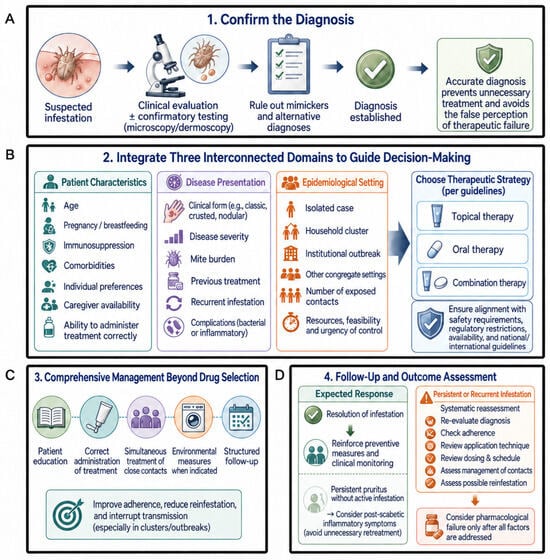
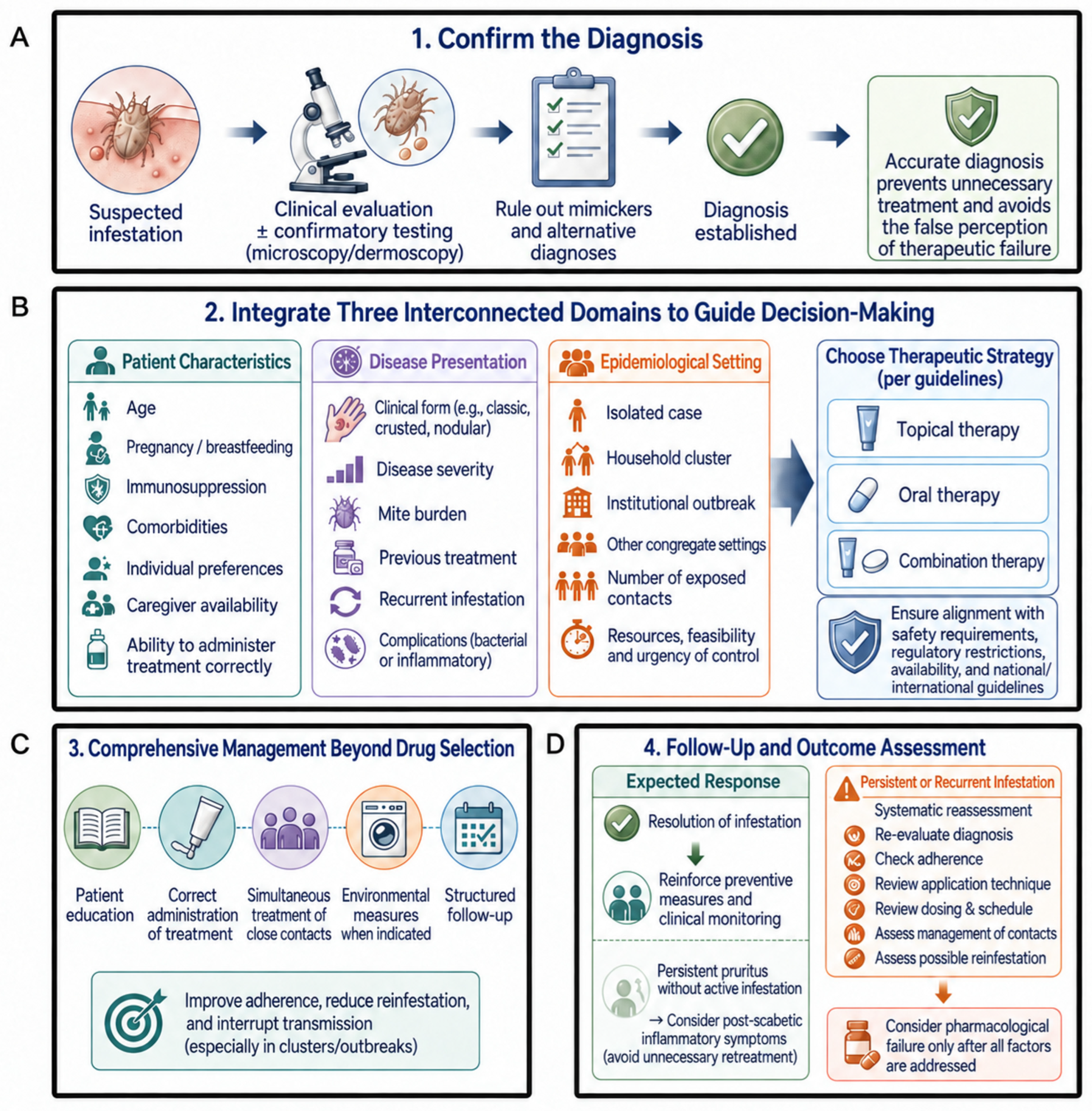
The proposed precision-based approach is summarized in Figure 1.
Figure 1.
Proposed precision-based clinical pathway for scabies management. (A) Diagnostic confirmation and exclusion of alternative diagnoses. (B) Integration of patient characteristics, disease presentation, and epidemiological setting to select an appropriate guideline-supported therapeutic strategy. (C) Comprehensive treatment implementation and outcome assessment, including patient education, correct treatment administration, simultaneous treatment of close contacts, environmental measures when indicated, and structured follow-up. Persistent or recurrent infestation should prompt reassessment of diagnosis, adherence, application technique, dosing schedule, contact management, and possible reinfestation before pharmacological failure is considered. (D) Follow-up and outcome assessment, including management of resolved, persistent, or recurrent infestation.
The practical application of this framework is illustrated in Table 3. The scenarios are intentionally simplified and are designed to demonstrate how clinical reasoning may differ according to patient, disease, and epidemiological factors. They should not be interpreted as treatment algorithms or as recommendations to substitute specific therapies for those currently endorsed by international or national guidelines.
Table 3.
Illustrative Clinical Scenarios for a Precision-Based Approach to Scabies Management. The scenarios and management principles presented in this table are illustrative and are intended to demonstrate the application of individualized clinical reasoning. They are not prescriptive treatment recommendations and should not be interpreted as replacements for current international or national guidelines, regulatory restrictions, or drug-specific safety recommendations.
5. Future Directions: From Drug Choice to Therapeutic Strategy
The therapeutic landscape of scabies has evolved considerably, with topical and systemic acaricides informing current international treatment recommendations. Nevertheless, much of the available evidence continues to focus on comparisons between individual drugs, while less attention has been paid to the factors determining treatment effectiveness in routine clinical practice.
Future research should increasingly evaluate therapeutic strategies rather than acaricides in isolation. Pragmatic clinical trials, real-world observational studies, and implementation research could clarify how treatment outcomes are influenced by adherence, correct application, simultaneous treatment of close contacts, patient characteristics, and epidemiological context. Such evidence may be particularly valuable in institutional outbreaks and other settings in which organizational and behavioural factors substantially affect treatment success.
Several pharmacological developments also warrant further investigation [1]. Spinosad 0.9% topical suspension has been approved in the United States for the treatment of scabies, although additional comparative evidence is needed to define its role relative to established treatments. Moxidectin, a long-acting macrocyclic lactone related to ivermectin, has also been investigated as a potential treatment option. Another emerging class of interest is represented by the isoxazolines [25], including fluralaner, lotilaner, sarolaner, and afoxolaner. These compounds act on arthropod γ-aminobutyric acid (GABA)- and glutamate-gated chloride channels and have demonstrated acaricidal activity in veterinary medicine. Fluralaner, in particular, provides prolonged ectoparasite control in veterinary applications, while lotilaner ophthalmic solution was approved in the United States in 2023 for the treatment of Demodex blepharitis. However, these applications should not be interpreted as evidence of established efficacy or safety against human scabies. The potential role of isoxazolines in human scabies therefore remains an area for preclinical and clinical investigation, including the assessment of appropriate formulations, dosing regimens, safety, and comparative efficacy. Table 4 summarizes these compounds and distinguishes their current applications from their potential relevance to scabies treatment.
Table 4.
Emerging isoxazoline acaricides and their potential relevance to human scabies. Abbreviations and note: Isoxazolines inhibit arthropod γ-aminobutyric acid (GABA)- and glutamate-gated chloride channels. Veterinary applications and activity against other ectoparasites should not be extrapolated to human scabies without appropriate clinical evidence.
Beyond drug development, several questions warrant prospective investigation. These include identifying patients or clinical scenarios in which intensified or combination treatment may provide additional benefit, determining the most effective approaches to scabies control during institutional outbreaks, and evaluating interventions designed to improve treatment adherence. Digital tools, teledermatology, caregiver education, and structured follow-up may also help improve treatment implementation, although their clinical effectiveness requires appropriate evaluation.
A precision-based approach does not imply abandoning or circumventing current international guidelines. Rather, it provides a framework for their appropriate application across heterogeneous patients and clinical settings. Future guidelines may benefit from considering treatment feasibility, adherence, contact management, and epidemiological context alongside pharmacological efficacy.
The proposed approach has several limitations. It remains a conceptual framework that has not yet been prospectively validated as a clinical decision-making tool. The relative importance of individual factors may vary across patients, healthcare settings, and countries, particularly because drug availability, regulatory restrictions, healthcare resources, and epidemiological conditions differ. Evidence regarding real-world treatment effectiveness and acaricide resistance also remains heterogeneous, and standardized tools for assessing these factors in routine practice are lacking. Finally, individualized management may increase decision-making complexity and resource requirements. The framework should therefore be regarded as a complement to established clinical guidelines and evaluated through prospective and implementation studies.
Ultimately, progress in scabies management will depend not only on the development of new acaricides but also on the integration of effective pharmacological treatments with evidence-informed strategies that improve adherence, reduce treatment failure and reinfestation, and support transmission control at individual and community levels.
6. Conclusions
Scabies has long been managed through a pharmacological lens, with much of the scientific discussion focusing on identifying the most effective acaricidal agent. This approach has undoubtedly contributed to substantial therapeutic advances and has improved patient care worldwide.
Throughout this Perspective, we have argued that many of the challenges encountered in everyday practice, including inadequate adherence, incorrect application of topical therapy, reinfestation, delayed diagnosis among contacts, and persistent post-scabetic symptoms, cannot be solved by choosing one acaricide over another. Rather, they require a broader clinical approach that integrates pharmacological treatment with patient education, individualized decision-making, coordinated management of contacts, and careful follow-up.
A precision-based approach to scabies management does not seek to replace current guidelines or establish new treatment hierarchies. Instead, it provides a conceptual framework that may help clinicians apply existing evidence more effectively according to the characteristics of the patient, the disease, and the epidemiological setting. Such an approach recognizes that two patients with the same diagnosis may legitimately require different therapeutic strategies to achieve the same objective.
Ultimately, the future of scabies management may not depend on discovering a single superior acaricide but on improving the way existing treatments are selected, implemented, and integrated into comprehensive models of care.
Author Contributions
Substantial contributions to the conception or design of the work, or the acquisition, analysis, or interpretation of data for the work: G.N., A.M., G.T. and A.V.M.; writing—original draft preparation, G.N., A.M., G.T. and A.V.M.; writing—review and editing, G.N., A.M., G.T. and A.V.M. All authors have read and agreed to the published version of the manuscript.
Funding
This research received no external funding.
Institutional Review Board Statement
Not applicable.
Informed Consent Statement
Not applicable.
Data Availability Statement
Not applicable as no new data were created.
Acknowledgments
During the preparation of this manuscript, the authors used ChatGPT-6.1 for the purposes of generating text and English editing. The authors have reviewed and edited the output and take full responsibility for the content of this publication.
Conflicts of Interest
G.N. has received honoraria for participation in advisory boards, meetings, or as a speaker for Giuliani Pharma, Logofarma, Novartis, SVR, La Roche Posay, Pierre Fabre, Uriage, Cantabria Labs, Pharcos. A.M. and G.T. declare no conflicts of interest. A.V.M. reports consultancy and/or advisory board honoraria from AbbVie, Amgen, Boehringer Ingelheim, Bristol Myers Squibb, Galderma, Incyte, Johnson and Johnson, Leopharma, MSD, Novartis, Otsuka, Pfizer, Sanofi-Regeneron, Takeda and UCB.
References
- Tavoletti, G.; Avallone, G.; Sechi, A.; Cinotti, E.; Veraldi, S.; Micali, G.; Lacarrubba, F.; Marzano, A.V.; Nazzaro, G. Scabies: An updated review from epidemiology to current controversies and future perspectives. Travel. Med. Infect. Dis. 2025, 67, 102878. [Google Scholar] [CrossRef] [Scilit] [PubMed]
- Karimkhani, C.; Colombara, D.V.; Drucker, A.M.; Norton, S.A.; Hay, R.; Engelman, D.; Steer, A.; Whitfeld, M.; Naghavi, M.; Dellavalle, R.P. The global burden of scabies: A cross-sectional analysis from the Global Burden of Disease Study 2015. Lancet Infect. Dis. 2017, 17, 1247–1254. [Google Scholar] [CrossRef] [Scilit] [PubMed] [PubMed Central]
- Aždajić, M.D.; Bešlić, I.; Gašić, A.; Ferara, N.; Pedić, L.; Lugović-Mihić, L. Increased Scabies Incidence at the Beginning of the 21st Century: What Do Reports from Europe and the World Show? Life 2022, 12, 1598. [Google Scholar] [CrossRef] [Scilit] [PubMed] [PubMed Central]
- Reichert, F.; Schulz, M.; Mertens, E.; Lachmann, R.; Aebischer, A. Reemergence of Scabies Driven by Adolescents and Young Adults, Germany, 2009–2018. Emerg. Infect. Dis. 2021, 27, 1693–1696. [Google Scholar] [CrossRef] [Scilit] [PubMed] [PubMed Central]
- Louka, C.; Logothetis, E.; Engelman, D.; Samiotaki-Logotheti, E.; Pournaras, S.; Stienstra, Y. Scabies epidemiology in health care centers for refugees and asylum seekers in Greece. PLoS Negl. Trop. Dis. 2022, 16, e0010153. [Google Scholar] [CrossRef] [Scilit] [PubMed] [PubMed Central]
- Di Meco, E.; Di Napoli, A.; Amato, L.M.; Fortino, A.; Costanzo, G.; Rossi, A.; Mirisola, C.; Petrelli, A.; INMP Team. Infectious and dermatological diseases among arriving migrants on the Italian coasts. Eur. J. Public Health 2018, 28, 910–916. [Google Scholar] [CrossRef] [Scilit] [PubMed]
- van Deursen, B.; Hooiveld, M.; Marks, S.; Snijdewind, I.; van den Kerkhof, H.; Wintermans, B.; Bom, B.; Schimmer, B.; Fanoy, E. Increasing incidence of reported scabies infestations in the Netherlands, 2011–2021. PLoS ONE 2022, 17, e0268865. [Google Scholar] [CrossRef] [Scilit] [PubMed] [PubMed Central]
- Balestri, R.; Magnano, M.; Infusino, S.D.; Rizzoli, L.; Girardelli, C.R.; Rech, G. Scabies is becoming less sensitive to permethrin therapy. J. Eur. Acad. Dermatol. Venereol. 2021, 35, e889–e891. [Google Scholar] [CrossRef] [Scilit] [PubMed]
- Mazzatenta, C.; Piccolo, V.; Argenziano, G.; Bassi, A. Is Scabies becoming less sensitive to permethrin therapy? J. Eur. Acad. Dermatol. Venereol. 2021, 35, e607–e609. [Google Scholar] [CrossRef] [Scilit] [PubMed]
- Veraldi, S.; Schianchi, R.; Nazzaro, G. Treatment of permethrin-resistant scabies with pyrethrins/piperonyl butoxide foam. J. Dermatol. Treat. 2023, 34, 2242539. [Google Scholar] [CrossRef] [Scilit] [PubMed]
- Salavastru, C.M.; Chosidow, O.; Boffa, M.J.; Janier, M.; Tiplica, G.S. European guideline for the management of scabies. J. Eur. Acad. Dermatol. Venereol. 2017, 31, 1248–1253. [Google Scholar] [CrossRef] [Scilit] [PubMed]
- Veraldi, S.; Schianchi, R.; Silvio, M.; Aromolo, I.F. Pseudoresistance to permethrin in scabies. J. Infect. Dev. Ctries. 2023, 17, 713–715. [Google Scholar] [CrossRef] [Scilit] [PubMed]
- Nemecek, R.; Stockbauer, A.; Lexa, M.; Poeppl, W.; Mooseder, G. Application errors associated with topical treatment of scabies: An observational study. J. Dtsch. Dermatol. Ges. 2020, 18, 554–559. [Google Scholar] [CrossRef] [Scilit] [PubMed]
- Balestri, R.; Magnano, M.; Infusino, S.D.; Girardelli, C.R.; Ioris, T.; Rech, G. Oral ivermectin to treat scabies: A comparison of two different regimens. Clin. Exp. Dermatol. 2023, 48, 232–234, Erratum in Clin. Exp. Dermatol. 2023, 48, 1307. https://doi.org/10.1093/ced/llad029. [Google Scholar] [CrossRef] [Scilit] [PubMed]
- Kim, H.S.; Hashimoto, T.; Fischer, K.; Bernigaud, C.; Chosidow, O.; Yosipovitch, G. Scabies itch: An update on neuroimmune interactions and novel targets. J. Eur. Acad. Dermatol. Venereol. 2021, 35, 1765–1776. [Google Scholar] [CrossRef] [Scilit] [PubMed]
- Chiu, L.W.; Berger, T.G.; Chang, A.Y. Management of common scabies and postscabetic itch in adults: Lessons learned from a single-center retrospective cohort study. Int. J. Womens Dermatol. 2021, 7, 716–720. [Google Scholar] [CrossRef] [Scilit] [PubMed] [PubMed Central]
- Veraldi, S.; Nazzaro, G.; Schianchi, R.; Ionescu, M.A. Treatment of postscabies itching with calamine: Results of a retrospective, multicenter, sponsor-free study. Ital. J. Dermatol. Venerol. 2025, 160, 458–459. [Google Scholar] [CrossRef] [Scilit] [PubMed]
- Riebenbauer, K.; Purkhauser, K.; Walochnik, J.; Urban, N.; Weber, P.B.; Stamm, T.; Handisurya, A. Detection of a knockdown mutation in the voltage-sensitive sodium channel associated with permethrin tolerance in Sarcoptes scabiei var. hominis mites. J. Eur. Acad. Dermatol. Venereol. 2023, 37, 2355–2361. [Google Scholar] [CrossRef] [Scilit] [PubMed]
- Yürekli, A. Is there a really resistance to scabies treatment with permethrin? In vitro killing activity of permethrin on Sarcoptes scabiei from patients with resistant scabies. Dermatol. Ther. 2022, 35, e15260. [Google Scholar] [CrossRef] [Scilit] [PubMed]
- Uzun, S.; Durdu, M.; Yürekli, A.; Mülayim, M.K.; Akyol, M.; Velipaşaoğlu, S.; Harman, M.; Taylan-Özkan, A.; Şavk, E.; Demir-Dora, D.; et al. Clinical practice guidelines for the diagnosis and treatment of scabies. Int. J. Dermatol. 2024, 63, 1642–1656. [Google Scholar] [CrossRef] [Scilit] [PubMed] [PubMed Central]
- Sánchez-Díaz, M.; Hernández-Martín, Á.; Descalzo, M.Á.; García-Doval, I.; Salavastru, C.M. European survey on the management of scabies by dermatologists in children under 2 months, pregnancy and breastfeeding woman. J. Eur. Acad. Dermatol. Venereol. 2024, 38, e950–e953. [Google Scholar] [CrossRef] [Scilit] [PubMed]
- Veraldi, S.; Nazzaro, G.; Serini, S.M. Treatment of crusted scabies with acitretin. Br. J. Dermatol. 2015, 173, 862–863. [Google Scholar] [CrossRef] [Scilit] [PubMed]
- Ioris, T.; Fortunato, F.; Magnano, M.; Zengarini, C.; Rech, G.; Infusino, S.D.; Michelerio, A.; Guarneri, C.; Cartini, J.; Giuffrida, R.; et al. Effectiveness of scabies treatments in Italy (SCAB-net): A prospective observational study. Lancet Infect. Dis. 2026. [Google Scholar] [CrossRef] [Scilit] [PubMed]
- Thadanipon, K.; Anothaisintawee, T.; Rattanasiri, S.; Thakkinstian, A.; Attia, J. Efficacy and safety of antiscabietic agents: A systematic review and network meta-analysis of randomized controlled trials. J. Am. Acad. Dermatol. 2019, 80, 1435–1444. [Google Scholar] [CrossRef] [Scilit] [PubMed]
- Zhou, X.; Hohman, A.E.; Hsu, W.H. Current review of isoxazoline ectoparasiticides used in veterinary medicine. J. Vet. Pharmacol. Ther. 2022, 45, 1–15. [Google Scholar] [CrossRef] [Scilit] [PubMed]

Disclaimer/Publisher’s Note: The statements, opinions and data contained in all publications are solely those of the individual author(s) and contributor(s) and not of MDPI and/or the editor(s). MDPI and/or the editor(s) disclaim responsibility for any injury to people or property resulting from any ideas, methods, instructions or products referred to in the content. |
© 2026 by the authors. Licensee MDPI, Basel, Switzerland. This article is an open access article distributed under the terms and conditions of the Creative Commons Attribution (CC BY) license.