


Abstract
Calcium carbonate (CaCO3) is a common soil amendment to alleviate cadmium (Cd) transformation and accumulation in brown rice, and tetraconazole is a widely used chiral pesticide to control rice sheath blight. This study investigated the effects of soil amendment CaCO3 and chiral pesticide tetraconazole on pesticide residues, Cd accumulation, and soil microorganisms in two rice cultivars (ZG 96 with low Cd accumulation and ZY 18 with high Cd accumulation) in Cd-contaminated paddy fields. Results showed that CaCO3 significantly reduced Cd concentrations in brown rice by 60.0–82.9%. It altered tetraconazole degradation half-lives in rice plants, increased residues in ZG 96 rice husk, and decreased enantioselectivity in soil. Tetraconazole residues in brown rice were lower in ZY 18 than in ZG 96. Both CaCO3 and tetraconazole reshaped soil microbial diversity, community structure, and metabolic functions, with distinct responses between the two rice cultivars. All residues of tetraconazole and Cd in brown rice were below maximum residue limits. The rice cultivar differences should be considered under the application of amendments and chiral pesticides, and this study would provide valuable data and theoretical basis for their combined treatments.
1. Introduction
The rapid development of industrialization and urbanization in recent years has led to the discharge of heavy metals into the environment, which has caused severe impacts on soil globally [1]. Soil heavy metal pollution in major rice-producing areas in southern China has been a matter of concern over the last several decades, with cadmium (Cd) being the major contaminant [2]. Due to the relatively high bioavailability of Cd in soil and the high capacity of rice to accumulate Cd, a large proportion of harvested rice grains exceeds safe Cd thresholds [3]. Long-term consumption of rice with excessive Cd concentration may endanger human health [4]. Therefore, it is an urgent task to remediate Cd-contaminated soil, reducing Cd content in rice grains. In situ remediation is a cost-effective way to tackle Cd-contaminated soil, which has been widely used on a large scale in China [5,6]. Liming materials, such as calcium carbonate (CaCO3), quick lime, and hydrated lime, have been widely used to improve soil pH and reduce the bioavailability of Cd in soil [7,8]. The application of CaCO3 at 2 g/kg could reduce the Cd concentration in brown rice by 69% [9].
Pesticide application has become a common practice to improve crop yield and quality [10]. Tetraconazole is a widely used sterol demethylation inhibitor with good systemic properties, which has good protective and therapeutic activities. Tetraconazole can be used to control rice sheath blight [11]. Tetraconazole has one chiral carbon atom and two chiral enantiomers. The enantiomer differences of tetraconazole have been reported, and R-tetraconazole showed stronger bactericidal activity than S-tetraconazole against two pathogens (Rhizoctonia cerealis and Fusarium graminearum) [12]. R-tetraconazole was preferentially degraded in wheat soil [12]. During the strawberry wine-making process and apples with bagging treatment from three regions, (-)-tetraconazole was degraded faster than (+)-tetraconazole [13,14]. The co-exposure of Cd increased the accumulation of S-tetraconazole, while decreasing the concentrations of R-tetraconazole in zebrafish [15]. However, under conditions of pesticide application in Cd-contaminated soils, whether the application of CaCO3 would affect the enantioselective behaviors of tetraconazole in rice needed to be studied.
This study evaluated the effects of CaCO3 and tetraconazole on two rice cultivars with distinct Cd accumulation abilities in a Cd-contaminated paddy field. It explored how CaCO3 impacts enantioselective degradation and pesticide residues, Cd accumulation in brown rice, and changes in soil microorganisms and their metabolic functions. The findings contribute to the efficient and safe application of chiral tetraconazole and CaCO3 and provide new insights into the effects of soil amendment on pesticides and heavy metals in the soil environment.
2. Materials and Methods
2.1. Compounds and Reagents
The racemic tetraconazole with a purity of 98% was obtained from J&K Scientific Ltd. (Shanghai, China). CaCO3 was purchased from Lingshou Yunda Mineral Products Co., Ltd. (Shijiazhuang, China). The other chemicals and materials are described in Supplementary Materials.
2.2. Field Experiment
The field experiments were carried out in a Cd-contaminated paddy field in Shaoxing, Zhejiang Province, China. Two rice cultivars with contrasting Cd accumulation abilities were selected for planting, including Zheyou 18 (ZY 18) and Zhegeng 96 (ZG 96), where the former is an indica japonica three-line hybrid rice cultivar with a relatively higher Cd accumulation capacity, and the latter is a japonica conventional rice with relatively lower Cd accumulation capacity. The experimental soil was classified as purple clayey paddy soil, and the pH, organic matter, total nitrogen, and total phosphorus were 5.0, 46.8 g/kg, 2.5 g/kg, and 0.4 g/kg, respectively. The background soil Cd concentration was 0.39 mg/kg. Eight treatments (Table 1 and Figure S1) were established, and each treatment covered an area of 100 m2 [16]. The treatments of KQ7d_1, KQ7d_3, KQ7d_5, and KQ7d_7 corresponded to ZG 96 exposed to Cd, Cd+CaCO3, Cd+tetraconazole, and Cd+CaCO3+tetraconazole, respectively. The treatments of KQ7d_2, KQ7d_4, KQ7d_6, and KQ7d_8 represented ZY 18 under the same four exposure conditions in sequence. Buffer zones were arranged between different treatments. CaCO3 was applied 10 days before rice transplanting at the dose of 4.5 t/ha, and was ploughed evenly with a depth of 0–20 cm.
Table 1.
The experimental design for CaCO3 and tetraconazole in Cd-contaminated soil.
In the degradation experiment, 17% tetraconazole·azoxystrobin suspension concentrate (7.5% of tetraconazole) was diluted to 48.375 g a.i./ha with water (450 L/ha) and sprayed once according to the recommended dosage. Based on the five-point method, representative rice plant samples were collected randomly at 2 h, 1, 3, 5, 7, 10, 14, 21, 28, and 35 days after application. Rice husk and brown rice were collected during the mature stage and before and after 7 days of the mature stage. All samples were separately homogenized and stored at −20 °C.
2.3. Sample Preparation and Analysis
For the determination of tetraconazole enantiomers, the extraction and purification of samples were adopted according to a report [17], and the Nexera UC SFC system (Shimadzu, Japan) with an LCMS-8050 (Shimadzu) was used. For Cd analysis, the plant samples were oven-dried and ground using a stainless-steel grinder. The soil samples were air-dried, ground, and passed through sieves with different mesh numbers. ICP-MS (X-series 2, Thermo, Waltham, MA, USA) was used for heavy metal analysis [6]. For soil property analysis, the soils sampled on the 7th day were used to test the soil properties according to the report [18]. All samples were treated with three repetitions. The specific pretreatment and detection methods are shown in Supplementary Materials.
2.4. Determination of Soil Microorganisms
According to the report, tetraconazole application significantly shifted the microbial community structure on the 7th day [19]. Thus, the soil samples on the 7th day were used to measure the soil properties and soil microorganisms. The sequencing process was based on the report, and the details were provided in Supplementary Materials [15].
2.5. Data Analysis
The degradation behavior of tetraconazole enantiomers is fitted by the first-order kinetics equation, and the half-life (t1/2) is calculated [15]:
where Ct: concentrations (ng/g) at time t, and kd: dissipation rate constant (d−1) of tetraconazole enantiomers (days).
Using enantiomer fraction (EF) as the indicator to measure the enantioselective degradation of tetraconazole [15]:
where CS: concentrations of S-(+)-tetraconazole (ng/g), and CR: concentrations of R-(-)-tetraconazole (ng/g). EF = 0.5 indicates that there is no enantioselectivity, EF < 0.5 indicates that S-(+)-tetraconazole is degraded preferentially, and EF > 0.5 indicates that R-(-)-tetraconazole is degraded preferentially.
Differential analysis of tetraconazole concentrations, Cd concentrations, and soil properties were carried out using SPSS software (version 20.0; one-way ANOVA and Tukey, p < 0.05).
3. Results
3.1. Enantioselective Fate of Tetraconazole Enantiomers in Rice Planting System
The degradation of tetraconazole enantiomers in rice plants under all treatment conditions was fit to the first-order degradation kinetics, and the parameters and half-lives are listed in Table 2.
Table 2.
The degradation kinetic parameters and half-lives of tetraconazole enantiomers in rice plants. The treatments of KQ7d_5 and KQ7d_7 were the exposure of Cd+tetraconazole and Cd+CaCO3+tetraconazole on ZG 96, respectively. The treatments of KQ7d_6 and KQ7d_8 were the exposure of Cd+tetraconazole and Cd+CaCO3+tetraconazole on ZY 18, respectively.
3.1.1. ZG 96 Rice Plants
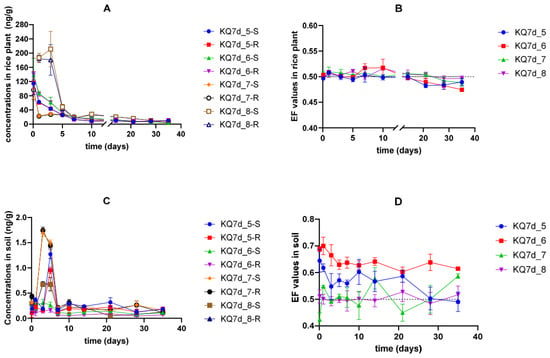
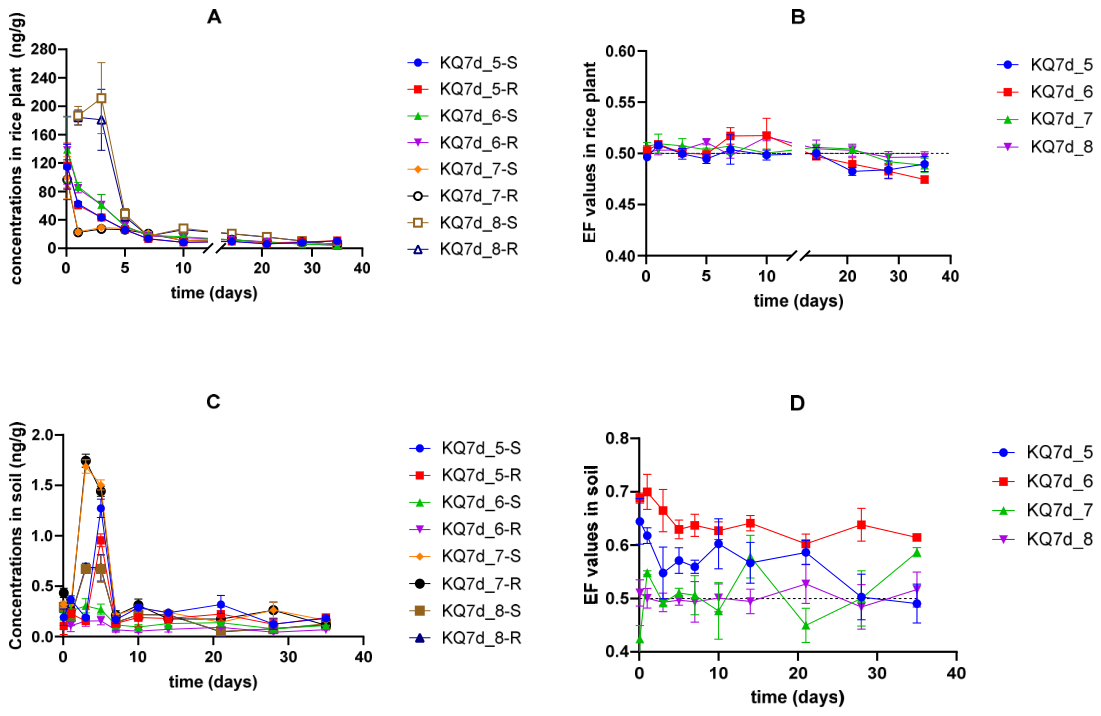
The initial concentration of S-(+)- and R-(-)-tetraconazole in ZG 96 rice plants (KQ7d_5) was 115 and 116 ng/g, respectively (Figure 1A). In the plot with CaCO3 (KQ7d_7), the initial concentration of S-(+)- and R-(-)-tetraconazole was 99.3 and 96.4 ng/g, respectively, but the half-lives were changed from 2.14–2.18 days to 2.23–2.41 days. No matter whether CaCO3 was added or not, tetraconazole enantiomers did not undergo enantioselective degradation in rice plants (Figure 1B).
Figure 1.
The concentration curves and EF values of tetraconazole enantiomers in rice plants (A,B) and soil (C,D) (means ± SD, n = 3). The treatments of KQ7d_5 and KQ7d_7 were the exposure of Cd+tetraconazole and Cd+CaCO3+tetraconazole on ZG 96, respectively. The treatments of KQ7d_6 and KQ7d_8 were the exposure of Cd+tetraconazole and Cd+CaCO3+tetraconazole on ZY 18, respectively. R and S represent the concentrations of R-tetraconazole and S-tetraconazole, respectively.
3.1.2. ZY 18 Rice Plants
The initial concentrations of S-(+)- and R-(-)-tetraconazole in ZY 18 rice plants (KQ7d_6) were 139 and 138 ng/g, respectively (Figure 1A). In the plot with CaCO3 (KQ7d_8), the initial concentration of S-(+)- and R-(-)-tetraconazole increased, which was 187 and 184 ng/g, respectively. The half-lives changed from 2.47–2.49 days to 1.86–1.98 days, which were shortened by 16.6–17.8%. No enantioselective degradation was found (Figure 1B).
3.1.3. Paddy Soil
During 3–5 days, the tetraconazole enantiomer concentrations in paddy soil with CaCO3 (KQ7d_7 and KQ7d_8, 0.67–1.74 ng/g) were higher than those in soil without CaCO3 (KQ7d_5 and KQ7d_6, 0.19–1.27 ng/g; Figure 1C). The concentration of R-(-)-tetraconazole was always lower than S-(+)-tetraconazole in the paddy soil without CaCO3 (KQ7d_5 and KQ7d_6) with EF values > 0.5 (Figure 1D). However, the concentrations of S-(+)- and R-(-)-tetraconazole in the soil with CaCO3 (KQ7d_7 and KQ7d_8) had little difference. CaCO3 decreased the enantioselectivity of tetraconazole in paddy soil.
3.2. Enantioselective Residue of Tetraconazole in Rice Husk and Brown Rice
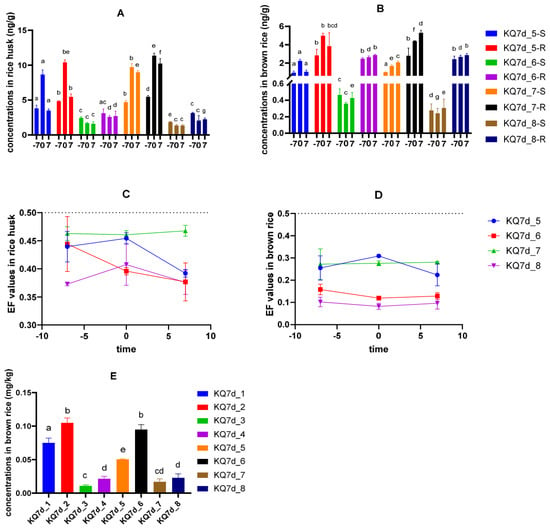
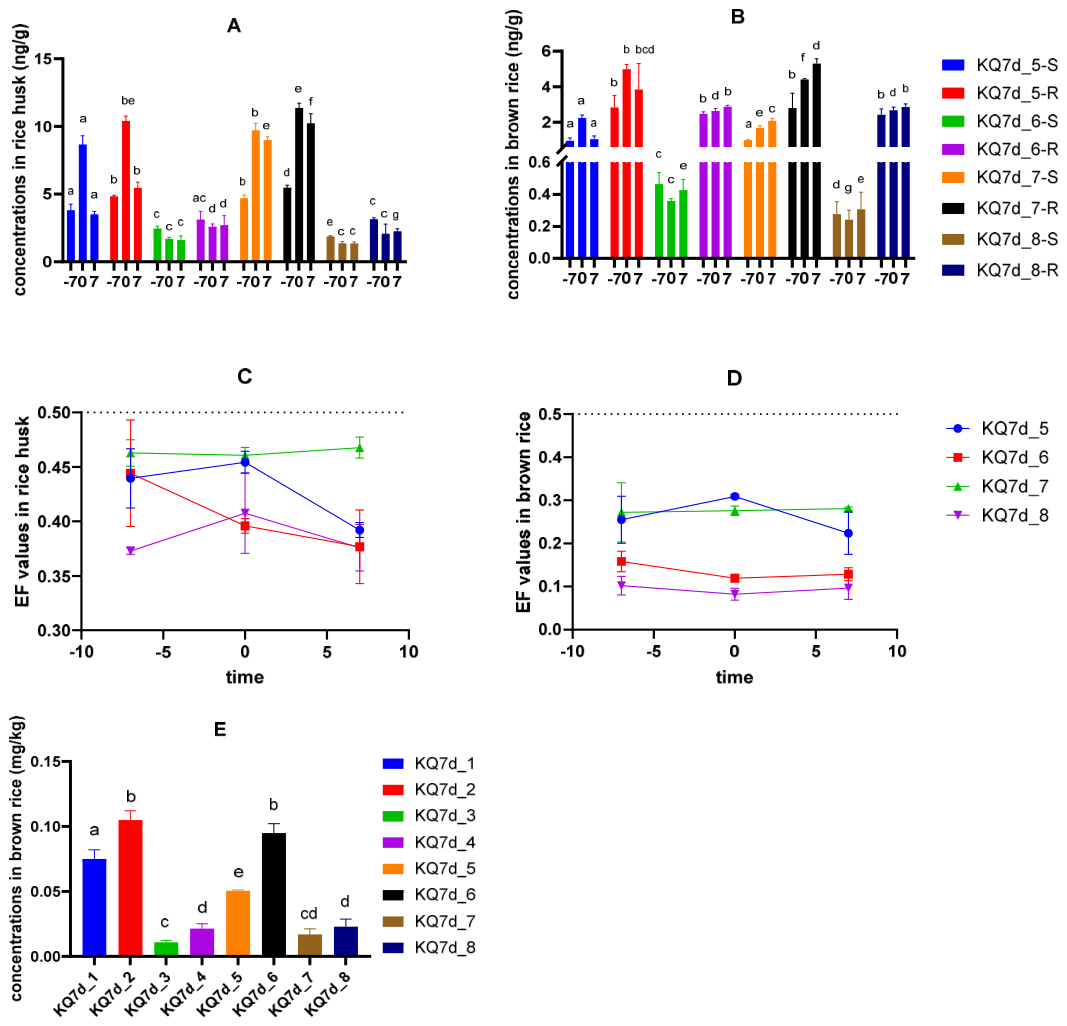
CaCO3 enhanced the residual tetraconazole concentration in ZG 96 rice husk by 10.5–115% but decreased the tetraconazole residue by 10.0–19.2% in ZY 18 rice husk (Figure 2). The concentrations of S-(+)-tetraconazole were always less than R-(-)-tetraconazole in all treatments, and the EF values were all <0.5. R-(-)-tetraconazole was more easily accumulated in rice husk and brown rice. The addition of CaCO3 did not cause a significant difference in the enantioselectivity of tetraconazole. For different rice cultivars, the residues of tetraconazole in ZG 96 brown rice were 1.29–2.41 times those of ZY 18, and in ZG 96 rice husk they were 1.55–6.12 times those of ZY 18. The maximum residue limit (MRL) of tetraconazole in rice stipulated by the European Food Safety Authority was 0.01 mg/kg. The residual tetraconazole concentrations in brown rice in all treatments were less than the MRL.
Figure 2.
The residue concentrations and EF values of tetraconazole enantiomers in rice husk (A,C) and brown rice (B,D) (means ± SD, n = 3). The residue concentrations of Cd in brown rice (E) (means ± SD, n = 3). The different letters indicate significant differences among different treatments on the same day (p < 0.05). The treatments of KQ7d_1, KQ7d_3, KQ7d_5, and KQ7d_7 were the exposure of Cd, Cd+CaCO3, Cd+tetraconazole, and Cd+CaCO3+tetraconazole on ZG 96, respectively. The treatments of KQ7d_2, KQ7d_4, KQ7d_6, and KQ7d_8 were the exposure of Cd, Cd+CaCO3, Cd+tetraconazole, and Cd+CaCO3+tetraconazole on ZY 18, respectively. R and S represent the concentrations of R-tetraconazole and S-tetraconazole, respectively, and 0, −7, and 7 represent the mature stage and before and after 7 days of the mature stage, respectively.
3.3. Cd Concentration in Brown Rice
In the plots with CaCO3 (Figure 2E), the Cd contents in brown rice decreased significantly. Compared with the Cd-alone treatments (KQ7d_1 and KQ7d_2), the concentrations of Cd in the treatments with CaCO3 (KQ7d_3 and KQ7d_4) in brown rice were reduced by 82.9% and 78.2%, respectively. Compared with the treatments of Cd and tetraconazole (KQ7d_5 and KQ7d_6), the treatments with CaCO3 (KQ7d_7 and KQ7d_8) decreased the Cd concentrations in brown rice by 60.0–81.0%. The concentration of Cd in ZY 18 was 1.35–1.95 times that of ZG 96 in different treatments, showing a stronger ability to accumulate Cd in ZY18. The MRLs of Cd in brown rice stipulated by China and the EU are both 0.2 mg/kg [20]. Fortunately, the residual amounts of Cd in brown rice in all treatments were less than the MRL.
3.4. Changes in Soil Properties
After using CaCO3, the soil pH increased from 5.1–5.5 to 6.0–6.4 (Figure S2A). The organic matter contents had little change (Figure S2B). The contents of total nitrogen and available nitrogen increased by 0.09–0.3 g/kg and 8.35–47.8 mg/kg, respectively, after applying tetraconazole (Figure S2C,D). The alone application of CaCO3 or tetraconazole had little effect on the total phosphorus and available phosphorus, which were significantly increased (0.045–0.050 g/kg and 2.2–3.4 mg/kg, respectively) after the combined application of CaCO3 and tetraconazole (Figure S2E,F).
3.5. Changes in Soil Microorganisms
3.5.1. Alpha and Beta Diversity Analysis
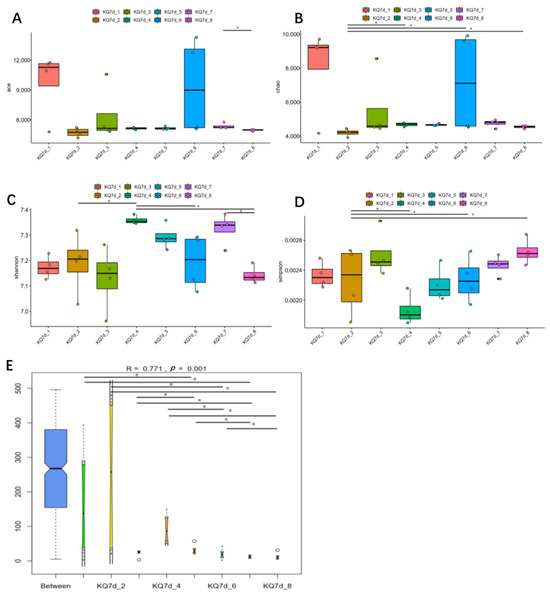
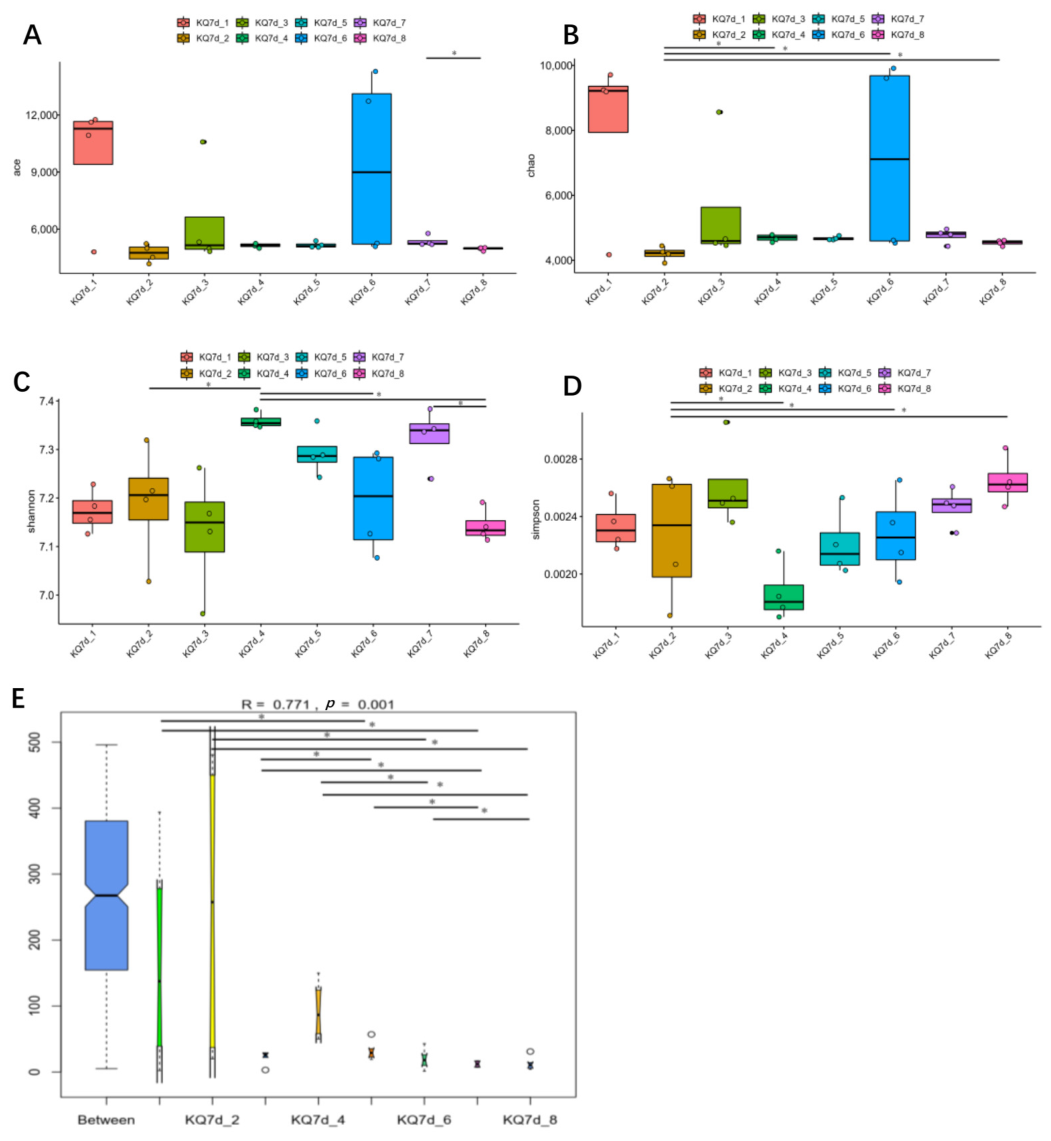
For Ace (Figure 3A) and Chao indices (Figure 3B), there was a decrease in KQ7d_3, KQ7d_5, and KQ7d_7 treatments compared with KQ7d_1, and a significant increase in KQ7d_4, KQ7d_6, and KQ7d_8 compared with KQ7d_2. The Shannon indices (Figure 3C) in KQ7d_4 compared with KQ7d_2, and KQ7d_6 and KQ7d_8 compared with KQ7d_4, increased significantly, indicating an increase in microbial diversity. For Simpson indices (Figure 3D), there was a significant decrease in KQ7d_4, KQ7d_6, and KQ7d_8 compared with KQ7d_2. Beta diversity analysis (Figure S3) indicated that the samples were similar when the distribution between different treatments was close. The principal coordinate analysis (PCoA) indicated that PCoA1 = 27.68% and PCoA2 = 20.10% (Figure S3). Moreover, the KQ7d_2 treatment was completely separated from KQ7d_7 and KQ7d_8, and the KQ7d_7 treatment was completely separated from KQ7d_3 and KQ7d_8.
Figure 3.
Alpha diversity analysis of soil microorganisms in different treatments, including Ace (A), Chao (B), Shannon (C), and Simpson indices (D). The ANOSIM analysis was used to analyze the degree of dissimilarity and diversity among soil microorganisms in different treatments (E). * Indicates a significant difference (p < 0.05). The treatments of KQ7d_1, KQ7d_3, KQ7d_5, and KQ7d_7 were the exposure of Cd, Cd+CaCO3, Cd+tetraconazole, and Cd+CaCO3+tetraconazole on ZG 96, respectively. The treatments of KQ7d_2, KQ7d_4, KQ7d_6, and KQ7d_8 were the exposure of Cd, Cd+CaCO3, Cd+tetraconazole, and Cd+CaCO3+tetraconazole on ZY 18, respectively.
3.5.2. Inter-Group Difference Analysis
ANOSIM analysis was used to test whether the differences between groups were significantly greater than those within groups. The ANOSIM analysis based on the binary Bray–Curtis method showed a significant difference (R = 0.771, p = 0.001) in microbial diversity among different groups except for KQ7d_1 vs. KQ7d_2 and KQ7d_2 vs. KQ7d_4 (Figure 3E), implying that different treatments might induce varying impact degrees on soil microorganisms.
3.5.3. Relative Abundance Changes of Microorganisms
Phylum Level
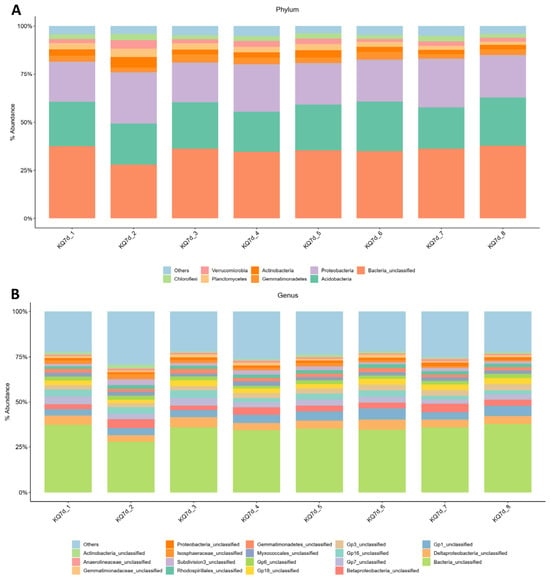
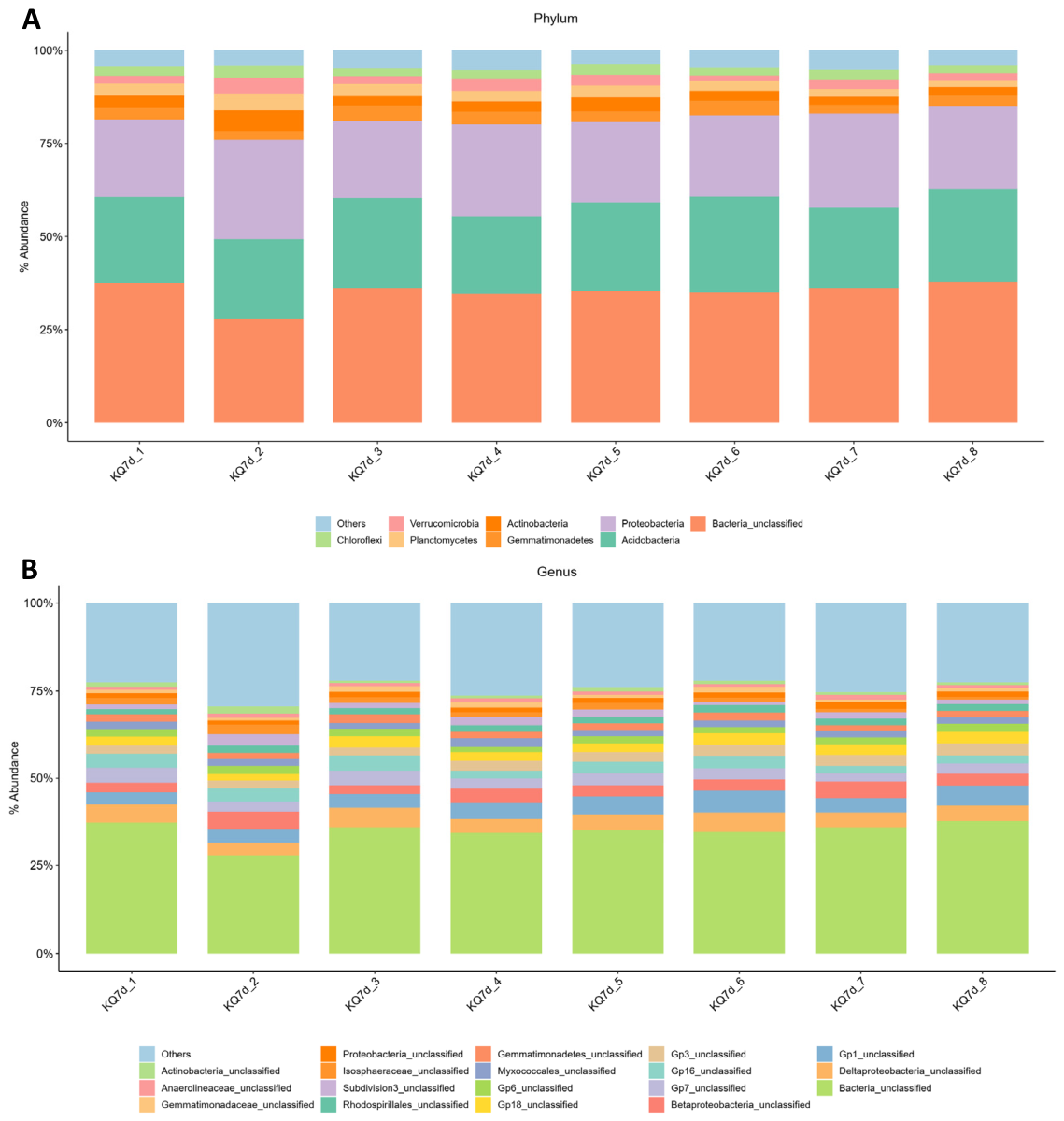
At the phylum level, the top eight microorganisms were Bacteria_unclassified, Acidobacteria, Proteobacteria, Planctomycetes, Actinobacteria, Gemmatimonadetes, Chloroflexi, and Verrucomicrobia (Figure 4A and Table S1). For ZG 96, compared with KQ7d_1 treatment, CaCO3 (KQ7d_3) treatment enhanced the relative abundance of Acidobacteria and Gemmatimonadetes, and reduced the relative abundance of Proteobacteria and Chloroflexi, while the opposite effects were observed in CaCO3+tetraconazole (KQ7d_7) combined treatment. The increase in relative abundance of Actinobacteria was observed in tetraconazole (KQ7d_5) treatment, while a decrease was observed in KQ7d_3 and KQ7d_7 treatments. KQ7d_5 and KQ7d_7 treatments increased the relative abundance of Verrucomicrobia.
Figure 4.
The community composition and abundance analysis at the phylum (A) and genus (B) levels. The treatments of KQ7d_1, KQ7d_3, KQ7d_5, and KQ7d_7 were the exposure of Cd, Cd+CaCO3, Cd+tetraconazole, and Cd+CaCO3+tetraconazole on ZG 96, respectively. The treatments of KQ7d_2, KQ7d_4, KQ7d_6, and KQ7d_8 were the exposure of Cd, Cd+CaCO3, Cd+tetraconazole, and Cd+CaCO3+tetraconazole on ZY 18, respectively.
For ZY 18, compared with KQ7d_2 treatment, the increased relative abundance of Bacteria_unclassified and Gemmatimonadetes, and the decrease in relative abundance of Proteobacteria, Planctomycetes, Actinobacteria, Chloroflexi, and Verrucomicrobia, were observed in all treatments (KQ7d_4, KQ7d_6, and KQ7d_8). The decrease in relative abundance of Acidobacteria was observed in the KQ7d_4 (CaCO3) treatment, while the increase was observed in the KQ7d_6 and KQ7d_8 (tetraconazole and CaCO3+tetraconazole) treatments.
Genus Level
As illustrated in Figure 4B and Table S2, for ZG 96, compared with the KQ7d_1 treatment, the CaCO3+tetraconazole (KQ7d_7) treatment reduced the relative abundance of Gp7_unclassified in KQ7d_3 and KQ7d_5 treatments, exhibiting a synergistic inhibition effect, and enhanced the relative abundance of Proteobacteria_unclassified, exhibiting a synergistic promotion effect. The effects of CaCO3 (KQ7d_3) and tetraconazole (KQ7d_5) were opposite on the relative abundance of Deltaproteobacteria_unclassified, Gp16_unclassified, Gemmatimonadetes, and Actinobacteria_unclassified, and the combined treatments (KQ7d_7) showed inhibitory effects. The decrease in relative abundance of Bacteria_unclassified, Isosphaeraceae_unclassified, and Chloroflexi_unclassified, and the increase in relative abundance of Rhodospirillales_unclassified and Proteobacteria_unclassified, were observed in all treatments (KQ7d_3, KQ7d_5, and KQ7d_7).
For ZY 18, compared with the KQ7d_2 treatment, the KQ7d_8 (CaCO3+tetraconazole) treatment decreased the relative abundance of Isosphaeraceae_unclassified in KQ7d_4 (CaCO3) and KQ7d_6 (tetraconazole) treatments, exhibiting a synergistic inhibition effect, and enhanced the relative abundance of Bacteria_unclassified, Gp3_unclassified, and Proteobacteria_unclassified, exhibiting a synergistic promotion effect. The decrease in relative abundance of Gp6_unclassified in the KQ7d_8 treatment was weaker than that in KQ7d_4 and KQ7d_6 treatments. For Actinobacteria_unclassified, Rhizobiales_unclassified, and Chloroflexi_unclassified, the decrease in relative abundance in the KQ7d_8 treatment was similar to that in KQ7d_4 and KQ7d_6 treatments. The decrease in Gp16_unclassified relative abundance in the KQ7d_8 treatment might be mainly caused by CaCO3. The increase in relative abundance of Gp1_unclassified, Deltaproteobacteria_unclassified, Gemmatimonadetes_unclassified, and Gp18_unclassified, and the decrease in relative abundance of Betaproteobacteria_unclassified and Subdivision3_unclassified, in KQ7d_8 treatment might be mainly caused by tetraconazole.
3.5.4. KEGG Function Prediction
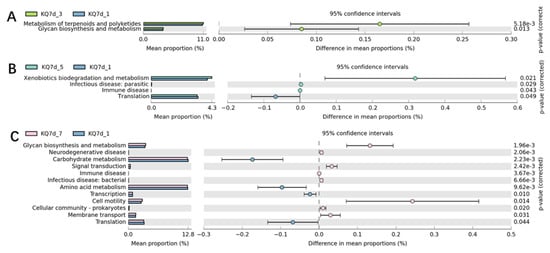
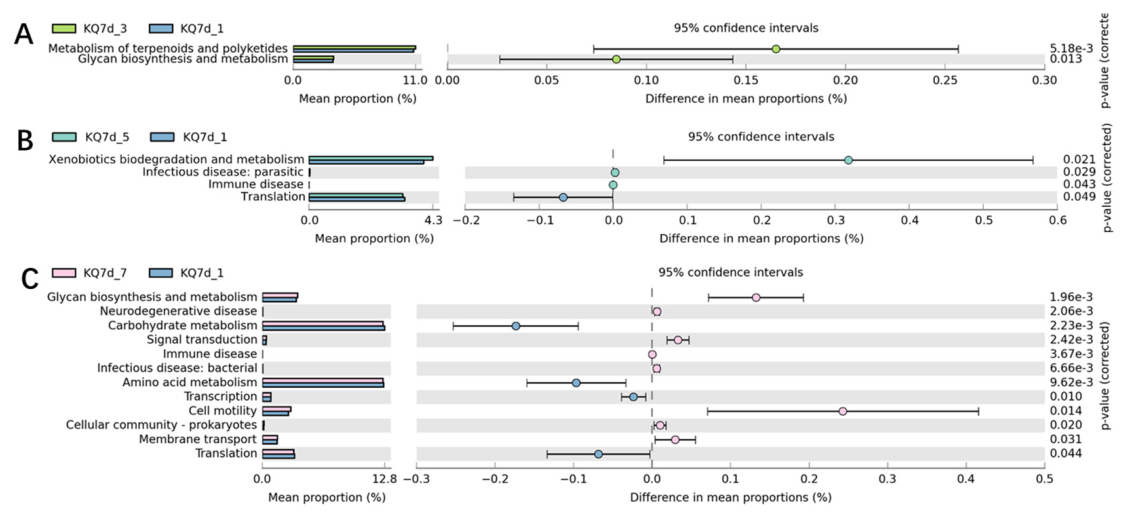
For ZG 96, the addition of CaCO3 affected metabolism of terpenoids and polyketides and glycan biosynthesis and metabolism (Figure 5A). Tetraconazole-alone treatment affected xenobiotics biodegradation and metabolism (Figure 5B). CaCO3+tetraconazole combined treatment affected glycan biosynthesis and metabolism, signal transduction, cell motility, and membrane transport (Figure 5C). Compared to CaCO3-alone treatment, tetraconazole-alone treatment affected glycan biosynthesis and metabolism, nucleotide metabolism, and folding, sorting, and degradation (Figure S4C). Compared to tetraconazole-alone treatment, CaCO3+tetraconazole combined treatment affected cell growth and death, cellular community prokaryotes, and glycan biosynthesis and metabolism (Figure S4D).
Figure 5.
The prediction analysis of KEGG pathways between different treatment groups at KEGG level 2: KQ7d_1 vs. KQ7d_3 (A), KQ7d_1 vs. KQ7d_5 (B), and KQ7d_1 vs. KQ7d_7 (C). The treatments of KQ7d_1, KQ7d_3, KQ7d_5, and KQ7d_7 were the exposure of Cd, Cd+CaCO3, Cd+tetraconazole, and Cd+CaCO3+tetraconazole on ZG 96, respectively.
For ZY 18, tetraconazole treatment affected cellular community prokaryotes and glycan biosynthesis and metabolism (Figure S4A). CaCO3+tetraconazole combined treatment affected cellular community prokaryotes, cell growth and death, energy metabolism, metabolism of cofactors and vitamins, and glycan biosynthesis and metabolism (Figure S4B).
4. Discussion
Cd pollution risk in rice planting systems has always been a hot spot of continuous concern. Using amendments (lime, biochar, clay mineral, organic fertilizer, etc.) and planting rice cultivars with low accumulation ability of heavy metals (DMY6188, DX4103, NY6368, GY725, etc.) are normally used to reduce the uptake and transfer of Cd from soil to rice, which can reduce the accumulation of Cd by more than 70% [21,22,23]. However, it is inevitable to use pesticides during rice planting. Whether the use of soil amendments affects the residue and degradation of pesticides and whether the mixed use of them affects soil microorganisms is worthy of attention.
According to the report, the half-life of tetraconazole in rice plants was 2.1–6.3 days [24]. In this study, the half-lives of tetraconazole in rice plants (KQ7d_5 and KQ7d_6 treatments) were 2.14–2.49 days, which was similar to the report. The half-lives of tetraconazole were 10.3–13.6 days in wheat soil [12]. In this study, tetraconazole was also degraded rapidly in seven days. However, considering the test soil was Cd-contaminated soil and there was no without-Cd soil in the test area, the Cd effects on the tetraconazole degradation were not tested simultaneously. Studies have shown that the presence of heavy metals will affect the environmental behavior of pesticides. For example, the co-existence of Cd2+ could prolong the persistence of atrazine in water [25]. Cd2+ and Pb2+ would inhibit the degradation of α-cypermethrin in soil, which might be related to the activity of soil microbes or the level of enzymes [26].
The soil amendments may also affect the pesticide fate. Liu et al. reported that the application of urea and phosphate fertilizers would promote the degradation of penthiopyrad in soil [27]. Here, the addition of CaCO3 increased the maximum concentration of tetraconazole in both ZY 18 soil and ZG 96 soil and decreased the enantioselectivity. In rice husk, CaCO3 increased the tetraconazole residue for ZG 96 (10.5–115%). For cultivar differences, the residual concentrations of tetraconazole in ZY 18 plants, rice husk, and brown rice were lower than in ZG 96. In paddy soil, rice husk, and brown rice, the enantioselectivity of tetraconazole in ZY 18 was more obvious than in ZG 96. Chang et al. found that R-tebuconazole was preferentially degraded in Fuji and Hanfu apples, while no enantioselectivity was found in Huahong variety apples [28]. Similar phenomena were found in different cucumbers for mefentrifluconazole [29,30]. These differences might be caused by the different enzyme activities and contents, and the different translocation [31,32,33]. Therefore, it is necessary to study chiral pesticides at the enantiomeric level, especially for different cultivars.
The effectiveness of CaCO3 in reducing Cd concentrations in brown rice has been verified, and the effects of other substances have been studied [34,35]. The combined application of EDTA-Fe(II) and CaCO3 could effectively decrease Cd accumulation in brown rice [9]. The combined application of humic substances and CaCO3 had a better effect than single treatments [36]. However, the information on the pesticide effect is limited. Akter et al. found that pesticide application increased the heavy metal concentrations in soil, which indirectly and directly affected the soil properties [37]. Here, the tetraconazole application increased Cd concentration in brown rice after CaCO3 treatments, and significantly increased total nitrogen, available nitrogen, total phosphorus, and available phosphorus by 8.0–82.0% in soils. Kuang et al. found that increasing pH and phosphorus in soil were two important factors decreasing available Cd [38]. The application of phosphorus fertilizer significantly decreased the Cd concentrations in brown rice by about 83.0%, and the phosphorus in soil might prevent the transport of Cd to aboveground mainly by inhibiting absorption and increasing root fixation [39]. Similarly, reasonable nitrogen application is a promising strategy for reducing crop Cd accumulation, and the application of NH4NO3 and NH4Cl inhibited the instantaneous root Cd uptake [40]. The combined application of CaCO3 and tetraconazole helped improve soil fertility, which also affected the soil microorganisms.
Microorganisms play a versatile ecophysiological role in soil formation, resource cycling, and management, such as enhancing the degradation of organic pollutants in soils, promoting plant growth, and increasing soil fertility [41,42,43,44]. Microorganisms can also increase phytoremediation efficiency by solubilizing heavy metals and promoting plant growth through the production of phytohormones in heavy-metal-contaminated soils [45]. Here, the dominant microflora in soil were Acidobacteria and Proteobacteria. Acidobacteria is one of the most abundant phyla in soil, and has been confirmed to actively interact with plants, functioning as plant-growth-promoting bacteria [46]. Proteobacteria, a prevalent phylum in metal-contaminated soils, can promote the bioreduction of metals in contaminated systems by manipulating microbial diversity, having a high detoxifying effect on heavy metals [47,48]. Some sequences of Proteobacteria can assist in carbonate mineral formation, offering some resistance to heavy metals [38,49].
Research has shown that pesticides can change the composition of rhizosphere microorganisms [50,51]. The response of soil microorganisms to tetraconazole depended on the soil management and soil properties [19,52]. The relative abundance of Actinobacteria, Chloroflexi, and Verrucomicrobia increased after the application of tetraconazole for ZG 96, which was the opposite for ZY 18. Actinobacteria can produce secondary metabolites, which play a positive role in bioremediation and promoting plant growth efficiency [53]. Chloroflexi seems to play a significant beneficial role by providing filamentous scaffolding, fermenting carbohydrates, and degrading complex polymeric organic compounds into low-molecular-weight substrates to support their growth and that of other bacterial populations [54]. Verrucomicrobia have potential roles in methane oxidation, polysaccharide degradation, and nitrogen fixation [55,56]. These changes might affect xenobiotics biodegradation and metabolism and glycan biosynthesis and metabolism for ZG 96 soils, and affect cellular community prokaryotes and glycan biosynthesis and metabolism for ZY 18 soils, leading to different concentration changes of Cd and tetraconazole.
Soil amendment application affects soil microorganisms, as has been proven. Lime application increased the abundance and richness of the prokaryotic microbes in paddy soil, which was caused by the changes in soil properties [57]. CaCO3 application for ZG 96 decreased the relative abundance of Actinobacteria and Proteobacteria, while increasing the relative abundance of Gemmatimonadetes, stimulating the function of metabolism of terpenoids and polyketides and glycan biosynthesis and metabolism. Similar effects of CaCO3 were observed for ZY 18 soil microorganisms. Most terpenoids have antibacterial and bactericidal effects, and some chemical defense substances can effectively protect themselves from pathogens [58]. The Proteobacteria communities are associated with functions such as ureolysis, nitrogen fixation, nitrate reduction, and hydrocarbon degradation [59]. Tian et al. speculated that Fe-Mn-modified biochar might increase soil pH by affecting the relative abundance of Acidobacteria, Gp1, and Gp3, and then reduce the content of available Cd in soil [60]. Thus, we speculated that the increase in soil pH and the decrease in Cd accumulation might be linked to the relative abundance changes of Acidobacteria, Proteobacteria, Gp1, and Gp3.
The combined application of CaCO3 and tetraconazole decreased the relative abundance of Planctomycetes and Actinobacteria for both ZG 96 and ZY 18 soils, which might be related to changes in the functions of cell growth and death, cellular community prokaryotes, and glycan biosynthesis and metabolism. Planctomycetes can utilize nitrite or oxidize ammonium ions to generate nitrogen, promoting global development [61]. Actinobacteria play an important role in nitrogen and phosphorus cycling [62], which might be related to the increase of total nitrogen, available nitrogen, total phosphorus, and available phosphorus. However, the effects on Acidobacteria, Proteobacteria, Gemmatimonadetes, Chloroflexi, and Verrucomicrobia were opposite for ZG 96 and ZY 18 soils. The functional changes in energy metabolism and metabolism of cofactors and vitamins were only observed for ZY 18 soils. In the same field and test conditions, rice cultivar differences were the main reason for microorganism differences. Crop cultivars differ in their root exudate profiles, architecture, and tissue chemistry, and these differences may lead to distinct microbiomes, which may explain 15% of the variation in soil microorganisms [63]. The different root microorganism compositions at the phylum level between the two rice cultivars have been reported [64]. The differences in root exudates induce plants to recruit different partners, resulting in variations in soil microorganism compositions, which deserve further study.
5. Conclusions
The combined effects of CaCO3 and tetraconazole were generally opposite for ZG 96 and ZY 18, with more significant effects for ZG 96. The combined treatment of CaCO3 and tetraconazole shortened the tetraconazole half-lives in ZY18 rice plants by 16.6–17.8%, which was opposite in ZG 96 rice plants. CaCO3 decreased the tetraconazole residue by 10.0–19.2% in ZY 18 rice husk, but not in ZG 96 rice husk. The Cd concentrations in ZY 18 brown rice were 1.35–1.95 times higher than in ZG 96. Tetraconazole and CaCO3 had opposite effects on Verrucomicrobia in ZG 96 soil and Acidobacteria in ZY 18 soil. The changes in the relative abundance of soil microorganisms might change the soil properties and the degradation and residues of Cd/tetraconazole. The findings contribute to the efficient and safe application of chiral tetraconazole and provide valuable data and a theoretical basis for the effect of amendments on pesticides and heavy metals in the environment. The limitation was that the field experiments were conducted at only one location during a single growing season, without replication across years or geographical locations. The amendment effects on the behaviors of pesticides and heavy metals deserve further study.
Supplementary Materials
The following supporting information can be downloaded at: https://www.mdpi.com/article/10.3390/toxics14090747/s1. The details of materials and methods. Figure S1: The experimental design schematic diagram. The treatments of KQ7d_1, KQ7d_3, KQ7d_5, and KQ7d_7 were the exposure of Cd, Cd+CaCO3, Cd+tetraconazole, and Cd+CaCO3+tetraconazole on ZG 96, respectively. The treatments of KQ7d_2, KQ7d_4, KQ7d_6, and KQ7d_8 were the exposure of Cd, Cd+CaCO3, Cd+tetraconazole, and Cd+CaCO3+tetraconazole on ZY 18, respectively. Figure S2: The soil properties in different treatments. The different letters indicate the significant differences among different treatments (p < 0.05). The treatments of KQ7d_1, KQ7d_3, KQ7d_5, and KQ7d_7 were the exposure of Cd, Cd+CaCO3, Cd+tetraconazole, and Cd+CaCO3+tetraconazole on ZG 96, respectively. The treatments of KQ7d_2, KQ7d_4, KQ7d_6, and KQ7d_8 were the exposure of Cd, Cd+CaCO3, Cd+tetraconazole, and Cd+CaCO3+tetraconazole on ZY 18, respectively. Figure S3: Principal coordinate analysis (PCoA) of weighted UniFrac scores of soil microorganisms in different treatments. The treatments of KQ7d_1, KQ7d_3, KQ7d_5, and KQ7d_7 were the exposure of Cd, Cd+CaCO3, Cd+tetraconazole, and Cd+CaCO3+tetraconazole on ZG 96, respectively. The treatments of KQ7d_2, KQ7d_4, KQ7d_6, and KQ7d_8 were the exposure of Cd, Cd+CaCO3, Cd+tetraconazole, and Cd+CaCO3+tetraconazole on ZY 18, respectively. Figure S4: The prediction analysis of KEGG pathways between different treatment groups at KEGG level 2: KQ7d_2 vs. KQ7d_6 (A), KQ7d_2 vs. KQ7d_8 (B), KQ7d_3 vs. KQ7d_5 (C), and KQ7d_5 vs. KQ7d_7 (D). The treatments of KQ7d_3, KQ7d_5, and KQ7d_7 were the exposure of Cd+CaCO3, Cd+tetraconazole, and Cd+CaCO3+tetraconazole on ZG 96, respectively. The treatments of KQ7d_2, KQ7d_6, and KQ7d_8 were the exposure of Cd, Cd+tetraconazole, and Cd+CaCO3+tetraconazole on ZY 18, respectively. Table S1: The relative abundance changes of microorganisms at the phylum level in different treatments. The treatments of KQ7d_1, KQ7d_3, KQ7d_5, and KQ7d_7 were the exposure of Cd, Cd+CaCO3, Cd+tetraconazole, and Cd+CaCO3+tetraconazole on ZG 96, respectively. The treatments of KQ7d_2, KQ7d_4, KQ7d_6, and KQ7d_8 were the exposure of Cd, Cd+CaCO3, Cd+tetraconazole, and Cd+CaCO3+tetraconazole on ZY 18, respectively. Table S2: The relative abundance changes of microorganisms at the genus level in different treatments. The treatments of KQ7d_1, KQ7d_3, KQ7d_5, and KQ7d_7 were the exposure of Cd, Cd+CaCO3, Cd+tetraconazole, and Cd+CaCO3+tetraconazole on ZG 96, respectively. The treatments of KQ7d_2, KQ7d_4, KQ7d_6, and KQ7d_8 were the exposure of Cd, Cd+CaCO3, Cd+tetraconazole, and Cd+CaCO3+tetraconazole on ZY 18, respectively.
Author Contributions
D.C., investigation, conceptualization, roles/writing—original draft, validation, visualization; Z.D., conceptualization, roles/writing—original draft, methodology; X.Y., supervision, data curation, methodology; Y.G., investigation, data curation, methodology; H.Z., software, supervision; P.Q., formal analysis, resources; Z.W., methodology; Z.L., supervision; X.W., resources, project administration, writing—review and editing; S.D., resources, project administration, writing—review and editing. All authors have read and agreed to the published version of the manuscript.
Funding
This study was supported by the Zhejiang Provincial Natural Science Foundation of China (Grant No. LMS26D010003) and the Science and Technology Cooperation Project of Agriculture and Rural Department of Zhejiang Province (Grant No. 2020SNLF004).
Institutional Review Board Statement
Not applicable.
Informed Consent Statement
Not applicable.
Data Availability Statement
The original contributions presented in this study are included in the article/Supplementary Materials. Further inquiries can be directed to the corresponding authors.
Conflicts of Interest
The authors declare no conflicts of interest.
References
- Wagh, M.S.; Osborne, W.J.; Sivarajan, S. Toxicity assessment of lead, nickel and cadmium on zebra fish augmented with Bacillus xiamenensis VITMSJ3: An insight on the defense mechanism against oxidative stress due to heavy metals. Food Chem. Toxicol. 2023, 177, 113830. [Google Scholar] [CrossRef] [Scilit]
- Shang, E.; Xu, E.; Zhang, H.; Huang, C. Spatial-Temporal Trends and Polution Source Analysis for Heavy Metal Contamination of Cultivated Soils in five Major Grain Producing Regions of China. Environ. Sci. 2018, 39, 4670–4683. [Google Scholar]
- Zhao, F.J.; Ma, Y.B.; Zhu, Y.G.; Tang, Z.; McGrath, S.P. Soil Contamination in China: Current Status and Mitigation Strategies. Environ. Sci. Technol. 2015, 49, 750–759. [Google Scholar] [CrossRef] [Scilit]
- Parmar, P.; Kumari, N.; Sharma, V. Structural and functional alterations in photosynthetic apparatus of plants under cadmium stress. Bot. Stud. 2013, 54, 45. [Google Scholar] [CrossRef] [Scilit] [PubMed]
- Chen, D.; Liu, X.Y.; Bian, R.J.; Cheng, K.; Zhang, X.H.; Zheng, J.F.; Joseph, S.; Crowley, D.; Pan, G.X.; Li, L.Q. Effects of biochar on availability and plant uptake of heavy metals—A meta-analysis. J. Environ. Manag. 2018, 222, 76–85. [Google Scholar] [CrossRef] [Scilit]
- Chen, D.; Ye, X.Z.; Zhang, Q.; Xiao, W.D.; Ni, Z.Y.; Yang, L.; Zhao, S.P.; Hu, J.; Gao, N.; Huang, M.J. The effect of sepiolite application on rice Cd uptake—A two-year field study in Southern China. J. Environ. Manag. 2020, 254, 109788. [Google Scholar] [CrossRef] [Scilit]
- Yang, Z.L.; Wang, M.X.; Hou, J.T.; Xiong, J.; Chen, C.; Liu, Z.Y.; Tan, W.F. Prediction of cadmium bioavailability in the rice-soil system on a county scale based on the multi-surface speciation model. J. Hazard. Mater. 2023, 449, 130963. [Google Scholar] [CrossRef] [Scilit]
- Kong, L.L.; Guo, Z.H.; Peng, C.; Xiao, X.Y.; He, Y.L. Factors influencing the effectiveness of liming on cadmium reduction in rice: A meta-analysis and decision tree analysis. Sci. Total Environ. 2021, 779, 146477. [Google Scholar] [CrossRef] [Scilit]
- Xu, B.; Chen, J.Y.; Qian, B.J.; Jiao, D.D.; You, Y.L.; Guo, X.D.; Hu, Y.B.; Wang, D.X.; Huang, L.W.; Wang, X.L.; et al. Coupling effects of Fe(II) and CaCO3 application on cadmium uptake and accumulation in rice (Oryza saliva L.). J. Appl. Bot. Food Qual. 2024, 97, 63–70. [Google Scholar]
- Feng, J.; Wang, Y.; Zhao, J.; Zhu, L.; Bian, X.; Zhang, W. Source attributions of heavy metals in rice plant along highway in Eastern China. J. Environ. Sci. 2011, 23, 1158–1164. [Google Scholar] [CrossRef] [Scilit]
- Castro-Sobrino, L.; Briz-Cid, N.; Figueiredo-González, M.; Sieiro-Sampedro, T.; González-Barreiro, C.; Cancho-Grande, B.; Rial-Otero, R.; Simal-Gándara, J. Impact of fungicides mepanipyrim and tetraconazole on phenolic profile and colour of Mencía red wines. Food Control 2019, 98, 412–423. [Google Scholar] [CrossRef] [Scilit]
- Tong, Z.; Dong, X.; Yang, S.; Sun, M.; Gao, T.; Duan, J.; Cao, H. Enantioselective effects of the chiral fungicide tetraconazole in wheat: Fungicidal activity and degradation behavior. Environ. Pollut. 2019, 247, 1–8. [Google Scholar] [CrossRef] [Scilit]
- Li, Y.; Nie, J.; Chang, W.; Xu, G.; Farooq, S.; Liu, M.; Zhang, J. Enantioselective behavior analysis of chiral fungicide tetraconazole in apples with UPLC-MS/MS. Food Control 2020, 116, 107305. [Google Scholar] [CrossRef] [Scilit]
- Liu, N.; Pan, X.; Zhang, S.; Ji, M.; Zhang, Z. Enantioselective behaviour of tetraconazole during strawberry wine-making process. Chirality 2018, 30, 686–694. [Google Scholar] [CrossRef] [Scilit]
- Di, S.; Li, Y.; Song, B.; Guo, C.; Qi, P.; Wang, Z.; Liu, Z.; Zhao, H.; Wang, X. Potential effects of individual and combined exposure to tetraconazole and cadmium on zebrafish from the perspective of enantioselectivity and intestinal microbiota. Sci. Total Environ. 2024, 921, 170899. [Google Scholar] [CrossRef] [Scilit]
- NY/T 788-2018; Guideline for the Testing of Pesticide Residues in Crops. Agricultural Industry Standard of the People’s Republic of China: Beijing, China, 2018.
- Qi, P.P.; Wang, J.; Liu, Z.Z.; Wang, Z.W.; Xu, H.; Di, S.S.; Zhao, H.Y.; Wang, X.Q. Integrated QuEChERS strategy for high-throughput multi-pesticide residues analysis of vegetables. J. Chromatogr. A 2021, 1659, 462589. [Google Scholar] [CrossRef] [Scilit]
- Lu, R. Analysis Methods of Soil Agricultural Chemistry; China Agricultural Science and Technology Publishing House: Beijing, China, 2000. [Google Scholar]
- Zhang, W.W.; Xu, J.; Dong, F.S.; Liu, X.G.; Zhang, Y.; Wu, X.H.; Zheng, Y.Q. Effect of tetraconazole application on the soil microbial community. Environ. Sci. Pollut. Res. 2014, 21, 8323–8332. [Google Scholar] [CrossRef] [Scilit]
- European Food Safety Authority (EFSA). Statement on tolerable weekly intake for cadmium. EFSA J. 2011, 9, 1975. [Google Scholar] [CrossRef] [Scilit]
- Liu, Z.; Hu, Y.; Zhang, J.; Gao, D.; Zhang, G.; Lu, H. Comparison of remediation effects of different passivators on cadmium-contaminated rice paddy. J. Huazhong Agric. Univ. 2024, 43, 176–184. [Google Scholar]
- Xu, M.; Yang, L.; Chen, Y.; Jing, H.; Wu, P.; Yang, W. Selection of rice and maize varieties with low cadmium accumulation and derivation of soil environmental thresholds in karst. Ecotoxicol. Environ. Saf. 2022, 247, 114244. [Google Scholar] [CrossRef] [Scilit]
- Qin, J.; Li, J.; Pei, H.; Li, Q.; Cheng, D.; Zhou, J.; Pei, G.; Wang, Y.; Liu, F. Effective remediation and phytotoxicity assessment of oxytetracycline and Cd co-contaminated soil using biochar. Environ. Technol. Innov. 2024, 35, 103649. [Google Scholar] [CrossRef] [Scilit]
- Duan, J.-s.; Wang, M.; Dong, X.; Sun, M.-n.; Xiao, Q.-q.; Zhu, Y.-j.; Sun, H.-b.; Liu, Y.-p.; Gao, T.-c. Residues and degradation dynamics of tetraconazole in rice and environment. Agrochemicals 2015, 54, 900–903. [Google Scholar]
- Xie, D.Y.; Chen, C.S.; Li, C.; Wang, Q.H. Influence of Cd on atrazine degradation and the formation of three primary metabolites in water under the combined pollution. Environ. Sci. Pollut. Res. 2021, 28, 16081–16091. [Google Scholar] [CrossRef] [Scilit]
- Jiang, W.Q.; Yao, G.J.; Jing, X.; Liu, X.K.; Liu, D.H.; Zhou, Z.Q. Effects of Cd2+ and Pb2+ on enantioselective degradation behavior of α-cypermethrin in soils and their combined effect on activities of soil enzymes. Environ. Sci. Pollut. Res. 2021, 28, 47099–47106. [Google Scholar] [CrossRef] [Scilit]
- Liu, H.; Liu, M.Q.; Chen, K.Y.; Shan, M.; Li, Y.Y. Fertilization can modify the enantioselective persistence of penthiopyrad in relation to the co-influence on soil ecological health. Environ. Res. 2023, 224, 115514. [Google Scholar] [CrossRef] [Scilit]
- Chang, W.X.; Liu, M.Y.; Ren, Q.; Shi, Z.S.; Wang, W.; Nie, J.Y.; Cai, Z.W. Enantioselective behavior and bioactivity of chiral tebuconazole in apples. Food Control 2023, 153, 109941. [Google Scholar] [CrossRef] [Scilit]
- An, X.K.; Pan, X.L.; Li, R.N.; Jiang, D.D.; Dong, F.S.; Zhu, W.T.; Xu, J.; Liu, X.G.; Wu, X.H.; Zheng, Y.Q. Enantioselective monitoring chiral fungicide mefentrifluconazole in tomato, cucumber, pepper and its pickled products by supercritical fluid chromatography tandem mass spectrometry. Food Chem. 2022, 376, 131883. [Google Scholar] [CrossRef] [Scilit]
- Li, L.S.; Sun, X.F.; Zhao, X.J.; Xiong, Y.D.; Gao, B.B.; Zhang, J.; Shi, H.Y.; Wang, M.H. Absolute Configuration, Enantioselective Bioactivity, and Degradation of the Novel Chiral Triazole Fungicide Mefentrifluconazole. J. Agric. Food Chem. 2021, 69, 4960–4967. [Google Scholar] [CrossRef] [Scilit]
- Sun, Z.Z.; Dzakpasu, M.; Zhang, D.X.; Liu, G.C.; Wang, Z.Z.; Qu, M.W.; Chen, R.; Wang, X.C.C.; Zheng, Y.C. Enantioselectivity and mechanisms of chiral herbicide biodegradation in hydroponic systems. Chemosphere 2022, 307, 135701. [Google Scholar] [CrossRef] [Scilit]
- Liu, S.; Li, X.; Heng, Z.; Qin, S.; Liang, L.; Liao, Y.; Zhu, J.; Tan, H.; Zhao, F. Comprehensive study of chiral herbicide flusulfinam uptake, translocation, degradation, and subcellular distribution in rice (Oryza sativa L.). Pestic. Biochem. Physiol. 2024, 204, 106018. [Google Scholar] [CrossRef] [Scilit]
- Liu, L.; Cheng, Z.P.; Wang, P.P.; Chen, X.X.; Chen, Z.L.; Li, J.; Lu, Y.; Sun, H.W. Insights into the Enantiomeric Uptake, Translocation, and Distribution of Triazole Chiral Pesticide Mefentrifluconazole in Wheat (Triticum aestivum L.). J. Agric. Food Chem. 2024, 72, 18401–18411. [Google Scholar] [CrossRef] [Scilit]
- He, L.L.; Huang, D.Y.; Zhang, Q.; Zhu, H.H.; Xu, C.; Li, B.; Zhu, Q.H. Meta-analysis of the effects of liming on soil pH and cadmium accumulation in crops. Ecotoxicol. Environ. Saf. 2021, 223, 112621. [Google Scholar] [CrossRef] [Scilit]
- Xu, B.; Chen, J.Y.; Hu, Y.B.; You, Y.L.; Sun, X.C.; Yu, J.Y.; Guo, X.D.; Hu, C.; Chen, C.L.; Chen, Y.H.; et al. Influence of FeSO4, nano zero-valent iron, and their CaCO3 composites on the formation of iron plaque and cadmium translocation in rice (Oryza sativa L.). Environ. Pollut. Bioavailab. 2024, 36, 2368588. [Google Scholar] [CrossRef] [Scilit]
- Liu, H.; Zhang, T.; Tong, Y.A.; Zhu, Q.H.; Huang, D.Y.; Zeng, X.B. Effect of humic and calcareous substance amendments on the availability of cadmium in paddy soil and its accumulation in rice. Ecotoxicol. Environ. Saf. 2022, 231, 113186. [Google Scholar] [CrossRef] [Scilit]
- Akter, R.; Mukhles, M.B.; Rahman, M.M.; Rana, M.R.; Huda, N.; Ferdous, J.; Rahman, F.; Rafi, M.H.; Biswas, S.K. Effect of pesticides on nitrification activity and its interaction with chemical fertilizer and manure in long-term paddy soils. Chemosphere 2022, 304, 135379. [Google Scholar] [CrossRef] [Scilit]
- Kuang, X.L.; Si, K.Y.; Song, H.J.; Peng, L.; Chen, A.W. Lime-Phosphorus Fertilizer Efficiently Reduces the Cd Content of Rice: Physicochemical Property and Biological Community Structure in Cd-Polluted Paddy Soil. Front. Microbiol. 2021, 12, 749946. [Google Scholar] [CrossRef] [Scilit]
- Li, Y.; Liu, M.S.; Wang, H.C.; Li, C.H.; Zhang, Y.; Dong, Z.Y.; Fu, C.L.; Ye, Y.X.; Wang, F.B.; Chen, X.H.; et al. Effects of different phosphorus fertilizers on cadmium absorption and accumulation in rice under low-phosphorus and rich-cadmium soil. Environ. Sci. Pollut. Res. 2024, 31, 11898–11911. [Google Scholar] [CrossRef] [Scilit]
- Hu, Y.C.; Yan, T.C.; Gao, Z.Y.; Wang, T.K.; Lu, X.L.; Yang, L.; Shen, L.; Zhang, Q.; Hu, J.; Ren, D.Y.; et al. Appropriate Supply of Ammonium Nitrogen and Ammonium Nitrate Reduces Cadmium Content in Rice Seedlings by Inhibiting Cadmium Uptake and Transport. Rice Sci. 2024, 31, 587–602. [Google Scholar] [CrossRef] [Scilit]
- Bashan, Y.; Salazar, B.G.; Moreno, M.; Lopez, B.R.; Linderman, R.G. Restoration of eroded soil in the Sonoran Desert with native leguminous trees using plant growth-promoting microorganisms and limited amounts of compost and water. J. Environ. Manag. 2012, 102, 26–36. [Google Scholar] [CrossRef] [Scilit]
- Su, D.; Liu, Y.; Liu, F.; Dong, Y.; Pu, Y. Enhancing polycyclic aromatic hydrocarbon soil remediation in cold climates using immobilized low-temperature-resistant mixed microorganisms. Sci. Total Environ. 2024, 939, 173414. [Google Scholar] [CrossRef] [Scilit]
- Sharma, A.; Saha, T.N.; Arora, A.; Shah, R.; Nain, L. Efficient Microorganism Compost Benefits Plant Growth and Improves Soil Health in Calendula and Marigold. Hortic. Plant J. 2017, 3, 67–72. [Google Scholar] [CrossRef] [Scilit]
- Alori, E.T.; Osemwegie, O.O.; Ibaba, A.L.; Daramola, F.Y.; Olaniyan, F.T.; Lewu, F.B.; Babalola, O.O. The Importance of Soil Microorganisms in Regulating Soil Health. Commun. Soil Sci. Plant Anal. 2024, 55, 2636–2650. [Google Scholar] [CrossRef] [Scilit]
- Xie, Y.; Bu, H.; Feng, Q.; Wassie, M.; Amee, M.; Jiang, Y.; Bi, Y.; Hu, L.; Chen, L. Identification of Cd-resistant microorganisms from heavy metal-contaminated soil and its potential in promoting the growth and Cd accumulation of bermudagrass. Environ. Res. 2021, 200, 111730. [Google Scholar] [CrossRef] [Scilit]
- Kielak, A.M.; Cipriano, M.A.P.; Kuramae, E.E. Acidobacteria strains from subdivision 1 act as plant growth-promoting bacteria. Arch. Microbiol. 2016, 198, 987–993. [Google Scholar] [CrossRef] [Scilit]
- Emenike, C.U.; Agamuthu, P.; Fauziah, S.H.; Omo-Okoro, P.N.; Jayanthi, B. Enhanced Bioremediation of Metal-Contaminated Soil by Consortia of Proteobacteria. Water Air Soil Pollut. 2023, 234, 731. [Google Scholar] [CrossRef] [Scilit]
- Zhu, J.Y.; Zhang, J.X.; Li, Q.; Han, T.; Xie, J.P.; Hu, Y.H.; Chai, L.Y. Phylogenetic analysis of bacterial community composition in sediment contaminated with multiple heavy metals from the Xiangjiang River in China. Mar. Pollut. Bull. 2013, 70, 134–139. [Google Scholar] [CrossRef] [Scilit]
- Heijs, S.K.; Aloisi, G.; Bouloubassi, I.; Pancost, R.D.; Pierre, C.; Sinninghe Damsté, J.S.; Gottschal, J.C.; van Elsas, J.D.; Forney, L.J. Microbial Community Structure in Three Deep-Sea Carbonate Crusts. Microb. Ecol. 2006, 52, 451–462. [Google Scholar] [CrossRef] [Scilit]
- Qian, H.; Zhu, Y.; Chen, S.; Jin, Y.; Lavoie, M.; Ke, M.; Fu, Z. Interacting effect of diclofop-methyl on the rice rhizosphere microbiome and denitrification. Pestic. Biochem. Physiol. 2018, 146, 90–96. [Google Scholar] [CrossRef] [Scilit]
- Roman, D.L.; Voiculescu, D.I.; Filip, M.; Ostafe, V.; Isvoran, A. Effects of Triazole Fungicides on Soil Microbiota and on the Activities of Enzymes Found in Soil: A Review. Agriculture 2021, 11, 893. [Google Scholar] [CrossRef] [Scilit]
- Sulowicz, S.; Piotrowska-Seget, Z. Response of microbial communities from an apple orchard and grassland soils to the first-time application of the fungicide tetraconazole. Ecotoxicol. Environ. Saf. 2016, 124, 193–201. [Google Scholar] [CrossRef] [Scilit]
- Ravi Kumar, K.; Mathur, A.; Awasthi, G.; Kant Awasthi, K. Actinobacteria as biological nitrogen fixation (BNF) and symbiotic association with actinorhizal plants for restoration of salinized soils. Mater. Today Proc. 2023, 95, 67–72. [Google Scholar] [CrossRef] [Scilit]
- Speirs, L.B.M.; Rice, D.T.F.; Petrovski, S.; Seviour, R.J. The Phylogeny, Biodiversity, and Ecology of the Chloroflexi in Activated Sludge. Front. Microbiol. 2019, 10, 2015. [Google Scholar] [CrossRef] [Scilit]
- Ravel, J.; Martinez-Garcia, M.; Brazel, D.M.; Swan, B.K.; Arnosti, C.; Chain, P.S.G.; Reitenga, K.G.; Xie, G.; Poulton, N.J.; Gomez, M.L.; et al. Capturing Single Cell Genomes of Active Polysaccharide Degraders: An Unexpected Contribution of Verrucomicrobia. PLoS ONE 2012, 7, e35314. [Google Scholar] [CrossRef] [Scilit]
- Wang, X.B.; Hsu, C.M.; Dubeux, J.C.B.; Mackowiak, C.; Blount, A.; Han, X.G.; Liao, H.L. Effects of rhizoma peanut cultivars (Arachis glabrata Benth.) on the soil bacterial diversity and predicted function in nitrogen fixation. Ecol. Evol. 2019, 9, 12676–12687. [Google Scholar] [CrossRef] [Scilit]
- Jiang, Y.X.; Hu, T.; Peng, O.U.; Chen, A.W.; Tie, B.Q.; Shao, J.H. Responses of microbial community and soil enzyme to heavy metal passivators in cadmium contaminated paddy soils: An in situ field experiment. Int. Biodeterior. Biodegrad. 2021, 164, 105292. [Google Scholar] [CrossRef] [Scilit]
- Grayer, R.J.; Harborne, J.B. A survey of antifungal compounds from higher plants, 1982–1993. Phytochemistry 1994, 37, 19–42. [Google Scholar] [CrossRef] [Scilit]
- Wang, Z.; Zhang, S.; Li, C.; Geng, Z.; Sun, L.; Zhang, L.; Cao, Z. Restoration via the aggregate spray-seeding technique affected the soil proteobacteria on an Uninhabited Island: Community structure, metabolic function, nutritional type, and life strategy. Glob. Ecol. Conserv. 2024, 53, e03009. [Google Scholar] [CrossRef] [Scilit]
- Tian, Y.H.; Li, P.; Chen, X.Y.; He, J.; Tian, M.J.; Zheng, Z.Y.; Hu, R.W.; Fu, Z.Q.; Yi, Z.X.; Li, J. R3 strain and Fe-Mn modified biochar reduce Cd absorption capacity of roots and available Cd content of soil by affecting rice rhizosphere and endosphere key flora. Ecotoxicol. Environ. Saf. 2024, 278, 116418. [Google Scholar] [CrossRef] [Scilit]
- Wang, K.Y.; Zhang, Z.F.; Wang, H.C.; Zhan, P.F.; Song, W.F.; Lu, M.; Wang, H. Analysis of Microbial Diversity and Functional Characteristics of Paddy Soil Under Traditional Tillage Methods in Hani Terraced Fields. J. Southwest For. Univ. 2022, 42, 56–66. [Google Scholar]
- Zhang, B.L.; Wu, X.K.; Tai, X.S.; Sun, L.K.; Wu, M.H.; Zhang, W.; Chen, X.M.; Zhang, G.S.; Chen, T.; Liu, G.X.; et al. Variation in Actinobacterial Community Composition and Potential Function in Different Soil Ecosystems Belonging to the Arid Heihe River Basin of Northwest China. Front. Microbiol. 2019, 10, 02209. [Google Scholar] [CrossRef] [Scilit]
- Ulbrich, T.C.; Friesen, M.L.; Roley, S.S.; Tiemann, L.K.; Evans, S.E. Intraspecific Variability in Root Traits and Edaphic Conditions Influence Soil Microbiomes Across 12 Switchgrass Cultivars. Phytobiomes J. 2020, 5, 108–120. [Google Scholar] [CrossRef] [Scilit]
- Ding, H.A.; Liu, T.Q.; Hu, Q.Y.; Liu, M.; Cai, M.L.; Jiang, Y.; Cao, C.G. Effect of microbial community structures and metabolite profile on greenhouse gas emissions in rice varieties. Environ. Pollut. 2022, 306, 119365. [Google Scholar] [CrossRef] [Scilit]

Disclaimer/Publisher’s Note: The statements, opinions and data contained in all publications are solely those of the individual author(s) and contributor(s) and not of MDPI and/or the editor(s). MDPI and/or the editor(s) disclaim responsibility for any injury to people or property resulting from any ideas, methods, instructions or products referred to in the content. |
© 2026 by the authors. Licensee MDPI, Basel, Switzerland. This article is an open access article distributed under the terms and conditions of the Creative Commons Attribution (CC BY) license.