


Abstract
Long-term field evidence remains limited regarding whether remediation of abandoned mining areas can sustainably reduce heavy metal accumulation in surrounding crops and associated dietary health risks. In this study, an abandoned Ni-Mo mining area in Zunyi, Guizhou Province, China was investigated using leafy vegetable samples collected from the same area and sampling locations in 2015 and 2026. The concentrations of Ni, Mo, Cd, Cr, Pb, Cu, Tl, V, and Zn were determined, and remediation performance was evaluated based on pollution indices, a human health risk assessment, and Monte Carlo simulation. Most metals showed substantial declines over the study period, with Pb, Tl, V, Cr, and Cd decreasing by 92.91%, 79.20%, 70.31%, 68.58%, and 65.59%, respectively, whereas Mo increased from 15.01 to 30.95 mg·kg−1. The Nemerow comprehensive pollution index decreased from 57.01 to 16.88, indicating a marked reduction in combined contamination, although considerable residual pollution persisted. The non-carcinogenic hazard index declined from 1025.78 to 186.33 for children and from 324.64 to 58.97 for adults, while the total carcinogenic risk decreased from 0.70 and 0.66 to 0.13, respectively. Despite these reductions, both non-carcinogenic and carcinogenic risks remained far above acceptable levels. Monte Carlo simulations further showed a systematic shift in risk distributions toward lower values, while the dominant risk structure changed from Pb-dominated non-carcinogenic risk to multi-element contributions and from Pb- to Ni-dominated carcinogenic risk. Overall, long-term soil-covering remediation substantially reduced crop heavy metal accumulation and dietary exposure risks, but did not restore the area to conditions suitable for safe agricultural use. Continued monitoring and targeted control of residual high-contribution elements, together with the anomalous increase in Mo, are therefore warranted.
1. Introduction
Mineral resource development provides important support for regional economic growth, but long-term mining, ore processing, and waste rock accumulation also result in substantial heavy metal enrichment in mining areas and their surrounding environments [1,2]. In particular, after mine closure, residual tailings, abandoned ore heaps, and exposed surfaces may remain subject to rainfall, runoff, and weathering over extended periods, allowing historically accumulated heavy metals to continue entering adjacent ecosystems [3]. Compared with the interior of mining areas, neighboring farmland exhibits higher ecological and social sensitivity. Pollutants may enter agricultural environments through surface runoff, atmospheric deposition, and other environmental transport pathways. Meanwhile, crops can absorb and accumulate heavy metals from their growth environment, which subsequently enter the human body through the food chain [4]. Crops around mining areas can not only reflect the impact of regional heavy metal pollution on agroecosystems but also directly relate to agricultural product quality and the dietary exposure safety of local residents. Studies have shown that soil-crop systems around mining areas may exhibit significant heavy metal accumulation and spatial heterogeneity, and the degree of enrichment of different elements in crops could also be influenced by the intrinsic properties of the elements and crop uptake characteristics [5]. Therefore, for abandoned mining sites that have ceased production, pollution control objectives should extend beyond the improvement of the mine site itself and also address whether the surrounding agricultural ecosystems and food safety have been restored over the long term following the implementation of remediation measures [6].
Soil-covering remediation is one of the commonly used engineering measures for the ecological restoration of abandoned mining areas. The primary rationale for this is to reduce direct contact between pollution sources and the external environment by covering contaminated or exposed areas, thereby creating conditions for subsequent ecological recovery [7]. Compared with short-term engineering treatments alone, soil-covering remediation is relatively simple to implement, widely applicable, and compatible with vegetation restoration; hence, it has been extensively applied in abandoned mines and tailings-contaminated areas [8]. However, remediation effects in mining areas exhibit pronounced temporal characteristics, and changes in pollution levels shortly after treatment may not fully represent long-term restoration outcomes [9]. In particular, for surrounding farmland, heavy metal concentrations in crops are influenced by not only inputs from pollution sources but also by the combined effects of agricultural practices and long-term environmental changes [10]. Therefore, long-term field observational data are needed to determine whether heavy metals in agricultural systems continue to decline after soil-covering remediation and whether these changes translate into improvements in food safety and human health risk. Compared with simply comparing soil heavy metal concentrations before and after remediation, crops serve as a crucial link between agricultural environmental contamination and dietary exposure; thus, evaluating remediation effectiveness based on the edible parts of crops has more direct practical significance [11,12].
Although heavy metal pollution in mining areas and its ecological risks have received considerable attention, research on long-term remediation effectiveness remains limited in certain respects. First, many studies have primarily focused primarily on mining soils, tailings, or contaminated sites themselves, paying relatively limited attention to the long-term responses of surrounding farmland and crops [13]. Second, studies are often based on pollution surveys at single time points, using pollution indices or risk models to evaluate current contamination status, while lacking long-term comparative data from the same area and same sampling locations. This makes it difficult to directly assess the actual effectiveness of engineering remediation measures over multi-year scales [14,15]. Furthermore, different heavy metals may exhibit markedly different responses to remediation measures; if only a comprehensive pollution index is used, the fact that some elements decrease significantly while others change only marginally or even increase may be masked [16]. More importantly, changes in heavy metal concentrations in crops ultimately need to be translated into food safety and human health risk dimensions [12]. A reduction in pollutant concentration does not necessarily mean that health risks have reached acceptable levels, underscoring the need to integrate heavy metal concentration changes, food pollution indices, and human health risks to establish a complete evaluation framework from pollution change to risk improvement [17]. For mining areas with special mineral resources such as Ni-Mo, multi-element joint assessment is particularly important because some elements lack clear food safety limits, and their long-term changes need to be assessed through concentration trends and integrated environmental risks [18,19,20].
Against this background, in this study, an abandoned Ni-Mo mining area and its surrounding agricultural zone in Zunyi, Guizhou Province, China, were investigated. A long-term comparative assessment was conducted using edible crop samples collected from the same area and the same sampling locations in 2015 and 2026. Concentrations of Ni, Mo, Cd, Cr, Pb, Cu, Tl, V, and Zn were determined to systematically characterize long-term changes in crop heavy metal accumulation and element-specific responses following soil-covering remediation. On this basis, single-factor pollution indices and the Nemerow comprehensive pollution index were used to evaluate changes in agricultural product contamination, while non-carcinogenic risk, carcinogenic risk, and Monte Carlo simulation were further applied to characterize dietary exposure risks and their associated uncertainties in different population groups. The aim of this study was to evaluate long-term remediation performance from multiple perspectives, including temporal changes in heavy metal concentrations, contamination levels, human health risks, and shifts in risk-contribution profiles, and to identify residual risk elements that remain of concern after remediation. The findings are intended to provide a scientific basis for long-term monitoring, risk management, and the safe utilization of agricultural ecosystems surrounding abandoned mining areas.
2. Materials and Methods
2.1. Overview of the Study Area
The study area was located in Xiaozhu Village, Songlin Town, Zunyi City, Guizhou Province, China. The region is characterized by undulating terrain, complex landforms, and well-developed karst features, with a typical humid subtropical monsoon climate. The long-term mean annual temperature ranges from 13 to 16 °C, and the annual precipitation is approximately 1150–1250 mm. The dominant soil types are yellow soil, limestone soil, and paddy soil, and commonly cultivated crops include Chinese cabbage, pepper, and tobacco. Due to historical Ni-Mo mining activities, large quantities of mine waste and tailings accumulated in the area and remained exposed to natural weathering and biogeochemical processes, thereby posing a potential threat to the surrounding environment. The study area was located in the upper reaches of Xiaozhu Creek. Following the cessation of mining activities in 2015, soil-covering remediation using imported clean soil was implemented within the mining area and on surrounding farmland along the potential transport pathway of mine-derived contaminants. The remediation zone extended approximately 500 m from the center of the mining area, with an average soil cover thickness of approximately 20 cm. After implementation, the imported soil cover was maintained as a long-term barrier to reduce the migration of heavy metals, particularly through dust dispersion, while conventional cultivation was continued to maintain local agricultural production.
2.2. Sample Site Layout and Crop Sampling
Based on the topographic characteristics of the study area, the distribution of abandoned mine waste deposits, and the spatial distribution of surrounding farmland, sampling was conducted at the same locations (106.67° E, 27.69° N) in October 2015 and May 2026. A total of 10 crop sampling sites were established downslope of the abandoned mining area, extending along Xiaozhu Creek toward the nearby residential area, with sites arranged sequentially along the downstream gradient. At each sampling time, 8–10 plants were collected at each of the 10 sites and pooled into one composite sample per site, resulting in 10 independent site-level composites per year (20 composites in total). All sampling sites were located approximately 300 m from the center of the mining area. At each site, the edible portions of mature leafy vegetables (Brassica rapa var. chinensis) were collected using clean rubber gloves and stainless steel scissors. The same type of leafy vegetable crop was cultivated at all sampling sites in both 2015 and 2026 to ensure comparability between the two sampling periods. The individual plants within each composite were subsamples rather than independent field replicates.
2.3. Determination of Heavy Metals in Crop Samples
Collected crop samples were cleaned of visible impurities and washed thoroughly with deionized water, cut into small pieces, and dried to a constant weight at 60 °C in a vacuum oven. The dried material was ground using an agate mortar and passed through a 200-mesh nylon sieve. For digestion, 0.2 g of homogenized dry sample was weighed into a polytetrafluoroethylene digestion vessel, and concentrated HNO3 and H2O2 were added [21]. After digestion and cooling, the digest was quantitatively transferred and diluted to a fixed volume with ultrapure water. Ni, Mo, Cd, Cr, Pb, Cu, Tl, V, and Zn were quantified via inductively coupled plasma mass spectrometry (ICP-MS, NexION 1000/2000, PerkinElmer Enterprise Management (Shanghai) Co., Ltd., Shanghai, China) using external calibration with a series of multi-element standards. The analytical batch included reagent blanks, parallel samples, and certified national reference materials. Recovery rates of 80–120% and the detection limit of 0.01 mg·L−1 were used as the acceptance criterion. The results are reported on a dry-weight basis (mg·kg−1).
All processing steps avoided direct contact with metal implements to minimize secondary contamination. Samples were analyzed in at least triplicate. The reduction capacity and rate were calculated as follows:
where Ci, 2015 and Ci, 2026 are the measured concentrations (mg·kg−1) of heavy metal i in 2015 and 2026, respectively. A positive reduction rate value indicates a decrease, whereas a negative reduction rate value indicates an increase.
2.4. Food Safety Assessment
The single-factor pollution index (Pᵢ) is commonly used to evaluate heavy metal contamination, but this method assesses only individual heavy metal elements. Therefore, the Nemerow pollution index (P) was used to provide a more comprehensive consideration of heavy metal contamination. The specific formulas are as follows:
where Ci is the measured concentration of heavy metal i in crops (mg·kg−1); Si is the maximum permissible concentration of heavy metal i in crops, the limits for Ni, Cd, Cr, Pb, Cu, and Zn are 1.00, 0.20, 0.50, 0.20, 10.00, and 20.00 mg·kg−1, respectively; MaxPi is the maximum single-factor pollution index among all heavy metals; and AvePi is the average of the single-factor pollution indices. According to the classification, Pi ≤ 0.7, 0.7 < Pi ≤ 1.0, 1.0 < Pi ≤ 2.0, 2.0 < Pi ≤ 3.0, and Pi > 3.0 correspond to unpolluted, very low pollution, slight pollution, moderate pollution, and severe pollution, respectively [22,23].
2.5. Human Health Risk Assessment
The target hazard quotient (THQ) was used to assess the non-carcinogenic risk posed to humans through the intake of heavy metals in crops. Subsequently, the overall non-carcinogenic risk (HI) from all heavy metals was calculated based on the target hazard quotient of each metal. The specific formulas are as follows [24]:
where C is the heavy metal concentration in crops (mg·kg−1). DI is the daily intake (0.26 and 0.36 kg·day−1 for children and adults, respectively) [25]. EF is the exposure frequency (365 d·year−1); EDTotal is the total exposure duration (10 and 30 years for children and adults, respectively) [26]. Rfd is the reference dose (0.02, 0.001, 1.5, 0.0003, 0.004, and 0.04 for Ni, Cd, Cr, Pb, Cu, and Zn, respectively) [27]. BW is the average body weight (16 and 70 kg for children and adults, respectively) [28] and ATn is the average exposure time for non-carcinogenic heavy metals, equal to EF × EDTotal. n represents the number of heavy metals (six in this study). A THQ or HI value < 1 is considered to be within the safe range, while a value > 1 indicates potential non-carcinogenic risk [29].
To assess the carcinogenic risk from heavy metal intake through crop consumption, the target carcinogenic risk (TCR) was calculated as follows [30]:
where SF is the cancer slope factor for heavy metals (1.70, 0.0085, 0.50, and 15.00 for Ni, Cd, Cr, and Pb, respectively) and ATc is the average exposure time for carcinogens (70 × 365 days) [24]. A TCR value between 1 × 10⁻⁶ and 1 × 10⁻⁴ is considered an acceptable risk level; <1 × 10⁻⁶ indicates no risk; >1 × 10⁻⁴ indicates high risk [27,31]. TCR was calculated separately for children and adults using the corresponding DI and BW values.
2.6. Monte Carlo Probabilistic Risk Assessment
Monte Carlo simulation was used as a concentration uncertainty analysis to explore how variability in measured crop-metal concentrations affected estimated dietary health risks. The environmental sampling design comprised 10 matched sites, each represented by one composite crop sample in 2015 and one in 2026. The human health risk assessment for the 10 composite samples was evaluated under two scenarios: non-carcinogenic risk and carcinogenic risk. Therefore, individual plants within a composite were not treated as independent observations, and the paired site structure should be retained in any resampling. For each simulation, sampling sites were first resampled with replacement within each scenario. Risk assessment values within each selected site were then resampled with replacement, and the site-level mean was calculated to preserve the hierarchical data structure. For each sampling site, the occurrence frequencies of the monitored heavy metal categories were counted. Within the set of heavy metals detected at that site, posterior sampling was performed using a Dirichlet distribution, the parameters of which were defined as αi = ni + 1.0. The heavy metal proportions obtained for the selected plots were subsequently averaged and normalized. A total of 10,000 iterations were performed for each scenario, and the relative contribution of each heavy metal to the overall risk estimate was calculated. The robustness of the principal results was evaluated by varying the number of simulation iterations, initial values, sample sets, and the strength of the weakly informative prior for the overall heavy metal frequency, defined as αfi = nfi + 1.0 I (nfi > 0) + κqi, where κ = 0–2 and qi represents the overall frequency of each heavy metal. In each iteration, sampled concentrations are inserted into the deterministic THQ/HI and TCR equations. Ingestion rate, body weight, exposure frequency and duration, reference doses, cancer slope factors, and averaging times were held at the fixed values specified in Section 2.5. Accordingly, this analysis propagates variability in measured concentrations only; it does not simulate uncertainty or variability in exposure or toxicological parameters. Relative metal contributions should be calculated from the risk estimates generated by the relevant equations, not inferred from metal occurrence frequencies.
2.7. Statistical Analysis
All data were analyzed using Microsoft Excel 2021, SPSS 25.0, and R version 4.5.3. The results are presented as mean ± standard deviation. The normality of paired differences was assessed using the Shapiro–Wilk test, and the paired-samples t-test was used for comparisons between 2015 and 2026 when its assumptions were met; otherwise, the Wilcoxon signed-rank test was used. The unit of replication was the sampling site (n = 10 matched sites), not the 8–10 plants pooled into each composite or repeated analytical measurements. The code for the Monte Carlo simulation was written by ChatGPT-6 (https://chatgpt.com/ (accessed on 10 August 2026)). Statistical significance was defined as p < 0.05. Figures were generated using OriginPro 2021 (v 9.8.0.200) and R version 4.5.3.
3. Results
3.1. Temporal Changes in Heavy Metal Concentrations
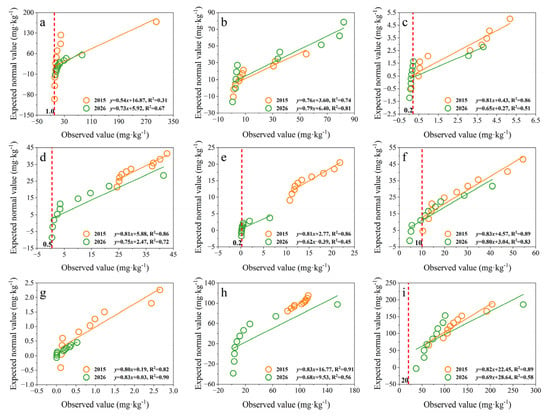
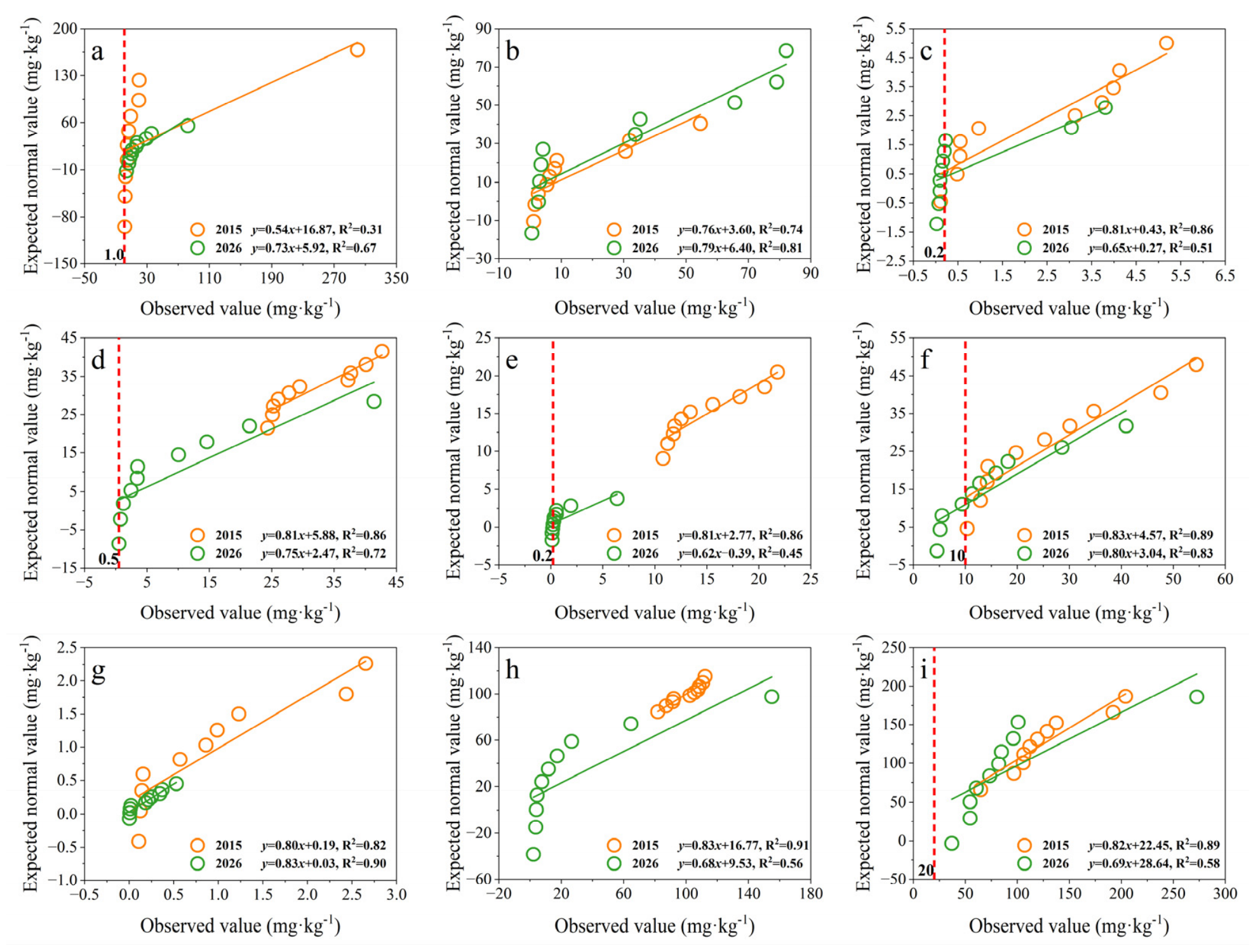
Between 2015 and 2026, heavy metal concentrations in crops surrounding the mining area exhibited pronounced temporal variation, with substantial differences in both the direction and magnitude of change among individual elements (Table 1, Figure 1). In 2015, the mean concentrations of Ni, Mo, Cd, Cr, Pb, Cu, Tl, V, and Zn in crops were 36.90, 15.01, 2.28, 31.56, 14.77, 26.34, 0.93, 99.88, and 126.61 mg·kg−1, respectively, indicating substantial multi-element accumulation. For Ni, Cd, Cr, Pb, Cu, and Zn, for which current food safety limits are available, the mean concentrations exceeded the corresponding limits to varying degrees, demonstrating pronounced heavy metal contamination in crops from farmland surrounding the mining area before remediation. In addition, heavy metal concentrations varied considerably among sampling sites, indicating marked spatial heterogeneity in crop accumulation under the long-term influence of mining activities. Because no current agricultural product safety limits are available for Mo, Tl, and V, these elements were evaluated primarily in terms of their temporal concentration changes rather than direct food safety exceedance.
Table 1.
Statistical summary of heavy metal concentrations in crops surrounding the abandoned Ni-Mo mining area before and after soil-covering remediation.
Figure 1.
Normal Q-Q plots of heavy metal concentrations in crops from farmland surrounding the abandoned Ni-Mo mining area before and after soil-covering remediation. (a–i) Normal Q-Q plots for Ni, Mo, Cd, Cr, Pb, Cu, Tl, V, and Zn, respectively. Different colored lines represent linear fits of the data for respective years.
The follow-up survey in 2026 showed that the concentrations of most heavy metals decreased relative to those in 2015, although the magnitude of the temporal response varied among elements. The mean concentration of Cd decreased from 2.282 to 0.785 mg·kg−1, Cr from 31.558 to 9.916 mg·kg−1, Pb from 14.768 to 1.047 mg·kg−1, Tl from 0.926 to 0.193 mg·kg−1, V from 99.880 to 29.656 mg·kg−1, and Zn from 126.605 to 91.530 mg·kg−1. Statistical analysis showed that the concentrations of Cr, Pb, Tl, and V differed significantly between the two sampling periods (p < 0.05), indicating clear long-term temporal changes in these elements. After remediation, the Cd, Cr, Pb, and Cu concentrations at 7, 1, 3, and 4 sampling sites, respectively, decreased to within the corresponding food safety limits, indicating an improvement in contamination status at these locations.
Compared with the above elements, Ni and Cu showed moderate declines, with mean concentrations decreasing from 36.90 and 26.34 mg·kg−1 to 21.90 and 15.21 mg·kg−1, respectively. In contrast, Mo exhibited an opposite temporal trend, with its mean concentration increasing from 15.01 to 30.95 mg·kg−1, and 7 of the 10 samples showing elevated concentrations. These results indicate that the heavy metal composition of crops underwent substantial restructuring over the approximately 10-year period and that individual elements did not respond synchronously. In particular, the contrasting increase in Mo demonstrates that changes in total heavy metal burden alone cannot fully characterize element-specific responses to long-term remediation. Therefore, subsequent assessments should integrate reduction magnitude, pollution indices, and health risk contributions to distinguish the remediation responses and environmental significance of individual elements.
3.2. Reduction Rate of Heavy Metals
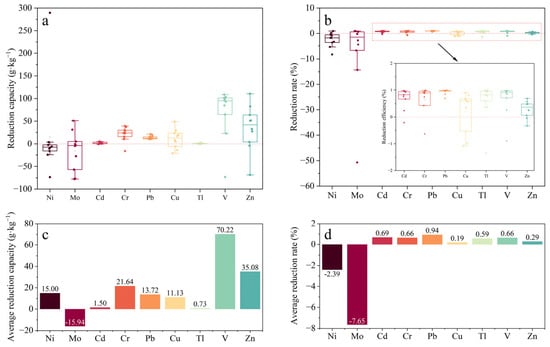
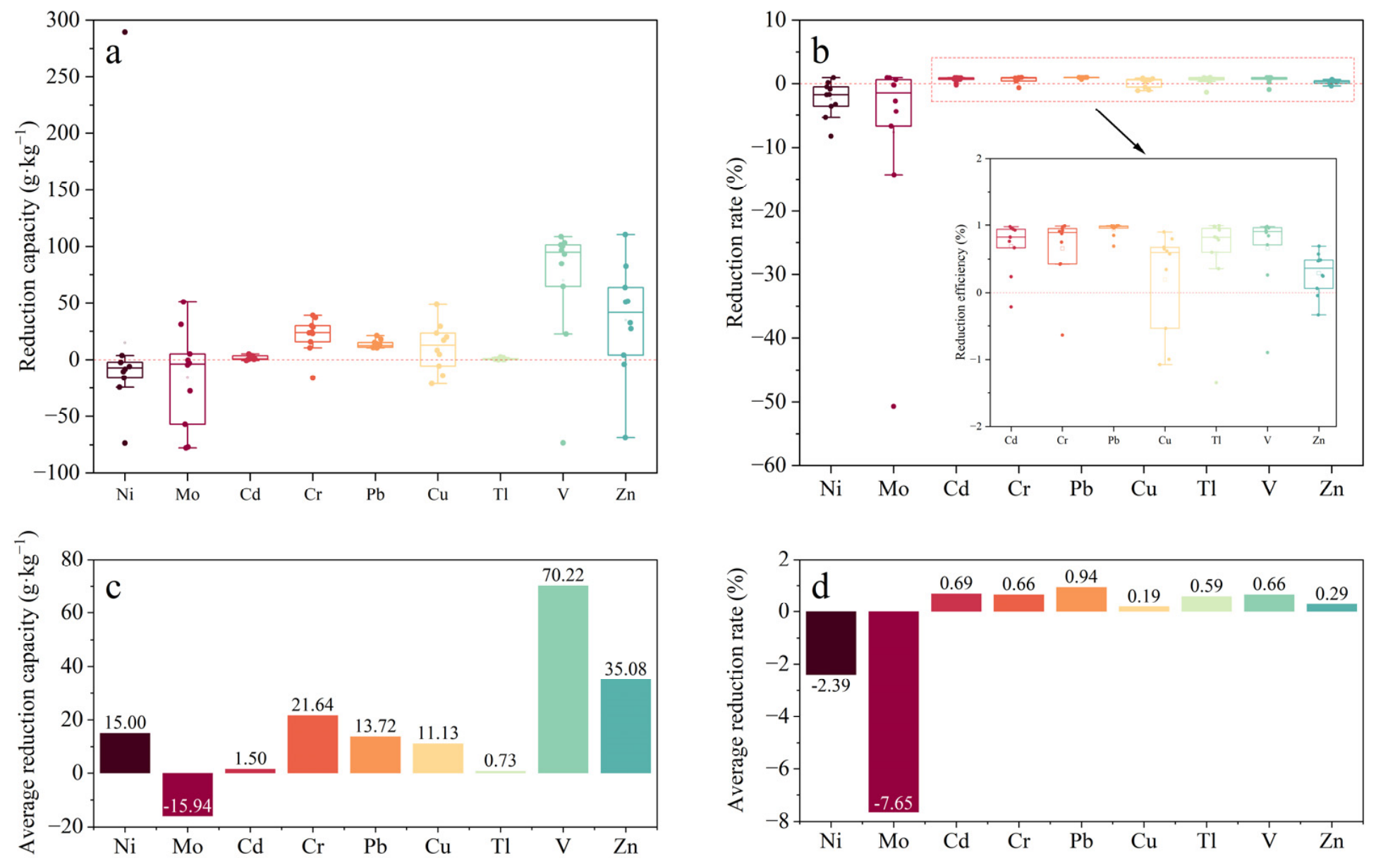
To further quantify the responses of individual heavy metals to long-term soil-covering remediation, the absolute changes in mean concentration and relative rates of change between 2015 and 2026 were used to evaluate the reduction rate (Figure 2). Clear differences were observed among elements. Pb exhibited the largest relative decrease, with its mean concentration declining by 13.72 mg·kg−1, corresponding to a reduction of 92.91%. Tl, V, Cr, and Cd decreased by 0.73, 70.22, 21.64, and 1.50 mg·kg−1, respectively, with corresponding reduction rates of 79.20%, 70.31%, 68.58%, and 65.59%. In comparison, Ni and Cu showed moderate responses, with reduction rates of 40.64% and 42.25%, respectively. Although Zn exhibited one of the largest absolute decreases, at 35.08 mg·kg−1, its relative reduction rate was only 27.70%, indicating that the absolute concentration decrease and relative remediation rate do not necessarily correspond directly. For elements with high initial concentrations, reliance solely on absolute decreases may overestimate the apparent remediation response, whereas relative change provides a more direct measure of the long-term reduction rate.
Figure 2.
Effects of soil-covering remediation on the reduction capacity and reduction rate of heavy metals in crops from farmland surrounding the abandoned Ni-Mo mining area. (a) Reduction capacity, with different colors indicating reduction amounts at different sampling points; (b) reduction rate, with different colors indicating reduction rates at different sampling points; (c) average reduction capacity; (d) average reduction rate.
Mo was the only element that showed a net increase, with its mean concentration increasing by 15.94 mg·kg−1, corresponding to a 106.16% increase, and most sampling sites showing the same direction of change. Based on the relative responses, Pb, Tl, V, Cr, and Cd exhibited high reduction efficiencies, whereas Ni, Cu, and Zn responded more moderately, and Mo followed a distinctly different trajectory. The marked divergence in reduction efficiencies demonstrates that the long-term effects of soil-covering remediation are strongly element-specific and cannot be adequately represented by changes in any single metal or by an overall mean response. These findings provide a quantitative basis for distinguishing highly responsive elements, residual accumulation elements, and anomalously increasing elements, and they also support the subsequent identification of major contaminants in the food safety assessment.
3.3. Improvement in Food Safety
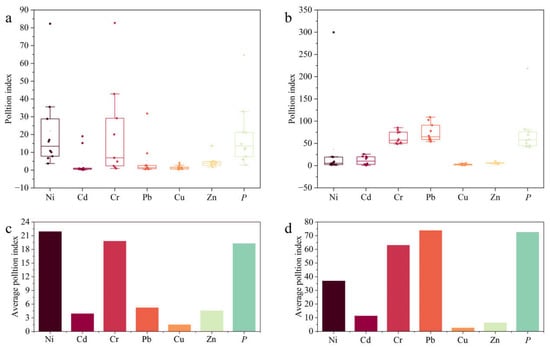
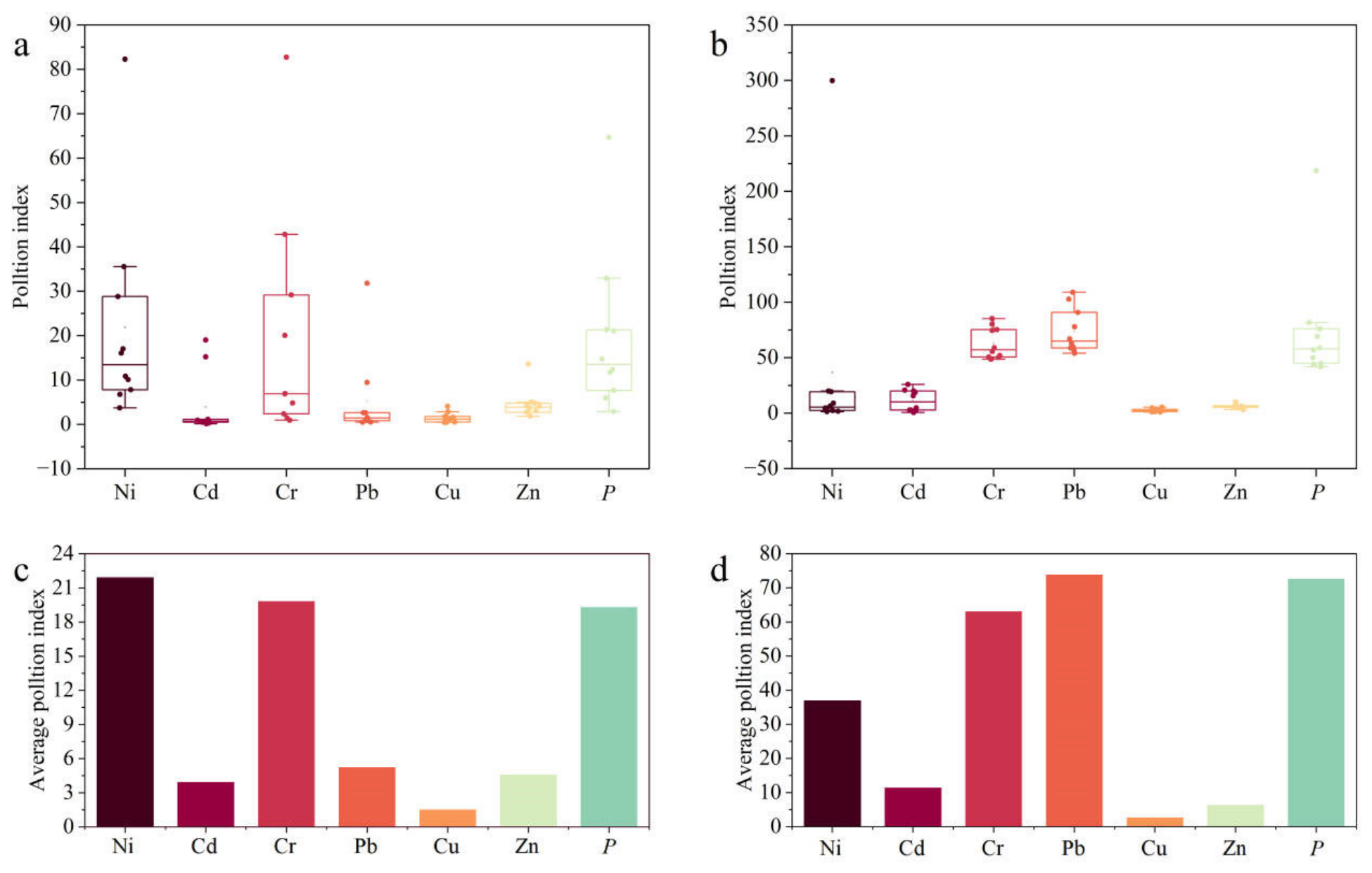
To determine whether temporal changes in heavy metal concentrations translated into improvements in agricultural product safety, the single-factor pollution index (Pᵢ) was used to evaluate the contamination status of individual elements (Figure 3a,b). In 2015, Ni, Cd, Cr, Pb, and Zn all exhibited relatively high pollution levels, with Pb showing the highest Pᵢ among all elements and some samples exceeding 100, indicating that Pb was one of the most prominent food contamination factors before remediation. In addition, substantial differences in Pᵢ values among sampling sites reflected pronounced spatial heterogeneity in agricultural product contamination around the mining area. By 2026, the Pᵢ values of most elements had shifted toward lower pollution levels, and the levels of some sampling sites that previously exceeded the relevant limits had fallen below the corresponding thresholds, indicating that long-term changes in heavy metal concentrations were also reflected in food safety classification. In particular, the mean Pᵢ of Cu decreased from 2.63 to 1.52, representing a reduction of approximately 42.2%, and its pollution category shifted from moderate to slight pollution. Nevertheless, some elements retained relatively high Pᵢ values after remediation, indicating that single-element contamination of agricultural products had not been completely resolved.
Figure 3.
Single-factor pollution indices and Nemerow comprehensive pollution indices of heavy metals in crops from farmland surrounding the abandoned Ni-Mo mining area before and after soil-covering remediation. (a) and (b) represent the single-factor pollution index and the Nemerow pollution index after and before remediation, respectively; (c) and (d) represent the mean values of the single-factor pollution index and the Nemerow pollution index after and before remediation, respectively. P denotes the Nemerow index.
The Nemerow comprehensive pollution index further characterized changes in food contamination under the combined influence of multiple elements (Figure 3c,d). In 2015, the comprehensive pollution index (P) showed a wide distribution among samples, with the maximum value exceeding 200 and the mean reaching 57.01, indicating substantial combined heavy metal contamination in crops before remediation. By 2026, P had decreased markedly, with the mean declining to 16.88, accompanied by reductions in both the number of high-value samples and the overall distribution level. These results indicate a substantial reduction in the combined multi-element contamination burden of crops. However, the decline in the comprehensive pollution index does not indicate that agricultural products have returned to a low-contamination state, as the post-remediation mean P still reflects considerable residual contamination in the study area.
3.4. Human Health Risk
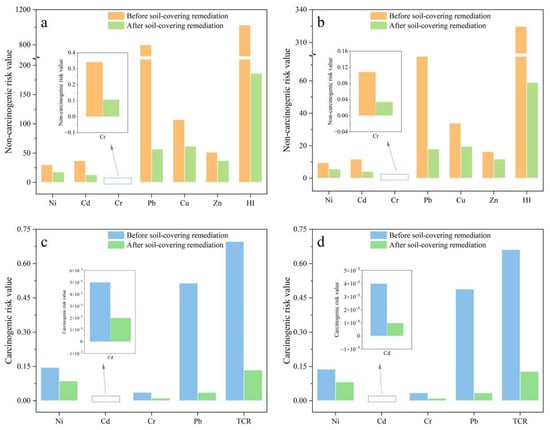
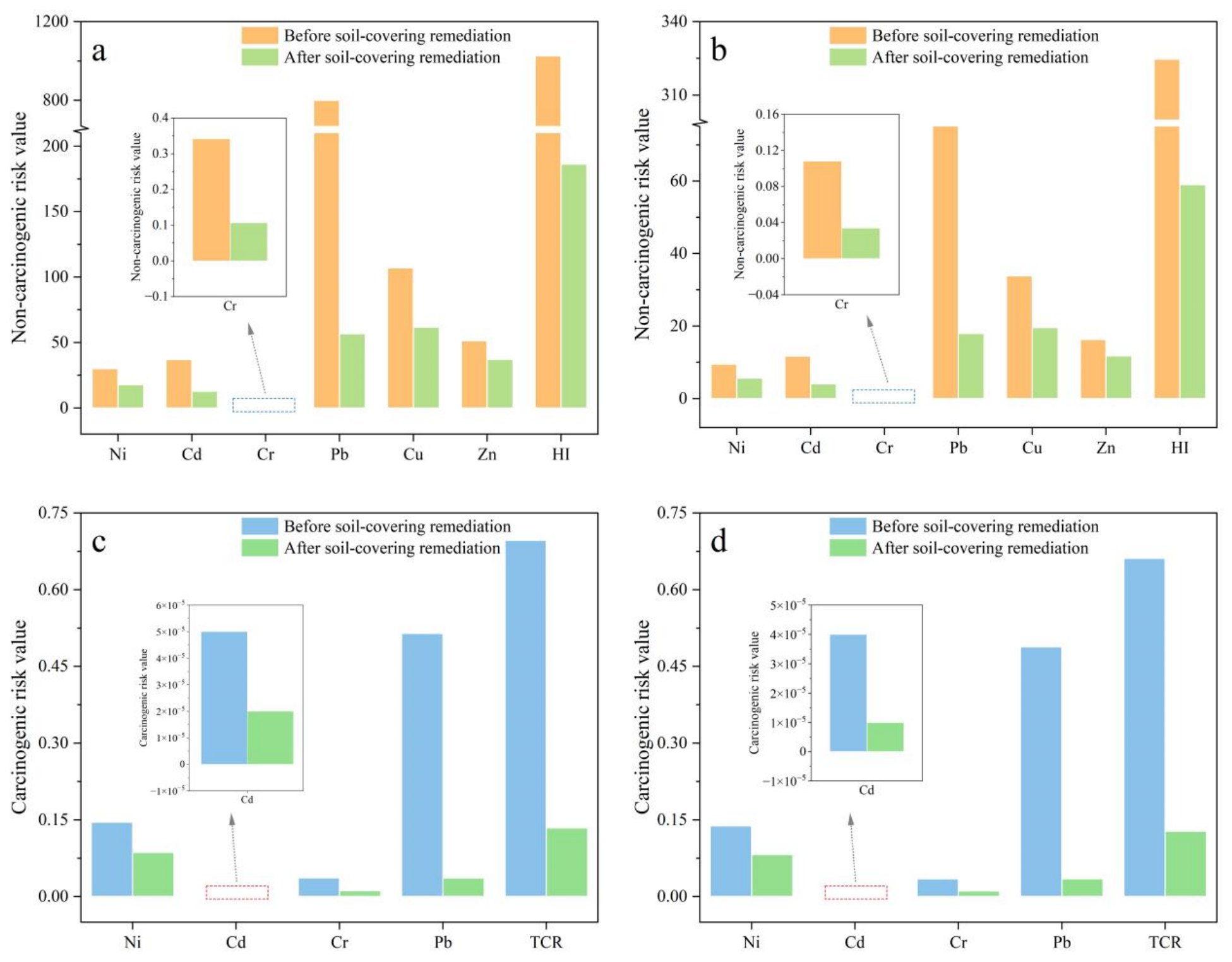
Based on the food contamination assessment, the non-carcinogenic health risks associated with dietary intake of heavy metals were further evaluated for children and adults (Figure 4a,b). In 2015, Pb and Cu were the major contributors to non-carcinogenic risk, while Zn, Cd, and Ni also contributed to the overall risk. After remediation, the target hazard quotient (THQ) values of all elements decreased, with Pb showing the most pronounced change. The THQ of Pb decreased from 799.93 to 56.71 for children and from 253.17 to 17.95 for adults. As a result of the cumulative effects of multiple elements, the hazard index (HI) decreased from 1025.78 to 186.33 for children and from 324.64 to 58.97 for adults, indicating a substantial reduction in overall non-carcinogenic risk through dietary exposure. Nevertheless, the post-remediation HI values for both population groups remained far above 1, indicating that, although the magnitude of risk was reduced, the risk itself remained substantial. Notably, the HI for children was approximately 3.2 times that for adults in both sampling periods, and this difference remained relatively stable before and after remediation. This indicates that children represent a more sensitive population group because of their higher exposure per unit body weight under comparable contamination conditions.
Figure 4.
Risk assessment of heavy metals in crops from farmland surrounding the abandoned Ni-Mo mining area before and after soil-covering remediation. (a) and (b) non-carcinogenic risk for children and adults, respectively; (c) and (d) carcinogenic risk for children and adults, respectively.
The carcinogenic risk assessment revealed a different pattern of elemental contributions from that observed for non-carcinogenic risk (Figure 4c,d). The individual carcinogenic risk associated with Cd remained within the acceptable range both before and after remediation, whereas the overall carcinogenic risk was mainly attributable to Ni, Cr, and Pb, with Ni and Pb making the largest contributions. The total carcinogenic risk (TCR) for children decreased from 0.70 in 2015 to 0.13 in 2026, while that for adults decreased from 0.66 to 0.13, corresponding to an overall reduction of approximately 80.70%. These results indicate that long-term remediation substantially reduced the magnitude of carcinogenic risk associated with dietary exposure. However, the post-remediation TCR remained well above the commonly accepted risk range, indicating that the observed reduction was insufficient to bring health risks to an acceptable level. Compared with pollution indices alone, the health risk assessment further demonstrates that the importance of an individual element is determined by not only its environmental concentration but also its toxicological parameters and exposure characteristics. Therefore, priority risk management targets should not be identified solely based on concentration rankings but should also account for the actual contributions of individual elements to overall non-carcinogenic and carcinogenic risks.
3.5. Monte Carlo-Based Probabilistic Risk Assessment
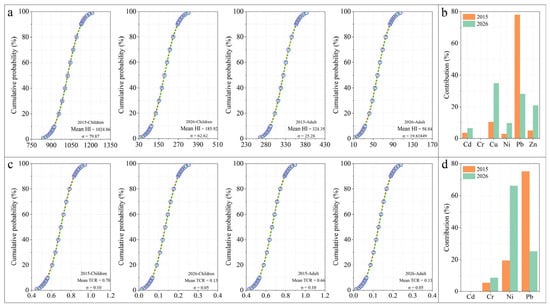
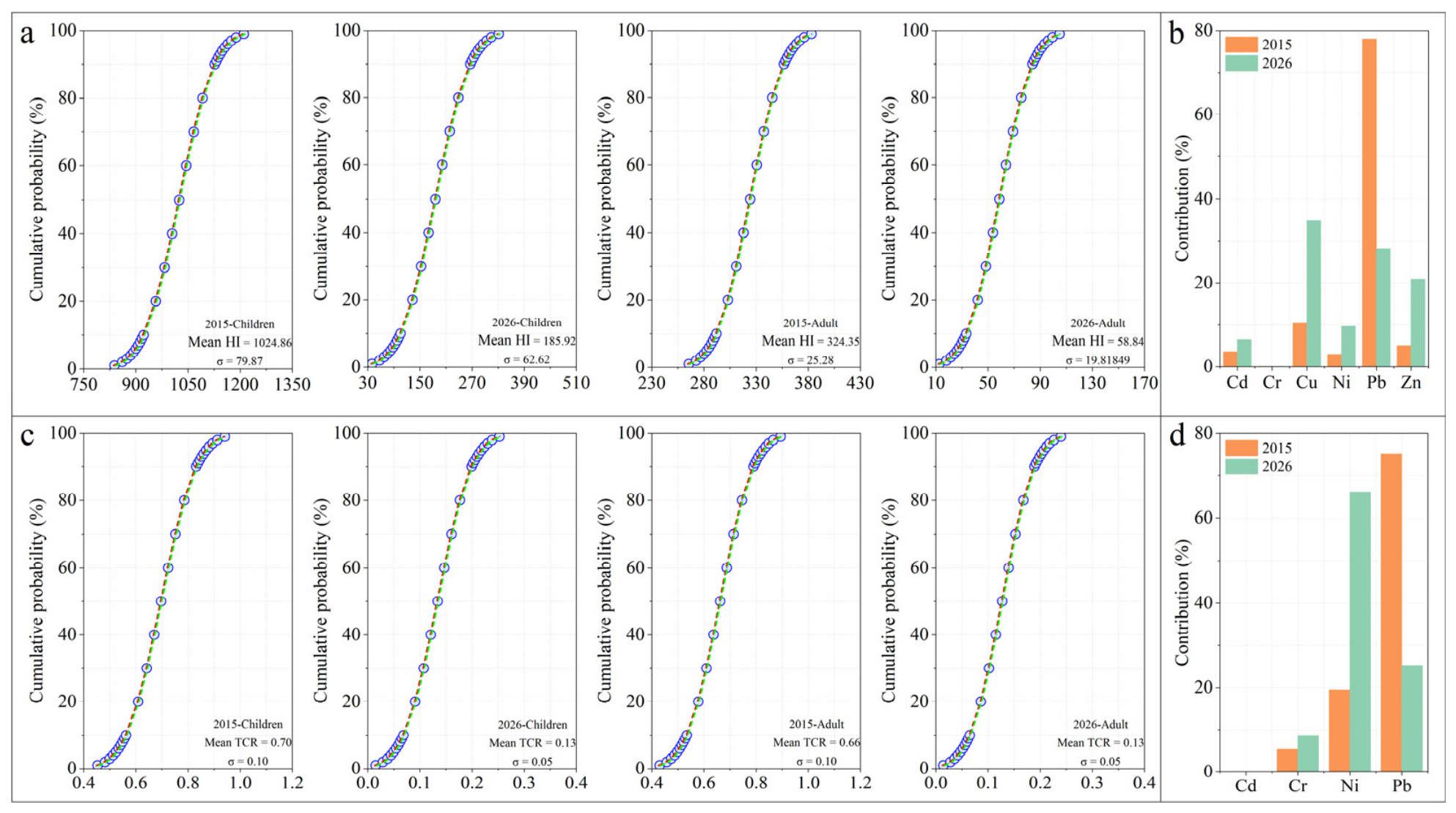
Building on the deterministic health risk assessment, Monte Carlo simulation was further used to characterize the probability distributions and stability of health risks arising from variation in measured crop metal concentrations (Figure 5). The cumulative probability distributions of non-carcinogenic risk showed an overall shift toward lower values for both children and adults between 2015 and 2026. The simulated mean HI for children decreased from 1024.86 to 185.92, while that for adults decreased from 324.35 to 58.84. Meanwhile, the corresponding standard deviations decreased from 79.87 to 62.62 for children and from 25.28 to 19.82 for adults, indicating reductions in both overall risk magnitude and dispersion after remediation. Nevertheless, the simulated HI distributions remained entirely above 1, demonstrating that the residual non-carcinogenic risk was not driven by a small number of extreme exposure scenarios but persisted across the simulated concentration distributions. More importantly, the contribution structure of non-carcinogenic risk changed substantially. In 2015, nearly 80% of the non-carcinogenic risk was attributable to Pb, indicating a highly concentrated risk profile. By 2026, the contribution of Pb had decreased to approximately 30%, whereas the relative contributions of Cu, Zn, and Ni increased to approximately 35%, 21%, and 10%, respectively, indicating a shift from single-element dominance to a multi-element risk structure.
Figure 5.
Monte Carlo simulation-based risk assessment. (a) Simulation of non-carcinogenic risk; (b) relative contributions of individual heavy metals to non-carcinogenic risk; (c) simulation of carcinogenic risk; and (d) relative contributions of individual heavy metals to carcinogenic risk.
A similar leftward shift was observed in the probability distributions of carcinogenic risk. The mean TCR decreased from 0.70 to 0.13 for children and from 0.66 to 0.13 for adults, while the standard deviation decreased from approximately 0.10 to 0.05. Despite this decline, the simulated TCR distributions remained consistently above the commonly accepted risk range. At the same time, the dominant contributor to carcinogenic risk shifted from Pb to Ni. The relative contribution of Pb decreased from approximately 75% to 25%, whereas that of Ni increased from approximately 19% to 66%, with the relative contribution of Cr also increasing. Thus, the principal value of the Monte Carlo analysis lies not merely in confirming the overall reduction in health risk but also in demonstrating that this reduction was robust across the simulated concentration distributions while also revealing a substantial shift in the sources of residual risk. Accordingly, post-remediation risk management should gradually move from prioritizing dominant contaminants such as Pb toward coordinated control of multiple residual high-contribution elements, particularly Ni, Cu, and Zn.
4. Discussion
4.1. Long-Term Effectiveness of Soil-Covering Remediation
Based on long-term comparative data from the same study area, this study found that, after approximately 10 years of soil-covering remediation, the accumulation levels of most heavy metals in crops surrounding the mining area, the degree of food contamination, and dietary exposure risks to local residents all showed consistent declining trends. These findings suggest that the effects of soil-covering remediation are not limited to physical isolation during the initial stage of treatment, but may persist over longer time scales by reducing the continuous input of contaminants from the mining area into adjacent agroecosystems [32]. Compared with pollution surveys conducted at a single time point, the long-term comparative design adopted in this study provides a more representative indication of the temporal trajectory of contamination pressure following remediation and highlights the need to evaluate restoration performance in abandoned mining areas over multi-year rather than short-term time scales. The fundamental function of soil covering is to reduce the direct exposure of mine wastes and contaminated surfaces to rainfall, runoff, and atmospheric processes, thereby limiting the continued migration of contaminants from abandoned mining areas into the surrounding environment [8]. In the study area, abandoned Ni-Mo mine wastes had been exposed to the natural environment for extended periods and were located in the upper reaches of Xiaozhu Creek. In the absence of effective barriers, the weathering and leaching of these materials could have represented persistent sources of contamination to the surrounding agricultural system. Therefore, the long-term decreases observed for most elements are temporally consistent with reduced source exposure and suppressed external contaminant inputs.
Nevertheless, the long-term effectiveness of remediation should not be interpreted as evidence that the agricultural ecosystem has returned to a safe condition. Mining-related contamination is characterized by pronounced historical accumulation, and even when external contaminant inputs are reduced, heavy metals previously introduced into farmland may persist in different chemical forms and retain a certain degree of bioavailability at the soil-crop interface. Accordingly, the observed decreases in crop contamination more likely reflect the combined effects of reduced ongoing inputs and gradual attenuation of legacy contamination rather than the complete removal of the pre-existing pollution burden. Several samples remained at relatively high contamination levels after remediation, and health risks had not declined to acceptable levels, further indicating a substantial time lag between engineering isolation and complete recovery of the agricultural ecosystem [33]. In particular, for abandoned mining areas with severe historical contamination, a one-time soil-covering intervention alone may be insufficient to achieve long-term risk elimination [34]. Therefore, evaluation of remediation performance should extend beyond determining whether contaminant concentrations have decreased and should also consider whether pollution sources remain stably controlled, whether farmland systems are progressively recovering, and whether residual risks continue to decline. Long-term continuous monitoring should therefore constitute an essential component of post-remediation effectiveness assessment.
4.2. Different Responses Among Heavy Metals
Pb, Cr, Cd, V, and Tl exhibited pronounced decreasing trends, whereas Ni, Cu, and Zn showed relatively moderate responses, and Mo displayed an increasing trend opposite to that of most other heavy metals. These contrasting responses indicate that soil-covering remediation does not necessarily induce synchronous reductions in all heavy metals at comparable rates. Instead, long-term remediation outcomes are jointly regulated by the composition of the contaminant source, element-specific geochemical behavior, bioavailability, and selective uptake by crops. Therefore, assessment of regional soil-covering remediation should not solely rely on comprehensive pollution indices but also consider the independent response patterns of individual heavy metals. Pb showed the largest decrease following remediation, accompanied by a marked reduction in its contribution to crop contamination and human health risk. This suggests that, for dominant contaminants before remediation, reducing continuous external inputs can directly lower crop exposure and associated health risks [35,36]. Cd also showed substantial improvement, which is particularly important from a food safety perspective because even relatively low levels of Cd accumulation may represent a critical limiting factor in agricultural product safety assessments [37]. In contrast, the smaller decreases observed for Ni, Cu, and Zn suggest that, once inputs of the dominant contaminants are effectively controlled, elements that initially contributed less to overall contamination or responded more slowly to environmental change may become increasingly important components of the residual post-remediation contamination profile.
The long-term increase in Mo further demonstrates that the responses of individual heavy metals following soil-covering remediation are more complex than a general pattern of overall contaminant decline. The mean Mo concentration increased in the study area, with most sampling sites showing a consistent upward trend; however, the available data are insufficient to establish a direct causal relationship between this increase and soil-covering remediation. The bioavailability of Mo in soil–plant systems is regulated by multiple environmental factors, and plants also exhibit element-specific uptake and utilization characteristics for Mo [38,39]. Therefore, long-term changes in Mo concentration may be influenced by the natural geochemical background of the mining area, changes in farmland environmental conditions, and crop uptake processes, making it difficult to infer causality from observations at only two time points. Importantly, unlike Pb, Cd, and Cr, Mo, Tl, and V currently lack clearly defined regulatory limits for agricultural products. Consequently, changes in their concentrations cannot be directly equated with changes in food safety risk. These findings indicate that long-term evaluation of soil-covering remediation in abandoned mining areas should expand from conventional monitoring of a limited number of priority contaminants toward a multi-element dynamic monitoring framework. Such an approach should assess not only reductions in dominant pre-remediation contaminants but also residual contamination and anomalously increasing elements after remediation, thereby avoiding the possibility that declines in integrated pollution indices obscure emerging changes in the elemental risk profile.
4.3. Improvement of Food Safety After Remediation
The significance of this study lies not only in demonstrating declining trends in heavy metal concentrations in crops but also in determining whether these changes translate into tangible health risk benefits along the pathway from contamination burden to food safety and ultimately human exposure. Following long-term remediation, both the single-factor pollution indices and the Nemerow comprehensive pollution index for heavy metals in crops decreased substantially, indicating that the environmental benefits of source control had extended to agricultural product quality. However, pollution indices and human health risks do not exhibit a simple linear relationship. Food contamination indices primarily reflect the extent to which elemental concentrations exceed regulatory limits, whereas human health risks are additionally influenced by reference doses, cancer slope factors, and exposure parameters specific to different population groups [40]. Therefore, even when different elements exhibit similar reductions in concentration, their contributions to overall health risk may differ substantially. This distinction was particularly evident for Pb and Ni. Before remediation, Pb was a major determinant of both food contamination and health risk, and its pronounced decline substantially reduced overall health risk. In contrast, as the contribution of Pb decreased, the relative importance of Ni in the post-remediation carcinogenic risk profile increased markedly. This indicates that remediation may involve not only a reduction in total risk magnitude but also a structural shift in the dominant contributors to risk.
The deterministic risk assessment and Monte Carlo simulation further support this interpretation from complementary perspectives. Both non-carcinogenic and carcinogenic risks for children and adults decreased substantially; however, the post-remediation hazard index (HI) and total carcinogenic risk (TCR) remained above their respective risk thresholds, demonstrating that risk reduction does not necessarily imply risk elimination. In particular, the Monte Carlo simulation showed that the post-remediation risk distributions shifted toward lower values and became less dispersed, yet elevated risks persisted across a broad probability range. This indicates that the residual risks were relatively robust and not driven solely by occasional extreme combinations of exposure parameters. Meanwhile, the non-carcinogenic risk profile shifted from a strong dominance of Pb before remediation to joint contributions from Pb, Cu, Zn, and Ni, whereas the principal contributor to carcinogenic risk shifted from Pb to Ni. This restructuring of the risk profile has important implications for regional environmental management. Once a dominant contaminant has been effectively reduced, elements that previously played secondary roles may become new priority targets because of their increased relative contributions to residual risk. Therefore, post-remediation agricultural product safety management should not continue to rely on the same single-element control strategy used before remediation but should dynamically adjust monitoring and management priorities according to the actual post-remediation risk contribution profile. The consistently higher non-carcinogenic risk observed for children also highlights the need to account for exposure heterogeneity among sensitive population groups when assessing agricultural production safety around mining areas [41].
4.4. Study Limitations and Future Perspectives
Although the long-term comparative data from the same study area provide useful field evidence, several limitations should be acknowledged. First, only two time points (2015 and 2026) were compared. The absence of continuous annual observations prevents the determination of whether changes were continuous, episodic, or subject to intermediate fluctuations; climatic conditions and agricultural practices may also have changed. Thus, the temporal differences should be interpreted as long-term changes observed in the context of soil-covering remediation, not as effects attributable exclusively to the remediation treatment [42,43]. Second, this study focused on edible crop portions and did not measure total and bioavailable metals in farmland soils or key soil properties at both time points, limiting the mechanistic interpretation of soil-to-crop transfer. Third, the probabilistic assessment varies measured crop metal concentrations with fixed ingestion rates, body weights, exposure durations, reference doses, and cancer slope factors. It therefore characterizes concentration-driven variability only and does not represent the full uncertainty or individual variability in dietary behavior and toxicological parameters. In addition, with 10 composite samples per year, the simulation results are conditional on a relatively small set of sampling sites and should not be interpreted as direct predictions of actual health outcomes in the local population [44].
Because the sampling sites were distributed within a relatively narrow distance range from the mining area, the present dataset was not designed to establish a robust distance-response relationship between the contamination source and crop metal accumulation. Future studies should establish a continuous monitoring framework linking pollution sources, cover materials, farmland soils, crops, and resident exposure and use multi-year and multi-media datasets to evaluate the long-term stability of soil-covering remediation. Simultaneous collection of mine waste or cover materials, farmland soils, and crops from the same sampling locations, together with measurements of total and bioavailable heavy metals and key soil physicochemical properties, would allow changes in soil-crop transfer processes following reductions in contaminant inputs to be identified more clearly [45]. Comparisons among different crop types, edible tissues, and distance gradients from the pollution source should also be incorporated to determine whether the observed patterns are representative of the broader agricultural system. Targeted monitoring and source apportionment are critical for the persistent increase in Mo and the increased relative contribution of Ni to post-remediation carcinogenic risk, in order to distinguish the potential influences of historical residues, natural geochemical background, and changes in the agricultural environment [46]. In addition, future health risk assessments should incorporate local dietary survey data and more representative exposure parameters to improve the realism of exposure scenarios. By integrating long-term contamination trends, elemental speciation, bioavailability, crop uptake, and probabilistic exposure risk, future research can go beyond determining whether remediation is effective and toward elucidating why it is effective, which risks persist, and which contaminants should be prioritized in subsequent management schemes. Such an integrated framework would provide a stronger scientific basis for the long-term recovery and risk management of agroecosystems surrounding abandoned mining areas.
5. Conclusions
In this study, edible leafy-vegetable samples collected from the same 10 sites in farmland surrounding an abandoned Ni–Mo mine in 2015 and 2026 were compared to assess long-term changes observed after soil-covering remediation. Most measured elements declined, and the overall crop contamination indices and estimated dietary health risks also showed substantial decreases. However, responses were element-specific: Mo increased, while residual contamination and estimated health risks remained concerning after the follow-up survey. These findings suggest that soil covering was associated with a marked long-term improvement in crop contamination conditions, but the available two-time-point observational design does not establish that remediation alone caused all observed changes. The results also show why overall indices should be interpreted alongside element-specific concentrations and risk contributions. Continued monitoring should take into account the mine waste, cover material, farmland soil, and edible crops; verify the stability and integrity of the cover; and prioritize residual risk contributors as well as the anomalous increase in Mo. Future studies should include repeated multi-year sampling, verified site coordinates, soil physicochemical and bioavailable metal measurements, and a probabilistic framework that explicitly distinguishes concentration variability from uncertainty in exposure and toxicity parameters.
Author Contributions
L.D.: writing—review and editing, writing—original, reviewed all drafts, investigation, and approved the final manuscript. F.L.: worked on the original draft, writing—review and editing, software and reviewed all drafts. X.W.: Conceptualization, methodology, and investigation. H.W.: Conceptualization, enhanced original draft. Y.H.: Conceptualization, analysis. All authors have read and agreed to the published version of the manuscript.
Funding
This work was financially supported by the Doctoral Research Fund of Guiyang Kangyang University (No. K2026-006); the Mountain Wellness Research Group of Guiyang Kangyang University (TD2025-0001); and the Doctoral Research Fund of Guiyang Kangyang University (No. K2022-02).
Institutional Review Board Statement
Not applicable.
Informed Consent Statement
Not applicable.
Data Availability Statement
The original contributions presented in this study are included in the article. Further inquiries can be directed to the corresponding author.
Acknowledgments
During the preparation of this manuscript, the author(s) used ChatGPT 6.1 and Grammerly (1.2.212.1789) for the purposes of grammar checking. The authors have reviewed and edited the output and take full responsibility for the content of this publication.
Conflicts of Interest
The authors declare no conflicts of interest.
References
- Doumas, P.; Munoz, M.; Banni, M.; Becerra, S.; Bruneel, O.; Casiot, C.; Cleyet-Marel, J.-C.; Gardon, J.; Noack, Y.; Sappin-Didier, V. Polymetallic pollution from abandoned mines in Mediterranean regions: A multidisciplinary approach to environmental risks. Reg. Environ. Change 2018, 18, 677–692. [Google Scholar] [CrossRef] [Scilit]
- Zhang, M.; Cheng, L.; Yue, Z.; Peng, L.; Xiao, L. Assessment of heavy metal(oid) pollution and related health risks in agricultural soils surrounding a coal gangue dump from an abandoned coal mine in Chongqing, Southwest China. Sci. Rep. 2024, 14, 18667. [Google Scholar] [CrossRef] [Scilit]
- Ioniță, M.F. From Phytoremediation to Safe Land Reuse: A PRISMA-ScR Review and Decision-Support Framework for Non-Food Crops on Metal-Contaminated Mining Soils. Agronomy 2026, 16, 1346. [Google Scholar] [CrossRef] [Scilit]
- Jahromi, M.A.; Jamshidi-Zanjani, A.; Darban, A.K. Heavy metal pollution and human health risk assessment for exposure to surface soil of mining area: A comprehensive study. Environ. Earth Sci. 2020, 79, 365. [Google Scholar] [CrossRef] [Scilit]
- Zhang, Q.; Yu, R.; Fu, S.; Wu, Z.; Chen, H.Y.H.; Liu, H. Spatial heterogeneity of heavy metal contamination in soils and plants in Hefei, China. Sci. Rep. 2019, 9, 1049. [Google Scholar] [CrossRef] [Scilit]
- Tibbett, M. Post-mining ecosystem reconstruction. Curr. Biol. 2024, 34, R387–R393. [Google Scholar] [CrossRef] [Scilit]
- Willscher, S.; Schaum, M.; Goldammer, J.; Franke, M.; Kuehn, D.; Ihling, H.; Schaarschmidt, T. Environmental biogeochemical characterization of a lignite coal spoil and overburden site in Central Germany. Hydrometallurgy 2017, 173, 170–177. [Google Scholar] [CrossRef] [Scilit]
- Karaca, O.; Cameselle, C.; Reddy, K.R. Mine tailing disposal sites: Contamination problems, remedial options and phytocaps for sustainable remediation. Rev. Environ. Sci. Bio/Technol. 2018, 17, 205–228. [Google Scholar] [CrossRef] [Scilit]
- Ceacero-Moreno, M.; Álvarez-Rogel, J.; González-Alcaraz, M.N. Soil chemical and functional indicators reveal limitations of restoration measures in abandoned metal mine soils of SE Spain: Implications for ongoing and future management. Environ. Geochem. Health 2026, 48, 477. [Google Scholar] [CrossRef] [Scilit]
- Ha, N.T.H.; Hieu, D.T.; Hai, N.T.; Nhung, T.K.; Anh, B.T.K.; Nga, T.T.H.; Kim, K.-W. A review and meta-analysis on heavy metals in soils and crops at metal mines: Accumulation, source, food safety, health risk, and management. J. Hazard. Mater. Adv. 2026, 23, 101173. [Google Scholar] [CrossRef] [Scilit]
- Jiang, F.; Ren, B.; Hursthouse, A.; Deng, R. Evaluating health risk indicators for PTE exposure in the food chain: Evidence from a thallium mine area. Environ. Sci. Pollut. Res. 2020, 27, 23686–23694. [Google Scholar] [CrossRef] [Scilit]
- Xiang, M.T.; Li, Y.; Yang, J.Y.; Lei, K.G.; Li, Y.; Li, F.; Zheng, D.F.; Fang, X.Q.; Cao, Y. Heavy metal contamination risk assessment and correlation analysis of heavy metal contents in soil and crops. Environ. Pollut. 2021, 278, 116911. [Google Scholar] [CrossRef] [Scilit]
- Mai, X.; Tang, J.; Tang, J.X.; Zhu, X.; Yang, Z.; Liu, X.; Zhuang, X.; Feng, G.; Tang, L. Research progress on the environmental risk assessment and remediation technologies of heavy metal pollution in agricultural soil. J. Environ. Sci. 2025, 149, 1–20. [Google Scholar] [CrossRef] [Scilit]
- Zhong, A.; Wang, Z.; Zhang, Z.; Hu, C. Remote sensing monitoring of ecological environment quality in mining areas under the perspective of ecological engineering. Environ. Earth Sci. 2024, 83, 587. [Google Scholar] [CrossRef] [Scilit]
- Zheng, P.; Tang, S.; Dai, J.; Guo, C.; Zhou, Y.; Mi, M.; Liu, H.; Tian, F. Evaluating ecological restoration outcomes in historical mine sites: Landscape connectivity and ecosystem service changes in the Xiang River Basin, China. Ecol. Model. 2025, 509, 111273. [Google Scholar] [CrossRef] [Scilit]
- Dey, M.; Akter, A.; Islam, S.; Dey, S.C.; Choudhury, T.R.; Fatema, K.J.; Begum, B.A. Assessment of contamination level, pollution risk and source apportionment of heavy metals in the Halda River water, Bangladesh. Heliyon 2021, 7, e08625. [Google Scholar] [CrossRef] [Scilit]
- Banerjee, S.; Ghosh, S.; Jha, S.; Kumar, S.; Mondal, G.; Sarkar, D.; Datta, R.; Mukherjee, A.; Bhattacharyya, P. Assessing pollution and health risks from chromite mine tailings contaminated soils in India by employing synergistic statistical approaches. Sci. Total Environ. 2023, 880, 163228. [Google Scholar] [CrossRef] [Scilit]
- Li, Y.; Zhang, B.; Liu, Z.; Wang, S.; Yao, J.; Borthwick, A.G.L. Vanadium contamination and associated health risk of farmland soil near smelters throughout China. Environ. Pollut. 2020, 263, 114540. [Google Scholar] [CrossRef] [Scilit]
- Hui, W.; Hao, Z.; Hongyan, T.; Jiawei, W.; Anna, L. Heavy metal pollution characteristics and health risk evaluation of soil around a tungsten-molybdenum mine in Luoyang, China. Environ. Earth Sci. 2021, 80, 293. [Google Scholar] [CrossRef] [Scilit]
- Song, Z.; Song, G.; Tang, W.; Yan, D.; Zhao, Y.; Zhu, Y.; Wang, J.; Ma, Y. Molybdenum contamination dispersion from mining site to a reservoir. Ecotoxicol. Environ. Saf. 2021, 208, 111631. [Google Scholar] [CrossRef] [Scilit]
- Charvalas, G.; Molla, A.; Lolas, A.; Skoufogianni, E.; Papadopoulos, S.; Chatzikirou, E.; Emmanouil, C.; Christopoulou, O. Evaluation of Potential Toxic Elements in Soils from Three Urban Areas Surrounding a Steel Industrial Zone. Toxics 2025, 13, 351. [Google Scholar] [CrossRef] [Scilit]
- Liu, Y.; Yang, Y.; Li, C.; Ni, X.; Ma, W.; Wei, H. Assessing Soil Metal Levels in an Industrial Environment of Northwestern China and the Phytoremediation Potential of Its Native Plants. Sustainability 2018, 10, 2686. [Google Scholar] [CrossRef] [Scilit]
- Ding, X.; Ye, S.; Laws, E.A.; Mozdzer, T.J.; Yuan, H.; Zhao, G.; Yang, S.; He, L.; Wang, J. The concentration distribution and pollution assessment of heavy metals in surface sediments of the Bohai Bay, China. Mar. Pollut. Bull. 2019, 149, 110497. [Google Scholar] [CrossRef] [Scilit]
- Song, T.; An, Y.; Cui, G.; Tong, S.; He, J. Bioconcentrations and health risk assessment of heavy metals in crops in the Naoli River Basin agricultural area, Sanjiang Plain, China. Environ. Earth Sci. 2021, 80, 452. [Google Scholar] [CrossRef] [Scilit]
- Chao, J.; Zhu, Z.; Meng, W.; Luo, X.; Wang, C.; Li, J.; Liao, K. Assessment of radionuclide levels, annual effective dose, and lifetime cancer risk from cultivated crop samples in Hainan Island, China. Front. Public Health 2026, 14, 1863848. [Google Scholar] [CrossRef] [Scilit]
- Shen, C.; Huang, S.; Wang, M.; Wu, J.; Su, J.; Lin, K.; Chen, X.; He, T.; Li, Y.; Sha, C.; et al. Source-oriented health risk assessment and priority control factor analysis of heavy metals in urban soil of Shanghai. J. Hazard. Mater. 2024, 480, 135859. [Google Scholar] [CrossRef] [Scilit]
- Wei, R.; Wang, X.; Tang, W.; Yang, Y.; Gao, Y.; Zhong, H.; Yang, L. Bioaccumulations and potential human health risks assessment of heavy metals in ppk-expressing transgenic rice. Sci. Total Environ. 2020, 710, 136496. [Google Scholar] [CrossRef] [Scilit]
- Zang, F.; Wang, S.; Nan, Z.; Ma, J.; Zhang, Q.; Chen, Y.; Li, Y. Accumulation, spatio-temporal distribution, and risk assessment of heavy metals in the soil-corn system around a polymetallic mining area from the Loess Plateau, northwest China. Geoderma 2017, 305, 188–196. [Google Scholar] [CrossRef] [Scilit]
- Zheng, S.; Wang, Q.; Yuan, Y.; Sun, W. Human health risk assessment of heavy metals in soil and food crops in the Pearl River Delta urban agglomeration of China. Food Chem. 2020, 316, 126213. [Google Scholar] [CrossRef] [Scilit]
- Huang, Y.; Li, Z. Deriving exposure route-specific cancer slope factors of carcinogenic chemicals via PBK modeling. Environ. Int. 2025, 199, 109483. [Google Scholar] [CrossRef] [Scilit]
- Clewell, R.A.; Thompson, C.M.; Clewell, H.J. Dose-dependence of chemical carcinogenicity: Biological mechanisms for thresholds and implications for risk assessment. Chem.-Biol. Interact. 2019, 301, 112–127. [Google Scholar] [CrossRef] [Scilit]
- Yu, J.; Liu, J.; Wang, J.; Li, Z.; Zhang, X. Spatial-temporal variation of heavy metal elements content in covering soil of reclamation area in fushun coal mine. Chin. Geogr. Sci. 2002, 12, 268–272. [Google Scholar] [CrossRef] [Scilit]
- Muchkina, E.Y.; Badmaeva, S.E.; Korotchenko, I.S.; Gorlushkina, K.S.; Myчкинa, E.Я.; Бaдмaeвa, C.Э.; Kopoтчeнкo, И.C.; Гopлyшкинa, K.C. Assessment of Heavy Metals Distribution in Soil Cover of Industry-Urban Area of Krasnoyarsk. Ecol. Ind. Russ. 2020, 24, 66–71. [Google Scholar] [CrossRef] [Scilit]
- Li, S.; Liu, C.; Chen, J.; Wang, S. Karst ecosystem and environment: Characteristics, evolution processes, and sustainable development. Agric. Ecosyst. Environ. 2021, 306, 107173. [Google Scholar] [CrossRef] [Scilit]
- Kan, X.; Dong, Y.; Feng, L.; Zhou, M.; Hou, H. Contamination and health risk assessment of heavy metals in China’s lead–zinc mine tailings: A meta–analysis. Chemosphere 2021, 267, 128909. [Google Scholar] [CrossRef] [Scilit]
- Shi, J.; Du, P.; Luo, H.; Chen, J.; Zhang, Y.; Wu, M.; Xu, G. Characteristics and Risk Assessment of Soil Polluted by Lead around Various Metal Mines in China. Int. J. Environ. Res. Public Health 2021, 18, 4598. [Google Scholar] [CrossRef] [Scilit]
- Wang, P.; Chen, H.; Kopittke, P.M.; Zhao, F. Cadmium contamination in agricultural soils of China and the impact on food safety. Environ. Pollut. 2019, 249, 1038–1048. [Google Scholar] [CrossRef] [Scilit]
- Naito, T.; Sachuronggui, U.M.; Maeda, I. Light-enhanced bioaccumulation of molybdenum by nitrogen-deprived recombinant anoxygenic photosynthetic bacterium Rhodopseudomonas palustris. Biosci. Biotechnol. Biochem. 2016, 80, 407–413. [Google Scholar] [CrossRef] [Scilit]
- Rana, M.; Sankhyan, N.K.; Thakur, P.; Babal, B.; Anjali; Sharma, S.; Kumari, S.; Kumar, P. Molybdenum in soil-plant system: Bioavailability, dynamics and implications for sustainable crop production. Discov. Soil 2025, 2, 89. [Google Scholar] [CrossRef] [Scilit]
- Yuan, X.; Xue, N.; Han, Z. A meta-analysis of heavy metals pollution in farmland and urban soils in China over the past 20 years. J. Environ. Sci. 2021, 101, 217–226. [Google Scholar] [CrossRef] [Scilit]
- Cai, L.; Wang, Q.; Luo, J.; Chen, L.; Zhu, R.; Wang, S.; Tang, C. Heavy metal contamination and health risk assessment for children near a large Cu-smelter in central China. Sci. Total Environ. 2019, 650, 725–733. [Google Scholar] [CrossRef] [Scilit]
- Belarmino, E.; Cabral, H.; Garcia, A.M. Long-term trends in the functional structure of estuarine fish assemblages in a subtropical estuary and its relationships with local environmental variability, man-made changes, and climatic drivers. Mar. Environ. Res. 2024, 201, 106698. [Google Scholar] [CrossRef] [Scilit]
- Jin, K.; Wu, Y.; Wang, F.; Li, C.; Zong, Q.; Liu, C. Assessment of climatic and anthropogenic influences on vegetation dynamics in China: A consideration of climate time-lag and cumulative effects. Int. J. Biometeorol. 2025, 69, 77–91, Correction in Int. J. Biometeorol. 2025, 69, 93. https://doi.org/10.1007/s00484-024-02803-5. [Google Scholar] [CrossRef] [Scilit]
- Ma, W.; Wang, Q.; Mak-Mensah, E.; Zhao, X.; Qi, W.; Zhu, J.; Azim, R.; Zhou, X.; Zhang, D.; Liu, B.; et al. Ecological risk assessment of emerging contaminants on soil and terrestrial ecosystems (2005–2024): A bibliometric and scientometric review. Environ. Geochem. Health 2025, 47, 179. [Google Scholar] [CrossRef] [Scilit]
- Guo, C.; Dou, Y.; Kuang, W.; Xiao, L.; Bao, W. Monitoring vegetation restoration on potentially contaminated mining land using a novel multi-source data fusion method. Geo-Spat. Inf. Sci. 2026, 1–20. [Google Scholar] [CrossRef] [Scilit]
- Chen, Z.; Zhao, Y.; Chen, D.; Huang, H.; Zhao, Y.; Wu, Y. Ecological risk assessment and early warning of heavy metal cumulation in the soils near the Luanchuan molybdenum polymetallic mine concentration area, Henan Province, central China. China Geol. 2023, 6, 15–26. [Google Scholar] [CrossRef] [Scilit]

Disclaimer/Publisher’s Note: The statements, opinions and data contained in all publications are solely those of the individual author(s) and contributor(s) and not of MDPI and/or the editor(s). MDPI and/or the editor(s) disclaim responsibility for any injury to people or property resulting from any ideas, methods, instructions or products referred to in the content. |
© 2026 by the authors. Licensee MDPI, Basel, Switzerland. This article is an open access article distributed under the terms and conditions of the Creative Commons Attribution (CC BY) license.