


Abstract
Background: The development of international transport corridors and growing freight flows require decision-support tools that jointly consider transport infrastructure, economic performance, and risks. This study develops a simulation-based decision-support system for strategic development of multimodal transport logistics in Kazakhstan. Methods: The system is based on an agent-based model representing producers, consumers, logistics centers, border checkpoints, container terminals, transport hubs, road and rail vehicles, and freight orders. AnyLogic simulation, geospatial transport-network data, optimization mechanisms, economic assessment, and risk-oriented indicators are integrated within a unified environment. Results: The model enables assessment of freight flows, transportation costs, infrastructure performance, profitability, integrated risk, and system resilience. Scenario experiments representing border modernization, rail corridor development, multimodal hub expansion, digital logistics, and integrated modernization demonstrate how infrastructure and operational changes affect transport, economic, and risk-related indicators. The integrated framework supports identification of bottlenecks and comparison of alternative development strategies under common model assumptions. Conclusions: The proposed system provides a unified simulation environment for scenario-based evaluation of Kazakhstan’s multimodal transport logistics development. It supports comparative assessment of infrastructure and operational interventions and provides quantitative information for strategic transport planning.
1. Introduction
1.1. Motivation
The rapid development of international transport corridors, the increasing volume of freight transportation, the ongoing processes of digital transformation and the growing uncertainty of the external environment have significantly increased the complexity of managing modern transport and logistics systems. National transport systems currently operate under conditions of highly dynamic demand, limited infrastructure resources, the need to integrate multiple modes of transport and the influence of economic, geopolitical, and technological factors. Consequently, traditional approaches to transport infrastructure planning and management are no longer sufficient to support strategic decision-making for the development and reform of transport and logistics systems.
The Republic of Kazakhstan occupies a strategically important position within the Eurasian transport system, serving as a key transit hub for international transport corridors connecting Europe, Asia and the Middle East. The implementation of initiatives aimed at developing the Trans-Caspian International Transport Route, international logistics corridors and multimodal transport networks has significantly increased the requirements for the efficient management of transport infrastructure, border crossing points, logistics centers and freight flows. Under these conditions, the development of decision-support tools capable of accounting for the interrelationships among transport, infrastructure, economic and risk-oriented factors has become particularly important.
1.2. Related Work and Problem Statement
Contemporary research in the field of multimodal transport logistics has evolved along several interrelated directions, including simulation and agent-based modeling of freight flows, multimodal route optimization, digital twins of transport and logistics systems, transport network resilience analysis, risk management and the development of decision-support systems. For example, Lu et al. [1] proposed an agent-based freight transport model for Germany that accounts for the spatial structure of the transport network; however, the study primarily focuses on generating national freight transport data from open-source datasets without integrating economic indicators. In the studies by Alaei Jordehi et al. [2] and Durán Micco et al. [3], agent-based modeling is applied to the analysis and replanning of synchromodal transportation, although the proposed models are primarily oriented toward the operational level of management. Zhang et al. [4] conducted a comprehensive review of synchromodal transport planning methods, confirming that routing and transport operation optimization remain the dominant research directions. Rentschler et al. [5] demonstrated the advantages of synchromodal transportation for enhancing the resilience of transport systems; however, the integration of transport, economic and risk-oriented factors into a unified decision-support system remains insufficiently explored.
Considerable attention in contemporary research has been devoted to the development of digital twins for transport and logistics systems. In the study by Le and Fan [6], a comprehensive review of digital twins in logistics and supply chains was conducted, and a conceptual architecture for their application was proposed. However, the integration of digital twins with simulation modeling and strategic decision-support systems was addressed only to a limited extent. Guo et al. [7] investigated the application of digital twins to improve supply chain management efficiency, demonstrating their potential for optimizing logistics processes. Liu et al. [8] conducted a systematic review of the capabilities of digital twins to enhance supply chain resilience, confirming the promise of this approach for risk management. Zhang et al. [9] proposed a digital twin architecture for supply chains based on a simplified Supply Chain Operations Reference (SCOR) model. Nevertheless, the study primarily focused on the conceptual design of the system without providing detailed modeling of transport infrastructure or an economic assessment of the proposed decision-making solutions.
A separate line of research is associated with the application of digital twin technologies to the management of transport and logistics systems. In the study by Klar et al. [10], an approach to the development of digital twins for port infrastructure was proposed based on the concepts of smart cities and supply chains; however, the modeling of multimodal transportation was addressed only to a limited extent. Nag et al. [11] presented a comprehensive review of the application of digital twins in transport planning, demonstrating their potential to support strategic decision-making. Li et al. [12] examined the use of digital twins for risk management in cross-border logistics systems, while Li et al. [13] analyzed contemporary approaches to the intelligent management of logistics systems based on digital twin technologies. Nevertheless, most existing studies in this area remain conceptual in nature and do not provide comprehensive integration of simulation modeling, economic analysis, risk assessment and scenario-based planning for transport infrastructure development.
In recent years, research on the integration of digital twins, simulation modeling, and optimization methods in transport and logistics systems has developed rapidly. Xu et al. [14] proposed an approach to the autonomous optimization of urban logistics based on agent-driven digital twins, while Zhang et al. [15] developed a digital twin architecture for supply chains to support modeling and forecasting tasks. Nevertheless, these solutions are primarily focused on specific application domains and do not address the strategic development of transport infrastructure. In the review by Archetti et al. [16], optimization methods for multimodal transportation were systematically analyzed, while Ferjani et al. [17] and Taran et al. [18] proposed approaches to the optimization of synchromodal and multimodal routes. However, the presented models substantially simplify the structure of the transport network and provide only limited consideration of the dynamic interactions among transport, infrastructure, economic, and risk-oriented factors.
An important research direction is the analysis of resilience and risks in multimodal transport systems. Layeb et al. [19] proposed an approach to timetable optimization in stochastic multimodal transport systems that accounts for the effects of uncertainty on transportation processes. Pang et al. [20] investigated the resilience of multimodal logistics networks using robust optimization methods, demonstrating the significant impact of disruptions on the efficiency of transport operations. Liao et al. [21] examined approaches to enhancing the resilience of multimodal logistics under external disturbances and post-crisis constraints, while Patnala et al. [22] presented a comprehensive review of methods for assessing the resilience of freight transport systems to various types of disruptions. Nevertheless, in these and most other studies, risks are treated primarily as a separate component of transport models rather than being integrated with economic efficiency, investment decision-making, and the strategic development of transport infrastructure.
For the transport system of the Republic of Kazakhstan, research related to the sustainable development of transport corridors, the digital transformation of logistics, the enhancement of transport infrastructure resilience and the modernization of multimodal transportation is of particular importance. Tavasszy et al. [23] presented a comprehensive review of approaches to modeling the transformation of freight transport systems under conditions of long-term change and the decarbonization of the transport sector. Kurniawan et al. [24] analyzed contemporary approaches to the development of sustainable multimodal logistics systems and global supply chains. Chung et al. [25] investigated the resilience of strategic transport infrastructure to various disruption scenarios and external disturbances in the context of military logistics.
Along with the development of modeling and optimization methods, the practical readiness of transport organizations for the adoption of advanced computational technologies represents an important consideration. Based on an expert study, Tatarczak et al. [26] identify a set of interrelated barriers to AI adoption in transport and logistics, including data quality and integration problems, infrastructure and financial constraints, insufficient competencies, managerial and organizational factors, as well as safety and regulatory concerns. Their findings demonstrate that the successful adoption of intelligent solutions depends not only on their technical capabilities but also on the organizational and information readiness of transport systems. Özkan Özen et al. [27] further specify this problem for smart logistics, identifying integration with existing information systems, infrastructure adaptation, and transparency and security issues among the key barriers to machine-learning adoption.
Del Ser et al. [28], in turn, systematize the potential of bioinspired computational intelligence for routing, traffic forecasting, and other intelligent transportation system applications, while highlighting the remaining gap between advances in adaptive and self-learning computational methods and their practical deployment in transportation systems. This emphasizes the need to consider optimization and decision-support methods not in isolation, but in relation to data availability, computational infrastructure, and their integration into real transport processes.
Thus, the conducted review demonstrates that current research covers a broad range of approaches to modeling and managing multimodal transport systems. Agent-based models reproduce decentralized interactions among transport actors and the dynamics of freight flows; digital-twin approaches support the integration of spatial and operational data; synchromodal planning and optimization methods focus on mode selection, routing, and freight-flow allocation; risk-oriented and resilience approaches assess disruptions and transport-network robustness; and decision-support systems enable the comparative evaluation of alternative transport and infrastructure-development solutions. However, the review reveals a methodological gap between these research directions: transport and infrastructure processes, the economic consequences of decisions, and dynamically emerging risks are predominantly addressed in separate models or treated as individual optimization criteria rather than as interrelated outcomes generated within a common simulation environment.
In our previous study [29], an agent-based simulation model of multimodal transport flows in the Republic of Kazakhstan was developed to represent the interaction of different transport modes, transport nodes, and logistics infrastructure within a common geospatial environment. In [30], this framework was further extended with freight transportation optimization methods and mechanisms supporting the digital transformation of the transport system. However, these studies were not designed to jointly assess economic outcomes, infrastructure constraints, and risks in the context of strategic transport-system development. An applied extension of the developed simulation environment is also presented in [31], where the underlying multimodal transport modeling mechanisms were adapted to Kazakhstan’s agricultural logistics, with a particular focus on the resilience of intermodal supply chains under dynamic export demand and infrastructure constraints.
Therefore, the methodological distinction of the present study does not lie in proposing a new routing method or an isolated transport-risk model, but in extending the existing agent-based simulation framework with an integrated decision-support layer in which transport-process outputs are directly used to derive economic and risk-oriented indicators and to comparatively evaluate transport-infrastructure development scenarios. This enables trade-offs among transport efficiency, economic performance, infrastructure constraints, and system resilience to be examined within a consistent simulation environment.
1.3. Research Objective and Tasks
The aim of this study is to develop a simulation-based decision-support system for managing the development and reform of the multimodal transport logistics system of the Republic of Kazakhstan. The proposed system integrates transport, infrastructure, economic, and risk-oriented components into a unified multi-agent simulation environment and enables scenario-based analysis of alternative transport system development strategies.
To achieve the stated objective, the following tasks were undertaken:
- -
- to develop a multi-agent model of the multimodal transport system of the Republic of Kazakhstan that integrates transport, infrastructure, economic, and risk-oriented components within a unified simulation environment;
- -
- to develop a managerial and economic subsystem for evaluating the performance of the transport and logistics system, providing analysis of revenues, costs, investment indicators, and integrated performance metrics;
- -
- to develop a risk-oriented subsystem for analyzing the resilience of the transport system, taking into account operational, transport, infrastructure, border-related, external, and demand-related risks;
- -
- to develop a decision-support subsystem for analyzing scenarios for the development and reform of the transport infrastructure of the Republic of Kazakhstan;
- -
- to conduct simulation experiments under various scenarios of multimodal transport logistics development in the Republic of Kazakhstan and evaluate their effectiveness.
The study builds upon the previously developed multi-agent model of multimodal transport flows in Kazakhstan [29] and the freight transportation optimization methods presented in [30]. In the present work, this simulation framework is extended with economic and risk-oriented subsystems and integrated with scenario-based mechanisms to support strategic decision-making for transport logistics development.
2. Materials and Methods
The research methodology is based on the integration of multi-agent simulation modeling, economic analysis, risk-oriented modeling, scenario analysis, and decision-support methods. The proposed approach provides an integrated framework for modeling transport processes, infrastructure constraints, economic indicators and risk factors within a unified intelligent environment, thereby enabling a comprehensive assessment of the efficiency, resilience, and development prospects of the multimodal transport logistics system of the Republic of Kazakhstan.
2.1. General Architecture of the Multimodal Transport Simulation Model
The baseline multi-agent model employed in this study was developed and described in detail in our previous work [29], including the agent structure and parameters, behavioral logic, state-transition mechanisms, event-based processes, interaction between transport and infrastructure agents, and procedures for multimodal freight transportation. Therefore, these mechanisms are not reproduced in detail in the present study, which focuses on extending the existing simulation model with economic, risk-oriented, and decision-support components.
The simulation model is implemented in AnyLogic 8.9 using agent-based and discrete-event simulation mechanisms and comprises a set of interacting agents representing transport infrastructure, transport vehicles, and freight flows. The spatial representation of the transport network is based on the built-in AnyLogic GIS functionality using OpenStreetMap data describing the transport network of the Republic of Kazakhstan and international transport corridors. Geographic coordinates are used to locate transport infrastructure agents and to construct vehicle routes within the corresponding transport network. Statecharts and event-based mechanisms define agent behavior, including order generation and processing, loading and unloading operations, vehicle movements, cargo handling at transport nodes and border checkpoints, and the collection of temporal and operational indicators.
The optimization methods used within the baseline transportation model, including freight routing and transport flow optimization procedures, were developed and described in our previous study [30]. In the present work, these mechanisms constitute the optimization component of the baseline model, while the main methodological extension concerns the integration of transportation simulation with economic assessment, risk-oriented analysis, and scenario-based decision support.
The principal agents of the transport system include manufacturing enterprises and freight consignees, regional distribution centers and logistics warehouses, container terminals and multimodal transport hubs, border crossing points, transport vehicles of various types, as well as freight order agents. The interactions among these agents enable the simulation of freight demand generation, freight routing, freight flow handling, multimodal transportation operations and the functioning of transport infrastructure facilities.
The transport subsystem of the model comprises road freight transportation performed by freight vehicles, rail freight transportation operated by freight trains and maritime transportation supporting the operation of international multimodal transport routes. For each mode of transport, mechanisms for route planning, travel time estimation, freight handling and interaction with transport infrastructure components have been implemented.
Particular attention is paid to the modeling of infrastructure facilities that have a significant impact on the efficiency of the transport system. The model incorporates border crossing points, multimodal terminals, distribution centers, and transport hubs, each characterized by limited handling capacity, freight processing time and operational performance parameters.
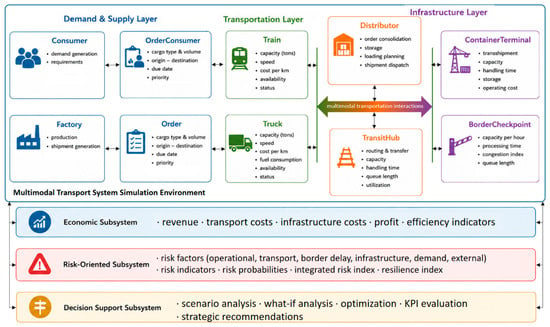
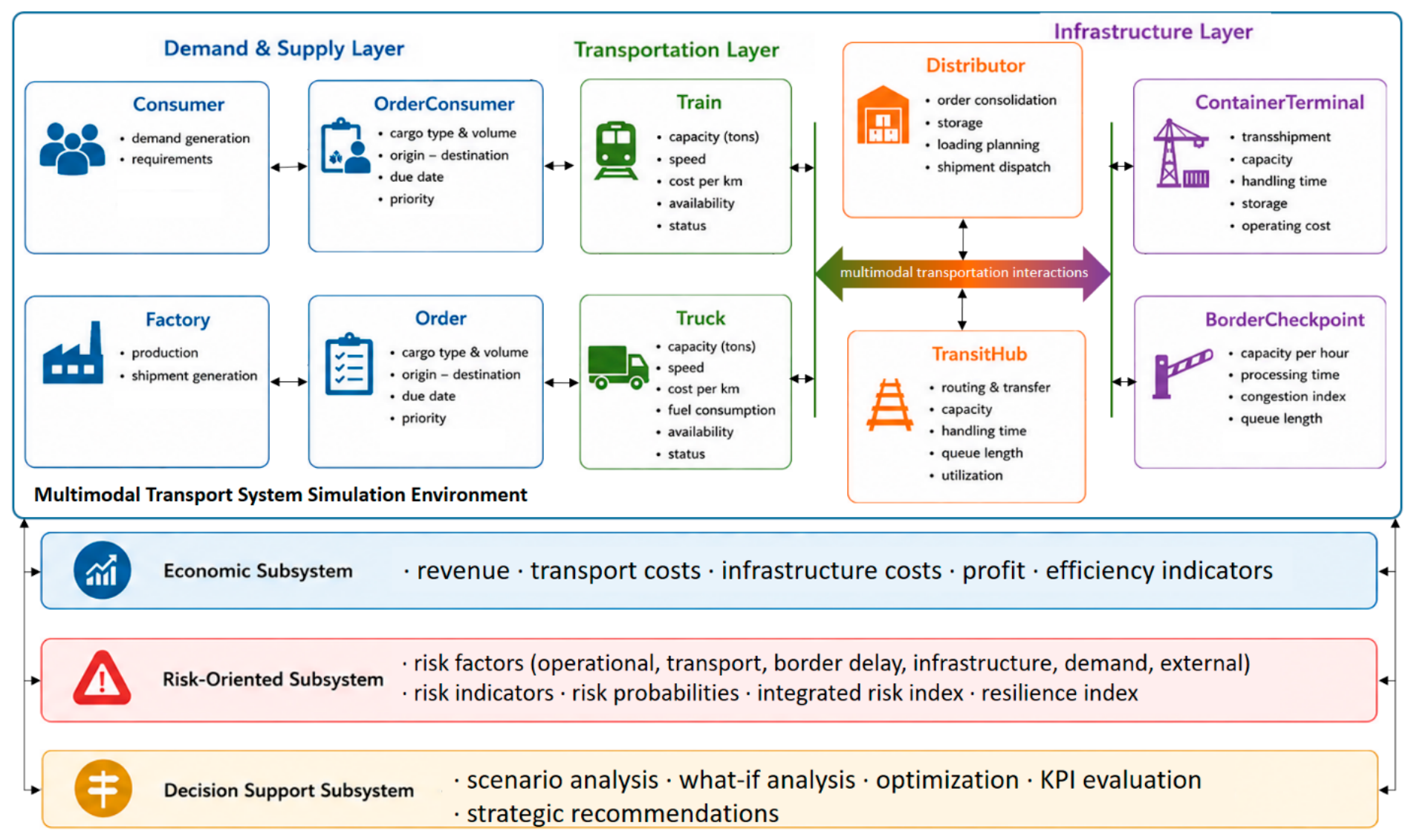
The developed multi-agent model enables the simulation of the dynamic functioning of the transport system of the Republic of Kazakhstan under conditions of external uncertainty and serves as the core platform for the integration of the economic, risk-oriented and managerial components considered in this study. The overall architecture of the simulation-based decision-support system for modeling multimodal transport logistics in the Republic of Kazakhstan is presented in Figure 1. The upper layer represents the multi-agent simulation environment, whereas the lower layers implement the economic, risk-oriented and decision-support functions. These components are described in greater detail in the following sections.
Figure 1.
General architecture of the proposed simulation-based decision support system for multimodal transport logistics of the Republic of Kazakhstan.
2.2. Economic Subsystem
One of the principal extensions of the baseline multi-agent model of multimodal transportation is the integration of a managerial and economic subsystem designed to evaluate the performance of the transport and logistics system, analyze the economic implications of management decisions and support the strategic planning of transport infrastructure development.
Unlike conventional simulation models of transport processes, which are primarily focused on analyzing the temporal and operational characteristics of transportation, the developed subsystem simultaneously accounts for transportation costs, revenues from transport operations, infrastructure operating costs, losses resulting from delays and integrated economic performance indicators. This enables the model to be used not only for the analysis of transport processes but also for supporting investment appraisal and managerial decision-making.
The economic subsystem is implemented as a set of interrelated indicators, the accumulation and calculation of which are performed throughout the simulation process (Table 1). The model accounts for total revenues from transport operations, costs associated with road and rail freight transportation, infrastructure operation and development costs, as well as additional expenses resulting from delays and disruptions to logistics processes.
Table 1.
Key economic parameters of the decision-support subsystem.
Transportation costs are calculated directly during the execution of transport operations and depend on the mode of transport employed, the volume of freight transported, the transportation distance and the operating conditions of the shipment. Mode-specific tariff coefficients are applied for different modes of transport to reflect the operational characteristics of road and rail freight transportation. In addition, the model accounts for economic losses arising from vehicle idle time, delays at transport infrastructure facilities and the occurrence of adverse transport system operating scenarios.
To evaluate the economic performance of the multimodal transport system, a set of integrated performance indicators is employed, including the total profit of the transport system, the average transportation cost per ton of freight, and an integrated logistics performance indicator. The model also provides separate accounting of the economic performance of road and rail freight transportation, thereby enabling an assessment of the impacts of different transport infrastructure development strategies on the efficiency of individual transport modes.
To support strategic management and scenario-based analysis of transport system development, the model incorporates investment performance indicators, including total infrastructure investment, return on investment and integrated indicators for assessing the effectiveness of transport system reform. The use of these indicators enables comparative analysis of alternative transport infrastructure modernization scenarios, evaluation of the economic feasibility of investment projects and substantiation of rational directions for the development of multimodal transport logistics in the Republic of Kazakhstan.
Thus, the developed managerial and economic subsystem enables a transition from the analysis of individual transport operations to a comprehensive assessment of the performance and development of the national transport and logistics system as a whole.
2.3. Risk-Oriented Subsystem
One of the key extensions of the proposed decision-support system is the integration of a risk-oriented subsystem for resilience analysis of multimodal transport logistics. The need to incorporate risk analysis is driven by the high level of uncertainty inherent in the operation of modern transport and logistics systems, which arises from fluctuations in freight demand, limited infrastructure resources, congestion at transport hubs, external economic and geopolitical factors, as well as potential disruptions to transport infrastructure.
Unlike most existing studies, which examine individual categories of transport risks independently, the proposed approach provides a comprehensive framework for modeling multiple groups of risks within a unified multi-agent simulation environment. The implementation of the risk-oriented subsystem is based on the integration of probabilistic risk event scenarios with the dynamic performance indicators of the transport system generated directly during the simulation process.
The developed system considers six major categories of risk:
- -
- operational risks associated with disruptions to loading, freight handling, and transport operations;
- -
- transportation risks arising from vehicle delays and increased transportation costs;
- -
- border crossing risks associated with congestion and delays at border crossing points;
- -
- infrastructure risks related to reduced transport infrastructure capacity;
- -
- freight demand risks associated with fluctuations in transportation demand;
- -
- external risks resulting from economic, natural, and geopolitical factors.
The effects of the different risk categories are incorporated directly into the operational logic of the transport system agents. Operational risks lead to increased loading and freight handling times. Transportation risks result in additional time delays and economic losses during transport operations. Border crossing risks increase freight processing times and contribute to the formation of vehicle queues. Infrastructure risks are modeled through the dynamic adjustment of the capacity of transport infrastructure facilities. Freight demand risks lead to changes in the intensity and structure of freight flows, while external risks affect the temporal and cost-related characteristics of transport operations.
To provide a quantitative assessment of the state of the transport system, a set of operational performance indicators generated during the simulation process is used, including the proportion of delayed orders, the proportion of unfulfilled shipments, the level of infrastructure congestion, the utilization level of transport hubs and transport network accessibility indicators (Table 2). These indicators serve as the basis for calculating individual risk metrics.
Table 2.
Main risk categories, impact mechanisms, and risk-oriented subsystem indicators.
Accordingly, the operational risk is determined using the following equation:
where is the number of delayed orders, and is the total number of orders.
The transportation risk is defined as the ratio of the number of failed orders, , to the total number of orders.
The overall transport system risk index is then calculated as follows:
where is the operational risk indicator; is the transportation risk indicator; is the border delay risk indicator; is the infrastructure risk indicator; is the freight demand risk indicator; is the external risk indicator; and denotes the weighting coefficients determined by expert judgment using multicriteria analysis methods.
To assess the ability of the transport and logistics system to maintain its operational performance under conditions of uncertainty, an integrated system resilience index is additionally employed:
where denotes the proportion of delayed shipments, is the proportion of unfulfilled shipments, is the transport infrastructure congestion index, is the transport system accessibility index, and are the corresponding weighting coefficients.
The developed risk-oriented subsystem not only enables the assessment of the impact of individual risk categories on the performance of the transport and logistics system but also provides a comprehensive analysis of the resilience of the multimodal transport network of the Republic of Kazakhstan, identifies critical infrastructure elements, and evaluates the effectiveness of alternative transport system development scenarios under conditions of uncertainty.
2.4. Decision Support Subsystem for Transport Development Planning
The final layer of the proposed simulation-based system is the decision-support subsystem, which is designed to perform scenario-based analysis of the development and reform of multimodal transport logistics in the Republic of Kazakhstan. Its primary purpose is to compare alternative management strategies based on transport, infrastructure, economic, and risk-oriented indicators generated during the simulation process.
Unlike the baseline simulation model, which is primarily focused on reproducing freight transportation and freight handling processes, the decision-support subsystem enables the assessment of the consequences of strategic changes to the transport system. These changes include the modernization of border crossing points, the development of rail transport corridors, the expansion of multimodal hubs, the implementation of digital logistics platforms, and the comprehensive modernization of transport and logistics infrastructure.
Development scenarios are defined by modifying the parameters of the infrastructure, transport, and managerial agents within the model. For example, the modernization of border crossing points is simulated by increasing their throughput capacity, reducing the baseline freight processing time, and decreasing the probability of delays. The development of rail transport corridors is represented by reducing the unit cost of rail freight transportation and improving the efficiency of handling large freight consignments. The expansion of multimodal hubs is modeled by increasing the productivity of loading and unloading operations and the throughput capacity of logistics hubs. The digitalization of logistics is simulated through reductions in order processing time and operational delays, as well as improved coordination among the agents of the transport system.
For the comparative evaluation of development scenarios, the subsystem employs economic indicators, risk indicators, and integrated performance criteria. The economic indicators include total transportation revenue, transportation costs, infrastructure costs, delay-related losses, total profit, the average transportation cost per ton of freight, and return on investment. The risk-oriented component enables the consideration of the integrated risk index, the transport system resilience index, the proportion of delayed orders, the proportion of unfulfilled shipments, and the level of infrastructure congestion.
The overall effectiveness of transport system development scenarios can be evaluated using an integrated transport system reform effectiveness index:
where is the transport system resilience index, is the logistics efficiency index, is the return on investment, and are weighting coefficients representing the relative importance of resilience, operational efficiency, and investment performance, respectively, as determined by expert judgment using multicriteria analysis methods.
The weighting coefficients of the individual components of the integrated risk and resilience indices were determined using the Analytic Hierarchy Process (AHP) based on expert assessments by specialists in transport logistics. The criteria considered included the potential impact of individual risk factors on delivery time, transportation costs, infrastructure capacity, and transportation reliability. The experts performed pairwise comparisons of the criteria using Saaty’s standard nine-point scale, while the consistency of the obtained judgments was controlled using the consistency ratio.
Thus, the decision-support subsystem enables a transition from the simulation-based analysis of individual transport processes to a comprehensive evaluation of strategic alternatives for the development of the transport and logistics system. It makes it possible to compare infrastructure modernization scenarios, identify the most effective investment priorities, assess the resilience of the transport system to various risks, and formulate recommendations for the development of multimodal transport logistics in the Republic of Kazakhstan.
3. Experimental Results and Discussion
Within the framework of the experimental study, the proposed simulation-based decision-support system was used to develop a set of multimodal transportation scenarios reflecting the key characteristics of the transport and logistics system of the Republic of Kazakhstan and its international transport corridors. The baseline multi-agent model comprises a set of interacting agents representing transport infrastructure, freight flows and transport vehicles operating within a unified geospatial environment.
The Distributor agents represent the major freight generation and distribution centers corresponding to the largest logistics hubs of the Republic of Kazakhstan, including Almaty and Astana. Their functions include freight consolidation, the generation of transport orders and the organization of multimodal transportation for both domestic and international destinations. The BorderCheckpoint agents model the key border crossing points, including Dostyk and Khorgos, which serve as critical elements of the international transport corridors. The model accounts for throughput capacity constraints, freight processing procedures and potential delays that have a significant impact on the efficiency of transport operations.
ContainerTerminal agents are located at the ports of Aktau and Kuryk and represent port nodes of the multimodal transport system. They model the arrival, processing, and transshipment of freight between road and rail transport and the maritime segment of international transport corridors. Maritime transportation and vessel movements themselves are not explicitly simulated; the corresponding incoming and outgoing freight flows are represented through the generation and processing of orders at the ContainerTerminal agents according to the modeled shipments.
The TransitHub agents represent intermediate transport hubs, railway stations and distribution centers that perform freight routing, transport resource allocation and transport network load balancing. The Customer agents represent end customers located both within the Republic of Kazakhstan and abroad, enabling the simulation of domestic, export and transit freight transportation.
For the experimental study, three freight categories of strategic importance to the transport system of the Republic of Kazakhstan were selected: grain commodities, representing export freight flows to China and the Caspian region; energy commodities, reflecting the transportation and transshipment of petroleum products; and industrial goods and equipment, representing import and transit freight flows passing through the country’s major transport corridors and logistics hubs. The use of a limited number of freight categories avoids unnecessary model complexity while preserving the ability to analyze the key operational characteristics of the multimodal transport system.
To demonstrate the capabilities of the proposed decision-support system, a computational experiment was conducted to simulate the operation of the multimodal transport system of the Republic of Kazakhstan, incorporating road, rail and maritime transportation. The reference scenario represents a reference configuration of the modeled multimodal transport system and provides a common benchmark for comparative evaluation of alternative development scenarios. It is not intended to reproduce or forecast the current national freight transport indicators of the Republic of Kazakhstan. In addition, scenarios involving the modernization of border infrastructure, the development of rail transport corridors, the expansion of multimodal transport hubs, the digitalization of logistics processes and the comprehensive development of the transport system were investigated.
The experimental model combines geospatially observed data with scenario-based and synthetic input parameters (Table 3). The spatial structure of the transport network and the locations of the principal transport infrastructure objects are based on OpenStreetMap data and publicly available geographical information. These data are used to represent the road and rail networks and to support GIS-based routing in AnyLogic. In contrast, freight-demand parameters, shipment sizes, processing times, risk probabilities, transportation costs, and infrastructure-development parameters used in the computational experiments are scenario inputs rather than estimates of actual current values for the entire transport system of Kazakhstan. They were selected within plausible ranges to reproduce characteristic multimodal freight processes and to demonstrate the comparative capabilities of the proposed decision support system. Accordingly, the model is used as a scenario-analysis testbed rather than as a calibrated digital replica of the national transport system. The numerical results are interpreted as comparative changes relative to the common reference scenario rather than as forecasts of absolute national transport indicators.
Table 3.
Key input parameters and data sources used in the simulation experiments.
The integrated modernization scenario does not introduce any additional favorable parameter changes; it combines the same interventions and parameter modifications considered separately in the four individual development scenarios (Table 4).
Table 4.
Parameterization of the transport logistics development scenarios relative to the reference scenario.
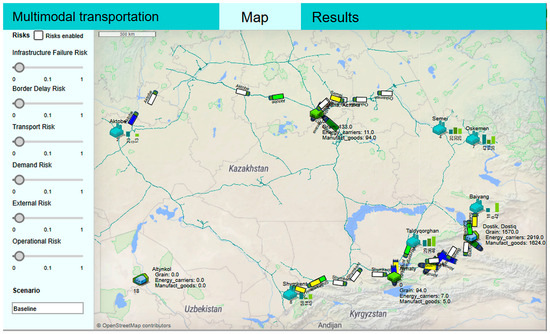
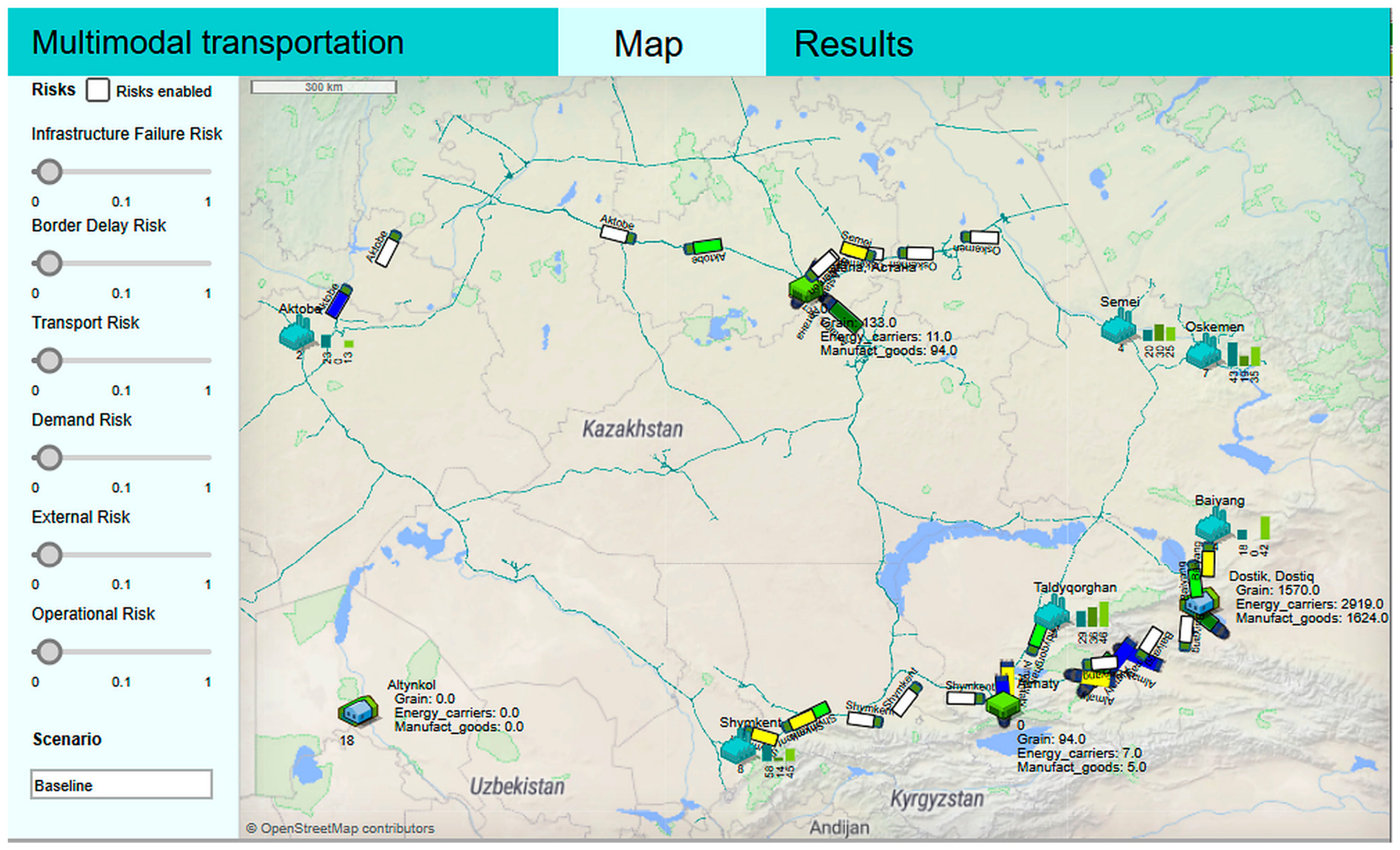
Figure 2 presents the interface of the decision-support system, which provides geospatial visualization of the transport infrastructure (OpenStreetMap), multimodal routes, logistics network facilities and risk-oriented management components. The developed interface enables users to modify the parameters of different risk categories, select transport infrastructure development scenarios, and analyze the impact of management decisions on the performance of the transport system. The integration of geospatial visualization facilitates the identification of transport network bottlenecks and supports scenario-based analysis of the development of the transport and logistics infrastructure of the Republic of Kazakhstan.
Figure 2.
Main interface of the decision-support system with geospatial visualization of the multimodal transport system and a scenario management panel.
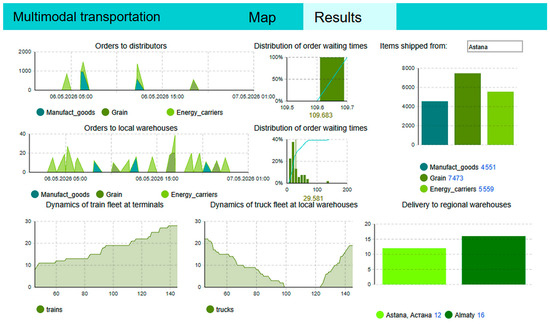
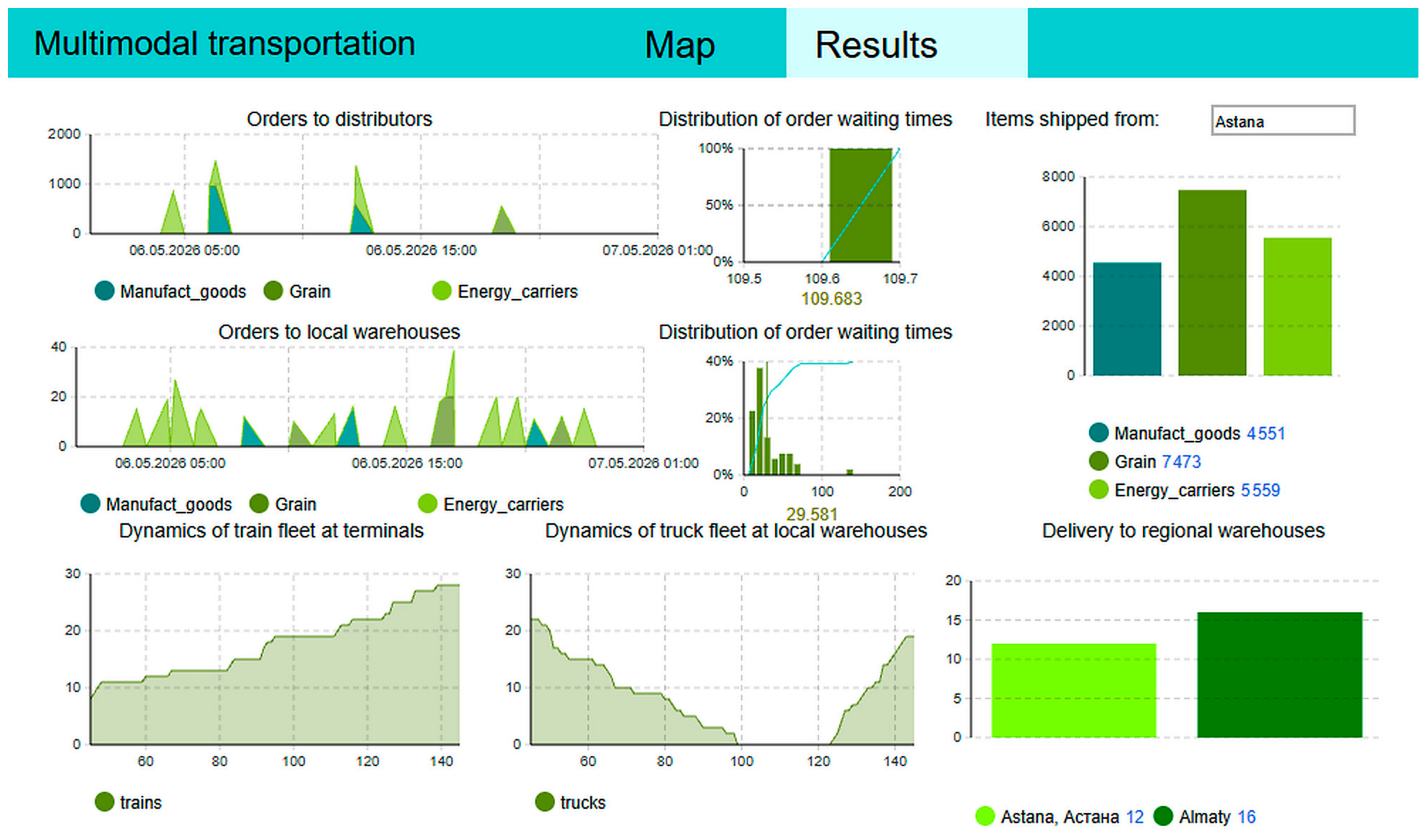
Figure 3 presents the aggregated performance indicators of the multimodal transport system. The simulation results make it possible to analyze the structure of freight flows, the dynamics of transport order generation, the distribution of waiting times, the utilization of transport vehicles and the interaction among different modes of transport. The obtained results confirm the capability of the proposed model to reproduce the key operational characteristics of the transport system of the Republic of Kazakhstan and to generate the statistical indicators required to support managerial decision-making.
Figure 3.
Summary results of the multimodal transport system operation.
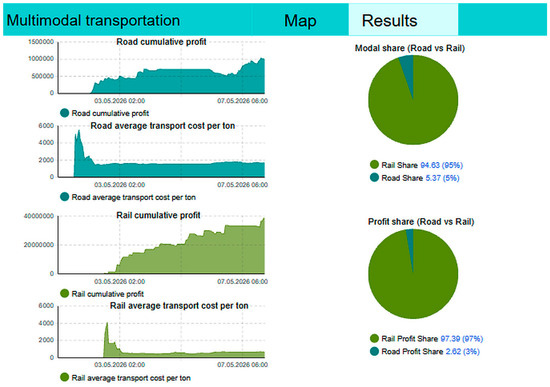
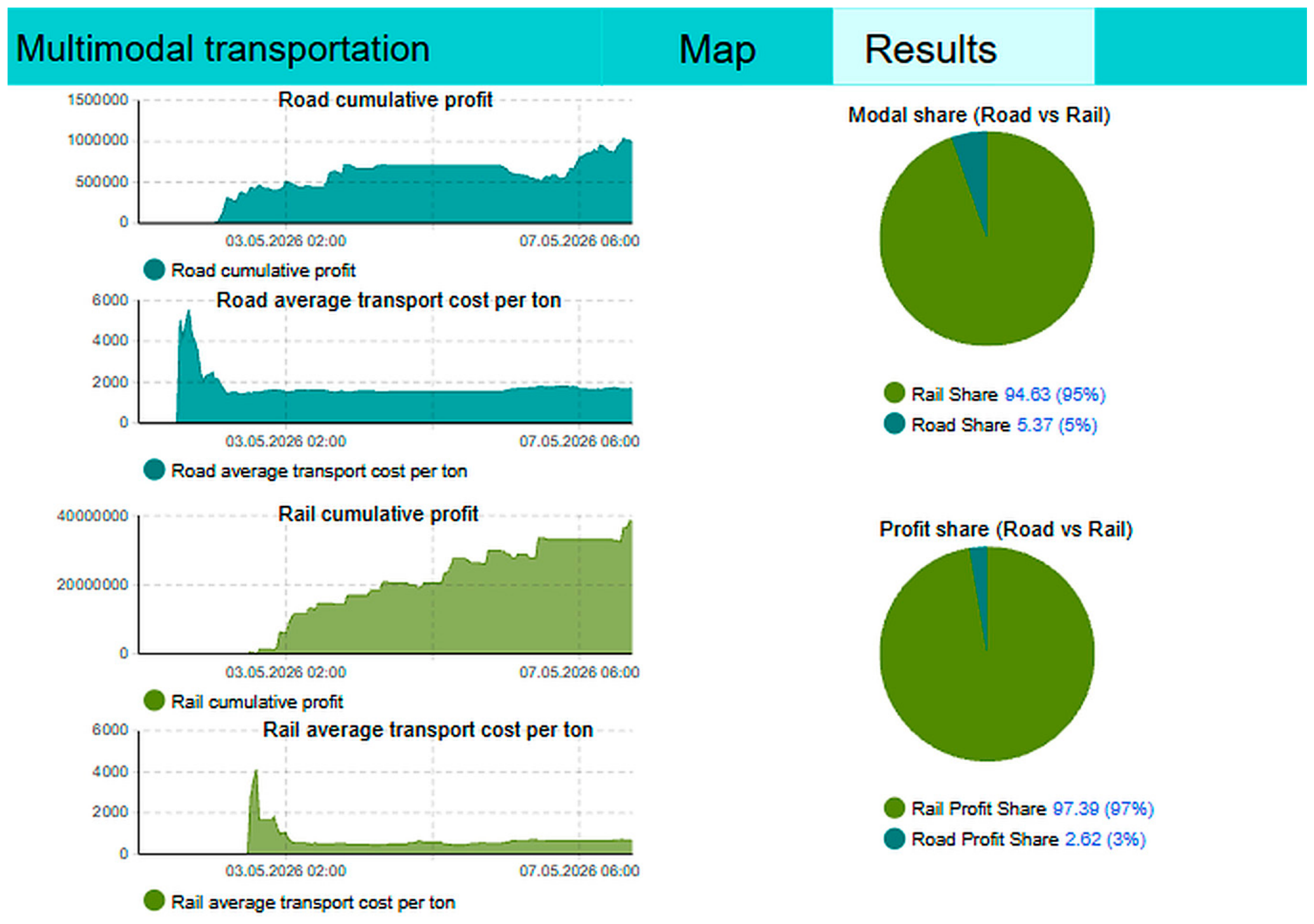
Figure 4 presents the results generated by the managerial and economic subsystem. The developed model provides separate accounting of the economic performance of road and rail transportation, including cumulative profit, the average transportation cost per unit of freight and the contribution of each transport mode to the overall economic performance of the transport system. The obtained results enable a comparative evaluation of the efficiency of different transportation modes and facilitate the assessment of the economic implications of strategic decisions related to transport infrastructure development.
Figure 4.
Economic performance indicators of the multimodal transport system.
The results of the comparative analysis of multimodal transport logistics development scenarios for the Republic of Kazakhstan are presented in Table 5. The findings demonstrate that different transport infrastructure modernization strategies have a substantial impact on the economic performance, risk level, and resilience of the transport system. The reference scenario is characterized by the highest integrated risk index and the lowest level of system resilience, highlighting the need for the continued development of the transport and logistics infrastructure.
Table 5.
Comparative analysis of multimodal transport logistics development scenarios in the Republic of Kazakhstan.
The predominance of rail transport observed in the reference experiment (approximately 95% of the transported freight volume) results directly from the experimental configuration, in which individual rail shipments are generated within the range of 500–1000 t, compared with 10–20 t for road shipments. Therefore, this modal share should not be interpreted as an estimate of the actual national modal split in Kazakhstan. It reflects the deliberately freight-intensive rail component of the illustrative scenario used to evaluate the response of the model to alternative development strategies. Similarly, the high contribution of rail transport to the total simulated profit is a consequence of the larger freight volumes assigned to rail shipments and the corresponding cost and revenue structure of the experimental scenario.
The border crossing modernization scenario reduces the integrated risk level by 15.5% and increases the transport system resilience index by 12.7% compared with the reference scenario. The development of rail transport corridors demonstrates the greatest improvement in economic performance among the individual modernization strategies, resulting in a 30.1% increase in total profit and a 13.7% reduction in the average transportation cost. The expansion of multimodal transport hubs achieves a balanced improvement in both the economic and operational performance of the transport system.
Of particular interest is the logistics digitalization scenario, which delivers the highest investment performance, with a return on investment of 29.5%, while also substantially enhancing the resilience of the transport system through the mitigation of operational and organizational risks. The best overall results are achieved under the comprehensive transport system modernization scenario, which simultaneously improves economic performance, reduces the integrated risk index, and enhances the resilience of the transport and logistics system. In particular, compared with the reference scenario, total profit increases by 50.0%, the average transportation cost decreases by 19.9%, the integrated risk index is reduced by 46.6%, and the transport system resilience index increases by 39.7%.
As expected, the integrated modernization scenario provides the highest absolute system-level performance because it combines the interventions introduced separately in the four development scenarios. Therefore, its superiority in terms of profit, risk reduction, and resilience should not be interpreted as an independently optimized result. The more informative comparison concerns the trade-off between the achieved system improvement and the resources required for its implementation. In this respect, the digital logistics scenario demonstrates a comparatively high return on investment despite producing smaller absolute improvements, whereas rail corridor development provides the strongest economic effect among the individual infrastructure-oriented interventions.
To assess the influence of the weighting coefficients on the scenario-analysis results, an additional sensitivity analysis was performed. Each component weight was sequentially varied by ± 10% and ± 20% relative to its AHP-derived value, while the remaining weights were proportionally normalized. Within the investigated range of weight variations, the integrated modernization scenario retained the highest overall score. The integral index values and the differences between individual scenarios varied, while their overall comparative assessment remained stable. More substantial changes in the weights may alter the scenario ranking, reflecting different priorities of the decision maker.
The obtained results demonstrate the capability of the proposed simulation-based system to support comparative assessment of alternative transport development scenarios under a consistent set of model assumptions. The experiments should be interpreted as a verification of the model behavior and a demonstration of its scenario-analysis capabilities rather than as empirical validation of the model against the actual performance of Kazakhstan’s national transport system.
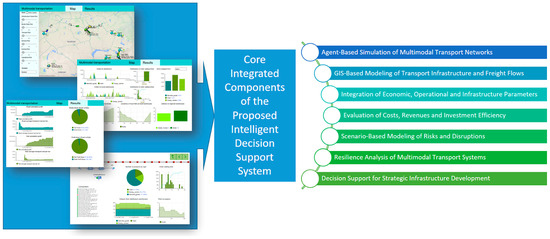
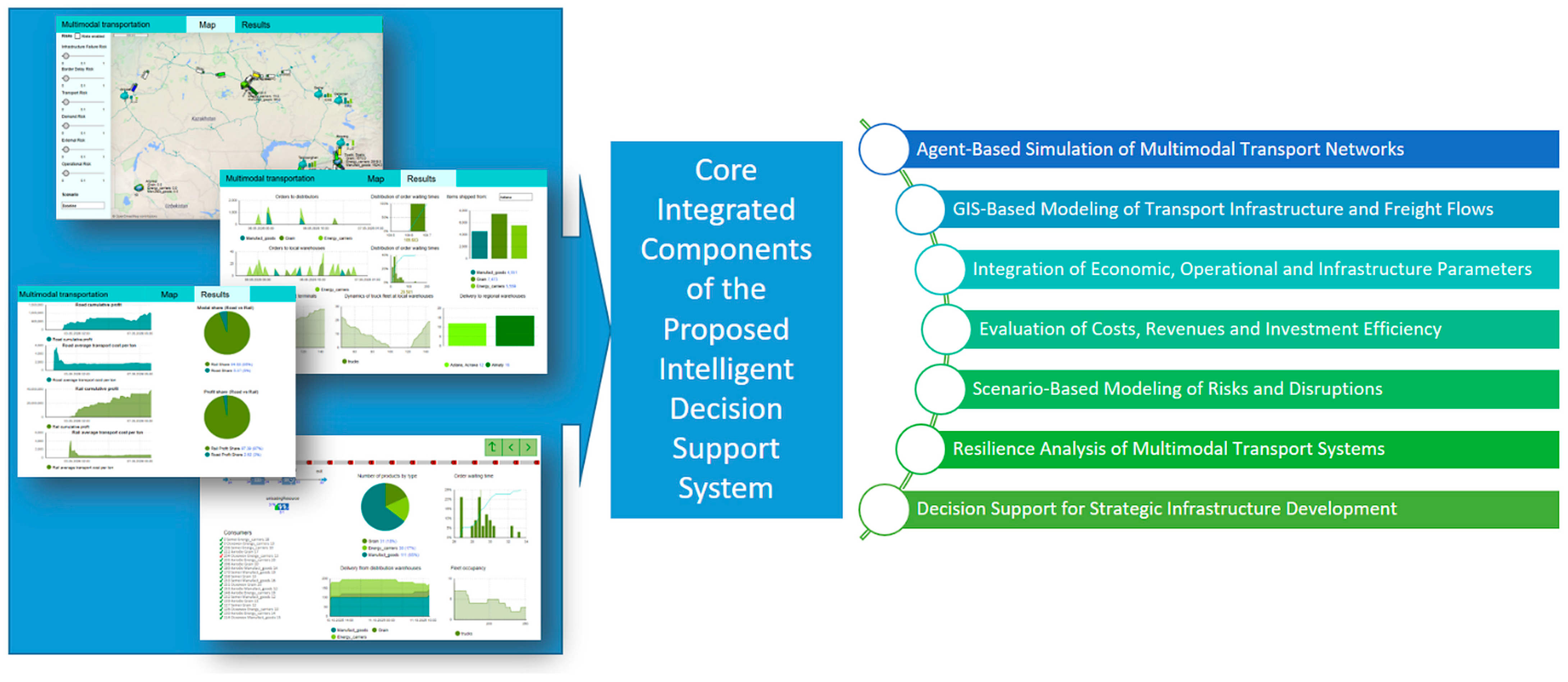
Thus, Figure 5 illustrates the key integrated components of the proposed decision-support system. The scientific novelty of the proposed approach lies in the integration of multi-agent modeling of multimodal transportation, GIS-based representation of transport infrastructure, economic analysis, risk-oriented modeling, and transport system resilience assessment within a unified simulation and decision-support environment. This integrated framework enables comprehensive scenario-based analysis of multimodal transport logistics development in the Republic of Kazakhstan under conditions of uncertainty and risk.
Figure 5.
Key integrated components of the proposed transport logistics platform.
4. Conclusions
This study proposes a simulation-based decision-support system for the analysis and strategic development of multimodal transport logistics in the Republic of Kazakhstan. The proposed approach is based on the integration of multi-agent modeling of transport processes, managerial and economic analysis, risk-oriented modeling and decision-support mechanisms.
Unlike existing approaches, which are primarily focused on modeling individual aspects of transport system operation, the proposed system provides a comprehensive analysis of the interactions among transport, infrastructure, economic and risk-oriented factors. As part of the study, a multi-agent model of the multimodal transport network was developed, incorporating freight producers and consumers, different types of transport vehicles, logistics centers, container terminals, border crossing points and transport hubs.
One of the main outcomes of the study is the development of a managerial and economic subsystem that enables the assessment of revenue, transportation and infrastructure costs, investment performance and integrated transport system performance indicators. In addition, a risk-oriented subsystem was developed to account for the effects of operational, transportation, infrastructure, border crossing, external and freight demand risks on the resilience of the transport and logistics system.
The experimental study confirmed the applicability of the proposed system for analyzing alternative transport infrastructure development scenarios in the Republic of Kazakhstan. The simulation results demonstrated that comprehensive transport system modernization simultaneously improves economic performance, reduces the integrated risk level and enhances the resilience of multimodal transport logistics compared with individual infrastructure development strategies.
The practical significance of the obtained results lies in the potential application of the proposed decision-support system to strategic transport infrastructure planning, the evaluation of investment projects, the resilience assessment of transport and logistics systems, and the substantiation of multimodal transport network reform strategies in the Republic of Kazakhstan.
A limitation of the present study is the absence of external empirical validation against historical operational data for specific transport corridors. Such validation will require a consistent dataset combining freight volumes, border-crossing and terminal processing times, infrastructure utilization, and transportation costs for the same observation period. This represents an important direction for further development of the model.
Future research will focus on expanding the range of modeled freight categories, integrating machine learning and freight demand forecasting methods, incorporating digital twin technologies for transport infrastructure and developing intelligent multicriteria optimization methods for multimodal transport logistics development strategies.
Author Contributions
Conceptualization, A.K. (Alisher Khussanov) and B.K. (Botagoz Kaldybayeva); methodology, O.P., A.K. (Aizhan Kamysbayeva) and S.B.; software, O.P., A.K. (Aizhan Kamysbayeva), Z.K. and D.K.; validation, A.K. (Alisher Khussanov), S.B., Z.K. and B.K. (Botagoz Kaldybayeva); formal analysis, O.P.; investigation, A.K. (Alisher Khussanov), B.K. (Baurzhan Korganbayev) and D.K.; resources, B.K. (Botagoz Kaldybayeva), A.K. (Alisher Khussanov) and S.B.; data curation, O.P., A.K. (Aizhan Kamysbayeva) and Z.K.; writing—original draft preparation, O.P., B.K. (Baurzhan Korganbayev) and B.K. (Botagoz Kaldybayeva); writing—review and editing, A.K. (Alisher Khussanov), Z.K., S.B. and B.K. (Botagoz Kaldybayeva); visualization, B.K. (Baurzhan Korganbayev), S.B. and D.K.; supervision, O.P., B.K. (Baurzhan Korganbayev) and B.K. (Botagoz Kaldybayeva); project administration, A.K. (Alisher Khussanov), O.P., A.K. (Aizhan Kamysbayeva) and D.K.; funding acquisition, O.P., A.K. (Alisher Khussanov), Z.K. and S.B. All authors have read and agreed to the published version of the manuscript.
Funding
This research was funded by the Science Committee of the Ministry of Science and Higher Education of the Republic of Kazakhstan (Grant No. AP26103485 Development of intelligent models for the development of transport infrastructure in the context of digital transformation).
Institutional Review Board Statement
Not applicable.
Informed Consent Statement
Not applicable.
Data Availability Statement
The raw data supporting the conclusions of this article will be made available by the authors on request.
Conflicts of Interest
The authors declare no conflicts of interest.
References
- Lu, C.; Martins-Turner, K.; Nagel, K. Creating an Agent-Based Long-Haul Freight Transport Model for Germany. Procedia Comput. Sci. 2022, 201, 614–620. [Google Scholar] [CrossRef] [Scilit]
- Alaei Jordehi, S.; Durán Micco, J.V.; Macharis, C. Synchromodal Transport Re-Planning: An Agent-Based Simulation Approach. Eur. Transp. Res. Rev. 2024, 16, 1. [Google Scholar] [CrossRef] [Scilit]
- Durán-Micco, J.; Jordehi, S.A.; Macharis, C. Evaluating Synchromodal Transport with Agent-Based Simulation. Transp. Res. Procedia 2023, 72, 619–626. [Google Scholar] [CrossRef] [Scilit]
- Zhang, Y.; Tan, X.; Gan, M.; Liu, X.; Atasoy, B. Operational Synchromodal Transport Planning Methodologies: Review and Roadmap. Transp. Res. Part E 2025, 194, 103915. [Google Scholar] [CrossRef] [Scilit]
- Rentschler, J.; Elbert, R.; Weber, F. Promoting Sustainability through Synchromodal Transportation: A Systematic Literature Review and Future Fields of Research. Sustainability 2022, 14, 13269. [Google Scholar] [CrossRef] [Scilit]
- Le, T.V.; Fan, R. Digital Twins for Logistics and Supply Chain Systems: Literature Review, Conceptual Framework, Research Potential, and Practical Challenges. Comput. Ind. Eng. 2024, 187, 109768. [Google Scholar] [CrossRef] [Scilit]
- Guo, D.; Mantravadi, S. The Role of Digital Twins in Lean Supply Chain Management: Review and Research Directions. Int. J. Prod. Res. 2025, 63, 1851–1872. [Google Scholar] [CrossRef] [Scilit]
- Liu, C.; Wang, Y.; Purvis, L.; Potter, A. Can Digital Twin Technology Enhance Supply Chain Resilience? A Systematic Literature Review. Sustainability 2026, 18, 2361. [Google Scholar] [CrossRef] [Scilit]
- Zhang, J.; Brintrup, A.; Calinescu, A.; Kosasih, E.; Sharma, A. Supply Chain Digital Twin Framework Design: An Approach of Supply Chain Operations Reference Model and System of Systems. arXiv 2021, arXiv:2107.09485. [Google Scholar] [CrossRef] [Scilit]
- Klar, R.; Fredriksson, A.; Angelakis, V. Digital Twins for Ports: Derived from Smart City and Supply Chain Twinning Experience. IEEE Access 2023, 11, 71777–71799. [Google Scholar] [CrossRef] [Scilit]
- Nag, D.; Brandel-Tanis, F.; Pramestri, Z.A.; Pitera, K.; Frøyen, Y.K. Exploring Digital Twins for Transport Planning: A Review. Eur. Transp. Res. Rev. 2025, 17, 15. [Google Scholar] [CrossRef] [Scilit]
- Li, S.; Jin, P.; Su, S.; Yao, J.; Pang, Q. Digital Twins and Cross-Border Logistics Systems Risk Management Capability: An Innovation Diffusion Perspective. Systems 2025, 13, 658. [Google Scholar] [CrossRef] [Scilit]
- Li, J.; Wang, J. Digital Twin-Driven Management Strategies for Logistics Transportation Systems. Sci. Rep. 2025, 15, 12186. [Google Scholar] [CrossRef] [Scilit] [PubMed]
- Xu, H.; Liu, Z.; Wang, K.; Chen, Y. Towards Autonomous Optimization of Urban Logistics Systems Using Agentic Digital Twins. arXiv 2025, arXiv:2506.13068. [Google Scholar] [CrossRef] [Scilit]
- Zhang, Z.; Brintrup, A.; Calinescu, A.; Kosasih, E.; Sharma, A. ISOMORPH: A Supply Chain Digital Twin for Simulation and Forecasting. arXiv 2026, arXiv:2605.12768. [Google Scholar] [CrossRef] [Scilit]
- Archetti, C.; Peirano, L.; Speranza, M.G. Optimization in Multimodal Freight Transportation Problems: A Survey. Eur. J. Oper. Res. 2022, 299, 1–20. [Google Scholar] [CrossRef] [Scilit]
- Ferjani, A.; Yaagoubi, A.; Boukachour, J.; Duvallet, C. An Optimization–Simulation Approach for Synchromodal Freight Transportation. Multimodal Transp. 2024, 3, 100151. [Google Scholar] [CrossRef] [Scilit]
- Taran, I.; Olzhabayeva, R.; Oliskevych, M.; Danchuk, V. Structural Optimization of Multimodal Routes for Cargo Delivery. Arch. Transp. 2023, 67, 49–70. [Google Scholar] [CrossRef] [Scilit]
- Layeb, S.B.; Jaoua, A.; Jbira, A.; Makhlouf, Y. A Simulation-Optimization Approach for Scheduling in Stochastic Freight Transportation. Comput. Ind. Eng. 2018, 126, 99–110. [Google Scholar] [CrossRef] [Scilit]
- Pang, Y.; Pan, S.; Ballot, E. Resilience Analysis of Multi-Modal Logistics Service Networks Through Robust Optimization with Budget-of-Uncertainty. IFAC-PapersOnLine 2024, 58, 676–681. [Google Scholar] [CrossRef] [Scilit]
- Liao, R.; Liu, W.; Yuan, Y. Resilience Improvement and Risk Management of Multimodal Transport Logistics in the Post-COVID-19 Era: The Case of TIR-Based Sea-Road Multimodal Transport Logistics. Sustainability 2023, 15, 6041. [Google Scholar] [CrossRef] [Scilit]
- Patnala, P.K.; Regehr, J.D.; Mehran, B.; Regoui, C. Resilience for Freight Transportation Systems to Disruptive Events: A Review of Concepts and Metrics. Can. J. Civ. Eng. 2023, 51, 237–263. [Google Scholar] [CrossRef] [Scilit]
- Tavasszy, L.; Köhler, J.; Pernestål, A.; Raoofi, Z.; Schmid, J.; Brauer, C. Modeling the Dynamics of Freight Transport Decarbonization: A Review and Research Agenda. Int. J. Sustain. Transp. 2026, 20, 759–771. [Google Scholar] [CrossRef] [Scilit]
- Kurniawan, D.A. Multimodal Logistics for Resilient and Sustainable Global Supply Chains: Strategic Insights from Integrated Transport Systems. Int. J. Logist. Res. Appl. 2024, 2, 213–224. [Google Scholar] [CrossRef] [Scilit]
- Chung, S.; Sardak, D.; Kitsak, M.; Jin, A.; Linkov, I. Contested Logistics: Resilience of Strategic Highways and Railways Under Disruption Scenarios. arXiv 2025, arXiv:2507.18470. [Google Scholar] [CrossRef] [Scilit]
- Tatarczak, A.; Żukowska, B.; Budiloviča, E.; Müller, C.-A.; Müller, V. Exploring Barriers to the Adoption of Artificial Intelligence in the Transportation Sector in the Context of Industry 5.0: A Qualitative Expert-Based Study. Transp. Telecommun. J. 2026, 27, 274–286. [Google Scholar] [CrossRef] [Scilit]
- Özkan Özen, Y.D.; Akçiçek, C.; Öztürkoğlu, Y. Machine Learning Applications in Smart Logistics: Analysing Barriers for Future Practices. J. Eng. Des. Technol. 2025, 23, 2105–2123. [Google Scholar] [CrossRef] [Scilit]
- Del Ser, J.; Osaba, E.; Sanchez-Medina, J.J.; Fister, I. Bioinspired Computational Intelligence and Transportation Systems: A Long Road Ahead. IEEE Trans. Intell. Transp. Syst. 2020, 21, 466–495. [Google Scholar] [CrossRef] [Scilit]
- Khussanov, A.; Kaldybayeva, B.; Prokhorov, O.; Khussanov, Z.; Kenzhebekov, D.; Yevadilla, M.; Janabayev, D. Agent-Based Simulation Modeling of Multimodal Transport Flows in Transportation System of Kazakhstan. Logistics 2025, 9, 172. [Google Scholar] [CrossRef] [Scilit]
- Kamysbayeva, A.; Khussanov, A.; Kaldybayeva, B.; Prokhorov, O.; Khussanov, Z.; Dosmakanbetova, A.; Korganbayev, B.; Issayeva, A. Simulation Model and Intelligent Optimization Methods for Freight Transportation Under the Digital Transformation of the Transport System of the Republic of Kazakhstan. Logistics 2026, 10, 109. [Google Scholar] [CrossRef] [Scilit]
- Kamysbayeva, A.; Khussanov, A.; Kaldybayeva, B.; Prokhorov, O.; Khussanov, Z.; Bekzhanova, S.; Sabyrkhanov, M.; Issayeva, A. Modeling the Resilience of Agricultural Intermodal Logistics in Kazakhstan Under Dynamic Export Demand and Infrastructure Constraints. Logistics 2026, 10, 143. [Google Scholar] [CrossRef] [Scilit]

Disclaimer/Publisher’s Note: The statements, opinions and data contained in all publications are solely those of the individual author(s) and contributor(s) and not of MDPI and/or the editor(s). MDPI and/or the editor(s) disclaim responsibility for any injury to people or property resulting from any ideas, methods, instructions or products referred to in the content. |
© 2026 by the authors. Licensee MDPI, Basel, Switzerland. This article is an open access article distributed under the terms and conditions of the Creative Commons Attribution (CC BY) license.