


1. Brief Overview of Recent Developments in the Field
Any new food processing technology must first be subjected to extensive research to verify the safety and quality of the food that it creates. Following this, the effects of the various physical parameters of the technology (for example, temperature, pressure, pH, water activity) are able to be examined. When enough publications are made focusing on a particular technology, authors are able to write reviews. High-pressure processing technology [1,2,3] and pulsed electric fields [4] have gone through this process. Additionally, Reference [4] has provided a comprehensive overview of a number of modern non-thermal technologies [5].
Our Special Issue is dedicated to non-thermal food processing, but it covers only a very small part of this area of food production. These methods have a promising future as consumers are increasingly coming to prefer gentler processing methods to safeguard their health, despite that fact that these products have shorter shelf lives.
Dalla Rosa et al. [C11] provided a review for our Special Issue, considering the impact of environmentally friendly technologies on the bioavailability of various food ingredients and their safety. This review paper also focused on the overall energy consumption for processing, emphasizing that non-thermal pretreatments, such as cold plasma, pulsed electric fields, high-pressure processing and ultrasound processing, combined with mild thermal drying technology, would help reduce energy costs. Any new technology needs some energy input for their application. This has been comprehensively reviewed in Reference [6]. This paper considers the advantages of non-thermal food processing in terms of quality and carbon footprint reduction; see Table 1.
Table 1.
Effects on food quality and carbon footprint elements of non-thermal processing (adapted from [6]).
Dynamic and hydrostatic high pressure, vacuum impregnation, ultrasound, pulsed electric fields and cold plasma applications can result in a less negative effect with respect to traditional thermal treatments. These technologies can help extract important substances from secondary raw materials or waste. This ability helps the circular bioeconomy.
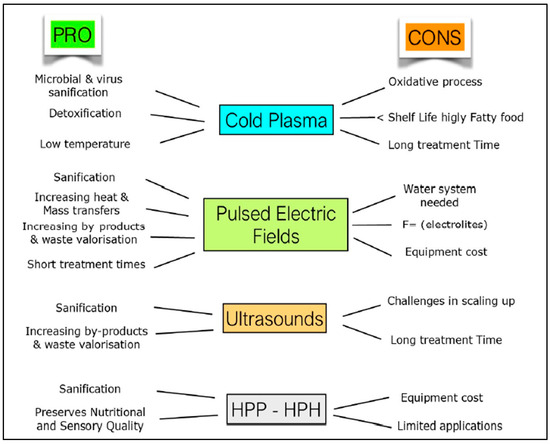
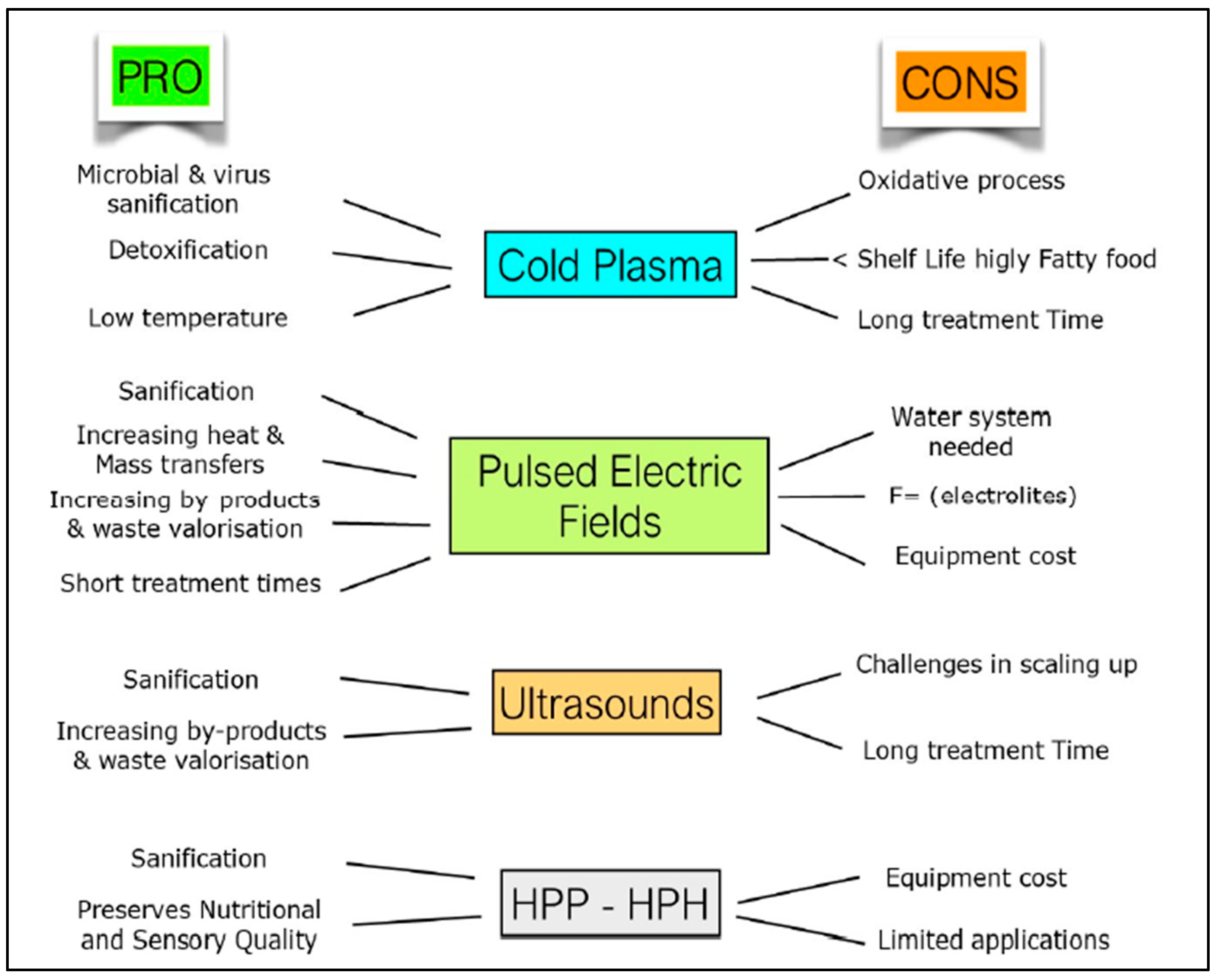
In Figure 1, a comparison of the positive and negative properties of the technologies considered is reported.
Figure 1.
Comparison of pros and cons of investigated technologies (adapted from C11).
These treatments can produce structural changes that improve the bioaccessibility and/or the bioavailability of bioactive compounds, such as probiotic microorganisms, to improve food healthiness and the gut microbiome.
Non-thermal low-impact processing technologies could help the food industry to pursue more sustainable practices and offer better food functionality, thereby being seen more favorably in the context of the ultra-processing debate.
However, an interdisciplinary approach among food engineers, microbiologists, food chemists, bio-NMR specialists and nutritionists is necessary to discover the best processing conditions, and to increase and assess the sustainability of processing in the food industry.
Our Special Issue includes works that deal with the effects of high pressure [C1], [C4], [C5] and [C10]; high voltage pulses [C7], [C8] and [C9]; UV-C radiation [C3]; and plasma treatment [C6] and nanoparticle-based TiO2 [C2] on various types of food and raw materials.
We consider that the most methodologically significant publication on the verification of any new technology against classical pasteurization is Paper [7]. From a methodological point of view, it does not matter that this work is focused on the treatment of human milk. A very useful overview of new non-thermal food processing technologies is provided in Paper [6].
2. The Gap in Knowledge and How This Special Issue Has Addressed Those Gaps
Our Special Issue is only a small contribution to the already established knowledge of non-thermal food processing technologies. Therefore, it is very difficult to assess whether there are any gaps in the knowledge of the field on the whole. Each research piece usually reveals new problems to be solved before the studied technology can be introduced into industrial practice (see, for example, the issue of scaling up).
It can be stated that the best application in food practice has so far been achieved by high-pressure treatment technology. The most frequently used products on the market that use this technology are fruit and vegetable juices, in which important significant substances (for example, vitamins and dyes) are able to be preserved. A certain uniqueness is represented by Article [C1], which presents the treatment of human breast milk by this technology.
3. Primary Focus on Future Research That Should Be Considered
The future of non-thermal food processing technologies lies in researching methods that will reliably ensure the safety of products and the preservation of their most nutritionally important and healthy ingredients.
Each method must enable the implementation of a reliable system of hazard analysis and critical control points that will allow any health risks to be significantly reduced or even eliminated.
The costs of their applications in practice must be comparable to the real sales price in order to ensure commercial success.
4. Concluding Remarks
Gentle technologies without targeted heating can enable the food industry to maintain consumer interest in foods that maintain a high content of their original substances, such as vitamins and enzymes.
The application of these technologies requires safeguarding health and ensuring quality within the framework of the HACCP system. It is important to maintain an interdisciplinary approach between food engineers, microbiologists, chemists, machine design specialists, nutritionists and employees of regulatory authorities—all of whom work together to define standards and regulations.
Author Contributions
M.H. writing—original draft preparation, R.B. supervision. All authors have read and agreed to the published version of the manuscript.
Funding
This research received no external funding.
Conflicts of Interest
The authors declare no conflicts of interest.
List of Contributions
- Jandová, M.; Fišerová, M.; Paterová, P.; Cacková, L.; Měřička, P.; Malý, J.; Kacerovský, M.; Kovaříková, E.; Strohalm, J.; Demnerová, K.; et al. High-Pressure Inactivation of Bacillus cereus in Human Breast Milk. Foods 2023, 12, 4245. https://doi.org/10.3390/foods12234245.
- Raymond, P.; St-Germain, F.; Paul, S.; Chabot, D.; Deschênes, L. Impact of Nanoparticle-Based TiO2 Surfaces on Norovirus Capsids and Genome Integrity. Foods 2024, 13, 1527. https://doi.org/10.3390/foods13101527.
- Polen, B.; Pendyala, B.; Patras, A.; D’Souza, D.H. Inactivation of Hepatitis A Virus and Feline Calicivirus on Model Food Contact Surfaces by Ultraviolet Light (UV-C) Systems. Foods 2024, 13, 2892. https://doi.org/10.3390/foods13182892.
- Dao, U.H.; Lamphun, J.N.; Tongdonyod, S.; Taya, S.; Phongthai, S.; Klangpetch, W. Optimization of High-Pressure Processing for Microbial Inactivation in Pigmented Rice Grass Juice and Quality Impact Assessment during Refrigerated Storage. Foods 2024, 13, 2995. https://doi.org/10.3390/foods13182995.
- Arroqui, C.; Horvitz, S.; Noriega, M.J.; Fernández-Pan, I.; Ibañez, F.C.; Vírseda, P. Effect of High-Pressure Processing Pretreatment on the Textural Properties of Cooked Nuovo Maratelli Rice. Foods 2024, 13, 4052. https://doi.org/10.3390/foods13244052.
- Zhou, Y.; Zuo, H.; Dai, Z.; Guo, Z.; Holman, B.W.B.; Ding, Y.; Shi, J.; Ding, X.; Huang, M.; Mao, Y. Changes to Pork Bacterial Counts and Composition After Dielectric Barrier Discharge Plasma Treatment and Storage in Modified-Atmosphere Packaging. Foods 2024, 13, 4162. https://doi.org/10.3390/foods13244162.
- Park, G.-S.; Seo, H.; Lee, H.-B.; Lee, J.-W.; Shahbaz, H.M.; Jeong, S.-H.; Lee, D.-U. Enhanced Peelability and Quality of Whiteleg Shrimp (Litopenaeus vannamei) Using Pulsed Electric Field (PEF) Treatment. Foods 2025, 14, 148. https://doi.org/10.3390/foods14020148.
- Miranda-Mejía, G.A.; Cardador-Martínez, A.; Tejada-Ortigoza, V.; Morales-de la Peña, M.; Martín-Belloso, O. Modulating Yogurt Fermentation Through Pulsed Electric Fields and Influence of Milk Fat Content. Foods 2025, 14, 1927. https://doi.org/10.3390/foods14111927.
- Berzosa, A.; Garza-Moreno, L.; Quílez, J.; Raso, J.; Álvarez-Lanzarote, I.; Martínez, J.M. Permeabilization of Cryptosporidium spp. Oocysts in Water, Apple and Carrot Juice by Pulsed Electric Field Technology. Foods 2025, 14, 2112. https://doi.org/10.3390/foods14122112.
- Tříska, J.; Vrchotová, N.; Strohalm, J.; Houška, M.; Kováříková, E.; Novotná, P.; Bednář, J.; Pavela, R. Effect of Ascorbic Acid Addition on the Phenolic Compounds Content in Homogenates from Aerial Parts of Spearmint, Fennel, and Thyme. Foods 2025, 14, 2165. https://doi.org/10.3390/foods14132165.
- Dalla Rosa, M.; Romani, S.; Rocculi, P.; Tylewicz, U.; Tappi, S. Progress in Low-Impact Processing Technologies to Deliver More Sustainable and Healthy Food Tomorrow. Foods 2025, 14, 2332. https://doi.org/10.3390/foods14132332.
References
- Hendrickx, M.E.; Knorr, D. (Eds.) Ultra High Pressure Treatment of Foods; Springer Science & Business Media: Berlin/Heidelberg, Germany, 2001. [Google Scholar]
- Ledward, D.A.; Johnston, D.E.; Earnshaw, R.G.; Hasting, A.P.M. High Pressure Processing of Foods; Nottingham University Press: Loughborough, UK, 1995. [Google Scholar]
- Houška, M.; da Silva, F.V.M. (Eds.) High Pressure Processing of Fruit and Vegetable Products; CRC Press: Boca Raton, FL, USA, 2018. [Google Scholar]
- Toepfl, S.; Heinz, V.; Knorr, D. Applications of Pulsed Electric Fields Technology for the Food Industry. In Pulsed Electric Fields Technology for the Food Industry; Food Engineering Series; Raso, J., Heinz, V., Eds.; Springer: Boston, MA, USA, 2006. [Google Scholar] [CrossRef] [Scilit]
- Zhang, H.Q.; Barbosa-Canovas, G.V.; Balasubramaniam, V.M.; Dunne, C.P.; Farkas, D.F.; Yuan, J.T.C. EDITORS (2011) Nonthermal Processing Technologies for Food; Blackwell Publishing Ltd.: Hoboken, NJ, USA, 2011; ISBN 978-0-813-81668-5. [Google Scholar]
- Yudhistira, B.; Punthi, F.; Gavahian, M.; Chang, C.-K.; Hazeena, S.H.; Hou, C.-Y.; Hsieh, C.-W. Nonthermal technologies to maintain food quality and carbon footprint minimization in food processing: A review. Trends Food Sci. Technol. 2023, 141, 104205. [Google Scholar] [CrossRef] [Scilit]
- Clifford, V.; Walter, L.L.; Klein, L.D.; Wu, T.; Wang, Y.; Bansal, N. A Framework for Evaluation of New Processing Technologies in Human Milk Banking. Compr. Rev. Food Sci. Food Saf. 2025, 24, e70288. [Google Scholar] [CrossRef] [Scilit] [PubMed]

Disclaimer/Publisher’s Note: The statements, opinions and data contained in all publications are solely those of the individual author(s) and contributor(s) and not of MDPI and/or the editor(s). MDPI and/or the editor(s) disclaim responsibility for any injury to people or property resulting from any ideas, methods, instructions or products referred to in the content. |
© 2026 by the authors. Licensee MDPI, Basel, Switzerland. This article is an open access article distributed under the terms and conditions of the Creative Commons Attribution (CC BY) license.