


Abstract
Evaluating practice-based research outputs poses structural challenges for traditional bibliometric and assessment systems. Using architectural research as a representative case study of practice-led inquiry, this article addresses the ongoing tensions between project-centered knowledge production and prevailing research evaluation structures. The argument is informed by contextual observations from the Spanish research evaluation system (Field 6.3/ANECA) and an exploratory review of 211 scholarly publications authored by faculty members of architectural projects departments, examined through an indicative thematic classification. These observations point toward a prevalent alignment with retrospective, humanities-oriented analyses rather than design-driven inquiry. To address this evaluation gap, the paper proposes a temporal framework for interpreting research outputs centered on the Architectural Project (AP), positioning the project not merely as an object of study but as an active medium and vehicle of knowledge production. The framework establishes three complementary temporal positions: Research ON the AP (retrospective), Research THROUGH the AP (contemporaneous/process-based), and Research WITH the AP (prospective/future-oriented). By foregrounding temporality, the proposed model offers a heuristic tool for research evaluators, institutional bodies, and practice-based disciplines seeking to recognize, communicate, and assess non-conventional research outputs beyond traditional publication formats.
1. Introduction: Practice-Based Inquiry, Research Assessment, and the Temporal Dimension
Practice-based and design-driven disciplines occupy a complex position within contemporary research evaluation systems. Unlike fields with strictly defined linear methodologies, practice-based inquiry—such as architectural research—combines creative design, empirical testing, technological development, and critical reflection, bridging artistic and scientific dimensions (Domingo-Calabuig et al., 2013a). While the paradigm of Research-through-Design has gained international traction as a legitimate mode of knowledge generation, institutional research assessment frameworks continue to struggle to evaluate non-conventional, project-centered research outputs (Torres-Cueco, 2017).
This evaluation gap creates a structural paradox. In many countries, national assessment agencies and accreditation bodies rely on commercial citation databases (such as Scopus or Web of Science) that inherently privilege retrospective, text-based analyses over generative design processes (Domingo-Calabuig et al., 2013b). Taking the Spanish evaluation system (specifically Field 6.3 under ANECA) as a representative case study, this paper illustrates how national assessment metrics can inadvertently push the architectural project to the periphery of recognized academic activity, widening the divide between disciplinary practice and evaluation standards (Barrera-Puigdollers, 2025). While architectural practice achieves high international recognition, project-centered academic research faces persistent barriers in formal evaluation, which may encourage researchers to align their scholarly outputs with established humanities-oriented venues where recognized bibliometric thresholds are more readily accessible.
Rather than proposing a rigid normative assessment tool, this article develops a conceptual and interpretative framework based on temporality. It posits that the difficulty in evaluating practice-based outputs stems from treating the project strictly as a completed, static object rather than as a temporally extended process of inquiry. By introducing a tripartite temporal taxonomy—Research ON, THROUGH, and WITH the Architectural Project (AP)—this paper offers an interpretative lens to help evaluators, institutions, and scholars articulate how design-driven knowledge is generated, validated, and transferred across time.
The empirical material mobilized in the article, including the analysis of publicly available data related to Field 6.3, is used exploratively and contextually, not as a systematic or exhaustive evaluation study, but as supporting evidence for a broader conceptual argument. Specifically, the empirical focus addresses scholarly publications examining professional architectural works, as peer-reviewed articles represent the primary medium indexed by institutional assessment systems. The proposed framework is therefore intended to be heuristic and open, offering a shared vocabulary to facilitate critical discussion rather than a prescriptive or normative classification.
To address this paradox, the article proceeds as follows: first, it analyses publicly available data on success rates in Field 6.3; second, it examines the reasons behind the scientific misalignment between architectural research practices and prevailing evaluation standards; third, it reviews internal disciplinary structures that may support improved integration; and finally, it proposes a taxonomy of AP research outputs that seeks to restore the architectural project to a central position within research interpretation and assessment.
2. Architectural Knowledge, Design Research, and Assessment
Architectural research is inherently multifaceted, spanning a spectrum from purely technological domains to qualitative analyses rooted in the social sciences. Within this landscape, architecture is often described as an “action discipline”—its primary output being a built artifact—compared to “reflective disciplines” that primarily move from knowledge to further knowledge (Martin, 2016). This dual identity, positioned between technical science, social science, and art, fosters epistemological plurality but also complicates the establishment of stable research foundations. Such plurality is not only methodological but also discursive, shaped by evolving terminologies that influence how architectural knowledge is framed (Salvador-Luján et al., 2024).
Till (2008) identifies three enduring myths that have historically constrained the discipline: the belief that architecture is too unique to be subject to standard methodologies, the notion that it must borrow validity from other fields, and the assumption that building itself constitutes research. Contemporary frameworks challenge these myths by advocating for inclusive models that combine scientific rigor—encompassing originality, significance, and systematic methods—with the contextual specificity of architecture (ACSA, 2019). Among these, the case study method has become a cornerstone, enabling empirical inquiry in real-world contexts and the derivation of general principles from specific architectural phenomena (Malec, 2025).
The theoretical grounding for structuring this inquiry rests on a long-standing tradition of taxonomies seeking to classify design research. Frayling (1993) established the foundational triad of research INTO, THROUGH, and FOR art and design, a scheme paralleled by Archer’s (1995) distinction between fundamental, applied, and action research (research through practitioner action). Subsequent refinements by Findeli et al. (2008) and Jonas (2007) replaced Frayling’s ambiguous FOR category—originally defined as research embodied silently within artifacts—with a clearer tripartite division: Research ABOUT/INTO, Research FOR (as data or instrument provider), and Research THROUGH (recherche-projet or project-grounded research). More recently, van de Weijer et al. (2014) mapped these approaches along a continuum spanning rationality vs. mimesis and problem-defining vs. problem-solving, while Luck (2019) highlighted the transdisciplinary nature of practice-based architectural design research and the professional identity of practitioner-researchers. While recent systematic mappings have addressed the timing of research interventions across linear project stages—categorizing inquiry into pre-design, through-design, and post-design phases (Alaie et al., 2025)—they primarily treat time as a chronological sequence to guide studio workflows. The ON–THROUGH–WITH framework advances beyond these linear stage models by positioning temporality as an active epistemic vector, articulating how architectural knowledge itself transforms from retrospective precedent analysis (ON), through live operative experimentation (THROUGH), to prospective, situated societal implementation (WITH).
Building upon these taxonomies, the paradigm of research by or through design positions the creative process as the primary vehicle for knowledge generation. Unlike traditional scientific approaches that test predefined hypotheses, design-led research is generative, producing artifacts that catalyze reflection and new insights. In this framework, the project serves as an active conduit for knowledge creation, where understanding emerges during the design process itself. This approach often intersects with action research, sharing iterative cycles of planning, acting, observing, and reflecting that allow researchers to capture emergent outcomes that purely quantitative strategies might overlook (Herr, 2017). By situating artifact construction at the core of knowledge production, practitioners transform unique cases into transferable theoretical contributions—a process of reflection-in-action that bridges academic theory and professional practice (Roggema, 2017).
Despite these conceptual advances, existing taxonomies predominantly treat design research modes as static, mutually exclusive methodological categories. By focusing primarily on isolated epistemological positions or academic dissertation structures, they often fail to capture the dynamic evolution of the architectural project over time or its shifting engagement with external practice and communities. Consequently, architectural research faces a persistent evaluation gap. Conventional metrics—such as Clarivate citation indexes, JCR, and SJR rankings—rarely accommodate design-specific outputs. Many architectural journals lack the citation patterns typical of the natural sciences, prompting researchers to seek recognition through humanities-oriented venues. In Spain, the creation of Field 6.3 within the ANECA evaluation framework sought to address these challenges by incorporating specialized indexes such as the Avery Index and the Architectural Publications Index; however, research recognition rates remain significantly lower than in other engineering or science fields (Domingo-Calabuig et al., 2013b).
Internationally, evaluation models such as the UK’s REF and the Netherlands’ SEP have shifted toward informed peer review, emphasizing qualitative expert judgment supported—but not dominated—by metrics. Excellence is increasingly assessed by originality, methodological rigor, and cultural or societal impact, with recognition of outputs such as exhibitions, prototypes, and innovative designs (Luce et al., 2023). Ultimately, the discipline requires harmonized standards that acknowledge the diversity of architectural production while upholding scientific rigor as a benchmark for impact.
To illustrate this dynamic, one might compare architectural research to language acquisition: traditional methods provide the grammar—structure and rigor—while design-led inquiry offers fluency, the ability to act and create within context. Current evaluation systems, in effect, attempt to compile a dictionary that values both grammatical precision and the expressive richness of spoken language.
3. Context: Research Assessment and Publication Tendencies in Spain
This article draws on observations from the Spanish architectural research context, which offers a particularly visible case for examining broader tensions among architectural practice, research production, and research assessment. Although these tensions are not exclusive to Spain, they reflect broader disciplinary debates concerning architectural knowledge production, practice-based research, and the epistemic status of architectural practice itself (Madan, 2026).
Spain represents a significant case for two main reasons. First, the country has achieved substantial international architectural recognition, as reflected in the work of Spanish practices receiving distinctions such as the Pritzker Prize, the European Union Prize for Contemporary Architecture—Mies van der Rohe Award, and, more recently, the New European Bauhaus Awards (Universidad de Almería, 2024; EFE Comunica, 2024). Second, Spain has maintained a regulated and relatively stable system of research assessment since 1994 (Ministerio de Educación y Ciencia, 1994), offering a coherent framework through which long-term tendencies in research evaluation can be observed.
Research assessment in Spain is overseen by the National Agency for Quality Assessment and Accreditation (ANECA), the public body responsible for evaluating academic programs, faculty qualifications, and research performance. A central element of this system is the assessment of research activity through six-year periods known as sexenios. During each evaluation cycle, academics submit their most representative research contributions for assessment, with positive evaluations carrying significant implications for professional recognition, career progression, and access to academic responsibilities.
Within this framework, Architecture is evaluated under Field 6.3 (Arquitectura, Ingeniería Civil, Construcción y Urbanismo). It is important to acknowledge that Field 6.3 represents an aggregated institutional category encompassing highly diverse technical and design disciplines rather than AP exclusively. Consequently, while the aggregated statistics in Field 6.3 offer a broad picture of institutional evaluation tendencies in Spain, they have inherent limitations when limited to AP research specifically. Differences in publication traditions, co-authorship practices, and citation habits between civil engineering or building technologies and practice-based architectural design mean that Field 6.3 data serve as a proxy contextual backdrop rather than a direct measurement of AP research performance. Additional factors, such as shifting applicant profiles, regulatory changes in evaluation criteria across sexenio calls, and strategic adjustments in researcher submission behavior over time, also influence these overall metrics. Nevertheless, publications in indexed journals remain the dominant indicator of research performance, while architectural works remain subject to specific conditions and quantitative limits, fueling long-standing debates on how adequately the system reflects project-centered research outputs.
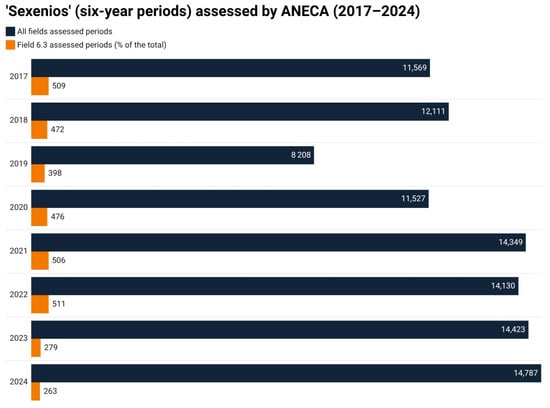
To contextualize this discussion, the article considers two complementary sources of evidence. The first consists of publicly available ANECA statistics concerning sexenio evaluations in Field 6.3 between 2017 and 2024, including application volumes, success rates, and positive evaluations. This complete series of official, anonymized public administrative data from ANECA provides an overview of recent tendencies in research assessment and forms the basis of the institutional context presented in Figure 1.
Figure 1.
Number of research assessments (sexenios) evaluated in Field 6.3 and across all fields in Spain (2017–2024). Source: Authors’ elaboration based on publicly available ANECA sexenio evaluation data (2017–2024).
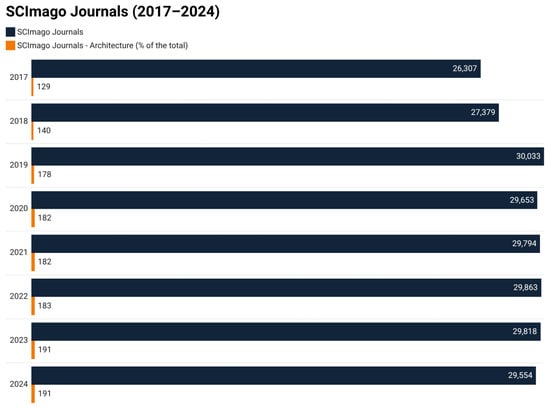
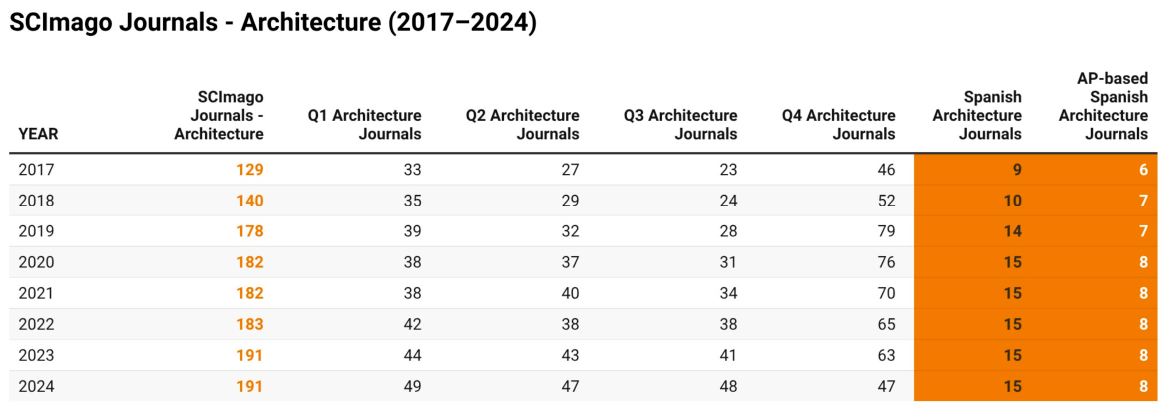
The second source of evidence focuses on publication tendencies within Architectural Projects (AP). To situate these tendencies, data obtained from Scopus were used to examine the relative presence of architecture journals within the broader indexed publishing landscape, as illustrated in Figure 2. Building on this overview, an exploratory review of 211 articles authored by faculty members affiliated with Architectural Projects departments in Spanish universities was undertaken. The purpose of this review was not to establish a comprehensive bibliometric account of the field, but rather to obtain an indicative picture of dominant research orientations and publication practices.
Figure 2.
Relative presence of architecture journals within the broader Scopus-indexed publishing landscape (2017–2024). Source: Authors’ elaboration based on Scopus/SCImago Journal & Country Rank (SJR) data (2017–2024).
Particular attention was paid to the relationship between research and project production, distinguishing between studies centered on the author’s own project and those focused on projects, works, or ideas developed by others. This review provides contextual evidence of how architectural research is currently represented in publication practices and, more specifically, of the place the project occupies within recognized scholarly outputs.
These observations help illuminate a broader disciplinary condition: the persistent difficulty of articulating the architectural project as a recognized form of research output within prevailing systems of evaluation and scholarly communication. In response to this condition, the temporal framework proposed in this article is developed.
4. Contextual Observations
4.1. Institutional Indicators and Publication Patterns
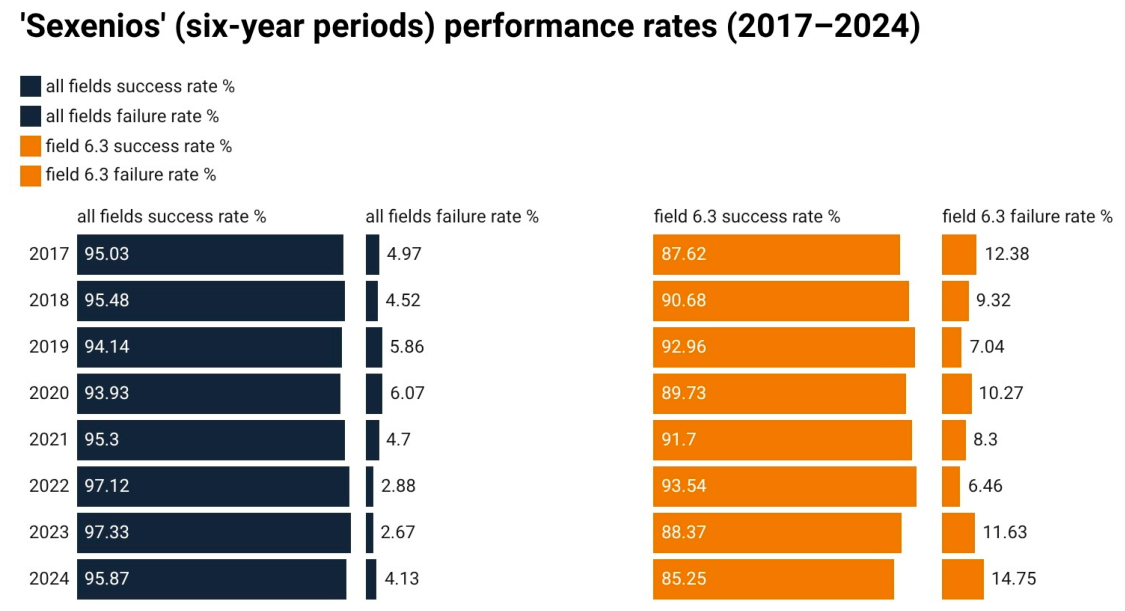
The analysis of ANECA’s publicly available data for Field 6.3 reveals significant trends in research evaluation outcomes between 2017 and 2024 (ANECA, 2024).
Positive evaluations have declined markedly over the observed period. In 2017, Field 6.3 recorded 446 successful sexenio assessments, whereas by 2024, this figure had dropped to 224 (derived from 263 total evaluations at an 85.25% success rate), representing a reduction of nearly 50%. This downward trend contrasts with the overall national pattern, in which the total number of submissions across all fields increased over the same timeframe.
The rate of negative decisions in Field 6.3 has consistently exceeded the national average across all evaluated years, reaching up to two to more than four times the general non-approval rate in specific calls (e.g., 11.63% failure rate in Field 6.3 vs. 2.67% overall in 2023, representing a ratio of 4.36×, and 14.75% vs. 4.13% in 2024, representing 3.57×), illustrating a persistent evaluation gap compared to other scientific domains. Furthermore, the volume of applications within Field 6.3 has decreased, even as the aggregate number of applications across all fields has grown, suggesting a relative contraction in participation from this area (Figure 3).
Figure 3.
Comparative success rates of sexenio evaluations in Field 6.3 and across all disciplinary fields in Spain (2017–2024). Source: Authors’ elaboration based on ANECA public statistics (2017–2024).
The review of indexed journals and publication practices reveals structural limitations that significantly shape research output in the field. In 2024, Scopus listed over 29,554 active scientific journals; yet only 191 addressed architecture broadly. Among these, 28 Q1 titles concentrated on technical domains such as construction, structural engineering, and sustainability. Despite the presence of architecture-related journals, the proportion dedicated to AP remains marginal. Notably, none of these high-impact journals is based in Spain, underscoring the absence of national platforms with strong international visibility.
Spanish journals specifically aligned with the AP are few and are positioned in the lower quartiles: two in Q2, three in Q3, and three in Q4 (Figure 4). This limited representation contrasts sharply with the humanities-oriented segment, where 446 international journals—including 116 Q1 titles—cover aesthetics, criticism, and cultural studies. This distribution highlights a structural alignment where researchers frequently publish in humanities-oriented journals, reflecting a broader disciplinary tendency toward retrospective and critical scholarship rather than a direct causal shift.
Figure 4.
Distribution of architecture journals by quartile and thematic orientation within the Scopus database (2024). Source: Authors’ elaboration based on SCImago Journal & Country Rank (SJR)/Scopus indicator data (2024).
4.2. Exploratory Review of Publication Tendencies
To examine publication tendencies within the field, the eight Scopus-indexed Spanish journals specifically aligned with Architectural Projects (AP) identified in Section 4.1 (ACE, EGA, Boletín Académico, ZARCH, VLC arquitectura, Proyecto Progreso Arquitectura, VEREDES, and RA. Revista de Arquitectura) were reviewed. On average, these journals publish approximately 28 articles annually. From this body of literature covering the period 2017–2024, an exploratory sample of 211 peer-reviewed research articles authored or co-authored by faculty members affiliated with Architectural Projects departments in Spanish public universities was selected.
Rather than providing a comprehensive bibliometric account, the review offers an indicative picture of dominant research orientations. To ensure methodological transparency and clarity, the exploratory review of the 211 research articles was conducted through a structured collaborative protocol. The primary corpus was compiled from all original research articles published between 2017 and 2024 across the eight Scopus-indexed Spanish AP journals. The journal sample was partitioned between the two authors to extract publication metadata and perform initial binary categorization according to the criteria defined in Table 1. Following this initial extraction, both authors conducted a comprehensive joint review of the entire dataset to verify classifications, resolve edge cases through mutual agreement, and confirm final coding consistency. In line with standard repository practices, the complete working dataset of reviewed publications is maintained by the authors and made available from the corresponding author upon reasonable request.
Table 1.
Methodological and coding protocol for the exploratory review of 211 publications.
Within this broad distribution, two dominant orientations emerge. A substantial proportion of publications engage with historical projects through empirical, documentary, or hermeneutic approaches, while another significant group concerns interpretative frameworks linked to aesthetics, criticism, and architectural theory. By contrast, publications that explicitly employ the project itself as an active instrument of inquiry appear comparatively infrequent.
Although the review is not intended as a definitive account of AP research production, it suggests a tendency for architectural knowledge to be communicated primarily through retrospective interpretation rather than through direct engagement with the design process as a site of knowledge generation. In many cases, the project is approached primarily through retrospective analysis, with comparatively fewer publications engaging directly with the design process itself.
A complementary examination of institutional repositories and ORCID profiles reinforces this impression. Much of the published research emphasizes conceptual interpretation, historical analysis, or disciplinary critique. These contributions frequently provide valuable insights into architectural culture and history, yet they often remain detached from the processes through which architectural decisions are conceived, tested, modified, and implemented. Consequently, the project tends to appear as a completed artifact rather than as an evolving research process.
From this perspective, the issue is not the predominance of historical, theoretical, or critical studies, all of which constitute legitimate and necessary forms of architectural scholarship. Rather, the review points to the relative scarcity of publications in which the author’s own project functions as a vehicle for investigation, experimentation, and knowledge production.
Taken together, these observations do not establish causal explanations, nor do they seek to evaluate the quality of existing scholarship. Instead, they help illuminate a disciplinary condition that provides part of the context for the argument developed in this article: the continuing difficulty of integrating project-centered forms of inquiry within dominant systems of scholarly communication and research recognition.
5. Toward a Temporal Framework for Interpreting Architectural Research Outputs
5.1. From Object to Process
The contextual observations presented in the previous sections point to a broader disciplinary question: how should architectural research outputs be interpreted when the project itself acts not merely as an object of study but also as a medium of knowledge production?
Conventional approaches to research assessment frequently focus on completed outputs, whether these take the form of publications, artifacts, buildings, exhibitions, or technical innovations. Within this logic, the architectural project is often reduced to its final material manifestation, while the complex sequence of inquiries, decisions, tests, adaptations, and evaluations that precede the built outcome receives comparatively little attention.
This reduction is particularly problematic for disciplines in which knowledge production occurs through action. As discussed in the previous section, architectural research increasingly recognizes the project not only as an outcome but also as a site of inquiry and knowledge generation (Martin, 2016; Luck, 2019). From this perspective, limiting interpretation to the completed artifact risks overlooking the processes through which architectural knowledge is actually produced, tested, and transformed.
Rather than understanding the architectural project solely as a finished object, this article proposes interpreting it as a temporally extended process through which different forms of knowledge emerge and become visible. Such a perspective shifts attention from the completed artifact to the sequence of transformations that lead to it, creating an alternative lens through which architectural research outputs may be interpreted.
5.2. Three Temporal Positions of Research
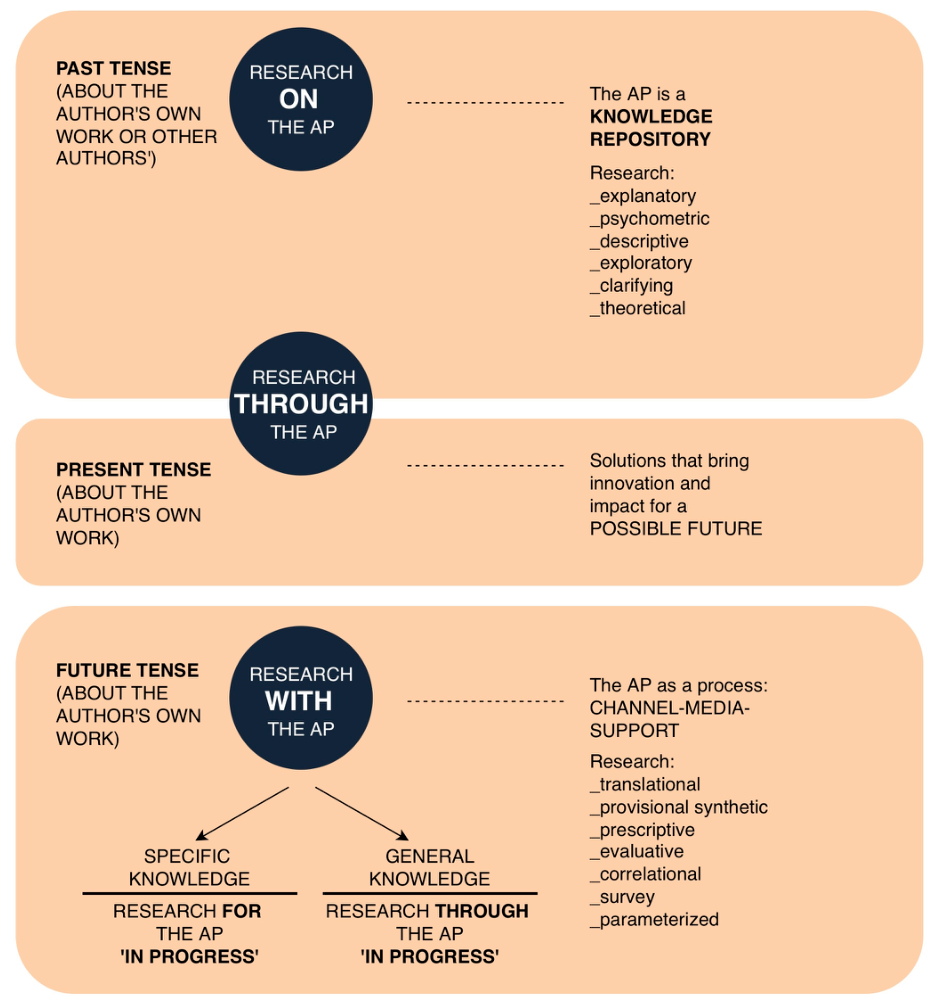
The framework proposed here introduces temporality as an interpretative dimension for understanding the relationship between research and the architectural project. Rather than classifying research according to disciplinary boundaries or methodological traditions, it distinguishes three broad temporal positions that correspond to different ways of engaging with the project (Figure 5).
Figure 5.
Temporal framework for interpreting research centered on the Architectural Project (AP). Source: Authors’ own elaboration.
The first position is Research ON the AP. In this category, the project functions as a repository of knowledge and becomes the object of investigation. Research commonly focuses on completed works, historical cases, precedents, theoretical interpretations, or critical analyses. Knowledge is generated retrospectively and is fundamentally oriented toward understanding what has already occurred. Within this temporal perspective, the project belongs to the past and is interpreted through explanatory, descriptive, exploratory, clarifying, psychometric, or theoretical forms of inquiry.
The second position is Research THROUGH the AP. Here, the project operates as an active instrument of investigation. Knowledge emerges during the design process itself as researchers formulate hypotheses, compare alternatives, test assumptions, document decisions, and evaluate emerging outcomes. The project is no longer merely observed but becomes part of the research apparatus through which inquiry is conducted.
The third position is Research WITH the AP. In this perspective, the project acts as a vehicle for generating future-oriented transformations. The emphasis shifts from understanding existing conditions to producing and evaluating possible futures. Research activities become associated with translational, synthetic, prescriptive, implementation-oriented, evaluative, correlational, survey-based, or parametric modes of inquiry. Knowledge production is thus connected to future consequences, applications, and societal impacts.
Taken together, these three temporal positions should not be understood as mutually exclusive categories. Architectural research frequently moves across them, combining retrospective analysis, present inquiry, and future projection within the same research trajectory. The framework, therefore, functions as an interpretative device rather than a rigid classification system.
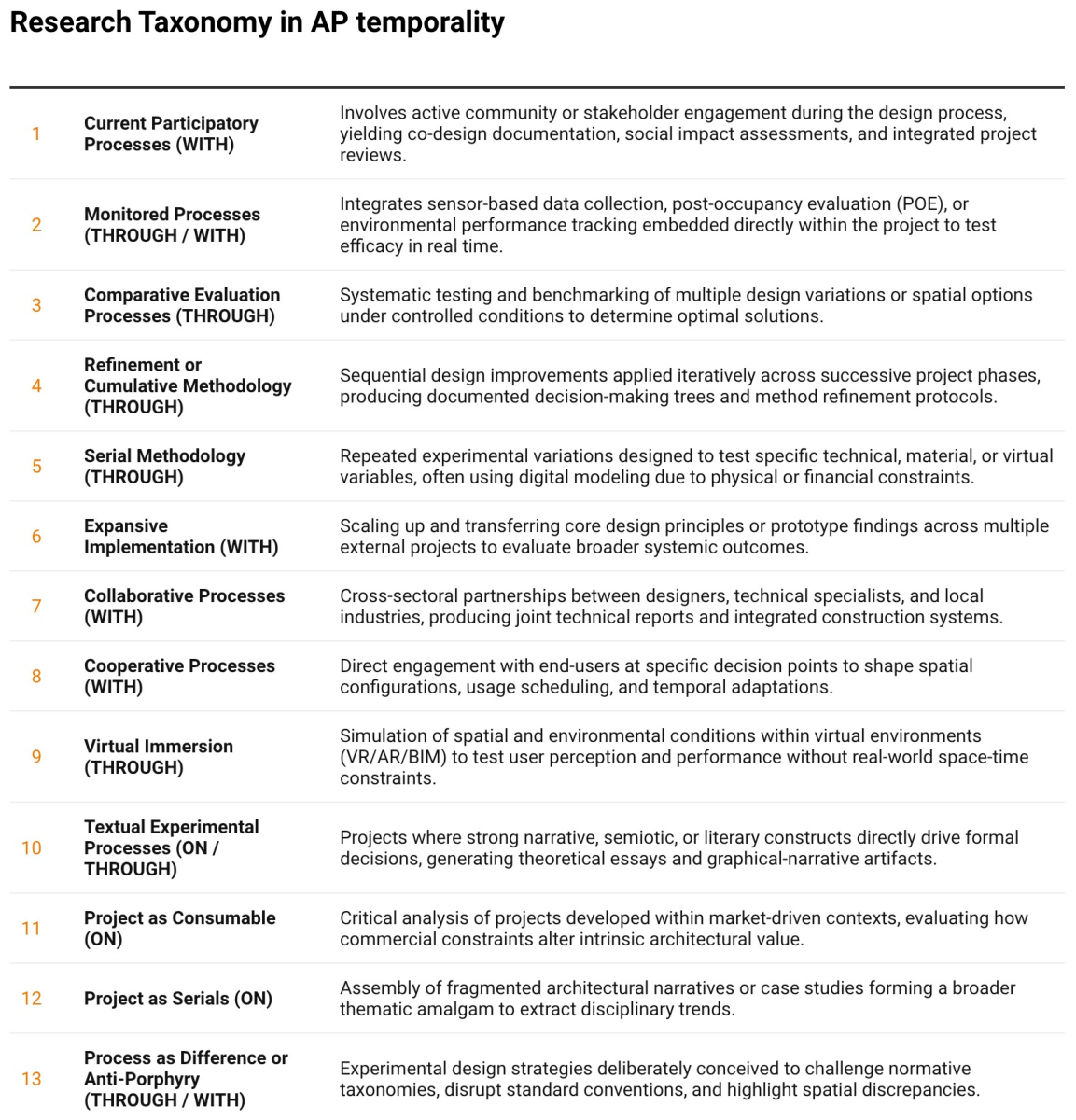
Building upon initial editorial and conceptual observations regarding the institutional visibility of project-centered inquiry (Barrera-Puigdollers, 2025), the present framework formalizes those preliminary insights into a structured operational taxonomy. Whereas earlier work identified the evaluation gap facing architectural project outputs and listed qualitative design approaches, this ON–THROUGH–WITH model establishes the structured temporal continuum, comparative positioning (Table 2), and heuristic configurations (Figure 6) required for systematic research assessment by accreditation panels and evaluation bodies.
Table 2.
Comparative analysis between existing design research taxonomies and the proposed ON–THROUGH–WITH framework.
Figure 6.
Heuristic matrix of project-centered research configurations mapped across temporal positions. Source: Authors’ own elaboration.
Crucially, a clear distinction must be maintained between temporal–epistemological positions and specific research methodologies. The ON–THROUGH–WITH framework categorizes the researcher’s epistemic relationship to the project across time, rather than prescribing fixed methodological tools. Methodological approaches—such as archival analysis, survey-based studies, parametric simulations, performance monitoring, or psychometric assessments—are not bound to a single temporal phase. For instance, computational modeling can be employed retrospectively to analyze historical structures (ON), operatively during live design iterations (THROUGH), or prospectively to simulate future environmental performance (WITH). Consequently, specific techniques function as transversal tools that can serve different epistemic purposes depending on the temporal stance adopted.
To explicitly clarify how this ON–THROUGH–WITH framework advances beyond the classical and contemporary design research taxonomies reviewed in Section 2 (such as Frayling, 1993; Archer, 1995; Findeli et al., 2008; Jonas, 2007; van de Weijer et al., 2014; Luck, 2019), its core theoretical contribution lies in an integrated interpretation defined by three key advances:
- Temporal Dynamism: It replaces static, isolated methodological categories with a dynamic vector, tracking how the architectural project evolves over time from prior analysis (ON), through live operative design experimentation (THROUGH), to prospective, situated co-design and societal implementation (WITH).
- Epistemic Continuum: It articulates the transition of architectural knowledge from tacit design moves into explicit, communicable theory, positioning the project as an active epistemic engine that bridges analytical problem definition and mimetic synthesis.
- Unified Evaluation Scope: It connects academic validation (knowledge production), professional efficacy (improving practice), and societal impact (end-user and community empowerment) into a comprehensive evaluative structure.
Table 2 synthesizes the comparative analysis between the proposed framework and established design research classifications.
5.3. The Architectural Project as Channel, Medium, Support, and Prosthesis
From a temporal perspective, the architectural project assumes different epistemic functions throughout its development.
First, the project constitutes a graphic and textual corpus through which theories, assumptions, technical parameters, and creative propositions are formulated and communicated. In this sense, the project functions as a channel, making ideas visible and enabling their circulation within disciplinary and professional contexts (Sainz, 1990). In some cases, it may even operate as a “channel of channels,” opening multiple directions for subsequent investigation.
Second, the project serves as a medium and support for inquiry. Architectural design involves the continuous negotiation of alternatives, constraints, opportunities, and evaluations. Although these processes do not always adopt the formal structure of scientific experimentation, they generate evidence, comparisons, and decisions that may contribute to broader forms of knowledge production when adequately documented and communicated (Ricarte, 1998).
Third, before construction, the project operates as a prosthesis, substituting a future reality through drawings, models, simulations, specifications, and projections. The project temporarily assumes the role of the building itself, allowing consequences to be anticipated, tested, modified, and evaluated before material realization takes place. Once executed, the built work becomes an object in the world, yet the knowledge embedded in its development remains distributed across the temporal sequence that produced it.
This interpretation helps explain the continuing relevance of unbuilt projects within architectural culture. Projects such as Le Corbusier’s Ville Radieuse or Mies van der Rohe’s Friedrichstraße schemes generated lasting influence despite their lack of physical realization. Their impact originated not from construction itself but from their capacity to reorganize disciplinary knowledge, demonstrating that research value may reside in processes, propositions, and trajectories as much as in completed artifacts.
5.4. Toward a Temporal Taxonomy of Research Outputs
The temporal perspective developed above provides a basis for reconsidering how architectural research outputs may be interpreted and communicated.
Within this framework, project-centered research extends beyond the production of singular objects. Research outcomes may include design principles, protocols, standards, evaluation procedures, formal grammars, decision-making strategies, diagrams, or transferable processes. What matters is not simply the final form achieved but the project’s capacity to generate communicable and transferable knowledge.
This perspective also helps clarify the distinction between architectural singularity and research contribution. A building may be unique without producing transferable knowledge, just as a project may generate valuable knowledge independently of its eventual construction. The relevant issue is therefore not the exceptional nature of the outcome but the extent to which design processes, tested alternatives, monitored transformations, and evaluative procedures can be articulated as forms of inquiry.
Such an approach aligns with broader discussions concerning iterability, heuristic reasoning, cumulative learning, and situated forms of verification in architectural research (Baxandall, 1985; Stiegler, 2005). It also resonates with contemporary debates on research-through-design and practice-based research, where knowledge emerges through cycles of action and reflection rather than through the linear validation of predefined hypotheses.
While Figure 5 establishes the core temporal logic of the ON–THROUGH–WITH framework, Figure 6 translates this logic into a heuristic matrix of project-centered research configurations. Rather than functioning as a closed or rigid normative classification, these 13 categories were derived inductively by synthesizing theoretical reasoning with qualitative observations of existing architectural research practices—including patterns identified during our exploratory review of project outputs.
These configurations outline specific ways in which inquiry is embedded within, conducted through, or extended alongside the architectural project across time:
- Research ON the AP (Retrospective Inquiry): Configurations such as Textual Experimental Processes (10), Project as Consumable (11), and Project as Serials (12) engage with past projects or narratives to extract critical, theoretical, or market-driven knowledge. Additionally, the configuration Textual Experimental Processes (10) operates at the intersection of ON/THROUGH, using textual–graphic narratives both to analyze precedent works and to drive live formal decisions.
- Research THROUGH the AP (Operative/Process Inquiry): Configurations such as Comparative Evaluation Processes (3), Refinement or Cumulative Methodology (4), Serial Methodology (5), Virtual Immersion (9), and Process as Difference or Anti-Porphyry (13) operate in real time during the design process, using iterations, simulations, and decision-making trees as primary experimental vehicles. Furthermore, Process as Difference or Anti-Porphyry (13) functions as a THROUGH/WITH hybrid, deploying experimental strategies to challenge normative conventions during design and in prospective realization.
- Research WITH the AP (Prospective/Situated Inquiry): Configurations such as Current Participatory Processes (1), Monitored Processes (2), Expansive Implementation (6), Collaborative Processes (7), and Cooperative Processes (8) extend into real-world contexts, engaging end-users, industries, and performance-tracking systems to evaluate prospective societal and environmental outcomes. Similarly, the configuration Monitored Processes (2) acts as a THROUGH/WITH hybrid, integrating real-time sensor data during design testing while extending into prospective post-occupancy evaluation (POE) in built environments.
Together, these configurations provide evaluators, institutions, and scholars with an open, operational vocabulary for recognizing, documenting, and assessing non-conventional research outputs beyond traditional written formats.
To demonstrate how this temporal framework operates across published scholarship, representative research articles exemplify each position. In the retrospective realm of Research ON the AP, Colquhoun (1966/2009) conducts a critical analysis of two late projects by Le Corbusier—the French Embassy in Brasilia and the Venice Hospital—examining how ideal geometrical schemata interact with functional logic to extract enduring theoretical principles. Operating within the live, process-based orientation of Research THROUGH the AP, Chi et al. (2021) deploy an ongoing dynamic shading project for a public space in Cancun as an active operative medium, using parametric modeling, multi-objective evolutionary algorithms, and microclimate simulations to test daylight and outdoor thermal comfort iterations in real time. Finally, illustrating the prospective and situated stance of Research WITH the AP, Brysch et al. (2024) explore the project as a relational vehicle through a longitudinal study of the La Borda housing cooperative in Barcelona, documenting how co-design processes, participatory value-setting, and user negotiations generate transferable social innovation and housing delivery protocols.
As mapped across the matrix in Figure 6, these representative instances illustrate how the ON–THROUGH–WITH framework can be operationally applied to published scholarship. Rather than providing a formal empirical validation, these cases serve as demonstrative examples showing how diverse practice-based outputs can be legibly organized across temporal stances.
In this sense, the temporal framework is not proposed as a replacement for existing research classifications. Instead, it offers an additional interpretative layer that accommodates the specific temporalities through which architectural knowledge often develops.
6. Conclusions
This article has examined a persistent tension between architectural knowledge production and the frameworks through which research outputs are commonly recognized and evaluated. While the discussion has been grounded in the Spanish context, the issues identified extend beyond national boundaries and resonate with broader debates surrounding practice-based research, research-through-design, and the assessment of disciplinary forms of knowledge.
The contextual evidence presented in this study highlights a series of converging tendencies. On the one hand, architecture continues to enjoy significant professional and cultural recognition. On the other hand, project-centered forms of inquiry remain only partially visible within dominant systems of research evaluation and scholarly communication. The observations derived from research assessment indicators and publication tendencies are not intended to provide definitive explanations for this situation. Rather, they illustrate a disciplinary condition that raises important questions regarding the interpretation of architectural research outputs.
In response to this condition, the article has proposed a temporal framework for interpreting architectural research centered on the AP. By organizing research into three complementary positions—Research ON (retrospective analysis), Research THROUGH (in-process design inquiry), and Research WITH (prospective and situated implementation)—the model shifts attention from static completed artifacts to the temporal sequences of decisions, testing, and transformations through which architectural knowledge unfolds.
As illustrated through the 13 research configurations in Figure 6 and exemplified through representative literature, the framework provides an open operational vocabulary rather than a rigid normative classification. Crucially, this temporal model offers evaluators, accreditation bodies, and academic panels a practical tool to assess non-conventional practice-based outputs. Rather than forcing project-centered inquiry into restrictive bibliometric templates, evaluators can systematically identify whether a submission generates knowledge through prior precedent inquiry (ON), live experimental design iterations (THROUGH), or prospective societal and policy transfer (WITH), establishing rigorous criteria based on evidence, decision-tree documentation, and impact across time.
Ultimately, the proposed framework reframes how architectural outputs are recognized, offering a shared, communicable lens that bridges the longstanding divide between professional design activity and academic research evaluation.
Author Contributions
Conceptualization, J.M.B.-P. and D.D.-C.; methodology, J.M.B.-P. and D.D.-C.; formal analysis, J.M.B.-P. and D.D.-C.; investigation, J.M.B.-P. and D.D.-C.; data curation, J.M.B.-P.; writing—original draft preparation, J.M.B.-P.; writing—review and editing, D.D.-C.; visualization, D.D.-C.; supervision, D.D.-C. All authors have read and agreed to the published version of the manuscript.
Funding
This research received no external funding.
Data Availability Statement
Publicly available administrative datasets on national sexenio evaluations were analyzed in this study and are available on the official ANECA website (https://www.aneca.es). Bibliometric data were obtained from Scopus (https://www.scopus.com) and are subject to institutional licensing and subscription conditions. The derived dataset generated during the exploratory review of the 211 publications is summarized in Table 1 and is available from the corresponding author upon reasonable request.
Acknowledgments
During the preparation of this manuscript, the authors used Generative AI tools solely for English language editing, proofreading, and stylistic refinements to improve readability. The authors have thoroughly reviewed and edited the output and take full responsibility for the content and scientific integrity of this publication.
Conflicts of Interest
The authors declare no conflicts of interest.
Abbreviations
The following abbreviations are used in this manuscript:
| AP | Architectural Project |
| ANECA | National Agency for Quality Assessment and Accreditation |
References
- Alaie, A., Ziashahabi, N., Ekhlassi, A., Faizi, M., & Yazdanfar, S. (2025). A systematic review of design research approaches in architectural design processes. International Journal of Architecture and Urban Development, 15, 5–16. [Google Scholar] [CrossRef]
- ANECA. (2024). Concedidos el 97,35% de los sexenios de investigación de funcionarias/os. Available online: https://www.aneca.es/-/concedidos-el-97-35-de-los-sexenios-de-investigaci%C3%B3n-de-funcionarias/os (accessed on 24 September 2026).
- Archer, B. (1995). The nature of research. Co-Design, 2, 6–13. [Google Scholar]
- Association of Collegiate Schools of Architecture (ACSA). (2019). ACSA white paper on assessing the quality of architectural research & scholarship. ACSA. Available online: https://www.acsa-arch.org/wp-content/uploads/2019/08/2019-qualityarchitecturalresearch-whitepaper-workingdoc.pdf (accessed on 8 March 2026).
- Barrera-Puigdollers, J. M. (2025). Editorial findings in architectural projects. VLC Arquitectura. Research Journal, 12, 5–8. [Google Scholar]
- Baxandall, M. (1985). Patterns of intention: On the historical explanation of pictures. Yale University Press. [Google Scholar]
- Brysch, S. L., Garcia i Mateu, A., & Czischke, D. (2024). The process of value setting through co-design: The case of La Borda, Barcelona. CoDesign, 20, 405–421. [Google Scholar] [CrossRef] [Scilit]
- Chi, D. A., González, M. E., Valdivia, R., & Gutiérrez, J. E. (2021). Parametric design and comfort optimization of dynamic shading structures. Sustainability, 13, 7670. [Google Scholar] [CrossRef] [Scilit]
- Colquhoun, A. (2009). Formal and functional interactions: A study of two late buildings by le corbusier. Architectural Design, 79, 27–33, (Original work published 1966). [Google Scholar]
- Domingo-Calabuig, D., Cabrera i Fausto, I., & Giménez-Ribera, M. (2013a). Las revistas de investigación de arquitectura y urbanismo: Adaptación de una especificidad temática a los procesos de evaluación. In M. T. Ramiro Sánchez, T. Ramiro Sánchez, & M. P. Bermúdez Sánchez (Eds.), FECIES 2013: X foro internacional sobre evaluación de la calidad de la investigación y de la educación superior (pp. 179–185). Asociación Española de Psicología Conductual. [Google Scholar]
- Domingo-Calabuig, D., Mas-Llorens, V., & Azulay-Tapiero, M. (2013b, October 23–25). Procesos de evaluación de la actividad investigadora en arquitectura: Un estudio comparado. The V Jornadas Internacionales Sobre Investigación en Arquitectura y Urbanismo (JIAU 2013) (pp. 1–10), Las Palmas de Gran Canaria, Spain. [Google Scholar]
- EFE Comunica. (2024). Spanish projects win the 2024 European Bauhaus Awards. Available online: https://efecomunica.efe.com/en/spanish-projects-win-the-2024-european-bauhaus-awards/ (accessed on 24 September 2026).
- Findeli, A., Brouillet, D., Martin, S., Moineau, C., & Tarrago, R. (2008). Research through design and transdisciplinarity: A tentative contribution to the methodology of design research. In Focused: Current design research projects and methods, proceedings of the Swiss design network symposium 2008 (pp. 67–89). Swiss Design Network. [Google Scholar]
- Frayling, C. (1993). Research in art and design (Royal College of Art Research Papers, Vol. 1, No. 1). Royal College of Art. [Google Scholar]
- Herr, C. M. (2017). Action research as a research method in architecture and design. In Proceedings of the 60th annual meeting of the international society for the systems sciences (ISSS 2016), Boulder, CO, USA, 24–29 July 2016 (pp. 1–12). ISSS. [Google Scholar]
- Jonas, W. (2007). Design research and its meaning to the methodological development of the discipline. In R. Michel (Ed.), Design research now: Essays and selected projects (pp. 187–206). Birkhäuser. [Google Scholar] [CrossRef] [Scilit] [PubMed]
- Luce, M., Pfarr-Harfst, M., Reeh, J., Schröder, J., & Tessmann, O. (2023). Evaluating research excellence in architecture: A view from German technical universities towards a European perspective. ARENA Journal of Architectural Research, 8(1), 9. [Google Scholar] [CrossRef] [Scilit]
- Luck, R. (2019). Design research, architectural research, architectural design research: An argument on disciplinarity and identity. Design Studies, 65, 152–166. [Google Scholar] [CrossRef] [Scilit]
- Madan, A. (2026). Theorising architectural practice as research: Epistemic knowledge production in contemporary Indian architecture. Archnet-IJAR, 20, 105–122. [Google Scholar] [CrossRef] [Scilit]
- Malec, T. E. (2025). Architectural research: An academic textbook for students of architecture. Springer. [Google Scholar] [CrossRef] [Scilit]
- Martin, L. (2016). Architects + research. arq Architectural Research Quarterly, 20, 189–191. [Google Scholar] [CrossRef] [Scilit]
- Ministerio de Educación y Ciencia. (1994). Orden de 2 de Diciembre de 1994 por la que se establece el procedimiento para la evaluación de la actividad investigadora. Boletín Oficial del Estado, 289, BOE-A-1994-26927. [Google Scholar]
- Ricarte, J. M. (1998). Creatividad y comunicación persuasiva. Universitat Autònoma de Barcelona. [Google Scholar]
- Roggema, R. (2017). Research by design: Proposition for a methodological approach. Urban Science, 1, 2. [Google Scholar] [CrossRef] [Scilit]
- Sainz, J. (1990). El dibujo de arquitectura: Teoría e historia de un lenguaje gráfico. Nerea. [Google Scholar]
- Salvador-Luján, N., Navarro-Bosch, A., & Barrera-Puigdollers, J. M. (2024, October 3–6). La violencia en la denominación; arquitectura sostenible enlazado con las dinámicas de género. The VI International Conference on Architecture and Gender (ICAG2023), Valencia, Spain. [Google Scholar] [CrossRef] [Scilit]
- Stiegler, B. (2005). Pasar al acto. Hiru Argitaletxea. [Google Scholar]
- Till, J. (2008). Three myths and one model. Building Materials, 17, 4–10. [Google Scholar]
- Torres-Cueco, J. (2017). El proyecto de arquitectura como investigación académica. En investigaciones departamentos de proyectos arquitectónicos 2017 (Idpa 03) (R. M. Añón Abajas, & J. J. Vázquez Avellaneda, Eds.; pp. 13–29). Recolectores Urbanos. [Google Scholar]
- Universidad de Almería. (2024). Several Spanish projects awarded at the New European Bauhaus Awards and European Urban Initiative call for proposals. Available online: https://www.cde.ual.es/en/several-spanish-projects-awarded-at-the-new-european-bauhaus-awards-and-european-urban-initiative-call-for-proposals/ (accessed on 24 September 2026).
- van de Weijer, M., van Cleempoel, K., & Heynen, H. (2014). Positioning research and design in academia and practice: A contribution to a continuing debate. Design Issues, 30, 17–29. [Google Scholar] [CrossRef] [Scilit]

Disclaimer/Publisher’s Note: The statements, opinions and data contained in all publications are solely those of the individual author(s) and contributor(s) and not of MDPI and/or the editor(s). MDPI and/or the editor(s) disclaim responsibility for any injury to people or property resulting from any ideas, methods, instructions or products referred to in the content. |
© 2026 by the authors. Licensee MDPI, Basel, Switzerland. This article is an open access article distributed under the terms and conditions of the Creative Commons Attribution (CC BY) license.