


Abstract
Aligning mental health research with territorial health needs remains a critical goal, yet the global distribution, coherence, and impact of scientific output across income groups remain poorly understood. We conducted a meta-research study combining scientometric analyses with longitudinal data on 60 health and development indicators. Over 386,000 peer-reviewed publications were retrieved from five major databases. Linear regressions, meta-analyses, and meta-regressions were performed, stratified by World Bank income classification. We find that high-income countries (HICs) accounted for 67% of publications, exhibiting the highest research density but the lowest potential marginal health returns. In contrast, low-income countries (LICs) showed the strongest associations between research volume and improvements in life expectancy (β = 0.13; p < 0.01) and child mortality (β = −1.38; p < 0.01). Structural moderators such as governance quality, health expenditure, and education explained up to 48% of between-group variance. In conclusion, the global landscape of mental health research remains unequal. While scientific production is concentrated in HICs, its population-level association is greatest in LICs. These findings underscore the need to redirect investments and enhance research coherence with health needs, particularly through governance safeguards and capacity building in underrepresented regions.
1. Introduction
Mental health disorders have been recognized as a leading cause of disability worldwide (Ferrari et al., 2024; World Health Organization, n.d.-c), yet uneven growth in the evidence base has been documented across regions and income levels (World Health Organization, n.d.-c; Yalcin et al., 2022; Zhang et al., 2025). The expansion of mental health research has accelerated in recent decades. Comprehensive knowledge of how scientific output has evolved in relation to local health needs has therefore been regarded as a critical prerequisite for achieving the ambitions set out in the current global mental health roadmaps (World Health Organization, 2022). However, little is known about its alignment with global health needs or its distributional equity across country income groups. Assessment of evidence availability, and of its alignment with epidemiological and service gaps, has been particularly urgent for low- (LICs) and lower-middle-income countries (LMICs) (World Health Organization, 2021, 2022), where treatment resources remain scarce and policy agendas continually compete for limited funds (Faija et al., 2025; World Health Organization, 2021, 2022).
Guidance issued by the United Nations (UN) (United Nations, n.d.-a), the World Health Organization (WHO) (World Health Organization, 2021, 2022), and allied bodies has repeatedly underscored that a sustainable future depends on synchronizing research agendas with territorial health priorities (i.e., country-level burden and service gaps) (Heymann & Sprague, 2023). Regular monitoring of the scientific corpus has been recommended as a means to track both the pertinence and the coherence of produced knowledge, especially in contexts marked by pronounced economic inequity (World Health Organization, 2007). Empirical assessments have also shown marked disparities in authorship and output across regions and income strata, with limited representation from many LMIC settings (Acuña-Rodríguez et al., 2025; Gmeiner et al., 2022; Yalcin et al., 2022). Despite substantial bibliometric and global mental health research describing publication patterns, treatment gaps, and regional inequities, systematic evaluations that jointly integrate longitudinal research trajectories with multi-domain macro-level indicators of health, development, and governance within an income-stratified framework remain scarce, and the dynamic relationship between research production and structural determinants (e.g., governance, expenditure, education) has yet to be examined longitudinally (World Health Organization, n.d.-c, 2021, 2022).
Consequently, uncertainty has persisted regarding whether scientific activity is keeping pace with population-level mental health needs (e.g., life expectancy, mortality, coverage), whether imbalances are widening or narrowing over time, and which economic, social, or governance factors modulate these trajectories (American Psychological Association, 2024; Wahlbeck, 2015). In parallel, major cross-country data gaps in nationally representative prevalence estimates constrain comparability and priority-setting (Casella et al., 2025). Absence of this information limits the capacity of researchers, funding agencies, and policymakers to allocate resources effectively or to advocate for corrective action where mismatches are detected (Zhou et al., 2018). A comprehensive appraisal that links the volume of mental-health scholarship to contextual metrics (the indicators used for cross-country comparison) is therefore indispensable to gauge the responsiveness of the global knowledge ecosystem and to identify leverage points for future investment and action plans (Lozada-Martinez et al., 2025b).
By integrating scientometric methods with contextual health and structural indicators, this study moves beyond traditional output metrics to examine the association based proxy measure of “translational alignment” in mental health research, defined as whether publication volume covaries longitudinally with population-level indicators and how this relationship differs across structural conditions such as governance, expenditure, and education, consistent with the need to strengthen knowledge mobilisation, particularly in LMIC contexts (Faija et al., 2025). This intersectional approach addresses persistent gaps in the meta-scientific understanding of research relevance, equity, and utility while avoiding causal interpretation.
To close these empirical and theoretical gaps, this study adopts a meta-research perspective to explicitly address three core questions: (1) Is global mental health research being produced in proportion to territorial health needs across income groups? (2) Does increased scientific output translate into measurable improvements in population-level mental health outcomes? (3) Which structural, socioeconomic, or governance factors modulate this relationship? Through a longitudinal, income-stratified scientometric analysis combined with meta-regression models, we assess both the quantity and contextual associations of mental health publications, thereby informing strategies for more equitable and responsive global research investment.
2. Materials and Methods
- Study design
Longitudinal meta-research study based on secondary, country–year repeated measures. This study was conducted as an applied meta-research investigation, aimed at assessing the coherence between scientific production in global mental health and territorial health and structural needs across income groups.
- Data sources
Methodological rigor and exhaustive coverage were secured through a systematic search of internationally recognized databases: Scopus, PubMed/MEDLINE, Web of Science Core Collection, SciELO Citation Index, and KCI-Korean Journal Database. Database inclusion was determined by their broad geographical representation, extensive indexing of health and biomedical literature, and stringent peer-review standards. Reliance on platforms with rigorous entry criteria and robust citation infrastructures heightened the reliability and reproducibility of the ensuing analyses. Extensive use of these resources in studies of comparable breadth has been documented previously (Andreasen et al., 2022; Sparling et al., 2022), thereby further validating the methodological framework adopted in this analysis.
- Search strategy
A structured, conceptually grounded search strategy, rooted in Medical Subject Headings (MeSH) and corresponding synonyms, was formulated to maximize precision and reproducibility. The descriptor “Mental Disorders” (MeSH Unique ID D001523) served as the foundational term; as a third-order concept (Tree Number F03), it subsumes a recognized spectrum of official disorders and their accepted synonyms, thereby permitting systematic retrieval of peer-reviewed studies that examine, analyse, or evaluate mental health conditions across diverse scientific fields.
During the preliminary phase, pilot queries were iteratively executed across multiple databases and search engines to refine combinations of descriptors and indexing tags. Performance metrics, relevance, sensitivity, and specificity guided successive adjustments to the search logic. The version demonstrating the greatest consistency and precision when tested in Scopus was: TITLE-ABS-KEY (“Mental Disorder” OR “Mental Illness” OR “Mental Illnesses” OR “Psychiatric Disorders” OR “Psychiatric Disorder” OR “Psychiatric Diseases” OR “Psychiatric Disease” OR “Psychiatric Illness” OR “Psychiatric Illnesses” OR “Behavior Disorders” OR “Psychiatric Diagnosis”). This formulation was subsequently adapted to align with the indexing frameworks of each additional database, ensuring methodological coherence and comparability across sources (Supplementary Material S1).
- Time period
The literature search took place on 28 November 2024 and encompassed English, Portuguese, and Spanish, thereby securing a broader and more representative corpus of publications. Title- and abstract-level screening was subsequently undertaken from 30 November 2024 to 25 February 2025, permitting the preliminary selection of studies congruent with the aims of the present analysis.
- Eligibility criteria
Eligibility was determined through predefined criteria that safeguarded both relevance and reliability. Articles were considered eligible when (A) published in regularly issued, peer-reviewed journals, thereby meeting accepted editorial and scientific standards; (B) accompanied by a full-text version, permitting in-depth examination and verification; and (C) anchored in an overarching aim that analyzed, discussed, investigated, synthesized, or evaluated mental-health disorders, according to MeSH definition.
Dataset integrity was preserved by excluding material that (A) originated from outlets lacking routine peer review, conference proceedings, books or chapters, errata, or retracted articles; (B) omitted essential bibliographic metadata such as author names, journal title, or corresponding author information, which impaired traceability; or (C) remained in press at the time of retrieval and therefore lacked a finalized version suitable for analysis.
Although English, Portuguese, and Spanish constituted the primary linguistic focus, publications in other languages were retained provided an abstract existed in at least one of those three languages, and every inclusion criterion, while avoiding any exclusion criterion, was satisfied. No lower boundary was imposed on publication year, thus enabling a longitudinal view of the field’s evolution.
- Data standardization
Results exported from all databases were stored in CSV format, with the full complement of available metadata retained. Each record contained publication year and first-author country of affiliation. Articles were then mapped to World Bank income groups (World Bank, n.d.-b) on the basis of the first author’s country.
As an initial quality-control step, duplicate records were removed and titles and abstracts were independently screened against the predefined inclusion and exclusion criteria. Screening was carried out in Microsoft Excel 2016, which facilitated structured visualization and systematic filtering of the dataset.
A subsequent independent extraction phase focused on scientometrics variables, science and society indicators, and metrics related to global health and global mental health services. Any discrepancies between reviewers were adjudicated by an external evaluator through discussion and consensus.
To ensure conceptual transparency and analytical coherence, all variables used in this study were classified into three operational domains: (1) scientometric variables, such as publication counts and first-author country of affiliation; (2) contextual moderators, which reflect structural determinants of scientific production and knowledge translation, such as national health expenditure, literacy rate, political stability, and governance indicators; and (3) health and development indicators, used as dependent or independent variables in regression models, including life expectancy, child mortality, physician and nurse density, and the Universal Health Coverage (UHC) Service Coverage Index. This classification was essential to support stratified analyses and enable meaningful interpretation of meta-regressions linking research production with broader societal outcomes.
Key variables were harmonized to support consistency and comparability in downstream analyses. All documents classified as reviews, irrespective of methodological subtype (narrative, systematic, or meta-analysis), were consolidated under a single “reviews” category.
- Data synthesis and analysis
For contextual comparisons, countries were assigned to the six WHO regions, the Americas, Europe, Western Pacific, Eastern Mediterranean, South-East Asia, and Africa (World Health Organization, n.d.-a), thereby aligning the analysis with widely used global-health frameworks. Income levels were applied using the World Bank’s 2024 economic classification (World Bank, n.d.-b), which groups economies as LICs, LMICs, upper-middle (UMICs), or high-income (HICs). The concurrent application of geographic and economic categories provided a multidimensional perspective for interpreting publication patterns in relation to structural and contextual factors.
Contextualization of the corpus was achieved using 60 national-level indicators obtained from open sources, the WHO Global Health Observatory (World Health Organization, n.d.-b), the World Bank (World Bank, n.d.-a), UN World Population Prospects (United Nations, n.d.-b), and the Institute for Health Metrics and Evaluation (Institute for Health Metrics and Evaluation, n.d.). Indicators were classified into four thematic domains: (A) Economy, Development and Education; (B) Global Health; (C) Inequality and Poverty; and (D) Governance and Rights. These indicators were used to compare, within a longitudinal framework, the influence and impact of mental-health research across income groups; consequently, data for each indicator were extracted on a year-by-year basis according to their availability in the respective open databases. The 60 indicators were selected based on relevance to global health and development frameworks (e.g., WHO, World Bank), and are fully listed and defined in Supplementary Material S2.
The analysis was structured in three sequential steps, linear regressions, meta-analyses, and meta-regression, to provide complementary layers of evidence.
- Step 1: Linear regressions
Separate linear models were fitted to gauge how publication volume evolved in relation to each contextual indicator. Depending on the specification, each indicator was treated as either a predictor or an outcome. Regressions were stratified by World Bank income group (LICs, LMICs, UMICs, and HICs). These models were used to summarize association patterns (not causal effects) in a parsimonious and comparable manner across indicators and strata. In this case, only the results linked to global health indicators are reported; full results appear in Supplementary Material S3. To facilitate comparison across indicators, β1 coefficients were standardized to Z-scores. Unstandardized coefficients (in the original units of each indicator) may be numerically large for outcomes expressed as absolute counts or heterogeneous scales; therefore, raw magnitudes should be interpreted cautiously and emphasis is placed on within-indicator comparisons across income strata. Given the longitudinal country–year structure and the count nature of publication volume, coefficients are interpreted as association-based proxy estimates, and potential within-country temporal dependence is addressed at the synthesis stage through heterogeneity quantification and moderation analyses (Steps 2–3). To account for multiple testing, p-values from regression models were adjusted within each income group using the Benjamini–Hochberg false discovery rate procedure.
- Step 2: Random-effects meta-analyses
Income-stratified regression coefficients were synthesized by pooling them in random-effects meta-analyses. For each indicator, effect sizes and their standard errors were combined, and between group variance was estimated with the Restricted Maximum Likelihood (REML) method. This step evaluates whether associations remain consistently different from zero when synthesized across income groups while accounting for between-stratum heterogeneity. The main text contains the global-health findings, whereas Supplementary Material S4 provides the complete meta-analytic output. p-values from meta-analyses were adjusted for multiple comparisons using the Benjamini–Hochberg procedure.
- Step 3: Meta-regressions
Sources of heterogeneity (I2) were examined through meta-regression. Each of the 60 income-level indicators, together with selected bibliometric variables, was entered individually as a moderator. Only those moderators that accounted for the largest share of heterogeneity for each global-health indicator are reported here; Supplementary Material S5 lists the exhaustive results. p-values for moderator effects were similarly adjusted for multiple testing using the Benjamini–Hochberg false discovery rate method.
This multi-layered analytical approach, combining income-stratified linear regressions, pooled meta-analyses, and meta-regression of structural moderators, offers a novel framework for evaluating the alignment between scientific output and real-world health indicators. To our knowledge, this is the first scientometric study applying this methodology to global mental health research.
All statistical analyses were conducted using R software (version 4.3.1) (R Core Team, 2025). The complete code, including documentation and annotations, is available at: https://doi.org/10.5281/zenodo.17956431.
- Ethical statements
This study was approved by the Scientific Committee of Universidad de la Costa (code GRA.2021-07-002-19). However, no humans, animals, or medical records were used as units of analysis.
3. Results
3.1. Associations Between Mental Health Research Output and Global Health Indicators by Income Level
The results presented below reflect a meta-research perspective that seeks to assess the alignment between mental health research output and population-level health outcomes across country income levels. By combining stratified scientometric analysis with contextual health indicators, we uncover patterns of imbalance, efficiency, and marginal return in global mental health research.
3.1.1. Research Output and Health Workforce Density
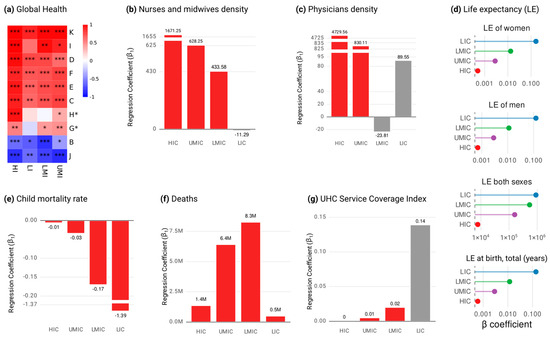
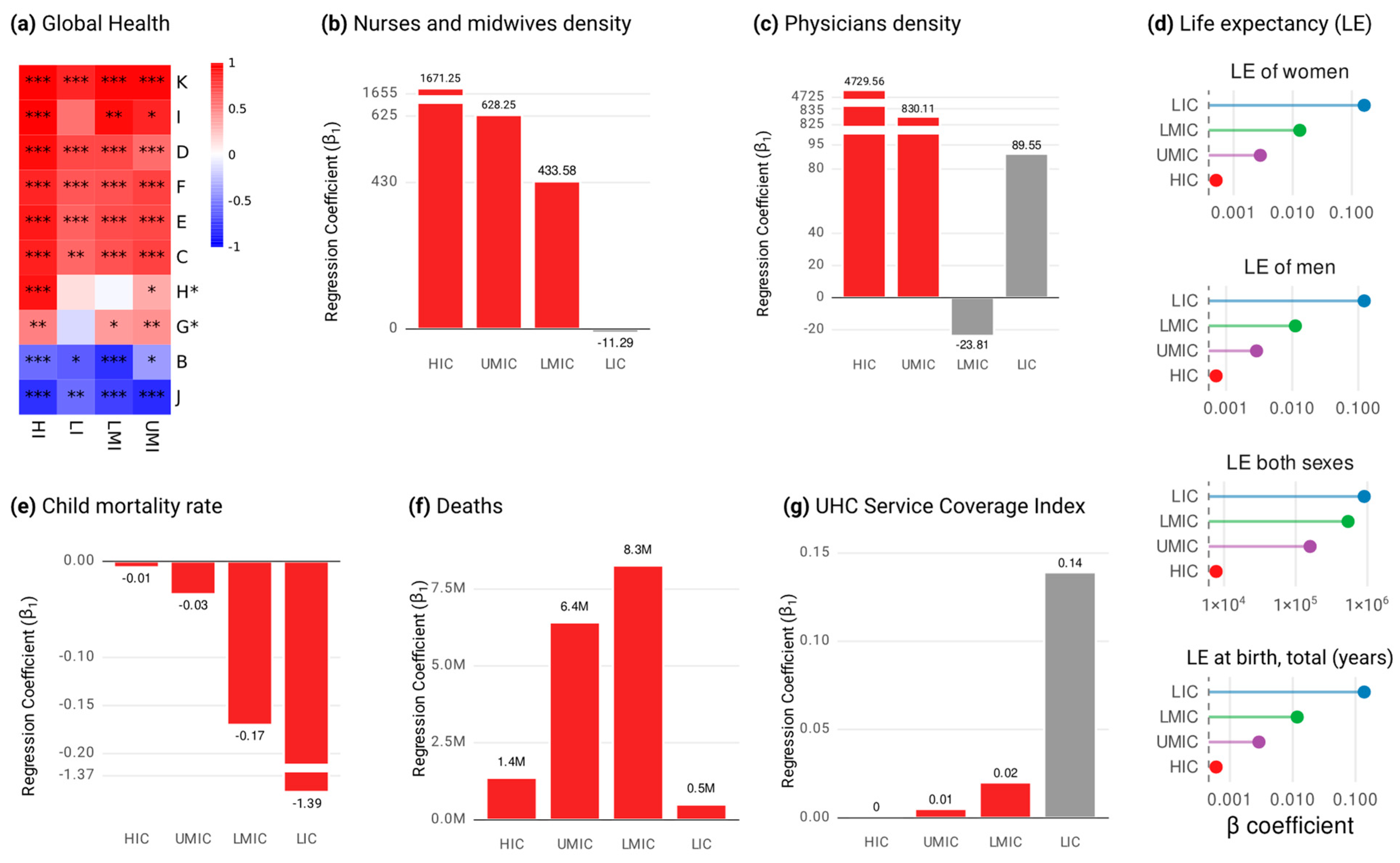
Among the 10 global health indicators used in the regression analyses with the volume of mental health-related publications (Figure 1a), we evaluated the productivity of the health workforce, measured as the publication volume relative to the density of nurses and midwives (per 1000 people) and physicians (per 1000 people), across each income group. It was observed that for each unit increase in average physician density, the number of newly published papers potentially increased by 4729 in HICs (β1 = 4729.5, p < 0.001), while a unit increase in the average density of nurses and midwives in the same income tier yielded an estimated 1671 new potential publications (β1 = 1671.2, p < 0.01). This productivity significantly decreased across lower income levels. Overall, physicians produced more mental health-related publications than nurses and midwives (Figure 1b,c).
Figure 1.
Associations between mental-health-related publication volume and global health indicators across income groups. (a) Heatmap showing standardized regression coefficients (β1) for the association between the volume of mental-health-related publications and ten global health indicators across HICs, UMICs, LMICs, and LICs. In panel (a), asterisks within the cells denote statistical significance (* p < 0.05, ** p < 0.01, *** p < 0.001), whereas asterisks next to variable abbreviations indicate the indicators used as independent variables in the regression models. Full variable names and corresponding abbreviations are provided in Supplementary Material S2. (b,c) Regression coefficients (β1) representing the association between publication volume and the density of nurses and midwives (b) and physicians (c) per 1000 people across income groups. (d) Regression coefficients (β1) for life expectancy (LE) indicators (LE at birth, LE both sexes, LE men, and LE women) across income groups. (e,f) Regression coefficients for child mortality rate (e) and number of deaths (f) across income groups. (g) Regression coefficients for the Universal Health Coverage (UHC) Service Coverage Index across income groups. Statistically significant associations in panels (b,c,e–g) are highlighted in red.
3.1.2. Life Expectancy Outcomes
When using life expectancy (LE) indicators as dependent variables in the models, a greater positive association of mental health-related research was observed in LICs for several outcomes. Notably, each publication was associated with a potential increase in LE at birth of 0.13 years (β1 = 0.13, p < 0.01), as well as increases in LE for men (β1 = 0.12, p < 0.001), and women (β1 = 0.16, p < 0.001) (Figure 1d).
3.1.3. Mortality Indicators
Similarly, the coefficient for child mortality rate, when used as a dependent variable, was lowest (i.e., most protective) in LICs, being associated with a potential reduction of 1.38 units (β1 = −1.38, p < 0.01) for each published article (Figure 1e). Interestingly, the coefficient for the number of deaths as a dependent variable was also lowest in LICs, but with each published article associated with a potential increase of 502,398 deaths (β1 = 502,398.4, p < 0.001), with no potential reduction observed across any of the income levels (Figure 1f).
3.1.4. Universal Health Coverage (UHC)
Finally, regarding the UHC Service Coverage Index, when used as a dependent variable, the potential association of publications on it was significantly positive but relatively small only in UMICs and LMICs, with no significant results observed in the remaining income tiers (Figure 1g).
3.2. Meta-Analysis of Regression Coefficients
To synthesize the income-stratified associations, we conducted random-effects meta-analyses of the regression coefficients. A statistically significant pooled association was observed for life expectancy (both sexes) (coefficient = 376,373.5; 95% CI: 1316.7–751,430.3), although the confidence interval was wide and statistical significance was lost after p-value adjustment. Additionally, heterogeneity was extraordinarily high across all pooled estimates, including life expectancy (both sexes) (I2 ≈ 99%; Table 1), and for most indicators the 95% confidence intervals crossed the null value of zero, indicating substantial variability in direction and magnitude of coefficients across income groups. Accordingly, pooled coefficients were treated as descriptive summaries under marked between-stratum heterogeneity, and the primary purpose of this step was to confirm that associations were not uniform across strata and to motivate the subsequent moderator meta-regressions (Step 3), which explicitly examine the structural factors driving this heterogeneity.
Table 1.
Meta-analysis results of global health indicators used as dependent or independent variables in linear models related to number of publications.
3.3. Structural Moderators of Heterogeneity in Research–Health Associations
To further explore the underlying drivers of heterogeneity in research impact across income groups, we implemented moderator meta-regression models incorporating structural and systemic variables (Table 2, Figure 2).
Table 2.
Summary of selected meta-regression results for key indicators.
Figure 2.
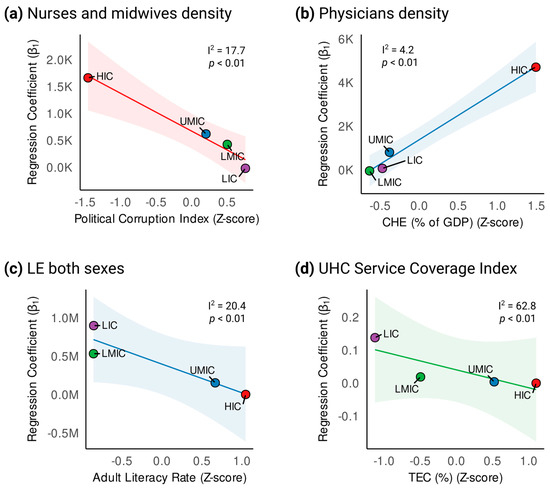
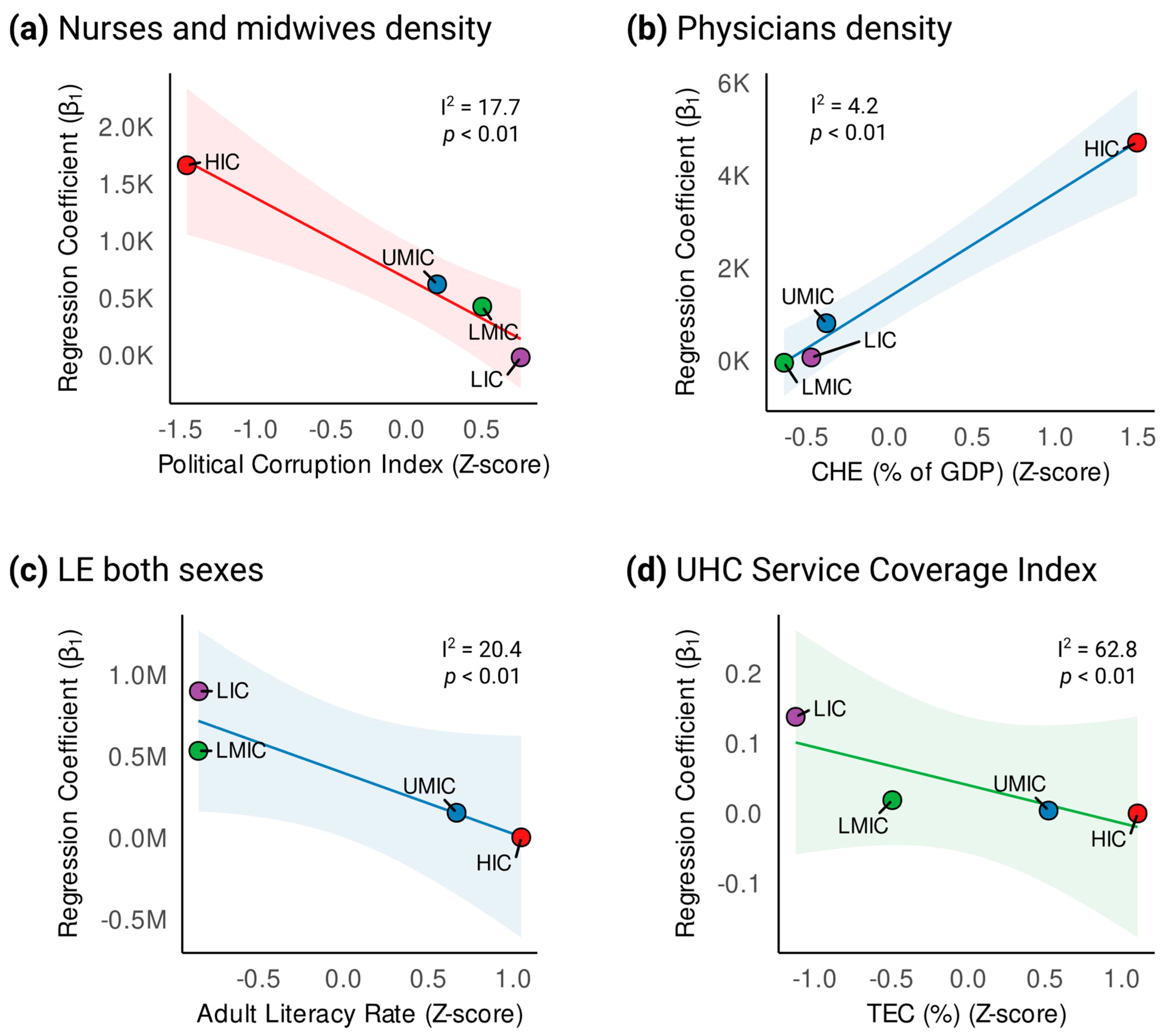
Meta-regressions identifying significant moderators of the association between mental-health-related publication volume and global health indicators. (a) Negative moderation effect of the Political Corruption Index on the association between nurses and midwives’ density and mental-health-related publication volume (I2 = 17.7%; βmod = −3175; p < 0.001). (b) Positive moderation effect of current health expenditure as a percentage of gross domestic product (CHE, % of GDP) on the association between physician density and mental-health-related publication volume (I2 = 4.2%; βmod = 431; p < 0.001). (c) Negative moderation effect of adult literacy rate (% of people aged 15 years and above) on the association between mental-health-related publications and life expectancy for both sexes (I2 = 20.4%; βmod = −17; p < 0.001). (d) Negative moderation effect of the percentage of territory effectively controlled by government (TEC) on the association between mental-health-related publications and the Universal Health Coverage (UHC) Service Coverage Index (I2 = 62.8%; βmod = −0.002; p < 0.001). Shaded areas represent 95% confidence intervals around the meta-regression lines. CHE = Current Health Expenditure; TEC = Territory Effectively Controlled.
3.3.1. Moderators of Research Productivity Among Nurses and Midwives
Several factors significantly influenced the relationship between the research output of nurses and midwives and the volume of mental health-related publications. These included the political corruption index, which was significantly associated with a potential reduction of 3175 publications for each unit increase (I2 = 17.7%; βmod = −3175, p < 0.001) (Figure 2a), regardless of nurse and midwife density. Conversely, a one-unit increase in the lifespan inequality Gini coefficient for both women (I2 = 26.1%; βmod = 39, p < 0.001) and men (I2 = 33.1%; βmod = 32, p < 0.001) was associated with an increase in scientific production, again independent of workforce density. Additionally, a higher state capacity index was associated with 976 new publications for each unit increase (I2 = 36.9%; βmod = 976, p < 0.001), also independent of the density of nurses and midwives.
3.3.2. Moderators of Physician Research Productivity
Regarding the proxy of physician scientific productivity in mental health, the most explanatory moderators were current health expenditure as a percentage of gross domestic product (I2 = 4.27%; βmod = 431, p < 0.001) (Figure 2b), indicating that each additional percentage point of national health spending amplifies the publication return of an additional physician by roughly 430 papers. Other significant positive moderators included average years of schooling, which also increased scientific production by 682 new papers for each additional average year (I2 = 50.1%; βmod = 682, p < 0.001), and the lifespan inequality Gini coefficient for men (I2 = 63.2%; βmod = 86, p < 0.001) and women (I2 = 68.5%; βmod = 105, p < 0.001), independent of physician density.
3.3.3. Moderators of Life Expectancy Outcomes
Although the meta-analysis for LE (both sexes) showed a high I2, the introduction of adult literacy rate (% of people ages 15 and above) as a moderator reduced heterogeneity to 20.4%, with a moderately significant negative moderation effect (βmod = −17,030, p < 0.001) (Figure 2c). This suggests that each additional unit increase in literacy rate decreases the positive association of mental-health-related publications on LE by 17,030. A similar contradictory pattern was observed when using the percentage of territory effectively controlled by government as a moderator, which reduced I2 to 28.04% (βmod = −78,221, p < 0.001).
3.3.4. Moderators of Universal Health Coverage (UHC)
Finally, the association of mental health-related research with the UHC Service Coverage Index was moderated by the percentage of territory effectively controlled by government (I2 = 62.8%; βmod = −0.002, p < 0.001) (Figure 2d) and the adult literacy rate (I2 = 64.5%; βmod = −0.0005, p < 0.001) (Table 2).
4. Discussion
This study offers a meta-research perspective on global mental health research, assessing whether scientific production is aligned with territorial health needs, and identifying structural enablers or constraints that shape its population-level associations. By applying a layered scientometric approach, we unveil systemic patterns of inequality, inefficiency, and missed translational opportunities.
Prior bibliometric work in mental health, often focused on specific disorders, regions, or acute shocks (e.g., COVID-19), has repeatedly documented that publication leadership and visibility remain concentrated in high-income settings, while internationally collaborative work may still under-represent local leadership from low-resource contexts despite being thematically “global” (Chen et al., 2021; Jauch et al., 2023; Vecchio et al., 2025). At the same time, global mental health scholarship has emphasized that research inequities are not only quantitative (volume/citations) but also structural (i.e., linked to agenda-setting, absorptive capacity, and the downstream translation of knowledge into service delivery and population benefit) (Moitra et al., 2023). Building on this literature, our contribution extends beyond output-only mapping by explicitly pairing research trajectories with contextual indicators and testing whether associations are consistent across income strata.
Marked asymmetries in how mental health research output relates to population health needs became evident once the results were stratified by income levels. A markedly steeper publication per clinician gradient in HICs, 4729 papers per additional physician and 1671 per additional nurse or midwife, was observed, whereas the gradient thinned progressively across UMICs-, LMICs- and LICs. This pattern confirms that research production remains concentrated in settings with abundant infrastructure, training, and funding, even though the greatest service gaps lie elsewhere (Rodríguez-Navarro & Brito, 2022). Physicians consistently exhibited greater output than nurses or midwives. This persistent imbalance highlights that nursing research, critical for task-shifting and community care, continues to receive inadequate support in resource-constrained settings (Yegros-Yegros et al., 2020).
These gradients highlight a paradox: while knowledge is produced more efficiently in HICs, its potential transformative impact is more evident in LICs. This contrast underscores the need to understand how scientific production translates into real-world outcomes across contexts.
Paradoxically, the strongest positive associations between publication volume and LE metrics surfaced in LICs. Each additional mental health article was associated with higher LE at birth (β = 0.13; p < 0.01) and in sex-specific LE (men: β = 0.12; women: β = 0.16; both p < 0.001). These patterns are consistent with the possibility that, in settings with lower baseline health-system capacity, variation in research output co-occurs with broader changes in financing, programmatic focus, and implementation intensity (Malekzadeh et al., 2020; Vodă et al., 2023). A similarly protective inverse association was observed for child mortality, whose regression coefficient was most negative in LICs (β = −1.38; p < 0.01). This pattern co-occurred with a large positive coefficient for total deaths (β = 502,398; p < 0.001), possibly indicating that absolute mortality still rises with larger populations despite incremental improvements in age-specific outcomes, potentially underscoring demographic pressure on fragile systems (Zicker et al., 2015). However, the unusually large magnitude of this coefficient should be interpreted as a macro-systemic indicator rather than a direct clinical effect. Mathematically, it reflects the juxtaposition of a massive, aggregated population-level mortality burden against a near-zero baseline of research output, highlighting a stark ecological disparity.
Furthermore, cross-country differences in population aging may shape the interpretation of LE-related associations by altering the baseline burden and demand for later-life psychiatric care, even as average national life expectancy improves (Cunningham et al., 2020).
These findings reflect not only a distributional imbalance, but also a broader issue of potential scientific misalignment, where the volume of research produced does not appear to always match the geographic or epidemiological needs. Addressing this coherence gap is likely central to enhancing the utility of global research systems.
The UHC Service-Coverage Index displayed an inverse income gradient: stronger associations with research productivity appeared in poorer settings (Tadesse et al., 2021). Because low-coverage baselines prevail where fiscal space is most constrained, new evidence that particularly highlight cost-effective psychological and community interventions may be more readily reflected in coverage gains than in mature systems where expansion requires marginal rather than foundational investments (Tadesse et al., 2021; Van Zyl et al., 2022).
A random-effects meta-analysis pooling income-stratified coefficients yielded a significant overall association for sex-combined LE (pooled β = 376,374; 95% CI: 1317–751,430) albeit under high heterogeneity (I2 > 90%), indicating that the pooled estimate should be interpreted only as a descriptive summary rather than a generalizable effect. The persistence of substantial between-group variance supported subsequent moderator analyses, which offered greater granularity regarding contextual factors associated with divergent trajectories.
Governance strongly moderated publication efficiency for nurses and midwives. A one-point rise in political corruption correlated with 3175 fewer papers (βmod = −3175; p < 0.001), whereas stronger state capacity increased output by nearly 1000 papers per unit (βmod = 976; p < 0.001) (Malekzadeh et al., 2020; Vodă et al., 2023).
Gini index coefficients also moderated this relationship positively, suggesting that widening survival disparities within countries heighten the perceived urgency of mental health research among nursing professionals (García Carrillo et al., 2024; Vodă et al., 2023). For physicians, macro-economic investment proved decisive: each extra percentage point of current health expenditure as a share of GDP was associated with higher output by roughly 430 papers (βmod = 431; p < 0.001). Schooling, an index of human-capital accumulation, exerted an equally pronounced moderating association (βmod = 682; p < 0.001), suggesting that broad educational attainment fosters both the supply of clinician-scientists and the demand for evidence-informed practice (García Carrillo et al., 2024; Vodă et al., 2023).
In models where LE constituted the outcome, adult literacy tempered the apparent beneficial association of publications: a one-percentage-point gain in literacy diminished the LE coefficient by 17,030, while reducing heterogeneity to 20%. Although this is an implausibly large moderator coefficient, the direction, significance, and reduction in heterogeneity raise concerns that the true association, although not exactly of this magnitude, is probably not positive.
High literacy may signify that incremental LE advances depend less on new knowledge and more on translating existing evidence into equitable services (Vodă et al., 2023). From a meta-research perspective, this pattern is consistent with literacy and schooling operating as translation and absorptive-capacity proxies: where baseline education is high, outcomes may depend more on implementation quality, service equity, and system integration than on marginal increases in the research corpus alone, whereas in lower-literacy settings, co-occurring gains in education can be a prerequisite for research uptake and sustained program delivery (García Carrillo et al., 2024; Vodă et al., 2023). Conversely, diminished governmental territorial control, which captures instability and conflict, was associated with gains in both LE and UHC, suggesting that fragility blunts the translational pipeline from scholarship to service delivery (Vodă et al., 2023).
Importantly, it is necessary to highlight the absence of statistically significant associations between specific indicators of global mental health and subjective well-being (Supplementary Material S3–S5), which suggest a persistent gap that warrants further investigation according to specific health needs (García Carrillo et al., 2024; Yegros-Yegros et al., 2020; Zicker et al., 2015). Also, this behavior suggests that variables other than regional health needs influence mental health research and the generation of new knowledge applicable to the management of mental disorders, and may warrant greater alignment efforts to strengthen scientific coherence (García Carrillo et al., 2024; Yegros-Yegros et al., 2020; Zicker et al., 2015).
Collectively, these findings illuminate a complex, non-linear landscape in which research output alone fails to guarantee health gains; structural enablers such as governance integrity, fiscal commitment, educational attainment and state capacity may shape how effectively knowledge is mobilized. The pronounced yield of publications per clinician in HICs, juxtaposed with the stronger income-stratified associations observed for selected health indicators in LICs, points to a double inequity: places with the highest scholarly density may experience attenuated marginal associations, whereas those with the greatest potential impact remain under-resourced. Such disequilibrium substantiates longstanding calls from multilateral agencies to synchronize research agendas with territorial burden profiles and to invest deliberately in capacity strengthening where the potential for translation may be greatest (Lozada-Martinez et al., 2025c; Patelli et al., 2023).
The present work therefore supports the premise that monitoring the concordance between evidence generation and contextual health needs constitutes an important component of global mental health governance. By integrating 60 macro-level indicators with research trajectories, the analysis offers stakeholders an empirically grounded framework to identify contextual correlates and potential leverage areas. Funding bodies could consider coupling grant allocations with anti-corruption safeguards and literacy programs; ministries of health may consider orienting clinician-scientists toward implementation research that bridges the publication–practice chasm; and academic networks could prioritize mentorship schemes in settings where every additional trained investigator may be associated with comparatively larger changes in population-level indicators (Acuña Rodriguez et al., 2025; Lozada-Martinez et al., 2025c; Patelli et al., 2023).
Persistent heterogeneity around several indicators underscores fertile ground for future inquiry. Sub-national analyses could dissect whether intra-country inequalities mirror or magnify the global patterns observed here. Mixed-methods studies may unravel how community trust, cultural paradigms, or digital connectivity mediate the translation of evidence into action, complementing the macro-statistical lens employed (Galván-Pérez et al., 2025; Lozada-Martinez et al., 2025a; Revolledo Caicedo et al., 2025). Furthermore, prospective evaluations of targeted capacity-building interventions would test the causal hypotheses suggested by the moderators, thereby informing a more adaptive research-investment architecture (Galván-Pérez et al., 2025; Lozada-Martinez et al., 2025a; Revolledo Caicedo et al., 2025).
From a methodological perspective, this study contributes a novel integration of stratified scientometric analysis with random-effects meta-analysis and meta-regression of structural moderators. This multi-layered approach enhances our capacity to detect how context may shape the translation of research into public benefit, a core objective of applied meta-research (Lozada-Martinez et al., 2024; Picón-Jaimes et al., 2025).
Taken together, these findings are consistent with the development of a more adaptive and equity-oriented research investment architecture. Funding agencies may consider integrating contextual indicators such as health burden, governance capacity, and educational attainment into research allocation criteria. Governments and institutions could benchmark research portfolios against territorial needs, while scientific networks should foster capacity-building schemes in low-resource settings, where each additional publication appears to yield disproportionately high societal returns (Lozada-Martinez et al., 2023; Rátiva Hernández et al., 2023).
Certain limitations were systematically managed in this analysis. Regarding literature coverage and search strategy, the potential under-representation of articles from non-indexed local journals was attenuated by combining five complementary bibliographic databases and conducting multilingual searches. Furthermore, omissions linked to the MeSH descriptor “Mental Disorders” were reduced through iterative pilot testing and the expansion of search synonyms.
In terms of geographic attribution and the measurement of contextual indicators, misclassification arising from first-author affiliation was contained by applying a single, consistent attribution rule to preserve internal comparability. Additionally, potential measurement lags and errors across the 60 contextual indicators were counterbalanced by employing income-stratified longitudinal models, random-effects meta-analyses, and moderator meta-regressions.
Finally, concerning the study design and generalizability, the ecological design and language restrictions inherently preclude causal inference and exclude grey literature. Consequently, these limitations may underrepresent scholarship published in languages with lower index coverage, meaning these findings reflect the globally indexed corpus rather than all worldwide production. However, these limitations were offset by analyzing a massive corpus exceeding 386,000 articles, conducting dual independent screening, harmonizing variables, and publicly disseminating the full analytical code and supplementary data, thereby maximizing replicability and sensitivity testing.
5. Conclusions
This study describes a complex and uneven landscape in global mental health research production: HICs generate most publications, while LICs show comparatively stronger income-stratified associations between publication volume and selected population-level indicators (e.g., life expectancy, child mortality, and service coverage). Given the acknowledged constraints in data coverage and representation for many low-income contexts, these specific associations should be interpreted as exploratory. Across strata, governance integrity, current health expenditure, educational attainment, and political stability emerged as key contextual correlates of variation in these associations, suggesting that publication volume alone is insufficient to characterize alignment with population needs and that structural conditions may shape observed coherence patterns.
A “dual inequity” was evident: settings with the highest research output are not necessarily those where associations with health indicators are strongest, highlighting a potential coherence gap with implications for equity and utility in the global knowledge ecosystem.
These findings provide a quantitative framework to inform coherence-sensitive benchmarking of national research portfolios against territorial health needs and to support hypothesis generation for more context-aware research investment and governance strategies, without implying causality. Future research should extend this approach using sub-national and collaboration-sensitive attribution, incorporate lagged or quasi-experimental designs to better probe temporal ordering, and broaden multilingual/regional index coverage to test robustness in under-indexed settings.
Supplementary Materials
The following supporting information can be downloaded at: https://www.mdpi.com/article/10.3390/publications14020035/s1, Supplementary Material S1: Full search strategies. Supplementary Material S2: Indicators used for analysis. Supplementary Material S3: Full results of the linear regressions. Supplementary Material S4: Full results of the random-effects meta-analyses. Supplementary Material S5: Full results of the meta-regressions.
Author Contributions
Conceptualization, D.A.H.-P., M.A.-R., K.F.M.-Q. and J.V.V.-D.; methodology, D.A.H.-P. and M.A.-R.; formal analysis, D.A.H.-P. and M.A.-R.; investigation, D.A.H.-P. and M.A.-R.; writing—original draft preparation, D.A.H.-P., M.A.-R., K.F.M.-Q. and J.V.V.-D.; writing—review and editing, D.A.H.-P., M.A.-R., K.F.M.-Q. and J.V.V.-D. All authors have read and agreed to the published version of the manuscript.
Funding
The article processing charge for this publication was funded by the University of Córdoba, Montería, Colombia.
Data Availability Statement
The complete code, including documentation and annotations, is available at: https://doi.org/10.5281/zenodo.17956431.
Conflicts of Interest
The authors declare no conflicts of interest.
References
- Acuña Rodriguez, M., Fiorillo-Moreno, O., Bolaño-Romero, M. P., & Cují-Galarza, W. (2025). Academic and scientific thinking on global mental health in future healthcare professionals: A new challenge aligned with contemporary needs. Inge CuC, 21(1), 67–76. [Google Scholar] [CrossRef] [Scilit]
- Acuña-Rodríguez, M., Quintero, K. F. M., Bolaño-Romero, M. P., & Lozada-Martinez, I. D. (2025). Gaps and opportunities in global mental health research: Disparities across geographic regions and income levels. Psychiatry Investigation, 22(11), 1227–1229. [Google Scholar] [CrossRef] [Scilit]
- American Psychological Association. (2024). Mental health care is in high demand. Psychologists are leveraging tech and peers to meet the need. Available online: https://www.apa.org/monitor/2024/01/trends-pathways-access-mental-health-care (accessed on 14 December 2025).
- Andreasen, J., Nørgaard, B., Draborg, E., Juhl, C. B., Yost, J., Brunnhuber, K., Robinson, K. A., & Lund, H. (2022). Justification of research using systematic reviews continues to be inconsistent in clinical health science—A systematic review and meta-analysis of meta-research studies. PLoS ONE, 17(10), e0276955. [Google Scholar] [CrossRef] [Scilit] [PubMed]
- Casella, C. B., Kousoulis, A. A., Kohrt, B. A., Bantjes, J., Kieling, C., Cuijpers, P., Kline, S., Kotsis, K., Polanczyk, G. V., Stein, D. J., Szatmari, P., Merikangas, K. R., Mneimneh, Z., & Salum, G. A. (2025). Data gaps in prevalence rates of mental health conditions around the world: A retrospective analysis of nationally representative data. The Lancet Global Health, 13(5), e879–e887. [Google Scholar] [CrossRef] [Scilit]
- Chen, Y., Zhang, X., Chen, S., Zhang, Y., Wang, Y., Lu, Q., & Zhao, Y. (2021). Bibliometric analysis of mental health during the COVID-19 pandemic. Asian Journal of Psychiatry, 65, 102846. [Google Scholar] [CrossRef] [Scilit] [PubMed]
- Cunningham, C., O’ Sullivan, R., Caserotti, P., & Tully, M. A. (2020). Consequences of physical inactivity in older adults: A systematic review of reviews and meta-analyses. Scandinavian Journal of Medicine & Science in Sports, 30(5), 816–827. [Google Scholar] [CrossRef] [Scilit]
- Faija, C., Bee, P., Pedley, R., Bennion, M., Susanti, H., Fausiah, F., Idaiani, S., Susilo, D., Hussen, M., & Brooks, H. (2025). Optimising knowledge mobilisation for mental health research in low- and middle-income countries: A systematic review of the state of knowledge and directions for future research. Cambridge Prisms: Global Mental Health, 12, e106. [Google Scholar] [CrossRef] [Scilit]
- Ferrari, A. J., Santomauro, D. F., Aali, A., Abate, Y. H., Abbafati, C., Abbastabar, H., Abd ElHafeez, S., Abdelmasseh, M., Abd-Elsalam, S., Abdollahi, A., Abdullahi, A., Abegaz, K. H., Abeldaño Zuñiga, R. A., Aboagye, R. G., Abolhassani, H., Abreu, L. G., Abualruz, H., Abu-Gharbieh, E., Abu-Rmeileh, N. M., … Murray, C. J. L. (2024). Global incidence, prevalence, years lived with disability (YLDs), disability-adjusted life-years (DALYs), and healthy life expectancy (HALE) for 371 diseases and injuries in 204 countries and territories and 811 subnational locations, 1990–2021: A systematic analysis for the global burden of disease study 2021. The Lancet, 403(10440), 2133–2161. [Google Scholar] [CrossRef] [Scilit]
- Galván-Pérez, Y., Herrera-Polo, M., Hernández-Páez, D. A., Neira Rodado, D., Salas-Navarro, K., Rueda-Olivella, A. M., Beltrán-Venegas, T., Lozada-Martinez, I. D., & Delgado, P. (2025). Six sigma applied to healthcare: A global scientometrics analysis of health services quality improvement research. Health Services Insights, 18, 11786329251352018. [Google Scholar] [CrossRef] [Scilit]
- García Carrillo, M., Gagnon, M.-A., & Blaustein, M. (2024). Editorial: Current priorities in health research agendas: Tensions between public and commercial interests in prioritizing biomedical, social, and environmental aspects of health. Frontiers in Medicine, 11, 1391982. [Google Scholar] [CrossRef] [Scilit]
- Gmeiner, A., Trimmel, M., Gaglia-Essletzbichler, A., Schrank, B., Süßenbacher-Kessler, S., & Amering, M. (2022). Diversity in high-impact psychiatric publishing: Gender parity within reach? Archives of Women’s Mental Health, 25(2), 327–333. [Google Scholar] [CrossRef] [Scilit]
- Heymann, J., & Sprague, A. (2023). Meeting the UN Sustainable Development Goals for mental health: Why greater prioritization and adequately tracking progress are critical. World Psychiatry, 22(2), 325–326. [Google Scholar] [CrossRef] [Scilit]
- Institute for Health Metrics and Evaluation. (n.d.). Mental health. Available online: https://www.healthdata.org/research-analysis/health-risks-issues/mental-health (accessed on 14 December 2025).
- Jauch, M., Occhipinti, S., & O’Donovan, A. (2023). The stigmatization of mental illness by mental health professionals: Scoping review and bibliometric analysis. PLoS ONE, 18(1), e0280739. [Google Scholar] [CrossRef] [Scilit]
- Lozada-Martinez, I. D., Ealo-Cardona, C. I., Marrugo-Ortiz, A. C., Picón-Jaimes, Y. A., Cabrera-Vargas, L. F., & Narvaez-Rojas, A. R. (2023). Meta-research studies in surgery: A field that should be encouraged to assess and improve the quality of surgical evidence. International Journal of Surgery, 109(6), 1823–1824. [Google Scholar] [CrossRef] [Scilit]
- Lozada-Martinez, I. D., Hernandez-Paez, D., Zárate, Y. E. J., & Delgado, P. (2025a). Scientometrics and meta-research in medical research: Approaches required to ensure scientific rigor in an era of massive low-quality research. Revista Da Associação Médica Brasileira, 71(4), e20241612. [Google Scholar] [CrossRef] [Scilit] [PubMed]
- Lozada-Martinez, I. D., Hernandez-Paz, D. A., Fiorillo-Moreno, O., Alejandro Picón-Jaimes, Y., & Bermúdez, V. (2025b). Meta-research in biomedical investigation: Gaps and opportunities based on meta-research publications and global indicators in health, science, and human development. Publications, 13, 7. [Google Scholar] [CrossRef] [Scilit]
- Lozada-Martinez, I. D., Lozada-Martinez, L. M., & Fiorillo-Moreno, O. (2024). Leiden manifesto and evidence-based research: Are the appropriate standards being used for the correct evaluation of pluralism, gaps and relevance in medical research? Journal of the Royal College of Physicians of Edinburgh, 54(1), 4–6. [Google Scholar] [CrossRef] [Scilit] [PubMed]
- Lozada-Martinez, I. D., Neira-Rodado, D., Martinez-Guevara, D., Cruz-Soto, H. S., Sanchez-Echeverry, M. P., & Liscano, Y. (2025c). Why is it important to implement meta-research in universities and institutes with medical research activities? Frontiers in Research Metrics and Analytics, 10, 1497280. [Google Scholar] [CrossRef] [Scilit]
- Malekzadeh, A., Michels, K., Wolfman, C., Anand, N., & Sturke, R. (2020). Strengthening research capacity in LMICs to address the global NCD burden. Global Health Action, 13(1), 1846904. [Google Scholar] [CrossRef] [Scilit]
- Moitra, M., Owens, S., Hailemariam, M., Wilson, K. S., Mensa-Kwao, A., Gonese, G., Kamamia, C. K., White, B., Young, D. M., & Collins, P. Y. (2023). Global mental health: Where we are and where we are going. Current Psychiatry Reports, 25(7), 301–311. [Google Scholar] [CrossRef] [Scilit]
- Patelli, A., Napolitano, L., Cimini, G., & Gabrielli, A. (2023). Geography of science: Competitiveness and inequality. Journal of Informetrics, 17(1), 101357. [Google Scholar] [CrossRef] [Scilit]
- Picón-Jaimes, Y. A., Lozada-Martinez, I. D., Tosas, M. R., Tiraboschi, J., Fiorillo-Moreno, O., & Bermúdez, V. (2025). What has been studied about attitudes and social stigma towards HIV/AIDS? A global bibliometric study with correlations on global health HIV-related indicators. Healthcare, 13(8), 891. [Google Scholar] [CrossRef] [Scilit]
- Rátiva Hernández, N. K., Carrero-Barragán, T. Y., Ardila, A. F., Rodríguez-Salazar, J. D., Lozada-Martinez, I. D., Velez-Jaramillo, E., Ortega Delgado, D. A., Fiorillo Moreno, O., & Navarro Quiroz, E. (2023). Factors associated with suicide in physicians: A silent stigma and public health problem that has not been studied in depth. Frontiers in Psychiatry, 14, 1222972. [Google Scholar] [CrossRef] [Scilit] [PubMed]
- R Core Team. (2025). R: A language and environment for statistical computing [Computer software]. R Foundation for Statistical Computing. Available online: https://www.R-project.org/ (accessed on 14 December 2025).
- Revolledo Caicedo, M. A., Montoya Obando, A. F., Hernández-Páez, D. A., Fiorillo-Moreno, O., Galván-Barrios, J., Delgado, P., & Lozada-Martinez, I. D. (2025). Research on medical errors exhibits diverse associations with global indicators of science, development, and health across geographic regions: A scientometrics study. Medicine, 104(29), e42985. [Google Scholar] [CrossRef] [Scilit]
- Rodríguez-Navarro, A., & Brito, R. (2022). The link between countries’ economic and scientific wealth has a complex dependence on technological activity and research policy. Scientometrics, 127(5), 2871–2896. [Google Scholar] [CrossRef] [Scilit]
- Sparling, T. M., Deeney, M., Cheng, B., Han, X., Lier, C., Lin, Z., Offner, C., Santoso, M. V., Pfeiffer, E., Emerson, J. A., Amadi, F. M., Mitu, K., Corvalan, C., Verdeli, H., Araya, R., & Kadiyala, S. (2022). Systematic evidence and gap map of research linking food security and nutrition to mental health. Nature Communications, 13(1), 4608. [Google Scholar] [CrossRef] [Scilit] [PubMed]
- Tadesse, A. W., Gurmu, K. K., Kebede, S. T., & Habtemariam, M. K. (2021). Analyzing efforts to synergize the global health agenda of universal health coverage, health security and health promotion: A case-study from Ethiopia. Globalization and Health, 17(1), 53. [Google Scholar] [CrossRef] [Scilit]
- United Nations. (n.d.-a). Goal 3: Ensure healthy lives and promote well-being for all at all ages. Available online: https://www.un.org/sustainabledevelopment/health/ (accessed on 12 December 2025).
- United Nations. (n.d.-b). World population prospects. Available online: https://population.un.org/wpp/ (accessed on 14 December 2025).
- Van Zyl, M., Fee, C., Burton, J., & Leon, E. (2022). Bridging the global mental health gap. In Suicide risk assessment and prevention (pp. 1–17). Springer International Publishing. [Google Scholar] [CrossRef] [Scilit]
- Vecchio, A., Nandawula, B., Sawyer, K., Amisi, J. A., Szkwarko, D., & Chang, K. Z. (2025). Authorship inequity in global health research conducted in low- and middle-income countries and published in high-income country family medicine journals. The Annals of Family Medicine, 23(3), 223–230. [Google Scholar] [CrossRef] [Scilit]
- Vodă, A. I., Bortoş, S., & Şoitu, D. T. (2023). Knowledge ecosystem: A sustainable theoretical approach. European Journal of Sustainable Development, 12(2), 47–66. [Google Scholar] [CrossRef] [Scilit]
- Wahlbeck, K. (2015). Public mental health: The time is ripe for translation of evidence into practice. World Psychiatry, 14(1), 36–42. [Google Scholar] [CrossRef] [Scilit]
- World Bank. (n.d.-a). Indicators. Available online: https://data.worldbank.org/indicator (accessed on 14 December 2025).
- World Bank. (n.d.-b). World bank country and lending groups. Available online: https://datahelpdesk.worldbank.org/knowledgebase/articles/906519-world-bank-country-and-lending-groups (accessed on 13 December 2025).
- World Health Organization. (n.d.-a). Countries/areas by WHO region. Available online: https://apps.who.int/violence-info/Countries%20and%20areas%20by%20WHO%20region%20-%2012bfe12.pdf (accessed on 14 December 2025).
- World Health Organization. (n.d.-b). Global health observatory. Available online: https://www.who.int/data/gho (accessed on 14 December 2025).
- World Health Organization. (n.d.-c). Mental health. Available online: https://www.who.int/health-topics/mental-health#tab=tab_1 (accessed on 12 December 2025).
- World Health Organization. (2007). Monitoring and evaluation of mental health policies and plans. Available online: https://iris.who.int/bitstream/handle/10665/43631/9789241547154_eng.pdf?sequence=1&isAllowed=y (accessed on 12 December 2025).
- World Health Organization. (2021). Comprehensive mental health action plan 2013–2030. Available online: https://iris.who.int/bitstream/handle/10665/345301/9789240031029-eng.pdf?sequence=1 (accessed on 12 December 2025).
- World Health Organization. (2022). World mental health report: Transforming mental health for all. Available online: https://www.who.int/publications/i/item/9789240049338 (accessed on 12 December 2025).
- Yalcin, N., Bayraktar, I., Karabulut, E., de Filippis, R., Jaguga, F., Karaliuniene, R., Nagendrappa, S., Noël, C., Ojeahere, M. I., Ori, D., Ransing, R., Saeed, F., Shalbafan, M., Shoib, S., Ullah, I., Vadivel, R., Vahdani, B., & Ramalho, R. (2022). Is everyone invited to the discussion table? A bibliometric analysis COVID-19-related mental health literature. Global Mental Health (Cambridge, England), 9, 366–374. [Google Scholar] [CrossRef] [Scilit]
- Yegros-Yegros, A., van de Klippe, W., Abad-Garcia, M. F., & Rafols, I. (2020). Exploring why global health needs are unmet by research efforts: The potential influences of geography, industry and publication incentives. Health Research Policy and Systems, 18(1), 47. [Google Scholar] [CrossRef] [Scilit] [PubMed]
- Zhang, X., Mori, Y., Abio, A., Khorasani, Z. K., Gilbert, S., Grimland, M., Bezborodovs, N., Wan Mohd Yunus, W. M. A., Silwal, S., Westerlund, M., Praharaj, S. K., Ndetei, D. M., Kaneko, H., Heinonen, E., & Sourander, A. (2025). Cross-national research on adolescent mental health: A systematic review comparing research in low, middle and high-income countries. BMJ Global Health, 10(7), e019267. [Google Scholar] [CrossRef] [Scilit] [PubMed]
- Zhou, W., Yu, Y., Yang, M., Chen, L., & Xiao, S. (2018). Policy development and challenges of global mental health: A systematic review of published studies of national-level mental health policies. BMC Psychiatry, 18(1), 138. [Google Scholar] [CrossRef] [Scilit] [PubMed]
- Zicker, F., Faid, M., Reeder, J., & Aslanyan, G. (2015). Building coherence and synergy among global health initiatives. Health Research Policy and Systems, 13(1), 75. [Google Scholar] [CrossRef] [Scilit]

Disclaimer/Publisher’s Note: The statements, opinions and data contained in all publications are solely those of the individual author(s) and contributor(s) and not of MDPI and/or the editor(s). MDPI and/or the editor(s) disclaim responsibility for any injury to people or property resulting from any ideas, methods, instructions or products referred to in the content. |
© 2026 by the authors. Licensee MDPI, Basel, Switzerland. This article is an open access article distributed under the terms and conditions of the Creative Commons Attribution (CC BY) license.