


Abstract
Background/Objectives: Laser therapy is increasingly used in pediatric dentistry, but no umbrella review has synthesized evidence across diagnostic, analgesic, and therapeutic domains. We synthesized systematic review (SR) evidence on laser interventions in patients aged 0–18 years and appraised quality, overlap, and certainty. Methods: This umbrella review followed PRIOR and was registered in PROSPERO (CRD420261308339). Five databases and Google Scholar were searched on 18 March 2026. We used AMSTAR-2, the corrected covered area (CCA), and GRADE ratings adopted from the SRs or, where absent, a structured umbrella-level rating (not formal GRADE). Results: Eighteen SRs were included (three diagnostic, five analgesic, 10 therapeutic). AMSTAR-2 confidence was Low for four and Critically Low for 14. Overlap was slight in the diagnostic domain (CCA = 3.57%), at the slight–moderate boundary in the therapeutic domain (5.67%), and at the moderate–high boundary in the analgesic domain (10.53%). One SR found photobiomodulation reduced injection pain (SMD −0.44; GRADE low); another, of mostly adult trials, found no effect. Laser and conventional pulpotomy did not differ significantly (low certainty). Other evidence was mostly very low certainty. Seven SRs reported adverse events; none reported a serious laser-related event. Conclusions: Photobiomodulation may reduce injection pain, but evidence is low-certainty and inconsistent. Evidence for other applications is insufficient for recommendations.
1. Introduction
Oral diseases are a major global health burden, particularly in children. Untreated dental caries in permanent teeth is the most prevalent condition worldwide, whereas untreated caries in primary teeth affect an estimated 621 million children globally [1]. Progressive caries may result in pulpal involvement, premature tooth loss, impaired oral function, and a reduced quality of life [2]. In addition to caries, pediatric dental patients frequently require management of pulpal disease, soft tissue abnormalities, frenular attachments, and procedure-related pain. Clinical management is further complicated by the need to minimize discomfort, reduce anxiety, and preserve developing oral structures [3].
Laser technology has emerged as a versatile adjunct in pediatric dentistry in the past three decades. Current applications encompass caries detection, cavity preparation, vital pulp therapy, soft tissue surgery, and photobiomodulation therapy (PBMT) for pain control [3,4,5]. Commonly used laser systems include erbium-doped yttrium–aluminum–garnet (Er:YAG), erbium, chromium-doped yttrium–scandium–gallium–garnet (Er,Cr:YSGG), diode, carbon dioxide (CO2), and neodymium-doped yttrium–aluminum–garnet (Nd:YAG) lasers, as well as low-level laser therapy (LLLT)/PBMT systems and laser fluorescence devices used for caries detection [4,5].
A growing number of systematic reviews have evaluated laser-based interventions across the diagnostic, analgesic, and therapeutic domains of pediatric dentistry, from laser fluorescence devices for caries detection, which show higher sensitivity but lower specificity than conventional visual assessment [6,7], to LLLT/PBMT for injection-related pain [8,9], to laser-assisted pulpotomy, soft-tissue surgery, caries prevention, and oral mucositis management [10,11,12,13], indicating an increasingly important clinical role for laser-based interventions in pediatric dental care.
Despite this expanding evidence base, existing systematic reviews have been conducted within individual clinical domains and vary substantially in terms of methodological quality, scope, and conclusions. Consequently, clinicians and policymakers face a fragmented body of evidence that is difficult to interpret. Furthermore, overlap of primary studies across systematic reviews may lead to duplication of evidence and potentially distort the interpretation of findings if not formally assessed.
Umbrella reviews provide a structured approach to synthesizing evidence from multiple systematic reviews addressing related clinical questions [14]. In addition to summarizing the findings, umbrella reviews facilitate methodological appraisal, identification of evidence gaps, assessment of review overlap, and evaluation of the certainty of evidence. This review applies A MeaSurement Tool to Assess systematic Reviews 2 (AMSTAR-2) [15] for methodological quality assessment, calculates the corrected covered area (CCA) [16] to quantify overlap among the included reviews, and uses the Grading of Recommendations Assessment, Development and Evaluation (GRADE) framework [17] to evaluate the certainty of evidence.
To our knowledge, no previous umbrella review has synthesized the evidence on laser interventions across the diagnostic, analgesic, and therapeutic domains of pediatric dentistry. One recent umbrella review addressed laser therapy for a single condition, oral mucositis, in mixed adult and pediatric populations (discussed in Section 4.2); it did not cover pediatric dentistry as a whole. The specific contribution of the present review is therefore a domain-by-domain appraisal, restricted to children and adolescents wherever pediatric data could be identified, of the methodological quality, primary-study overlap, and certainty of evidence of the available SRs. Accordingly, this umbrella review aimed to synthesize evidence from SRs evaluating laser and photobiomodulation interventions in patients aged 0–18 years, while assessing methodological quality, quantifying primary-study overlap, and rating certainty of evidence. The review was registered in PROSPERO and reported in accordance with the PRIOR guideline.
2. Materials and Methods
2.1. Protocol, Registration, and Eligibility Criteria
This umbrella review was reported in accordance with the PRIOR guideline [18] (a completed PRISMA 2020 checklist [19] is also provided as File S2) and registered in PROSPERO (CRD420261308339) on 13 February 2026; the database searches reported here were run on 18 March 2026. The eligibility criteria were defined using the PICOS framework, as detailed in Table 1. SRs with or without meta-analyses evaluating laser-based interventions in pediatric dental patients (0–18 years) were eligible. Narrative reviews, scoping reviews, clinical practice guidelines, conference abstracts, primary studies, and adult-only reviews without extractable pediatric data were excluded. Mixed-age SRs were included as partial includes only when pediatric primary studies could be identified from the SR’s own text or tables. A primary study was counted as pediatric when its reported age range or mean age lay within 0–18 years or when the SR described its sample as children or as primary or mixed dentition; studies with no reported age, or with age ranges extending beyond 18 years without disaggregated data, were not counted. Primary studies of non-laser interventions (including LED-only photobiomodulation or LED-activated photodynamic therapy) were also not counted. The number of eligible primary studies contributed by each partially included SR, and the studies themselves, are reported in Appendix C. Pediatric status of primary studies in partial includes was determined from the SR’s own study-characteristics tables, and no primary paper was re-extracted for effect estimates; every effect estimate reported here is one published by the SR itself.
Table 1.
PICOS eligibility criteria for inclusion and exclusion.
2.2. Information Sources and Search Strategy
A systematic search was conducted on 18 March 2026, from database inception to that date, across five bibliographic databases: PubMed/MEDLINE, Scopus, Web of Science Core Collection (Science Citation Index Expanded), LILACS (via the Virtual Health Library/BVS portal), and the Cochrane Library. All databases were searched on the same date. No date restrictions were imposed. The search was restricted to publications in English, as registered in PROSPERO. Supplementary searches were conducted in Google Scholar (Appendix A.6) and in grey-literature sources (PROSPERO, OSF Registries, Shodhganga, and the medRxiv and Research Square preprint servers; Appendix A.7), all on 18 March 2026. Forward and backward citation searching of the included SRs was performed on 21 March 2026. The grey-literature and citation searches identified no additional eligible SRs. The authors of the included SRs were not contacted. Unpublished data from the included SRs were not sought.
Search strings were developed using structured Boolean logic combining three conceptual blocks: (i) laser technology terms, (ii) dentistry/oral health terms, and (iii) pediatric population terms, intersected with a systematic review filter. Database-specific controlled vocabulary (MeSH for PubMed; trilingual free text for LILACS) was integrated with title/abstract/keyword free-text terms. Full search strings for all databases are provided in Appendix A.
2.3. Study Selection
The search results were de-duplicated using Rayyan (Rayyan Systems Inc., Cambridge, MA, USA; https://rayyan.ai) [20]. Two reviewers (SH and KS) independently screened the titles and abstracts against the eligibility criteria. The full texts of all potentially eligible records were obtained and independently assessed by the same two reviewers. Disagreements at both stages were resolved by discussion, with a third reviewer (ST) adjudicating any disagreement that remained.
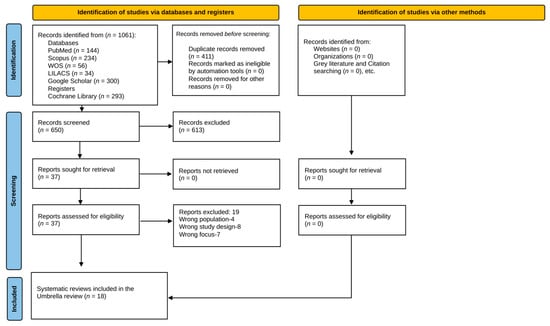
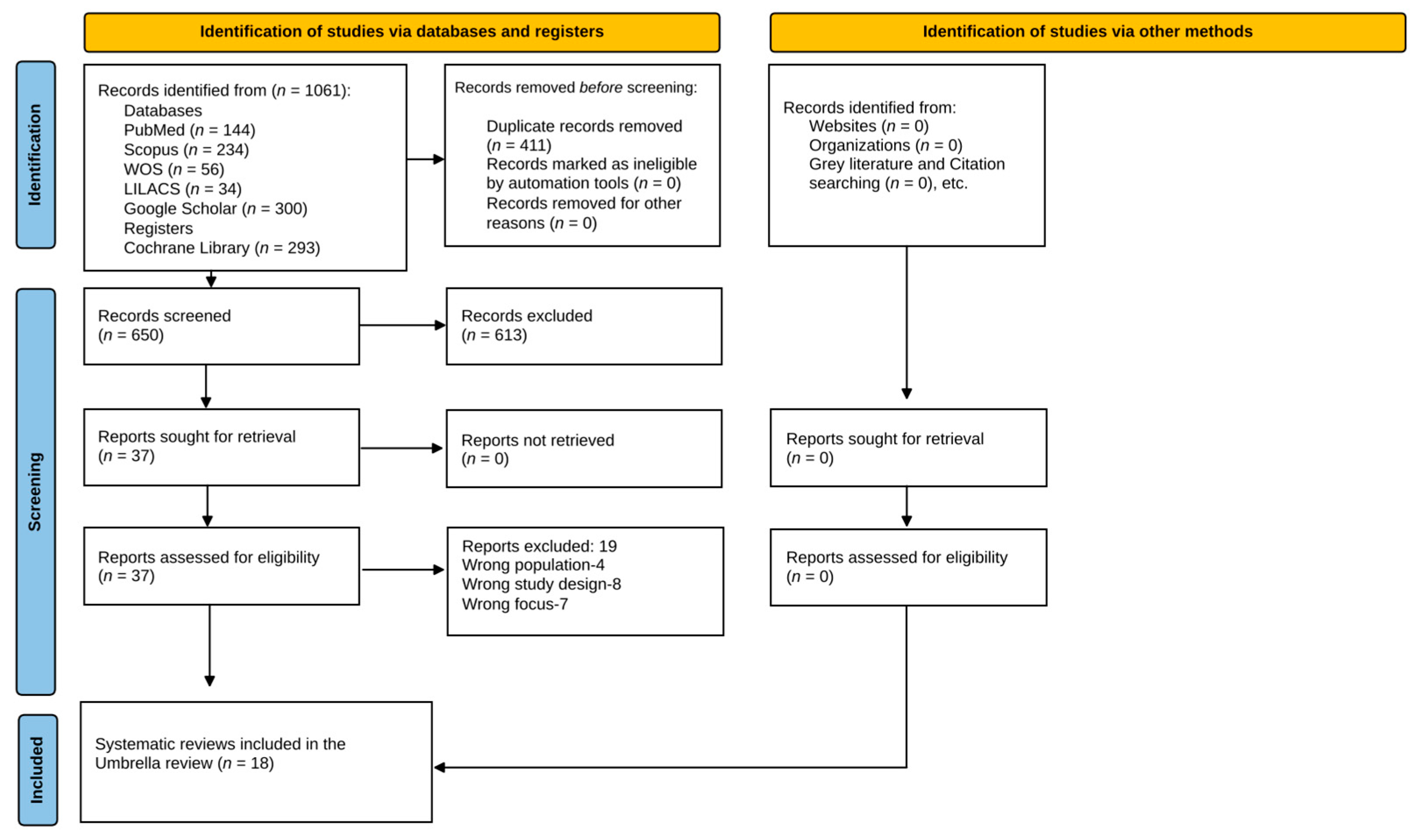
A two-stage screening process was applied: (1) title/abstract screening to exclude clearly ineligible records and (2) full-text screening to confirm eligibility, assign domain allocation (diagnostic, analgesic, therapeutic), and determine full versus partial inclusion status. Reasons for exclusion at the full-text stage were recorded and are reported in the flow diagram (Figure 1).
Figure 1.
PRISMA 2020-style flow diagram of the identification, screening, and inclusion of systematic reviews in the umbrella review.
2.4. Data Extraction
Structured data were extracted independently by three reviewers (SH, KS, and ST) using a pre-specified extraction template. The extracted fields included the first author and year, SR registration and protocol status, PICOS elements (population characteristics, laser type/parameters, comparator, outcomes, and follow-up), number of primary studies and participants, databases searched and search date, meta-analytic estimates (effect size, measure, 95% confidence interval, heterogeneity I2), GRADE certainty rating (where reported in the SR), and reviewer conclusions. Discrepancies were resolved through consensus. The authors of the included SRs were not contacted for additional data.
2.5. Quality Appraisal
The methodological quality of each included SR was assessed with the A MeaSurement Tool to Assess systematic Reviews version 2 (AMSTAR-2) [15] independently by two reviewers (SH and KS) against the full text of each SR, with a third reviewer (ST) resolving disagreements. Online supplementary files were consulted where available. AMSTAR-2 comprises 16 items, of which seven are critical domains (items 2, 4, 7, 9, 11, 13, and 15). Items 11, 12, and 15, which concern meta-analysis, were rated ‘not applicable’ for SRs without a meta-analysis. Overall confidence (High, Moderate, Low, Critically Low) was assigned according to the published algorithm: Critically Low when more than one critical domain was not met; Low when exactly one critical domain was not met; Moderate when no critical domain was not met but more than one non-critical domain was not met; and High when no critical domain was not met and at most one non-critical weakness existed. AMSTAR-2 was not designed for systematic reviews of diagnostic accuracy. It was applied to the three diagnostic reviews (D1–D3) as an adapted, non-validated approach: the PICO components of item 1 were read as population, index test, reference standard, and target condition; QUADAS-2 was accepted as a satisfactory risk-of-bias technique for item 9; and item 15 was rated on whether the authors investigated publication bias in any way. The confidence ratings for D1–D3 are therefore not equivalent to standard AMSTAR-2 assessments. The completed matrices for all 18 SRs are presented in Appendix B.
2.6. Overlap Assessment
Because the included SRs within each domain may share primary studies, the corrected covered area (CCA) was calculated separately for each of the three domains, and for the clusters that address the same clinical question (pulpotomy, oral mucositis, and injection pain), using the method of Pieper et al. (2014) [16]. CCA = (Total inclusions − Unique primary studies)/[Unique primary studies × (number of SRs − 1)], where total inclusions is the number of primary-study citations summed across the SRs, counting a study once for each SR that includes it. Overlap was interpreted using the thresholds of Pieper et al. [16]: slight (0–5%), moderate (6–10%), high (11–15%), and very high (>15%). Only primary studies that met the eligibility criteria of this review were counted: participants aged 0–18 years (or an identifiable primary or mixed dentition sample) and a laser-based intervention, including laser-activated photodynamic therapy. Adult studies, studies of non-laser interventions (including LED-only photobiomodulation), and studies without extractable age were not counted. A single pooled CCA across domains was not calculated. Citation matrices are provided in Appendix C.
2.7. Data Synthesis
Evidence was synthesized narratively and stratified across three clinical domains: diagnostic (detection and measurement of dental disease using laser-based devices), analgesic (pain management, injection anxiety, and behavior outcomes), and therapeutic (restorative and surgical interventions using hard- or soft-tissue lasers, including pulpotomy, caries management, soft-tissue surgery, and frenulectomy/frenectomy). Within each domain, the SRs were further grouped by intervention type and clinical outcome.
No additional meta-analysis was performed at the umbrella-review level; effect estimates and heterogeneity statistics reported by individual SRs were summarized descriptively. When several SRs addressed the same clinical comparison, their estimates were compared narratively, with attention to heterogeneity (I2), direction of effect, confidence interval width, AMSTAR-2 confidence, and the CCA of the cluster. Laser-activated photodynamic therapy studies were retained, as specified in the registered protocol, and are identified where they contribute. Where an SR reported different values for the same estimate in different places (abstract, text, table, or forest plot), we reported every value with its location, did not select between them or recalculate them, and flagged the discrepancy; where the choice changes whether the interval crosses the null.
2.8. Approach to Certainty Assessment
Certainty of evidence was handled as specified in the registered protocol. Where an included SR reported a formal GRADE assessment, we adopted its rating and its stated reasons for downgrading without modification (marked †). Where an SR reported no GRADE assessment, we assigned an umbrella-level structured certainty rating. This rating is not a formal GRADE assessment. For each cluster it records, from information available in the SRs, the five GRADE considerations: risk of bias (as reported by the SR’s authors), inconsistency (I2 and direction of effect), indirectness (population, intervention, and outcome relative to the review question), imprecision (width of the confidence interval and number of studies), and publication bias (reported by the SR or not assessed). The AMSTAR-2 confidence of the contributing SRs and the CCA of the cluster informed interpretation but were not used in place of these considerations. The basis for each rating is stated in Section 3 and the judgement for each domain is given in File S5. Each consideration was scored 0 (not serious), −1 (serious), or −2 (very serious); an additional −1 under “other” was used only where an SR reported conflicting values that change the conclusion. The final level is High (4) minus the total downgrade, with Very Low (1) as the floor; the arithmetic for every row is shown in File S5. Certainty was categorized as High, Moderate, Low, or Very Low.
2.9. Use of Generative Artificial Intelligence
ChatGPT (OpenAI, San Francisco, CA, USA; GPT-6) accessed on 5 March 26 and SciSpace (PubGenius Inc., [Bengaluru, India]) accessed on 15 March 2026 were used for preliminary literature orientation. All titles/abstracts and full texts were screened independently by two human reviewers (SH, KS), with a third (ST) resolving disagreements, and humans made every eligibility, data-extraction and AMSTAR-2 decision; AI outputs were checked against the source documents. A first draft of the umbrella-level certainty ratings (Section 2.8) was prepared with ChatGPT; the authors checked each rating against the SRs and made the final decisions. Generative AI (Claude Sonnet 5.5; Anthropic, San Francisco, CA, USA) was used under direct author supervision to assist with manuscript drafting, technical editing, and verification of calculations. The authors verified all AI-assisted content and take full responsibility for the accuracy and integrity of the final manuscript.
2.10. Deviations from the Registered Protocol
The following departures from the PROSPERO record (13 February 2026) are declared. (1) CINAHL, listed in the protocol, was not searched; the Cochrane Library and Google Scholar were added. (2) The protocol planned to group evidence as diagnostics, hard-tissue therapy, soft-tissue surgery, and adjunctive therapies; the review instead grouped SRs into diagnostic, analgesic, and therapeutic domains because outcomes and effect measures differ between these.
3. Results
3.1. Overview of Included Systematic Reviews
The systematic search identified 1061 records, of which 411 duplicates were removed, leaving 650 records for title and abstract screening. Following full-text assessment of 37 records, 18 SRs met all eligibility criteria and were included (the 19 excluded full texts and the reasons for exclusion are listed in File S4): three in the diagnostic domain [7,21,22], five in the analgesic domain [8,9,23,24,25], and 10 in the therapeutic domain [10,11,12,13,26,27,28,29,30,31] (Figure 1). Seven reviews were fully included [9,10,24,25,27,28,29] and 11 were partially included [7,8,11,12,13,21,22,23,26,30,31], because only pediatric-specific data could be extracted from mixed-age study pools, or because only some of the included trials used a laser-based intervention. The inclusion type of each review is shown in Table 2, and the eligible primary studies are listed in Appendix C. Of the 37 full-text reports, 19 were excluded. The characteristics of all included reviews are provided in Supplementary Tables S1–S3. None of the 18 included SRs, and none of the 19 reports excluded at the full-text stage (File S4), reviewed laser cavity preparation, caries removal, or root canal disinfection in primary teeth.
Table 2.
AMSTAR-2 confidence ratings and included types for all 18 included systematic reviews.
Of the 18 SRs, four (Macey 2020 [7]; Mira 2023 [25]; Mesquita 2024 [23]; Pagano 2020 [12]) were rated Low and 14 Critically Low; none was rated Moderate or High. The commonest critical weaknesses were the absence of a list of excluded studies with reasons (item 7; 15 SRs), no protocol registered or published in advance (item 2; 7 SRs), no publication-bias test among SRs with a meta-analysis (item 15; 9 SRs), no adequate risk-of-bias assessment (item 9; 7 SRs), item 13 (8 SRs) and item 11 (5 SRs). Item 10 (funding of included studies) was not met by any of the 18 SRs (Appendix B). Primary-study overlap was slight in the diagnostic domain (CCA = 3.57%), at the slight–moderate boundary in the therapeutic domain (CCA = 5.67%), and at the moderate–high boundary in the analgesic domain (CCA = 10.53%), with overlap concentrated among SRs addressing injection pain (CCA = 40.00%), pulpotomy (CCA = 40.00%), and oral mucositis (CCA = 17.65%) (Table 3). GRADE ratings were adopted from four SRs; the remaining outcome clusters received an umbrella-level rating that is not a formal GRADE assessment (Table 4).
Table 3.
Corrected covered area (CCA) by domain (Pieper et al. 2014 [16]).
3.2. Diagnostic Domain (D1–D3)
Three SRs examined laser fluorescence-based devices for caries detection (Supplementary Table S1): Singh et al. 2013 [21], Pinheiro et al. 2004 [22], and Macey et al. 2020 [7]. All three were partial includes. Singh et al. [21] (Critically Low confidence) reviewed 16 articles on DIAGNOdent and drew conclusions for permanent teeth, and Pinheiro et al. [22] (Critically Low) reviewed four English-language in vivo studies of occlusal caries in permanent teeth. They contribute only a few pediatric studies, mostly of permanent molars in children (Singh et al. [21]: Costa 2008, Duruturk 2011, Sheehy 2001; Pinheiro et al. [22]: Anttonen 2003, Sheehy 2001), and neither reports pediatric-specific accuracy estimates; Singh et al. [21] reported specificity of 63–95% across all included articles. Duruturk 2011 [21], checked against the primary paper, examined newly erupted first permanent molars in 307 children aged 6–7 years; Macey et al. [7] records the same study as primary molars, and we counted it as pediatric on the basis of participant age. Macey et al. [7] (Cochrane; searches to 30 May 2019) included 133 studies of fluorescence devices in children and adults; 55 did not report 2 × 2 data, and 79 studies (114 datasets; 21,283 tooth surfaces) entered the meta-analysis (the review’s stated figures of 55 and 79 sum to 134, not 133). Pooled across all devices (red, blue, and green fluorescence), the hierarchical summary ROC estimate of sensitivity was 0.70 (95% CI 0.64 to 0.75) at the median specificity of 0.78, with a diagnostic odds ratio of 14.12 (95% CI 11.17 to 17.84). Accuracy did not differ statistically between device types (χ2 = 3.91, 2 df, p = 0.14) or between primary and permanent/mixed dentition (relative DOR 0.81, 95% CI 0.50 to 1.31; p = 0.19). The review authors rated the certainty as low (risk of bias, indirectness from the many in vitro studies, and inconsistency) and reported substantial variability that none of the investigated factors explained. These estimates are not specific to children and are dominated by in vitro studies; the red-fluorescence group corresponds to the laser-based devices (DIAGNOdent), whereas the blue and green groups are not laser devices. For this umbrella review, 55 studies in Macey et al. [7] that evaluated a laser fluorescence device in children, in vivo or on extracted teeth, were identified for the overlap assessment (Appendix C). Studies on extracted primary teeth, or on teeth from children, were counted as pediatric on the basis of dentition so that all laser-fluorescence evidence relevant to children would be captured; these studies show laboratory accuracy, not clinical performance in children, which is a limitation (Section 4.3); the SR’s estimates were not re-derived for these studies. Differences in caries threshold, reference standard, tooth surface, and lesion severity limit the pooling of results, and the SR authors found considerable unexplained variation. Taken together, the evidence is compatible with an adjunctive role for laser fluorescence devices alongside visual-tactile examination, but it does not support a stand-alone role or pediatric-specific accuracy estimates.
3.3. Analgesic Domain (A1–A5)
Five SRs examined photobiomodulation therapy (PBMT) or low-level laser therapy (LLLT) for pain management and patient behavior in pediatric dental patients (Supplementary Table S2), spanning three subdomains: pain at the injection or puncture site (A1, A2, A5), post-procedural anesthesia reversal (A3), and LLLT at acupuncture points (A4). Primary-study overlap was at the moderate–high boundary (CCA = 10.53%). It was driven mainly by the six pediatric primary studies of Hakimiha et al. 2025 [8], all of which are also in Zanchetta Peron et al. 2026 [9] (two of them, Amruthavarshini 2021 and Uçar 2022, are also in Mesquita et al. 2024 [23]); Mira et al. 2023 [25] and Adameh et al. 2025 [24] shared no primary studies with any other SR [8,9,23,24,25]. Because A1, A2 and A5 draw on largely the same trials, their agreement or disagreement should not be read as independent confirmation. Zanchetta Peron et al. 2026 [9] (A2; exclusively pediatric; PROSPERO CRD42024539486) included 10 RCTs in 773 children aged 5–13 years and conducted two meta-analyses of pain at needle insertion: PBMT versus placebo (three studies contributing 14 comparisons; SMD −0.44, 95% CI −0.59 to −0.29; I2 = 0%), a moderate effect according to the authors, and PBMT versus topical anesthetic gel (two split-mouth studies measured with the Wong–Baker Faces Pain Rating Scale; MD −3.30, 95% CI −3.98 to −2.62; I2 = 0%). Both were rated low certainty with GRADE because of methodological limitations, inconsistency among study findings, and imprecision [9]. The two split-mouth studies compare two sides of the same mouth, so the gel-comparison estimate rests on only two small studies and may not generalize beyond that design. Hakimiha et al. 2025 [8] (A1; mixed ages) reported a pediatric subgroup estimate of MD −1.10 (95% CI −1.80 to −0.41; I2 = 75.6%) in its forest plot (Figure 3 of the original systematic review), a subgroup that was not pre-specified [8]; the abstract and text of that paper repeat the adult estimate (MD −0.59; 95% CI −1.11 to −0.08) for children, so we use the forest-plot value and note the inconsistency. Mesquita et al. 2024 [23] (A5; PROSPERO CRD42022304740; searches in November 2021 with alerts to June 2022) included eight RCTs (540 patients aged 6–75 years; diode lasers, 660–980 nm) without meta-analysis; most trials were in adults, and two were in children (Uçar 2022; Amruthavarshini 2021). Its authors concluded that PBMT seems to have no effect on pain perception during the anesthetic puncture (GRADE low to very low). In its pediatric comparisons, PBMT added to topical anesthetic was better than topical anesthetic alone on the Wong–Baker scale only (one trial, 60 participants; low), and PBMT alone gave significantly higher pain scores than topical anesthetic (one trial, 30 participants; very low) [23]. Adameh et al. 2025 [24] included five RCTs; their meta-analysis of anesthesia duration pooled four comparisons from three RCTs (MD −44.85 min, I2 = 94%; 95% CI −83.71 to −5.99 in the text but −68.71 to −20.99 in the forest plot) [24]. Mira et al. 2023 [25] synthesized four RCTs of LLLT at acupuncture points for pre-anesthetic pain, gag reflex, and sleep bruxism in children, with favorable findings but no meta-analysis.
3.4. Therapeutic Domain (T1–T10)
Ten SRs examined therapeutic laser applications across five subdomains: laser pulpotomy in primary teeth [10,27,28], LLLT/PBMT or photodynamic therapy for chemotherapy-induced oral mucositis in pediatric oncology patients [11,26,29,30], laser therapy for dentinal hypersensitivity in MIH-affected teeth [31], sub-ablative laser for caries prevention [12], and laser frenulectomy [13] (Supplementary Table S3). Primary-study overlap was 5.67% (at the slight–moderate boundary). Six SRs were partial includes [11,12,13,26,30,31]. Laser-activated photodynamic therapy (PDT) studies were included, as specified in the registered protocol: Ribeiro da Silva 2018 (T4, T5; 660 nm, 100 mW, 35 J as tabulated by Diniz et al. [29]) and Medeiros-Filho 2017 (T5; methylene blue activated by a 660 nm, 100 mW laser for 90 s, combined with LLLT versus LLLT alone; 15 children aged 3–16 years analyzed). Santos Vieira 2019 and Mandetta 2023 (T7; red-light PDT, 660 nm) were not counted because they have no published results. Three SRs provided an evidence base (2013–2024) for laser pulpotomy across 20 unique primary studies (Table 3): 18 RCTs and two case series included only by De Coster et al. [27]. Pandiyan et al. 2024 [10], the most recent, found no statistically significant difference between laser and conventional pulpotomy for clinical success (RR 1.01; 95% CI 0.98–1.04; I2 = 0%; 13 RCTs) or radiographic success (RR 1.00; 95% CI 0.91–1.09; I2 = 64%; 12 RCTs); against MTA, the results text gives clinical RR 0.92 (95% CI 0.79–1.07) and radiographic RR 0.90 (95% CI 0.74–1.10), while its Table 4 gives clinical RR 0.90 (95% CI 0.79–1.02) [10]. A non-significant difference does not demonstrate equivalence. Nematollahi et al. 2018 [28] and De Coster et al. 2013 [27] likewise found no significant clinical difference between laser and conventional pulpotomy agents [27,28]. For oral mucositis, Andriakopoulou et al. 2024 [11] included 11 laser-related RCTs (two of them PDT-related), of which three contributed to quantitative pooling of mucositis incidence (RR 0.99, 95% CI 0.26–3.76, prevention and treatment combined; RR 0.48, 95% CI 0.04–6.20, treatment only); neither was statistically significant and both had wide confidence intervals, so they do not consistently favor laser therapy. The reported reduction in hospital stay (MD −4.33 days, 95% CI −7.02 to −1.64) came from honey, not laser (two RCTs) [11]. Diniz et al. 2023 [29] (Critically Low) included nine studies and was given the least interpretive weight [29]. Bjordal et al. 2011 [30] contributed two pediatric RCTs (Cruz 2007; Kuhn 2009), both favoring lasers [30]. Marques et al. 2025 [26] (T10; preventive PBM in children with hematologic malignancies; PROSPERO CRD42024610954; searches to February 2025) included five trials in patients aged 4 months to 22 years (four used low-level laser, one of which also compared laser with LED; one used LED only); two trials were at high and one at unclear risk of bias. Three trials were eligible for meta-analysis. For oral mucositis of any grade, two RCTs were pooled and favored PBM (OR 0.08; 95% CI 0.01–0.84 in the forest plot, but 0.01–0.64 in the figure legend; p = 0.04; I2 = 70%); for grade 3–4 mucositis, three RCTs (one of them LED-only) showed no significant difference (RD −0.08; 95% CI −0.18 to 0.01; p = 0.08; I2 = 0%); heterogeneity for grade 1–2 mucositis was I2 = 85%. No GRADE assessment was reported [26]. This finding exhibits a distinct magnitude and significance compared to the non-significant pooled estimates presented in Andriakopoulou et al. [11] and illustrates why preventive and therapeutic applications must be distinguished: Marques et al. [26] addressed prevention only, whereas Andriakopoulou et al. [11] pooled prevention and treatment, and treatment alone. Cerqueira et al. 2025 [31] reviewed laser therapy for MIH hypersensitivity (seven studies; six in children, aged 6–14 years, one in adults). Only three of the six pediatric studies have published results: Muniz 2020 [33] (laser had an immediate desensitizing effect; laser plus fluoride varnish was more effective than laser alone), Pion 2022 [34] (laser reduced hypersensitivity by 11% at 30 days, with no statistically significant difference from glass ionomer sealing), and Zhao 2023 [35] (Er:YAG laser reduced hypersensitivity immediately). Fossati 2023 [36], Mandetta 2023, and Santos Vieira 2019 are protocols or trials without published results and were not counted in the overlap analysis, and no pooled estimate was available [31]. Pagano et al. 2020 [12] did not perform a meta-analysis. It included nine studies, five of them in children (Brugnera 1997, Durmus 2017, Kumar 2016, Raucci-Neto 2015, Zezell 2009), and reported single-trial caries-incidence results that favored laser combined with a traditional prophylactic intervention: RR 0.44 (95% CI 0.20–0.97) for Er:YAG plus sealant versus sealant alone, and RR 0.39 (95% CI 0.22–0.71) for Nd:YAG laser plus acidulated phosphate fluoride gel versus gel alone; laser used alone did not reduce caries (RR 0.89, 95% CI 0.40–1.97, in permanent teeth). All included studies had an evident risk of bias. These estimates come from single trials and are not specific to children [12]. Marrapodi et al. 2025 [13] synthesized four pediatric primary studies, consistently reporting less intraoperative pain, reduced bleeding, and faster healing with laser versus conventional scalpel frenulectomy; no pooled estimate was available [13]. Across the 10 therapeutic SRs, the direction of effect mostly favored laser, but heterogeneous laser parameters, the absence of standardized protocols, small numbers of pediatric studies, and predominantly Critically Low AMSTAR-2 ratings preclude confident conclusions in any therapeutic subdomain.
3.5. Certainty of Evidence
Certainty ratings are shown in Table 4. Four SRs reported GRADE assessments, which were adopted unchanged: Macey et al. [7] (fluorescence-based caries detection: low), Zanchetta Peron et al. [9] (PBMT versus placebo and versus topical gel for injection pain: low), Pandiyan et al. [10] (laser pulpotomy: low for all six comparisons), and Mesquita et al. [23] (PBMT at the anesthetic puncture: low to very low by comparison). For the remaining clusters, which were not graded in the included SRs, umbrella-level ratings were assigned using the procedure in Section 2.8; these are not formal GRADE assessments. No cluster achieved Moderate or High certainty. Point estimates did not uniformly favor laser: the pulpotomy estimates were close to the null, the pooled mucositis incidence estimates in Andriakopoulou et al. [11] were non-significant with wide intervals, and Mesquita et al. [23] found no effect of PBMT at the puncture site in mostly adult trials. Hakimiha et al. [8] report a mean difference and Zanchetta Peron et al. [9] a standardized mean difference, so their estimates are on different scales and are described as pointing in the same direction, not as numerically consistent. Table 4 presents the certainty rating, its source, and its basis for every outcome cluster.
Table 4.
Summary of certainty of evidence—laser interventions in pediatric dentistry (SR-reported GRADE ratings † and umbrella-level ratings).
3.6. Adverse Events and Safety Reporting
Adverse events were a pre-specified outcome of interest (Table 1), but only seven of the 18 SRs reported anything about them, and not in a form that could be pooled. In the analgesic domain, Zanchetta Peron et al. [9] reported that four of the 10 included trials stated explicitly that no adverse effects occurred and that the other six did not report adverse events. Adameh et al. [24] listed adverse events as a secondary outcome but reported no adverse-event results; soft-tissue trauma after anesthesia, which follows prolonged numbness and is not an effect of the laser, was lower with PBMT in the text (RR 0.36; 95% CI 0.07–1.78) and in the forest plot (RR 0.30; 95% CI 0.10–0.93), with the significance differing between the two. In the therapeutic domain, Bjordal et al. [30] reported that all included trials monitored side effects, none found effects beyond those with placebo LLLT, five trials stated that LLLT was well tolerated, and no serious incidents or withdrawals due to intolerance occurred. Marques et al. [26] stated that none of the PBMT trials cited in their review reported intolerance or adverse effects, and Diniz et al. [29] stated, citing the earlier literature, that children and adolescents did not experience side effects with PBMT. Pagano et al. [12] pre-specified adverse effects (irreversible pulpitis, pulp necrosis, abscess) as primary outcomes; two trials (44 participants aged 15–38 years; 174 permanent teeth) found one case of reversible pulpitis at 3 days and no irreversible pulpitis or necrosis, but these data are not pediatric-specific. Marrapodi et al. [13] reported complete healing in all cases except one scar formation in the scalpel group of an included trial. The other 11 SRs (D1–D3, A1, A4, A5, T1–T3, T5, T7) reported no adverse-event data that we could identify. Absence of reporting is not evidence of safety, and no SR assessed adverse events systematically in children.
4. Discussion
4.1. Methodological Considerations
An umbrella review was chosen because several SRs of laser interventions in children exist, but they address separate clinical questions and differ in quality and scope. Outcomes, comparators, and effect measures differ between the diagnostic, analgesic, and therapeutic domains and cannot be pooled across them, so synthesis, overlap (CCA), and certainty were handled within domains and, where several SRs addressed one question, within clusters. Partial inclusion made it possible to use the pediatric data of mixed-age SRs (its limits are given in Section 4.3). Certainty followed the registered protocol (Section 2.8). We avoided inferring equivalence from non-significant differences.
4.2. Principal Findings in the Context of Existing Evidence
In the diagnostic domain, the three SRs are compatible with an adjunctive role for laser fluorescence devices rather than a replacement for visual–tactile examination, which aligns with the AAPD 2025 policy [4]. The best available estimate, from Macey et al. 2020 [7], is pooled across all fluorescence devices, children and adults, and mostly in vitro studies, with sensitivity 0.70 at specificity 0.78 and low certainty; it supports neither a pediatric-specific estimate nor a laser-specific one [7]. Macey et al. 2020 [7], the best-conducted SR in this domain, was rated Low because it ran no publication-bias test (item 15), although its authors explain that available tests are unreliable for diagnostic data. The two Critically Low SRs (Singh et al. 2013 [21]; Pinheiro et al. 2004 [22]) pre-date current appraisal standards, and their inclusion reflects completeness rather than endorsement of their methods [21,22]. Their pediatric contribution is a few studies, mostly of permanent molars. The persistent heterogeneity in caries threshold, tooth surface, and device type indicates that the field has not adopted reporting standards sufficient for reliable pooling, a gap the AAPD policy acknowledges in calling for pediatric-specific research [4].
In the analgesic domain, the evidence is mixed. Zanchetta Peron et al. 2026 [9], the only exclusively pediatric SR, found a moderate effect of PBMT on injection pain; it was rated Critically Low on AMSTAR-2 (items 11 and 15), as was Hakimiha et al. 2025 [8], so both SRs behind the pooled injection-pain estimates are of low methodological confidence, and the GRADE low rating reflects methodological limitations, inconsistency, and imprecision in the primary studies, not only a limited number of studies [9]. Hakimiha et al. 2025 [8] reported a pediatric subgroup effect in the same direction (forest-plot MD −1.10, 95% CI −1.80 to −0.41, whereas its text gives the adult value) but with I2 = 75.6% and a subgroup that was not pre-specified [8], whereas Mesquita et al. 2024 [23] concluded that PBMT seems to have no effect on pain at the puncture site, on the basis of mostly adult trials and one pediatric trial in which PBMT alone produced higher pain scores than topical anesthetic [23]. Because A1, A2, and A5 share many of the same pediatric trials (CCA of the cluster 40.00%), agreement among them is not independent evidence. The AAPD 2025 policy endorses photobiomodulation for pain reduction in children [4]; policy endorsement is not evidence of effectiveness, and the SRs show that effects depend on the comparator and laser protocol. For anesthesia reversal, Adameh et al. 2025 [24] reported a significant reduction in soft-tissue anesthesia duration (MD −44.85 min), but I2 = 94% was the highest in this umbrella review and undermines confidence in the pooled estimate; a wavelength subgroup suggested 660 nm might be more effective; 660 nm is one of the wavelengths (632.8, 650, and 660 nm) in the five adult intraoral PBM protocols listed by the MASCC/ISOO 2020 guideline, which does not nominate a single preferred wavelength [37], and extrapolation from oncology to anesthesia reversal is not justified. Acupoint LLLT (Mira et al. [25]) delivers laser to remote acupuncture points rather than the oral cavity, which introduces indirectness [25].
In the therapeutic domain, laser pulpotomy is the most substantial cluster: three SR teams (De Coster et al. 2013 [27], Nematollahi et al. 2018 [28], Pandiyan et al. 2024 [10]) found no statistically significant difference between laser and conventional pulpotomy [10,27,28]. A non-significant result does not establish equivalence: the clinical success interval (RR 0.98–1.04) is narrow, but the radiographic interval (0.91–1.09) is wider with I2 = 64%, and both were rated low certainty, so further trials could change the estimate. The three SRs share many primary trials (CCA of the cluster 40.00%) and all three are Critically Low on AMSTAR-2, so their convergence is not independent confirmation and should not be counted as three separate lines of evidence. For oral mucositis, the evidence points in different directions: preventive PBM in children with hematologic malignancies favored PBM (Marques et al. [26]), but the pooled incidence estimates in Andriakopoulou et al. [11] were non-significant with very wide intervals, and the pediatric certainty is very low. Grzech-Leśniak et al. 2025 [38], an umbrella review of 22 SRs on laser therapy for oral mucositis (adults and children, including PDT combinations; endorsed by the Polish Society for Laser Dentistry), reported that preventive PBM reduces grade 3–4 mucositis by 40–80% and therapeutic PBM shortens ulcer duration by 4–7 days, with optimal settings of 630–670 nm intraorally [38]. That review pools adult and pediatric evidence for a single condition and does not apply directly to children; its findings are consistent in direction with, but not evidence for, the pediatric results here. The MASCC/ISOO 2020 guideline recommends intraoral low-level laser PBM for the prevention of oral mucositis in adults receiving hematopoietic stem cell transplantation conditioning with high-dose chemotherapy (level of evidence I) and in adults receiving head and neck radiochemotherapy (level I) or radiotherapy alone (level II); for pediatric patients the panel considered the randomized trial results promising but too early to base a guideline on [37]. We distinguish evidence of clinical effectiveness from evidence that laser interventions are feasible or potentially useful: for most therapeutic applications (hypersensitivity in MIH, caries prevention, frenulectomy), the SRs show feasibility and favorable trends in small numbers of pediatric studies, not established effectiveness. Laser parameters, treatment protocols, operator experience, and clinical settings varied across the primary studies and are likely to affect generalizability.
4.3. Strengths and Limitations
Strengths of this umbrella review include a registered protocol, a PRIOR-guided report, AMSTAR-2 appraisal, domain- and cluster-level CCA restricted to eligible pediatric laser studies, adoption of SR-reported GRADE ratings without alteration, and explicit rules for pediatric extraction. The limitations follow from the evidence base and from our methods. First, 14 of the 18 SRs were rated Critically Low and four Low on AMSTAR-2, which limits the certainty that can be attached to their findings. Second, pediatric data in the 11 partially included SRs depend on age information that the SRs report incompletely, and counts rest on explicit rules (Section 2.1): Pritchard 2024 [26] (LED only, ages up to 22 years) and Dantas 2011 [23](age not reported) were not counted, and records without published results (Fossati 2023, Mandetta 2023, Santos Vieira 2019) [31] were not counted as primary studies. Different decisions could change the overlap figures and certainty ratings. For Macey et al. [7], studies on extracted teeth were counted as pediatric when they used primary teeth or teeth from children; they show laboratory accuracy, not clinical performance in children. Third, the GRADE ratings adopted from Macey et al. [7] and Mesquita et al. [23] refer to largely adult, in vitro or non-laser evidence and may overstate the certainty for children treated with lasers; the other umbrella-level ratings are structured judgements, not formal GRADE, and are less reliable. Fourth, grouping heterogeneous interventions within broad domains (lasers, wavelengths, energy densities, comparators) may obscure differences in effectiveness. Fifth, the search was restricted to English, as registered, and CINAHL was not searched, so eligible SRs may have been missed despite citation searching. Sixth, adverse events were reported by only seven SRs and could not be synthesized (Section 3.6), and the funding of the primary studies (AMSTAR-2 item 10) was unreported in all 18 SRs, which limits the assessment of safety and commercial influence. Generative AI was used as described in Section 2.9.
4.4. Future Research Directions
In the diagnostic domain, adequately powered pediatric diagnostic accuracy studies of laser fluorescence devices, in vivo, with pre-specified caries thresholds and QUADAS-2 [32] assessment, are needed. In the analgesic domain, larger multicenter RCTs with standardized PBMT parameters (wavelength, energy density, application time) and clearly stated comparators are required to settle the conflicting injection-pain findings; wavelength-stratified trials would also address the heterogeneity in the anesthesia-reversal cluster. For oral mucositis, pediatric RCTs using unified grading scales and chemotherapy-protocol stratification, with explicit separation of LLLT and PDT arms from the design stage and separate reporting of prevention and treatment, are needed. Laser pulpotomy trials should adopt a core outcome set, stratify by laser type, and extend follow-up. Future SRs should register protocols prospectively, provide lists of excluded studies, apply GRADE, report pediatric-specific data, and report primary-study funding. Patient-reported experience measures, cost-effectiveness, and long-term safety data are largely absent from the pediatric laser evidence base and are needed to inform routine practice.
5. Conclusions
This umbrella review synthesized 18 SRs on laser applications in pediatric dentistry. Laser fluorescence devices may serve as adjuncts to conventional examination, but the pediatric diagnostic evidence is limited and not laser-specific. Photobiomodulation shows potential for reducing injection-related pain, based on low-certainty evidence that is inconsistent across SRs and may not generalize across laser protocols. For laser pulpotomy, no statistically significant difference from conventional pulpotomy was found, with low certainty; this does not establish equivalence. For oral mucositis, dentinal hypersensitivity, caries prevention, and frenulectomy, the evidence is of very low certainty and does not support definitive clinical recommendations. No included SR was rated Moderate or High on AMSTAR-2, and 14 of 18 were Critically Low. No outcome achieved Moderate or High certainty. Standardized laser parameters and rigorous pediatric-specific trials are needed before clinical guidelines can be established.
Supplementary Materials
The following supporting information can be downloaded at: https://www.mdpi.com/article/10.3390/dj14120779/s1, Table S1: Characteristics and AMSTAR-2 appraisal of included systematic reviews—diagnostic domain (D1–D3); Table S2: Characteristics and AMSTAR-2 appraisal of included systematic reviews—analgesic domain (A1–A5); Table S3: Characteristics and AMSTAR-2 appraisal of included systematic reviews—therapeutic domain (T1–T10); File S1: Appendix B, full 16-item AMSTAR-2 appraisal of the 18 included systematic reviews; File S2: PRIOR reporting checklist; File S3: completed PRISMA 2020 checklist; File S4: list of the 19 full-text reports excluded, with reasons; File S5: certainty-of-evidence judgements by cluster and domain.
Author Contributions
Conceptualization, S.H. and K.S.; methodology, S.H., K.S., and S.T.; investigation (screening, data extraction, and AMSTAR-2 appraisal), S.H., K.S., and S.T.; formal analysis (AMSTAR-2 synthesis, CCA, and GRADE), S.H.; validation, K.S., S.T., and T.T.; writing—original draft preparation, S.H.; writing—review and editing, K.S., S.T., J.S.V., S.B., S.H., and T.T.; supervision, K.S.; project administration, S.H. All authors have read and agreed to the published version of the manuscript.
Funding
This research received no external funding.
Institutional Review Board Statement
Not applicable.
Informed Consent Statement
Not applicable.
Data Availability Statement
No new data were created or analyzed in this study. The review protocol is registered in PROSPERO (CRD420261308339). The search strategies are provided in Appendix A, and the characteristics and appraisal of the included systematic reviews are provided in Supplementary Tables S1–S3.
Acknowledgments
During the preparation of this study, the author(s) used Claude (Anthropic; Claude Sonnet 5.5, accessed through Claude Code, 1 November 2026) for the purpose of designing and drawing the graphical abstract from the authors’ results (layout and drawing code). No AI image-generation model was used. The authors have reviewed and edited all AI-assisted output and take full responsibility for the content of this publication.
Conflicts of Interest
The authors declare no conflicts of interest.
Abbreviations
The following abbreviations are used in this manuscript:
| AAPD | American Academy of Pediatric Dentistry |
| AMSTAR-2 | A MeaSurement Tool to Assess systematic Reviews, version 2 |
| AUC | Area under the curve |
| CCA | Corrected covered area |
| CI | Confidence interval |
| GRADE | Grading of Recommendations, Assessment, Development and Evaluation |
| HSCT | Hematopoietic stem cell transplantation |
| LED | Light-emitting diode |
| LF | Laser fluorescence |
| LLLT | Low-level laser therapy |
| MASCC/ISOO | Multinational Association of Supportive Care in Cancer/International Society of Oral Oncology |
| MD | Mean difference |
| MIH | Molar-incisor hypomineralization |
| OM | Oral mucositis |
| PBMT | Photobiomodulation therapy |
| PDT | Photodynamic therapy |
| PICOS | Population, intervention, comparator, outcomes, study design |
| QLF | Quantitative light-induced fluorescence |
| RCT | Randomized controlled trial |
| RoB | Risk of bias |
| ROC | Receiver operating characteristic |
| RR | Risk ratio |
| SMD | Standardized mean difference |
| SR | Systematic review |
Appendix A. Search Strategies
All searches were run on 18 March 2026, from database inception to that date (see Section 2.2). Search strings are reproduced as run.
Appendix A.1. PubMed
(“Lasers”[Mesh] OR “Laser Therapy”[Mesh] OR “Photodynamic Therapy”[Mesh] OR laser*[tiab] OR “Er:YAG”[tiab] OR “Er,Cr:YSGG”[tiab] OR “Nd:YAG”[tiab] OR CO2[tiab] OR diode[tiab] OR “low level laser”[tiab] OR LLLT[tiab] OR photobiomodulation[tiab] OR PBM[tiab] OR “laser fluorescence”[tiab] OR DIAGNOdent[tiab] OR “photodynamic therapy”[tiab] OR PDT[tiab]) AND (“Dentistry”[Mesh] OR “Pediatric Dentistry”[Mesh] OR dent*[tiab] OR odontolog*[tiab] OR oral[tiab]) AND( “Infant”[Mesh] OR “Child”[Mesh] OR “Adolescent”[Mesh] OR pediatric*[tiab] OR paediatric*[tiab] OR child*[tiab] OR adolescent*[tiab] OR infant*[tiab] OR “primary teeth”[tiab] OR deciduous[tiab] OR “mixed dentition”[tiab]) AND (systematic[sb] OR “systematic review”[Publication Type] OR “meta-analysis”[Publication Type] OR “systematic review”[tiab] OR “meta-analysis”[tiab] OR “umbrella review”[tiab] OR overview[tiab] OR “overview of reviews”[tiab])
Appendix A.2. Scopus
TITLE-ABS-KEY (laser* OR “laser therapy” OR “Er:YAG” OR “Er,Cr:YSGG” OR “Nd:YAG” OR CO2 OR diode OR “low level laser” OR LLLT OR photobiomodulation OR PBM OR “photodynamic therapy” OR PDT OR “laser fluorescence” OR DIAGNOdent) AND TITLE-ABS-KEY(dent* OR odontolog* OR oral) AND TITLE-ABS-KEY(pediatric* OR paediatric* OR child* OR adolescent* OR infant* OR “primary teeth” OR deciduous OR “mixed dentition”) AND TITLE-ABS-KEY(“systematic review” OR “meta-analysis” OR “meta analysis” OR “umbrella review” OR overview OR “overview of reviews”).
Appendix A.3. Web of Science Core Collection
TS=(laser* OR “laser therapy” OR “Er:YAG” OR “Er,Cr:YSGG” OR “Nd:YAG” OR CO2 OR diode OR “low level laser” OR LLLT OR photobiomodulation OR PBM OR “photodynamic therapy” OR PDT OR “laser fluorescence” OR DIAGNOdent) AND TS=(dent* OR odontolog* OR oral) AND TS=(pediatric* OR paediatric* OR child* OR adolescent* OR infant* OR “primary teeth” OR deciduous OR “mixed dentition”) AND TS=(“systematic review” OR “meta-analysis” OR “meta analysis” OR “umbrella review” OR overview OR “overview of reviews”).
Appendix A.4. Cochrane Library (Search Manager)
#1 MeSH descriptor: [Lasers] explode all trees
#2 MeSH descriptor: [Laser Therapy] explode all trees
#3 MeSH descriptor: [Photodynamic Therapy] explode all trees
#4 (laser* or “Er:YAG” or “Er,Cr:YSGG” or “Nd:YAG” or CO2 or diode or LLLT or “low level laser” or photobiomodulation or PBM or “laser fluorescence” or DIAGNOdent or PDT):ti,ab,kw
#5 #1 OR #2 OR #3 OR #4
#6 MeSH descriptor: [Dentistry] explode all trees
#7 MeSH descriptor: [Pediatric Dentistry] explode all trees
#8 (dent* or odontolog* or oral):ti,ab,kw
#9 #6 OR #7 OR #8
#10 MeSH descriptor: [Child] explode all trees
#11 MeSH descriptor: [Adolescent] explode all trees
#12 MeSH descriptor: [Infant] explode all trees
#13 (pediatric* or paediatric* or child* or adolescent* or infant* or “primary teeth” or deciduous or “mixed dentition”):ti,ab,kw
#14 #10 OR #11 OR #12 OR #13
#15 (“systematic review” or “meta-analysis” or “umbrella review” or overview or “overview of reviews”):ti,ab,kw
#16 #5 AND #9 AND #14 AND #15
Appendix A.5. LILACS (Via BVS/VHL)
tw:(laser* OR “terapia laser” OR laserterapia OR “fotobiomodulação” OR fotobiomodulacao OR “terapia fotodinâmica” OR “terapia fotodinamica” OR “terapia fotodinámica” OR “terapia fotodinamica” OR PDT OR “fluorescência a laser” OR “fluorescencia a laser” OR DIAGNOdent) AND tw:(odontologia OR dental OR dent* OR oral OR “saúde bucal” OR “salud bucal”) AND tw:(criança OR crianca OR crianças OR criancas OR infantil OR pediatr* OR odontopediatria OR niño OR niños OR infantil OR pediatr* OR “odontología pediátrica” OR child* OR adolescent* OR infant*) AND tw:(“revisão sistemática” OR “revisao sistematica” OR “revisión sistemática” OR “revision sistematica” OR “systematic review” OR metanálise OR metaanalise OR metaanálisis OR metaanalisis OR “meta-analysis” OR “umbrella review” OR overview OR “revisão de revisões” OR “revision de revisiones”)
Appendix A.6. Google Scholar (Run Separately)
PBM/LLLT: (“systematic review” OR meta-analysis) (photobiomodulation OR “low level laser” OR LLLT) dentistry child.
Photodynamic therapy: (“systematic review” OR meta-analysis) (“photodynamic therapy” OR PDT) dentistry child.
Laser fluorescence/DIAGNOdent: (“systematic review” OR meta-analysis) (DIAGNOdent OR “laser fluorescence”) caries child.
Appendix A.7. Grey Literature and Other Sources
PROSPERO: “laser dentistry child systematic review”; “photobiomodulation dentistry child systematic review”; “photodynamic therapy dentistry child systematic review”.
OSF Registries: “laser pediatric dentistry systematic review”; “photobiomodulation pediatric dentistry systematic review”.
Shodhganga: “laser dentistry systematic review”; “photobiomodulation dentistry systematic review”.
Preprint servers (medRxiv, Research Square): “laser dentistry systematic review”; “photobiomodulation dentistry systematic review”.
Forward and backward citation searching of the included SRs was performed on 21 March 2026; it identified no additional eligible SRs. The authors of the SRs were not contacted.
Appendix B. AMSTAR-2 Appraisal Matrices
The complete 16-item AMSTAR-2 appraisal for all 18 included systematic reviews is provided as a separate supplementary file (File S1, Appendix B).
Appendix C. Citation Matrices for Corrected Covered Area
Appendix C.1. Diagnostic Domain
| SR | D1 Singh K et al. 2013 [21] | D2 Pinheiro IVA et al. 2004 [22] | D3 Macey R et al. 2020 [7] | n Pediatric Studies | Pediatric Primary Studies Counted |
| D1 Singh K et al. 2013 [21] | — | 1 | 2 | 3 | Costa 2008; Duruturk 2011; Sheehy 2001 [21] |
| D2 Pinheiro IVA et al. 2004 [22] | 1 | — | 2 | 2 | Anttonen 2003; Sheehy 2001 [22] |
| D3 Macey R et al. 2020 [7] | 2 | 2 | — | 55 | Anttonen 2003; Apostolopoulou 2009; Attrill 2001; Bahrololoomi 2015; Barberia 2008; Bengtson 2005; Bittar 2012; Braga 2006; Braga 2008; Braga 2009; Bussaneli 2015a; Chawla 2012; Chen 2012; Chong 2003; Cinar 2013; Costa 2007; Diniz 2009; Diniz 2019; Duruturk 2011; Ferreira 2008; Francescut 2003; Goel 2009; Jeon 2004; Kavvadia 2008; Kavvadia 2012; Kockanat 2017; Kouchaji 2012; Kucukyilmaz 2015; Kuhnisch 2008; Li 2006; Lussi 2003; Matos 2011; Mendes 2005; Mendes 2006; Mendes 2012; Mepparambath 2014; Muller-Bolla 2017; Neuhaus 2011; Novaes 2009; Novaes 2010; Novaes 2012; Novaes 2012a; Novaes 2016; Pinelli 2002; Rando-Meirelles 2011; Ribeiro 2015; Rocha 2003; Rocha-Cabral 2008; Rodrigues 2009; Rodrigues 2011; Sheehy 2001; Shwetha 2017; Souza 2013; Souza 2018; Teo 2014 [7] |
| CCA Calculation (Pieper et al. 2014 [16]) Parameter | Value |
| Number of SRs (r) | 3 |
| Total unique pediatric primary studies (N) | 56 |
| Total inclusions | 60 |
| Overlapping inclusions (total − unique) | 4 |
| Formula | CCA = (Total inclusions − Unique studies)/[Unique studies × (r − 1)] |
| Denominator | 56 × (3 − 1) = 112 |
| CCA value | 4/112 = 0.0357 |
| CCA% | 3.57% |
| Studies in more than one SR | Anttonen 2003; [7,22] Duruturk 2011 [7,21]; Sheehy 2001 [7,21,22] |
| Singh K et al. 2013 [21] and Pinheiro IVA et al. 2004 [22] are partial includes (permanent teeth; pediatric studies only). Macey R et al. 2020 [7] is a partial include: of 133 studies, 55 evaluated a laser fluorescence device (DIAGNOdent or DIAGNOdent pen) in children (primary or mixed dentition, or participants aged 18 years or younger), in vivo or in extracted teeth. The two QLF reviews (Brouwer; Twetman) were removed because QLF is not laser-based. CCA value 3.57% (slight). | |
Appendix C.2. Analgesic Domain
| SR | A1 Hakimiha 2025 [8] | A2 Zanchetta Peron 2026 [9] | A3 Adameh 2025 [24] | A4 Mira 2023 [25] | A5 Mesquita 2024 [23] | n Pediatric Studies | Pediatric Primary Studies Counted |
| A1 Hakimiha 2025 [8] | — | 6 | 0 | 0 | 2 | 6 | Amruthavarshini 2021; Dehgan D 2022; Shekarchi F 2022; Uçar 2022; Elbay M 2023; Seraj B 2023 [8] |
| A2 Zanchetta Peron 2026 [9] | 6 | — | 0 | 0 | 2 | 10 | Hamouda A 2024; Shekarchi F 2022; Elbay M 2023; Seraj B 2023; Aykanat B 2024; Dehgan D 2022; Uçar 2022; Khan BS 2023; Amruthavarshini 2021; Shrutha SP 2024 [9] |
| A3 Adameh 2025 [24] | 0 | 0 | — | 0 | 0 | 5 | Annu A 2023; Ghajari MF 2024; Olszewska A 2024; Othman HY 2025; Seraj B 2020 [24] |
| A4 Mira 2023 [25] | 0 | 0 | 0 | — | 0 | 4 | Salgueiro MDCC 2021; Sandhyarani B 2021; Goel H 2017; Elbay M 2016 [25] |
| A5 Mesquita 2024 [23] | 2 | 2 | 0 | 0 | — | 2 | Amruthavarshini 2021; Uçar 2022 [23] |
| CCA Calculation (Pieper et al. 2014 [16]) Parameter | Value |
| Number of SRs (r) | 5 |
| Total unique pediatric primary studies (N) | 19 |
| Total inclusions | 27 |
| Overlapping inclusions (total − unique) | 8 |
| Formula | CCA = (Total inclusions − Unique studies)/[Unique studies × (r − 1)] |
| Denominator | 19 × (5 − 1) = 76 |
| CCA value | 8/76 = 0.1053 |
| CCA% | 10.53% |
| Elbay M 2022 (A1; Lasers Med Sci; n = 40) and Elbay M 2023 (A2; J Clin Pediatr Dent; n = 160) were confirmed as the same primary study and treated as a single entry. A1 (Hakimiha 2025 [8]) is a partial include: seven adult studies were not counted (Sattayut 2014, Ghaderi 2016, Ghabraei 2020, El Feghali 2022, Afkhami 2022, Kermanshah 2022, Sharifi 2022), so that six of the SR’s 13 studies were counted; the children subgroup MD = −1.10 (95% CI −1.80 to −0.41; forest plot, Figure 3 of that SR) is the estimate used; the SR’s text gives the adult value (−0.59) for children. A5 (Mesquita 2024 [23], Low) is a partial include: two of eight trials counted (Uçar 2022; Amruthavarshini 2021); the other six are adult trials, and Dantas 2011 (age not reported) is not counted. A3 (Adameh 2025 [24]) addresses anesthesia reversal; A1, A2, and A5 address injection or puncture pain. Overlap cells give the number of shared pediatric primary studies between SR pairs. CCA thresholds: slight 0–5%; moderate 6–10%; high 11–15%; very high >15%. This domain: overlap at the moderate–high boundary (10.53%). | |
Appendix C.3. Therapeutic Domain
| SR | T1 De Coster 2013 [27] | T2 Nematollahi 2018 [28] | T3 Pandiyan 2024 [10] | T4 Diniz 2023 [29] | T5 Andriak 2024 | T6 Bjordal 2011 [30] | T7 Cerqueira 2025 [31] | T8 Pagano 2020 [12] | T9 Marrapodi 2025 [13] | T10 Marques 2025 [26] | n | Pediatric Primary Studies Counted |
| T1 De Coster 2013 [27] | — | 5 | 5 | 0 | 0 | 0 | 0 | 0 | 0 | 0 | 7 | Pescheck 2002; Saltzman 2005; Furze 2006; Liu JF 2006; Odabas 2007; Golpayegani 2009; Huth 2012 [27] |
| T2 Nematollahi 2018 [28] | 5 | — | 11 | 0 | 0 | 0 | 0 | 0 | 0 | 0 | 11 | Saltzman 2005; Liu JF 2006; Odabas 2007; Golpayegani 2009; Huth 2012; Durmus & Tanboga 2014; Yadav 2014; Fernandes 2015; Gupta 2015; Niranjani 2015; Uloopi 2016 [28] |
| T3 Pandiyan 2024 [10] | 5 | 11 | — | 0 | 0 | 0 | 0 | 0 | 0 | 0 | 18 | Saltzman 2005; Liu JF 2006; Odabas 2007; Golpayegani 2009; Huth 2012; Durmus & Tanboga 2014; Yadav 2014; Gupta 2015; Fernandes 2015; Niranjani 2015; Uloopi 2016; Joshi PR 2017; Ansari 2018; Alamoudi 2020; Ramanandvignesh 2020; Pei ST 2020; Wang J 2022; Yavagal CM 2022 [10] |
| T4 Diniz 2023 [29] | 0 | 0 | 0 | — | 6 | 1 | 0 | 0 | 0 | 1 | 9 | Kuhn 2009; Gobbo 2018; Reyad 2023; Amadori 2016; Tomaževič 2020; Cauwels & Martens 2011; Guimaraes 2021; Mohamed 2022; Ribeiro da Silva 2018 [29] |
| T5 Andriakopoulou 2024 [11] | 0 | 0 | 0 | 6 | — | 2 | 0 | 0 | 0 | 0 | 11 | Gobbo 2018; Reyad 2023; Amadori 2016; Tomaževič 2020; Kuhn 2009; Cruz 2007; Karaman 2022; Soares 2021; Vitale 2017; Medeiros-Filho 2017; Ribeiro da Silva 2018 [11] |
| T6 Bjordal 2011 [30] | 0 | 0 | 0 | 1 | 2 | — | 0 | 0 | 0 | 0 | 2 | Cruz 2007; Kuhn 2009 [30] |
| T7 Cerqueira 2025 [31] | 0 | 0 | 0 | 0 | 0 | 0 | — | 0 | 0 | 0 | 3 | Muniz 2020 [33]; Pion 2022 [34]; Zhao 2023 [35] |
| T8 Pagano 2020 [12] | 0 | 0 | 0 | 0 | 0 | 0 | 0 | — | 0 | 0 | 5 | Brugnera 1997; Durmus 2017; Kumar 2016; Raucci-Neto 2015; Zezell 2009 [12] |
| T9 Marrapodi 2025 [13] | 0 | 0 | 0 | 0 | 0 | 0 | 0 | 0 | — | 0 | 4 | Xie 2022; Ginini 2023; Kara 2008; Sarmadi 2021 [13] |
| T10 Marques 2025 [26] | 0 | 0 | 0 | 1 | 0 | 0 | 0 | 0 | 0 | — | 4 | de Castro 2013; Boris 2016; Guimaraes 2021; Elkady 2025 [26] |
| CCA Calculation (Pieper et al. 2014 [16]) Parameter | Value |
| Number of SRs (r) | 10 |
| Total unique pediatric primary studies (N) | 49 |
| Total inclusions | 74 |
| Overlapping inclusions (total − unique) | 25 |
| Formula | CCA = (Total inclusions − Unique studies)/[Unique studies × (r − 1)] |
| Denominator | 49 × (10 − 1) = 441 |
| CCA value | 25/441 = 0.0567 |
| CCA% | 5.67% (slight/moderate boundary) |
| Golpayegani is cited as 2010 in T1 (De Coster 2013 [27]) and as 2009 in T2 (Nematollahi 2018 [28]); treated as a single entry (Golpayegani 2009)[27]. Laser-activated PDT studies are counted: Ribeiro da Silva 2018 (T4, T5), Medeiros-Filho 2017 (T5). T6 (Bjordal 2011 [30]): eight adult studies not counted. T9 (Marrapodi 2025 [13]): ages reported by the SR were Xie 2022, 5–10 years; Ginini 2023, 2–6; Kara 2008, mean 16.45; Sarmadi 2021, 7–19 (upper limit above 18 years, mean age not reported; counted under the age-range rule and flagged as borderline). T7 (Cerqueira 2025 [31]): Sobral 2021 (adults) not counted; Fossati 2023 [36] and Mandetta 2023 are trial protocols and Santos Vieira 2019 has no published results; none of the three was counted, so three of the SR’s six pediatric studies were counted (Muniz 2020, Pion 2022, Zhao 2023) [33,34,35]. T10 (Marques 2025 [26], Critically Low): four laser trials counted, with the age ranges reported by the SR (de Castro 2013, 1–18 years; Boris 2016, 1–17; Guimarães 2021, 4–12; Elkady 2025, 3–18); Pritchard 2024 (LED only; ages 4 months–22 years) not counted. Cluster values: pulpotomy (T1–T3) 40.00%; oral mucositis (T4–T6, T10) 17.65%. | |
References
- Kassebaum, N.J.; Bernabé, E.; Dahiya, M.; Bhandari, B.; Murray, C.J.; Marcenes, W. Global burden of untreated caries: A systematic review and metaregression. J. Dent. Res. 2015, 94, 650–658. [Google Scholar] [CrossRef] [Scilit] [PubMed]
- Sheiham, A. Dental caries affects body weight, growth and quality of life in pre-school children. Br. Dent. J. 2006, 201, 625–626. [Google Scholar] [CrossRef] [Scilit] [PubMed]
- Caprioglio, C.; Olivi, G.; Genovese, M.D. Pediatric laser dentistry. Part 1: General introduction. Eur. J. Paediatr. Dent. 2017, 18, 80–82. [Google Scholar] [CrossRef] [Scilit] [PubMed]
- American Academy of Pediatric Dentistry. Policy on the use of lasers for pediatric dental patients. In The Reference Manual of Pediatric Dentistry; American Academy of Pediatric Dentistry: Chicago, IL, USA, 2025; pp. 141–144. [Google Scholar]
- Olivi, G.; Genovese, M.D. Laser restorative dentistry in children and adolescents. Eur. Arch. Paediatr. Dent. 2011, 12, 68–78. [Google Scholar] [CrossRef] [Scilit] [PubMed]
- Bader, J.D.; Shugars, D.A. A systematic review of the performance of a laser fluorescence device for detecting caries. J. Am. Dent. Assoc. 2004, 135, 1413–1426. [Google Scholar] [CrossRef] [Scilit] [PubMed]
- Macey, R.; Walsh, T.; Riley, P.; Glenny, A.M.; Worthington, H.V.; Fee, P.A.; Clarkson, J.E.; Ricketts, D. Fluorescence devices for the detection of dental caries. Cochrane Database Syst. Rev. 2020, 12, CD013811. [Google Scholar] [CrossRef] [Scilit] [PubMed]
- Hakimiha, N.; Amiri, P.; Sheibani, F.; Razzaghi, Z. Efficacy of photobiomodulation therapy on pain perception reduction associated with dental anesthetic infiltration injection: A systematic review and meta-analysis. Photochem. Photobiol. 2025, 101, 53–62. [Google Scholar] [CrossRef] [Scilit] [PubMed]
- Zanchetta Peron, F.; Ribeiro, M.C.; da Costa, V.P.P.; Leão Goettems, M. Effect of photobiomodulation on pain perception during local anesthesia in children: A systematic review and meta-analysis. J. Dent. Anesth. Pain Med. 2026, 26, 1–18. [Google Scholar] [CrossRef] [Scilit] [PubMed]
- Pandiyan, R.; Lehl, G.K.; Kumar, R.; Sharma, U.; Jagachandiran, V.V. Assessing the efficacy of laser pulpotomy versus conventional pulpotomy in primary teeth: A systematic review and meta-analysis of clinical trials. Lasers Med. Sci. 2024, 39, 198. [Google Scholar] [CrossRef] [Scilit] [PubMed]
- Andriakopoulou, C.S.; Yapijakis, C.; Koutelekos, I.; Perdikaris, P. Prevention and treatment of oral mucositis in pediatric patients: Systematic review and meta-analysis of randomized controlled trials. In Vivo 2024, 38, 1016–1029. [Google Scholar] [CrossRef] [Scilit] [PubMed]
- Pagano, S.; Lombardo, G.; Orso, M.; Abraha, I.; Capobianco, B.; Cianetti, S. Lasers to prevent dental caries: A systematic review. BMJ Open 2020, 10, e038638. [Google Scholar] [CrossRef] [Scilit] [PubMed]
- Marrapodi, M.M.; Nicoletti, G.M.; Straticó, M.P.; Piccolo, S.; Russo, D.; Uzunçıbuk, H.; Patil, S.; Cervino, G.; Minervini, G. The efficacy of laser therapy in labial frenulectomy compared with conventional surgery in children and adolescents: A systematic review. Bull. Stomatol. Maxillofac. Surg. 2025, 21, 179–190. [Google Scholar] [CrossRef] [Scilit]
- Aromataris, E.; Fernandez, R.; Godfrey, C.M.; Holly, C.; Khalil, H.; Tungpunkom, P. Summarizing systematic reviews: Methodological development, conduct and reporting of an umbrella review approach. Int. J. Evid. Based Healthc. 2015, 13, 132–140. [Google Scholar] [CrossRef] [Scilit] [PubMed]
- Shea, B.J.; Reeves, B.C.; Wells, G.; Thuku, M.; Hamel, C.; Moran, J.; Moher, D.; Tugwell, P.; Welch, V.; Kristjansson, E.; et al. AMSTAR 2: A critical appraisal tool for systematic reviews that include randomised or non-randomised studies of healthcare interventions, or both. BMJ 2017, 358, j4008. [Google Scholar] [CrossRef] [Scilit] [PubMed]
- Pieper, D.; Antoine, S.L.; Mathes, T.; Neugebauer, E.A.; Eikermann, M. Systematic review finds overlapping reviews were not mentioned in every other overview. J. Clin. Epidemiol. 2014, 67, 368–375. [Google Scholar] [CrossRef] [Scilit] [PubMed]
- Guyatt, G.H.; Oxman, A.D.; Vist, G.E.; Kunz, R.; Falck-Ytter, Y.; Alonso-Coello, P.; Schünemann, H.J. GRADE: An emerging consensus on rating quality of evidence and strength of recommendations. BMJ 2008, 336, 924–926. [Google Scholar] [CrossRef] [Scilit] [PubMed]
- Gates, M.; Gates, A.; Pieper, D.; Fernandes, R.M.; Tricco, A.C.; Moher, D.; Brennan, S.E.; Li, T.; Pollock, M.; Lunny, C.; et al. Reporting guideline for overviews of reviews of healthcare interventions: Development of the PRIOR statement. BMJ 2022, 378, e070849. [Google Scholar] [CrossRef] [Scilit] [PubMed]
- Page, M.J.; McKenzie, J.E.; Bossuyt, P.M.; Boutron, I.; Hoffmann, T.C.; Mulrow, C.D.; Shamseer, L.; Tetzlaff, J.M.; Akl, E.A.; Brennan, S.E.; et al. The PRISMA 2020 statement: An updated guideline for reporting systematic reviews. BMJ 2021, 372, n71. [Google Scholar] [CrossRef] [Scilit] [PubMed]
- Ouzzani, M.; Hammady, H.; Fedorowicz, Z.; Elmagarmid, A. Rayyan—A web and mobile app for systematic reviews. Syst. Rev. 2016, 5, 210. [Google Scholar] [CrossRef] [Scilit] [PubMed]
- Singh, K.; Singla, A.; Basavaraj, P.; Singh, S. Diagnodent—In detection of dental decay—A systematic review. J. Pearldent 2013, 4, 7–17. [Google Scholar]
- Pinheiro, I.V.A.; Medeiros, M.C.S.; Ferreira, M.A.F.; Lima, K.C. Use of laser fluorescence (DIAGNOdent™) for in vivo diagnosis of occlusal caries: A systematic review. J. Appl. Oral Sci. 2004, 12, 177–181. [Google Scholar] [CrossRef] [Scilit] [PubMed]
- Mesquita, C.M.; Oliveira, M.B.; Costa, M.D.M.A.; Vieira, W.A.; Lima, R.R.; Rode, S.M.; Paranhos, L.R. Effect of photobiomodulation therapy on pain perception during anesthetic puncture of dental local anesthesia: A systematic review. Clinics 2024, 79, 100322. [Google Scholar] [CrossRef] [Scilit] [PubMed]
- Adameh, M.; Abudoush, R.; Ahmed, H.; Elabd, A.; Mafrachi, A.; Elsaka, O. Effectiveness of photobiomodulation therapy in reversing soft tissue anesthesia in pediatric dental patients: A systematic review and meta-analysis. Laser Dent. Sci. 2025, 9, 36. [Google Scholar] [CrossRef] [Scilit]
- Mira, P.C.D.S.; Vilela, L.D.; Corona, S.A.M.; Borsatto, M.C. Effect of low-level laser stimulation of acupuncture points in pediatric dentistry: A systematic review. Lasers Med. Sci. 2023, 38, 52. [Google Scholar] [CrossRef] [Scilit] [PubMed]
- Marques, M.T.; Arêde, L.T.; Rodrigues, J.V.S.; Takeshita, W.M.; Garcia, V.G.; de Molon, R.S.; Theodoro, L.H. Photobiomodulation as a preventive strategy for oral mucositis in pediatric oncology: A systematic review and meta-analysis. J. Dent. 2025, 162, 106074. [Google Scholar] [CrossRef] [Scilit] [PubMed]
- De Coster, P.; Rajasekharan, S.; Martens, L. Laser-assisted pulpotomy in primary teeth: A systematic review. Int. J. Paediatr. Dent. 2013, 23, 389–399. [Google Scholar] [CrossRef] [Scilit] [PubMed]
- Nematollahi, H.; Sarraf Shirazi, A.; Mehrabkhani, M.; Sabbagh, S. Clinical and radiographic outcomes of laser pulpotomy in vital primary teeth: A systematic review and meta-analysis. Eur. Arch. Paediatr. Dent. 2018, 19, 205–220. [Google Scholar] [CrossRef] [Scilit] [PubMed]
- Diniz, G.S.; Felício, L.M.P.; Guimarães, J.P. Influence of low-level laser on oral mucositis treatment in young cancer patients undergoing chemotherapy: A systematic review. RGO Rev. Gaúch. Odontol. 2023, 71, e20230045. [Google Scholar] [CrossRef] [Scilit]
- Bjordal, J.M.; Bensadoun, R.J.; Tunèr, J.; Frigo, L.; Gjerde, K.; Lopes-Martins, R.A. A systematic review with meta-analysis of the effect of low-level laser therapy (LLLT) in cancer therapy-induced oral mucositis. Support. Care Cancer 2011, 19, 1069–1077. [Google Scholar] [CrossRef] [Scilit] [PubMed]
- Cerqueira, N.M.; Altube, L.G.; Gambarini, L.; Borsatto, M.C.; Corona, S.A.M. Laser therapy in molar-incisor hypomineralization (MIH) teeth treatment of hypersensitivity: A systematic review. Lasers Med. Sci. 2025, 40, 11. [Google Scholar] [CrossRef] [Scilit] [PubMed]
- Whiting, P.F.; Rutjes, A.W.S.; Westwood, M.E.; Mallett, S.; Deeks, J.J.; Reitsma, J.B.; Leeflang, M.M.G.; Sterne, J.A.C.; Bossuyt, P.M.M.; QUADAS-2 Group. QUADAS-2: A revised tool for the quality assessment of diagnostic accuracy studies. Ann. Intern. Med. 2011, 155, 529–536. [Google Scholar] [CrossRef] [Scilit] [PubMed]
- Muniz, R.S.C.; Carvalho, C.N.; Aranha, A.C.C.; Dias, F.M.C.S.; Ferreira, M.C. Efficacy of low-level laser therapy associated with fluoride therapy for the desensitisation of molar-incisor hypomineralisation: Randomised clinical trial. Int. J. Paediatr. Dent. 2020, 30, 323–333. [Google Scholar] [CrossRef] [Scilit] [PubMed]
- Pion, L.A.; Faraoni, J.J.; Quero, I.B.; Hesse, D.; de Carvalho, F.K.; Palma-Dibb, R.G. Laser managed in the treatment of hypomineralized occlusal defects in teeth enamel affected by molar-incisor hypomineralization: A randomized controlled clinical study. Braz. J. Health Rev. 2022, 5, 7766–7780. [Google Scholar] [CrossRef] [Scilit]
- Zhao, S.; Zhou, L.; Jiang, Y.; Xing, X. Er:YAG laser therapy in combination with GLUMA desensitizer reduces dentin hypersensitivity in children with molar-incisor hypomineralization: A randomized clinical trial. Lasers Med. Sci. 2023, 38, 280. [Google Scholar] [CrossRef] [Scilit] [PubMed]
- Fossati, A.L.; Sobral, A.P.T.; Hermida Bruno, M.L.L.; Viarengo, N.O.; Sertaje, M.R.F.; Santos, E.M.; Gonçalves, M.L.L.; Ferrari, R.A.M.; Fernandes, K.P.S.; Horliana, A.C.R.T.; et al. Photobiomodulation and glass ionomer sealant as complementary treatment for hypersensitivity in molar incisor hypomineralisation in children: Protocol for a blinded randomised clinical trial. BMJ Open 2023, 13, e068102. [Google Scholar] [CrossRef] [Scilit] [PubMed]
- Elad, S.; Cheng, K.K.F.; Lalla, R.V.; Yarom, N.; Hong, C.; Logan, R.M.; Bowen, J.; Gibson, R.; Saunders, D.P.; Zadik, Y.; et al. MASCC/ISOO clinical practice guidelines for the management of mucositis secondary to cancer therapy. Cancer 2020, 126, 4423–4431, Erratum in Cancer 2021, 127, 3700. https://doi.org/10.1002/cncr.33549. [Google Scholar] [CrossRef] [Scilit] [PubMed]
- Grzech-Leśniak, K.; Fiegler-Rudol, J.; Grzech-Leśniak, Z.; Matys, J.; Marek, G.; Skaba, D.; Pokrzywka, B.; Bubała, H.; Dowgierd, K.; Szuta, M.; et al. Laser therapy for the management of oral mucositis: An umbrella review—Official recommendations of the Polish Society for Laser Dentistry. Dent. Med. Probl. 2025, 62, 1157–1175. [Google Scholar] [CrossRef] [Scilit] [PubMed]

Disclaimer/Publisher’s Note: The statements, opinions and data contained in all publications are solely those of the individual author(s) and contributor(s) and not of MDPI and/or the editor(s). MDPI and/or the editor(s) disclaim responsibility for any injury to people or property resulting from any ideas, methods, instructions or products referred to in the content. |
© 2026 by the authors. Licensee MDPI, Basel, Switzerland. This article is an open access article distributed under the terms and conditions of the Creative Commons Attribution (CC BY) license.