


Abstract
1,3-di(2-pyridyl)benzene (dpybH) is a fascinating pro-ligand which is structurally similar to terpyridine but the central N atom is replaced by a CH moiety; when CH deprotonation occurs upon binding to a metal atom, then a cyclometallated compound is formed in which the N^C^N-bound ligand is isoelectronic with terpyridine, but it is an anionic ligand rather than a neutral ligand. In this study we prepared and thoroughly characterized two new pro-ligands, namely 1,3-bis(4-triphenylethylene-pyridin-2-yl)-4,6-difluoro-benzene and 1,3-bis(4-tetraphenylethylene-pyridin-2-yl)-4,6-difluoro-benzene, which open the doors for new N^C^N metal complexes. The related platinum(II) complexes, characterized by a weak emission in solution, were also synthesized.
1. Introduction
Polypyridyl ligands have a fundamental role in modern coordination chemistry [1]. In fact, bipyridine has been called “the most widely used ligand” [2], with a ubiquitous number of related coordination compounds, with the terdentate ligand terpyridine following not far behind [3,4,5]. Metal complexes bearing these ligands are highly stable with respect to metal dissociation, due to the synergistic combination of p-accepting heterocycles and s-donating nitrogen atoms coupled with the presence of five-membered chelating rings; moreover, the same properties favour light absorption—and in some cases emission—in the visible region [1]. Another fascinating pro-ligand is the 1,3-di(2-pyridyl)benzene (dpybH) which is structurally similar to terpyridine but the central N atom is replaced by a CH moiety. When CH deprotonation occurs at this position upon binding to a metal atom, a cyclometallated compound is formed in which the N^C^N-bound ligand is isoelectronic with terpyridine; however, it is an anionic ligand rather than a neutral ligand. Sauvage et al. reported the first example of a cyclometallated complex with a dpyb ligand in 1991 [6]. They synthesized the complex [Ru(ttpy)(dpyb)]+ (ttpy = 4′tolyl-2,2′:6′2″-terpyridine), an analogue of the related bis-terpyridyl ruthenium(II) complex prepared earlier [7]. Cyclometallation was found to have a profound effect on the redox and excited-state properties of this complex compared to those of the terpyridyl analogue. Following this pioneering report, Sauvage and their co-workers prepared the corresponding cyclometallated osmium(II) complex [8]. Since then, a lot of coordination compounds bearing the dpyb ligand with other metals such as iridium(III), rhodium(III), platinum(II), palladium(II), gold(III) have been prepared [1].
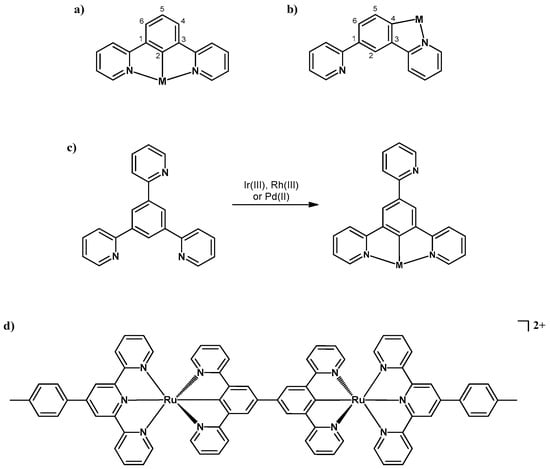
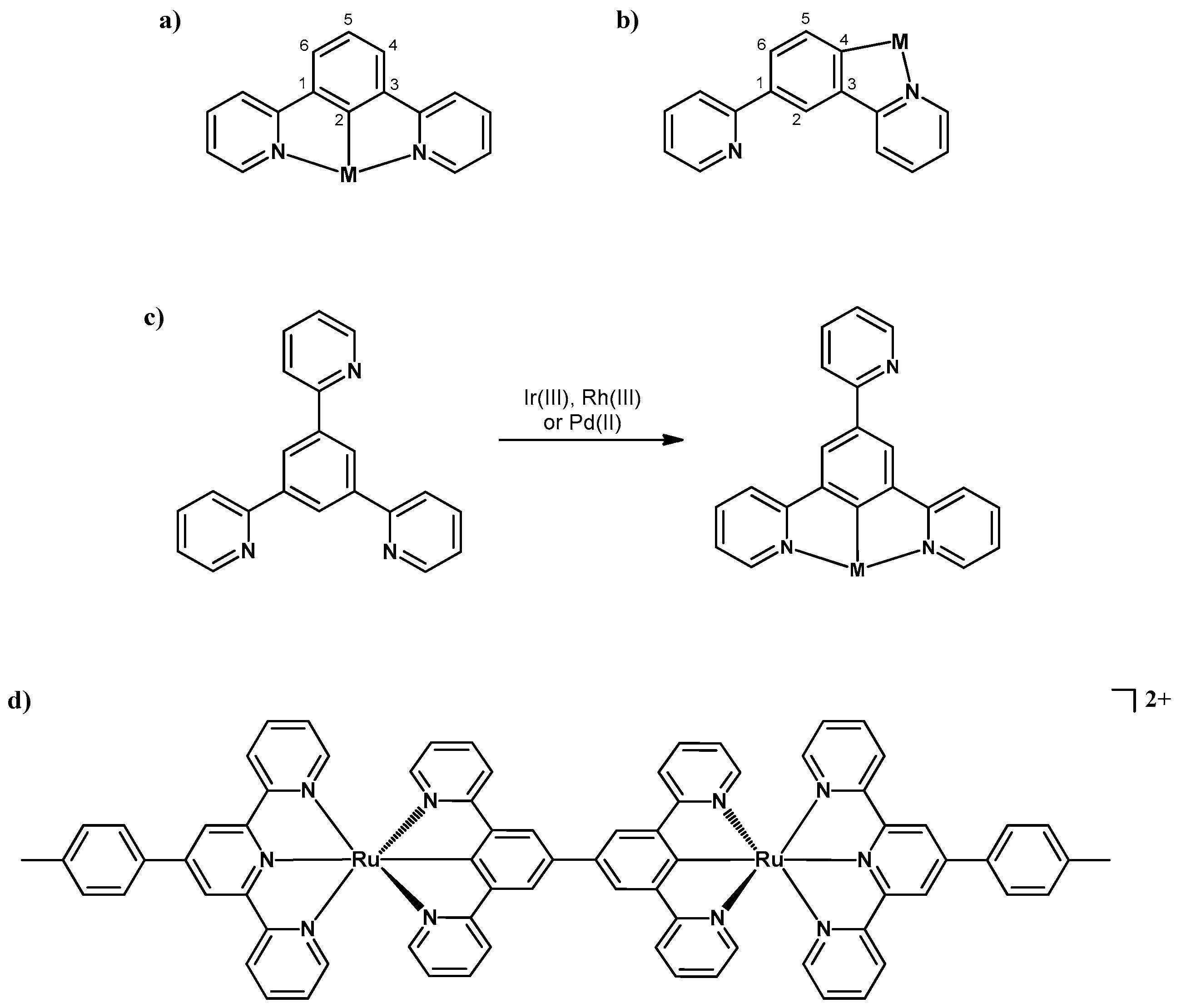
Whereas ruthenium(II), osmium(II) and platinum(II) give a terdentate N^C^N binding mode in which cyclometallation occurs at C2 (Figure 1a), iridium(III), rhodium(III) and palladium(II) tend to give a N^C binding mode with C4 cyclometallation (Figure 1b) although the latter process can be inhibited with a suitable modified dpyb ligand, allowing the N^C^N binding mode to be obtained with these metal ions too (Figure 1c). The observation of the dimetallic complex [Ru(ttpy)(m-dpyb-dpyb)Ru(ttpy)]2+ (Figure 1d) during the formation of [Ru(ttpy)(dpyb)]+ [6] led to the preparation of various dimetallic coordination compounds including heterometallic (e.g., Ru-Os) dimers with mixed valency [9].
Figure 1.
(a) N^C^N binding mode with cyclometallation at C2. (b) N^C binding mode with cyclometallation at C4. (c) The three C-H bonds in the central ring of 1,3,5-tri(2-pyridyl)benzene are equivalent, ensuring N^C^N binding mode of Ir(III), Rh(III) and Pd(II) which would otherwise cyclometallate at C4/C6. (d) Structure of [Ru(ttpy)(m-dpyb-dpyb)Ru(ttpy)]2+.
The pioneering reports of Sauvage et al. established the great potential of 1,3-di(2-pyridyl)benzene as a cyclometallating N^C^N-coordinating ligand and showed the interesting properties it gives to osmium(II) and ruthenium(II) complexes. Since then, this ligand turned out to have a rich coordination chemistry. For example, palladium (II) complexes bearing a N^C^N dpyb ligand are high-performance catalysts in the Heck reaction of iodobenzene and methyl acrylate, with a turnover frequency as high as 280 000 h−1 [10]. In addition, iridium(III) complexes bearing a N^C^N-1,3-di(2-pyridyl)-4,6-dimethylbenzene ligand (where the presence of the methyl groups block competitive cyclometallation at the C4 and C6 positions), in combination with N^C phenylpyridines, are bright emitters [11]. Due to their strong luminescence, many platinum(II) complexes of dipyridylbenzenes found application in the organic light-emitting device (OLED) technology [12,13,14,15,16] and in biomedicine [17,18,19,20,21].
Thus, eight years after the pioneering work of Sauvage et al. on dpybH, Cardenas et al. observed that this pro-ligand reacts with K2PtCl4 in acetic acid, affording Pt(bpyb)Cl, the first Pt(II) complex with a cyclometallated N^C^N 1,3-bis(pyribin-2-yl)benzene ligand [22]. A few years thereafter, Williams et al. reported that this complex is a bright emitter at room temperature (Φlum = 0.60 and t = 7.2 ms in diluted deoxygenated dichloromethane solution) [23], due to the presence of a cyclometallating carbon and the rigidity of the N^C^N ligand [1]. An important aspect of these Pt(bpyb)Cl complexes is that the emission wavelength can be tuned by the donor/acceptor nature of the substituents on the pyridine and cyclometallating benzene. Thus, the presence of electron-donating substituents on the pyridine rings and/or electron-withdrawing groups on the benzene ring gives a blue-shifted emission, whereas the addition of electron-withdrawing groups in the pyridines and/or electron-donating groups in the benzene ring leads to a red-shifted one [24,25,26]. In addition, we recently reported that the introduction of a variously substituted phenyl or thienyl group in position 4 of the pyridine rings of the N^C^N 1,3-bis(pyridin-2-yl)-4,6-difluoro-benzene ligand allows for the preparation of platinum(II) complexes with quantum yields approaching unity [27,28,29]; some of them already found application in the preparation of efficient OLEDs [27,29].
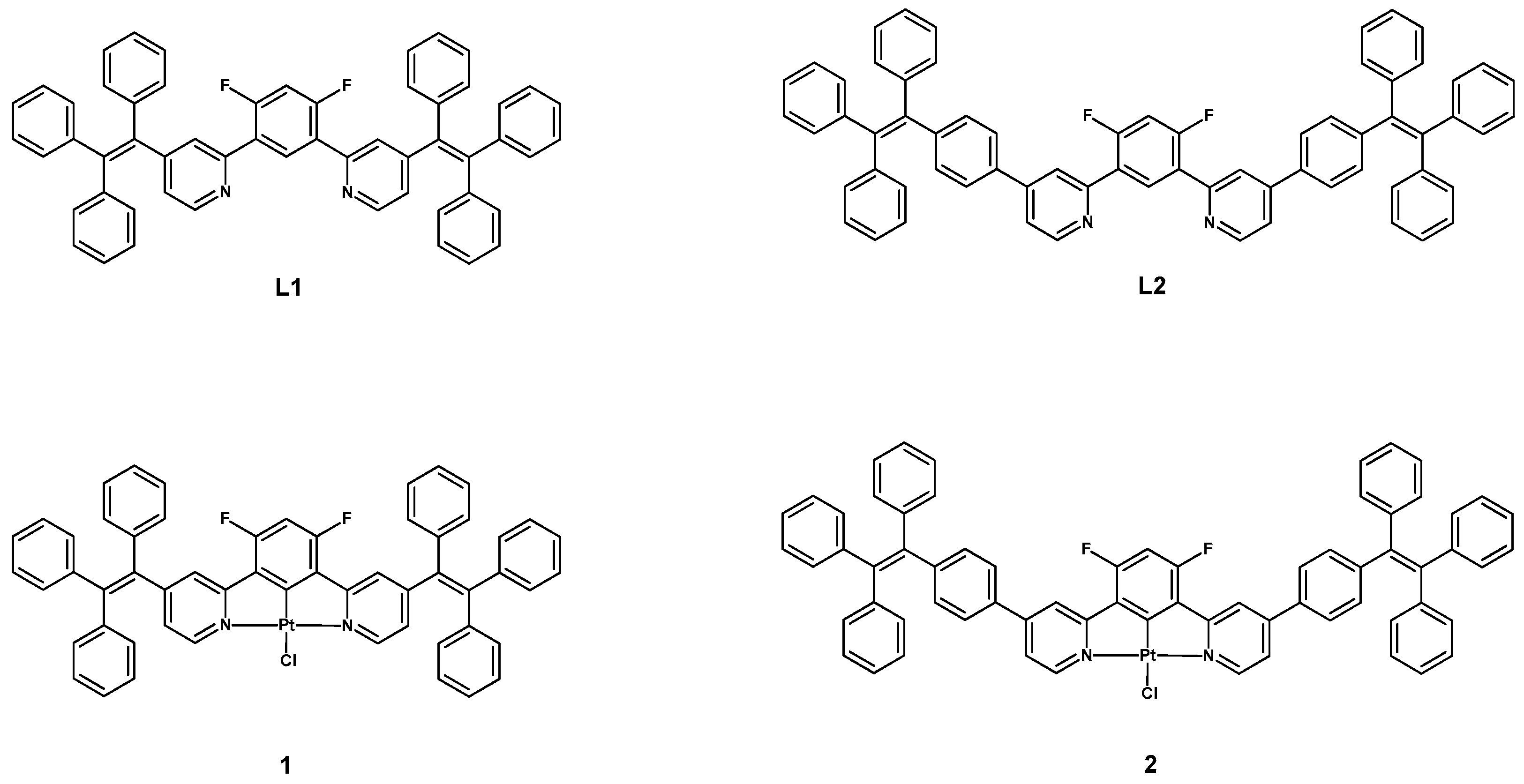
These observations, along with the known activity of triphenylethylene derivatives against estrogen receptor-positive breast cancer [30,31,32], the fascinating nature of tetraphenyethylene as a key component in dye-sensitized solar cells [33,34], and the great potential of both in luminogenic materials with aggregation-induced emission [35,36,37,38,39], prompted us to prepare 1,3-bis(4-triphenylethylene-pyridin-2-yl)-4,6-difluoro-benzene (L1, Figure 2) and 1,3-bis(4-tetraphenylethylene-pyridin-2-yl)-4,6-difluoro-benzene (L2). The related platinum(II) complexes (1 and 2) were also synthesized.
Figure 2.
Chemical structure of the investigated compounds.
2. Results and Discussion
2.1. Synthesis of the Pro-Ligands and Related Platinum(II) Complexes
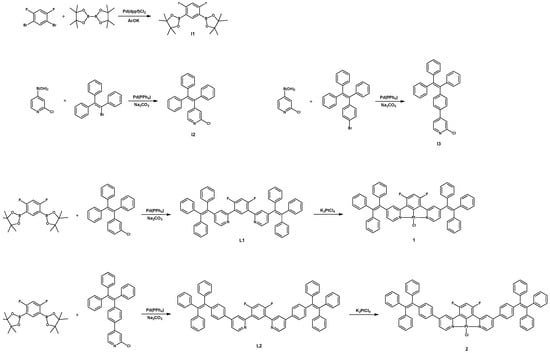
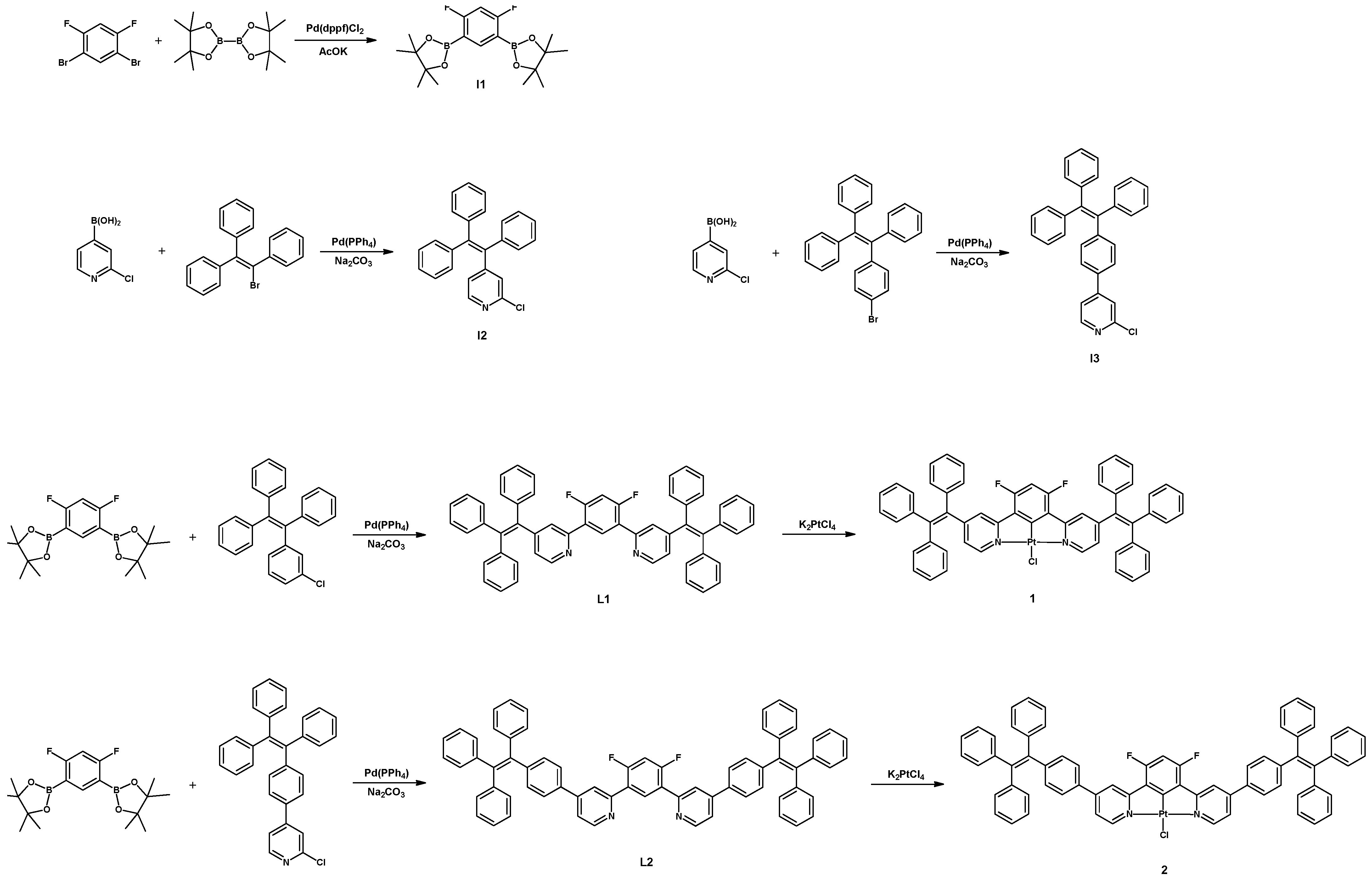
The new pro-ligands 1,3-bis(4-triphenylethylene-pyridin-2-yl)-4,6-difluoro-benzene (L1) and 1,3-bis(4-tetraphenylethylene-pyridin-2-yl)-4,6-difluoro-benzene (L2) are readily prepared by cross-coupling the pinacol ester of 1,3-difluoro-4,6-diboronic acid [40] with the suitable easily obtained 2-chloro-4-tri or tetra-phenylethylene-pyridine (Scheme 1, details of the syntheses are given in the Supplementary Materials). Reaction of these pro-ligands with K2PtCl4 leads to the related 1 and 2 complexes. Pro-ligands and platinum(II) complexes were characterized by NMR spectroscopy, mass spectrometry and elemental analysis (see Supplementary Materials). Various attempts to obtain crystals of the platinum complexes suitable for X-ray structure determination failed. However, in agreement with the literature [27,28], and as expected upon cyclometallation of the pro-ligands with platinum, in the 1H-NMR spectrum of the complexes, there is a loss of the signal corresponding to the proton of the benzene ring located between the two pyridines; as a consequence, the peak of the remaining protons on the benzene passes from a doublet to a singlet. Furthermore, the doublet signal associated with the protons in position 2 on the pyridines becomes shifted towards higher ppm (from 8.45 to 8.99 ppm) and undergoes coupling not only with the adjacent protons but also with the 195Pt component of the metal, appearing as a couple of satellite peaks presenting a large 3J of around 37 Hz (see Supplementary Materials). The formation of 1 and 2 was confirmed by high-resolution mass spectrometry and elemental analysis (see Supplementary Materials).
Scheme 1.
Synthesis of pro-ligands L1–L2 and related platinum(II) complexes 1–2.
The new pro-ligands L1 and L2 open the doors for the preparation of N^C^N complexes with other metals. Specifically, they can be a springboard for the synthesis of novel thiocyanate-free ruthenium(II) photosensitizers for dye-sensitized solar cells (DSSCs). Up to now, the most commonly used photosensitizers had been the 2,2′-bipyridineruthenium(II) (2,2′-bipyridine = bpy) complexes with thiocyanate ancillary ligands that, however, can be easily replaced by other competing ligands present in the solar cell, yielding less efficient species [41,42]. Cyclometallated thiocyanate-free ruthenium complexes turned out to be a good alternative for DSSCs [43,44,45,46,47,48,49]. However, although cyclometallated N^C^N ruthenium(II) complexes have been known since 1991 [6], to our knowledge, they have never been investigated as dyes in DSSCs. In addition, it has been reported that the introduction of a tetraphenylethylene moiety in both phenothiazine and porphyrin dyes is a way to suppress dye aggregation and charge recombination, leading to an enhancement of the photovoltages and efficiencies of DSSCs [33,34]. These observations suggest that ruthenium(II) complexes based on L1 and L2 could potentially be efficient dyes for DSSCs.
2.2. Photophysical Properties of the Platinum(II) Complexes
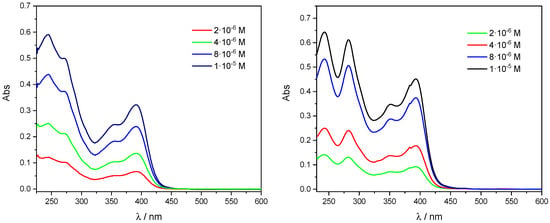
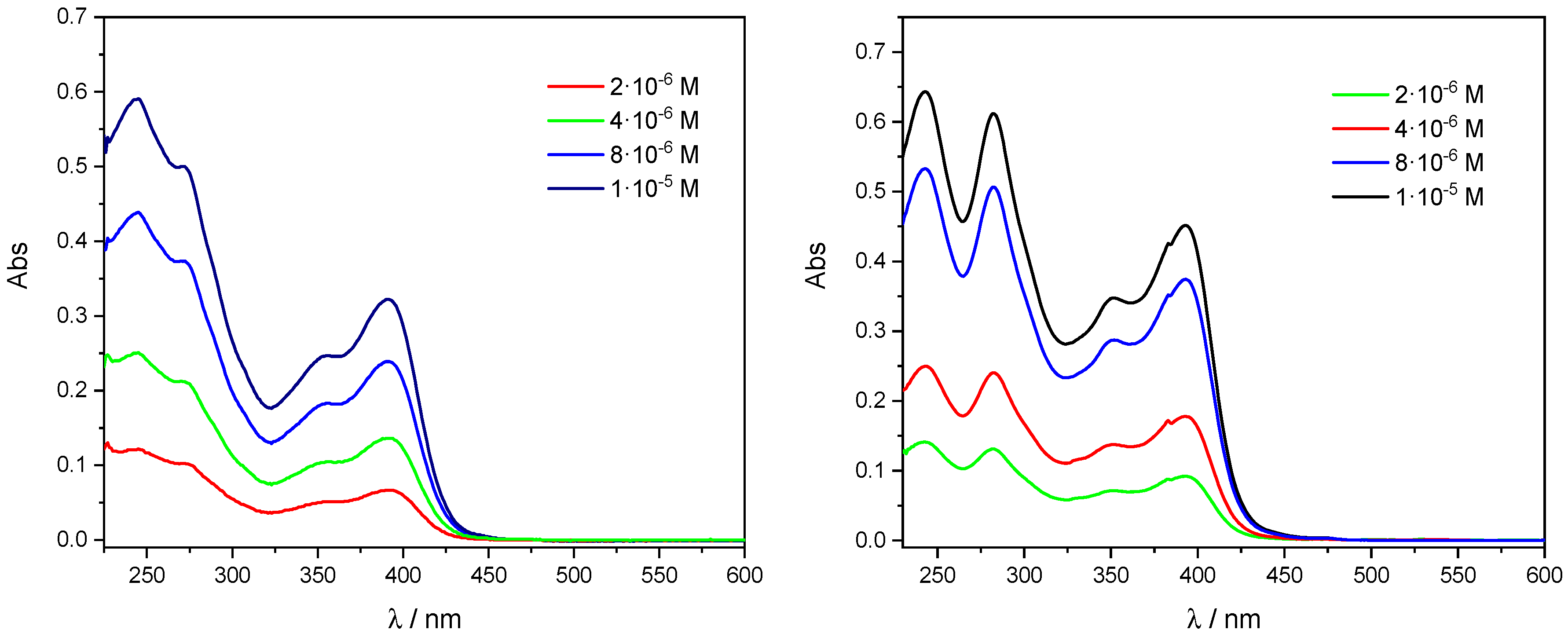
Complexes 1–2 were investigated from the photophysical point of view by recording their electronic absorption spectra in CH2Cl2 solution at room temperature and at different concentrations in order to calculate the molar extinction coefficients (ε) for the absorption maxima. As reported in Figure 3, both compounds show high intensity absorption bands below 330 nm (ε244 = 5.6 × 10⁴ M−1 cm−1 and ε243 = 6.4 × 10⁴ M−1 cm−1 for 1 and 2, respectively), which are typically assigned to intraligand 1π–π* transitions of the N^C^N ligand [50], whereas the metal to ligand charge transfer (MLCT) transitions occur in the 320–450 nm region (ε391 = 3.1 × 10⁴ M−1 cm−1 and ε393 = 4.6 × 10⁴ M−1 cm−1 for 1 and 2, respectively), by analogy with other N^C^N platinum(II) complexes [50].
Figure 3.
Absorption spectra of 1 (left) and 2 (right) in CH2Cl2 at different concentrations at 298 K.
Complexes 1 and 2 were studied from the luminescence point of view, registering their excitation and emission spectra and measuring their absolute Quantum Yield (QY) and lifetimes in a CH2Cl2 solution. Both complexes yielded very weak emission (maxima in the range 450–520 nm), with QY values in the range of 1.0–1.6% and excited-state lifetime of 5.73 and 4.82 µs for 1 and 2, respectively, even after the Freeze-Pump-Thaw (FPT) procedure necessary to remove dissolved oxygen (Table 1). This poor luminescence is in agreement with the faint emission of tri- and tetra-phenylethylene in diluted solutions due to dynamic intramolecular rotations against the double bond of the phenyl groups [51,52,53,54,55]. Clearly, the rotational motions of the multiple peripheral phenyl rings likely remain active in the platinum complexes, thus favouring a high radiationless decay (knr ≈ 105 s−1) in the solution. Neither of the platinum complexes are emissive in the solid state, as powders, or when dispersed in a polymethyl methacrylate (PMMA) matrix (3% w/w). Complete photophysical data and spectra are reported in the Supplementary Materials (Figures S1–S4, Table S1).
Table 1.
Photophysical data for complexes 1 and 2 in CH2Cl2 solution. QY before (QYbefore) and after (QYafter) Freeze-Pump-Thaw (FPT). Excited-state lifetime (τ) after FPT.
We previously reported that the introduction of a variously substituted phenyl or thienyl group in position 4 of the pyridine rings of the N^C^N 1,3-bis(pyridin-2-yl)-4,6-difluoro-benzene ligand allows for the preparation of platinum(II) complexes with quantum yields approaching unity [27,28,29]. In contrast, the results of the present work show that the introduction of tri- and tetra-phenylethylene substituents on the pyridine rings is not a good strategy for the preparation of highly luminescent N^C^N platinum(II) complexes.
3. Materials and Methods
Details on the synthesis of pro-ligands and related platinum(II) complexes are reported in the Supplementary Materials, along with their characterization (1H, 13C and 19F NMR spectra, elemental analysis, mass spectrometry). Thin films were prepared via the spin-coating technique from CH2Cl2 solutions of PMMA (10% w/w with respect to the solvent) containing 3% w/w of the complex. Electronic absorption spectra were measured at room temperature in a CH2Cl2 solution, by means of a Shimadzu UV3600 spectrophotometer (Shimadzu Italia S.r.l., Milan, Italy) and quartz cuvettes (optical path length = 1 cm). Luminescence data were obtained in the CH2Cl2 solution after three Freeze-Pump-Thaw cycles, in order to remove dissolved oxygen. Absolute photoluminescence quantum yields (QY) were obtained with the C11347 Quantaurus Hamamatsu Photonics K.K spectrometer (Hamamatsu Photonics K.K., Hamamatsu, Japan). Steady-state and time-resolved fluorescence data were obtained by means of the FLS980 spectrofluorimeter (Edinburg Instrument Ltd., Livingston, UK). Measurement techniques are thoroughly described in the Supplementary Materials [56].
4. Conclusions
In conclusion, the two new N^C^N pro-ligands, namely 1,3-bis(4-triphenylethylene-pyridin-2-yl)-4,6-difluoro-benzene (L1) and 1,3-bis(4-tetraphenylethylene-pyridin-2-yl)-4,6-difluoro-benzene (L2), were prepared and thoroughly characterized along with their related platinum(II) complexes (1 and 2) which turned out to be poorly luminescent. In the near future, we plan to investigate the use of L1 and L2 as N^C^N pro-ligands in the preparation of thiocyanate-free ruthenium(II) sensitizers for dye-sensitized solar cells.
Supplementary Materials
The following supporting information can be downloaded at https://www.mdpi.com/article/10.3390/inorganics14110281/s1. Synthesis and characterization of intermediates, pro-ligands and platinum(II) complexes; Photophysical characterization of 1 and 2 [56]; Figure S1: Excitation and emission spectra of complex 1 in CH2Cl2; Figure S2: Excitation and emission spectra of complex 2 in CH2Cl2; Figure S3: Excited-state decay of complex 1 in CH2Cl2 solution; Figure S4: Excited-state decay of complex 2 in CH2Cl2 solution; Table S1: Absorption maxima and corresponding molar extinction coefficients for complexes 1 and 2 in CH2Cl2 solution.
Author Contributions
Conceptualization, V.G. and D.R.; methodology, G.D.S., A.C., C.D., F.F. and D.M.; investigation, G.D.S., F.F. and D.M.; resources, A.C., C.D. and D.R.; data curation, D.M. and F.F.; supervision, V.G. and D.R.; Writing—original draft, F.F.; Writing—review and editing, G.D.S., V.G., A.C., C.D., F.F., D.R. and D.M. All authors have read and agreed to the published version of the manuscript.
Funding
This research received no external funding.
Data Availability Statement
The original contributions presented in this study are included in the article/Supplementary Material. Further inquiries can be directed to the corresponding authors.
Acknowledgments
We acknowledge the National Interuniversity Consortium of Materials Science and Technology (Project TRI_25_073 Dragonetti and TRI_25_173 Colombo), Fondazione Cariplo and Regione Lombardia for the instrumentation bought during the SmartMatLab Centre project (2014). A.C., C.D. and D.R. acknowledge Regione Lombardia and European Union–Call “Collabora&Innova”—Project 6154644—GREEN-TECH—(Applicazione di tecnologie innovative a basso impatto ambientale per lo sviluppo e l’ottimizzazione di processi chimici sostenibili).
Conflicts of Interest
The authors declare no conflicts of interest.
Abbreviations
The following abbreviations are used in this manuscript:
| dpybH | 1,3-di(2-pyridyl)benzene |
| DSSC | dye-sensitized solar cell |
| Pd(dppf)Cl2 | [1,1′-bis(diphenylphosphino)ferrocene]dichloropalladium(II) |
| ttpy | 4′tolyl-2,2′:6′2″-terpyridine |
References
- Williams, J.A.G. The coordination chemistry of dipyridylbenzene: N-deficient terpyridine or panacea for brightly luminescent metal complexes? Chem. Soc. Rev. 2009, 38, 1783–1801. [Google Scholar] [CrossRef] [Scilit] [PubMed]
- Kaes, C.; Katz, A.; Hosseini, M.W. Bipyridine: The Most Widely Used Ligand. A Review of Molecules Comprising at Least Two 2,2‘-Bipyridine Units. Chem. Rev. 2000, 100, 3553–3590. [Google Scholar] [CrossRef] [Scilit] [PubMed]
- Cargill Thompson, A.M.W. The synthesis of 2,2′:6′,2″-terpyridine ligands—Versatile building blocks for supramolecular chemistry. Coord. Chem. Rev. 1997, 160, 1–52. [Google Scholar] [CrossRef] [Scilit]
- Hofmeier, H.; Schubert, U.S. Recent developments in the supramolecular chemistry of terpyridine-metal complexes. Chem. Soc. Rev. 2004, 33, 373–399. [Google Scholar] [CrossRef] [Scilit] [PubMed]
- Constable, E.C. 2,2′:6′,2″-terpyridines: From chemical obscurity to common supramolecular motifs. Chem. Soc. Rev. 2007, 36, 246–253. [Google Scholar] [CrossRef] [Scilit] [PubMed]
- Beley, M.; Collin, J.-P.; Louis, R.; Metz, B.; Sauvage, J.-P. 3,3′,5,5′-Tetrapyridylbiphenyl, a bis-cyclometalating bridging ligand with a high coupling ability in ruthenium(III), ruthenium(II) mixed valence systems. J. Am. Chem. Soc. 1991, 113, 8521–8522. [Google Scholar] [CrossRef] [Scilit]
- Collin, J.-P.; Beley, M.; Sauvage, J.-P.; Barigelletti, F. A room temperature luminescent cyclometalated ruthenium(II) complex of 6-phenyl-2,2′-bipyridine. Inorg. Chim. Acta 1991, 196, 91–93. [Google Scholar] [CrossRef] [Scilit]
- Beley, M.; Collin, J.-P.; Sauvage, J.-P. Highly coupled mixed-valence dinuclear ruthenium and osmium complexes with a bis-cyclometalating terpyridine analog as bridging ligand. Inorg. Chem. 1993, 32, 4539–4543. [Google Scholar] [CrossRef] [Scilit]
- Barigelletti, F.; Flamigni, L.; Collin, J.-P.; Sauvage, J.-P. Vectorial transfer of electronic energy in rod-like ruthenium–osmium dinuclear complexes. Chem. Commun. 1997, 33, 333–338. [Google Scholar] [CrossRef] [Scilit]
- Soro, B.; Stoccoro, S.; Minghetti, G.; Zucca, A.; Cinellu, M.A.; Gladiali, S.; Manassero, M.; Sansoni, M. Synthesis of the First C-2 Cyclopalladated Derivatives of 1,3-Bis(2-pyridyl)benzene. Crystal Structures of [Hg(N-C-N)Cl], [Pd(N-C-N)Cl], and [Pd2(N-C-N)2(m-OAc)]2[Hg2Cl6]. Catalytic activity in the heck reaction. Organometallics 2005, 24, 53–61. [Google Scholar] [CrossRef] [Scilit]
- Wilkinson, A.J.; Puschmann, H.; Howard, J.A.K.; Foster, C.E.; Williams, J.A.G. Luminescent complexes of iridium(III) containing N^C^N-coordinating terdentate ligands. Inorg. Chem. 2006, 45, 8685–8699. [Google Scholar] [CrossRef] [Scilit] [PubMed]
- Kalinowski, J.; Fattori, V.; Cocchi, M.; Williams, J.A.G. Light-emitting devices based on organometallic platinum complexes as emitters. Coord. Chem. Rev. 2011, 255, 2401–2425. [Google Scholar] [CrossRef] [Scilit]
- Gildea, L.F.; Williams, J.A.G. Iridium and platinum complexes for OLEDs. In Organic Light-Emitting Diodes: Materials, Devices and Applications; Buckley, A., Ed.; Woodhead Publishing: Cambridge, UK, 2013. [Google Scholar]
- Cocchi, M.; Kalinowski, J.; Murphy, L.; Williams, J.A.G.; Fattori, V. Mixing of molecular exciton and excimer phosphorescence to tune color and efficiency of organic LEDs. Org. Electron. 2010, 11, 388–396. [Google Scholar] [CrossRef] [Scilit]
- Dragonetti, C.; Fagnani, F.; Marinotto, D.; di Biase, A.; Roberto, D.; Cocchi, M.; Fantacci, S.; Colombo, A. First member of an appealing class of cyclometalated 1,3-di-(2-pyridyl)benzene platinum(ii) complexes for solution-processable OLEDs. J. Mater. Chem. C 2020, 8, 7873–7881. [Google Scholar] [CrossRef] [Scilit]
- Roberto, D.; Colombo, A.; Dragonetti, C.; Fagnani, F.; Cocchi, M.; Marinotto, D. Novel class of cyclometalated platinum(II) complexes for solution-processable OLEDs. Molecules 2022, 27, 5171. [Google Scholar] [CrossRef] [Scilit] [PubMed]
- Baggaley, E.; Weinstein, J.A.; Williams, J.A.G. Lighting the way to see inside the live cell with luminescent transition metal complexes. Coord. Chem. Rev. 2012, 256, 1762–1785. [Google Scholar] [CrossRef] [Scilit]
- Doherty, R.E.; Sazanovich, I.V.; McKenzie, L.K.; Stasheuski, A.S.; Coyle, R.; Baggaley, E.; Bottomley, S.; Weinstein, J.A.; Bryant, H.E. Photodynamic killing of cancer cells by a platinum(II) complex with cyclometallating ligand. Sci. Rep. 2016, 6, 22668. [Google Scholar] [CrossRef] [Scilit] [PubMed]
- Chatzisideri, T.; Thysiadis, S.; Katsamakas, S.; Dalezis, P.; Sigala, I.; Lazarides, T.; Nikolakaki, E.; Trafalis, D.; Gederaas, O.A.; Lindgren, M.; et al. Synthesis and biological evaluation of a platinum(II)-c(RGDyK) conjugate for integrin-targeted photodynamic therapy. Eur. J. Med. Chem. 2017, 141, 221–231. [Google Scholar] [CrossRef] [Scilit] [PubMed]
- Scoditti, S.; Dabbish, E.; Russo, N.; Mazzone, G.; Sicilia, E. Anticancer activity, DNA binding, and photodynamic properties of a N^C^N-coordinated Pt(II) complex. Inorg. Chem. 2021, 60, 10350–10360. [Google Scholar] [CrossRef] [Scilit] [PubMed]
- Dell’Acqua, R.M.; Fagnani, F.; Wojciechowska, M.; Marinotto, D.; Colombo, G.; Dalle-Donne, I.; Trylska, J.; Cauteruccio, S.; Colombo, A. Highly phosphorescent N^C^N platinum(II)peptide nucleic acid conjugates: Synthesis, photophysical studies and hybridization behaviour. Dalton Trans. 2025, 54, 3314–3322. [Google Scholar] [CrossRef] [Scilit] [PubMed]
- Cardenas, D.J.; Echavarren, A.M.; Ramirez de Arellano, M.C. Divergent Behavior of Palladium(II) and Platinum(II) in the Metalation of 1,3-Di(2-pyridyl)benzene. Organometallics 1999, 18, 3337–3341. [Google Scholar] [CrossRef] [Scilit]
- Williams, J.A.G.; Beeby, A.; Davies, E.S.; Weinstein, J.A.; Wilson, C. An alternative route to highly luminescent platinum(II) complexes: cyclometalation with N^C^N-coordinating dipyridylbenzene ligands. Inorg. Chem. 2003, 42, 8609–8611. [Google Scholar] [CrossRef] [Scilit] [PubMed]
- Sotoyama, W.; Satoh, T.; Sato, H.; Matsuura, A.; Sawatari, N. Excited states of phosphorescent platinum(II) complexes containing N^C^N-coordinating tridentate ligands: spectroscopic investigations and time-dependent density functional theory calculations. J. Phys. Chem. A 2005, 109, 9760–9766. [Google Scholar] [CrossRef] [Scilit] [PubMed]
- Williams, J.A.G. Photochemistry and Photophysics of Coordination Compounds: Platinum. Top. Curr. Chem. 2007, 281, 205–268. [Google Scholar] [CrossRef] [Scilit]
- Fagnani, F.; Colombo, A.; Dragonetti, C.; Roberto, D.; Marinotto, D. The intriguing effect of thiolates as co-ligands in platinum(II) complexes bearing a cyclometalated 1,3-di(2-pyridyl)benzene. Inorg. Chim. Acta 2022, 532, 120744. [Google Scholar] [CrossRef] [Scilit]
- Colombo, A.; De Soricellis, G.; Dragonetti, C.; Fagnani, F.; Roberto, D.; Carboni, B.; Guerchais, V.; Roisnel, T.; Cocchi, M.; Fantacci, S.; et al. Introduction of a mesityl substituent on pyridyl rings as a facile strategy for improving the performance of luminescent 1,3-bis-(2-pyridyl)benzene platinum(ii) complexes: A springboard for blue OLEDs. J. Mater. Chem. C 2024, 12, 9702–9715. [Google Scholar] [CrossRef] [Scilit]
- De Soricellis, G.; Carboni, B.; Guerchais, V.; Williams, J.A.G.; Marinotto, D.; Colombo, A.; Dragonetti, C.; Fagnani, F.; Fantacci, S.; Roberto, D. New members of the family of highly luminescent 1,3-bis(4-phenylpyridin-2-yl)-4,6-difluorobenzene platinum(II) complexes: Exploring the effect of substituents on the 4-phenylpyridine unit. Dalton Trans. 2025, 54, 10566–10573. [Google Scholar] [CrossRef] [Scilit] [PubMed]
- Fagnani, F.; Colombo, A.; De Soricellis, G.; Dragonetti, C.; Roberto, D.; Marinotto, D.; Guerchais, V.; Tinti, F.; Cocchi, M. Red to blue OLEDs based on highly luminescent 1,3-bis(4-phenylpyridin-2-yl)-4,6-difluorobenzene platinum(ii) complexes: The key role of substituents on the 4-phenylpyridine unit (Themed collections: Perspective on the technologies of OLEDs). J. Mater. Chem. C 2026, 14, 4818–4826. [Google Scholar] [CrossRef] [Scilit]
- Yao, J.; Deng, K.; Huang, J.; Zeng, R.; Zuo, J. Progress in the Understanding of the Mechanism of Tamoxifen Resistance in Breast Cancer. Front. Pharmacol. 2020, 11, 592912. [Google Scholar] [CrossRef] [Scilit] [PubMed]
- Díaz, M. Triphenylethylene antiestrogen-induced acute relaxation of mouse duodenal muscle. Possible involvement of Ca2+ channels. Eur. J. Pharmacol. 2002, 445, 257–266. [Google Scholar] [CrossRef] [Scilit] [PubMed]
- Elnakib, H.E.; Ramsis, M.M.; Albably, N.O.; Vector, M.A.; Weigand, J.J.; Schwedtmann, K.; Wober, J.; Zierau, O.; Vollmer, G.; Abadi, A.H.; et al. Manipulating Estrogenic/Anti-Estrogenic Activity of Triphenylethylenes towards Development of Novel Anti-Neoplastic SERMs. Int. J. Mol. Sci. 2021, 22, 12575. [Google Scholar] [CrossRef] [Scilit] [PubMed]
- Li, C.-T.; Kuo, Y.-L.; Kumar, C.P.; Huang, P.-T.; Lin, J.-T. Tetraphenylethylene tethered phenothiazine-based double-anchored sensitizers for high performance dye-sensitized solar cells. J. Mater. Chem. A 2019, 7, 23225–23233. [Google Scholar] [CrossRef] [Scilit]
- Zou, J.; Tang, Y.; Baryshnikov, G.; Yang, Z.; Mao, R.; Feng, W.; Guan, J.; Li, C.; Xie, Y. Porphyrins containing a tetraphenylethylene substituted phenothiazine donor for fabricating efficient dye sensitized solar cells with high photovoltages. J. Mater. Chem. A 2022, 10, 1320–1328. [Google Scholar] [CrossRef] [Scilit]
- Hong, Y.; Lam, J.W.Y.; Tang, B.Z. Aggregation-induced emission. Chem. Soc. Rev. 2011, 40, 5361–5388. [Google Scholar] [CrossRef] [Scilit] [PubMed]
- Zhang, G.; Hu, F.; Zhang, D. Manipulation of the aggregation and deaggregation of tetraphenylethylene and silole fluorophores by amphiphiles: Emission modulation and sensing applications. Langmuir 2015, 31, 4593–4604. [Google Scholar] [CrossRef] [Scilit] [PubMed]
- Xu, B.; Chi, Z.; Yang, Z.; Chen, J.; Deng, S.; Li, H.; Li, X.; Zhang, Y.; Xu, N.; Xu, J. Facile synthesis of a new class of aggregation-induced emission materials derived from triphenylethylene. J. Mater. Chem. 2010, 20, 4135–4141. [Google Scholar] [CrossRef] [Scilit]
- Ou, D.; Yu, T.; Yang, Z.; Luan, T.; Mao, Z.; Zhang, Y.; Liu, S.; Xu, J.; Chi, Z.; Bryce, M.R. Combined aggregation induced emission (AIE), photochromism and photoresponsive wettability in simple dichloro-substituted triphenylethylene derivatives. Chem. Sci. 2016, 7, 5302–5306. [Google Scholar] [CrossRef] [Scilit] [PubMed]
- Li, X.-F.; Chi, Z.-G.; Xu, B.-J.; Li, H.-Y.; Zhang, X.-Q.; Zhou, W.; Zhang, Y.; Liu, S.-W.; Xu, J.-R. Synthesis and characterization of triphenylethylene derivatives with aggregation-induced emission characteristics. J. Fluoresc. 2011, 21, 1969–1977. [Google Scholar] [CrossRef] [Scilit] [PubMed]
- Murphy, L.; Brulatti, P.; Fattori, V.; Cocchi, M.; Williams, J.A.G. Blue-shifting the monomer and excimer phosphorescence of tridentate cyclometallated platinum(II) complexes for optimal white-light OLEDs. Chem. Commun. 2012, 48, 5817–5819. [Google Scholar] [CrossRef] [Scilit] [PubMed]
- Dragonetti, C.; Colombo, A.; Magni, M.; Mussini, P.; Nisic, F.; Roberto, D.; Ugo, R.; Valore, A.; Valsecchi, A.; Salvatori, P.; et al. Thiocyanate-Free Ruthenium(II) Sensitizer with a Pyrid-2-yltetrazolate Ligand for Dye-Sensitized Solar Cells. Inorg. Chem. 2013, 52, 10723–10725. [Google Scholar] [CrossRef] [Scilit] [PubMed]
- Colombo, A.; Dragonetti, C.; Fagnani, F.; Roberto, D. Recent Developments of Ruthenium Complexes for Dye-Sensitized Solar Cells. Electronics 2025, 14, 1639. [Google Scholar] [CrossRef] [Scilit]
- Wadman, S.H.; Kroon, J.M.; Bakker, K.; Lutz, M.; Spek, A.L.; van Klink, G.P.M.; van Koten, G. Cyclometalated ruthenium complexes for sensitizing nanocrystalline TiO2 solar cells. Chem. Commun. 2007, 19, 1907–1909. [Google Scholar] [CrossRef] [Scilit] [PubMed]
- Bomben, P.G.; Robson, K.C.D.; Sedach, P.A.; Berlinguette, C.P. On the Viability of Cyclometalated Ru(II) Complexes for Light-Harvesting Applications. Inorg. Chem. 2009, 48, 9631–9643. [Google Scholar] [CrossRef] [Scilit] [PubMed]
- Bomben, P.G.; Koivisto, B.D.; Berlinguette, C.P. Cyclometalated Ru Complexes of Type [RuII(N∧N)2(C∧N)]z: Physicochemical Response to Substituents Installed on the Anionic Ligand. Inorg. Chem. 2010, 49, 4960–4971. [Google Scholar] [CrossRef] [Scilit] [PubMed]
- Bomben, P.G.; Borau-Garcia, J.; Berlinguette, C.P. Three is not a crowd: Efficient sensitization of TiO2 by a bulkytrichromic trisheteroleptic cycloruthenated dye. Chem. Commun. 2012, 48, 5599–5601. [Google Scholar] [CrossRef] [Scilit] [PubMed]
- Abbotto, A.; Coluccini, C.; Dell’Orto, E.; Manfredi, N.; Trifiletti, V.; Salamone, M.M.; Ruffo, R.; Acciarri, M.; Colombo, A.; Dragonetti, C.; et al. Thiocyanate-free cyclometalated ruthenium sensitizers for solar cells based on heteroaromatic-substituted 2-arylpyridines. Dalton Trans. 2012, 41, 11731–11738. [Google Scholar] [CrossRef] [Scilit] [PubMed]
- Dragonetti, C.; Valore, A.; Colombo, A.; Roberto, D.; Trifiletti, V.; Manfredi, N.; Salamone, M.M.; Ruffo, R.; Abbotto, A. A new thiocyanate-free cyclometallated ruthenium complex for dye-sensitized solar cells: Beneficial effects of substitution on the cyclometallated ligand. J. Organomet. Chem. 2012, 714, 88–93. [Google Scholar] [CrossRef] [Scilit]
- Sruthi, M.M.; Sourava, C.P.; George, A.S.; Nitha, P.R.; Rakesh, K.M.; Jubi, J.; Suraj, S. Exploring the synergy between copper electrolytes and molecularly engineered thiocyanate-free cyclometalated ruthenium sensitizers for dye-sensitized solar cells. Photochem. Photobiol. 2024, 100, 1127–1139. [Google Scholar] [CrossRef] [Scilit] [PubMed]
- Farley, S.J.; Rochester, D.L.; Thompson, A.L.; Howard, J.A.K.; Williams, J.A.G. Controlling Emission Energy, Self-Quenching, and Excimer Formation in Highly Luminescent N^C^N-Coordinated Platinum(II) Complexes. Inorg. Chem. 2005, 44, 9690–9703. [Google Scholar] [CrossRef] [Scilit] [PubMed]
- Iasilli, G.; Battisti, A.; Tantussi, F.; Fuso, F.; Allegrini, M.; Ruggeri, G.; Pucci, A. Aggregation-Induced Emission of Tetraphenylethylene in Styrene-Based Polymers. Macromol. Chem. Phys. 2014, 215, 499−506. [Google Scholar] [CrossRef] [Scilit]
- Zhao, G.-J.; Han, K.-L.; Lei, Y.-B.; Dou, Y.-S. Ultrafast excited-state dynamics of tetraphenylethylene studied by semiclassical simulation. J. Chem. Phys. 2007, 127, 094307. [Google Scholar] [CrossRef] [Scilit] [PubMed]
- Barbara, P.F.; Rand, S.D.; Rentzepis, P.M. Direct measurements of tetraphenylethylene torsional motion by picosecond spectroscopy. J. Am. Chem. Soc. 1981, 103, 2156–2168. [Google Scholar] [CrossRef] [Scilit]
- Schilling, C.L.; Hilinski, E.F. Dependence of the lifetime of the twisted excited singlet state of tetraphenylethylene on solvent polarity. J. Am. Chem. Soc. 1988, 110, 2296–2298. [Google Scholar] [CrossRef] [Scilit]
- Micheletti, C.; Wang, Q.; Ventura, F.; Turelli, M.; Ciofini, I.; Adamo, C.; Pucci, A. Red-emitting tetraphenylethylene derivative with aggregation-induced enhanced emission for luminescent solar concentrators: A combined experimental and density functional theory study. Aggregate 2022, 3, 1501–1511. [Google Scholar] [CrossRef] [Scilit]
- Suzuki, K.; Kobayashi, A.; Kaneko, S.; Takehira, K.; Yoshihara, T.; Ishida, H.; Shiina, Y.; Oishic, S.; Tobita, S. Reevaluation of absolute luminescence quantum yields of standard solutions using a spectrometer with an integrating sphere and a back-thinned CCD detector. Phys. Chem. Chem. Phys. 2009, 11, 9850–9860. [Google Scholar] [CrossRef] [Scilit] [PubMed]

Disclaimer/Publisher’s Note: The statements, opinions and data contained in all publications are solely those of the individual author(s) and contributor(s) and not of MDPI and/or the editor(s). MDPI and/or the editor(s) disclaim responsibility for any injury to people or property resulting from any ideas, methods, instructions or products referred to in the content. |
© 2026 by the authors. Licensee MDPI, Basel, Switzerland. This article is an open access article distributed under the terms and conditions of the Creative Commons Attribution (CC BY) license.