


Abstract
Self-injection-locked (SIL) VCSELs enable optically coupled apertures to operate as a coherent supermode, combining the high power of multi-aperture devices with quasi-single-mode emission, narrowing far-field beam divergence, and simplified coupling into single-mode fiber. In this work, SIL VCSELs operating near 850 and 880 nm were characterized to examine whether their chirp properties remain favorable for extended-reach short-wavelength transmission. More than 29% coupling efficiency into a single-mode fiber (Hi780) was achieved for both devices using a two-lens coupling arrangement. Link transfer functions were measured over a long single-mode fiber, Hi780, and via a standard single-mode fiber, with fundamental-mode launch via a spliced section of Hi780. The dominant transient chirp behavior is preserved for SIL VCSEL similar to the case of single-mode (SM) VCSEL and multi-aperture (MA) SM VCSELs. A unified full-spectrum fitting method was introduced to extract physically consistent chirp and chromatic-dispersion parameters from shallow transfer-function dips, with the chirp parameter determined to be approximately −2.6. Using the 850 nm SIL VCSEL, 32G NRZ transmission over 1 km of a standard single-mode fiber with fundamental mode launch was demonstrated. Compared with the back-to-back configuration, the 1 km link produced a more open eye and improved 7-tap FFE equalized Gaussian BER from 7.56 × 10⁻¹³ to 1.53 × 10⁻¹⁴, confirming chirp–dispersion-induced bandwidth enhancement.
1. Introduction
Vertical-cavity surface-emitting lasers (VCSELs) operating over multimode fiber (MMF) links form the foundation of the short-reach optical interconnect ecosystem used in modern data centers and high-performance computing systems [1,2]. Their low power consumption and efficient coupling into MMF without optical isolation have enabled widespread deployment in Ethernet, InfiniBand, Fiber Channel and AI cluster interconnects. Driven by the rapid growth of artificial intelligence (AI) and machine learning (ML) workloads, modern data center architectures are undergoing a fundamental transformation. High-density GPU compute pods require massive scale-up interconnect fabrics capable of operating at 100G to 200G per lane with picojoule per bit energy efficiency [3,4,5,6]. As conventional electrical copper traces hit reach and power dissipation barriers at baud rates exceeding 53 Gbaud PAM4, optical interconnects based on VCSELs are emerging as the leading technology for short-reach scale-up networks, Near-Package Optics (NPO), and Co-Packaged Optics (CPO) [5,7,8]. Compared to silicon photonics or externally modulated lasers, directly modulated VCSELs provide superior wall-plug efficiency, low cost, and straightforward array integration [6,8,9]. Achieving these objectives requires optical transmitters with higher modulation bandwidth, improved spectral control, and enhanced launch characteristics to mitigate modal and chromatic-dispersion impairments. These requirements have motivated the development of advanced VCSEL architecture. Conventional single-mode (SM) VCSELs can achieve excellent spectral purity and high intrinsic modulation bandwidth because their small apertures favor single-transverse-mode operation [9]. However, the small aperture size required for stable single-mode operation typically results in high series resistance, limited output power, and increased thermal loading, which restrict their practical deployment. Multi-aperture (MA) SM VCSELs and, more recently, self-injection-locked (SIL) VCSELs, seek to extend the performance limits of conventional VCSEL-based optical interconnects while preserving the advantages of standard SM VCSELs [10,11,12].
Multi-aperture (MA) VCSELs have emerged as a promising approach for simultaneously achieving high modulation bandwidth, high output power, and improved modal control by utilizing multiple small apertures that naturally favor single-transverse-mode operation. A particularly advanced implementation of this concept is the self-injection-locked (SIL) VCSEL, in which neighboring apertures are optically coupled and lock into a single coherent supermode, causing the array to operate as a unified laser source rather than as independent emitters. This self-locking mechanism enables near-single-mode behavior while preserving a larger effective emitting area, offering a favorable combination of high brightness, narrow spectral width, narrow far-field divergence, and potentially very high dynamic response. Compared with conventional single-aperture single-mode VCSELs, SIL VCSELs can provide higher optical power while maintaining improved beam quality and coupling efficiency into single-mode fibers. These characteristics make SIL VCSELs attractive candidates for future 200–400 Gb/s optical interconnects, where both high modulation bandwidth and reduced spectral broadening are essential. Recent studies have also shown that SIL operation can significantly modify the modulation response, including photon–photon resonance effects with post-pulse oscillations approaching 100 GHz under quasi-single-mode operation [10]. Together with continued reduction in parasitic capacitance and electrical parasitics in improved designs, these results indicate that SIL VCSELs may offer substantial performance advantages for next-generation short-reach links.
Despite this promise, the transmission properties of SIL VCSELs remain insufficiently understood. In particular, several studies have shown that single-mode (SM) VCSELs and SM MA VCSELs exhibit strong transient chirp that can interact favorably with chromatic dispersion, enabling improved transmission over both multimode fiber and single-mode fiber [13,14,15]. Whether this beneficial chirp–dispersion interaction is preserved in SIL VCSELs remains an open question, since the SIL supermode and the internal optical coupling among apertures may influence chirp, spectral dynamics, and fiber-coupling behavior. This question is especially relevant because external optical injection locking has been shown to modify VCSEL chirp and extend single-mode-fiber transmission through adjustable chirp [16], whereas the SIL VCSEL studied here relies on internal coupling rather than external injection. In this work, SIL VCSELs operating near 850 nm and 880 nm were fabricated and characterized, targeting short-wavelength division multiplexing (SWDM). Key chirp parameters were extracted and analyzed for the 850 and 880 nm devices, revealing favorable interactions between laser chirp and chromatic dispersion that can extend transmission reach. Coupling into single-mode fiber was also investigated, together with high-speed transmission over 1 km of standard single-mode fiber. Since standard single-mode fiber supports two modes at these wavelengths, a section of Hi780 fiber [17], which is single-mode at 850 nm, was spliced to the launch end to ensure excitation of only the fundamental mode [18]. The results demonstrate that SIL VCSELs can combine high brightness, high output power, and near-single-mode operation with favorable chirp characteristics, making them promising candidates for extended-reach, high-data-rate optical communication systems. Furthermore, the availability of four wavelengths for SWDM operation (850, 880, 910, and 940 nm) may provide an effective alternative to CWDM solutions in the 1300 nm spectral range for distances of up to 0.5 km in 200G and 400G applications, since wavelength chirp can play a highly positive role in the SWDM range while glass-fiber absorption remains small over such distances. By contrast, at wavelengths above 1.31 µm, chirp in directly modulated DFB lasers generally plays a negative role, making such sources less suitable for 400G-per-lane CWDM applications over 0.5 km links.
In this work, SIL VCSELs operating at 850 and 880 nm are investigated. Their chirp characteristics, coupling behavior into single-mode fiber, and high-speed transmission performance over kilometer-scale links are analyzed to assess the suitability of SIL VCSELs for future high-data-rate optical interconnects. In Section 2, a brief description of SIL VCSELs and their key characteristics is provided. In Section 3, the optical coupling setup and detailed characterization of two SIL VCSELs operating near 850 and 880 nm are presented. The link transfer functions measured over kilometer-scale optical fibers are then used to extract the VCSEL chirp parameter and evaluate whether the chirp can interact favorably with fiber chromatic dispersion to enhance transmission performance. Transmission experiment at 32 Gbaud using NRZ modulation format is subsequently reported in Section 4. A discussion section (Section 5) is included to compare various aspects of the work and place the current study in proper context. Finally, the conclusions are summarized in Section 6.
2. SIL VCSELs and Their Key Characteristics
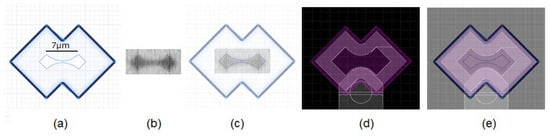
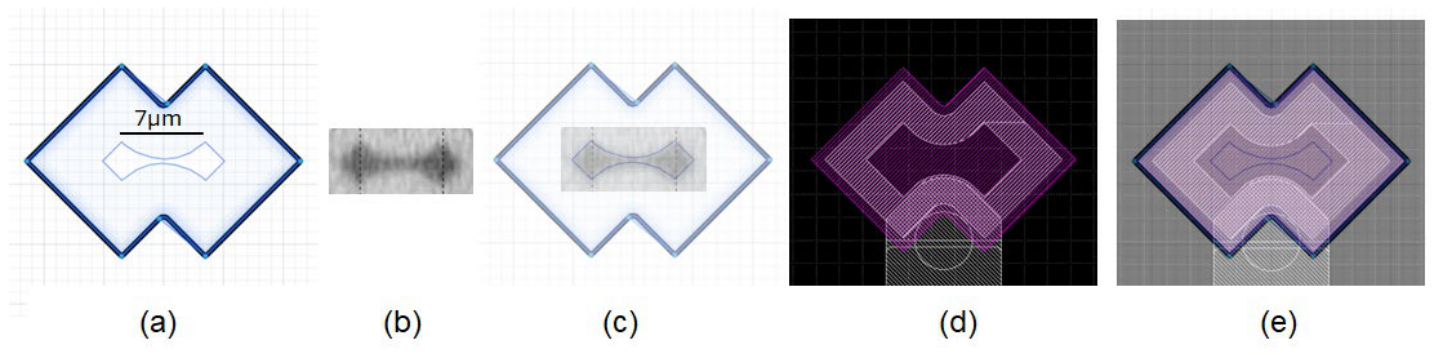
The studied device is made up of coupled square mesas, and upon oxidation, an oxide-confined aperture with a narrow connecting bridge is realized. Such a shape is important to selectively suppress the symmetric supermode which has a higher intensity in the thin bridge region and can exhibit higher external and diffraction losses. Consequently, a self-injection locking regime in an antisymmetric supermode can be realized. In Figure 1, we illustrate the geometry of the devices studied. The mesa shape and contact layout of the self-injection-locked VCSEL are shown.
Figure 1.
Mesa shape and device layout of self-injection-locked VCSEL: (a) mesa shape (thick border) and the shape of the oxide-confined aperture (thin border) modeled assuming the isotropic oxidation rate and oxidation length for 1D oxidation, 4.5 µm; (b) optical microscopy image under excitation wavelength of ~790 nm revealing the non-oxidized region of the aperture (dark); (c) images (a) and (b) are superimposed, indicating a good match between modeled and experimental images; (d) contact placement; (e) superimposed (d) and (a) images illustrating the relative positioning of the metal contact and the oxide-confined aperture.
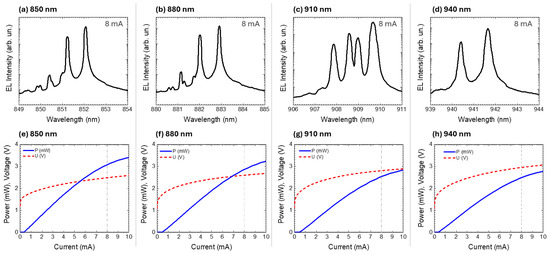
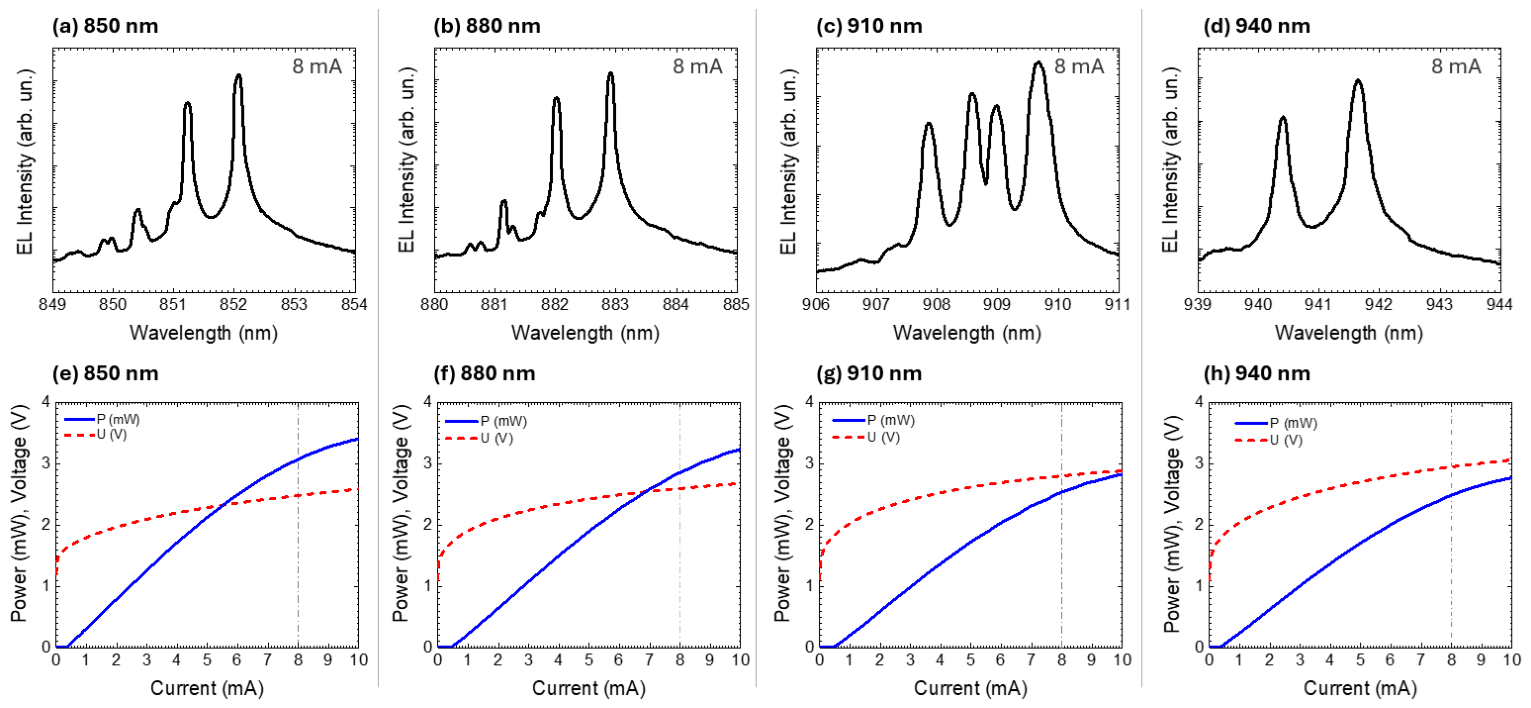
The devices were packaged into VCSEL module with open access to the VCSEL aperture for fiber coupling. In Figure 2 we show electroluminescence spectra at 8 mA of SIL VCSEL high-frequency modules (a–d) and the light–current–voltage characteristics (e–h) of these devices emitting at 850 nm (a,e), 880 nm (b,f), 910 nm (c,g) and 940 nm (d,h). One can conclude that the spectra maintain quasi-single-mode lasing in a broad range of current up to 8 mA, keeping the side-mode suppression ratio (SMSR) in the range of ~8–10 dB. The far-field emission pattern represents two narrow lobes characteristic of an antisymmetric supermode [10], with lower losses in the present SIL VCSEL design and being responsible for SIL lasing. The residual higher-order mode content arises from incomplete spatial overlap between the optical supermode field and the carrier density profile across the multi-aperture structure. Because internal self-injection locking occurs on a picosecond timescale, the dominant antisymmetric supermode maintains stable phase lock under high-speed large-signal modulation, preventing dynamic mode partitioning or degradation of transmission performance.
Figure 2.
Electroluminescence spectra at 8 mA of SIL VCSELs (a–d) and light–current–voltage characteristics (e–h) of SIL VCSELs emitting at 850 nm (a,e), 880 nm (b,f), 910 nm (c,g) and 940 nm (d,h). Side-mode suppression ratio remains high (8–10 dB) even at high operating currents and does not prevent data transmission at low bit error ratio.
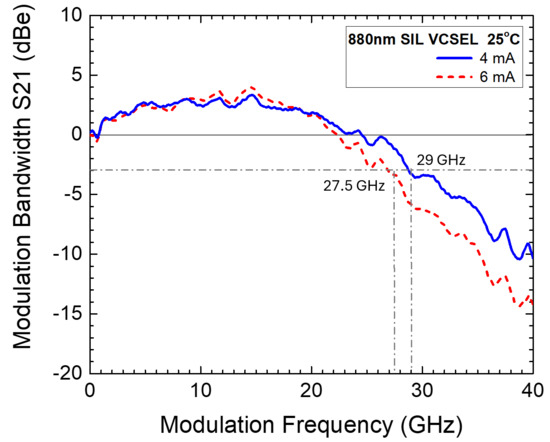
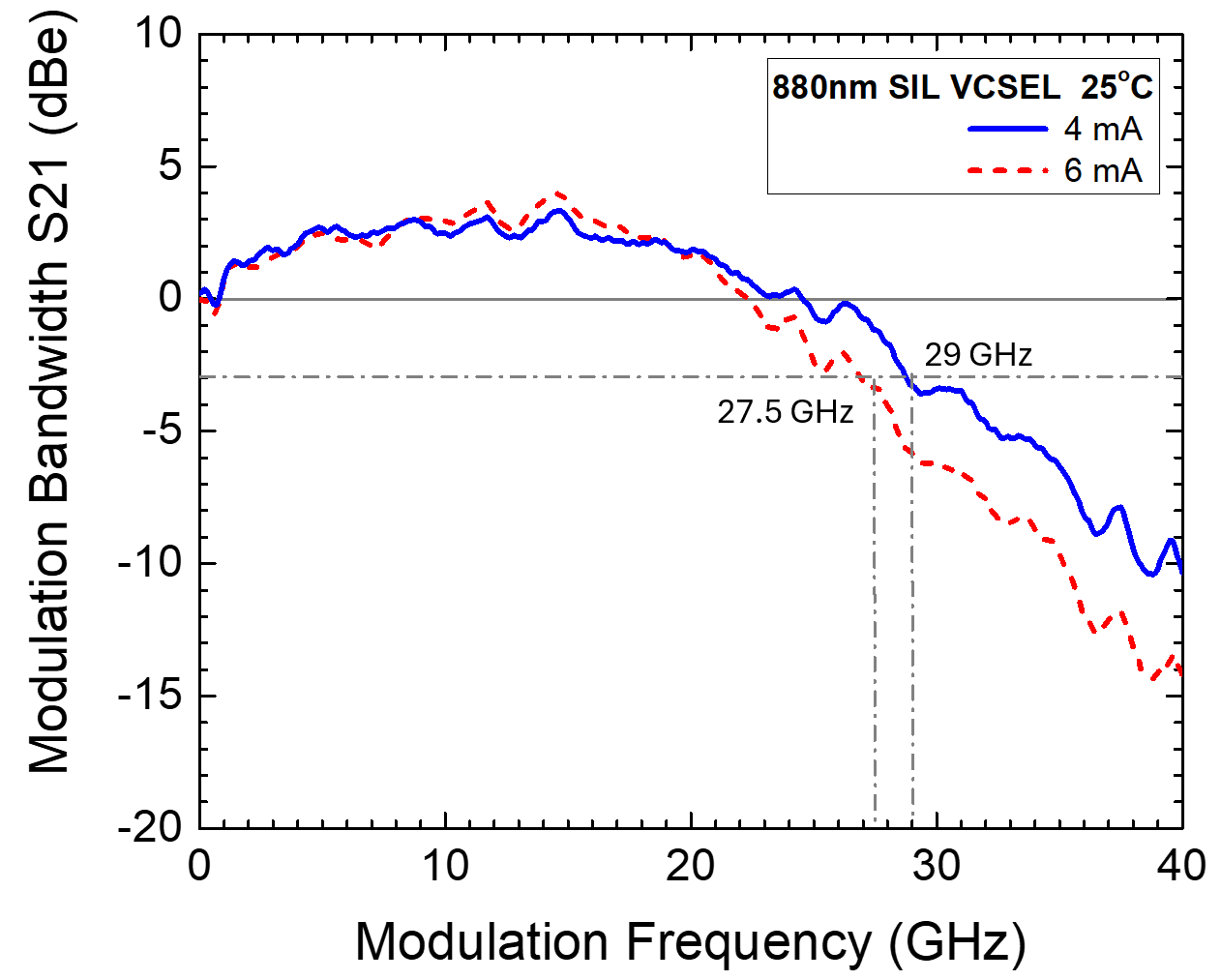
In Figure 3, as an example, we show a typical modulation response of the SIL VCSEL module at 4 and 6 mA. One can see that the high-frequency ~27 GHz modulation bandwidth (f−3dBe) is realized already at ~4 mA and at 6 mA, and f−3dBe reaches 29 GHz. Note that dBe is defined based on the operator. Other SIL VCSEL modules at the SWDM wavelengths demonstrated comparable performance.
Figure 3.
Modulation response of the 880 nm SIL VCSEL module at 4 and 6 mA.
3. Measurements of SIL VCSELs and Characterizations of Their Chirp Properties
In Refs. [14,15], SM MA VCSELs operating near 850, 880, 910, and 940 nm were investigated, and their chirp properties were shown to interact favorably with the negative chromatic dispersion of the fiber. Here, we examine whether SIL VCSELs preserve similar chirp characteristics. Although an SIL VCSEL can be regarded as a type of MA VCSEL, its apertures are optically coupled to form a coherent supermode. Moreover, because SIL VCSELs are not strictly single-mode, an important question is whether interactions with residual higher-order modes influence chirp behavior. In this section, two SIL VCSELs operating near 850 and 880 nm are investigated separately.
3.1. Optical Setup and Characterizations
We built an optical setup to couple the light from the VCSEL into a Hi780 single-mode fiber. The experimental setup is similar to that in [13] by modulating the VCSEL directly with 7 mA bias current through a vector network analyzer. For the 850 nm SIL VCSEL, an optical power of −1.75 dBm (0.67 mW) is coupled into a Hi780 fiber, while the VCSEL emits 3.6 dBm (2.29 mW) before coupling. This corresponds to a coupling efficiency of 29%. For the 880 nm SIL VCSEL, an optical power of −1.19 dBm (0.76 mW) is coupled into the fiber while the VCSEL emits 3.98 dBm (2.5 mW) before coupling. This corresponds to a coupling efficiency of 30.4%. Coupling was achieved using two lenses: the first lens, with a focal length of 5 mm, collimated the light from the VCSEL, while the second lens, with a focal length of 8 mm, focused the light into the fiber. We believe that by applying astigmatic lenses, one can achieve further improved coupling efficiency.
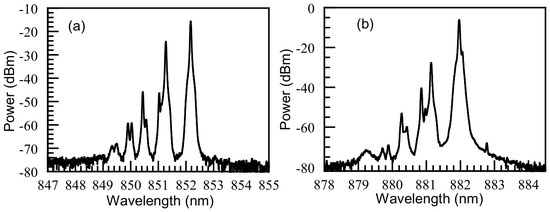
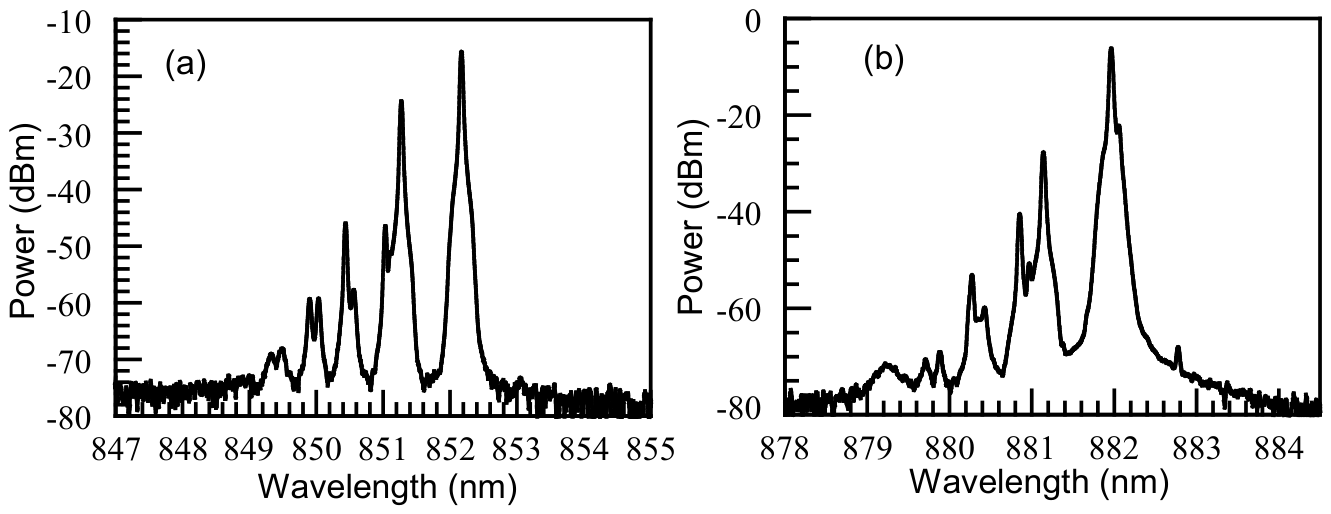
Optical spectra were experimentally measured for both SIL VCSELs, as shown in Figure 4. The 850 nm SIL VCSEL has a center wavelength of 852.06 nm and an RMS linewidth of 0.3 nm, whereas the 880 nm SIL VCSEL has a center wavelength of 881.96 nm and an RMS linewidth of 0.077 nm. The broader linewidth of the 850 nm device is attributed to relatively stronger higher-order mode content. By contrast, the lower relative power of the higher-order modes in the 880 nm device results in a narrower RMS linewidth and more pronounced quasi-single-mode behavior. Nevertheless, as discussed later, no adverse impact of the residual higher-order modes on data transmission was observed.
Figure 4.
(a) The optical spectrum of an SIL VCSEL operating around an 850 nm wavelength. (b) The optical spectrum of an SIL VCSEL operating around an 880 nm wavelength. Drive current, 7 mA.
3.2. Measurements of Transfer Function and Extraction of Chirp Parameter
In an ideal single-mode laser operating under pure transient chirp propagating through a single-mode fiber, the small-signal intensity modulation transfer function is given by [19]:
where , is the linewidth-enhancement factor, is the chromatic dispersion, is the fiber length, is the operating wavelength, and is the speed of light in vacuum. In this work, we chose the sign convention of α to be the same as that in Refs. [13,20]. Note that α is also referred to as the linewidth enhancement factor. The SM VCSEL studied in [13] and SM MA VCSEL [14] are dominated by transient chirp. Therefore, in the current work, we adopted the same assumption. The transient chirp parameter can be extracted using the formalism described in [20], which allows both the alpha parameter and the fiber’s chromatic dispersion to be determined through straightforward equations. The extracted alpha parameter can then be substituted into Equation (1) to compare the analytical transfer function with the experimental measurements to verify their agreements.
The measured transfer function represents the amplitude of the S21 parameter obtained from the vector network analyzer (VNA). The contribution from the back-to-back (BtB) system is calibrated out so that what is measured is due to the fiber link that includes the fiber modal bandwidth and the outcome of the interaction between laser chirp and fiber chromatic dispersion. A sufficiently long fiber is needed to achieve large cumulative chromatic dispersion so that several dips in the frequency response can be observed. Following [16], the resonance-like dips in the frequency response occur at frequencies , which can be determined using the following equation:
where c is the speed of light in the vacuum, D is the fiber chromatic dispersion, L is the fiber length, is the operation wavelength, and is an integer corresponding to the first, second, and third dips and so on. Therefore, the α value can be calculated from the frequencies at the first and second dips:
The chromatic dispersion of the fiber can be calculated using Equation (4):
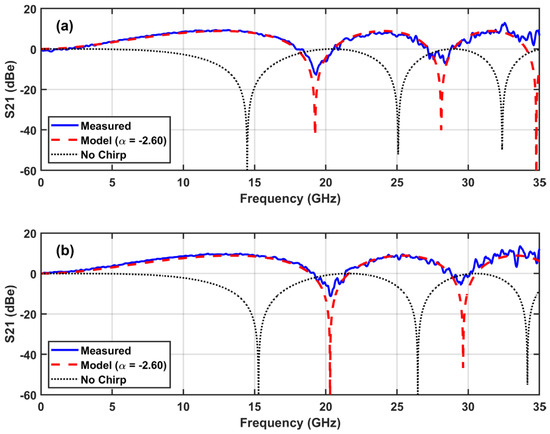
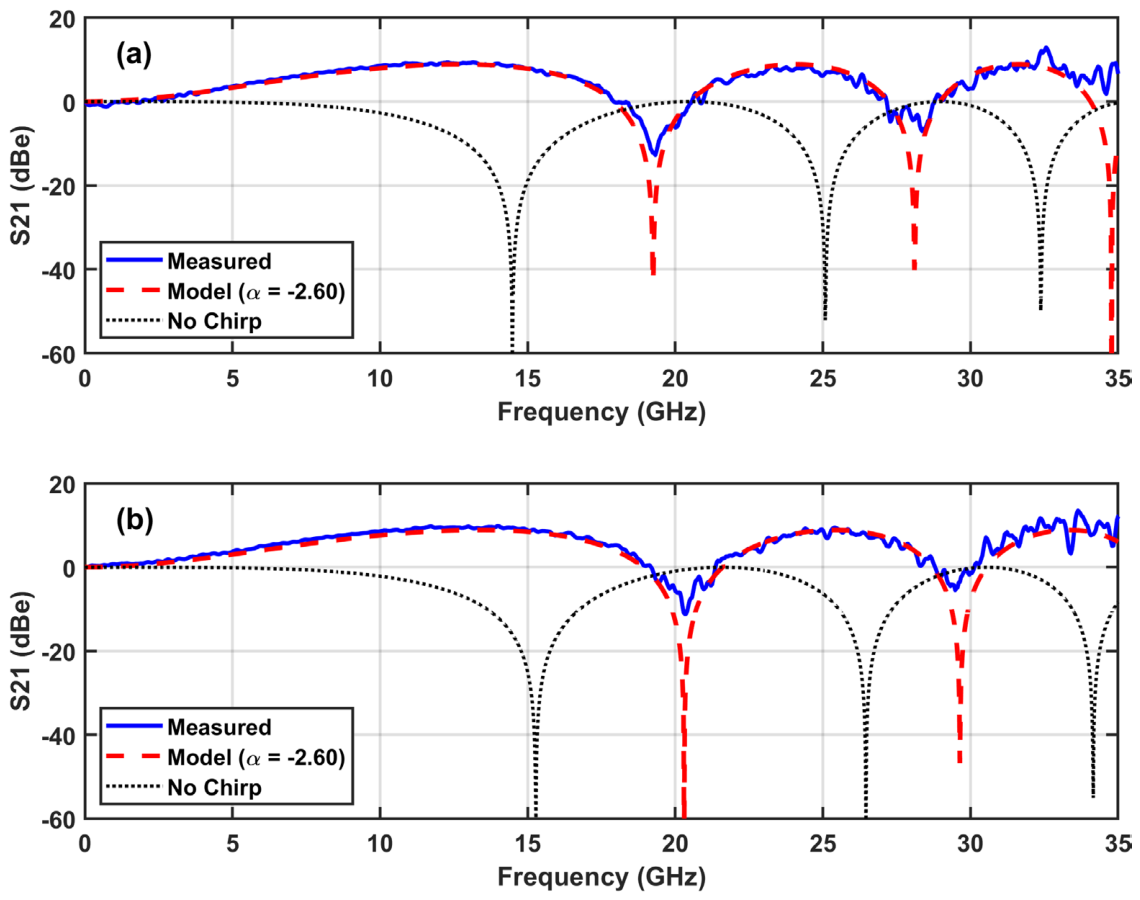
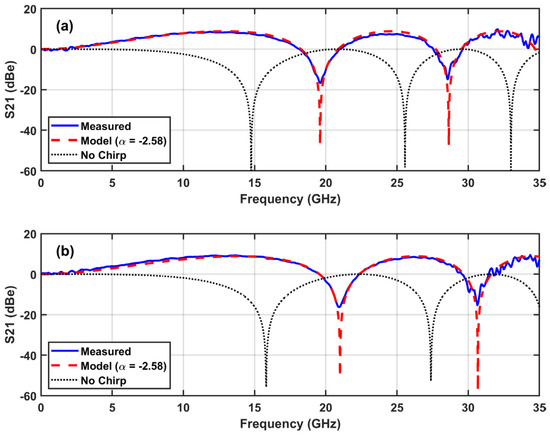
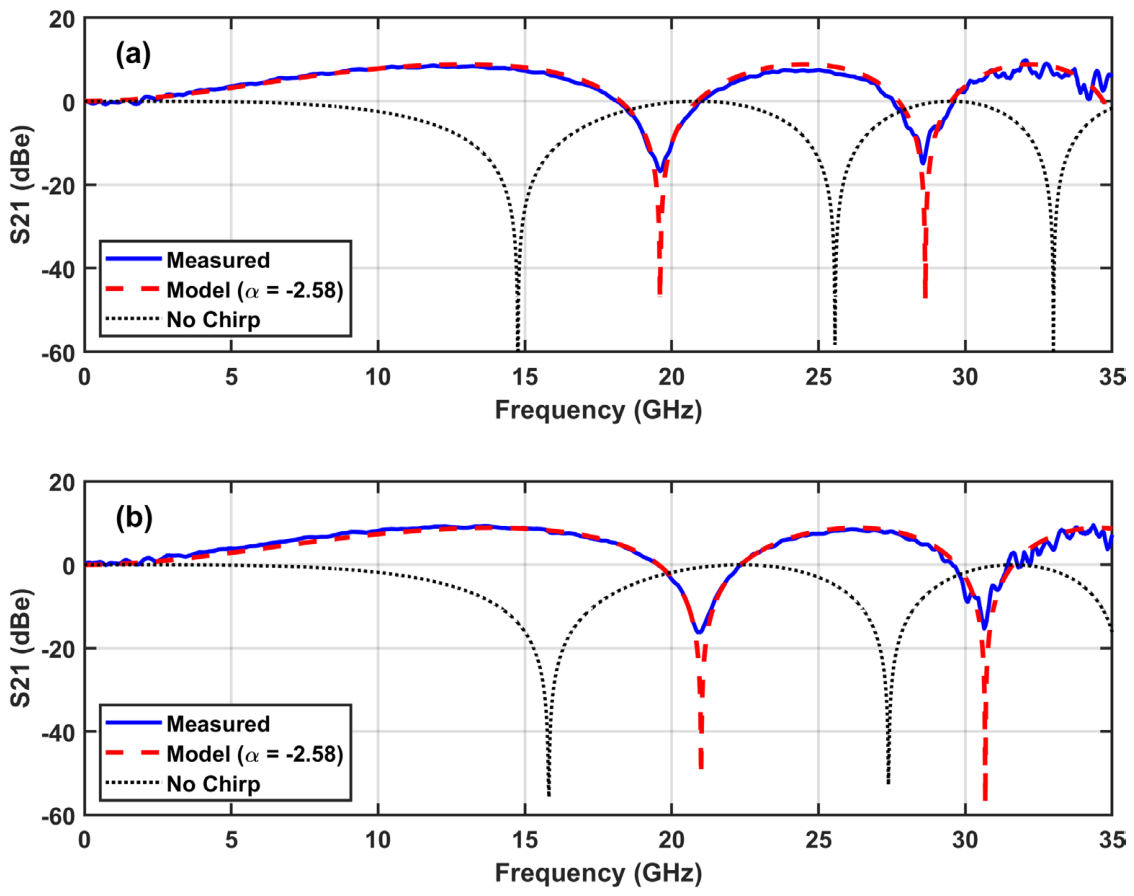
We used two long fibers for the current experiments. One, referred to as ‘fiber 1’, is Hi780 [17], a single-mode fiber at 850 nm with a length of 10.099 km. Another fiber, referred to as ‘fiber 2’, is a specially prepared fiber sample based on a standard single-mode fiber, SMF28 Ultra [21], in compliance with the ITU G652.D standard. It is known that a standard single-mode fiber is single mode above its cable cutoff wavelength around 1260 nm and is a two-mode fiber at 850 nm, and therefore, it is not suitable for chirp measurement directly. We spliced a 2 m Hi780 fiber at the launch end with the standard single-mode fiber with a length of 10 km so that only LP01 fundamental mode is launched into the fiber [18]. In this way, we forced the fiber to behave like a single-mode fiber. Using the two fibers, we measured the transfer functions from the fiber link using an 850 nm SIL VCSEL and an 880 nm SIL VCSEL, respectively, as shown in Figure 2 and Figure 3. As one may observe, for each transfer function, we observe two dips. Theoretically, transmission nulls (dips) occur at frequencies satisfying , producing sharp zeros (). However, in the measured transfer functions of the self-injection-locked (SIL) VCSEL over ‘fiber 1’ and ‘fiber 2’, the observed dips are shallow and somehow rounded ( depth: to ; depth: to ). The dips are shallow, in particular from the measurements using 850 nm SIL VCSEL, which makes it difficult to extract the precise frequencies of the dips. We attribute the cause to the modal structure of the SIL VCSEL. While self-injection locking aligns the multi-aperture VCSEL into a dominant collective supermode, weak residual higher-order transverse modes or secondary supermodes persist. The incoherent superposition of light from these residual modes prevents complete destructive RF interference at the nominal null frequencies.
We conducted a sensitivity analysis to understand the limitations of two-dip extraction. Equation (3) calculates from two dip frequencies ( and ). Due to the steep derivative of the tangent function near , small reading errors in the frequency ratio produce dramatic variations in extracted :
- For the SIL VCSEL, a difference in frequency ratio between ‘fiber 1’ () and ‘fiber 2’ () causes to change from to .
- For the SIL VCSEL, a difference in frequency ratio between ‘fiber 1’ () and ‘fiber 2’ () causes to swing from to .
Because shallow dips possess a broad minimum spanning , direct dip reading introduces high uncertainty. Reporting different values from direct dip extraction is therefore a mathematical artifact of tangent derivative sensitivity rather than a true physical change in the laser.
To overcome dip-reading ambiguity and extract an accurate, physically self-consistent device parameter, a unified full-spectrum fitting approach was implemented. Note that for a fixed bias current (), is an intrinsic cavity property of the SIL VCSEL and must be identical regardless of the propagating fiber medium. Rather than relying on two isolated discrete points , the entire measured curve over is fitted simultaneously across both ‘fiber 1’ and ‘fiber 2’. The single shared parameter and the respective fiber dispersion values ( and ) are optimized by minimizing the global root-mean-square error (RMSE) between measured and theoretical transfer functions:
To ensure robust extraction against high-frequency VNA noise roll-off above 25 GHz, a three-point moving-average filter was applied to the baseline-subtracted transfer functions, and the RMSE optimization was evaluated over the 0–35 GHz band where the SNR remains >15 dB. Because the fit evaluates the continuous spectrum across both fiber types simultaneously, the extracted parameter is anchored primarily by the high-SNR zero-crossings and first resonance nulls (19–21 GHz). As a result of the optimization,
- For 850 nm SIL VCSEL, the unified fit yields , with and .
- For 880 nm SIL VCSEL, the unified fit yields , with and
Based on the extracted and chromatic dispersion value for each fiber, we also modeled the transfer function using Equation (1). As can be seen in Figure 5 and Figure 6, the modelled transfer functions agree well with the measured ones. We also show the transfer function without chirp (), which helps to highlight the effects of the laser chirp. We note that the extracted is the property of VCSEL. In our experiments, we added two 2 m jumpers using Hi780 and placed them between the VCSEL jumper output and the fiber test for obtaining the transfer function. Even with shaking of the jumpers, we got essentially the same results.
Figure 5.
(a) Measured and modeled link transfer functions for the 850 nm SIL VCSEL with 10.099 km of “fiber 1”; (b) measured and modeled link transfer functions for the 850 nm SIL VCSEL with 10 km of “fiber 2”.
Figure 6.
(a) Measured and modeled link transfer functions for the 880 nm SIL VCSEL with 10.099 km of “fiber 1”; (b) measured and modeled link transfer functions for the 880 nm SIL VCSEL with 10 km of “fiber 2”.
4. A 32 Gb/s NRZ Transmission Experiment over 1 km of Standard Single-Mode Fiber with Fundamental Mode Launch
4.1. Fiber Sample Preparation
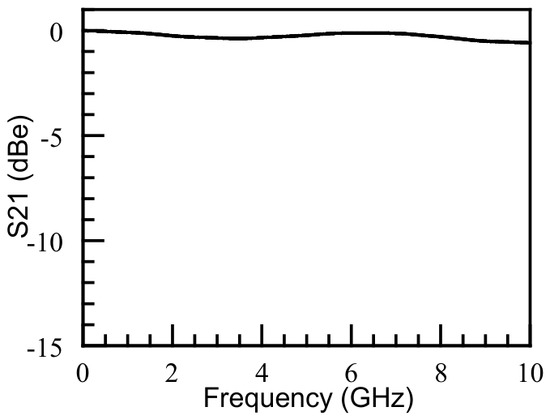
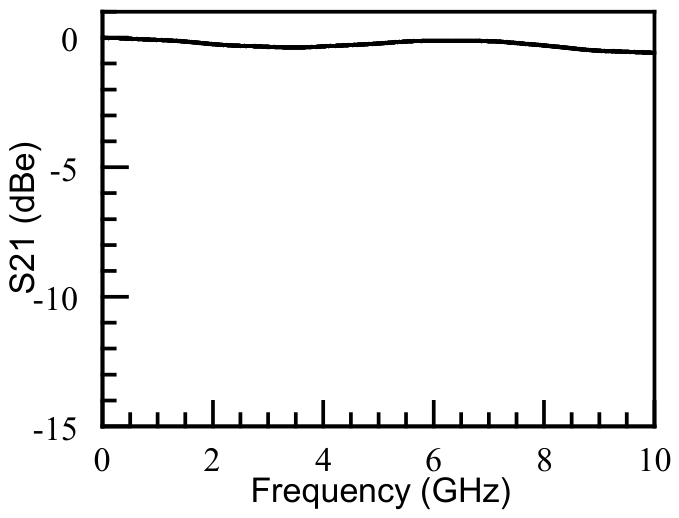
With the chirp properties characterized, we then proceeded to the transmission experiment. A separate fiber sample, referred to as ‘fiber 3’, was prepared using the same type of standard single-mode fiber as ‘fiber 2’, but with a length of 1 km. In addition, a section of Hi780 fiber was spliced to the launch end so that only the LP01 mode of the standard single-mode fiber was excited. The splice quality was verified to ensure fundamental-mode launch. Figure 7 shows the fiber transfer function measured with a VNA using a narrow-linewidth optical source modulated by a Mach–Zehnder modulator. With proper VNA calibration, the contribution from the baseline BtB system was removed, so that only the fiber contribution was captured. The measured transfer function remains nearly flat (ripple < 0.5 dB across 0–10 GHz), confirming that higher-order mode excitation is suppressed with a Higher-Order Mode Suppression Ratio (HOMSR) exceeding 20 dB. Mechanical shaking of some portions of the fiber span produced no observable modal noise penalty or BER degradation during transmission. The measured transfer function remains nearly flat, indicating that it is dominated by the fundamental mode. This fiber link was therefore used for fundamental-mode transmission in the following subsection.
Figure 7.
The measured transfer function for ‘fiber 3’ using narrow linewidth source modulated by MZM.
4.2. Transmission Experiment and Off-Line Digital Signal Processing
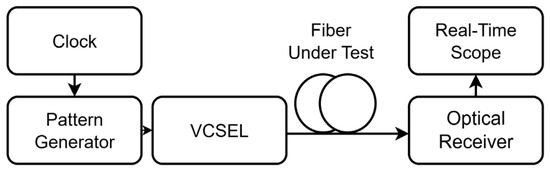
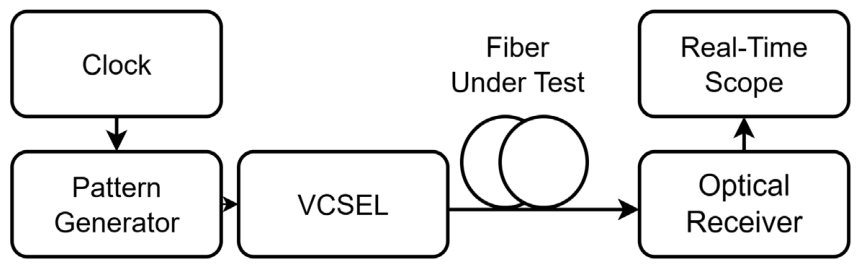
Using the 850 nm SIL VCSEL, we conducted a 32 Gb/s transmission experiment using NRZ modulation format. The experimental setup is shown in Figure 8. We used an Agilent N4951 32 Gb/s pattern generator. A multimode optical receiver from Discovery Semiconductor (Lab Buddy optical receiver R409, Discovery Semiconductors, New Jersey, United States) was used. The optical receiver (OR) has a 15 GHz bandwidth around 850 nm. The received signals were captured using a real-time scope (Tektronix DPO 73304D Digital Phosphor Oscilloscope, Discovery Semiconductoers, New Jersey, United States). To evaluate the optical link performance and recover high-speed data transmitted at a rate of using PRBS pattern, the raw optical signals were captured using a high-bandwidth real-time oscilloscope (33 GHz analog bandwidth) operating at a sampling rate of . At this sampling rate, each symbol is digitized into approximately discrete samples.
Figure 8.
The schematic layout of the transmission testing setup.
Because high-speed real-time scope captures inherently exhibit subtle sampling clock frequency offsets (e.g., relative drift) and phase wander, conventional fixed-period symbol slicing leads to catastrophic clock cycle slips over long record lengths ( points symbols). To resolve this, an offline digital signal processing (DSP) pipeline was implemented, consisting of three main stages:
- Initial Rate Estimation and Fractional Resampling: Linear regression on zero-crossing timing markers is first performed to determine the exact baud rate () and symbol period of ~. The digitized waveform is then fractionally resampled using linear interpolation to a normalized oversampled grid of exactly .
- Decision-Directed Phase-Locked Loop (PLL) Clock Recovery: A first-order, closed-loop decision-directed PLL is implemented on the resampled grid [22]. The PLL dynamically tracks residual low-frequency phase wander at each symbol index, : , where is the initial phase offset and is the optimal intra-symbol decision phase. By maintaining phase lock across the entire -symbol sequence, cycle slips are completely eliminated.
- Adaptive Feed-Forward Equalization (FFE): To compensate for inter-symbol interference (ISI) induced by the band-limited transmitter and receiver response, a seven-tap fractionally spaced FFE filter (, , and ) is trained using the Minimum Mean Square Error (MMSE) criterion, , where is the convolution matrix of resampled signal samples and is the synchronized transmit bit sequence. The seven-tap FFE filter converged within <500 symbols using the MMSE criterion. Post-cursor decision-feedback equalizer (DFE) structures were also evaluated but yielded negligible performance gain (<0.1 dB SNR equivalent) because the fiber’s optical chirp–dispersion peaking already effectively compensated for post-cursor ISI without amplifying high-frequency electrical noise.
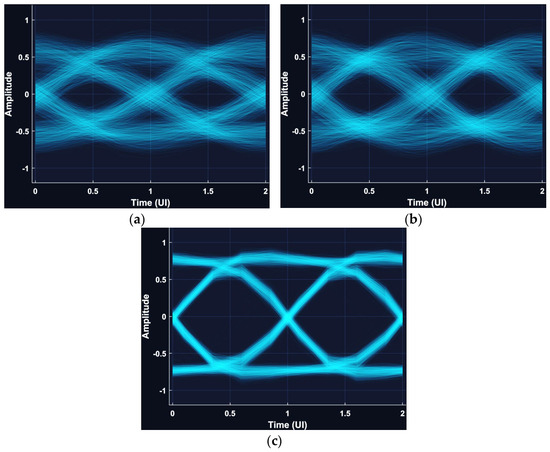
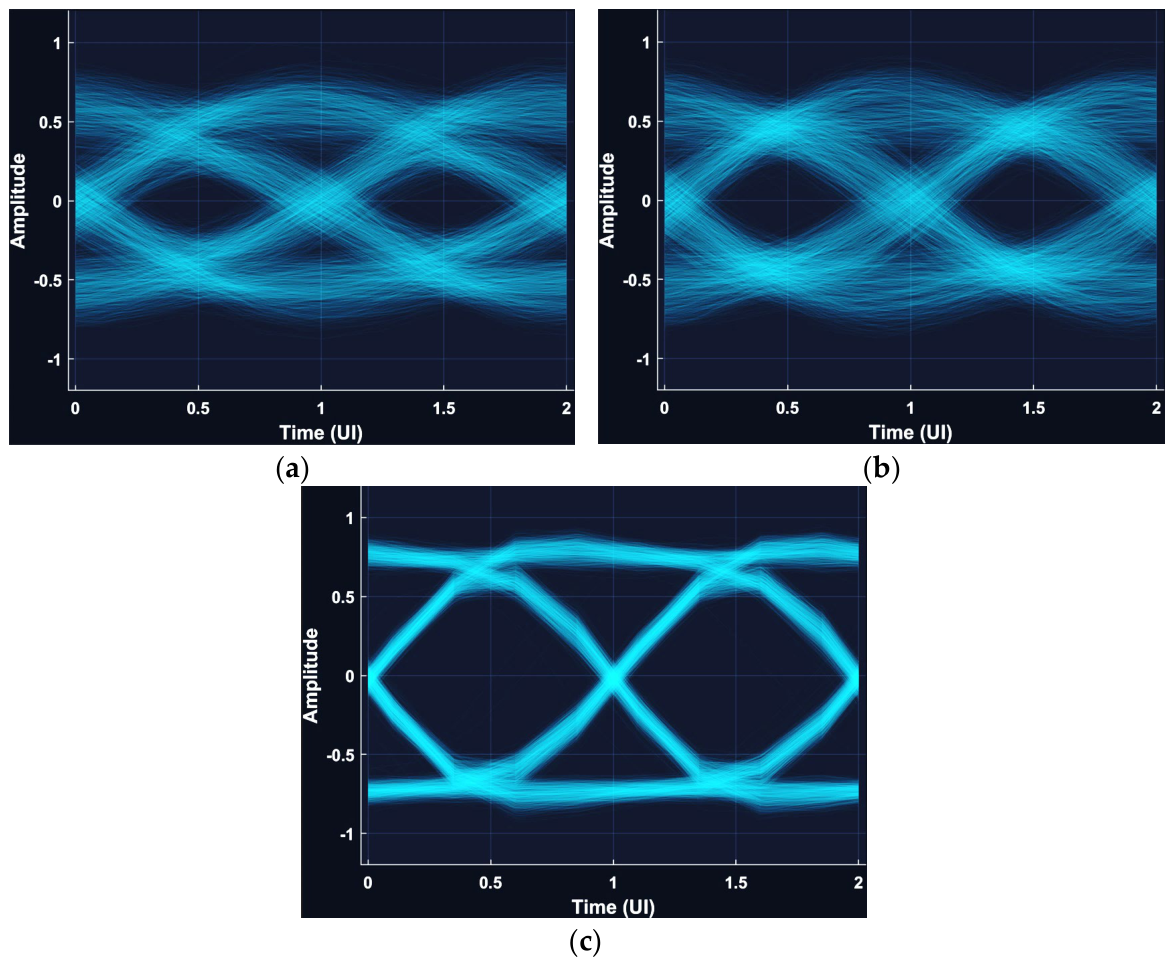
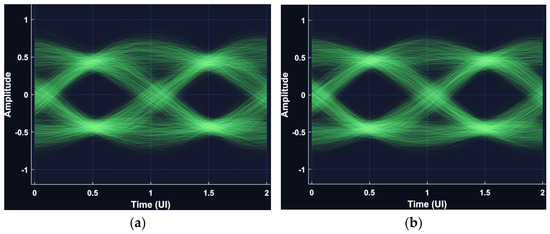
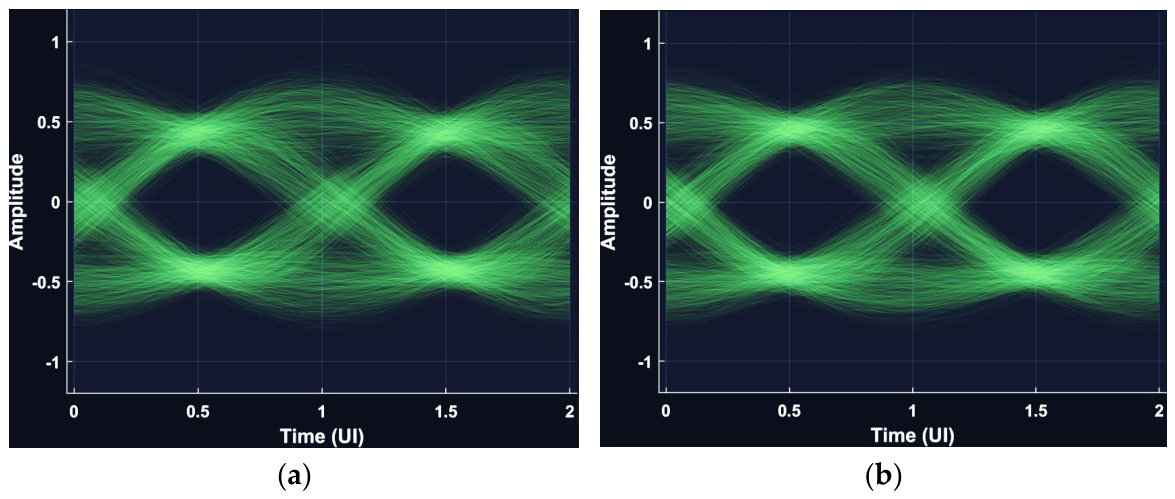
Figure 9 shows the raw eye diagrams obtained from the BtB system in Figure 9a, and the system including ‘fiber 3’ is shown in Figure 9b. In both link configurations, the eyes remain open, although the rising and falling edges are relatively slow. The eye diagram from the pattern generator (PG) alone is also included as a transmission baseline in Figure 9c. Comparison of these eye diagrams indicates that the rise and fall times are primarily limited by the PG. The equalized eye diagrams are shown in Figure 10. With the improvement provided by the FFE-based DSP, the eyes become more open and more closely approach the performance allowed by the PG baseline. Notably, the eye after transmission through the 1 km fiber is more open than the BtB eye, indicating an enhancement in transmission performance relative to the BtB configuration. This result is counterintuitive, since a fiber span would normally be expected to introduce transmission penalty. Further analysis is therefore provided to explain the underlying mechanism.
Figure 9.
(a) The raw eye diagram of the BtB system at 32Gbaud without applying equalization; (b) the raw eye diagram of the system with 1 km long ‘fiber 3’; and (c) the raw electric eye diagram obtained from PG without involving VCSEL-based optical link and demonstrating the intrinsic 32Gbuad eye resolution.
Figure 10.
(a) The eye diagram of the BtB system including 15 GHz OR with equalization applied; (b) the eye diagram of the system with 1 km long ‘fiber 3’ with equalization applied.
To evaluate system performance both before and after equalizing the signal, two complementary metrics are employed: hard error counting (Raw BER) and Gaussian-estimated BER derived from the Quality Factor (-factor). Note that the linear Quality Factor (Q-factor) quantifies the eye-diagram vertical opening by comparing the voltage separation between the logical ‘1’ and ‘0’ mean signal levels to the sum of their noise standard deviations at the optimal sampling phase. Under the complementary error function formulation, the theoretical BER estimated from the Gaussian noise distribution is given by
where linear -factor derived from the signal mean levels () and noise standard deviations ():
While hard bit error counting gives the exact bit error rate, its resolution is fundamentally floored by the total captured sample length (1 M sampling points digitized at ~3.125 samples/symbol, yielding ~3.2 × 10⁵ symbols and establishing an empirical counting floor of ~3.1 × 10⁻⁶). When an equalized link operates error-free over the captured record, the Gaussian Q-factor projection provides a statistical estimate of the underlying bit error rate below the empirical counting floor. The results are shown in Table 1. The raw BER for all configurations is 0, but they are floored due to the limited total samples. The Gaussian BER provided a better view, and the BtB and VCSEL system with 1 km fiber have raw BERs of 2.31 × 10⁻⁴ and 1.92 × 10⁻⁶, respectively. With the seven-tap FFE, the BER dramatically improved to 7.56 × 10⁻¹³ and 1.53 × 10⁻¹⁴, respectively. The BER from the 1 km link is better than the BtB system confirming the visual observation from the eye diagrams.
Table 1.
The Q-Factor and BER in different configurations.
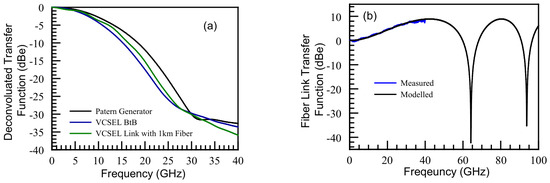
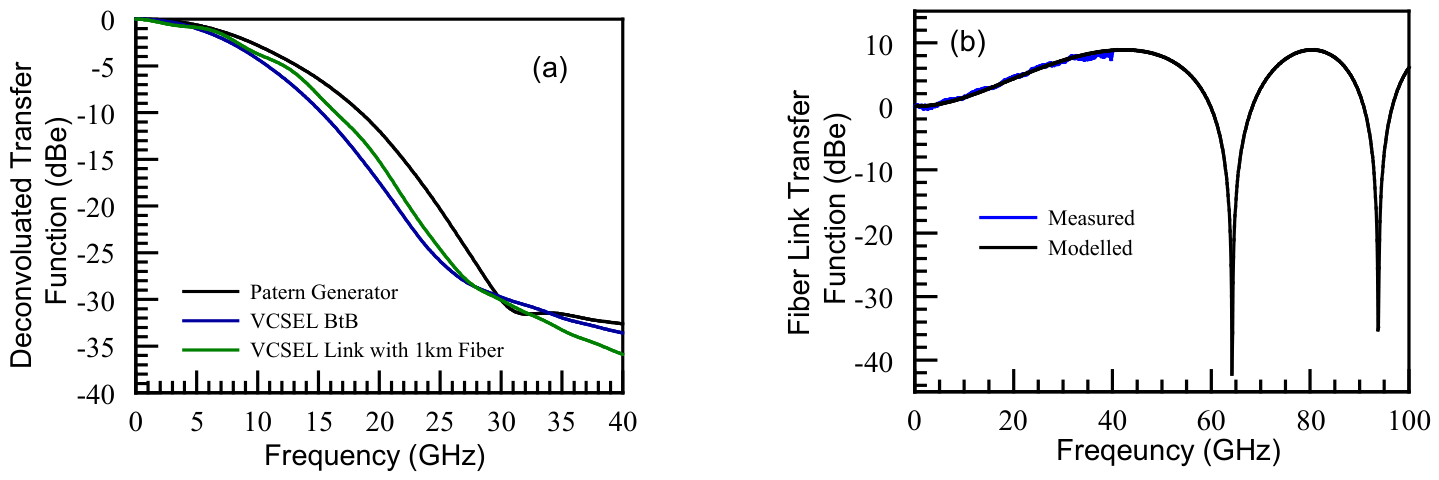
To further quantify this performance enhancement, digital channel estimation via least-squares deconvolution was performed using the synchronized PRBS input sequences by solving for the link’s impulse response, g, using the synchronized PRBS input sequence, followed by Fast Fourier Transform (FFT) to extract the normalized transfer functions, H(f). We show the transfer function for the pattern generator, VCSEL BtB system, and the full VCSEL link with 1 km fiber in Figure 11a. Channel estimates obtained through least-squares deconvolution of the 32 Gb/s PRBS signals yielded electrical bandwidths of 10.33 GHz for the PG back-to-back baseline, 8.45 GHz for the VCSEL back-to-back system, and 8.95 GHz for the 1 km fiber link (‘fiber 3’, single-mode launch with single-mode fiber). While the initial bandwidth drop from 10.33 GHz to 8.45 GHz reflects the electro-optic modulation limits of the integrated PG-VCSEL-OR link, the subsequent bandwidth extension to 8.95 GHz after 1 km of fiber is driven by VCSEL chirp–dispersion interaction. Specifically, chromatic dispersion converts transient optical frequency chirp into amplitude modulation (FM-to-AM conversion), generating a high-frequency resonance peaking that acts as an in-line passive equalizer to sharpen pulse edges and improve the eye opening. This mechanism was directly verified by measuring the baseline-subtracted fiber transfer function using a VNA, as shown in Figure 11b. The VNA measurements demonstrate excellent agreement with theoretical calculations incorporating the SIL VCSEL’s extracted chirp parameter and the fiber’s dispersion coefficient. While the deconvolved transfer function extracted from the 32 Gb/s PRBS sequence reflects the bandwidth limits of the pattern generator and receiver, as shown in Figure 11, the transfer function for the 1 km fiber link demonstrates a positive FM-to-AM gain slope extending up to 45 GHz and a 3 dBe bandwidth exceeding 60 GHz. This passive optical peaking provides natural high-frequency boost, proving that the SIL VCSEL link chirp–dispersion interaction is well-suited to support higher data rates such as 100G per lane and even 200G per lane.
Figure 11.
(a) The de-convoluted transfer functions for pattern generator signals, BtB VCSEL- OR link and the full VCSEL- OR link with 1 km fiber; (b) the directly measured fiber link transfer function using VNA and the modeled transfer function using extract chirp parameter and fiber chromatic dispersion.
5. Discussion
In this paper, we characterized two SWDM SIL VCSEL modules, studied data transmission operating at 850 nm, and investigated several of their key aspects related to optical coupling into single-mode fiber, the interaction between the laser chirp and chromatic dispersion and the transmission benefit. In this section, we discuss and highlight a few relevant aspects to put the results in better contexts.
- SIL VCSEL vs. SM MA VCSEL and SM VCSEL: SIL VCSEL is a type of MA VCSEL, in which case, neighboring apertures are optically coupled and lock into a single coherent supermode, causing the array to operate as a unified laser source rather than as independent emitters. Compared with conventional single-aperture SM VCSELs, SIL VCSELs can provide higher optical power while maintaining excellent beam quality and improved coupling efficiency into single-mode fibers. Compared to small aperture SM MA VCSEL, SIL VCSEL possesses higher-order modes at 8–10 dB SMSR.
- Possessing transient chirp in the presence of higher-order VCSEL modes: For conventional multimode VCSEL, the presence of chromatic dispersion from the multimode fiber it transmits through, the chromatic dispersion-related effect contributed to the transmission penalty and is a major limiting factor for high data rate transmission. The investigation in this work found that despite the presence of a moderate amount of higher-order modes, resulting in a 0.3 nm RMS linewidth, the transient chirp is still present and chromatic dispersion-related transmission limit is not observed. As a result, the transfer function of the link moves to a higher value as the frequency increases; this would compensate for the bandwidth limitation of the baseline system and modal bandwidth for the fiber, which serve a role similar to the FIR filter used in the transceiver for pre-emphasis. As noted, the SM MA VCSELs studied in [14,15] also exhibit transient chirp. Table 2 summarizes those results and compares them with the present work. It can be seen that all extracted alpha parameters are negative and span from −2.58 to −3.81. Therefore, all of these devices provide transmission benefits through their interaction with the fiber’s chromatic dispersion.
- Ease of coupling into single-mode fiber: This self-locking mechanism enables near-single-mode behavior while preserving a larger effective emitting area, offering a favorable combination of high brightness, narrow spectral width, narrow far-field divergence, and potentially very high dynamic response. In our study, we were able to couple moderately more light into the single-mode fiber compared to using SM MA VCSEL in previous studies [14]. In case SIL is realized in the symmetric supermode and the emission pattern is single lobe, 90% coupling efficiency can be reached.
- Methodology of the current study: In our high-speed transmission experiments, data rates of up to 32 Gb/s NRZ were demonstrated over a 1 km span of standard single-mode fiber (SMF-28 Ultra). The NRZ modulation format was selected because its binary two-level structure provides distinct pulse transitions, making the optical pulse compression resulting from negative chirp–dispersion interaction directly visible as a sharpening of the eye-diagram edges and a wider eye opening after 1 km compared to the back-to-back case. This offers a clean, transparent baseline to evaluate chirp–dispersion passive optical equalization without multi-level DSP artifacts. Although standard single-mode fiber is inherently two-moded near 850 nm, excitation was restricted purely to the fundamental mode by splicing a short (2 m) section of Hi780 single-mode fiber at the launch end. In analyzing the link transfer functions measured over Hi780 and a standard single-mode fiber, minor variations in the extracted dip frequency ratio () were observed between fiber spans. As derived in Section 3.2, these variations stem from the extreme mathematical sensitivity of the conventional two-dip formula, , where a shift of less than in the dip frequency ratio causes the extracted value to swing between and near . This tangent derivative sensitivity demonstrates that dip–ratio discrepancies are mathematical artifacts of shallow-dip readings rather than physical variations in laser chirp, fully justifying our implementation of the unified full-spectrum fitting procedure across both fiber links.
- Transmission Benefits: The presence of the transient chirp, with alpha parameter around −2.60, is in a similar magnitude to previously studied SM MA VCSELS. Therefore, the chirping effect would benefit both the transmission over MMFs and single-mode fibers. Although in this work, we presented the detailed transmission study over a 1 km standard single-mode fiber, we note that the transmission benefits would similarly be carried over to MMFs, as studied in Refs. [13,14,23].
- Fundamental mode transmission over standard single-mode fiber: At 850 nm, standard single-mode fiber is two-mode and generally possesses low modal bandwidth. Through fundamental mode launch by splicing Hi780 fiber with the standard single-mode fiber, we can use two-mode fiber as if it is single-mode fiber at 850 nm. This offers an approach to conduct longer reach transmission over 500–1000 m without requiring more expensive and specially designed fiber for 850 nm operation while still transmitting at a high data rate.
Table 2.
Comparison of alpha parameter between SM MA VCSEL in [14,15] and SIL VCSEL in the current work.
6. Conclusions
In this work, 850 nm and 880 nm self-injection-locked VCSELs were investigated as high-brightness, quasi-single-mode optical sources for extended-reach short-wavelength transmission. The SIL VCSELs preserve the key advantages of multi-aperture VCSELs, including high output power, narrow spectral width, narrow far-field divergence, and efficient coupling into single-mode fiber, while the optically coupled apertures operate as a coherent supermode. More than 29% coupling efficiency into Hi780 fiber was achieved for both devices using a two-lens coupling arrangement. Although residual higher-order transverse modes were present, particularly for the 850 nm device, the measured link transfer functions over long Hi780 and fundamental-mode-launched standard single-mode fiber confirmed that the dominant chirp behavior remains present. A unified full-spectrum fitting method was therefore introduced to reduce uncertainty associated with shallow transfer-function dips and to extract physically consistent chirp and chromatic-dispersion parameters for the SIL VCSEL links, with the chirp parameter determined to be approximately −2.6.
The extracted chirp parameters show that the favorable interaction between SIL VCSEL transient chirp and the negative chromatic dispersion of short-wavelength fiber links can provide a useful high-frequency response enhancement rather than a transmission penalty. This effect was directly verified in a 32 Gbaud (32 Gb/s NRZ) experiment using the 850 nm SIL VCSEL over 1 km of standard single-mode fiber with a spliced Hi780 launch section to enforce fundamental-mode excitation in a standard single-mode fiber. We see no impact of fiber shaking or additional SMF connectors on the data transmission. Compared with the BtB configuration, the 1 km link exhibited a more open eye and improved estimated BER, with the seven-tap FFE equalized Gaussian BER improving from 7.56 × 10⁻¹³ for the back-to-back case to 1.53 × 10⁻¹⁴ for the fiber link. Deconvolved and VNA-measured transfer functions further confirmed that this improvement originated from chirp–dispersion-induced bandwidth enhancement. These results indicate that SIL VCSELs can combine high optical power, improved single-mode coupling, and beneficial chirp–dispersion interaction, making them promising candidates for future 200–400 Gb/s short-wavelength optical interconnects over multimode fiber and fundamental-mode-launched standard single-mode fiber. Higher PG and OR bandwidths should be applied at such data rates. Specific to the current work, we demonstrated that 850 nm SIL VCSEL can work with standard single-mode fiber to cover 500–1000 m transmission, which is traditionally handled by the DR type of transceivers using lasers operating around 1310 nm.
Author Contributions
Conceptualization, X.C., N.L.J., H.D., M.-J.L. and N.L.; methodology, X.C., N.L.J. and M.-J.L.; validation, X.C., J.E.H., N.L.J., H.D., O.M., A.L. and N.L.; formal analysis, X.C. and N.L.; investigation, X.C., J.E.H., N.L.J., O.M., A.L. and N.L.; resources, H.D. and N.L.; writing—original draft preparation, X.C., and N.L.; writing—review and editing, J.E.H., H.D., N.L.J. and M.-J.L.; visualization, X.C. All authors have read and agreed to the published version of the manuscript.
Funding
This research was funded in part by Federal Ministry of Research, Technology and Space (No. 01QE2432B).
Institutional Review Board Statement
Not applicable.
Informed Consent Statement
Not Applicable.
Data Availability Statement
Data is contained within the article, as shown in the figures and associated descriptions.
Conflicts of Interest
Xin Chen, Jason E. Hurley, Hao Dong, and Ming-Jun Li were employed by Corning Incorporated. Nikolay Ledentsov Jr., O. Yu. Makarov, Alexander Ledentsov and Nikolay Ledentsov were employed by VI Systems GmbH. The authors declare that this study received funding from Federal Ministry of Research, Technology and Space (No. 01QE2432B). The funder was not involved in the study design, collection, analysis, interpretation of data, the writing of this article or the decision to submit it for publication.
References
- Michalzik, R. VCSELs: Fundamentals, Technology and Applications of Vertical-Cavity Surface-Emitting Lasers, 2013rd ed.; Springer Series in Optical Sciences, 166; Springer: Berlin/Heidelberg, Germany, 2013; p. 166. [Google Scholar]
- Bottacchi, S. Multi-Gigabit Transmission over Multimode Optical Fibre: Theory and Design Methods for 10GbE Systems; John Wiley & Sons, Ltd.: Hoboken, NJ, USA, 2006. [Google Scholar]
- Wang, J.; Murty, M.V.R.; Feng, Z.-W.; Taslim, S.-J.; Sridhara, A.; Cai, X.; Leong, N.; Koh, G.-H.; Hioki, A.; Cheng, A.-N.; et al. High speed 850nm oxide VCSEL development for 100Gb/s ethernet at Broadcom. In Proceedings of the Vertical-Cavity Surface-Emitting Lasers XXVI; SPIE: Bellingham, WA, USA, 2022; Volume 12020, pp. 52–58. [Google Scholar]
- Yang, Y.-C.; Cheng, H.-T.; Wu, C.-H. Single-channel 106.25 Gb/s PAM-4 and 64 Gb/s NRZ transmission with a 33.4-GHz 850-nm VCSEL with low-RIN characteristics. J. Light. Technol. 2023, 42, 293–301. [Google Scholar] [CrossRef] [Scilit]
- Chow, T.H.; Wang, J.; Jiang, S.; Murty, M.V.R.; Giovane, L.M.; Chua, C.P.; Chong, L.M.; Bacus, L.; Shan, X.; Sabbatino, S.; et al. 200G VCSEL development and proposal of using VCSELs for near-package-optics scale-up application. Photonics 2026, 13, 90. [Google Scholar] [CrossRef] [Scilit]
- Ibrahim, H.R.; Ge, C.; Shimizu, S.; Gu, X.; Shinada, S.; Koyama, F. 200-Gbps Directly Modulated 1060 nm Single-Mode VCSEL with Metal-Aperture Coupled Cavity Achieving a Record Data-Rate and Link-Length Product of 400-Gbps·km. In 2025 Conference on Lasers and Electro-Optics (CLEO); IEEE: Piscataway, NJ, USA, 2025; pp. 1–2. [Google Scholar]
- Tian, W.; Hou, H.; Dang, H.; Cao, X.; Li, D.; Chen, S.; Ma, B. Progress in research on co-packaged optics. Micromachines 2024, 15, 1211. [Google Scholar] [CrossRef] [Scilit] [PubMed]
- Valicourt, G.D.; Assumpcao, D.; Abbaslou, S.; Elsinger, L.; Adibi, A.; Le, S.T.; Winzer, P. Co-Design of Electronic and Photonic Systems for Future LPO, NPO, and CPO. In 2026 Optical Fiber Communications Conference and Exhibition (OFC); IEEE: Piscataway, NJ, USA, 2026; pp. 1–3. [Google Scholar]
- Larsson, A.; Gustavsson, J.S. Single-mode VCSELs. In VCSELs: Fundamentals, Technology and Applications of Vertical-Cavity Surface Emitting Lasers; Michalzik, R., Ed.; Springer: Berlin/Heidelberg, Germany, 2013. [Google Scholar]
- Ledentsov, N.N.; Ledentsov, N., Jr.; Shchukin, V.A.; Ledentsov, A.N.; Makarov, O.Y.; Titkov, I.E.; Lindemann, M.; de Adelsburg Ettmayer, T.; Gerhardt, N.C.; Hofmann, M.R.; et al. VCSELs: Influence of design on performance and data transmission over multi-mode and single-mode fibers. Photonics 2025, 12, 1037. [Google Scholar] [CrossRef] [Scilit]
- Ledentsov, N.N.; Shchukin, V.A.; Kalosha, V.; Ledentsov, N., Jr.; Makarov, O.Y.; Titkov, I.; Ledentsov, A.; Chorchos, Ł.; Turkiewicz, J.; Chen, X.; et al. Single mesa multiaperture VCSELs for high data rate transmission over multimode fiber. In Vertical-Cavity Surface-Emitting Lasers XXIX; SPIE: Bellingham, WA, USA, 2025; Volume 13384, p. 1338402. [Google Scholar]
- Lindemann, M.; Gerhardt, N.C.; Hofmann, M.R.; Ledentsov, N.; Shchukin, V.A.; Ledentsov, N.N.; Makarov, O.Y.; Zerova, V.; D’Alessandro, M.; Tibaldi, A.; et al. Study of electrically excited photon-photon resonances in self-injection-locked coupled-cavity VCSELs. In 2024 IEEE 29th International Semiconductor Laser Conference (ISLC); IEEE: Piscataway, NJ, USA, 2024; pp. 1–2. [Google Scholar]
- Chen, X.; Li, K.; Stone, J.S.; Li, M.-J. Enhanced 850-nm SM VCSEL transmission by favorable chirp interaction with fiber dispersion. AIP Adv. 2021, 11, 105104. [Google Scholar] [CrossRef] [Scilit]
- Chen, X.; Ledentsov, N., Jr.; Karar, A.S.; Hurley, J.E.; Makarov, O.Y.; Dong, H.; Atieh, A.; Li, M.-J.; Ledentsov, N. Characterization of Chirp Properties of an 850 nm Single-Mode Multi-Aperture Vertical-Cavity Surface-Emitting Laser and Analysis of Transmission Performance over Multimode and Single-Mode Fibers. Photonics 2025, 12, 703. [Google Scholar] [CrossRef] [Scilit]
- Chen, X.; Ledentsov, N.; Karar, A.S.; Hurley, J.E.; Makarov, O.Y.; Dong, H.; Atieh, A.; Li, M.-J. Chirp Properties of Single-Mode Multi-Aperture VCSEL Operating at SWDM Wavelengths and Analysis of Transmission Capability for Short Reach Applications. In 2025 Asia Communications and Photonics Conference (ACP); IEEE: Piscataway, NJ, USA, 2025; pp. 1–5. [Google Scholar]
- Zhao, X.; Zhang, B.; Christen, L.; Parekh, D.; Hofmann, W.; Amann, M.C.; Koyama, F.; Willner, A.E.; Chang-Hasnain, C.J. Greatly increased fiber transmission distance with an optically injection-locked vertical-cavity surface-emitting laser. Opt. Express 2009, 17, 13785–13791. [Google Scholar] [CrossRef] [Scilit] [PubMed]
- Corning® HI 780 & HI 780C Specialty Optical Fibers Single-Mode/Bend Insensitive. Available online: https://www.corning.com/microsites/coc/oem/documents/specialty-fiber/OEM-076-AEN.pdf (accessed on 10 August 2026).
- Kim, M.; Kim, B.G.; Bae, S.; Chung, Y.C. 112-Gb/s PAM4 Transmission Over 1 km of MMF With Mode-Field Matched Center- Launching in 850-nm Band. IEEE Photonics Technol. Lett. 2021, 33, 23–26. [Google Scholar] [CrossRef] [Scilit]
- Neto, L.A.; Erasme, D.; Genay, N.; Chanclou, P.; Deniel, Q.; Traore, F.; Anfray, T.; Hmadou, R.; Aupetit-Berthelemot, C. Simple estimation of fiber dispersion and laser chirp parameters using the downhill simplex fitting algorithm. J. Light. Technol. 2013, 31, 334–342. [Google Scholar] [CrossRef] [Scilit]
- Hui, R.; O’Sullivan, M. Fiber Optic Measurement Techniques; Elsevier Academic Press: Amsterdam, The Netherlands, 2009. [Google Scholar]
- Industry-Leading Attenuation with ITU-T G.657.A1 Bend and 9.2 µm Mode Field Diameter in Traditional and Reduced Diameters. Available online: https://www.corning.com/optical-communications/worldwide/en/home/products/fiber/optical-fiber-products/smf-28-ultra.html (accessed on 10 August 2026).
- Gardner, F.M. Phaselock Techniques, 3rd ed.; John Wiley & Sons: Hoboken, NJ, USA, 2005. [Google Scholar]
- Chen, X.; Ledentsov, N., Jr.; Hurley, J.E.; Makarov, O.Y.; Li, M.-J.; Ledentsov, N. Link bandwidth and transmission capability of single-mode multi-aperture vertical-cavity surface-emitting lasers at 100 G/lane and 200 G/lane over multimode fibers. Photonics 2025, 12, 147. [Google Scholar] [CrossRef] [Scilit]

Disclaimer/Publisher’s Note: The statements, opinions and data contained in all publications are solely those of the individual author(s) and contributor(s) and not of MDPI and/or the editor(s). MDPI and/or the editor(s) disclaim responsibility for any injury to people or property resulting from any ideas, methods, instructions or products referred to in the content. |
© 2026 by the authors. Licensee MDPI, Basel, Switzerland. This article is an open access article distributed under the terms and conditions of the Creative Commons Attribution (CC BY) license.