


Abstract
This work investigates the sensing capabilities of a compact, all-in-fibre Mach–Zehnder interferometer (MZI) fabricated using femtosecond laser inscription. The device was created within the cladding region of a single-mode optical fibre, in close proximity to the cladding–air interface, enabling light extraction from the core and enhanced evanescent-field interaction with the surrounding environment. The sensing structure integrates three collocated optical elements: a cladding-based MZI, a fibre Bragg grating (FBG) inscribed within the MZI sensing arm, and a conventional FBG inscribed in the fibre core, providing distinct and complementary sensing responses. All components were fabricated using the plane-by-plane (Pl-by-Pl) femtosecond laser inscription technique, ensuring high fabrication flexibility, repeatability, and reliability through the use of common inscription parameters. The sensing performance of the compound device was experimentally evaluated under variations in temperature, relative humidity, axial strain, bending, and surrounding refractive index. The three integrated sensing elements exhibited complementary responses, enabling multiple parameters to be monitored using the same interrogation equipment while providing opportunities to mitigate cross-sensitivity effects through the selection and combination of appropriate sensing signals. The proposed compact all-in-fibre sensing platform demonstrates the potential of femtosecond laser micromachining for the development of robust, multifunctional optical fibre sensors.
1. Introduction
Femtosecond laser processing enables precise modification of transparent materials and supports the fabrication of complex photonic structures directly inside optical fibres [1,2]. Beyond its role in protecting the core, the fibre cladding contributes to optical confinement and modal propagation through its refractive-index contrast with the core. Exploiting cladding-guided modes can therefore provide a route to sensors whose responses are strongly influenced by external conditions. Among the available in-fibre architectures, the Mach–Zehnder interferometer (MZI) is particularly useful because its output depends on the phase difference accumulated along two optical paths. In a typical configuration, one path serves as a reference while the other responds to the measurand. In fibre implementations, light can be transferred from the core mode to a cladding waveguide and subsequently recoupled into the core [3]. Interference between the resulting optical fields produces a spectrum whose free spectral range (FSR)—the wavelength separation between adjacent maxima or minima—is governed by the optical path difference. MZI-based devices have been investigated for applications ranging from optical signal processing [4] to physical, chemical, and biological sensing [5,6,7]. When MZIs are illuminated by a broadband light source they act as wavelength selective filters. Within an optical fibre, they have very low loss and high stability. Fibre MZIs have been realized using several approaches, including long-period gratings [4], tapered fibres [8,9], dissimilar splices [10,11], collapsed photonic-crystal fibre structures, multimode-fibre sections [12], and laser-inscribed cladding waveguides [13,14,15]. Although these techniques can provide useful interferometric responses, tapering and specialty-fibre splicing may introduce fragile regions or additional handling requirements [16]. Long-period gratings offer an established alternative, but their spectral characteristics can constrain measurement precision and usable bandwidth. Cladding waveguides are attractive for sensing because their interaction with the external environment can be strong; however, this can also make their responses sensitive to temperature and bending. Here, we investigate a compound fibre sensor comprising a cladding-based, evanescently coupled MZI, an FBG incorporated into its sensing arm, and a separate FBG in the fibre core. The grating responses provide complementary information that can be used when interpreting the MZI response under varying environmental conditions. In this work, we focus on the fabrication of a novel compound sensor in the cladding area of the optical fibre; an evanescent coupling-based MZI, that supports in the waveguide an integrated fibre Bragg grating (FBG) and a core-located FBG, in order to deal with cross-sensitivity issues. Preserving the fibre core during fabrication was a key design consideration. The cladding waveguide was therefore written parallel to the core, allowing optical power to transfer through evanescent coupling without requiring the waveguide to cross the core. Plane-by-plane (Pl-by-Pl) femtosecond-laser inscription was selected because it supports the fabrication of different optical components using a shared set of principal laser parameters [17]. The sensing arm was positioned close to the cladding–air boundary to increase its interaction with the surrounding medium. Writing in this region is challenging because of the fibre’s curved surface, making accurate control of the inscription position and processing conditions essential. The resulting configuration combines the near-surface MZI with the embedded MZI-FBG and core FBG in a single fibre. This study examines the sensor’s responses to temperature, bending, surrounding refractive index, and relative humidity, with emphasis on the complementary information provided by the integrated elements. Sensing responses are discussed in relation to issues of cross-sensitivity and we comment on the ability of the device to perform in situations where multiple effects are present. We consider that in this work, we are pushing the limits of fs laser material processing capabilities. In this work, the writing parameters are controlled to create the structure close to the cladding–air boundary without compromising the fibre integrity, enabling the integration of the MZI-FBG and core FBG using a common plane-by-plane femtosecond-laser inscription process.
2. Materials and Methods
Femtosecond Laser Component Fabrication
The cladding waveguides were fabricated in commercial single-mode optical fibre by direct femtosecond-laser writing [18,19], with inscription performed through the fibre coating. A HighQ laser femtoREGEN system operating at 517 nm was used, with 220 fs pulses, a pulse energy of 115 nJ, and a repetition rate of 50 kHz. The MZI, MZI-FBG, and core FBG shared the same laser source and focusing conditions, while their writing trajectories and processing settings were adapted to the geometry of each component. The focused spot diameter inside the cladding was approximately 1 μm, and the resulting MZI branches were approximately 8 μm in diameter. The continuous MZI waveguide was produced by longitudinal fibre translation during plane-by-plane inscription. The MZI-FBG was incorporated into this waveguide by introducing a periodic distribution of laser-induced modifications along its length. Both structures were therefore written using the same laser and focusing conditions, but with different spatial patterns. The cladding waveguide was positioned parallel to the core rather than crossing it, allowing evanescent power transfer while leaving the core available for inscription of the conventional FBG. The fabrication approach follows the general strategy of integrating fibre components through femtosecond-laser processing [20].
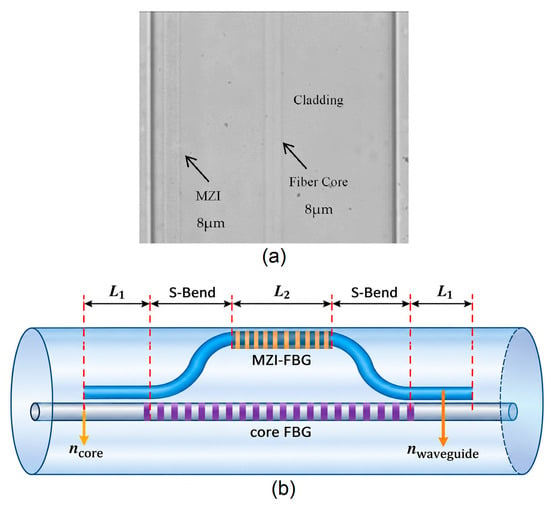
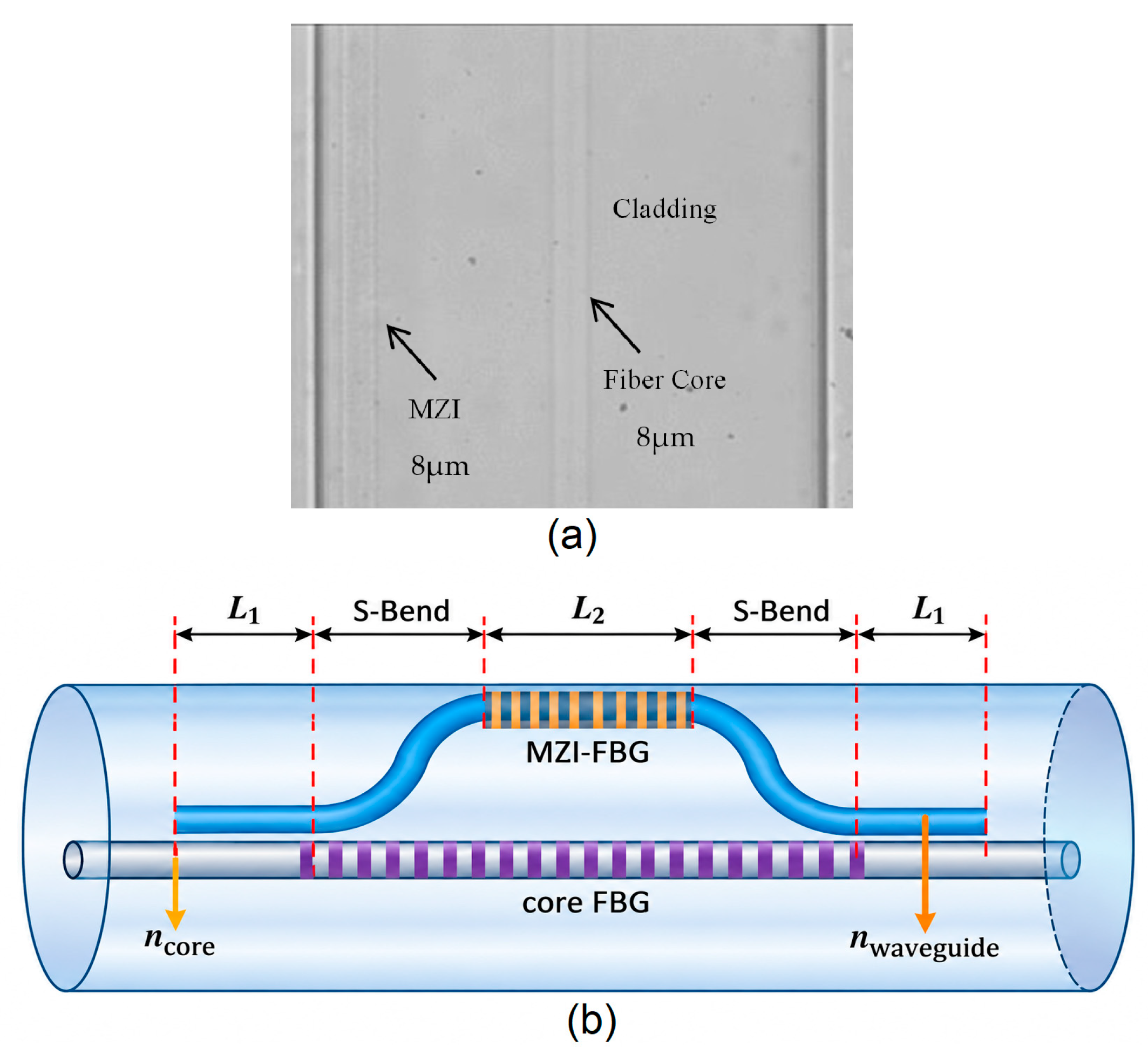
Figure 1a presents a microscope image of the MZI waveguide positioned near the cladding–air interface, with a measured separation below 5 μm. The inscription position was controlled using a high-precision air-bearing translation stage. The observed structure shows no visible damage in the displayed region. The plane-by-plane “inscribe-and-step” procedure allows the spatial dimensions of the modification to be controlled through the inscription trajectory and processing conditions. The MZI geometry, including waveguide thickness, coupling length, and coupling angle, was investigated in detail in [21]. The dimensions selected for the present device were intended to provide approximately 50% evanescent coupling. Figure 1b depicts a schematic of the device under study: it was designed with a 250 μm coupling length (L1), a branch length (L2) of 5 mm and a specific coupling angle (θ) smaller than 3° for a total size close to 1 cm.
Figure 1.
Microscope images of the waveguide MZI structure (a). Schematic of the final device (b).
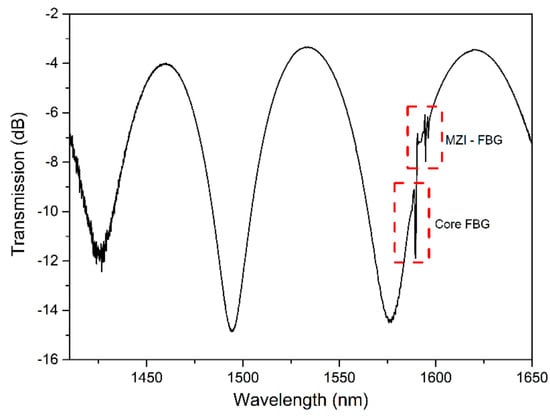
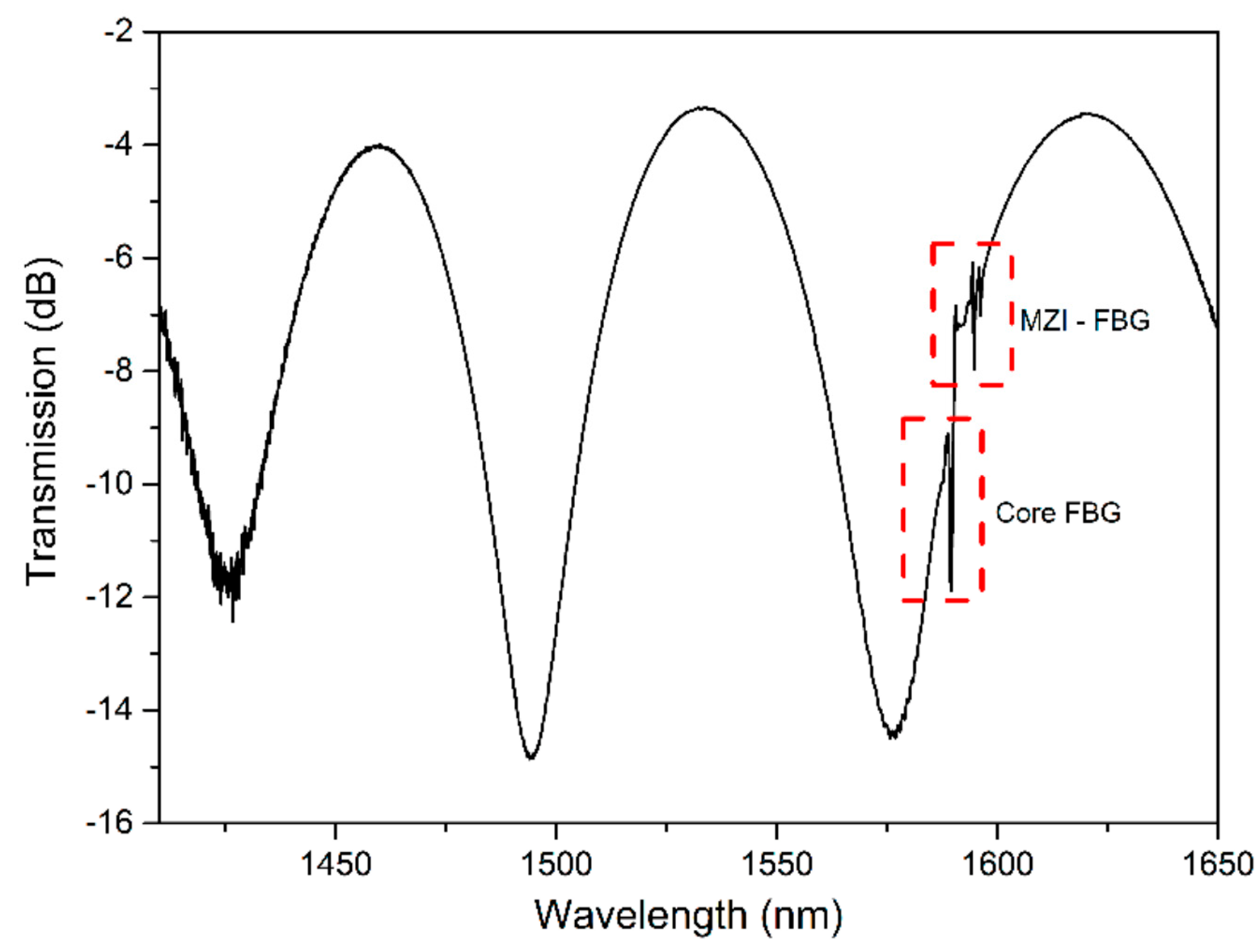
The transmission spectrum in Figure 2 contains the resonance associated with the core FBG at 1590 nm and that of the MZI-FBG at 1595 nm. The corresponding grating periods were 2.197 μm and 2.203 μm, respectively. Because the MZI-FBG was written close to the cladding–air boundary, its inscription speed was adjusted to obtain a weaker grating response while limiting the risk of damaging the surrounding structure.
Figure 2.
Transmission spectrum of the MZI, core FBG and MZI-FBG.
3. Experimental Results
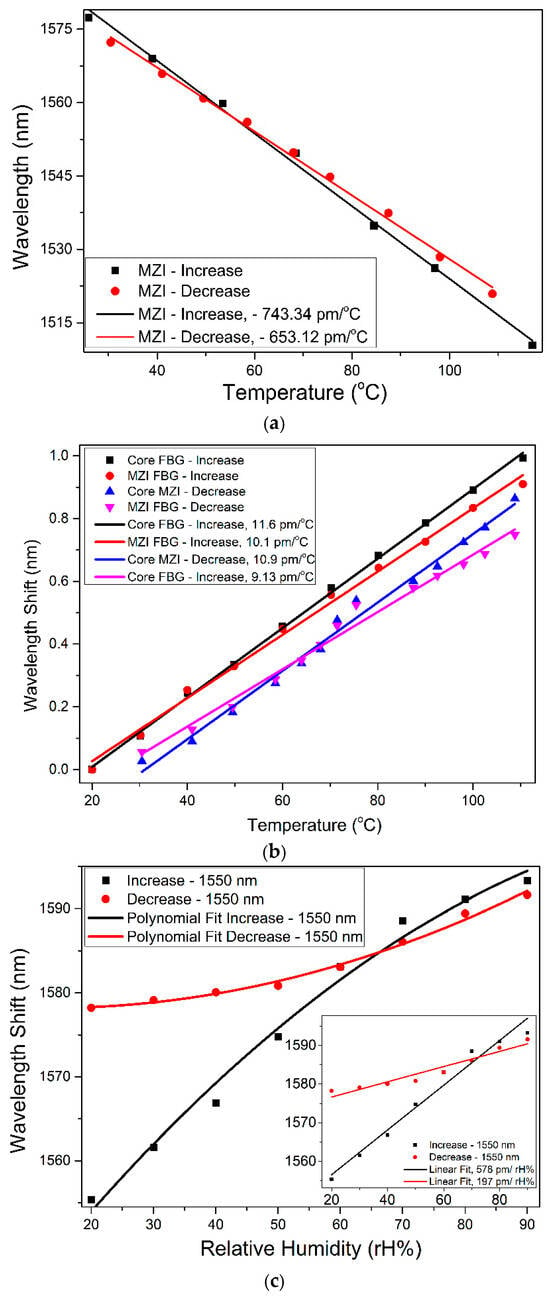
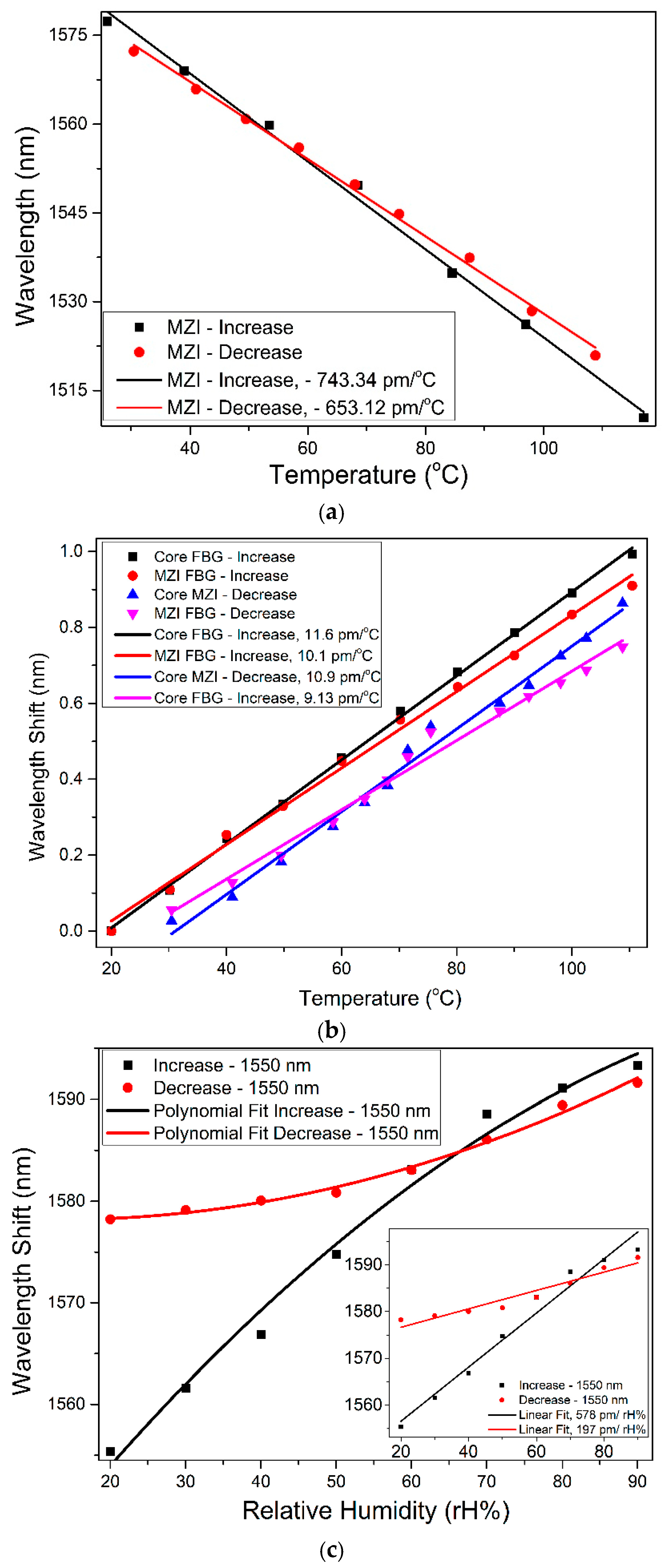
Measurements were carried out using a broadband light source (BBS) and an Advantest Q8384 optical spectrum analyser (OSA). The BBS provided unpolarized illumination; nevertheless, polarization-dependent effects can remain in an MZI and may influence both fringe visibility and the positions of its minima [22]. The sensitivity of an interference minimum depends on the phase difference between the modes propagating along the two optical paths. Changes in temperature, strain, curvature, or surrounding refractive index modify their effective refractive indices and optical path lengths, thereby changing the accumulated phase difference and shifting the interference spectrum. Because modal dispersion and phase response depend on wavelength, different interference minima need not exhibit the same sensitivity. Their wavelength shifts can differ in magnitude and, depending on the operating conditions, may also have opposite signs. Since the phase response and modal dispersion vary with wavelength, the corresponding wavelength shift per unit change in the measurand is not necessarily constant across the measured spectral range. Consequently, different interference dips can exhibit different sensitivities, including differences in magnitude and, depending on the operating point, sign. For temperature and relative humidity measurements, samples were placed in a climate chamber, where temperature was controlled with an accuracy of 0.1 °C with incremental steps of 10 °C from 20 to 110 °C, for a fixed value of relative humidity of 30%. Relative humidity measurements were made from 20% to 90% at 40 °C. Having three possible avenues for sensing (FBG, MZI, MZI-FBG) measured in both transmission and reflection using a micron optics Hyperion si155 interrogator, we show in Figure 3a their respective sensitivity to temperature changes. As expected, the core FBG and MZI-FBG display a sensitivity of 11.6 pm/°C and 10.9 pm/°C, respectively, after a linear regression. We observe this effect because of the inscription in such close proximity to the edge (curvature, modified area). The most sensitive observable dip of the MZI in the investigated wavelength range appears to decline as the temperature increases. If a linear fit is applied, a sensitivity of −0.743 nm/°C is obtained, which is close to 75 times higher than a core FBG. The complementary temperature responses of the two FBGs can therefore provide reference information for considering temperature effects when interpreting the response of the MZI to other measurands. However, a quantitative evaluation of temperature hysteresis would require a separate analysis of the heating and cooling responses.
Figure 3.
Sensitivity of the Mach-Zehnder dips as a function of temperature (a); of MZI-FBG, FBG (b) and relative humidity. Inset: linear regression of relative humidity (c). FBG and MZI-FBG are not sensitive to relative humidity.
Figure 3c depicts the processed responses to changes in relative humidity. While the core FBG and MZI-FBG are insensitive, the MZI dips show a second order polynomial function that grows with relative humidity. For comparison, a linear regression was applied with a sensitivity of 0.578 nm/% of relative humidity for the most sensitive dip. The difference between the ascending and descending humidity responses indicates hysteresis in the MZI sensor. This behaviour may be attributed to moisture absorption and desorption in the polymer coating. Since the MZI waveguides are inscribed close to the fibre surface, humidity-induced changes in the coating’s refractive index and/or dimensions can influence the effective refractive index of the guided modes, resulting in different wavelength shifts during humidification and drying.
When axial strain was applied uniformly to the MZI, both the MZI optical paths experienced the same overall strain change; thus, any differential strain was insignificant. To evaluate the sensitivity to bend, we mounted the device on a stage and introduced controlled compression on the horizontal axis [23]. The curvature (C) is directly related to the radius (R) of circle:
C = 1/R
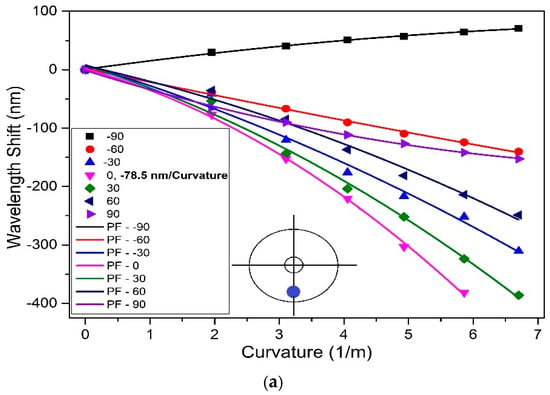
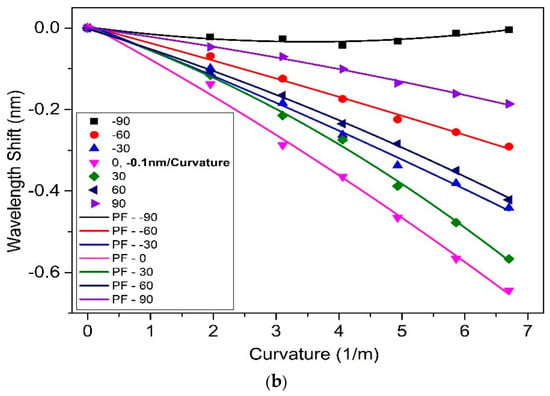
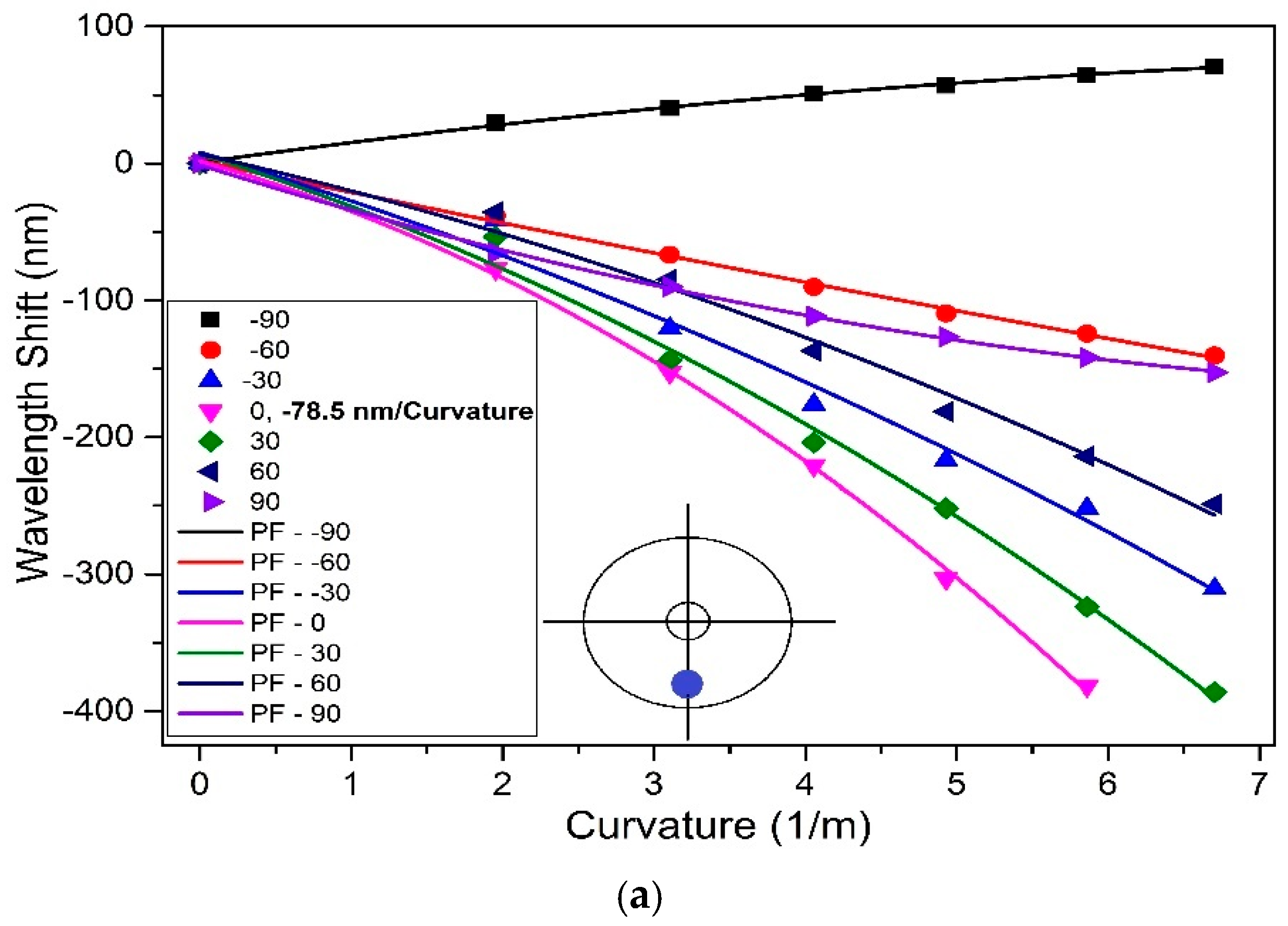
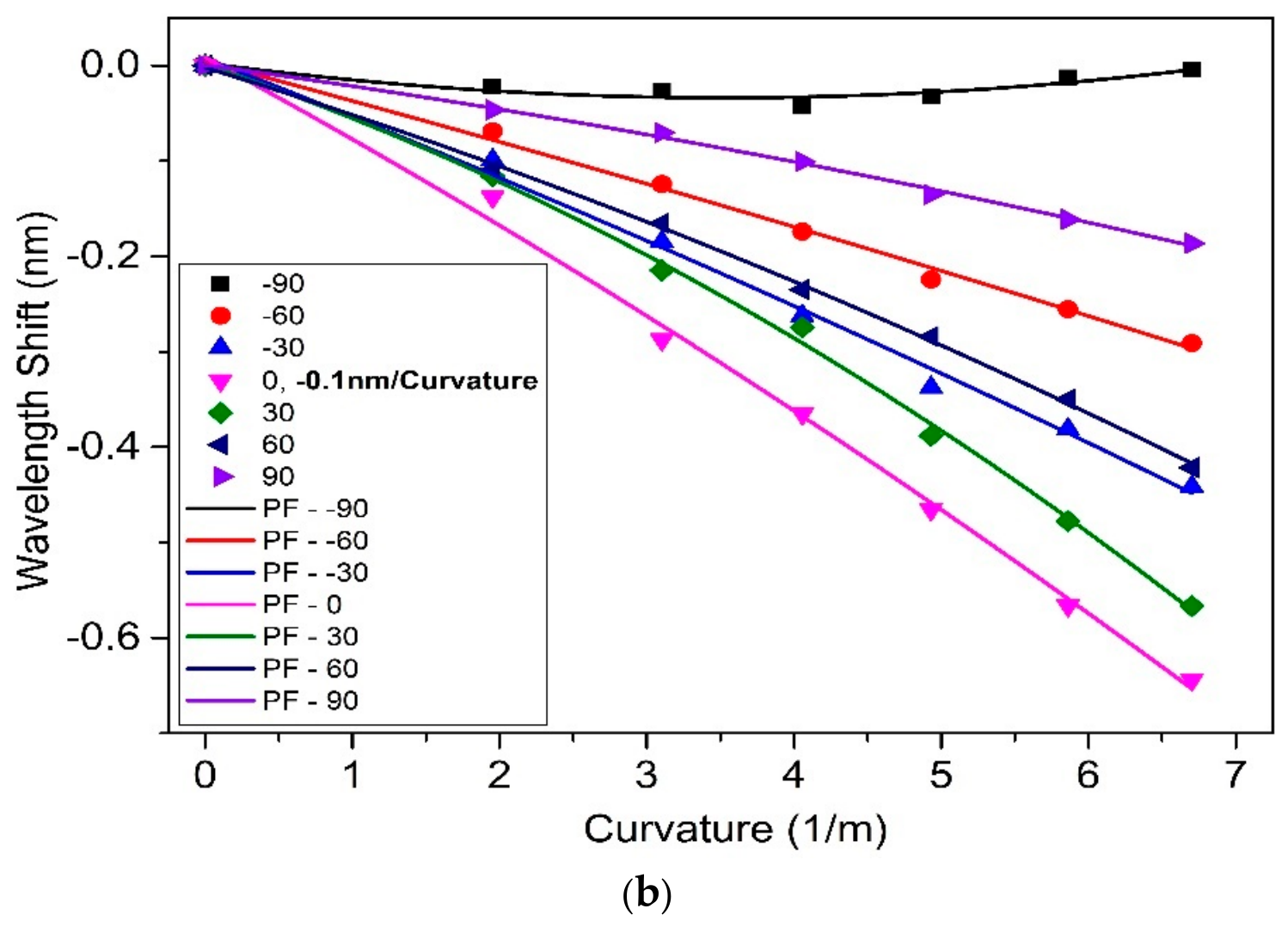
Figure 4 depicts the sensitivity of the most sensitive MZI dip and the shift in the MZI-FBG; the dips follow a second order polynomial function. To evaluate the performance, a linear fit was introduced over a limited range. While the core FBG is unaffected by the bending of the fibre, the MZI dip shows a maximum sensitivity of –78.5 nm/m−1, compared to the MZI-FBG that is contained within it, with –0.1 nm/m−1; thus, the sensitivity is at least 780 times greater. Surrounding refractive index (SRI) was investigated by immersing the fibre sensor in salt-water solutions and adjusting their refractive index through the addition of deionized water. The sensitivity coefficients were obtained from the measured spectral responses under the conditions investigated. A refractometer with a specified accuracy of 10−4 RIU was used to characterize the solutions. This instrument specification does not, by itself, determine the uncertainty, resolution, or detection limit of the fibre sensor. A complete metrological assessment, including sensitivity-fit uncertainty, repeatability, and detection limit, was not carried out in this study and remains necessary for further characterization. The sensor response was evaluated by tracking MZI interference minima in the transmission spectrum (Figure 5).
Figure 4.
Bend sensing measurements in reflection with respect to sensor rotation for the most sensitive dip of the MZI (a) and the MZI-FBG (b). From the measured response in each direction, we note the initial FBG position in the fibre cross-section (inset).
Figure 5.
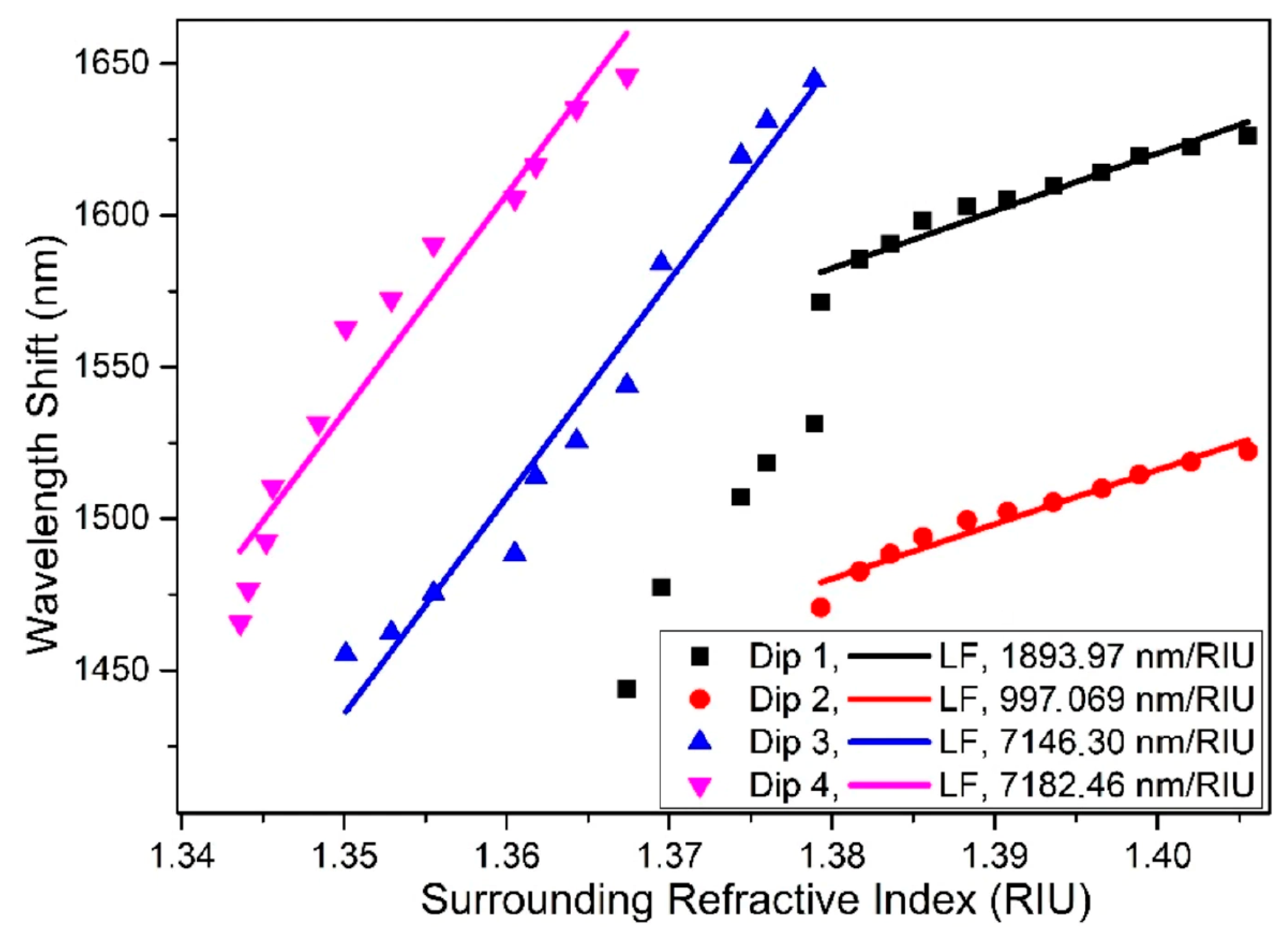
Sensitivity of the transmission MZI dips when the surround refractive index (SRI) changes with values from 1.345 to 1.4025.
As the surrounding refractive index changed, the fringes shifted substantially, and some moved beyond the observable spectral window. Different interference minima were therefore used over different refractive-index intervals. The measured sensitivity was 7182.46 nm/RIU over 1.345–1.3675 and 1893 nm/RIU over 1.3785–1.4025. These values describe the respective intervals and should not be interpreted as a single constant sensitivity across the complete investigated range. The observed refractive-index response is consistent with the evanescent interaction between the cladding waveguide and the surrounding medium. A change in the ambient refractive index alters the propagation constant of the guided modes, modifying their phase difference and consequently shifting the MZI interference fringes [24]. Reducing the separation between the waveguide and the cladding–air interface could potentially increase this interaction, although further fabrication and characterization would be needed to establish the resulting performance.
4. Discussion
In this work, sensing performances were analyzed separately without considering cross-sensitivity issues. One can argue that the latter are very limited considering the three avenues of sensing with the option to measure both in transmission and reflection.
Since we could obtain the responses of the MZI-FBG and core FBG in reflection we can calibrate our device for a pure SRI measurement. The temperature sensitivity of 11.66 nm/°C hardly influences the response. Bend sensing can be obtained from reflection, and since the MZI dip response is known, it can be demodulated. Furthermore, a practical device would be secured and packaged, thus further reducing the possible cross-sensitivity issues. Table 1 shows a brief summary of the measurements and responses that were presented in this work. Previous fibre-optic sensors have combined MZIs and FBGs to measure multiple parameters [25,26], including configurations assembled from different fibre sections or separately fabricated elements [27,28]. The principal feature of the present design is the integration of the MZI, the FBG within its cladding-based sensing arm, and the conventional core FBG directly into one optical fibre through femtosecond-laser inscription. Avoiding inter-fibre splices removes splice-related interfaces and may simplify alignment and assembly. The three elements provide distinct spectral responses to temperature, humidity, bending, and surrounding refractive-index variations, allowing complementary information to be obtained from the same fibre. The approach therefore emphasizes the integration of sensing functions in a compact, splice-free structure rather than claiming universally superior sensitivity to existing devices. This monolithic configuration offers a practical route toward compact and mechanically integrated multi-parameter fibre-optic sensing systems.
Table 1.
Summary of performances for MZI, MZI-FBG and core FBG, enabling possible sensing without cross-sensitivities.
5. Conclusions
This study presents a compact, single-fibre sensing configuration combining a cladding-based Mach–Zehnder interferometer (MZI), a Bragg grating incorporated into the MZI sensing arm (MZI-FBG), and a conventional core FBG. The three elements were fabricated using plane-by-plane femtosecond-laser inscription, with shared laser and focusing conditions and structure-specific writing parameters. Positioning the cladding waveguide near the cladding–air boundary provides interaction with the surrounding environment while preserving the fibre core. Experimental characterization demonstrated responses to temperature, bending, surrounding refractive index, and relative humidity. The MZI exhibited a maximum reported refractive-index sensitivity of approximately 7000 nm/RIU over the relevant interval and a bending sensitivity of −78.5 nm/m−1. Its relative-humidity response yielded a fitted sensitivity of 0.578 nm/%RH for the selected interference minimum. Temperature sensitivities of 11.6 pm/°C and 10.9 pm/°C were obtained for the core FBG and MZI-FBG, respectively, while the MZI exhibited a temperature sensitivity of −0.743 nm/°C. The different spectral responses of the three elements offer complementary information for multi-parameter sensing within a single fibre. Further work is required to quantify measurement uncertainty, repeatability, detection limits, and long-term stability. These results demonstrate the potential of the integrated configuration for compact optical-fibre sensing applications.
Author Contributions
Conceptualization, A.I. and K.K.; methodology, A.I. and A.T.; investigation, A.I.; formal analysis, A.I.; data curation, A.I.; writing—original draft preparation, A.I.; writing—review and editing, A.I., A.T. and K.K.; visualization, A.I.; supervision, K.K. All authors have read and agreed to the published version of the manuscript.
Funding
This work is funded by the research project EXCELLENCE/0918/0324 (T-Sense).
Data Availability Statement
The data supporting the findings of this study are available from the corresponding author upon reasonable request.
Conflicts of Interest
The authors declare no conflicts of interest.
Abbreviations
The following abbreviations are used in this manuscript:
| FBG | Fibre Bragg Grating |
| FSR | Free Spectral Range |
| fs | Femtosecond |
| MZI | Mach–Zehnder Interferometer |
| MZI-FBG | Mach–Zehnder Interferometer Fibre Bragg Grating |
| OPD | Optical Path Difference |
| OSA | Optical Spectrum Analyzer |
| Pl-by-Pl | Plane-by-Plane |
| RI | Refractive Index |
| SRI | Surrounding Refractive Index |
References
- Rizvi, N.H. Femtosecond laser micromachining: Current status and applications. Glass 2003, 50, 107–112. [Google Scholar]
- Smith, G.N.; Kalli, K.; Sugden, K. Advances in Femtosecond Micromachining and Inscription of Micro and Nano Photonic Devices. In Frontiers in Guided Wave Optics and Optoelectronics; IntechOpen: London, UK, 2010; Volume 674. [Google Scholar]
- Chen, M.Q.; He, T.Y.; Zhao, Y. Review of femtosecond laser machining technologies for optical fiber microstructures fabrication. Opt. Laser Technol. 2022, 147, 107628. [Google Scholar] [CrossRef] [Scilit]
- Suda, S.; Matsuura, H.; Suzuki, K.; Ikeda, K.; Namiki, S.; Murao, T.; Noriki, A.; Nakamura, F.; Amano, T. High-speed, reliable, self-adaptive calibration for dual MZI-based silicon photonics switch applications. J. Light. Technol. 2026, 44, 7172–7181. [Google Scholar] [CrossRef] [Scilit]
- Peternella, F.G.; Ouyang, B.; Horsten, R.; Haverdings, M.; Kat, P.; Caro, J. Interrogation of a ring-resonator ultrasound sensor using a fiber Mach-Zehnder interferometer. Opt. Express 2017, 25, 31622. [Google Scholar] [CrossRef] [Scilit] [PubMed]
- Tu, D.; Huang, X.; Yu, H.; Yin, Y.; Yu, Z.G.; Wei, Z.; Li, Z.-Y. Photonic sampled and quantized analog-to-digital converters on thin-film lithium niobate platform. Opt. Express 2023, 31, 1931–1942. [Google Scholar] [CrossRef] [Scilit] [PubMed]
- Liang, H.; Wang, J.; Zhang, L.; Liu, J.; Wang, S. Review of optical fiber sensors for temperature, salinity, and pressure sensing and measurement in seawater. Sensors 2022, 22, 5363. [Google Scholar] [CrossRef] [Scilit] [PubMed]
- Gao, J.W.; Wang, D.N.; Xu, B. Highly improved refractive index sensitivity in fiber Mach-Zehnder interferometer based on two tapers. IEEE Photonics Technol. Lett. 2023, 35, 935–938. [Google Scholar] [CrossRef] [Scilit]
- Li, S.; Zhao, Y. A Mach-Zehnder interferometer based on tapered dual side hole fiber for refractive index sensing. Opt. Fiber Technol. 2018, 45, 267–270. [Google Scholar] [CrossRef] [Scilit]
- Dong, X.; Du, H.; Sun, X.; Duan, J. Simultaneous strain and temperature sensor based on a fiber Mach-Zehnder interferometer coated with Pt by iron sputtering technology. Materials 2018, 11, 1535. [Google Scholar] [CrossRef] [Scilit] [PubMed]
- Dong, X.; Du, H.; Sun, X.; Luo, Z.; Duan, J. A novel strain sensor with large measurement range based on all fiber Mach-Zehnder interferometer. Sensors 2018, 18, 1549. [Google Scholar] [CrossRef] [Scilit] [PubMed]
- Srivastava, A.; Esposito, F.; Campopiano, S.; Iadicicco, A. Mode transition phenomena into an in-fiber Mach-Zehnder interferometer. Opt. Fiber Technol. 2023, 80, 103481. [Google Scholar] [CrossRef] [Scilit]
- Dey, K.; Gerald, R.E.; Zhu, C.; Huang, J. Femtosecond-Laser-Inscribed Cladding Fiber Bragg Gratings: Architectures, Design Trade-Offs and Future Sensing Opportunities. Laser Photonics Rev. 2026, 20, e71860. [Google Scholar] [CrossRef] [Scilit]
- Liu, R.; Luo, P.; Li, X.; Chen, F.; Zhou, R.; Qiao, X. Cladding waveguide fiber Bragg grating accelerometer fabricated in single-mode fiber using femtosecond laser direct writing. Opt. Commun. 2025, 583, 131679. [Google Scholar] [CrossRef] [Scilit]
- Wang, H.; Qian, J.; Zhang, X.; Zhang, J.; Li, X.; Dong, L.; Yu, J.; Chen, H. Miniature fiber-optic near-surface gap-coupled cladding waveguide Mach-Zehnder interferometric refractive index sensor inscribed by femtosecond laser. Opt. Laser Technol. 2023, 166, 109649. [Google Scholar] [CrossRef] [Scilit]
- Chen, P.; Shu, X.; Sugden, K. Ultra-compact all-in-fiber-core MZI. Opt. Lett. 2017, 42, 4059. [Google Scholar] [CrossRef] [Scilit] [PubMed]
- Theodosiou, A.; Ioannou, A.; Polis, M.; Lacraz, A.; Koutsides, C.; Kalli, K. Femtosecond laser waveguide and FBG inscription in four-core optical fibre. In Micro-Structured and Specialty Optical Fibres IV; SPIE: Bellingham, WA, USA, 2016; Volume 9886, p. 52. [Google Scholar]
- Theodosiou, A.; Lacraz, A.; Stassis, A.; Koutsides, C.; Komodromos, M.; Kalli, K. Plane-by-Plane Femtosecond Laser Inscription Method for Single-Peak Bragg Gratings in Multimode CYTOP Polymer Optical Fiber. J. Light. Technol. 2017, 35, 5404–5410. [Google Scholar] [CrossRef] [Scilit]
- Ioannou, A.; Theodosiou, A.; Caucheteur, C.; Kalli, K. Direct writing of plane-by-plane TFBGs using a femtosecond laser. Opt. Lett. 2017, 42, 5198. [Google Scholar] [CrossRef] [Scilit] [PubMed]
- Kalli, K.; Theodosiou, A.; Ioannou, A.; Lacraz, A. Femtosecond laser processing of optical fibres for novel sensor development. In Proceedings of the 2017 25th Optical Fiber Sensors Conference (OFS), Jeju, Republic of Korea, 24–28 April 2017; pp. 1–4. [Google Scholar]
- Theodosiou, A.; Ioannou, A.; Kalli, K. All-in-Fiber Cladding Interferometric and Bragg Grating Components Made via Plane-by-Plane Femtosecond Laser Inscription. J. Light. Technol. 2019, 37, 4864–4871. [Google Scholar] [CrossRef] [Scilit]
- Yuan, D.; Dong, Y.; Liu, Y.; Li, T. Mach-Zehnder interferometer biochemical sensor based on silicon-on-insulator rib waveguide with large cross section. Sensors 2015, 15, 21500–21517. [Google Scholar] [CrossRef] [Scilit] [PubMed]
- Arjmand, M.; Chiavaioli, F.; Berneschi, S.; Baldini, F.; Soltanolkotabi, M.; Trono, C. Effect of induced inner curvature on refractive index sensitivity in internally tilted long-period gratings. Opt. Lett. 2016, 41, 1443. [Google Scholar] [CrossRef] [Scilit] [PubMed]
- Lee, D.E.; Lee, Y.J.; Shin, E.; Kwon, S.H. Mach-Zehnder Interferometer Refractive Index Sensor Based on a Plasmonic Channel Waveguide. Sensors 2017, 17, 2584. [Google Scholar] [CrossRef] [Scilit] [PubMed]
- Zhu, J.; He, W.; Li, S.; Li, Z.; Zhu, L. Temperature and strain simultaneous sensing measurement based on an all-fiber Mach-Zehnder interferometer and fiber Bragg grating. Appl. Opt. 2023, 62, 6661–6671. [Google Scholar] [CrossRef] [Scilit] [PubMed]
- Yu, J.; Xu, S.; Jiang, Y.; Chen, H.; Feng, W. Multi-parameter sensor based on the fiber Bragg grating combined with triangular-lattice four-core fiber. Optik 2020, 208, 164094. [Google Scholar] [CrossRef] [Scilit]
- Zhao, X.; Dong, M.; Zhang, Y.; Luo, F.; Zhu, L. Simultaneous measurement of strain, temperature and refractive index based on a fiber Bragg grating and an in-line Mach–Zehnder interferometer. Opt. Commun. 2019, 435, 61–67. [Google Scholar] [CrossRef] [Scilit]
- Wang, J.; Wang, L.; Su, X.; Xiao, R.; Cheng, H. Temperature, stress, refractive index and humidity multi parameter highly integrated optical fiber sensor. Opt. Laser Technol. 2022, 152, 108086. [Google Scholar] [CrossRef] [Scilit]

Disclaimer/Publisher’s Note: The statements, opinions and data contained in all publications are solely those of the individual author(s) and contributor(s) and not of MDPI and/or the editor(s). MDPI and/or the editor(s) disclaim responsibility for any injury to people or property resulting from any ideas, methods, instructions or products referred to in the content. |
© 2026 by the authors. Licensee MDPI, Basel, Switzerland. This article is an open access article distributed under the terms and conditions of the Creative Commons Attribution (CC BY) license.