


Abstract
A graph is called H-free if the graph has no subgraph being isomorphic to H. The classical Turán problem aims to determine the maximum size of an H-free graph with given order. In 2010, Nikiforov introduced the spectral Turán-type problem: determine the maximum spectral radius of an H-free graph with given order. He also presented the following conjecture: for sufficiently large and for , the graph is the unique -vertex -free graph having the largest spectral radius, and is the unique -vertex -free graph having the largest spectral radius. Recently, this conjecture was confirmed by Cioabă, Desai, and Tait. In this contribution, we resolve Nikiforov’s even cycle conjecture for bipartite graphs. Let and k be two integers satisfying if and if . Then, we show that the complete bipartite graph uniquely maximizes the spectral radius over the set of -free bipartite graphs of order .
MSC:
05C35; 05C50
1. Introduction
Consider a simple graph where is the vertex set, and is the edge set. As usual, is the order, and is the size of respectively. We use to denote the number of components of G. And , and denote the complete bipartite graph, the complete graph, the cycle, and the path on vertices, respectively. Assume that is a family of graphs. Then, a graph is -free if this graph has no subgraph isomorphic to any element in . When the set is a singleton, say , then we write H-free instead of -free.
The following is the Füredi-Simonovits type problem [1]:
Problem 1.
Let be a set of graphs with Given a pair of parameters on G, one aims to maximize the second parameter ι under the condition that its first parameter σ is fixed and G is -free.
If , then Problem 1 is the well-known Turán type problem: determine the maximum size, , of an -vertex -free graph. One calls the Turán number. In 1941, Turán [2] determined the exact value of and the unique corresponding extremal graph, written as . This result was extended by the Erdős–Stone–Simonovits theorem [3,4] to some other graphs with given chromatic number, and the exact asymptotics for the Turán numbers of graphs with a chromatic number of at least three were given. One sees that
where is the chromatic number of graph H. Notice that when H is bipartite, one merely obtains . Indeed, although the even cycle is very simple, it is still very hard to determine the exact asymptotics of , which is wide open in the Turán-type problem. From [1], one only knows the order of magnitude for .
Given a family of graphs the Zarankiewicz number of is defined to be the maximum number of edges in an -vertex -free bipartite graph. This study of cycles of bipartite graphs attracts much attention. Let . Erdős and Simonovits [5] conjectured that for any family of bipartite graphs, say holds for some odd integer k. Keevash, Sudakov, and Verstraëte [6] confirmed this conjecture when . It shows that the study of the Zarankiewicz number is an effective approach to investigate the Turán number. Furthermore, we know from [7,8] that development of cycles for bipartite graphs are important to the research on cycles of hypergraphs. For more details on this topic, one may consult the survey paper [1] and references [9,10,11,12,13,14].
Let be the adjacency matrix of G. Then, its largest eigenvalue, written by is called the spectral radius of G. In Problem 1, if one lets , then it is just the spectral Turán-type problem, which is the well-known Brualdi–Solheid–Turán type problem (see [15] for details): determine the maximum spectral radius of an H-free graph of order Nikiforov [15] was the first to study this problem systematically. Nikiforov [16] showed that is the unique one having the maximum spectral radius over all -vertex -free graphs. The Brualdi–Solheid–Turán type problem was studied extensively in the past decade. The references [17,18,19,20,21] can be consulted for more details.
Given two graphs and one defines to be their disjoint union. The graph is the join of and . Let , and . In 2010, Nikiforov [15] posed the spectral even cycle conjecture as follows.
Conjecture 1
([15]). Let and G be a graph of sufficiently large order .
- (i)
- If G is -free, then with equality if and only if
- (ii)
- If G is -free, then with equality if and only if .
Very recently, Cioabă, Desai, and Tait [22] confirmed Conjecture 1 completely. Notice that is a non-bipartite graph when . Motivated by Conjecture 1 and the studies on Zarankiewicz number, it is natural and interesting to investigate the bipartite analogous version of the Nikiforov’s even cycle conjecture.
One may see that [23] is relevant as a recent application of adjacency-matrix/graph-theoretic consistency analysis, illustrating a further use of the adjacency-matrix formalism central to the present paper. Note that [24] is relevant as a recent study of matrix/tensor representations of network (graph) adjacency structure, connecting to the matrix-analytic (Perron–Frobenius, adjacency-spectrum) tools used throughout this manuscript. Similarly, ref. [25] is relevant as a recent extremal-combinatorics result on edge-labeled trees obtaining Ramsey-type maximum/minimum bounds, methodologically in the same broad family of extremal/threshold problems as Theorem 1 below.
The following is our main result in this contribution, which establishes a spectral sufficient condition to ensure a bipartite graph with sufficiently large order to contain an even cycle of given length, i.e., we determine the unique bipartite graph forbidding an even cycle of described length having maximum spectral radius and sufficiently large order.
Theorem 1.
Let ν and k be two integers satisfying if and if . Assume that G is a ν-vertex bipartite graph with . Then, G contains as a subgraph, unless .
Further on we need the following lemmas.
Lemma 1
([22]). Let M be a non-negative symmetric matrix, be a non-negative non-zero vector, and c be a positive constant. If entrywise, then .
Lemma 2
([26]). Assume that is a bipartite graph satisfying and with . If G is -free for some integer , then
Furthermore, if , then holds if and only if .
Lemma 3
([27]). Let be a bipartite graph with and . If G is -free with , then
2. Some Structural Characterizations
We give some preliminaries in this section, which are indeed some structure characterizations. Given a graph G with , denote the neighborhood of v in G by . Then, is the degree of v (in G). As usual, the subindex referring to the underlying graph is dropped if it is clear in the context. The notation denotes the set of vertices at distance i from .
For a bipartite graph , assume and , let be the subgraph of H, whose vertex set is and edge set consists of all the edges between A and B in H. Let (or ) be the size of .
Our first two lemmas are direct consequences of Lemmas 2 and 3, which give an upper boundary for the Zarankiewicz number of and , respectively.
Lemma 4.
holds for , and the corresponding extremal graph is just .
Lemma 5.
holds for .
The subsequent consequence gives a sufficient condition for a bipartite graph containing a path of specified length with both ends in the same part of the graph.
Theorem 2.
Let be a bipartite graph, and let k be a positive integer. If
then there exists a path of length with both ends in X.
Proof.
Denote . We prove our result by induction on . Firstly, we consider . Then, or holds. Notice that
If , then , a contradiction. Hence, and . Then, . Together with (1), one has . Notice that . Then, , and so , which implies . Thus, G is a star and possibly together with some isolated vertices. Applying (1) again yields . Hence, there exists a path of length 2 with both ends in X, as desired.
Next, assume it is true for each bipartite graph of order less than . We are to show our result is true for an -vertex bipartite graph, say G, where . We proceed by considering whether G is connected or not.
If G is disconnected, then let be all the components of G, where with , and . Suppose our result does not hold, i.e., there does not exist a path of length with both ends in X. Thus, for each , does not contain any path with both ends in . By induction, one has for ,
Summing (2), for , gives us
a contradiction. Thus, there exists a path of length with both ends in X.
Now, we consider that G is connected. When G is Hamiltonian, i.e., there exists a spanning cycle in G, then one sees clearly that G contains a path of length with both ends in X. So, we may assume that G is non-Hamiltonian. We distinguish the proof into three possible cases.
Case 1. There is a vertex u in X satisfying . Let . Then,
By the inductive assumption, there is a path of length with both ends in , as desired.
Case 2. There is a vertex v in Y satisfying . By a similar argumentation as that in Case 1, one may show that there is a path of length with both ends in X.
Case 3. for all , and for all . Choose a maximal path in G. Then, , and . One considers the following possible subcases.
Subcase 3.1. . Notice that . Then, . Therefore, . Thereby, ; that is, there is a path of length at least with both ends in X. Obviously, G also contains a path of length with both ends in X.
Subcase 3.2. and or and . Assume, without loss of generality, that , and . Then, , and . Therefore, . Hence, there is a path of length at least with one end in X and the other in Y. Thus, there is a path of length with both ends in X.
Subcase 3.3. . Notice that . Then, . Consequently, . Hence, ; that is, there is a path of length at least with both ends in Y. It follows that there is a path of length with both ends in X.
By Cases 1–3, we complete our proof. □
Lemma 6.
Let be a bipartite graph on ν vertices. If G is -free with then
Proof.
Consider a vertex u of G. Assume for some . Put and . Notice that in , there does not exist a path of length with both ends in A. By Lemma 2, one sees
Obviously, . Thus,
Consequently,
Note that, for each , the term appears in the left-hand sum exactly times, and so
This completes the proof. □
3. Proof of Theorem 1
We show Theorem 1 in this section. At first we recall some definitions. The distance between two vertices (in a graph) is the length of a shortest path connecting them. We use the notation to denote the distance between vertices v and u. The diameter of a connected graph G is defined as We call a shortest path connecting any two vertices v and u satisfying a diametrical path. A vertex u of a graph G is called a cut vertex if . A block of a graph is a subgraph which is nonseparable and is maximal with respect to this property. If G is separable, the block of G which contains just one cut vertex of G is referred to as its pendant block. The double star is formed from and by adding an edge to join their largest degree vertices.
From ([28], Corollary 1.3.8), one sees that a graph is connected if and only if its spectral radius is a simple eigenvalue with an eigenvector whose coordinates are non-zero and of the same sign. Any positive eigenvector corresponding to the spectral radius is called a Perron vector. As usual, for a vector it is assumed that the coordinate (which is also called the weight) corresponds to the vertex .
Proof of Theorem 1.
Choose a -free bipartite graph, say on vertices such that is maximum, where . Clearly, , and so, it is sufficient to prove .
For convenience, put . One may see that must be connected. Otherwise, add an edge e to connect two disconnected components of . The resultant graph does not create any cycles, and , a contradiction. Assume that is the Perron vector of whose maximum entry equals 1. Assume, without loss of generality, that .
Firstly, we consider . That is, forbids . Choose a diametrical path, say , of ; here, . We show the following claim.
Claim 1.
, and there exists at most one cut vertex in .
Proof of Claim 1.
We show Claim 1 by contradiction. Suppose . Let . Hence, is bipartite, and . By the choice of , we know that contains as a subgraph with . Hence, there exists a path of length 3 that connects and in . It follows that the distance between and is less than d, a contradiction.
Now choose two cut vertices u and v such that is as large as possible. Assume, without loss of generality, that . Then, move a pendant block of from v to u, and the resultant graph is denoted by . One sees that there does not exist odd cycle or in That is to say, is bipartite, forbidding and having vertices. Another fact should be considered, that is, with the help of the Rayleigh quotient, we obtain , a contradiction. □
If , then the double star is a spanning subgraph of . Recall that is a -free bipartite graph. Then, , and so has two cut vertices, which contradicts Claim 1.
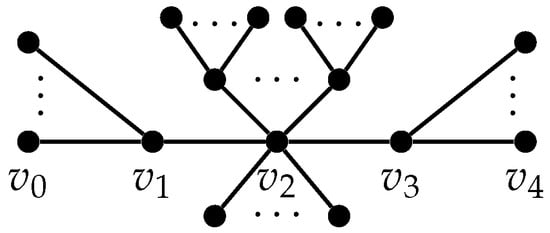
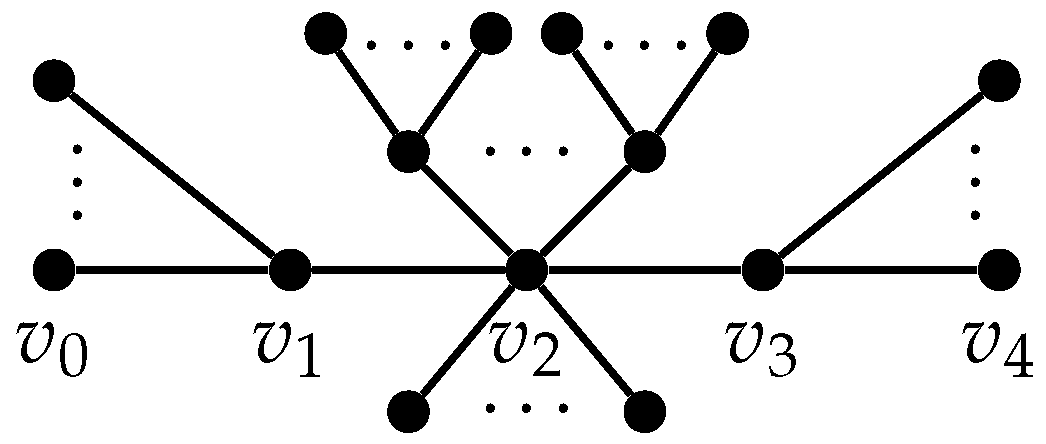
If , then is a spanning subgraph of (see Figure 1). Since is a -free bipartite graph, each vertex in is a pendant vertex in . It follows that has at least two cut vertices, which also contradicts Claim 1. Applying Claim 1 again yields , and, therefore, , as desired.
Figure 1.
Graph with labelled vertices and .
In the remainder of our proof, we need only consider and . We proceed by showing the following claims.
Claim 2.
and .
Proof of Claim 2.
Clearly, is -free. Hence, .
Suppose that . Since is a subgraph of , one has , a contradiction. Thus, and so .
Let . Since is -free, in the graph , there is no paths of length with both ends in . In view of Lemma 2, one has
Notice that . Together with (3), we obtain
It follows from that , that is, , as desired. □
With foresight, we define and as follows:
Define L to be the set of vertices whose weight is greater than , and let S be the set of vertices whose weight is no greater than , i.e.,
Define
Let u be in . Then, put
Claim 3.
and .
Proof of Claim 3.
For any vertex , based on Claim 2, one has
Summing the above inequalities for all , together with Lemma 5, gives us
Consequently, .
Similarly, if one replaces with throughout the deduction process as above, we may obtain the upper bound for , which is omitted. □
Claim 4.
for all and .
Proof of Claim 4.
Firstly, we show the first part by contradiction if there exists a vertex u in L satisfying . For convenience, assume . Based on Claim 2 and (4), one has
which implies that
Put . Next, we show the subsequent fact.
Fact 1.
There exist at least terms with in the sum Q.
Proof of Fact 1.
Suppose to the contrary that there are less than terms with in the sum Q. Therefore,
Notice that is an induced subgraph of and that there is no path of length in . By Lemma 4, one has . Together with (5) and , one has , i.e., , a contradiction.
We finish the proof of Fact 1. □
By Fact 1, one sees
Another fact should be considered. In graph , there is no path of length with both ends in . Based on Lemma 2, one has
Then, together with Claim 3, one has
it is equivalent to
which implies
That is,
Note that . By (8), we obtain
Consequently,
which contradicts our assumption. Thus, for each .
Now we show the second part of Claim 4. By Lemma 6, we obtain
Therefore,
The last inequality in (9) follows by . □
Indeed, we may refine the lower bound on the degree of vertices in L.
Claim 5.
for all u in L.
Proof of Claim 5.
We prove Claim 5 by contradiction. Suppose that there is a vertex such that . For convenience, put . Then, . In view of (4), one has
Notice that and do not contain with both ends in . Based on Lemma 2, we have
and
Consequently, by Claim 4 and the fact that , we get
that is,
which implies
Recall that . Hence,
which contradicts our assumption. □
Claim 6.
and .
Proof of Claim 6.
Let u be any vertex in . Based on Claim 5, one has
Suppose that . Then, . Recall that and , one has
which implies . This contradicts our assumption. Thereby, .
In view of Claim 2 and (10), we know , and, for every vertex z in , one has . Recall that . Hence, , as desired. □
Claim 7.
for all vertices .
Proof of Claim 7.
Notice that there does not exist a path of length in such that both ends of the path lie in . Based on Lemma 4 and Claim 4, we have
The last inequality in (11) follows by and . □
Claim 8.
and for all vertices . Moreover, .
Proof of Claim 8.
Let u be a vertex in . Suppose that . In view of Claim 6, one has . Notice that contains no path of length . Combining with Lemma 4 gives us
On the other hand, since , by Claims 2 and 5, one has
Consequently,
i.e., , this contradicts our choice for . Therefore, holds for each .
Since , by Claim 5, one has
as desired.
Now, we prove . If this is not true, then either , or . For the former, there is a vertex subset of satisfying . Note that, for each vertex x in , one has . Then there are at most vertices in Y each of which is not adjacent to some vertices in . Clearly, . Based on Claim 5, one sees
The last inequality in (13) follows by . That is to say, there is a vertex subset of Y such that , and each vertex in is adjacent to each one in . Therefore, is a subgraph of ; this is impossible.
In the remainder of our proof, we consider . Based on Claim 7 and (4), one has
Together with and , we get
which is impossible. Thus, .
We finish the proof of Claim 8. □
By Claim 8, the cardinality of equals k, and every vertex, say z, in satisfies . Thus, it follows that the cardinality of the common neighborhood of is at least . That is, at most vertices in Y are not adjacent to all of . Let
Clearly, . Furthermore,
and
The last inequality in (15) follows by
By (15), if one adds a new vertex and connects it with each vertex in by an edge, no cycle of length is created, otherwise such cycle already exists in .
Clearly, (14) tells us an upper bound on . In fact, we hope to show that . In order to obtain this fact, we need the following claim.
Claim 9.
for each u in .
Proof of Claim 9.
We prove Claim 9 by contradiction. That is, for some , happens, then together with Claim 2, one has , which implies . By Claim 8, . Define . One sees that is bipartite, and it is -free. Clearly, the order of is . Combining with Rayleigh quotient and Claim 8 yields
That is, , a contradiction to the choice of . □
Now we are ready to show R is an empty set.
Claim 10.
.
Proof of Claim 10.
We prove Claim 10 by reduction to absurdity. Suppose that . Choose a vertex . If , then . Otherwise, there exists a cycle in , which will not happen. Notice that for any vertex . Then,
Recall that . Together with Claim 9, one has
Now, we consider . Notice that u has at most neighbors in . Then,
It follows from Claim 9 that
Applying Lemma 1 and Claim 2, we get . We also notice that there does not exist a cycle in . Hence, Claim 2 implies
a contradiction. Thus, . □
By Claim 10, R is an empty set, and so . Together with Claim 8, we deduce . Therefore, we finish the proof for Theorem 1. □
4. Further Research Problems
In this contribution, our research concerns the spectral Turán-type problem of bipartite graphs. We show that the -free bipartite graph with sufficient large order having maximum spectral radius is .
Denote the family of -vertex bipartite graphs by , and let be the family of all bipartite graphs with two parts of sizes p and q, respectively. We propose two further research problems as follows.
Problem 2.
How can we characterize the -free bipartite graph among having the largest spectral radius?
Problem 3.
How can we characterize the -free bipartite graph among having the largest spectral radius?
Funding
This work is supported by the Science and Technology Research Project of Hubei Provincial Department of Education (Grant No. B2023493).
Data Availability Statement
No data is available during the current study.
Acknowledgments
We are very grateful to the anonymous referees for their thoughtful comments, suggestions, and constructive feedback on our manuscript.
Conflicts of Interest
The author declares no conflicts of interest.
References
- Füredi, Z.; Simonovits, M. The history of degenerate (bipartite) extremal graph problems. In Erdős Centennial. Bolyai Society Mathematical Studies; Lovász, L., Ruzsa, I.Z., Sós, V.T., Eds.; Springer: Berlin/Heidelberg, Germany, 2013; Volume 25, pp. 169–264. [Google Scholar]
- Turán, P. On an external problem in graph theory. Mat. Fiz. Lapok 1941, 48, 436–452. [Google Scholar]
- Erdős, P.; Simonovits, M. A limit theorem in graph theory. Stud. Sci. Math. Hung. 1966, 1, 51–57. [Google Scholar]
- Erdős, P.; Stone, A.H. On the structure of linear graphs. Bull. Am. Math. Soc. 1946, 52, 1087–1091. [Google Scholar] [CrossRef] [Scilit]
- Erdős, P.; Simonovits, M. Compactness results in extremal graph theory. Combinatorica 1982, 2, 275–288. [Google Scholar] [CrossRef] [Scilit]
- Keevash, P.; Sudakov, B.; Verstraëte, J. On a conjecture of Erdős and Simonovits: Even cycles. Combinatorica 2013, 33, 699–732. [Google Scholar] [CrossRef] [Scilit][Green Version]
- Kostochka, A.; Luo, R. On r-uniform hypergraphs with circumference less than r. Discret. Appl. Math. 2020, 276, 69–91. [Google Scholar]
- Kostochka, A.; Verstraëte, J. Even cycles in hypergraphs. J. Comb. Theory Ser. B 2005, 94, 173182. [Google Scholar] [CrossRef] [Scilit][Green Version]
- Desai, D.N. Spectral Turán problems for intersecting even cycles. arXiv 2023, arXiv:2303.15635v1. [Google Scholar]
- Desai, D.N.; Kang, L.Y.; Li, Y.T.; Ni, Z.Y.; Tait, M.; Wang, J. Spectral extremal graphs for intersecting cliques. Linear Algebra Appl. 2022, 644, 234–258. [Google Scholar] [CrossRef] [Scilit]
- Li, S.C.; Yu, Y.T. On Aα spectral extrema of graphs forbidding even cycles. Linear Algebra Appl. 2023, 668, 11–27. [Google Scholar] [CrossRef] [Scilit]
- Erdós, P.; Sárkxoxzy, A.; Sxoxs, V.T. On product representation of powers I. Eur. J. Comb. 1995, 16, 323–331. [Google Scholar] [CrossRef] [Scilit]
- Gyori, E. C6-free bipartite graphs and product representation of squares. Discret. Math. 1997, 165/166, 371–375. [Google Scholar] [CrossRef] [Scilit]
- Sárközy, C.N. Cycles in bipartite graphs and an application in number theory. J. Graph Theory 1995, 19, 323–331. [Google Scholar] [CrossRef] [Scilit]
- Nikiforov, V. The spectral radius of graphs without paths and cycles of specified length. Linear Algebra Appl. 2010, 432, 2243–2256. [Google Scholar] [CrossRef] [Scilit]
- Nikiforov, V. Bounds on graph eigenvalues II. Linear Algebra Appl. 2007, 427, 183–189. [Google Scholar] [CrossRef] [Scilit]
- Chen, M.-Z.; Liu, A.-M.; Zhang, X.-D. On the spectral radius of graphs without a star forest. Discret. Math. 2021, 344, 112269. [Google Scholar] [CrossRef] [Scilit]
- Cioabă, S.; Desai, D.N.; Tait, M. The spectral radius of graphs with no odd wheels. Eur. J. Comb. 2022, 99, 103420. [Google Scholar] [CrossRef] [Scilit]
- Cioabă, S.; Feng, L.H.; Tait, M.; Zhang, X.-D. The maximum spectral radius of graphs without friendship subgraphs. Electron. J. Comb. 2020, 27, 4.22. [Google Scholar] [CrossRef] [Scilit]
- Nikiforov, V. A spectral condition for odd cycles in graphs. Linear Algebra Appl. 2008, 428, 1492–1498. [Google Scholar] [CrossRef] [Scilit]
- Shi, L.S.; Song, Z.P. Upper bounds on the spectral radius of book-free and/or K2,l-free graphs. Linear Algebra Appl. 2007, 420, 526–529. [Google Scholar] [CrossRef] [Scilit]
- Cioabă, S.; Desai, D.N.; Tait, M. The spectral even cycle problem. arXiv 2022, arXiv:2205.00990v1. [Google Scholar]
- Conejero, J.A.; Falcó, A.; Mora-Jiménez, M. On the tensor approximation of Watts–Strogatz Networks. Unif. Distrib. Theory 2026, 21, 10–25. [Google Scholar] [CrossRef] [Scilit]
- Jin, F.; Wang, F.; Zhao, K.; Chen, H.; Guirao, J.L.G. The method of judging satisfactory consistency of linguistic judgment matrix based on adjacency matrix and 3-loop matrix. AIMS Math. 2024, 9, 18944–18967. [Google Scholar] [CrossRef] [Scilit]
- Moniri, M. Ramsey–Collatz Correlation and Some Extremal Combinatorics, along with Ramsey–Mahler Rare Concurrencies. Unif. Distrib. Theory 2025, 20, 90–143. [Google Scholar] [CrossRef] [Scilit]
- Gyárfxaxs, A.; Rousseau, C.C.; Schelp, R.H. An extremal problem for paths in bipartite graphs. J. Graph Theory 1984, 8, 83–95. [Google Scholar] [CrossRef] [Scilit]
- Naor, A.; Verstraëte, J. A note on bipartite graphs without 2k-cycles. Comb. Probab. Comput. 2005, 14, 845–849. [Google Scholar] [CrossRef] [Scilit]
- Cvetković, D.; Rowlinson, P.; Simić, S.K. An Introduction to the Theory of Graph Spectra; Cambridge University Press: Cambridge, UK, 2010. [Google Scholar]
Disclaimer/Publisher’s Note: The statements, opinions and data contained in all publications are solely those of the individual author(s) and contributor(s) and not of MDPI and/or the editor(s). MDPI and/or the editor(s) disclaim responsibility for any injury to people or property resulting from any ideas, methods, instructions or products referred to in the content. |
© 2026 by the author. Licensee MDPI, Basel, Switzerland. This article is an open access article distributed under the terms and conditions of the Creative Commons Attribution (CC BY) license.