


Abstract
The increasing generation of spent Ni-rich layered cathodes creates an urgent demand for efficient lithium recovery and value-added reutilisation of transition-metal components. An MnSO4·H2O-assisted rapid thermal reconstruction route coupled with water leaching was developed for selective lithium recovery from spent NCM811 cathodes. At an MnSO4·H2O-to-NCM811 mass ratio of 0.9:1, an applied current of 30 A, and a treatment duration of 20 s, the layered structure was converted into water-soluble lithium sulfates and transition-metal-rich oxides. Water leaching at 20 °C for 20 min achieved a stage lithium-leaching recovery of 99.12%, with limited dissolution of Ni, Co, and Mn. The combined aqueous stream contained 0.42 g L−1 Li. After concentration and CO2 carbonation, Li2CO3 was obtained with a precipitation efficiency of 90.6% and a purity of 99.52 wt.%, corresponding to an overall lithium recovery of 88.7%. Elemental-balance closures were 98.6–99.6% for Li, Ni, Co, Mn, and S. The regenerated cathode LiNi0.54Co0.07Mn0.39O2 delivered 95.2 mAh g−1 after 150 cycles at 0.2 C. These results demonstrate integrated lithium recovery and transition-metal reutilisation from spent Ni-rich cathodes.
1. Introduction
Lithium-ion batteries serve as core energy storage devices for new energy vehicles, large-scale energy storage and 3C electronics [1,2]. Industry projections indicate global lithium-ion battery demand will exceed 2800 GWh by 2030 and surpass 9000 GWh by 2050 [3]. Ternary Ni-Co-Mn cathodes have been widely commercialized due to high energy density [4]. The consumption of strategic metals, including Li, Ni, Co, and Mn, continues to increase, whereas primary mineral reserves are limited and their extraction is associated with considerable environmental impacts [5,6]. The typical service life of commercial power batteries is approximately 5–8 years, and a large number of batteries deployed during the early expansion of the electric-vehicle industry are now approaching end of life [7]. Simple disposal such as landfilling or incineration leads to permanent loss of scarce Li, Ni and Co, and leakage of electrolyte and heavy metals causes long-term soil and water pollution [8,9]. Meanwhile, black mass from spent lithium-ion batteries acts as high-grade urban mines with much higher valuable metal contents than natural ores [5,10,11]. Under the imbalance of metal supply and demand as well as dual-carbon restrictions, efficient recovery of waste cathode materials is an essential way to stabilize the new energy industrial chain.
At present, mainstream recycling technologies for spent ternary lithium-ion batteries are divided into pyrometallurgy and hydrometallurgy [9,12]. Conventional pyrometallurgy adopts smelting above 1200 °C and omits complicated pretreatment like disassembly and crushing [13,14,15]. However, in conventional alloy-producing smelting routes, lithium is commonly transferred to the slag or volatilized into the flue dust, resulting in relatively low direct lithium recovery [16,17]. This technology also consumes massive fuel and generates fluorine-containing toxic waste gas with high tail gas treatment costs [18,19]. As a mature industrial route, hydrometallurgy separates metals via acid-base leaching and solvent extraction [20,21]. Its Ni and Co recovery rates reach 99.2%, and the total recovery rate of all metals exceeds 95% [3]. The energy consumption stands at only 1.8–2.3 kWh per kilogram, one quarter of that of pyrometallurgy [22,23,24,25]. Nevertheless, hydrometallurgy features lengthy procedures and massive consumption of acids, alkalis and extractants, producing large amounts of saline wastewater and hazardous solid waste with poor environmental friendliness [22,26,27,28]. The inherent drawbacks of the two methods restrict large-scale closed-loop recycling, so mild, short-flow and low-energy recycling strategies are urgently required.
To address the limitations of conventional recycling technologies, this work develops an MnSO4-assisted rapid thermal reconstruction route for the selective recovery of lithium from spent NCM811 cathode materials. The effects of the MnSO4·H2O addition ratio, applied current, and treatment duration on phase evolution are systematically investigated. The reconstructed products are subsequently treated by water leaching, and the effects of leaching temperature, duration, and solid loading on lithium recovery and transition-metal dissolution are evaluated. In addition, the lithium-rich leachate and transition-metal-rich residue are further utilized for Li2CO3 recovery and cathode regeneration, respectively. This study provides an experimental basis for integrating selective lithium separation with the reutilization of Ni, Co, and Mn components.
2. Experimental Procedure
2.1. Chemicals and Materials
The as-received spent NCM811 cathode powder was supplied by a battery-recycling enterprise in Hebei Province, China. The powder contained NCM811 active material together with heterogeneously distributed residual graphite and polymeric binder originating from the industrial electrode-separation process. MnSO4·H2O, anhydrous NiSO4, and all other chemical reagents were of analytical grade and purchased from Aladdin Biochemical Technology Co., Ltd. (Shanghai, China). Deionized water was used throughout the experiments.
The bulk elemental composition of the as-received spent NCM811 cathode powder was determined by complete digestion followed by ICP-OES analysis. The contents of Li, Ni, Co and Mn were 7.30, 48.90, 6.88 and 3.29 wt.%, respectively.
2.2. Experimental Methods
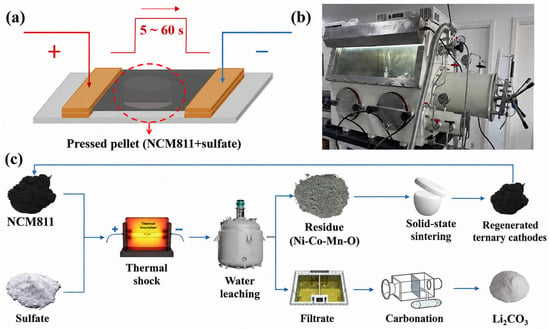
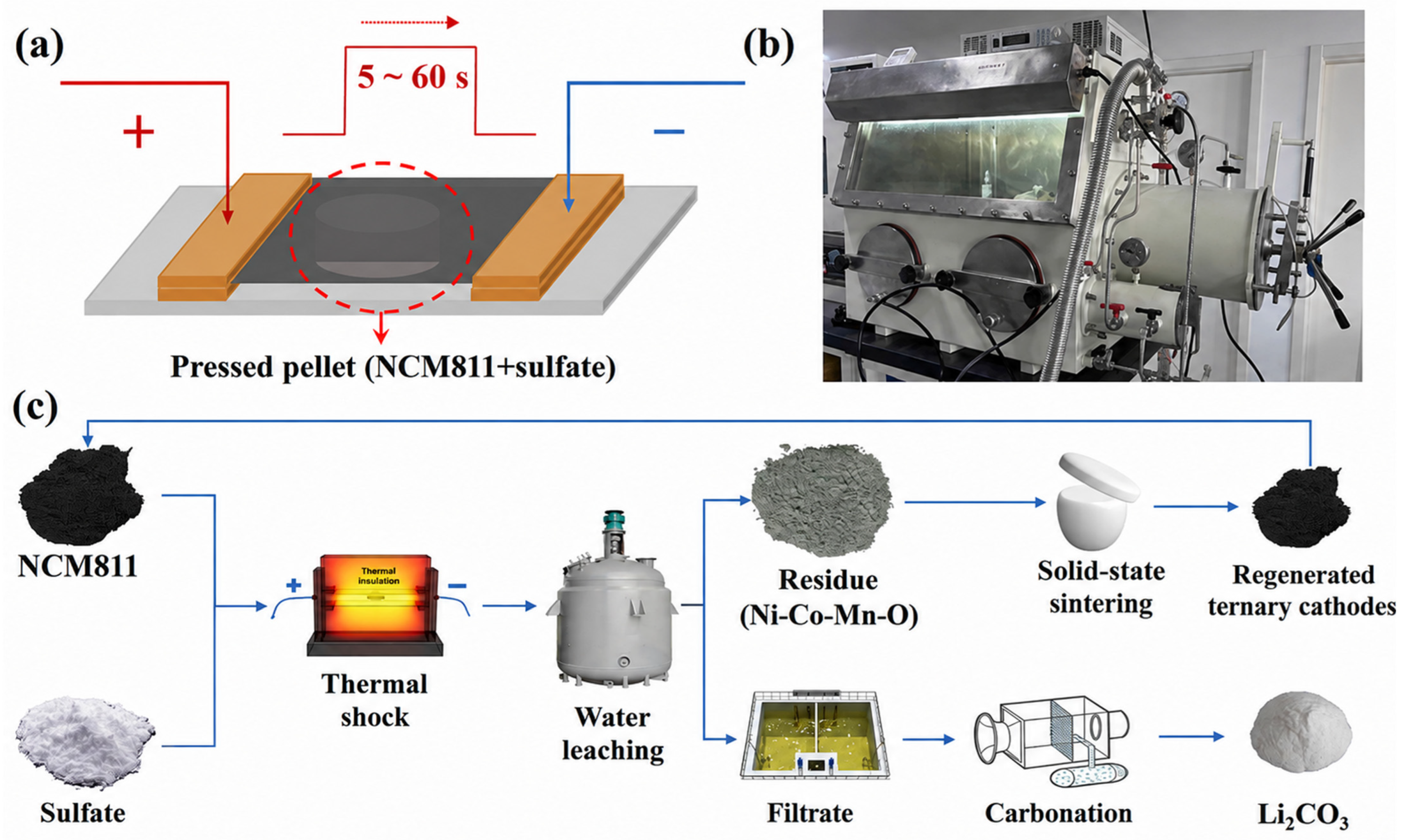
As illustrated in Figure 1, the as-received NCM811 powder was mixed with the selected sulfate at prescribed mass ratios, thoroughly ground, and compacted into pellets. Each pellet was placed between two graphite-felt strips with dimensions of 6.0 cm × 1.5 cm × 3 mm. The two ends of the graphite felts were connected to a direct-current power supply using copper clamps, forming a Joule-heating platform, as shown in Figure 1a. The assembled device was transferred into a glove box and purged three times with high-purity Ar to establish an inert atmosphere. The transient heating intensity and treatment duration were controlled by adjusting the applied current and energization time, respectively. The treatment duration was varied from 5 to 60 s.
Figure 1.
(a) Schematic diagram of rapid thermal reconstruction reaction device; (b) digital photograph of glove box equipped with rapid thermal reconstruction platform; (c) overall technological flow chart of sulfate-assisted rapid thermal reconstruction recycling process.
After rapid thermal reconstruction, the entire product obtained from each run was quantitatively transferred, ground, and subjected to water leaching in a covered glass beaker containing 50.0 mL of deionised water. The suspension was agitated at 800 rpm using an intelligent magnetic stirrer equipped with a polytetrafluoroethylene-coated magnetic stirring bar (Beijing Xingde Jingyi Laboratory Instrument Co., Ltd., Beijing, China). The glass beaker was covered with a watch glass during leaching but was not hermetically sealed.
The leaching temperature was varied from 20 to 100 °C at intervals of 10 °C, the leaching duration was varied from 5 to 25 min at intervals of 5 min, and the solid loading was varied among 1.25, 2.5, 5.0, 7.5, 10.0, 12.5, 15.0, 17.5, and 20.0 g L−1. Unless otherwise specified, the leaching experiments were conducted at 20 °C for 20 min with a solid loading of 17.5 g L−1.
The mass of the covered leaching vessel and its contents was recorded before and immediately after each experiment. After leaching, the suspension was cooled to room temperature, and the final liquid volume was measured. The evaporation loss was 0.28% under the preferred leaching conditions and increased to 4.83% at 100 °C. The measured final liquid volume, rather than the nominal initial volume of 50.0 mL, was used in all recovery calculations. The suspension was vacuum-filtered using an SHZ-DIII circulating-water vacuum pump (Gongyi Yuhua Instrument Co., Ltd., Gongyi, China) and a 0.45 μm polyethersulfone membrane. The solid residue was washed three times using 10.0 mL of deionised water in each washing step. The primary leachate, the three residue-washing solutions, and a final 5.0 mL equipment-rinsing solution were collected and analysed separately. The washed residue was dried at 45 °C for 24 h and weighed before further characterisation.
All leaching experiments were independently performed in triplicate. The numerical values reported in the main text and tables represent the arithmetic means of three independent experiments. Where applicable, the corresponding standard deviations are presented as error bars in the figures. The stage leaching recovery or dissolution loss of element i was calculated using Equation (1):
where Ri,stage is the stage leaching recovery or dissolution loss of element i; Ci,L and VL are the concentration of element i and the measured volume of the primary leachate, respectively; Ci,w,j and Vw,j are the concentration of element i and the volume of the jth residue-washing solution, respectively; Ci,R,k and VR,k are the concentration of element i and the volume of the kth equipment-rinsing solution, respectively; and Mi,RP is the mass of element i initially contained in the reconstructed product, as determined by complete digestion followed by ICP-OES analysis.
The stage lithium-leaching recovery therefore represents the proportion of lithium transferred from the reconstructed product into the combined primary leachate, residue-washing solutions, and equipment-rinsing solution. It should not be interpreted as the overall recovery of lithium from the initial spent NCM811 powder to the final Li2CO3 product.
To recover Li2CO3, the combined primary leachate, residue-washing solutions, and equipment-rinsing solution, containing 0.42 g L−1 Li, were concentrated under reduced pressure until the Li concentration reached 4.20 g L−1. The concentrated solution was transferred into a thermostatically controlled glass reactor and maintained at 25 °C. Its initial pH was adjusted to 12.80 using 2.0 mol L−1 NaOH.
Carbon dioxide was introduced at a flow rate of 250 mL min−1 for 40 min under continuous magnetic stirring at 500 rpm. Carbonation was terminated when the solution pH decreased to 10.80. The resulting suspension was aged for 45 min and subsequently filtered through a 0.45 μm polyethersulfone membrane.
The precipitate was washed twice using 10.0 mL of cold Li2CO3-saturated water in each washing step and was then dried at 90 °C for 12 h. The precipitation mother liquor and all product-washing solutions were collected separately and analysed by ICP-OES and ion chromatography.
The lithium precipitation efficiency was calculated using Equation (2):
where PLi is the lithium precipitation efficiency; mLi, product is the mass of lithium contained in the recovered Li2CO3 product; and mLi, precipitation-feed is the total mass of lithium entering the precipitation stage.
The overall lithium recovery was calculated using Equation (3):
where RLi, overall is the overall lithium recovery from the initial spent NCM811 powder to the final Li2CO3 product, and mLi, initial-feed is the mass of lithium initially contained in the as-received spent NCM811 powder. For cathode resynthesis, the transition-metal-rich leaching residue was completely digested and analysed by ICP-OES before relithiation. The measured Ni:Co:Mn molar ratio of the residue was 0.55:0.07:0.38. The residue was mixed with Li2CO3 at a nominal Li-to-total-transition-metal molar ratio of 1.05:1. Anhydrous ethanol was added at a liquid-to-solid mass ratio of 2:1, and zirconia milling balls were introduced at a ball-to-powder mass ratio of 20:1. The mixture was ball-milled at 400 rpm for 12 h, dried at 70 °C for 24 h, and passed through a 400-mesh sieve. The homogenised powder was placed in a muffle furnace (SGM-M30/16, Sigma (Shanghai) High Temperature Electric Furnace Co., Ltd., Shanghai, China), preheated at 400 °C for 2 h, and subsequently calcined at 800 °C for 8, 12, or 16 h at a heating rate of 5 °C min−1. The material calcined at 800 °C for 16 h was selected for subsequent electrochemical characterisation. The final Li, Ni, Co, and Mn contents of the resynthesised cathode were determined by complete digestion followed by ICP-OES. The measured Li-to-total-transition-metal molar ratio was 1.00, and the Ni:Co:Mn molar ratio was 0.54:0.07:0.39. Accordingly, the regenerated cathode was designated as LiNi0.54Co0.07Mn0.39O2 (Figure 1c).
2.3. Process-Stream Sampling and Elemental Mass-Balance Calculations
A process-wide elemental balance was established for Li, Ni, Co, Mn, and S. The balance was normalised to 100 g of as-received spent NCM811 cathode powder and 90 g of MnSO4·H2O, corresponding to the selected MnSO4·H2O-to-NCM811 mass ratio of 0.9:1.
The input masses of Li, Ni, Co, and Mn from the spent NCM811 powder were 7.30, 48.90, 6.88, and 3.29 g, respectively. The addition of 90 g of MnSO4·H2O introduced an additional 29.25 g of Mn and 17.07 g of S.
The following process streams were independently collected and analysed: The reconstructed product, material remaining on the graphite felt and transfer tools, primary leachate, residue-washing solutions, equipment-rinsing solution, water-leaching residue, concentrated lithium solution, Li2CO3 product, precipitation mother liquor, Li2CO3 washing solutions, and resynthesised cathode material.
The mass of element i in each solid stream was calculated using Equation (4):
where mi,s is the mass of element i in solid stream s; ms is the dry mass of solid stream s; and wi,s is the measured mass fraction of element i in solid stream s.
The mass of element i in each liquid stream was calculated using Equation (5):
where mi,l is the mass of element i in liquid stream l; Ci,l is its measured concentration; and Vl is the measured final volume of the liquid stream.
The elemental-balance closure was calculated using Equation (6):
where Bi is the balance closure of element i; mi,input is the total input mass of element i; Σs mi,s is its total measured mass in all solid output streams; and Σl mi,l is its total measured mass in all liquid output streams.
The apparent unaccounted fraction was calculated using Equation (7):
where Ui is the apparent unaccounted fraction of element i, arising from incomplete material transfer, volatilisation, sampling losses, or analytical uncertainty.
The specific MnSO4·H2O dosage was calculated using Equation (8):
To quantify sulfur released during rapid thermal treatment, the outlet gas was passed successively through two absorption bottles containing 0.2 mol L−1 NaOH and 2 wt.% H2O2. Sulfur in the absorption solutions was oxidised to sulfate and quantified by ion chromatography.
All material-balance experiments were independently performed three times. The numerical values reported in the main text and tables represent the arithmetic means of the independent experiments.
2.4. Characterization
X-ray diffraction (XRD; SmartLab 9 kW, Rigaku Corporation, Tokyo, Japan) with Cu Kα radiation was used to identify the crystalline phases. The diffraction patterns were collected over a 2θ range of 5–90° at a scanning rate of 20° min−1. Thermogravimetric and differential thermogravimetric analyses were performed using a SETARAM LABSYS EVO instrument (SETARAM Instrumentation, Caluire, France). Approximately 10.2 mg of powder was placed in an open alumina crucible and heated from room temperature to 1000 °C at 10 °C min−1 under high-purity Ar flowing at 80 mL min−1. An empty-crucible baseline was recorded under identical conditions and subtracted from the sample curve. Fourier-transform infrared spectroscopy (FTIR, Bruker T27, Bruker Optik GmbH, Ettlingen, Germany) was used to characterize the surface functional groups. The morphologies and elemental distributions of the samples were examined by scanning electron microscopy coupled with energy-dispersive X-ray spectroscopy (SEM-EDS, JEOL JSM-7800 Prime, JEOL Ltd., Akishima, Japan equipped with an Oxford EDS detector, Oxford Instruments plc, High Wycombe, UK). The concentrations of metal ions in the leachates were determined by inductively coupled plasma optical emission spectroscopy (ICP-OES, PerkinElmer Avio 200, PerkinElmer, Inc., Shelton, CT, USA).
2.5. Electrochemical Performance Test
The cathode slurry was prepared by mixing the resynthesised active material, acetylene black and poly (vinylidene fluoride) at a mass ratio of 8:1:1 using N-methyl-2-pyrrolidone as the solvent. The slurry was uniformly coated onto Al foil and vacuum-dried at 100 °C for 10–12 h. CR2032 coin-type half-cells were assembled in an Ar-filled glove box using Li metal as the counter electrode and 1 M LiPF6 dissolved in a mixture of ethylene carbonate and diethyl carbonate (1:1 by volume) as the electrolyte.
The assembled CR2032 coin cells were rested for 24 h before electrochemical testing. Galvanostatic charge–discharge measurements were performed at 25 °C using a LAND CT2001A battery-testing system over a voltage range of 2.8–4.3 V versus Li/Li+. Electrochemical impedance spectroscopy was conducted using a CHI660 electrochemical workstation at the open-circuit voltage with a perturbation amplitude of 5 mV over a frequency range of 105–0.01 Hz. For qualitative comparison, electrochemical impedance spectroscopy was also performed on the as-received NCM811 cathode using the same electrode-fabrication, cell-assembly, and testing procedures. At least three independently assembled CR2032 cells containing the regenerated cathode material were tested. The numerical values reported in the main text represent the arithmetic means of the independently tested cells. Electrochemical impedance spectra were fitted using the same equivalent circuit, and the quality of each fit was evaluated using the corresponding chi-squared value.
3. Results and Discussion
3.1. Raw Material Characterization and Principle of Rapid Thermal Reconstruction
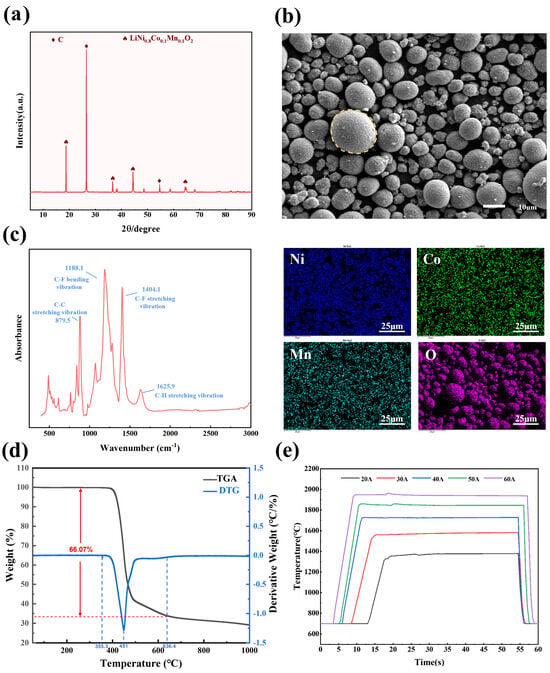
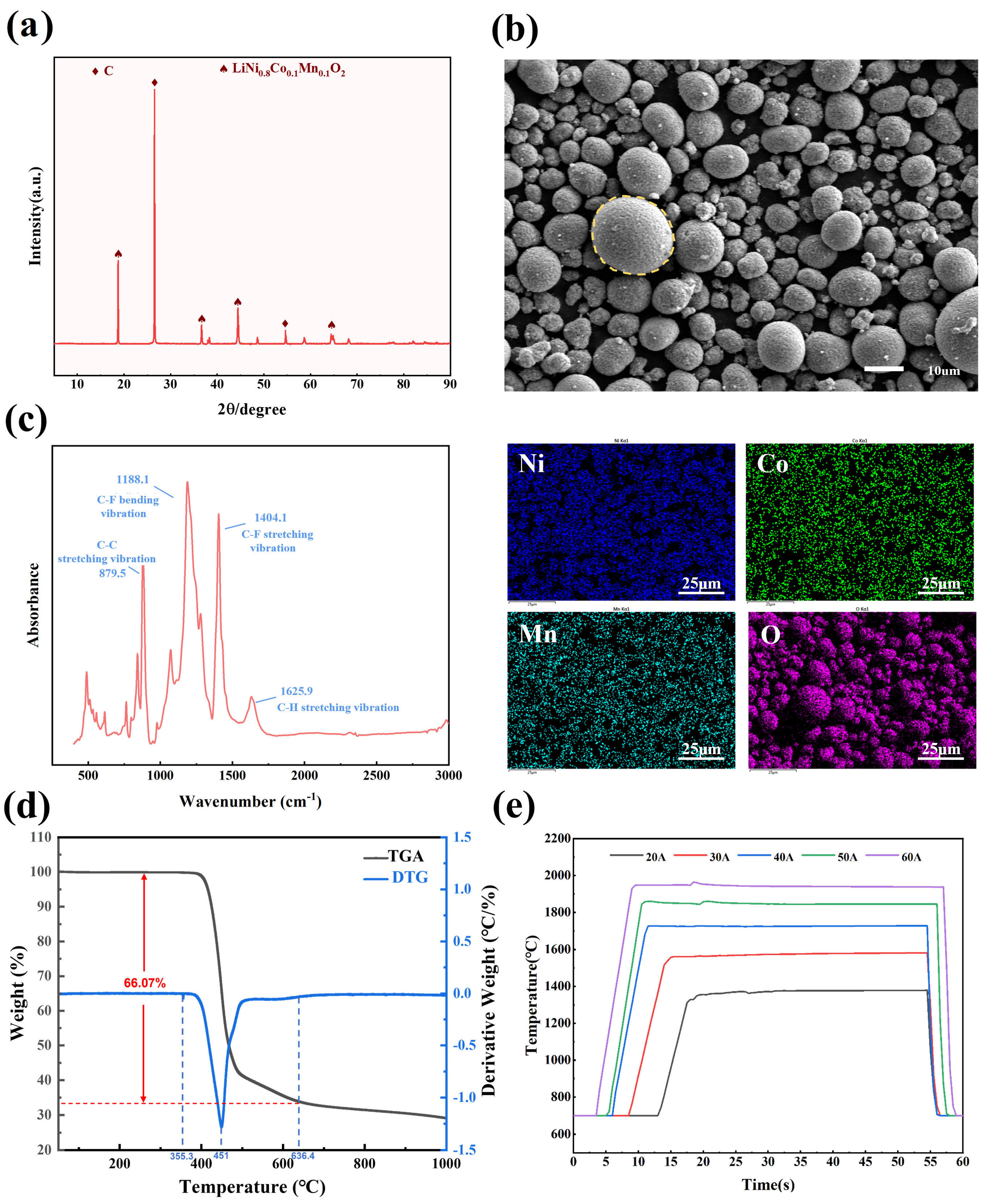
The as-received spent NCM811 cathode powder was characterized by XRD, SEM-EDS, FTIR, and TG-DTG, as shown in Figure 2a–d). The XRD pattern in Figure 2a shows that the major diffraction peaks can be assigned to the layered NCM811 phase, indicating that the bulk layered structure is largely retained after battery service. Weak graphite-related reflections are also observed, which are attributed to incomplete separation of the cathode and anode components during industrial pretreatment. The SEM image in Figure 2b shows spherical secondary particles with a broad particle-size distribution. The EDS maps indicate relatively homogeneous distributions of Ni, Co, Mn, and O within the examined region. The FTIR spectrum in Figure 2c contains bands associated with C-C, C-F, and C-H vibrations, suggesting the presence of residual carbonaceous species and PVDF binder.
Figure 2.
(a) XRD pattern of the as-received spent NCM811 cathode powder; (b) SEM-EDS mapping of spent NCM811 cathode material; (c) FTIR spectrum of spent NCM811 cathode material; (d) TG-DTG curves of spent NCM811 cathode material; (e) temperature of double-layer carbon felt over time.
The TG-DTG curve in Figure 2d exhibits a pronounced mass loss during heating. The pronounced mass loss is attributed to the combined contributions of residual graphite, polymeric binder, electrolyte-derived species, and oxygen release from the layered oxide. The weak graphite-related reflections in Figure 2a, together with the C-C, C-F, and C-H vibration bands in Figure 2c, support the presence of residual carbonaceous components resulting from incomplete separation of the cathode and anode materials.
Because the as-received material was obtained from an industrial electrode-separation process and contained residual graphite, the TG curve represents the thermal behaviour of a mixed cathode powder rather than that of pure NCM811. The relatively large mass loss may also be associated with the heterogeneous distribution and local enrichment of graphite in the small powder aliquot used for TG analysis. During heating, residual carbon may react with oxygen released from the layered oxide, further contributing to the observed mass decrease.
A sulfate-assisted transient high-temperature rapid thermal reconstruction process was established to realize efficient phase reconstruction of spent NCM811, as well as selective lithium leaching and green regeneration of ternary oxide precursors. Different from the conventional slow resistive heating of tube furnaces, the instantaneous temperature and thermal holding behaviour of the carbon felt platform can be precisely regulated by adjusting pulse current intensity and energization duration [27,29,30]. At an applied current of 30 A, the temperature of the graphite-felt heating region increases from approximately 25 °C to nearly 1600 °C within 10 s, corresponding to an average heating rate of approximately 9.5 × 10³ °C min−1 (Figure 2e). This rate is approximately 500–1900 times higher than the typical heating rates of 5–20 °C min−1 used in conventional tube furnaces. The short high-temperature exposure may limit long-range solid-state diffusion and reduce the duration available for metal volatilization. Meanwhile, the transient thermal field promotes rapid structural collapse and phase reconstruction of the layered cathode material. After the power is switched off, the heating region cools rapidly, favoring the preservation of metastable or fine-grained reconstructed phases. The demonstrated advantage of pulsed Joule heating lies primarily in its rapid and controllable thermal input. The graphite-felt heater was powered by a RU-36-6060 direct-current power supply and operated in an Ar-filled MT-STX2 glove box. The temperature of the central heating region was monitored using an infrared thermometer with an accuracy of ±1.5%. At 30 A, the heating region reached approximately 1600 °C within 10 s, enabling the major phase reconstruction to be completed within 20 s. This short high-temperature exposure is substantially shorter than the heating and holding periods generally required for conventional furnace treatment. Because the specific electrical energy consumption was not measured in the original experiments, the present study does not claim a quantitative energy advantage over conventional heating.
The intrinsic properties of raw materials and the ultra-fast thermal regulation mechanism jointly build a unique reaction system, which facilitates the structural modification and component transformation of cathode materials. On the basis of the above fundamental characteristics and process mechanisms, the structural and phase evolution behaviours of cathode materials during thermal treatment can be systematically explored.
3.2. MnSO4-Assisted Rapid Thermal Reconstruction and Phase Evolution of the Cathode Material
XRD was used to determine how the sulfate reagent and transient thermal conditions governed the phase reconstruction of spent NCM811. MnSO4·H2O was mechanically mixed with the spent cathode powder as a solid reconstruction reagent before Joule heating. No aqueous sulfate medium was present during rapid thermal treatment. Water was introduced only after thermal reconstruction to selectively dissolve the newly formed lithium-bearing sulfate phases. Therefore, the proposed route consists of a solid-state sulfate-assisted phase-reconstruction step followed by an aqueous water-leaching step, rather than thermal treatment in an aqueous sulfate solution.
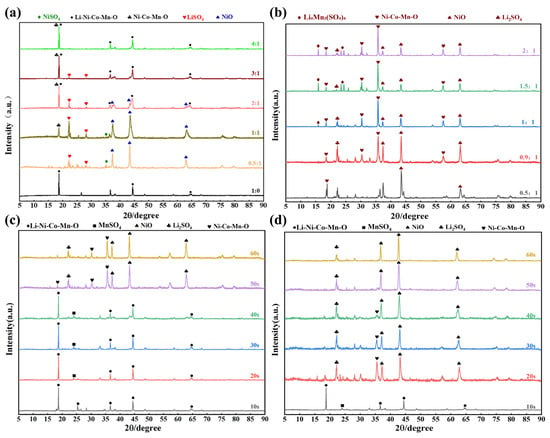
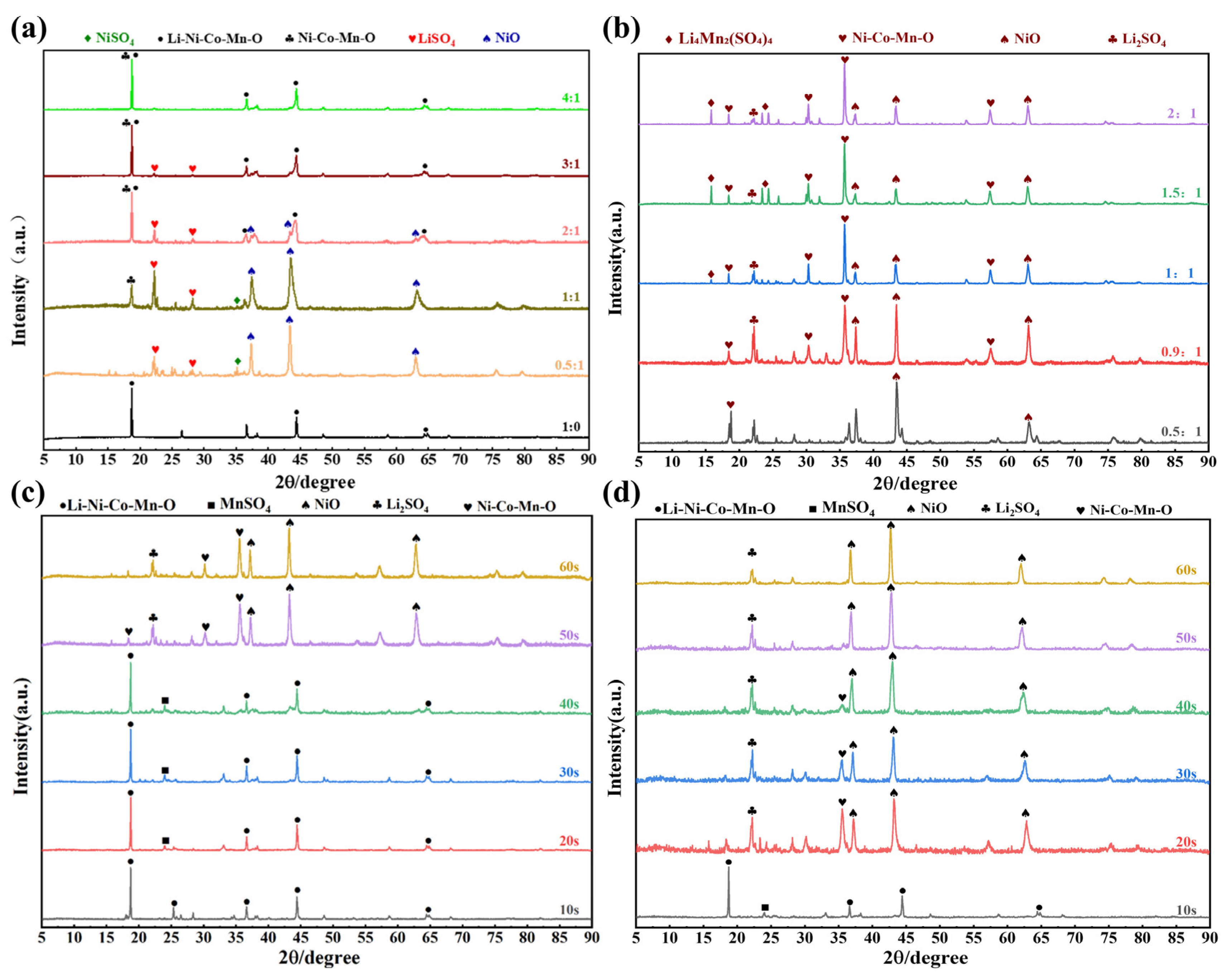
NiSO4 and MnSO4·H2O were selected for comparative experiments because both reagents contain transition-metal elements already present in ternary cathode materials and therefore avoid the introduction of difficult-to-remove foreign elements. Figure 3a presents the XRD patterns of NCM811 treated with different amounts of NiSO4. At a NiSO4-to-NCM811 mass ratio of 0.5:1, distinct reflections of residual layered NCM811 remained, indicating that the sulfate addition was insufficient for complete reconstruction. When the NiSO4-to-NCM811 mass ratio was increased to 1:1, the layered NCM811 reflections disappeared, while residual NiSO4, Li2SO4, NiO, and Ni-Co-Mn-O composite oxides were detected. The residual NiSO4 reflections indicate excessive reagent addition.
Figure 3.
XRD patterns showing phase evolution during sulfate-assisted rapid thermal reconstruction: (a) NCM811 mixed with NiSO4 at different mass ratios; (b) NCM811 mixed with MnSO4·H2O at different mass ratios; (c) NCM811/MnSO4·H2O mixtures treated at 20 A for different durations; and (d) NCM811/MnSO4·H2O mixtures treated at 30 A for different durations.
A quantitative comparison was subsequently conducted under the respective preferred conditions for the two sulfate reagents. The stage lithium recoveries (Table 1). obtained using MnSO4·H2O and NiSO4 were 99.12% and 98.54%, respectively. For the MnSO4-assisted system, the dissolution losses of Ni, Co, and Mn were 0.56%, 0.29%, and 2.85%, respectively. For the NiSO4-assisted system, the corresponding dissolution losses were 1.18%, 0.31%, and 0.48%, respectively. Although NiSO4 also achieved a high lithium recovery, it introduced additional Ni into the solid residue and shifted the Ni:Co:Mn ratio away from that required for controlled cathode resynthesis.
Table 1.
Quantitative comparison of sulfate reagents under the selected rapid thermal reconstruction conditions.
CoSO4 was not included in the experimental comparison because its addition would similarly alter the Co fraction of the transition-metal-rich residue. Moreover, the use of a cobalt-containing reagent is less favourable in terms of reagent cost and critical-metal conservation. Since the purpose of the reconstruction reagent was to promote lithium sulfation while enabling reutilisation of the remaining transition-metal components, MnSO4·H2O was considered more compatible with the subsequent cathode-resynthesis process. Nevertheless, the absence of a direct CoSO4 comparison is recognised as a limitation of the present study.
Figure 3b shows the XRD patterns of the products obtained at different MnSO4·H2O-to-NCM811 mass ratios. At a ratio of 0.5:1, the major reconstructed phases were Li2SO4, NiO, and Ni-Co-Mn-O composite oxides, but the stage lithium recovery was only 91.84%, indicating incomplete conversion of lithium into water-soluble sulfate phases. Increasing the mass ratio to 0.7:1 increased the lithium recovery to 97.26%. At a ratio of 0.9:1, no detectable layered NCM811 reflections remained, and the lithium recovery reached 99.12%.
Further increasing the MnSO4·H2O-to-NCM811 mass ratio to 1.0:1, 1.5:1, and 2.0:1 resulted in lithium recoveries of 99.20%, 99.28%, and 99.31%, respectively (Table 2). However, the corresponding manganese dissolution losses increased from 2.85% at 0.9:1 to 3.35%, 5.25%, and 7.40%, respectively. The corresponding specific MnSO4·H2O dosages were 7.46, 9.86, 12.44, 13.81, 20.70, and 27.59 g of MnSO4·H2O per gram of recovered Li at mass ratios of 0.5:1, 0.7:1, 0.9:1, 1.0:1, 1.5:1, and 2.0:1, respectively. Thus, increasing the mass ratio above 0.9:1 markedly increased reagent consumption while producing only a marginal improvement in lithium recovery.
Table 2.
Effect of the MnSO4·H2O-to-NCM811 mass ratio on lithium recovery, manganese dissolution, and specific reagent dosage.
The increased manganese dissolution at high MnSO4·H2O additions was consistent with the progressive appearance of Li4Mn2(SO4)4 reflections. Although Li4Mn2(SO4)4 is water-soluble and does not substantially reduce lithium extraction, its formation transfers additional Mn into the leachate and increases sulfate consumption. Therefore, an MnSO4·H2O-to-NCM811 mass ratio of 0.9:1 was selected because it provided a favourable compromise among lithium recovery, complete reconstruction of the layered cathode, manganese retention, and specific reagent consumption.
At a fixed applied current of 20 A, the effect of treatment duration on phase evolution is shown in Figure 3c. Short treatment durations provide insufficient thermal input to disrupt the layered NCM811 structure. After 40 s, the characteristic reflections of layered NCM811 are no longer detectable, and the dominant crystalline products are assigned to Li2SO4, NiO and Ni-Co-Mn-O composite oxides. Thus, a longer treatment duration is required to achieve comparable phase reconstruction at 20 A.
XRD patterns of the samples treated at 30 A for different durations are shown in Figure 3d. The higher current provides a greater transient thermal input, thereby accelerating the collapse and phase reconstruction of the layered NCM811 structure. After 20 s of treatment, the characteristic diffraction peaks of layered NCM811 are no longer detectable, while Ni-Co-Mn-O spinel-type composite oxides and NiO become the dominant crystalline phases. Compared with the treatment at 20 A, the application of 30 A substantially reduces the time required for phase reconstruction.
These results demonstrate that the sulfate reagent, reagent addition, applied current, and treatment duration jointly determine the extent of layered-structure collapse and the phase assemblage of the reconstructed products. MnSO4·H2O provided a slightly higher lithium recovery than NiSO4 and avoided the excessive introduction of Ni or Co into the transition-metal-rich residue. An MnSO4·H2O-to-NCM811 mass ratio of 0.9:1 was selected because further reagent addition produced only a marginal increase in lithium recovery but substantially increased manganese dissolution and specific reagent consumption. Accordingly, the preferred reconstruction conditions were an MnSO4·H2O-to-NCM811 mass ratio of 0.9:1, an applied current of 30 A, and a treatment duration of 20 s. Under these conditions, lithium was predominantly converted into water-soluble sulfate phases, whereas Ni, Co, and most of the Mn remained in transition-metal-rich oxide phases.
3.3. Optimization of Water Leaching Parameters and Selective Separation of Lithium
Cathode materials subjected to rapid thermal reconstruction exhibit distinctly different dissolution behaviours in water. The reconstructed products contain water-soluble lithium-bearing sulfate phases, including Li2SO4 and Li4Mn2(SO4)4, together with water-insoluble transition-metal-rich oxide phases, such as Ni-Co-Mn-O spinel-type composite oxides. The marked difference in water solubility between these phases provides the physicochemical basis for selective lithium separation using water as the leaching agent. Accordingly, the effects of leaching temperature, leaching duration, and solid loading on lithium recovery and the dissolution losses of Ni and Co were systematically investigated.
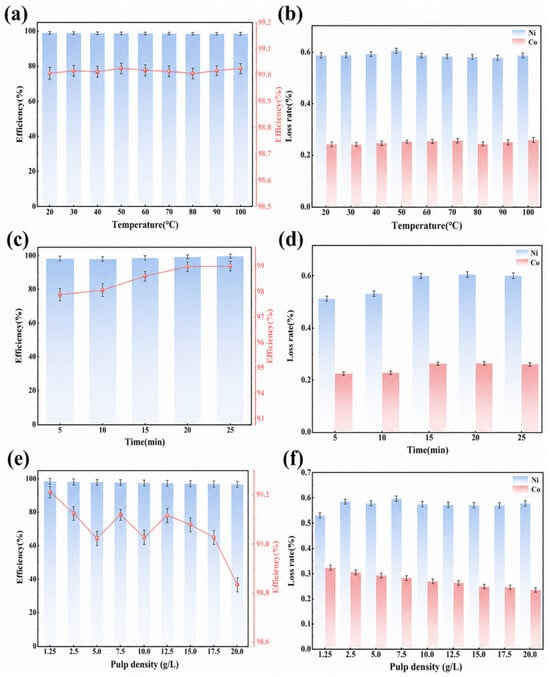
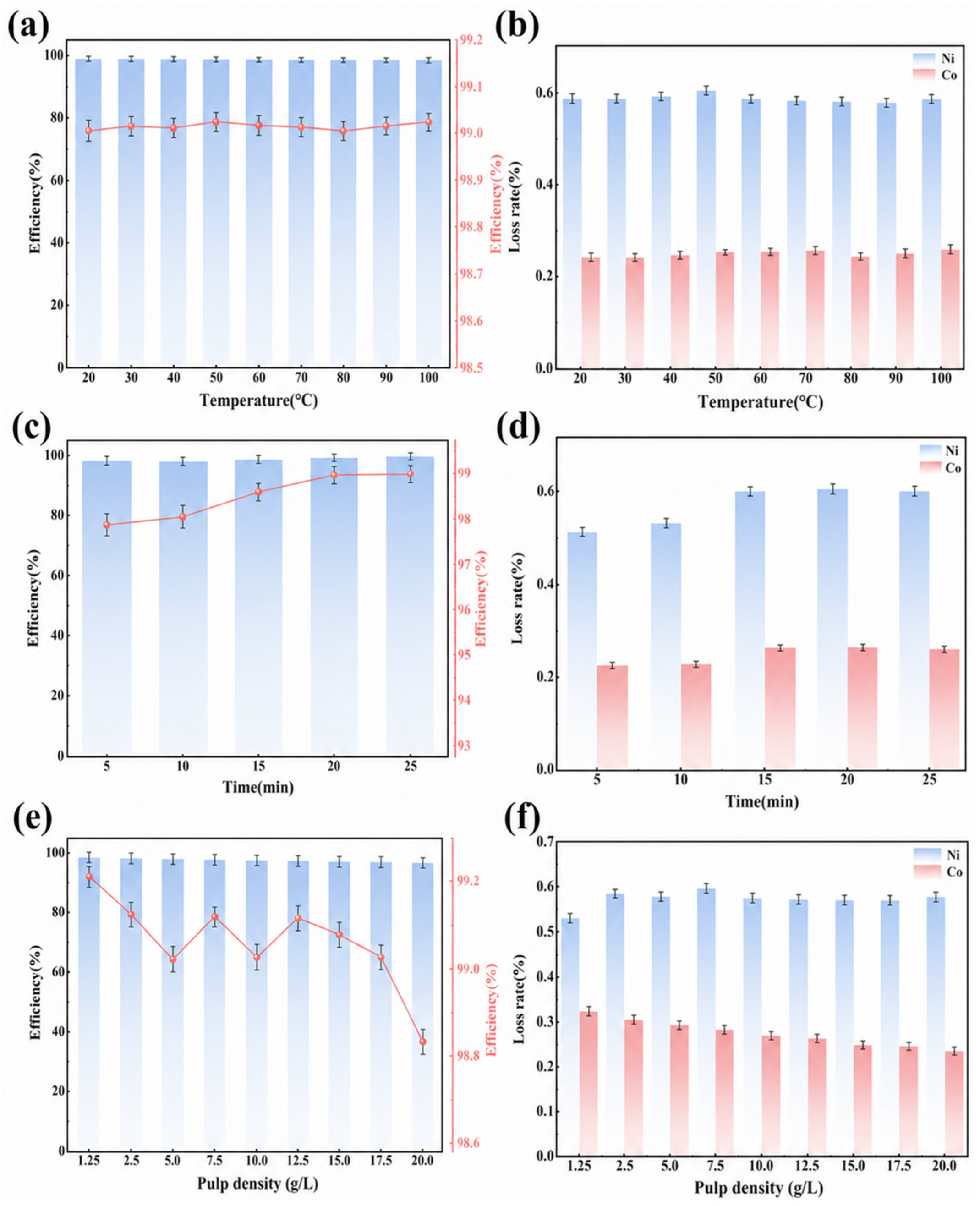
With the leaching duration and solid loading fixed at 20 min and 17.5 g L−1, respectively, the leaching temperature was varied from 20 to 100 °C. As shown in Figure 4a, lithium recovery remained essentially unchanged over the investigated temperature range, indicating that the lithium-bearing sulfate phases dissolved readily in water. Therefore, 20 °C was selected as the preferred leaching temperature to avoid unnecessary thermal input. As shown in Figure 4b, the dissolution losses of Ni and Co remained below 0.6%, confirming that the transition-metal-rich oxide phases were only slightly dissolved during water leaching.
Figure 4.
Effects of water-leaching parameters on metal separation: (a) lithium recovery and (b) Ni and Co dissolution losses at different temperatures; (c) lithium recovery and (d) Ni and Co dissolution losses at different leaching durations; and (e) lithium recovery and (f) Ni and Co dissolution losses at different solid loadings.
The effect of leaching duration was subsequently investigated at 20 °C and a solid loading of 17.5 g L−1. Lithium recovery exceeded 98% after 5 min and increased to approximately 99% after 20 min. Further extension of the leaching duration produced no appreciable improvement. Meanwhile, the dissolution losses of Ni and Co remained below 0.6% throughout the investigated duration range. Therefore, 20 min was selected as the preferred leaching duration.
The effect of solid loading was evaluated at 20 °C with a fixed leaching duration of 20 min. Lithium recovery remained above 98.8% throughout the investigated solid-loading range, indicating that selective lithium extraction could be maintained at relatively high solid loadings. Considering lithium recovery and process throughput, a solid loading of 17.5 g L−1 was selected.
The complete ionic composition of the combined primary leachate, residue-washing solutions, and equipment-rinsing solution was determined under the preferred conditions. The combined aqueous stream contained 0.42 g L−1 Li and 2.76 g L−1 sulfate. The concentrations of Ni, Co, and Mn were 15.8, 1.2, and 53.6 mg L−1, respectively. The concentrations of Na, Al, Cu, Fe, Ca, and Mg were 8.4, 3.2, 1.4, 2.6, 6.8, and 2.1 mg L−1, respectively. The concentrations of fluoride and chloride were 4.5 and 1.2 mg L−1, respectively. The final pH of the combined solution was 6.92. Under the preferred conditions, the stage lithium-leaching recovery was 99.12%. The dissolution losses of Ni, Co, and Mn were 0.56%, 0.29%, and 2.85%, respectively. The complete ionic composition of the combined aqueous stream obtained under the preferred conditions is summarised in Table 3.
Table 3.
Chemical composition of the combined aqueous stream obtained under the preferred water-leaching conditions.
Of the total lithium transferred to the aqueous phase, 93.70% was present in the primary leachate, 5.40% was recovered in the residue-washing solutions, and 0.90% was recovered in the equipment-rinsing solution. Therefore, the washing and rinsing solutions together accounted for 6.30% of the leached lithium and were included in all recovery calculations.
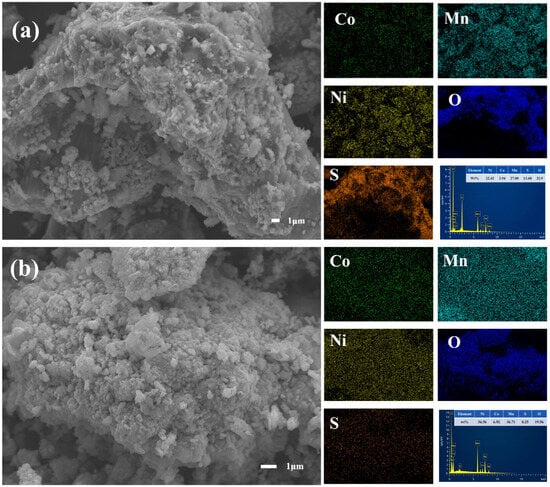
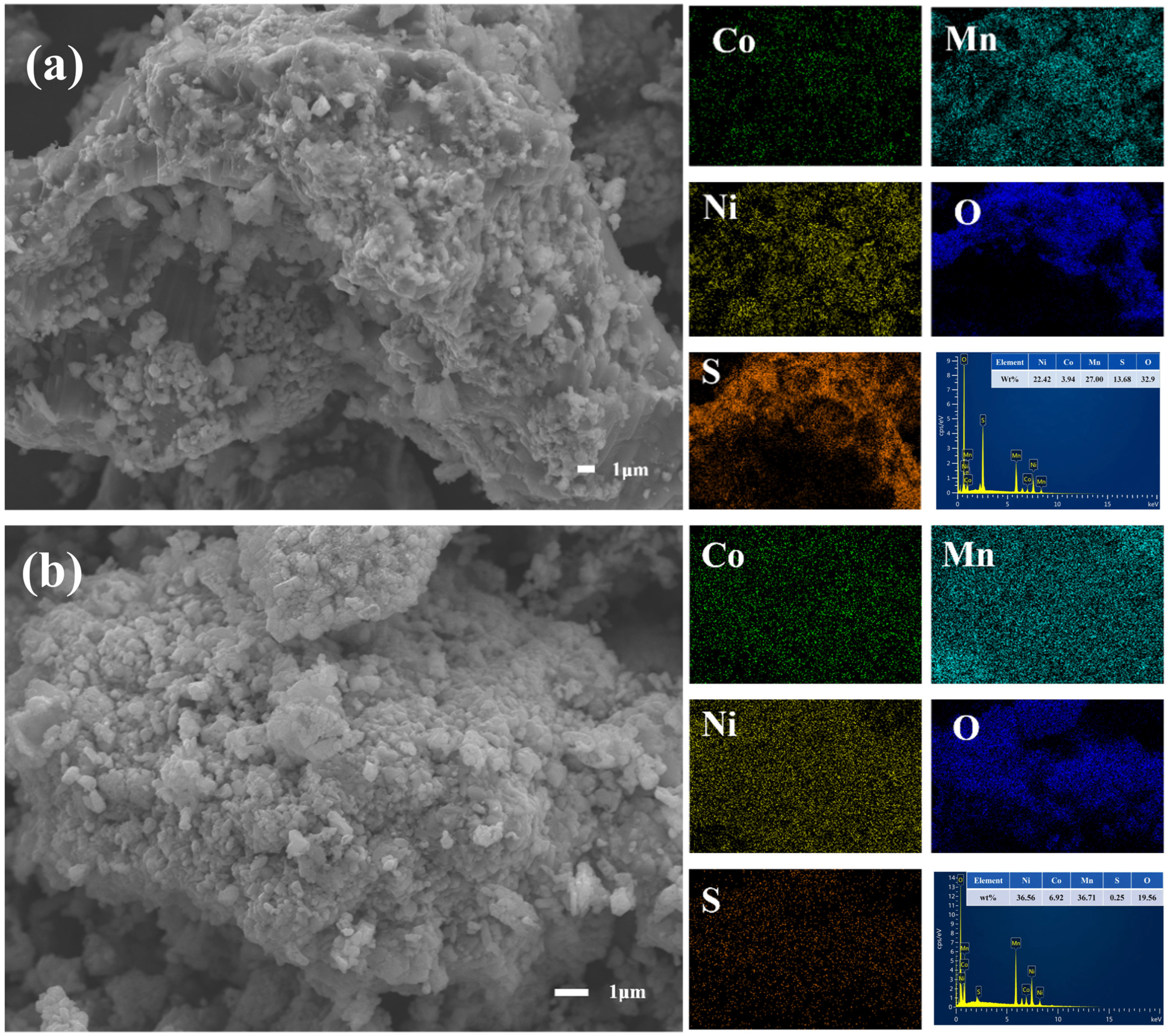
SEM-EDS characterization was performed to compare the morphology and local elemental distributions of the reconstructed products before and after water leaching, as shown in Figure 5. Following the transient high-temperature treatment, the original fine particles partially sintered and agglomerated into larger irregular particles. Ni, Co, Mn, S, and O were detected by EDS, whereas Li could not be reliably detected because of its low atomic number. Among the detectable elements, Mn exhibited the highest local relative content, suggesting that Mn introduced by MnSO4·H2O participated in the formation of the transition-metal-rich oxide phases. After water leaching, Ni and Mn each accounted for approximately 36% of the locally detected elements in the residue. The slight decrease in the relative Mn content may be associated with the dissolution of water-soluble Mn-containing sulfate phases, particularly Li4Mn2(SO4)4, which could transfer part of the Mn into the leachate together with lithium. The observed changes in local elemental distribution are consistent with the selective removal of soluble sulfate phases during water leaching. However, because EDS provides only local semiquantitative information, bulk chemical analysis is still required to establish the overall metal distribution and mass balance.
Figure 5.
SEM-EDS images of sulfate-assisted rapid thermal reconstruction products (a) before and (b) after water leaching.
Overall, the rapid thermal reconstruction process produced water-soluble lithium-bearing sulfates and water-insoluble transition-metal-rich oxides, enabling selective lithium separation using pure water. Under the preferred conditions, the stage lithium recovery was 99.12%, while the dissolution losses of Ni, Co, and Mn were 0.56%, 0.29%, and 2.85%, respectively. The process consequently generated a lithium-rich aqueous stream and a transition-metal-rich solid residue for subsequent Li2CO3 recovery and cathode resynthesis.
3.4. Recovery of Lithium Carbonate and Resynthesis of a Layered Ternary Cathode Material
The preceding selective water-leaching process yields a lithium-rich leachate and a transition-metal-rich solid residue. The lithium-rich leachate was further processed to recover Li2CO3, whereas the solid residue was relithiated to resynthesise a layered ternary cathode material. The electrochemical performance of the resynthesised material was subsequently evaluated.
Before carbonation, the combined lithium-rich aqueous stream was concentrated under reduced pressure from an initial Li concentration of 0.42 g L−1 to 4.20 g L−1. This concentration step increased the supersaturation available for Li2CO3 precipitation. The initial pH of the concentrated solution was adjusted to 12.80 using NaOH. Carbon dioxide was introduced at 250 mL min−1 and 25 °C for 40 min. The final pH was 10.80. After carbonation, the suspension was aged for 45 min, filtered, washed twice with cold Li2CO3-saturated water, and dried at 90 °C for 12 h. The lithium precipitation efficiency was 90.6%. A total of 34.7 g of Li2CO3 product was obtained per 100 g of as-received spent NCM811 powder. The overall lithium recovery from the initial spent NCM811 powder to the Li2CO3 product was 88.7%. The precipitation mother liquor and product-washing solutions contained 7.50% and 1.90% of the lithium entering the precipitation stage, respectively. These streams therefore represent the principal remaining opportunities for improving the overall lithium recovery. The XRD pattern agreed well with the reference pattern of Li2CO3 and showed no detectable crystalline transition-metal-containing impurity phases. However, chemical purity was determined from bulk chemical analysis rather than from XRD peak matching. ICP-OES and ion-chromatography analyses gave a Li2CO3 chemical purity of 99.52 wt.%. The principal impurities were Na at 0.18 wt.% and sulfate at 0.21 wt.%. The concentrations of Mn, Ni, and Co were 85, 32, and less than 10 mg kg−1, respectively. The chemical composition of the recovered Li2CO3 product is summarised in Table 4.
Table 4.
Chemical composition of the recovered Li2CO3 product.
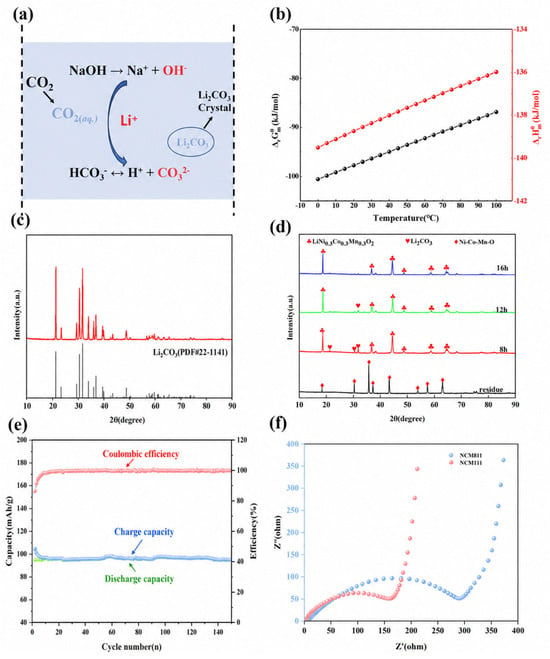
The simplified Li2O-CO2 thermodynamic calculation shown in Figure 6b provides qualitative support for carbonate formation. However, precipitation from the actual sulfate-containing aqueous solution is also controlled by lithium concentration, solution pH, carbonate-bicarbonate equilibria, ionic strength, and sulfate activity.
Figure 6.
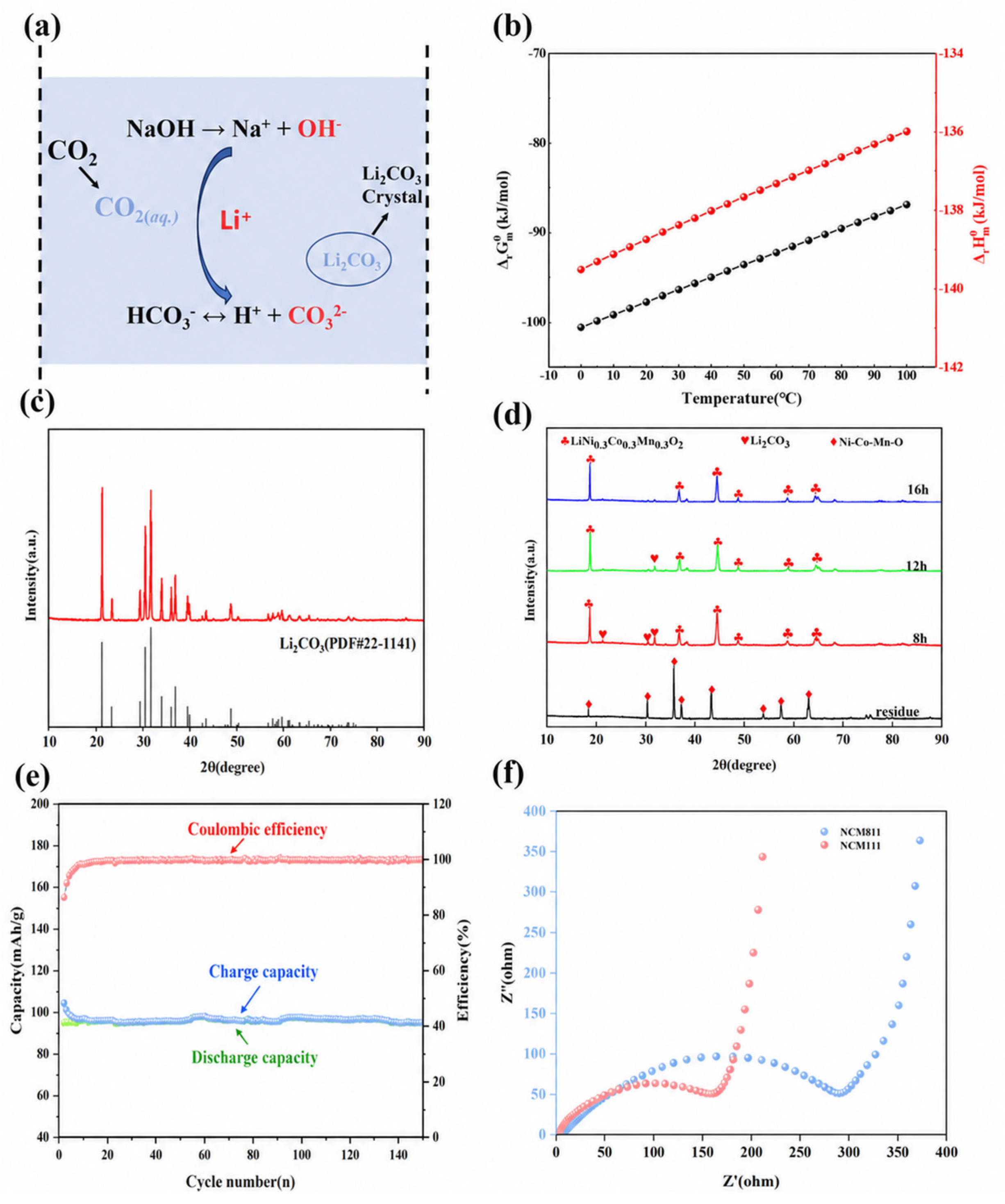
Recovery and reutilisation of the separated components: (a) schematic illustration of Li2CO3 precipitation from the concentrated lithium-rich aqueous stream; (b) simplified thermodynamic analysis of the Li2O-CO2 system; (c) XRD pattern of the recovered Li2CO3; (d) XRD patterns of the resynthesised layered cathode materials calcined for different durations; (e) cycling performance and Coulombic efficiency of the regenerated cathode at 0.2 C; and (f) electrochemical impedance spectra of the as-received NCM811 cathode and the regenerated ternary cathode. The label “NCM111” in panel (f) denotes the regenerated cathode according to the original figure notation; its measured composition was LiNi0.54Co0.07Mn0.39O2.
ICP-OES analysis showed that the transition-metal-rich residue had a Ni:Co:Mn molar ratio of 0.55:0.07:0.38. After relithiation and calcination, the resynthesised cathode had a Li-to-total-transition-metal molar ratio of 1.00 and a Ni:Co:Mn molar ratio of 0.54:0.07:0.39. Accordingly, the measured composition of the regenerated cathode was LiNi0.54Co0.07Mn0.39O2. Although the regenerated material is labelled as “NCM111” in Figure 6f following the original figure notation, this label is used only to distinguish the regenerated ternary cathode from the as-received NCM811 cathode and does not represent its exact stoichiometric composition.
The transition-metal-rich residue was mixed with Li2CO3 at a nominal Li-to-total-transition-metal molar ratio of 1.05:1. After ball milling, drying, and sieving, the mixtures were preheated at 400 °C for 2 h and calcined at 800 °C for 8, 12, or 16 h. After 8 h, reflections characteristic of a layered ternary oxide appeared together with residual Li2CO3 reflections at approximately 21.4°, 30.55°, and 31.64°. The residual Li2CO3 reflections gradually weakened with increasing calcination duration and were no longer detectable after 16 h. Therefore, calcination at 800 °C for 16 h was selected as the preferred condition.
At 0.2 C, the regenerated cathode delivered an initial discharge capacity of 128.6 mAh g−1 and an initial Coulombic efficiency of 86.04%. After 150 cycles, the discharge capacity remained at 95.2 mAh g−1, corresponding to a capacity retention of 74.0%. Figure 6f compares the electrochemical impedance spectra of the as-received NCM811 cathode and the regenerated ternary cathode. The regenerated cathode is labelled as “NCM111” in the figure according to the original plotting convention, although ICP-OES analysis showed that its actual composition was LiNi0.54Co0.07Mn0.39O2. The regenerated cathode exhibited a solution resistance of 2.40 Ω and a charge-transfer resistance of 157.4 Ω, and the chi-squared value of the impedance fit was below 1.0 × 10⁻³. Because the two cathodes differ in composition, electrochemical history, and structural state, the impedance spectra are used only to provide a qualitative comparison rather than to demonstrate a direct performance improvement caused by the reconstruction process. Together with the cycling results, these observations confirm that the transition-metal-rich residue can be relithiated to obtain an electrochemically active layered cathode material. Nevertheless, further optimisation of residue purification, elemental-ratio adjustment, and calcination conditions is required to improve its reversible capacity and cycling stability.
Overall, the proposed route integrates lithium recovery with the reutilisation of transition-metal components from spent NCM811 cathodes. The lithium-rich aqueous stream was converted into high-purity Li2CO3, while the transition-metal-rich residue was relithiated to prepare an electrochemically active layered cathode material. The stage lithium-leaching recovery exceeded 99%, whereas the overall recovery as Li2CO3 was 88.7% because a fraction of the lithium remained in the precipitation mother liquor and product-washing solutions. The regenerated cathode retained electrochemical activity after 150 cycles, demonstrating the feasibility of reutilising the transition-metal-rich residue for cathode resynthesis.
3.5. Process-Wide Elemental Distribution and Material Balance
A process-wide elemental balance was established on the basis of 100 g of as-received spent NCM811 powder and 90 g of MnSO4·H2O. The initial spent NCM811 powder contained 7.30 g Li, 48.90 g Ni, 6.88 g Co, and 3.29 g Mn. The MnSO4·H2O reagent introduced an additional 29.25 g Mn and 17.07 g S.
After rapid thermal reconstruction, the material remaining on the graphite felt and transfer tools was quantitatively recovered and combined with the collected reconstructed product before water leaching. On this basis, the total reconstructed solid stream accounted for 98.8% of the input Li, 99.5% of the input Ni, 99.6% of the input Co, 99.2% of the input Mn, and 96.0% of the input S. Before quantitative recovery, the fractions retained on the graphite felt and transfer tools corresponded to 0.6% of the input Li, 0.3% of the input Ni, 0.2% of the input Co, and 0.4% of the input Mn. Approximately 2.4% of the input sulfur was detected in the alkaline off-gas absorption solutions. During water leaching, 99.12% of the lithium in the reconstructed product was transferred to the combined aqueous streams. In contrast, 99.44% of Ni, 99.71% of Co, and 97.15% of Mn were retained in the solid residue. The primary leachate contained 93.70% of the aqueous lithium, while residue washing and equipment rinsing recovered an additional 6.30%. The washing and rinsing solutions were therefore included in the stage lithium-recovery calculation. During Li2CO3 precipitation, 90.6% of the lithium in the concentrated solution was incorporated into the Li2CO3 product. The precipitation mother liquor contained 7.50% of the lithium entering the precipitation stage, while 1.90% was detected in the product-washing solutions.
Relative to the lithium initially contained in the as-received NCM811 powder, the overall lithium recovery as Li2CO3 was 88.7%. The final elemental-balance closures were 98.8% for Li, 99.5% for Ni, 99.6% for Co, 99.2% for Mn, and 98.6% for S.
These results distinguish the stage lithium-leaching recovery from the overall lithium-product recovery. Although the water-leaching stage recovered more than 99% of the lithium in the reconstructed product, lithium remaining in the precipitation mother liquor and washing solutions reduced the overall recovery to approximately 89%.
4. Conclusions
An MnSO4·H2O-assisted route coupling rapid thermal reconstruction with water leaching was developed for selective lithium recovery and transition-metal reutilisation from spent NCM811 cathodes. At an MnSO4·H2O-to-NCM811 mass ratio of 0.9:1, an applied current of 30 A, and a treatment duration of 20 s, the layered cathode structure was converted into water-soluble lithium-bearing sulfates and water-insoluble transition-metal-rich oxides.
Under the preferred water-leaching conditions of 20 °C, 20 min, and 17.5 g L−1, the stage lithium recovery was 99.12%. The dissolution losses of Ni, Co, and Mn were 0.56%, 0.29%, and 2.85%, respectively. Residue-washing and equipment-rinsing solutions accounted for 6.30% of the lithium transferred to the aqueous phase, demonstrating the importance of including these streams in the stage recovery calculation.
After solution concentration and CO2 carbonation, Li2CO3 was obtained with a lithium precipitation efficiency of 90.6% and a chemical purity of 99.52 wt.%. The overall lithium recovery as Li2CO3 was 88.7%, which was lower than the stage water-leaching recovery because lithium remained in the precipitation mother liquor and product-washing solutions.
The complete process balance gave elemental closures of 98.8% for Li, 99.5% for Ni, 99.6% for Co, 99.2% for Mn, and 98.6% for S. The regenerated cathode had a measured composition of LiNi0.54Co0.07Mn0.39O2 and retained a discharge capacity of 95.2 mAh g−1 after 150 cycles at 0.2 C. These results confirm the feasibility of reutilising the transition-metal-rich residue for cathode resynthesis, although further optimisation of residue purification, elemental-ratio control, and calcination conditions is required to improve the electrochemical performance of the regenerated material.
Author Contributions
Z.P.: writing—original draft, investigation, writing—review and editing. R.Z.: formal analysis, data curation, writing—original draft, writing—review and editing. X.W.: investigation, data curation. Z.W. (Zhen Wan): methodology, investigation. X.P.: funding acquisition, supervision, Conceptualization, Validation. Z.W. (Zhi Wang): funding acquisition, investigation, supervision. Z.Z.: conceptualization, investigation, supervision. D.W.: writing—review and editing, investigation. G.Q.: conceptualization, writing—review and editing, funding acquisition, supervision. All authors have read and agreed to the published version of the manuscript.
Funding
The authors acknowledge the financial support of the National Key Research and Development Program of China (Grant No. 2023YFC2909100) and the National Natural Science Foundation of China (Grant No. 52404418).
Data Availability Statement
The original contributions presented in this study are included in the article. Further inquiries can be directed to the corresponding authors.
Acknowledgments
We are also grateful for the technical guidance provided by Lei Cheng from Shenzhen Joule IC Technology Co., Ltd. (http://www.jouleic.com) in utilizing the Joule ultrafast heating device, which significantly contributed to our experimental outcomes.
Conflicts of Interest
The authors declare no conflicts of interest.
References
- Pang, D.; Wang, H.; Zeng, Y.; Han, X.; Zheng, Y. Sustainable recycling of lithium-ion battery cathodes: Life cycle assessment, technologies, and economic insights. Nanomaterials 2025, 15, 1283. [Google Scholar] [CrossRef] [Scilit]
- Niu, B.; E, S.; Song, Q.; Xu, Z.; Han, B.; Qin, Y. Physicochemical reactions in e-waste recycling. Nat. Rev. Chem. 2024, 8, 569–586. [Google Scholar] [CrossRef] [Scilit]
- Liu, B.; Zhou, J.; Yang, L.; Wang, X.; Sun, Z.; Gan, W.; Chang, V.W.C. Impacts of pretreatment routes on spent lithium-ion batteries recycling. Nat. Sustain. 2026, 9, 626–638. [Google Scholar] [CrossRef] [Scilit]
- Zhang, X.; Zhu, M. Recycling spent lithium-ion battery cathode: An overview. Green Chem. 2024, 26, 7656–7717. [Google Scholar] [CrossRef] [Scilit]
- Wang, W.; Liu, Z.; Zhu, Z.; Ma, Y.; Zhang, K.; Meng, Y.; Ahmad, T.; Khan, N.A.; Peng, Q.; Xie, Z.; et al. Electrochemical lithium recycling from spent batteries with electricity generation. Nat. Sustain. 2025, 8, 287–296. [Google Scholar] [CrossRef] [Scilit]
- Chen, W.; Chen, J.; Bets, K.V.; Salvatierra, R.V.; Wyss, K.M.; Gao, G.; Choi, C.H.; Deng, B.; Wang, X.; Li, J.T.; et al. Battery metal recycling by flash Joule heating. Sci. Adv. 2023, 9, eadh5131. [Google Scholar] [CrossRef] [Scilit]
- Iturrondobeitia, M.; Vallejo, C.; Berroci, M.; Akizu-Gardoki, O.; Minguez, R.; Lizundia, E. Environmental impact assessment of LiNi1/3Mn1/3Co1/3O2 hydrometallurgical cathode recycling from spent lithium-Ion batteries. ACS Sustain. Chem. Eng. 2022, 10, 9798–9810. [Google Scholar] [CrossRef] [Scilit]
- Zhu, A.; Bian, X.; Han, W.; Cao, D.; Wen, Y.; Zhu, K.; Wang, S. The application of deep eutectic solvents in lithium-ion battery recycling: A comprehensive review. Resour. Conserv. Recycl. 2023, 188, 106690. [Google Scholar] [CrossRef] [Scilit]
- Tran, M.K.; Rodrigues, M.-T.F.; Kato, K.; Babu, G.; Ajayan, P.M. Deep eutectic solvents for cathode recycling of Li-ion batteries. Nat. Energy 2019, 4, 339–345. [Google Scholar] [CrossRef] [Scilit]
- Holley, E.A.; Hadden, K.M.; Hammerling, D.; Eggert, R.; Spiller, D.E.; Nelson, P.P. By-product recovery from US metal mines could reduce import reliance for critical minerals. Sci. Adv. 2025, 389, adw8997. [Google Scholar] [CrossRef] [Scilit]
- Mann, M.; Nicholls, T.P.; Patel, H.D.; Lisboa, L.S.; Pople, J.M.M.; Pham, L.N.; Worthington, M.J.H.; Smith, M.R.; Yin, Y.; Andersson, G.G.; et al. Sustainable gold extraction from ore and electronic waste. Nat. Sustain. 2025, 8, 947–956. [Google Scholar] [CrossRef] [Scilit]
- Zhang, Q.; Zheng, X.; Lv, W.; He, M.; Yan, W.; Gao, W.; Ning, P.; Cao, H.; Sun, Z. An acid-free process to prepare battery grade nickel and cobalt sulfates from complex resources. Nat. Commun. 2025, 16, 4687. [Google Scholar] [CrossRef] [Scilit]
- Georgi-Maschler, T.; Friedrich, B.; Weyhe, R.; Heegn, H.; Rutz, M. Development of a recycling process for Li-ion batteries. J. Power Sources 2012, 207, 173–182. [Google Scholar] [CrossRef] [Scilit]
- Xiao, S.; Ren, G.; Xie, M.; Pan, B.; Fan, Y.; Wang, F.; Xia, X. Recovery of Valuable Metals from Spent Lithium-Ion Batteries by Smelting Reduction Process Based on MnO–SiO2–Al2O3 Slag System. J. Sustain. Metall. 2017, 3, 703–710. [Google Scholar] [CrossRef] [Scilit]
- Zhu, X.H.; Li, Y.J.; Gong, M.Q.; Mo, R.; Luo, S.Y.; Yan, X.; Yang, S. Recycling valuable metals from spent lithium-ion batteries using carbothermal shock method. Angew. Chem. Int. Ed. 2023, 62, e202300074. [Google Scholar] [CrossRef] [Scilit]
- Dang, H.; Li, N.; Chang, Z.; Wang, B.; Zhan, Y.; Wu, X.; Liu, W.; Ali, S.; Li, H.; Guo, J.; et al. Lithium leaching via calcium chloride roasting from simulated pyrometallurgical slag of spent lithium ion battery. Sep. Purif. Technol. 2020, 233, 116025. [Google Scholar] [CrossRef] [Scilit]
- Chen, M.; Ma, X.; Chen, B.; Arsenault, R.; Karlson, P.; Simon, N.; Wang, Y. Recycling end-of-life electric vehicle lithium-ion batteries. Joule 2019, 3, 2622–2646. [Google Scholar] [CrossRef] [Scilit]
- Li, N.; Guo, J.; Chang, Z.; Dang, H.; Zhao, X.; Ali, S.; Li, W.; Zhou, H.; Sun, C. Aqueous leaching of lithium from simulated pyrometallurgical slag by sodium sulfate roasting. RSC Adv. 2019, 9, 23908–23915. [Google Scholar] [CrossRef] [Scilit]
- Shen, A.; Zhang, J.; Chen, Y.; Wang, C. Recycling spent lithium ion batteries by flash joule heating: Preferential lithium recovery and Li-phase conversion mechanism under ultra-temperature. Resour. Conserv. Recycl. 2025, 222, 108433. [Google Scholar] [CrossRef] [Scilit]
- Ren, Z.; Li, H.; Wang, Y.; Zhang, G.; Wang, P.; Lv, L.; Sun, Z.; Gao, W. Green recycling assessment on typical spent lithium-ion batteries (LIBs): A multi-objective assessment. Resour. Conserv. Recycl. 2024, 206, 107648. [Google Scholar] [CrossRef] [Scilit]
- Yang, F.; Chen, X.; Qu, G.; Nie, Q.; Liu, G.; Wan, W.; Wang, T.; Li, S.; Huang, Y.; Li, J.; et al. Electrode separation via water electrolysis for sustainable battery recycling. Nat. Sustain. 2025, 8, 520–529. [Google Scholar] [CrossRef] [Scilit]
- Ji, H.; Wang, J.; Qiu, X.; Ren, H.; Xue, H.; Zhang, H.; Ji, G.; Cheng, H.-M.; Zhou, G. A universal protocol for ultrafast direct regeneration and upcycling of spent lithium-ion battery cathode materials. Nat. Protoc. 2026, 21, 2413–2447. [Google Scholar] [CrossRef] [Scilit]
- Fan, X.; Song, C.; Lu, X.; Shi, Y.; Yang, S.; Zheng, F.; Huang, Y.; Liu, K.; Wang, H.; Li, Q. Separation and recovery of valuable metals from spent lithium-ion batteries via concentrated sulfuric acid leaching and regeneration of LiNi1/3Co1/3Mn1/3O2. J. Alloys Compd. 2021, 863, 158775. [Google Scholar] [CrossRef] [Scilit]
- Cheng, Q.; Chirdon, W.M.; Lin, M.; Mishra, K.; Zhou, X. Characterization, modeling, and optimization of a single-step process for leaching metallic ions from LiNi1/3Co1/3Mn1/3O2 cathodes for the recycling of spent lithium-ion batteries. Hydrometallurgy 2019, 185, 1–11. [Google Scholar] [CrossRef] [Scilit]
- Tan, J.; Huang, R.; Li, K.; Yan, X.; Guo, L.; Guo, Z.; Zhang, W.; Chai, L. Achieving high solid–liquid ratio through competitive coordination towards efficient recovery of metals from spent batteries. Angew. Chem. Int. Ed. 2025, 64, e202422313. [Google Scholar] [CrossRef] [Scilit]
- Gao, S.; Chen, X.; Qu, J.; Guo, Y.; Shi, H.; Pang, F.; Guo, L.; Qu, X.; Wang, D.; Yin, H. Recycling of silicon solar panels through a salt-etching approach. Nat. Sustain. 2024, 7, 920–930. [Google Scholar] [CrossRef] [Scilit]
- Deng, B.; Eddy, L.; Wyss, K.M.; Tiwary, C.S.; Tour, J.M. Flash Joule heating for synthesis, upcycling and remediation. Nat. Rev. Clean. Technol. 2025, 1, 32–54. [Google Scholar] [CrossRef] [Scilit]
- Li, Y.; Yang, Z.; Cai, J.; Li, Y.; Wu, Z.; Long, Z.; Yan, X.; Zhang, S. Dual-salt carbothermal shock strategy enabling ultrafast and sustainable regeneration of spent LiFePO4 cathode materials. Adv. Funct. Mater. 2026, 36, e75876. [Google Scholar] [CrossRef] [Scilit]
- Zhang, B.; Wang, L.; Song, D.; Wu, J.; Yu, J.; Li, J. Recycling of spent lithium-ion batteries via sulfidation shock. Chem. Eng. J. 2025, 505, 159206. [Google Scholar] [CrossRef] [Scilit]
- Tao, R.; Xing, P.; Li, H.; Wu, Y.; Li, S.; Sun, Z. Full-component pyrolysis coupled with reduction of cathode material for recovery of spent LiNixCoyMnzO2 lithium-ion batteries. ACS Sustain. Chem. Eng. 2021, 9, 6318–6328. [Google Scholar] [CrossRef] [Scilit]

Disclaimer/Publisher’s Note: The statements, opinions and data contained in all publications are solely those of the individual author(s) and contributor(s) and not of MDPI and/or the editor(s). MDPI and/or the editor(s) disclaim responsibility for any injury to people or property resulting from any ideas, methods, instructions or products referred to in the content. |
© 2026 by the authors. Licensee MDPI, Basel, Switzerland. This article is an open access article distributed under the terms and conditions of the Creative Commons Attribution (CC BY) license.