


Abstract
As an efficient dry separation technology, electrostatic separation exhibits significant potential for application in the sorting and recovery of carbon-rich resources from coal gasification fine slag (CGFS). The small particle size and high moisture content of CGFS particles are the main factors affecting the efficiency of separation. This study proposes a method integrating particle moisture reduction and charging promotion based on molecular sieves, with the aim of investigating its feasibility in improving the electrostatic separation efficiency of CGFS particles. The results indicate that molecular sieves can effectively adsorb moisture from the ambient humid air and the surface of particles, allowing for rapid drying of wet particles. The reduction in moisture content on the particle surfaces significantly promotes their charging capability, creating favorable conditions for electrostatic separation. After molecular-sieve-assisted charging enhancement, the carbon content in the ash-enriched positive plate product decreased by 4.96%, while the carbon content in the carbon-enriched negative plate product increased by 12.15%, indicating a significant improvement in carbon–ash separation efficiency. Correspondingly, the decarbonization efficiency of the positive plate and carbon recovery efficiency of the negative plate were increased by 21.30% and 52.17%, respectively. Furthermore, when the moisture content exceeds 10%, the phenomenon of inter-particle agglomeration can adversely affect the separation of carbon and ash particles. The most suitable operating conditions are a moisture content no higher than 10%, an electric field density of 30 kV/m, a filling molecular sieve of 400 g, and a gas velocity of 12 m/s (volumetric flow rate 84.78 m3/h). In practical industrial applications, it is advisable to consider pre-treating the particles for drying or employing secondary separation to enhance sorting accuracy.
1. Introduction
Coal gasification fine slag (CGFS) is the solid waste residue filtered from the gasification ash and synthesis gas generated during the high-temperature and high-pressure gasification of coal [1,2]. Its main components are aluminosilicate minerals and carbon particles, characterized by a small particle size, high carbon content, high moisture content, and a well-developed porosity with a large specific surface area. CGFS is employed in the preparation of adsorbent materials, soil amendments, and catalysts and is mainly utilized in fields such as construction materials [3], mine backfilling [4], and wastewater treatment [5].
The high carbon content of CGFS affects its resource utilization process. For instance, during the preparation of construction materials, the presence of carbon leads to a decrease in the strength and durability of the products, necessitating a reduction in the carbon content. Additionally, the fixed carbon in the fine slag exhibits high reactivity, which can result in a risk of spontaneous combustion due to oxidation when stockpiled for mine backfilling. Furthermore, the residual carbon serves as a potential energy source [6], which can be utilized in fluidized bed co-firing and gasification in conjunction with coal powder. Therefore, the removal of residual carbon particles from CGFS is a prerequisite for achieving effective resource utilization.
The electrostatic separation method can efficiently segregate fine mineral particles and has significant technical advantages, including a simple process flow, high separation efficiency, low investment costs, and minimal environmental pollution [7]. This method has been widely applied in various fields such as decarbonization of fly ash [8,9], the upgrading of coal gangue, and decarbonization of CGFS [10]. Although the overall moisture content of the particles is significantly reduced after dehydration and drying processes [11,12,13], various issues still constrain separation efficiency due to the inherent characteristics of the material. On one hand, the particle size of fine slag is extremely small, and many porous carbon particles readily adsorb moisture from the air, resulting in increased surface moisture content that greatly complicates particle charging. On the other hand, the moisture present on the particle surface enhances its conductivity, leading to charge transfer or neutralization of already charged particles, which directly reduces the charge-to-mass ratio (CMR) of the particles and subsequently impacts the effectiveness of electrostatic separation [14].
The charging of powder particles is a complex physical phenomenon [15,16]. The factors influencing the charging of CGFS particles are diverse, encompassing external environments, operating conditions, and charging methods. Tao et al. found through rotational triboelectrostatic separation experiments that electrode voltage and air velocity are key factors affecting decarbonization efficiency, with optimal separation results observed at 45 kV and 2 m/s [17]. Previous studies have shown that corona discharge can enhance the charging process of CGFS particles and improve decarbonization efficiency by 17.99% [18]. The combination of ball milling and the salicylic acid reagent method can achieve a surface modification strategy for CGFS particles, regulate the surface properties of carbon and ash particles, and improve the particle charge to mass ratio and electrostatic separation efficiency. Xing et al. reviewed and analyzed electrostatic decarbonization methods, residual carbon mineralogical characteristics, and separation efficiency [19]. By comparing various decarbonization methods, they identified the potential of electrostatic separation in industrial applications while highlighting its advantages, including minimal environmental pollution, water resource conservation, and a low particle size limit. The electrostatic sorting of CGFS is also significantly influenced by differences in particle size and microstructure.
Therefore, moisture content is a very important influencing factor for electrostatic sorting [20]. Jari’s research found that the total charge of polyethylene particles and glass walls in a vibrating bed system decreases with increasing humidity, and there is little change in total charge when the humidity value is below 30% [7]. Federico’s research found that as particle size decreases, the effects of humidity and surface moisture become more important. These particles with a diameter exceeding 75 microns are almost unaffected, while particles smaller than 45 microns show a fourfold increase in the electrostatic separation rate when the surface moisture content is changed [8]. The high moisture content (particle surface moisture content higher than 10%) of a particle significantly reduces its particle charging efficiency [12]. To address this critical issue, this paper proposes a novel method that utilizes spherical molecular sieves to realize moisture reduction and charging promotion in CGFS through fluidized bed collisions. This approach synergistically reinforces charging in two ways: on one hand, it takes advantage of the strong hygroscopic properties of the molecular sieve, effectively reducing the moisture content of both the humid air environment and the CGFS particles, thereby creating favorable conditions for the charging of fine slag particles. On the other hand, fluidized-bed and gas–solid contact systems are well known to exhibit significant triboelectric charging due to frequent particle–particle and particle–wall collisions [21]. During the fluidization process, the high-frequency collision between CGFS particles and molecular sieves is expected to further promote the particle charging effect and improve its CMR.
This study proposed a novel in situ enhancement method for CGFS electrostatic separation, which uses a 3A spherical molecular sieve as the core medium to realize synergistic particle moisture reduction and triboelectric charging enhancement via a gas–solid fluidized bed collision system. The influence mechanism and strengthening effect of water content, molecular sieve filling mass, and gas flow rate on the particle charging process will be analyzed. The feasibility of using fluidized molecular sieves to improve the electrostatic separation efficiency of CGFS particles will be studied, and the most suitable process operating conditions will be explored to provide a foundation for subsequent industrial applications. Compared with methods such as thermal drying, microwave drying, and chemical surface modification, this method has technical advantages such as low energy consumption, no secondary pollution, a simple system, and a good charging effect. It provides important theoretical and practical value for promoting the high-value utilization of CGFS solid waste resources.
2. Experimental Procedure
2.1. Materials
2.1.1. CGFS
The CGFS in this study is derived from the entrained-flow coal gasification process under high temperature and high pressure (1300–1500 °C, 4.0–6.0 MPa). It was obtained from a coal chemical plant in Ningxia, China, exhibiting an average loss on ignition (LOI) of 23.29%.
The internal moisture content in the free moisture of the CGFS remained stable; thus, the discussions in this study are primarily based on the external moisture. After drying the original samples for 12 h, deionized water was added, and the mixture was thoroughly stirred. Deionized water was used in the experiment to eliminate the interference of inorganic ions and chemical components in industrial filtrate on particle surface properties and moisture adsorption, so as to accurately study the pure effect of moisture content on CGFS charging and electrostatic separation.
The samples were then allowed to rest in a constant temperature and humidity testing chamber for 18 h to ensure adequate moisture absorption, resulting in samples with varying moisture contents. The internal moisture content of the CGFS sample used in this study is 1.54%. The moisture content of the samples was measured using the HB43-S moisture analyzer (Mettler Toledo, Zurich, Switzerland), and when the moisture content reached 5%, 10%, 15%, and 20%, the samples were sealed in bags and placed in the constant temperature and humidity chamber.
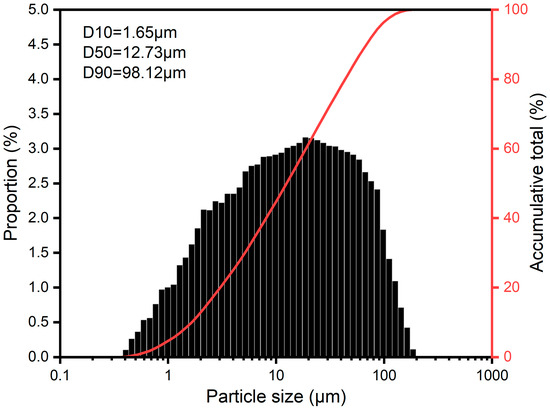
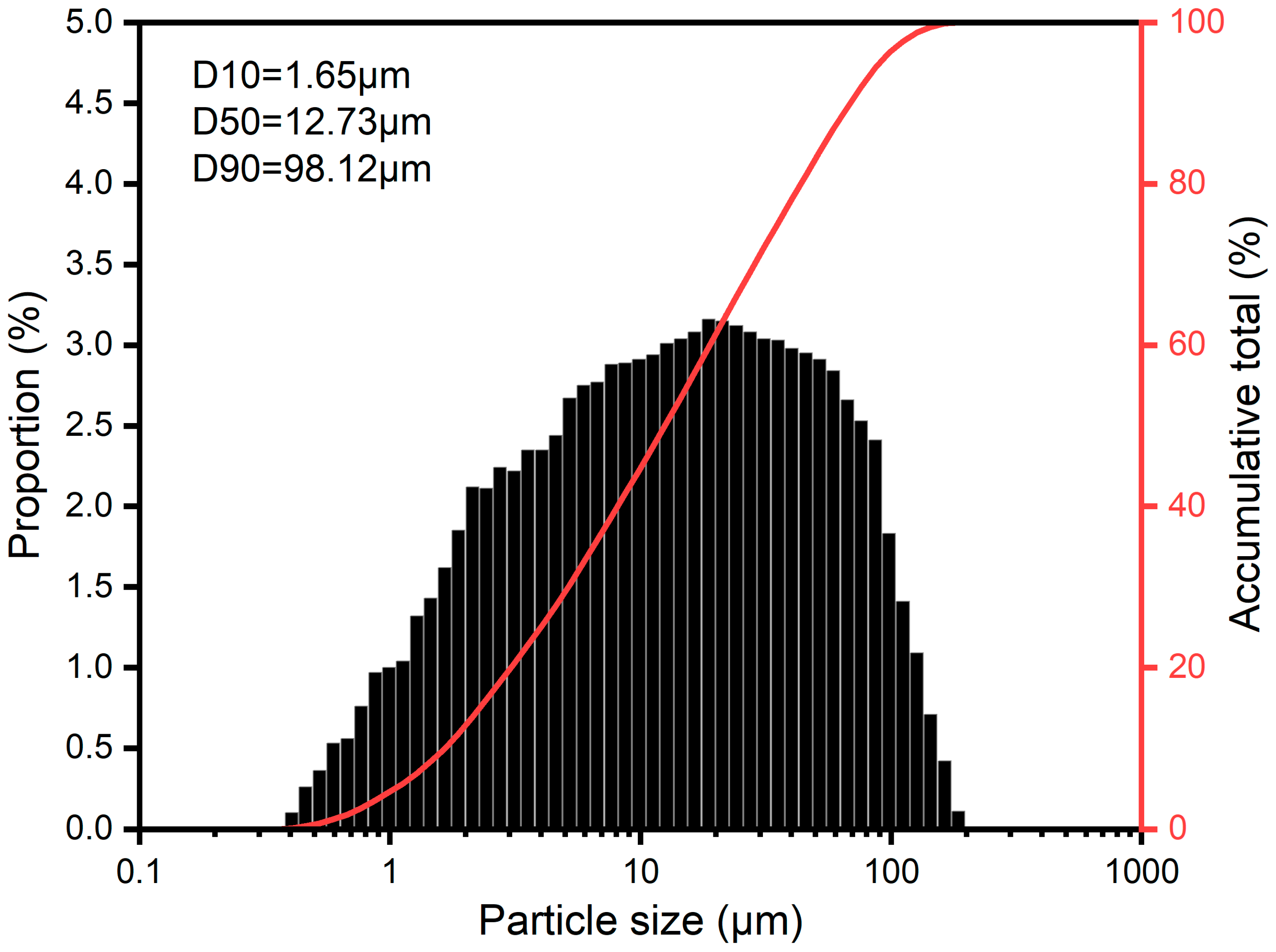
The particle size distribution of the sample was measured using the Bettersize 2600 laser particle size analyzer (Bettersize Instruments, Dandong, China). The result is shown in Figure 1. It shows that the effective particle size range of the gasification fine slag particles was 0.41~185.75 μm. Particles smaller than 0.41 μm were not detected, and particles larger than 185.75 μm accounted for 0%. The particle size distribution showed a unimodal continuous distribution, mainly concentrated in a range of 1–100 μm, where the volume fraction of particles accounted for over 95%. Among them, the median particle size D10 was about 1.65 μm, and D50 was about 12.73 μm; the cumulative distribution of 90% corresponded to a particle size of approximately 98.12 μm. The overall particle size of fine slag was relatively fine and evenly distributed, with a low proportion of large particles. Fine particles smaller than 10 μm accounted for nearly 50%, and the gasification fine slag had the characteristic of fine-grained enrichment.
Figure 1.
Diagram of the particle size distribution.
The chemical composition of the sample was analyzed using an X-ray fluorescence spectrometer (BRUKER S8 TIGER, Karlsruhe, Germany) to characterize the main inorganic oxide composition. Table 1 presents the XRF test results of gasification fine slag. The oxides with the highest content are SiO2 and Al2O3, with a total content of 75.43%. This indicates that the gasification fine slag ash particles are mainly composed of aluminosilicates, with SiO2 and Al2O3 as the main components. In addition, it also contains a small number of oxides such as Fe2O3, CaO, MgO, K2O, Ti2O, etc.
Table 1.
The main chemical composition of CGFS.
2.1.2. Molecular Sieve
When selecting materials, multiple characteristics were considered comprehensively. The 0.3 nm pore size of the 3A molecular sieve is compatible with the dynamic diameter of water molecules at 0.28 nm, and it can selectively adsorb water molecules and remove large molecular gases from the air, achieving efficient directional dehydration of the CGFS system [22,23]. This sieve has both high saturation water adsorption capacity and fast adsorption rate [24], which can quickly reduce the water content of CGFS particles and the ambient air of the charger, meeting the rapid dehydration requirements of electrostatic separation. The commercial 3A molecular sieve has good crushing strength and can resist the collision and friction of CGFS particles in fluidized bed loading, avoiding material crushing and powder mixing that affect separation efficiency. Furthermore, its chemical properties are stable and will not react with CGFS particles or experimental system components, which can prevent secondary contamination of the sample and damage to the experimental equipment.
The experiments used the 3A type sodium aluminosilicate molecular sieve (Henan Sanyi Water Treatment Technology Co., Ltd., Zhengzhou, China). Its structure consists of [SiO4]4− and [AlO4]4− tetrahedra as the fundamental building units, interconnected through shared oxygen atoms, thereby forming a three-dimensional continuous crystalline framework. This molecular sieve features a uniform pore structure with a pore diameter of 0.3 nm, which is greater than the kinetic diameter of water molecules, allowing for effective moisture adsorption. Particles with a diameter of 6 mm were selected through sieving and subsequently placed in an electric blast drying oven set at a temperature of 250 °C for regeneration for 4 h. Afterward, the material was transferred to a vacuum drying oven.
2.2. Experimental System
2.2.1. Particle Charging Experiment
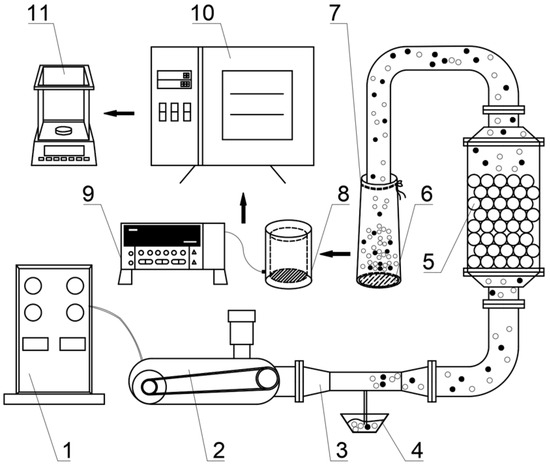
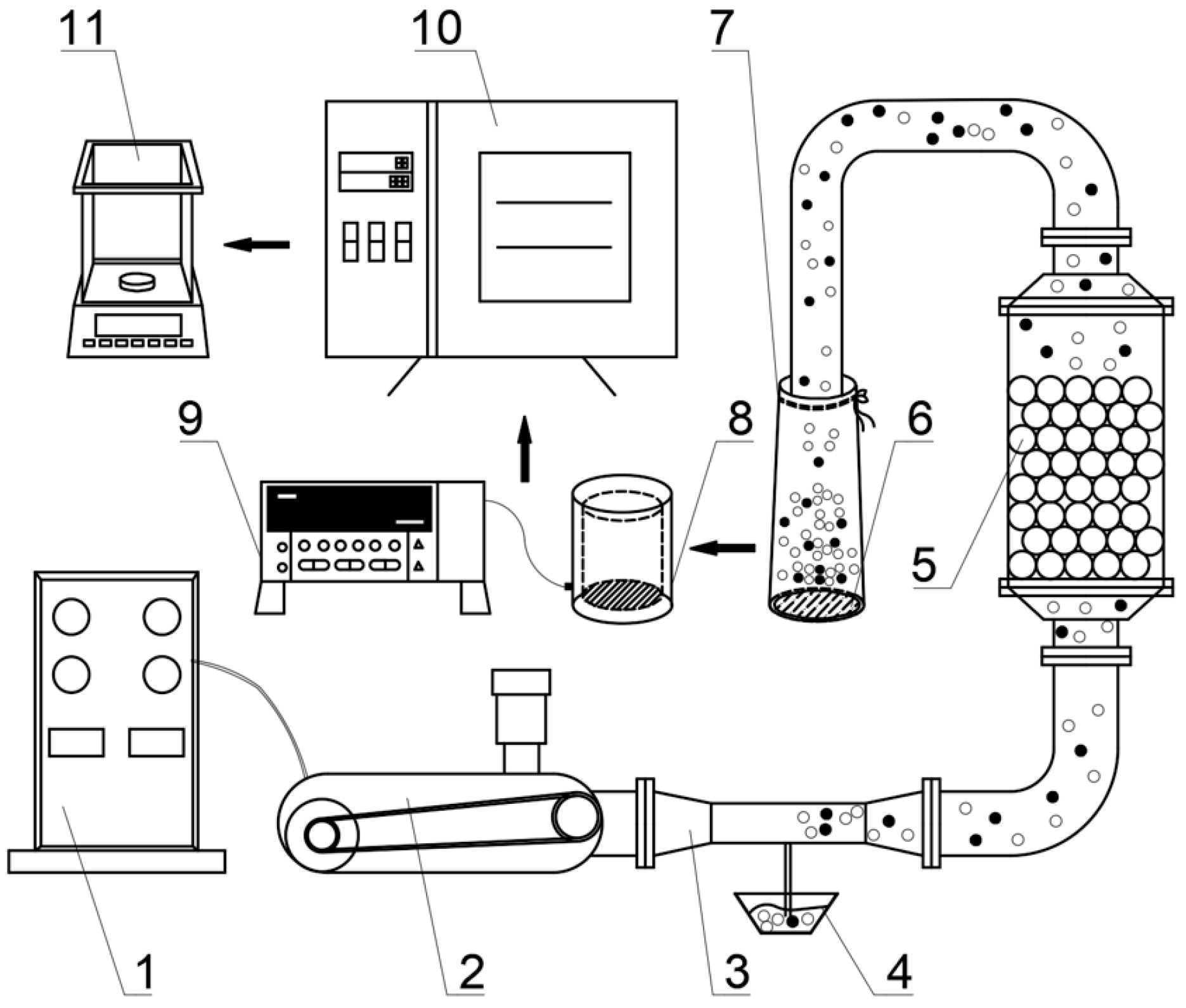
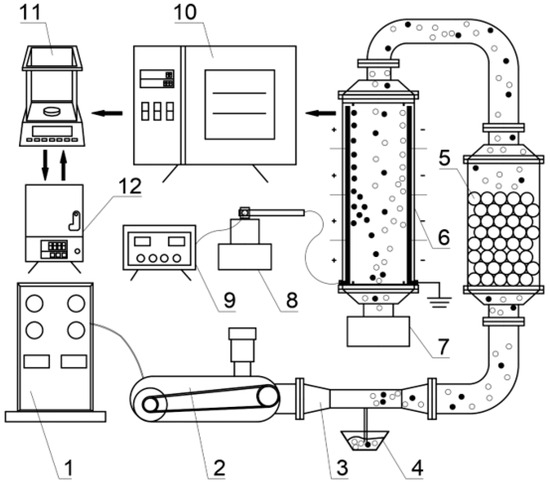
The molecular sieve charging experiment system is illustrated in Figure 2. The objective of the experiment is to evaluate the role of the molecular sieve in enhancing particle charging by comparing the differences in charge levels with and without the presence of the molecular sieve. The molecular sieve charger is a cylindrical structure with a wall thickness of 5 mm, an inner diameter of 100 mm, and a height of 165 mm. The 6-mesh nylon screen is installed at the inlet and outlet of the charging device to ensure that the molecular sieve cannot escape. A Faraday tube is a double cylindrical structure, with an inner diameter of 100 mm, a height of 190 mm, and a wall thickness of 5 mm for the inner cylinder, with an inner diameter of 110 mm, a height of 200 mm, and a wall thickness of 5 mm for the outer cylinder. Three 10 mm thick insulation blocks are installed at the bottom of the inner cylinder.
Figure 2.
Diagram of the molecular sieve charging experimental setup. 1. Variable frequency drive. 2. Conveying device. 3. Converging pipe. 4. Feed hopper. 5. Molecular sieve charger. 6. Glass fiber filter membrane. 7. High-mesh dust collection bag. 8. Faraday cylinder. 9. Faraday cup–electrometer system. 10. Electric heating forced air drying oven. 11. Electronic balance. (Hollow spheres are positively charged particles, while solid spheres are negatively charged particles.).
The environmental conditions during the experiment were maintained at a temperature of 25 °C and a relative humidity of 45%. Before being fed into the charging system, all CGFS particles are placed in a Faraday cage for 30 min to achieve natural electrostatic neutralization, and the Faraday cage is grounded to eliminate any residual static charge on the particle surface.
The particles are fed into the gas stream through a nozzle with negative pressure adsorption. This can ensure that the particle feeding is uniform. The flow rate is stably controlled by a frequency converter. The gas flow rate can be adjusted within the range of 5–18 m/s. Before the experiment, the relevant instruments are calibrated to ensure measurement accuracy. The average value of 5 measurements taken using a hot wire anemometer (AR8668A, SMART SENSOR, Dongguan, China) at a distance of 10 mm from the pipeline outlet is taken as the actual gas flow rate. The feed quality for each experiment is 15 g within 60 s. Negative pressure was employed to feed the CGFS into the system, where it came into contact and collided with the molecular sieve. The molecular sieve is capable of adsorbing moisture from the air as well as moisture from the particles. Under the influence of contact potential difference and physical adsorption, both carbon and ash particles acquired opposite charges. It should be noted that triboelectric charging exhibits a bipolar charge distribution even for identical particles [10,25]. Thus, the results were the net charge. Under the same experimental conditions, all experimental measurements were repeated 5 times, and the arithmetic mean of the measurements was taken as the result.
Charged particles escaping from the charger were collected using a filter bag and membrane setup. Wearing insulated gloves, the filter bag and membrane setup were swiftly transferred into a Faraday cup, where an electrometer was used to measure the charge carried by the particles. After drying, the mass of the collected particles was measured, allowing for the calculation of the average CMR.
The particle mass was determined immediately after charge measurement by drying the same sample fraction to constant mass, ensuring consistency between the charge and mass values. Although charge and mass were not measured simultaneously, strict sample handling protocols were applied to minimize particle loss, cross-contamination, and external interference, thereby ensuring a reliable CMR. To reduce background contributions from the filter bag and membrane, blank measurements were performed using unused filter materials under identical handling procedures, and the corresponding background charge was subtracted from the total measured charge. In this way, contributions from triboelectric charging of the filter media during sampling and handling were compensated, allowing the reported CMR to represent the net electrostatic charge of the sampled particles.
2.2.2. Electrostatic Separation Experiment
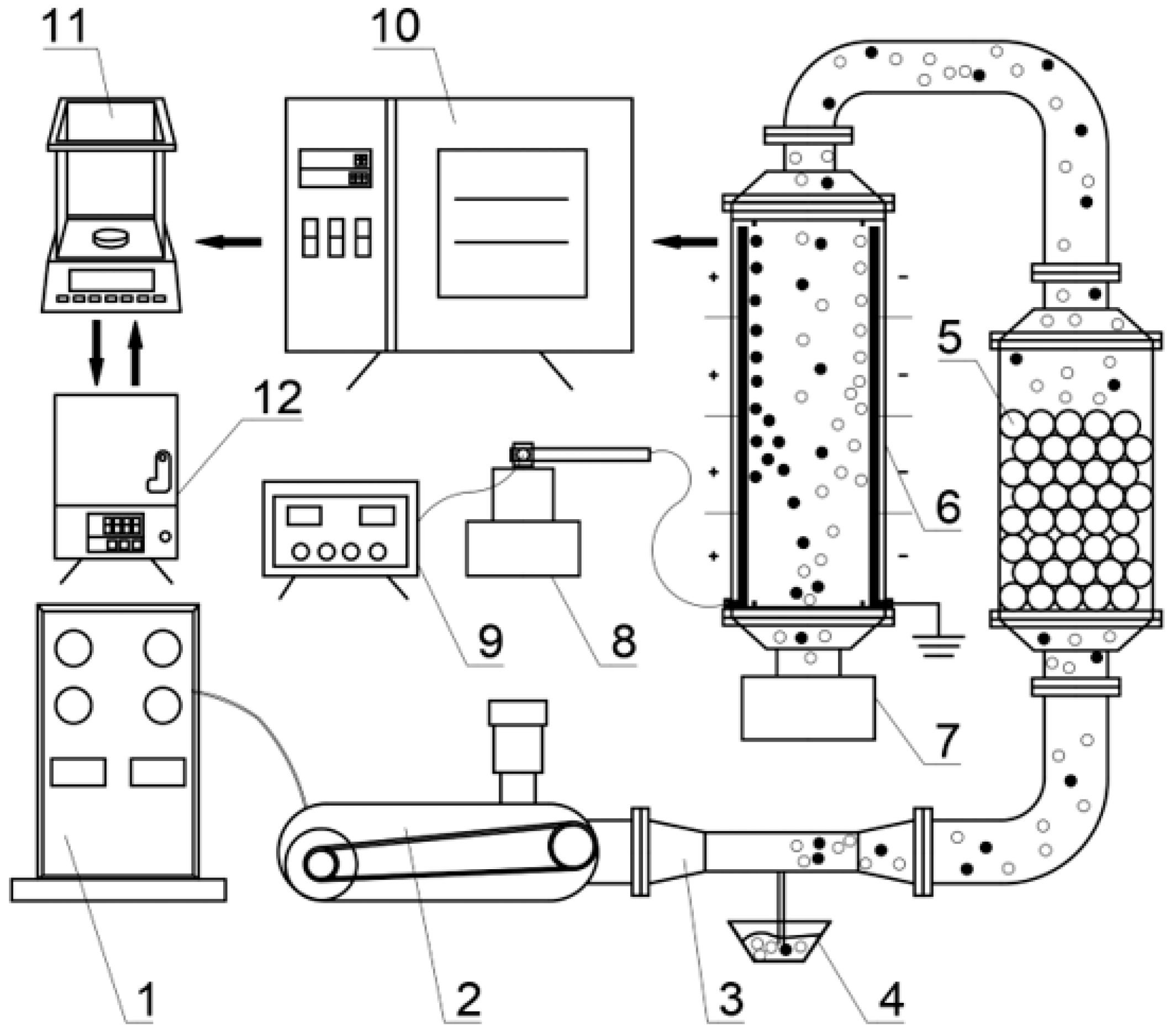
The particle electrostatic separation experiment system is illustrated in Figure 3. The experimental conditions were set as follows: airflow velocity of 12 m/s, electric field density 30 kV/m, particle feed amount of 50 g, with an ambient temperature of 25 °C and a relative humidity of 45%. This system primarily consists of three functional units: particle charging, electrostatic separation, and product collection.
Figure 3.
Experimental system for CGFS electrostatic separation. 1. Variable frequency drive. 2. Conveying device. 3. Converging pipe. 4. Feed hopper. 5. Molecular sieve charger. 6. Separation electric field. 7. Dust collector. 8. High-voltage power supply. 9. Power regulator. 10. Electric heating forced air drying oven. 11. Electronic balance. 12. Muffle furnace.(Hollow spheres are positively charged particles, while solid spheres are negatively charged particles.)
In the experiment, the structural dimensions of the molecular sieve charger are consistent with those in Figure 2. The CGFS particles with varying moisture contents were selected as the subjects of study. Driven by the airflow, the particles passed through the molecular sieve charger, which facilitated enhanced charging. The electrostatic sorting electric field is mainly composed of two parallel electrode plates with a length of 1430 mm, a width of 100 mm, and a thickness of 3 mm and an insulating shell matched with the electrode plates. The distance between the electrode plates is 200 mm. The high-voltage power supply is used to apply a DC voltage to one end of the electrode plate, while the other electrode plate is grounded. Due to the opposite charge polarities carried by carbon particles and ash particles, they experience opposing electric field forces in the high-voltage electrostatic field. Specifically, the carbon particles are deflected toward the positive plate, while the ash particles are directed toward the negative plate, accomplishing the separation and enrichment of carbon and ash. The dust collector located at the bottom of the system is utilized for collecting the separated tailings. It has a conical structure with an upper inner diameter of 400 mm, a lower inner diameter of 100 mm, and a total height of 500 mm. The input quality of this system is the feed quality of CGFS, and the output quality includes positive electrode plate products, negative electrode plate products, tailings quality, and residual quality of internal components. After the experiment is completed, it is necessary to calculate the material balance.
To investigate the moisture re-equilibration behavior of molecular-sieve-treated CGFS particles in ambient air (25 °C, 45% RH), the moisture content of the treated particles was measured at different standing times (0 min, 10 min, 30 min, 60 min). The measurement was conducted with three parallel tests for each time point to evaluate the persistence of the molecular sieve drying effect.
2.3. Evaluation Index
- (1)
- Moisture Content
The calculation of moisture content for the particles is shown as follows:
where represents the mass of the particles before drying, in grams (g); denotes the mass of the particles after drying, in grams (g).
- (2)
- Average CMR
The formula for calculating the average CMR is as follows:
In this equation, represents the CMR of particles with varying moisture content, measured in nanocoulombs per gram (nC/g); denotes the total charge of the particles, in nanocoulombs (nC); and signifies the total mass of the particles, in grams (g).
- (3)
- LOI
After drying the particles at a low temperature of 105 °C for 24 h to remove free moisture, the measurement of LOI was conducted in a muffle furnace at 850 °C for 2 h in an air atmosphere (in accordance with the national standard GB/T 212-2008 for coal analysis) [26]. The calculation is expressed as follows:
In this equation, and represent the masses of the particles before and after combustion, respectively, measured in grams (g).
- (4)
- Carbon Recovery Efficiency Index (REC)
The REC indicates the degree of carbon recovery of the negative plate products relative to the sample. It can be calculated as follows:
In this equation, represents the LOI of the negative plate products.
- (5)
- Decarbonization Efficiency Index (REM)
The REM represents the extent of carbon removal from the positive plate products relative to the sample. It can be calculated as follows:
In this equation, denotes the LOI of the positive plate products.
- (6)
- Product Mass Yield
The mass yield of electrostatic separation products (positive plate, negative plate, tailings) was calculated to characterize the mass distribution of the separation system, defined as:
where Yi is the mass yield of the i-th product (positive plate: Y+, negative plate: Y−, tailings: Yt), %; mi is the mass of the i-th product, g; mf is the initial feed mass of CGFS particles, g.
- (7)
- Mass Balance
The mass balance of the molecular sieve charger and electrostatic separation system was calculated to quantify particle retention loss on internal components (molecular sieve beads, glass walls, filter membranes) and verify the reliability of experimental data. The total mass recovery rate (Rm) and particle retention rate (Rr) were defined as follows:
where is the feed mass of CGFS particles into the system (g), is the total collected mass of particles (including product particles and recovered retained particles, g), and is the mass of tailing particles collected by the dust collector (g). The retained particles on internal components were collected, and their mass was measured with an electronic balance to ensure the accuracy of the mass balance calculation.
After each experiment, the internal components of the charger and separator were carefully cleaned to collect retained particles, and the mass was measured using an electronic balance. The mass balance was calculated under all experimental conditions, and the apparent LOI and CMR values were corrected based on the actual collected particle mass to eliminate the influence of retention loss.
3. Results and Discussion
3.1. Influence of Molecular Sieves on Particle Moisture Content
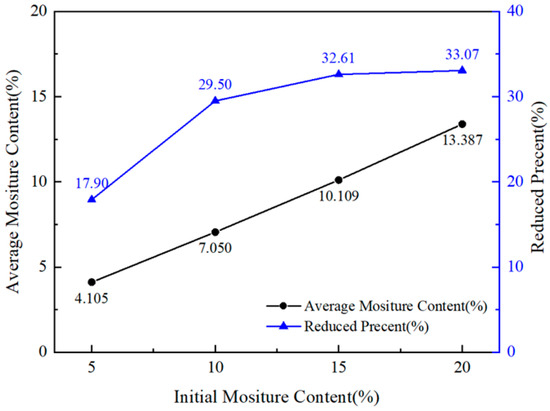
The influence of molecular sieves on particle moisture content is presented in Figure 4. Molecular sieve drying exhibits a noticeable dewatering effect on particles with relatively high initial moisture contents. At initial moisture contents of 5% and 10%, the moisture levels were reduced to 4.11% and 7.05% after treatment, corresponding to dewatering rates of 17.90% and 29.50%, respectively. This suggests that the overall moisture removal capacity of molecular sieves tends to increase with rising initial particle moisture content.
Figure 4.
Influence of molecular sieves on particle moisture content (molecular sieve: 400 g, gas velocity: 12 m/s, 25 °C, 45% RH, feed quality: 15 g).
As the initial moisture content increases to 10%, the rate of moisture reduction begins to slow, indicating a gradual decrease in marginal drying efficiency. For initial moisture contents of 15% and 20%, the achieved dewatering rates were 32.61% and 33.07%, respectively, with a markedly narrowed difference between the two conditions.
The observed trends can be interpreted from the perspective of moisture mobility and associated thermodynamic driving forces. Particles with higher initial moisture content generally possess greater surface moisture mobility, accompanied by higher water activity and vapor pressure at the particle–gas interface. Such moisture is more readily released from the particle surface into the surrounding gas phase, thereby enhancing the driving force for moisture adsorption by molecular sieves. However, molecular sieves have a finite adsorption capacity. Once approaching saturation, further increases in initial moisture content no longer lead to a proportional rise in moisture removal, and the overall reduction rate tends to stabilize.
It should be noted that since gas-phase humidity was not measured upstream and downstream of the molecular sieve treatment, the above interpretation remains qualitative. Quantitative analysis would require direct measurement of water activity or vapor pressure to fully characterize the driving forces for moisture transfer during drying.
3.2. Influence of Moisture Content on Particle Charge
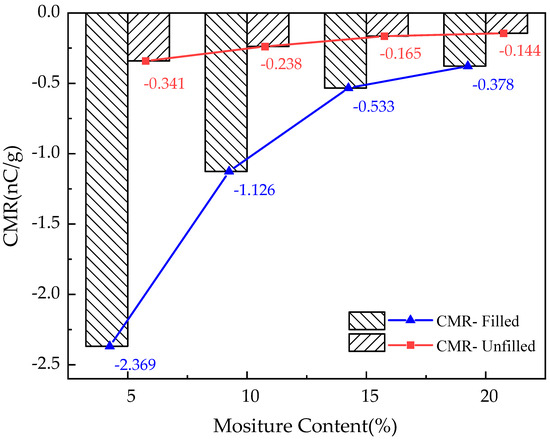
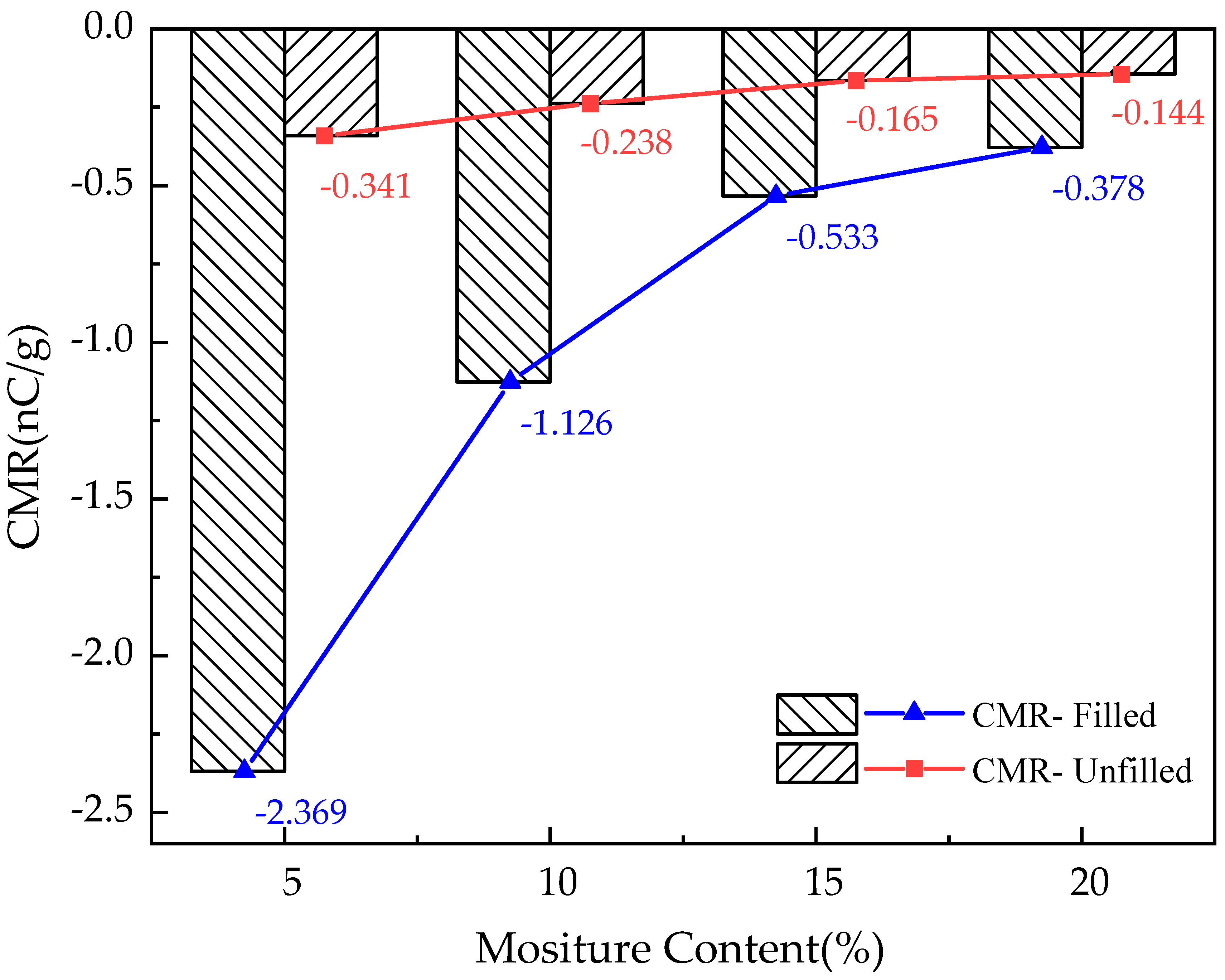
When the mass of the molecular sieve is 400 g, and the gas velocity is 12 m/s, the influence of moisture content on particle charge is compared between the cases with and without filling the molecular sieve, as shown in Figure 5. With the increase in particle moisture content, the CMR gradually decreases. Moisture significantly inhibits the charging process of the particles. Previous studies have shown that when fly ash is exposed to moisture, the charge characteristics of particles undergo significant changes [9]. When the external moisture content is less than 10%, the resistivity of the particles is relatively high, and the relative permittivity is low, which is favorable for particle charging, resulting in a significantly increased CMR. This is consistent with the results reported in reference [10]. As the moisture content of the particles increases, the accumulation of moisture on the particle surface increases the cohesion between the particles, leading to agglomeration. This reduces the contact area for collisions between particles and decreases the efficiency of collision charging [12]. At the same time, the increase in moisture content raises the surface conductivity of the particles, accelerating the charge neutralization and transfer processes, which, in turn, increases the diffusion rate of surface charges on the particles, leading to a reduction in the CMR.
Figure 5.
Influence of moisture content on particle charge. (Gas velocity: 12 m/s, 25 °C, 45% RH, feed quality: 15 g. Filled: molecular sieve: 400 g; unfilled: no molecular sieve.)
It is noteworthy that the remarkable difference in the CMR between the filled and unfilled molecular sieve systems at the same nominal particle moisture content cannot be solely explained by the moisture adsorption effect of molecular sieves. The introduction of molecular sieve beads increases the bed height in the fluidized bed charger, which significantly enhances the frequency of multi-scale contact and collision events during the fluidization process—including the collisions between CGFS particles and molecular sieve beads, as well as the repeated contacts between particles and the glass wall of the charging chamber. Previous studies have shown that the total charge of fluidized bed particles is closely related to humidity [7]. These intensified mechanical interactions effectively promote triboelectric charge separation and electron transfer between different contact surfaces, which is an important additional mechanism for the promotion of particle CMRs.
When the molecular sieve is not filled, the charging of the particles primarily occurs through collisions between them. The differences in CMRs for particles with different moisture contents are relatively small. For particles with moisture contents of 5% and 10%, their CMRs are −0.341 nC/g and −0.238 nC/g, respectively. When the moisture content increases from 15% to 20%, the CMR of the particles decreases from −0.165 nC/g to −0.144 nC/g. After filling the molecular sieve, the CMRs of the particles significantly increase. At moisture contents of 5% and 10%, the CMRs are −2.369 nC/g and −1.126 nC/g, respectively, while for moisture contents of 15% and 20%, the CMRs are −0.533 nC/g and −0.378 nC/g, respectively.
Therefore, when the moisture content does not exceed 10%, filling the molecular sieve can significantly promote the CMR of the particles, which contributes to improving the particle charging efficiency. This synergistic enhancement effect is attributed to the coupled action of two key mechanisms: on the one hand, molecular sieves adsorb moisture from particles and the ambient air, reducing particle surface conductivity and agglomeration to suppress charge dissipation and maintain effective charging [8,9]; on the other hand, molecular sieve beads intensify collision and contact dynamics in the charger, promoting the generation and separation of triboelectric charges to increase the charge amount of individual particles [12]. Under these conditions, it is more meaningful to study the effects of the mass of the filled molecular sieve and the gas velocity on the charging process. When the moisture content is 5%, the difference in CMR between the particles with and without a filled molecular sieve reaches its maximum value of −2.028 nC/g. As the moisture content increases, this difference gradually decreases. When the moisture content reaches 20%, the difference between the two is −0.234 nC/g. Therefore, when the moisture content exceeds 15%, the relatively low CMR of the particles is unfavorable for improving the efficiency of electrostatic separation since the severe particle agglomeration not only reduces collision contact efficiency but also weakens the positive effect of molecular sieve beads on triboelectric charging.
Table 2 presents the mass balance data of the molecular sieve charging and electrostatic separation system under different particle moisture contents (5–20%) with fixed 400 g molecular sieve filling and 12 m/s gas velocity (15 g feed mass). The Rm remained above 97.33% across all moisture conditions, with the Rr on internal components ranging from 1.86% to 2.67%. Notably, Rm slightly increased with rising moisture content, while Rr showed a gentle decreasing trend, indicating negligible particle adhesion and retention loss on molecular sieve beads and system walls under all experimental conditions. The high mass recovery efficiency verifies the reliability of the measured CMR and separation efficiency data in this study, with no significant interference from particle retention on experimental results.
Table 2.
Mass balance measurements of the charger system.
3.3. Influence of Molecular Sieve Filling Mass on Particle Charging
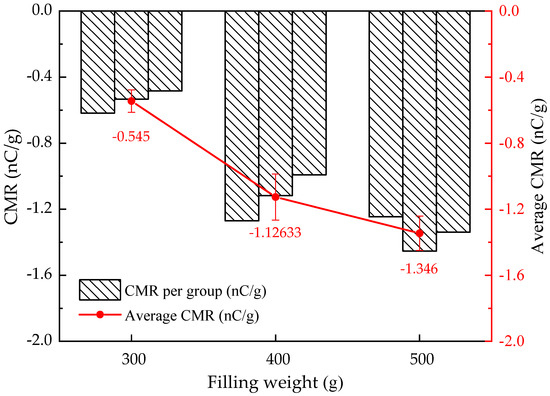
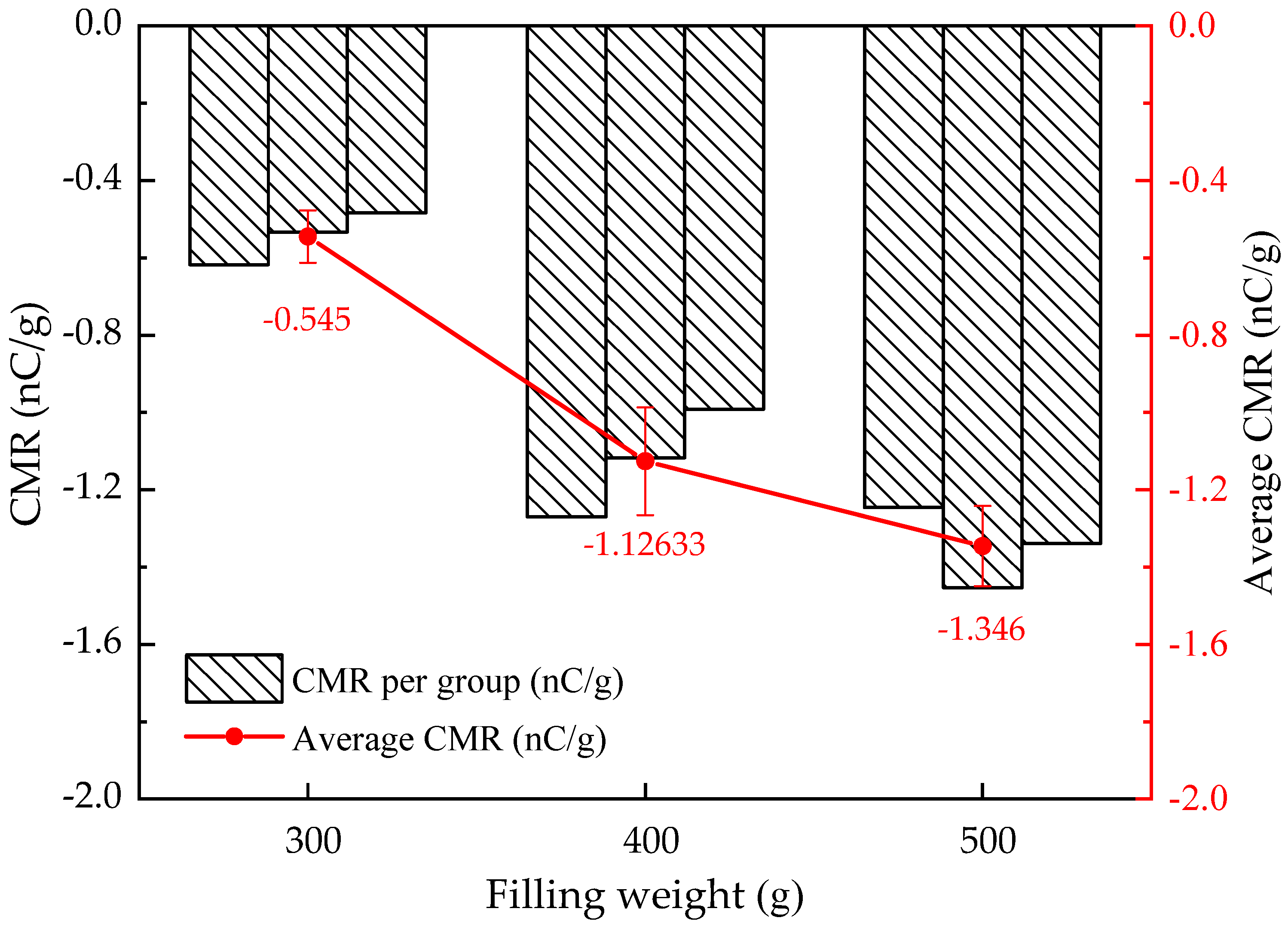
As shown in Figure 6, the effect of the molecular sieve filling quality on the particle charging performance of CGFS is investigated at an inlet gas velocity of 12 m/s and a moisture content of 10%. The experimental results indicate that with an increase in the mass of the molecular sieve, the bed height also rises correspondingly, leading to a gradual increase in both the particle CMR and the average CMR. Specifically, when the mass of the molecular sieve is increased from 300 g to 400 g, the average CMR of the particles rises from −0.545 nC/g to −1.126 nC/g. Further increasing the mass of the molecular sieve to 500 g results in an average CMR of −1.346 nC/g. Notably, when the filling mass of the molecular sieve is 400 g, the growth trend of the average CMR stabilizes.
Figure 6.
Effect of molecular sieve filling quality on particle charging (Gas velocity: 12 m/s, 25 °C, 45% RH, feed quality: 15 g, moisture content: 10%. Filled: molecular sieve.)
The continuous increase in the particle CMR with rising molecular sieve loading cannot be solely attributed to the enhanced drying and moisture reduction effect; the concomitant changes in contact and collision dynamics induced by increased bead loading are also well-recognized key drivers of triboelectric charge transfer. The elevated bed height from the higher molecular sieve filling mass first significantly increases the frequency of multi-scale contact events, including the collisions between CGFS particles and molecular sieve beads, as well as the repeated rubbing between particles and the glass wall of the charging chamber, which directly promotes triboelectric charge separation and electron transfer to facilitate charge accumulation on particle surfaces [7]. Secondly, the increased bed height prolongs the residence time of CGFS particles in the charger, providing sufficient time for both the molecular sieve to adsorb moisture from particle surfaces and the triboelectric charging events to proceed completely. In addition, the altered contact mechanics with higher bead loading optimizes the contact pressure and contact area between particles and beads during collisions, further improving the efficiency of triboelectric charge transfer. These mechanical contact-related effects synergistically act with the enhanced moisture removal effect to boost the particle CMR with increasing molecular sieve loading.
Moisture content has a direct regulatory effect on the generation, transfer, and dissipation of particle charges. On the one hand, water molecules adsorbed on the surface of the particles can reduce their work function, and differences in work function can alter the contact potential difference, thereby driving electron transfer [9]. On the other hand, the charging chamber walls are made of glass. Under the action of airflow, the molecular sieve and CGFS particles continuously collide and rub against the walls, generating static electricity. However, the formation of a water film between the moist particles and the wall creates a charge conduction pathway, causing the charges carried by the particles to flow back to the wall. Simultaneously, water molecules in the airflow increase the electrical conductivity of the air, further enhancing the probability of charge diffusion from the particle surface into the airflow [8]. The stabilization of the CMR growth at a molecular sieve filling mass of 400 g is attributed to the balance between the nearly saturated moisture adsorption effect of the molecular sieve and the gradually stable collision frequency and contact mechanics in the charger; a further increase in loading leads to only a slight improvement in charging performance due to the lack of significant enhancement in both drying and contact dynamics.
Table 2 shows that the total mass recovery rate remains above 97.45% at a particle moisture content of 10% across all molecular sieve bead loading conditions (300–500 g), with the particle retention rates on molecular sieve beads and internal walls being 1.95% (300 g), 2.28% (400 g) and 2.55% (500 g). This low and slight increase in retention loss with rising bead loading is attributed to the 10% moisture content effectively mitigating inter-particle and particle–surface adhesive forces, preventing significant particle adhesion on internal components. The retention rate is less than 3%. The LOI and CMR values in this study were corrected based on the actual collected particle mass, and the minor retention loss has no significant impact on the trend and conclusion of charging performance analysis.
3.4. Influence of Gas Velocity on Particle Charging
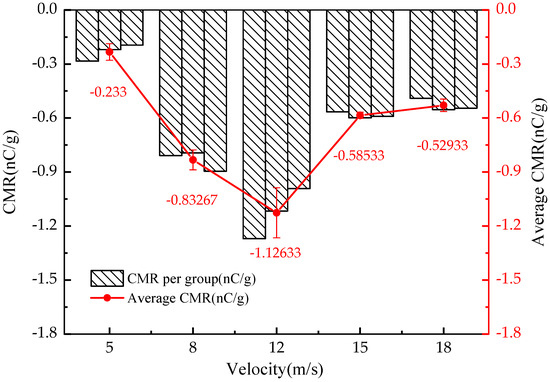
When the mass of the molecular sieve is 400 g, and the moisture content of the particles is 10%, the effect of gas velocity on the charging performance of CGFS particles is as illustrated in Figure 7. The results indicate that within the lower gas velocity range, the average CMR of the particles exhibits a gradually increasing trend with rising gas flow velocity. When the gas velocity reaches 12 m/s, the average CMR of the particles attains its maximum value, corresponding to a peak average CMR of −1.126 nC/g. After exceeding 12 m/s, the average CMR of the particles declines with increasing flow velocity and gradually stabilizes; at a gas velocity of 18 m/s, the average CMR increases by only 0.297 nC/g compared to that at 5 m/s. This indicates that only an appropriate inlet gas velocity can effectively increase the CMR of the CGFS particles.
Figure 7.
Effect of gas velocity on particle charging. (Molecular sieve: 400 g, 25 °C, 45% RH, moisture content: 10%, feed quality: 15 g.)
The non-monotonic variation of particle CMR with gas velocity is a synergistic result of molecular-sieve-induced moisture regulation and gas-velocity-driven collision-mechanical effects, rather than being dominated by drying efficiency alone. Classic studies have demonstrated that gas velocity is a key factor regulating triboelectric charging via its influence on particle–particle/particle–wall collision frequency, impact energy, and effective contact time [20,21], and these collision-mechanical mechanisms are closely coupled with the moisture reduction effect of molecular sieves in this study to determine the final charging performance of CGFS particles.
At low to moderate gas velocities (≤12 m/s), the moisture reduction effect of molecular sieves and the enhanced collision-mechanical behavior act synergistically to promote particle charging. On the one hand, the increasing gas velocity optimizes the fluidization state of CGFS particles and molecular sieve beads in the charger, enhancing the drying efficiency of molecular sieves for humid air and particle surfaces, which reduces particle surface conductivity and agglomeration, effectively suppressing charge neutralization and dissipation [7]. On the other hand, the rising gas velocity significantly increases the collision frequency of particle–particle, particle–molecular sieve bead and particle–glass wall contacts and elevates the impact energy of collisional interactions within the fluidized bed; the moderate increase in impact energy maintains elastic deformation at the contact interface, which is favorable for efficient triboelectric charge separation and electron transfer. Meanwhile, the optimized fluidization at 12 m/s ensures an adequate effective contact time for each collisional event, facilitating sufficient charge accumulation on the particle surface, which collectively contributes to the peak CMR at this critical gas velocity.
The molecular sieve exhibits a significant drying effect on humid air and particles, yet its drying efficiency varies notably with gas velocity. Within the lower gas velocity range, the gradual increase in airflow velocity enhances the mass and heat transfer between molecular sieves and the gas–solid two-phase system, leading to a significant reduction in the moisture content of both the ambient air and particle surfaces [11]. Conversely, once the gas velocity exceeds 12 m/s, further increases in flow rate result in a gradual decline in the drying performance of the molecular sieve: the excessively high gas velocity shortens the residence time of humid air and particles in the charger, weakening the moisture adsorption capacity of molecular sieves and leading to a slight rebound in particle surface moisture content. More importantly, the excessively high gas velocity causes a further increase in collision impact energy, which triggers a transition from elastic to plastic deformation at the contact interface of colliding particles; this plastic deformation reduces the effective contact area for triboelectric charge transfer and accelerates charge relaxation at the contact interface, significantly deteriorating the charging efficiency. Additionally, the excessively high gas velocity shortens the effective contact time of collisional interactions, limiting the sufficient generation and accumulation of triboelectric charges.
The molecular sieve’s regulation of air humidity can affect the dynamic balance between adsorption and desorption processes between the molecular sieve and the particles. Consequently, as the gas flow velocity increases, the molecular sieve’s ability to adsorb moisture from the particles initially improves and then diminishes, demonstrating a corresponding pattern where the moisture content of the particles first decreases and then increases. At gas velocities > 12 m/s, the weakened drying efficiency of molecular sieves (causing increased charge dissipation), and the deteriorated collision-mechanical conditions (excessive impact energy, plastic deformation, and shortened effective contact time, leading to reduced charge generation) act competitively, resulting in the continuous decline and subsequent stabilization of the particle CMR. This fully explains the non-monotonic variation in CGFS particle charging performance with gas velocity and is consistent with the established research conclusions on velocity-dependent triboelectric charging in gas–solid fluidized beds.
3.5. Influence of Molecular Sieve on Particle Electrostatic Separation
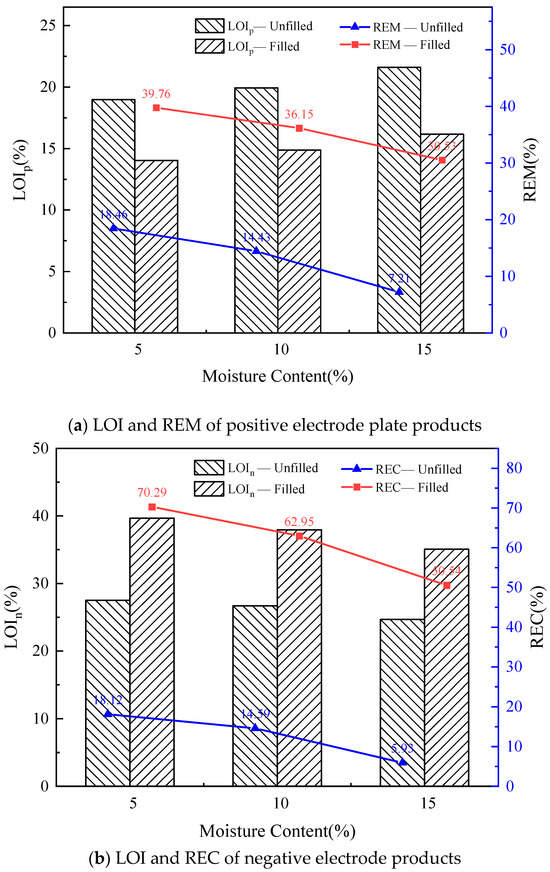
Molecular sieve drying is effective in reducing the moisture content of CGFS particles and improving the charge mass ratio of particles. It is feasible that it can be used to enhance particle charging. In order to test the effectiveness of molecular sieve in improving electrostatic separation, electrostatic separation experiments of CGFS particles with different moisture content (5%, 10%, and 15%) were carried out under the conditions of filling the molecular sieve and not filling the molecular sieve. The separation results, including product LOI, REM, REC, product mass yield and total mass balance parameters, are shown in Figure 8 and Table 3. Prior to the efficiency analysis, the moisture re-equilibration of molecular-sieve-treated particles and ash mass distribution in products were quantitatively investigated to exclude potential interference factors.
Figure 8.
Experimental results of electrostatic separation of CGFS. (Electric field density: 30 kV/m, filling molecular sieve: 400 g, gas velocity: 12 m/s, 25 °C, 45% RH, feed quality: 50 g).
Table 3.
Product mass yield and mass balance of CGFS electrostatic separation.
Table 3 presents the mass distribution of electrostatic separation products and mass balance parameters of the CGFS electrostatic separation under unfilled and molecular sieve-filled conditions at moisture contents of 5%, 10% and 15%. The Rm of the separation system remained above 94.42% across all experimental conditions, with the particle retention rate Rr ranging from 4.48% to 5.58%, indicating a low level of particle adhesion and retention on the internal components of the separation system and good material recovery performance of the experimental system. Under the same moisture content, the filling of molecular sieve slightly altered the mass distribution of separation products: Y+ showed a noticeable decrease, Y− presented a slight increase, and Yt had a marginal rise, which reflected the improved separation efficiency of carbon and ash particles after molecular-sieve-enhanced charging. The minor variation in Rm and Rr between the filled and unfilled conditions suggested that molecular sieve filling had no significant impact on particle retention in the separation system, and the slight change in product mass distribution was entirely attributed to the enhanced triboelectric charging and electrostatic separation effect of CGFS particles.
Figure 8 shows that filling the molecular sieve has a significant regulation effect on the LOI of positive plate products after electrostatic separation of CGFS. When the molecular sieve was not filled, the LOI of the positive plate product increased continuously from 18.99% to 21.61% as the moisture content of the sample increased from 5% to 15%, indicating that high moisture content would reduce the separation efficiency of carbon components in the separation process. After filling the molecular sieve, the LOI of the positive plate product decreased significantly under the same moisture content. For the particles with water contents of 5% and 10%, the LOI of the positive plate product can be reduced by 4.96% and 5.06%, respectively, while for the particles with water content of 15%, the LOI can reach 5.43%. For the material with 5% moisture content, the LOI of the negative plate can be increased from 39.66% to 45.17% by filling the molecular sieve. For the materials with 10% and 15% moisture contents, the LOI of the negative plate will increase by 6.10% and 4.89%, respectively. Therefore, under the condition of the same moisture content of raw materials, filling the molecular sieve can significantly improve the LOI of the negative plate. This confirms that the combined effects of moisture reduction and enhanced collision-mechanical charging by molecular sieve can effectively strengthen particle charge, improve the carbon–ash separation efficiency of electrostatic separation, and reduce the adverse effect of increased moisture content on CGFS electrostatic separation.
It can be seen that the filled molecular sieve can significantly improve the decarburization efficiency index of the positive plate. Under the condition of the same moisture content of raw materials, the REM value of the filled molecular sieve is much higher than that of the unfilled molecular sieve. For particles with 5% moisture content, the REM value after filling the molecular sieve increased significantly from 18.46% to 39.76%, and the decarburization effect was obvious. At the same time, with the moisture content of raw materials increasing from 5% to 15%, REM values showed a downward trend, indicating that excessive moisture had a negative impact on decarbonization efficiency. However, filling the molecular sieve effectively slowed down this downward trend. The REM of unfilled zeolite decreased by 11.25%, while that of filled zeolite decreased by 9.23%, showing better stability. Therefore, the filled molecular sieve can not only greatly improve the decarburization efficiency of the positive plate, but also enhance the adaptability of the electrostatic separation process to the fluctuation of raw material moisture content to a certain extent.
The negative plate REC showed a significant downward trend with the increase in particle moisture content. When the molecular sieve is not filled, the REC values corresponding to moisture contents of 5%, 10% and 15% are 70.29%, 62.95% and 50.54%, respectively; after filling the molecular sieve, the corresponding REC values increased to 93.95%, 89.14% and 71.53%, respectively. For particles with a moisture content of 5%, the REC can be increased by 23.66% by filling the molecular sieve, indicating that the molecular sieve can significantly improve the REC of negative plates by strengthening the drying and collision-mechanical charging performance of particles, and the promotion effect is more prominent under the condition of low moisture content.
Table 3 shows that the total mass recovery rate of the separation system remained above 94.42% under all experimental conditions, with the particle retention rate ranging from 4.48% to 5.58%. The low retention rate indicates negligible particle loss on internal components, and the slight retention has no significant impact on the quantitative analysis of separation efficiency. Based on the supplemented product mass yield, full mass balance and ash distribution data, the observed improvements in REM and REC are confirmed to represent the true carbon–ash separation efficiency of the electrostatic separation process, with no interference from ash redistribution, particle retention or transient moisture effects. Therefore, molecular sieving is effective in improving the electrostatic separation efficiency of CGFS particles. The positive plate REM and negative plate REC with a moisture content of 5% particles are the highest, and the separation efficiency is the best.
3.6. Industrial Application Prospects
The 3A molecular-sieve-assisted CGFS electrostatic separation technology proposed in this study combines industrial applicability and ecological value feasibility while also having a broad expansion space. It can provide a new technical method for CGFS resource utilization and electrostatic separation for high-moisture fine solid waste, with broad application prospects.
In terms of industrial applications, the technology has strong practicality and a wide expansion scope. The optimal process conditions determined by the research can be directly adapted to the industrial transformation of CGFS electrostatic separation. The 3A molecular sieve used can be directly purchased from the market, and the experimental system can be flexibly scaled up according to industrial production capacity. The transformation cost is low, and it is easy to achieve industrial conversion. At the same time, the molecular-sieve-assisted dehumidification and -enhanced charging method can also be extended to fine mineral particles, such as fly ash and coal gangue, as well as the electrostatic separation of high moisture content and small-particle-size solid waste, such as industrial sludge and metal oxide fine powder, with diverse application scenarios.
Compared to flotation methods [27,28], the electrostatic separation and quality improvement of gasification fine slag also have significant ecological benefits, which are in line with the requirements of green development and dual carbon goals. The annual emissions of CGFS can reach millions of tons, and storage can easily cause environmental problems, such as soil and water pollution and spontaneous combustion of carbon components. The application of electrostatic separation technology can greatly improve the efficiency of CGFS carbon–ash separation, realizing the resource recovery of high-carbon components (used as fuel) and high-purity ash components (used as building materials and adsorbents), truly turning waste into treasure. In addition, electrostatic separation is a dry process technology, and molecular-sieve-assisted wet separation eliminates the large amount of water used in traditional wet separation, making it particularly suitable for water-scarce areas in the coal chemical industry. It not only saves water resources but also avoids the generation of dust containing wastewater, reducing the risk of water pollution.
4. Conclusions
- (1)
- The moisture reduction effect of molecular sieves on CGFS particles with high moisture content is significant. The higher the moisture content of particles, the greater the dehydration rate. This is due to the high proportion of free water on the surface of particles at high moisture content, strong activity, and easier adsorption by molecular sieves. However, when the initial moisture content exceeds by 15%, the moisture content change rate slows down, indicating that the adsorption of molecular sieve gradually approaches saturation, and the drying efficiency decreases. Higher particle moisture content increases adhesive forces between particles and solid surfaces, leading to particle retention rates in the internal components of the charger and separator of less than 2.67% and 5.58%, respectively.
- (2)
- The charging promotion effect of molecular sieves on particle charge is obvious. Molecular sieves can significantly improve the charge mass ratio of CGFS particles, especially when the moisture content is no higher than 10%. The charge mass ratio of the particles decreases with the increase in water content, and water content will inhibit the charge efficiency. Molecular sieves realize the synergistic improvement of particle CMR through a dual mechanism: on the one hand, they adsorb surface moisture of particles to reduce surface conductance and particle agglomeration, thus suppressing charge neutralization and dissipation; on the other hand, the molecular sieve beads increase the collision and contact frequency between particles and beads, as well as between particles and the charger wall, which effectively strengthens triboelectric collision charging and promotes charge generation and separation. The mass recovery rate of the molecular sieve charger system is above 97.45% under all bead loading conditions, with negligible particle retention loss that has no significant effect on CMR analysis. Therefore, the maximum charge efficiency can be obtained by controlling the moisture content not higher than 10%, an electric field density of 30 kV/m, a filling molecular sieve of 400 g, and a gas velocity of 12 m/s (volumetric flow rate 84.78 m3/h), and the maximum average charge mass ratio is −1.126 nC/g.
- (3)
- Molecular sieves can significantly improve the separation efficiency of carbon ash particles from CGFS through the synergistic effect of moisture reduction and charging promotion. The positive plate REM and negative plate REC with 5% moisture content particles will be significantly increased to 39.76% and 93.95% respectively. Molecular sieves can effectively restrain the negative impact of high moisture content on separation efficiency by adsorbing moisture and enhancing the adaptability of the process to the fluctuation of raw material moisture content. The electrostatic separation system maintains a mass recovery rate above 94.42% under all moisture content conditions. Mass balance verification of the separation system shows that the minor particle retention loss has no significant impact on the reported separation efficiency. It is feasible to strengthen the electrostatic separation of particles with molecular sieves, which has a good application prospect in practical industrial production and ecological value.
Author Contributions
Conceptualization, C.L. and H.Z.; methodology, H.L. and J.L.; software, Z.X. and H.Z.; validation, C.L. and Q.G.; formal analysis, C.L. and Q.Z.; investigation, Q.Z.; resources, J.L. and Q.G.; data curation, J.L.; writing—original draft, Z.X., C.L. and H.Z.; writing—review and editing, C.L. and Y.C.; visualization, Q.G.; supervision, H.L.; project administration, Y.C.; funding acquisition, H.L. All authors have read and agreed to the published version of the manuscript.
Funding
The authors thank the National Key Research and Development Program of China [grant 2025YFE0219700] and the National Natural Science Foundation of China [grant 51674259] for funding this work.
Data Availability Statement
The original contributions presented in this study are included in the article. Further inquiries can be directed to the corresponding authors.
Acknowledgments
The authors thank China University of Mining and Technology for providing the samples that were analyzed in this study.
Conflicts of Interest
Author Jie Li and Qiqiang Gao were employed by the Shaanxi Yongming Coal Mine Co., Ltd., Yanan 717306, China. Author Qiang Zhao was employed by the Hangzhou Augmented Intelligence Manufacturing Solutions Co., Ltd., Hangzhou 310051, China. The remaining authors declare that the research was conducted in the absence of any commercial or financial relationships that could be construed as a potential conflict of interest.
References
- Liu, X.D.; Jin, Z.W.; Jing, Y.H.; Fan, P.; Qi, Z.; Bao, W.; Wang, J.; Yan, X.; Lv, P.; Dong, L. Review of the characteristics and graded utilisation of coal gasification slag. Chin. J. Chem. Eng. 2021, 35, 92–106. [Google Scholar] [CrossRef] [Scilit]
- Chen, C.S.; Shenoy, S.; Pan, Y.H.; Sasaki, K.; Tian, Q.; Zhang, H. Mechanical activation of coal gasification slag for one-part geopolymer synthesis by alkali fusion and component additive method. Constr. Build. Mater. 2024, 411, 134585. [Google Scholar] [CrossRef] [Scilit]
- Patel, S.K.; Satpathy, H.P.; Nayak, A.N.; Mohanty, C.R. Utilization of Fly Ash Cenosphere for Production of Sustainable Lightweight Concrete. J. Inst. Eng. (India) Ser. A 2019, 101, 179–194. [Google Scholar] [CrossRef] [Scilit]
- Li, M.; Zhang, J.; Li, A.; Zhou, N. Reutilisation of coal gangue and fly ash as underground backfill materials for surface subsidence control. J. Clean. Prod. 2020, 254, 120113. [Google Scholar] [CrossRef] [Scilit]
- Chen, X.; Song, H.; Guo, Y.; Wang, L.; Cheng, F. Converting waste coal fly ash into effective adsorbent for the removal of ammonia nitrogen in water. J. Mater. Sci. 2018, 53, 12731–12740. [Google Scholar] [CrossRef] [Scilit]
- Yu, W.; Zhang, H.L.; Wang, X.B.; Rahman, Z.U.; Shi, Z.; Bai, Y.; Wang, G.; Chen, Y.; Wang, J.; Liu, L. Enrichment of residual carbon from coal gasification fine slag by spiral separator. J. Environ. Manag. 2022, 315, 115149. [Google Scholar] [CrossRef] [Scilit]
- Kolehmainen, J.; Sippola, P.; Raitanen, O.; Ozel, A.; Boyce, C.M.; Saarenrinne, P.; Sundaresan, S. Effect of humidity on triboelectric charging in a vertically vibrated granular bed: Experiments and modeling. Chem. Eng. Sci. 2017, 173, 363–373. [Google Scholar] [CrossRef] [Scilit]
- Cangialosi, F.; Notarnicola, M.; Liberti, L.; Stencel, J. The role of weathering on fly ash charge distribution during triboelectrostatic beneficiation. J. Hazard. Mater. 2009, 164, 683–688. [Google Scholar] [CrossRef] [Scilit]
- Baltrus, J.P.; Diehl, J.R.; Soong, Y.; Sands, W. Triboelectrostatic separation of fly ash and charge reversal. Fuel 2002, 81, 757–762. [Google Scholar] [CrossRef] [Scilit]
- Zhou, H.; Zhang, X.; Miao, W.; Li, H.; Chen, Y.; Chen, J. Inspiration of quartz bipolar charging in pipe conveying: Enhancement on triboelectrostatic separation of gasification fine slag by wet sieving. Powder Technol. 2024, 448, 120277. [Google Scholar] [CrossRef] [Scilit]
- Li, H.; Chen, Y.; Zhang, X.; Li, C. The role of electrical heating on tribocharging and triboelectrostatic beneficiation of fly ash. Physicochem. Probl. Miner. Process. 2019, 55, 896–905. [Google Scholar]
- Zhou, H.; Yao, J.; Chen, S.; Li, H.; Chen, Y.; Wu, X. Effect of moisture content on charging and triboelectrostatic separation of coal gasification fine ash. Sep. Purif. Technol. 2024, 333, 125976. [Google Scholar] [CrossRef] [Scilit]
- Cangialosi, F.; Notarnicola, M.; Liberti, L.; Caramuscio, P.; Belz, G.; Gurupira, T.; Stencel, J. Significance of surface moisture removal on triboelectrostatic beneficiation of fly ash. Fuel 2006, 85, 2286–2293. [Google Scholar] [CrossRef] [Scilit]
- Xia, L.; Zhou, H.; Li, H.; Chen, Y.; Kang, J.; Yao, J.; Chen, J. Promoting effect of microwave heating and thermal storage ball on drying and triboelectrostatic separation of wet CGFS particles. Powder Technol. 2025, 465, 121333. [Google Scholar] [CrossRef] [Scilit]
- Matsusaka, S.; Maruyama, H.; Matsuyama, T.; Ghadiri, M. Triboelectric charging of powders: A review. Chem. Eng. Sci. 2010, 65, 5781–5807. [Google Scholar] [CrossRef] [Scilit]
- Matsusaka, S. Control of particle tribocharging. KONA Powder Part. J. 2011, 29, 27–38. [Google Scholar] [CrossRef] [Scilit]
- Tao, Y.; Zhang, L.; Tao, D.; Xian, Y.; Sun, Q. Effects of key factors of rotary tribo-electrostatic separator on efficiency of fly ash decarbonization. Int. J. Min. Sci. Technol. 2017, 27, 1037–1042. [Google Scholar] [CrossRef] [Scilit]
- Wang, W.; Xia, L.; Li, H.; Chen, Y.; Xu, Z.; Chen, J.; Zhou, H. Investigation on electrostatic separation of coal gasification fine slag enhanced by corona charging. Int. J. Coal Prep. Util. 2026, 46, 359–380. [Google Scholar] [CrossRef] [Scilit]
- Xing, Y.; Guo, F.; Xu, M.; Gui, X.; Li, H.; Li, G.; Xia, Y.; Han, H. Separation of unburned carbon from coal fly ash: A review. Powder Technol. 2019, 353, 372–384. [Google Scholar] [CrossRef] [Scilit]
- Hou, J.T.; Grace, J.R.; Bi, X.T. Effect of fluidizing gases, humidity, and grounding on particle charging dynamics in gas-solids fluidized beds. Chem. Eng. Sci. 2025, 306, 121279. [Google Scholar] [CrossRef] [Scilit]
- Fotovat, F.; Bi, X.T.T.; Grace, J.R. Electrostatics in gas-solid fluidized beds: A review. Chem. Eng. Sci. 2017, 173, 303–334. [Google Scholar] [CrossRef] [Scilit]
- Zhang, J.; He, J.; Wang, G.; Ma, H.; Zhan, X.; Zhang, D. Study on the Adsorption of Trace Water in N-Methyl-pyrrolidone Solvents by A-Type Molecular Sieves. ACS Omega 2024, 9, 15481–15492. [Google Scholar] [CrossRef] [Scilit]
- Cybulski, M.; Przybylek, P. The application of a molecular sieve for drying the insulation system of a power transformer in terms of improving its perational reliability. Eksploat. Niezawodn. 2022, 24, 502–509. [Google Scholar] [CrossRef] [Scilit]
- Jovic, S.; Laxrninarayan, Y.; Keurentjes, J. Adsorptive Water Removal from Dichloromethane and Vapor-Phase Regeneration of a Molecular Sieve 3A Packed Bed. Ind. Eng. Chem. Res. 2017, 56, 5042–5054. [Google Scholar] [CrossRef] [Scilit] [PubMed]
- Javadi, M.; Abohelw, M.; Wollmann, A.; Weber, A.P. Characteristics of powder charging behavior via forced triboelectric charging on an inclined chute. Powder Technol. 2025, 449, 120400. [Google Scholar] [CrossRef] [Scilit]
- GB/T 212-2008; Proximate Analysis of Coal. China Standard Press: Beijing, China, 2008.
- Zhang, N.N.; Cheng, M.Y.; Han, R.; Li, Z.; Chen, S.; Zhu, Z.; Yu, Y.; Zhou, A. Innovative flotation separation considering pores blocking to facilitate residual carbon recovery from coal gasification fine slag. Sep. Purif. Technol. 2023, 310, 123254. [Google Scholar] [CrossRef] [Scilit]
- Ren, L.; Gong, Y.; Guo, Q.H.; Yu, G. Enhanced flotation of coal gasification fine slag based on ultrasonic pretreatment pulp and composite collector. Powder Technol. 2023, 424, 118530. [Google Scholar] [CrossRef] [Scilit]

Disclaimer/Publisher’s Note: The statements, opinions and data contained in all publications are solely those of the individual author(s) and contributor(s) and not of MDPI and/or the editor(s). MDPI and/or the editor(s) disclaim responsibility for any injury to people or property resulting from any ideas, methods, instructions or products referred to in the content. |
© 2026 by the authors. Licensee MDPI, Basel, Switzerland. This article is an open access article distributed under the terms and conditions of the Creative Commons Attribution (CC BY) license.