


Abstract
To investigate the effect of calcination temperature on the electrochemical lithium-adsorption performance of Prussian blue-derived iron oxides, Prussian blue (PB) synthesized via a hydrothermal method was used as the precursor. A series of iron-oxide materials were obtained by calcination at 350, 550, and 650 °C in air. Scanning electron microscopy (SEM), X-ray diffraction (XRD), X-ray photoelectron spectroscopy (XPS), Fourier-transform infrared spectroscopy (FT-IR), and N2 adsorption–desorption isotherms were employed to characterize the morphology, crystal phase, and pore structure of the prepared materials. Their electrochemical behaviors, Li+ adsorption capacity, adsorption kinetics, and cycling stability were evaluated in LiCl electrolyte. The results reveal that calcination temperature exerts a significant influence on the pore-structure evolution and crystal-phase transformation of the adsorbents. PB-Fe2O3 (350 °C) delivers the largest specific surface area of 67.52 m2·g−1; PB-Fe2O3 (550 °C) forms a mixed β/γ-Fe2O3 phase while preserving the mesoporous structure; obvious particle agglomeration and pore-structure shrinkage occur for PB-Fe2O3 (650 °C). At −0.9 V (vs. saturated calomel electrode, SCE), the maximum experimentally determined Li+ adsorption capacity of PB-Fe2O3 (550 °C) reaches 132.23 mg·g−1, which is higher than those of pristine PB, PB-Fe2O3 (350 °C), and PB-Fe2O3 (650 °C). Kinetic analyses demonstrate that the Li+ adsorption processes of pristine PB and PB-Fe2O3 (550 °C) can be well described by the pseudo-first-order kinetic model. After 10 charge–discharge cycles, PB-Fe2O3 (550 °C) maintains a capacity retention above 93%, exhibiting favorable short-term cycling stability. Moreover, in a binary Li+/Mg2+ simulated brine, PB-Fe2O3 (550 °C) exhibited preferential Li+ uptake with a Li+/Mg2+ separation factor was 4.07, demonstrating its potential for selective lithium recovery from Mg2+-rich brines. Appropriate calcination can harmonize the pore-structure, crystal-phase, and oxygen-vacancy characteristics of materials, thus improving their electrochemical lithium-adsorption performance. This work provides experimental support for structural regulation and performance optimization of Prussian blue-derived iron oxides for electrochemical lithium adsorption.
1. Introduction
Driven by the rapid growth of new energy vehicles, electrochemical energy storage, and consumer electronics industries, the demand for lithium resources continues to increase rapidly. According to data from the International Energy Agency (IEA), global demand for power batteries exceeded 750 GWh in 2023, with the battery industry accounting for approximately 85% of total global lithium consumption. Global lithium demand is projected to expand significantly further by 2030 [1,2]. However, conventional hard-rock extraction and salt-pan evaporation processes suffer from high energy consumption, substantial water usage, and significant environmental disruption, making it difficult to meet the requirements for green, efficient, and sustainable lithium resource development [3,4]. In China, lithium resources are mainly concentrated in salt lake brines in regions such as Qinghai and Tibet. Unlike typical salt lakes with low Mg/Li ratios in South America, Chinese salt lake brines generally exhibit low lithium concentrations and high Mg/Li ratios, with some brines having Mg/Li ratios ranging from tens to hundreds [5,6]. Because Li+ and Mg2+ possess similar hydrated ionic radii and solution chemical behaviors, the selective separation and efficient recovery of Li+ under high Mg/Li ratio conditions remain key challenges constraining the industrialization of salt-lake lithium extraction in China [6,7].
Currently, lithium extraction from salt lake brines mainly relies on technical routes such as precipitation, solvent extraction, adsorption, membrane separation, and electrochemical techniques [6,7,8,9]. Although conventional precipitation and solar evaporation processes are mature, they suffer from long processing cycles, elevated consumption of alkaline precipitants, and limited resource utilization efficiency, and they are generally applicable only to brines with relatively low Mg/Li ratios [3,4,5,6]. Solvent extraction offers good selectivity, but the widely used tributyl phosphate (TBP)/FeCl3 systems require high acid concentrations for stripping and careful regeneration, which cause serious equipment corrosion, high reagent consumption, co-extraction of Na+, and organic-solvent loss with associated environmental risks [4,5,6,7,9,10,11]. Adsorption methods are suitable for high Mg/Li ratio brines, yet certain adsorbents face notable limitations: lithium-ion sieves (e.g., Mn- and Ti-based) suffer from metal dissolution loss during acid elution, slow adsorption kinetics, high fresh-water consumption during regeneration, and limited adsorption capacity, and their powder form leads to high pressure drops and difficult separation in practical operation [4,5,6,7,9,10,12]. Membrane separation is often constrained by membrane fouling, scaling, and concentration polarization in high-salinity environments, which progressively degrade membrane permeability and Li+/Mg2+ selectivity over time [4,7,9,10,13]. In contrast, electrochemical lithium extraction utilizes electrode materials to achieve ion-selective separation through reversible Li+ insertion/extraction or charge compensation. This approach features mild operating conditions, controllable processes, low energy consumption, and high selectivity, and is widely regarded as a promising emerging technology for salt-lake lithium extraction [8,14,15]. Therefore, developing electrode materials that combine Li+ selectivity, rapid ion transport, and good cycling stability is essential for enhancing electrochemical lithium extraction efficiency.
Electrode materials currently used for electrochemical lithium extraction mainly include lithium manganate, lithium iron phosphate, lithium nickel cobalt manganese oxide, and Prussian blue analogs (PBAs) [8,14,16,17]. Among them, LiMn2O4 (LMO) possesses three-dimensional Li+ diffusion channels and favorable Li+ selectivity; however, Mn-based materials are susceptible to structural distortion and metal dissolution during prolonged cycling. LiFePO4 (LFP) exhibits a stable olivine structure and good Li+ selectivity, but its intrinsic electronic/ionic transport capabilities still require further improvement [18,19]. By comparison, Prussian blue (PB) and its analogs possess open three-dimensional framework structures, large ion-transport channels, and abundant redox-active sites. These features provide a structural foundation for the reversible insertion/extraction of alkali metal ions, while their electronic structures and redox characteristics can be tuned through transition-metal components [20,21,22,23]. Previous studies have demonstrated that PB and its analogs can serve as active electrode materials in electrochemical lithium extraction and capacitive deionization systems, exhibiting satisfactory Li+ adsorption capacity and cycling stability [24,25]. These characteristics render PB an important precursor and research platform for constructing novel electrochemical lithium extraction materials.
In addition to direct use as electrode materials, PB’s unique coordination structure endows it with potential for preparing porous metal oxides via pyrolysis. During heat treatment in an air atmosphere, the cyanide ligands in PB gradually decompose accompanied by the oxidation of iron species, forming Fe2O3 with distinct microstructures, while ligand liberation induces pore structure reconstruction [26,27,28]. Previous studies have shown that the pyrolysis temperature, heating rate, and precursor structure of PB influence the crystalline phase composition, grain size, and pore structure of the resulting iron oxides; appropriate heat treatment conditions are conducive to obtaining high specific surface areas and hierarchical porous structures. PB-derived iron oxides have shown promising application potential in lithium-ion storage and electrochemical separation, suggesting that precursor-derived structures can provide favorable conditions for Li+ transport and storage [27,28,29]. Heterojunction engineering is an effective strategy for enhancing the electrochemical ion storage and separation performance of iron-based oxides. Building iron-based heterointerfaces generates a built-in electric field, which lowers the activation energy barrier for charge transfer and optimizes lithium-ion migration kinetics. Furthermore, lattice distortion at heterointerfaces provides numerous redox-active sites, thereby improving both the target ion adsorption capacity and reaction reversibility [30,31]. In addition, for electrode materials in electrochemical lithium extraction, ion diffusion/mass transfer behavior and long-term cycling stability are crucial metrics alongside adsorption capacity in determining practical applicability.
Based on these considerations, this study utilizes hydrothermally synthesized Prussian blue cubic crystals as precursors to construct a series of PB-derived Fe2O3 materials via calcination at various temperatures in air. Particular focus is placed on investigating the effects of calcination temperature on the micro-morphology, pore structure, phase composition, and surface chemical states of the adsorbents. SEM, EDS, XRD, XPS, FT-IR, and BET (N2 adsorption–desorption) measurements were employed to analyze structural evolution. Combined with CV, EIS, chronoamperometry (i–t), ICP-OES, GCD adsorption kinetics, and cycling stability tests, the Li+ electrochemical adsorption behavior and stability of adsorbents calcined at different temperatures were systematically evaluated. On this basis, the relationships governing the influence of calcination temperature on adsorbent structure, electrochemical interfacial behavior, and Li+ adsorption performance were elucidated. Through multi-dimensional electrochemical characterization, optimal calcination temperature and adsorption potential were identified, and the structure-property relationship for electrochemical Li+ adsorption was further explored, providing insights for applying PB-derived porous iron oxides to electrochemical lithium recovery.
2. Materials and Methods
2.1. Experimental Reagents and Instruments
Main Reagents: Polyvinylpyrrolidone (PVP), potassium ferrocyanide (K4[Fe(CN)6]·3H2O), hydrochloric acid (HCl), anhydrous ethanol, anhydrous lithium chloride (LiCl), and sodium chloride (NaCl) were analytical grade and supplied by Aladdin (Shanghai, China). Nafion solution (5 wt%), hydrophobic carbon paper and Nafion 117 proton exchange membranes were purchased from Shengernuo Technology Co., Ltd. (Suzhou, China). Self-prepared deionized water and ultrapure water were used throughout all experiments.
Instruments and Equipment: CP214 precision electronic balance (OHAUS, Parsippany, NJ, USA), 85-2 constant-temperature magnetic stirrer (Changzhou Guoyu Instrument Manufacturing Co., Ltd., Changzhou, China), DHG-907A blast drying oven (Shanghai Lichen-BX Instrument Technology Co., Ltd., Shanghai, China), 100 mL Teflon-lined hydrothermal autoclave (Xi’an Toption Instrument Co., Ltd., Xi’an, China), TGL-20B high-speed centrifuge (Shanghai Anting Scientific Instrument Factory, Shanghai, China), KSL-1000X muffle furnace (MTI Corporation, Richmond, CA, USA), KQ-3200 ultrasonic cleaner (Kunshan Shumei Ultrasonic Instruments Co., Ltd., Kunshan, China), 5800 ICP-OES inductively coupled plasma optical emission spectrometer (Thermo Fisher Scientific, Waltham, MA, USA), CHI760E electrochemical workstations (Shanghai Chenhua Instrument Co., Ltd., Shanghai, China), and CT3004A Land battery testing system (Wuhan Land Electronic Co., Ltd., Wuhan, China).
2.2. Adsorbent Preparation
2.2.1. Synthesis of Prussian Blue and Derived Iron Oxides
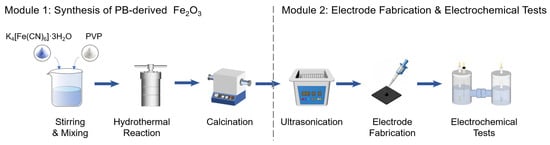
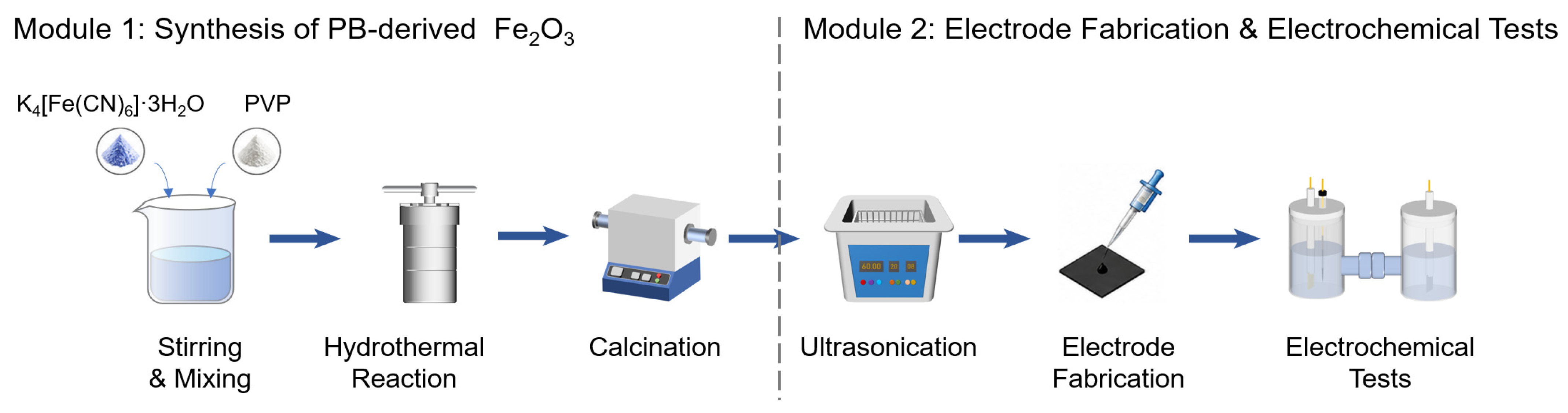
The preparation process of the adsorbents is schematically illustrated in Figure 1. Briefly, 3.8 g of PVP and 0.11 g of K4[Fe(CN)6]·3H2O were dissolved in 50 mL of 0.1 M HCl solution and magnetically stirred at room temperature for 30 min. The mixed solution was transferred into an autoclave and reacted at 80 °C for 24 h. After cooling to room temperature, the product was collected by centrifugation, washed alternately three times with ultrapure water and ethanol, and dried and ground to yield a blue Prussian blue powder.
Figure 1.
Schematic illustration for the synthesis of PB-derived Fe2O3 adsorbents, electrode fabrication, and subsequent electrochemical tests.
The prepared Prussian blue powder was divided equally into four portions: one portion was kept as the pristine sample; the remaining three portions were placed in a muffle furnace and calcined under an air atmosphere at a heating rate of 2 °C·min−1 at 350, 550, and 650 °C for 6 h, respectively. After cooling and grinding, the samples were labeled as PB-Fe2O3 (350 °C), PB-Fe2O3 (550 °C), and PB-Fe2O3 (650 °C).
2.2.2. Working Electrode Fabrication
As shown in Figure 1, 4.8 mg of the adsorbent to be tested was added to a mixture of 4.8 μL Nafion solution and 2 mL anhydrous ethanol, followed by ultrasonic dispersion for 30 min to obtain a uniform suspension. A 1250 μL aliquot of the suspension was drop-coated incrementally onto hydrophobic carbon paper (1.5 cm × 1.5 cm), with an effective coated area of 1.5 cm × 1.0 cm. After drop-coating, the electrodes were dried at room temperature for over 8 h prior to use, ensuring consistent effective working areas across different batches. Upon weighing, the actual mass loading of active material on each carbon paper substrate was approximately 3 mg (with loading variations controlled within ±5% across different batches).
2.3. Structural and Material Characterization
Field emission scanning electron microscopy (FESEM, Helios 5CX, Thermo Fisher Scientific, Waltham, MA, USA) was used to analyze morphology. X-ray diffraction (XRD, Empyrean, Malvern Panalytical, Almelo, The Netherlands) was conducted to determine phase composition over a scanning range of 10° to 90° to ensure phase identification accuracy and resolution. Surface chemical states were characterized using X-ray photoelectron spectroscopy (XPS, Nexsa G2, Thermo Fisher Scientific, Waltham, MA, USA). Fourier-transform infrared spectroscopy (FT-IR, VERTEX70V, Bruker, Ettlingen, Germany) was employed for functional group analysis. N2 adsorption–desorption isotherms were recorded on a Micromeritics ASAP 2460 instrument (Micromeritics Instrument Corporation, Norcross, GA, USA) after degassing samples at 120 °C for 12 h. Lithium-ion concentrations in solution were determined using inductively coupled plasma optical emission spectrometry (ICP-OES, iCAP PROXP, Thermo Fisher Scientific, Waltham, MA, USA) at an analytical wavelength of Li 670.784 nm. All samples were measured in triplicate, and mean values are reported.
2.4. Electrochemical Lithium Adsorption and Performance Testing
An H-type three-electrode cell was assembled using a CHI electrochemical workstation (Shanghai Chenhua Instrument Co., Ltd., Shanghai, China), as illustrated in Figure 1. The working electrode was hydrophobic carbon paper loaded with the adsorbent, the reference electrode was a saturated calomel electrode (SCE), and the counter electrode was a platinum foil. 0.5 M solutions of LiCl and NaCl (35 mL each) were placed on opposite sides of the cell separated by a proton exchange membrane. All electrochemical Li+ adsorption tests were conducted at 30 °C to eliminate temperature-induced interference on current and impedance signals (All adsorbents were analyzed in triplicate, and the mean values were reported as the final results):
Cyclic Voltammetry (CV): The adsorption potential screening range was set from −1.2 V to 0.6 V (vs. SCE) at a scan rate of 5 mV·s−1. The first 10 cycles served as an electrode activation process; thus, the 11th cycle CV curve was chosen for comparison.
Electrochemical Impedance Spectroscopy (EIS): EIS was measured using a low-amplitude AC perturbation across high-to-low frequency ranges to analyze charge-transfer resistance.
Chronoamperometry and Capacity Calculation (i–t): Testing potentials were set at −0.8, −0.9, and −1.0 V for a duration of 3600 s. After adsorption, the remaining Li+ concentration in the working-electrode compartment was measured via ICP-OES after appropriate dilution. The adsorption capacity qt was calculated according to Equation (1):
where qt is the adsorption capacity at time t (mg·g−1), C0 and Ct represent the initial and time-t concentrations of Li+ (mg·L−1), V is the electrolyte volume (L), and m is the mass of active electrode material (g).
Adsorption Kinetics Fitting: Pseudo-first-order and pseudo-second-order kinetic models were applied to fit experimental data for PB and PB-Fe2O3 (550 °C) adsorbents, as expressed in Equations (2) and (3):
Pseudo-first-order kinetic model:
ln (qe − qt) = lnqe − k1t
Pseudo-second-order kinetic model:
where qe (mg·g−1) is the equilibrium adsorption capacity, k1 (min−1) and k2 (g·(mg·min)−1) are the rate constants for pseudo-first-order and pseudo-second-order kinetic models, respectively, qt (mg·g−1) is the adsorption capacity at time t (min), and C represents the boundary layer constant.
Galvanostatic Charge–Discharge (GCD) and Cycling Stability: The GCD test current was set at 1 mA. For stability testing, 10 continuous GCD cycles were performed under magnetic stirring (350 rpm) at 30 °C with a 1 mA current. The specific discharge capacity of each cycle was recorded to evaluate reusability and stability.
2.5. Li+/Mg2+ Selective Separation Performance Test
To evaluate the selective separation performance of the PB-Fe2O3 (550 °C) adsorbent, electrochemical adsorption experiments were carried out at 30 °C and 350 r·min−1. In the adsorption process, the working electrode was replaced with a hydrophobic carbon paper loaded with the PB-Fe2O3 (550 °C) adsorbent, which was immersed in 35 mL of a simulated salt-lake brine solution (with Li+ and Mg2+ concentrations of 2 g·L−1 and 20 g·L−1, respectively). A test potential of −0.9 V was applied for a duration of 3600 s. After adsorption, the solution on the working electrode side was appropriately diluted, and the residual Li+ and Mg2+ concentrations were determined by inductively coupled plasma optical emission spectrometry (ICP-OES); the adsorption capacity and separation coefficient were then calculated. The adsorption capacity qt was calculated according to Equation (1). The distribution coefficient (Kd, L·g−1) and separation factor were calculated according to Equations (4) and (5), respectively:
where qt is the adsorption capacity (mg·g−1), and Ct represents the equilibrium concentration of ions in aqueous solution (mg·L−1).
3. Results and Discussion
3.1. Structural Evolution of PB-Derived Fe2O3 with Calcination Temperature
To systematically elucidate the effect of calcination temperature on the microstructural evolution of the adsorbents, FESEM, BET (N2 adsorption–desorption), XRD, XPS, and FT-IR characterizations were conducted to comprehensively analyze micro-morphology, pore structure, crystalline phase, and surface chemical states.
3.1.1. Morphology and Elemental Composition
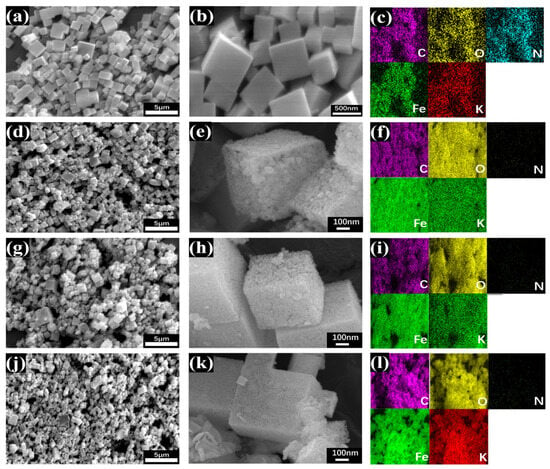
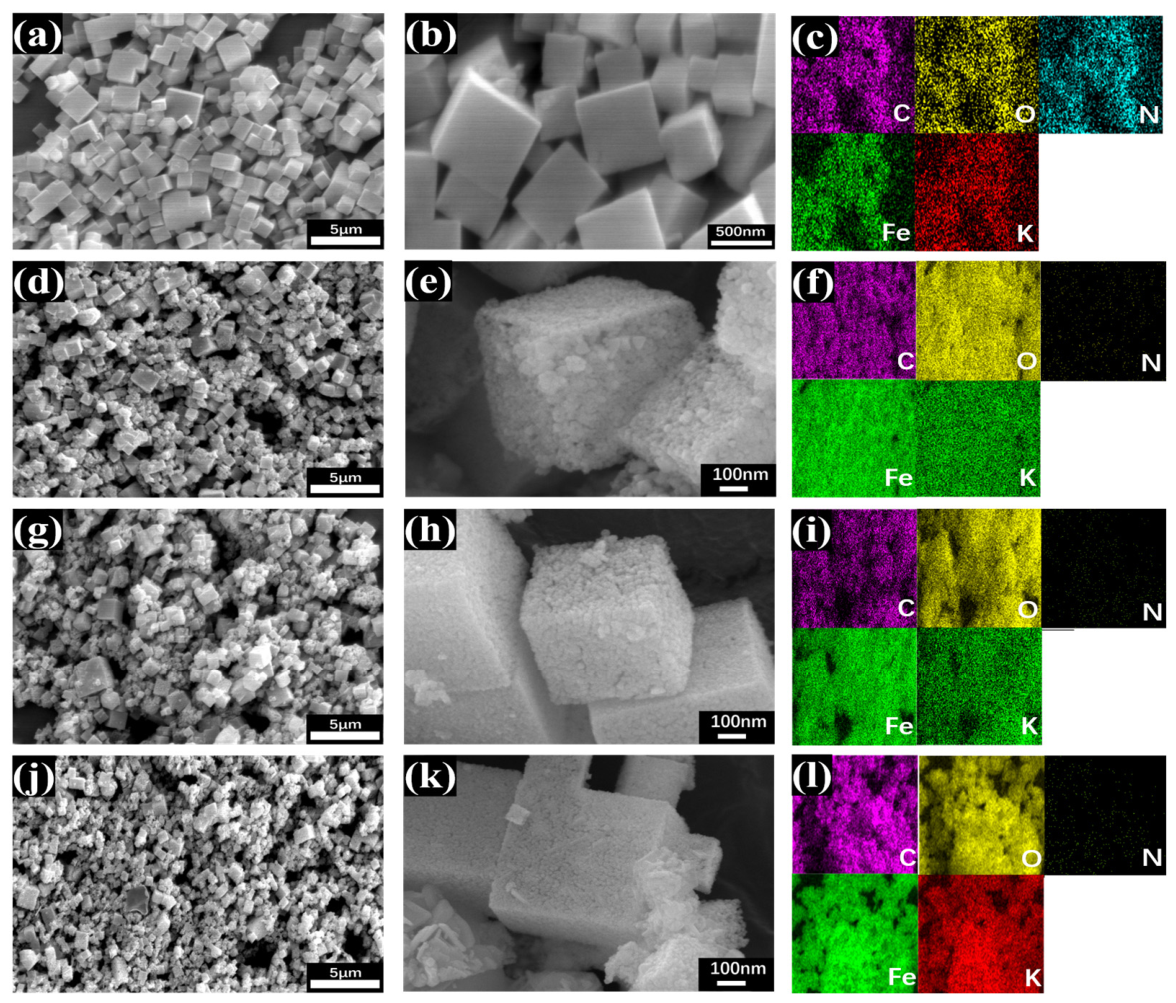
The micro-morphology and elemental distributions of adsorbents prepared at different calcination temperatures are shown in Figure 2. Pristine PB presents a uniform and well-defined cubic crystal structure with sharp edges and good dispersibility (Figure 2a). High-magnification FESEM (Figure 2b) reveals smooth particle surfaces with only minor defects, indicating high crystallinity and complete cubic morphology resulting from hydrothermal synthesis. Energy-dispersive X-ray spectroscopy (EDS) elemental mapping (Figure 2c and Figure S1) confirms the presence of characteristic Fe, C, N, and K elements with low O content in pristine PB, consistent with Prussian blue’s typical composition.
Figure 2.
SEM images and corresponding EDS elemental mapping of PB and calcined PB-derived Fe2O3 samples. (a,d,g,j) Low-magnification SEM; (b,e,h,k) high-magnification SEM; (c,f,i,l) EDS elemental mapping of C, O, Fe, K, and N for each sample. Scale bars: 5 μm for low-resolution SEM, 500 nm for high-resolution SEM and EDS mapping.
For the PB-Fe2O3 (350 °C) adsorbent obtained after calcination at 350 °C, crystal edges are slightly rounded while maintaining the overall cubic outline of pristine PB (Figure 2d). High-magnification FESEM exhibits a slightly roughened surface (Figure 2e). Corresponding EDS mapping (Figure 2f and Figure S2) shows significantly enhanced Fe and O signals alongside a sharp decline in C and N signals, with N dropping below the detection limit. For PB-Fe2O3 (550 °C) calcined at 550 °C, the cubic surface undergoes noticeable restructuring and slight agglomeration while retaining a cubic contour (Figure 2g). High-magnification FESEM reveals a rough, porous surface appearance with partial edge damage (Figure 2h). EDS mapping (Figure 2i and Figure S3) indicates that Fe and O become the dominant surface elements, with C content further decreasing. When the calcination temperature rises to 650 °C, extensive particle agglomeration and sintering occur in PB-Fe2O3 (650 °C), resulting in blurred crystal boundaries (Figure 2j). High-magnification FESEM shows remnant cubic shapes where grain fusion has induced surface densification and pore closure (Figure 2k). Corresponding EDS mapping (Figure 2l and Figure S4) shows complete dominance of Fe and O elements with the virtual disappearance of C.
Overall, Figure 2 demonstrates that calcination temperature exerts strong control over the microstructure of PB-derived iron oxides. As the temperature rises from 350 to 650 °C, the adsorbent undergoes a continuous transition from “cubic structure retention with surface roughening” to “structural reconstruction” and ultimately to “high-temperature sintering and densification.” At 350 °C, PB undergoes initial pyrolysis while maintaining its cubic framework; at 550 °C, substantial structural reconstruction occurs, yielding a roughened surface with enhanced local defect density; at 650 °C, grain growth, agglomeration, and surface densification intensify significantly. This morphological evolution correlates well with trends observed in specific surface area and pore volume from BET (N2 adsorption–desorption) measurements: moderate calcination yields an open porous network, whereas excessive temperatures lead to pore collapse and surface area reduction. These microstructural and composition changes markedly affect electrochemical Li+ adsorption by altering mass transfer channels and active site exposure.
3.1.2. Pore Structure and Surface Area
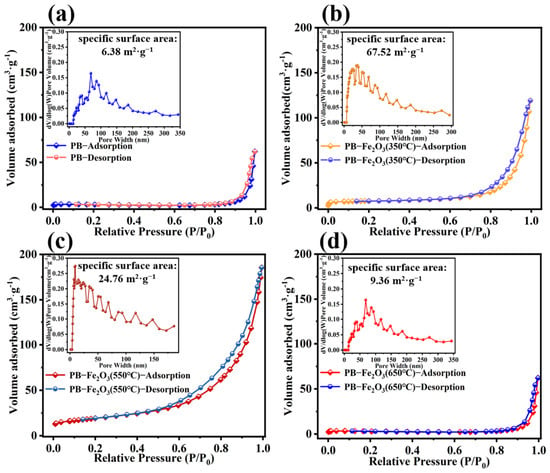
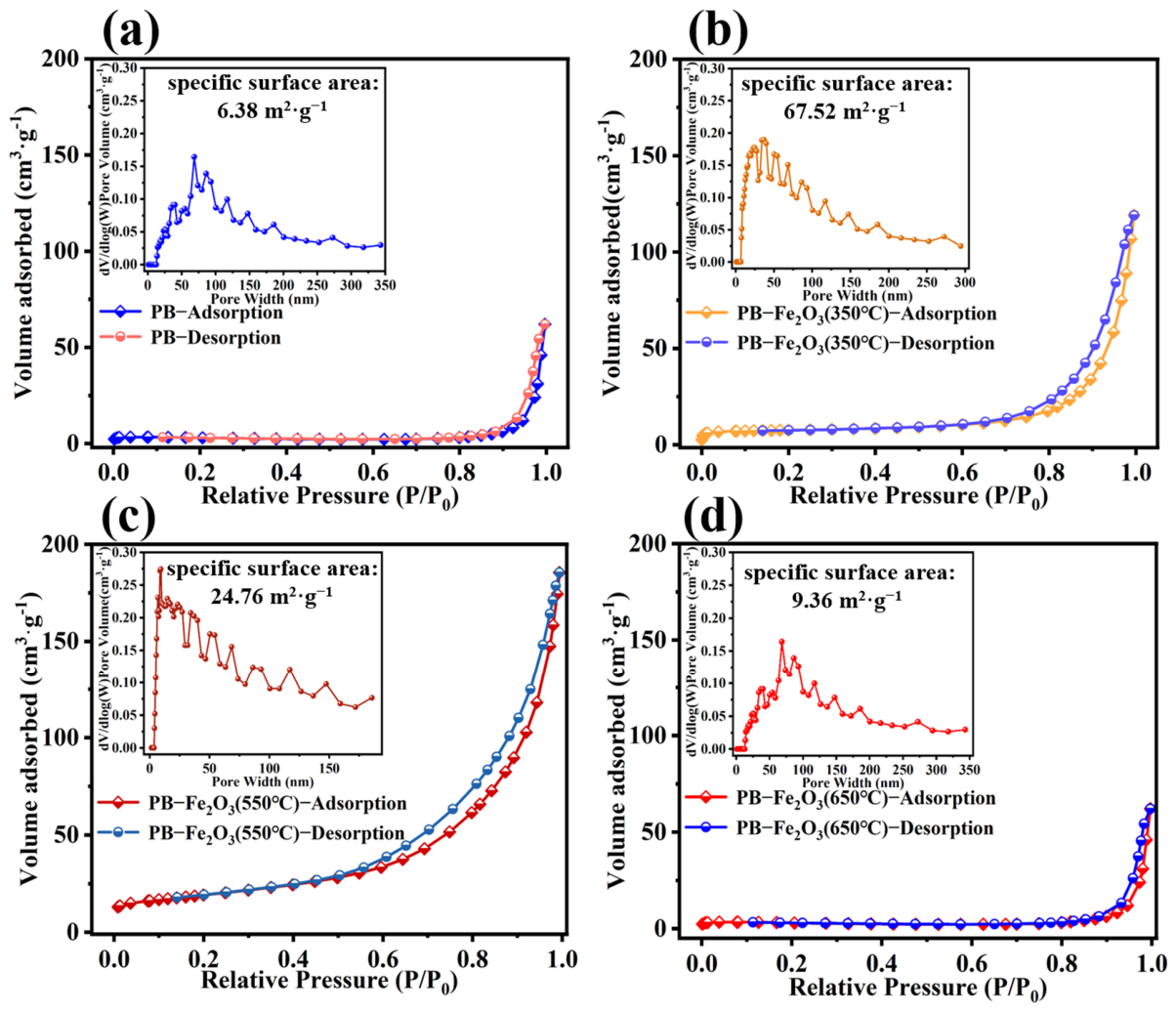
Figure 3 shows the N2 adsorption–desorption isotherms and corresponding pore size distribution curves (insets) for the adsorbents. As shown in the insets, the primary pore size peaks for all samples fall within the mesopore-macropore range (2–100 nm). As calcination temperature increases, the dominant pore size exhibits a trend of initially decreasing and then increasing: pristine PB has a most probable pore diameter of 68.49 nm (dominated by macropores); PB-Fe2O3 (350 °C) shifts to 37.06 nm (dominated by mesopores); PB-Fe2O3 (550 °C) exhibits 9.31 nm (dominated by mesopores); and PB-Fe2O3 (650 °C) returns to 68.49 nm (dominated by macropores). The N2 isotherms for all samples exhibit typical Type IV behavior with distinct hysteresis loops at medium-to-high relative pressures (P/P0 > 0.7), confirming a predominantly mesoporous-macroporous structure. Low N2 uptake at low relative pressures (P/P0 < 0.1) indicates minimal micropore content.
Figure 3.
N2 adsorption–desorption isotherms and pore-size distribution plots (insets) of PB and PB-derived Fe2O3 adsorbents calcined at different temperatures: (a) PB; (b) PB-Fe2O3 (350 °C); (c) PB-Fe2O3 (550 °C); (d) PB-Fe2O3 (650 °C).
Figure 3a displays the BET (N2 adsorption–desorption) plot for pristine PB, yielding a low specific surface area of only 6.38 m2·g−1 and the lowest nitrogen uptake, reflecting dense particle packing and a scarcity of internal pores. In Figure 3b, PB-Fe2O3 (350 °C) exhibits a remarkably increased specific surface area of 67.52 m2·g−1, the highest among all four samples. During low-temperature calcination, the removal of interstitial water and cyanide ligands generates abundant mesopores within the framework without causing sintering or structural collapse. Figure 3c shows that for PB-Fe2O3 (550 °C), mild particle agglomeration leads to partial pore closure, lowering the specific surface area to 24.76 m2·g−1; nevertheless, a large volume of small mesopores is preserved to provide active adsorption sites. In Figure 3d, further increasing the temperature to 650 °C causes the specific surface area of PB-Fe2O3 (650 °C) to drop to 9.36 m2·g−1. In summary, calcination temperature effectively tunes the specific surface area and pore architecture; high-temperature calcination induces grain growth and agglomeration, shrinking interparticle gaps and causing pore wall collapse that diminishes the mesoporous structure.
3.1.3. Phase and Surface Chemical Evolution
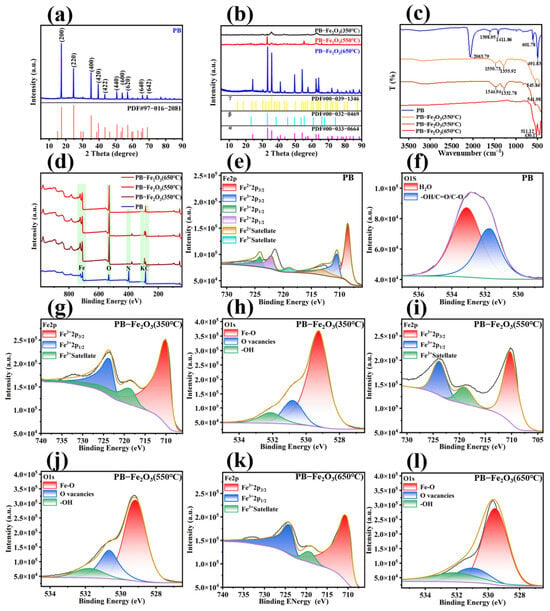
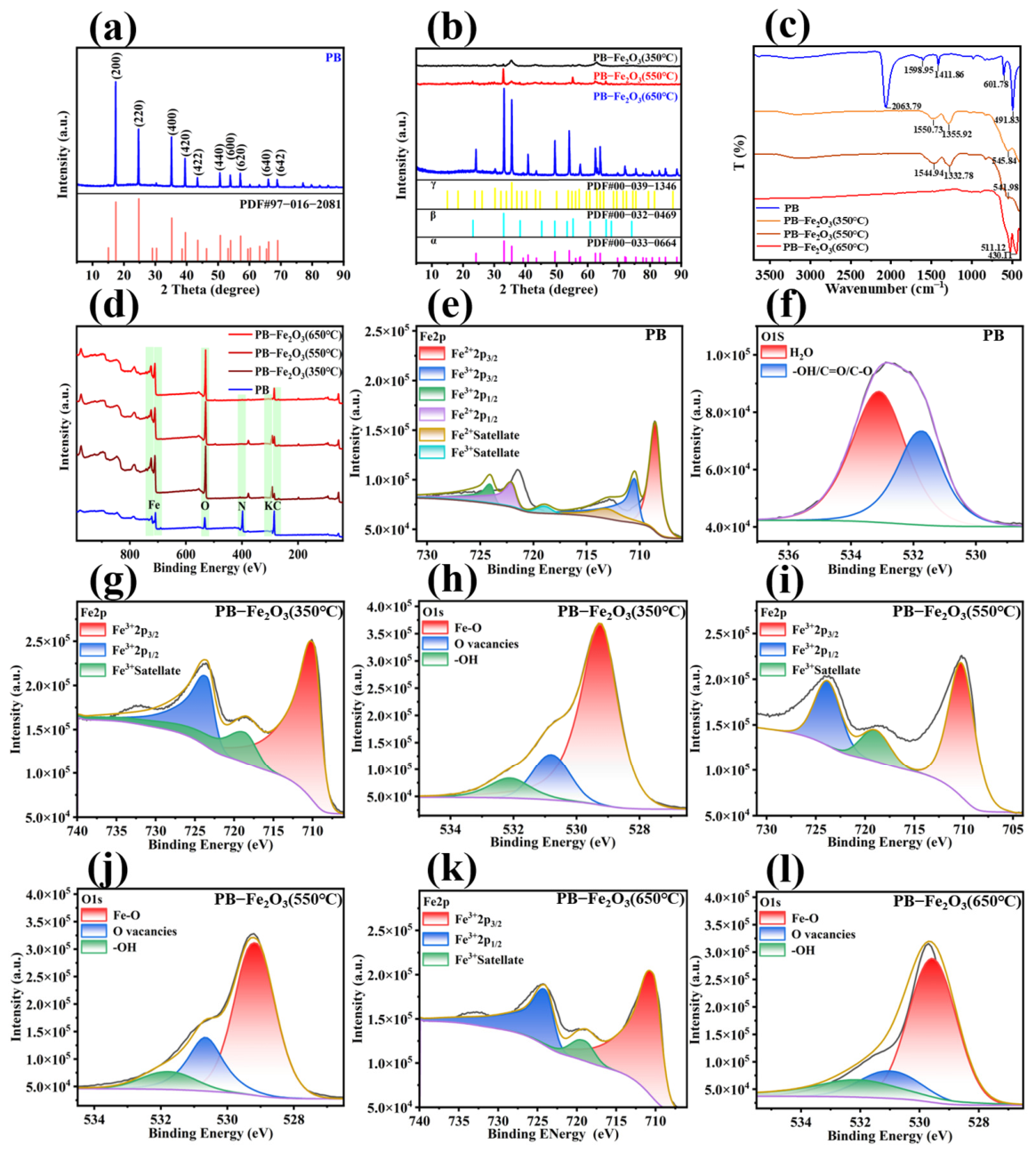
XRD patterns of the adsorbents are presented in Figure 4a,b. Pristine PB (Figure 4a) displays sharp diffraction peaks without impurities that perfectly match standard cubic Prussian blue (PDF#97-061-2081), confirming high phase purity and crystallinity. In Figure 4b, PB-Fe2O3 (350 °C) consists of a two-phase mixture of cubic bixbyite-type β-Fe2O3 and cubic spinel-type γ-Fe2O3. For PB-Fe2O3 (550 °C), diffraction peaks sharpen with higher intensity, comprising predominantly β-Fe2O3 alongside a minor γ-Fe2O3 phase [32]. For PB-Fe2O3 (650 °C), complete phase transformation into pure hematite α-Fe2O3 occurs. These XRD results demonstrate that calcination temperature significantly governs the crystalline phase composition and degree of crystallinity of the iron oxides.
Figure 4.
Structural characterization of PB and PB-derived Fe2O3 adsorbents calcined at different temperatures: (a) XRD pattern of the pristine PB adsorbent; (b) XRD patterns of PB-Fe2O3 (350 °C), PB-Fe2O3 (550 °C), and PB-Fe2O3 (650 °C); (c) FT-IR spectra and (d) XPS survey spectra of PB, PB-Fe2O3 (350 °C), PB-Fe2O3 (550 °C), and PB-Fe2O3 (650 °C); (e,g,i,k) high-resolution Fe 2p and (f,h,j,l) O 1s spectra of the four samples, respectively.
FT-IR spectra (Figure 4c) provide further evidence of the structural evolution of the adsorbents. For pristine PB, the strong peak at 2063.79 cm−1 originates from the characteristic Fe2+–C≡N–Fe3+ cyanide stretching vibration, and the peaks at 491.83 and 601.78 cm−1 correspond to Fe-C and Fe-CN skeleton vibrations, together confirming the intact PB coordination framework. The weak absorption band at approximately 1598.95 cm−1 is attributed to the H-O-H bending vibration of residual coordinated water or surface hydroxyl groups [33,34]. It should be noted that, prior to FT-IR measurement, the samples had undergone degassing at 120 °C for 12 h during BET analysis, which effectively removes physisorbed surface water; therefore, this absorption band is more likely attributable to the bending vibration of surface hydroxyl groups and confined water within the PB framework that was not fully removed by 120 °C degassing. The corresponding O–H stretching vibrations expected at 3200–3600 cm−1 are weak in intensity, consistent with the low residual water content after thermal degassing [33,35]. The band at 1411.86 cm−1 is tentatively assigned to C–O stretching vibrations of surface carbonate species. After 350 °C calcination, a peak appears at 545.84 cm−1, assigned to Fe-O lattice stretching characteristic of iron oxide polymorphs [36], while peaks at 1550.73 cm−1 and 1355.92 cm−1 arise from the asymmetric and symmetric C-O stretching vibrations, respectively, of adsorbed surface carbonate species on PB-Fe2O3 (350 °C) [37]. For PB- Fe2O3 (550 °C), the Fe-O lattice stretching peak shifts to 541.98 cm−1, alongside carbonate absorption bands at 1544.94 cm−1 and 1332.78 cm−1. For PB-Fe2O3 (650 °C), only Fe-O lattice stretching vibrations at 511.12 cm−1 and 430.11 cm−1 remain, corresponding to the characteristic Fe-O modes of hematite. The complete disappearance of the characteristic Fe-C≡N cyanide stretching peak after calcination at 350–650 °C confirms total decomposition of organic ligands, leaving behind metal-oxygen (Fe-O) vibrational bands in the 500–600 cm−1 region.
XPS survey spectra (Figure 4d) confirm surface element evolution: pristine PB exhibits Fe, C, N, O, and K peaks corresponding to standard PB. Upon calcination, C 1s and N 1s peak intensities diminish progressively with increasing temperature, whereas Fe 2p and O 1s intensities rise significantly due to thermal oxidation and surface enrichment. The K peak intensity displays a trend of initial increase followed by a decrease. A temperature of 350 °C represents a critical transition threshold for the conversion of PB into iron oxides. The Fe 2p spectrum of the pristine PB (Figure 4e) was deconvoluted into two spin–orbit-split doublets: the Fe2+ 2p3/2 peak at 708.5 eV (low-spin Fe coordinated to the carbon of the cyanide group) and the Fe3+ 2p3/2 peak at 710.5 eV (high-spin Fe coordinated to nitrogen), together with the corresponding 2p1/2 peaks (722.1 and 724.1 eV) and shake-up satellites at approximately 713 and 719 eV; the surface Fe2+/Fe3+ atomic ratio was determined to be approximately 1.47, confirming the coexistence of divalent and trivalent iron in the PB framework. After calcination (350, 550 and 650 °C), the Fe 2p spectra (Figure 4g,i,k) were dominated by the Fe3+ 2p3/2 main peak at approximately 710.2–710.4 eV originating from Fe2O3, accompanied by satellite peaks at approximately 718.5–719.0 eV and the corresponding 2p1/2 peaks (approximately 723.5–724.1 eV, with a spin–orbit splitting of approximately 13.6 eV), while the Fe2+ peaks disappeared, confirming the oxidation of Fe2+ to Fe3+ and the gradual conversion of PB into Fe2O3. Moreover, the O 1s spectra of the calcined adsorbents (Figure 4h,j,l) were dominated by lattice oxygen at approximately 529.2–529.6 eV originating from the Fe-O bonds of Fe2O3, and were deconvoluted into two additional components, namely oxygen vacancies at approximately 530.7–531.0 eV and surface hydroxyl groups at approximately 531.7–532.1 eV; the proportion of oxygen vacancies relative to the lattice-oxygen peak area was approximately 16%, 23% and 16% for the samples calcined at 350, 550 and 650 °C, respectively, exhibiting a volcano-shaped variation with a maximum at 550 °C.
Combining SEM, BET (N2 adsorption–desorption), XRD, XPS, and FT-IR characterizations shows that PB undergoes a continuous evolution involving ligand decomposition, structural reconstruction, and high-temperature sintering during calcination in air, with the calcination temperature simultaneously modulating the pore architecture, phase composition, and surface chemistry. Calcination at 350 °C favored the development of a porous structure, where PB began to convert into Fe2O3 accompanied by certain surface defects, with the oxygen-vacancy proportion relative to the lattice-oxygen peak area being approximately 16%; as the temperature rose to 550 °C, the phase transformation proceeded further and grain growth began, giving rise to more surface defects, and the oxygen-vacancy proportion reached a maximum of approximately 23%; at 650 °C, severe particle agglomeration and pore collapse led to a significant drop in surface area, while the sharpest FT-IR peaks indicated a nearly complete crystallization, and the oxygen-vacancy proportion decreased to approximately 16%. Consequently, the calcination temperature effectively modified the adsorbent through the synergistic regulation of crystallinity, pore structure, and oxygen-vacancy concentration. Notably, although PB-Fe2O3 (550 °C) has a lower surface area than PB-Fe2O3 (350 °C), it delivers superior subsequent electrochemical performance, suggesting that the Li+ adsorption capacity also relies heavily on the phase structure and charge-transport characteristics.
3.2. Electrochemical Li+ Adsorption Performance
The electrochemical lithium recovery process in this study relies on a reversible intercalation/deintercalation mechanism driven by redox reactions. Upon applying a negative potential, an electric field drives small-radius Li+ ions through mesoporous/macroporous channels into the crystal lattice. Concurrently, Fe3+ within the electrode accepts an electron and is reduced to Fe2+, maintaining electrical neutrality via valence changing and accomplishing electrochemical Li+ adsorption.
3.2.1. Electrochemical Activity and Charge-Transfer Kinetics
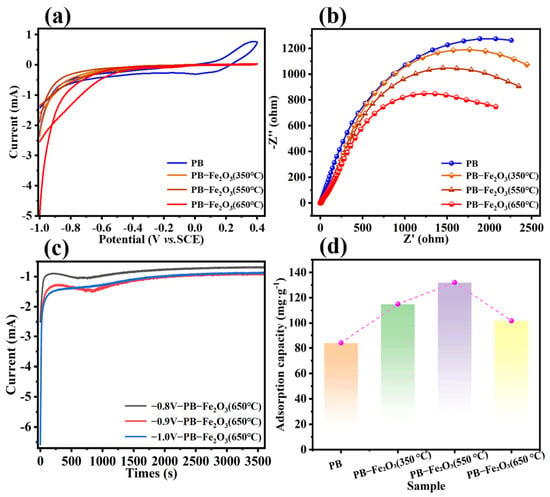
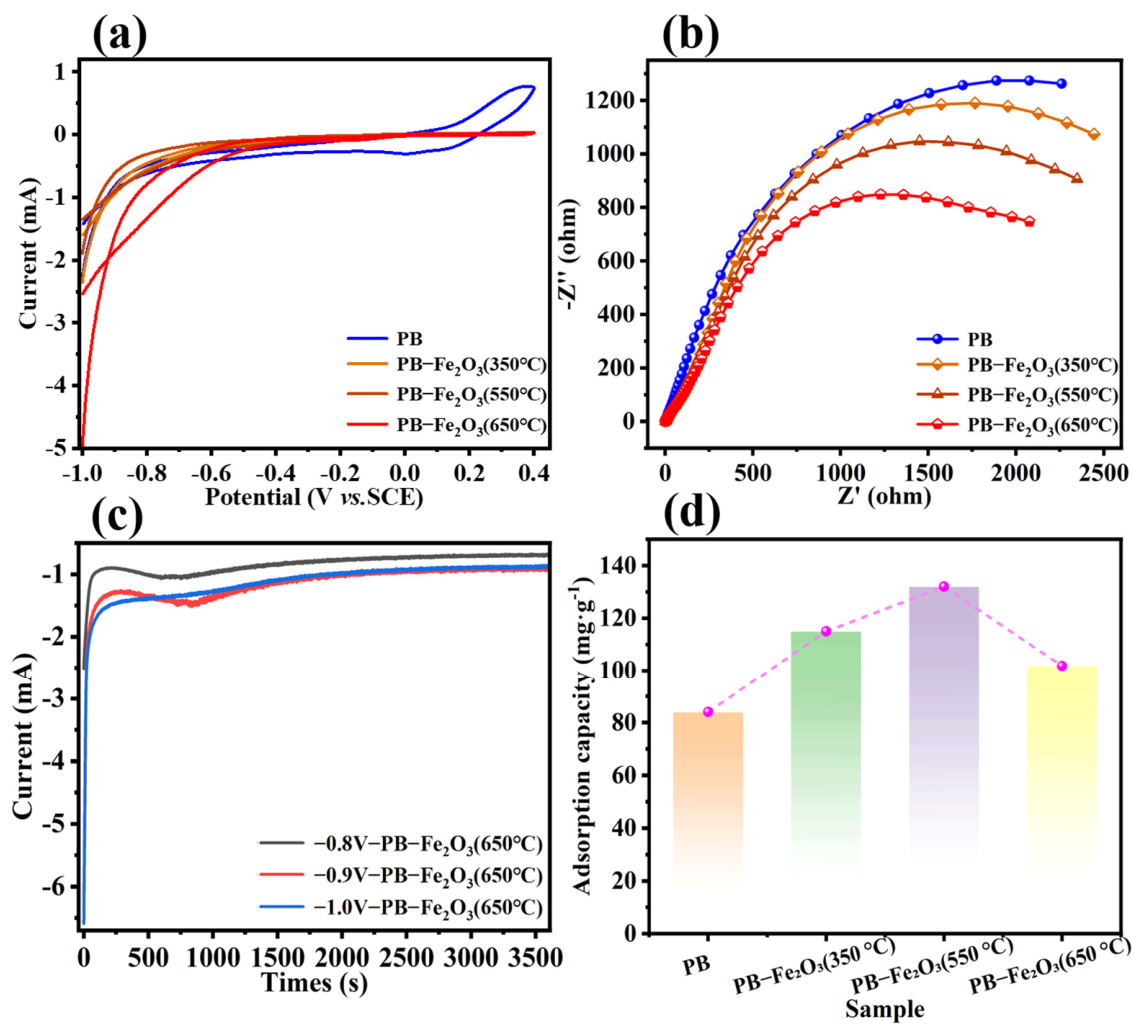
Cyclic voltammetry curves for the adsorbents are presented in Figure 5a. The cathodic peak current in CV curves directly reflects electrochemical activity. All adsorbents show prominent cathodic reduction peaks in the negative potential region, corresponding to the reduction of Fe3+ to Fe2+ accompanied by Li+ insertion into the crystal lattice to balance charge. Peak currents increase progressively with calcination temperature: pristine PB displays a peak current of −0.0018 A (lowest activity), whereas PB-Fe2O3 (350 °C), PB-Fe2O3 (550 °C), and PB-Fe2O3 (650 °C) reach −0.0025 A, −0.0049 A, and −0.0053 A, respectively. This indicates that higher calcination temperatures improve crystallinity and electronic conductivity, accelerating reaction kinetics and boosting electrochemical activity.
Figure 5.
Electrochemical performance tests of PB and PB-derived Fe2O3 adsorbents calcined at different temperatures: (a) CV curves at a scan rate of 5 mV·s−1; (b) EIS Nyquist plots; (c) Chronoamperometric (i–t) curves of PB-Fe2O3 (650 °C) at −0.8 V, −0.9 V, and −1.0 V; (d) Maximum experimentally determined Li+ adsorption capacity (3600 s of adsorption at −0.9 V).
EIS Nyquist plots (Figure 5b) validate this trend: as calcination temperature increases, the semicircle radius in the high-frequency region shrinks progressively, reflecting a gradual decline in charge-transfer resistance. PB-Fe2O3 (650 °C) exhibits the highest electronic conductivity due to complete ligand removal and high crystallinity at elevated temperature.
3.2.2. Optimization of Applied Potential and Modulation of Li+ Adsorption Performance
Chronoamperometric (i–t) tests were performed on PB-Fe2O3 (650 °C) coated electrodes across various potentials (−0.8, −0.9, and −1.0 V vs. SCE), as shown in Figure 5c. No gas bubbles were observed throughout the tests, ruling out hydrogen evolution interference. At −0.9 V, the cathodic current reached its highest magnitude, providing the optimal driving force for electrochemical Li+ adsorption. At −0.8 V, adsorption kinetics were insufficient due to a lower current response. At −1.0 V, a high initial transient current decayed rapidly, making the electrode susceptible to side reactions. Post-adsorption ICP-OES analysis of residual Li+ concentrations after 3600 s at various potentials (Figure S5) demonstrated a maximum Li+ adsorption capacity of 101.78 mg·g−1 at −0.9 V, establishing −0.9 V as the optimal working potential.
3.2.3. Charge–Discharge Behavior
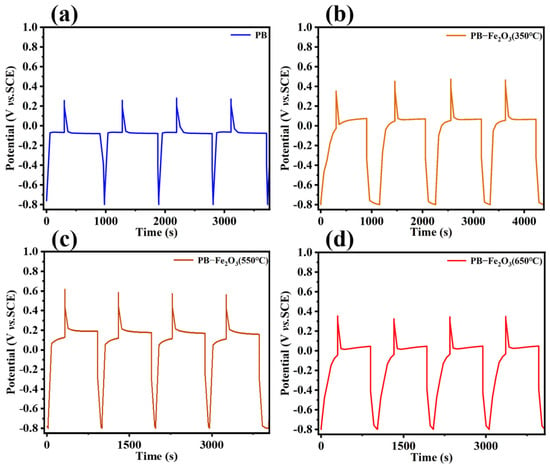
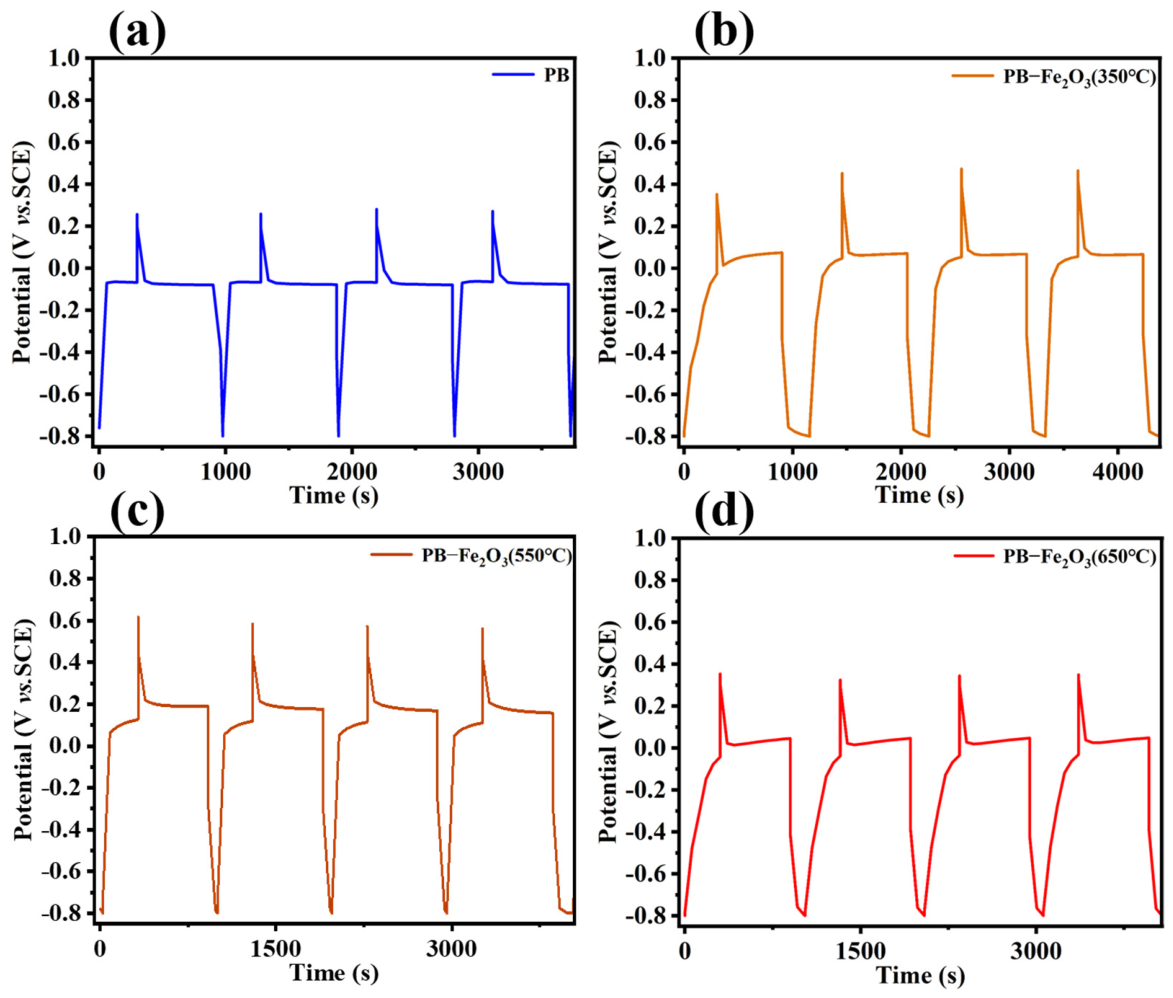
Fifth-cycle GCD curves for all four adsorbents are compared in Figure 6. Clear and stable charge–discharge voltage plateaus are observed across all samples, indicating good reversibility and structural stability during Li+ insertion/extraction without severe degradation of the electrode framework. A closer comparison reveals that pristine PB (Figure 6a) exhibits sharp voltage spikes and severe polarization at charge–discharge switching points, with a relatively negative adsorption plateau potential (~−0.08 V), indicating high charge-transfer resistance and sluggish kinetics. For PB-Fe2O3 (350 °C) (Figure 6b), polarization is mitigated and the plateau potential rises to +0.06 V, though the single-cycle duration remains short. For PB-Fe2O3 (650 °C) (Figure 6d), the plateau potential drops slightly to +0.04 V with a similarly brief cycle duration. In contrast, PB-Fe2O3 (550 °C) (Figure 6c) exhibits superior performance with a smooth plateau (~+0.18 V), the longest single-cycle duration (totaling nearly 4000 s across 5 cycles), and highly reproducible overlap across consecutive cycles, confirming efficient Li+ intercalation/deintercalation and high stability. Discharge capacity values for the 5th cycle are listed in Table S1.
Figure 6.
Galvanostatic charge–discharge (GCD) curves of PB and PB-derived Fe2O3 adsorbents calcined at different temperatures: (a) Pristine PB; (b) PB-Fe2O3 (350 °C); (c) PB-Fe2O3 (550 °C); (d) PB-Fe2O3 (650 °C).
3.2.4. Li+ Adsorption Capacity
Maximum experimentally determined Li+ adsorption capacity after 3600 s of adsorption at −0.9 V follow the order (Figure 5d): PB-Fe2O3 (550 °C) > PB-Fe2O3 (350 °C) > PB-Fe2O3 (650 °C) > pristine PB.
In summary, PB-Fe2O3 (350 °C) possesses a high specific surface area but suffers from poor crystallinity and low conductivity, yielding an adsorption capacity of 114.94 mg·g−1. PB-Fe2O3 (650 °C) features high α-Fe2O3 crystallinity, complete ligand removal, and optimal electronic conductivity, but high-temperature sintering collapses its mesoporous channels and reduces accessible active sites, yielding 101.78 mg·g−1. PB-Fe2O3 (550 °C) strikes an optimal balance by retaining abundant mesoporous adsorption sites while maintaining favorable electronic transport properties. Because adsorption performance is governed synergistically by pore availability, phase composition, and electrical conductivity, PB-Fe2O3 (550 °C) delivers the highest capacity of 132.23 mg·g−1 and superior overall electrochemical performance.
3.2.5. Li+ Adsorption Kinetics
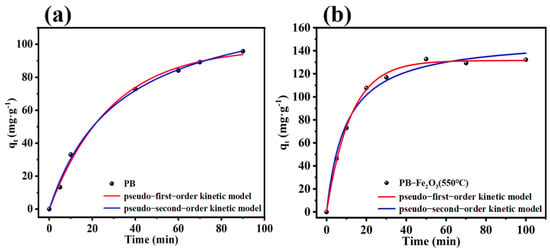
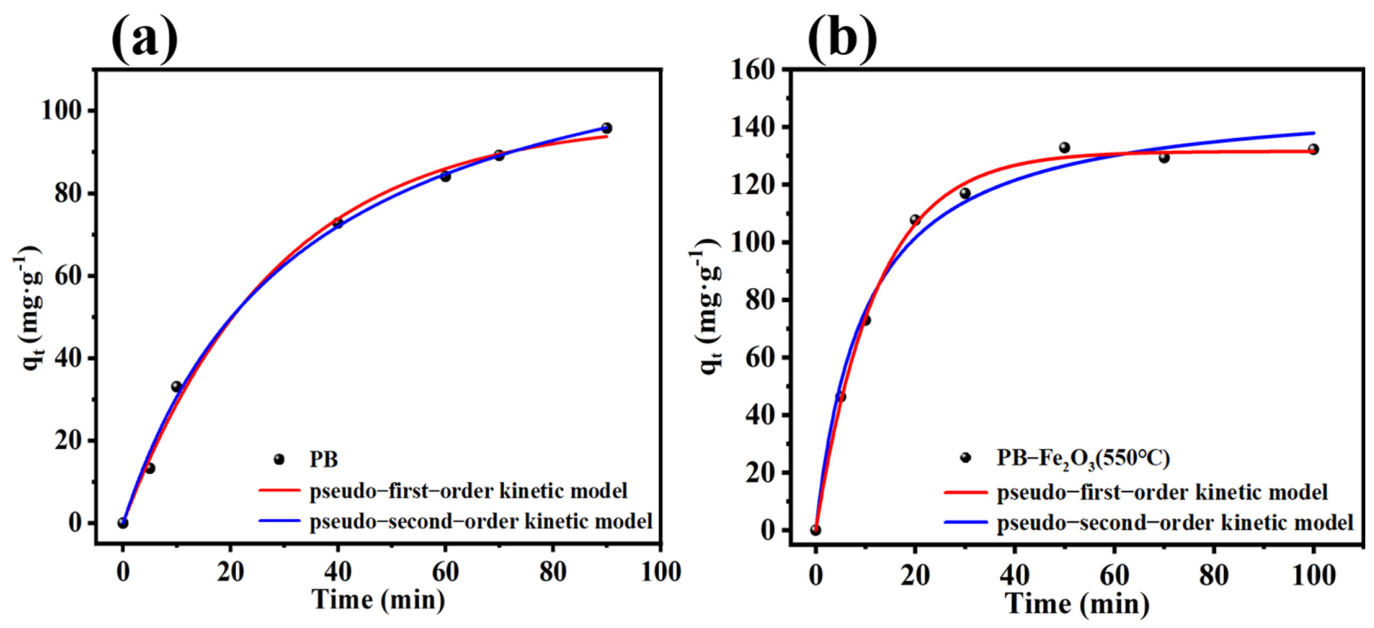
Based on the combined results of the crystal-structure characterization and electrochemical measurements, PB-Fe2O3 (550 °C) exhibited the optimal adsorption performance among all the calcined adsorbents. Therefore, to elucidate the rate-limiting steps and kinetic mechanisms governing the electrochemical Li+ adsorption process in the pristine PB and PB-Fe2O3 (550 °C) adsorbents, the experimental data were fitted using the pseudo-first-order and pseudo-second-order kinetic models (Figure 7). The fitted parameters and correlation coefficients are summarized in Table 1.
Figure 7.
Adsorption kinetic curves for Li+ over PB and PB-Fe2O3 (550 °C) adsorbents: (a) Pristine PB; (b) PB-Fe2O3 (550 °C).
Table 1.
Kinetic model parameters for Li+ adsorption onto PB and PB-Fe2O3 (550 °C) adsorbents at 30 °C.
For pristine PB (Figure 7a), active sites are occupied progressively as the reaction proceeds, causing the initial rapid adsorption rate to slow down before reaching equilibrium. Comparing the fitted parameters, the correlation coefficient of the pseudo-first-order kinetic model (R2 = 0.996) is very close to that of the pseudo-second-order kinetic model (R2 = 0.997). Nevertheless, the maximum experimentally determined Li+ adsorption capacity (qe = 97.92 mg·g−1) matches the experimental value closely. This indicates that Li+ adsorption onto pristine PB aligns well with pseudo-first-order kinetics, where the adsorption rate is controlled primarily by physical diffusion and mass transfer at the solid–liquid interface and within lattice pores. The open 3D cubic framework of PB provides diffusion channels, consistent with ion-exchange mechanisms characteristic of Prussian blue materials.
For PB-Fe2O3 (550 °C) (Figure 7b), during the first 40 min, abundant vacant active sites on the surface and within internal pores combine with a high Li+ concentration gradient to provide a strong mass-transfer driving force, leading to a rapid capacity rise. As active sites approach saturation, the driving force weakens, and the curve plateaus into equilibrium after 50 min. Model comparisons reveal that the pseudo-first-order kinetic model yields a higher correlation coefficient (R2 = 0.998) than the pseudo-second-order model (R2 = 0.988), with its calculated equilibrium capacity (qe = 131.56 mg·g−1) matching the experimental capacity closely. These results demonstrate that Li+ adsorption onto PB-Fe2O3 (550 °C) follows pseudo-first-order kinetics controlled by diffusion mass transfer.
Comparative analysis shows that thermally restructured PB-Fe2O3 (550 °C) exhibits both a higher equilibrium capacity and a faster rate constant. This highlights that heterointerfaces and optimized pore architecture formed during moderate calcination enhance Li+ diffusion channels and expose additional usable adsorption sites, achieving simultaneous boosts in adsorption kinetics and capacity.
3.2.6. Study on Adsorption and Separation Performance
The electrochemical adsorption and separation performance of PB-Fe2O3 (550 °C) was evaluated in a binary Li+/Mg2+ solution containing 2 g·L−1 Li+ and 20 g·L−1 Mg2+. The adsorption experiments were conducted at an applied potential of −0.9 V for 3600 s. Before ICP-OES analysis, the collected solution samples were diluted 500-fold. The measured concentrations and calculated adsorption parameters are summarized in Table 2.
Table 2.
Selective adsorption parameters of the PB-Fe2O3 (550 °C) adsorbent in mixed solutions at 30 °C.
The adsorption capacities of PB-Fe2O3 (550 °C) for Li+ and Mg2+ reached 9.98 and 26.78 mg·g−1, respectively, with corresponding distribution coefficients of 2.32 and 0.57 L·g−1. The resulting Li+/Mg2+ separation factor was 4.07, demonstrating a clear difference in the distribution behavior of the two ions. Notably, the distribution coefficient of Li+ was approximately four times that of Mg2+, indicating a preferential affinity for Li+ under the applied electrochemical conditions. These results highlight the potential of PB-Fe2O3 (550 °C) for selective lithium recovery from Mg2+-rich solutions and demonstrate its promising application in electrochemical lithium separation.
3.2.7. Cycling Stability
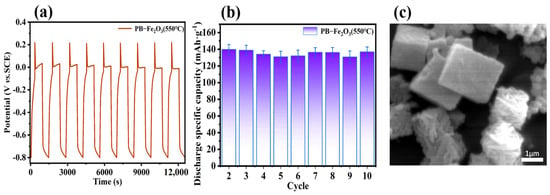
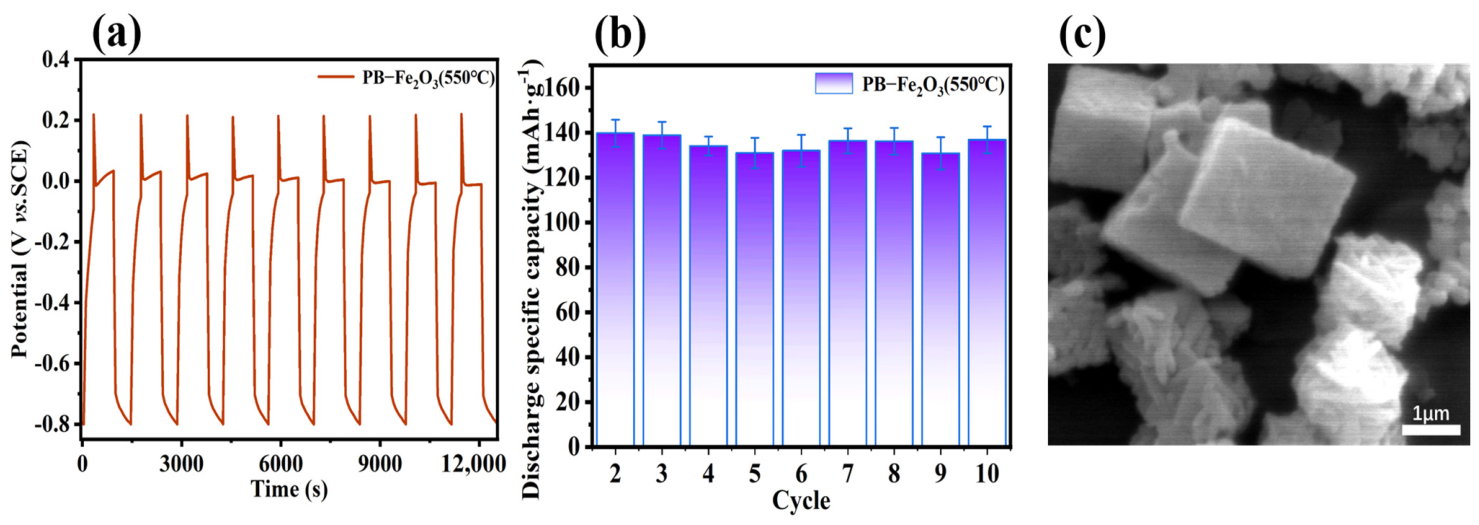
Ten consecutive GCD cycles of PB-Fe2O3 (550 °C) are shown in Figure 8a,b. The discharge capacity remained stable throughout the cycling test, with a capacity retention above 93% and nearly 100% coulombic efficiency. After 10 cycles, the SEM image of PB-Fe2O3 (550 °C) showed no obvious morphological degradation (Figure 8c), indicating that the porous structure and β/γ-Fe2O3 heterojunctions were well maintained during electrochemical cycling. These results demonstrate good electrochemical reversibility and structural stability for Li+ recovery.
Figure 8.
Cycling stability tests of the PB-Fe2O3 (550 °C) adsorbent: (a) Galvanostatic charge–discharge curves; (b) Capacity retention over cycling; (c) SEM image after Li+ adsorption testing.
Compared with representative electrochemical lithium recovery systems reported in recent studies, PB-Fe2O3 (550 °C) combines a high Li+ adsorption capacity with favorable cycling stability under the tested conditions [18,22,38,39,40,41]. The combination of a porous structure and β/γ-Fe2O3 heterojunctions may contribute to efficient Li+ transport while maintaining structural integrity during repeated electrochemical cycling. Representative literature data are summarized in Table S2.
4. Conclusions
In this study, Prussian blue (PB) synthesized via a hydrothermal method served as a precursor to prepare PB-derived iron oxide adsorbents PB-Fe2O3 (350 °C), PB-Fe2O3 (550 °C), and PB-Fe2O3 (650 °C) via calcination at 350, 550, and 650 °C in air, respectively. The effects of calcination temperature on structural properties and electrochemical Li+ adsorption performance were systematically investigated. Structural characterization revealed that calcination at 350 °C significantly enhanced the specific surface area to 67.52 m2·g−1. Further temperature increases promoted iron oxide crystallization and structural reconstruction, whereas calcination at 650 °C caused notable particle agglomeration, grain fusion, and pore shrinkage. Electrochemical results showed that PB-Fe2O3 (550 °C) achieved an optimal balance between pore architecture and interfacial charge transport, delivering a maximum experimentally determined Li+ adsorption capacity of 132.23 mg·g−1 at −0.9 V (vs. SCE), which outperformed pristine PB, PB-Fe2O3 (350 °C), and PB-Fe2O3 (650 °C). Kinetic fitting demonstrated that adsorption on both pristine PB and PB-Fe2O3 (550 °C) adhered closely to the pseudo-first-order model. PB-Fe2O3 (550 °C) maintained over 93% capacity retention after 10 cycles, demonstrating favorable short-term stability. Overall, moderate calcination enhances electrochemical Li+ adsorption by synergistically tuning pore structure, crystal phase, oxygen vacancies, and interfacial electrochemistry. It should be noted that although the PB-Fe2O3 (550 °C) adsorbent exhibited preferential Li+ uptake in a binary Li+/Mg2+ simulated brine with a separation factor of 4.07, the present study primarily employed model electrolytes and did not systematically evaluate selectivity or long-term stability under real multi-ion salt-lake brines with high Mg/Li ratios; future research should focus on Mg2+ competition, complex ion matrices, and extended cycle life.
Supplementary Materials
The following supporting information can be downloaded at: https://www.mdpi.com/article/10.3390/separations13110310/s1, Figure S1: EDS elemental spectra of PB-based adsorbents; Figure S2: EDS elemental spectra of PB Fe2O3 (350 °C) adsorbent; Figure S3: EDS elemental spectra of PB Fe2O3 (550 °C) adsorbent; Figure S4: EDS elemental spectra of PB Fe2O3 (650 °C) adsorbent; Figure S5: Adsorption capacity of PB-derived Fe2O3 (650 °C) adsorbent after 3600 s adsorption at different voltages; Table S1: Cyclic specific capacities of different adsorbents at the 5th cycle; Table S2: Comparison of representative electrochemical lithium recovery systems reported in the literature.
Author Contributions
S.K.: Data curation, Formal analysis, Investigation, Software, Validation, Visualization, Writing—original draft; M.C.: Conceptualization, Formal analysis, Funding acquisition, Methodology, Resources, Supervision, Writing—review and editing; D.L.: Conceptualization, Data curation, Formal analysis, Methodology, Resources, Software, Supervision; Y.C.: Data curation, Formal analysis, Investigation, Validation; L.W.: Investigation, Project administration, Software; X.Y.: Investigation, Project administration, Software. All authors have read and agreed to the published version of the manuscript.
Funding
This research was financially supported by the Scientific Research Capacity Improvement Project of Qinghai University (Grant No. 2025KTST02), the Kunlun High-end Innovation and Entrepreneurship Talent Project of Qinghai Province, and the Salt Lake Chemical Research Complex Development Project of Qinghai University (Grant No. 2025-DXSSKF-13).
Data Availability Statement
The original contributions presented in this study are included in the article/Supplementary Material. Further inquiries can be directed to the corresponding author.
Conflicts of Interest
Author Xiuying Yan was employed by the Zangge Mining Co., Ltd., Golmud 816000, China. The remaining authors declare that the research was conducted in the absence of any commercial or financial relationships that could be construed as a potential conflict of interest.
References
- Gatto, A.; Nuta, A.C.; Marjerison, R.K. Sustainable, Just and Circular Decarbonization from Lithium and Hydrogen Production. J. Clean. Prod. 2025, 507, 144795. [Google Scholar] [CrossRef] [Scilit]
- Du, Y.; Li, J.; Xu, Y. Will Carbon Neutrality Alleviate China’s Energy Security Concerns?–The Strategic Importance of Critical Metals in Batteries. Resour. Policy 2024, 93, 105056. [Google Scholar] [CrossRef] [Scilit]
- Abrishami, S.; Gonbadi, M.; Boroumand, Y.; Golmohammadi, M.; Narimani, M.; Sarmadi, A.; Matthews, C.; Estay, H.; Khiadani, M.; Razmjou, A. Comprehensive Review of Lithium Extraction Processes with Economic and Environmental Analysis. Sep. Purif. Technol. 2026, 381, 135582. [Google Scholar] [CrossRef] [Scilit]
- Ruberti, M. Pathways to Greener Primary Lithium Extraction for a Really Sustainable Energy Transition: Environmental Challenges and Pioneering Innovations. Sustainability 2025, 17, 160. [Google Scholar] [CrossRef] [Scilit]
- Yang, S.; Wang, Y.; Pan, H.; He, P.; Zhou, H. Lithium Extraction from Low-Quality Brines. Nature 2024, 636, 309–321. [Google Scholar] [CrossRef] [Scilit] [PubMed]
- Zhu, R.; Wang, S.; Srinivasakannan, C.; Li, S.; Yin, S.; Zhang, L.; Jiang, X.; Zhou, G.; Zhang, N. Lithium Extraction from Salt Lake Brines with High Magnesium/Lithium Ratio: A Review. Environ. Chem. Lett. 2023, 21, 1611–1626. [Google Scholar] [CrossRef] [Scilit]
- Zhang, T.; Zheng, W.; Wang, Q.; Wu, Z.; Wang, Z. Designed Strategies of Nanofiltration Technology for Mg2+/Li+ Separation from Salt-Lake Brine: A Comprehensive Review. Desalination 2023, 546, 116205. [Google Scholar] [CrossRef] [Scilit]
- Wang, J.; Yue, X.; Wang, P.; Yu, T.; Du, X.; Hao, X.; Abudula, A.; Guan, G. Electrochemical Technologies for Lithium Recovery from Liquid Resources: A Review. Renew. Sustain. Energy Rev. 2022, 154, 111813. [Google Scholar] [CrossRef] [Scilit]
- Zhang, Y.; Sun, S.; Wang, M.; Shen, Q.; Cong, S.; Zhao, Y.; Peng, J.; Pang, H. Metal-Organic Framework (MOF) Membranes for Mg2+/Li+ Separation. Sep. Purif. Technol. 2025, 374, 133737. [Google Scholar] [CrossRef] [Scilit]
- Hu, Y.; Su, H.; Zhu, Z.; Qi, T.; Pang, Q. Environmentally Benign Techniques of Lithium Extraction from Salt Lakes: A Review. Environ. Chem. Lett. 2024, 22, 105–120. [Google Scholar] [CrossRef] [Scilit]
- Swain, B. Separation and Purification of Lithium by Solvent Extraction and Supported Liquid Membrane, Analysis of Their Mechanism: A Review. J. Chem. Technol. Biotechnol. 2016, 91, 2549–2562. [Google Scholar] [CrossRef] [Scilit]
- Li, Y.; Yang, Z.; Ma, P. Research Progress on New Types of H2TiO3 Lithium-Ion Sieves: A Review. Metals 2023, 13, 977. [Google Scholar] [CrossRef] [Scilit]
- Li, X.; Mo, Y.; Qing, W.; Shao, S.; Tang, C.Y.; Li, J. Membrane-Based Technologies for Lithium Recovery from Water Lithium Resources: A Review. J. Membr. Sci. 2019, 591, 117317. [Google Scholar] [CrossRef] [Scilit]
- Zhao, X.; Yang, S.; Hou, Y.; Gao, H.; Wang, Y.; Gribble, D.A.; Pol, V.G. Recent Progress on Key Materials and Technical Approaches for Electrochemical Lithium Extraction Processes. Desalination 2023, 546, 116189. [Google Scholar] [CrossRef] [Scilit]
- Santos, C.; La Mantia, F. Recent Advances in Reactor Design and Control for Lithium Recovery by Means of Electrochemical Ion Pumping. Curr. Opin. Electrochem. 2022, 35, 101089. [Google Scholar] [CrossRef] [Scilit]
- Zavahir, S.; Elmakki, T.; Gulied, M.; Ahmad, Z.; Al-Sulaiti, L.; Shon, H.K.; Chen, Y.; Park, H.; Batchelor, B.; Han, D.S. A Review on Lithium Recovery Using Electrochemical Capturing Systems. Desalination 2021, 500, 114883. [Google Scholar] [CrossRef] [Scilit]
- Rethinasabapathy, M.; Bhaskaran, G.; Hwang, S.-K.; Ryu, T.; Huh, Y.S. Efficient Lithium Extraction Using Redox-Active Prussian Blue Nanoparticles-Anchored Activated Carbon Intercalation Electrodes via Membrane Capacitive Deionization. Chemosphere 2023, 336, 139256. [Google Scholar] [CrossRef] [Scilit] [PubMed]
- Fang, D.; Zhang, X.; Liu, F.; Hu, S.; Zhang, P.; Li, K. Structural Stabilization via Strontium Doping in LiMn2O4 Enables Selective Lithium Capture from High-Mg Brines by Rocking-Chair Capacitive Deionization. Chem. Eng. J. 2025, 521, 166161. [Google Scholar] [CrossRef] [Scilit]
- Zhu, W.; Xu, W.; Liu, D.; He, L.; Liu, X.; Zhao, Z. Ionic Transport Kinetics of Selective Electrochemical Lithium Extraction from Brines. Electrochim. Acta 2024, 475, 143519. [Google Scholar] [CrossRef] [Scilit]
- Hurlbutt, K.; Wheeler, S.; Capone, I.; Pasta, M. Prussian Blue Analogs as Battery Materials. Joule 2018, 2, 1950–1960. [Google Scholar] [CrossRef] [Scilit]
- Ma, L.; Cui, H.; Chen, S.; Li, X.; Dong, B.; Zhi, C. Accommodating Diverse Ions in Prussian Blue Analogs Frameworks for Rechargeable Batteries: The Electrochemical Redox Reactions. Nano Energy 2021, 81, 105632. [Google Scholar] [CrossRef] [Scilit]
- Kim, D.; Lee, H.; Jeon, S. Entropy-Stabilized Prussian Blue Analogue Electrode for Selective Lithium-Ion Recovery via Capacitive Deionization. Desalination 2026, 617, 119487. [Google Scholar] [CrossRef] [Scilit]
- Hu, B.; Zhang, B.; Wang, Y.; Li, M.; Yang, J.; Liu, J. Prussian Blue Analogue Derived 3D Hollow LiCoMnO4 Nanocube for Selective Extraction of Lithium by Pseudo-Capacitive Deionization. Desalination 2023, 560, 116662. [Google Scholar] [CrossRef] [Scilit]
- Gao, M.; Xiao, W.; Miao, L.; Yang, Z.; Liang, W.; Ao, T.; Yang, Q.; Chen, W. Prussian Blue and Its Analogs: A Robust Platform for Efficient Capacitive Deionization. Desalination 2024, 574, 117278. [Google Scholar] [CrossRef] [Scilit]
- Trócoli, R.; Battistel, A.; La Mantia, F. Nickel Hexacyanoferrate as Suitable Alternative to Ag for Electrochemical Lithium Recovery. ChemSusChem 2015, 8, 2514–2519. [Google Scholar] [CrossRef] [Scilit] [PubMed]
- Li, Y.; Hu, J.; Yang, K.; Cao, B.; Li, Z.; Yang, L.; Pan, F. Synthetic Control of Prussian Blue Derived Nano-Materials for Energy Storage and Conversion Application. Mater. Today Energy 2019, 14, 100332. [Google Scholar] [CrossRef] [Scilit]
- Zboril, R.; Machala, L.; Mashlan, M.; Sharma, V. Iron(III) Oxide Nanoparticles in the Thermally Induced Oxidative Decomposition of Prussian Blue, Fe4[Fe(CN)6]3. Cryst. Growth Des. 2004, 4, 1317–1325. [Google Scholar] [CrossRef] [Scilit]
- Hu, M.; Jiang, J.-S.; Bu, F.-X.; Cheng, X.-L.; Lin, C.-C.; Zeng, Y. Hierarchical Magnetic Iron(III) Oxides Prepared by Solid-State Thermal Decomposition of Coordination Polymers. RSC Adv. 2012, 2, 4782–4786. [Google Scholar] [CrossRef] [Scilit]
- Zhao, Z.; Liu, X.; Luan, C.; Liu, X.; Wang, D.; Qin, T.; Sui, L.; Zhang, W. Architecting Hierarchical Shell Porosity of Hollow Prussian Blue-Derived Iron Oxide for Enhanced Li Storage. J. Microsc. 2019, 276, 53–62. [Google Scholar] [CrossRef] [Scilit] [PubMed]
- Guo, Y.; Huang, Z.; Hu, Y.; Li, J.; Xu, J. Recent Advances in Iron-Based Heterostructure Anode Materials for Sodium Ion Batteries. Acta Phys.-Chim. Sin. 2025, 41, 100022. [Google Scholar] [CrossRef] [Scilit]
- Qin, T.; Zhao, X.; Sui, Y.; Wang, D.; Chen, W.; Zhang, Y.; Luo, S.; Pan, W.; Guo, Z.; Leung, D.Y.C. Heterointerfaces: Unlocking Superior Capacity and Rapid Mass Transfer Dynamics in Energy Storage Electrodes. Adv. Mater. 2024, 36, 2402644. [Google Scholar] [CrossRef] [Scilit] [PubMed]
- Zhang, L.; Wu, H.B.; Madhavi, S.; Hng, H.H.; Lou, X.W. Formation of Fe2O3 Microboxes with Hierarchical Shell Structures from Metal–Organic Frameworks and Their Lithium Storage Properties. J. Am. Chem. Soc. 2012, 134, 17388–17391. [Google Scholar] [CrossRef] [Scilit] [PubMed]
- Estelrich, J.; Busquets, M.A. Prussian Blue: A Safe Pigment with Zeolitic-Like Activity. Int. J. Mol. Sci. 2021, 22, 780. [Google Scholar] [CrossRef] [Scilit] [PubMed]
- Kanase, A.B.; Dhandole, L.K.; Kim, H.G.; Ryu, J.; Jang, J.S. Facial Deposition of Prussian Blue on Thermochemically Functionalized Carbon Cloth: An Efficient Cesium Recovery via Electrochemically Assisted Ions Adsorption–Desorption Process. Chem. Eng. J. 2026, 527, 171795. [Google Scholar] [CrossRef] [Scilit]
- Zhang, R.; Liu, Y.; Liu, H.; Zhong, Y.; Zhang, Y.; Wu, Z.; Wang, X. Y-Tube Assisted Coprecipitation Synthesis of Iron-Based Prussian Blue Analogues Cathode Materials for Sodium-Ion Batteries. RSC Adv. 2024, 14, 12096–12106. [Google Scholar] [CrossRef] [Scilit] [PubMed]
- Ali, A.A.; Ahmed, I.S.; Elfiky, E.M. Auto-Combustion Synthesis and Characterization of Iron Oxide Nanoparticles (α-Fe2O3) for Removal of Lead Ions from Aqueous Solution. J. Inorg. Organomet. Polym. Mater. 2021, 31, 384–396. [Google Scholar] [CrossRef] [Scilit]
- Bargar, J.R.; Kubicki, J.D.; Reitmeyer, R.; Davis, J.A. ATR-FTIR Spectroscopic Characterization of Coexisting Carbonate Surface Complexes on Hematite. Geochim. Cosmochim. Acta 2005, 69, 1527–1542. [Google Scholar] [CrossRef] [Scilit]
- Zhan, H.; Qiao, Y.; Qian, Z.; Li, J.; Wu, Z.; Hao, X.; Liu, Z. Manganese-Based Spinel Adsorbents for Lithium Recovery from Aqueous Solutions by Electrochemical Technique. J. Ind. Eng. Chem. 2022, 114, 142–150. [Google Scholar] [CrossRef] [Scilit]
- Xue, N.; Wu, X.; Shi, H.; Zhang, Y.; Zhang, Y.; Lv, Y.; Zhang, X.; Chen, X.; Yu, Y.; Liu, W. Single Lithium-Ion Conductor Decorated LiMn2O4 with High Selectivity and Stability for Electrochemical Lithium Extraction. ACS Nano 2024, 18, 33743–33753. [Google Scholar] [CrossRef] [Scilit] [PubMed]
- Tang, J.; Luo, Q.; Shi, K. Fabrication of Single-Crystal Li-Rich Manganese Oxides as the Electrode for Electrochemical Lithium Extraction. Ceram. Int. 2025, 51, 51526–51534. [Google Scholar] [CrossRef] [Scilit]
- Kök, C.; Hernández, P.V.; Ruthes, J.G.A.; Janka, O.; Quade, A.; Presser, V. Acid-Free Electrochemical Regeneration of Sandrose-Like Aluminum Layered Double Hydroxide Electrodes for Selective Lithium-Ion Recovery in Mixed Ion Solution. ACS Sustain. Chem. Eng. 2025, 13, 19218–19228, Correction in ACS Sustain. Chem. Eng. 2026, 14, 848–849. [Google Scholar] [CrossRef] [Scilit] [PubMed]

Disclaimer/Publisher’s Note: The statements, opinions and data contained in all publications are solely those of the individual author(s) and contributor(s) and not of MDPI and/or the editor(s). MDPI and/or the editor(s) disclaim responsibility for any injury to people or property resulting from any ideas, methods, instructions or products referred to in the content. |
© 2026 by the authors. Licensee MDPI, Basel, Switzerland. This article is an open access article distributed under the terms and conditions of the Creative Commons Attribution (CC BY) license.