


Abstract
The increasing use of post-consumer recycled (PCR) plastics in sensitive packaging applications requires robust approaches for assessing chemical contaminants potentially introduced during previous use and recycling. Safety assessments based on finished packaging, however, can be resource-intensive and may hinder efficient material screening at an early stage. Here, we evaluate a pellet-based migration screening approach for recycled high-density polyethylene (rHDPE) as a potential representative and conservative alternative to testing finished packaging. Gas chromatography–mass spectrometry (GC–MS) was used to characterize substances released from rHDPE pellets into dichloromethane, 95% ethanol, and 50% ethanol under controlled time and temperature conditions. Key substance groups included alkanes and alkenes, fatty acid derivates, phthalates, salicylates, alkyl benzoates and antioxidants. Substance release kinetics were systematically investigated to identify conditions providing a representative or conservative estimate of the release potential. Most substances exhibited comparable release profiles, reaching approximately 85% of their maximum concentrations after 3 days at 40 °C in dichloromethane and after 7 days at 60 °C in ethanol. The outcomes of testing on pellets were subsequently assessed in comparison with testing on corresponding finished rHDPE bottles. For most identifiable substances, pellet testing yielded concentrations comparable to or higher than those measured in bottles, indicating that the approach can adequately capture the substance release potential without requiring production of finished packaging. A limited number of substance-specific deviations were identified and further evaluated; none were considered critical for a typical safety assessment. These findings provide experimental evidence that rHDPE pellets can serve as a representative and generally conservative test material for chemical safety screening of recycled plastics, enabling more efficient material qualification and facilitating the broader use of PCR plastics in contact-sensitive packaging applications.
Keywords:
cosmetic packaging; extraction; GC–MS; HDPE; migration; packaging; product safety; recycled plastic 1. Introduction
Plastic materials play a central role in the packaging of a wide range of consumer products, including food, cosmetics, detergents, and other household products. While the recycling of commonly used plastics [1], including post-consumer packaging waste [2], is well established, the use of recycled polyolefins in sensitive packaging applications remains comparatively limited. This is particularly relevant for applications in which the packaging material is in direct contact with the product and where specific regulatory and safety requirements must be fulfilled [3,4,5].
A robust assessment of the suitability of recycled plastics for such applications requires an understanding of the chemical substances that may be released from the packaging material into the packed product [6].
For virgin plastics intended for food contact, cosmetic, and other sensitive applications, migration or extraction testing is commonly used to characterize potentially releasable substances [7]. The resulting extracts are typically analysed using non-targeted analytical approaches, such as gas chromatography coupled with mass spectrometry (GC–MS), complemented by targeted analyses where required by the intended application [7]. Such assessments generally consider both intentionally added substances and non-intentionally added substances (NIAS) [8,9].
Compared with virgin plastics, post-consumer recycled (PCR) materials may contain additional chemical contaminants originating from their previous use, collection and waste handling, recycling processes, and thermal degradation. Of particular relevance is the potential uptake of substances from the previous filling goods into the packaging material [10]. Consequently, the chemical composition and potential release of substances from PCR plastics require specific consideration before their use in contact-sensitive applications [1,11,12]. An increasing volume of studies has been published to describe these analyses and to characterise the purity of recycled plastics [11,13,14,15,16,17,18,19,20,21,22,23,24,25,26,27,28,29,30,31,32,33,34,35,36,37,38].
Many studies focused on the safe use of (recycled) plastic materials in sensitive packaging apply the testing conditions for food contact defined by European regulations, particularly Regulation (EU) No 10/2011 on plastic materials and articles intended to come into contact with food. This includes the choice of solvent (migration testing simulant or extraction medium), contact temperature, and contact time. Testing is typically performed on finished packaging, such as bottles, or finished packaging materials, such as packaging films. Although this approach is well established, it requires the production of representative packaging specimens and may therefore be resource-intensive, particularly during early-stage material screening or directly at recycling facilities.
An alternative strategy is to perform analytical screening directly on recycled plastic pellets. Such a pellet-based approach could enable the substance release potential of a recyclate to be assessed before the material is converted into finished packaging. This would provide a more efficient route for material qualification and could be particularly advantageous in an industrial setting, where recyclers may not have access to the equipment required for producing standardized packaging specimens. The reproducibility of GC–MS analyses following contact of rHDPE pellets with 95% ethanol has already been demonstrated [39].
The approach investigated in the present study differs from analytical strategies based on headspace and solid-phase microextraction techniques (e.g., [17,27,36,40,41,42]) or other extraction-based approaches (e.g., [17,43,44,45,46]) by retaining key principles of conventional migration testing for contact-sensitive packaging applications. In particular, the extraction medium is selected with consideration of the intended filling product, thereby maintaining a direct link between the screening procedure and potential real-use conditions.
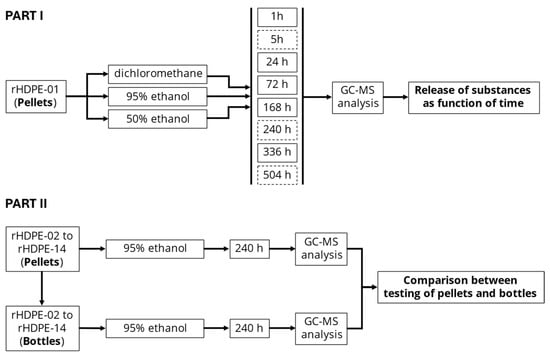
The first aim of the present study was to determine suitable contact conditions, specifically, contact time and temperature, for the testing of rHDPE in pellet form (see Figure 1).
Figure 1.
Overview of the samples investigated, and the testing performed in this study. Contact times shown in dashed boxes for PART I were not apply for every extraction medium.
The second aim of the present study was to confirm this form of testing as a pragmatic screening approach that provides results comparable to migration testing on samples of bottles produced from the same recycled material (see Figure 1).
Our study was not intended as an exhaustive safety assessment of the substances found in or released from rHDPE, nor as an assessment of the ‘quality’ of the different rHDPE samples. A comprehensive safety assessment generally requires additional targeted analyses and the evaluation of migratable inorganic substances. The objective of our study was to establish and experimentally evaluate a practical screening strategy that can support the early-stage chemical safety assessment and qualification of rHDPE for sensitive packaging applications. It thereby contributes to addressing concerns that a harmonisation of screening methods is key for the use in safety assessments.
2. Materials and Methods
2.1. Samples
The recycled plastic materials investigated during the study of the effects of solvent choice and contact conditions were commercial post-consumer rHDPE grades, obtained in pellet form. More information on the samples is provided in the Supplementary Materials S1.
All pellets were tested as received. For testing in the form of bottles, the rHDPE samples were blow-moulded to obtain bottles weighing approximately 19 g and having a filling volume of approximately 200 mL.
2.2. Reagents and Standards
Ethanol (absolute, pro analysis) was purchased from Merck, Darmstadt, Germany (article 1.00983.2511). 4,4′-Difluorobiphenyl (DFBP), dichloromethane (DCM, <0.02% water), and C7–C30 saturated alkanes in hexane (alkane standard) were purchased from Sigma-Aldrich, a part of Merck, Darmstadt, Germany (articles D102407, VWR 83665.320, and 49451-U). Tetrahydrofuran (THF) was purchased in chromatography grade from Supelco, a product range of Merck, Darmstadt, Germany (article 1.08101.1000). Purified water (0.055 µS/cm) was prepared in-house using an Elga PURELAB flex system made by Elga, Celle, Germany. Details of the preparation of the solvents and standards for the analyses can be found in the Supplementary Materials S1.
2.3. Equipment
The GC/MS system used was an Agilent 7890 GC with a 5977 MSD mass spectrometer detector made by Agilent, Waldbronn, Germany, utilizing an Rxi-5Sil MS, column (30 m × 0.25 mm i.d., 0.5 µm d.f.) made by Restek, Bad Homburg vor der Höhe, Hessen, Germany. Equipment settings are provided in the Supplementary Materials.
The test tubes used for immersing the recycled plastic samples in the simulant were 16 × 100 mm Duran glass tubes (VWR, Darmstadt, Germany, art. 391-0145). The included black screw caps (PP) were not used; instead, red screw caps GL18 made of PBT with PTFE-coated seals (VWR, Darmstadt, Germany, art. 201-0001) were used. The heating block used was a Thermobil type TM-130-56 from Liebisch, Bielefeld, Germany, equipped with a monoblock MHB-S-26-16. The pipette for adding the simulant to the test material was a 10 mL Dispensette S Organic from Brand, Wertheim, Germany. Other equipment used was generic laboratory equipment.
All manipulation of hazardous materials, in particular the organic solvents, was performed in a fume hood.
2.4. Extraction and Migration Testing Procedure on Pellets
The extraction/migration of pellet samples was performed following a method previously described and assessed in [39].
The sample in the form of pellets, weighing 3.00 g ± 0.05 g, was transferred into a screw-cap glass tube. Subsequently, 3.00 mL ± 0.07 mL of solvent—i.e., extraction medium (dichloromethane, ‘DCM’) or simulant (95% ethanol, ‘Eth95’ or 50% ethanol, ‘Eth50’)—were added. The tube was sealed with a screw cap and placed in the metal block thermostat at a set temperature of 40 °C (for dichloromethane) or 60 °C (for both concentrations of ethanol). Full coverage of the pellet sample by the solvent was achieved in all experiments.
For the study of the release of substances as a function of solvent and time, separate samples were prepared for the defined contact times of 1 h (for all solvents), 5 h (dichloromethane only), 24, 72, 168 and 336 h (for all solvents), and 240 and 504 h (95% ethanol and 50% ethanol only).
For the comparison of the testing on bottles and on pellets, a separate series of tests was performed. In this series, a fixed contact time of 240 h was used.
After the defined contact time, the test tube was removed from the block and allowed to cool to room temperature. The test tube was briefly shaken, and most of the liquid was pipetted into a gas chromatography sample vial. The liquid phase was not subjected to any concentration steps.
For the study of the release of substances as a function of solvent and time, each time/solvent combination was performed in duplicate, meaning two sets of pellets were separately placed in contact with fresh solvent, following the procedure described above, and analysed separately by GC–MS. For the comparative testing on bottles and pellets, testing was performed in triplicate, meaning three sets of pellets were separately placed in contact with fresh simulant, following the procedure described above, and analysed separately by GC–MS as described in the Supplementary Materials S1.
2.5. Migration Testing Procedure on Bottles
The sample in the form of a bottle, weighing approximately 19 g, was filled with 200.0 ± 0.1 mL of simulant 95% ethanol. The bottle was closed with a tight-fitting cap and placed in a drying oven rated for explosive atmospheres at a set temperature of 60 °C.
After a contact time of 10 days, the bottle was removed from the oven and allowed to cool to room temperature. The contents of the bottle were transferred to a glass flask and concentrated by a factor of 10:1 (v/v) using a rotary evaporator (water bath at 60 °C, approximately 30 min of runtime, and a final pressure of around 85 mbar).
Testing was performed in duplicate, meaning two bottle samples were separately placed in contact with fresh simulant, and analysed separately by GC–MS. Details of the GC–MS analysis can be found in the Supplementary Materials S1.
2.6. Processing of GC–MS Results
Details regarding the analysis of the GC–MS results are provided in the Supplementary Materials.
The identifiable substances were grouped by their chemical structure into alkyl benzenes (ALB), alkanes and alkenes (ALK), antioxidant-related substances (ANTIOX), fatty acid-related and fatty acid ester compounds (FAE), phthalates (PHTH), salicylates (SAL), and other substances (OTHER). Unidentified substances were all placed into a single group (UNIDENTIFIED).
Comparisons of substance quantities with thresholds used for packaging safety assessment were based on the values provided in the CosPaTox substance list [47], using the values provided in the column for ‘QL-A’ (column I), i.e., a quality level for a leave-on cosmetic product packaging representing a body lotion product in a 250 mL bottle and applied by an adult person. For the few detected substances not found in this list, thresholds were derived from toxicological data. Details can be found in the Supplementary Materials S1.
3. Results
3.1. Release of Substances from Pellet Samples as a Function of Solvent and Contact Time
The number of substances detected when testing rHDPE-01 pellets depended on the choice of solvent. This number ranged, depending on contact time, from 105 to 134 identified substances using dichloromethane or 95% ethanol, compared to only 37 to 43 identified substances using 50% ethanol (see measurement data in Supplementary Information).
Additionally, depending on contact time, between 78 and 165 unidentified substances were found in dichloromethane and 95% ethanol, compared to between 24 and 60 in 50% ethanol. The non-identification of substances was in most cases related to their very low concentration in the extraction solvent or migration simulant (insufficient signal-to-noise ratio).
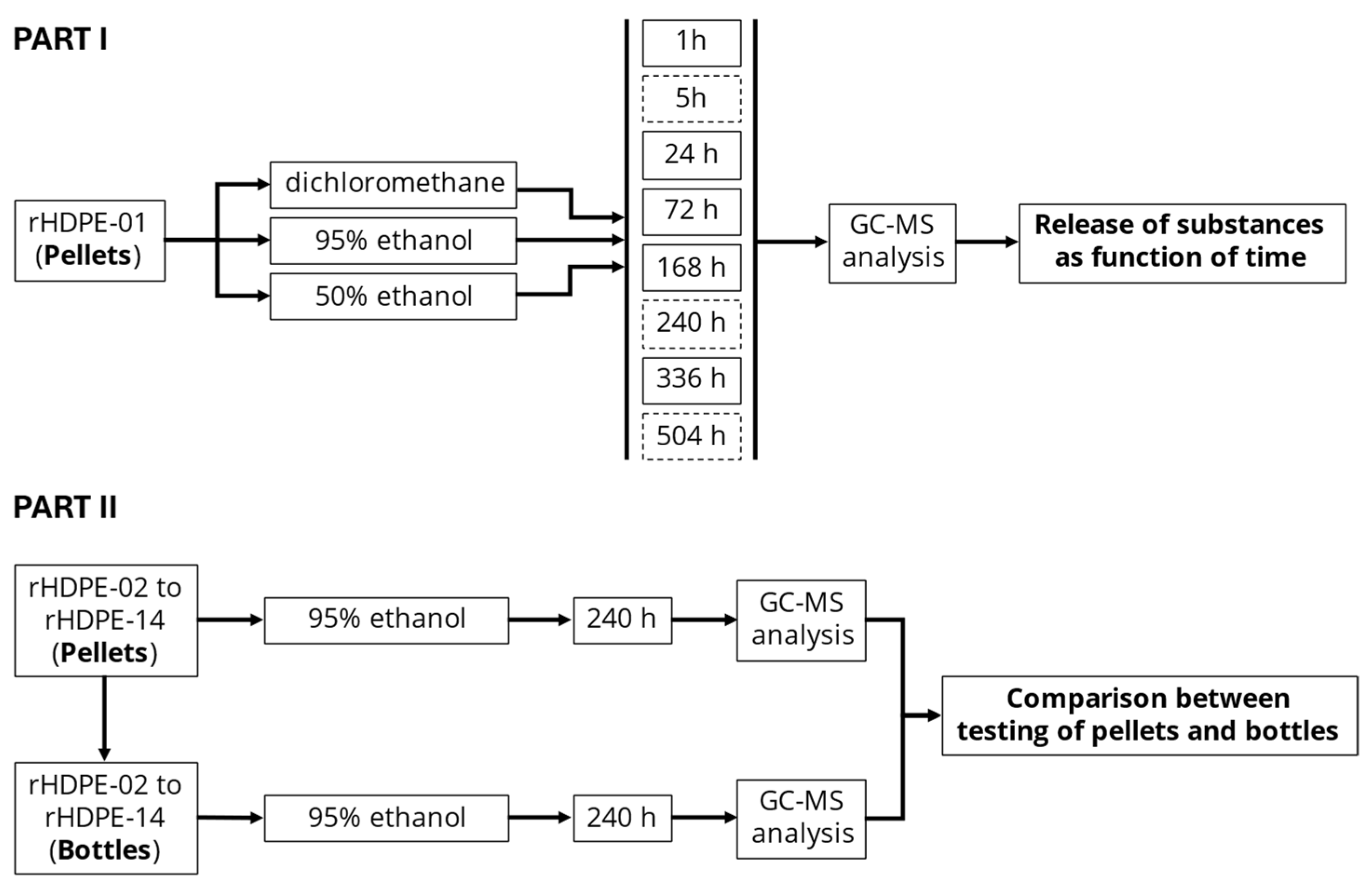
In certain cases, substances were detectable in 50% ethanol, but only after the longest contact times, i.e., after 168 h or more (see, for example Figure 2, group ‘ALK’). This suggests that the released concentrations for many substances remained below the limit of detection in this solvent, or that the substances were not released into 50% ethanol at all, demonstrating that dichloromethane and 95% ethanol provide qualitatively different results compared to 50% ethanol. Actual consumer products, which are unlikely to have the extraction power of dichloromethane or 95% ethanol, can therefore be expected to lead to a lower number (and quantities, see below) of released substances than testing with these two harsher solvents will suggest.
Figure 2.
Evolution of the concentration of substances released from rHDPE-01 pellets with contact time, summed by group, shown with fitted saturation functions.
A contact time of more than 3 days for dichloromethane, or more than 7 days for ethanol (both 95% and 50%) did not lead to substantial changes in the number of detected substances (see Supplementary Materials).
3.2. Evolution of Substance Concentrations with Contact Time
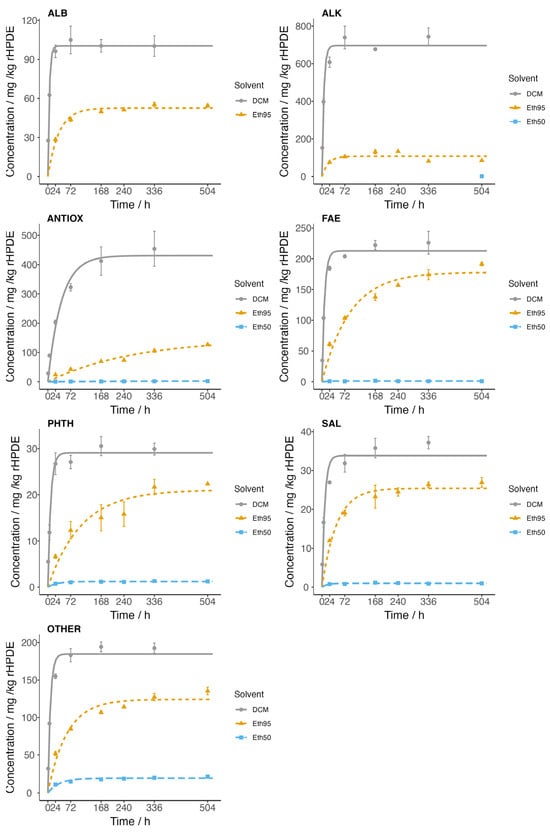
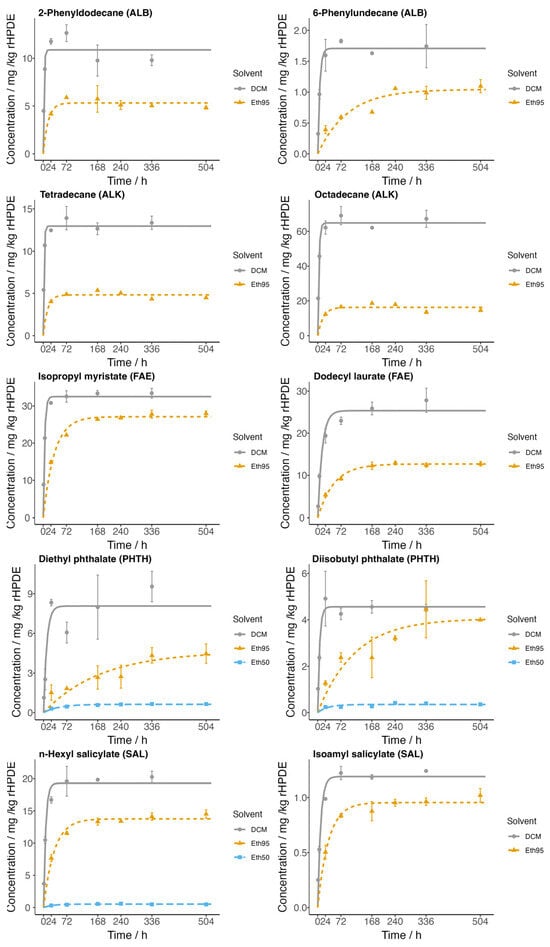
Substance concentrations, both for single substances and for each group of substances, showed a similar distinction between the three solvents (see Figure 2 and Figure 3 and Supplementary Materials). For all groups of substances (as a sum), the detected concentrations were highest in dichloromethane and noticeably lower in 50% ethanol than in either dichloromethane or 95% ethanol.
Figure 3.
Evolution of the concentration of select substances released from rHDPE-01 pellets with contact time (mean value of replicate tests, shown with standard deviation), shown with fitted saturation functions.
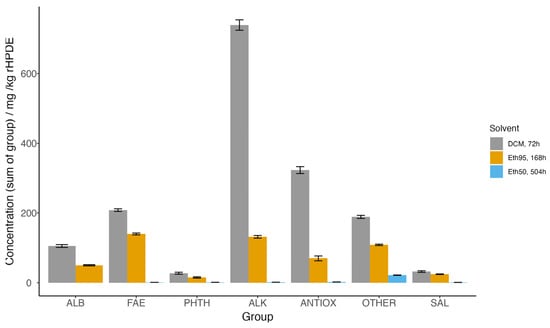
Figure 4 shows that the concentrations obtained after seven days of contact with 95% ethanol at 60 °C are, for most substance groups, not orders of magnitude different from those obtained by what is commonly considered a full extraction, i.e., three days of contact with dichloromethane at 40 °C. The notable exceptions are alkanes/alkenes and antioxidant-related substances, which are released in much higher quantity into dichloromethane. This suggests that, with above-mentioned exceptions, testing with 95% ethanol for seven days at 60 °C is not very far from extraction conditions, in terms of the concentration of many substances (and their numbers, see above), while 50% ethanol clearly represents migration conditions.
Figure 4.
Sum of the concentrations of substances released from rHDPE-01 pellets within a given group as a function of the solvent.
3.3. Determination of Suitable Contact Times for Pragmatic Testing
The concentration of nearly all individual substances as well as substance groups evolved toward a maximum concentration within the range of contact times that were studied. To determine the maximum concentration and the contact time after which the concentration of a substance or a group does not substantially increase, a saturation function of the form shown in Equation (1) was fitted to each dataset using a nonlinear least squares method.
c(t) is the concentration of a substance or a group found in the solvent at a given time t, and cmax is the maximum concentration, and is a rate constant. The Supplementary Materials, Table S2, list the maximum concentrations obtained from fitting the saturation function to the data, as well as the time t85 at which the fitted function reaches 85% of the maximum concentration. This value of 85% was chosen to account for an assumed uncertainty of 15% in the quantification by GC–MS, which is semi-quantitative in nature as used in this study (i.e., without substance-by-substance calibration). A prior study by some of the authors of this paper [39] and a recent sister study on the reproducibility of the pellet-based testing confirmed 15% as an achievable standard deviation between repeated measurements in a single laboratory.
t85 differed between the applied solvents. In 95% ethanol and 50% ethanol, substances approached their maximum concentrations noticeably slower than in the case for dichloromethane (Figure 2). Most substances exhibited a similar evolution of concentration with time and exhibited a t85 of less than 72 h of contact time with dichloromethane at 40 °C, and after less than 168 h of contact time with either 95% ethanol or 50% ethanol at 60 °C (see Figure 2 and Figure 3 and Supplementary Materials). A 7-day contact with 95% ethanol therefore yielded very comparable results to the 10 days commonly chosen when testing food contact materials.
The concentration of phthalates, notably, exhibited a t85 greater than seven days when testing was performed with 95% ethanol (Figure 2 and Supplementary Materials). This behaviour was not observed with dichloromethane or 50% ethanol. The faster release into dichloromethane is likely due to swelling of the rHDPE. For 50% ethanol, the result may be the result of a lower solubility of phthalates compared to the other solvents.
Antioxidant-related substances exhibited a t85 slightly above three days in dichloromethane and substantially longer than seven days in ethanol, possibly due to their high concentration in the rHDPE. However, it can be noted that this difference is not likely to lead to a difference in a safety assessment (see Supplementary Materials, Figure S2).
3.4. Comparison of Results Obtained on Pellets and on Bottles
For the comparison of the pellet-based testing approach with the conventional testing on finished packaging (materials), the results obtained from testing multiple rHPDE pellet samples (rHDPE-02 to rHDPE-14) were compared with results obtained on bottles produced from the same samples. The bottle size of ca. 200 mL provided a surface area equivalent to about 12.8 g of pellets (value based on X-ray tomography of the pellet as described in [48]).
Unidentifiable substances were excluded from this comparison, as a reliable correlation of unidentified peaks in the chromatogram of two independent tests (one on pellets, one on a bottle) cannot be ensured. It is noted that the reason for the non-identification of substances was in most cases their low concentration in the migrate.
The concentrations of each substance were compared directly between pellets and bottles. Due to a non-negligible quantification error in the GC–MS analysis, the results were classified based on whether the results obtained for pellets were within, below, or above a range of 85% to 115% of the result obtained for bottles, accounting for the same 15% uncertainty as was applied in Section 3.3. Cases where a substance was detectable only in the pellet test or the bottle test were included in this comparison.
Figure S3 presents the results of this analysis, broken down by substance group and substance, by rHDPE sample, and by different concentration intervals for the detected substances (intervals shown are: 0 to 5 mg/kg rHDPE; 5 to 10 mg/kg rHDPE; 10 to 20 mg/kg rHDPE; and above 20 mg/kg rHDPE). This analysis demonstrates a noticeable difference for substances in the ALK group. For substances in this group, the results obtained on pellets were consistently and significantly (i.e., at least 15%) lower than the results obtained on bottles. For substances from other groups, such cases of underestimation in pellet testing were largely limited to low concentrations (below 5 mg/kg rHDPE), where quantification becomes more difficult. Above a concentration of 5 mg/kg rHDPE, only isolated cases of significant underestimation can be seen in Figure S3. At concentrations above 20 mg/kg rHDPE, no significant underestimation occurred outside the ALK group.
Figure S3 further demonstrates the case of substances detected only in the pellet tests but not in the bottle tests (shown in grey in the figure). These substances were found only at low concentrations (i.e., within the range of 0 to 5 mg/kg rHDPE), suggesting that they may have also been present in the bottles but remained below the detection limit. As no clear pattern in terms of retention index—and therefore approximate boiling point—can be observed in Figure S3 for substances either only found in pellets (grey) or measured clearly higher from pellets than from bottles (dark green), it appears unlikely that the solvent reduction step performed for the bottle testing led to a significant reduction in low-boiling substances.
3.5. Impact on Safety Assessments
Differences between the two testing approaches (pellets and bottles) are most relevant when they occur close to the maximum acceptable substance concentration (MASC) used for the safety assessment. To assess the potential impact of these differences, a second analysis was performed in which the concentrations of individual substances were expressed relative to a typical MASC applicable to leave-on cosmetic products, rather than as absolute concentrations (mg/kg rHDPE).
Figure S4 visualises the outcomes of this analysis. Substance concentrations relative to the MASC were classified into four ranges: 0–1%, 1–2%, 2–10%, and >10% of the respective threshold value. All cases in which pellet testing resulted in lower concentrations than bottle testing were below 1% of the MASC according to the CosPaTox methodology and substance list (see Section 2). This also applied to all alkanes/alkenes, for which the concentrations remained below 1% of their respective MASC. The observed underestimation in pellet testing is therefore considered unlikely to have a relevant impact on the outcome of a safety assessment.
To support this conclusion, a comparison was performed between the two testing approaches regarding which substances nominally exceeded their MASC in each of the two tests. Figure S5 suggests that an assessment based on a pellet results can lead, at least for certain rHDPE samples, to a substance exceeding the MASC even when it did not exceed it when tested in bottle form. At least for the rHDPE grades under study, the pellet testing approach could thus be considered somewhat conservative compared to bottle testing, from a safety assessment standpoint. We do note however that, due to the semi-quantitative nature of the described analyses, the nominal exceeding of the MASC should be considered cautiously. At least the previously described standard deviation of 15% between two measurements on the same sample in the same laboratory should be considered. As substance quantities have not been calibrated against reference sample, a certain additional non-statistical error must be assumed. In a real-world safety-assessment, a specific quantification of substances approaching their MASC would be common practice, but this was beyond the scope of our study.
4. Discussion
This study demonstrates that the number and concentrations of substances released from rHDPE pellets depend strongly on the extraction or migration medium, consistent with observations from testing of finished packaging. The choice of solvent is therefore a critical parameter when evaluating recycled materials, as it should reflect the intended application and, where appropriate, the nature of the packaged product.
For rHDPE pellets, 95% ethanol at 60 °C exhibited extraction-like behaviour, despite being classified as a migration simulant in food-contact testing. Consequently, testing under these conditions is likely to provide a conservative estimate of the transfer of substances into many real products. This distinction should be considered when interpreting pellet-based screening results and defining appropriate test conditions for safety assessment.
Based on the observed release kinetics, a contact time of 3 days at 40 °C for dichloromethane and 7 days at 60 °C for both 95% and 50% ethanol is considered appropriate for screening rHDPE pellets. Under these conditions, concentrations close to the maximum observed release were reached for nearly all substances. Phthalates and antioxidant-related substances did not reach a plateau in 95% ethanol within 7 days. Where these substance classes are relevant to the safety assessment, their concentrations may therefore require confirmation by targeted analysis under extended or dedicated test conditions.
Comparison of pellet and bottle testing showed that, for most identifiable substances at concentrations above 5 mg/kg rHDPE, pellet testing yielded concentrations comparable to or higher than those obtained from finished bottles, despite the surface area of the pellets being about one fourth of the surface area of the bottle. Alkanes/alkenes represented a notable exception, with lower concentrations generally observed in pellet testing. However, these concentrations remained below 1% of typical maximum acceptable substance concentrations used in packaging safety assessments. The same was true for the other substances for which pellet testing resulted in lower concentrations.
5. Conclusions
Overall, the results indicate that, for the rHDPE grades investigated, pellet testing provides a suitable and generally conservative screening approach from a chemical safety assessment perspective. No relevant safety assessment threshold was exceeded in bottle testing without also being identified in the corresponding pellet testing. Conversely, several substances exceeded their maximum acceptable substance concentration in pellet testing while remaining below the threshold in bottle testing, and some substances were detected only in pellet samples, despite the pellet samples providing only about a quarter of the surface area of the tested bottles. These findings support the use of pellet-based testing as an efficient screening tool for the early-stage safety assessment of rHDPE intended for sensitive packaging applications.
Although unidentified substances were excluded from the quantitative comparison, the observed trends suggest that the overall conclusion may also extend to unidentified substances other than alkanes/alkenes. This assumption should, however, be verified in future studies using a broader range of rHDPE materials and analytical approaches. As the release of chemical substances from plastics is influenced by the contact area, when applying the method described in this paper, potential surface area differences between pellets and the final packaging (bottles or otherwise) should be taken into account.
Supplementary Materials
The following supporting information can be downloaded at https://www.mdpi.com/article/10.3390/separations13100299/s1, Document S1: Additional information on the recycled plastic samples; preparation of reagents and standards; details of the GC–MS analysis and processing of GC–MS data; additional tables and figures. Table S1. Maximum number of identified substances for rHDPE-01 at the maximum contact time. Table S2. Maximum concentrations and time needed to reach 85% of maximum concentration for selected substances and groups of substances released from rHPDE-01, resulting from the fitting of the saturation function to the data. Figure S1. Concentrations of substances (sums of all substances) detected for rHPDE-01 as a function of solvent and time shown with fitted saturation functions. Figure S2. Comparison of the GC-MS analysis results (identifiable substances only) obtained on rHPDE-01 pellets as a function of solvent and contact time. The graph shows whether for a given substance the maximum acceptable substance concentration provided by CosPaTox for leave-on cosmetic packaging is respected (value below the maximum acceptable concentration) or exceeded (value above the maximum acceptable concentration). Within each group, substances are ordered by increasing retention time from top to bottom. Table S3: Measurement data and outcomes of the fitting of the saturation function for the testing on rHPDE-01. Table S4: Measurement data for the testing of pellets in comparison to bottles. Figure S3: Comparison of the GC–MS analysis results (identifiable substances only) obtained on pellets of rHDPE-02 to rHDPE-14 and on bottles made from the same rHDPE sample. Figure S4: Comparison of the GC–MS analysis results (identifiable substances only) obtained on pellets of rHDPE-02 to rHDPE-14 and on bottles made from the same rHDPE sample. Substance concentrations are expressed relative to the MASC for leave-on cosmetic product. Figure S5: Comparison of the GC–MS analysis results (identifiable substances only) obtained on pellets of rHDPE-02 to rHDPE-14 and on bottles made from the same rHDPE sample [49,50].
Author Contributions
Conceptualisation, all authors; methodology, all authors; validation, H.G.-B.; formal analysis, D.B.; investigation, H.G.-B.; resources, H.G.-B.; data curation, H.G.-B.; writing—original draft preparation, D.B.; writing—review and editing, J.L.L.M., T.R.B. and H.G.-B.; visualisation, D.B.; supervision, H.G.-B. All authors have read and agreed to the published version of the manuscript.
Funding
This study was funded by the CosPaTox consortium and its member companies.
Data Availability Statement
Data is contained within the article or Supplementary Material.
Acknowledgments
The authors would like to thank the CosPaTox Consortium and its management for the productive organisation of the CosPaTox working groups. This study was designed and conducted by members of the CosPaTox WP4 working group. The authors would also like to thank Anika Brett (Mann und Schröder GmbH), Diana Doetsch (LyondellBasell), Maryline Gasthuys (L’OREAL), Andreas Grabitz (Eurofins Consumer Product Testing GmbH), Manfred Hoffmann (Amcor Flexibles Kreuzlingen AG), Jonas Bastian Metternich (Lyondellbasell), Christophe Tondelier (Veolia Research & Innovation) and Frank Welle (Fraunhofer Institute für Process Engineering and Packaging) for the fruitful discussions and exchanges during the development and execution of this study and for the sharing measurement experience of their laboratories.
Conflicts of Interest
T.R.B, J.L.L.M, M.R., A.W. and H.G-B. are employees of their respective organisations. D.B. is a managing partner at Emerging Motif OHG. The CosPaTox consortium provided the funding for the work of D.B. in relation to this paper.
References
- Ignatyev, I.A.; Thielemans, W.; Vander Beke, B. Recycling of Polymers: A Review. ChemSusChem 2014, 7, 1579–1593. [Google Scholar] [CrossRef] [Scilit] [PubMed]
- Schyns, Z.O.G.; Shaver, M.P. Mechanical Recycling of Packaging Plastics: A Review. Macromol. Rapid Commun. 2021, 42, 2000415. [Google Scholar] [CrossRef] [Scilit] [PubMed]
- Publications Office of the European Union. Commission Regulation (EU) 2022/1616 of 15 September 2022 on Recycled Plastic Materials and Articles Intended to Come into Contact with Foods, and Repealing Regulation (EC) No 282/2008; Publications Office of the European Union: Luxembourg, 2022.
- Publications Office of the European Union. Regulation (EC) No 1223/2009 of the European Parliament and of the Council of 30 November 2009 on Cosmetic Products; Publications Office of the European Union: Luxembourg, 2009.
- Publications Office of the European Union. European Union Regulation (EC) No 1935/2004 of the European Parliament and of the Council of 27 October 2004 on Materials and Articles Intended to Come into Contact with Food and Repealing Directives 80/590/EEC and 89/109/EEC; Publications Office of the European Union: Luxembourg, 2004.
- Meng, W.; Sun, H.; Su, G. Plastic Packaging-Associated Chemicals and Their Hazards—An Overview of Reviews. Chemosphere 2023, 331, 138795. [Google Scholar] [CrossRef] [Scilit] [PubMed]
- Sanchis, Y.; Yusà, V.; Coscollà, C. Analytical Strategies for Organic Food Packaging Contaminants. J. Chromatogr. A 2017, 1490, 22–46. [Google Scholar] [CrossRef] [Scilit] [PubMed]
- Koster, S.; Bani-Estivals, M.-H.; Bonuomo, M.; Bradley, E.; Chagnon, M.-C.; Garcia, M.L.; Godts, F.; Gude, T.; Helling, R.; Paseiro-Losada, P.; et al. Guidance International Life Sciences Institute on Best Practices on the Risk Assessment of Non Intentionally Added Substances (NIAS) in Food Contact Materials and Articles 2016; International Life Sciences Institute: Washington, DC, USA, 2016. [Google Scholar]
- Kato, L.S.; Conte-Junior, C.A. Safety of Plastic Food Packaging: The Challenges about Non-Intentionally Added Substances (NIAS) Discovery, Identification and Risk Assessment. Polymers 2021, 13, 2077. [Google Scholar] [CrossRef] [Scilit] [PubMed]
- Bolte, L.; Gers-Barlag, H.; Heinsohn, G.; Daniels, R. Migration of Cosmetic Components Into Polyolefins. Adv. Polym. Technol. 2024, 2024, 2680899. [Google Scholar] [CrossRef] [Scilit]
- Undas, A.K.; Groenen, M.; Peters, R.J.B.; Van Leeuwen, S.P.J. Safety of Recycled Plastics and Textiles: Review on the Detection, Identification and Safety Assessment of Contaminants. Chemosphere 2023, 312, 137175. [Google Scholar] [CrossRef] [Scilit] [PubMed]
- Cecon, V.S.; Da Silva, P.F.; Curtzwiler, G.W.; Vorst, K.L. The Challenges in Recycling Post-Consumer Polyolefins for Food Contact Applications: A Review. Resour. Conserv. Recycl. 2021, 167, 105422. [Google Scholar] [CrossRef] [Scilit]
- Bayer, F.L. Polyethylene Terephthalate Recycling for Food-Contact Applications: Testing, Safety and Technologies: A Global Perspective. Food Addit. Contam. 2002, 19, 111–134. [Google Scholar] [CrossRef] [Scilit] [PubMed]
- Colombo, G.; Corredig, M.; Uysal Ünalan, I.; Tsochatzis, E. Untargeted Screening of NIAS and Cyclic Oligomers Migrating from Virgin and Recycled Polyethylene Terephthalate (PET) Food Trays. Food Packag. Shelf Life 2024, 41, 101227. [Google Scholar] [CrossRef] [Scilit]
- Franz, R.; Welle, F. Contamination Levels in Recollected PET Bottles from Non-Food Applications and Their Impact on the Safety of Recycled PET for Food Contact. Molecules 2020, 25, 4998. [Google Scholar] [CrossRef] [Scilit] [PubMed]
- Kastbjerg, S.; Malmgren-Hansen, B.; Kristensen, G.T.; Villadsen, S.R.; Jacobsen, E. Initial Safety Assessment of Recycled Plastic for Packaging of Cosmetic Products; Danish Environmental Protection Agency: Odense, Denmark, 2021.
- Nerìn, C.; Albiñana, J.; Philo, M.R.; Castle, L.; Raffael, B.; Simoneau, C. Evaluation of Some Screening Methods for the Analysis of Contaminants in Recycled Polyethylene Terephthalate Flakes. Food Addit. Contam. 2003, 20, 668–677. [Google Scholar] [CrossRef] [Scilit] [PubMed]
- Núñez, S.S.; Moltó, J.; Conesa, J.A.; Fullana, A. Heavy Metals, PAHs and POPs in Recycled Polyethylene Samples of Agricultural, Post-Commercial, Post-Industrial and Post-Consumer Origin. Waste Manag. 2022, 144, 113–121. [Google Scholar] [CrossRef] [Scilit] [PubMed]
- Núñez, S.S.; Conesa, J.A.; Moltó, J.; Fullana, A. Decontamination of Recycled LDPE Using Different Washing Methods. Resour. Conserv. Recycl. 2023, 195, 107017. [Google Scholar] [CrossRef] [Scilit]
- Roosen, M.; Mys, N.; Kusenberg, M.; Billen, P.; Dumoulin, A.; Dewulf, J.; Van Geem, K.M.; Ragaert, K.; De Meester, S. Detailed Analysis of the Composition of Selected Plastic Packaging Waste Products and Its Implications for Mechanical and Thermochemical Recycling. Environ. Sci. Technol. 2020, 54, 13282–13293. [Google Scholar] [CrossRef] [Scilit] [PubMed]
- Schweighuber, A.; Gall, M.; Fischer, J.; Liu, Y.; Braun, H.; Buchberger, W. Development of an LC-MS Method for the Semiquantitative Determination of Polyamide 6 Contaminations in Polyolefin Recyclates. Anal. Bioanal. Chem. 2021, 413, 1091–1098. [Google Scholar] [CrossRef] [Scilit] [PubMed]
- Su, Q.-Z.; Vera, P.; Nerín, C. Combination of Structure Databases, In Silico Fragmentation, and MS/MS Libraries for Untargeted Screening of Non-Volatile Migrants from Recycled High-Density Polyethylene Milk Bottles. Anal. Chem. 2023, 95, 8780–8788. [Google Scholar] [CrossRef] [Scilit] [PubMed]
- Su, Q.-Z.; Vera, P.; Nerín, C.; Lin, Q.-B.; Zhong, H.-N. Safety Concerns of Recycling Postconsumer Polyolefins for Food Contact Uses: Regarding (Semi-)Volatile Migrants Untargetedly Screened. Resour. Conserv. Recycl. 2021, 167, 105365. [Google Scholar] [CrossRef] [Scilit]
- Su, Q.-Z.; Vera, P.; Salafranca, J.; Nerín, C. Decontamination Efficiencies of Post-Consumer High-Density Polyethylene Milk Bottles and Prioritization of High Concern Volatile Migrants. Resour. Conserv. Recycl. 2021, 171, 105640. [Google Scholar] [CrossRef] [Scilit]
- Vera, P.; Canellas, E.; Su, Q.-Z.; Mercado, D.; Nerín, C. Migration of Volatile Substances from Recycled High Density Polyethylene to Milk Products. Food Packag. Shelf Life 2023, 35, 101020. [Google Scholar] [CrossRef] [Scilit]
- Welle, F. Post-Consumer Contamination in High-Density Polyethylene (HDPE) Milk Bottles and the Design of a Bottle-to-Bottle Recycling Process. Food Addit. Contam. 2005, 22, 999–1011. [Google Scholar] [CrossRef] [Scilit] [PubMed]
- Vera, P.; Canellas, E.; Nerín, C. Designing Safe Recycled High-Density Polyethylene (HDPE) for Child Toys. J. Hazard. Mater. 2024, 478, 135482. [Google Scholar] [CrossRef] [Scilit] [PubMed]
- Strangl, M.; Fell, T.; Schlummer, M.; Maeurer, A.; Buettner, A. Characterization of Odorous Contaminants in Post-Consumer Plastic Packaging Waste Using Multidimensional Gas Chromatographic Separation Coupled with Olfactometric Resolution. J. Sep. Sci. 2017, 40, 1500–1507. [Google Scholar] [CrossRef] [Scilit] [PubMed]
- Strangl, M.; Schlummer, M.; Maeurer, A.; Buettner, A. Comparison of the Odorant Composition of Post-Consumer High-Density Polyethylene Waste with Corresponding Recycled and Virgin Pellets by Combined Instrumental and Sensory Analysis. J. Clean. Prod. 2018, 181, 599–607. [Google Scholar] [CrossRef] [Scilit]
- Fink, J.K. Food Safety, Plastics and Sustainability: Materials, Chemicals, Recycling and the Circular Economy, 1st ed.; Wiley: Hoboken, NJ, USA, 2023. [Google Scholar]
- Chen, Z.-F.; Lin, Q.-B.; Su, Q.-Z.; Zhong, H.-N.; Nerin, C. Identification of Recycled Polyethylene and Virgin Polyethylene Based on Untargeted Migrants. Food Packag. Shelf Life 2021, 30, 100762. [Google Scholar] [CrossRef] [Scilit]
- Paiva, R.; Veroneze, I.B.; Wrona, M.; Nerín, C.; Cruz, S.A. The Role of Residual Contaminants and Recycling Steps on Rheological Properties of Recycled Polypropylene. J. Polym. Environ. 2022, 30, 494–503. [Google Scholar] [CrossRef] [Scilit]
- Thoden Van Velzen, E.U.; Workala, Y.; Teunissen, W.; Smeding, I. Volatile Organic Contaminants in HDPE Milk Bottles along the Mechanical Recycling Value Chain, Revealing Origins and Contamination Pathways. J. Clean. Prod. 2024, 459, 142571. [Google Scholar] [CrossRef] [Scilit]
- Zeng, S.-F.; Zeng, Y.; Guo, P.; Hu, C.-Y.; Wang, Z.-W. Characterization of Odors and Volatile Organic Compounds Changes to Recycled High-Density Polyethylene through Mechanical Recycling. Polym. Degrad. Stab. 2023, 208, 110263. [Google Scholar] [CrossRef] [Scilit]
- Carmona, E.; Rojo-Nieto, E.; Rummel, C.D.; Krauss, M.; Syberg, K.; Ramos, T.M.; Brosche, S.; Backhaus, T.; Almroth, B.C. A Dataset of Organic Pollutants Identified and Quantified in Recycled Polyethylene Pellets. Data Brief 2023, 51, 109740. [Google Scholar] [CrossRef] [Scilit] [PubMed]
- Chen, Z.-F.; Lin, Q.-B.; Song, X.-C.; Chen, S.; Zhong, H.-N.; Nerin, C. Discrimination of Virgin and Recycled Polyethylene Based on Volatile Organic Compounds Using a Headspace GC–MS Coupled with Chemometrics Approach. Food Packag. Shelf Life 2020, 26, 100553. [Google Scholar] [CrossRef] [Scilit]
- Daggubati, L.; Sobhani, Z.; Carbery, M.; Ramadass, K.; Palanisami, T. Fingerprinting Risk from Recycled Plastic Products Using Physical and Chemical Properties. J. Hazard. Mater. 2025, 488, 137507. [Google Scholar] [CrossRef] [Scilit] [PubMed]
- Bhattarai, B.; Wedebye, E.B.; Nikolov, N.G.; Cederberg, T.L.; Jensen, L.K.; Granby, K.; Pedersen, G.A. Analytical Testing Strategy for Identification and in Silico Toxicity Assessment of Non-Intentionally Added Substances in Repeatedly Recycled Flexible Mono-Plastic Food Contact Material. Food Packag. Shelf Life 2025, 48, 101456. [Google Scholar] [CrossRef] [Scilit]
- Brandt, M.; Vietzke, J.-P.; Bankmann, D.; Gers-Barlag, H. GC/MS Screening of Substances Released from Post-Consumer Recycled HDPE Pellets into 95% Ethanol: Reproducibility and Variation between Production Batches. Recycling 2024, 9, 101. [Google Scholar] [CrossRef] [Scilit]
- Strangl, M.S. Characterization of Odor-Active Compounds in Post-Consumer Polyolefins. Ph.D. Thesis, Friedrich-Alexander-Universität Erlangen-Nürnberg, Erlangen-Nürnberg, Germany, 2021. [Google Scholar]
- Feng, Y.; Jayakody, M.M.; Sharma, B.; Nolvachai, Y.; Jadhav, S.R.; Dias, D.A.; Shellie, R.A. Multidimensional Gas Chromatography Approach to Measure Aroma Compounds in Post-Consumer Recycled Plastic Materials. J. Chromatogr. A 2026, 1785, 467340. [Google Scholar] [CrossRef] [Scilit] [PubMed]
- Zhang, M.-Y.; Su, Q.-Z.; Lin, Q.-B.; Zhong, H.-N.; Chen, S.; Li, D.; Dong, B.; Xu, M.-Q.; Li, W.-L. Identification and Quantification of Volatile Organic Compounds in Chinese Recycled HDPE: Consequences for Its Applicability. Food Packag. Shelf Life 2025, 47, 101424. [Google Scholar] [CrossRef] [Scilit]
- Gauquie, J.; Devriese, L.; Robbens, J.; De Witte, B. A Qualitative Screening and Quantitative Measurement of Organic Contaminants on Different Types of Marine Plastic Debris. Chemosphere 2015, 138, 348–356. [Google Scholar] [CrossRef] [Scilit] [PubMed]
- Chibwe, L.; De Silva, A.O.; Spencer, C.; Teixera, C.F.; Williamson, M.; Wang, X.; Muir, D.C.G. Target and Nontarget Screening of Organic Chemicals and Metals in Recycled Plastic Materials. Environ. Sci. Technol. 2023, 57, 3380–3390. [Google Scholar] [CrossRef] [Scilit] [PubMed]
- Su, Q. Safety Assessment of Recycled Polyolefins for Food Contact Applications: Non-Target Screening of Volatile and Non-Volatile Substances; Universidad Zaragoza: Zaragoza, España, 2023. [Google Scholar]
- Yang, X.; Zhang, H.; Yan, J.; Xue, H.; Shi, H.; Miao, J. Determination of 15 Restricted Substances in Plastic-Packaged Food by Gas Chromatography–Mass Spectrometry. Rapid Commun. Mass Spectrom. 2026, 40, e70023. [Google Scholar] [CrossRef] [Scilit] [PubMed]
- CosPaTox. CosPaTox Substance List (April 2024); CosPaTox: Worms, Germany, 2024. [Google Scholar]
- CosPaTox. Evaluation of the Safety of Recyclates in Cosmetic and Detergent Packaging (CosPaTox Dossier); CosPaTox: Worms, Germany, 2024. [Google Scholar]
- R Core Team. R: A Language and Environment for Statistical Computing (Manual); R Foundation for Statistical Computing: Vienna, Austria, 2021. [Google Scholar]
- Wickham, H. ggplot2: Elegant Graphics for Data Analysis; Springer International Publishing: Cham, Switzerland, 2016. [Google Scholar] [CrossRef] [Scilit]
Disclaimer/Publisher’s Note: The statements, opinions and data contained in all publications are solely those of the individual author(s) and contributor(s) and not of MDPI and/or the editor(s). MDPI and/or the editor(s) disclaim responsibility for any injury to people or property resulting from any ideas, methods, instructions or products referred to in the content. |
© 2026 by the authors. Licensee MDPI, Basel, Switzerland. This article is an open access article distributed under the terms and conditions of the Creative Commons Attribution (CC BY) license.