


Abstract
Seawater desalination can only be sustainable if it cuts energy use, membrane fouling, brine discharge, and water cost. This review compares thermal and membrane technologies against these four challenges. RO supplies 70 to 80% of desalinated water at 3 to 5.5 kWh/m3, against 6.5 to 12 for MED and vapor compression and 13.5 to 25.5 for MSF, and it usually gives the lowest water cost, though energy prices and brine rules shift this. Thermal processes still yield purer distillate. A life-cycle appraisal structured by ISO 14040 and 14044 finds that energy drives most RO emissions, that brine recovery lowers impacts, and that low-carbon heat or different criteria weights can reverse technology rankings. Hybrids target recovery and scaling: RO–MSF and NF–RO have commercial or pilot cases, whereas MSF–MED and MD-based options rest on simulations and pilot work. AI models now optimize energy use, forecast fouling, and monitor water quality, but rarely link thermal, brine, and life-cycle stages. Priorities are fouling-resistant membranes, renewable-powered hybrids, brine minimization, and joint AI and life-cycle assessment.
1. Introduction
With the ever-growing global population, water scarcity has become a global phenomenon. According to UNICEF, around 4 billion people face severe water scarcity for at least one month each year, a burden intensified by industrialization, contamination of available freshwater resources, and climate change [1]. As freshwater sources such as rivers, lakes, and groundwater grow increasingly limited and inaccessible in water-stressed regions, desalination and water reuse have become increasingly popular ways to complement freshwater supply [2]. Desalination removes salt and other minerals from seawater to produce water suitable for drinking, agricultural, and industrial use, primarily through membrane-based processes such as reverse osmosis (RO), nanofiltration (NF), and membrane distillation (MD) [3]. RO alone accounts for approximately 70 to 80% of desalinated water produced worldwide, most of it in the Middle East and North Africa (MENA), where freshwater scarcity is most severe [2,4]. Thermal-based methods, chiefly multi-stage flash (MSF) distillation and multiple-effect distillation (MED), remain widely used as well, particularly in large-scale plants valued for high economic return and water–power cogeneration. Thermal desalination was first deployed in the 1950s, roughly two decades before membrane desalination emerged in the 1970s–1980s, though membrane-based technologies have since overtaken thermal methods owing to their lower energy and capital costs [4], aided by continued advances in membrane science [5,6,7,8,9,10,11,12,13]. Desalination is also classified by feedwater source into seawater desalination (SWD), which accounts for 61% of produced water [14], and brackish-water desalination (BWD), for which RO was first implemented in the late 1960s [15].
One of the key challenges in making membrane-based desalination technologies less energy-intensive is the semi-permeable membrane itself. The permeability and selectivity trade-off also limits the development of membrane materials. Extensive research efforts are ongoing to find more robust and less energy-intensive membrane materials [16,17,18]. Another major environmental issue with desalination plants is the management of brine, which is almost twice as saline, and the chemicals used for pretreatment and membrane cleaning. Energy use, membrane fouling, brine discharge, and water cost are the four challenges that recur across thermal and membrane routes, and this review is organized around them.
A bibliometric analysis was done to map the current research overview in SWD, using Publish or Perish software; 6678 unique publications from 2021 to 2026 were retrieved from Google Scholar with relevant keywords. VOSviewer (version 1.6.20) was used for keyword co-occurrence analysis, where network visualization (Figure 1a) showed three distinct research clusters. The first cluster groups are machine learning, neural networks, multi-objective optimization, and energy efficiency studies. The second cluster centers on solar-driven evaporation, photothermal materials, hydrogel-based evaporators, and interfacial steam generation. The third cluster covers membrane science including NF, water flux, and pervaporation. These clusters remain largely disconnected from one another on the map, and the density visualization (Figure 1b) reinforces this fragmentation, with the weakest connectivity occurring precisely between the artificial intelligence (AI)-optimization cluster and the other two. Recent reviews mirror this fragmentation (Table 1). This pattern shows a clear and consistent gap: existing research and existing reviews alike, treat AI optimization, solar-driven emerging technologies, membrane science, thermal systems, and sustainability assessment as separate domains within the field of SWD. To our knowledge, no recent review integrates all five of these domains in a single study.
Figure 1.
Bibliometric analysis of recent SWD research (2021–2026) using VOSviewer keyword co-occurrence: (a) network visualization, where cluster 1 (red) covers machine learning and optimization, cluster 2 (green) covers solar-driven desalination, and cluster 3 (blue) covers membrane processes; and (b) density visualization, where yellow brightness indicates a higher keyword occurrence density.
Table 1.
Recent reviews related to this work, with their main focus and the topics each leaves out.
The present review closes this gap with one organizing question: how can SWD cut its energy use, fouling, brine discharge, and water cost? Unlike previous reviews, it treats AI-assisted optimization and sustainability assessment as dedicated topics rather than incorporating them into a general future outlook. The focus is seawater, and brackish-water use appears only where a technology mainly serves it, such as electrodialysis (ED). Section 2, Section 3 and Section 4 compare thermal and membrane technologies and review their global deployment and cost trends. Section 5, Section 6, Section 7 and Section 8 then examine renewable energy integration, emerging and hybrid systems, AI-assisted optimization, and environmental life-cycle assessment as routes to meeting these challenges. Finally, it outlines future research directions focused on sustainable materials and renewable-powered hybrid desalination systems.
2. Thermal Desalination Technologies
In recent times, most modern desalination technologies are RO, MSF, and MED. Thermal desalination processes contribute around 28% of global desalination, where most of these processes are MSF and MED systems [23]. In the Gulf region, the thermal desalination system is most common, as it accounts for around 65% of the total desalination processes [24]. The key reasons behind this are poor seawater quality, availability of heat from power plants, and fossil fuels [25]. In these regions, the most used thermal desalination systems include MED, MSF, vapor compression (VC), and solar still.
A key performance benchmark across all thermal technologies is the Gained Output Ratio (GOR). It is defined as the ratio between the mass of distillate produced and the mass of heating steam consumed. A single-effect system achieves a theoretical GOR ≈ 1; modern MED plants reach 10–16 depending on the number of effects, and an MSF plant achieves 8–12 through repeated reuse of latent heat. A higher GOR means more volume of freshwater produced with a lower steam consumption, which is generally desirable for any thermal plant from an economic perspective [26].
That said, all four technologies discussed in this section share a common thermodynamic constraint. That is, they all require vaporization of water, which requires approximately 2260 kJ/kg of latent heat regardless of the specific configuration [23,27]. Even though modern systems such as MED, MSF, and vapor-compression desalination can recover and reuse energy to a certain extent, this underlying requirement for vaporization is still unavoidable. Because of this, thermal-based technologies exhibit a higher energy consumption compared to membrane-based processes such as RO [26]. However, although this inherent disadvantage persists, they produce a higher quality distillate than RO, with total dissolved solids (TDS) below 20 ppm. These can also work with almost any quality or salinity of feedwater without requiring any extensive pretreatment. Moreover, they are highly reliable and can integrate well with power plants because they can take advantage of the cogenerated steam and readily available waste heat [25,28]. The following subsections describe each of these four technologies in detail.
2.1. Multiple Effect Distillation (MED): Effect Arrangement, Feed Flow Patterns, and Top Brine Temperature (TBT) Limit
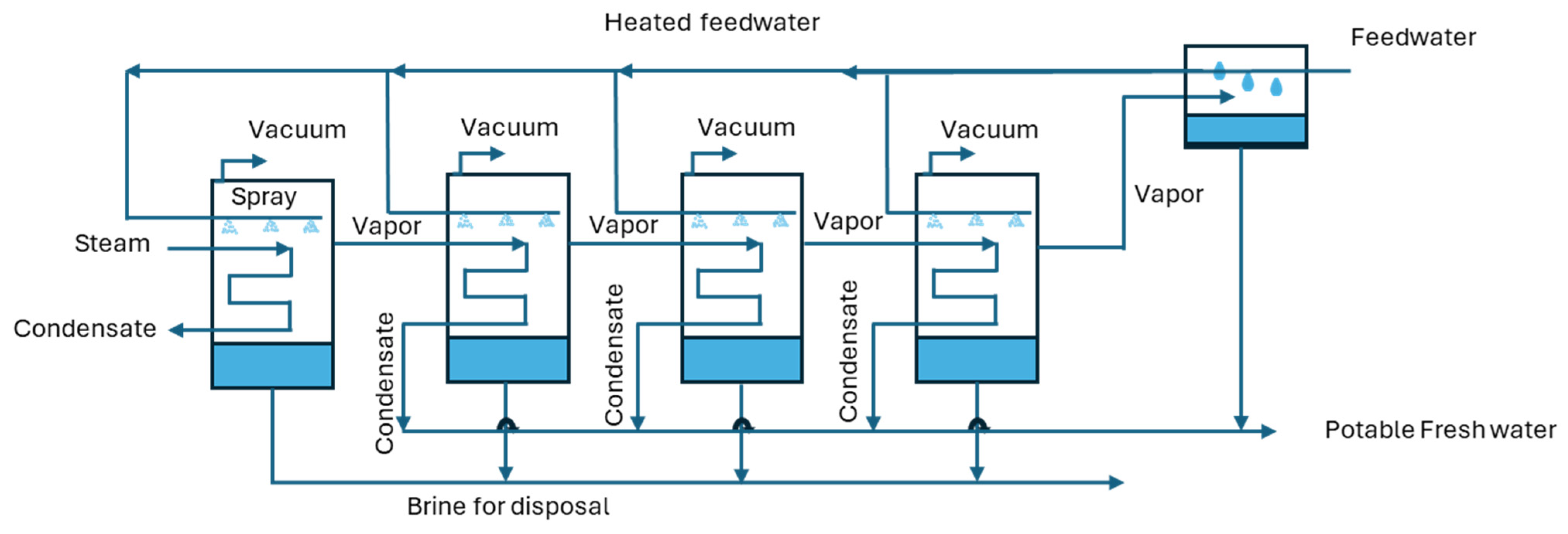
The MED process is widely used to produce freshwater from SWD, and it consists of a series of distillation stages, known as effects, arranged in sequence. In each effect, seawater is evaporated using heat supplied from a vessel, and the generated vapor is then transferred to the next stage. The vapor leaving one effect serves as the heating medium for the subsequent effect, enabling further evaporation of saline water. As evaporation occurs in the next effect, the incoming vapor condenses through heat exchange, producing freshwater. This condensate from all effects is collected and combined into a single product water stream, which is then pumped for freshwater recovery. After evaporation from each effect, the remaining liquid will be drained as a highly conductive waste brine [29,30]. In this process, a large amount of latent heat of condensation is reused several times before being released to the environment, ensuring a sustainable waste-heat reuse mechanism. The vapor pressure from each sequential effect must be lower in temperature and pressure than the previous effect and higher than the next effect [31].
In MED, the feedwater flow pattern can affect efficiency, scaling risk, and operational cost. There are multiple types of patterns, such as forward feed, backward feed, and parallel feed [32]. Forward feed: the feedwater enters the first effect and flows in the same direction as the vapor flow till the last effect, whereas backward feed is a kind of reverse flow pattern, as the feedwater enters the last effect and then moves to the first effect last, which has the highest temperature. In parallel, the feedwater is divided equally among the effects, and each effect is supplied with its own feedwater. This process has a lower scaling risk than the other two flow patterns, and it is the most used process in SWD plants [28,33].
Each effect must contain a heat exchanger and an evaporator section. There are multiple types of evaporators, and the most commonly used are: falling-film evaporator, vertical falling-film evaporator, and submerged-tube evaporator. In most MED processes, the falling-film evaporator is used for heat transfer due to its superior mass and heat transfer [24,34]. In this process, water is sprayed from the top to the outer surface of the heated elements, producing steam, which is then transferred to the next effect to boil the seawater [35]. The arrangement of sequential effects and steam pathway in a typical MED plant is shown in Figure 2.
Conventional MED typically operates at a TBT of 60–75 °C [36]. Exceeding this limit can increase the risk of scaling, specifically by CaCO3 or CaSO4, which can precipitate on the heat-exchanger surface, degrading its thermal performance and increasing the need for maintenance [36,37]. This TBT ceiling limits the number of stackable effects and, consequently, the plant’s achievable GOR [33,38,39]. Most large-scale plants (70,000–80,000 ton/day) now incorporate thermal vapor compression (TVC) into their system, where a steam ejector recycles part of the produced vapor into the first effect. This can significantly reduce the thermal energy requirement and boost GOR to nearly 15 [38,39]. Typical MED plant thermal energy consumption ranges from 145 to 230 MJ/m3 with electrical energy demand being in the range of 2 to 2.5 kWh/m3 for pumping. This makes them thermodynamically superior and more energy efficient compared to MSF at a comparable scale [33,38]. The low TBT requirement of MED also means they can work with low-grade thermal sources such as solar thermal heat, geothermal heat, or industrial waste heat [33,35]. However, key limitations of MED include a large physical footprint requirement, TBT-restricted water recovery, and a dependence on continuous heat sources [36,38].
Figure 2.
Schematic diagram of multi-effect distillation evaporator desalination process, (drawn based on the concepts from [40] under (CC BY-SA 4.0) license).
2.2. MSF: Flash Staging, Flow Arrangements, and TBT Limit
In MSF, seawater is heated to a high temperature and then injected into a flash chamber. The flash chamber has a pressure lower than the saturated vapor pressure at a given temperature. Because of a sudden decrease in vapor pressure, the portion of the seawater rapidly evaporates into steam. Vaporization is partial, and the remaining brine flows to the next stage, where flash vaporization occurs again, but at a lower temperature and pressure than in the previous stage. This process is continued to the next stage, and finally, the waste brine is rejected in the heat rejection stage [41]. The generated steam is condensed in heat exchangers, where the tube side carries cold seawater, and the steam is condensed by exchanging heat with the outside surface of the tube [42]. The feed seawater is heated up slowly from stage to stage. The orientation of the heat-exchanger tubes can be bundled in a cross-flow or a parallel pattern. These patterns are selected according to the process optimization principles [43].
In the MSF process, there are different types of flow arrangements: single-pass and recirculating. The single-pass is the most straightforward process, as the brine is passed through a single path and disposed of at the last stage of the treatment. This process requires more flash chambers. On the other hand, in a recirculating flow, the brine is mixed with the feed seawater. This process is more commonly followed in larger-scale operations [44].
MSF operates at a higher TBT, typically 90–110 °C [25,38]. While this increases the flash range and drives higher water production, it becomes more vulnerable to scaling due to this elevated temperature. To be specific, at temperatures above ~120 °C, CaSO4 dissolved in the seawater can precipitate and form hard scale. Therefore, this precipitation acts as a constraint on how hot the process can operate, without requiring antiscalant dosing or strict TBT control [36,37,38]. The standard recirculating MSF process can achieve a maximum GOR of 10. This can be significantly increased by integrating TVC, which enhances the plant efficiency by 30–40%; MSF-TVC systems can push the achievable GOR to 15–16 [23]. Even though its main strengths are mechanical robustness and compatibility with variable feedwater, which is backed by decades of operational data from Gulf plants, it is still more energy-intensive compared to MED and RO for new installations [23,25,28,38]. Figure 3 represents a schematic of a once-through MSF unit.
Figure 3.
Schematic of an MSF unit (reprinted from Thabit et al. [45] licensed under CC BY 4.0).
2.3. VC: MVC and TVC Configurations and Energy Use
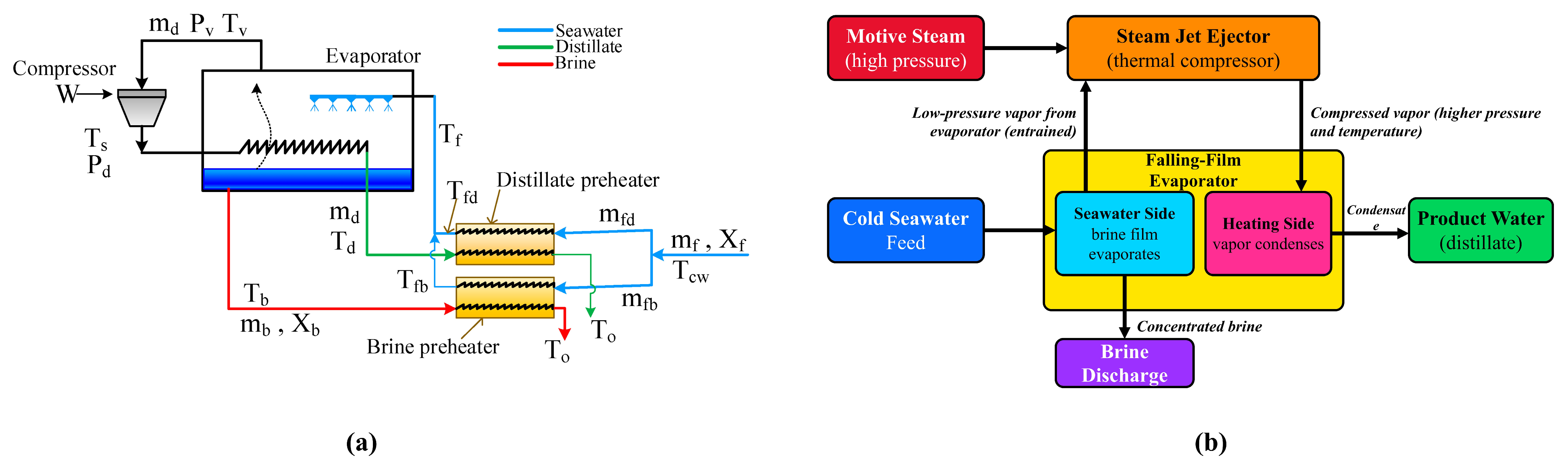
The principle of using VC technology is to recover energy from the produced vapor by compressing it to evaporate the feedwater. VC can be of two types: the mechanical VC (MVC) (Figure 4a) and the TVC (Figure 4b) [46]. The main difference between these types is the compression process. In TVC, the vapor is compressed by lateral processes like power cycles. A steam jet ejector can be used for the TVC process [47]. On the other hand, in the MVC process, the compression follows mechanical principles using electrical energy to compress the vapor mechanically [48]. In the VC process, the vapor from each stage is used to evaporate brine water in the next stage. It is also quite similar to the MED process, as evaporation is carried out using falling-film technology to improve heat transfer. The latent heat of condensation vapor is used to evaporate the cold seawater [49].
The main difference between the MED and VC is that in VC, the vapor generated in the last stage is compressed to a higher pressure, thereby increasing the temperature. It is recycled to the first stage of the system, where it condenses by exchanging heat with cold seawater and evaporates the cold seawater [49]. Finally, the condensed vapor is mixed with product water. This process can efficiently reuse heat energy. However, the primary energy is consumed through the compressor [50].
MVC and TVC typically differ in energy source and application niche. MVC runs entirely on electrical energy without any steam requirement, which makes it highly suitable for remote areas where steam production infrastructure may be absent. Moreover, renewable energy sources such as solar or wind or a combination of both can be used to operate it, though its specific energy consumption (SEC) spans a wide range of 3.6–193 kWh/m3 [51]. TVC draws on motive steam, which reduces overall electrical demand wherever waste heat or co-generated steam is accessible [47,49]. However, both configurations are capped at 100–3000 m3/day [50], far below MSF or MED output. Neither is economical beyond this range. Furthermore, the continuous electrical supply or steam source requirement of VC limits its application to small-scale, decentralized deployments rather than full-scale municipal use [51,52].
Figure 4.
Schematic of (a) MVC (reprinted from [53] licensed under CC BY 4.0) and (b) TVC unit.
2.4. Solar Still: Passive Solar Distillation, Near-Zero Operating Cost, and Low Productivity
Solar distillation is considered a sustainable desalination method for hot geographic regions such as the Gulf countries. In this process, solar energy is utilized to desalinate water through evaporation and condensation. The device used for this purpose is commonly referred to as a solar still [54]. Since solar energy is naturally abundant, the system operates with nearly zero operational cost [55]. In a basic solar still setup, water is placed in a basin covered with a sloped transparent glass lid that maximizes solar energy absorption through light refraction (Figure 5). To absorb the maximum amount of heat from solar energy, the basin has a coating of black liner or black heat-absorbing material [56]. The reason is that solar radiation passes through the glass cover, and the black-coated liner absorbs large amounts of solar energy. The water gains heat by convection, and some of it vaporizes. The vapor rises to the top surface, where the vapor condenses, and the freshwater droplets are collected through a collection tray [57]. The tray is at ambient temperature and pressure. The reduced temperature enhances condensation within the tray. The condensate flows through a pipe before being stored in a storage tank [58]. Despite its simplicity, a basic solar still produces only 3–8.33 L/day and is highly dependent on solar irradiation, which renders it unusable under cloudy conditions [58,59]. This limits solar stills to off-grid, rural, small-scale applications rather than any meaningful municipal supply.
Figure 5.
A simplified schematic of a solar still process (reprinted from [60] licensed under CC BY).
2.5. Comparative Summary of Thermal Technologies: Capacity, Energy Use, Water Quality, and Cost
Table 2 gives a detailed comparison of these four thermal technologies across capacity, energy demand, water quality, and capital cost. Among them, MED offers the best balance of energy efficiency (~42 kWh/m3) and product water quality (<5 mg/L TDS), while maintaining adequate capacity. MSF consumes nearly double the energy but handles poorer feedwater. VC occupies a mid-range energy position but is limited to small capacity, whereas solar stills consume virtually no energy but produce negligible output by comparison.
Table 2.
Comparative study of thermal-based desalination technologies.
3. Membrane-Based Desalination Technologies and Comparative Assessment
Selective mass transport theory is the main mechanism underlying membrane-based desalination technology. Semi-permeable barriers are used to separate dissolved salts and impurities from saline feedwater. Though the thermal method involves phase-change operations, membrane processes purify water from dissolved ions through physical and electrochemical mechanisms at ambient or near-ambient temperatures. Among different membrane technologies such as NF, UF, and RO, which are widely used for effluent purification, the four principal membrane technologies covered in this section are RO, NF, forward osmosis (FO), and ED, each differing fundamentally in its driving force, selectivity, and range of application [70].
3.1. Reverse Osmosis (RO)
3.1.1. Water Transport Mechanism, Selectivity–Permeability Trade-Off and Membrane Development
RO is the most popular membrane-based process, currently dominating the global desalination market [71]. It operates by applying hydraulic pressure greater than the osmotic pressure of the saline feedwater, forcing water molecules through a semi-permeable membrane while rejecting dissolved salt ions and other contaminants as a concentrated brine stream [72]. In a critical historical and theoretical review, pore flow is described as the dominant mechanistic framework for RO membranes: water moves as a continuum through nanopores under a pressure gradient, with a constant water concentration in the pores. The required transmembrane pressure ranges from 15 to 20 bar for brackish water and 55 to 70 bar for saline or seawater applications. In a comprehensive review of seawater reverse osmosis (SWRO) membrane fabrication, Lim et al. [73] reported that current thin film composite (TFC) membranes achieve NaCl rejection rates exceeding 99%. They also identify four enduring challenges: the permeability-selectivity trade-off, inadequate single-pass boron exclusion, membrane fouling, and suboptimal chlorine resistance. These challenges continue to drive membrane research globally. Although RO achieves the highest commercial maturity among membrane desalination technologies, its future improvement is limited by the fundamental permeability–selectivity trade-off of thin-film composite membranes. Therefore, current research focuses on advanced membrane architectures, including nanocomposite, graphene-based and biomimetic membranes, to simultaneously enhance water flux, salt rejection and antifouling performance [74].
3.1.2. Large-Scale RO Configuration
A conventional RO plant consists of four major subsystems: (i) pre-treatment units (coagulation, media filtration, antiscalant dosing, and disinfection) to protect membranes from fouling and scaling; (ii) high-pressure pumps; (iii) membrane modules (most commonly spiral-wound elements housed in pressure vessels); and (iv) energy recovery devices (ERDs) that recapture energy from the high-pressure brine stream and recycle it to the feed. A simplified layout of a conventional RO plant is shown in Figure 6 [71], indicating that ultrafiltration (UF), microfiltration (MF), and coagulation–flocculation are customarily used pre-treatment technologies, and the quality of the pre-treatment directly affects membrane life and energy consumption. Kim et al. [75] reported in a data analysis of more than 70 large-scale SWRO plants that the implementation of isobaric ERDs has been the single most important factor in minimizing SEC in modern SWRO plants. Their analysis clearly showed that the SEC has decreased across successive generations of plants, mainly driven by improvements in ERD efficiency and pump performance. The major progress in industrial SWRO has not only resulted from membrane improvement but also from system-level optimization, particularly high-efficiency ERDs, improved pretreatment, and optimized operating conditions. These developments have significantly reduced SEC in modern desalination plants [75].
Figure 6.
Simplified schematic of RO process, (redrawn based on [76] under (CC BY 4.0) license).
3.1.3. Industrial Deployment, Energy Benchmark and Remaining Performance Limitations
RO plants are available in a range of sizes, from small point-of-use units (<1 m3/day) to large municipal plants. RO process is responsible for about 70 to 80% of the global desalination industry, and spiral-wound membranes are the prevailing module configuration [77]. Their sensitivity modeling of a large-scale SWRO unit showed that water recovery, product TDS, and SEC are all significantly affected by feed salinity, feed temperature, feed flow rate, and operating pressure, providing important guidance for plant design optimization under variable seawater conditions. Park et al. [78] estimated the theoretical minimum energy for SWRO to be around 1.06 kWh/m3 for standard seawater (35 g/L NaCl at 50% recovery), showing the large potential for improvement in existing plants, where practical SEC ranges from 3 to 5 kWh/m3 in well-designed modern plants. Although RO currently dominates global desalination capacity because of its maturity and scalability, future improvements are restricted by energy limits, membrane degradation, fouling, and brine management challenges [78].
3.2. Nanofiltration (NF)
3.2.1. Mechanism: Size-Charge Selective Transport
NF functions within the operational range between UF and RO, characterized by membrane pore diameters of roughly 1 nm and molecular weight cut-offs of 300–500 Da [79]. In a review of NF rejection mechanisms, Suhalim et al. [79] explained that NF separation is uniquely governed by a combination of four mechanisms: steric hindrance (size exclusion), electric exclusion via the Donnan effect, dielectric effects, and hydration effects. This multi-mechanism nature underpins NF’s characteristic behavior of selectively rejecting divalent and multivalent ions (Ca2+, Mg2+, SO42–) at rates of 85–98% while allowing greater passage of monovalent ions (Na+, Cl−), making it particularly suitable for water softening and selective ion removal rather than full desalination. Efforts to extend NF’s monovalent rejection performance have shown promise. Zhang et al. [80] demonstrated that applying an external voltage to conductive NF membranes can increase surface charge density by up to 6.1 times, raising NaCl rejection from 53.9% to 82.4% without reducing water. Separately, Anand et al. [81] reviewed graphene oxide (GO)-incorporated NF membranes and found they offer both improved ion selectivity and inherent antifouling properties compared to conventional polyamide NF membranes, owing to GO’s hydrophilic surface chemistry. Unlike RO, NF provides selective separation of multivalent ions through size exclusion and charge interactions, making it particularly suitable for water softening, pretreatment, and hybrid desalination systems [79].
3.2.2. Process Configurations: Standalone Applications and Hybrid Systems
NF systems are structurally similar to RO installations, typically employing spiral-wound membrane modules, but operate at substantially lower pressures of 3–20 bar, resulting in significantly lower energy demand. Pre-treatment requirements are generally less stringent than RO, though coagulation and MF are still commonly employed. NF is frequently deployed in three configurations: (i) as a standalone brackish-water softening system; (ii) as a pre-treatment step upstream of SWRO to reduce divalent ion-scaling potential; or (iii) in hybrid FO-NF configurations [82]. This third application was demonstrated effectively by using NF to regenerate the drawing solution of an FO system for real brackish-groundwater treatment, achieving greater than 60% water recovery with high-permeate quality. Current research increasingly considers NF as a complementary technology rather than a replacement for RO. NF integration before or after RO can reduce scaling potential, improve recovery, and decrease overall energy requirements in selected applications [83]. Figure 7 shows a simplified NF process schematic.
Figure 7.
Simplified schematic of NF process, (redrawn based on [84] under (CC BY 4.0) license).
3.2.3. Application Range, Energy Advantages and Limitations
NF is not commonly used as a primary SWD technology because of its limited monovalent-salt rejection. It is most effective for brackish water with TDS up to 5000 mg/L and for selective ion removal. Individual plant capacities vary broadly from a few hundred to tens of thousands of m3/day. The key performance advantage is energy: at 0.5–1.5 kWh/m3. NF energy consumption is 3–7 times lower than SWRO, making it attractive where partial ion removal or hardness reduction is the treatment objective, rather than full desalination [78,84,85].
3.3. FO: Osmotic Driving Force, Draw-Solution Regeneration, and Pilot-Scale Status
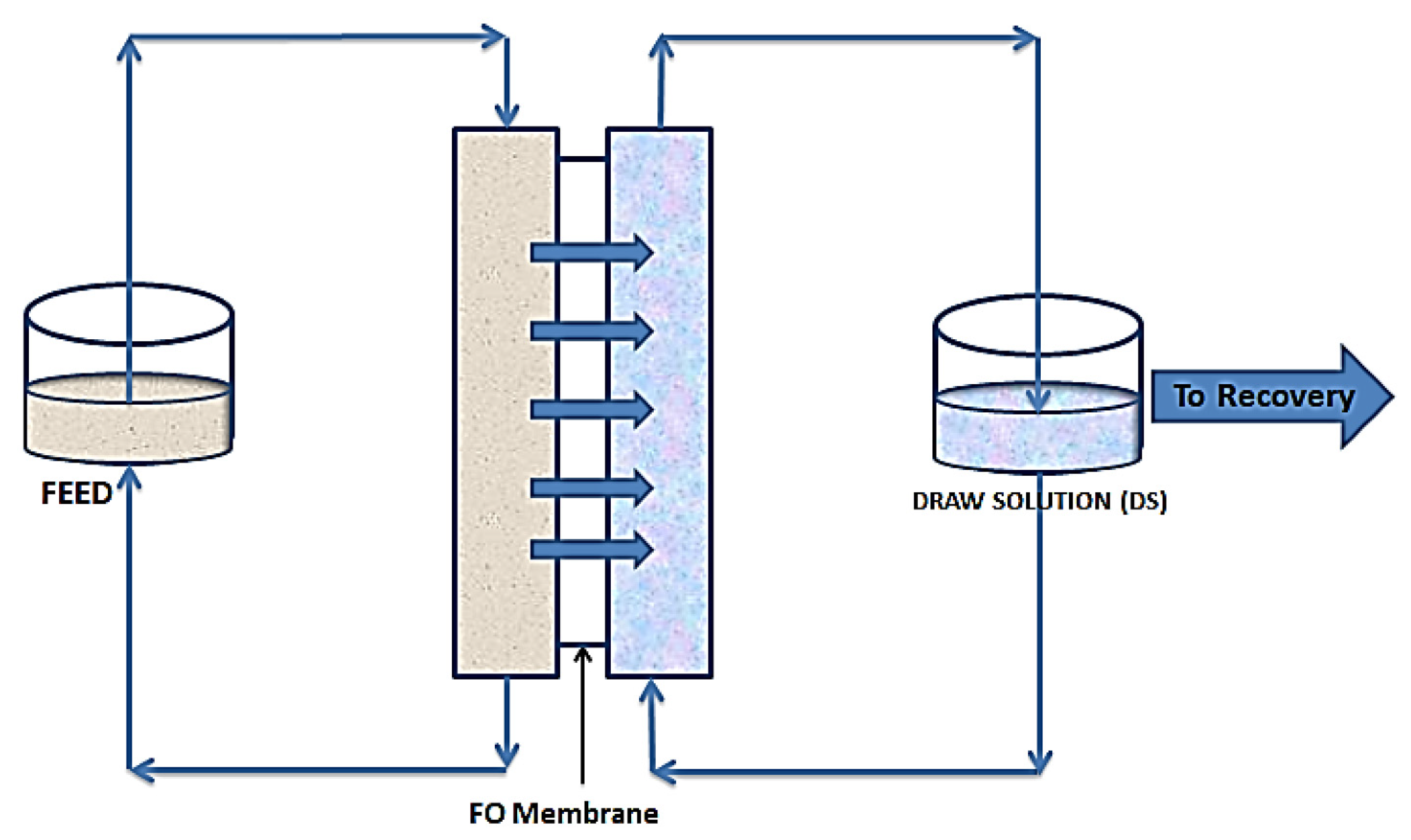
FO is a membrane process powered by osmotic pressure, utilizing a natural gradient between a dilute saline feed solution and a concentrated draw solution over a semi-permeable membrane [86]. The membrane orientation and osmotic driving force in FO mode are illustrated in Figure 8. Depending on the membrane orientation, the selective layer can face either the feed solution (FO mode) or the draw solution (pressure-retarded osmosis (PRO) mode). Each configuration presents different trade-offs between water permeability, internal concentration polarization, membrane fouling, and reverse solute flux. Although the absence of hydraulic pressure reduces mechanical stress on the membrane and generally lowers fouling propensity, concentration polarization and reverse solute diffusion remain major limitations that reduce effective osmotic driving force and water flux.
The performance of an FO system depends not only on membrane properties but also on the characteristics of the drawing solution. An ideal draw solute should generate high osmotic pressure while exhibiting minimal reverse diffusion, low toxicity, good chemical stability, and facile regeneration. Consequently, the selection of draw agents strongly influences water recovery, energy consumption, operating cost, and overall process economics [87]. Reflecting the importance of these interconnected challenges, a statistical review of 9345 FO publications identified draw-solution development, membrane innovation, membrane fouling, and energy consumption as the four dominant research themes in the field [88].
A typical FO desalination system consists of a membrane module, which may employ hollow-fiber or flat-sheet configurations, together with feed pretreatment and a draw-solution circulation and regeneration unit. Unlike pressure-driven membrane processes, the major energy demand in FO arises from recovering and reconcentrating the draw solution after water extraction. Depending on the draw solute employed, regeneration is commonly achieved using secondary separation technologies such as RO, NF, thermal distillation, or stimuli-responsive recovery methods. A review of 15 pilot-scale FO studies concluded that draw-solution recovery remains the principal barrier to economic competitiveness and estimated that a 40 to 50% reduction in regeneration energy is necessary for FO to compete with conventional RO systems [89].
Despite its attractive features, including operation without applied hydraulic pressure, relatively low membrane fouling, and the potential to treat highly saline or complex feed streams, FO remains predominantly at the pilot and demonstration stage [90]. Commercial deployment has been limited by membrane cost, concentration polarization, reverse salt diffusion, and the absence of an ideal draw solution that combines high osmotic efficiency with low-cost regeneration. Current pilot-scale installations rarely exceed a few thousand m3/day, and standalone FO has not yet achieved economic competitiveness with seawater RO for large-scale SWD.
Overall, FO represents a promising alternative membrane technology with distinct operational advantages over pressure-driven desalination processes. However, its widespread commercialization depends on continued advances in membrane materials, draw-solution chemistry, and energy-efficient regeneration technologies. Addressing these challenges will be essential for improving process efficiency, reducing operating costs, and establishing FO as a viable option for future sustainable desalination applications.
Figure 8.
Simplified schematic main mechanism of FO desalination technology (reproduced from [91] under (CC BY 4.0) license).
3.4. ED: Ion-Exchange Membrane Stack, EDR Operation, and Brackish-Water Suitability
ED is an electrochemical membrane desalination process in which a direct current (DC) electric field drives the migration of dissolved ions through alternating cation-exchange membranes (CEMs) and anion-exchange membranes (AEMs) arranged in a membrane stack. Cations migrate toward the cathode through CEMs but are blocked by AEMs, whereas anions migrate toward the anode through AEMs but are blocked by CEMs. This selective ion transport creates alternating dilute and concentrated compartments, thereby removing salts from the feed stream. A key advantage of ED is that its energy consumption is proportional to the quantity of ions removed rather than the total volume of water treated, making it particularly attractive for low- and moderate-salinity feedwaters. A recent review identified high water treatment efficiency, long membrane lifetime, and relatively low electrical energy consumption as major advantages of ED for BWD [92]. Furthermore, a comprehensive techno-economic assessment demonstrated that ED is already more cost-effective than RO for feed salinities of ≤3 g/L, while further reductions in ion-exchange membrane costs below $60/m2 could extend this advantage to feed salinities of up to 5 g/L [93].
A typical ED system consists of a modular membrane stack containing alternating CEMs and AEMs separated by spacers, electrode compartments connected to a DC power supply, and appropriate feed pre-treatment units. The modular design allows capacity to be increased by adding additional membrane pairs. The electrodialysis reversal (EDR) configuration periodically reverses electrode polarity, typically every 15 to 30 min, to mitigate membrane scaling and fouling without the need for acid dosing. Figure 9 illustrates a simplified ED process, showing the membrane stack configuration and ion migration pathways. The effectiveness of EDR for concentrate management has also been demonstrated, achieving approximately 85% water recovery from industrial RO brine while reducing concentrate volume by about 6.5-fold without observable organic fouling during six days of continuous operation [94].
Figure 9.
Simplified schematic of the ED process, (redrawn based on [40] under (CC BY-SA 4.0) license).
ED and EDR are well-suited for BWD (TDS typically below 12,000 mg/L) but less competitive in high-salinity seawater. Nayar et al. [95] compared RO, closed-circuit RO (CCRO), EDR, and monovalent-selective EDR (MS-EDR) for greenhouse agriculture, and found that RO is most economical for small installations (<10 ha) while MS-EDR becomes economically competitive for larger systems where the ability to selectively retain beneficial divalent nutrients (Ca2+, Mg2+) reduces fertilizer costs. Overall, ED represents a mature and energy-efficient desalination technology for low-salinity waters, with continued improvements in membrane performance and cost expected to further expand its practical and economic viability.
3.5. Comparative Assessment of Thermal and Membrane Technologies
The selection of membrane-based desalination technologies depends strongly on feedwater salinity, required product-water quality, energy availability, and treatment objectives. Although RO dominates SWD due to its high salt rejection and industrial maturity, alternative technologies such as NF, FO, and ED provide advantages under specific operating conditions. Therefore, a direct comparison should consider not only desalination performance but also energy demand, economic feasibility, scalability, and environmental impacts [96].
3.5.1. Economic Performance and Scalability
RO is the most mature and optimized, with water cost as low as 0.5 USD/m3 in large plants and generally the lowest cost at seawater salinity [71]. ED is cheaper than RO at low salinity (e.g., 0.384 vs. 0.46 USD/m3 at 5 ppt), but becomes more expensive than RO at seawater salinity [97]. NF used as a brine treatment or in hybrids can lower costs by reducing scaling and brine volume [83,98]. FO by itself is not yet cost-competitive; hybrid FO–NF can achieve low OPEX (0.41 AUD/m3), but membrane cost and extra area remain issues [99,100,101]. Among current membrane technologies, RO has achieved the highest commercial maturity because of decades of optimization, large-scale manufacturing, and reduced membrane costs. However, technology selection is highly dependent on feed salinity. ED can become economically competitive for low-salinity brackish water because its energy demand depends mainly on ion removal rather than total water volume. In contrast, FO remains economically challenging because additional draw-solution recovery units increase system complexity and capital requirements [93].
3.5.2. Energy Demand and Potential for Low-Carbon Operation
The energy advantage of each technology is strongly influenced by salinity. RO generally provides the lowest energy consumption for SWD because modern ERDs have significantly reduced hydraulic energy losses. However, ED can achieve lower energy consumption than RO for dilute brackish water because electrical energy is mainly associated with ion transport. FO has inherently low hydraulic energy demand, but its overall energy performance depends on the efficiency of draw-solution regeneration [75,89]. Typical seawater RO consumes 2–4 kWh/m3 and is more energy efficient than ED at high salinity (RO 2.0 vs. ED ~3.7 kWh/m3) [71,102]. For brackish water, ED and other electrified processes can match or beat RO energy use [97,103,104]. NF applied to SWRO brine can run at 0.5–1.5 kWh/m3 [83]. FO alone is low pressure, but once draw recovery is included, modeled SEC is similar to RO or slightly higher (e.g., FO–RO 3.88 vs. RO 3.65 kWh/m3, FO–NF vs. FO–RO 2.25 vs. 2.75 kWh/m3 in a case study) [100,105,106].
3.5.3. Desalination Performance, Capacity and Product Water Quality
RO provides very-high salt rejection (up to 99.8%) and dominates large-scale SWD with high capacities [71,107]. However, ED achieves high salt rejection and is particularly suitable for brackish water with high water recovery, as high salinity increases cost [102,104,108]. NF typically reaches up to 90% salt rejection; in hybrids, NF+RO can give >99% salt rejection and higher recovery than RO alone [83,98,105]. Alternatively, FO can deliver good quality water, but overall performance strongly depends on the draw solute and the recovery method [99,100,101]. Table 3 summarizes these four membrane technologies side by side across all key performance parameters.
Table 3.
Comparative evaluation of RO, NF, FO and ED membrane desalination technologies.
3.5.4. Thermal Versus Membrane Trade-Offs: Energy Use, Product Quality, and Unit Water Cost
The advancement of desalination technology is associated with materials science, thermodynamics, and economic planning to help address the global water scarcity problem in the present and future. When we analyze the shift from traditional thermal methods to highly advanced membrane-based systems, the primary concerns lie in operational stability and energy intensity. Traditionally, the water desalination system was dominated by MSF and MED, whose processes are analogous to the natural water cycle through evaporation and condensation. Despite this, thermal processes are mechanically robust and enable treatment of low-quality feedwater with minimal pretreatment chemicals and equipment; they are limited by the high latent heat of vaporization required for phase change. Due to the lack of a proper thermodynamic process, this water desalination method requires more energy to operate than non-thermal desalination technologies, which require less energy. As a result, while thermal plants remain a mainstay in regions with low-cost fossil-fuel energy or integrated power-and-water cogeneration setups, their global market share has steadily declined in favor of more energy-efficient configurations [107].
The RO technology has effectively bridged the gap between the high cost of desalination and its practical affordability in everyday life. After using high-pressure pumps, it overcomes the osmotic pressure and drives water molecules through semi-permeable membranes; RO avoids the phase-change energy penalty entirely. The most sophisticated RO system used ERDs and can achieve an SEC of 2.5 to 4.0 kWh/m3, a part of the energy required for MSF [110]. While robust metallic heat exchangers in thermal plants are very susceptible to scaling and biofouling, RO membranes are also very susceptible to scaling and biofouling. Analytical comparisons reveal that for RO, the operational focus shifts from thermal management to chemical and physical pretreatment. Operational complexity comes from stringent filtration and pH adjustment, making RO highly sensitive in the presence of organic matter and high water salinity in the feed [111].
The main constraint for RO in high-salinity environments has spurred the development of emerging gap-filling technologies such as FO and MD. A highly concentrated solution is used by FO, which creates a natural osmotic driving force; as a result, the operation occurs at much lower hydraulic pressures. This system helps reduce compaction of foulants on the top membrane, leading to lower fouling rates and easier cleaning cycles compared with RO. However, the main analytical challenge for FO is the energy-efficient recovery of the drawing solution without a low-energy separation step, and the process’s overall efficiency often lags behind RO. On the other hand, MD occupies a unique niche by combining thermal and membrane principles. The main driving force is the temperature gradient to pass water vapor through a hydrophobic membrane. While MD faces many obstacles in membrane wetting and pore scaling, it is suitable for using low-grade waste heat and solar energy and offers a viable way for decentralized water production when electricity is not available all the time [111,112].
In terms of product quality and recovery, thermal processes still have a clear advantage in specific industrial applications. To produce high-purity distillate, MSF and MED are robust, with TDS levels often below 10 mg/L; by contrast, RO produces water in the 100 to 500 mg/L range. For industrial boilers or pharmaceutical needs, the superior rejection rates of thermal systems are often worth the energy premium [110]. Moreover, as seawater salinity increases and brine discharge intensifies, the recovery limits of standard RO must be tested. At high water salinity, osmotic pressure can exceed the structural limits of current membrane modules. This has led to the emergence of hybrid systems such as MSF-RO or MED-RO, which optimize the strengths of energy efficiency of the membrane and the high-concentration handling capabilities of the thermal process [111].
Recent techno-economic studies suggest that the choice between thermal and membrane routes is less clear-cut than standalone figures imply. In dual-purpose power plants, coupling MED with RO used fuel more efficiently than either route alone, and a configuration of 30% MED and 70% RO lowered water production costs by about 30% relative to standalone thermal systems [113]. A review of RO hybridization reports a similar pattern, with RO-MD systems reaching an SEC of about 3.6 kWh/m3 compared with 5.2 to 6.7 kWh/m3 for RO-MSF, although both options add integration complexity and maintenance demands [114]. The comparison also changes with feed salinity. For minimal-liquid-discharge applications, osmotically assisted RO was cheaper than batch vacuum-air-gap MD below a feed salinity of 70 g/L and a recovery of 75%, while batch MD was the cheaper option at higher salinity and recovery [115]. Cost assessments across plant types likewise found that hybrid configurations, cogeneration, and renewable integration reduce the unit product cost mainly by lowering energy consumption [116].
The last step of a desalination system is to check the viability of the unit water cost (UWC). While RO yields the lowest UWC across the widest range of global contexts, the calculation is highly sensitive to local energy prices and brine-disposal regulations. Thermal processes are associated with higher capital expenditure (CAPEX) due to the large use of corrosion-resistant alloys and large-scale infrastructure, but they provide longer lifetimes and lower sensitivity to changes in feedwater temperature. On the other hand, RO requires lower CAPEX but entails higher recurring costs for membrane replacement and chemical pretreatment. The future of desalination is Smart Desalination, where machine learning, combined with porous materials such as graphene-based membranes, is used to reduce fouling and the carbon footprint [110,112]. Through the production of these diverse technologies, the industry aims to bridge the gap between high-quality output and low-energy inputs, ensuring that desalination remains a sustainable pillar of global water security [107].
4. Global Trends of Desalination Technology
4.1. Growth of Global Desalination Capacity
Desalination has seen remarkable growth over the past six decades, transitioning from a niche technology to a cornerstone of global water-supply strategy. According to Jones et al. [2], 95.37 million m3 of desalinated water is manufactured daily by around 15,906 operational desalination plants globally, a count that includes plants under construction. The continuous increase in global desalination capacity reflects the transition of desalination from a specialized water supply option to an important component of water security strategies. The growth has been strongly associated with improvements in membrane technology, reduction in energy consumption, and increasing freshwater stress in arid and coastal regions. Future expansion is expected to be driven not only by municipal demand but also by industrial water requirements and climate-induced water scarcity. The global growth trajectory of desalination plants and capacity is illustrated in Figure 10.
Figure 10.
Growth in total desalination plants and desalination capacity (reprinted from [48] licensed under CC BY 4.0).
4.2. Regional Distribution and Leading Markets
Desalination capacity remains unevenly distributed globally. According to Jones et al. [2], the MENA region produces 48% of the world’s desalinated water, with nations like Saudi Arabia, the United Arab Emirates, Kuwait, and Qatar mainly depending on desalination for municipal supplies. Saudi Arabia, the United Arab Emirates, Kuwait, and Qatar alone produce 55% of the world’s brine. Figure 11 compares each region’s share of desalination plants with its share of capacity [2,117]. The MENA hold about 30% of the world’s plants but 47.5% of its capacity, which points to a larger average plant size there. However, this geographic concentration is shifting. As per Eke et al. [118], desalination capacity has significantly increased in regions such as Europe and Africa that did not previously use the technology. The Asia-Pacific region, led by China, India, and Australia, has emerged as one of the fastest-growing markets. Zapata-Sierra et al. [119] identified China, the USA, and India as the top three most productive countries in desalination research, with eight of the top 20 most active research institutions based in China, reflecting that nation’s strategic investment in the sector. The geographical concentration of desalination capacity reflects the strong relationship between freshwater scarcity, economic development, and energy availability. Although MENA countries remain the largest users of desalination, increasing investments in Asia-Pacific and Africa indicate a gradual expansion toward regions facing growing water stress. However, adoption in developing regions remains constrained by high capital costs, energy requirements, and limited technical infrastructure [120].
Figure 11.
Regional distribution of desalination plants and desalination capacity worldwide. Capacity shares are as reported; plant shares were calculated from plant counts (15,906 plants in total). Created by the authors using data from Jones et al. [2].
4.3. Shift from Thermal to Membrane Technology
One of the most consequential global trends has been the decisive shift from thermal to membrane-based desalination, particularly RO [121]. Reports show that membrane desalination (primarily RO) now accounts for approximately three-quarters of global desalination capacity, with thermal technologies making up most of the remainder. This shift is further supported by Mayor et al. [122], who analyzed historical deployment dynamics using logistic growth curves and found that thermal technologies are in an advanced growth phase approaching saturation, with deployment levels likely to peak before 2050, while RO continues to expand. Key drivers of RO’s dominance include dramatic reductions in membrane costs, improved ERDs, and greater modularity [75]. It is confirmed that isobaric ERDs have been central to reducing SEC in large-scale SWRO plants, with analysis of over 70 large-scale plant datasets demonstrating the progressive reduction in SEC over recent decades [71]. Similarly, it is concluded that the cost of water desalination has fallen to levels that make RO competitive even with conventional water treatment in many regions. Figure 12 compares the typical SEC of SWRO, MED and MSF, separating electrical from thermal energy.
Figure 12.
Typical SEC of SWRO, MED and MSF desalination in large-scale plants, separated into electrical and thermal energy. Solid bars show the lower bound and light bars the upper bound of the reported range. Thermal energy for MSF and MED is supplied as low-pressure steam in cogeneration systems. Created by the authors using data from [117].
4.4. Cost Reduction Trends
The abatement in the cost of desalinated water has been one of the most significant economic developments in the sector [123]. RO desalination is now described as a highly efficient method capable of making clean, affordable water accessible to millions [124]. It is identified that energy consumption and maintenance costs remain the primary cost drivers, and that incorporating ERDs and high-efficiency pumps is the most effective lever for further cost reduction [125]. By analyzing data from 64 SWRO facilities, it is found that combining methods, including semi-batch RO configurations, has significant potential to further reduce SEC beyond current benchmarks [125]. However, energy consumption remains the dominant contributor to operational costs, indicating that further cost reduction will depend on increasing energy efficiency, integrating renewable electricity, extending membrane lifetime, and improving concentrate management strategies [75,125].
4.5. Desalination in Developing Nations and Future Demand
While desalination has historically been concentrated in wealthy, water-scarce nations, a critical emerging trend is its expanding role in developing countries facing acute water stress. According to Dhakal et al. [120], water scarcity would probably affect 2 billion people in 44 countries by 2050, with 95% of those people living in developing countries. Their analysis estimates that 14 of the most severely affected countries (including Uganda, Nigeria, Ethiopia, Haiti, and Pakistan) will require an additional 54 million m3/day of desalination capacity by 2050 to meet basic municipal water demand. The geographic spread of this growing water stress is shown in Figure 13, which maps projected stress levels by country for 2040. Significant barriers include high capital costs, energy intensity, the need for specialized technical capacity, and environmental concerns around brine discharge.
Figure 13.
Projected water stress by country in 2040, from low to extremely high (reprinted from [117] licensed under CC BY 4.0).
Panagopoulos emphasizes that overcoming these barriers will require integrating renewable energy with desalination as a central policy strategy, since fossil-fuel-powered desalination imposes both economic and environmental costs that developing economies are poorly positioned to bear [126,127]. It is shown through modeling that increasing global desalination from 2.9 to 13.6 billion m3 per month could significantly reduce the number of people experiencing water scarcity at the policy level, especially in Asia. However, the negative effects of brine discharge, energy demand, and economic costs must be carefully managed.
5. Energy Sources and Renewable Energy Integration
A defining trend in contemporary desalination is the integration of desalination systems with renewable energy sources. It is motivated by the need to reduce both carbon emissions and long-term operational costs [128]. A comprehensive review of renewable-integrated desalination is provided, noting that solar photovoltaic-RO integration is among the most practically scalable combinations [129]. It is further noted that growing interest in Photovoltaic (PV)-RO, solar thermal-RO, and MD driven by solar energy reflects the compatibility between solar resource availability and high desalination demand in the same geographic regions. A focused study by Allouhi et al. [130] analyzed 14 RO plants across Saudi Arabia and found that optimized hybrid renewable energy systems could achieve renewable energy fractions of 31–36%, with the cost of energy remaining competitive in the range of $0.070–0.078/kWh.
5.1. Conventional Energy Sources
Traditional energy sources for desalination are mainly fossil fuels, including natural gas, heavy fuel oil, and coal, which are a basic power supply for most global facilities. These sources are categorized into two roles: first, providing thermal energy through the combustion of fossil fuels to generate process steam for distillation, such as MSF and MED and second, providing electrical energy, which is necessary for RO. Despite their diverse uses, these conventional sources are highly energy-intensive and estimated to consume approximately 75.2 TWh of energy annually as of 2014. This heavy reliance results in massive environmental and economic drawbacks, also responsible for 76 million tons of CO2 per year, and operational costs of up to 50% of the total expenditure of the plant [107].
5.2. Renewable Energy Sources
Figure 14 illustrates the distribution of renewable energy sources integrated into desalination systems, highlighting the relative contributions of solar PV, solar thermal, wind, and hybrid technologies.
Figure 14.
Renewable energy source integration in desalination (reprinted from [48] licensed under CC BY 4.0).
5.2.1. Solar
Solar energy is an important renewable energy source for decarbonizing desalination and reducing dependence on fossil fuels. It is related to MED and MSF systems to provide low-grade thermal energy for evaporation. In RO plants, solar power can be used to drive pumps via hybrid PV-thermal systems, reducing total energy consumption by up to 35% through heat recovery. Future applications include solar MS (SMD), which is suitable for remote areas, and photothermal membranes that improve solar-to-vapor conversion efficiency [107]. Using solar energy increases the per-unit cost of water. A study shows that MED driven by concentrated solar power can cost between 2.4 and 2.8 USD/m3; this gap is expected to narrow as the price of solar panels decreases [107].
5.2.2. Wind
Decentralized desalination systems rapidly utilize wind power as a renewable energy source to address water scarcity in remote areas, off-grid, and coastal regions. Research highlights the frequent integration of wind power into hybrid energy systems, combining it with solar photovoltaic and biomass technologies to enhance the reliability, performance, and overall resilience of small- to medium-sized desalination units. The use of wind power is common for supplying energy to membrane-based separation processes such as RO and ED, as well as to thermal methods such as MED, thereby significantly reducing the carbon footprint and fossil-fuel dependency of traditional water treatment systems. Bibliometric analysis shows a massive upward trajectory in the study of wind-powered energy desalination over the past decade, especially regarding its implementation on islands and in arid areas where after-service is difficult. While this growth is very promising, the practical implementation often faces barriers such as the need for regular maintenance service and the availability of spare parts in rural or underdeveloped areas [131].
5.2.3. Geothermal
Currently, geothermal energy is a very important renewable energy resource for sustainable water desalination because it provides constant, weather-independent heat flows, unlike other energy sources. Geothermal energy provides a stable temperature gradient for driving both thermal desalination processes, such as MED and RO. Current research shows that low-enthalpy geothermal sources (70–90 °C) are well-suited for MED, and high-enthalpy reservoirs (above 200 °C) can be used to generate the electricity that is needed for high-capacity RO units. Globally, nations such as Iceland, Kenya, Italy, and Mexico have already begun using geothermal energy in their energy and water infrastructure, demonstrating its potential as a pollution-free alternative to fossil fuels. While implementing geothermal in accessible geothermal reservoir areas is difficult, the ability of geothermal to drive the system without expensive heat sources makes it highly effective in addressing the growing global freshwater crisis [132].
5.2.4. Biomass
The integration of biomass with water desalination technologies is a great initiative toward sustainable energy system management and eco-friendly water purification. Using tiny pores, or porosity, in natural materials like wood and biomass, scientists have developed highly sophisticated solar evaporators that absorb more sunlight during the day than other types of systems and help move water more efficiently. These types of biomass-based structures are often used in multi-stage channels to increase evaporation rates while managing salt accumulation through specialized bionic designs. Beyond solar energy, the concept of green chemistry in hydrate-based desalination (HBD) is based on using clean, biodegradable, plant-based additives, such as starch and biosurfactants, instead of conventional synthetic chemicals that are severely harmful to the environment and animals. This movement toward HBD not only decreases the environmentally harmful impact of the desalination process but also supports the concept of a circular economy by reusing and repurposing natural waste to create useful, high-performance materials that help in efficient water production [133].
5.2.5. Hydropower
Nowadays, the relationship between hydro energy and the desalination process is a major advancement in cogeneration technology, addressing water scarcity and improving system energy efficiency. Research shows that there are two basic configurations for these systems. The first one is an integrated pumped hydro RO (IPHRO) model, and the other one is a direct hydro-powered RO application. The IPHRO system is an advanced way to provide both fresh drinking water and clean energy simultaneously. It pumps water up to a high elevation using wind and solar power and stores that energy for later use. As water is released, gravity creates immense pressure as it flows back down. This very-high pressure is used to rotate turbines to generate electricity and to push seawater through desalination filters to produce fresh drinking water. For example, in Jordan and Egypt, where gravity and natural hills are already used, expensive and polluting pumps can be replaced by such systems. This new hydropower system provides a sustainable, much cheaper, and greener way to produce fresh water in arid, coastal regions [134].
5.2.6. Energy Storage Systems
An energy storage system is essential for the solar-powered desalination process because sunlight and wind are not available continuously. These energy storage systems provide a continuous power supply, prevent grid overloads, and meet the high surge demands of motor-driven pumps. Key technologies include thermal (high-temperature and latent heat) and mechanical (flywheels, compressed air, pumped hydro, and battery energy storage). A hybrid battery storage system that combines chemistries such as nickel manganese cobalt (NMC) and lithium titanium oxide (LTO) is showing as a very promising approach to optimize the system’s efficiency, safety, and lifespan. In solar electrochemical distillation (SED) systems, storage efficiency is increased using advanced materials, such as paraffin infused with graphene nanocomposites, which help enhance energy efficiency by up to 53%. In the same way, solar-powered passive desalination (SPPD) technologies use phase-change materials (PCMs) to store heat energy during the day and release it at night, potentially increasing production capacity by 50%. For integrated solar capacitive deionization (SCDI) systems, supercapacitors are used to increase electrical energy recovery efficiency by approximately 30%. Moreover, advanced systems such as RO increasingly use ERDs to reduce losses and improve overall process efficiency. To ensure a reliable freshwater supply, storage and recovery mechanisms are important for reducing weather dependence, a major barrier [112,135].
6. Emerging and Hybrid Desalination Technologies
Population growth, improvement in human living standards, and industrialization have led to aggression against nature, resulting in climate change and making it the primary cause of freshwater scarcity across the world [136,137,138]. Although ¾ of the entire Earth is covered by water, only around 3% is drinkable; however, this is not evenly distributed, meaning 40% of countries face a freshwater crisis [139,140], and by the year 2050, this supply will fall 56% short of the demand [141,142]. Therefore, to escape this problem, sustainable desalination technology is the only effective path [143,144]. In freshwater production from seawater, RO still rules because it remains the most profitable and feasible for bulk production [71,145,146]. Issues related to high salinity feed solutions, membrane fouling, brine disposal, and the impracticality of this technology in off-grid regions have paved the way for seeking alternatives [147,148].
Interfacial evaporation powered by inexhaustible and environmentally friendly solar energy has opened a new horizon. Where conventional processes were made unsustainable by light wastage, dependence on daylight, low water production, and higher investment and operating costs, this emerging technology has become a blessing for regions that have abundant solar energy [149,150]. Desalination can primarily be divided into two categories: thermal and membrane, but the modification of conventional methods and the development of new desalination processes have increased significantly over the past few years. For instance, FO, CDI, pervaporation, and modifications of thermal evaporators and RO are leading towards even greater efficiency and sustainability [135,151,152].
6.1. Membrane-Based Emerging Technologies
6.1.1. Membrane Distillation (MD)
In MD, a vapor-pressure difference across a hydrophobic membrane drives the separation, which makes MD compatible with low-grade heat [153]. The process runs at low pressure and temperature and resists osmotic pressure [154]. Direct-contact MD (DCMD) can concentrate brines to their saturation limit [155]. Vacuum MD (VMD) adds a vacuum to raise the vapor-pressure difference, which increases flux and eases temperature polarization [154]. Three problems limit MD. Pore wetting is one reason standalone MD cannot yet compete with RO [156], temperature polarization lowers performance [154] and a pilot trial on waste heat below 40 °C recovered water but met inorganic scaling, organic fouling, and heat-exchanger corrosion over extended operation [153]. MD is generally regarded as a complement to RO rather than a replacement. It provides capabilities that RO cannot easily achieve, including tolerance of high-salinity feeds, the utilization of low-grade or solar heat, and the concentration of brine close to saturation. However, its broader implementation continues to be limited by membrane wetting, scaling, temperature polarization, and significant heating and cooling requirements. These challenges are often underestimated when the heat source is considered to be free. Consequently, MD is best suited to applications where low-cost heat is available and electricity is limited, or where it is used as a concentration step for RO brine. Wider adoption will depend on the development of wetting-resistant membranes and on evaluating MD using the same life-cycle assessment and cost frameworks applied to other desalination technologies.
6.1.2. Pervaporation
As a vapor-pressure-driven process, pervaporation has established a significant position among emerging technologies. Although similar to MD, this technology utilizes non-porous and dense membranes, providing an effective solution to current issues like hypersaline solutions and pore-wetting complications [157,158,159]. Another distinct characteristic is the absence of an osmotic pressure limit, making it an effective alternative to the RO process; furthermore, the use of non-porous membranes makes it highly stable against fouling and scaling [3,147,158]. The solution–diffusion transport mechanism across a PV membrane is depicted in Figure 15. Currently, research is ongoing to make this technology more application-oriented. A major recent challenge was the weakening of membrane stability due to chemical attack from prolonged exposure to water; however, this has been successfully addressed through modifications to membrane material characteristics and fabrication processes. At present, the primary goal for researchers is the discovery of mixed matrix membranes, which simultaneously possess hydrophobicity, cost-effectiveness, fast water transport characteristics, and high stability in high-salt media [160,161,162]. Nevertheless, the biggest obstacle to making this technology practical remains overcoming the low production rate [162,163].
Figure 15.
Transport mechanism of a PV membrane desalination, (reproduced based on [162] under (CC BY 4.0) license).
6.1.3. Capacitive Deionization (CDI)
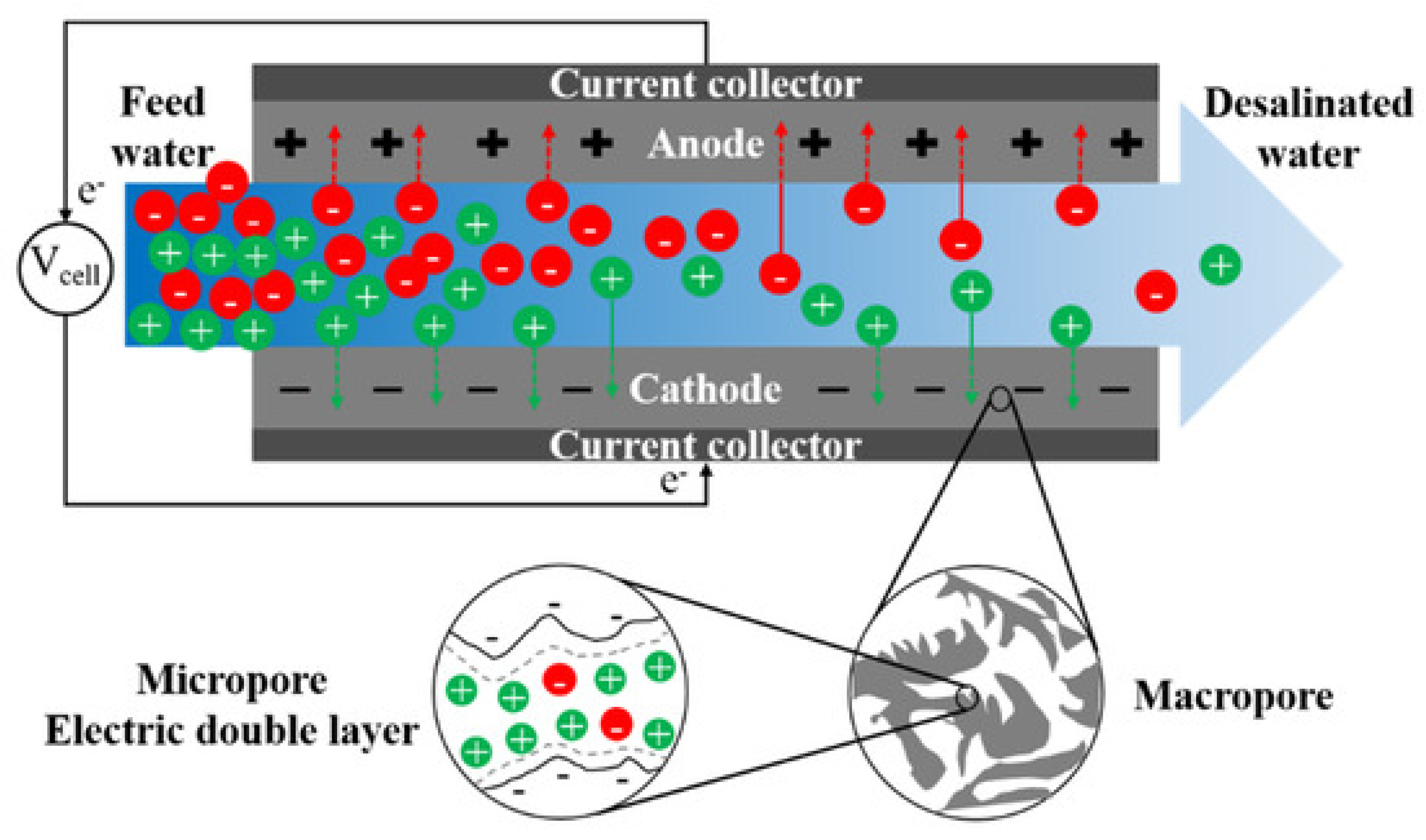
It is a cost-effective, promising, and emerging alternative in modern times. While RO separates water using high pressure, CDI achieves desalination at normal temperatures and low voltages using electrodes [164,165]. It is a particularly promising process for low-salinity feedwater or brackish water due to its high activity [166]. The emerging membrane CDI (MCDI) is effective against Co-ion expulsion, lower salt capture capability, and parasitic Faraday reactions, resulting in high energy efficiency [167,168]. Furthermore, compared to RO, it exhibits an eight times lower exergy destruction value [169,170]. Figure 16 shows the electrode configuration and ion capture process in a CDI cell.
To address low ion capture capability, the discovery of intercalation materials (such as MnO2 and Na0.44 MnO2) as replacements for carbon electrodes has opened new horizons. However, given the cheap and durable characteristics of carbon electrodes, using high-capacity intercalation materials is not always seen as a sustainable solution [171,172]. Recent research is ongoing to increase the surface area of carbon electrodes, create hierarchical porosity to improve ion transport, and incorporate graphene and carbon nanotubes (CNTs) to achieve higher conductivity. Another major challenge is Cl- storage; researchers are currently seeking alternatives to expensive silver (Ag) or hazardous bismuth (Bi) for this purpose [173,174].
Figure 16.
Schematic diagram of capacitive deionization technology, (reproduced based on [175] under (CC BY 4.0) license).
6.1.4. Freeze Desalination
As an alternative to thermal distillation, freeze desalination is a promising technology that requires six times less energy compared to standard distillation processes [176,177,178]. While membrane fouling is a major issue in membrane-based desalination, the low operating temperatures in freeze desalination reduce scaling and corrosion, enabling the use of inexpensive materials such as plastic [179,180]. However, a significant challenge is the entrapment of salt within ice crystals, which leads to heat loss and increased energy consumption for purification [181]. Despite extensive research, commercialization remains challenging due to high capital and operating costs, low rejection rates, and the inherent complexities of the freezing process [179,180]. The primary components of a freeze desalination unit are shown in Figure 17.
Figure 17.
Primary components of freeze desalination technology, adapted from [182] under (CC BY 4.0) license.
Recently, shear-assisted freeze desalination, which utilizes controlled surface temperatures and seawater flow, has achieved an ion rejection rate of 98.2%. Nevertheless, using this at a bulk scale is still under research because the water flux remains relatively low [183]. To make the process more efficient and sustainable, researchers are currently exploring the integration of renewable energy or the utilization of the ‘cold energy’ recovered from liquefied natural gas (LNG) [177,181,184].
6.2. Advanced Thermal Evaporator
Solar-Driven Interfacial Evaporation
In thermal mechanisms, conventional evaporators used for water desalination can only utilize 30–40% of the total energy effectively [149,150]. Challenges such as salt accumulation damaging materials, heat energy scattering to the surroundings, and total dependence on sunlight have paved the way for advanced evaporator designs [185,186]. Recently, the discovery of interfacial evaporation has pushed volumetric energy efficiency to over 90% [149,187,188]. Beyond just interfacial technology, nano-enhanced PCMs are now being utilized. These materials exhibit localized surface plasmon resonance (LSPR), which enhances light absorption and converts photoenergy into heat through nonradiative decay processes; this simultaneously increases heat conversion and minimizes reflection [189,190]. Current research is advancing in heat accumulation, creating large surface areas for evaporation, and designing porous, hydrophilic micro-architectures to improve capillary action [190,191].
Recent studies focus on further developing interfacial evaporators by combining nano-enhanced PCM with wick-assisted systems. For example, the use of cord wicks with Ag-nano PCM has increased water production by over 250%, while jute wicks combined with TiO2 Nano-enhanced PCM have proven to be four times more efficient [192,193]. In 2026, the use of high-heat-conducting GO nano-PCMs with twin wedge solar stills and jute/cotton wick materials demonstrated the capability to create a sustainable desalination process across the 4E factors (Energy, Exergy, Economics, and Environmental Emissions). This approach is projected to reduce CO2 emissions by 28.14 tons and successfully produce fresh water with a TDS level of 12–15 ppm [190], which is significantly lower than the maximum limits set by the World Health Organization (WHO) [194].
6.3. Advanced RO
It is the most widely recognized and currently the most useful desalination process [3,183]. It is highly effective for treating low-salinity water and for large-scale production [71]. However, a major challenge remains regarding energy requirements; as salt concentration increases, the energy demand to operate the pump also rises. Consequently, researchers are focusing on advanced configurations and thermodynamic principles to maintain a consistent flux rate [195,196]. By prioritizing entropy distribution, a multi-stage RO process was developed. Following this, an even more efficient and higher-flux batch RO was developed, which is a promising configuration [148,197]. Nevertheless, in this configuration, to minimize energy requirements, the applied pressure remains very close to the osmotic pressure. This leads to behavior similar to low-salt rejection RO (LSRRO), where solute transport causes energy loss—a factor that is challenging for researchers and inspiring further studies in the future [196].
Another barrier to sustainability is marine biodiversity, which leads to biological growth on the membrane, a reduction in the overall pressure difference, filter clogging, reduced membrane lifespan, and higher energy dissipation [198,199]. Currently, research has found an effective solution using bacteria as anti-biofouling materials, whereas previous chemical and physical anti-fouling treatments were economically and environmentally infeasible. However, the stability of these bacteria-derived anti-biofouling agents in extreme environments, as well as their large-scale commercialization, is still under investigation [110,200]. Table 4 presents a comparative overview of emerging desalination technologies, highlighting their operating conditions, membrane materials, desalination performance, and key operational parameters.
Table 4.
Performance comparison of emerging desalination technologies. N/A: Not applicable.
6.4. Hybrid Systems in Desalination
Although the RO process is widely used [3], its drawbacks spur the development of new technologies. For example, after establishing SWRO plants in the Arabian Gulf, pretreatment problems emerged that the individual RO process could not resolve [2]. Alongside this, emerging technologies like FO, Pervaporation, MD, and CDI, while advanced in certain aspects, have individually failed to achieve the highest efficiency, perfection across all conditions, and environmental friendliness [149,162,166,207]. Hybrid systems offer flexibility based on demand, enabling the simultaneous generation of fresh water and electricity. They ensure maximum energy utilization (i.e., minimal waste), can be operated using waste heat, and achieve high efficiency. Therefore, in different situations, researchers are working to make the desalination process highly efficient and sustainable by combining technologies [107,208].
In solar-driven interfacial evaporation (SDIE) research, scientists have utilized hybridization models for electricity production [209], salt collection [210], and bringing water to a zero-microorganism level [150,211], bringing it into perfectly drinkable water. To make the SDIE system even more efficient, researchers are considering harnessing the latent heat released during condensation and the kinetic energy of the vapor. Furthermore, electricity generation through thermoelectric generators and thermogalvanic generators, using temperature differences and redox couple reactions in water, has gained significant attention [212,213].
By integrating MED with adsorption desalination (AD), which can operate over a large temperature range, scaling problems in tubes have been minimized, and promising results in high water generation have been achieved [107]. Currently, research is ongoing to power these processes with renewable energy and reduce pressure on fossil fuels. A solar-based integrated hybrid system combining RO and ED can reject ions from low-salinity water using the RO process. Since pressure must be applied against osmotic pressure in RO, where high pressure is not required for low-salinity feed, and the remaining high-salinity water or highly concentrated brine is then processed using dual filtration (mechanical and electrochemical) to separate ions and produce fresh water. This method is significantly more efficient, cost-effective, and environmentally friendly compared to individual RO, and it is controlled by renewable energy [148,166,195,214].
Each desalination process trades off energy, recovery, cost, and brine differently (Section 8), so designers increasingly combine them. Hybrid thermal and membrane systems have been proposed for two decades to improve water quality, energy efficiency, and production rate, and several have reached industrial use [215]. Their costs added integration complexity, higher maintenance, and compatibility problems between processes [114]. Table 5 therefore summarizes three typical hybrids, MSF–MED, RO–MSF, and NF–RO, by their synergistic advantages, technical bottlenecks, and representative studies or demonstrations.
Table 5.
Typical hybrid desalination systems: synergistic advantages, technical bottlenecks, and representative studies.
Across these pairings, the synergy comes from sharing heat, intake, or pretreatment between processes, and the bottlenecks come from the same sharing: scaling and fouling when feed is preheated or softened, high vacuum, and extra heat transfer area. The evidence is uneven. RO–MSF and NF–RO have commercial and pilot-scale cases, whereas MSF–MED rests on simulations alone. Across the studies, it is evident that hybrids pay off mainly where heat, intake, or brine handling can be shared at an existing site. Each should be judged against the same seven indicators and the same life-cycle assessment (LCA) and MCDM framework used in Section 8 not on recovery or energy alone.
7. Smart Desalination and AI-Assisted Optimization
Desalination plants run under changing feed salinity, temperature, fouling state, and energy prices, so a fixed operating point rarely stays optimal for long. AI methods can learn these nonlinear relationships from plant data and adjust operation accordingly, and they have been widely applied across recent desalination research [224]. This section first covers AI for process and energy optimization, then sorts the algorithms by application scenario, followed by a discussion on AI coupling with emerging and LCA systems.
7.1. AI for Process and Energy Optimization
Process optimization is where AI acts most directly on energy use and cost. In RO, operating pressure, recovery, and configuration interact nonlinearly with feed salinity and temperature, which makes their individual effects hard to isolate with linear regression. Gradient boosting trained on data from operating seawater RO plants predicted SEC most accurately, and shapley additive explanations (SHAP) analysis ranked energy recovery device type and commissioning year among the main drivers. The model estimated an SEC of 2.8 kWh/m3 for extra-large plants using current technology [225]. Surrogate models also enable multi-objective search. An ANN-NSGA-II framework for brackish-water RO produced Pareto-optimal operating regions, combining 0.6 kWh/m3 with recovery of up to 80%, instead of a single setpoint [226]. For real-time operation, a cascade of deep deterministic policy gradient (DDPG) and deep Q-network (DQN) reinforcement learning agents was designed to minimize the daily operating cost of an RO plant with a storage tank under varying demand, and simulations confirmed its effectiveness [227]. Several of these results come from simulation or pilot-scale data, so long-term validation in full plants is still limited.
Energy optimization targets the power supply side, which matters most when desalination runs on intermittent renewables. Forecasting is the usual starting point. At four mid-to-large U.S. desalination plants, gradient boosting and an extreme gradient boosting (XGBoost) averaging method predicted water production, energy demand, and weather with a normalized root mean square error (RMSE) below 10%, and the results can support sizing the solar, wind, and storage mix [228]. For control, a convolutional neural network (CNN)–based DQN power management strategy for a PV-assisted plant reached a computation time of 0.2 s and an energy loss of 0.01 MW in MATLAB simulation, both lower than conventional models [229]. Metaheuristics handle the sizing problem. In a standalone coastal microgrid, a modified walrus optimization algorithm treated the RO plant as a flexible load for surplus energy and reached a levelized energy cost of 0.1714 $/kWh, a water cost of 0.7715 $/m3, and a 71.9% renewable share [230]. The control and sizing results come from simulation, so field validation is still needed.
7.2. AI Algorithms by Application Scenario
Algorithm choice depends mainly on the data type and the decision it supports. The optimization tasks above rely largely on tabular regressors, metaheuristics, and reinforcement learning. Fouling forecasting and predictive maintenance work from sensor histories, so sequence models dominate. In a full-scale ZLD plant, six machine learning (ML) models were compared for forecasting RO flux and salt rejection. Convolutional long short-term memory (ConvLSTM) was the most accurate at 1-day (R2 = 0.960) and 7-day (R2 = 0.942) horizons, while long short-term memory (LSTM) performed comparably at 30 days, which suggests the added spatial component matters less as the horizon grows [231]. For maintenance, a temporal convolutional network trained on differential-pressure records from 14 RO trains (2015 to 2020) gave lower prediction error than LSTM, CNN-LSTM, and gated recurrent unit (GRU), and the authors report that it supports faster anomaly detection. They also note that such models depend heavily on real operational data [232].
Water quality monitoring is mostly a tabular prediction task, where ensemble models are common. In a full-scale SWRO plant in southeast Spain, an ensemble-based machine learning model predicted the boron permeability coefficient, an indicator of boron rejection in the permeate, with a mean absolute percentage error (MAPE) of 11.8% and a margin of about 1 mg/L [233]. The same approach carries over to emerging processes. In FO, XGBoost tuned with particle swarm optimization predicted boron recovery with R2 = 95.4%, identified pH, boron concentration, and membrane orientation as the main drivers, and was then used to search for operating conditions with a predicted rejection of 98.28% [234]. Overall, tree ensembles and ANNs suit process and water quality prediction, sequence models suit fouling and maintenance, and metaheuristics and reinforcement learning suit optimization and control. The next subsection shows how these roles carry over to thermal desalination, emerging processes, brine management, and LCA.
7.3. AI Coupling with Thermal, Emerging, Brine, and LCA Systems
AI is also being applied beyond RO. In thermal desalination, XGBoost was trained on a six-effect vertical tube MED unit operated with smooth and turbulence-enhanced tubes, and it outperformed ANN, support vector machine (SVM), and random forest (R2 = 0.972, RMSE = 0.87). Turbulence enhancement raised distillate output, heat transfer rate, and gain output ratio by about 25 to 30%, and SHAP ranked feedwater temperature as the dominant factor [235]. In MD, ANNs have been used to predict permeate flux, rejection, fouling, and wetting. Data scarcity, limited interpretability, and poor generalizability still restrict early fouling and wetting detection, and digital twins are proposed as a remedy [236].
Brine management and LCA are where AI could link the stages of a desalination system, but current studies mostly treat each stage separately. For brine, an ANN trained on laboratory data for a forced circulation crystallizer identified an optimal residence time of 4 h, a cold-water flow of 10 kg/min, and a 70% occupied volume, and the conventional design cost about 30% more than the optimized one [237]. The model covers a single unit at laboratory scale, so it says little about how that unit behaves when coupled to a real upstream RO train, whose fouling is already being forecast in ZLD systems [231]. For LCA, ML surrogates allow thousands of designs to be screened. In one study, 118,800 wind-driven SWRO configurations were assessed against water output, cost, and global warming potential, and the cost-prioritized and emission-prioritized scenarios reached 1.39 US$/m3 and 0.70 kg CO2eq/m3, respectively [238]. These results come from a modeled system, so they hold only as far as the performance and inventory assumptions do. A more useful coupling is a chain in which the output of one model (recovery, brine composition, energy demand) feeds the next, with LCA as the final check. Until such chains are validated at pilot scale on shared datasets, they remain design aids rather than operating tools.
8. Environmental Impact and Life-Cycle Assessment
Where drinking water is scarce, desalination technology has brought a spark of life. However, this technology is also making the environment unsafe for future generations. Although desalination is an effective means of generating fresh water, it poses a severe threat to the marine ecosystem. The primary problem with desalination technology is brine discharge, which contains high salt, defoamers, cleaning chemicals, and heavy metals that are lethal to aquatic life [239]. Furthermore, its operation consumes high energy, which continues to increase greenhouse gas (GHG) emissions and the burden on fossil fuels [240]. Therefore, innovating sustainable and eco-friendly approaches is the only way to ensure a sustainable future.
Although both thermal and membrane-based processes are in use, the use of RO is widespread [71]. However, its primary problem is low water recovery, which results in the creation of a massive amount of brine, increasing the eutrophication potential [241]. Along with this, high-pressure pumps must be operated, which is a major contributor to increasing GWP. Currently, another barrier to sustainability in this process is membrane production, which is non-renewable, and the solvents used for it are toxic, emitting VOCs and NOx that are responsible for ozone depletion [241,242]. Therefore, researchers are continuing studies to create durable and higher separation efficiency by integrating renewable energy, bio-based polymers, green solvents, and mechanosynthesis approaches simultaneously [243,244]. It is not just that conventional processes are being modified; alongside them, novel technologies such as FO, CDI, SED, and MD have been invented, and further research is ongoing with new methods [112].
To understand the environmental impact of desalination, the most important tool is its LCA. Following ISO 14040 and ISO 14044, this assessment should consider goal and scope definition, life-cycle inventory, impact assessment, and interpretation, so that environmental performance is evaluated across the full life cycle rather than through isolated indicators [153]. We organize the published LCAs below by these four phases. In the goal and scope phase, studies already diverge: Do Thi et al. [245] limited the boundary to plant operation per 1 m3 of product water, Aljuwaisseri et al. [246] used a cradle-to-gate boundary per 1 m3 of seawater desalinated, and Raluy et al. [247] followed the life cycle from raw-material extraction to reject disposal. Differences in functional unit, electricity mix, system boundary, impact categories, and the inclusion of intake, brine, and chemicals can make findings look contradictory when the technologies themselves do not disagree. In the inventory phase, energy dominates: more than 90% of life-cycle greenhouse gas emissions in RO come from energy use, and in many cases membrane replacement, construction, and end-of-life burdens are comparatively small [153]. The impact on the environment can be properly understood through six different categories: global warming potential (GWP), primary energy demand (PED), ozone depletion potential (ODP), photochemical ozone formation potential (POFP), eutrophication potential (EP), and ecotoxicity potential (ET) [248]. Analyzing these impacts can smooth the path to finding a sustainable solution. Currently, the focus is on waste-heat recovery, mixing cooling water with brine to reduce salt concentration, and preventing heavy metals from leaching into the water due to metallic corrosion.
Alongside this, researchers have considered many measures for a safe, sustainable, cost-effective, and efficient marine ecosystem, such as zero liquid discharge (ZLD), valuable ion extraction from brine, salt recovery, etc. When conducting an LCA comparing the two processes, conventional brine management and chemical recovery from brine, it is observed that the brine recovery approach reduces the environmental impact by more than 70% [249]. Moreover, the impact of electricity-based systems is even higher. Most comparative LCAs of MSF, MED, and RO find lower impacts for RO because it needs less thermal energy [153], and RO combined with renewable energy performed best in two separate studies [245,250]. The heat source changes this picture, because low-carbon heat gives MSF, MED, and MD a carbon footprint advantage alongside RO [251]. In the interpretation phase, the defining factors in one cradle-to-gate MED and RO comparison were the primary fuel exergy and the allocation of energy in water and electricity cogeneration [246].
Between the two processes of low-fouling and low-energy-consuming UF-RO technology compared to standard RO, the UF-RO brine valorization demonstrates lower GWP and lower ODP values [248] than RO-direct brine discharge and RO-brine recovery. Although comparing RO and low-temperature MED (LT-MED) shows that LT-MED has a lower GWP, its damage to the ozone layer is much more serious [22]. While LT-MED is also preferable from an economic standpoint, RO is more suitable in terms of social cost. This RO/LT-MED comparison is itself a multi-criteria decision-making (MCDM) problem as no single indicator identifies an optimal technology, since the ranking reverses depending on whether GWP, ozone depletion, economic cost, or social cost is weighted most heavily. A comprehensive sustainability assessment of desalination technologies should therefore integrate LCA-derived environmental indicators with techno-economic and operational performance indicators rather than relying on a single metric [153]. In this framework, indicators such as SEC, freshwater recovery, water production cost, brine generation, operational reliability, and technological maturity should be considered together to obtain a balanced decision.
RO has significant impacts from electricity use and brine disposal, contributing 5–33% of the total cost tied to brine management [71,102]. FO is ranked as having the best environmental profile, followed by ED/EDR, both of which are better than RO in a qualitative assessment [121]. FO–NF hybrids showed lower global warming impact (e.g., 2.25 vs. 2.75 kg CO2 eq for FO–NF vs. FO–RO) and lower chemical use [99,105]. NF and ED are often favored in multi-criteria analyses when environmental and operating impacts are weighted highly [96,105,252].
Published MCDM studies show the same conditionality. Using interval analytic hierarchy process (AHP) and technique for order preference by similarity to ideal solution (TOPSIS) across economic, environmental, technological, and social criteria, Wang et al. [253] ranked LT-MED first and RO last among MSF, LT-MED, RO, and VC, and their sensitivity analysis found the LT-MED result robust. Orfi et al. [107] and Mishra et al. [254] found RO superior under their own criteria and weights. Reviews of MCDM in desalination report AHP as the most common weighting method and TOPSIS as the most common ranking method, and they warn that rankings change with goals, data, and expert judgment [255]. An MCDM rating of RO plants was likewise sensitive to category weights [256], so criteria and weights should be reported openly and tested by sensitivity analysis [153].
Across the seven indicators, SEC is 3 to 5.5 kWh/m3 for RO, 6.5 to 12 kWh/m3 for MED and MVC, and 13.5 to 25.5 kWh/m3 for MSF [257]. Emissions follow the energy source, so they should be reported per m3 of water with the source stated [251]. Freshwater recovery and brine generation move together: ZLD and MLD trains recover 32.6% to 98.6% of the water and shrink the brine volume, but at a steep energy and cost penalty [240]. Water production cost depends on scope, since externality costs raised MED and MSF water costs by 65.8% and 81.9% on average [258]. For reliability and maturity, RO, MED, and MSF are commercially mature [153], while FO and MD are nearing commercialization [259], and MD still needs larger-scale tests of pore wetting and long-term stability [156].
Even though desalination technology has environmental impacts, there is no alternative but to rely on it, given the water crisis. This process has become much more advanced than before; it has been developed and made more eco-friendly, and progress continues. Researchers are constantly developing new approaches and making modifications to ensure sustainability while minimizing environmental harm.
9. Future Prospects and Conclusions
As freshwater sources around the world continue to become compromised, it is imperative to continuously advance and improve desalination technologies to ensure a sustainable future. Technological improvement can be achieved through modifications and upgrades to process systems, hybridization of existing systems, and the exploration of renewable energy resources, each of which can contribute significantly to sustainable development. The primary focus should be on finding solutions for fouling- and scaling-resistant membranes, as these issues are very common across most desalination processes. Energy consumption reduction and heat loss minimization are also being studied extensively, but there are still many areas for further work. The overall thermal efficiency and system efficiency of membrane technologies also need to be optimized for a cost-effective desalination process [112].
Future desalination systems should increasingly shift from brine disposal toward brine minimization and resource recovery. Emerging approaches such as Minimal Liquid Discharge (MLD) and ZLD can reduce brine volumes and, in the case of ZLD, recover solid mineral by-products through the integration of advanced membranes and crystallization technologies [260]. However, the high energy requirements of ZLD make MLD a potentially more practical approach for near-term implementation.
Along with water scarcity, fossil fuels are also in short supply. In the future, fossil-fuel resources will be depleted; therefore, it is crucial to seek alternatives such as renewable energy. A hybrid solar photovoltaic–wind energy system can serve as a supporting energy source for operating desalination plants. A case study in Egypt implemented this renewable approach and achieved an approximately 8% reduction in the electricity supply grid [261]. These modifications can both reduce operational costs and carbon emissions. In Japan, a desalination plant used pressure retarded osmosis power to generate electricity [262]. Another study in the Middle East region used a combination of solar panels and wind turbines. This integration supported the energy consumption reduction by generating 0.39 kWh per m3 of water produced [263]. Apart from these renewable sources, some pilot projects successfully used wave energy to produce freshwater from seawater. These projects need to be more focused on higher-scale production in the near future.
Overall, the future development prospects should focus on environmentally sustainable and energy-efficient desalination systems. Based on the discussion above, the following research directions are recommended:
- Development of fouling- and scaling-resistant membranes that remain effective across different desalination processes.
- Further reduction in energy consumption and heat loss, together with optimization of thermal efficiency and overall system efficiency of membrane technologies for cost-effective desalination.
- Improvement of the energy efficiency and economic feasibility of MLD and ZLD, while maximizing water recovery and valuable resource recovery through advanced membranes and crystallization technologies.
- Hybridization of existing desalination systems, including integration with renewable sources such as solar photovoltaic–wind systems and pressure retarded osmosis, to lower operational costs and carbon emissions.
- Scaling up of pilot projects, particularly wave-energy-driven desalination, toward higher-scale production.
Author Contributions
M.S.I.M.: Writing—original draft, Visualization. S.S.S.: Writing—original draft, Data curation. M.I.S.: Writing—original draft, Methodology. R.H.R.: Writing—original draft, Visualization, Formal analysis. S.K.: Writing—original draft, Formal analysis. P.D.: Writing—original draft, Conceptualization. A.A.A.: Writing—original draft, Validation. T.T.: Writing—original draft, Validation. S.M.: Writing—review and editing, Supervision, Funding acquisition, Conceptualization. M.S.I.: Writing—review and editing, Supervision, Project Administration. All authors have read and agreed to the published version of the manuscript.
Funding
This research received no external funding.
Informed Consent Statement
This article does not contain any studies with human participants or animals performed by any of the authors.
Data Availability Statement
No new data were created or analyzed in this study. Data sharing is not applicable to this article.
Acknowledgments
The authors acknowledge the support from Bangladesh University of Engineering and Technology. Generative AI tools, including ChatGPT GO (GPT-6.0), Microsoft 365 Copilot, and Grammarly Plus, were used in the writing process. All content was subsequently reviewed and edited by the authors, who take full responsibility for the final version.
Conflicts of Interest
Authors Shadman Sakib Sayem and Azmain Akib Akash were employed by the company Arcadis US, Inc. The remaining authors declare that the research was conducted in the absence of any commercial or financial relationships that could be construed as a potential conflict of interest.
Abbreviations
| AD | Adsorption desalination |
| AEMs | Anion-exchange membranes |
| AHP | Analytic hierarchy process |
| AI | Artificial intelligence |
| ANN | Artificial neural network |
| BWD | Brackish-water desalination |
| CAPEX | Capital expenditure |
| CCRO | Closed-circuit reverse osmosis |
| CDI | Capacitive deionization |
| CEMs | Cation-exchange membranes |
| CNN | Convolutional neural network |
| CNTs | Carbon nanotubes |
| ConvLSTM | Convolutional long short-term memory |
| DC | Direct current |
| DCMD | Direct-contact membrane distillation |
| DDPG | Deep deterministic policy gradient |
| DQN | Deep Q-network |
| ED | Electrodialysis |
| EDR | Electrodialysis reversal |
| EP | Eutrophication potential |
| ERDs | Energy recovery devices |
| ET | Ecotoxicity potential |
| FO | Forward osmosis |
| GHG | Greenhouse gas |
| GO | Graphene oxide |
| GOR | Gained output ratio |
| GRU | Gated recurrent unit |
| GWP | Global warming potential |
| HBD | Hydrate-based desalination |
| IEMs | Ion-exchange membranes |
| IPHRO | Integrated pumped hydro reverse osmosis |
| ISO | International Organization for Standardization |
| LCA | Life-cycle assessment |
| LNG | Liquefied natural gas |
| LSPR | Localized surface plasmon resonance |
| LSRRO | Low-salt rejection reverse osmosis |
| LSTM | Long short-term memory |
| LT-MED | Low-temperature multiple-effect distillation |
| LTO | Lithium titanium oxide |
| MAPE | Mean absolute percentage error |
| MCDI | Membrane capacitive deionization |
| MCDM | Multi-criteria decision-making |
| MD | Membrane distillation |
| MED | Multiple-effect distillation |
| MEE | Multiple-effect evaporation |
| MENA | Middle East and North Africa |
| MF | Microfiltration |
| MIGD | Million imperial gallons per day |
| ML | Machine learning |
| MLD | Minimal liquid discharge |
| MS-EDR | Monovalent-selective electrodialysis reversal |
| MSF | Multi-stage flash |
| MVC | Mechanical vapor compression |
| NF | Nanofiltration |
| NMC | Nickel manganese cobalt |
| NOM | Natural organic matter |
| NR | Not reported |
| ODP | Ozone depletion potential |
| OPEX | Operating expenditure |
| PCMs | Phase-change materials |
| PED | Primary energy demand |
| POFP | Photochemical ozone formation potential |
| PR | Performance ratio |
| PRO | Pressure-retarded osmosis |
| PV | Photovoltaic |
| RMSE | Root mean square error |
| RO | Reverse osmosis |
| RR | Recovery ratio |
| SCDI | Solar capacitive deionization |
| SDIE | Solar-driven interfacial evaporation |
| SEC | Specific energy consumption |
| SED | Solar electrochemical distillation |
| SHAP | Shapley additive explanations |
| SMD | Solar membrane distillation |
| SPPD | Solar-powered passive desalination |
| SVM | Support vector machine |
| SWD | Seawater desalination |
| SWRO | Seawater reverse osmosis |
| TBT | Top brine temperature |
| TDS | Total dissolved solids |
| TFC | Thin film composite |
| TOPSIS | Technique for order preference by similarity to ideal solution |
| TSS | Total suspended solids |
| TVC | Thermal vapor compression |
| UF | Ultrafiltration |
| UNICEF | United Nations Children’s Fund |
| UWC | Unit water cost |
| VC | Vapor compression |
| VMD | Vacuum membrane distillation |
| VOCs | Volatile organic compounds |
| WHO | World Health Organization |
| XGBoost | Extreme gradient boosting |
| ZLD | Zero liquid discharge |
References
- Elimelech, M.; Phillip, W.A. The Future of Seawater Desalination: Energy, Technology, and the Environment. Science 2011, 333, 712–717. [Google Scholar] [CrossRef] [Scilit] [PubMed]
- Jones, E.; Qadir, M.; van Vliet, M.T.H.; Smakhtin, V.; Kang, S.M. The state of desalination and brine production: A global outlook. Sci. Total Environ. 2019, 657, 1343–1356. [Google Scholar] [CrossRef] [Scilit] [PubMed]
- Deshmukh, A.; Boo, C.; Karanikola, V.; Lin, S.; Straub, A.P.; Tong, T.; Warsinger, D.M.; Elimelech, M. Membrane distillation at the water-energy nexus: Limits, opportunities, and challenges. Energy Environ. Sci. 2018, 11, 1177–1196. [Google Scholar] [CrossRef] [Scilit]
- Ravi, J.; Othman, M.H.D.; Matsuura, T.; Ro’il Bilad, M.; El-badawy, T.H.; Aziz, F.; Ismail, A.F.; Rahman, M.A.; Jaafar, J. Polymeric membranes for desalination using membrane distillation: A review. Desalination 2020, 490, 114530. [Google Scholar] [CrossRef] [Scilit]
- Bengani-Lutz, P.; Converse, E.; Cebe, P.; Asatekin, A. Self-Assembling Zwitterionic Copolymers as Membrane Selective Layers with Excellent Fouling Resistance: Effect of Zwitterion Chemistry. ACS Appl. Mater. Interfaces 2017, 9, 20859. [Google Scholar] [CrossRef] [Scilit] [PubMed]
- Bengani-Lutz, P.; Zaf, R.D.; Culfaz-Emecen, P.Z.; Asatekin, A. Extremely fouling resistant zwitterionic copolymer membranes with ∼1 nm pore size for treating municipal, oily and textile wastewater streams. J. Membr. Sci. 2017, 543, 184. [Google Scholar] [CrossRef] [Scilit]
- Boo, C.; Hong, S.; Elimelech, M. Relating organic fouling in membrane distillation to intermolecular adhesion forces and interfacial surface energies. Environ. Sci. Technol. 2018, 52, 14198. [Google Scholar] [CrossRef] [Scilit] [PubMed]
- Brant, J.A.; Childress, A.E. Colloidal adhesion to hydrophilic membrane surfaces. J. Membr. Sci. 2004, 241, 235. [Google Scholar] [CrossRef] [Scilit]
- Chen, W.L.; Cordero, R.; Tran, H.; Ober, C.K. 50th anniversary perspective: Polymer brushes: Novel surfaces for future materials. Macromolecules 2017, 50, 4089. [Google Scholar] [CrossRef] [Scilit]
- Cheng, N.; Brown, A.A.; Azzaroni, O.; Huck, W.T.S. Thickness-Dependent Properties of Polyzwitterionic Brushes. Macromolecules 2008, 41, 8288. [Google Scholar] [CrossRef] [Scilit]
- Chiao, Y.H.; Chen, S.T.; Sivakumar, M.; Ang, M.B.M.Y.; Patra, T.; Almodovar, J.; Wickramasinghe, S.R.; Hung, W.S.; Lai, J.Y. Zwitterionic polymer brush grafted on polyvinylidene difluoride membrane promoting enhanced ultrafiltration performance with augmented antifouling property. Polymers 2020, 12, 1303. [Google Scholar] [CrossRef] [Scilit] [PubMed]
- Ding, J.; Liang, H.; Zhu, X.; Xu, D.; Luo, X.; Wang, Z.; Bai, L. Surface modification of nanofiltration membranes with zwitterions to enhance antifouling properties during brackish water treatment: A new concept of a “buffer layer”. J. Membr. Sci. 2021, 637, 119651. [Google Scholar] [CrossRef] [Scilit]
- Fantin, M.; Ramakrishna, S.N.; Yan, J.; Yan, W.; Divandari, M.; Spencer, N.D.; Matyjaszewski, K.; Benetti, E.M. The role of Cu0 in surface-initiated atom transfer radical polymerization: Tuning catalyst dissolution for tailoring polymer interfaces. Macromolecules 2018, 51, 6825. [Google Scholar] [CrossRef] [Scilit]
- Curto, D.; Franzitta, V.; Guercio, A. A Review of the Water Desalination Technologies. Appl. Sci. 2021, 11, 670. [Google Scholar] [CrossRef] [Scilit]
- Elsaid, K.; Kamil, M.; Sayed, E.T.; Abdelkareem, M.A.; Wilberforce, T.; Olabi, A. Environmental impact of desalination technologies: A review. Sci. Total Environ. 2020, 748, 141528. [Google Scholar] [CrossRef] [Scilit] [PubMed]
- Horseman, T.; Yin, Y.; Christie, K.S.S.; Wang, Z.; Tong, T.; Lin, S. Wetting, Scaling, and Fouling in Membrane Distillation: State-of-the-Art Insights on Fundamental Mechanisms and Mitigation Strategies. ACS ES&T Eng. 2020, 1, 117–140. [Google Scholar] [CrossRef] [Scilit]
- McGaughey, A.L.; Srinivasan, S.; Zhao, T.; Christie, K.S.S.; Ren, Z.J.; Priestley, R.D. Scalable Zwitterionic Polymer Brushes for Antifouling Membranes via Cu0-Mediated Atom Transfer Radical Polymerization. ACS Appl. Polym. Mater. 2023, 5, 4921–4932. [Google Scholar] [CrossRef] [Scilit]
- Li, M.; Hu, J.; Li, B.; Deng, S.; Zhang, X. Graphene oxide nanofiltration membrane with trimethylamine-N-oxide zwitterions for robust biofouling resistance. J. Membr. Sci. 2021, 640, 119855. [Google Scholar] [CrossRef] [Scilit]
- Zhang, G.; Wang, X. Seawater Desalination System Driven by Sustainable Energy: A Comprehensive Review. Energies 2024, 17, 5706. [Google Scholar] [CrossRef] [Scilit]
- Zhang, Y.; He, J.; Li, D.; Wang, J.; Song, Q.; Wang, X.; Zhu, J.; Feng, X.; Duan, K.; Gao, X.; et al. Evaluation of machine learning applied in membrane-based water desalination: A review. Desalination 2025, 613, 119041. [Google Scholar] [CrossRef] [Scilit]
- Su, W.; Liu, Z.; Jin, X.; Liu, Z.; Yang, D.; Zhang, X. A comprehensive review on 3D interfacial solar evaporation for sustainable desalination and integrated energy management: Structural optimization strategies, advanced materials, and emerging applications. Appl. Energy 2025, 402, 126926. [Google Scholar] [CrossRef] [Scilit]
- Liang, M.; Yu, C.; Huang, X.; Su, M. Sustainability analysis of seawater desalination: Assessing the social, economic, and environmental impacts of membrane and thermal technologies. J. Clean. Prod. 2026, 553, 147984. [Google Scholar] [CrossRef] [Scilit]
- Catrini, P.; Cipollina, A.; Giacalone, F.; Micale, G.; Piacentino, A.; Tamburini, A. Thermodynamic, Exergy, and Thermoeconomic analysis of Multiple Effect Distillation Processes. In Renewable Energy Powered Desalination Handbook; Butterworth-Heinemann: Oxford, UK, 2018. [Google Scholar] [CrossRef] [Scilit]
- Aly, S.; Jawad, J.; Manzoor, H.; Simson, S.; Lawler, J.; Mabrouk, A.N. Pilot testing of a novel integrated Multi Effect Distillation—Absorber compressor (MED-AB) technology for high performance seawater desalination. Desalination 2022, 521, 115388. [Google Scholar] [CrossRef] [Scilit]
- Ghaffour, N.; Missimer, T.M.; Amy, G.L. Technical review and evaluation of the economics of water desalination: Current and future challenges for better water supply sustainability. Desalination 2013, 309, 197–207. [Google Scholar] [CrossRef] [Scilit]
- Feria-Díaz, J.J.; López-Méndez, M.C.; Rodríguez-Miranda, J.P.; Sandoval-Herazo, L.C.; Correa-Mahecha, F. Commercial Thermal Technologies for Desalination of Water from Renewable Energies: A State of the Art Review. Processes 2021, 9, 262. [Google Scholar] [CrossRef] [Scilit]
- Datt, P. Latent Heat of Vaporization/Condensation. In Encyclopedia of Snow, Ice and Glaciers; Singh, V.P., Singh, P., Haritashya, U.K., Eds.; Springer: Dordrecht, The Netherlands, 2011; p. 703. [Google Scholar] [CrossRef] [Scilit]
- Goh, P.S.; Kang, H.S.; Ismail, A.F.; Hilal, N. The hybridization of thermally-driven desalination processes: The state-of-the-art and opportunities. Desalination 2021, 506, 115002. [Google Scholar] [CrossRef] [Scilit]
- Haqiqi, M.; Dussi, S.; Garcia-Navarro, J. Multi-effect distillation for water desalination in an offshore PEM electrolyser system. Energy Rep. 2025, 14, 1452–1466. [Google Scholar] [CrossRef] [Scilit]
- Rahimi, B.; Chua, H. Low Grade Heat Driven Multi-Effect Distillation and Desalination; Elsevier: Amsterdam, The Netherlands, 2017. [Google Scholar] [CrossRef] [Scilit]
- Al-Othman, A.; Darwish, N.N.; Qasim, M.; Tawalbeh, M.; Darwish, N.A.; Hilal, N. Nuclear desalination: A state-of-the-art review. Desalination 2019, 457, 39–61. [Google Scholar] [CrossRef] [Scilit]
- Abdelkareem, M.; Mesalhy, O.; Mohammed, R.H.; Chow, L.C. Transient performance of MED processes with different feed configurations. Desalination 2018, 438, 37–53. [Google Scholar] [CrossRef] [Scilit]
- Abusorrah, A.M.; Mebarek-Oudina, F.; Ahmadian, A.; Baleanu, D.; Abusorrah, A.M.; Mebarek-Oudina, F.; Ahmadian, A.; Baleanu, D. Modeling of a MED-TVC desalination system by considering the effects of nanoparticles: Energetic and exergetic analysis. J. Therm. Anal. Calorim. 2021, 144, 2675–2687. [Google Scholar] [CrossRef] [Scilit]
- El-Dessouky, H.T.; Ettouney, H.M. Fundamentals of Salt Water Desalination; Elsevier: Amsterdam, The Netherlands, 2002. [Google Scholar]
- Tareemi, A.A.; Sharshir, S.W. A state-of-art overview of multi-stage flash desalination and water treatment: Principles, challenges, and heat recovery in hybrid systems. Sol. Energy 2023, 266, 112157. [Google Scholar] [CrossRef] [Scilit]
- Liponi, A.; Wieland, C.; Baccioli, A. Multi-effect distillation plants for small-scale seawater desalination: Thermodynamic and economic improvement. Energy Convers. Manag. 2020, 205, 112337. [Google Scholar] [CrossRef] [Scilit]
- Suo, G.; Xie, L.; Xu, S.; Feng, L.; Dong, T.; Shao, X. Study on inhibitors’ performance under the condition of high concentration ratio in MED system. Desalination 2018, 437, 100–107. [Google Scholar] [CrossRef] [Scilit]
- Nassrullah, H.; Anis, S.F.; Hashaikeh, R.; Hilal, N. Energy for desalination: A state-of-the-art review. Desalination 2020, 491, 114569. [Google Scholar] [CrossRef] [Scilit]
- Panagopoulos, A. Process simulation and techno-economic assessment of a zero liquid discharge/multi-effect desalination/thermal vapor compression (ZLD/MED/TVC) system. Int. J. Energy Res. 2020, 44, 473–495. [Google Scholar] [CrossRef] [Scilit]
- Islam, M.; Sultana, A.; Saadat, A.H.M.; Shammi, M.; Uddin, M. Desalination Technologies for Developing Countries: A Review. J. Sci. Res. 2018, 10, 77–97. [Google Scholar] [CrossRef] [Scilit]
- Belessiotis, V.; Kalogirou, S.; Delyannis, E. Indirect Solar Desalination (MSF, MED, MVC, TVC). In Thermal Solar Desalination; Academic Press: Cambridge, MA, USA, 2016. [Google Scholar] [CrossRef] [Scilit]
- Hafiz, M.; Alfahel, R.; Altaee, A.; Hawari, A.H. Techno-economic assessment of forward osmosis as a pretreatment process for mitigation of scaling in multi-stage flash seawater desalination process. Sep. Purif. Technol. 2023, 309, 123007. [Google Scholar] [CrossRef] [Scilit]
- Toth, A.J. Modelling and Optimisation of Multi-Stage Flash Distillation and Reverse Osmosis for Desalination of Saline Process Wastewater Sources. Membranes 2020, 10, 265. [Google Scholar] [CrossRef] [Scilit] [PubMed]
- Huang, Q.-Y.; Jiang, A.-P.; Zhang, H.-Y.; Wang, J.; Xia, Y.-D.; He, L.; Huang, Q.-Y.; Jiang, A.-P.; Zhang, H.-Y.; Wang, J.; et al. Dynamic Modelling and Simulation of a Multistage Flash Desalination System. Processes 2021, 9, 522. [Google Scholar] [CrossRef] [Scilit]
- Thabit, Q.; Nassour, A.; Nelles, M. Water Desalination Using the Once-through Multi-Stage Flash Concept: Design and Modeling. Materials 2022, 15, 6131. [Google Scholar] [CrossRef] [Scilit] [PubMed]
- Yousef, M.S.; Hassan, H. Solar desalination with energy storage. In Energy Storage Multigeneration; Academic Press: Cambridge, MA, USA, 2023. [Google Scholar] [CrossRef] [Scilit]
- Amir Hossein Behroozi, A.H. MXene-based membranes for water desalination. In Mxenes and Their Composites; Elsevier: Amsterdam, The Netherlands, 2022. [Google Scholar] [CrossRef] [Scilit]
- Farbod, E. Hybrid renewable energy systems for desalination. Appl. Water Sci. 2020, 10, 84. [Google Scholar] [CrossRef] [Scilit]
- Gray, S.; Semiat, R.; Duke, M.; Rahardianto, A.; Cohen, Y. Seawater Use and Desalination Technology. In Treatise on Water Science; Elsevier: Amsterdam, The Netherlands, 2011. [Google Scholar] [CrossRef] [Scilit]
- Rabiee, H.; Khalilpour, K.R.; Betts, J.M.; Tapper, N. Energy-Water Nexus: Renewable-Integrated Hybridized Desalination Systems. In Polygeneration with Polystorage for Chemical and Energy Hubs; Academic Press: Cambridge, MA, USA, 2019. [Google Scholar] [CrossRef] [Scilit]
- Shamet, O. Mechanical vapor compression desalination technology—A review. Renew. Sustain. Energy Rev. 2023, 187, 113757. [Google Scholar] [CrossRef] [Scilit]
- Zimerman, Z. Development of large capacity high efficiency mechanical vapor compression (MVC) units. Desalination 1994, 96, 51–58. [Google Scholar] [CrossRef] [Scilit]
- Ali, E.; Orfi, J.; Mokraoui, S. Hybrid Mechanical Vapor Compression and Membrane Distillation System: Concept and Analysis. Membranes 2025, 15, 69. [Google Scholar] [CrossRef] [Scilit] [PubMed]
- Asif, M. Fundamentals and Application of Solar Thermal Technologies. In Encyclopedia of Sustainable Technologies; Elsevier: Amsterdam, The Netherlands, 2017. [Google Scholar] [CrossRef] [Scilit]
- Zheng, H. General Problems in Seawater Desalination. In Solar Energy Desalination Technology; Elsevier: Amsterdam, The Netherlands, 2017. [Google Scholar] [CrossRef] [Scilit]
- Jeevadason, A.W.; Padmini, S.; Bharatiraja, C.; Kabeel, A.E. A review on diverse combinations and Energy-Exergy-Economics (3E) of hybrid solar still desalination. Desalination 2022, 527, 115587. [Google Scholar] [CrossRef] [Scilit]
- Kumar, K.V.; Bai, R.K. Performance study on solar still with enhanced condensation. Desalination 2008, 230, 51–61. [Google Scholar] [CrossRef] [Scilit]
- Sampathkumar, K.; Arjunan, T.V.; Pitchandi, P.; Senthilkumar, P. Active solar distillation—A detailed review. Renew. Sustain. Energy Rev. 2010, 14, 1503–1526. [Google Scholar] [CrossRef] [Scilit]
- Kumar, R.; Kumar, L.; Mirjat, N.H.; Harijan, K. Frontiers|CFD simulation of modified solar still for effective condensation and evaporation: Energy and exergy analysis. Front. Water 2024, 6, 1436169. [Google Scholar] [CrossRef] [Scilit]
- Wiener, J.; Khan, M.Z.; Shah, K. Performance enhancement of the solar still using textiles and polyurethane rollers. Sci. Rep. 2024, 14, 5202. [Google Scholar] [CrossRef] [Scilit] [PubMed]
- Romo, S.A.; Storch, M.; Srebric, J. Operation modeling and comparison of actual multi-effect distillation and reverse osmosis desalination plants. Desalination 2024, 571, 117046. [Google Scholar] [CrossRef] [Scilit]
- Abdelkareem, M.A.; Radi, M.A.; Mahmoud, M.; Sayed, E.T.; Salameh, T.; Alqadi, R.; Kais, E.-C.A.; Olabi, A.G. Recent progress in wind energy-powered desalination. Therm. Sci. Eng. Prog. 2024, 47, 102286. [Google Scholar] [CrossRef] [Scilit]
- Wang, R.; He, W.; Wang, R.; He, W. Accelerating solar-powered desalination deployment through transferable learning. Commun. Mater. 2024, 5, 203. [Google Scholar] [CrossRef] [Scilit]
- Mu, L.; Chen, L.; Lin, L.; Park, Y.H.; Wang, H.; Xu, P.; Kota, K.; Kuravi, S. An overview of solar still enhancement approaches for increased freshwater production rates from a thermal process perspective. Renew. Sustain. Energy Rev. 2021, 150, 111458. [Google Scholar] [CrossRef] [Scilit]
- Attia, M.E.H.; Thalib, M.M.; Kumar, S.; Afzal, A.; Vaithilingam, S.; Sathyamurthy, R.; Manokar, A.M. Water quality analysis of solar still distillate produced from various water sources of El Oued region Algeria. Desalin. Water Treat. 2022, 253, 55–62. [Google Scholar] [CrossRef] [Scilit]
- Kosmadakis, G.; Papapetrou, M.; Ortega-Delgado, B.; Cipollina, A.; Alarcón-Padilla, D.-C. Correlations for estimating the specific capital cost of multi-effect distillation plants considering the main design trends and operating conditions. Desalination 2018, 447, 74–83. [Google Scholar] [CrossRef] [Scilit]
- Reddy, K.V.; Ghaffour, N. Overview of the cost of desalinated water and costing methodologies. Desalination 2007, 205, 340–353. [Google Scholar] [CrossRef] [Scilit]
- Lara, J.R.; Lara, J.R.; Osunsan, O.; Osunsan, O.; Holtzapple, M.T.; Holtzapple, M.T. Advanced Mechanical Vapor-Compression Desalination System|IntechOpen. In Desalination, Trends and Technologies; IntechOpen: London, UK, 2011. [Google Scholar] [CrossRef] [Scilit] [PubMed]
- Ranjan, K.R.; Kaushik, S.C. Economic feasibility evaluation of solar distillation systems based on the equivalent cost of environmental degradation and high-grade energy savings. Int. J. Low-Carbon Technol. 2016, 11, 8–15. [Google Scholar] [CrossRef] [Scilit]
- Shekh, M.I.; Masum, M.S.I.; Rafi, R.H.; Murshed, I.; Sayem, S.S.; Akash, A.A.; Zhu, X.; Mahmud, S. Adsorbent-modified membranes for selective contaminant removal—Surface functionalization strategies and performance enhancement. J. Mater. Sci. 2026, 61, 17858–17895. [Google Scholar] [CrossRef] [Scilit]
- Qasim, M.; Badrelzaman, M.; Darwish, N.N.; Darwish, N.A.; Hilal, N. Reverse osmosis desalination: A state-of-the-art review. Desalination 2019, 459, 59–104. [Google Scholar] [CrossRef] [Scilit]
- Heiranian, M.; Fan, H.; Wang, L.; Lu, X.; Elimelech, M. Mechanisms and models for water transport in reverse osmosis membranes: History, critical assessment, and recent developments. Chem. Soc. Rev. 2023, 52, 8455–8480. [Google Scholar] [CrossRef] [Scilit] [PubMed]
- Lim, Y.J.; Goh, K.; Kurihara, M.; Wang, R. Seawater desalination by reverse osmosis: Current development and future challenges in membrane fabrication—A review. J. Membr. Sci. 2021, 629, 119292. [Google Scholar] [CrossRef] [Scilit]
- Charcosset, C. Classical and Recent Developments of Membrane Processes for Desalination and Natural Water Treatment. Membranes 2022, 12, 267. [Google Scholar] [CrossRef] [Scilit] [PubMed]
- Kim, J.; Park, K.; Yang, D.R.; Hong, S. A comprehensive review of energy consumption of seawater reverse osmosis desalination plants. Appl. Energy 2019, 254, 113652. [Google Scholar] [CrossRef] [Scilit]
- Leon, F.; Ramos, A. Performance Analysis of a Full-Scale Desalination Plant with Reverse Osmosis Membranes for Irrigation. Membranes 2021, 11, 774. [Google Scholar] [CrossRef] [Scilit] [PubMed]
- Aladwani, S.H.; Al-Obaidi, M.A.; Mujtaba, I.M. Performance of reverse osmosis based desalination process using spiral wound membrane: Sensitivity study of operating parameters under variable seawater conditions. Clean. Eng. Technol. 2021, 5, 100284. [Google Scholar] [CrossRef] [Scilit]
- Park, K.; Kim, J.; Yang, D.R.; Hong, S. Towards a low-energy seawater reverse osmosis desalination plant: A review and theoretical analysis for future directions. J. Membr. Sci. 2020, 595, 117607. [Google Scholar] [CrossRef] [Scilit]
- Suhalim, N.S.; Kasim, N.; Mahmoudi, E.; Shamsudin, I.J.; Mohammad, A.W.; Mohamed Zuki, F.; Jamari, N.L. Rejection Mechanism of Ionic Solute Removal by Nanofiltration Membranes: An Overview. Nanomaterials 2022, 12, 437. [Google Scholar] [CrossRef] [Scilit] [PubMed]
- Zhang, H.; Quan, X.; Fan, X.; Yi, G.; Chen, S.; Yu, H.; Chen, Y. Improving Ion Rejection of Conductive Nanofiltration Membrane through Electrically Enhanced Surface Charge Density. Environ. Sci. Technol. 2019, 53, 868–877. [Google Scholar] [CrossRef] [Scilit] [PubMed]
- Anand, A.; Unnikrishnan, B.; Mao, J.-Y.; Lin, H.-J.; Huang, C.-C. Graphene-based nanofiltration membranes for improving salt rejection, water flux and antifouling—A review. Desalination 2018, 429, 119–133. [Google Scholar] [CrossRef] [Scilit]
- Giagnorio, M.; Ricceri, F.; Tiraferri, A. Desalination of brackish groundwater and reuse of wastewater by forward osmosis coupled with nanofiltration for draw solution recovery. Water Res. 2019, 153, 134–143. [Google Scholar] [CrossRef] [Scilit] [PubMed]
- Figueira, M.; López, J.; Reig, M.; Cortina, J.L.; Valderrama, C. Techno-economic analysis of seawater reverse osmosis brines treatment using nanofiltration modelling tools. Desalination 2023, 568, 117013. [Google Scholar] [CrossRef] [Scilit]
- Rosentreter, H.; Walther, M.; Lerch, A. Partial Desalination of Saline Groundwater: Comparison of Nanofiltration, Reverse Osmosis and Membrane Capacitive Deionisation. Membranes 2021, 11, 126. [Google Scholar] [CrossRef] [Scilit] [PubMed]
- Boussouga, Y.-A.; Ramos, R.L.; Ogunniyi, E.O.; Richards, B.S.; Schäfer, A.I. Energy efficiency of single-pass electrodialysis and nanofiltration/reverse osmosis for brackish water desalination: An experimental comparison. Desalination 2026, 621, 119670. [Google Scholar] [CrossRef] [Scilit]
- Cath, T.Y.; Childress, A.E.; Elimelech, M. Forward osmosis: Principles, applications, and recent developments. J. Membr. Sci. 2006, 281, 70–87. [Google Scholar] [CrossRef] [Scilit]
- Abounahia, N.; Ibrar, I.; Kazwini, T.; Altaee, A.; Samal, A.K.; Zaidi, S.J.; Hawari, A.H. Desalination by the forward osmosis: Advancement and challenges. Sci. Total Environ. 2023, 886, 163901. [Google Scholar] [CrossRef] [Scilit] [PubMed]
- Wang, J.; Liu, X. Forward osmosis technology for water treatment: Recent advances and future perspectives. J. Clean. Prod. 2021, 280, 124354. [Google Scholar] [CrossRef] [Scilit]
- Awad, A.M.; Jalab, R.; Minier-Matar, J.; Adham, S.; Nasser, M.S.; Judd, S.J. The status of forward osmosis technology implementation. Desalination 2019, 461, 10–21. [Google Scholar] [CrossRef] [Scilit]
- Ibrar, I.; Altaee, A.; Zhou, J.L.; Naji, O.; Khanafer, D. Challenges and potentials of forward osmosis process in the treatment of wastewater. Crit. Rev. Environ. Sci. Technol. 2020, 50, 1339–1383. [Google Scholar] [CrossRef] [Scilit]
- Ezugbe, E.O.; Rathilal, S.; Obotey Ezugbe, E.; Rathilal, S. Membrane Technologies in Wastewater Treatment: A Review. Membranes 2020, 10, 89. [Google Scholar] [CrossRef] [Scilit] [PubMed]
- Sedighi, M.; Behvand Usefi, M.M.; Ismail, A.F.; Ghasemi, M. Environmental sustainability and ions removal through electrodialysis desalination: Operating conditions and process parameters. Desalination 2023, 549, 116319. [Google Scholar] [CrossRef] [Scilit]
- Patel, S.K.; Lee, B.; Westerhoff, P.; Elimelech, M. The potential of electrodialysis as a cost-effective alternative to reverse osmosis for brackish water desalination. Water Res. 2024, 250, 121009. [Google Scholar] [CrossRef] [Scilit] [PubMed]
- Zhao, D.; Lee, L.Y.; Ong, S.L.; Chowdhury, P.; Siah, K.B.; Ng, H.Y. Electrodialysis reversal for industrial reverse osmosis brine treatment. Sep. Purif. Technol. 2019, 213, 339–347. [Google Scholar] [CrossRef] [Scilit]
- Nayar, K.G.; Lienhard, J.H.L. Brackish water desalination for greenhouse agriculture: Comparing the costs of RO, CCRO, EDR, and monovalent-selective EDR. Desalination 2020, 475, 114188. [Google Scholar] [CrossRef] [Scilit]
- Ahmed, F.E.; Hashaikeh, R.; Hilal, N. Hybrid technologies: The future of energy efficient desalination—A review. Desalination 2020, 495, 114659. [Google Scholar] [CrossRef] [Scilit]
- Generous, M.M.; Qasem, N.A.A.; Akbar, U.A.; Zubair, S.M. Techno-economic assessment of electrodialysis and reverse osmosis desalination plants. Sep. Purif. Technol. 2021, 272, 118875. [Google Scholar] [CrossRef] [Scilit]
- Tariqi, A.Q.; Cruzado, L.; Straub, A.P.; Hickenbottom, K.L.; Karanikola, V. Synergistic solutions: Reverse osmosis and nanofiltration configurations for efficient brackish water desalination. npj Clean Water 2025, 8, 83. [Google Scholar] [CrossRef] [Scilit]
- Kim, J.E.; Phuntsho, S.; Chekli, L.; Hong, S.; Ghaffour, N.; Leiknes, T.; Choi, J.Y.; Shon, H.K. Environmental and economic impacts of fertilizer drawn forward osmosis and nanofiltration hybrid system. Desalination 2017, 416, 76–85. [Google Scholar] [CrossRef] [Scilit]
- Mazlan, N.M.; Peshev, D.; Livingston, A.G. Energy consumption for desalination—A comparison of forward osmosis with reverse osmosis, and the potential for perfect membranes. Desalination 2016, 377, 138–151. [Google Scholar] [CrossRef] [Scilit]
- Chaoui, I.; Abderafi, S.; Vaudreuil, S.; Bounahmidi, T. Water desalination by forward osmosis: Draw solutes and recovery methods—Review. Environ. Technol. Rev. 2019, 8, 25–46. [Google Scholar] [CrossRef] [Scilit]
- Kadhim, R.; Khudhair, B.; Jaafar, M. Comparative Study of Water Desalination using Reverse Osmosis (RO) and Electro-dialysis Systems (ED): Review. J. Eng. 2023, 29, 61–77. [Google Scholar] [CrossRef] [Scilit]
- Pan, S.-Y.; Haddad, A.Z.; Kumar, A.; Wang, S.-W. Brackish water desalination using reverse osmosis and capacitive deionization at the water-energy nexus. Water Res. 2020, 183, 116064. [Google Scholar] [CrossRef] [Scilit] [PubMed]
- Sheng, M.; Guo, Y.; Lee, B.; Epsztein, R.; Wang, Z.; Wang, L. Electrified desalination processes: Where we are and where to go from performance and economic perspectives. Desalination 2025, 600, 118486. [Google Scholar] [CrossRef] [Scilit]
- Junco, G.; Migo, V.; Magboo, M.; Eusebio, R. Selection of optimal draw solution recovery technology for forward osmosis desalination system using analytical hierarchy process. Palawan Sci. 2024, 16, 38–47. [Google Scholar] [CrossRef] [Scilit]
- Hussain, Y.; Irfan, M.; Gul, S. Modeling Approach to Estimate Energy Consumption of Reverse Osmosis and forward Osmosis Membrane Separation Processes for Seawater Desalination. Mater. Proc. 2024, 17, 17. [Google Scholar] [CrossRef] [Scilit]
- Orfi, J.; Sherif, R.; AlFaleh, M. Conventional and Emerging Desalination Technologies: Review and Comparative Study from a Sustainability Perspective. Water 2025, 17, 279. [Google Scholar] [CrossRef] [Scilit]
- Ankoliya, D.; Mudgal, A.; Sinha, M.K.; Patel, V.; Patel, J. Techno-economic analysis of a hybrid electrodialysis–batch reverse osmosis process for brackish water desalination. AQUA—Water Infrastruct. Ecosyst. Soc. 2023, 72, 593–607, Corrigendum in AQUA—Water Infrastruct. Ecosyst. Soc. 2023, 72, 1646. https://doi.org/10.2166/aqua.2023.103. [Google Scholar] [CrossRef] [Scilit]
- He, W.; Le Henaff, A.-C.; Amrose, S.; Buonassisi, T.; Peters, I.M.; Winter, A.G. Flexible batch electrodialysis for low-cost solar-powered brackish water desalination. Nat. Water 2024, 2, 370–379. [Google Scholar] [CrossRef] [Scilit]
- Cruz-Balladares, V.; Vera-Villalobos, H.; Riquelme, C.; Silva Aciares, F. Current Trends and Biotechnological Innovations in Biofouling Control of RO Membranes in Desalination Systems. Membranes 2025, 15, 270. [Google Scholar] [CrossRef] [Scilit] [PubMed]
- Moon, J.; Son, S.; Kim, J.; Park, K. Critical challenges in high-salinity seawater reverse osmosis systems: Technical, energy, and environmental reviews. Desalination 2025, 607, 118811. [Google Scholar] [CrossRef] [Scilit]
- Alenezi, A.; Alabaiadly, Y. Emerging technologies in water desalination: A review and future outlook. Energy Nexus 2025, 17, 100373. [Google Scholar] [CrossRef] [Scilit]
- Arunachalam, M.; Ihm, S.; Hamed, O.A.; Elmakki, T.; Park, H.; Lee, S.; Han, D.S. Fuel efficiency and cost optimization in combined cycle power plant (CCPP)-integrated desalination systems: A comparative study of MSF, MED, and SWRO. Desalin. Water Treat. 2026, 325, 101596. [Google Scholar] [CrossRef] [Scilit]
- Harby, K.; Emad, M.; Benghanem, M.; Abolibda, T.Z.; Almohammadi, K.; Aljabri, A.; Alsaiari, A.; Elgendi, M. Reverse osmosis hybridization with other desalination techniques: An overview and opportunities. Desalination 2024, 581, 117600. [Google Scholar] [CrossRef] [Scilit]
- Zhang, Z.; Atia, A.A.; Andrés-Mañas, J.A.; Zaragoza, G.; Fthenakis, V. Comparative techno-economic assessment of osmotically-assisted reverse osmosis and batch-operated vacuum-air-gap membrane distillation for high-salinity water desalination. Desalination 2022, 532, 115737. [Google Scholar] [CrossRef] [Scilit]
- Bhojwani, S.; Topolski, K.; Mukherjee, R.; Sengupta, D.; El-Halwagi, M.M. Technology review and data analysis for cost assessment of water treatment systems. Sci. Total Environ. 2019, 651, 2749–2761. [Google Scholar] [CrossRef] [Scilit] [PubMed]
- Bundschuh, J.; Kaczmarczyk, M.; Ghaffour, N.; Tomaszewska, B. State-of-the-art of renewable energy sources used in water desalination: Present and future prospects. Desalination 2021, 508, 115035. [Google Scholar] [CrossRef] [Scilit]
- Eke, J.; Yusuf, A.; Giwa, A.; Sodiq, A. The global status of desalination: An assessment of current desalination technologies, plants and capacity. Desalination 2020, 495, 114633. [Google Scholar] [CrossRef] [Scilit]
- Zapata-Sierra, A.; Cascajares, M.; Alcayde, A.; Manzano-Agugliaro, F. Worldwide research trends on desalination. Desalination 2021, 519, 115305. [Google Scholar] [CrossRef] [Scilit]
- Dhakal, N.; Salinas-Rodriguez, S.G.; Hamdani, J.; Abushaban, A.; Sawalha, H.; Schippers, J.C.; Kennedy, M.D. Is Desalination a Solution to Freshwater Scarcity in Developing Countries? Membranes 2022, 12, 381. [Google Scholar] [CrossRef] [Scilit] [PubMed]
- Elsaid, K.; Sayed, E.T.; Abdelkareem, M.A.; Mahmoud, M.S.; Ramadan, M.; Olabi, A.G. Environmental impact of emerging desalination technologies: A preliminary evaluation. J. Environ. Chem. Eng. 2020, 8, 104099. [Google Scholar] [CrossRef] [Scilit]
- Mayor, B. Growth patterns in mature desalination technologies and analogies with the energy field. Desalination 2019, 457, 75–84. [Google Scholar] [CrossRef] [Scilit]
- Shemer, H.; Wald, S.; Semiat, R. Challenges and Solutions for Global Water Scarcity. Membranes 2023, 13, 612. [Google Scholar] [CrossRef] [Scilit] [PubMed]
- Feo-García, J.; Pulido-Alonso, A.; Florido-Betancor, A.; Florido-Suárez, N.R. Cost Studies of Reverse Osmosis Desalination Plants in the Range of 23,000–33,000 m3/day. Water 2024, 16, 910. [Google Scholar] [CrossRef] [Scilit]
- Alnajdi, S.; Naderi Beni, A.; Alsaati, A.A.; Luhar, M.; Childress, A.E.; Warsinger, D.M. Practical minimum energy use of seawater reverse osmosis. Joule 2024, 8, 3088–3105, Correction in Joule 2024, 8, 3436. https://doi.org/10.1016/j.joule.2024.10.009. [Google Scholar] [CrossRef] [Scilit]
- Panagopoulos, A. Water-energy nexus: Desalination technologies and renewable energy sources. Environ. Sci. Pollut. Res. 2021, 28, 21009–21022. [Google Scholar] [CrossRef] [Scilit] [PubMed]
- Van Vliet, M.; Jones, E.; Flörke, M.; Franssen, W.; Hanasaki, N.; Wada, Y.; Yearsley, J. Global water scarcity including surface water quality and expansions of clean water technologies. Environ. Res. Lett. 2021, 16, 024020. [Google Scholar] [CrossRef] [Scilit]
- Ghazi, Z.M.; Rizvi, S.W.F.; Shahid, W.M.; Abdulhameed, A.M.; Saleem, H.; Zaidi, S.J. An overview of water desalination systems integrated with renewable energy sources. Desalination 2022, 542, 116063. [Google Scholar] [CrossRef] [Scilit]
- Ahmed, F.E.; Hashaikeh, R.; Hilal, N. Solar powered desalination—Technology, energy and future outlook. Desalination 2019, 453, 54–76. [Google Scholar] [CrossRef] [Scilit]
- Allouhi, A.; Almohammadi, K.M. Towards green desalination: A multi-site analysis of hybrid renewable energy integration in Saudi Arabian RO plants. Desalination 2024, 592, 118087. [Google Scholar] [CrossRef] [Scilit]
- Barros, R.P.; Fajardo, A.; Lara-Borrero, J. Decentralized Renewable-Energy Desalination: Emerging Trends and Global Research Frontiers—A Comprehensive Bibliometric Review. Water 2025, 17, 2054. [Google Scholar] [CrossRef] [Scilit]
- Shelare, S.; Kumar, R.; Gajbhiye, T.; Kanchan, S. Role of Geothermal Energy in Sustainable Water Desalination—A Review on Current Status, Parameters, and Challenges. Energies 2023, 16, 2901. [Google Scholar] [CrossRef] [Scilit]
- Wang, M.; Wei, Y.; Li, R.; Wang, X.; Wang, C.; Ren, N.; Ho, S.H. Sustainable Seawater Desalination and Energy Management: Mechanisms, Strategies, and the Way Forward. Research 2023, 6, 0290. [Google Scholar] [CrossRef] [Scilit] [PubMed]
- Murakami, M. Hydro-powered reverse osmosis (RO) desalination for co-generation: A Middle East case study. Desalination 1994, 97, 301–311. [Google Scholar] [CrossRef] [Scilit]
- Gevorkov, L.; Domínguez-García, J.L.; Trilla, L. The Synergy of Renewable Energy and Desalination: An Overview of Current Practices and Future Directions. Appl. Sci. 2025, 15, 1794. [Google Scholar] [CrossRef] [Scilit]
- Opoku, K.N.; Wei, Y.; Dankwa, C.A.A.; Ni, R.; Wang, Z.; Zhai, L.; Zhang, J.; Ang, E.H.; Yang, F. Advances in photothermal water evaporation: Synthesis, mechanisms, and coupled techniques. Energy Mater. 2025, 5, 500020. [Google Scholar] [CrossRef] [Scilit]
- Fang, Y.; Gao, H.; Cheng, K.; Bai, L.; Li, Z.; Zhao, Y.; Xu, X. An overview of photothermal materials for solar-driven interfacial evaporation. Chin. Chem. Lett. 2025, 36, 109925. [Google Scholar] [CrossRef] [Scilit]
- Anand, B.; Shankar, R.; Murugavelh, S.; Rivera, W.; Midhun Prasad, K.; Nagarajan, R. A review on solar photovoltaic thermal integrated desalination technologies. Renew. Sustain. Energy Rev. 2021, 141, 110787. [Google Scholar] [CrossRef] [Scilit]
- Sharon, H.; Reddy, K.S. A review of solar energy driven desalination technologies. Renew. Sustain. Energy Rev. 2015, 41, 1080–1118. [Google Scholar] [CrossRef] [Scilit]
- Naroei, M.; Sarhaddi, F.; Sobhnamayan, F. Efficiency of a photovoltaic thermal stepped solar still: Experimental and numerical analysis. Desalination 2018, 441, 87–95. [Google Scholar] [CrossRef] [Scilit]
- Saleem, A.; Mahmood, I.; Sarjoughian, H.; Nasir, H.A.; Malik, A.W. A Water Evaluation and Planning-based framework for the long-term prediction of urban water demand and supply. Simulation 2021, 97, 323–345. [Google Scholar] [CrossRef] [Scilit]
- Preet, M. Empowering Sustainability: Navigating global water challenges with WRI’s Aqueduct Water Risk Atlas. XRDS Crossroads ACM Mag. Stud. 2024, 30, 36–38. [Google Scholar] [CrossRef] [Scilit]
- Shatat, M.; Worall, M.; Riffat, S. Opportunities for solar water desalination worldwide: Review. Sustain. Cities Soc. 2013, 9, 67–80. [Google Scholar] [CrossRef] [Scilit]
- Thimmaraju, M.; Sreepada, D.; Babu, G.S.; Dasari, B.K.; Velpula, S.K.; Vallepu, N. Desalination of Water. In Desalination and Water Treatment; IntechOpen: London, UK, 2018. [Google Scholar] [CrossRef] [Scilit]
- Wang, R.; Shi, L.; Tang, C.Y.; Chou, S.; Qiu, C.; Fane, A.G. Characterization of novel forward osmosis hollow fiber membranes. J. Membr. Sci. 2010, 355, 158–167. [Google Scholar] [CrossRef] [Scilit]
- Lee, K.P.; Arnot, T.C.; Mattia, D. A review of reverse osmosis membrane materials for desalination—Development to date and future potential. J. Membr. Sci. 2011, 370, 1–22. [Google Scholar] [CrossRef] [Scilit]
- Wilf, M.; Bartels, C. Optimization of seawater RO systems design. Desalination 2005, 173, 1–12. [Google Scholar] [CrossRef] [Scilit]
- Lin, S.; Elimelech, M. Staged reverse osmosis operation: Configurations, energy efficiency, and application potential. Desalination 2015, 366, 9–14. [Google Scholar] [CrossRef] [Scilit]
- Chen, C.; Kuang, Y.; Hu, L. Challenges and Opportunities for Solar Evaporation. Joule 2019, 3, 683–718. [Google Scholar] [CrossRef] [Scilit]
- Dao, V.-D.; Vu, N.H.; Yun, S. Recent advances and challenges for solar-driven water evaporation system toward applications. Nano Energy 2020, 68, 104324. [Google Scholar] [CrossRef] [Scilit]
- Hassan, A.A.; Awad, M.M. Bibliometric analysis on hybrid renewable energy-driven desalination technologies. Energy Nexus 2023, 11, 100215. [Google Scholar] [CrossRef] [Scilit]
- Kariman, H.; Shafieian, A.; Khiadani, M. Small scale desalination technologies: A comprehensive review. Desalination 2023, 567, 116985. [Google Scholar] [CrossRef] [Scilit]
- Moharram, N.A.; Ibrahim, M.M.; Shehata, A.I.; Konsowa, A.H.; El-Maghlany, W.M. Beyond conventional desalination: A critical review of multigeneration systems and emerging pathways for sustainable water production. J. Hazard. Mater. Adv. 2026, 23, 101425. [Google Scholar] [CrossRef] [Scilit]
- Lee, Y.; Jeong, S.; Kim, J.-H.; Jeong, S. Mechanism of Silica Nanoparticle-Induced Particulate Fouling in Vacuum Membrane Distillation. Membranes 2024, 14, 76. [Google Scholar] [CrossRef] [Scilit] [PubMed]
- Lou, J.; Vanneste, J.; DeCaluwe, S.C.; Cath, T.Y.; Tilton, N. Computational fluid dynamics simulations of polarization phenomena in direct contact membrane distillation. J. Membr. Sci. 2019, 591, 117150. [Google Scholar] [CrossRef] [Scilit]
- Skuse, C.; Gallego-Schmid, A.; Azapagic, A.; Gorgojo, P. Can emerging membrane-based desalination technologies replace reverse osmosis? Desalination 2021, 500, 114844. [Google Scholar] [CrossRef] [Scilit]
- Li, Y.; Thomas, E.R.; Molina, M.H.; Mann, S.; Walker, W.S.; Lind, M.L.; Perreault, F. Desalination by membrane pervaporation: A review. Desalination 2023, 547, 116223. [Google Scholar] [CrossRef] [Scilit]
- Wang, Q.; Li, N.; Bolto, B.; Hoang, M.; Xie, Z. Desalination by pervaporation: A review. Desalination 2016, 387, 46–60. [Google Scholar] [CrossRef] [Scilit]
- Ashoor, B.B.; Mansour, S.; Giwa, A.; Dufour, V.; Hasan, S.W. Principles and applications of direct contact membrane distillation (DCMD): A comprehensive review. Desalination 2016, 398, 222–246. [Google Scholar] [CrossRef] [Scilit]
- Liu, G.; Jin, W. Pervaporation membrane materials: Recent trends and perspectives. J. Membr. Sci. 2021, 636, 119557. [Google Scholar] [CrossRef] [Scilit]
- Abukhadra, M.R.; Eid, M.H.; El-Sherbeeny, A.M.; Abd Elgawad, A.E.E.; Shim, J.-J. Effective desalination of brackish groundwater using zeolitized diatomite/kaolinite geopolymer as low-cost inorganic membrane; Siwa Oasis in Egypt as a realistic case study. J. Contam. Hydrol. 2022, 244, 103923. [Google Scholar] [CrossRef] [Scilit] [PubMed]
- Hashim Bashir, B.; Zhang, B. Water Desalination via Membrane Pervaporation. In Desalination Frontiers—Innovations and Progress in Water Purification Technologies; IntechOpen: London, UK, 2026. [Google Scholar] [CrossRef] [Scilit]
- Xie, Z.; Ng, D.; Hoang, M.; Duong, T.; Gray, S. Separation of aqueous salt solution by pervaporation through hybrid organic–inorganic membrane: Effect of operating conditions. Desalination 2011, 273, 220–225. [Google Scholar] [CrossRef] [Scilit]
- Thamilselvan, A.; Nesaraj, A.S.; Noel, M. Review on carbon-based electrode materials for application in capacitive deionization process. Int. J. Environ. Sci. Technol. 2016, 13, 2961–2976. [Google Scholar] [CrossRef] [Scilit]
- Ahmed, M.A.; Tewari, S. Capacitive deionization: Processes, materials and state of the technology. J. Electroanal. Chem. 2018, 813, 178–192. [Google Scholar] [CrossRef] [Scilit]
- Taktour, A.; Mellalou, A.; Outzourhit, A.; Ghamouss, F. Thermodynamic insights on desalination processes: Exergy analysis, minimum separation work, and advances in capacitive deionization with battery electrodes. RSC Adv. 2026, 16, 19657–19673. [Google Scholar] [CrossRef] [Scilit] [PubMed]
- Porada, S.; Zhao, R.; van der Wal, A.; Presser, V.; Biesheuvel, P.M. Review on the science and technology of water desalination by capacitive deionization. Prog. Mater. Sci. 2013, 58, 1388–1442. [Google Scholar] [CrossRef] [Scilit]
- Hemmatifar, A.; Palko, J.W.; Stadermann, M.; Santiago, J.G. Energy breakdown in capacitive deionization. Water Res. 2016, 104, 303–311. [Google Scholar] [CrossRef] [Scilit] [PubMed]
- Biesheuvel, P.M.; van der Wal, A. Membrane capacitive deionization. J. Membr. Sci. 2010, 346, 256–262. [Google Scholar] [CrossRef] [Scilit]
- Fritz, P.A.; Zisopoulos, F.K.; Verheggen, S.; Schroën, K.; Boom, R.M. Exergy analysis of membrane capacitive deionization (MCDI). Desalination 2018, 444, 162–168. [Google Scholar] [CrossRef] [Scilit]
- Xu, K.; Liu, Y.; An, Z.; Xu, G.; Gadgil, A.J.; Ruan, G. The polymeric conformational effect on capacitive deionization performance of graphene oxide/polypyrrole composite electrode. Desalination 2020, 486, 114407. [Google Scholar] [CrossRef] [Scilit]
- Nam, D.-H.; Lumley, M.A.; Choi, K.-S. A Desalination Battery Combining Cu3[Fe(CN)6]2 as a Na-Storage Electrode and Bi as a Cl-Storage Electrode Enabling Membrane-Free Desalination. Chem. Mater. 2019, 31, 1460–1468. [Google Scholar] [CrossRef] [Scilit]
- Chen, F.; Leong, Z.Y.; Yang, H.Y. An aqueous rechargeable chloride ion battery. Energy Storage Mater. 2017, 7, 189–194. [Google Scholar] [CrossRef] [Scilit]
- Zhao, X.; Zhao-Karger, Z.; Wang, D.; Fichtner, M. Metal Oxychlorides as Cathode Materials for Chloride Ion Batteries. Angew. Chem. Int. Ed. 2013, 52, 13621–13624. [Google Scholar] [CrossRef] [Scilit] [PubMed]
- Honarparvar, S.; Zhang, X.; Chen, T.; Alborzi, A.; Afroz, K.; Reible, D.; Honarparvar, S.; Zhang, X.; Chen, T.; Alborzi, A.; et al. Frontiers of Membrane Desalination Processes for Brackish Water Treatment: A Review. Membranes 2021, 11, 246. [Google Scholar] [CrossRef] [Scilit] [PubMed]
- Kadi, K.E.; Janajreh, I. Desalination by Freeze Crystallization: An Overview. Int. J. Therm. Environ. Eng. 2017, 15, 103–110. [Google Scholar] [CrossRef] [Scilit]
- Chang, J.; Zuo, J.; Lu, K.-J.; Chung, T.-S. Freeze desalination of seawater using LNG cold energy. Water Res. 2016, 102, 282–293. [Google Scholar] [CrossRef] [Scilit] [PubMed]
- Nemmour, A.; Kadi, K.E.; Janajreh, I. A conceptual demonstration of direct contact membrane distillation and freeze desalination hybrid process for reverse osmosis brine treatment. Energy Nexus 2026, 21, 100637. [Google Scholar] [CrossRef] [Scilit]
- Rahman, M.S.; Al-Khusaibi, M. Freezing-Melting Desalination Processes. In Desalination; John Wiley & Sons, Inc.: Hoboken, NJ, USA, 2019; pp. 447–478. [Google Scholar] [CrossRef] [Scilit]
- Najim, A. A review of advances in freeze desalination and future prospects. npj Clean Water 2022, 5, 15. [Google Scholar] [CrossRef] [Scilit]
- Altohamy, A.A.; Sharafeldin, M.A.; Abdelrahman, M.A.; Attia, A.A.A.; Elsemary, I.M.M. An experimental study of a newly designed freezing desalination unit equipped with reversed vapor compression cycle. Case Stud. Therm. Eng. 2021, 28, 101610. [Google Scholar] [CrossRef] [Scilit]
- Zhao, S.; Zhu, R.; Song, J.; Yuan, H. An Overview of Sustainable Desalination with Freezing Crystallization: Current Development, Future Challenges, and Prospects. Sustainability 2024, 16, 10138. [Google Scholar] [CrossRef] [Scilit]
- Shi, D.; Wang, Y.; Sun, Y.; Li, Z. Enhancing drinking water yield in shear-assisted freeze desalination. Desalination 2026, 629, 120162. [Google Scholar] [CrossRef] [Scilit]
- Hendijanifard, M.; HajAli, A.; Farhadi, S. Comparing energy and exergy of multiple effect freeze desalination to MEE MSF RO. npj Clean Water 2024, 7, 95. [Google Scholar] [CrossRef] [Scilit]
- Nawaz, F.; Yang, Y.; Zhao, S.; Sheng, M.; Pan, C.; Que, W. Innovative salt-blocking technologies of photothermal materials in solar-driven interfacial desalination. J. Mater. Chem. A 2021, 9, 16233–16254. [Google Scholar] [CrossRef] [Scilit]
- Irshad, M.S.; Wang, X.; Abbasi, M.S.; Arshad, N.; Chen, Z.; Guo, Z.; Yu, L.; Qian, J.; You, J.; Mei, T. Semiconductive, Flexible MnO2 NWs/Chitosan Hydrogels for Efficient Solar Steam Generation. ACS Sustain. Chem. Eng. 2021, 9, 3887–3900. [Google Scholar] [CrossRef] [Scilit]
- Wang, Z.; Liu, Y.; Tao, P.; Shen, Q.; Yi, N.; Zhang, F.; Liu, Q.; Song, C.; Zhang, D.; Shang, W.; et al. Bio-Inspired Evaporation Through Plasmonic Film of Nanoparticles at the Air–Water Interface. Small 2014, 10, 3234–3239. [Google Scholar] [CrossRef] [Scilit] [PubMed]
- Guo, Y.; Zhao, F.; Zhou, X.; Chen, Z.; Yu, G. Tailoring Nanoscale Surface Topography of Hydrogel for Efficient Solar Vapor Generation. Nano Lett. 2019, 19, 2530–2536. [Google Scholar] [CrossRef] [Scilit] [PubMed]
- Chen, J.; Ye, Z.; Yang, F.; Yin, Y. Plasmonic Nanostructures for Photothermal Conversion. Small Sci. 2021, 1, 2000055. [Google Scholar] [CrossRef] [Scilit] [PubMed]
- Rajendran, V.; Pichandi, R.; Aboobucker Parvez, Y.; Rajakannu, A.; Aruldoss, W.J. Energy-exergy-economic-environmental (4E) analysis and optimization of twin wedge solar still using nano Al2O3/graphene oxide composite PCM and wick materials for sustainable desalination. Sep. Purif. Technol. 2026, 391, 137051. [Google Scholar] [CrossRef] [Scilit]
- Li, A.; Huang, M.; Hu, D.; Tang, Z.; Xu, J.; Li, Y.; Zhang, X.; Chen, X.; Wang, G. Polydopamine-coated metal-organic framework-based composite phase change materials for photothermal conversion and storage. Chin. Chem. Lett. 2023, 34, 107916. [Google Scholar] [CrossRef] [Scilit]
- Elamy, M.I.; Mohammed, S.A.; Basem, A.; Alawee, W.H.; Aldabesh, A.; Abdullah, A.S.; Majdi, H.S.; Omara, Z.M.; Essa, F.A. Augmenting thermal performance in tubular solar stills: A multifaceted strategy with wick cords, integrated baffles, reflectors, and nano-PCM. Results Eng. 2024, 23, 102771. [Google Scholar] [CrossRef] [Scilit]
- Essa, F.A.; Alawee, W.H.; Mohammed, S.A.; Dhahad, H.A.; Abdullah, A.S.; Omara, Z.M. Experimental investigation of convex tubular solar still performance using wick and nanocomposites. Case Stud. Therm. Eng. 2021, 27, 101368. [Google Scholar] [CrossRef] [Scilit]
- Pollard, B.L.; Thanusing, M.K.; Connal, L.A. WHO said what? Non-robust standards in citing WHO and EPA drinking water guidelines. Mol. Syst. Des. Eng. 2026, 11, 147–153. [Google Scholar] [CrossRef] [Scilit]
- Lienhard, V.J.H. Energy Savings in Desalination Technologies: Reducing Entropy Generation by Transport Processes. J. Heat Transf. 2019, 141, 072001. [Google Scholar] [CrossRef] [Scilit]
- Cohen, Y.; Semiat, R.; Rahardianto, A. A perspective on reverse osmosis water desalination: Quest for sustainability. AIChE J. 2017, 63, 1771–1784. [Google Scholar] [CrossRef] [Scilit]
- Hosseinipour, E.; Davies, P.A. Direct experimental comparison of batch reverse osmosis (RO) technologies. Desalination 2024, 583, 117717. [Google Scholar] [CrossRef] [Scilit]
- Maddah, H.; Chogle, A. Biofouling in reverse osmosis: Phenomena, monitoring, controlling and remediation. Appl. Water Sci. 2016, 7, 2637–2651. [Google Scholar] [CrossRef] [Scilit]
- Qian, P.-Y.; Cheng, A.; Wang, R.; Zhang, R. Marine biofilms: Diversity, interactions and biofouling. Nat. Rev. Microbiol. 2022, 20, 671–684. [Google Scholar] [CrossRef] [Scilit] [PubMed]
- Cai, X.; Long, X.; Zhang, H.; Xu, Y.; Huang, H.; Yu, S.; Gao, C. Tailoring multifunctional quaternized polyvinyl alcohol coatings for reverse osmosis membranes with enhanced permeability, fouling resistance and stability. J. Membr. Sci. 2026, 744, 125179. [Google Scholar] [CrossRef] [Scilit]
- Bashir, B.H.; Zhang, B. Graphitic carbon nitride (g-C3N4) nanosheet augmented polyamide composite membranes for enhanced pervaporation desalination. Desalin. Water Treat. 2026, 328, 101922. [Google Scholar] [CrossRef] [Scilit]
- Liu, Q.; Tao, B.; Zhang, C.; Wang, S.; Liu, Y.; Lei, Y.; Xu, X.; Huang, X. Waste corrugated paperboard derived binder-free carbon for improved brackish water desalination performance via capacitive deionization. Desalination 2026, 625, 119906. [Google Scholar] [CrossRef] [Scilit]
- Nemmour, A.; Al Khatib, A.; Savvopoulos, S.; Kadi, K.E.; Janajreh, I. Experimental and data-driven modeling of multistage freeze desalination for high-salinity reverse osmosis brine treatment. Environ. Sci. Pollut. Res. 2026, 33, 12241–12254. [Google Scholar] [CrossRef] [Scilit] [PubMed]
- Singmai, W.; Kitcharoen, P.; Onthong, K. Experimental optimization and thermodynamic performance analysis of a solar-driven vacuum desalination system using RSM–BBD and ANFIS. Appl. Therm. Eng. 2026, 300, 131337. [Google Scholar] [CrossRef] [Scilit]
- Dimitriou, E.; Camacho-Espino, J.; Anastasiou, A.; Papadakis, G. Experimental investigation of the performance of a seawater reverse osmosis desalination system operating under variable feed flowrate pressure and temperature conditions. J. Environ. Chem. Eng. 2025, 13, 115778. [Google Scholar] [CrossRef] [Scilit]
- Farag, E.; Nady, N.; El-Zanati, E. Development of a Polyvinylidene fluoride–based membrane incorporating magnetic iron–nickel alloy for vacuum membrane distillation desalination. Sci. Rep. 2026, 16, 15501. [Google Scholar] [CrossRef] [Scilit] [PubMed]
- Malatji, M.; Mashifana, T.P.; Baloyi, S.J.; Muedi, K.L.; Masindi, V. An update on the use of forward osmosis desalination technology for water treatment: Current trends and future research outlooks. Desalin. Water Treat. 2026, 326, 101744. [Google Scholar] [CrossRef] [Scilit]
- Al-Oweiti, Q.N.; Kaoud, O.G.; Elbassoussi, M.H.; Zubair, S.M. Techno-economic evaluation of hybrid multi-effect and membrane desalination systems for improved water production. Energy Convers. Manag. 2026, 347, 120548. [Google Scholar] [CrossRef] [Scilit]
- Li, X.; Min, X.; Li, J.; Xu, N.; Zhu, P.; Zhu, B.; Zhu, S.; Zhu, J. Storage and Recycling of Interfacial Solar Steam Enthalpy. Joule 2018, 2, 2477–2484. [Google Scholar] [CrossRef] [Scilit]
- Shao, Y.; Tang, J.; Li, N.; Sun, T.; Yang, L.; Chen, D.; Zhi, H.; Wang, D.; Liu, H.; Xue, G. Designing a bioinspired synthetic tree by unidirectional freezing for simultaneous solar steam generation and salt collection. EcoMat 2020, 2, e12018. [Google Scholar] [CrossRef] [Scilit]
- Dao, V.-D.; Vu, N.H.; Thi Dang, H.-L.; Yun, S. Recent advances and challenges for water evaporation-induced electricity toward applications. Nano Energy 2021, 85, 105979. [Google Scholar] [CrossRef] [Scilit]
- Zhu, L.; Ding, T.; Gao, M.; Peh, C.K.N.; Ho, G.W. Shape Conformal and Thermal Insulative Organic Solar Absorber Sponge for Photothermal Water Evaporation and Thermoelectric Power Generation. Adv. Energy Mater. 2019, 9, 1900250. [Google Scholar] [CrossRef] [Scilit]
- Gao, M.; Zhu, L.; Peh, C.K.; Ho, G.W. Solar absorber material and system designs for photothermal water vaporization towards clean water and energy production. Energy Environ. Sci. 2019, 12, 841–864. [Google Scholar] [CrossRef] [Scilit]
- Radhika, A.; Rishi, M.K.; Srinath Aravinth, R.K.; Ruby Sofiya, A.; Siva Badri, S. Solar-Powered Hybrid Desalination and Salinity Control System Using Reverse Osmosis and Electro-Dialysis. In Proceedings of the 2025 IEEE First International Conference on Innovations in Engineering and Next-Generation Technologies for Sustainability (ICINVENTS), Coimbatore, India, 7–8 November 2025; pp. 1–6. [Google Scholar] [CrossRef] [Scilit]
- Al-Obaidi, M.; Alsarayreh, A.A.; Rashid, F.L.; Sowgath, M.T.; Alsadaie, S.; Ruiz-García, A.; Khayet, M.; Ghaffour, N.; Mujtaba, I.M. Hybrid membrane and thermal seawater desalination processes powered by fossil fuels: A comprehensive review, future challenges and prospects. Desalination 2024, 583, 117694. [Google Scholar] [CrossRef] [Scilit]
- Caballero-Talamantes, F.J.; Velázquez-Limón, N.; Aguilar-Jiménez, J.A.; Casares-De la Torre, C.A.; López-Zavala, R.; Ríos-Arriola, J.; Islas-Pereda, S. A Novel High Vacuum MSF/MED Hybrid Desalination System for Simultaneous Production of Water, Cooling and Electrical Power, Using Two Barometric Ejector Condensers. Processes 2024, 12, 2927. [Google Scholar] [CrossRef] [Scilit]
- Ali, E.; Orfi, J.; AlAnsary, H.; Alsaadi, A.S.; Ghaffour, N. Hybrid reverse multi-stage flash and multi-effect evaporator systems powered by low grade energy for water desalination. Desalin. Water Treat. 2024, 319, 100501. [Google Scholar] [CrossRef] [Scilit]
- Hamed, O.A. Overview of hybrid desalination systems—Current status and future prospects. Desalination 2005, 186, 207–214. [Google Scholar] [CrossRef] [Scilit]
- El-Sayed, E.; Abdel-Jawad, M.; Ebrahim, S.; Al-Saffar, A. Performance evaluation of two RO membrane configurations in a MSF/RO hybrid system. Desalination 2000, 128, 231–245. [Google Scholar] [CrossRef] [Scilit]
- Filippini, G.; Al-Obaidi, M.A.; Manenti, F.; Mujtaba, I.M. Performance analysis of hybrid system of multi effect distillation and reverse osmosis for seawater desalination via modelling and simulation. Desalination 2018, 448, 21–35. [Google Scholar] [CrossRef] [Scilit]
- Al-Hajouri, A.A.; Al-Amoudi, A.S.; Farooque, A.M. Long term experience in the operation of nanofiltration pretreatment unit for seawater desalination at SWCC SWRO plant. Desalin. Water Treat. 2013, 51, 1861–1873. [Google Scholar] [CrossRef] [Scilit]
- Kaya, C.; Sert, G.; Kabay, N.; Arda, M.; Yüksel, M.; Egemen, Ö. Pre-treatment with nanofiltration (NF) in seawater desalination—Preliminary integrated membrane tests in Urla, Turkey. Desalination 2015, 369, 10–17. [Google Scholar] [CrossRef] [Scilit]
- Rivero-Falcón, A.; López-López, Y.; Peñate Suárez, B.; Melián-Martel, N. Performance evaluation of nanofiltration membranes for SWRO brine valorisation: Insights from a pilot plant under real conditions. Sep. Purif. Technol. 2025, 359, 130774. [Google Scholar] [CrossRef] [Scilit]
- Jamil, S.; Jamil, M.A.; Mustafa, J.; Shahzad, M.W. Comprehensive review of desalination: Techniques, renewable energy integration, and the role of artificial intelligence. Int. Commun. Heat Mass Transf. 2026, 172, 110733. [Google Scholar] [CrossRef] [Scilit]
- Wang, C.; Wang, L.; Dong, L.; Shon, H.K.; Kim, J. Specific energy consumption of seawater reverse osmosis desalination plants using machine learning. Desalination 2025, 602, 118654. [Google Scholar] [CrossRef] [Scilit]
- Abkar, L.; Kamyab, S.; Aghili Mehrizi, A.; Abbasi, P.; van Loosdrecht, M.; Ghassemi, A.; Mohseni, M. From fixed points to optimum regions: AI–NSGA-II framework for high-recovery, low-energy brackish water RO. Water Res. 2026, 289, 124934. [Google Scholar] [CrossRef] [Scilit] [PubMed]
- Golabi, A.; Erradi, A.; Qiblawey, H.; Tantawy, A.; Bensaid, A.; Shaban, K. Optimal operation of reverse osmosis desalination process with deep reinforcement learning methods. Appl. Intell. 2024, 54, 6333–6353. [Google Scholar] [CrossRef] [Scilit]
- Sanan, O.; Sperling, J.; Greene, D.; Greer, R. Forecasting Weather and Energy Demand for Optimization of Renewable Energy and Energy Storage Systems for Water Desalination. In Proceedings of the 2024 IEEE Conference on Technologies for Sustainability (SusTech), Portland, OR, USA, 14–17 April 2024; pp. 175–182. [Google Scholar] [CrossRef] [Scilit]
- Almashnowi, M.Y.A.; AlGhamdi, S.; Alamier, W.M.; Ali, S.K.; Bakather, O.Y.; Hassan, M.; Qudsieh, I.Y.; Imran, M.; Alam, M.M. A Hybrid Deep Learning-Based Power Management Strategy for PV-Assisted Desalination Plant. Part. Part. Syst. Charact. 2024, 41, 2400053. [Google Scholar] [CrossRef] [Scilit]
- Menesy, A.S.; Kotb, K.M.; Elseify, M.A.; Kamel, S.; Kassas, M.; Habiballah, I.O.; Abido, M.A.; Khalid, M.; Afia, R. A modified walrus optimization algorithm for multi-objective sizing and excess energy management of hybrid microgrid in coastal communities with excess-driven freshwater desalination. Energy Convers. Manag. X 2026, 30, 101658. [Google Scholar] [CrossRef] [Scilit]
- Ding, H.; Hao, N.; Cao, Q.; Hei, S.; Zhong, X.; Liang, S.; Huang, X. A Multi-Model Ensemble for Advanced Prediction of Reverse Osmosis Performance in Full-Scale Zero-Liquid Discharge Systems. Environ. Sci. Technol. 2025, 59, 17617–17627. [Google Scholar] [CrossRef] [Scilit] [PubMed]
- Phan, T.-S.; Do, T.-H.; Do, P. Enhanced Temporal Convolutional Network Based Approach for Degrada-tion Prediction of Reverse Osmosis Systems. Int. J. Math. Eng. Manag. Sci. 2026, 11, 525. [Google Scholar] [CrossRef] [Scilit]
- Ajali-Hernández, N.I.; Ruiz-García, A.; Travieso-González, C.M. ANN based-model for estimating the boron permeability coefficient as boric acid in SWRO desalination plants using ensemble-based machine learning. Desalination 2024, 573, 117180. [Google Scholar] [CrossRef] [Scilit]
- Wang, M.; Ji, Z.; Dong, Y. Machine learning-guided performance prediction of forward osmosis polymeric membranes for boron recovery. Water Res. 2025, 281, 123700. [Google Scholar] [CrossRef] [Scilit] [PubMed]
- Sagar, J.K.; Saxena, V.; Siddiqui, T.U.; Chandra, P. Machine learning-driven prediction and optimization of turbulence-enhanced multi-effect distillation system for efficient water treatment. Energy Sources Part A Recovery Util. Environ. Eff. 2026, 48, 2715747. [Google Scholar] [CrossRef] [Scilit]
- Shahrudin, N.; Septari, N.; Mokhtar, N.; Rahman, S. Machine Learning in Membrane Distillation for Pulp and Paper Wastewater Treatment: A Review. J. Appl. Membr. Sci. Technol. 2026, 30, 112–135. [Google Scholar] [CrossRef] [Scilit]
- Saatchi, S.; Farahbod, F.; Alizadeh, O. Optimizing forced circulation crystallizer performance in zero discharge desalination using artificial neural networks. Int. J. Environ. Sci. Technol. 2025, 22, 5577–5590. [Google Scholar] [CrossRef] [Scilit]
- Alzahrani, K.M.; Rojas-Michaga, M.F.; Ma, L.; Ingham, D.; Pourkashanian, M. Multi-objective optimisation of a seawater reverse osmosis desalination system driven by vertical axis wind turbines: Technical, economic, and environmental perspectives. Energy Nexus 2026, 21, 100686. [Google Scholar] [CrossRef] [Scilit]
- Panagopoulos, A.; Haralambous, K.-J. Minimal Liquid Discharge (MLD) and Zero Liquid Discharge (ZLD) strategies for wastewater management and resource recovery—Analysis, challenges and prospects. J. Environ. Chem. Eng. 2020, 8, 104418. [Google Scholar] [CrossRef] [Scilit]
- O’Connell, M.G.; Rajendran, N.; Elimelech, M.; Gilron, J.; Dunn, J.B. Analysis of energy, water, land and cost implications of zero and minimal liquid discharge desalination technologies. Nat. Water 2024, 2, 1116–1127. [Google Scholar] [CrossRef] [Scilit]
- Yadav, P.; Ismail, N.; Essalhi, M.; Tysklind, M.; Athanassiadis, D.; Tavajohi, N. Assessment of the environmental impact of polymeric membrane production. J. Membr. Sci. 2021, 622, 118987. [Google Scholar] [CrossRef] [Scilit]
- Chong, W.C.; Chung, Y.T.; Teow, Y.H.; Zain, M.M.; Mahmoudi, E.; Mohammad, A.W. Environmental impact of nanomaterials in composite membranes: Life cycle assessment of algal membrane photoreactor using polyvinylidene fluoride—Composite membrane. J. Clean. Prod. 2018, 202, 591–600. [Google Scholar] [CrossRef] [Scilit]
- Torre-Celeizabal, A.; Russo, F.; Galiano, F.; Figoli, A.; Casado-Coterillo, C.; Garea, A. Green Synthesis of Cellulose Acetate Mixed Matrix Membranes: Structure–Function Characterization. ACS Sustain. Chem. Eng. 2025, 13, 1253–1270. [Google Scholar] [CrossRef] [Scilit] [PubMed]
- Coutinho de Paula, E.; Santos Amaral, M.C. Environmental and economic evaluation of end-of-life reverse osmosis membranes recycling by means of chemical conversion. J. Clean. Prod. 2018, 194, 85–93. [Google Scholar] [CrossRef] [Scilit]
- Do Thi, H.T.; Pasztor, T.; Fozer, D.; Manenti, F.; Toth, A.J. Comparison of Desalination Technologies Using Renewable Energy Sources with Life Cycle, PESTLE, and Multi-Criteria Decision Analyses. Water 2021, 13, 3023. [Google Scholar] [CrossRef] [Scilit]
- Aljuwaisseri, A.; Aleisa, E.; Alshayji, K. Assessing Seawater Desalination using Reverse Osmosis and Multi-effect Distillation for Kuwait using Life Cycle Assessment: Fossil fuels versus solar power. IOP Conf. Ser. Earth Environ. Sci. 2022, 1026, 012025. [Google Scholar] [CrossRef] [Scilit]
- Raluy, G.; Serra, L.; Uche, J. Life cycle assessment of MSF, MED and RO desalination technologies. Energy 2006, 31, 2361–2372. [Google Scholar] [CrossRef] [Scilit]
- Song, R.; Shao, W.; Jing, Z.; Zhang, X.; Li, Z.; Chang, N.; Su, B.; Wang, H. Life cycle assessment of membrane-based seawater desalination combined with brine resource recovery. Adv. Membr. 2026, 8, 100235. [Google Scholar] [CrossRef] [Scilit]
- Ktori, R.; Posada, J.A.; van Loosdrecht, M.C.M.; Xevgenos, D. LCA methodological choices and environmental impacts performance of an integrated seawater desalination and brine treatment system. Sustain. Prod. Consum. 2025, 61, 338–355, Corrigendum in Sustain. Prod. Consum. 2026, 64, 305. https://doi.org/10.1016/j.spc.2026.01.009. [Google Scholar] [CrossRef] [Scilit]
- Do Thi, H.T.; Tóth, A.J. Investigation of carbon footprints of three desalination technologies: Reverse osmosis (RO), multi-stage flash distillation (MSF), and multi-effect distillation (MED). Period. Polytech. Chem. Eng. 2023, 67, 41–48. [Google Scholar] [CrossRef] [Scilit]
- Wang, Y.; Morosuk, T.; Cao, W. Carbon Footprint of Seawater Desalination Technologies: A Review. J. Energy Resour. Technol. 2024, 146, 080801. [Google Scholar] [CrossRef] [Scilit]
- Balogun, H.A.; Ojelade, O.A.; Kareem, A.A.; Giwa, A.; Amusa, H.K.; Yusuf, A.O.; Amna, R.; Abid, H.A.; Okolie, J. Cost and energy requirement of electrochemical membrane systems: A critical review and data analysis. J. Environ. Chem. Eng. 2024, 12, 113733. [Google Scholar] [CrossRef] [Scilit]
- Wang, Z.; Wang, Y.; Xu, G.; Ren, J. Sustainable desalination process selection: Decision support framework under hybrid information. Desalination 2019, 465, 44–57. [Google Scholar] [CrossRef] [Scilit]
- Mishra, A.R.; Liu, P.; Rani, P. COPRAS method based on interval-valued hesitant Fermatean fuzzy sets and its application in selecting desalination technology. Appl. Soft Comput. 2022, 119, 108570. [Google Scholar] [CrossRef] [Scilit]
- Chebli, H.; Bellantuono, N.; Davies, P.A.; Fornarelli, F. Application of multi-criteria decision-making for seawater desalination: A review. Desalination 2026, 617, 119443. [Google Scholar] [CrossRef] [Scilit]
- El-Shahat, A.M.; Bakhoum, E.S.; Marzouk, M. Rating sustainability aspects of reverse osmosis desalination plants using multi-criteria decision-making approach. Clean. Environ. Syst. 2025, 19, 100380. [Google Scholar] [CrossRef] [Scilit]
- Fazil, T.N.; Mona, A.; Serafina, C.S.; Nicholas, B.; Josias, O. Environmental Impact Cost Analysis of Multi-Stage Flash, Multi-Effect Distillation, Mechanical Vapor Compression, and Reverse Osmosis Medium-Size Desalination Facilities. In Proceedings of the 2016 ASEE Annual Conference & Exposition, New Orleans, LA, USA, 26 June 2016. [Google Scholar] [CrossRef] [Scilit]
- Saleh, L.; Mezher, T. Techno-economic analysis of sustainability and externality costs of water desalination production. Renew. Sustain. Energy Rev. 2021, 150, 111465. [Google Scholar] [CrossRef] [Scilit]
- Ahmed, F.E.; Khalil, A.; Hilal, N. Emerging desalination technologies: Current status, challenges and future trends. Desalination 2021, 517, 115183. [Google Scholar] [CrossRef] [Scilit]
- Tong, T.; Xu, L.; Horseman, T.; Westerhoff, P.; Xu, P.; Yao, Y.; Zhang, X.; Alghanayem, R.; Lin, S. Brine management with zero and minimal liquid discharge. Nat. Rev. Clean Technol. 2025, 1, 185–200. [Google Scholar] [CrossRef] [Scilit]
- Awad, A.A.M.; Shehata, A.S.; Seddik, E.H.; El-Gazzar, S.H.K. Design of a hybrid renewable energy system for a reverse osmosis desalination plant: Case study of Abuqir-Egypt. In AIP Conference Proceedings; AIP Publishing LLC: Melville, NY, USA, 2023; Volume 3018. [Google Scholar] [CrossRef] [Scilit]
- Matsuyama, K.; Makabe, R.; Ueyama, T.; Sakai, H.; Saito, K.; Okumura, T.; Hayashi, H.; Tanioka, A. Power generation system based on pressure retarded osmosis with a commercially-available hollow fiber PRO membrane module using seawater and freshwater. Desalination 2021, 499, 114805. [Google Scholar] [CrossRef] [Scilit]
- Tabsissi, K.; Semmar, A.; Ansari, L.E.; Rabbah, N.; Shrestha, S.; Paudel, S.R.; Medromi, H.; Machkour, N. Current insights and future outlooks of energy-efficient desalination plants: A comprehensive bibliometric analysis. Results Eng. 2026, 29, 109342. [Google Scholar] [CrossRef] [Scilit]
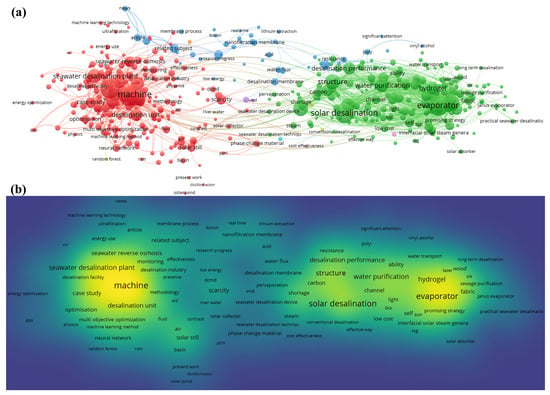
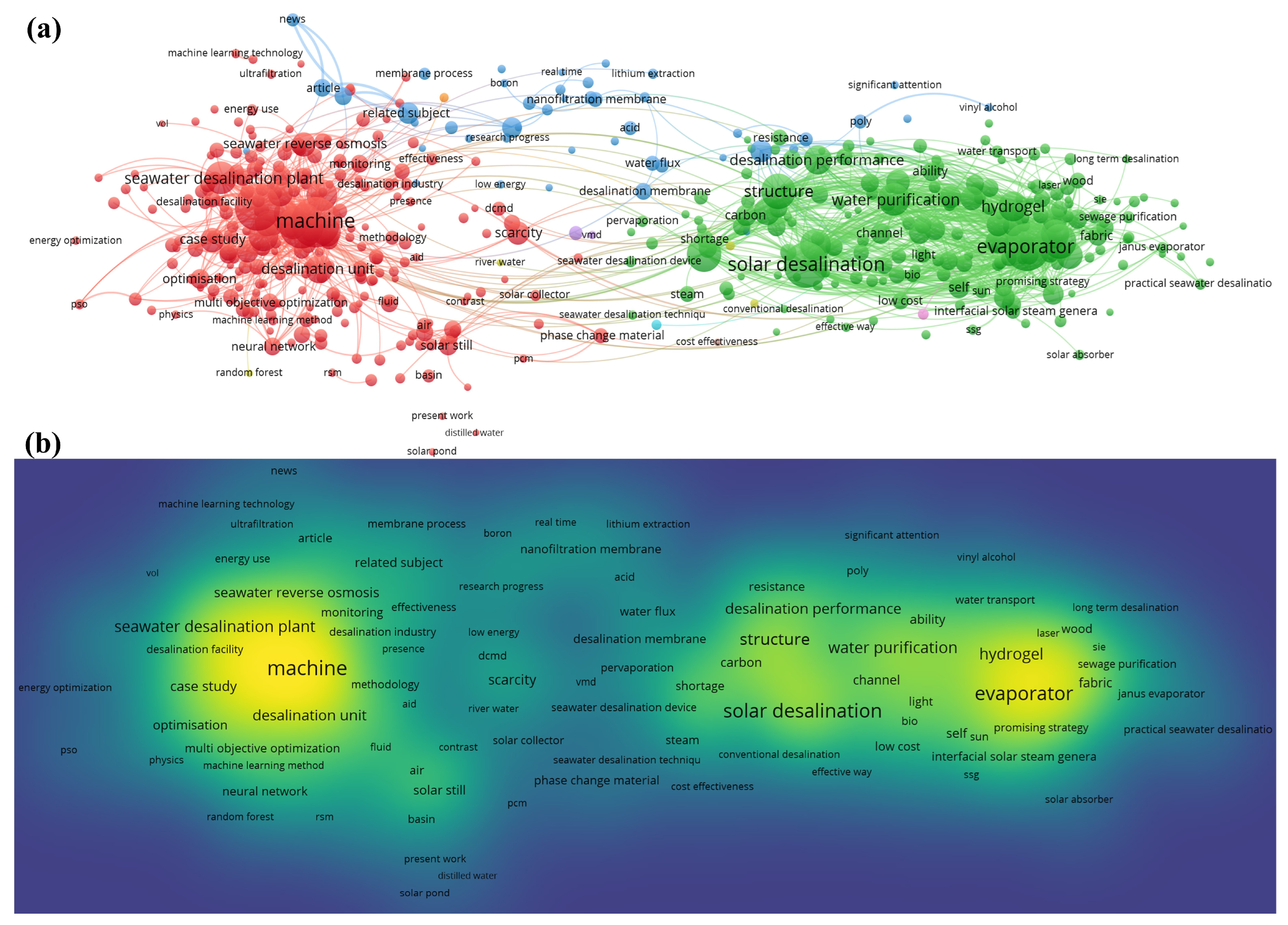
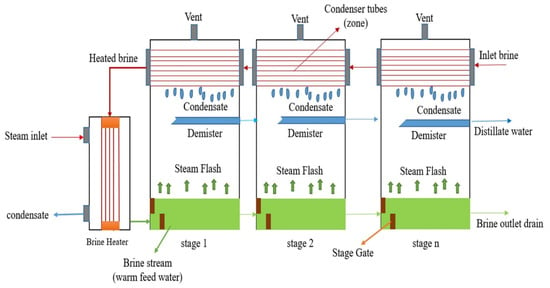
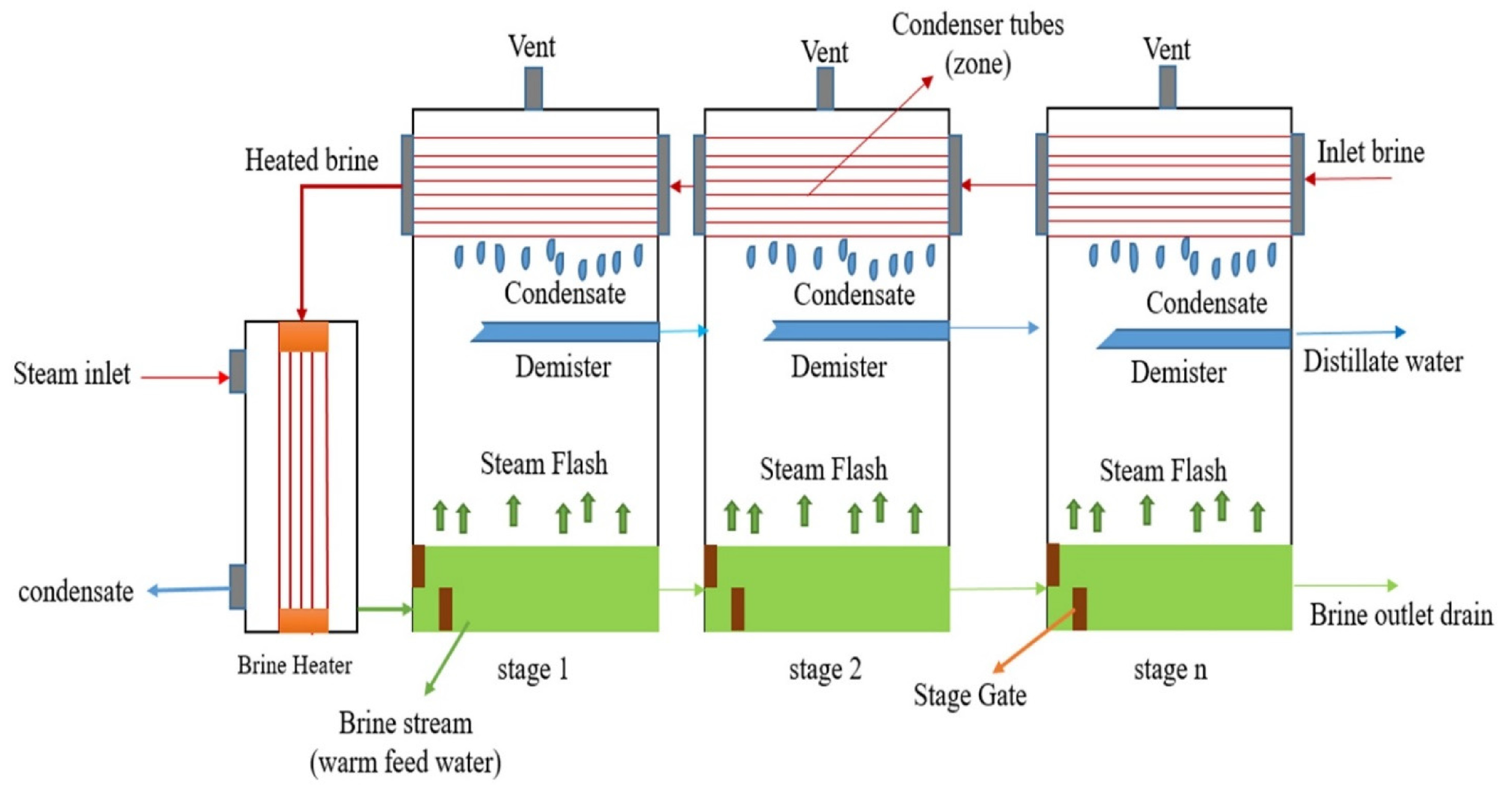
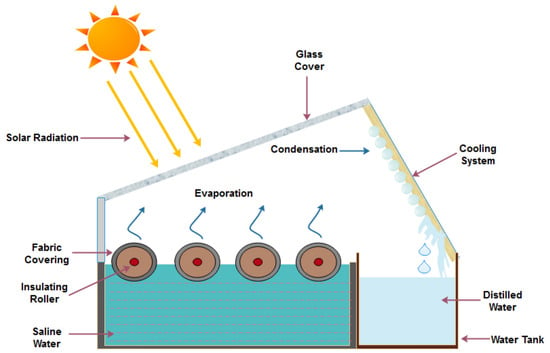
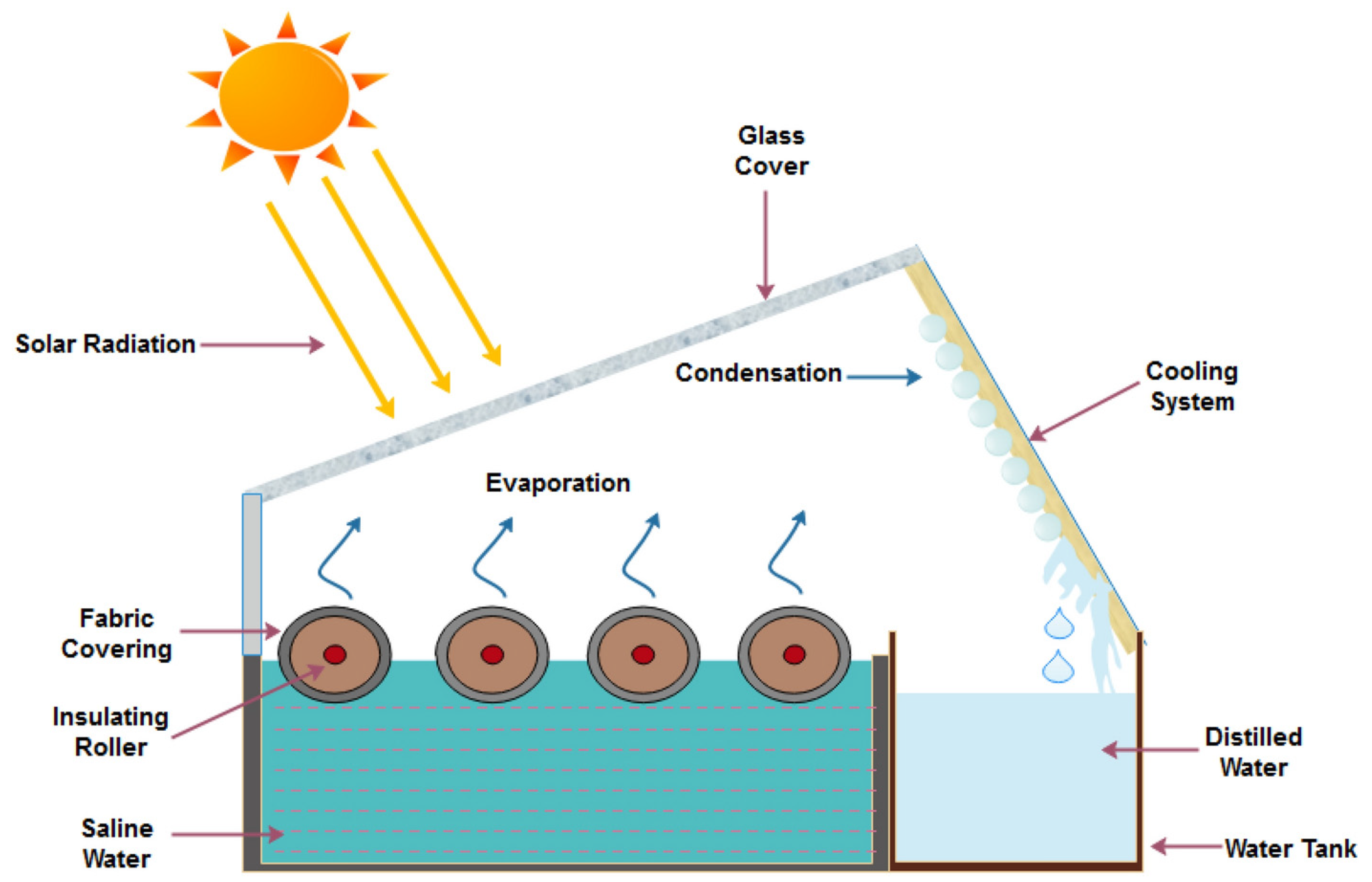
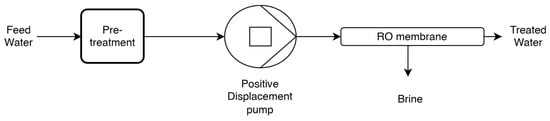
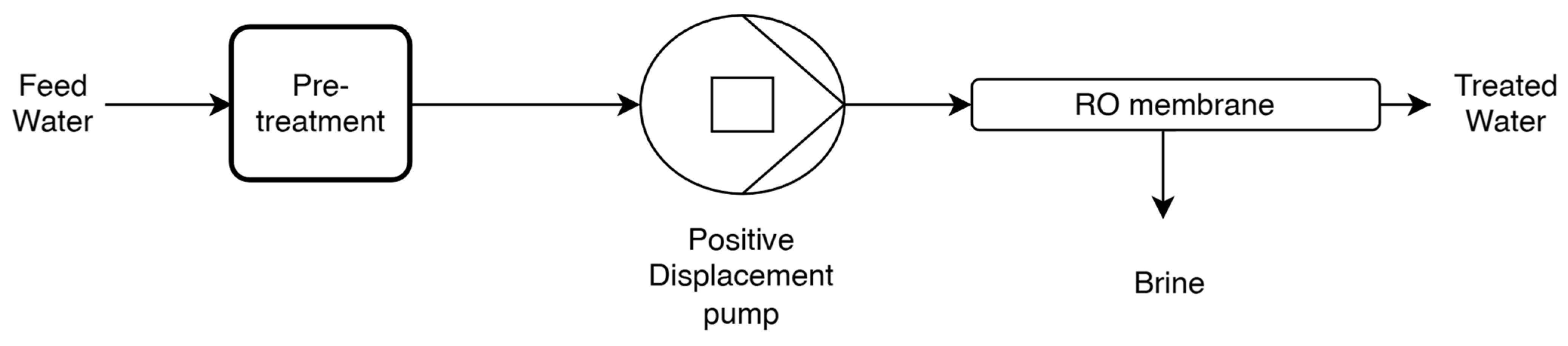
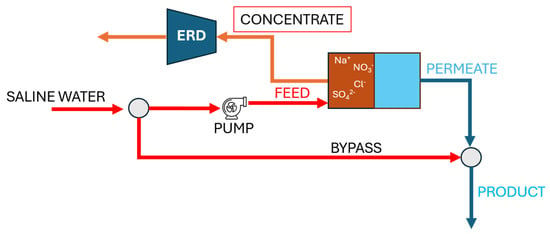
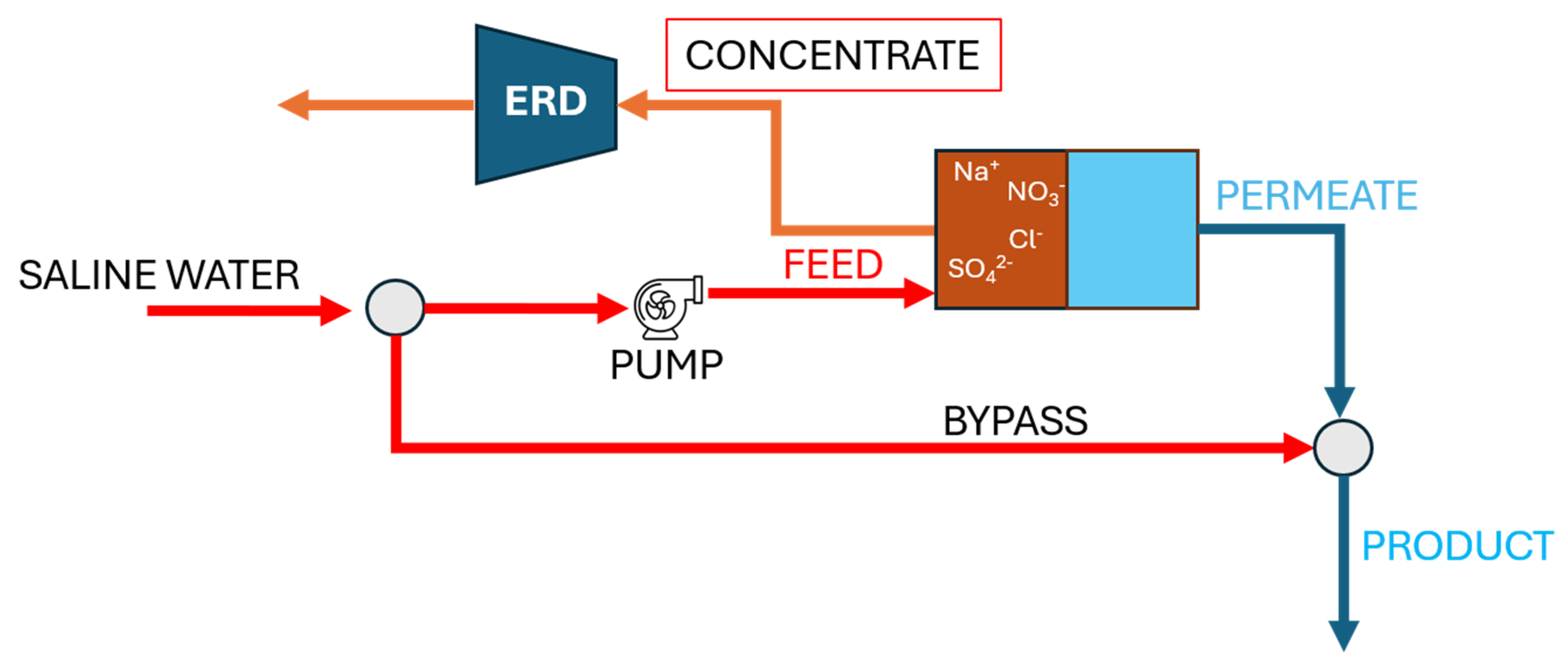
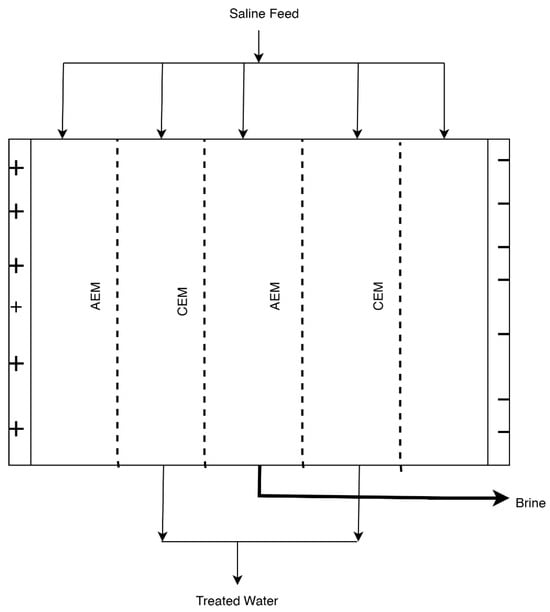
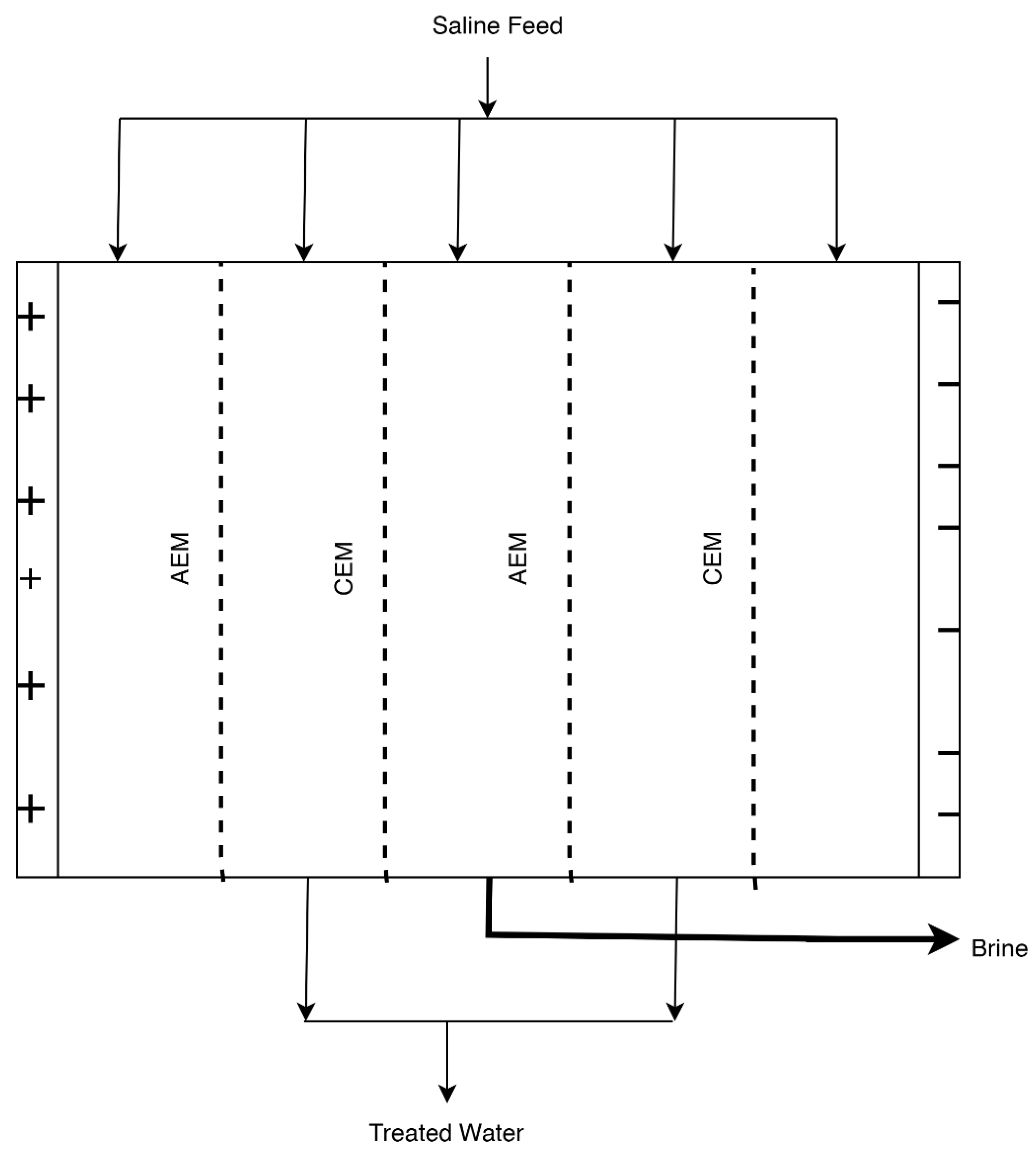
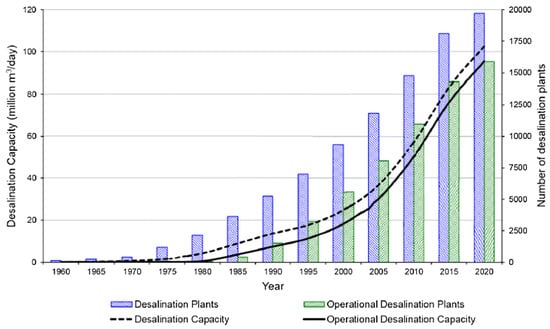
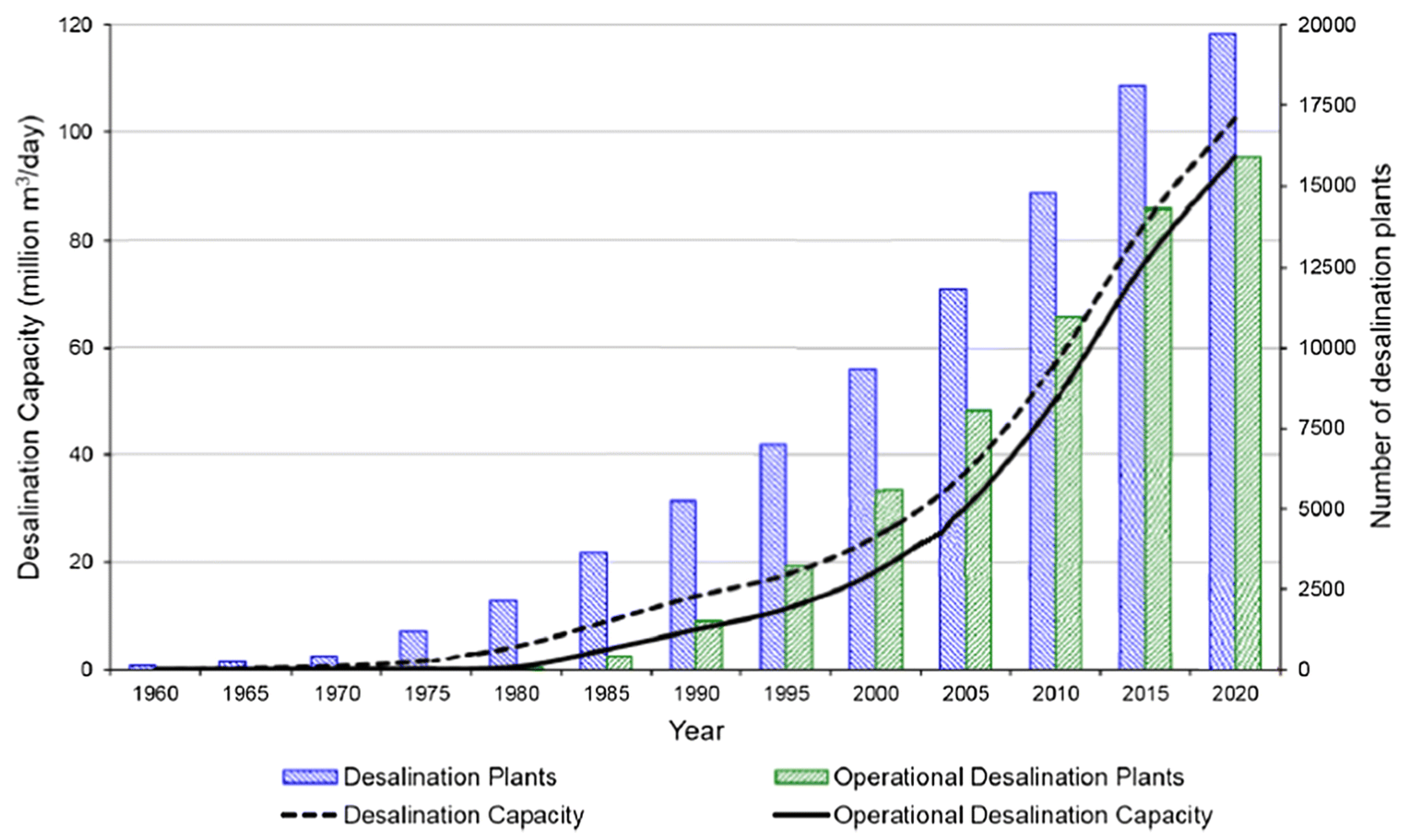
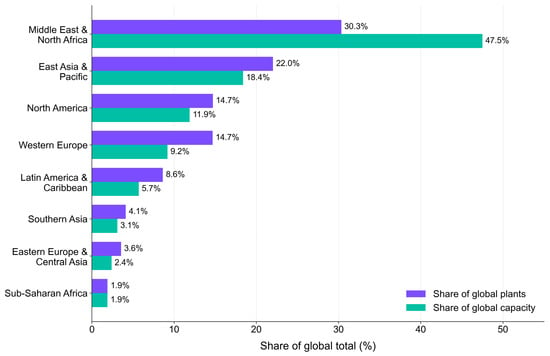
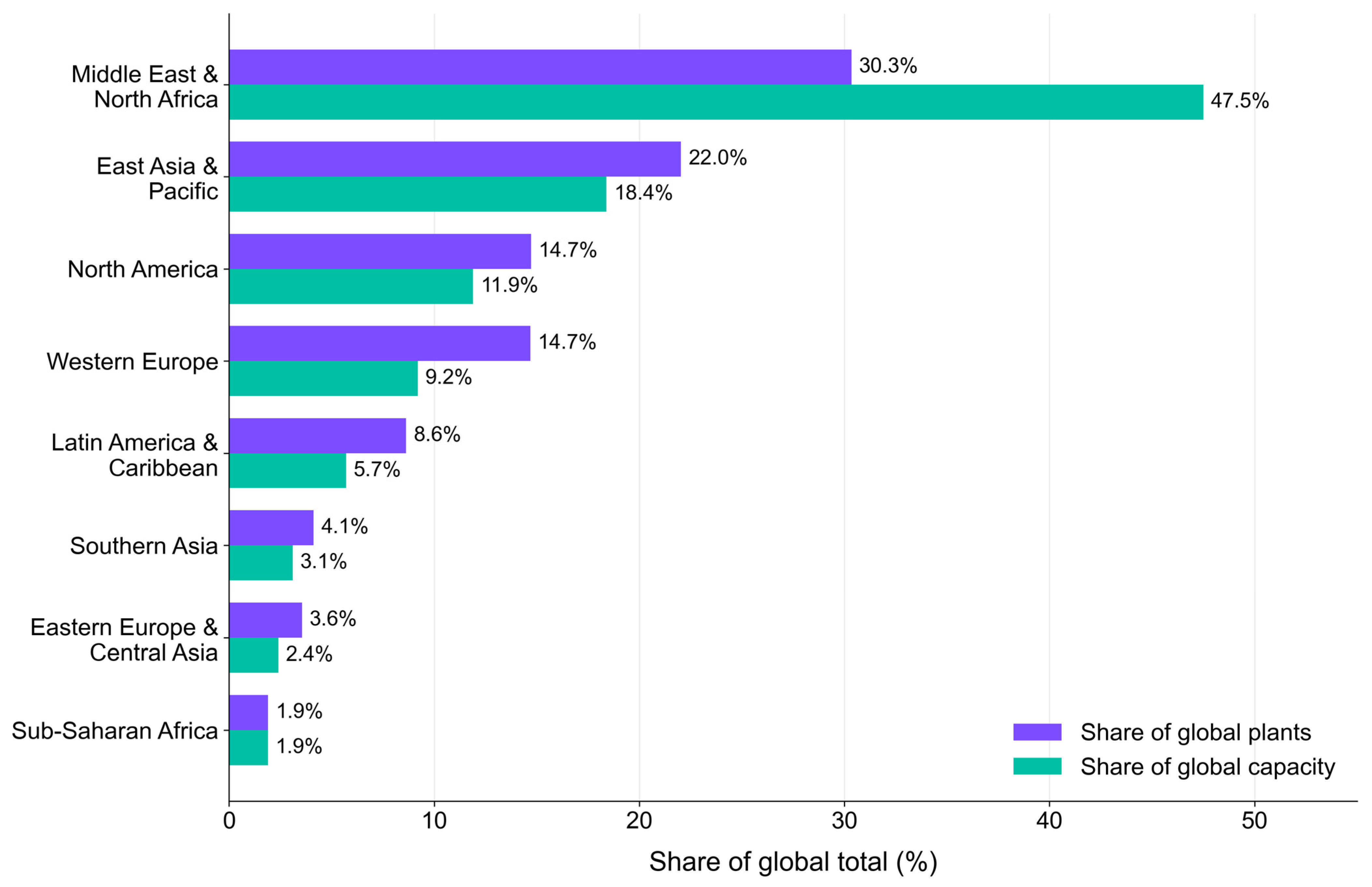
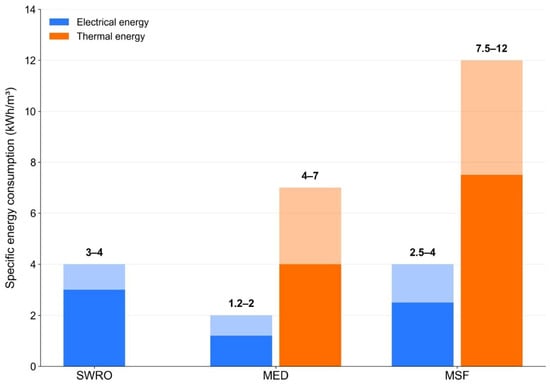
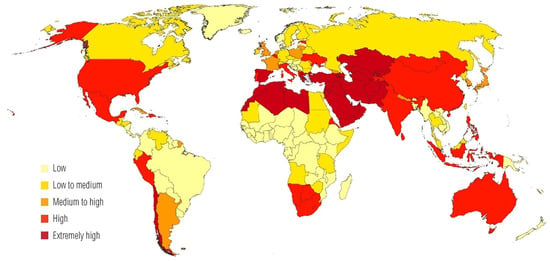
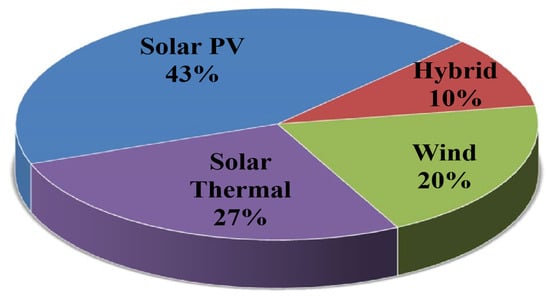
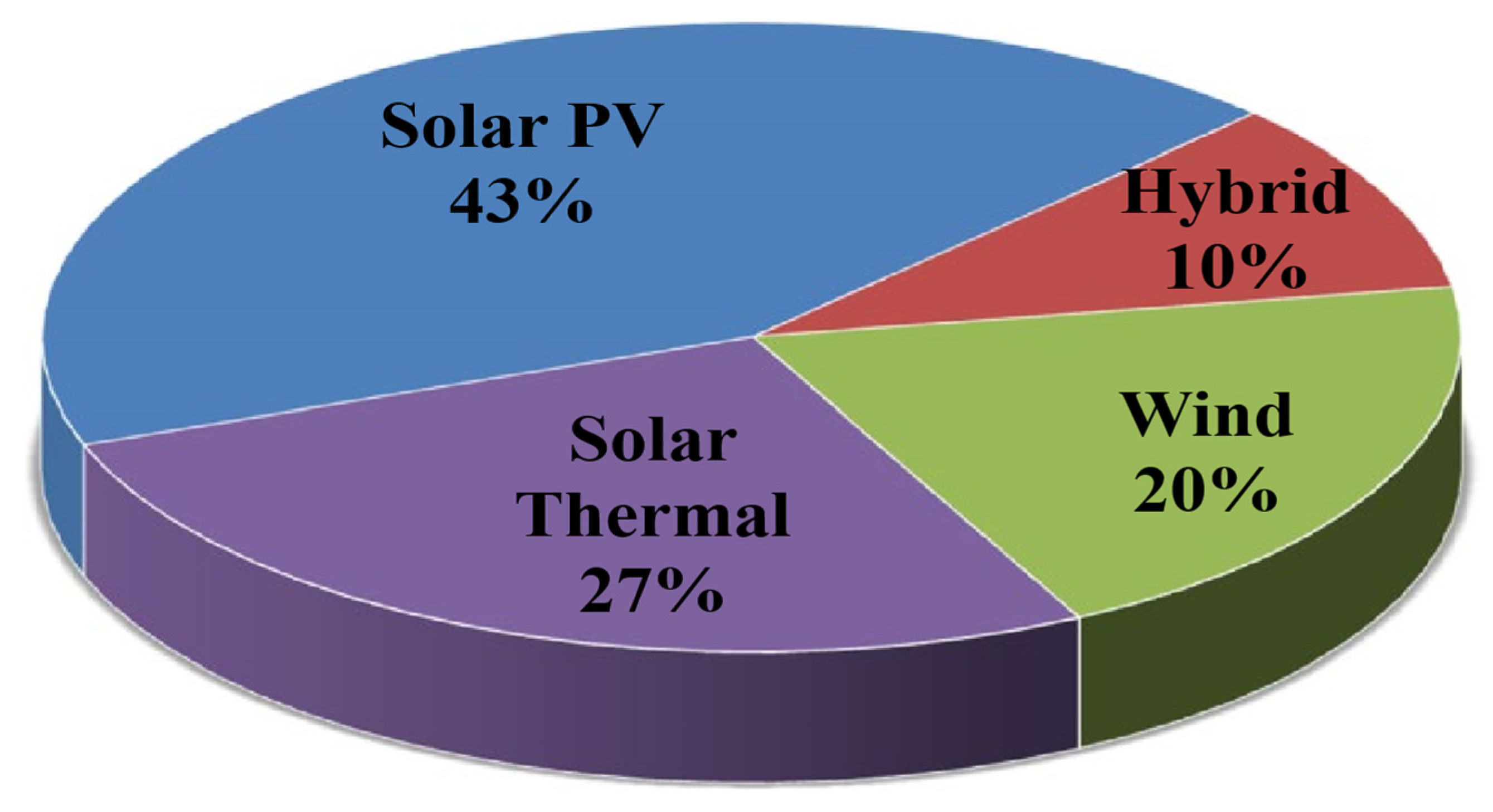
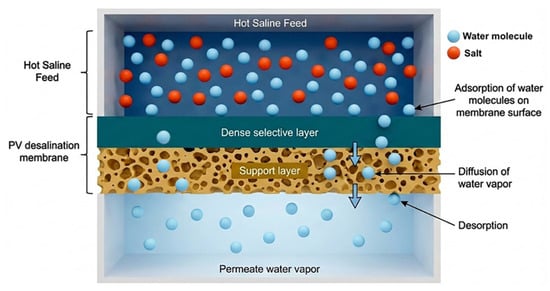
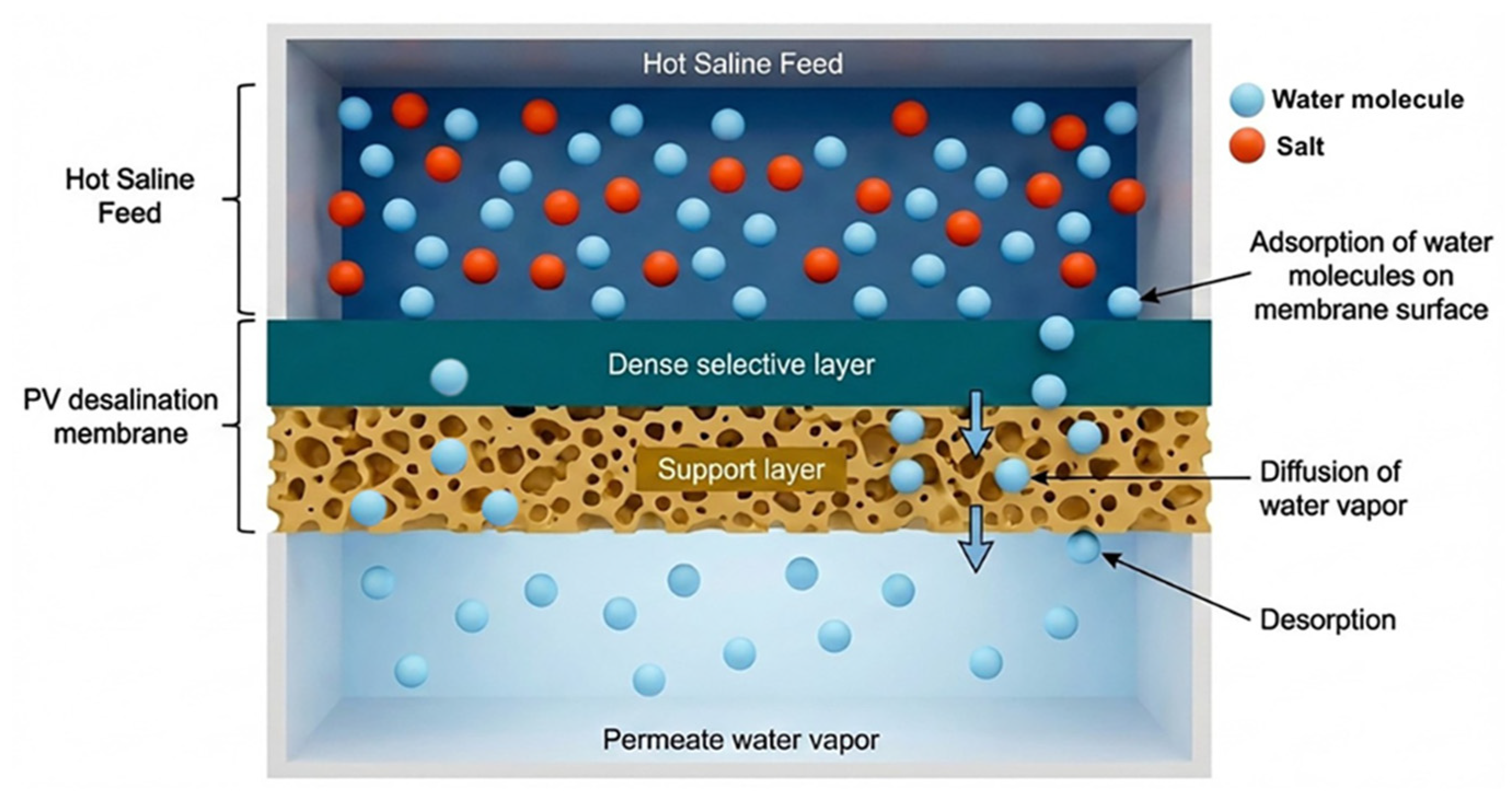
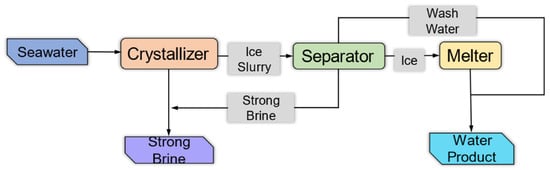
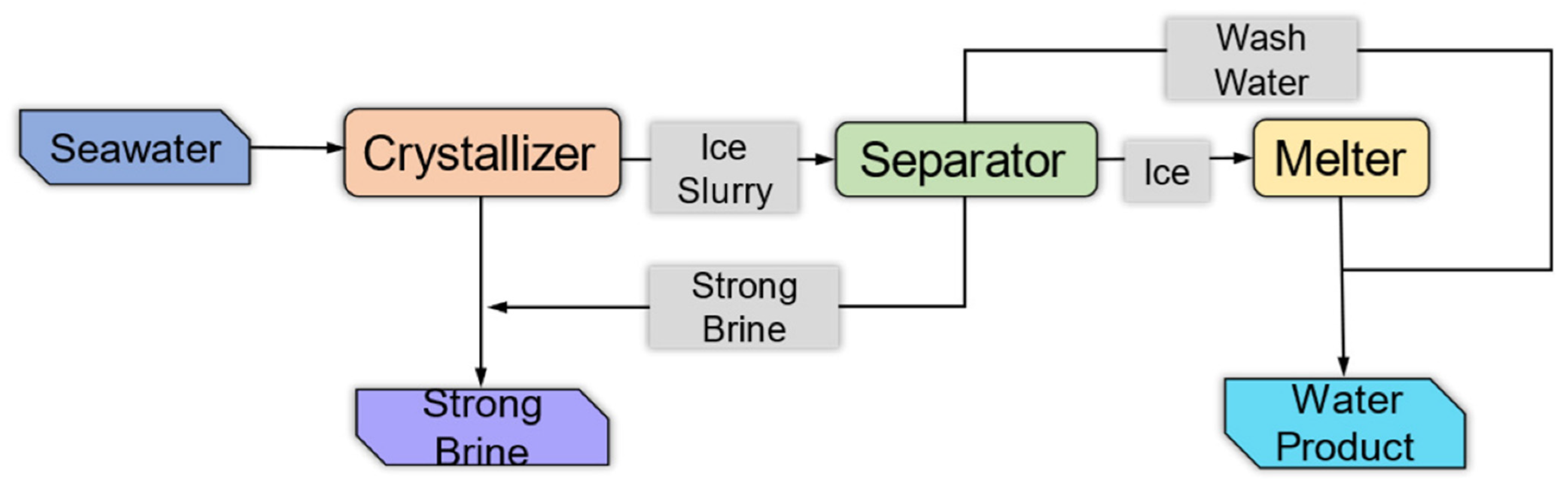

Disclaimer/Publisher’s Note: The statements, opinions and data contained in all publications are solely those of the individual author(s) and contributor(s) and not of MDPI and/or the editor(s). MDPI and/or the editor(s) disclaim responsibility for any injury to people or property resulting from any ideas, methods, instructions or products referred to in the content. |
© 2026 by the authors. Licensee MDPI, Basel, Switzerland. This article is an open access article distributed under the terms and conditions of the Creative Commons Attribution (CC BY) license.