


Abstract
Short-chain per- and polyfluoroalkyl substances (PFAS) have emerged as a challenging issue in water remediation due to their strong hydrophilicity and small molecular dynamic dimensions. Most current studies on biochar-based PFAS removal treat short-chain PFAS as secondary issues related to long-chain congeners. These technologies often apply classical theoretical frameworks, including hydrophobic interactions, electrostatic attraction, and conventional micropore filling, to explain mechanisms and develop functional materials. However, recent experimental evidence suggests that the dominant adsorption behavior of short-chain PFAS at biochar interfaces differs substantially from that of long-chain PFAS. First, the key capture process for short-chain PFAS appears to occur within sub-nanoporous domains with sizes between 0.56 and 0.85 nm, rather than within the broad microporous structures traditionally assumed. In addition, design principles based on synergistic pore–surface chemistry for long-chain PFAS may cause irreversible damage to sub-nanopores through metal-loading modifications, potentially reducing short-chain PFAS adsorption performance. Finally, material regeneration and disposal strategies for short-chain PFAS may need to shift from passive physical adsorption toward integrated adsorption–degradation systems. The main contribution of this perspective is to propose an independent mechanistic and material design framework for short-chain PFAS removal, based on the possible synergy between sub-nanopores and surface basic sites, and to outline a transition from passive adsorption to integrated adsorption–degradation. Future breakthroughs may depend less on pursuing ultra-high adsorption capacities alone and more on the precise, synergistic control of pore structure and surface chemistry, enabling combined adsorptive enrichment and in situ degradation.
1. Introduction
Per- and polyfluoroalkyl substances (PFAS), characterized by strong C–F covalent bonds with bond energies up to 544 kJ/mol, show remarkable chemical stability [1,2,3,4,5]. They have been widely detected in global surface and groundwater environments and have posed significant health concerns [1,5,6]. In 2024, the U.S. Environmental Protection Agency (EPA) released the National Primary Drinking Water Regulation, setting mandatory maximum contaminant levels (MCLs) for perfluorooctanoic acid (PFOA) and perfluorooctane sulfonate (PFOS) at 4 ng/L, while tightening regulatory thresholds for some emerging PFAS to 10 ng/L [7,8]. These trace-level standards urgently demand the development of economically viable PFAS remediation technologies [9,10,11].
Among several PFAS treatment strategies, adsorption technology has attracted wide attention from engineering communities because of its simplicity, low operational costs, and adaptability to complex environmental matrices [9,10,11]. Adsorbents such as activated carbon, ion-exchange resins, and metal–organic frameworks offer advantages but also have limitations and commonly suffer from high raw material costs and scalability challenges in large-scale applications [10,11,12,13]. Biochar, derived from pyrolysis of agricultural and forestry residues or sludge, offers abundant feedstock sources, costs only one-sixth as much as commercial activated carbon, and provides additional environmental benefits through carbon sequestration [14,15,16]. Thus, it is considered a promising, low-cost carbon-based adsorbent for PFAS remediation [14,15,16].
To date, several technologies have been explored for the removal of short-chain PFAS from water, including adsorption, ion exchange, membrane separation, advanced oxidation/reduction, and electrochemical treatment. Adsorption using activated carbon, ion-exchange resins, and metal–organic frameworks has been widely studied because of its operational simplicity and relatively low energy demand [8,9,10]. However, activated carbon often shows limited affinity for short-chain PFAS, due to their high hydrophilicity and weak hydrophobic driving force [3,8,9], while ion-exchange resins can be affected by competitive displacement from coexisting anions and natural organic matter [11,12]. Membrane separation, such as nanofiltration and reverse osmosis, can reject short-chain PFAS but may require high pressure, generate concentrated brine, and face fouling issues. Advanced oxidation processes and electrochemical methods can degrade PFAS, but their application to short-chain PFAS is often limited by high energy consumption, incomplete mineralization, and the formation of short-chain transformation products. In comparison, biochar-based adsorption is attractive because of its low cost, abundant feedstock, and potential for carbon sequestration [13,14,15]. Nevertheless, pristine biochar usually exhibits unsatisfactory removal efficiency for short-chain PFAS, and conventional modification strategies developed for long-chain PFAS are not necessarily effective [16,17,18]. Therefore, there is a clear need to compare existing short-chain PFAS removal techniques and to develop biochar materials specifically tailored to short-chain PFAS [8,9,10,11,12,13,14,15,16,17,18].
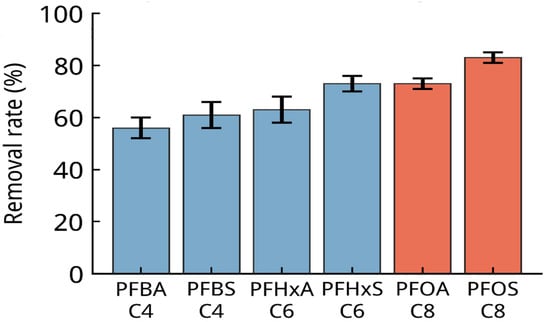
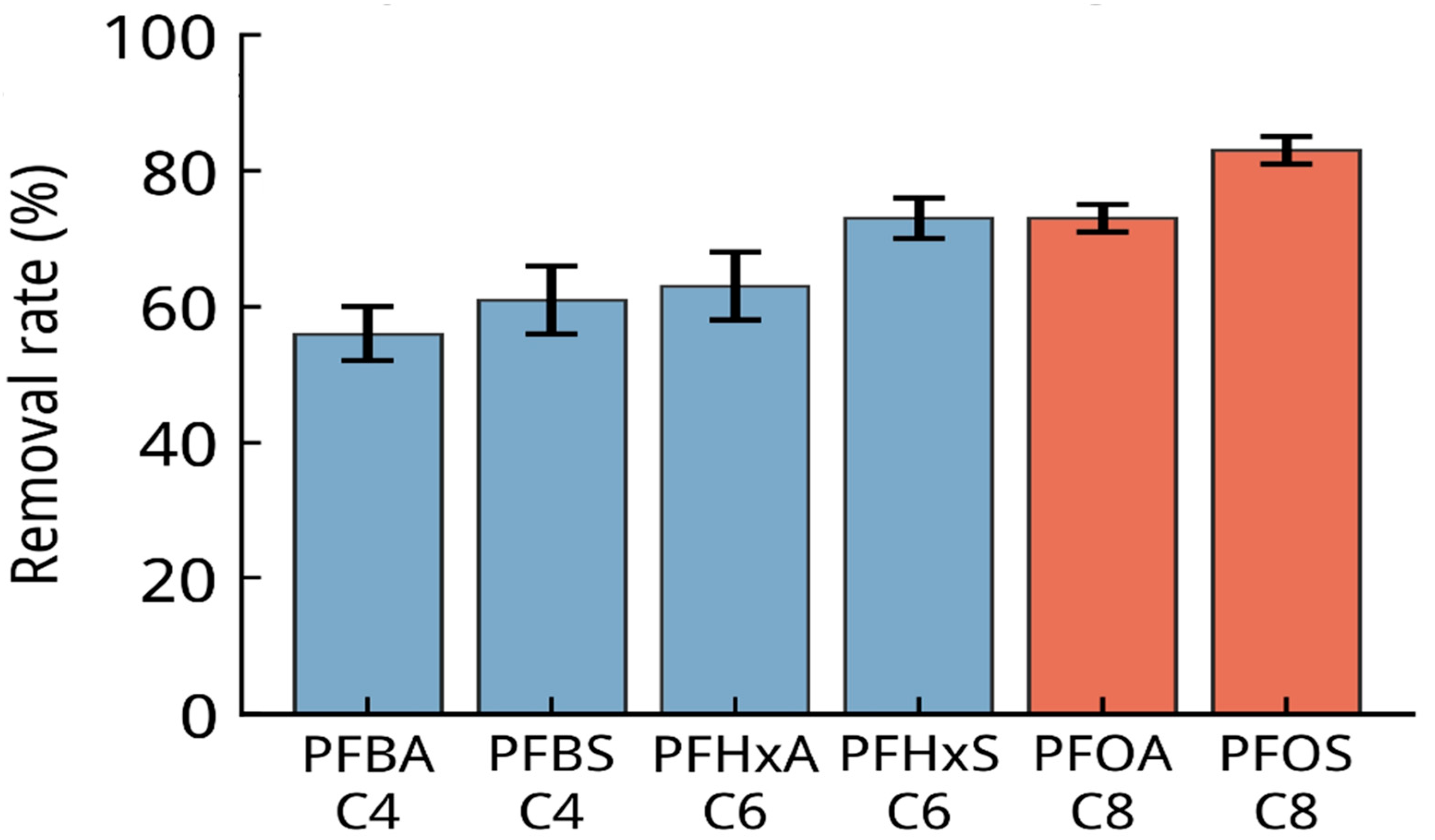
However, numerous laboratory and column leaching simulation experiments have revealed a common challenge [17,18,19,20,21]. Compared to long-chain PFAS, short-chain PFAS (≤6 carbon atoms) exhibit significantly reduced adsorption capacity and removal efficiency on biochar [17,18,19]. Dalahmeh et al. (2019) [16] developed a biochar-packed filter column system achieving removal efficiencies of 90–99% for C7–C11 perfluorocarboxylic acids and C6/C8 perfluorosulfonic acids, whereas removal efficiencies for short-chain PFAS (C3–C6) remained between 20% and 60%. Liu et al. (2021) [17] reported an 83% removal efficiency for PFOS using reed straw-derived biochar in groundwater treatment, while the removal rate for the corresponding short-chain perfluorobutanoic acid (PFBA) was 56% (Figure 1). Short-chain components are more prone to migration and diffusion in the aqueous phase, posing a risk of secondary groundwater contamination [20,21]. Short-chain PFAS molecules exhibit reduced hydrophobicity, and under natural water pH conditions, most biochar surfaces carry a net negative charge, leading to electrostatic repulsion against anionic short-chain PFAS and deteriorating adsorption performance [22,23]. These results indicate that the adsorption mechanisms of short-chain PFAS are distinct from those of long-chain PFAS.
Figure 1.
Comparison of short-chain and long-chain PFAS removal efficiencies on biochar. Removal efficiencies of six PFAS compounds on biochar are compared as a function of carbon chain length. Data are from Liu et al. (2021) [17]. Error bars represent the standard deviation of triplicate measurements (n = 3), as reported in the original study. PFBA, perfluorobutanoic acid; PFBS, perfluorobutane sulfonic acid; PFHxA, perfluorohexanoic acid; PFHxS, perfluorohexanesulfonic acid; PFOA, perfluorooctanoic acid; PFOS, perfluorooctane sulfonic acid.
With advances in detailed pore characterization techniques for biochar, increasing evidence has suggested fundamental differences in the interfacial interactions between short- and long-chain PFAS and biochar [24,25,26,27,28]. Pores in typical unactivated wood-based biochar generally measure less than 1.5 nm, which is insufficient to accommodate larger long-chain PFAS molecules but enables higher short-chain PFAS adsorption [24,25]. A study further summarized that conventional micropores (<2 nm) impose size exclusion on large PFAS molecules but are more accessible to short-chain PFAS, whereas mesopores (2–50 nm) can provide favorable adsorption sites for long-chain PFAS, thereby enhancing long-chain PFAS adsorption [26,27,28].
The size-exclusion logic for removing long-chain PFAS in water is that pores must be sufficiently large to accommodate larger pollutant molecules [29,30,31]. However, this logic cannot be directly applied to short-chain PFAS systems [32,33]. Short-chain PFAS have smaller dynamic molecular diameters; their challenge is not too-small pores that cannot contain them, but rather potentially oversized pores that fail to retain them [34,35]. Current material designs lack an independent framework that integrates pore structure and surface chemistry specifically for short-chain PFAS [18,19]. Many modification strategies simply borrow optimization approaches developed for long-chain PFAS, resulting in limited improvements or even performance degradation [19,36,37].
A systematic literature search was conducted using Web of Science, Scopus, ScienceDirect, and Google Scholar for studies published between January 2015 and March 2025. Keywords included “short-chain PFAS,” “biochar,” “sub-nanopores,” “surface basicity,” “adsorption mechanism,” and “integrated adsorption–degradation,” which were used in various combinations. The inclusion criteria were: (i) peer-reviewed English-language studies; (ii) studies reporting adsorption or removal data for PFAS on biochar, modified biochar, or biochar-based composites; and (iii) studies providing information on pore structure, surface chemistry, or regeneration performance. The exclusion criteria were: (i) conference abstracts, patents, and non-peer-reviewed reports; (ii) studies focusing exclusively on non-biochar adsorbents without comparative relevance; and (iii) studies lacking sufficient experimental detail on adsorbent preparation or adsorption conditions. After removing duplicates and screening titles and abstracts, 96 records were assessed in full text, and 59 studies were included in this perspective. Because this work is a perspective article rather than a formal systematic review, the search was intended to identify representative mechanistic and material design studies rather than to provide an exhaustive quantitative synthesis.
Based on prior studies, this study proposes an alternative framework tailored for short-chain PFAS [18,19,27,28]. The adsorption of short-chain PFAS cannot simply replicate the material development strategies used for long-chain PFAS [19,36,37]. Instead, it should be treated as an independent mechanism-material problem [18,19]. Technological breakthroughs should not rely solely on maximizing adsorption capacity, but rather focus on the precise, synergistic control of sub-nanometer pores and surface basic sites, thereby advancing passive adsorption toward an integrated closed-loop system that combines adsorption and degradation [38,39,40,41,42]. This perspective aims to address the following research questions: (1) Why do conventional theoretical frameworks developed for long-chain PFAS fail to fully explain short-chain PFAS adsorption on biochar? (2) What is the dominant capture mechanism for short-chain PFAS at biochar interfaces? (3) How should biochar pore structure and surface chemistry be designed to enhance short-chain PFAS removal without causing irreversible damage to sub-nanopores? (4) How can short-chain PFAS be transformed from simple phase transfer to greater degradation through integrated adsorption–degradation systems? The objective of this perspective is to establish an independent mechanistic and material design framework for short-chain PFAS removal by biochar, rather than simply extending optimization strategies developed for long-chain PFAS. In this perspective, “destruction” refers to the disappearance or transformation of parent PFAS molecules; “mineralization” refers to the conversion of PFAS into inorganic products such as fluoride, CO2, and short-chain intermediates that may still be fluorinated; and “defluorination” specifically refers to the release of fluoride ions from the carbon–fluorine bond. Unless supported by fluoride mass balance, gas chromatography–mass spectrometry (GC–MS), liquid chromatography–tandem mass spectrometry (LC–MS/MS), or ion chromatography (IC) data, these terms should not be used interchangeably.
The main contribution of this perspective is threefold. First, it critically evaluates the limitations of classical adsorption mechanisms, including hydrophobic interactions, electrostatic attraction, and conventional micropore filling, when applied to short-chain PFAS. Second, it proposes an alternative framework in which sub-nanopores of 0.56–0.85 nm, combined with alkaline surface sites on pore walls, may act synergistically to capture short-chain PFAS. Third, it discusses how material design, regeneration, and disposal strategies could be reoriented from passive adsorption toward integrated adsorption–degradation systems. Accordingly, this perspective is organized as follows: Section 2 reviews the limitations of current theoretical frameworks; Section 3 proposes the possible synergistic mechanism of sub-nanopores and surface basic sites; Section 4 discusses integrated adsorption–degradation regeneration; Section 5 outlines future research needs; Section 6 summarizes the main conclusions. This article is intended as a perspective rather than a systematic review or an experimental study. Its conclusions should therefore be read as an evidence-based framework and research agenda, not as final proof of a universal mechanism.
2. Limitations of Current Theoretical Frameworks
2.1. Hydrophobic Interactions
Hydrophobic interactions are widely recognized as the dominant mechanism for biochar adsorption of anionic PFAS, especially playing a decisive role in the adsorption of long-chain PFAS [9,10,22,23]. Previous studies have shown that hydrophobic partitioning is the core adsorption mechanism controlling the binding of anionic PFAS to biochar [9,10,22]. High-temperature biochars rich in condensed aromatic domains effectively immobilize long-chain compounds such as PFOS and PFOA through hydrophobic interactions [29,30]. However, this hydrophobic-dominant theory has inherent limitations when applied to short-chain PFAS [2,18,27]. Taking PFBA (C4) as an example, short-chain PFAS generally possess short fluorinated carbon chains, resulting in weak hydrophobic driving forces and extremely high aqueous solubility [2,18,23]. Strong solvation in the aqueous phase hinders molecular migration toward the hydrophobic biochar interface [2,23,27]. PFOS contains more internal CF2 repeating units and thus exhibits significantly greater hydrophobicity than 6:2 fluorotelomer sulfonate (6:2 FTS) [31]. Extending the carbon chain strengthens hydrophobic adsorption interactions [31]. These findings can explain the chain-length-dependent trend in which longer chains adsorb more strongly [31]. However, they cannot address the core scientific question: when the hydrophobic driving force itself is already extremely weak, what other forces actually drive short-chain PFAS from the aqueous phase to the solid–liquid interface of biochar [27,28]?
If hydrophobic interactions were solely responsible, short-chain PFAS would hardly partition spontaneously from the aqueous phase to the biochar surface [2,18,23]. This indicates that hydrophobic partitioning may play only a minor role and that other mechanisms are likely dominant in governing the interfacial behavior of short-chain PFAS [27,28]. Therefore, modification strategies that rely solely on increasing pyrolysis temperature to enhance hydrophobic aromatic carbon content offer limited improvement in short-chain PFAS removal [32,33]. This reasoning could explain why many high-temperature biochars still perform poorly in treating short-chain PFAS [18,19,32]. It should be noted that hydrophobic interactions remain important for long-chain PFAS, but their contribution to short-chain PFAS adsorption may be limited by the lower hydrophobicity and smaller molecular size of short-chain congeners.
2.2. Electrostatic Attraction and Metal-Loading Modification
Electrostatic attraction represents another widely invoked theoretical framework [9,10,22,23]. When the solution pH is below the point of zero charge (pHpzc) of biochar, the surface hydroxyl and carboxyl groups become protonated, rendering the surface positively charged [34,35]. This allows electrostatic attraction to bind anionic PFAS molecules, thereby enhancing adsorption [34,35]. Conversely, when the pH exceeds pHpzc, these functional groups deprotonate, rendering the surface negatively charged and leading to electrostatic repulsion, which reduces adsorption efficiency [22,23,34]. However, applying this theory to real-world aquatic environments gives rise to two practical contradictions [22,23].
Natural water typically has pH values within the neutral range of 5–9, under which most conventional biochars exhibit negative zeta potentials [22,23]. Experimental data showed that biochars derived from corn and poplar have zeta potentials between −25.0 and −58.1 mV at pH 5–9, indicating overall negative surface charges and thus electrostatic repulsion toward anionic PFAS [22,23]. To achieve effective electrostatic attraction, the system pH must fall below the pHpzc, which requires strong acidification, a condition that is rarely feasible in practical engineering applications [22,43,44,45,46,47,48].
Several reports of high adsorption capacities for metal-modified biochars are based on long-chain PFAS systems and cannot be directly extrapolated to short-chain PFAS [36,37,49]. Rodrigo et al. (2022) modified Douglas fir-based biochar with Fe3O4, increasing the maximum PFOA adsorption capacity [35]. Zhou et al. (2021) achieved a PFOA adsorption capacity of up to 1269 mg/g using molten alkali-activated microporous biochar [36]. These performances were attributed to increased specific surface area, expanded pore volume, and a greater number of positively charged surface sites [36,37]. However, parallel control experiments targeting short-chain PFAS are severely lacking, and the side effects introduced by metal oxides and metal salts, including clogging of fine pores, are often overlooked [19,38,39]. Although metal loading introduces positively charged sites, it may simultaneously disrupt the delicate pore structures that are critical for short-chain PFAS adsorption, resulting in a trade-off whereby charge increases but the adsorption of short-chain PFAS actually decreases (Table 1) [19,38,39]. Overall, electrostatic attraction and metal loading can enhance adsorption of long-chain PFAS, but their benefits for short-chain PFAS remain uncertain because the same modification may block or destroy sub-nanopores that are critical for short-chain capture.
Table 1.
Comparison of pore characteristics and short-chain PFAS adsorption/removal performance of representative biochar-based materials.
2.3. Competition Between Surface Charge Enhancement and Pore Structure Integrity
A key yet underexplored trade-off has been identified in the effects of surface functional groups on biochar [30,40,41]. Excessive oxygen-containing functional groups (especially COOH) on biochar surfaces can create steric hindrance and even intensify electrostatic repulsion, thereby reducing adsorption capacity [30,40]. Biochars produced via low-temperature pyrolysis typically possess abundant functional groups [30,41]. However, these groups block pore entrances, preventing pollutant molecules from reaching internal adsorption sites and thus offsetting any performance gains provided by the functional groups [30,41]. All modification strategies aimed at increasing surface positive charge carry the risk of compromising pore structure [19,36,38,39]. Although extensive studies have been conducted on using minerals and metal salts to modify biochar for enhanced heavy metal adsorption, mechanistic studies on polar organic pollutants and surfactants, including PFAS, remain scarce [38,39,47]. Most reported excellent adsorption data for metal-modified biochar have focused on long-chain PFAS such as PFOS and PFOA, which primarily rely on mesopores and hydrophobic aromatic surfaces, and show low dependence on sub-nanometer pores [42,43,49]. In contrast, short-chain PFAS strongly depend on fine pores, and the loss of sub-nanometer pores caused by metal loading significantly weakens the material’s ability to capture short-chain components [19,27,28]. This leads to a common scientific misconception: high-performance modified biochar selected based on long-chain PFAS may not necessarily perform equally well when applied to short-chain PFAS systems [19,27,28,49].
In summary, the two traditional classical adsorption mechanisms fail to fully explain the behavior of short-chain PFAS adsorption [18,19,27]. Modification strategies developed for long-chain PFAS carry significant negative side effects and cannot be directly adopted [19,36,37]. Therefore, there is an urgent need to establish an independent analytical framework tailored to the unique molecular characteristics of short-chain PFAS [18,19,27,28,50].
3. Synergistic Mechanism of Sub-Nanopores and Surface Basic Sites
3.1. Size-Selective Capture Effect of Sub-Nanopores
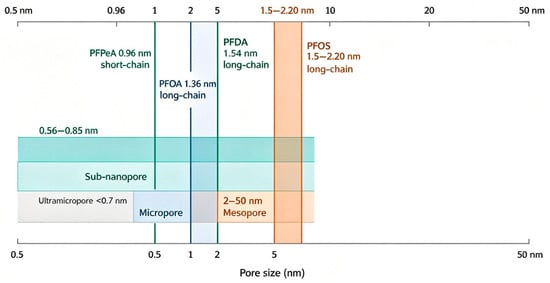
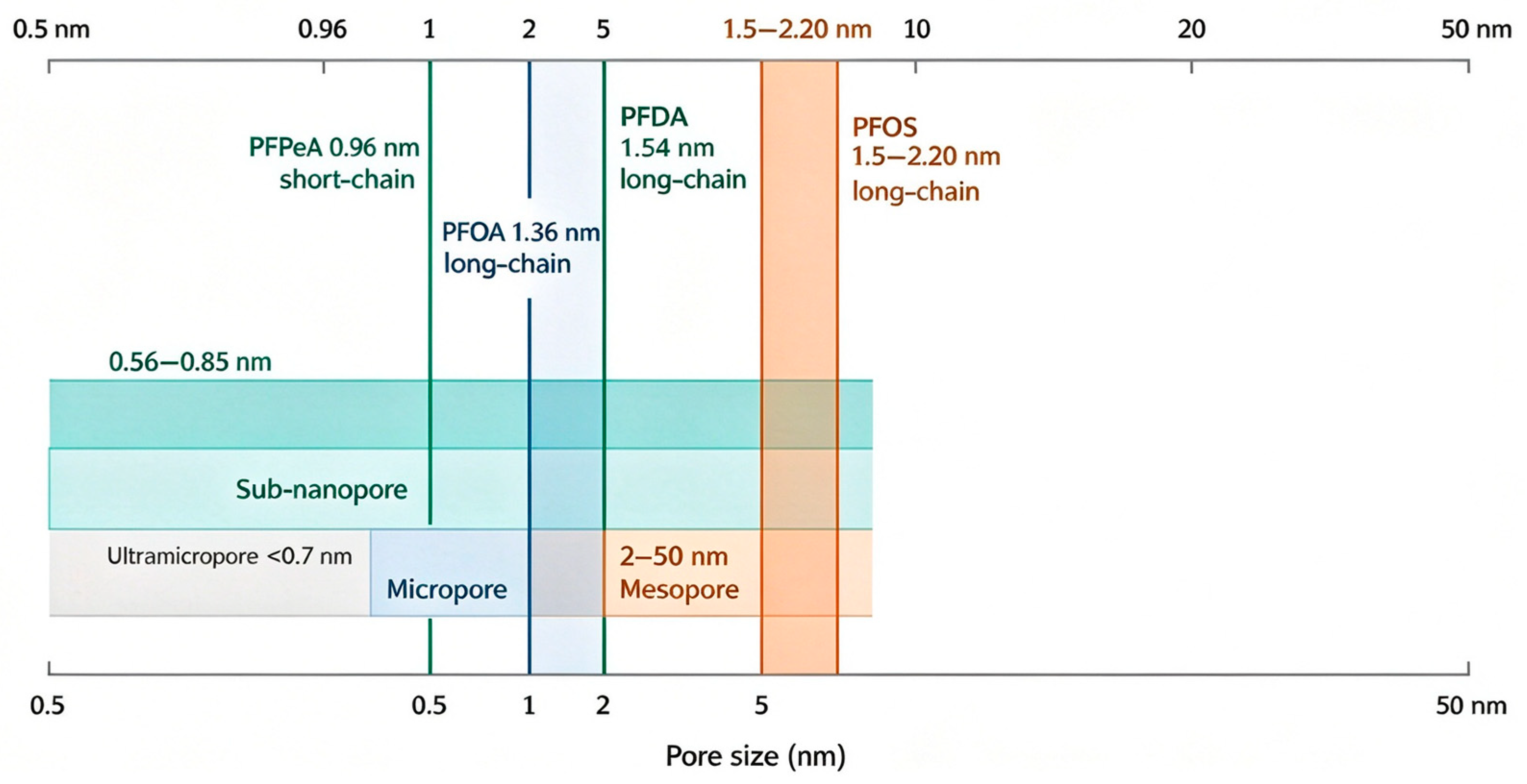
Previous studies define pores larger than 2 nm as mesopores and those smaller than 2 nm collectively as micropores, assuming that a higher micropore content leads to more adsorption sites and better adsorption performance [9,10,26]. However, several studies emphasized that pore size distribution can be at least as important as specific surface area, and may exert a stronger influence on PFAS adsorption selectivity [26,27,28]. It is important to clarify that specific surface area and pore size distribution are not competing parameters; both are essential for adsorption. Specific surface area reflects the total availability of adsorption sites, whereas pore size distribution determines whether those sites are accessible to molecules of a given size and shape [26,27,28]. For short-chain PFAS, a high specific surface area alone may not guarantee high adsorption if the pores are predominantly too small or too large. Conversely, a moderate surface area with well-developed sub-nanopores may provide more effective capture. Therefore, pore size distribution may have a stronger influence on short-chain PFAS selectivity, but it should be evaluated together with specific surface area rather than in isolation [26,27,28]. For instance, wood-based biochar with a high specific surface area of up to 715 m2/g performs worse in PFAS adsorption due to excessive microporosity, as long-chain PFAS molecules cannot enter these tiny pores, compared with sludge-derived biochar that has a surface area of only 261 m2/g but well-developed mesopores [42,43,44]. In particular, ultramicropores below 0.7 nm are entirely incapable of accommodating long-chain PFAS molecules, resulting in strong steric exclusion [26,27,28]. Short-chain PFAS molecules are significantly smaller, with their molecular dynamic diameter precisely falling within the 0.56–0.85 nm range, corresponding to sub-nanopores [27,28]. These sub-nanopores neither belong to conventional mesopores nor fully fall under the broad category of micropores [27,28]. For short-chain PFAS, efficient capture appears to depend less on large mesopores alone and more on the availability of precisely matched confined spaces, particularly sub-nanopores (Figure 2) [27,28]. Specific surface area remains important because it determines the total number of potential adsorption sites, but its contribution may be limited unless the pore size distribution is suitable for the target molecules. Within sub-nanopores, unique adsorption potential wells form, leveraging spatial confinement to trap small, short-chain PFAS molecules inside the pore cavities, a pathway unavailable for long-chain PFAS [27,28].
Figure 2.
Matching between biochar pore-size distribution and PFAS molecular dynamic diameters. The horizontal axis represents pore size on a logarithmic scale (0.5–50 nm), divided into four pore categories: sub-nanopores (0.56–0.85 nm), ultramicropores (<0.7 nm), micropores (<2 nm), and mesopores (2–50 nm). Vertical markers indicate the maximum molecular diameters (Dmax) of representative PFAS: perfluoropentanoic acid (PFPeA, 0.96 nm, short-chain), perfluorooctanoic acid (PFOA, 1.36 nm, long-chain), perfluorodecanoic acid (PFDA, 1.54 nm, long-chain), and perfluorooctanesulfonic acid (PFOS, 1.5–2.20 nm, long-chain) [27,28]. The molecular diameter values are derived from reported computational and experimental estimates. Because PFAS molecules are flexible and their effective dimensions depend on conformation, hydration, and measurement method, these values should be regarded as approximate ranges rather than exact constants. The pore-size categories are based on IUPAC conventions and the cited literature. Note that the Dmax of PFPeA (0.96 nm) is not directly comparable to the sub-nanopore size range (0.56–0.85 nm), as they describe different physical quantities. The figure is conceptual and is intended to illustrate size-matching trends, not to provide a quantitative prediction for a specific biochar.
This hypothesis explains several seemingly contradictory experimental observations reported in the literature [18,19,27,28]. First, reducing biochar particle size does not necessarily enhance short-chain PFAS adsorption [45,46]. If sub-nanopores are primarily responsible for capturing short-chain PFAS, grinding may destroy these delicate sub-nanopores while exposing new surfaces prone to oxidation, leading to a significant loss of sub-nanopores [45,46]. The benefit from improved mass transfer is thus offset by structural damage, resulting in counterintuitive outcomes in which larger particles exhibit better PFBA adsorption [45,46]. Second, unactivated wood-based biochar generally shows poor PFAS removal efficiency [24,25,46]. This statistical outcome reflects an average of both long-chain and short-chain PFAS [18,24,46]. Although wood-based biochar contains abundant pores smaller than 1.5 nm that are too narrow for long-chain PFAS, the presence of sub-nanopores measuring 0.56 to 0.85 nm theoretically enables the capture of short-chain PFAS [27,28]. However, few published experiments separately report results for short-chain and long-chain PFAS, thereby masking the potential role of sub-nanopores in capturing short-chain species [18,19,27]. Third, sub-nanopore capture is not purely a geometric sieving effect, as the chemical properties of pore walls also play a crucial role [27,28]. Even when pore size matches, highly hydrophilic pore walls rich in negatively charged functional groups can repel anionic short-chain PFAS, preventing stable retention within the pores [22,23,27,28]. Therefore, for sub-nanopores to achieve selective capture, they must be paired with a suitably alkaline surface chemistry on the pore walls [27,28,47,48]. It should be emphasized that the proposed role of sub-nanopores is based on a synthesis of existing evidence rather than on a fully validated universal mechanism. Relatively few studies have directly separated short-chain and long-chain PFAS under identical experimental conditions.
3.2. Electrostatic Anchoring Function of Surface Sites
Sub-nanopores provide spatial confinement, while alkaline sites on the pore walls serve as electrostatic anchoring sites; together, they synergistically immobilize short-chain PFAS [27,28]. Surface functional groups such as –OH and phenolic hydroxyl groups on biochar can provide interaction sites for PFAS, and hydroxyl groups can also form hydrogen bonds with the polar head groups of short-chain PFAS, with the hydrogen-bonding contribution being significantly higher for short-chain PFAS than for long-chain congeners [27,28,47,48]. However, not all oxygen-containing functional groups are beneficial; surface alkaline sites (which raise the pHpzc) are the key [27,28,47]. Conventional biochars generally have low pHpzc values, and under soil and water pH conditions, their functional groups deprotonate, rendering the surface negatively charged and repelling anionic PFAS molecules [22,23,34,35]. Increasing the overall surface basicity of biochar and raising its point of zero charge can weaken electrostatic repulsion, while alkaline sites on the walls of sub-nanopores can electrostatically anchor the negatively charged sulfonate and carboxylate head groups of short-chain PFAS, compensating for their insufficient hydrophobic driving force [27,28,47,48]. It is important to distinguish between the overall pHpzc of the bulk biochar and the local basicity of pore-wall sites. Even when the bulk pHpzc remains low, locally alkaline mineral or oxygen-containing sites within sub-nanopores can create positively charged microenvironments that anchor anionic short-chain PFAS [27,28,47].
Native mineral phases (iron and aluminum oxides) within biochar provide positively charged sites, allowing negatively charged PFAS head groups to bind via ionic interactions to the positively charged mineral surfaces of iron oxides [47,48]. However, traditional studies have primarily focused on this phenomenon with long-chain PFAS [38,39,47]. For short-chain PFAS, alkaline mineral sites are not merely external adsorption sites [27,28,47]. When these sites are distributed along the inner walls of sub-nanopores, spatial confinement combined with localized electrostatic attraction creates strong adsorption potential wells, significantly enhancing retention capacity for short-chain PFAS [27,28,47,48]. It is essential to distinguish between the overall pHpzc of the material and the local charge state of pore wall sites [27,28,47]. Even if the macroscopic zeta potential of biochar indicates negative charge, locally alkaline mineral sites within sub-nanopores can still generate microenvironments with positive charges, enabling anchoring of short-chain PFAS [27,28,47]. This explains why some macroscopically negatively charged biochars can still adsorb a measurable amount of short-chain PFAS [18,19,27]. The distinction between the overall pHpzc of the material and the local charge state of pore-wall sites is important. Even when the macroscopic zeta potential of biochar is negative, locally alkaline mineral sites within sub-nanopores may generate a microenvironment with positive charges, potentially enabling anchoring of short-chain PFAS. However, direct evidence for such local charge effects remains limited and should be further examined.
3.3. Design Principles for Synergistic Pore Surface Materials
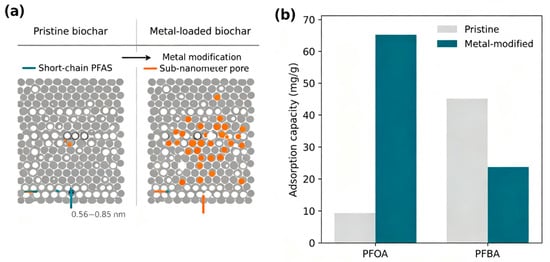
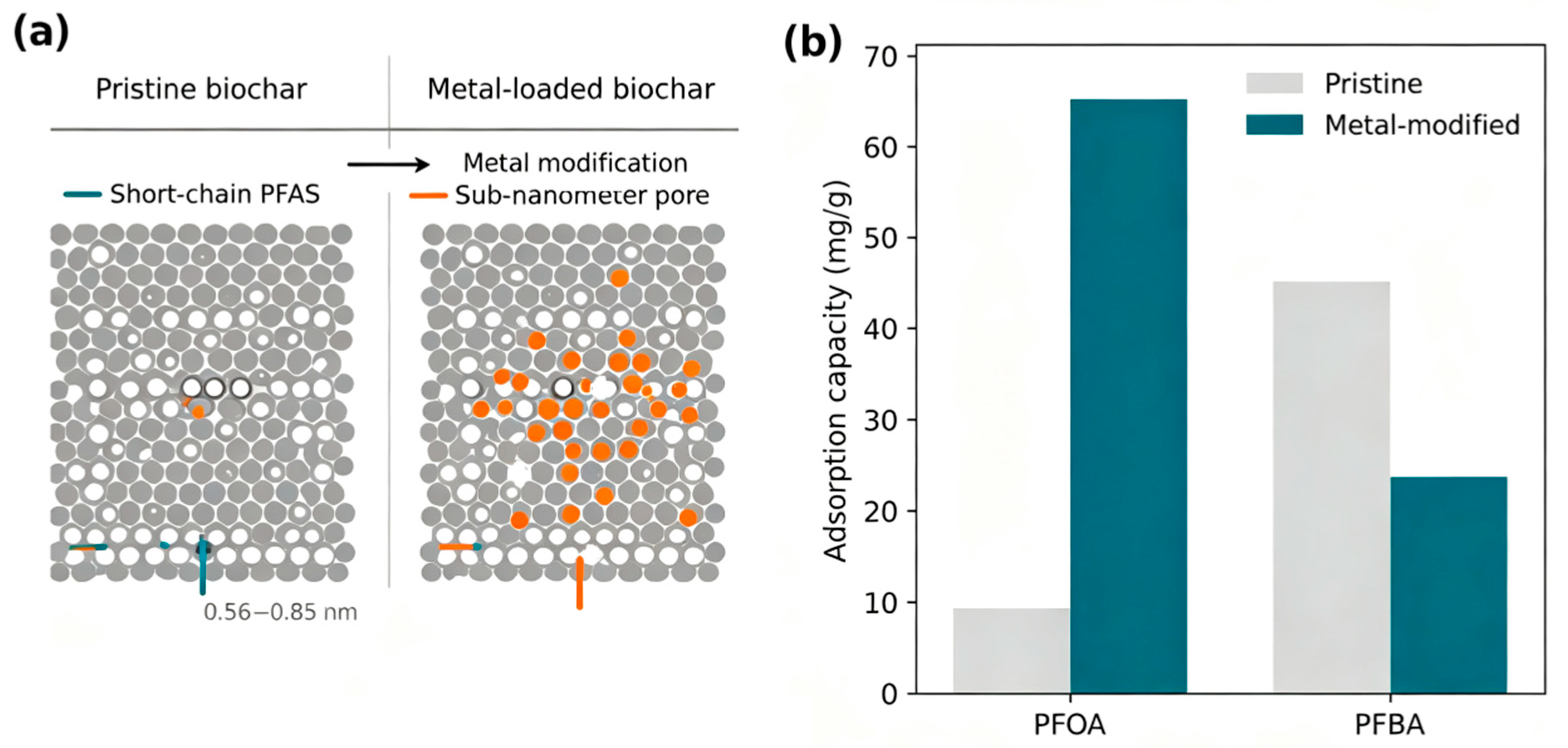
Based on the synergistic mechanism of sub-nanopore surface alkalinity, modification for short-chain PFAS should not aim solely at maximizing any single parameter but requires a careful balance between preserving sub-nanopore structure and introducing positively charged alkaline sites [19,27,28,49,50]. Metal-based modification is currently the most popular approach [36,37,38,39,51]. For example, FeCl3-activated cow dung biochar (Fe@MBC) increased PFOA adsorption capacity, attributed to multiple effects including inner-sphere complexation, hydrophobic interactions, and chemical bonding [48,51]. However, processes such as metal salt impregnation and high-temperature loading often lead to metal oxide crystallites blocking sub-nanopores (Figure 3) [19,36,38,39]. While long-chain PFAS mainly rely on mesopores and outer surface sites, making sub-pore loss less critical, short-chain PFAS depend heavily on sub-nanopore confinement [27,28,42,43]. Once sub-nanopores are blocked by metal particles, even an increase in surface positive charge sites may result in reduced overall adsorption performance for short-chain PFAS [19,36,37]. Most current modification studies report only performance against long-chain PFAS, lacking comparative data on short-chain PFAS [19,36,37,49].
Figure 3.
Trade-off between metal loading-induced disruption of sub-nanometer pores in biochar and short-chain PFAS adsorption. (a) Schematic comparison of pristine biochar (left) and metal-loaded biochar (right). Pristine biochar retains intact sub-nanometer pores (0.56–0.85 nm) that allow short-chain PFAS to enter and be captured. Metal modification deposits metal oxide nanoparticles that partially block these pores; despite increased surface positive charges, short-chain PFAS cannot access the blocked pores [19,27,28]. (b) Adsorption capacities of pristine and metal-modified biochar for long-chain PFOA and short-chain PFBA. The values are conceptually reconstructed from published studies and are intended to illustrate the general trend rather than to represent a single experimental dataset. The original studies used different biochar feedstocks, pyrolysis temperatures, metal loadings (e.g., Fe3O4 or FeCl3), adsorbent doses, initial PFAS concentrations, solution pH, and contact times. Because these experimental conditions were not identical, the comparison should be regarded as semi-quantitative [26,27,28,36].
Finely grinding biochar particles does not improve, or may even reduce, short-chain PFAS adsorption [45,46]. Modified biochars with high pHpzc but poor sub-nanopore development still exhibit low adsorption capacity toward short-chain PFAS [19,27,52,53]. These observations suggest that isolated optimization of surface charge or porosity may not be sufficient for short-chain PFAS removal [19,27,28]. Future material evaluation systems could establish a three-dimensional correlation among pore structure, surface chemistry, and PFAS chain-length selectivity, rather than simply reporting a single adsorption capacity value [49,50].
4. Integrated Adsorption-Degradation Regeneration
4.1. Competitive Displacement in Coexisting Matrices
In mixed PFAS systems, long-chain PFAS generally exhibit stronger hydrophobicity and higher affinity for biochar surfaces, and may therefore occupy adsorption sites preferentially, displacing previously adsorbed short-chain PFAS back into the aqueous phase [31,54]. However, the magnitude of competitive displacement is highly dependent on matrix conditions. Reported decreases in total PFAS removal efficiency in mixed systems range from 32% to 58%, but these values were obtained under different experimental conditions, including variations in PFAS composition (e.g., PFBA, PFBS, PFHxA, PFHxS, PFOA, and PFOS), initial concentration ratios (often from 1:1 to 1:10 for short-chain:long-chain PFAS), adsorbent type and dose (e.g., pristine biochar, activated carbon, or modified biochar at 0.1–1.0 g/L), solution pH (typically 6–8), ionic strength, and the presence of dissolved organic matter (DOM) and inorganic anions [31,54]. Because competitive effects are strongly matrix-dependent, the reported 32–58% reduction should be interpreted as a general range rather than a universal value. In particular, DOM can block pore entrances and compete for hydrophobic sites, while divalent cations may bridge anionic PFAS and negatively charged biochar surfaces, partially offsetting electrostatic repulsion. Therefore, future studies should report the full matrix composition, concentration ratios, and adsorbent characteristics when quantifying competitive displacement.
Traditional chemical regeneration methods use organic solvents or alkaline solutions to desorb adsorbed contaminants [55,56]. A study conducted regeneration experiments on Fe@MBC using a 0.1% NH4OH methanol system, which maintained nearly unchanged adsorption capacity after four cycles [55]. In contrast, regeneration with 0.1 M NaOH aqueous solution showed an initial efficiency of 83% but dropped sharply to 55% by the fourth cycle [55]. However, this regeneration system was specifically developed for long-chain PFAS such as PFOA [55,56]. Short-chain PFAS due to their weaker binding affinity, are more easily desorbed under organic solvent conditions [18,55]. Yet, desorption merely results in phase transfer of the pollutants without destruction, generating high-concentration PFAS wastewater and creating secondary disposal challenges [55,56,57]. The passive adsorption model of simple adsorption, desorption, and reuse is therefore poorly suited for engineering applications involving short-chain PFAS [55,56,57].
4.2. Thermal Regeneration
Thermal regeneration is a well-established pathway for regenerating carbon-based adsorbents, and it continues to offer new possibilities for PFAS treatment. It is no longer viewed only as a process for desorbing pollutants and restoring pore structures; it may also contribute to the thermal degradation of captured PFAS. Under a nitrogen atmosphere at around 900 °C, parent PFAS molecules can undergo thermal decomposition [57,58]. However, the disappearance of parent PFAS should not be equated with complete mineralization. Evidence for complete mineralization requires fluoride mass balance, quantification of fluorinated gas-phase products, and confirmation that residual short-chain PFAS and volatile organofluorine compounds (VOFs) have been adequately controlled. In addition, after three cycles of adsorption and thermal regeneration, biochar has been reported to show enhanced rather than diminished PFAS adsorption capacity [57,58]. This has been attributed to the reconstruction of micropore and sub-nanopore structures and the renewal of active adsorption sites [57,58]. Nevertheless, this approach also carries potential risks: improper temperature control may generate VOFs and secondary short-chain PFAS byproducts, making integrated exhaust gas treatment necessary [57,58]. The thermal process may also alter the physicochemical properties of the biochar itself [57,58].
These observations point to a possible closed-loop strategy [57,58]. In this concept, biochar first uses sub-nanopores and basic surface sites to enrich short-chain PFAS from aqueous environments [27,28]. After adsorption saturation, high-temperature thermal regeneration is applied, potentially degrading the captured PFAS while simultaneously restructuring fine pores and regenerating sub-nanopore capture sites, thereby enabling material reuse [57,58]. Integrating thermal regeneration with thermal degradation shifts the focus away from indefinite, stable adsorption of short-chain PFAS under ambient conditions, and toward staged enrichment followed by centralized thermal treatment. This may help overcome the weak binding affinity and facile displacement or desorption that are often associated with short-chain PFAS [55,56]. At the same time, the practical feasibility of this strategy will depend on energy consumption, reactor design, off-gas treatment, and the long-term stability of the regenerated biochar.
4.3. Catalytic Biochar for in Situ Adsorption and Degradation Integration
Further advancement lies in endowing biochar with intrinsic catalytic activity, eliminating the need for offline thermal regeneration and enabling in situ integration of adsorption, enrichment, and catalytic degradation at ambient temperatures [55,56]. This approach directly mineralizes short-chain PFAS, achieving pollutant destruction rather than mere phase transfer [56]. This concept aligns well with research directions in advanced oxidation/reduction technologies using carbon-based materials [55,56]. For instance, curcumin-mediated synthesis of Fe3C/N-doped three-dimensional magnetic biochar enables PFAS degradation through a pathway involving cleavage of long-chain PFAS into short-chain intermediates, which are then further mineralized and defluorinated, achieving a degradation efficiency of 83% [55,56]. Coupling biochar with advanced reduction processes can simultaneously achieve PFAS adsorption and destructive degradation [55,56]. Nevertheless, most current studies on biochar-based catalytic systems primarily target long-chain PFAS [52]. Short-chain PFAS exhibit greater chemical inertness and pose higher challenges for ring-opening and defluorination [55,56]. Furthermore, introducing catalytic components such as metals or nitrogen doping often damages sub-nanopores [19,52]. Thus, preserving the 0.56–0.85 nm sub-nanopore capture domain while incorporating catalytic active sites remains a critical gap in developing integrated adsorption-degradation materials for short-chain PFAS [19,52].
Although integrated adsorption–degradation is a promising direction, its practical feasibility must be evaluated beyond adsorption capacity alone. Key factors include: (i) regeneration energy consumption, especially for thermal regeneration at high temperatures; (ii) catalyst stability and deactivation during repeated adsorption–degradation cycles; (iii) secondary emissions, such as volatile fluorinated byproducts, fluoride-containing wastewater, or spent catalyst residues; and (iv) overall treatment cost, including material synthesis, regeneration, catalyst replacement, and waste disposal. A fair comparison with established technologies such as activated carbon adsorption, ion exchange, and membrane separation should therefore include energy demand, chemical consumption, greenhouse gas emissions, and long-term operational stability. Pilot-scale studies are needed to quantify these parameters under realistic water matrices.
5. Future Research
For short-chain PFAS remediation using biochar, five research directions merit particular attention [18,19,27,28,50]. First, a theoretical framework for sub-nanopore capture of short-chain PFAS should be further developed, with systematic investigation of the possible synergistic mechanisms between pore size distribution in the 0.56–0.85 nm range and alkaline surface chemistry on pore walls [27,28,49]. CO2 adsorption techniques can be employed for more precise characterization of sub-nanopores [27,28]. Molecular dynamics simulations may help reveal adsorption potential wells, molecular arrangements, and retention mechanisms of short-chain PFAS within sub-nanopores [27,28]. It will be important to differentiate the effects of sub-nanopores on short-chain versus long-chain PFAS, and to quantify the relationship between sub-nanopore volume fraction and short-chain PFAS adsorption capacity [27,28].
Second, the actual effectiveness of various modification strategies for short-chain PFAS should be re-evaluated [19,36,37]. Most performance data from existing modification studies are based on long-chain PFAS such as PFOS and PFOA, so parallel control experiments with short-chain PFAS are needed [19,36,37]. Particular attention should be paid to quantifying the extent to which modification techniques such as metal loading and acid–base activation damage sub-nanoporous structures, to clarifying the trade-off between enhanced surface charge and sub-nanopore loss, and to identifying modification processes that can increase surface alkalinity while preserving sub-nanopores as much as possible [19,27,28,36,37]. This approach challenges the conventional assumption that superior performance for long-chain PFAS guarantees satisfactory performance for short-chain PFAS [19,27,28,49].
Third, integrated adsorption–degradation biochar-based functional materials should be developed [50,52]. Biochar composites could be designed to combine strong sub-nanopore enrichment capacity with catalytic degradation activity [50,52]. Catalytically active components such as Fe, Mn, and N doping may be introduced strategically while avoiding blockage or destruction of sub-nanopores [52]. PFAS degradation pathways and pore structure evolution during thermal regeneration should be systematically investigated, the risk of volatile organofluorine byproducts in exhaust gases should be evaluated, and coupling advanced oxidation or reduction processes with biochar should be explored to achieve in situ defluorination and, where supported by evidence, mineralization of short-chain PFAS, thereby mitigating secondary pollution risks associated with adsorption-phase transfer [58].
Fourth, a three-dimensional evaluation framework for porous materials based on pore structure, surface chemistry, and PFAS chain-length selectivity should be established [49,50]. Material evaluation should not rely solely on single adsorption capacity metrics [49,50]. Instead, it should comprehensively characterize fine pore structures, including sub-nanopores, and surface chemical properties, while distinguishing adsorption selectivity toward long-chain and short-chain PFAS [27,28,49,50]. Standardized testing methods should be developed to enable cross-study comparisons and to prevent misjudgments caused by using only long-chain PFAS for material screening [19,49,50].
Fifth, field-scale validation for short-chain PFAS remediation should be advanced [17,21]. Most current research remains limited to laboratory batch and column simulation tests [17,21]. Under real-world conditions, short-chain PFAS face interference from DOM, competing ions, pH fluctuations, and aging effects [21,54]. Pilot-scale and field demonstration trials are needed to verify whether laboratory performance can be replicated under actual environmental conditions, to assess engineering costs of integrated adsorption–degradation processes, and to evaluate long-term material stability [21,54,57]. Attention should also be paid to sub-nanopore collapse and loss of surface basic sites during biochar aging, so that the risk of long-term decline in remediation efficiency can be assessed [21,54].
6. Conclusions
The proposed role of sub-nanopores and surface basic sites is consistent with a growing body of evidence, but direct comparative studies on short-chain and long-chain PFAS remain limited. Future experimental work should test, refine, or challenge this framework under well-controlled conditions.
- Short-chain PFAS removal by biochar should be treated as an independent research topic rather than a secondary issue of long-chain PFAS research.
- Classical mechanisms such as hydrophobic interactions, electrostatic attraction, and conventional micropore filling cannot fully explain short-chain PFAS adsorption onto biochar. Both specific surface area and pore size distribution are important for short-chain PFAS adsorption, but pore size distribution may play a more decisive role in determining accessibility and retention.
- Current evidence suggests that sub-nanopore confinement, combined with alkaline surface sites on pore walls, may be a promising framework for short-chain PFAS capture; however, relatively few studies have directly separated short-chain and long-chain PFAS, and this mechanism requires further experimental validation.
- Metal-loading modification can increase surface positive charge but may simultaneously block or destroy sub-nanopores, leading to a trade-off that is particularly detrimental to short-chain PFAS adsorption.
- Unilateral optimization of a single parameter, such as surface charge, specific surface area, or hydrophobicity, is likely insufficient for efficient short-chain PFAS removal.
- Passive adsorption alone may not meet practical engineering requirements because short-chain PFAS have weak binding energy and are susceptible to competitive displacement by long-chain PFAS, DOM, and coexisting ions.
- Future breakthroughs may depend on the precise, synergistic control of sub-nanometer pores and surface basic sites, and on the development of integrated adsorption–degradation closed-loop systems.
- Claims of complete destruction, mineralization, or defluorination should be supported by fluoride mass balance and product-analysis evidence.
- Pilot-scale and field demonstration trials are urgently needed to verify laboratory performance, evaluate engineering costs, and assess the long-term stability of biochar materials under realistic environmental conditions.
Author Contributions
Conceptualization, Q.L.; writing—original draft preparation, Q.L.; investigation, Q.L. and X.Q.; writing—review and editing, Q.L. and X.Q.; supervision, Q.L. and X.Q. All authors have read and agreed to the published version of the manuscript.
Funding
This research received no external funding.
Data Availability Statement
Data is included in the main text.
Conflicts of Interest
The authors declare no conflicts of interest.
References
- Liu, Q.; Schauer, J.J. Estimation of Aqueous Solubility and Hygroscopicity in Poly- and Perfluoroalkyl Substances with COSMOtherm. Environ. Pollut. 2026, 400, 128284. [Google Scholar] [CrossRef] [Scilit]
- Liu, Q.; Schauer, J.J. The Unintended Consequences of the Transition to Short-Chain Per- and Polyfluoroalkyl Substance Chemicals. Environ. Toxicol. Chem. 2026, 45, vgag196. [Google Scholar] [CrossRef] [Scilit] [PubMed]
- Krafft, M.P.; Riess, J.G. Selected Physicochemical Aspects of Poly- and Perfluoroalkylated Substances Relevant to Performance, Environment and Sustainability—Part One. Chemosphere 2015, 129, 4–19. [Google Scholar] [CrossRef] [Scilit] [PubMed]
- Nakayama, S.F.; Yoshikane, M.; Onoda, Y.; Nishihama, Y.; Iwai-Shimada, M.; Takagi, M.; Kobayashi, Y.; Isobe, T. Worldwide Trends in Tracing Poly- and Perfluoroalkyl Substances (PFAS) in the Environment. TrAC Trends Anal. Chem. 2019, 121, 115410. [Google Scholar] [CrossRef] [Scilit]
- Hu, X.C.; Andrews, D.Q.; Lindstrom, A.B.; Bruton, T.A.; Schaider, L.A.; Grandjean, P.; Lohmann, R.; Carignan, C.C.; Blum, A.; Balan, S.A.; et al. Detection of Poly- and Perfluoroalkyl Substances (PFASs) in U.S. Drinking Water Linked to Industrial Sites, Military Fire Training Areas, and Wastewater Treatment Plants. Environ. Sci. Technol. Lett. 2016, 3, 344–350. [Google Scholar] [CrossRef] [Scilit] [PubMed]
- U.S. EPA. Per- and Polyfluoroalkyl Substances (PFAS) Final PFAS National Primary Drinking Water Regulation. 2024. Available online: https://www.epa.gov/sdwa/and-polyfluoroalkyl-substances-pfas (accessed on 1 January 2026).
- US EPA. Drinking Water Health Advisories for PFOA and PFOS; 800-F-16-003; US EPA: Washington, DC, USA, 2016. [Google Scholar]
- Zhang, D.Q.; Zhang, W.L.; Liang, Y.N. Adsorption of Perfluoroalkyl and Polyfluoroalkyl Substances (PFASs) from Aqueous Solution—A Review. Sci. Total Environ. 2019, 694, 133606, Correction in Sci. Total Environ. 2020, 748, 142354. [Google Scholar] [CrossRef] [Scilit] [PubMed]
- Du, Z.; Deng, S.; Bei, Y.; Huang, Q.; Wang, B.; Huang, J.; Yu, G. Adsorption Behavior and Mechanism of Perfluorinated Compounds on Various Adsorbents—A Review. J. Hazard. Mater. 2014, 274, 443–454. [Google Scholar] [CrossRef] [Scilit] [PubMed]
- Karbassiayzadi, E.; Kasula, M.; Modak, S.; Pala, J.; Kalantari, M.; Altaee, A.; Esfahani, M.R.; Razmjou, A. A Juxtaposed Review on Adsorptive Removal of PFAS by Metal-Organic Frameworks (MOFs) with Carbon-Based Materials, Ion Exchange Resins, and Polymer Adsorbents. Chemosphere 2023, 311, 136933. [Google Scholar] [CrossRef] [Scilit] [PubMed]
- Deng, S.; Yu, Q.; Huang, J.; Yu, G. Removal of Perfluorooctane Sulfonate from Wastewater by Anion Exchange Resins: Effects of Resin Properties and Solution Chemistry. Water Res. 2010, 44, 5188–5195. [Google Scholar] [CrossRef] [Scilit]
- Liu, Y.-L.; Sun, M. Ion Exchange Removal and Resin Regeneration to Treat Per- and Polyfluoroalkyl Ether Acids and Other Emerging PFAS in Drinking Water. Water Res. 2021, 207, 117781. [Google Scholar] [CrossRef] [Scilit] [PubMed]
- Alhashimi, H.A.; Aktas, C.B. Life Cycle Environmental and Economic Performance of Biochar Compared with Activated Carbon: A Meta-Analysis. Resour. Conserv. Recycl. 2017, 118, 13–26. [Google Scholar] [CrossRef] [Scilit]
- Ahmad, M.; Rajapaksha, A.U.; Lim, J.E.; Zhang, M.; Bolan, N.; Mohan, D.; Vithanage, M.; Lee, S.S.; Ok, Y.S. Biochar as a Sorbent for Contaminant Management in Soil and Water: A Review. Chemosphere 2014, 99, 19–33. [Google Scholar] [CrossRef] [Scilit] [PubMed]
- Lehmann, J.; Cowie, A.; Masiello, C.A.; Kammann, C.; Woolf, D.; Amonette, J.E.; Cayuela, M.L.; Camps-Arbestain, M.; Whitman, T. Biochar in Climate Change Mitigation. Nat. Geosci. 2021, 14, 883–892. [Google Scholar] [CrossRef] [Scilit]
- Dalahmeh, S.S.; Alziq, N.; Ahrens, L. Potential of Biochar Filters for Onsite Wastewater Treatment: Effects of Active and Inactive Biofilms on Adsorption of Per- and Polyfluoroalkyl Substances in Laboratory Column Experiments. Environ. Pollut. 2019, 247, 155–164. [Google Scholar] [CrossRef] [Scilit] [PubMed]
- Liu, N.; Wu, C.; Lyu, G.; Li, M. Efficient Adsorptive Removal of Short-Chain Perfluoroalkyl Acids Using Reed Straw-Derived Biochar (RESCA). Sci. Total Environ. 2021, 798, 149191. [Google Scholar] [CrossRef] [Scilit] [PubMed]
- Liu, N.; Li, Y.; Zhang, M.; Che, N.; Song, X.; Liu, Y.; Li, C. Efficient Adsorption of Short-Chain Perfluoroalkyl Substances by Pristine and Fe/Cu-Loaded Reed Straw Biochars. Sci. Total Environ. 2024, 946, 174223. [Google Scholar] [CrossRef] [Scilit] [PubMed]
- Hoisæter, Å.; Pfaff, A.; Breedveld, G.D. Leaching and Transport of PFAS from Aqueous Film-Forming Foam (AFFF) in the Unsaturated Soil at a Firefighting Training Facility under Cold Climatic Conditions. J. Contam. Hydrol. 2019, 222, 112–122. [Google Scholar] [CrossRef] [Scilit]
- Hoisæter, Å.; Arp, H.P.H.; Slinde, G.; Knutsen, H.; Hale, S.E.; Breedveld, G.D.; Hansen, M.C. Excavated vs Novel in Situ Soil Washing as a Remediation Strategy for Sandy Soils Impacted with Per- and Polyfluoroalkyl Substances from Aqueous Film Forming Foams. Sci. Total Environ. 2021, 794, 148763. [Google Scholar] [CrossRef] [Scilit] [PubMed]
- Zhi, Y.; Liu, J. Sorption and Desorption of Anionic, Cationic and Zwitterionic Polyfluoroalkyl Substances by Soil Organic Matter and Pyrogenic Carbonaceous Materials. Chem. Eng. J. 2018, 346, 682–691. [Google Scholar] [CrossRef] [Scilit]
- Zhang, D.; He, Q.; Wang, M.; Zhang, W.; Liang, Y. Sorption of Perfluoroalkylated Substances (PFASs) onto Granular Activated Carbon and Biochar. Environ. Technol. 2021, 42, 1798–1809. [Google Scholar] [CrossRef] [Scilit] [PubMed]
- Kupryianchyk, D.; Hale, S.E.; Breedveld, G.D.; Cornelissen, G. Treatment of Sites Contaminated with Perfluorinated Compounds Using Biochar Amendment. Chemosphere 2016, 142, 35–40. [Google Scholar] [CrossRef] [Scilit] [PubMed]
- Hale, S.E.; Arp, H.P.H.; Kupryianchyk, D.; Cornelissen, G. A Synthesis of Parameters Related to the Binding of Neutral Organic Compounds to Charcoal. Chemosphere 2016, 144, 65–74. [Google Scholar] [CrossRef] [Scilit] [PubMed]
- Kabiri, S.; Navarro, D.A.; Hamad, S.A.; Grimison, C.; Higgins, C.P.; Mueller, J.F.; Kookana, R.S.; McLaughlin, M.J. Physical and Chemical Properties of Carbon-Based Sorbents That Affect the Removal of Per- and Polyfluoroalkyl Substances from Solution and Soil. Sci. Total Environ. 2023, 875, 162653. [Google Scholar] [CrossRef] [Scilit] [PubMed]
- Lenka, S.P.; Kah, M.; Chen, J.-L.-Y.; Tiban-Arrango, B.A.; Padhye, L.P. Adsorption Mechanisms of Short-Chain and Ultrashort-Chain PFAS on Anion Exchange Resins and Activated Carbon. Environ. Sci. Water Res. Technol. 2024, 10, 1280–1293. [Google Scholar] [CrossRef] [Scilit]
- Wang, Z.; Alinezhad, A.; Nason, S.; Xiao, F.; Pignatello, J.J. Enhancement of Per- and Polyfluoroalkyl Substances Removal from Water by Pyrogenic Carbons: Tailoring Carbon Surface Chemistry and Pore Properties. Water Res. 2023, 229, 119467. [Google Scholar] [CrossRef] [Scilit]
- Keiluweit, M.; Nico, P.S.; Johnson, M.G.; Kleber, M. Dynamic Molecular Structure of Plant Biomass-Derived Black Carbon (Biochar). Environ. Sci. Technol. 2010, 44, 1247–1253. [Google Scholar] [CrossRef] [Scilit] [PubMed]
- Janu, R.; Mrlik, V.; Ribitsch, D.; Hofman, J.; Sedláček, P.; Bielská, L.; Soja, G. Biochar Surface Functional Groups as Affected by Biomass Feedstock, Biochar Composition and Pyrolysis Temperature. Carbon Resour. Convers. 2021, 4, 36–46. [Google Scholar] [CrossRef] [Scilit]
- Singh, M.; Hakimabadi, S.G.; Van Geel, P.J.; Carey, G.R.; Pham, A.-L.-T. Modified Competitive Langmuir Model for Prediction of Multispecies PFAS Competitive Adsorption Equilibria on Colloidal Activated Carbon. Sep. Purif. Technol. 2024, 345, 127368. [Google Scholar] [CrossRef] [Scilit]
- Tomczyk, A.; Sokolowska, P.; Boguta, P. Biochar Physicochemical Properties: Pyrolysis Temperature and Feedstock Kind Effects. Rev. Environ. Sci. Bio/Technol. 2020, 19, 191–215. [Google Scholar] [CrossRef] [Scilit]
- Wiersma, W.; van der Ploeg, M.; Sauren, L.J.M.; Stoof, C.R. No Effect of Pyrolysis Temperature and Feedstock Type on Hydraulic Properties of Biochar and Amended Sandy Soil. Geoderma 2020, 364, 114209. [Google Scholar] [CrossRef] [Scilit]
- Christensen, C.S.Q.; Bai, L.; Wei, Z. Deciphering Physicochemical Principles Guiding PFAS Adsorption and Thermal Degradation on Regenerable Waste-Derived Biochar. Environ. Sci. Technol. 2026, 60, 8224–8237. [Google Scholar] [CrossRef] [Scilit]
- Song, Z.; He, J.; Kouzekhannan, S.M.T.; Oh, T.S.; Olshansky, Y.; Duin, E.C.; Carroll, K.C.; Wang, D. Enhanced Sorption and Destruction of PFAS by Biochar-Enabled Advanced Reduction Process. Chemosphere 2024, 363, 142760. [Google Scholar] [CrossRef] [Scilit]
- Rodrigo, P.M.; Navarathna, C.; Pham, M.T.H.; McClain, S.J.; Stokes, S.; Zhang, X.; Perez, F.; Gunatilake, S.R.; Karunanayake, A.G.; Anderson, R.; et al. Batch and Fixed Bed Sorption of Low to Moderate Concentrations of Aqueous Per- and Polyfluoroalkyl Substances (PFAS) on Douglas Fir Biochar and Its Fe3O4 Hybrids. Chemosphere 2022, 308, 136155. [Google Scholar] [CrossRef] [Scilit] [PubMed]
- Zhou, Y.; Xu, M.; Huang, D.; Xu, L.; Yu, M.; Zhu, Y.; Niu, J. Modulating Hierarchically Microporous Biochar via Molten Alkali Treatment for Efficient Adsorption Removal of Perfluorinated Carboxylic Acids from Wastewater. Sci. Total Environ. 2021, 757, 143719. [Google Scholar] [CrossRef] [Scilit] [PubMed]
- Hassan, M.; Liu, Y.; Naidu, R.; Du, J.; Qi, F. Adsorption of Perfluorooctane Sulfonate (PFOS) onto Metal Oxides Modified Biochar. Environ. Technol. Innov. 2020, 19, 100816. [Google Scholar] [CrossRef] [Scilit]
- Hassan, M.; Du, J.; Liu, Y.; Naidu, R.; Zhang, J.; Ahsan, M.A.; Qi, F. Magnetic Biochar for Removal of Perfluorooctane Sulfonate (PFOS): Interfacial Interaction and Adsorption Mechanism. Environ. Technol. Innov. 2022, 28, 102593. [Google Scholar] [CrossRef] [Scilit]
- Ahmed, M.B.; Zhou, J.L.; Ngo, H.H.; Johir, M.A.H.; Sun, L.; Asadullah, M.; Belhaj, D. Sorption of Hydrophobic Organic Contaminants on Functionalized Biochar: Protagonist Role of π-Electron-Donor-Acceptor Interactions and Hydrogen Bonds. J. Hazard. Mater. 2018, 360, 270–278. [Google Scholar] [CrossRef] [Scilit] [PubMed]
- Wang, Z.; Liu, K.; Xie, L.; Zhu, H.; Ji, S.; Shu, X. Effects of Residence Time on Characteristics of Biochars Prepared via Co-Pyrolysis of Sewage Sludge and Cotton Stalks. J. Anal. Appl. Pyrolysis 2019, 142, 104659. [Google Scholar] [CrossRef] [Scilit]
- Krahn, K.M.; Cornelissen, G.; Castro, G.; Arp, H.P.H.; Asimakopoulos, A.G.; Wolf, R.; Holmstad, R.; Zimmerman, A.R.; Sormo, E. Sewage Sludge Biochars as Effective PFAS-Sorbents. J. Hazard. Mater. 2023, 445, 130449. [Google Scholar] [CrossRef] [Scilit] [PubMed]
- Skjennum, K.A.; Krahn, K.M.; Sormo, E.; Wolf, R.; Goranov, A.I.; Hatcher, P.G.; Hartnik, T.; Arp, H.P.H.; Zimmerman, A.R.; Zhang, Y.; et al. The Impact of Biochar’s Physicochemical Properties on Sorption of Perfluorooctanoic Acid (PFOA). Sci. Total Environ. 2024, 955, 177191. [Google Scholar] [CrossRef] [Scilit] [PubMed]
- Meservey, A.; Kilaots, I.; Bryant, J.D.; Gray, C.; Wahl, J.; Manz, K.E.; Pennell, K.D. Adsorption of Per- and Polyfluoroalkyl Substances on Biochar Derived from Municipal Sewage Sludge. Chemosphere 2024, 365, 143331. [Google Scholar] [CrossRef] [Scilit] [PubMed]
- Goranov, A.I.; Sormo, E.; Hagemann, N.; Cornelissen, G.; Zimmerman, A.R.; Hatcher, P.G. Using the Benzenepolycarboxylic Acid (BPCA) Method to Assess Activated Biochars and Their PFAS Sorption Abilities. Chemosphere 2024, 355, 141750. [Google Scholar] [CrossRef] [Scilit] [PubMed]
- Fabregat-Palau, J.; Vidal, M.; Rigol, A. Examining Sorption of Perfluoroalkyl Substances (PFAS) in Biochars and Other Carbon-Rich Materials. Chemosphere 2022, 302, 134733. [Google Scholar] [CrossRef] [Scilit] [PubMed]
- Xu, X.; Zhao, Y.; Sima, J.; Zhao, L.; Mašek, O.; Cao, X. Indispensable Role of Biochar-Inherent Mineral Constituents in Its Environmental Applications: A Review. Bioresour. Technol. 2017, 241, 887–899. [Google Scholar] [CrossRef] [Scilit] [PubMed]
- Guo, B.; Kan, E.; Zeng, S. Enhanced Adsorption of Aqueous Perfluorooctanoic Acid on Iron-Functionalized Biochar: Elucidating the Roles of Inner-Sphere Complexation. Sci. Total Environ. 2024, 955, 176926. [Google Scholar] [CrossRef] [Scilit] [PubMed]
- He, Y.; Cheng, X.; Gunjal, S.J.; Zhang, C. Advancing PFAS Sorbent Design: Mechanisms, Challenges, and Perspectives. ACS Mater. Au 2023, 4, 108–114. [Google Scholar] [CrossRef] [Scilit] [PubMed]
- Kumar, A.; Shaikh, W.A.; Maqsood, H.M.; Parikh, S.J.; Biswas, J.K. Harnessing Sustainable Biochar-Based Composites for Effective PFAS Removal from Wastewater. Curr. Opin. Environ. Sci. Health 2025, 43, 100594. [Google Scholar] [CrossRef] [Scilit]
- Li, D.-C.; Ding, J.-W.; Qian, T.-T.; Zhang, S.; Jiang, H. Preparation of High Adsorption Performance and Stable Biochar Granules by FeCl3-Catalyzed Fast Pyrolysis. RSC Adv. 2016, 6, 12226–12234. [Google Scholar] [CrossRef] [Scilit]
- Liu, Z.; Zhang, P.; Wei, Z.; Xiao, F.; Liu, S.; Guo, H.; Qu, C.; Xiong, J.; Sun, H.; Tan, W. Porous Fe-Doped Graphitized Biochar: An Innovative Approach for Co-Removing Per-/Polyfluoroalkyl Substances with Different Chain Lengths from Natural Waters and Wastewater. Chem. Eng. J. 2023, 476, 146888. [Google Scholar] [CrossRef] [Scilit]
- Saawarn, B.; Mahanty, B.; Hait, S. Adsorptive Removal of Perfluorooctanoic Acid from Aqueous Matrices Using Peanut Husk-Derived Magnetic Biochar: Statistical and Artificial Intelligence Approaches, Kinetics, Isotherm, and Thermodynamics. Chemosphere 2024, 360, 142397. [Google Scholar] [CrossRef] [Scilit] [PubMed]
- Yu, J.; Lv, L.; Lan, P.; Zhang, S.; Pan, B.; Zhang, W. Effect of Effluent Organic Matter on the Adsorption of Perfluorinated Compounds onto Activated Carbon. J. Hazard. Mater. 2012, 225–226, 99–106. [Google Scholar] [CrossRef] [Scilit] [PubMed]
- Deng, J.; Han, J.; Hou, C.; Zhang, Y.; Fang, Y.; Du, W.; Li, M.; Yuan, Y.; Tang, C.; Hu, X. Efficient Removal of Per- and Polyfluoroalkyl Substances from Biochar Composites: Cyclic Adsorption and Spent Regenerant Degradation. Chemosphere 2023, 341, 140051. [Google Scholar] [CrossRef] [Scilit] [PubMed]
- Vakili, M.; Cagnetta, G.; Deng, S.; Wang, W.; Gholami, Z.; Gholami, F.; Dastyar, W.; Mojiri, A.; Blaney, L. Regeneration of Exhausted Adsorbents after PFAS Adsorption: A Critical Review. J. Hazard. Mater. 2024, 471, 134429. [Google Scholar] [CrossRef] [Scilit] [PubMed]
- Jafarinejad, S.; He, J.; Wang, D. Regeneration of Biochars (Pristine and Modified/Engineered) and Economic Analysis of Their Use in the Removal of Per- and Polyfluoroalkyl Substances (PFAS) from Water/Wastewater. Front. Environ. Sci. Eng. 2025, 19, 20, Correction in Front. Environ. Sci. Eng. 2025, 19, 57. [Google Scholar] [CrossRef] [Scilit]
- Xiao, F.; Sasi, P.C.; Yao, B.; Kubátová, A.; Golovko, S.A.; Golovko, M.Y.; Soli, D. Thermal Stability and Decomposition of Perfluoroalkyl Substances on Spent Granular Activated Carbon. Environ. Sci. Technol. Lett. 2020, 7, 343–350. [Google Scholar] [CrossRef] [Scilit]
- Watanabe, N.; Takata, M.; Takemine, S.; Yamamoto, K. Thermal Mineralization Behavior of PFOA, PFHxA, and PFOS during Reactivation of Granular Activated Carbon (GAC) in Nitrogen Atmosphere. Environ. Sci. Pollut. Res. 2018, 25, 7200–7205. [Google Scholar] [CrossRef] [Scilit] [PubMed]

Disclaimer/Publisher’s Note: The statements, opinions and data contained in all publications are solely those of the individual author(s) and contributor(s) and not of MDPI and/or the editor(s). MDPI and/or the editor(s) disclaim responsibility for any injury to people or property resulting from any ideas, methods, instructions or products referred to in the content. |
© 2026 by the authors. Licensee MDPI, Basel, Switzerland. This article is an open access article distributed under the terms and conditions of the Creative Commons Attribution (CC BY) license.