


Abstract
Nightmares are distressing sleep experiences associated with emotional difficulties, impaired daytime functioning, and reduced sleep quality. Although imagery rescripting (IR) has demonstrated effectiveness in reducing nightmare-related distress among adults, evidence regarding its applicability in children remains limited, particularly in Japan. IR is thought to operate, at least in part, by enabling individuals to actively modify threatening imagery and thereby enhance a sense of mastery or perceived control over distressing dream experiences. Although developmental factors may influence how children engage with this process, current evidence does not establish that the fundamental mechanism of IR differs substantially between children and adults. This pilot study examined immediate changes in self-reported fear associated with recalled bad dreams following a brief web-based imagery-rescripting procedure in non-clinical Japanese elementary school children and explored children’s rescripting strategies. Participants were thirty-five fourth- and sixth-grade students (aged 9–12 years) recruited from public elementary schools in Japan. Using a web-based procedure, participants recalled a safe image, described a memorable bad dream, rated its fear intensity, rescripted the dream, and then re-rated fear intensity. Among the 23 participants with complete pre- and post-task ratings, self-reported fear was significantly lower after the procedure than before it. Subgroup patterns according to rescripting status and rescripting strategy were examined descriptively. These findings indicate that self-reported fear associated with recalled bad dreams decreased immediately following the procedure. Further research using larger samples and controlled designs is needed to determine the specific contribution of imagery rescripting and the durability and clinical relevance of these changes.
1. Introduction
Nightmares are distressing dream experiences that commonly occur across the lifespan and are influenced by psychophysiological and social factors. Nightmare experiences begin in early childhood, between the ages of 3 and 6, increase during childhood, and peak in late adolescence [1,2]. Recurrent nightmares are associated with impaired sleep quality, emotional dysregulation, anxiety, and reduced daytime functioning. In severe clinical cases and nonclinical population, nightmare distress can also be linked to a higher risk of suicide [3,4].
Current clinical guidelines from the American Academy of Sleep Medicine recommend non-pharmacological interventions as first-line treatments for nightmare disorder in adults, particularly cognitive–behavioral approaches involving imagery modification techniques such as Imagery Rehearsal Therapy (IRT) [5] and Exposure, Relaxation and Rescripting Therapy (ERRT) [6,7]. These approaches share a common therapeutic principle: rescript and modify distressing dream imagery into alternative scenarios with more adaptive or emotionally controllable endings.
IR-based interventions are thought to reduce distress by modifying threatening imagery and increasing a sense of mastery or perceived control over the imagined event. This basic therapeutic rationale has also been applied in pediatric interventions; whether the underlying mechanisms operate differently in children and adults remains insufficiently understood. Developmental differences may instead influence how children generate and express alternative imagery or narratives.
Typical nightmare themes include being chased, attacked, trapped, or threatened with death. In IR-based interventions, individuals are encouraged to consciously rewrite these narratives by escaping, confronting the threat, receiving assistance, or transforming the situation into a safe outcome [8]. Previous studies in adolescents and adults have demonstrated that such interventions can reduce nightmare frequency, nightmare-related distress, and associated sleep problems [5,9].
A systematic review by Gill and colleagues [10] summarized psychosocial treatments for nightmares in both adults and children. The review concluded that substantial evidence supports the effectiveness of cognitive–behavioral interventions, including IRT and exposure-based approaches, in adults, whereas evidence in children remains limited because of the relatively small number of controlled studies. Nevertheless, the review highlighted that direct modification of dream content within the imagery itself through re-scripting appears to be a common active component across effective non-pharmacological nightmare interventions.
One of the earliest randomized controlled trials examining IRT in children was con-ducted by St-Onge, M. et al. [11]. In that study, children aged 9–11 years who experienced frequent nightmares for more than six months were assigned either to an IRT intervention group or to a waiting-list control group. Nightmare frequency significantly decreased in the treatment group, and these effects were maintained at a nine-month follow-up. However, reductions in nightmare-related distress and anxiety were less pronounced, suggesting that emotional distress associated with nightmares may persist even after nightmare frequency decreases.
More recently, Cromer, L. D. M. et al. [12] conducted a randomized controlled trial of cognitive–behavioral therapy for children and adolescents aged 6–17 years with chronic distressing nightmares. Their intervention combined exposure, relaxation, and rescripting therapy (ERRT) with insomnia-focused cognitive–behavioral components, including sleep hygiene and bedtime routine training. The treatment group showed significant re-ductions in nightmare frequency, nightmare distress, and nocturnal awakenings. Importantly, the study demonstrated improvements not only in nightmare occurrence but also in the emotional distress associated with nightmares, suggesting that imagery-based rescripting interventions may play a central role in pediatric nightmare treatment.
These findings indicate that imagery rescripting techniques may be effective not only for trauma-related nightmares but also for idiopathic nightmares and nonclinical bad dreams. Such interventions are particularly important during childhood, a developmental period in which nightmare frequency tends to increase.
In Japan, insufficient sleep among children has become a significant social concern. Compared with other industrialized countries, average sleep duration in Japan is relatively short. OECD data indicate that Japanese individuals aged 15–64 years have an average sleep duration of 7.40 h, among the shortest reported for OECD member countries [13]. While 9 to 11 h of sleep is recommended for elementary school children [14], only 28.1% of middle-grade elementary school students and 15.8% of upper-grade elementary school students meet this requirement, indicating that Japanese elementary school students also suffer from insufficient sleep [15]. Furthermore, Japanese populations often demonstrate reluctance toward pharmacological treatment for sleep-related problems, especially in children. Therefore, the development and dissemination of safe, low-burden, non-pharmacological psychological interventions are particularly important in the Japanese context [16].
Imagery rescripting is a relatively simple and child-applicable intervention that can potentially be delivered through web-based formats. However, empirical studies examining its effects in Japanese children remain scarce. Only case studies concerning adolescent clinical cases have been reported [17,18]. It should be noted that dreams have a hierarchy, and nightmares that pose a clinical problem are those that cause awakenings during sleep [19]. Here, we have decided to examine non-clinical bad dreams.
The present pilot study therefore aimed to examine immediate changes in self-reported fear associated with recalled bad dreams following a brief web-based imagery-rescripting procedure among Japanese elementary school children. In addition, the study explored qualitative patterns of dream rescripting strategies used by children. Given the exploratory nature of the study, we also descriptively examined whether changes in fear varied according to whether children generated an identifiable modification of the dream narrative and the type of rescripting strategy used. In the present study, “bad dreams” were defined as frightening or unpleasant dreams reported by nonclinical children, irrespective of whether they resulted in awakening from sleep. Accordingly, this study focused on fear associated with bad dreams, rather than clinically diagnosed nightmare disorder, and examined the preliminary feasibility of imagery rescripting in a nonclinical child sample.
2. Materials and Methods
2.1. Participants
Participants were thirty-five elementary school students (16 boys, 17 girls, and 2 identifying as other) aged 9–12 years who were enrolled in the fourth and sixth grades at public elementary schools in the Koshinetsu region of Japan. After approval was obtained from school administrators, the research objectives were shared with parents and homeroom teachers, and recruitment was conducted through homeroom teachers. Participation was entirely voluntary, and informed consent procedures were implemented prior to participation.
2.2. Procedure
The study was conducted in school classrooms using Google Forms accessed via individual iPads. Participants completed the web-based procedure individually under the supervision of their homeroom teacher. The procedure consisted of the following five steps:
- Participants first recalled and described an image or scene that made them feel safe, relaxed, or reassured.
- Participants then recalled and described a memorable bad dream that they considered unpleasant but modifiable. As part of the dream description, they freely described events or experiences related to the dream content, as well as the circumstances surrounding the time when the dream occurred.
- Participants rated the level of fear associated with the recalled dream on an 11-point scale ranging from 0 (“not scary at all”) to 10 (“extremely scary”).
- Participants who provided a bad-dream narrative were asked to rewrite or modify the storyline of the recalled dream in any way they wished. All participants who proceeded to this stage received the same imagery rescripting instructions.
- Following the imagery rescripting task, participants again rated the level of fear associated with the dream using the same 11-point scale.
The researchers did not interact with participants face-to-face during the procedure.
The intervention procedure was designed as a brief experimental application of imagery rescripting for nonclinical bad dreams rather than as formal psychotherapy. Based on the studies of Harb et al. [20] and Albanese et al. [21], the descriptions written by children in their Inquiry Reports were classified by two independent raters. The Harb et al. [20] study conducted a content analysis of image rescripts for PTSD-related nightmares and reported that many participants chose to “introduce alternative endings.” Several strategies were also identified, including the addition of positive images, transformation of the threat object, insertion of reminders, and psychological distancing. The three strategy-level categories were treated as mutually exclusive, and each response was assigned to the category that best represented its predominant rescripting strategy.
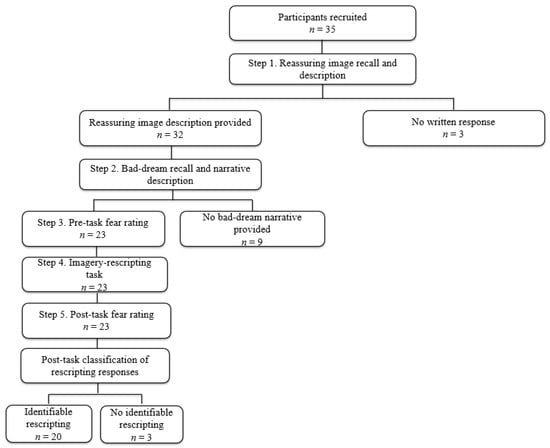
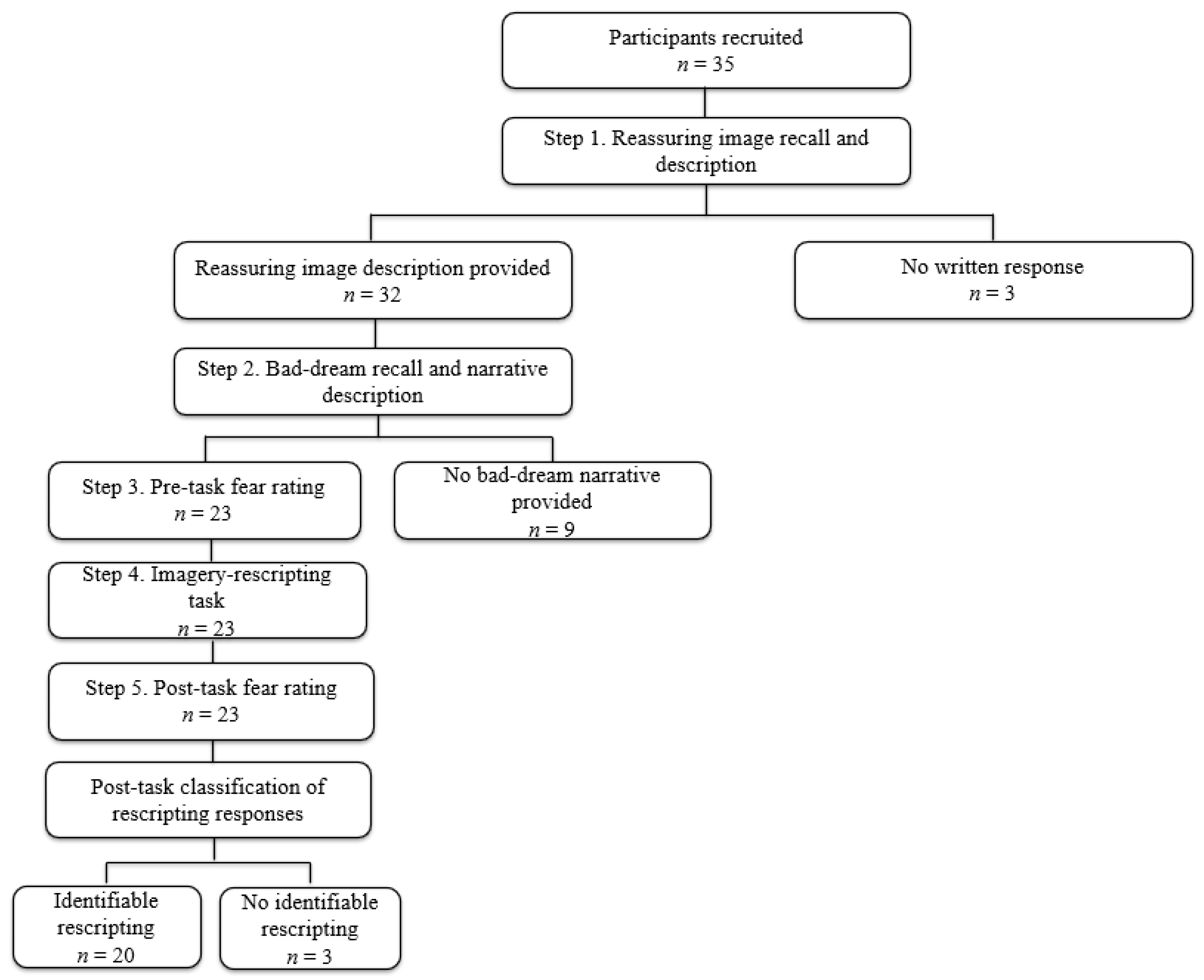
The study was conducted in a school classroom under the supervision of the homeroom teacher. The response time was approximately 15–20 min. Flow of Participants Through the Web-Based Imagery Rescripting Procedure was shown in Figure 1. Participants who did not provide a bad-dream narrative were excluded from the primary analytic sample. Among participants who completed the imagery-rescripting task, those whose rewritten narratives did not contain any identifiable modification of the original dream content were classified as the non-rescripting group.
Figure 1.
Participant flow through the web-based imagery rescripting procedure. Note. The primary analytic sample comprised participants who provided a bad-dream narrative and completed both the pre-task and post-task fear ratings. All participants in the analytic sample received the same imagery-rescripting instructions. Rescripting status was classified after task completion and did not represent an experimentally assigned condition.
An a priori power analysis was not conducted because the present study was designed as an exploratory pilot study in a school setting, and the sample size was not determined on the basis of a prespecified effect size or statistical power calculation.
2.3. Ethical Considerations
The children were informed that the purpose of the study was to investigate methods for reducing fear after experiencing unpleasant dreams by changing dream narratives into less frightening stories. Responses were collected anonymously to protect participant privacy.
Because recalling frightening dreams could potentially induce temporary distress, participants were first instructed to recall a reassuring or comforting image before describing nightmares. They were also informed that they could discontinue participation at any time if they felt uncomfortable and could mentally return to the reassuring image whenever necessary. The homeroom teacher remained present throughout the procedure and could discontinue the task and provide immediate reassurance if a child showed signs of distress.
No participant required termination of the task or additional support because of distress during the procedure. After completing the questionnaire, participants and their parents were provided with brief psychoeducational information regarding coping strategies for nightmares and sleep hygiene. This study was approved by the Ethics Review Committee of Toyo University (Approval No. P240072).
2.4. Data Analyses
Frequencies and descriptive statistics were used to summarize participant flow, the characteristics of the recalled bad dreams, and the qualitative classifications of the rescripting responses. The primary analytic sample consisted of participants who provided a bad-dream narrative and complete pre- and post-task fear ratings. Analyses were based on complete cases, and missing values were not imputed.
Bad-dream narratives and post-task responses were independently coded by two raters. Rescripting-strategy categories were informed by Harb et al. [20] and Albanese et al. [21]. Initial agreement between the two raters exceeded 80% overall. Disagreements were resolved through discussion until consensus was reached. The broad forms of narrative modification—changes to the participant’s own behavior, another character’s behavior, or the dream environment—were not mutually exclusive because a single response could receive more than one code.
The primary quantitative analysis examined within-participant changes in fear ratings among the 23 participants with complete pre- and post-task ratings. The distribution of the paired difference scores was assessed using the Shapiro–Wilk test, Q–Q plots, and boxplots. Because the difference scores showed evidence of non-normality, pre- and post-task fear ratings were compared using a two-tailed Wilcoxon signed-rank test, with the two-sided asymptotic p value reported. Pairs with zero differences were excluded from the calculation of signed ranks, and tied absolute difference scores were assigned average ranks. The standardized effect size was calculated as r = |Z|/√N, where N was the total number of complete pairs (N = 23), including pairs with zero differences. The 95% confidence interval for r was estimated using a nonparametric percentile bootstrap based on 10,000 participant-level resamples with replacement, preserving the pairing of pre- and post-task ratings.
For descriptive reporting, within-participant reductions in fear were calculated as pre-task minus post-task ratings, such that positive values indicated lower post-task fear. The mean reduction and its standard deviation were reported together with a t-based 95% confidence interval for the mean reduction calculated from the paired differences (df = 22).
Because rescripting status and rescripting strategy were classified after task completion rather than experimentally assigned, and because the resulting subgroups were small and unequal in size, no inferential comparisons were conducted across these subgroups. Subgroup results were summarized descriptively using frequencies, means, standard deviations, and individual scores where appropriate. Because only one primary inferential test was conducted, no adjustment for multiple testing was applied. Statistical analyses were performed using IBM SPSS Statistics Version 29.0, with the bootstrap confidence interval for r obtained using custom Python 3 code within SPSS. The significance level for the primary analysis was set at α = 0.05.
3. Results
3.1. Participant Flow and Analytic Sample
Of the 35 recruited children, 32 provided a written description of a reassuring image, whereas three did not provide a written response at this stage. Among the 32 participants who described a reassuring image, 23 subsequently provided a bad-dream narrative and completed both the pre-task and post-task fear ratings. The remaining nine participants did not provide a bad-dream narrative. Accordingly, the primary analytic sample comprised 23 participants, representing 65.7% of the recruited sample. The remaining 12 participants were not included in the pre–post analysis because they did not provide the data required for that analysis.
All 23 participants in the analytic sample received the same imagery-rescripting instructions. Post-task coding indicated that 20 participants (87.0%) produced an identifiable modification of the original bad-dream narrative, whereas three participants (13.0%) did not. Rescripting status was therefore treated as a post-task descriptive classification rather than an experimentally assigned condition.
3.2. Characteristics of Bad Dreams
Among the 23 participants included in the primary analytic sample, the most frequently reported bad-dream themes were being chased or pursued (n = 6), being killed (n = 4), encountering creatures that were part animal and part human (n = 4), and being physically attacked (n = 3). Additional themes are presented in Table 1. Because a single bad-dream narrative could contain more than one theme, the category frequencies were not mutually exclusive and did not sum to the number of participants.
Table 1.
Frequencies of recalled bad-dream themes.
3.3. Pre- and Post-Task Fear Ratings
Mean fear ratings decreased from 6.39 (SD = 2.97) before the task to 1.48 (SD = 2.43) after the task. The mean within-participant reduction was 4.91 points (SD = 3.54), 95% CI [3.38, 6.44]. Difference scores deviated from normality (Shapiro–Wilk W = 0.90, p = 0.025). A two-tailed Wilcoxon signed-rank test indicated significantly lower post-task than pre-task fear ratings, Z = −4.025, two-sided asymptotic p < 0.001, r = 0.84, 95% CI [0.78, 0.88]. Of the 23 participants, 21 reported lower fear ratings after the task, 2 reported unchanged ratings, and none reported higher ratings.
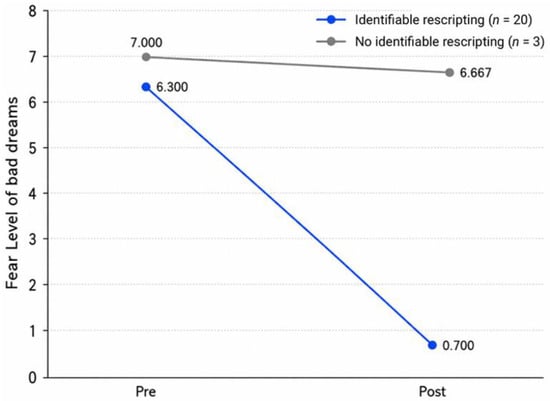
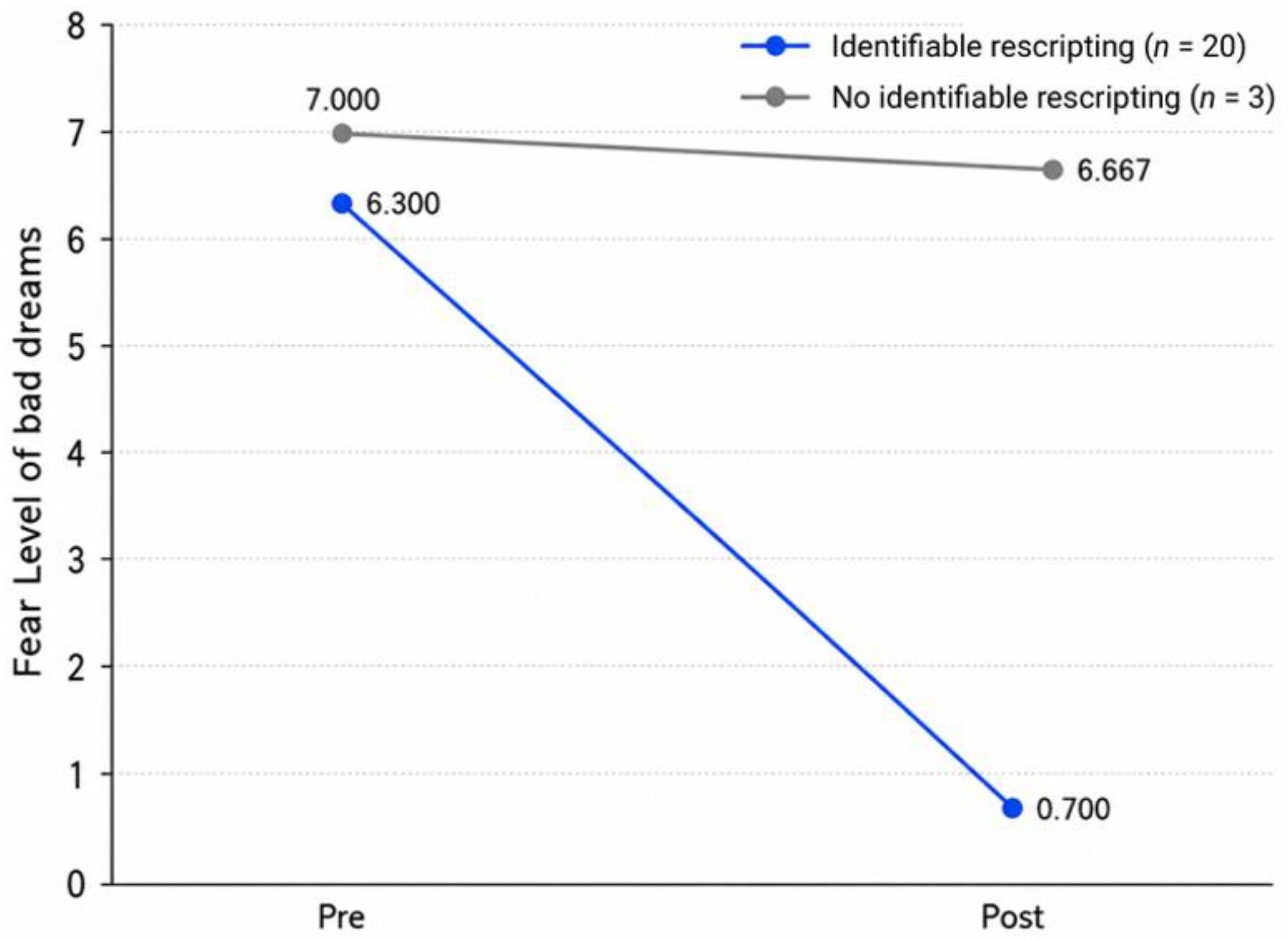
Among the 20 participants with identifiable rescripting, mean fear ratings decreased from 6.30 (SD = 3.03) to 0.70 (SD = 0.98), corresponding to a mean reduction of 5.60 points. Among the 3 participants without identifiable rescripting, 1 reported being unable to rewrite the dream (pre-/post-task ratings: 10/10), another expressed regret about having listened to a frightening story without modifying the dream narrative (7/6), and the remaining participant considered modification unnecessary because the actual medical test result was not unfavorable (4/4). Mean pre- and post-task fear ratings by rescripting status are shown descriptively in Figure 2.
Figure 2.
Changes in fear ratings associated with bad dreams before and after the intervention. Note. Points represent subgroup means, and lines connect the pre- and post-task means. All 23 participants received the same imagery-rescripting instructions. Rescripting status was determined post hoc based on task performance and was not experimentally assigned.
3.4. Descriptive Classification of Rescripting Responses
Qualitative coding of the 20 narratives containing an identifiable modification revealed three broad forms of narrative modification: modification of the participant’s own behavior within the dream (n = 11), modification of another character’s behavior (n = 6), and manipulation or transformation of the dream environment (n = 12). Because a single narrative could receive more than one code, these categories were not mutually exclusive and their frequencies did not sum to the number of participants.
Using the strategy-level classification based on Harb et al. [20], seven responses were classified as alternative endings, eight as the introduction or substitution of new positive images, and five as the transformation of threatening elements. Descriptively, mean fear ratings decreased from 6.14 (SD = 3.34) to 0.86 (SD = 0.69) for alternative endings, from 6.75 (SD = 3.24) to 0.25 (SD = 0.46) for the introduction or substitution of new positive images, and from 5.80 (SD = 2.78) to 1.20 (SD = 1.64) for the transformation of threatening elements. The corresponding mean reductions were 5.29, 6.50, and 4.60 points, respectively.
Frequencies and representative examples are presented in Table 2, and descriptive pre- and post-task fear ratings are presented in Table 3. No inferential comparisons were conducted across rescripting-strategy categories because of the small subgroup sizes.
Table 2.
Frequencies and representative examples of rescripting strategies.
Table 3.
Descriptive Statistics for Fear Ratings by Rescripting Category.
4. Discussion
The present pilot study examined immediate changes in self-reported fear associated with recalled bad dreams following a brief web-based procedure that included imagery rescripting among Japanese elementary school children. The results showed a significant reduction in fear ratings following the procedure. Descriptively, larger reductions were observed among children whose responses contained an identifiable modification of the dream narrative. These findings provide preliminary support for the feasibility of examining imagery rescripting in nonclinical children and highlight the variety of rescripting strategies that children can spontaneously generate. Previous research on pediatric imagery rehearsal therapy [23] provides a rationale for further evaluation of developmentally appropriate imagery-based procedures in nonclinical children. The present study assessed immediate changes in fear ratings only; long-term effects on nightmare frequency and sleep quality were not examined.
The observed reduction in fear is generally consistent with previous studies examining imagery-based interventions for nightmares in both adults and children [10]. A previous randomized controlled trial in children [11] reported a reduction in nightmare frequency following imagery rehearsal therapy. In the present study, immediate decreases in self-reported fear were observed following a brief web-based procedure that included imagery rescripting and was completed in classrooms under teacher supervision. However, because the study did not include a control condition and assessed only immediate fear ratings, the specific contribution of imagery rescripting and its effects on broader emotional regulation cannot be determined.
The bad dreams recalled by the participants largely coincided with themes common in dreams of Japanese children [24]. Among the three children without an identifiable narrative modification, one reported a one-point decrease in fear, whereas the other two reported no change. Given the very small number of cases, no conclusions can be drawn regarding the mechanisms underlying these responses. Future studies could separately evaluate whether reassuring imagery, dream narration, or cognitive reinterpretation contributes to immediate changes in fear.
The qualitative analysis of rescripting strategies revealed several characteristic patterns. Some children altered their own actions within the dream, whereas others changed the behavior of threatening characters or transformed environmental elements. These findings suggest that children can generate multiple forms of imaginative modification when rescripting distressing dream content. Descriptive patterns of fear reduction varied across rescripting categories; however, no inferential comparisons were conducted because of the small subgroup sizes. Developmentally, children’s imaginative capacities may facilitate imagery-based interventions, although individual differences in cognitive flexibility and emotional processing may influence engagement with imagery-based rescripting tasks.
At the same time, three participants did not produce an identifiable modification of the dream narrative. The reasons why some children did not produce an identifiable rescripting response remain unclear. One possibility requiring future investigation is that individual differences in the ability to intentionally manipulate mental imagery or construct alternative narratives may influence engagement with the task. Previous pediatric nightmare studies have suggested that additional support strategies, such as drawing dreams, guided storytelling, or parental involvement, may facilitate rescripting processes in children. Collaborative support from caregivers may therefore enhance children’s ability to engage in imagery modification tasks.
This study also has several methodological limitations. First, the sample size was relatively small, particularly for analyses based on rescripting status or strategy, limiting statistical power and the precision of subgroup estimates. Second, the study used a nonclinical sample and assessed only an immediate change in a single self-reported fear rating; socioeconomic status, habitual sleep patterns, validated measures of nightmare distress, nightmare frequency, sleep quality, and follow-up outcomes were not obtained. Third, rescripting status was determined post hoc rather than by random assignment, and baseline differences and other individual characteristics may therefore have contributed to differences in change scores. Fourth, incomplete responses reduced the analytic sample from 35 recruited children to 23 participants with complete bad-dream and fear-rating data. Fifth, because the intervention was conducted through self-report questionnaires in a web-based format, variations in comprehension and engagement among participants could not be fully controlled. Moreover, repeated assessment may have introduced expectancy or demand characteristics, as participants may have inferred that lower fear ratings were expected following the procedure. Because no experimentally assigned control condition was included, the contributions of imagery rescripting cannot be separated from those of reassuring-image recall, dream narration, repeated assessment, expectancy or demand characteristics, the passage of time, or regression to the mean.
Future research should use controlled designs with larger and more diverse samples, include longitudinal follow-up assessments, and investigate factors influencing children’s engagement with rescripting. Such studies could evaluate the longer-term clinical and preventive value of school-based imagery rescripting, together with its delivery costs and support requirements. Evidence from this work could inform the development of culturally appropriate and developmentally tailored imagery rescripting methods and their evaluation across different settings.
5. Conclusions
In this pilot study, self-reported fear associated with recalled bad dreams was lower immediately after a brief web-based procedure that included imagery rescripting and was completed in classrooms under teacher supervision. Qualitative analyses further showed that children generated several distinct forms of dream modification, providing descriptive evidence that children in this age group can engage with imagery-rescripting tasks in multiple ways. Because the study did not include a control condition and assessed only immediate self-reported fear, the observed change cannot be attributed specifically to imagery rescripting, and no conclusions can be drawn regarding preventive, clinical, or broader emotional-regulation effects.
These findings provide a preliminary basis for controlled studies examining the specific contribution of imagery rescripting and other components of the procedure to immediate changes in fear associated with bad dreams. Future research should use larger and more diverse samples, validated measures of nightmare-related distress and sleep outcomes, and longitudinal follow-up to determine the durability and clinical relevance of these changes and to evaluate developmentally and culturally appropriate approaches to imagery rescripting in children.
Funding
This research was funded by JSPS KAKENHI, Grant Numbers JP21H05343, JP23K02969 and JP25K00891.
Institutional Review Board Statement
The study was conducted in accordance with the Declaration of Helsinki and approved by the Ethics Review Committee of Toyo University (protocol code P240072).
Informed Consent Statement
Permission to conduct the study was obtained from the principals of the participating schools. Written informed consent was obtained from all participants and their legal guardians prior to participation.
Data Availability Statement
The data presented in this study are available from the corresponding author upon reasonable request. The data are not publicly available due to privacy and ethical restrictions related to research involving minor participants.
Acknowledgments
The author would like to thank Kaori Oguchi and Youngsun Yuk for their valuable assistance and support throughout this study. The author also gratefully acknowledges the participating schools, children, and their legal guardians for their cooperation.
Conflicts of Interest
The author declares no conflicts of interest. The funders had no role in the design of the study; in the collection, analysis, or interpretation of data; in the writing of the manuscript; or in the decision to publish the results.
Abbreviations
The following abbreviations are used in this manuscript:
| IRT | Imagery Rehearsal Therapy |
| IR | Imagery rescripting |
| ERRT | Exposure, Relaxation and Rescripting Therapy |
| PTSD | Post-traumatic stress disorder |
References
- American Psychiatric Association. Diagnostic and Statistical Manual of Mental Disorders, Fifth Edition, Text Revision (DSM-5-TR); American Psychiatric Association Publishing: Washington, DC, USA, 2022. [Google Scholar] [CrossRef] [Scilit]
- Okada, H.; Matsuda, E. Current studies of psychological mechanisms and psychotherapy of nightmares. Jpn. J. Stress Manag. Res. 2017, 13, 11–17. (In Japanese) [Google Scholar]
- Sjöström, N.; Wærn, M.; Hetta, J. Nightmares and sleep disturbances in relation to suicidality in suicide attempters. Sleep 2007, 30, 91–95. [Google Scholar] [CrossRef] [Scilit] [PubMed]
- Song, T.H.; Wang, T.T.; Zhuang, Y.Y.; Zhang, H.; Feng, J.H.; Luo, T.R.; Zhou, S.J.; Chen, J.X. Nightmare distress as a risk factor for suicide among adolescents with major depressive disorder. Nat. Sci. Sleep 2022, 14, 1687–1697. [Google Scholar] [CrossRef] [Scilit] [PubMed]
- Krakow, B.; Hollifield, M.; Johnston, L.; Koss, M.; Schrader, R.; Warner, T.D.; Tandberg, D.; Lauriello, J.; McBride, L.; Cutchen, L.; et al. Imagery rehearsal therapy for chronic nightmares in sexual assault survivors with posttraumatic stress disorder: A randomized controlled trial. JAMA 2001, 286, 537–545. [Google Scholar] [CrossRef] [Scilit] [PubMed]
- Davis, J.L.; Wright, D.C. Case series utilizing exposure, relaxation, and rescripting therapy: Impact on nightmares, sleep quality and psychological distress. Behav. Sleep Med. 2005, 3, 151–157. [Google Scholar] [CrossRef] [Scilit] [PubMed]
- Aurora, R.N.; Zak, R.S.; Auerbach, S.H.; Casey, K.R.; Chowdhuri, S.; Karippot, A.; Maganti, R.K.; Ramar, K.; Kristo, D.A.; Bista, S.R.; et al. Best practice guide for the treatment of nightmare disorder in adults. J. Clin. Sleep Med. 2010, 6, 389–401. [Google Scholar] [CrossRef]
- Krakow, B.; Zadra, A. Imagery rehearsal therapy: Principles and practice. Sleep Med. Clin. 2010, 5, 289–298. [Google Scholar] [CrossRef] [Scilit]
- Krakow, B.; Sandoval, D.; Schrader, R.; Keuhne, B.; McBride, L.; Yau, C.L.; Tandberg, D. Treatment of chronic nightmares in adjudicated adolescent girls in a residential facility. J. Adolesc. Health 2001, 29, 94–100. [Google Scholar] [CrossRef] [Scilit] [PubMed]
- Gill, P.; Fraser, E.; Tran, T.T.D.; De Sena Collier, G.; Jago, A.; Losinno, J.; Ganci, M. Psychosocial treatments for nightmares in adults and children: A systematic review. BMC Psychiatry 2023, 23, 283. [Google Scholar] [CrossRef] [Scilit] [PubMed]
- St-Onge, M.; Mercier, P.; De Koninck, J. Imagery rehearsal therapy for frequent nightmares in children. Behav. Sleep Med. 2009, 7, 81–98. [Google Scholar] [CrossRef] [Scilit] [PubMed]
- Cromer, L.D.; Bell, S.B.; Prince, L.E.; Hollman, N.; El Sabbagh, E.; Buck, T.R. Efficacy of a telehealth cognitive behavioral therapy for improving sleep and nightmares in children aged 6–17. Front. Sleep 2024, 3, 1401023. [Google Scholar] [CrossRef] [Scilit] [PubMed]
- Organisation for Economic Co-Operation and Development (OECD). Time Use Database. Available online: https://www.oecd.org/en/data/datasets/time-use-database.html (accessed on 2 June 2026).
- Hirshkowitz, M.; Whiton, K.; Albert, S.M.; Alessi, C.; Bruni, O.; DonCarlos, L.; Hazen, N.; Herman, J.; Katz, E.S.; Kheirandish-Gozal, L.; et al. National Sleep Foundation’s sleep time duration recommendations: Methodology and results summary. Sleep Health 2015, 1, 40–43. [Google Scholar] [CrossRef] [Scilit] [PubMed]
- Ministry of Education, Culture, Sports, Science and Technology of Japan. Research Study on the Comprehensive Promotion of Home Education, FY2018. Available online: https://www.mext.go.jp/component/a_menu/education/detail/__icsFiles/afieldfile/2019/12/04/1246352_001.pdf (accessed on 2 June 2026).
- Matsuda, E. Coping with sleep disorders and cognitive behavioral therapy: Towards the treatment and prevention of sleep-wake problems. Jpn. J. Behav. Sci. 2015, 54, 53–62. (In Japanese) [Google Scholar]
- Kawase, Y.; Matsuda, E. A case study of school counseling for a female high school student complaining of nightmares and insomnia. Jpn. J. Stress Manag. Res. 2017, 13, 32–41. (In Japanese) [Google Scholar]
- Matsuda, E.; Kawase, Y. Application of image exposure and image rescripting to high school students whose main complaint is nightmares. Jpn. J. Couns. Sci. 2023, 56, 69–78. [Google Scholar] [CrossRef] [PubMed]
- Levin, R.; Nielsen, T.A. Disturbed dreaming, posttraumatic stress disorder, and affect distress: A review and neurocognitive model. Psychol. Bull. 2007, 133, 482–528. [Google Scholar] [CrossRef] [Scilit] [PubMed]
- Harb, G.C.; Thompson, R.; Ross, R.J.; Cook, J.M. Combat-related PTSD nightmares and imagery rehearsal: Nightmare characteristics and relation to treatment outcome. J. Trauma Stress 2012, 25, 511–518. [Google Scholar] [CrossRef] [Scilit] [PubMed]
- Albanese, M.; Liotti, M.; Cornacchia, L.; Mancini, F. Nightmare rescripting: Using imagery techniques to treat sleep disturbances in post-traumatic stress disorder. Front. Psychiatry 2022, 13, 866144. [Google Scholar] [CrossRef] [Scilit] [PubMed]
- Mathes, J.; Schred, M.; Göritz, A.S. Frequency of Typical Dream Themes in Most Recent Dreams: An Online Study. Dreaming 2014, 24, 57–66. [Google Scholar] [CrossRef] [Scilit]
- Simard, V.; Nielsen, T. Adaptation of imagery rehearsal therapy for nightmares in children: A brief report. Psychotherapy 2009, 46, 492–497. [Google Scholar] [CrossRef] [Scilit] [PubMed]
- Matsuda, E.; Yoshihara, M.; Kawase, Y. Research on developmental disorder characteristics and dream reporting in children. Jpn. J. Stress Manag. Res. 2020, 16, 60–61. [Google Scholar]

Disclaimer/Publisher’s Note: The statements, opinions and data contained in all publications are solely those of the individual author(s) and contributor(s) and not of MDPI and/or the editor(s). MDPI and/or the editor(s) disclaim responsibility for any injury to people or property resulting from any ideas, methods, instructions or products referred to in the content. |
© 2026 by the author. Licensee MDPI, Basel, Switzerland. This article is an open access article distributed under the terms and conditions of the Creative Commons Attribution (CC BY) license.