


Abstract
BACKGROUND: Over the last two decades, the relationship between distance and mental health and the role of distance in psychotherapy has generated considerable research interest. Up to date, operationalisations have primarily focused on verbal content whereas descriptions of distance on the level of communicative form are lacking in the psychological literature. DESIGN AND METHODS: Five open-ended narrative interviews with persons with an experience of psychotic (two) or depressive (three) illness were transcribed and systematically coded for characteristics of distance described in the psychological and linguistic literature up to date. Codes for further characteristics of distance were developed bottom-up from the data. Codes were then grouped into broader interpretative categories and these categories were again applied to the data. RESULTS: Distance was displayed at the level of content and form. In total, 29 individual characteristics of distance could be identified, and three interpretative categories emerged: “detachment”, “balanced oscillation” and “immersion”. DISCUSSION: Our study provides an in-depth, nuanced and gestaltic description of distance and raises awareness for displays of distance at the level of communicative form in addition to content. Our results also support an understanding of distance as a continuous phenomenon and highlight its processual character. Possible connections between distancing and coping as well as implications for psychotherapy are discussed.

Background
“Distance” is a concept intuitively used by psychotherapists to describe a person’s character as in “she is a rather distant person” or more specifically to describe the way in which someone relates to an autobiographical experience as in the quote above: “I have now gained a certain distance from it”. “Distance” in these instances is employed and understood metaphorically as a “mental construction through which events or objects can be psychologically removed from the here and now of the self” [1].
Over the last two decades, the relationship between distance and mental health and the role of distance in psychotherapy has generated considerable research interest. As distance, like most, if not all, psychological phenomena, cannot be directly observed, a lot of effort has been undertaken in the first place to operationalise the concept. This was done by examining verbal displays of distance assuming a correlation between linguistic surface and underlying mental phenomenon. Trope and Liberman [2] showed that whilst temporally close events are told in a concrete, complex, unstructured, incoherent and contextualised manner, temporally distant events are told in an abstract, simple, structured, coherent and decontextualised manner. They assumed that this systematic equally holds for other dimensions of psychological distance such as spatial or social distance. Building on Trope and Liberman’s work, later studies identified several aspects of verbal content that allow differentiation between a self-distanced and a self-immersed perspective on autobiographical experiences [1, 3–7]: When adopting a self-distanced perspective, the narrator talks about past experiences from the perspective of a distanced observer, akin to a fly on the wall, focusing on the broader context and reconstructing the experiences [3, 8]. When adopting a self-immersed perspective, the narrator of the experience and the self that is experiencing it coincide [7], and the narrative typically takes the form of a detailed recounting of the experience. With regard to the characterisation of formal aspects of the verbal display of distance, psychological studies have so far limited themselves to discussing the use of the impersonal “you” instead of “I” as characteristic of a self-distanced perspective [6, 9, 10].
A study in linguistic conversation analysis has much to add on this point. Linguistic conversation analysis [11–13] is a framework and method to systematically analyse the how of conversation by examining aspects such as the organisation of a conversation (turn-taking, sequential and thematic organisation) and the use of specific verbal (e.g., technical jargon, fillers), para(e.g., intonation, loudness) and nonverbal (e.g., gestures and facial expressions) resources to solve a specific communicative task. Thus, in her analysis of narratives of child loss, Stukenbrock [14, 15] equally describes the avoidance of self-referential pronouns that is employed to display a distance from one’s burdensome experience. But she goes beyond such single formal aspects to detail complex communicative strategies that are employed for this purpose: immersion is displayed, for example, by lack of narrative structure and coherence, speech and thought reproduction, as well as by paraverbal signs of being acutely emotionally affected or even overwhelmed such as crying and exhalations. Typical strategies to display distance, on the other hand, are desubjectivised and generalised speech (e.g., avoidance of self-referential pronouns, occupation of the subject by placeholders “es”/“it”) and formulation difficulties manifesting in sentence break-offs, reformulations and delay signals. Importantly, conversation analysis does not share psychology’s basic assumption of an a priori correlation of linguistic surface and underlying mental phenomenon. Besides offering valuable insights into verbal form, conversation analysis therefore also offers new perspectives on the interpretation of the results of psychological studies working with language-based operationalisations.
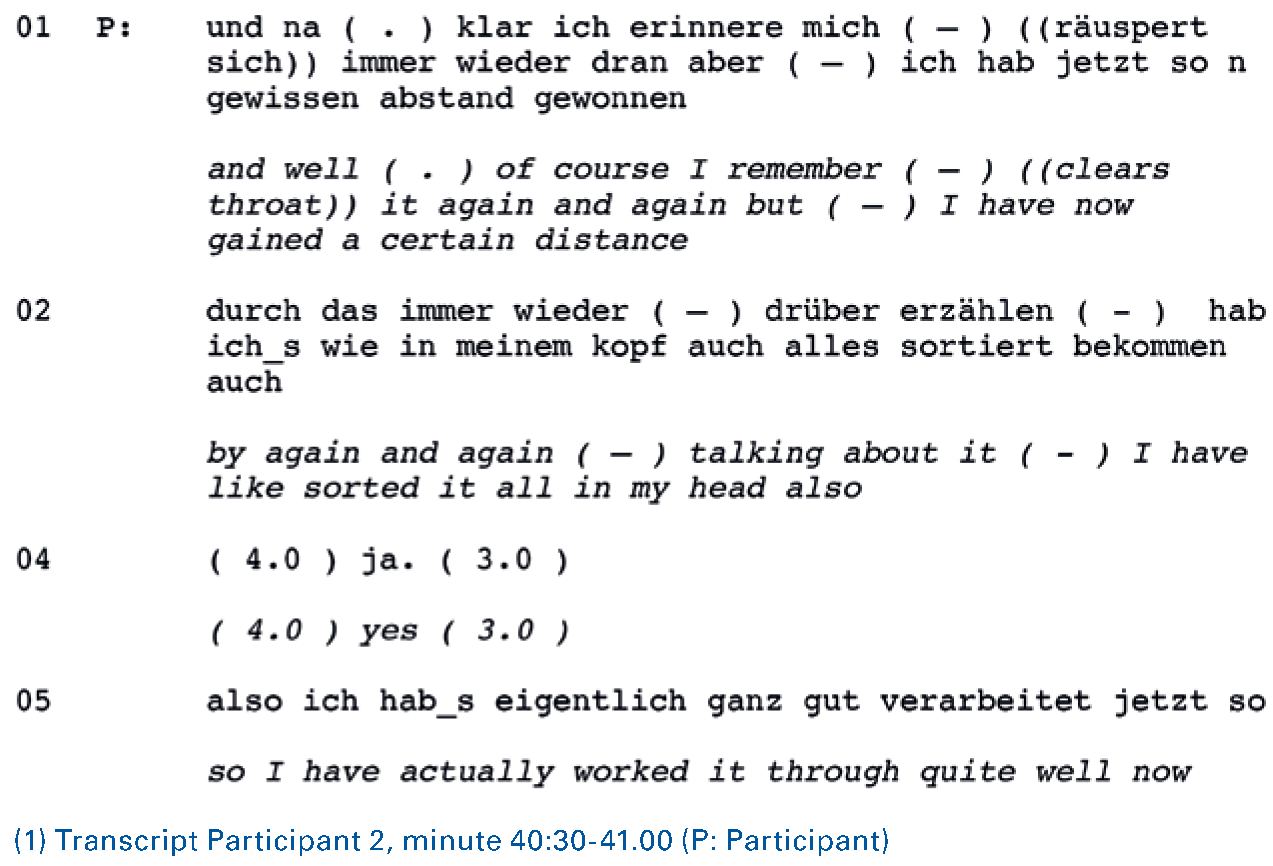
In psychological studies on its significance with regards to mental health, distance has been linked to the ability to mentally reorganise adverse experiences and thereby help integrate them in a coherent concept of oneself [3, 16–19]. It has furthermore been linked to specific positive effects on mental health such as increase in emotional well-being, lower emotional reactivity, reduced duration and intensity of emotions, and lower physiological reactivity [3, 7, 17]. Other authors have cautioned, however, that distance may be associated with cognitive avoidance and rumination [20, 21]. They have also stressed that the opposite of distancing, the adoption of an immersed perspective, plays an equally important role in processing an adverse experience [4, 5, 22]. Most recent work argues that immersion and distancing play complementary roles and that it is the shift from the one to the other [1, 22] or the progressive transition from immersion to distancing that is essential for coping with adverse experiences [4, 5]. Thus, distance has come to be seen as a continuous phenomenon reaching from immersion at one end to distance at the other end. Various psychotherapeutic approaches specifically build on modulating the degree of distancing [23], for example mindfulnessbased therapies for depressive disorders [24], emotion-focused therapy [25] and exposure-based therapies for trauma-associated disorders [24]. Some of these approaches specifically employ narration to this purpose, for example, narrative exposure therapy (NET) [26].
Distancing appears as a basic psychological mechanism probably involved in any kind of coping. We seek to add to the depth of description of this mechanism by integrating psychological and linguistic insights into its communicative display in narratives of mental illness.
Against this background, distancing appears as a basic psychological mechanism probably involved in any kind of coping. What we seek to do in this paper is to add to the depth of description of this mechanism by integrating psychological and linguistic insights into its communicative display in narratives of mental illness. For this purpose, we analysed five autobiographical narratives of experiences of mental illness broadly following principles of qualitative content analysis with a view to firstly identifying communicative strategies employed to display distance as well as to secondly explore whether different types of distance can be demarcated. We hypothesised that we would find all or most verbal strategies used to display distance described in the psychological as well as the linguistic literature so far and that these features would fall into two or three groups corresponding to different types of distance.
We hope that our analysis heightens the awareness of phenomena of distancing in conversations on mental illness and helps to make sense of them in their wider conversational context. We hope that our work will help clinicians work more effectively with this important psychological mechanism and thereby contribute to enhanced coping and ultimately recovery from mental illness.
Design and methods
Participants and recruitment
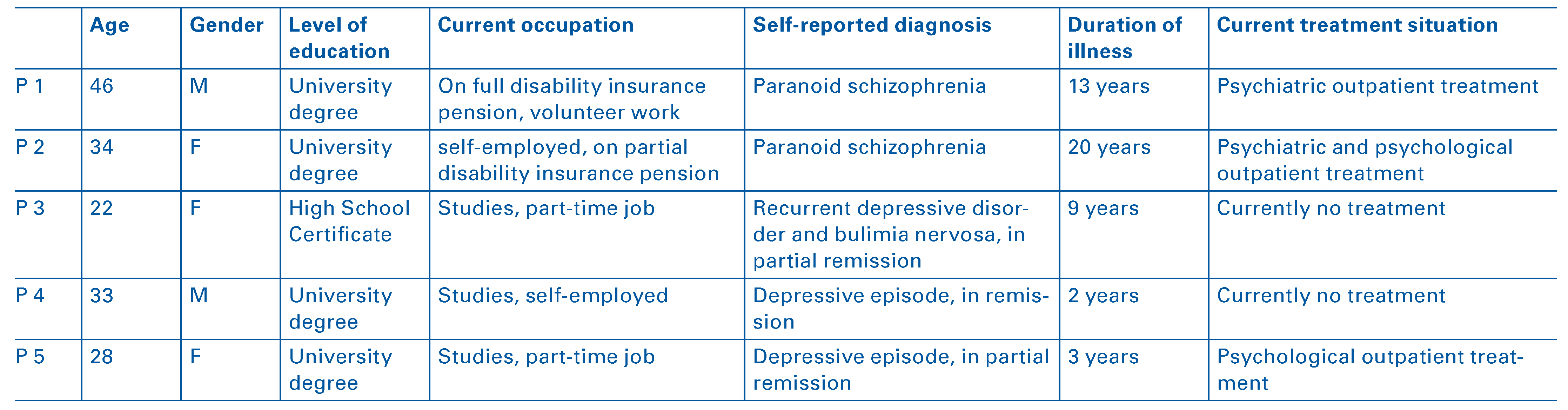
All people aged between 18 and 65 with a self-declared history of either psychotic or affective illness, whose mother tongue was either German or Swiss German and who had the capacity to consent were eligible. Participants were recruited via the authors’ own clinical practice, personal contacts and student portals at the University of Zurich. In accordance with the principle of maximum variation sampling [27], the aim was to achieve a sample with the highest possible degree of diversity regarding factors that are thought to influence the illness experience (especially diagnosis, duration of illness, treatment experience, age, gender). This analysis is based on narrative interviews with five participants (Table 1).
Table 1.
Participants.
Data collection
The interviews were conducted for the larger project ‘Drüber reden! Aber wie?’ (www.drueberreden.ch). They follow the principles of narrative interviewing [28]. They were opened in a standardised fashion with the question “Can you tell me your story?” (“Können Sie mir Ihre Geschichte erzählen?”). As they had previously read the study information and been personally consented, it was clear to the interviewees that the intended topic of the interview was their experience of mental illness. Subsequently, the interviewees were given as much freedom as possible, follow-up questions were open-ended and only asked if the spontaneous narration ended. At the end of the interview, participants were asked about their experiences with talking about their illness. After the interview, sociodemographic and clinical information was collected. The interviews were audio- (1) or video-recorded (4). They lasted between 35 minutes and 2 hours.
Three interviews were conducted by RK, who was a master student in psychology at the time, one interview by YI, who was a doctoral researcher in linguistics, and one interview together by HW, an expert by experience, and AM, a trainee psychiatrist. Three interviews were conducted in private homes and two interviews were conducted at an outpatient clinic of the University Hospital of Psychiatry in Zurich.
Data preparation
The interviews were transcribed verbatim; additionally, in some aspects, the conventions of the Konversationsanalytisches Transkriptionssystem GAT 2 [29], an established conversation analytic system of transcription for German speech data, were followed (see appendix). GAT 2 allows the standardised transcription not only of verbal utterances, but additionally of the sequential organisation (e.g., overlaps), pauses, as well as paraverbal (e.g., pitch, volume) and nonverbal behaviour (e.g., gestures, facial expressions). For our purposes, the focus of the transcription was on the verbal utterances of both interviewee and interviewer. Nonverbal and paraverbal behaviour was only partially transcribed. The transcripts comprised a total of 137 pages (Courier, font size 11).
Data analysis
The transcripts were analysed following the principles of qualitative content analysis. Content analysis is an established method or rather set of methods in qualitative health research [30] that makes interpretation of text describable and intersubjectively transparent by establishing content analytic rules [31]. At the heart of qualitative content analysis is the process of coding: a code is typically a word or short phrase that “symbolically assigns a summative, salient, essence-capturing, and/or evocative attribute” to a portion of the text [32]. Codes can be generated deductively from the existing literature or inductively from the specific data [33]. For this study, a deductive-inductive approach [34] was chosen. For a first round of coding, codes were derived from the above mentioned psychological and linguistic literature on distance: descriptions and operationalizations of distance both at the level of content as well as at the level of form (see “Background” section) were extracted and used as codes. These a priori codes, for example “speech- and thought reproduction” and “desubjectivised speech” were applied to the data and thus served to identify either distancing or immersion in the transcripts. In a second round of coding, the codes were refined and supplemented by aspects of distance/immersion to the experience of mental illness emerging bottom-up from our data (see “Results”). The analysis can thus be described as a hermeneutical process starting off from the existing concept and the related empirically identified textual displays of distance, and refining and supplementing them based on our specific narrative data. In a further step, codes were grouped into broader interpretative categories. The formation of these categories builds on similarities (again both at the level of content and at the level of form) between codes as well as co-occurrences of codes and was done in view of our knowledge of existing interpretative frameworks of distance like Scheff’s [23] and Barbosa et al.’s [8]. These categories were again applied to the data.
Data sessions, at which a portion of the data was consensually coded [34], were held amongst the members of the research team (RK, YI, HW, AM) to ensure communicative validation [35, 36] and to add to the interpretative strength of the analysis: first, each researcher coded the data independently and then the results were compared and discussed. Furthermore, RK coded the whole dataset twice at an interval of three months to ensure intra-coder reliability [30].
Ethics
The Ethics Committee of the Canton of Zurich issued a declaration of non-responsibility for the study (BASEC 2018-01305). The study was then submitted to the Ethics Committee of the Faculty of Philosophy at the University of Zurich and approved in the current form (approval 19.2.9).
Results
Psychological distance was displayed at various communicative levels in our data, at the level of content and at the level of linguistic form, including para- and nonverbal behaviour. The latter, however, was not analysed systematically.
Our data display most of the characteristics of distance identified by previous studies. Besides these, some new aspects emerged that characterize the display of distance to the narrated experience of mental illness: Some of these characteristics have to do with what people tell in relation to their illness experience, e.g. whether they describe changes and difficulties related to the illness. But they also concern how people talk about their experience and what terms they use, e.g. whether they classify their experience as belonging to an illness or whether they avoid any classification as pathological.
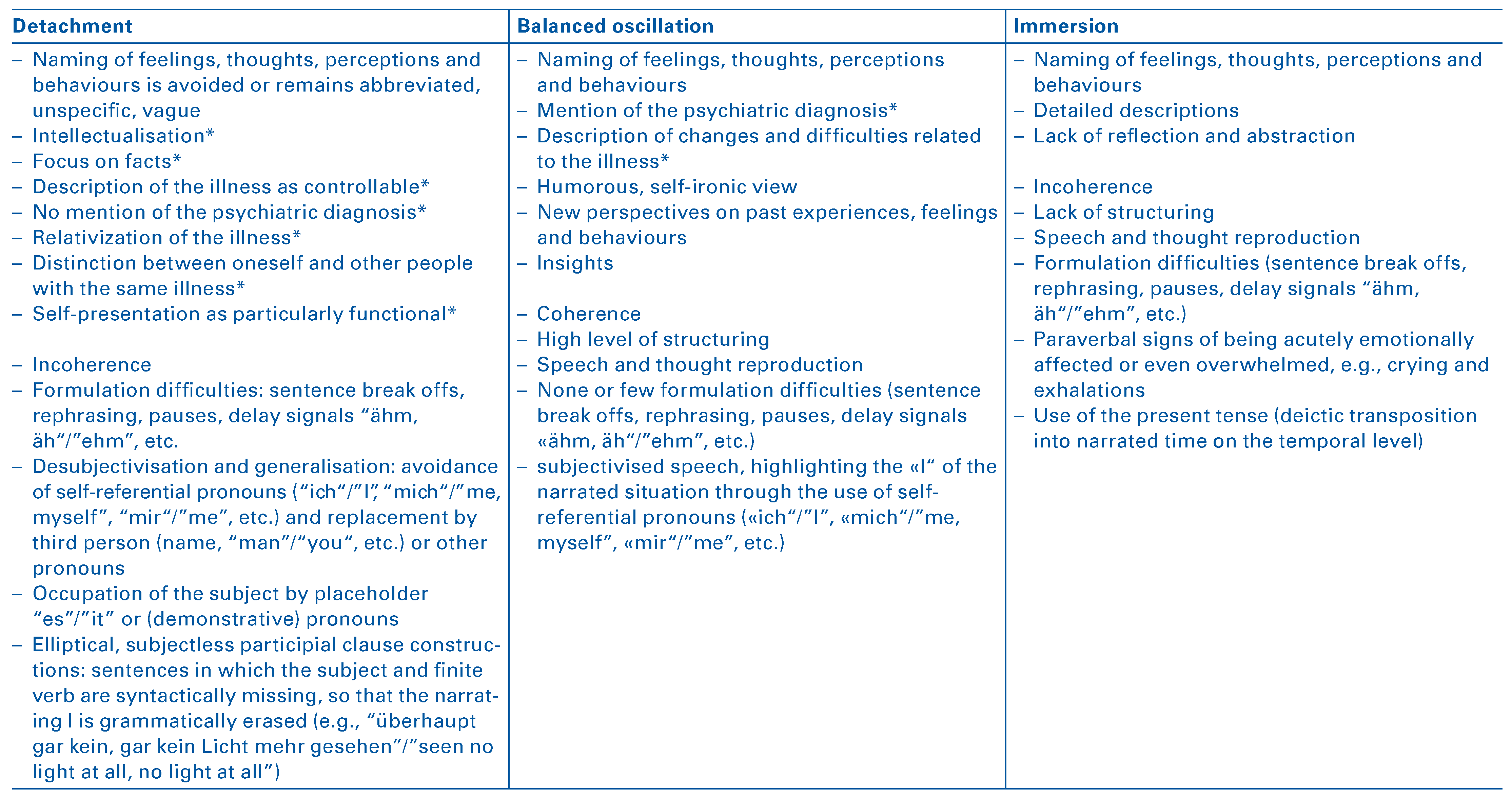
The characteristics could be grouped into three broader categories that were interpreted as three modes of distance: ‘detachment’ at one end, ‘immersion’ at the other end, and ‘balanced oscillation’ between the two poles.
The characteristics could be grouped into three broader categories that were interpreted as three modes of distance: ‘detachment’ at one end, ‘immersion’ at the other end, and ‘balanced oscillation’ between the two poles. We found more than one mode of distancing in each participant’s narrative. But when counting how often each mode had been coded in a given narrative, a dominant mode of distancing emerged for each participant: ‘balanced oscillation’ was the dominant mode in participants 1, 2, 3, and 5, and ‘detachment’ was the dominant mode in participant 4. Whilst ‘immersion’ was displayed in several participants’ narratives in several places, it was never the dominant mode of distancing.
In the following, we illustrate these modes of distance with excerpts from our data. As for reasons of space, we can only provide one excerpt per mode, not all the single characteristics we identified are present in the excerpts (see characteristics and modes of distance in Table 2).
Table 2.
Modes of distance and their characteristics.
Detachment
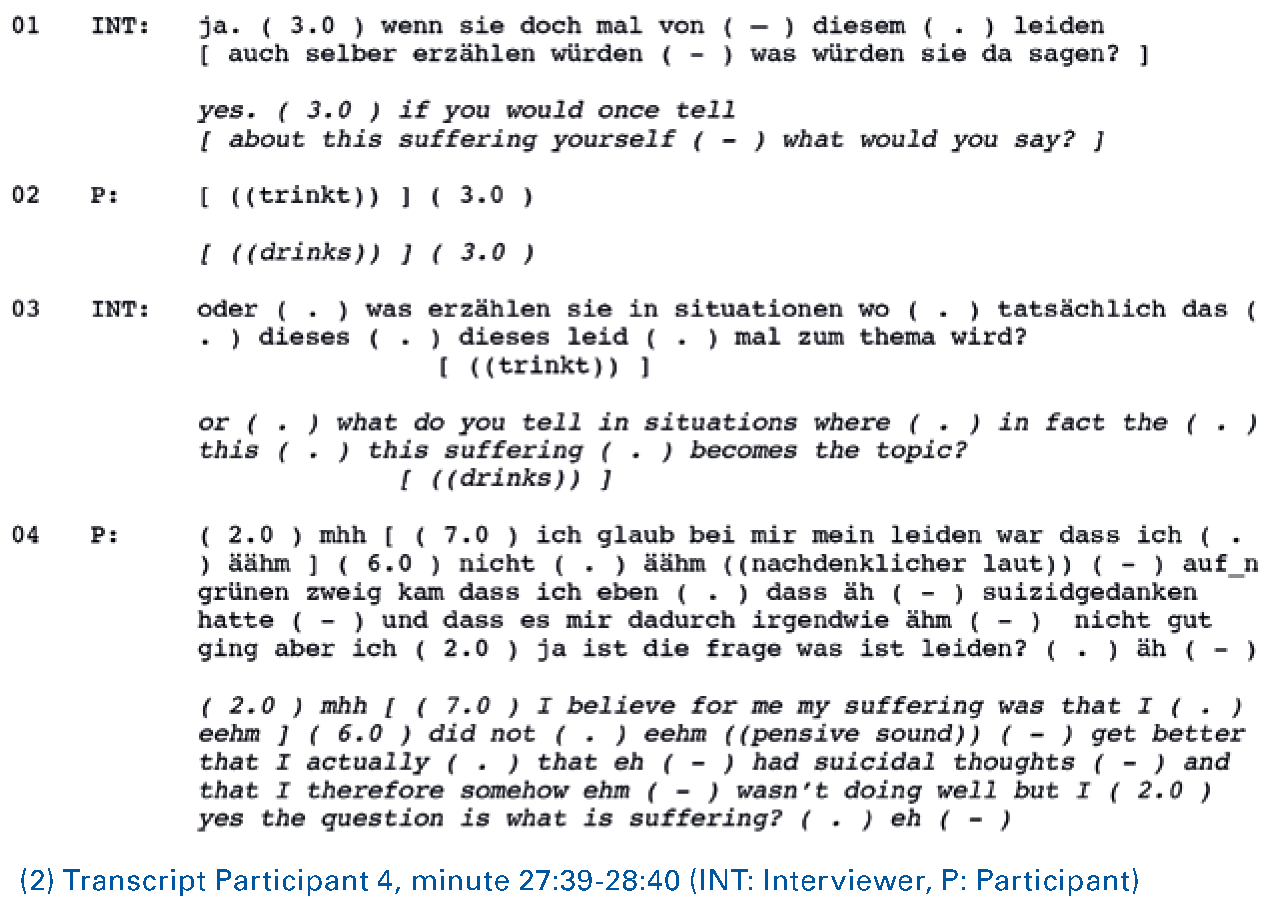
This section follows the participant’s statement that he mostly avoids talking about the suffering (“leiden”) he experienced in his mental illness. The response is characterised by formulation difficulties that show themselves in long pauses, rephrasings (“ich glaub bei mir mein leiden war”/”I believe for me my suffering was”; “dass ich eben ( . ) dass”/”that I actually ( . ) that”) as well as delay signs like “ähm, äh”/“ehm”. He mentions suicidal thoughts, thus he uses a technical term borrowed from professional jargon in response to the subjective term “leiden” (“suffering”) employed in the interviewer’s question. Besides the mention of suicidal thoughts and the general statement that he wasn’t well, the participant does not describe any feelings, thoughts, perceptions or behaviours. His formulations are mostly vague (“irgendwie/“somehow”) and he ends the section with a general, relativising and intellectualising question “what is suffering?”.
The participant thus positions himself as a
personally unaffected observer of his illness; in other words, he presents
himself as detached from the experience.
Immersion
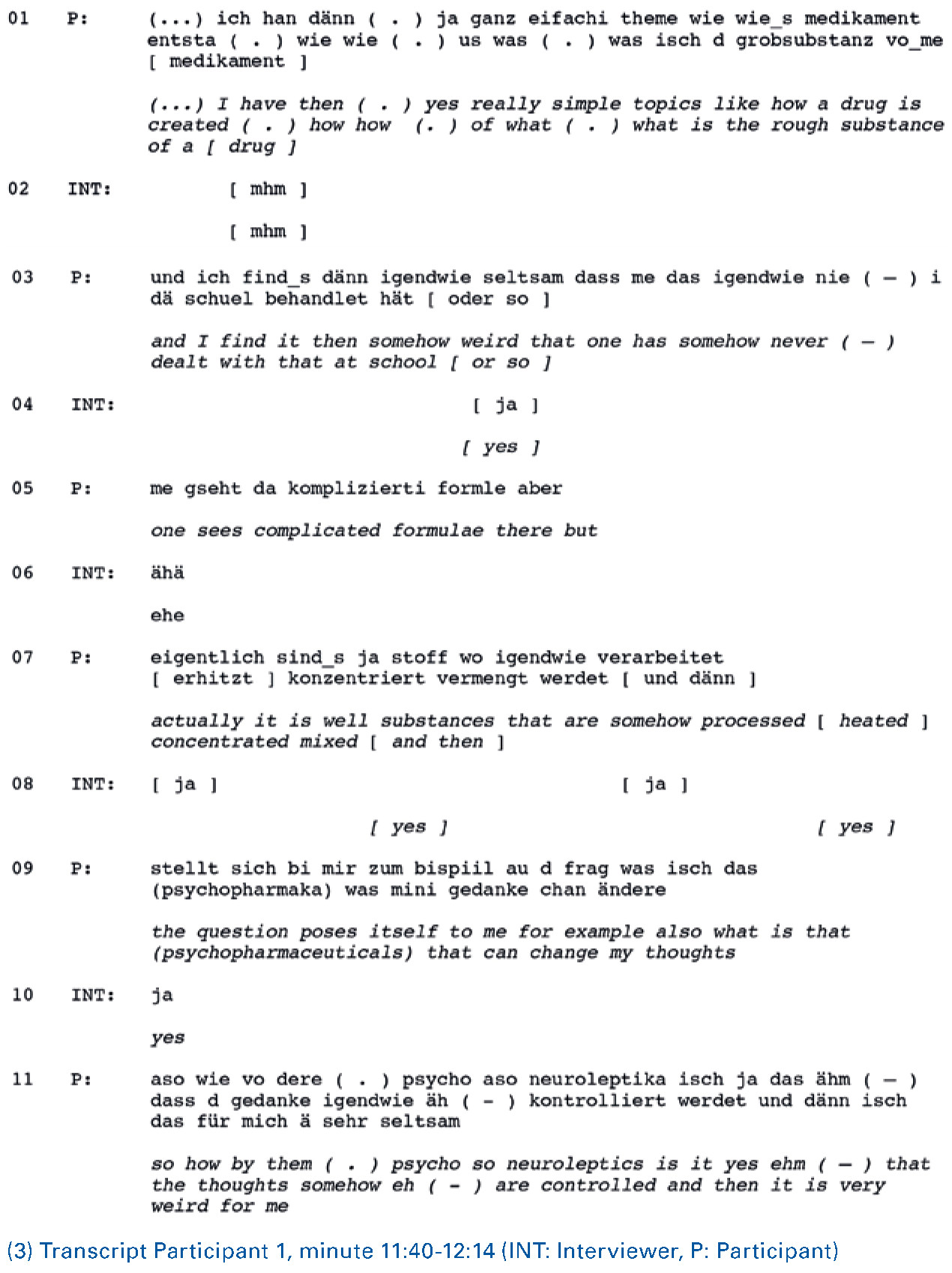
This passage follows the interviewer asking the participant to describe what he had earlier called an “acute phase” (“eine akute phase”). The participant then describes his thoughts in such a phase. He introduces the first two thoughts by the expressions “ich han dänn”/“I have then” and “und ich find_s dänn”/“and I find it then” thereby marking the thoughts as thoughts and he ends the passage with the comment “und dänn isch das für mich ä sehr seltsam”/“and then it is very weird for me”. But in the middle of the passage, no expressions marking thoughts as thoughts are used. Rather, thoughts are reported directly as in direct speech and the present tense is used throughout. The description is detailed, the structure lacks coherence. There’s a lack of reflection and abstraction. Furthermore, formulation difficulties can be seen, manifesting in sentence break-offs and rephrasings (e.g., “wie wie_s medikament entsta ( . ) wie wie ( . ) us was ( . ) was”/“like how a drug is created ( . ) how how (. ) of what ( . ) what”), as well as in delay signals (“ähm, äh”/“ehm”). In line 7, we see an enumeration of four past participles in a passive construction “verarbeitet erhitzt konzentriert vermengt”/“processed heated concentrated mixed” by which the impression of condensation and acceleration is created. Thus, the participant displays the thought process of an “acute phase” in the interview situation, i.e., the illness experience is actualised in the here and now. In other words, the participant appears immersed in the experience he narrates.
Balanced oscillation
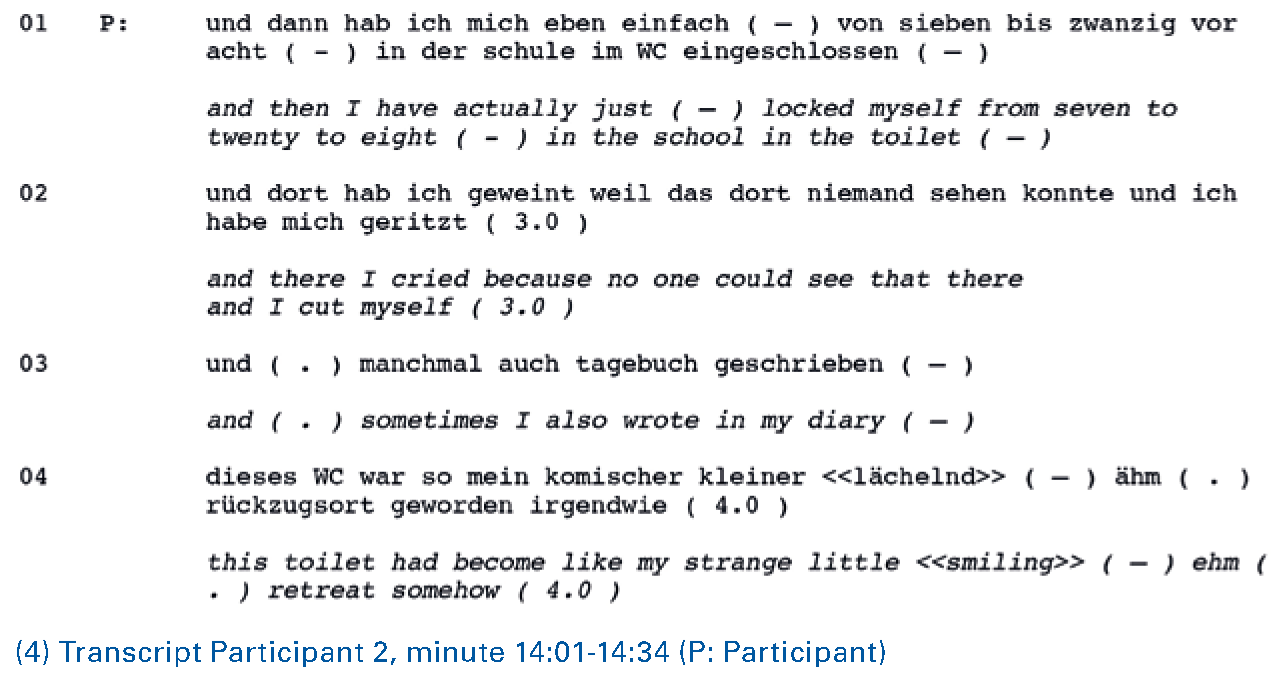
This section is taken from the participant’s description of her adolescence, which was shaped by difficulties with her parents and the onset of her mental illness. Her narrative is coherent and structured and shows little formulation difficulty. She describes her daily routine of retreating to the school’s toilet, naming the concrete feelings, thoughts and behaviours she experienced then (2–3). By using self-referential pronouns (“ich”/“I”, “mich”/“myself”, “mein”/“my”) she subjectivises these mental states. With her statement “ich habe mich geritzt”/“I cut myself”, she names a concrete symptom of mental illness. The giving of reasons for her behaviour (“weil das dort niemand sehen konnte”/”because no one could see that there”) as well as the interpretation of the toilet as a “komischer kleiner rückzugsort”/“strange little retreat” shows a difference between her perspective then and her perspective now. The formulation “komischer kleiner” / “strange little” which is presented with a smile adds an element of humor and self-irony to her narration.
The participant thus presents herself as personally affected by the events of the past, yet clearly distinguishes between now and then, and adds insightful interpretations from her present perspective. So one could say that she integrates aspects of immersion as well as of detachment without ever reaching either extreme; in other words, she oscillates between these poles in a balanced way.
Modes of distance and their characteristics
In summary, the narratives show three modes in which distance is created – “detachment”, “balanced oscillation” and “immersion” (table 2). They appear as three distinct constellations of formal and content-related aspects of the narrative. There are some overlaps of characteristics between the categories, which is why the single characteristics must always be interpreted in the broader context. “Detachment” and “immersion” are similar on a formal level, both being characterised by formulation difficulties and lack of coherence, but can be differentiated by focusing on the level of abstraction and on emotionality: whereas in “detachment”, the narration is abstract and/or little emotional (no naming of feelings, desubjectivised and generalised speech), in “immersion”, it is concrete and detailed as well as / or highly emotional (naming of feelings, paraverbal signs of being acutely emotionally affected or even overwhelmed, e.g., crying and exhalations). “Balanced oscillation” and “immersion” equally share some features, especially the concrete naming of feelings, thoughts and behaviours and the reproduction of speech and thought. They can be differentiated by considering the level of abstraction and coherence: whereas in “balanced oscillation”, concrete and abstract descriptions occur side by side and the narrative is coherent, in “immersion”, concrete descriptions prevail and the narrative lacks coherence. “Detachment” and “balanced oscillation” are most clearly distinct from each other.
Table 2 shows all the individual characteristics and the three modes of distance identified in our data. Characteristics that newly emerged from our data are marked with an asterix (*), characteristics previously described in the literature are not marked.
Discussion
Distance is a phenomenon that, whilst increasingly being researched and specifically exploited in psychotherapy over the past two decades, is still only sketchily defined at the descriptive level. In this qualitative analysis of distance in autobiographical narratives of mental illness, we integrated psychological and linguistic insights on distance, which, roughly speaking, amounts to integrating aspects of content and form. This allowed a more in-depth, nuanced and gestaltic description of distance, which also takes into consideration the multilayered nature of narration as a communicative act.
Interdisciplinary approach
Against the background of the interdisciplinary approach taken here, it seems particularly apt – and indeed fruitful – to reflect on the basic assumptions of the research design and the scope of its findings: our study took the psychological concept of distance as its departure point. Psychology’s as well as medicine’s traditional understanding of language can be summarised as considering language as a window into the human mind. Based on this understanding, a correlation between features of the linguistic surface and underlying mental phenomena is assumed. Thus, in psychological research on distance, distance has been operationalised, i.e., made observable by verbal features such as statements of reflection, insights etc. [4, 5, 8]. It is precisely this assignment of a psychological function to a given linguistic feature that linguistic conversation analysis considers illegitimate or at least highly problematic. It is argued that the function of a given linguistic feature can always only be identified in a specific communicative context, in other words, that generalisations about the psychological function of a given linguistic feature disregard the situatedness and context-dependence of communication [14]. So, any general statement about a connection between a given feature observed on the linguistic surface and an underlying mental state seems misled. But such general connections are exactly what research in psychology as well as medicine typically seeks to establish.
This study in clinical psychology draws on insights from linguistic conversation analysis to describe the phenomenon under study – distance – in more depth and detail, especially by using conversation analytic instruments to systematically describe how distance is displayed in communicative interactions.
This study is a typical exercise in interdisciplinarity insofar as it combines what at a first glance seem to be theoretically incompatible approaches. Clearly, this is not a study in linguistic conversation analysis. Rather, it is a study in clinical psychology drawing on insights from linguistic conversation analysis to describe the phenomenon under study – distance – in more depth and detail, especially by using conversation analytic instruments to systematically describe how distance is displayed in communicative interactions. The paradigmatic difference between psychology and conversation analysis, namely the latter’s rejection of the a priori correlation of features of the linguistic surface with underlying mental phenomena, can itself be informative: Stukenbrock [14] points out that phenomena such as coping, actualisation and distancing take place within the narrative or more generally the communicative process itself. This view of conversations as self-sufficient interactive rooms in which processes such as distancing unfold seems indeed to be well suited to capturing essential characteristics of psychotherapeutic practice. Whilst not specifically focusing on distance, this processual and interactive character of narratives in the context of psychotherapy has also been stressed by Boothe and colleagues [37, 38], and it is no coincidence that they too draw on conversation analysis to grasp and systematically describe these aspects.
Discussion of results
Overall, we identified 29 individual characteristics that display distance – understood as a continuum of perspectives reaching from detachment at one end to immersion at the other – to the experience of mental illness. In the first place, we could identify most of the characteristics described in previous studies [2, 3, 5–7, 14, 15, 23] in our data, too. This was to be expected as the experience of mental illness, the object of distancing in this study, is an autobiographical experience, constituted by emotions and thoughts, that were the objects of distancing in previous studies. By carefully examining the narratives and especially the passages in which the previously described characteristics had been identified further, we recognised nine additional characteristics: intellectualisation, focus on facts, description of the illness as controllable, mention or no mention of the psychiatric diagnosis, relativisation of the illness, distinction between oneself and other people with the same diagnosis, self-presentation as particularly functional, and description of changes and difficulties related to the illness. Whilst intellectualisation and a focus on facts might, in combination with other characteristics, be general ways to display detachment from an experience, the other characteristics identified here appear to be specific to displays of distance regarding (mental) illness experiences.
We identified 29 individual characteristics that display distance – understood as a continuum of perspectives reaching from detachment at one end to immersion at the other – to the experience of mental illness.
When the individual characteristics were grouped into broader categories, three categories emerged with some characteristics occurring in more than one category. The categories were interpreted as “detachment”, “balanced oscillation”, and “immersion” and can be understood as spanning the continuum of distance with “balanced oscillation” being a sort of middle ground. This description of the phenomenon of distance corresponds to Scheff’s work [23] from the 1980s. Scheff described distance as the ratio of observation of, to participation in one’s emotions while talking about past experiences. He identified three types of distance which he terms “overdistanced”, “aesthetically distanced”, and “underdistanced”. Stukenbrock [14, 15] also described three modes of presentation or framing in narratives of child loss, namely “actualisation and overpowering”, “actualisation and performance”, and “distancing and de-personalization”. Most recent psychological research on distance, however, has assumed only two types of distance: Kross et al. [3, 6, 7] and Barbosa et al. [5, 9] distinguish between a “self-distanced” and “self-immersed” perspective or speech, with “selfimmersed” corresponding to our category “immersion” and “self-distanced” being most akin to what we term “balanced oscillation”. Interestingly, Barbosa herself raises concerns about her two-fold model of distance, pointing out that there seems to be an avoiding and an insightful type of distance [4, 5]. Our three-fold model of distance substantiates these concerns. It is also very much in line with findings from psychotherapy research that describe the ability to shift from an immersed to a detached perspective or the other way round as decisive for coping with adverse experiences [1, 22] and has shown that in the course of a psychotherapy, it is the progressive transition from immersion to distancing that distinguishes between cases with good and cases with poor outcomes, rather than the frequency of immersion/distancing at a given moment [4, 5].
In our data, we found more than one mode of distancing in each participant’s narrative. But when the frequency of the coded modes were counted, a dominant mode of distancing emerged for each participant. This finding too highlights the continuous nature of distance as well as its processual constitution. Distancing is not about reaching a certain mental state, but rather a positioning to one’s experience that one actively performs time and time again. The dominance of one mode of distancing in each participant’s narrative suggests that a certain kind of positioning can become a habit. This further suggests a possible link between distancing and coping.
Strengths and limitations
Our study’s integration of psychological and conversation analytic approaches to distance adds depth and detail, especially at the level of linguistic form, to previous descriptions and operationalisations of distance. It furthermore highlights the importance of viewing individual verbal characteristics in their broader communicative context in order to arrive at meaningful interpretations. Apart from the principled concerns raised about generalisations by conversation analysis, the qualitative design more generally and the small sample size especially limit the generalisability of our results. As the small sample was nevertheless diverse with regards to diagnosis, duration of illness and gender (unfortunately not with regards to educational background), we can still assume that important aspects of distance did indeed emerge in our sample. As the setting of narrative interviews shares important features with psychotherapeutic settings, our detailed, systematizing description of distance can serve as starting point for larger-scale, possibly also quantitative studies, on this important phenomenon in the clinical context. Aspects that equally need further investigation are the role of the communicative interaction of narrator and interviewer resp. patient and therapist as well as the role of non-verbal behavior like gaze, facial expressions, gesticulation and body posture in the constitution of distance.
Clinical relevance
Psychotherapists routinely observe phenomena of distancing, yet usually lack a systematic of characteristics by which to assess and describe them. Our study provides such a systematic and particularly highlights the awareness of verbal form not only at the level of individual characteristics, but at a more gestaltic level including, for example, the formulation process. With regards to the conception of distance, our study adds to the continuum view and stresses its processual character. It also negates simple evaluations as “over-” or “under-distanced” as well as the normative positing of distance as unequivocally desired for mental health. This encourages psychotherapists to elicit modulation of distance as a therapeutic intervention and provides them with technical means to support this, for example by changing between or suggesting formulations that are in line with one of the described modes of distance or another. Settings other than psychotherapy in which narration of illness experiences is encouraged, such as so-called Erzählcafés (https://www.netzwerkerzaehlcafe.ch/), might also provide a space for modulations of distance and thereby contribute to coping and recovery.
Disclosure statement
No financial support and no other potential conflict of interest relevant to this article was reported.
Acknowledgements
We would like to thank Yvonne Ilg, co-leader of the project “Drüber reden! Aber wie?”, for introducing us to conversation analysis, and for critically accompanying this analysis and the development of this manuscript.
References
- You find the complete bibliography in the online version of the article at http://doi.org/10.4414/sanp.2022.10069.

This is an open-access article distributed under the terms of the Creative Commons Attribution Non-Commercial No Derivatives (CC BY-NC-ND) 4.0 License.