


Abstract
With the anti-CD52 antibody alemtuzumab, the second monoclonal antibody for the treatment of patients with relapsing-remitting multiple sclerosis was approved in Switzerland in December 2014. Alemtuzumab is administered intravenously in two treatment courses, the second being administered twelve months after the first. The clinical study programme of alemtuzumab encompasses three studies comparing the monoclonal antibody with subcutaneous high-dose interferon beta (IFNB)-1a in treatment-naïve and pretreated patients. The antibody proved to reduce significantly the annualised rate of relapse and the rate of sustained accumulation of disability compared with IFNB-1a. In addition, the rate of brain atrophy was significantly lower in alemtuzumab-treated patients. The risks identified with the use of alemtuzumab include infusion-associated reactions, infections and antibody-mediated autoimmunity, in particular autoimmune thyroid disorders and immune thrombocytopenia. In clinical practice, the monoclonal antibody will so far be reserved for the treatment of patients with active disease and in cases of treatment failure.
Introduction
In the past 10 years, the treatment options for patients with relapsing-remitting multiple sclerosis (RRMS) underwent some major changes. After relying on injectable interferon-beta preparations for quite some time, the advent of the first monoclonal antibody, natalizumab, followed by the first oral drug, fingolimod, improved the outcome of these patients and the possibilities to treat them more individually quite dramatically. With alemtuzumab now, the second monoclonal antibody was approved in December 2014.
Indication/dosage
In Switzerland, alemtuzumab is indicated for adult patients with relapsing remitting multiple sclerosis (RRMS) with active disease defined by at least two relapses in the two years before treatment initiation, at least one of them within a year before starting treatment [1]. The recommended and approved dosage of alemtuzumab in patients with RRMS is 12 mg/day administered as an intravenous infusion for two treatment courses. Initial treatment course: 12 mg/day for 5 consecutive days (60 mg total dose). Second treatment course: 12 mg/day for 3 consecutive days (36 mg total dose) administered 12 months after the initial treatment course.
Mode of action
Alemtuzumab binds to CD52, a 12-amino-acid cell surface protein. The exact function of CD52 is unknown. Some data indicate that it may be involved in the costimulation and migration of T cells [2,3]. CD52 is present at high levels on T and B lymphocytes, and at lower levels on natural killer cells, monocytes, dendritic cells, macrophages and eosinophils [4]. There is little or no CD52 detected on neutrophils, plasma cells or bone marrow stem cells.
Following cell surface binding to T and B lymphocytes, alemtuzumab acts through antibody-dependent cellular cytolysis and complement-mediated lysis. This leads to a selective and efficient lysis of the circulating lymphocytes of the adaptive immune system while leaving the components of the innate immune system relatively intact [4]. Within few weeks after alemtuzumab treatment, a distinctive pattern of T and B cell repopulation begins.
The exact mechanism by which alemtuzumab exerts its therapeutic effects in MS is not fully elucidated. However, research suggests that alterations in the number, proportion and properties of lymphocyte subsets during repopulation post-alemtuzumab may change the balance of the immune system. In particular, the proportion of regulatory T (Treg) cells and the representation of memory T and B lymphocytes increase [5]. Consequently, there seems to be a reduction of T cell infiltration into the CNS and a shift in the T cell cytokine profile that may lead to reduced inflammation [6,7]. An increased percentage of Treg post-alemtuzumab may contribute to reduction in MS disease activity [4,8].
Clinical study programme
The clinical study programme of alemtuzumab encompasses three studies comparing the monoclonal antibody with subcutaneous high-dose interferon beta (IFNB)-1a: CAMMS223, CARE-MS I and CARE-MS II. Whereas CAMMS223 and CARE-MS I were conducted in treatment-naïve patients, CARE-MS II included patients who had relapsed on prior therapy.
CAMSS223
This phase II study enrolled 334 treatment-naïve RRMS patients with an expanded disability status scale (EDSS) of three or less, disease duration of 3 years of less and one or more enhancing lesions, as seen on at least one of up to four monthly cranial magnetic resonance imaging (MRI) scans [9]. The patients were randomised to receive either subcutaneous IFNB-1a (at a dose of 44 μg) three times per week or annual intravenous cycles of alemtuzumab (at a dose of either 12 mg or 24 mg per day) for 36 months.
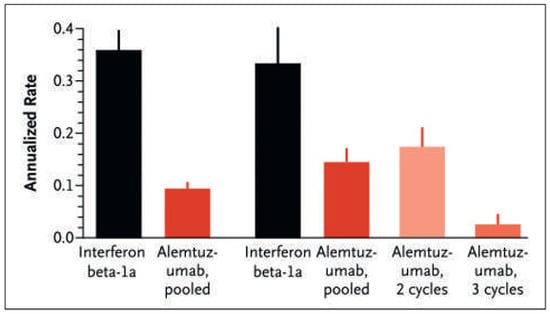
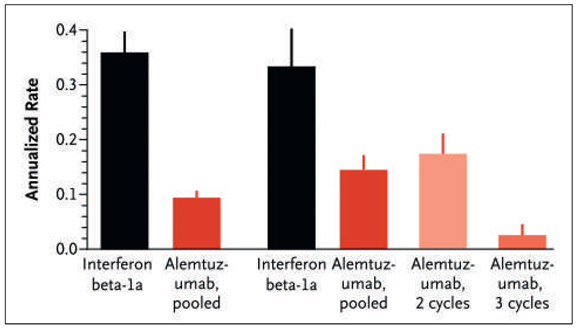
Compared with IFNB-1a alemtuzumab significantly reduced the rate of sustained accumulation of disability (9.0% vs 26.2%; p <0.001) and the annualised rate of relapse (0.10 vs 0.36; p <0.001) (coprimary endpoint) (Figure 1). In addition, the lesion burden in the alemtuzumab group was reduced significantly. From month 12 to 36, brain volume increased in the alemtuzumab group while it decreased in the IFNB-1a group (p = 0.02). Most important adverse events seen in the study were infusion-related reaction (98.6%), thyroid disorders (23% vs 3% with IFNB-1a), infections (66% vs 47%) and immune thrombocytopenic purpura (ITP, 3% vs 1%). As one of six patients developing ITP under treatment with alemtuzumab died from a fatal brain haemorrhage before diagnosis, a programme to ensure prompt identification and appropriate management of ITP was implemented. All other ITP patients recovered (four with specific treatment, one without).
Figure 1.
Annualised relapse rate under alemtuzumab and interferon beta-1a [9]. (Alemtuzumab: months 0 to 36, n = 222; months 24 to 36, n = 97 [2 cycles] and n = 45 [3 cycles]. Interferon beta-1a: months 0 to 36: n = 111; months 24 to 36, n = 74).
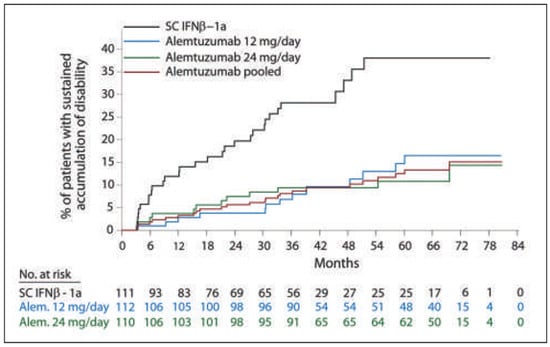
Patients in CAMMS223 were invited to participate in an extension study to explore the continued durability of the treatment effects of alemtuzumab and to assess the long-term safety profile [10]. Data from this extension phase showed that over 5 years, alemtuzumab (both dosages pooled) lowered the risk of sustained accumulation of disability by 72% (Figure 2) and the rate of relapse by 69% compared with IFNB-1a (both p <0.0001). The safety profile for alemtuzumab remained similar to that one found during the original study period. The incidence of secondary autoimmune disease declined during the extension period. Thyroid disease was the most common autoimmune event, seen in 30% of alemtuzumab-treated patients vs 4% in the IFNB-1a group. Onset ranged from 6 to 61 months after the first alemtuzumab exposure. These patients responded to conventional therapy. No additional ITP evens where reported during the extension phase. As well, there was no case of PML (progressive multifocal leucoencephalopathy) throughout the whole study.
Figure 2.
Kaplan-Meier estimates of time to sustained accumulation of disability through complete follow-up with the number of at-risk patients listed below [10].
CARE-MS I
This 2-year, randomised controlled phase III trial enrolled 581 treatment-naïve RRMS patients with an EDSS of three or less and disease duration of 5 years or less [11]. They were allocated to either intravenous alemtuzumab (12 mg) or subcutaneous IFNB-1a (44 μg). A total of 376 patients could be included in the primary analysis. Alemtuzumab showed a 55% reduction of the annualised relapse rate compared with IFNB-1a (p <0.0001). Seventy-eight percent of the alemtuzumab-treated patients compared with 59% of the IFNB-1a group remained relapse free over 2 years (p <0.0001). The risk of sustained accumulation of disability vs IFNB-1a was reduced by 30% (p = 0.22). With alemtuzumab, the degree of brain atrophy was reduced by 42% compared with IFNB-1a (p <0.0001). Overall, 90% of patients in the alemtuzumab group had infusion-associated reactions, 12 (3%) of which were regarded as serious. Infections, predominantly of mild or moderate severity, occurred in 253 (67%) patients treated with alemtuzumab versus 85 (45%) patients treated with IFNB-1a. By 24 months, 68 (18%) patients in the alemtuzumab group had thyroid-associated adverse events compared with 12 (6%) in the IFNB-1a group. Three (1%) alemtuzumab-treated patients developed ITP compared with none in the IFNB-1a group. There was no case of PML reported during this study.
CARE-MS II
In this 2-year phase III study, 840 RRMS patients were randomised to receive either alemtuzumab (12 or 24 mg) or subcutaneous IFNB-1a (44 μg) [12]. Eligible patients had disease duration of 10 years or less, at least two attacks in the previous 2 years with at least one in the previous year, at least one relapse while on IFNB or glatiramer acetate after at least 6 months of treatment and an EDSS scores of 5 or less.
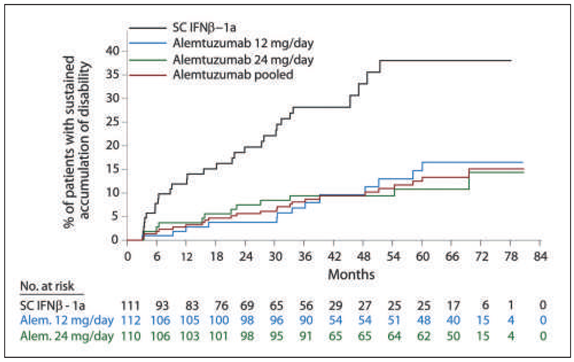
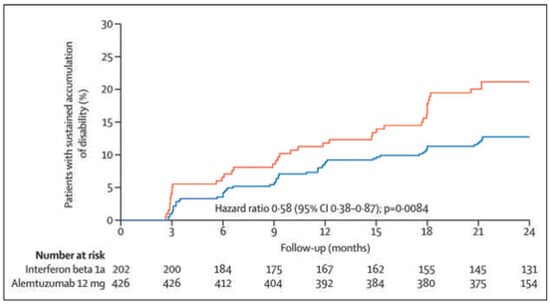
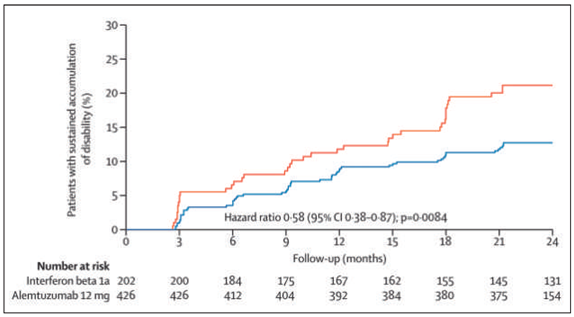
Fifty-one percent of the patients in the INFB group relapsed compared with 35% of patients in the alemtuzumab group (p <0.0001), corresponding to a 49.4% improvement with alemtuzumab. A total of 65% of alemtuzumab-treated patients and 47% of patients in the IFNB-1a group were relapse-free at 2 years (p <0.0001). Treatment with alemtuzumab reduced the risk of sustained accumulation of disability by 42% (p = 0.0084) (Figure 3). Patients who relapsed on prior therapy were more than twice as likely to demonstrate sustained improvement in pre-existing disability with alemtuzumab than with IFNB-1a. The degree of brain atrophy compared with IFNB-1a was reduced by alemtuzumab by 23% (p = 0.01).
Figure 3.
Kaplan-Meier estimate of 6-month sustained accumulation of disability [12].
In total, 90% of the patients allocated to alemtuzumab 12 mg had infusion-associated reactions, 77% had infections (compared with 66% of patients in the IFNB-1a group) that were mostly mild-moderate with none fatal. Thyroid disorders were more common after alemtuzumab (16% under alemtuzumab 12 mg vs 5% under IFNB-1a) without any cases of ophthalmopathy. All cases could be managed conventionally. Three patients (1%) of the alemtuzumab-12-mg group had immune thrombocytopenia. No case of PML was reported in this study either.
The 3-year follow-up of both the CARE-MS I and II studies showed that alemtuzumab-treated patients demonstrated durable disease control for up to 3 years [13]. The relapse rate remained consistently low and mean changes in EDSS scores remained stable or improved compared with baseline in the majority of patients. Fewer than 20% of patients required retreatment with alemtuzumab during year 3.
First long-term efficacy and safety data
In 2014, Tuohy et al. published data from an observational cohort study with alemtuzumab with a median follow up of 7 years [14]. They collected data from all 87 patients treated with alemtuzumab on investigator-led studies in Cambridge, United Kingdom, from 1999 to 2012. These patients had RRMS with at least one relapse in the preceding year, an EDSS of less than six, disease duration of less than 10 years and no previous exposure to experimental therapy. Most of these patients (52%) required just two cycles of alemtuzumab. Using a 6-month sustained accumulation of disability definition, 67.8% of patients had an improved or unchanged disability compared with baseline. No new safety concerns arose over this extended follow-up.
Conclusion
In the two phase III studies CARE-MS I and II, the monoclonal anti-CD52 antibody alemtuzumab showed a significant reduction in relapse rate versus the active comparator IFNB-1a (44 μg s.c.) by 55% and 49%, respectively (p <0.0001) [11,12]. It is important to note that no placebo controlled study was performed. The risk of 6-month sustained disability progression versus the active comparator was reduced by 30% and 42%, respectively (p = 0.22 / p = 0.0084). In addition, the rate of brain atrophy was significantly lower in alemtuzumab-treated patients compared with the patients of the IFNB-1a group. The adverse event profile seen in these two studies was consistent with previous trials. The risks identified with the use of alemtuzumab include infusion-associated reactions, infections and antibody- mediated autoimmunity, in particular autoimmune thyroid disorders and immune thrombocytopenia. The proactive risk minimisation procedures implemented allowed early detection and management of serious autoimmunity-related adverse events with good outcomes.
In daily clinical practice, for the time being, alemtuzumab will be reserved for RRMS patients with active disease courses or for cases with so called treatment failure. The data available on efficacy of alemtuzumab are convincing, but the safety profile will have to be carefully taken into account. In order to minimise the risk of complications regular follow-up investigations and clinical vigilance will be of key importance. It will be the duty of neurologists and general practitioners to ensure that compliance of the patients in between the infusion cycles and after the end of treatment is maintained.
Conflicts of Interest
AC served as advisor for Biogen, Genzyme, Merck Serono, Bayer Schering, Novartis and TBVA.
References
- Prescribing Information Alemtuzumab (Lemtrada®), www.swissmedicinfo.ch.
- Watanabe T, Masuyama J, Sohma Y, Inazawa H, Horie K, Kojima K et al. CD52 is a novel costimulatory molecule for induction of CD4+ regulatory T cells. Clin Immunol 2006;120:247–59.
- Masuyama J, Yoshio T, Suzuki K, Kitagawa S, Iwamoto M, Kamimura T et al. Characterization of the 4C8 antigen involved in transendothelial migration of CD26(hi) T cells after tight adhesion to human umbilical vein endothelial cell monolayers. J Exp Med 1999;189:979–90.
- Hu Y, Turner MJ, Shields J, Gale MS, Hutto E, Roberts BL et al. Investigation of the mechanism of action of alemtuzumab in a human CD52 transgenic mouse model. Immunology 2009;128:260–70.
- Wiendl H, Kieseier B. Multiple sclerosis: reprogramming the immune repertoire with alemtuzumab in MS. Nat Rev Neurol 2013;9(3):125–6.
- Turner MJ, LaMorte MJ, Chretien N, Havari E, Roberts BL, Kaplan JM et al. Immune status following alemtuzumab treatment in human CD52 transgenic mice. J Neuroimmunol 2013;261(1–2):29–36.
- Zhang X et al. Neurology 2012;78 (suppl. 1): LA. P02.119.
- Cox AL, Thompson SA, Jones JL, Robertson VH, Hale G, Waldmann H et al. Lymphocyte homeostasis following therapeutic lymphocyte depletion in multiple sclerosis. Eur J Immunol 2005;35,3332-42.
- CAMMS223 Trial Investigators. Alemtuzumab vs. interferon-1a in early multiple sclerosis. N Engl J Med 2008;359:1786–1801.
- Coles AJ1, Fox E, Vladic A, Gazda SK, Brinar V, Selmaj KW et al. Alemtuzumab more effective than interferon β-1a at 5-year follow-up of CAMMS223 clinical trial. Neurology 2012;78:1069–78.
- Cohen JA, Coles AJ, Arnold DL, Confavreux C, Fox EJ, Hartung HP et al. Alemtuzumab versus interferon beta 1a as first-line treatment for patients with relapsing-remitting multiple sclerosis: a randomised controlled phase 3 trial. Lancet 2012;380:1819–28.
- Coles AJ, Twyman CL, Arnold DL, Cohen JA, Confavreux C, Fox EJ et al. Alemtuzumab for patients with relapsing multiple sclerosis after disease-modifying therapy: a randomised controlled phase 3 trial. Lancet 2012;380(9856):1829–39.
- Fox E, Arnold D, Cohen J, Coles A, Confavreux C, Hartung HP et al. Durable Efficacy of Alemtuzumab in Relapsing-Remitting Multiple Sclerosis Patients Who Participated in the CARE-MS Studies: Three Year Follow-Up; Neurology 2013; 80(Meeting Abstracts): S41.001.
- Tuohy O et al. Alemtuzumab treatment of multiple sclerosis: long-term safety and efficacy. J Neurol Neurosurg Psychiatry. 2014 May 21. [Epub ahead of print].
This is an open-access article distributed under the terms of the Creative Commons Attribution Non-Commercial No Derivatives (CC BY-NC-ND) 4.0 License.