


Antonio Machón:
Children’s Drawings The Genesis and Nature of Graphic Representation. A Developmental Study
Madrid: fibulas publishers; 2013. Softcover, 446 pages, 461 illustrations
(56 in colour)
Price: € 26,00.
ISBN: 978-84-616-5557-1
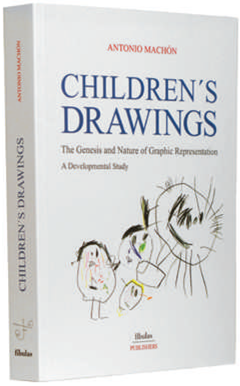
This remarkable book is strongly recommended to all persons professionally involved with children and children’s drawings. The author has studied Fine Arts and Psychology and undertaken Teacher Training. His scientific work on children’s drawings and their graphic development started in 1971.
This book, first published in Spain in 2003, is the result of a profound study of the scientific literature on children’s drawings and child development, as well as of field work in schools and methodical collection of over 30,000 drawings, giving rise to the archive of drawings on which the original research is based.
The drawings for analysis and statistical elaboration were collected by the author and his students, using a test especially designed for the children of this study.
The reader will welcome the elaborate discussion and graphic display of the existing classifications from 1895 to 1992, from the following authors: Sully, Lukens, Kerschensteiner, Rouma, Burt, Luquet, Prantl, Lowenfeld, Kellogg, Osterrieth and from Machón himself. The author’s own classification is on a card attached to the book, which is very handy. He goes into more detail in presenting existing studies on the subject, for instance those by E. Claparède at Geneva University and Corrado Ricci from Bologna.
Machón enumerates different approaches, such as anthropological, genetic-developmental, perceptive-formal, neuromotor, psychometric, projective, psychopathological, psychoanalytical, pedagogic, semiotic and artistic, and lists them, together with their definitions and the principal authors, in a table (p. 32).
He distinguishes, from age 0 to 10 years, four periods: the Formless Period, the Period of Form, the Period of Schematisation, and the Period of Subjective Realism. All four periods are classified along the criteria of formal graphic development and representational development, and are subdivided: from pre-scribble through the periods of form and of schematisation to subjective realism on the graphic side, and from graphomotor representations to graphic-symbolic representation, figurative representation, and the beginning of graphic narration on the side of representational development.
It is a pure pleasure to read this book that is well-written, besides being so instructive, and to contemplate the many drawings and paintings that are beautifully displayed and of impressive emotional content, as well as instructive.
Thomas von Salis, Zürich
This is an open-access article distributed under the terms of the Creative Commons Attribution Non-Commercial No Derivatives (CC BY-NC-ND) 4.0 License.