


Abstract
A new era has begun in the treatment of multiple sclerosis (MS) with the emergence of oral molecules and/or of therapies with higher efficacy. Early diagnosis is critical, as is the time and the choice of therapeutic intervention. With increasing options, personalisation of the timing and type of treatment for each individual is required. Thus, the assessment of individual risks and benefits for each treatment is mandatory, since these are long term, and possibly life-long, therapies. Monitoring tools that allow objective assessment of MS activity and severity on one hand, and the safety and risks of treatments on the other hand, already exist but need to be further developed.
Introduction
Multiple Sclerosis (MS) is the most frequent chronic neurological disease of young adults in Switzerland. MS is probably the neurological field where the most obvious advances in treatment options have occurred during the last two decades. MS was first considered to be an autoimmune disease of the central nervous system, but it is now recognised that both inflammatory and neurodegenerative processes play a role in the pathogenesis and evolution of MS. It is generally admitted that neurodegeneration is at the beginning of the disease mostly secondary to inflammation [1]. However, the exact interaction and sequence of these two different mechanisms still need to be determined. Persistent MS-related handicap, which is measured using the expanded disability status scale (EDSS), is secondary to neuronal damage; unfortunately, existing treatments only slightly influence neurodegeneration, and target mostly MS inflammatory mechanisms.
The revised diagnostic criteria published in 2011 [2], in which the detection of asymptomatic gadolinium-enhanced lesions by magnetic resonance imaging (MRI) at any time is considered to prove dissemination in time, simplifies MS early diagnosis. This is the case for a subset of active patients who would previously have been considered to have “clinical isolated syndrome” (CIS), and would have needed a second MRI after three months or a second relapse to confirm MS diagnosis.
Early diagnosis of MS helps introduction of disease modifying treatment (DMT) at an early stage, when inflammatory mechanisms are predominant and most patients have no established neurological deficit. In relapsing remitting (RR) MS, the inflammatory process is believed to predominate over neurodegeneration, which is more obvious in the secondary progressive (SP) phase of the disease, where neurological deficits become progressively more severe and MRI shows signs of cerebral and medullary atrophy, even though the mechanisms are still not clearly understood [1,3]. These observations emphasise the importance of early treatment, especially when the disease is active.
The different treatment options approved or expected in 2013 makes the decision “who, how and when to treat” MS patients more complicated. It is necessary to balance risks of treatment complications and risks of active MS, and consider the cost of each treatment as opposed to the social cost of patients severely handicaped as a result of late or insufficient MS treatment, in order to reach a responsible decision for each individual patient. Thus, any MS patient who is a candidate for treatment needs to be openly informed about the different options, their advantages and their side effects.
First-line DMT used in RRMS
Classic injectable DMTs, approved in Switzerland since 1996, are used as first-line therapies and still have a role in the treatment of MS. Three interferon beta (IFNβ) preparations (Avonex®, Betaferon®, Rebif®) and glatiramer acetate (Copaxone®) are approved for the treatment of RRMS, and it is accepted that treatment initiation early in the progress of the disease ensures a better therapeutic response.
Nevertheless, given the overall moderate efficacy of these DMTs, which essentially act on the inflammatory process, alternatives have been developed in recent years.
Fingolimod
Fingolimod (Gilenya®), approved in Switzerland in 2011, is the first oral treatment available for RRMS [4,5]. It modulates sphingosine-1 phosphate (S1P) receptors and prevents immune T and B lymphocytes from exiting secondary lymphoid tissues and reaching the central nervous system. A daily dose of 0.5 mg of fingolimod decreased the annual relapse rate by 54% compared with placebo and by 52% in comparison with IFNβ-1a 30 μg weekly. In four-year extension studies, both clinical and radiological efficaciy persisted, and were more pronounced if the treatment was started earlier. Slower progression of brain atrophy was noted at two and four years (European Committee for Treatments and Research in Multiple Sclerosis, ECTRIMS, 2012) [6], but these results need to be confirmed in the long term. This effect may be linked to the fact that S1P receptors are expressed by oligodendrocytes, astrocytes and neurones, and thus these cells could be positively modulated by fingolimod. In the same vein, results are expected from an ongoing trial of fingolimod versus placebo in primary progressive MS, where neurodegeneration is a fundamental mechanism of disease progression. Subgroups analysis [7,8] showed that RRMS patients with persisting disease activity during IFNβ treatment had a 71% decrease in annual relapse rate after switching to fingolimod. Furthermore, treatment-naïve patients with signs of high disease activity showed a 67% decrease in relapse rate compared with placebo.8
In spite of these encouraging results, other European countries have approved fingolimod only as a second-line treatment. This choice may be related to its immunodepressive properties, which might potentially increase the risk of viral infections and cancer. So far, a few severe viral infections have been reported [9,10], but the overall risk is low, probably because there is normal circulation of the T effector cells that are responsible for viral antigen recognition [11]. In practice, pretreatment screening to check the patients’ immunisation status is important, because live attenuated vaccines are contraindicated with fingolimod. At present, only varicella vaccine is mandatory before starting the treatment.
Fingolimod-associated macular oedema has been reported in 0.5% of cases; it appears to be dose-dependent and typically resolves upon cessation of therapy [12]. An ophthalmological exam is required after three months and the treatment should be stopped in the case of macular oedema.
Cardiac surveillance protocols for the six hours after the first administration (pulse, blood pressure, ECG, cardiac monitoring) have been reinforced worldwide and, in the case of treatment interruption during the first month, related to the risk of cardiac complications [13,14]. There is a risk of bradycardia and of transient first and second degree atrio-ventricular block, explained by the fact that atrial cardiac myocytes express S1P receptors [13]. When the treatment is taken regularly, S1P receptors are internalised and destroyed, and myocytes become insensitive to fingolimod. This is why it is important to exclude possible cardiac contraindications before introducing this treatment. Skin examination is proposed for patients at risk, because the frequency of basal cell carcinoma was slightly increased with fingolimod as compared with placebo or IFNβ-1a.
First-line DMT in the process of homologation for RRMS
Dimethyl fumarate (BG-12)
The oral medicine dimethyl fumarate (BG-12) is expected in 2013. One important advantage of this treatment is past experiance with the mixed compound dimethyl and monoethyl fumarate in the treatment of psoriasis, which reassures on its safety profile. BG-12 has shown beneficial effects in preclinical models of neuroinflammation, neurodegeneration, and toxic oxidative stress, mainly through the activation of the nuclear factor erythroid 2-related factor 2 (Nrf2) antioxidant response pathway [15]
Tested at doses of 240 mg twice or thrice daily [15], it decreased the relapse rate by 53% and 48%, respectively, compared with placebo, and reduced the risk of disability progression by 38% and 34%, respectively, over a period of two years. Side effects included flushing and gastrointestinal events, such as diarrhea, nausea and upper abdominal pain, as well as decreased lymphocyte counts and elevated liver aminotransferase levels. Even if its effect on disability progression has to be confirmed in the long term, BG-12 should be an interesting alternative to the already available first line DMTs, although twice or thrice daily administration may affect compliance.
Teriflunomide
Teriflunomide [16], the active metabolite of leflunomide, which is used in rheumatoid arthritis, inhibits de-novo synthesis of pyrimidines for deoxyribonucleic acid (DNA) replication, reducing T and B cell activation, proliferation and function in response to autoantigens. Once daily oral doses of 7 or 14 mg show similar efficacy in decreasing the relapse rate to injectable DMT. Additionally, the 14-mg regimen slightly reduced the risk of progression compared with placebo (20.2% vs 27.3% patients progressed over two years). No severe adverse event was reported and both dosages of teriflunomide were approved by the FDA in September 2012 and are being assessed in Europe.
Second-line DMT for RRMS
Natalizumab
Natalizumab (NTZ; Tysabri®) is well recognised for its efficacy, but also for a rare but major adverse event, namely progressive multifocal leucoencephalopathy (PML). It is used in cases of persistent MS activity with first-line DMT or as a first choice in severe RRMS [17]. NTZ showed the highest anti-inflammatory effect, decreasing the relative relapse rate up to 68% compared with placebo. Unfortunately, the risk of PML, which is due to reactivation of JC virus (JCV), a papilloma virus infecting 50% of the general population, requires that NTZ is used with caution.
PML in patients treated with NTZ can lead to severe handicap and even to death in 23% of the patients.
As of April 2nd 2013, 347 cases of PML in patients treated with NTZ have been described; the global risk is of 2.97o/oo. The individual risk can, however, be stratified on the basis of three criteria: (i.) previous JCV infection (antibodies in the serum), (ii.) duration of NTZ treatment, and (iii.) previous exposure to immunosuppressants [17,18,19]. After the 24th infusion, patients negative for anti-JCV antibodies have a lower risk, with an incidence of <0.09o/oo; this incidence is higher when patients have detectable anti-JCV antibodies (4.6o/oo, 95% confidence interval [CI] 3.7–5.6) and for patients who have previously been treated with immunosuppressants (11.1o/oo, 95% CI 8.3–14.5) [18]. Since a JCV negative patient can be infected anytime, serology should be repeated every six months. For safety reasons, MRI is also required annually for all patients treated with NTZ, according to the existing recommendations [17,19]. If PML is suspected, NTZ must be stopped and the diagnosis confirmed by a polymerase chain-reaction (PCR) test for JCV in the cerebrospinal fluid. If the PCR is negative, the spinal tap should be repeated and, depending on the degree of suspicion, a brain biopsy should be considered.
In the case of confirmed PML, NTZ is stopped and plasma exchange is often considered in order to eliminate rapidly NTZ [4]. However, after suspension of NTZ and, even more, after plasma exchange, there is a risk of developing immune reconstitution inflammatory syndrome (IRIS). During this process, lymphocytes massively invade the brain to fight against JCV infection for control of PML. If this inflammatory reaction is limited, there is no deleterious effect; however, if the inflammatory reaction is massive, it may be a burden even greater than PML itself. In such cases, corticosteroids are indicated, with the risk of promoting JCV proliferation. For this reason, corticosteroids should be administered only for the treatment of PML-IRIS and not to prevent this process [20].
Alemtuzumab
Alemtuzumab, a humanised monoclonal antibody targeting CD52, is presently in assessment for homologation. It causes severe depletion and then repopulation of B and T lymphocytes, leading to long-lasting changes in immunity with CD4 T lymphocytes returning to low normal values only after 35 months. Tested against IFNβ 44 ug thrice weekly in early RRMS [21], it showed a 55% superiority in decreasing the relapse rate. When administered as second-line therapy after IFNβ failure [22], it decreased the relapse rate by 49% and the risk of disability progression by 42% compared with IFNβ. Given these results, alemtuzumab appears to be one of the most potent drugs. It is, however, not without serious adverse events, such as infections, thyroid disorders (16%) and autoimmune thrombocytopenia (1%) [22], that can appear even five years after the last dose. Target patients might be, at this stage, those who still have active disease in spite of receiving first- or even second-line DMT.
How to make the best treatment decisions for individual RRMS patients?
In the light of the above drug profiles, it is understandable that treatment decisions do not depend solely on the comparisons of DMT efficacy. The assessment of the risks associated with each treatment, the use of algorithms that stratify these risks, as well as ways to treat possible complications must be considered in the choice of a DMT. Algorithms that stratify the risks should be available for all new treatments. In this vein, the management of the risk of PML in NTZ-treated patients is a good model to use for other molecules with similar risks.
However, MS burden should not be underestimated, and patients at risk of developing a fixed handicap should be anticipated at each stage of the disease. Insufficient or late treatment of active MS significantly increases the probability of a significant worsening of the patient’s health, which is far greater than that of a DMT potential side effect [23,24].
The field of MS research is constantly in progress, with important steps towards individualised treatment. New tools for monitoring the disease are becoming available, but efforts are still needed to increase efficacy and reduce the risks of complications in the care of MS patients.
Funding
This research received no external funding.
Conflicts of Interest
No financial support and no other potential conflict of interest relevant to this article was reported.
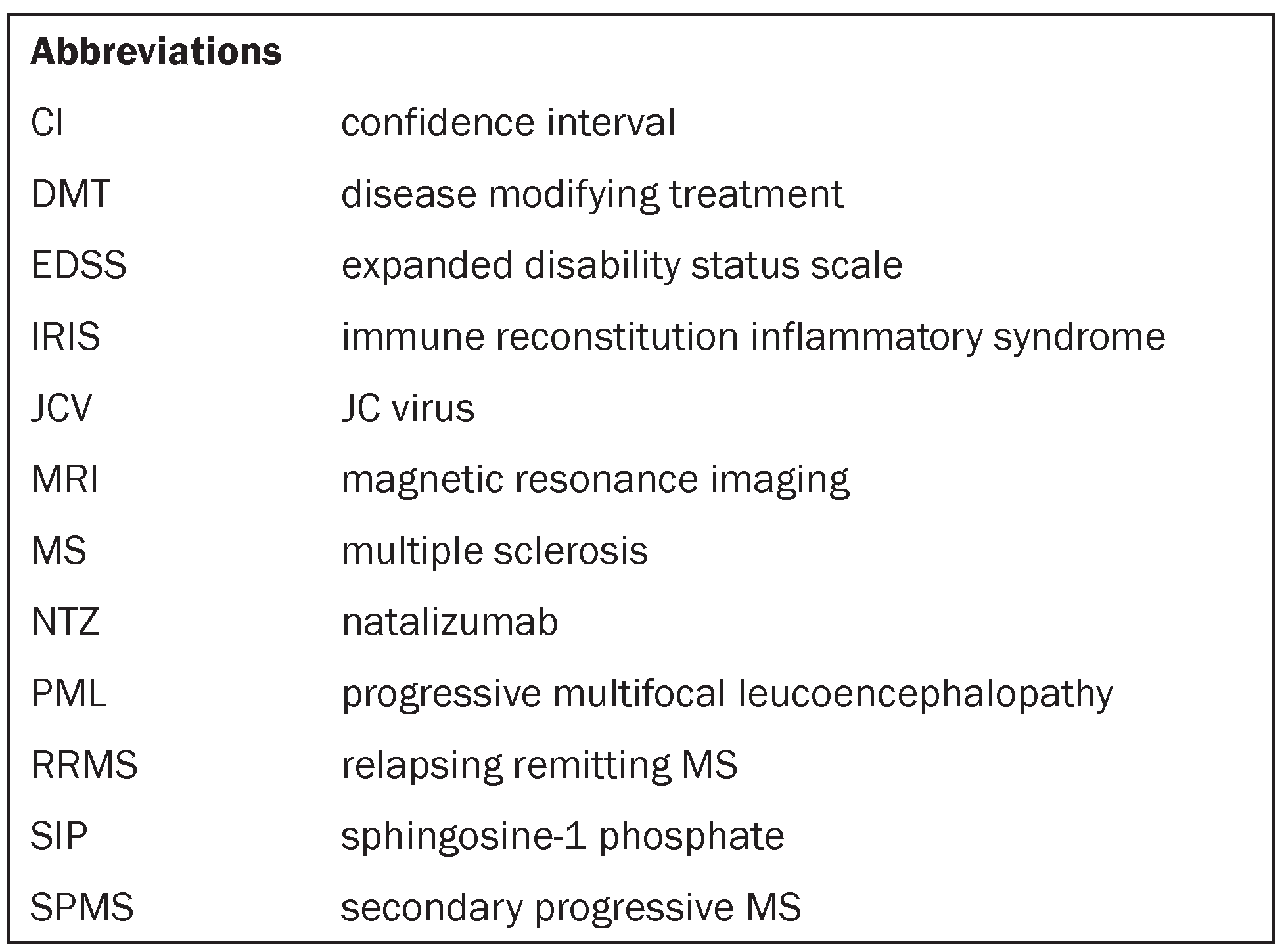
Abbreviations
References
- Haider, L.; Fischer, M.T.; Frischer, J.M.; Bauer, J.; Hoftberger, R.; Botond, G.; et al. Oxidative damage in multiple sclerosis lesions. Brain 2011, 134, 1914–1924. [Google Scholar] [CrossRef] [Scilit] [PubMed]
- Polman, C.H.; Reingold, S.C.; Banwell, B.; Clanet, M.; Cohen, J.A.; Filippi, M.; et al. Diagnostic criteria for multiple sclerosis: 2010 revisions to the McDonald criteria. Ann Neurol. 2011, 69, 292–302. [Google Scholar] [CrossRef] [Scilit] [PubMed]
- Rovaris, M; Confavreux, C; Furlan, R; Kappos, L; Comi, G; Filippi, M. Secondary progressive multiple sclerosis: current knowledge and future challenges. Lancet Neurol. 2006, 5, 343–354. [Google Scholar] [CrossRef] [Scilit]
- Schluep, M.; Du Pasquier, R. Sclérose en plaques: au-delà des traitements de première ligne. Rev Med Suisse 2012, 8, 946–949. [Google Scholar] [CrossRef] [Scilit]
- Pelletier, D.; Hafler, D.A. Fingolimod for multiple sclerosis. N Engl J Med. 2012, 366, 339–347. [Google Scholar] [CrossRef] [Scilit]
- Kappos, L.; Radue, E.W.; O’Connor, P.; et al. Phase III FREEDOMS study extension: fingolimod (FTY720) efficacy in patients with relapsing–remitting multiple sclerosis receiving continuous or placebo-fingolimod switched therapy for up to 4 years. Presented at ECTRIMS 2012; Lyon, France [Abstract P979]. Mult Scler. 2012, 18, 451–452. [Google Scholar]
- Kappos, L.; Radue, E.W.; O’Connor, P.; Polman, C.; Hohlfeld, R.; Calabresi, P.; et al. A placebo-controlled trial of oral fingolimod in relapsing multiple sclerosis. N Engl J Med. 2010, 362, 387–401. [Google Scholar] [CrossRef] [Scilit]
- Devonshire, V.; Havrdova, E.; Radue, E.W.; O’Connor, P.; Zhang-Auberson, L.; Agoropoulou, C.; et al. Relapse and disability outcomes in patients with multiple sclerosis treated with fingolimod: subgroup analyses of the double-blind, randomized, placebo-controlled FREEDOMS study. Lancet Neurol. 2012, 11, 420–428. [Google Scholar] [CrossRef] [Scilit]
- Ratchford, J.N.; Costello, K.; Reich, D.S.; Calabresi, P.A. Varicella-zoster encephalitis and vasculopathy in a patient treated with fingolimod. Neurology 2012, 79, 2002–2004. [Google Scholar] [CrossRef] [Scilit]
- Gross, C.M.; Baumgartner, A.; Rauer, S.; Stich, O. Multiple sclerosis rebound following herpes zoster infection and suspension of fingolimod. Neurology 2012, 79, 2006–2007. [Google Scholar] [CrossRef] [Scilit]
- Mehling, M.; Hilbert, P.; Fritz, S.; Durovic, B.; Eichin, D.; Gasser, O.; et al. Antigenspecific adaptive immune responses in fingolimod-treated multiple sclerosis patients. Ann Neurol. 2011, 69, 408–413. [Google Scholar] [CrossRef] [Scilit]
- Jain, N.; Bhatti, M.T. Fingolimod-associated macular edema: incidence, detection, and management. Neurology 2012, 78, 672–680. [Google Scholar] [CrossRef] [Scilit]
- Koyrakh, L.; Roman, M.I.; Brinkmann, V.; Wickman, K. The heart rate decrease caused by acute FTY720 administration is mediated by the G protein-gated potassium channel I. Am J Transplant. 2005, 5, 529–536. [Google Scholar] [CrossRef] [Scilit]
- Faber, H.; Fischer, H.-J.; Weber, F. Prolonged and symptomatic bradycardia following a single dose of fingolimod. Mult Scler. 2013, 19, 126–128. [Google Scholar] [CrossRef] [Scilit] [PubMed]
- Gold, R.; Kappos, L.; Arnold, D.L.; Bar-Or, A.; Giovannoni, G.; Selmaj, K.; et al. Placebo-controlled phase 3 study of oral BG-12 for relapsing multiple sclerosis. N Engl J Med. 2012, 367, 1098–1107. [Google Scholar] [CrossRef] [Scilit] [PubMed]
- O’Connor, P.; Wolinsky, J.S.; Confavreux, C.; Comi, G.; Kappos, L.; Olsson, T.P.; et al. Randomized trial of oral teriflunomide for relapsing multiple sclerosis. N Engl J Med. 2011, 365, 1293–1303. [Google Scholar] [CrossRef] [Scilit] [PubMed]
- Kappos, L.; Bates, D.; Edan, G.; Eraksov, M.; Garcie-Merino, A.; Grigoriadis, N.; et al. Natalizumab treatment for multiple sclerosis: updated recommendations for patient selection and monitoring. Lancet Neurol. 2011, 10, 745–758. [Google Scholar] [CrossRef] [Scilit]
- Bloomgren, G.; Richman, S.; Hotermans, C.; Subramanyam, M.; Goeltz, S.; Natarajan, A.; et al. Risk of natalizumab-associated progressive multifocal leukoencephalopathy. N Engl J Med. 2012, 366, 1870–1880. [Google Scholar] [CrossRef] [Scilit]
- Trampe, A.K.; Hemmelmann, C.; Stroet, A.; Haghikia, K.; Wiendi, H.; Goeltz, S.; et al. Anti-JC virus antibodies in a large German natalizumab-treated multiple sclerosis cohort. Neurology 2012, 78, 1736–1742. [Google Scholar] [CrossRef] [Scilit]
- Antoniol, C.; Jilek, S.; Schluep, M.; Mercier, N.; Canales, M.; Le Goff, G.; et al. Impairment of JCV-specific T-cell response by corticotherapy: Effect on PML-IRIS management? Neurology 2012, 79, 2258–2264. [Google Scholar] [CrossRef] [Scilit]
- Cohen, J.A.; Coles, A.J.; Arnold, D.L.; Confavreux, C.; Fox, E.J.; Hartung, H.P.; Havrdova, E.; et al. Alentuzumab versus interferon beta 1a as first-line treatment for patients with relapsing-remitting multiple sclerosis: a randomized controlled phase 3 trial. Lancet 2012, 380, 1819–1828. [Google Scholar] [CrossRef] [Scilit]
- Coles, A.J.; Twyman, C.L.; Arnold, D.L.; Cohen, J.A.; Confavreux, C.; Fox, E.J.; et al. Alentuzumab for patients with relapsing multiple sclerosis after diseasemodifying therapy: a randomized controlled phase 3 trial. Lancet 2012, 380, 1829–1839. [Google Scholar] [CrossRef] [Scilit] [PubMed]
- Rigau, V.; Mania, A.; Béfort, P.; Carlander, B.; Jonquet, O.; Lassmann, H.; et al. Lethal multiple sclerosis relapse after natalizumab withdrawal. Neurology 2012, 79, 2214–16. [Google Scholar] [CrossRef] [Scilit] [PubMed]
- Centonze, D.; Rossi, S.; Rinaldi, F.; Gallo, P. Severe relapses under fingolimod treatment prescribed after natalizumab. Neurology 2012, 79, 2004–2006. [Google Scholar] [CrossRef] [Scilit] [PubMed]
This is an open-access article distributed under the terms of the Creative Commons Attribution Non-Commercial No Derivatives (CC BY-NC-ND) 4.0 License.