


Key points
What are the risk factors and is there an indication for screening?
The lifetime risk of developing an intracranial aneurysm is about 2% and the risk of suffering from an aneurysmal SAH is about 0.6% when no other first degree relatives are affected. A strong risk factor for intracranial aneurysm is a positive family history, defined as two or more first degree relatives with subarachnoid haemorrhages (relative risk [RR] = 6.6) or polycystic kidney disease (RR = 4.4) [2]. These risk factors may identify individuals where screening may detect an unruptured aneurysm and occluding it may prevent potential SAH for this patient. However, because of the rare occurrence of these diseases, screening of individuals who have a family history of SAH or polycystic kidney disease will have little effect on the incidence of SAH in the general population. Most occurrences of subarachnoid haemorrhage in the general population are related to the more common risk factors of hypertension (RR = 2.8) and smoking (RR = 1.9), however, these risk factors alone cannot be used to trigger screening for an individual patient. Screening should be offered to patients with familial history or polycystic kidney disease and the rules of Rinkel should be followed [2]: The goal of individual screening is not to detect or to treat an aneurysm, but to increase the number of quality years of life. Therefore, before intracranial vessels are imaged, the risks and benefits of screening should be weighed. The procedure and the risks of screening – the risks of having an aneurysm, of an aneurysm rupturing, of treatment, and of finding a very small aneurysm that will not be treated but followed up, must be explained to the patient. The implications for driving and flying licences and life insurance (which differ by country), and the yield of repeated screening if the initial screening is negative should also be included when counselling a patient about screening. If the candidate wants to be screened, another important decision that has to be made before the screening is whether to inform the patient about unrelated incidental findings. Of course, all of these patients, including those who do not want to be screened, should be advised against smoking and to have their blood pressure checked regularly [2].
What is the risk of rupture from an unruptured intracranial aneurysm?
The International Study of Unruptured Intracranial Aneurysms (ISUIA) changed the management of unruptured IAs in the last decade. Before ISUIA, unruptured IAs were believed to bleed with a rate of 1% per year. ISUIA was the largest prospective study of the natural history and the risk of treatment of unruptured IAs. The main risk factors of rupture were size, site and the history of previous SAH from another aneurysm. The 5-year cumulative rupture rates for patients who did not have a history of SAH with aneurysms located in the anterior circulation were 0% (<7 mm), 2.6% (7–12 mm), 14.5% (13–24 mm) and 40% (>24 mm) compared with rates of 2.5% (<7 mm), 14.5% (7–12 mm), 18.4% (13–24) and 50% (>24 mm), respectively, for posterior circulation and posterior communicating artery aneurysms [3]. The age of the patient was a strong predictor for outcome after surgery, and patients >70 years, posterior circulation and large aneurysm size were predictors of poor outcome both in endovascular and microsurgical treatment. However, the study has been criticised for the potential selection bias, the high crossover rate for treatment, the a posteriori definition of size classed for rupture risk and especially the extremely low rupture rate of small (<7 mm) incidental aneurysms of the anterior circulation. A recent study on familial aneurysms found a rupture rate of 1% per year of those aneurysms that did not rupture in the ISUIA cohort [4].
How can the rupture paradox of small aneurysms be explained?
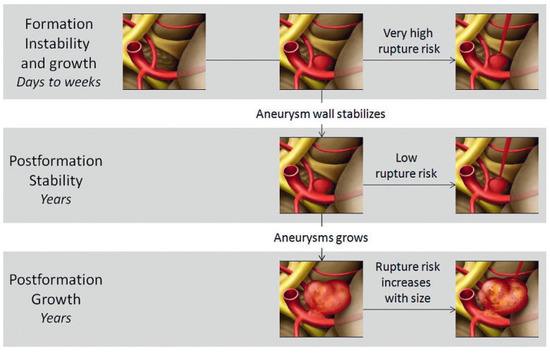
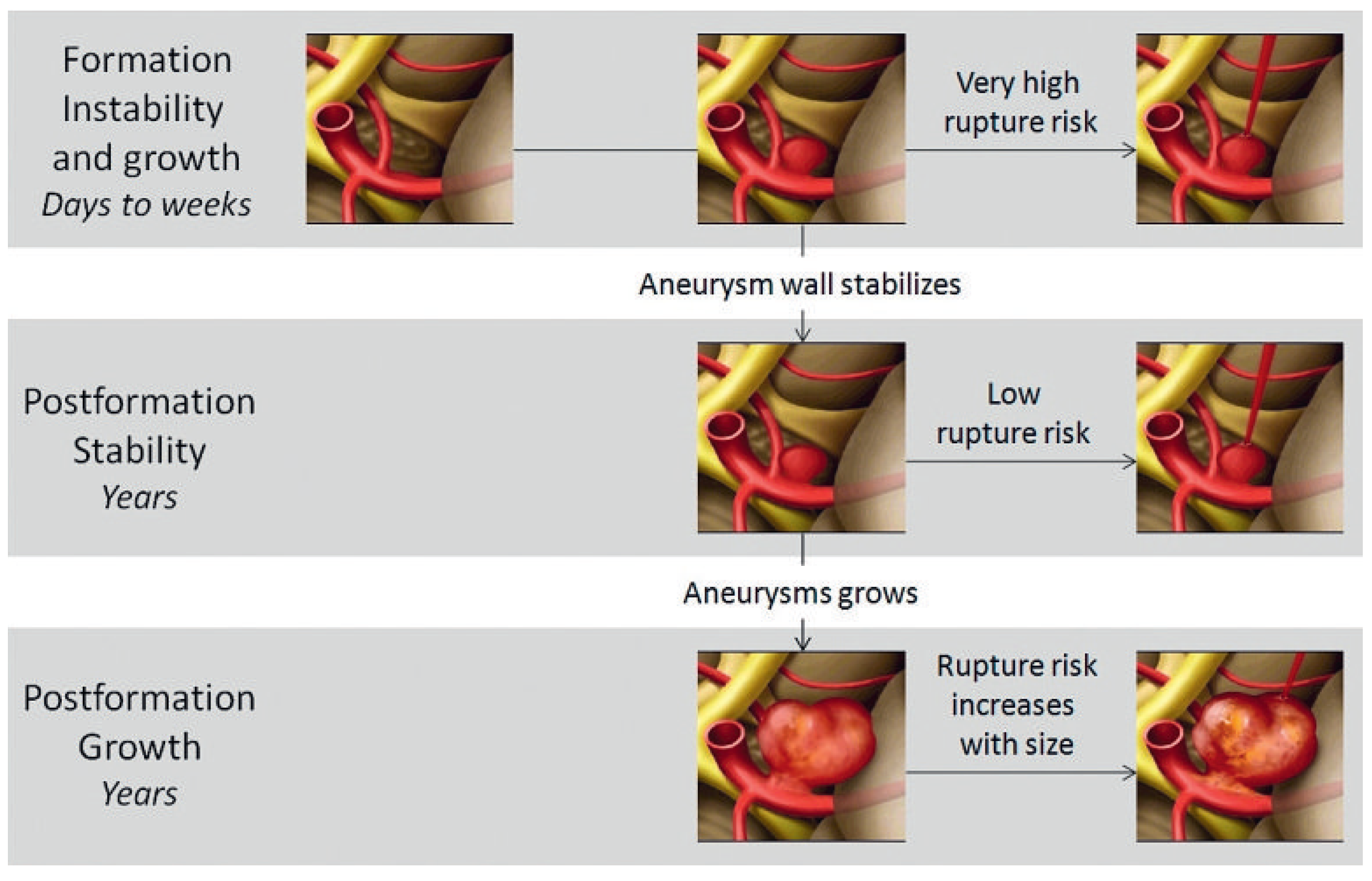
Subarachnoid haemorrhage is caused, in more than 50% of cases, by a small (<7 mm) ruptured aneurysm of the anterior circulation. However, when unruptured aneurysms of the same size and location in patients without previous SAH were observed in the ISUIA, no single aneurysm ruptured during a mean follow-up period of 4 years. Besides an ISUIA patient selection bias, a second hypothesis exists explaining the paradox by a “formation-instability” time bias. According to this hypothesis, intracranial aneurysms develop over a very short time. During their formation, they are highly unstable and have a high risk of rupture. After formation, they stabilise and the risk of rupture decreases sharply. After stabilisation they may stay at the same size or increase in size over time. With an increase in size, the risk of rupture may then increase again. Provided that the unstable formation time of aneurysms is short, it may become difficult to observe them during this early stage (Figure 1).
Figure 1.
Hypothesis of formation instability of intracranial aneurysms. During the different time periods of the life of intracranial aneurysms, they may have different risks of rupture. Due to the short time of formation and instability, it is unlikely that an aneurysm is diagnosed incidentally during this period.
Funding / potential competing interests
No financial support and no other potential conflict of interest relevant to this article was reported.
References
- van der Schaaf, I; Algra, A; Wermer, M; Molyneux, A; Clarke, MJ; van Gijn, J; Rinkel, GJE. Endovascular coiling versus neurosurgical clipping for patients with aneurysmal subarachnoid haemorrhage. Cochrane Database of Systematic Reviews 2005, 4, CD003085. [Google Scholar] [CrossRef] [Scilit]
- Rinkel, GJ. Intracranial aneurysm screening: indications and advice for practice. Lancet Neurol. 2005, 4, 122–8. [Google Scholar] [CrossRef] [Scilit] [PubMed]
- Wiebers, DO; Whisnant, JP; Huston, J; Meissner, I; Brown, RD; Piepgras, DG; et al. Unruptured intracranial aneurysms: natural history, clinical outcome, and risks of surgical and endovascular treatment. Lancet 2003, 362, 103–10. [Google Scholar] [CrossRef] [Scilit] [PubMed]
- Broderick, JP; Brown, RD; Sauerbeck, L; Hornung, R; Huston, J; Woo, D; et al. Greater rupture risk for familial as compared to sporadic unruptured intracranial aneurysms. Stroke 2009, 40, 1952–7. [Google Scholar] [CrossRef] [Scilit] [PubMed]
This is an open-access article distributed under the terms of the Creative Commons Attribution Non-Commercial No Derivatives (CC BY-NC-ND) 4.0 License.