


Summary
The Swiss Archives of Neurology and Psychiatry were founded in 1917 by Constantin von Monakow. The main motivation was the growing need for an independent Swiss journal. Previously Swiss neurologists had had to submit their scientific contributions to German or French journals, with the result that they were often insufficiently informed of their own compatriots’ work. For the Swiss Neurological Society, established in 1908, the foundation of the Swiss Archives was also a milestone in its battle to be accepted as an independent medical faculty. While the papers were mainly Swiss authored, the Swiss Archives also occupied a significant international position from the outset, as witness the regular contributions from well-known European neurologists. Constantin von Monakow remained editor-inchief until his death in 1930. Most of the famous (neuro-)scientific-philosophical works written during the last 15 years of his life were published in the Swiss Archives. Certainly the most outstanding volume was No 13 (1923), which contains 52 articles by the most renowned neurologists, psychiatrists, neuroanatomists and physiologists of that time as a festschrift for Constantin von Monakow’s 70th birthday. After Constantin von Monakow’s death, R. Bing (Basel) and M. Minkowski (Zurich) took over as editors of the neurology section. Both neurologists published a considerable number of papers in the Swiss Archives and contributed greatly to the quality of the journal, not least through their contacts with scientists from all over the world. It was in the Swiss Archives that M. Minkowski published his well-known work on the course of the optic nerve fibres (1920) and studies on the reflexes of the human foetus (1924, 1925). The 1st International Neurological Congress, which took place in Berne in 1931, was an important event in the history of Swiss neurology and formed the subject of a commentary in the Swiss Archives. At the end of the congress all the participants received a presentation copy of the most recent volume of the Swiss Archives. During the years preceding World War II the Swiss Archives played a remarkable international role by continuing to publish foreign papers, despite growing nationalism and racism in the surrounding countries of Europe. The journal also appeared regularly during the war. In 1959 the neurosurgeon H. Krayenbühl, who in 1941 had published his classic work on cerebral aneurysm in the Swiss Archives, became editor-inchief. During his editorship the journal’s name was expanded to Swiss Archives of Neurology, Neurosurgery and Psychiatry (until 1986). The most cited papers since 1945 have been those of R. Adams (on normopressive hydrocephalus) and B. Roth (on narcolepsy and hypersomnia). Several contributions have come from related specialities, e.g. the physiologist and Nobel Prizewinner W. Hess wrote on the autonomic nervous system, the anatomist G. Töndury on foetopathies and the paediatrician G. Fanconi on poliomyelitis.
Founding of an independent neurological journal
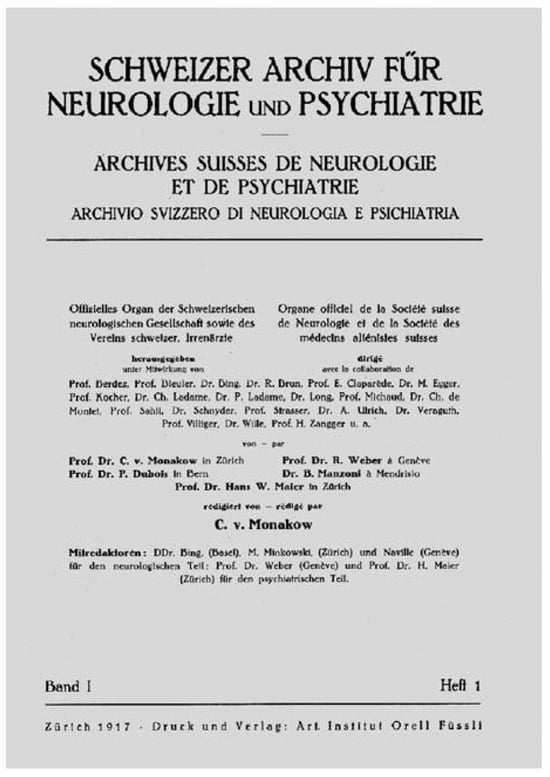
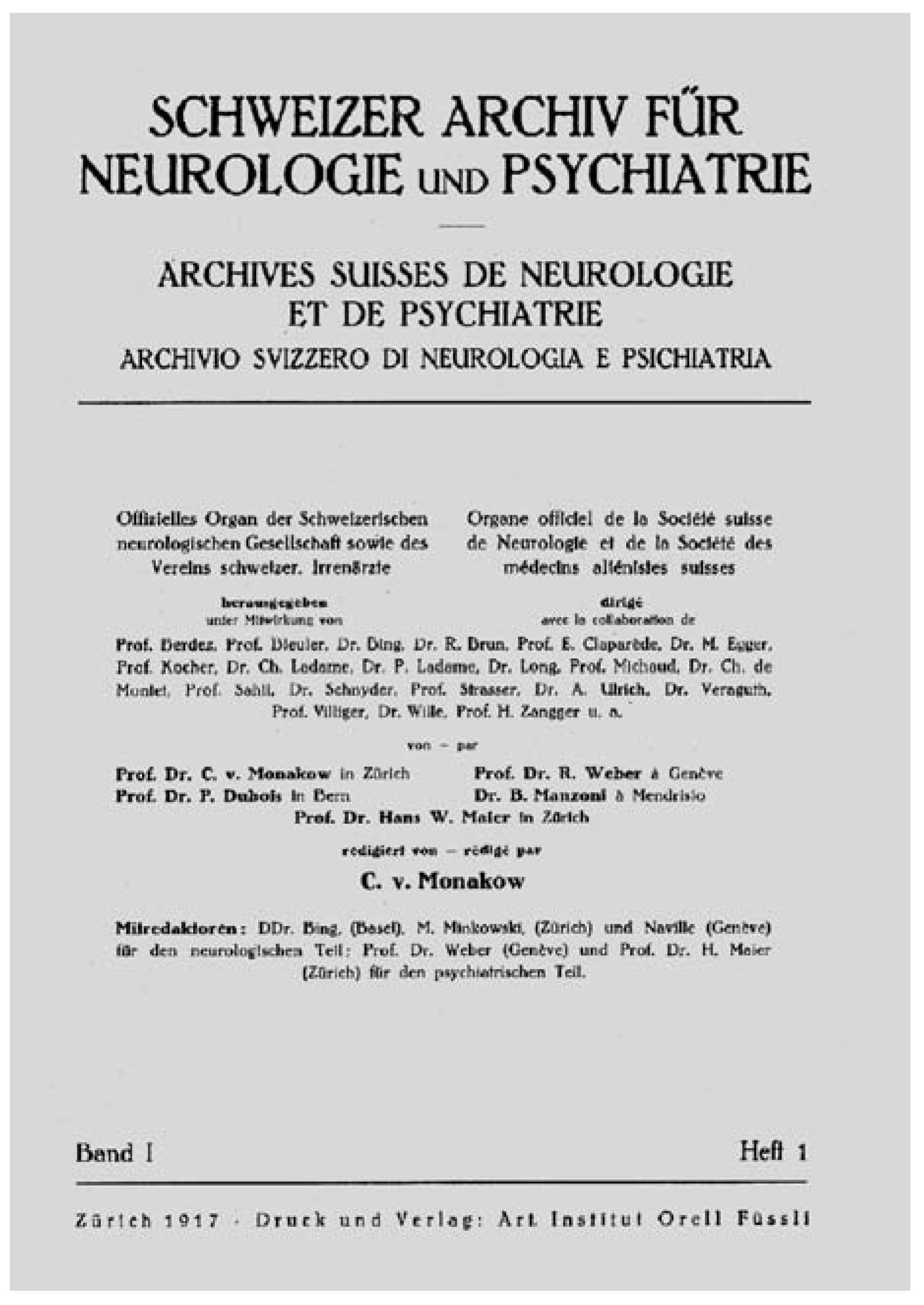
The first issue of the Swiss Archives of Neurology and Psychiatry was published in 1917 by the Zurich publisher Orell Füssli (Figure 1). The initiative for this originated with Constantin von Monakow (1853– 1930), who first suggested the idea of an independent Swiss neurological journal to the management committee of the Swiss Neurological Society (SNS) (founded at Olten in 1908) at its meeting in Neuchâtel on 12th November 1916 [1].
Figure 1.
Front-page of the first issue of the Swiss Archives of Neurology and Psychiatry.
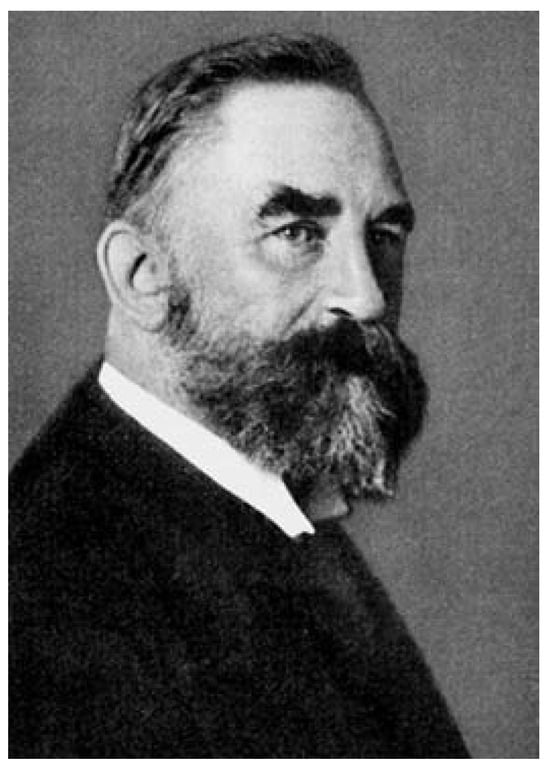
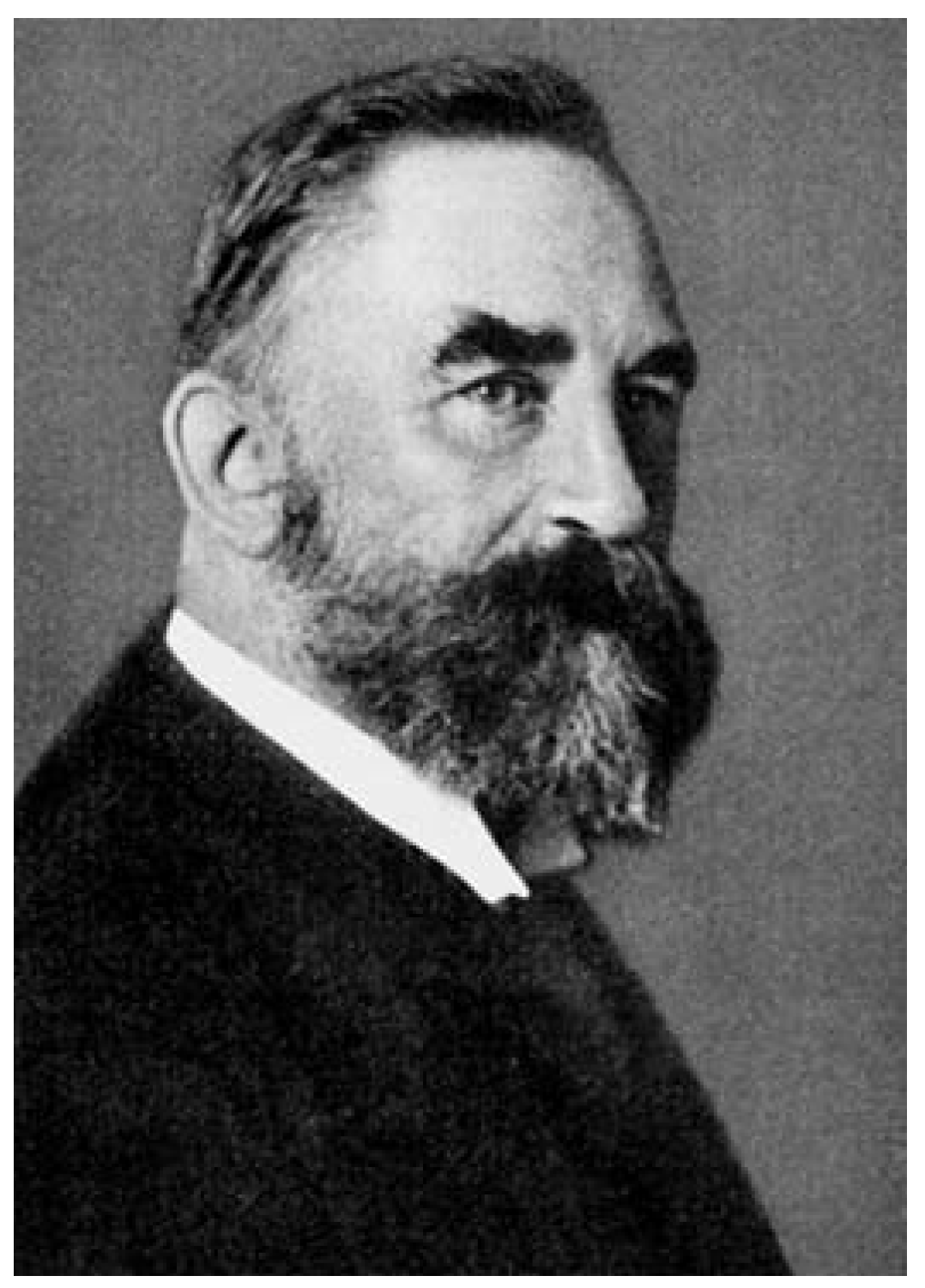
C. von Monakow (Figure 2) was born in Vologda Government, Russia, in 1853 and arrived in Zurich in 1866 (after a 3-year stay in Germany) [2]. While still pursuing his medical studies, he came into personal contact with contemporary leading psychiatrists and neuroanatomists, and for a year was assistant to E. Hitzig (1838–1907), director of Burghölzli Psychiatric Clinic. Other decisive encounters were with W. Griesinger (1817–1875) and his “Gehirnpsychiatrie”, and B. Gudden (1824–1886) with his celebrated microtome. Von Monakow laid the foundations of his work on neuropathology, neurophysiology and neuroanatomy during his year-long period as assistant in remote St Pirminsberg in the St Gall region (1878–1885) [3,4]. His monumental studies Gehirnpathologie (1897) and Die Lokalisation im Grosshirn und der Abbau der Funktion durch kortikale Herde (1914) made von Monakow world famous, and Zurich, where he had held an associate professorship since 1894 (the first chair of neurology in Switzerland), became a world byword for the “Zurich neurobiology school” or the “Monakow clinical-anatomical movement” [5,6,7,8].
Figure 2.
Constantin von Monakow (1853–1930).
As early as 1905–1916 the Arbeiten aus dem Hirnanatomischen Institut in Zürich were published – also with von Monakow as editor – although by a foreign publisher (I. F. Bergmann in Wiesbaden); these included, from 1909 to 1910, his celebrated monograph on the red nucleus, the tegmentum of midbrain and the subthalamic region [9,10,11]. After a total of 10 issues the flow of publications dried up – a consequence of the First World War. Von Monakow had further reasons to press for the founding of a new journal. In those days Swiss papers were mainly published in neighbouring countries – Germany or France, depending on the language. Von Monakow complained that in German-speaking Switzerland little notice was taken of papers by French-speaking compatriots, and vice versa (“… nous ne nous rencontrons et ne faisons première connaissance qu’au moyen de la presse étrangère”) ([1], p. 3). In addition, growing nationalism in war-torn Europe was making it increasingly difficult to bring out Swiss publications in other countries [10].
The need for an independent, unifying national journal may also have been sharpened by the fact that in other European countries during the last quarter of the 19th century several neurological journals had come into being. In Germany, for example, three important new publications (Archiv für Psychiatrie und Nervenkrankheiten, Centralblatt für Nervenheilkunde and Neurologisches Centralblatt) were founded between 1868 and 1882. This was also the case in France, where, under the editorship of J. M. Charcot (1825–1893) the journals Archives de Neurologie and Nouvelle Iconographie de la Salpêtrière were founded in 1880 and 1888 respectively, followed in 1893 by La Revueneurologique.The English review Brain had existed since 1878 [12].
In the history of Swiss neurology the founding of the Swiss Archives of Neurology and Psychiatry constituted a milestone: in the struggle for acceptance as an independent and officially recognised speciality neurology had taken a decisive step forward. If for no other reason, the Swiss Archives must also have been a source of keen personal satisfaction for von Monakow, who had for decades – and in the face of stubborn resistance to the very end – fought to lead neurology out from under the wing of internal medicine and psychiatry.
M. Minkowski (1884–1972), one of the first assistants in Zurich’s Brain Anatomy Institute under von Monakow, and his successor as Director of the University Neurological Clinic (1928), honoured him in his 1958 festschrift to mark the SNS’s 50-year jubilee as the “eigentlichen Pionier der Verselbständigung der Neurologie als medizinisches Fach” ([10], p. 5).
As its name makes clear, the Swiss Archives of Neurology and Psychiatry is not only the official organ of the SNS, but also of the Swiss Society of Psychiatry (SSP). The journal reflects a rapprochement of the two disciplines, between which there had been considerable animosity in the past, not least of a personal nature between von Monakow and A. Forel (1848–1931). The latter was highly sceptical about the founding of the SNS and described it as a “ganz überflüssigen Konkurrenten neben unserem Schweizerischen Irrenärzte-Verein” ([13], p. 70).
However, in the other Swiss university towns (Basel, Berne, Geneva and Lausanne) the position of neurology was equally unsatisfactory [9,14]. In Berne, for example, the renowned internist H. Sahli (1856–1933) vehemently opposed independent status for neurology, an attitude in which his own interest in neurological diseases no doubt played a considerable role [10]. In Basel neurology was long represented only in the form of an office in the medical outpatient clinic. In the university hospitals of Lausanne and Geneva neurology could boast a department of its own only in the second half of the 20th century [9,15,16].
In von Monakow’s view the articles published in Swiss Archives should (1) originate chiefly from Switzerland, but if possible also leave room for foreign contributions, (2) be devoted to the anatomy, physiology, pathological anatomy and clinical features of the nervous system, together with psychiatry, (3) be written in the three national languages. A regular feature should also be the congress reports of the SNS and SSP, as well as summaries of the papers given at the meetings.Von Monakow’s proposals were approved unanimously, as were the decisions concerning annual subscriptions (CHF 600 for the SNS and CHF 400 for the SSP). The treasurer also drew attention to the extra strain on financial resources, whereupon an extraordinary contribution of CHF 4 per member was decided.
Von Monakow was not only the founder of Swiss Archives, but subsequently assumed the mantle of editor-in-chief. The editorial board also included P. Dubois from Berne (psychotherapist and neuropathologist), R. Weber from Geneva (psychiatrist), B. Manzoni from Mendrisio (psychiatrist, from 1906 to 1944 director of the presentday Clinica Psichiatrica in Mendrisio [17]) and H. W. Maier from Zurich (psychiatrist). Numerous well-known Swiss physicians were contributors, including, among others, E. Bleuler (psychiatrist), R. Brun (neurologist), E. Claparède (psychologist), M. Egger (neurologist), C. Ladame (psychiatrist), P. Ladame (neurologist), E. Long (neurologist), C. de Montet (neurologist), F. de Quervain (surgeon), H. Sahli (internist) and A. Ulrich (epileptologist). Also among the contributors was T. Kocher (1841–1917), though he died in the foundation year.
At this point it is worth recalling that Kocher, a Nobel Prizewinner, not only did revolutionary work in the field of thyroid surgery, but also took a close interest in neurology. Among other achievements, he was among the first, even before Henry Head (1861–1940), to create a complete table of the human dermatomes [18,19]. Kocher was also among the pioneers of neurosurgery, and his many students included Harvey Cushing (1869–1939) from Baltimore, who in 1900/01 was pursuing further studies in Berne and at that time wrote a paper on intracranial pressure [20].
The early years to von Monakow’s death in 1930
The first contribution to the first number was by P. Dubois (1848–1918) (“Somatogène ou psychogène?”, [1917;1:8–18]). It was to be Dubois’ sole paper, since he died a year after Swiss Archives was founded. Dubois was reputed as a psychotherapist far beyond the country’s borders and influenced, among others, J. J. Dejerine (1849– 1917), with whom he had had a personal friendship since early youth. In view of his outstanding success patients flocked to Berne from all over Europe to consult him; his most famous patient was none other than the novelist Marcel Proust (1871–1922). From 1902 Dubois was also associate professor of neuropathology [21,22].
The aftermath of the First World War, which had contributed indirectly to the founding of Swiss Archives, was perceptible in the contents of the publication’s early years. Despite Switzerland’s neutrality in both world wars, many Swiss doctors were thrown into direct contact with the medical fallout from war, either through their work in the belligerent nations’ army medical centres or in treating war victims transferred to Swiss hospitals. Numerous contributions to Swiss Archives and papers delivered at SNS congresses dealt with problems of war neurology and psychiatry. Probably the leading Swiss institution was the Lucerne Army Medical Institute (AMI), which included an autonomous neurological department (in total contrast to all Swiss university hospitals!). O. Veraguth and H. Brun, two of von Monakow’s co-workers from Zurich, reported on the methods employed there for cranio-cerebral topography in cranial injuries, the systematic investigation of motor and sensory abnormalities in peripheral nervous lesions, and the diagnosis and therapy of spinal bullet wounds [1918;2:160–7]. The Basel neurologist R. Bing, a co-founder of the SNS with von Monakow and P. Dubois in 1908 [23], discussed, in his paper “‘Akrodystonie’ als Folgezustand von Kriegsverletzungen der oberen Extremitäten”, two cases involving unusual traumatic contracture of the hand, which in his view corresponded to none of the classic palsy types (radial, ulnar, median) or mixed forms of these, but whose pathogenesis was “disturbed tonal balance” [1918;2:40–7]. L. Schnyder, who was president of the SNS from 1924 to 1927, wrote a lengthy contribution entitled “La question des troubles nerveux fonctionnels de la guerre” [1918;2:116–29], and E. Long of Geneva, later a successor of L. Schnyder as president of the SNS, wrote on “Les plaies des nerfs dans les blessures de guerre” [1918;2:130–42].
The horrors of war also brought a fundamental reorientation in von Monakow’s scientific activities. Brain anatomy and neurological studies abruptly receded into the background, since “… die Zeit des unseligen Krieges die Aufmerksamkeit auch des Neurologen mit Macht und von neuem wieder auf die allgemeinen, ewigen Probleme des Lebens und speziell auf die menschliche Seele hinlenkt, mit deren Not und Pein gerade er so viel zu tun hat” ([10], p. 30). Until his death in 1930 his interest centred increasingly on ethical, philosophical and also religious issues, which he attempted to approach from a scientific, neurobiological perspective [24,25,26]. Since the founding of Swiss Archives his contributions had been omnipresent and in number exceeded all the others. For Swiss Archives alone he wrote a score of articles from 1917 to his death, not infrequently substantial contributions spread over two volumes. The new orientation is already clear from the choice of titles: “Versuch einer Biologie der Instinktwelt” (1921, 1922), “Betrachtungen über Gefühl und Sprache” (1922), “Grundlagen der biologischen Psychiatrie” (1925), “Die Syneidesis, das biologische Gewissen” (1927), “Recht, Verbrechen und Zurechnungsfähigkeit in biologischer Beleuchtung” (1928), “Wahrheit, Irrtum und Lüge (Menschliches und Biologisches)” (1930), “Religion und Nervensystem (Biologische Betrachtungen)” (1930).
Volume 13 (1923) of Swiss Archives is undoubtedly the finest and most valuable. Under the direction of O. Veraguth, M. Minkowski and R. Brun, a festschrift was compiled to honour von Monakow’s 70th birthday, bringing together, in the space of 700 pages, a total of 52 papers from the pens not only of Swiss authors but also the leading international names in neurology, brain anatomy and physiology. Nearly all were papers with a more or less direct connection to von Monakow’s work. Veraguth, for example, wrote a contribution entitled “Die Lehre von der Diaschisis”, P. von Monakow (his son) wrote on “Urämie und Plexus chorioidei”, R. Bing on “Das ‘Zahnrad-Phänomen’ und die antagonistische Innervation” and R. Brun (a renowned myrmecologist and C. von Monakow’s first assistant [27]) on “Vergleichende Untersuchungen über Insektengehirne, mit besonderer Berücksichtigung der pilzhutförmigen Körper (Corpora pedunculata Dujardini)”.
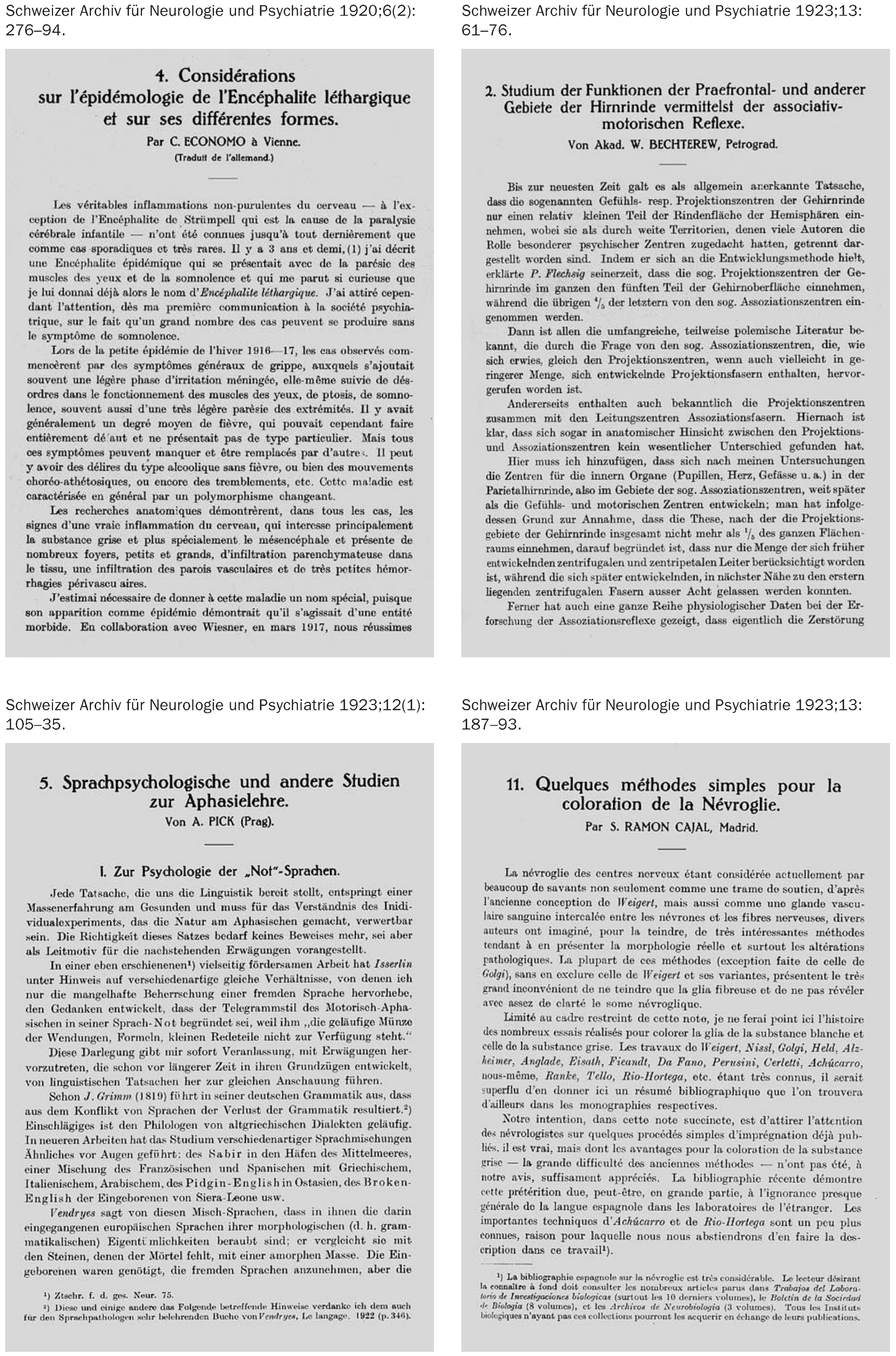
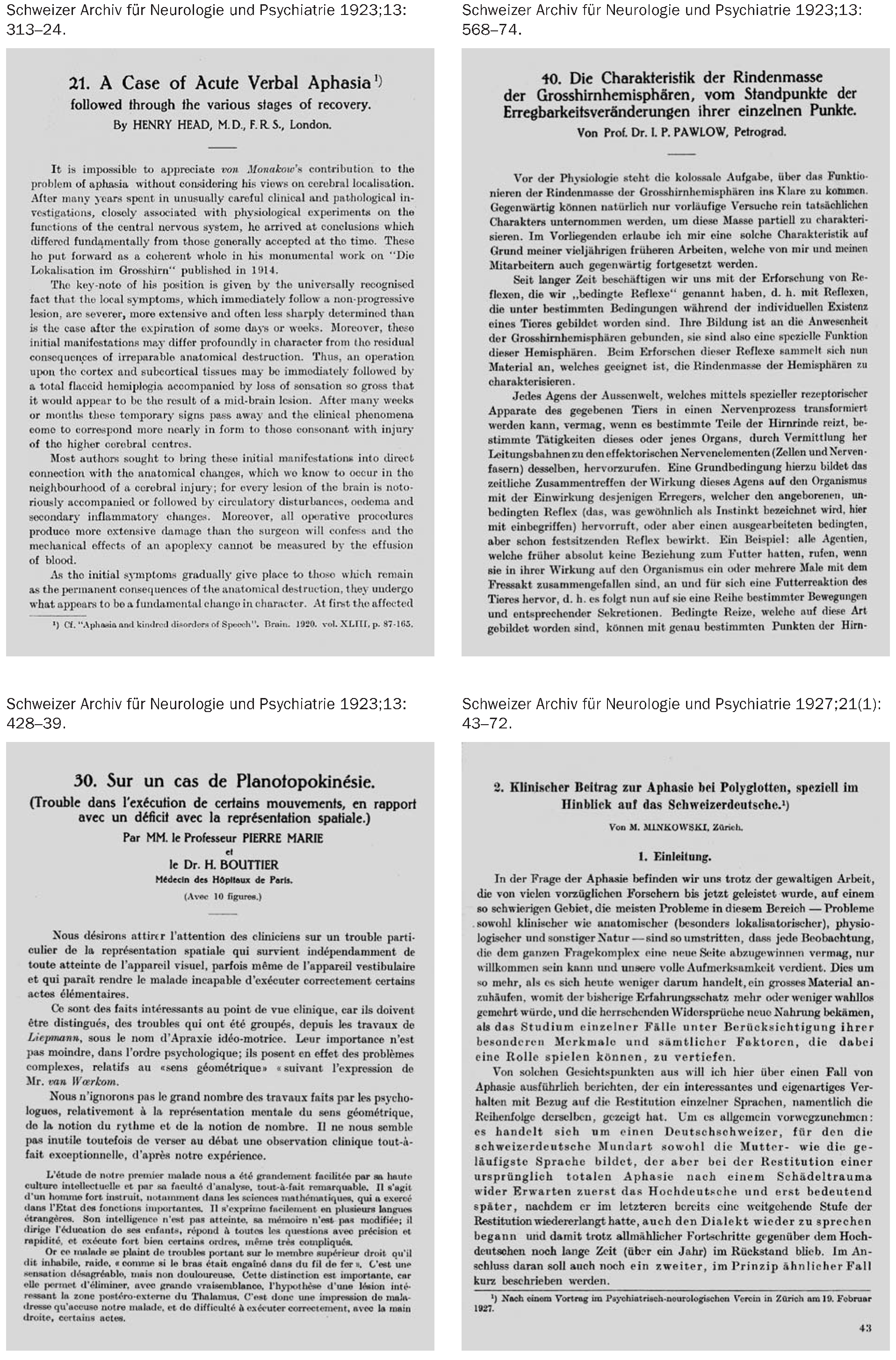
Also represented were E. Bleuler (“Halluzinationen und Schaltschwäche”) and E. Claparède from Geneva (“Quelques remarques sur le Subconscient”). However, the majority of papers were from foreign countries, of which only those by the most celebrated authors will be mentioned here: W. M. Bechterew from St Petersburg (“Studium der Funktion der Präfrontal- und anderer Gebiete der Hirnrinde vermittelst der assoziativ-motorischen Reflexe”), S. Ramon y Cajal of Madrid (“Quelques méthodes simples pour la coloration de la Névroglie”), E. Flatau (Warsaw), S. Goldflam (Warsaw), K. Goldstein (Frankfurt am Main), H. Head (London), R. Magnus and G. G. J. Rademacher (Utrecht), O. Marburg (Vienna), P. Marie and H. Bouttier from Paris (“Sur un cas de Planotopokinésie”), G. Mingazzini (Rome), I. P. Pawlow from St Petersburg (“Die Charakteristik der Rindenmasse der Grosshirnhemisphären vom Standpunkt der Erregbarkeitsveränderungen ihrer einzelnen Punkte”), C. Winkler (Utrecht) and others.
It is not possible here to do justice to the abundance of important papers published in Swiss Archives and their authors. However, in what follows at least some articles of particular interest from the early years of Swiss Archives may be mentioned. In 1917 F. Naville (1883–1968) from Geneva published the paper “Etude anatomique du névraxe dans un cas d’Idiotie familiale amaurotique de Sachs” [1917;1:286–313]; this was probably the first observed case in Switzerland of familial Tay-Sachs disease (in a Jewish family from Poland). F. Naville, who had studied with J. J. Dejerine in Paris among others, served as president of the SNS from 1930 to 1933 and was an editorial associate of Swiss Archives from the beginning until his death in 1968 [28]. He took up a professorship of forensic medicine in 1925. In this function he was, incidentally, requested by the German consulate in 1943 to serve on the international expert commission to investigate the Polish victims of the Katyn massacre [29].
At that time a highly topical issue was the phenomenon of aphasia, on which numerous contributions from noted neurologists appeared in Swiss Archives. A. Pick (1851–1924) from Prague, for example, wrote on “Sprachpsychologische und andere Studien zur Aphasielehre” [1923;2(1):105– 35/2(2):179–200], focusing particular interest on the influence of aphasia on thought. Two papers on aphasia came from Rome, from G. Mingazzini (1859–1929): “Contributo clinico ed anatomopatologico allo studio delle afasie musicali e transcorticali” [1918;3:210–33] and “Weitere klinische und pathologisch-anatomische Beiträge zum Studium der Aphasien” [1923;13:447–57]. One widely noticed article was by M. Minkowski, “Klinischer Beitrag zur Aphasie bei Polyglotten, speziell im Hinblick auf das Schweizerdeutsche” [1927;21:43–72], in which he reports on a Swiss German with total aphasia subsequent to cranial trauma who, after some time, unexpectedly began first to speak High German and only considerably later the dialect he had previously much preferred. Also worth mentioning is the paper by H. Head (1861–1940), “A case of acute verbal aphasia followed through the various stages of recovery” [1923;13:313–24], in which the detailed time course in a case of postoperative aphasia is discussed in the light of von Monakow’s diaschisis theory. Of particular significance in aphasia research are the contributions of K. Goldstein (1878–1965). He was one of a group of noted neurologists who had to leave Germany in the 1930s and found temporary asylum in Switzerland. During this time Goldstein played an active part in SNS meetings and afterwards became one of the leading American scientific and medical theorists [10,30,31,32]. In 1926 his paper “Über Aphasie” was published in Swiss Archives [1926;19:3–38] and in 1934 “Kritisches und Tatsächliches zu einigen Grundfragen der Psychopathologie, im Besonderen zum Aphasieproblem” [1934;34(1):69–93; 34(2):230–43].
A particular merit of Swiss Archives was in regularly making important work by leading neurologists in Eastern Europe and Russia accessible to readers in Western Europe. One example of work published in Swiss Archives is “Frühkontraktur und Abwehrreflexe bei Cerebralparalysen” by S. N. Dawidenkow (1880–1961) [1928;23:308–13/1929;24:105–33]. Dawidenkow, a pioneer in the field of neurogenetics, is among Russia’s most important 20th century neurologists [33]. In the West he is almost exclusively known for his work on scapulo-peroneal amyotrophy [34,35]. He devoted himself more than almost anyone else to the problem of “tonic attacks” (originally termed “convulsions” by Nothnagel in 1868 [36]), not infrequently observed during the acute phase of cerebrovascular events in the paralysed body parts. Specifically for these attacks Dawidenkow coined the term “Hormetonie” (after the Greek ôρμή = attack, and uóνoς = tension). The term “Dawidenkowsche Hormetonie” has remained in use until today in Russia, where Dawidenkow published much work on the subject, though without gaining a foothold in world neurological literature [37,38,39]. The article quoted is of special interest because, apart from anything else, it is probably the fullest non-Russian paper by Dawidenkow on the subject.
Contributions from neighbouring disciplines
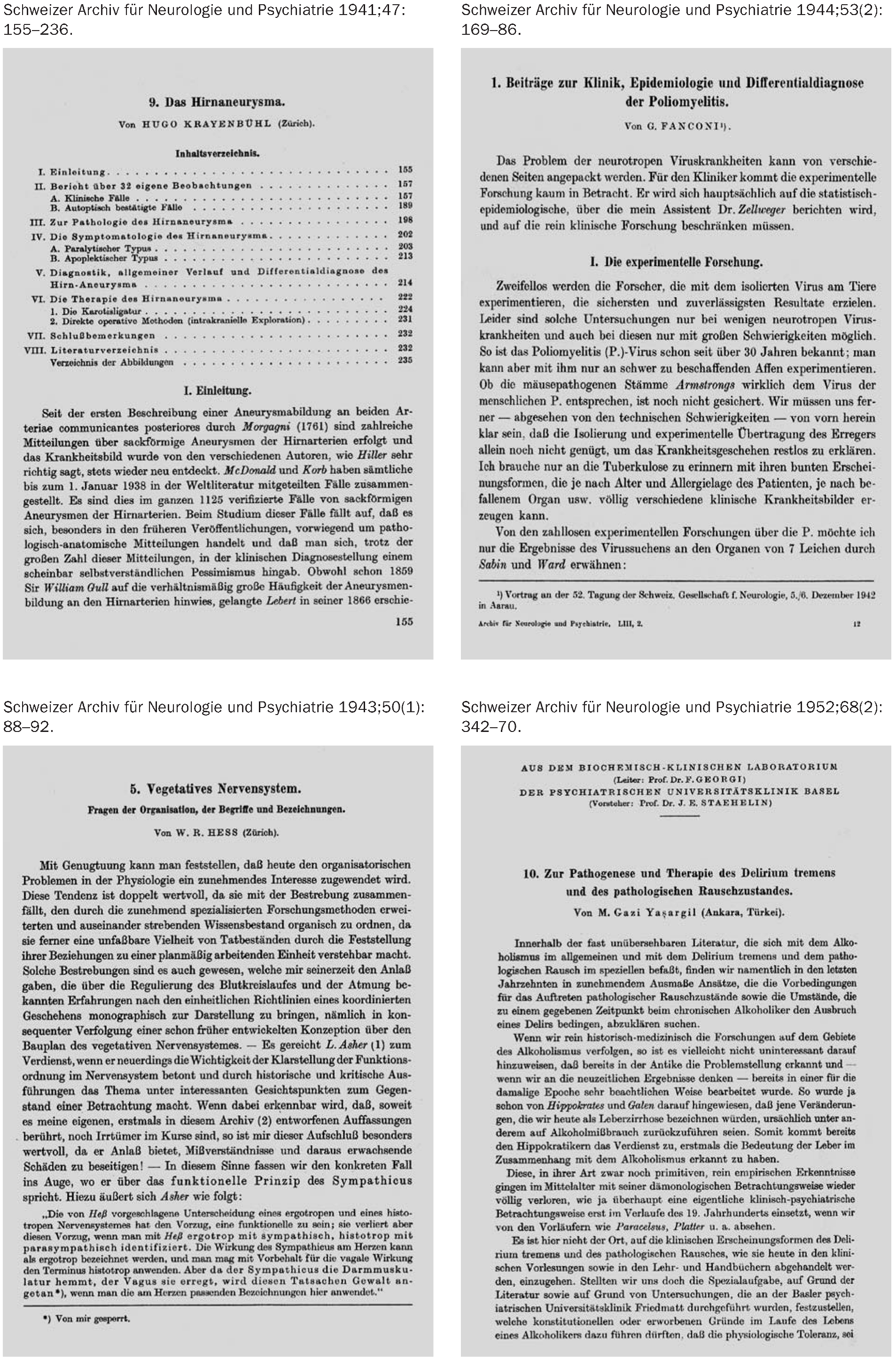
It had been von Monakow’s original wish that Swiss Archives regularly publish articles from neighbouring disciplines. Thus, for example, the Zurich physiologist and later Nobel Prizewinner W. R. Hess (1881–1973) contributed some of his studies to Swiss Archives [40,41,42]. The following papers may be instanced: “Zur Physiologie der Vasomotoren” [1924;14:20–9] and “Vegetatives Nervensystem. Fragen der Organisation, der Begriffe und Bezeichnungen” [1943;50:88–92].
G. Fanconi (1892–1979), senior consultant of Zurich Children’s Hospital from 1929 to 1962, who is regarded as the first to describe cystic fibrosis and other diseases (e.g. Fanconi anaemia) [43], contributed a paper on poliomyelitis (“Beiträge zur Klinik, Epidemiologie und Differentialdiagnose der Poliomyelitis” [1944;53:169–86]). In this paper Fanconi, who in 1949 published the book Die Poliomyelitis und ihre Grenzgebiete in conjunction with H. Zellweger and A. Botsztejn, reviewed the epidemiological and clinical aspects of the disease and concluded with a mention of the severe poliomyelitis epidemic in the city of Zurich in September 1941, the sudden outbreak of which prompted him to investigate a possible connection with the weather.
A paper worthy of mention in the field of anatomy was by the young G. Töndury (1906– 1985). Töndury, who for more than three decades directed Zurich University’s Institute of Anatomy, acquired an international reputation through his work on embryo- and foetopathies [44]. An early contribution appeared in the 1939 volume of Swiss Archives (“Normale und abwegige Entwicklung des zentralen Nervensystems im Lichte neuerer Amphibienexperimente” [1939;43:360–80]).
The same issue also contains a paper by R. Levi-Montalcini, discoverer in 1952 of the nerve growth factor (NGF) for which she received the 1986 Nobel Prize for Medicine and Physiology [45,46,47,48,49]. At the time she was already engaged in cancer research and experimenting with chicken embryos (F. Visintini, R. Levi-Montalcini, “Relazione tra differenziazione strutturale e funzione dei centri e delle vie nervose nell’embrione di pollo” [1939; 43:381–93 and 44:119–50]).
Swiss Archives also published numerous contributions from the field of neurosurgery (H. Krayenbühl, M. G. Yas¸argil), which will be dwelt on in more detail below.
New editors: R. Bing and M. Minkowski
After von Monakow’s death R. Bing and M. Minkowski took over the editorship of the neurological section of Swiss Archives of Neurology and Psychiatry. Their importance for the journal and for Swiss neurology in general was for many decades so great that they will now be briefly introduced.
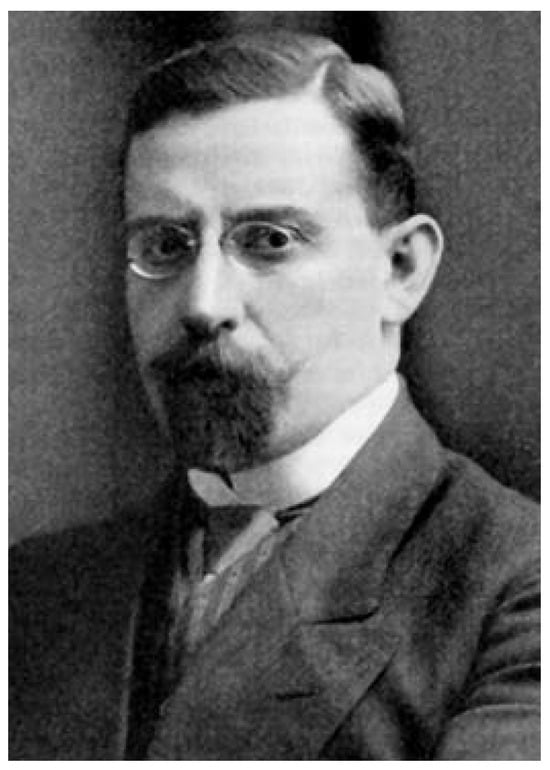
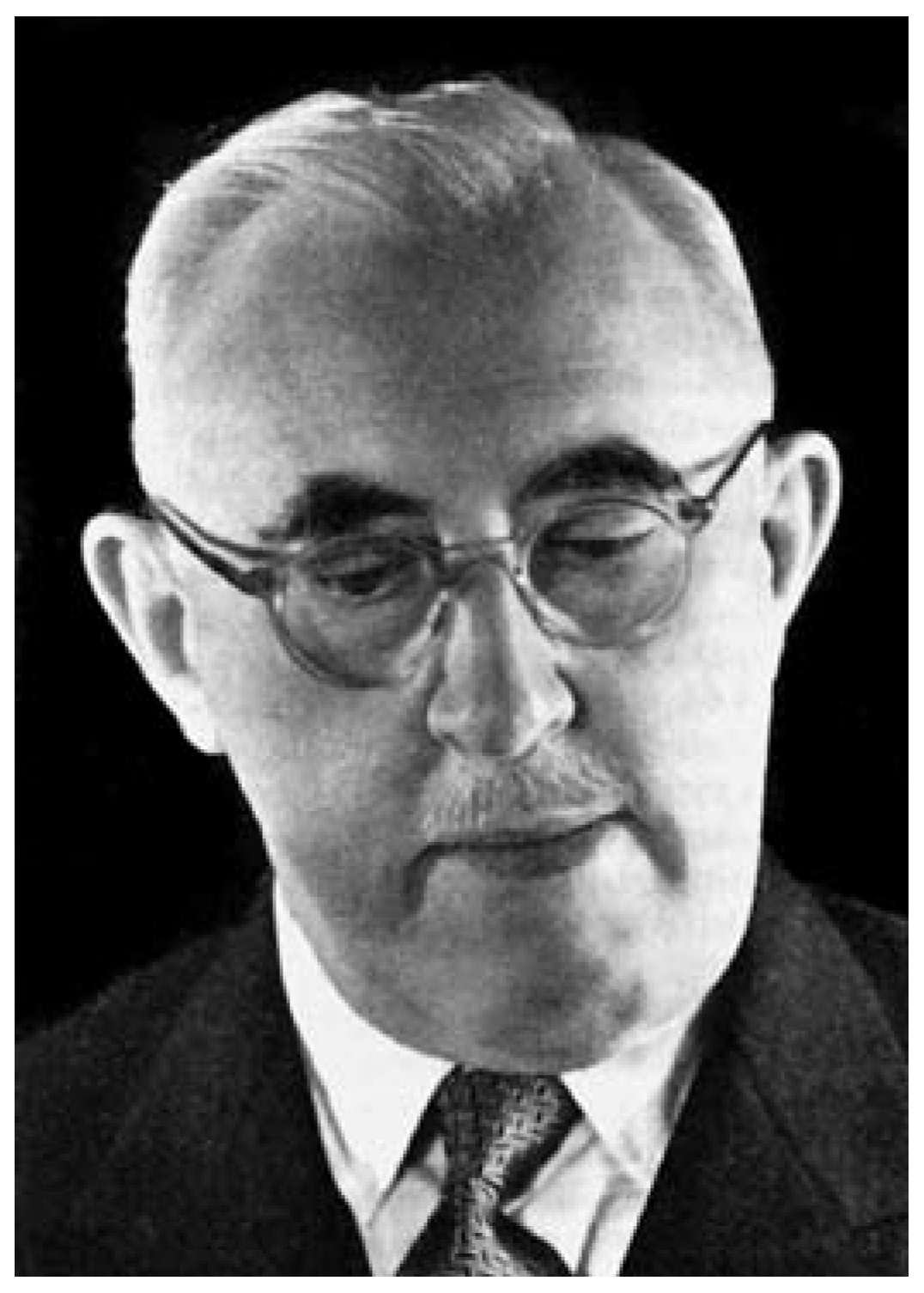
Robert Bing, who was born in Strasbourg in 1878 but grew up in Basel (Figure 3), acquired a worldwide reputation as a clinical neurologist and the author of several outstanding textbooks which were translated into six or seven languages. His teachers included the neurophysiologist H. Munk (1839–1912) in Berlin, the neuroanatomist L. Edinger (1855–1918) in Frankfurt am Main, the neurosurgeon V. Horsley (1857–1916) in London as well as the renowned French neurologists J. J. Dejerine (1849–1917) and J. Babinski (1857–1932). In 1907 he wrote a postdoctoral thesis on the spinocerebellar afferents; in 1918 he was appointed associate professor and in 1932 full professor of neurology in Basel (the first full professorship of neurology at a Swiss university) [50,51].
Figure 3.
Robert Bing (1878–1956).
One of the first papers he published in Swiss Archives was an in-depth study of the various mechanisms triggering the Babinski reflex [1918; 3:89–94]. He had previously described the so-called paradoxical ankle reflex, which bears his name (bending movement of the passive dorsally flexed foot on tapping of the dorsum at ankle level) [52]. Several of his articles in Swiss Archives are devoted to the interdisciplinary field of neuroophthalmology; they were ultimately incorporated into his famous book Gehirn und Auge (edited in collaboration with the ophthalmologist R. Brückner). However, his best known work was to be the Kompendium der topischen Gehirn- und Rückenmarksdiagnostik, which went through innumerable editions and is sometimes described as the successor to Oppenheim’s classic neurology textbook. Bing was editor of Swiss Archives until 1951 and remained a member of the editorial board until his death in 1956.
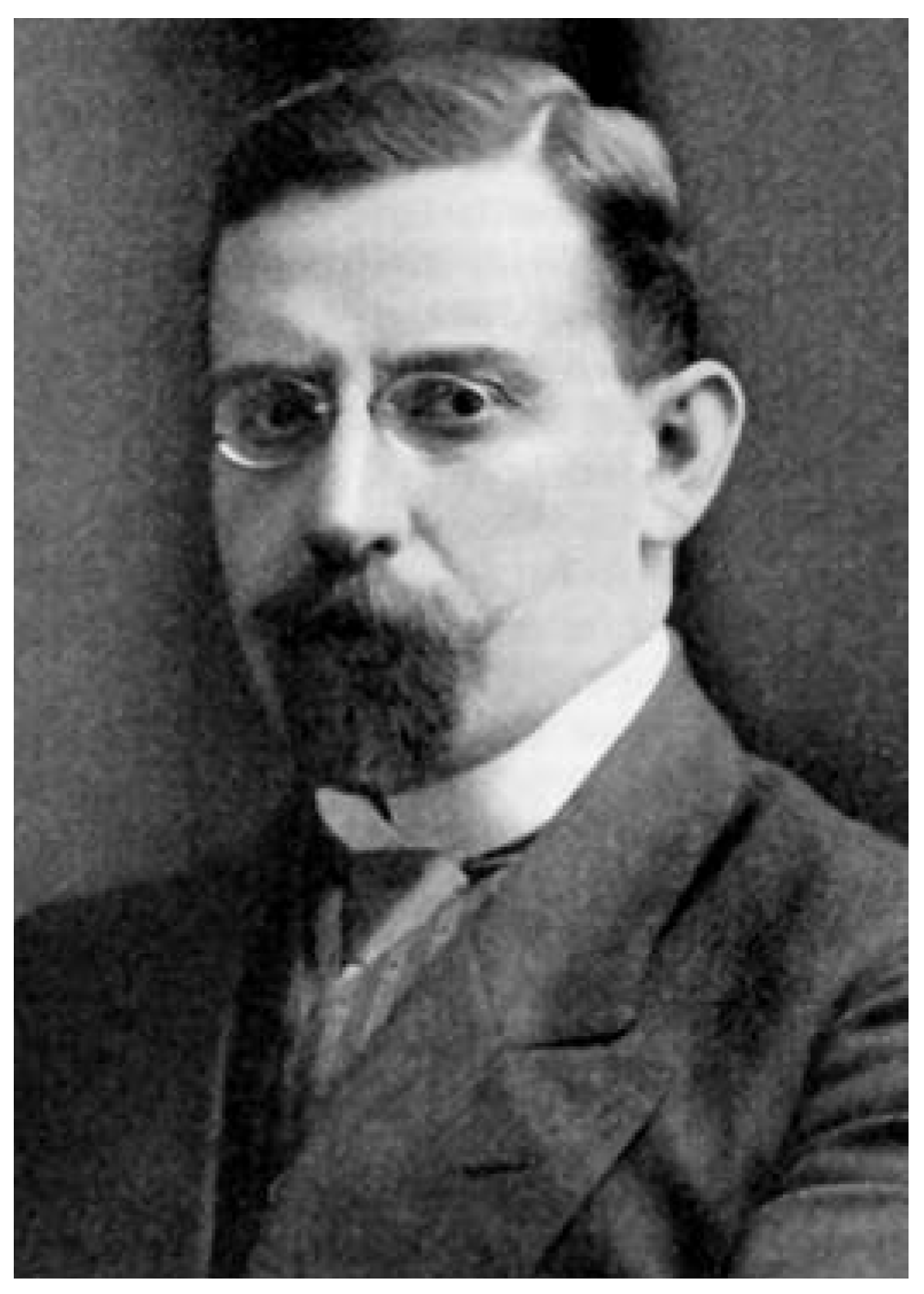
Mieczyslaw Minkowski (Figure 4) was born in Warsaw in 1884. He came from a highly gifted family whose members included the mathematician H. Minkowski (1864–1909), Albert Einstein’s teacher, and O. Minkowski (1858–1931), discoverer of the connection between diabetes mellitus and pancreatic function [53,54,55]. Minkowski obtained his doctorate with A. Strümpell (1853–1925) and completed his training with I. P. Pawlow (1849– 1936) in St Petersburg, A. Alzheimer (1864–1915) in Munich as well as M. Rothmann (1868–1915) and T. Ziehen (1862–1950) in Berlin. He did postdoctoral work under C. von Monakow in 1913 and in 1928 succeeded him as Director of the Neurological Outpatient Clinic. Like R. Bing, Minkowski was a founding editor of Swiss Archives, to whose high standing he decisively contributed for over half a century (1930–1960 as editor) and, in particular, promoted the lively scientific exchanges between Swiss and foreign neurologists. His last contribution dates from 1969 [103:93–106].
Figure 4.
Mieczyslaw Minkowski (1884–1972).
In 1920 his important study “Über den Verlauf, die Endigung und die zentrale Repräsentation von gekreuzten und ungekreuzten Sehnervenfasern bei einigen Säugetieren und beim Menschen” was published in Swiss Archives [1920;6:201–52/1920;7: 268–303]. Minkowski had already produced a postdoctoral thesis on the optical system, in which he investigated the effects of enucleation of an eye on the ensuing visual centres and took a particular interest in the “Endverteilung der aus beiden Augen stammenden, d.h. gekreuzten und ungekreuzten Sehnervenfasern im corpus geniculatum externum”. The discovery that the projections of the homonymous retinal halves in the layers of the corpus geniculatum externum (laterale) end alternately was of historical importance for the understanding of binocular vision [56].
Equally remarkable were his investigations into the “Bewegungen und Reflexe des menschlichen Fötus während der ersten Hälfte seiner Entwicklung” [1924;15(1):239–59/1925;16(1):133–52 and 1925;16(2):266–84].
At the 85th meeting of the Swiss Society for Psychiatry in Berne in 1934 he vehemently criticised a law passed in Germany in 1933 which declared persons with hereditary mental illness to be “a threat to society”, and called for schizophrenics to be compulsorily sterilised (M. Minkowski: “Diskussionsvotum zum Referat von E. Rüdin” [1935;35:368–71]). In the middle of the Second World War Minkowski, a Jew, was elected president of SNS, which he regarded as an honour and an “eindrucksvollen Beweis von Unerschrockenheit, Unabhängigkeit des Geistes und echter demokratischer Gesinnung” [1958;82:94].
In 1954 Minkowski celebrated his 70th birthday, and among many other tributes mention should be made here of the paper by 29-year-old M. Mumenthaler “Über die Brachialgia paraesthetica nocturna. Herrn Prof. Dr. M. Minkowski zum 70. Geburtstag gewidmet” [1954;74:362–81]. It was Mumenthaler’s first publication in Swiss Archives.
The 1st International Neurological Congress, Berne 1931
An event of major importance was the 1st International Neurological Congress (INC) in Berne from 31st August to 4th September 1931; it was to have been held there as far back as 1914, but owing to the war it had not taken place. It was attended by 700–800 neurologists from 42 countries. How intensive the preparations were can be learned from Vol. 25 of Swiss Archives [1930;25: 316–26]. B. Sachs of the USA was elected president of the INC; the vice-presidents included, alongside G. Guillain of France and Sir Charles Sherrington of Britain, R. Bing. The 1st INC was a great success and as a gift from the SNS every participant received a special number of the Swiss Archives of Neurology and Psychiatry [1931; volume 27, issue 2]. The last evening of the congress included, on the initiative of M. Minkowski, a discussion of the then burning topic “Die Beziehungen der Neurologie zur allgemeinen Medizin und zur Psychiatrie an der Universität und Spitälern der verschiedenen Länder” [see 1933;30:159–77]. Minkowski himself recalled that in Switzerland as early as the years 1907–1910 “die Verselbständigung der Neurologie von verschiedenen Seiten mit ernster Argumentation gefordert wurde”. Nevertheless, in 1931 he was obliged to note that Switzerland was one of a minority of countries in which neurology still had “keine selbständige, offizielle Vertretung im medizinischen Fachstudienplan” (just as in Belgium, Denmark, Finland, Germany, Great Britain, Hungary and Spain). He considered “obligatorischen neurologischen Unterricht” in universities of particular importance, since he noted that in many countries this led to the creation of independent neurological clinics (Bulgaria, Czechoslovakia, Estonia, France, Netherlands, Norway, Poland, Portugal, Romania, Soviet Union, USA). In Switzerland at that time there were only two neurological outpatient clinics (Basel and Zurich). At the INC in Berne the German O. Foerster (1873–1941) advocated this idea with particular energy and proposed a resolution which was unanimously adopted.
International role
As early as 1917 P. Dubois, marked by the experience of the First World War, voiced his conviction that Swiss Archives not only had a national role to play but should also provide a free, neutral platform for colleagues from the belligerent foreign countries. In the dark years before the Second World War Swiss Archives did indeed play a significant role on the international plane. A glance at the Swiss Archives volumes of the final years before the Second World War shows a marked increase in foreign contributions, particularly from Eastern Europe. During the war the foreign voices fell silent, and the papers now came almost exclusively from Swiss pens. It is remarkable, however, that Swiss Archives continued to be published throughout the war and has lasted until the present.
The period after the Second World War to the present
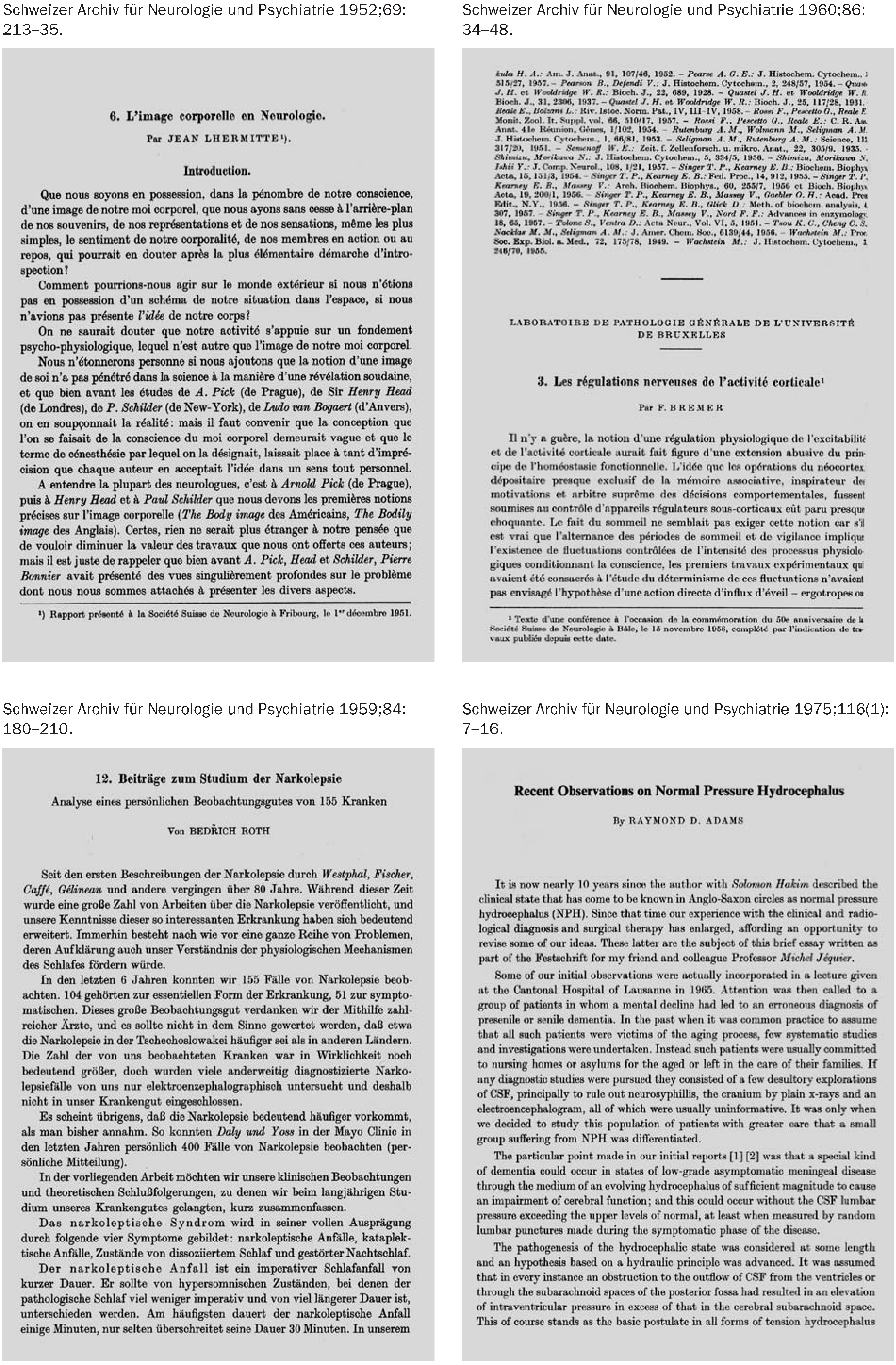
Contributions from other countries were also published regularly after World War II. Examples worthy of mention are the numerous papers by the well-known Czech sleep researcher B. Roth. From 1949 Roth contributed decisively through many articles to more precise clinical definition and diagnostic differentiation of illnesses such as narcolepsy and idiopathic hypersomnia, describing inter alia “Hypersomnie mit Schlaftrunkenheit” (1972) [57,58]. In 1959 Swiss Archives published his article “Beiträge zum Studium der Narkolepsie. Analyse eines persönlichen Beobachtungsgutes von 155 Kranken” [1959;84:180–210], summarising a book-length study published by the author in the then CSSR two years earlier. The book’s German translation appeared belatedly in 1962, i.e. three years after the publication in Swiss Archives. At that time it was probably the biggest monograph on this theme, also containing interesting research results from the Communist bloc otherwise scarcely accessible to the Western reader. Further publications with classic status are “Heredofamilial aspects of narcolepsy and hypersomnia” (with S. Nevsimalová-Bruhová) [1972;110:45–54] and “Narcolepsy and Hypersomnia: Review and Classification of 642 Personally Observed Cases” [1976;119:31–41].
From 1952 the Geneva neurologist G. de Morsier (1894–1982) succeeded R. Bing as editor in conjunction with M. Minkowski. From 1934 to 1964 de Morsier was director of Geneva University Neurological Clinic [9,15].
In a very long 1944 article he described the socalled “Acromegalo-epileptisches Syndrom”, also called, after him, “de Morsier’s syndrome I” (diencephalic pathology, associated with behavioural anomalies, disorders of sensitivity and premature sexual development) (“Pathologie du diencéphale. Les syndromes psychologiques et syndromes sensorio-moteurs” [1944;54:161–226]).
1959 saw not only a change of editor but – temporarily – of Swiss Archives’ name. Under H. Krayenbühl (1902–1985), editor-in-chief of the neurology section from 1959 to 1971, the journal was expanded to Swiss Archives of Neurology, Neurosurgery and Psychiatry (in 1986 neurosurgery was dropped from the title again). In 1937 Krayenbühl had founded the first Swiss neurosurgical clinic in Zurich. Before that he had undergone further education in London under Hugh Cairns (1896–1952), a former pupil of Cushing [40,59]. In 1941 he published a postdoctoral thesis, his standard work “Das Hirnaneurysma”, which appeared in Swiss Archives [1941;47:155–236]. Apart from vascular neurosurgery, his interests also included neurosurgery of epilepsy and thus influenced his student and successor M. G. Yas¸argil, who later introduced the method of selective amygdalohippocampectomy [60].To mark Krayenbühl’s 70th birthday a festschrift was published in Swiss Archives to which leading neurosurgeons from all over the world contributed and thus underscored the esteem in which Krayenbühl was held internationally. At least some of the 25 papers may be cited here: W. Penfield (Montreal): “All Hail to a Master Neurosurgeon” [1972;111:221–2]; P. Bucy and T. Stilp (Chicago): “Metastatic Choriocarcinoma of the Brain” [111:237–42]; R. Hess: “Das Elektroenzephalogramm nach Entlastungsoperationen bei erhöhtem intrakraniellem Druck” [111: 285–97]; T. Rasmussen, G. Mathiesen, F. Le Blanc (Montreal): “Surgical Therapy of a Typical and a Forme Fruste Variety of the Sturge-Weber Syndrome” [111:393–409]; E. Tolosa (Barcelona): “Hematomas of the Brain Stem. Case Report” [111:447–52]; M. G. Yas¸ argil: “Die klinischen Erfahrungen mit der Mikrotechnik” [111:493–504]. It should also be mentioned here that the beginnings of neuropsychiatry in Zurich can also be traced back to H. Krayenbühl.
From 1971 to 1988 G. Baumgartner (1924–1991) occupied the editor’s chair, though without himself having published in Swiss Archives. Baumgartner – director of Zurich’s Neurological Clinic and Outpatient Clinic from 1967 to 1991 – was already famed as a young doctor for his electrophysiological work on the visual system; the discovery (in conjunction with R. Jung) of cortical cells which react to stimuli from both eyes was a revolutionary finding in the neurobiology of binocular vision [61,62].
Table 1.
Editors-in-chief of the Swiss Archives of Neurology and Psychiatry.
He was succeeded as editor in 1988 by H. P. Ludin (until 1995). Since 1995 A. J. Steck (Basel) is editor-in-chief for the neurology section, initially in conjunction with F. Regli (1995–1998), then with J. Bogousslavsky (1998–2006) and since 2006 with C. L. Bassetti (Zurich).
The journal’s publishers have also changed several times in its history. Until 1992 Swiss Archives remained with the Zurich publisher Orell Füssli, before transferring to Zürichsee-Verlag for 2 years and then J. Bäbler publishing house in Berne from 1994 to 1997. Since June 1997 Swiss Archives has been published by Schwabe Verlag in Basel.
Annexe
References
- Von Monakov, C. Création d’un Journal suisse de Neurologie et Psychiatrie. Schweiz Arch Neurol Psychiatr 1917, 1, 3–7. [Google Scholar]
- Jagella, C; Isler, H; Hess, K. 100 Jahre Neurologie an der Universität Zürich 1894 bis 1994. Constantin von Monakow (1853 bis 1930). Hirnforscher – Neurologe – Psychiater – Denker. Schweiz Arch Neurol Psychiatr 1994, 145 (Suppl), 1–61. [Google Scholar]
- Koehler, PJ; Jagella, C. Constantin von Monakow (1853–1930). J Neurol 2002, 249, 115–6. [Google Scholar] [CrossRef] [PubMed]
- Kesselring, J. Constantin von Monakow’s formative years in Pfafers. J Neurol 2000, 247, 200–5. [Google Scholar] [CrossRef] [PubMed]
- Pearce, JM. Von Monakow and diaschisis. J Neurol Neurosurg Psychiatry 1994, 57, 197. [Google Scholar] [CrossRef] [PubMed][Green Version]
- Akert, K. Constantin von Monakow (1853–1930) als Hirnanatom. Schweiz Arch Neurol Psychiatr 1995, 146 (Suppl 1), 9–15. [Google Scholar]
- Haymaker, W. The founders of Neurology.; C. C. Thomas: Springfield, Illinois, 1953. [Google Scholar]
- Minkowski, M. Constantin von Monakows Beiträge und Impulse zur Entwicklung der neurologischen Grundprobleme des Aufbaus der nervösen Funktionen. Schweiz Arch Neurol Psychiatr 1954, 74, 27–59. [Google Scholar]
- Mumenthaler, M. Medizingeschichtliches zur Entwicklung der Neurologie in der Schweiz. Schweiz Arch Neurol Psychiatr 1987, 138, 15–30. [Google Scholar]
- Minkowski, M. 50 Jahre Schweizerische Neurologische Gesellschaft. Schweiz Arch Neurol Psychiatr 1958, 82, 3–181. [Google Scholar]
- Von Monakow, C. Der rote Kern, die Haube und die Regio hypothalamica bei einigen Säugetieren und beim Menschen. Arbeiten aus dem Hirnanatomischen Institut in Zürich 1909;3:49–267 und 1910;4:103–226.
- Bonduelle, M; Lhermitte, F; Gautier, JC. La revue neurologique, 1893–1993. Rev Neurol (Paris) 1993, 149, 91–112. [Google Scholar] [PubMed]
- Meier, R. Auguste Forel (1848–1931), Arzt, Naturforscher Sozialreformer. Eine Ausstellung der Universität Zürich, Herbst 1986; Berichthaus AG: Zürich, 1986. [Google Scholar]
- Mumenthaler, M. Neurology as an independent specialty. Ther Umsch 1993, 50, 725–6. [Google Scholar] [PubMed]
- De Morsier, G. Histoire de la psychiatrie et de la neurologie à Genève. Gesnerus 1977, 34, 186–202. [Google Scholar] [CrossRef] [PubMed]
- Jequier, M. Neurology in Lausanne. Rev Méd Suisse Romande 1974, 94, 873–85. [Google Scholar]
- Callegari, R. La minaccia di un destino. 1898–1998 Casvegno da manicomio-villaggio a quartiere. Organizzazione sociopsichiatrica cantonale Casvegno-Mendrisio 1998.
- Tröhler, U. Theodor Kocher und die neurotopographische Diagnostik: Angewandte Forschung mit grundlegendem Ergebnis um 1900. Gesnerus 1983, 40, 203–14. [Google Scholar] [CrossRef]
- Boschung, U. Theodor Kocher (1841–1917); Huber: Bern, 1991. [Google Scholar]
- Yonekawa, Y; Fandino, J. Theodor Kocher, Hayazo Ito, and Harvey Cushing in Berne, Switzerland. Neurol Med Chir (Tokyo) 1998, 38, 301–3. [Google Scholar]
- Müller, Ch. «Sie müssen an Ihre Heilung glauben!» Paul Dubois (1848–1918). Ein vergessener Pionier der Psychotherapie; Schwabe: Basel, 2001. [Google Scholar]
- Bassetti, C; Jagella, C. Joseph Jules Dejerine (1849–1917). In J Neurol; 2005. (in press)
- Swiss Neurological Society. 75th anniversary. 100th birthday of M. Minkowski. 6–7 May 1983 in Winterthur. Schweiz Arch Neurol Neurochir Psychiatr 1983, 133, 205–22. [Google Scholar]
- Akert, K. The 50th anniversary of Constantin von Monakow’s death. Schweiz Arch Neurol Neurochir Psychiatr 1981, 128, 335–9. [Google Scholar]
- Finger, S; Koehler, PJ; Jagella, C. The Monakow concept of diaschisis: origins and perspectives. Arch Neurol 2004, 61, 283–8. [Google Scholar]
- Constantin von Monakow (1853–1930), neurobiologic philosopher. JAMA 1970, 211, 1003–4. [CrossRef]
- In memoriam Rudolf Brun (1885–1969). Rev Neurol (Paris) 1970, 122, 274–5.
- In memoriam François Naville (1883–1968). Rev Neurol (Paris) 1970, 122, 274.
- Stauffer, P. Polen – Juden – Schweizer. Felix Calonder (1921–1937), «Exilpolens» Berner Emissäre (1939–1945), Die Schweiz und Katyn (1943); Verlag Neue Zürcher Zeitung: Zürich, 2004. [Google Scholar]
- Danzer, G; Eisenblatter, A; Belz, W; Schulz, A; Klapp, BF. Kurt Goldstein’s understanding of amnesic aphasia and its underlying disorder – an early model of the pensee operatoire of the French psychosomatic school? Fortschr Neurol Psychiatr 2002, 70, 368–73. [Google Scholar] [CrossRef] [PubMed]
- Noppeney, U; Wallesch, CW. Language and cognition – Kurt Goldstein’s theory of semantics. Brain Cogn 2000, 4, 367–86. [Google Scholar] [CrossRef] [PubMed]
- Noppeney, U. Kurt Goldstein – a philosophical scientist. J Hist Neurosci 2001, 10, 67–78. [Google Scholar]
- Zhulev, NM; Sajkova, LA; Skoromets, AA. Sergej Nikolajewitsch Dawidenkow [Russ.]. In Letsch Nerw Bolezn; 2002; pp. 41–3. [Google Scholar]
- Dawidenkow, SN. Scapuloperoneal amyotrophy. Arch Neurol Psychiatr 1939, 41, 694. [Google Scholar] [CrossRef]
- Serratrice, G; Pellissier, JF; Pouget, J. 3 cases of scapuloperoneal neurogenic amyotrophy (Dawidenkow’s syndrome). Nosological situation in relation to Charcot-Marie-Tooth disease. Rev Neurol (Paris) 1984, 140, 738–40. [Google Scholar]
- Bassetti, C; Bogousslavsky, J; Barth, A; Regli, F. Isolated infarcts of the pons. Neurology 1996, 46, 165–75. [Google Scholar] [CrossRef]
- Dawidenkow, SN. Das Hormetonie-Syndrom [Russ.]. Wratsch Delo 1919, 23, 801–6. [Google Scholar]
- Dawidenkow, SN. Weitere Beobachtungen zur Hormetonie-Lehre. Analyse eines Falles von «früher Kontraktur» [Russ.]. Wratsch Delo 1921, 1, 17–21. [Google Scholar]
- Dawidenkow, SN. Hormetonie und «decerebrate rigidity» [Russ.]. Klin Med 1924, 2, 217–22. [Google Scholar]
- Kesselring, J. Developments in neurology from the 19th to the 20th century with special reference to various contributions from Switzerland. Schweiz Rundsch Med Prax 1994, 83, 491–6. [Google Scholar]
- Jain, KM; Swan, KG; Casey, KF. Nobel prize winners in surgery. Part 3. (Frederick Grant Banting, Walter Rudolph Hess). Am Surg 1982, 48, 287–90. [Google Scholar] [PubMed]
- Waser, PG. Walter Rudolf Hess. His life and activities at the University of Zurich Medical School centennial celebration of his birth: 14 March 1981. Gesnerus 1982, 39, 279–86. [Google Scholar] [CrossRef] [PubMed]
- Stevens, RF; Meyer, S. Fanconi and Glanzmann: the men and their works. Br J Haematol 2002, 119, 901–4. [Google Scholar] [PubMed]
- Töndury, Gian. Nachruf von Wolfgang Zenker; Sonderabdruck aus dem Almanach der Österreichischen Akademie der Wissenschaften: Wien, 1986. [Google Scholar]
- Allen, GE. A pact with the embryo: Viktor Hamburger, holistic and mechanistic philosophy in the development of neuroembryology, 1927–1955. J Hist Biol 2004, 37, 421–75. [Google Scholar]
- Aloe, L. Rita Levi-Montalcini: the discovery of nerve growth factor and modern neurobiology. Trends Cell Biol 2004, 14, 395–9. [Google Scholar] [CrossRef]
- Bennet, MR; Gibson, WG; Lemon, G. Neuronal cell death, nerve growth factor and neurotrophic models: 50 years on. Auton Neurosci 2002, 95, 1–23. [Google Scholar]
- Raju, TN. The Nobel chronicles. 1986: Stanley Cohen (b 1922); Rita Levi-Montalcini (b 1909). Lancet 2000, 355, 506. [Google Scholar] [CrossRef]
- Cowan, WM. Viktor Hamburger and Rita Levi-Montalcini: the path to the discovery of nerve growth factor. Annu Rev Neurosci 2001, 24, 551–600. [Google Scholar]
- Gigon, A. Zum Heimgang von Professor Dr. Robert Bing. Bull Schweiz Akad Med Wiss 1956, 12(1), 91–2. [Google Scholar]
- Haymaker, W. Robert Paul Bing, 1878–1956. AMA Arch Neurol Psychiatry 1956, 76, 508–10. [Google Scholar]
- Bassetti, C. Babinski and Babinski sign. Spine 1995, 20, 2591–4. [Google Scholar] [CrossRef]
- Karbowski, K. Mieczyslaw Minkowski (1884–1972). J Neurol 2001, 248, 820–1. [Google Scholar] [CrossRef] [PubMed]
- Mumenthaler, M; Akert, K. In memory of Mieczyslaw Minkowski, Warswa, April 15, 1884 – Zurich, July 20, 1972. Schweiz Arch Neurol Neurochir Psychiatr 1973, 113, 7–16. [Google Scholar] [PubMed]
- Herman E. Mieczyslaw Minkowski (15 April, 1884 –20 July, 1972). J Neurol Sci 1973, 18, 359–60.
- Milos, G; Akert, K. Die neurobiologischen Grundlagen der binokulären Raumwahrnehmung. Historische Übersicht über die Entwicklung der Vorstellungen und Erkenntnisse. Schweiz Arch Neurol Psychiatr 1982, 130, 39–67. [Google Scholar]
- Bassetti, C; Aldrich, MS. Idiopathic hypersomnia. A series of 42 patients. Brain 1997, 120, 1423–35. [Google Scholar] [CrossRef]
- Billiard, M; Dauvilliers, Y. Idiopathic hypersomnia. Sleep Med Rev 2001, 5, 349–58. [Google Scholar] [CrossRef]
- Zander, E. Neurosurgeon of the year: Hugo Krayenbuhl. Surg Neurol 1977, 7, 1–2. [Google Scholar]
- Donaghy, RM. Neurosurgeon of the year: Mahmut Gazi Yas¸argil. Surg Neurol 1980, 13, 1–3. [Google Scholar]
- Hess, K. Günter Baumgartner 1924–1991. Freiburg und Zürich. Nervenarzt 2000, 71, 150. [Google Scholar]
- Jerusalem, F. In memory of Günter Baumgartner (1 September 1924 – 11 August 1991). Schweiz Arch Neurol Psychiatr 1992, 143, 101–4. [Google Scholar]
This is an open-access article distributed under the terms of the Creative Commons Attribution Non-Commercial No Derivatives (CC BY-NC-ND) 4.0 License.