


Summary
It is well known that patients with schizophrenia have some degree of cognitive impairment, such as deficits in executive functions. There has been a debate over the influence of cognitive impairment in the outcome of schizophrenia, compared to the influence of positive or negative symptoms. Negative symptoms are more chronic and persistent and less responsive to treatment. They are also associated with poor premorbid adjustment, poor social functioning, greater likelihood of cognitive impairment and brain ventricular enlargement. The aim of this study was to relate psychopathological measures and neurocognitive tests to social outcome, to find out which measure is the best predictor of social outcome in the long run. Forty-nine subjects with a DSM-IV diagnosis of schizophrenia were recruited from inpatient and outpatient units in East Yorkshire, UK. The patients were taking conventional and atypical antipsychotic drugs. Psychopathological measures (Brief Psychiatric Rating Scale [BPRS], total and subscales), neurocognitive tests (the Rivermead Behavioural Memory Test, the Intra/Extra Dimensional Shift Test, the Stockings of Cambridge Test) and social outcome scales (Social Behaviour Scale [SBS] and Independent Living Skills Survey, reduced version) were administered at baseline, 9 months and 18 months. The Social Behaviour Scale was developed by the MRC Social Psychiatry Unit, with chronic institutionalised subjects, whilst the Independent Living Skills Survey was designed to provide an assessment of independent living skills in the community of chronically mentally ill patients living in residential care facilities. A stepwise multivariate regression analysis using psychopathological measures and neurocognitive tests as predictors and social functioning scales as outcome showed that negative symptoms were the strongest predictor of social functioning both at 9 months and 18 months. This is the most important finding of this study. The regression analysis at 9 months, with SBS score as the dependent variable, produced a significant overall model (F = 4.748, p <0.05, with R square = 0.126; adjusted R square = 0.099). The only significant partial contribution was made by the BPRS withdrawal retardation dimension (beta = 0.355; p <0.05). Regression analysis at 18 months with the SBS score as the dependent variable also produced a significant model (F = 9.110, p <0.01, with R square = 0.275; adjusted R square = 0.245) and confirmed that the BPRS withdrawal retardation dimension was the only significant predictor in the model (beta = 0.525, p <0.01). In spite of the limitations of this study (small sample size, use of reduced versions of the Independent Living Skills Survey and use of the withdrawal-retardation dimension of the Brief Psychiatric Rating Scale only as a measure of negative symptoms), these findings point in the direction of the importance of negative symptoms’ control in schizophrenia.
Introduction
It is well known that patients with schizophrenia have some degree of cognitive impairment. Deficits in attention, non-verbal and verbal executive tasks and memory are widely described in the literature [1]. Many attempts have been made to treat the cognitive impairment in schizophrenia [2,3,4,5]; atypical antipsychotics are thought to improve cognitive function independently [6] but these data are controversial and open to criticism. A review [7] showed that although there might be some improvement of cognitive status in patients treated with atypical antipsychotics, specific inferences relating cognitive change to particular treatments would remain speculative until more sophisticated investigation had been carried out. It was emphasised that the quality of the studies examined was not very high, with only one randomised controlled trial published.
Cognitive impairment seems to have a deleterious impact on social outcome, as shown in several studies and reviews [8,9,10,11,12]. In an influential review of 17 studies by Green correlating neurocognitive deficits with social outcome [12], secondary verbal memory was a strong predictor or correlate of outcome, and vigilance was found to be consistently associated with acquisition of social skills. On the other hand, Green found that Wisconsin card sorting, a widely used measure of cognitive deficit in schizophrenia, was consistently related to community outcome, but inconsistently related to skill acquisition and not related to social problem solving. It was concluded that the evidence for negative symptoms as a predictor of social functioning remained inconsistent. An update of the 1996 review was published in 2000 by the same author and colleagues [11]. Thirty-seven studies were examined.The authors’ conclusions were that neurocognitive measures, both global and specific, were confirmed as strong predictors of social outcome. In particular, secondary verbal memory was strongly related to social outcome. Immediate verbal memory, Wisconsin card sorting and vigilance also had a significant relationship with social outcome.
There have been some studies examining the effect of atypical antipsychotics on social outcome. A recent review of 31 published studies [13] concluded that the results were mixed. If negative or deficit symptoms comprised the outcome measure, the results tended to be positive. Even so, only half of the studies reported that atypical antipsychotics were associated with significantly greater improvements in psychosocial outcome compared with conventional antipsychotics.
In contrast with positive symptoms, negative symptoms are more chronic and persistent and less responsive to treatment [14,15,16]. Negative symptoms are also associated with poor premorbid adjustment, poor social functioning, greater likelihood of cognitive impairment and brain ventricular enlargement [17,18,19,20]. Some studies have attempted to estimate the effect of negative symptoms on social outcome, but their findings remain controversial. In a study examining predictors of social functioning in schizophrenia [21] negative symptoms at baseline did not predict social outcome; rather, cognitive impairment was a significant predictor. On the other hand, Dickerson and colleagues [10] found that negative symptoms were an independent predictor of social functioning at two years, alongside neurocognitive measures.
Differential prediction by specific cognitive domains regarding separate aspects of functional outcome may be important [12]. Moreover, it may be valuable to find whether neurocognitive measures or symptoms are the best predictors of social functioning in schizophrenia: this has a direct bearing on rehabilitation potential. The precise relationship between symptoms and cognitive dysfunction remains to be established in schizophrenia, and contradictory conclusions have been reported in recent studies [22,23]. However, most authors would agree that cognitive deficits and psychopathology are at least partially distinct in terms of the underlying pathophysiological process. Therefore, the functional consequences of these problems are not necessarily identical, and it would be valuable to explore whether neurocognitive measures or symptoms are the best predictors of social functioning in schizophrenia.
The aim of this study was to relate psychopathological and neurocognitive measures to social outcome and to find out which measure is the best predictor of social outcome in the long run.
Subjects and methods
Subjects
Forty-nine subjects with a DSM-IV diagnosis of schizophrenia were recruited from inpatient and outpatient units in East Yorkshire, UK. Fulfilling of DSM-IV criteria by the patient was ascertained by clinical interview. Approval of the project was granted by the Hull and East Riding Ethics Committee. This sample of patients was approached when they were having antipsychotic medication either started or reviewed, as this provided the most convenient opportunity for patient contact. Therefore, the sample comprised both first-onset patients and patients who were about to change medication due to clinical need or routine changes in a consultant’s prescribing practice, i.e. the changeover from the use of conventional antipsychotics to the use of atypical antipsychotics. Patients were excluded for three reasons: if they had a global cognitive impairment (<24 on the Mini Mental State Examination, MMSE [24]), if they had suffered a significant head injury resulting in hospitalisation or if they had a history of dependent drug or alcohol abuse. The study was explained to the patients by their consultant, their key worker or a member of the research team. Informed consent was obtained from all patients. The number of subjects entered was 49. The participants in the study had a mean age of 35.1 years (SD = 10.4); 31 were males (61.2%), 18 were females (38.8%). With regard to the antipsychotic taken, 7 subjects were on conventional antipsychotics (fluphenazine, chlorpromazine or thioridazine), whilst the remaining sample was on atypical antipsychotics: 9 on olanzapine, 10 on clozapine, 8 on quetiapine, 9 on risperidone and 6 on amisulpride. Details of the patient’s age, sex, duration of illness and number of years of education were recorded.
Procedure
Assessments were conducted at baseline, 9-month follow-up and 18-month follow-up. These time intervals were set in order to get a long-term picture of changes in psychopathology, cognition and social function.
Symptom measures
The Brief Psychiatric Rating Scale (BPRS) [25] was used to assess patient symptoms. This scale was chosen because it has well-validated psychometric properties and covers a broad range of symptoms. A total pathology score was obtained in addition to a sub-score related to the four symptom dimensions identified by factor analysis by Overall [26]: thinking disturbance (BPRS-TD), withdrawal/retardation (BPRS-WR), hostility/suspiciousness (BPRS-SU) and anxiety/depression (BPRS-AD).The finding of Overall was replicated in other BPRS-factor analyses [27] which consistently identified the same dimensions.
The 17-item Hamilton Depression Rating Scale (HDRS) [28] was employed as a measure of depression.
Social function measures
Social functioning was assessed using two scales. The first, the Social Behaviour Scale (SBS) [29] was developed by the MRC Social Psychiatry Unit based on work by Wing [30] and Wing and Brown [31], with chronic institutionalised subjects. The scale covers 21 behaviour areas, such as little spontaneous communication, inappropriate social mixing, inappropriate social behaviour, poor self-care, etc. There are also items regarding psychiatric symptoms. Most of the items are rated on a scale from 0 (no problem) to 4 (serious problem). The important feature of this scale is that the source of information is not the patient but an informant. The scale was first validated in 1986 [29]. We considered the total SBS score as outcome measure.
The second social scale used was the Independent Living Skills Survey (ILSS) [32,33]. The instrument was developed to provide an assessment of independent living skills in the community of chronically mentally ill patients living in residential care facilities. Nine areas of skills are assessed: eating habits, grooming skills, domestic activities, food preparation skills, health maintenance skills, economic skills, use of public transportation, leisure activities and job-seeking skills. Each area has a variable number of items, with a total of 112 items. The items are formatted as a questionnaire to be completed by significant others or facility staff using two six-point response scales, focused on behaviour and events of the previous month and of the past six months respectively (never, sometimes, often, usually, always and no opportunity to perform).We used a reduced version, asking only about the previous month and eliminating some items that were not relevant to our population, limiting the total number of items to 67. We considered the total ILSS score as outcome measure.
Neurocognitive measures
The National Adult Reading Test (NART) [34] was chosen to provide an indication of premorbid IQ. The neurocognitive battery of tests was selected in order to provide a broad assessment of the cognitive abilities of patients, with special regard to abilities that have been associated with social function in previous studies. Four tests were chosen; the Digit Span test (DS), which provides a measure of short-term memory; the Rivermead Behavioural Memory Test (RBMT), which assesses verbal and visual long-term memory; the Intra/Extra Dimensional Shift test (IDED) from the Cambridge Automated Neuropsychological Testing Battery (CANTAB) [35]. This test provides an assessment of attentional set-shifting ability and is a computer analogue of the Wisconsin Card Sorting Test. The stage reached on this test was used as our performance indicator. The final neurocognitive test used was the Stockings of Cambridge test (SOC), which is also from the CANTAB. This test is a computerised version of the Tower of London test and assesses the ability to think ahead and plan a sequence of actions in order to achieve a desired goal. We used the number of problems solved within the minimum number of moves as our primary measure for the SOC.
A baseline only Mini Mental State Examination test (MMSE) [24] was also administered.
Statistical analyses
Data were analysed with SPSS for Windows version 9.0.
Independent samples two-tailed t-tests were used to compare mean scores of the BPRS (total and dimensions), HDRS and neurocognitive tests at baseline, 9 months and 18 months between males and females.
A stepwise multivariate regression analysis was performed, to find out which measure contributed most significantly to the social outcome. The variables entered in the model as predictors were: BPRS-TD score at baseline, BPRS-WR score at baseline, BPRS-AD score at baseline, BPRS-SU score at baseline, years from onset of illness, RBMT at baseline, SOC at baseline, IDED at baseline. The dependent variables considered were SBS scores at 9 and 18 months and ILSS scores at 9 and 18 months.A regression model was created for each of the social scales at 9 and 18 months, a total of 4 models.
Results
Subjects had a mean time since onset of illness of 9.9 years (SD = 9.9). The subjects on average had 12.5 years of education (SD = 2.0). The subjects’ mean premorbid IQ, as measured on the NART, was 98.6 (SD = 14.1). Due to the small sample size, no differential analysis has been carried out between subjects on typical and subjects on atypical antipsychotics.
Analyses with independent samples two-tailed t-tests indicated that there were no baseline differences between men and women on all the scales administered, years of onset, premorbid IQ and years of education.
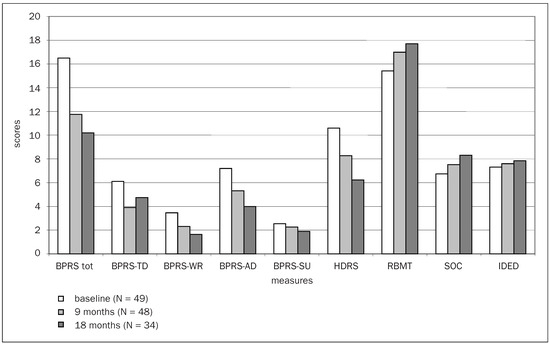
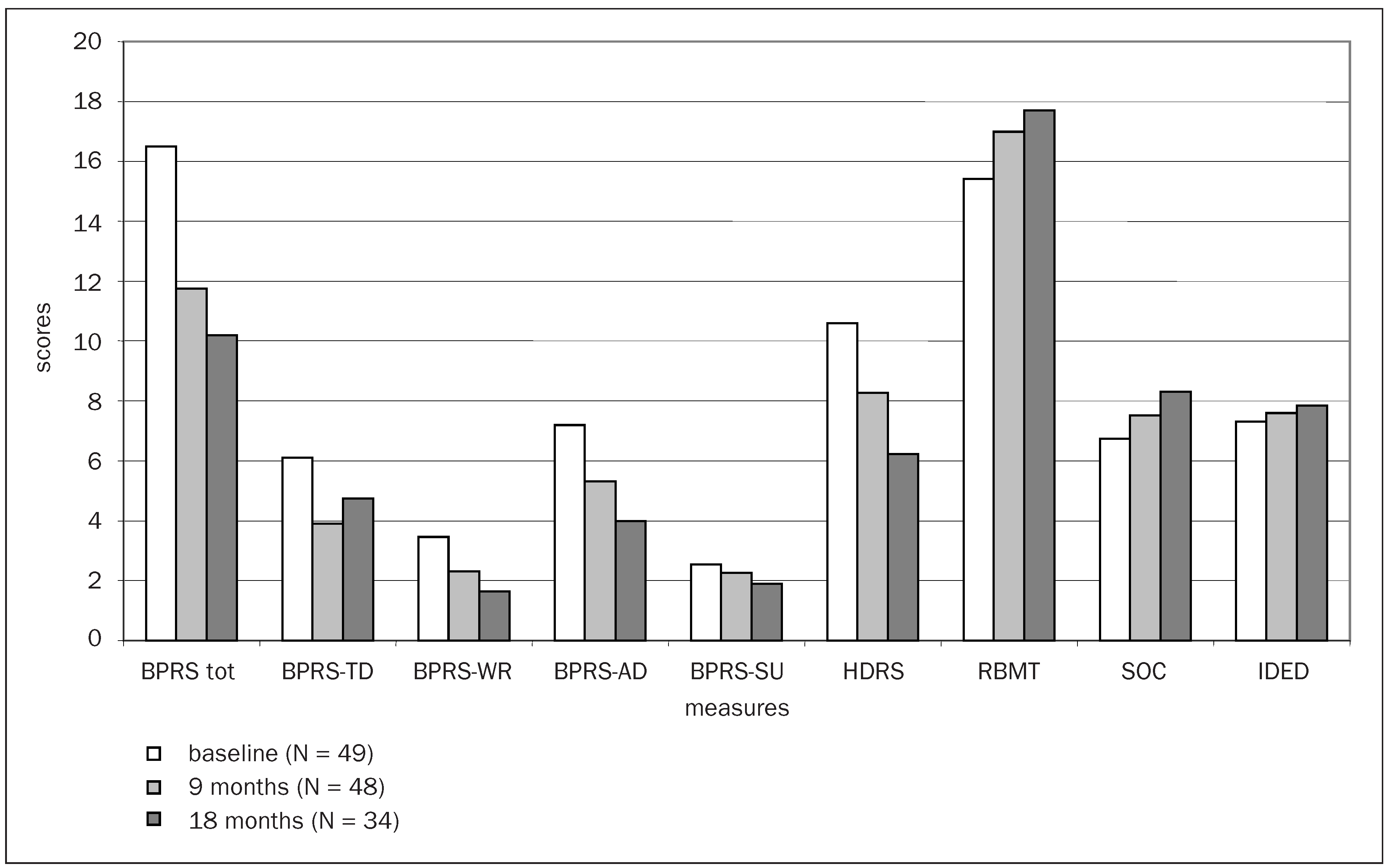
One patient was lost at follow-up before 9 months whilst a further 14 patients discontinued the study before 18 months. The data analysis at 18 months was therefore performed on 34 subjects. The trend for the mean scores over time is shown on Figure 1.
Figure 1.
Average scores of symptoms and neurocognitive measures over time.
The regression analysis at 9 months, with SBS score as the dependent variable, produced a significant overall model (F = 4.748, p <0.05, with R square = 0.126; adjusted R square = 0.099). The only significant partial contribution was made by the BPRS withdrawal-retardation dimension (beta = 0.355, p <0.05). Regression analysis at 18 months with the SBS score as the dependent variable also produced a significant model (F = 9.110, p <0.01, with R square = 0.275; adjusted R square = 0.245) and confirmed that the BPRS withdrawal-retardation dimension was the only significant predictor in the model (beta = 0.525, p <0.01).
Regression analysis with the ILSS score as the dependent variable produced significant models both at 9 months (F = 10.098, p <0.01 with R square = 0.240; adjusted R square = 0.216) and at 18 months (F = 5.309, p <0.05 with R square = 0.181; adjusted R square = 0.147). In these models, too, the only significant predictor over the other parameters at 9 months and 18 months remained the BPRS withdrawal-retardation dimension with a beta of –0.490 (p <0.01) and –0.426 (p <0.05) respectively.
Discussion
The most important finding of this study is the fact that negative symptoms, as measured on BPRS withdrawal-retardation dimension, are the strongest predictor of two domains of social functioning both at 9 and 18 months in our sample. This finding is in line with previous studies [36,37,38] which stressed the importance of symptom control in schizophrenia. Our model is interesting since negative symptoms are a stronger predictor than likely cognitive tests on both social functioning scales. This finding is consistent with the idea that negative symptoms and social behaviour are both mediated by the prefrontal cortex. Indeed, damage to the prefrontal cortex can result in behavioural problems such as apathy, poor judgement, an inability to adapt to new situations, carelessness and attenuated social sensibility [23,31]. These behavioural deficits are similar to those observed with negative symptoms, and therefore the relationship between negative symptoms and social function is unsurprising. However, it is unclear why there was no significant contribution, made in our models, by cognition on social function, since some of the tests used in the current study are also associated with frontal lobe function, namely the SOC and the IDED test. Perhaps an answer to this question can be provided by Lezak [39] who suggests that problems in social function do not represent pure cognitive deficits in themselves, rather, they represent an impairment in “one or more aspects of behavioural integration and expression”. The implication here is that behavioural deficits are multifarious phenomena, which are not necessarily related to performance on very specific tests of cognitive ability. To be considered alongside this point are the recent findings of Wykes and colleagues [40] who reported that improvements in cognitive function do have a positive effect on social function, but only after cognitive improvements have reached a criterion threshold. These findings suggest that the cognitive abilities of patients need to be above a particular level of functioning before they have any association with social abilities. In the current study this threshold level may not have been met.
The study points out the fact that negative symptom control needs to be taken into account in rehabilitation plans; it is well known that negative symptoms are notoriously difficult to treat, and this might explain some failures in social rehabilitation. This does not mean that cognitive ability is necessarily less important, but that the effect of negative symptoms on social functioning may be underestimated. The social functioning scales used here measured slightly different dimensions of social outcome; the SBS is more related to social behaviour and social competence, whilst the ILSS tests more the ability of living independently. Negative symptoms predict both social competence and independent living. In particular, the ability to live independently is an important outcome in psychiatric rehabilitation and must always be kept in mind as a target in a rehabilitation plan.
A possible advantage of this study is the length of follow-up. We managed to follow up most of our subjects for 18 months, a time long enough to make predictions about improvement.
This study has some limitations. First of all, the size of the sample is quite small, although some studies on the same topic have used a similar number of subjects. The use of the scales to rate symptoms and social functioning is also open to discussion.The only measure of negative symptoms is on the BPRS withdrawal-retardation dimension, without using any other more extensive scale for negative symptoms. Moreover, the use of the social functioning scales has some limitations in our sample; the ILSS has widely been used as a scale in itself, but we used a reduced version, which is open to criticism. The scale, however, might be considered valid since the items excluded were not relevant to our sample and therefore would always be rated 0. We also excluded observations of the past six months, which is another characteristic of ILSS. On the other hand, we used the full version of the SBS. Some items of SBS are a direct measure of symptoms and test the same symptoms as the BPRS. However, the fact that negative symptoms consistently predict social functioning in our models, both on SBS and ILSS, and at 9 and 18 months, suggests that despite a number of caveats, all the evidence tends to point in the same direction.
Conclusion
Negative symptoms must always be assessed and taken into account when planning a therapeutic project, as they are associated with high functional impairment [41]. Treatment is difficult and needs to be started as early as possible [41]. Families find negative symptoms more a burden than positive symptoms [41]. Available medication are amisulpride and other atypical antipsychotics [41], which should be associated with psychosocial interventions and rehabilitation, which has much to offer during and after the optimisation of pharmacological treatment [41]. Negative symptoms are very difficult to treat: in spite of that, it is important to instil hope and treat them as much as possible. After all, there are few patients for whom absolutely nothing can be done.
References
- Albus, M; Hubmann, W; Scherer, J; Dreikorn, B; Hecht, S; Sobizack, N; et al. A prospective 2-year follow-up study of neurocognitive function in patients with first-episode schizophrenia. Eur Arch Psychiatry Clin Neurosci. 2002, 252, 262–7. [Google Scholar] [CrossRef]
- Cassens, G; Inglis, AK; Appelbaum, PS; Gutheil, TG. Neuroleptics: effects on neuropsychological function in chronic schizophrenic patients. Schizophr Bull. 1990, 16, 477–99. [Google Scholar] [CrossRef]
- Heaton RK, Crowley TJ. Effects of psychiatric disorders and their somatic treatments on neuropsychological test results. In: Heaton RK, Crowley TJ, editors. Handbook of Clinical Neuropsychology. New York, NJ: Wiley Interscience; 1981. p. 481–525.
- Medalia, A; Gold, J; Merriam, A. The effects of neuroleptics on neuropsychological test results of schizophrenics. Arch Clin Neuropsychol. 1988, 3, 249–71. [Google Scholar] [CrossRef]
- Spohn, HE; Strauss, ME. Relation of neuroleptic and anticholinergic medication to cognitive functions in schizophrenia. J Abnorm Psychol. 1989, 98, 367–80. [Google Scholar] [CrossRef]
- Sharma T, Harvey PD, editors. Cognition in Schizophrenia: Impairments, Importance, and Treatment Strategies. New York, NJ: Oxford University Press; 2003.
- Purdon SE. Cognitive improvement in schizophrenia with novel antipsychotic medications. Schizophr Res. 1999;35(Suppl):S51–S60. [CrossRef] [PubMed]
- Addington, J; Addington, D. Neurocognitive and social functioning in schizophrenia: a 2.5-year follow-up. Schizophr Res. 2000, 44, 47–56. [Google Scholar] [CrossRef] [PubMed]
- Addington, J; Addington, D. Neurocognitive and social functioning in schizophrenia. Schizophr Res. 1999, 25, 173–82. [Google Scholar] [CrossRef] [PubMed]
- Dickerson, F; Bornonov, JJ; Ringer, N; Parente, F. Social functioning and neurocognitive deficits on outpatients with schizophrenia: a 2-year follow-up. Schizophr Res. 1999, 37, 13–20. [Google Scholar] [CrossRef]
- Green, MF; Kern, RS; Braff, DL; Mintz, J. Neurocognitive deficits and functional outcome in schizophrenia: are we measuring «the right stuff»? Schizophr Bull. 2000, 26, 119–36. [Google Scholar] [CrossRef]
- Green, MF. What are the functional consequences of neurocognitive deficits in schizophrenia? Am J Psychiatry 1996, 153, 321–30. [Google Scholar]
- Corrigan, P; Reinke, R; Landsberger, SA; Charate, A; Toombs, GA. The effects of atypical antipsychotic medications on psychosocial outcomes. Schizophr Res. 2003, 63, 97–101. [Google Scholar] [CrossRef]
- Crow, TJ. Positive and negative schizophrenic symptoms and the role of dopamine. Br J Psychiatry 2003, 137, 383–6. [Google Scholar] [CrossRef]
- Kay, SR; Singh, MM. The positive-negative distinction in drug-free schizophrenic patients: stability, response to neuroleptics, and prognostic significance. Arch Gen Psychiatry 1989, 46, 711–8. [Google Scholar] [CrossRef]
- Marneros A, Andreasen NC, Tsuang MT. Negative versus Positive Schizophrenia. Berlin: Springer; 1991.
- Andreasen, NC. Negative symptoms in schizophrenia: definition and reliability. Arch Gen Psychiatry 1982, 39, 784–8. [Google Scholar] [CrossRef]
- Barnes TRE, Liddle PF. Evidence for the validity of negative symptoms. In: Barnes TRE, Liddle PF, editors. Schizophrenia Positive and Negative Symptoms and Syndromes. Basel: Karger; 1990.
- Greden JF, Tandon R. Negative Schizophrenic Symptoms: Pathophysiology and Clinical Implications. Washington, DC: American Psychiatric Press; 1991.
- Pogue-Geile, MF; Zubin, J. Negative symptomatology in schizophrenia: a conceptual and empirical review. Int J Ment Health 1988, 16, 3–45. [Google Scholar] [CrossRef]
- Lysaker, PH; Bell, MD; Zito, WS; Bioty, SM. Deficit and predictors of improvement in schizophrenia. J Nerv Ment Dis. 1995, 183, 688–92. [Google Scholar] [CrossRef]
- Bersani, G; Clemente, R; Gherardelli, S; Pancheri, P. Deficit of executive functions in schizophrenia: relationship to neurological soft signs and psychopathology. Psychopathology 2004, 37, 118–23. [Google Scholar] [CrossRef] [PubMed]
- Bozikas, VP; Kosmidis, MH; Kioperlidou, K; Karavatos, A. Relationship between psychopathology and cognitive functioning in schizophrenia. Compr Psychiatry 2004, 45, 392–400. [Google Scholar] [CrossRef] [PubMed]
- Folstein, MF; Folstein, SE; McHugh, PR. “Mini-mental state”: a practical method for grading the cognitive state of patients for the clinician. J Psychiatr Res. 1975, 12, 189–98. [Google Scholar] [CrossRef]
- Overall, JE; Gorham, DR. Brief Psychiatric Rating Scale. Psychol Rep. 1962, 10, 799–812. [Google Scholar] [CrossRef]
- Overall JE. The Brief Psychiatric Rating Scale in psychopharmacological research. In: Overall JE, editor. ECDEU Assessment Manual for Psychopharmacology revised. US Department of Health and Human Service, Alcohol Drug Abuse and Mental Health Administration. Rockville: NIMH Psychopharmacology Research Branch; 1976. p. 166–9.
- Hedlund, JL; Vieweg, BW. The Brief Psychiatric Rating Scale (BPRS): a comprehensive review. J Oper Psychiatry 1980, 1, 48–65. [Google Scholar]
- Hamilton, M. Development of a rating scale for primary depressive illness. Br J Soc Clin Psychol. 1967, 6, 278–96. [Google Scholar] [CrossRef] [PubMed]
- Wykes, T; Sturt, E. The measurement of social behaviour in psychiatric patients: an assessment of the reliability and validity of the SBS Schedule. Br J Psychiatry 1986, 148, 1–11. [Google Scholar] [CrossRef]
- Wing, JK. A simple and reliable subclassification of chronic schizophrenia. J Ment Sci. 1961, 107, 862–75. [Google Scholar] [CrossRef]
- Wing JK, Brown GW. Institutionalism and Schizophrenia: A Comparative Study of Three Mental Hospitals. London: Cambridge University Press; 1970.
- Wallace CJ, Boone SE, Donahue PC, Foy DW. The chronically mentally disabled: independent living skills survey. In: Wallace CJ, Boone SE, Donahue PC, Foy DW, editors. Clinical Handbook of Psychological Disorders. New York, NJ: Guildford Press; 1985. p. 462–501.
- Wallace, CJ; Liberman, RP; Tauber, R; Wallace, J. The Independent Living Skills Survey: a comprehensive measure of the community functioning of severely and persistently mentally ill individuals. Schizophr Bull. 2000, 26, 631–44. [Google Scholar] [CrossRef]
- Nelson HE. National Adult Reading Test (NART): Test Manual. Windsor: NFER-Nelson; 1982.
- Stahl SM, Iversen SD, Goodman EC, editors. Cognitive Neurochemistry. New York, NJ: Oxford University Press; 1987.
- Addington, D; Addington, J; Maticka-Tyndale, E. Cognitive functioning and positive and negative symptoms in schizophrenia. Schizophr Res. 1991, 5, 123–34. [Google Scholar] [CrossRef] [PubMed]
- Hagger, C; Buckley, P; Kenny, JT; Friedman, L; Ubogy, D; Meltzer, HY. Improvement in cognitive functions and psychiatric symptoms in treatment-refractory schizophrenic patients receiving clozapine. Biol Psychiatry 1993, 34, 702–12. [Google Scholar] [CrossRef]
- Zahn, TP; Pickar, D; Haier, RJ. Effects of clozapine, fluphenazine and placebo on reaction time measures of attention and sensory dominance in schizophrenia. Schizophr Res. 1994, 13, 133–44. [Google Scholar] [CrossRef]
- Lezak MD. Neuropsychological Assessment. New York, NJ: Oxford University Press; 1995.
- Wykes, T; Reeder, C; Williams, C; Corner, J; Rice, C; Everitt, B. Are the effects of cognitive remediation therapy (CRT) durable? Results from an exploratory trial in schizophrenia. Schizophr Res. 2003, 61, 163–74. [Google Scholar] [CrossRef]
- Mortimer AM, Spence S. Managing Negative Symptoms of Schizophrenia. London: Science Press; 2001.
This is an open-access article distributed under the terms of the Creative Commons Attribution Non-Commercial No Derivatives (CC BY-NC-ND) 4.0 License.