


Summary
Dreaming has fascinated mankind since the dawn of history. This article focuses on the psychologically oriented research which has three major areas of interest: (1) a description of dreams (What do dreams look like?), (2) factors influencing dream content and (3) the effects of dreams on subsequent waking life. The following definition attempts to cover the consensus of the researchers in the field: “A dream or dream report is the recollection of mental activity which has occurred during sleep.” A more detailed differentiation between different types of dreams is based on the underlying physiology, e.g. REM dreams, NREM dreams and sleep-onset dreams or content characteristics such as nightmares and lucid dreaming. Next, methodological issues that form the basis of modern dream research like the process of dream recall, methods of collecting dream reports and dream-content analysis, are discussed. Especially for the basic method of psychological dream research, dreamcontent analysis, reliability and validity issues are addressed in order to allow a proper interpretation of findings in this area. Whereas there are large numbers of studies on the so-called continuity hypothesis (which postulates that dreams are reflecting waking-life experiences), the hypothesis itself remains very imprecise. In order to stimulate future research, a mathematical model describing factors which affect the incorporation rate of waking-life experiences into dreams is presented. These are exponential decrease with time, emotional involvement, type of waking-life experience, interaction between personality traits and incorporation of waking-life events and time of the night (time interval between sleep onset and dream onset). Some of these factors are already supported by studies investigating the effect of pre-sleep experiences, “real” stress and trauma on dreams. The research investigating the effects of dreams on subsequent waking life is rather scarce. Most often, participants report that dreams affect their daytime mood, especially negatively toned dreams such as nightmares. Therefore, the imagery rehearsal therapy, an easily applicable tool for treating nightmares, is also briefly outlined. Anecdotal evidence and several surveys indicate that dreams stimulate daytime creativity in artists, scientists and “normal” samples. Future research will focus on specific models describing the continuity between waking and dreaming, the correspondence between physiological parameters during sleep and dream content and the effect of dreams on waking life.The aim of this kind of paradigm is to approach the question whether dreaming serves a function or works independently from the functions of sleep, especially those formulated for REM sleep.
Mankind has been fascinated with dreaming since the dawn of recorded history. In the scientific realm, three major approaches can be differentiated: the psychoanalytic approach, the neurophysiological approach and the psychological approach [1]. This article focuses on the psychologically oriented research which has three major areas of interest: (1) description of dreams (What do dreams look like?), (2) factors influencing dream content and (3) the effect of dreams on subsequent waking life. Before these topics will be reviewed, it is important to point out the methodological issues which form the basis of modern dream research (starting with a proper definition of dreaming), the process of dream recall, methods of collecting dream reports and dream-content analysis. The aim of this kind of paradigm is to approach the question whether dreaming serves a function or works independently from the functions of sleep, especially those formulated for REM sleep.
Methodological issues
First, a clear definition of dreaming is necessary in order to specify the subject of the field.The following definition attempts to cover the consensus of the researchers in the field:
“A dream or a dream report is the recollection of mental activity which has occurred during sleep.” ([1], p. 12)
It is important to notice that dreaming as a mental activity during sleep is not directly measurable, two boundaries have to be crossed (sleep/wake transition, time) before the person can report the subjective experiences which occurred during sleep. This leads to the problem of validity, i.e., is dream report an appropriate account of the actual dream experience (see section on dream-content analysis). The second question which has been raised by Maury [2] is whether the dream report reflects mental activity during sleep or is merely produced during the awakening process. Modern research combining physiological approaches with dream-content analysis, however, have been able to demonstrate that dream reports are accounts of mental activity during sleep since physiological parameters, e.g. eye movements, heart rate, during REM sleep at least partially match with dream contents elicited upon awakening (cf. [3]). In addition, the incorporation of stimuli applied during sleep into dreams [1,4] corroborates the assumption that dreaming occurs during sleep. A more detailed differentiation of dream phenomena is given in table 1.
Table 1.
Different kinds of dreams.
During the initial phase of psycho-physiological dream research REM sleep was considered to be the physiological concomitant of dreaming [5]. However, in 1962, Foulkes [6] showed that dream reports can be elicited after awakening out of all stages of sleep, although recall rates are somewhat lower for NREM awakenings (REM: 81.9% and NREM: 43.0%; [7]). Although Nielsen [7] tried to connect NREM dreaming with REM sleep by postulating covert REM processes to be responsible for dream recall out of NREM sleep, Wittmann and Schredl [8] pointed out the logical errors of this assumption and argued that mental activity is presumably present continuously during sleep; i.e. that the mind never sleeps. Dreaming therefore is the psychic correlate of the continuous brain activity, reflecting the (sleep) stage-dependent physiological conditions of the brain. Differences regarding formal characteristics of dreaming and waking cognition as well as between dream reports of different sleep stages can be explained by factors such as cortical activation, blockade of external sensory input and neuromodulation as described by the AIM-model [9].
Nightmares are a subgroup of REM dreams with strong negative emotions but whether these actually cause awakening is not yet known (cf. [1]). Night terrors, on the other hand, occur out of NREM sleep and the person often does not remember the incident in the morning. The third kind of dream phenomena associated with fear are called posttraumatic re-enactment or posttraumatic nightmares which are special since they seem to occur in REM sleep as well as in NREM sleep (cf. [10]). Lucid dreams in which the dreamer is aware that she/he is dreaming offer fascinating opportunities to study the body-mind relationship during sleep because the dreamer can carry out pre-arranged tasks during the dream and mark their beginning and end by distinct eye movements which can be measured electrically (cf. [11]).
Naturally, dream recall is a prerequisite for dream-content studies. The large amount of research in this area (overview: [12]) showed that personality factors such as “thin boundaries”, absorption, openness to experiences, creativity, visual memory and sleep behaviour (frequent nocturnal awakenings) are associated with heightened dream recall. However, a recent large-scale study [13] including these factors indicated that the variance explained by these factors is rather small (below 10%); i.e., the reasons for the large interindividual differences or intra-individual fluctuations in dream recall are poorly understood. Sophisticated studies, e.g. applying event-related potential paradigms, investigating the awakening process are necessary.
The easiest way to collect dream reports (table 2) from large samples is the so-called “most recent dream”approach (see [14]).The participants are asked to write down (as complete as possible) the last dream they remember. The advantage of this retrospective collecting method is that dreaming is not affected by the method but, on the other hand, – depending on how long ago the dream was recalled in the first place – the participant might have problems to remember the dream fully; i.e., research demonstrated that intense,bizarre dreams are more often reported in such settings than mundane dreams [1]. Similar effects have been found for dreams reported during an interview or for patients’ dreams recorded by the therapist after the therapy session [17].To minimise recall bias,dream diaries are an appropriate tool [16]. In order to optimise controllability of the experimental situation and enhance the amount of dream material – in addition to measuring physiological parameters –, laboratory awakenings are the “gold standard”.The major drawback of this paradigm, however, is the strong effect of the setting on dream content; i.e., up to 50% of the dreams include laboratory references [4]. Other studies (e.g. [18]) found that aggressive and sexual elements occur in laboratory dreams less often than in home dreams; a finding which is interpreted as “inhibitory” effect of the laboratory setting (including video taping of the sleeper, technical staff present, etc.). Some researchers (e.g. [19]) tried to combine the advantages of the different methods by using ambulatory measurement units to collect dreams and physiological parameters in the home setting.
Table 2.
Methods of dream collection.
Dream-content analysis
The main goal of dream-content analysis is the quantification of specific aspects of the dream (e.g. number of dream persons, types of interactions, settings) in order to perform statistical analyses (cf. [20]). The following fictive example illustrates the procedure.A clinical psychologist puts forward the hypothesis that depressed patients dream more often about rejection than healthy persons. The researcher develops a scale measuring rejection (occurrence vs not present in the dream content). Dream reports are collected from the two groups and arranged in random sequence so that external judges applying the content scale do not know whether the dream is a patient’s dream or a control dream. After the rating procedure, the dream reports are reassigned to the two groups and the difference in percentage of dreams including at least one rejection can be tested statistically.
Within their book “Dimensions of Dreams”, Winget and Kramer [21] have compiled 132 scales and rating systems. The most elaborated coding system was published by Hall and Van de Castle [20]. Domhoff [14] presents an overview of dreamcontent analytic studies and concludes that this coding system is widely used. Sometimes, it seems more appropriate to use global rating scales,e.g. for measuring emotional intensity, since the Hall and Van de Castle system simply measures the occurrence of explicit described emotions and adding all emotions of a dream report is a very crude measure of emotional intensity. Schredl [1], for example, developed four-point scales to measure intensity of positive and negative emotions separately. In some cases it is also useful to use a self-rating scale applied by the dreamer her-/himself.
The most important methodological issues in dream-content analysis are reliability and validity. The interrater reliability designates the agreement between two or more external judges rating the same dream material. High indices indicate that the scale can be applied easily and the findings are not the results of the raters’ subjective point of view. Cutoff points for sufficient interrater reliability have not yet been published. The exact agreements for the Hall and Van de Castle system vary between 61 and 98% [14]; for ordinal rating scales the coefficients are typically between 0.70 and 0.95 [1]. Only one study [22], however, has systematically studied the effect of training on interrater reliability. The findings indicate that training (coding 100 to 200 dreams and discussing differences) is valuable in improving reliability. In addition to the issue of interrater reliability indicating the quality of the scales, the “normal” reliability problem has also to be considered in dream-content research. Schredl [23] reported that up to 20 dream reports per participant are necessary to reliably measure interindividual differences in dream content which is necessary, for example, if dream characteristics are related to differences in personality measures.
At first glance, the validity issue seems very easy to solve; a scale designed for measuring aggression reflects the amount of aggression within the dream report. However, one has to keep in mind that the researcher is genuinely interested in the dream experience itself; i.e., the question arises whether the dream report represents the dream experience sufficiently.The following example that includes the measurement of dream emotions will illustrate this line of thinking. Schredl and Doll [24] applied three different methods of measuring dream emotions: the emotion scales of Hall and Van de Castle [20] measuring only explicitly mentioned emotions, the four-point global rating scales designed by Schredl [1] allowing coding emotions when it is obvious from the dream action and similar four-point scales rated by the dreamer. The dreams were sorted into four groups (see table 3).
Table 3.
Dream emotions (N = 133 dreams; [24]).
Two findings are striking: first, the emotions are markedly underestimated by the external judges and second, the ratio of positive and negative emotions differs, depending on the measurement technique:a balanced ratio for the self-ratings and predominantly negative for the external ratings [24]. A similar underestimation was found for the number of bizarre elements within the dream [25]. These two studies clearly indicate that some aspects of the dream experiences are not measured with high validity if dream-content analytic scales are applied to dream reports only. More research is needed to estimate the effect of the validity problem on dream-content analytic findings.
Phenomenology of dreams
In the analysis of large samples of dream reports, different dream aspects like bizarreness, emotions and perception have been characterised. Over 90% of the dreams included the dream ego; i.e., dreaming is experienced in a similar way as waking life (with the exception of lucid dreams which are very rare; [1]). About 20% of the laboratory dream reports collected by Strauch and Meier [4] included bizarre elements (30% of diary dreams; [26]), whereas about 30% were realistic (could have happened in the exactly same way in waking life) and 50% were fictional,e.g. possible in real life but unlikely to happen in the dreamer’s everyday life. Using a broader definition of bizarreness, e.g. including incongruences with waking life (a street of the home town with a new building), the number of bizarre elements increases drastically [27]. Strauch and Meier [4] and Schredl and Doll [24] found a balance between positive and negative emotions in larger samples of laboratory and home dreams in healthy persons. Studies reporting predominantly negative dreams (e.g. [20]) have to be considered with caution due to methodological problems (see section on dream-content analysis).
In table 4, three studies investigating sensory perceptions are listed.Visual perceptions are present in every dream.Auditory perceptions are very common whereas tactile, gustatory and olfactory perceptions and pain are quite rare. Colours are not very often reported spontaneously (25% of dream reports; [31]) but Rechtschaffen and Buchignani [32,33] who instructed their participants to compare their dream images with 129 coloured pictures with different intensities and contrasts found that colours of elements which are prominent in the dream are comparable to the colours experienced in waking life, solely the background in dreams is less intense than one would expect in waking life. Whether this is merely a problem of recall has not been analysed by these authors.
Table 4.
Sensory perceptions in dreams.
Factors influencing dream content
For reviews regarding the effect of stimuli applied during sleep on dream content and the relationship between sleep physiology and dream content see Schredl [1] and Strauch and Meier [4]. The main focus of this section will be the effect of wakinglife experiences on subsequent dream content. In table 5 different methodological approaches for studying the relationship between waking life and dreaming are listed.
Table 5.
Effect of waking-life experiences on dream content.
The most detailed study regarding temporal references of dream elements was carried out by Strauch and Meier [4].Fifty dreams stemming from REM awakenings of five subjects included 80 key role characters, 39 extras (person playing a minor role in the dream), 74 settings and 298 objects. Strauch and Meier [4] did not only ask about the last occurrence in waking life but also when the dream element had appeared in waking thought.
Over 50% of the references were from the previous day and less than 10% were older than one year. The major drawback of this approach is the limited memory capacity of the subjects; it is difficult to completely remember all waking-life experiences, let alone all thoughts occurring during the preceding days. Another problem is that of multiple correspondences, e.g., if the mother was present in the dream, it could not easily be determined whether this refers to a childhood experience or a recent telephone conversation.
The experimental approach manipulates the pre-sleep situation, most often by showing an exciting film (e.g. [34]). Dreams in the night after such a film will be compared to a control condition (e.g. neutral film). Interestingly, the effect of films (even if they are strongly negatively toned) on subsequent dreams is quite small (overview: [1]). The effect of “real” stress like intense psychotherapy or awaiting a major surgery is much stronger [35]. The strong effect of traumata such as war experiences [36], kidnapping [37] or sexual abuse [38] on dreams even years later also indicate that the emotional intensity affect the incorporation rate of waking-life events into dreams.
Another approach for investigating the effects of waking life on dreams is to look at differences in dreams of specific groups of persons who differ in particular aspects of their waking life. Schredl and Montasser [39],for example, compared dreams of patients with eating disorders to those of healthy controls and found that the typical waking-life symptoms (rejecting food in patients with anorexia nervosa) occur more often in these patients’ dreams. Similarly, gender differences in dream content,e.g. heightened physical aggression in male dreams, are paralleled by similar differences in waking-life behaviour found in meta-analyses [40].
The last paradigm presented in this section uses the method of correlating waking-life parameters with dream content variables. Schredl and Engelhardt [41] demonstrated that depressive mood during the day is directly correlated with the emotional tone of dreams irrespective of the diagnoses the patients had. Similarly, the amount of time spent with a particular waking-life activity, e.g. driving a car, reading, spending time with the partner, was positively correlated with the number of occurrences of these elements within dreams [42].
In table 6, the factors which might affect the continuity between waking life and dreaming and, thus, are of importance for a mathematical model (see next section) have been compiled from the literature by Schredl [43].
Table 6.
Factors which affect the continuity between waking life and dreaming.
Many studies (e.g. [4,44]) have shown an exponential decrease of the incorporation rate of waking-life experiences into dreams with elapsed time between experience and the subsequent dream. The differences in effects of experimental stress and “real” stress and trauma research (see above) indicate that emotional involvement affects the incorporation rate. Three studies [42,45,46] have shown that focused thinking activity (reading, working with a computer) occur less frequently as opposed to waking than activities such as talking with friends, etc.These results also indicate that the type of activity is of importance for the continuity between waking life and dreaming.The time of the night or the time interval between sleep onset and dream onset has affected the incorporation rate of waking-life experiences in two studies [47,48]; dreams of the second part of the night comprise more elements of the distant past while dreams of the first part of the night incorporate mostly recent daytime experiences (cf. [49,50]). The last factor which has been studied rarely is the interaction between personality traits and incorporation of waking-life experiences. It seems plausible that personality dimensions such as field dependence [51] or thin boundaries [52] moderate the magnitude of continuity between waking and dreaming.
The “continuity hypothesis” of dreaming
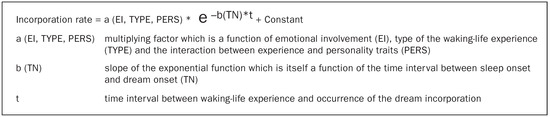
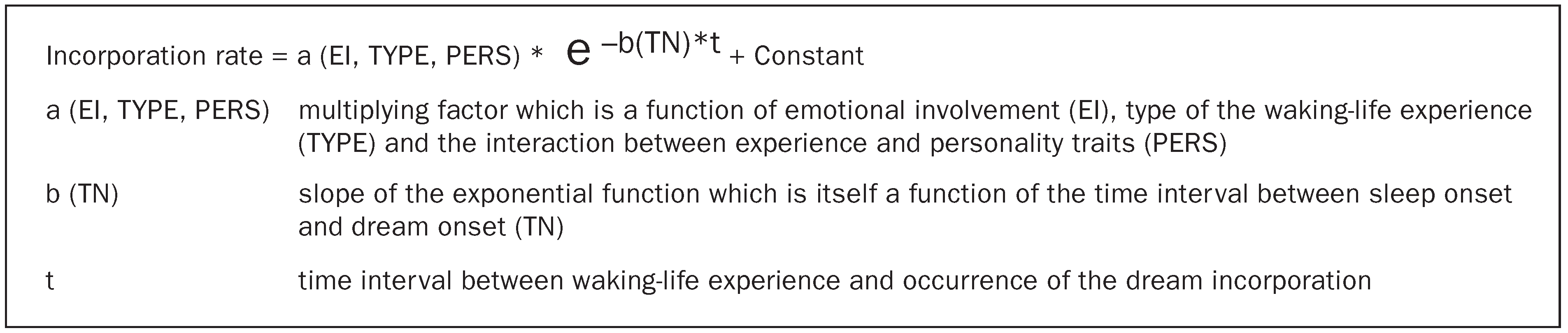
Many researchers (e.g. [1,4,14]) are advocating the so-called “continuity hypothesis” of dreaming which simply states that dreams reflect wakinglife experiences. However, for deriving specific hypotheses the continuity hypothesis in its general formulation is too imprecise. In order to advance the research in this field, Schredl [43] postulated a mathematical model that is based on the published findings and seems to be promising for further empirical testing (see fig. 1).The multiplying factor includes the effects of emotional involvement (EI), type of the waking-life experience (TYPE) and the interaction between personality traits and incorporation rates (PERS).The relationships between these factors should be determined by future studies.The slope of the exponential function may be moderated by the time interval between sleep onset and dream onset (time of the night; TN).
Figure 1.
Mathematical model for the continuity between waking life and dreaming.
Effect of dreams on waking life
Whereas the amount of studies investigating the effect of waking life on dreams is considerable, research looking into the effect of dreams on waking life is encountered quite rarely.Three major topics have been studied: (1) effect of nightmares on daytime mood, (2) creative inspiration by dreams and (3) dreams and psychotherapy.
Schredl [53] has found that “dreams affect the mood of the following day” is the effect most often reported of dreams on waking life. Carrying out a carefully designed diary study, Köthe and Pietrowsky [54] reported that days after experiencing a nightmare are rated much lower on scales like anxiety, concentration and self-esteem than days after non-nightmare nights. The hypothesis of Belicki [55] that the effects of nightmares on waking life are overestimated by persons with high neuroticism scores has not been supported by the findings of Schredl, Landgraf and Zeiler [56]. The major factor contributing to nightmare distress is nightmare frequency which is best explained by current stress and personality factors (neuroticism, thin boundaries; see [57]). In addition to these causal factors, the fact that anxiety phenomena can be perpetuated by avoiding the confrontation should be noticed [57] because this is very important regarding the therapy of nightmares.
The most effective treatment strategy for reducing the frequency of nightmares and their effects on waking life is the imagery rehearsal therapy (IRT), developed by Barry Krakow and co-workers [58]. Patients write down a recent (less intense) nightmare and they are asked to change the dream in any way they wish and to write down the altered version. Lastly, they are instructed to rehearse the new “dream” once a day over a two-week period. Five randomised controlled trials of IRT performed with chronic nightmare sufferers (e.g. [59]) showed the efficiency of confronting the nightmare anxiety (by writing down the dream) and coping with this anxiety by creating a new action pattern. Long-term follow-ups have shown stable treatment effects over time [60].
Many examples of creative inspiration from dreams have been reported over the years (overviews: [61,62]): “Wild strawberries” (a film by Ingmar Bergman), the story of Dr. Jekyll and Mr. Hyde by Robert Louis Stevenson, the pop song “Yesterday” by Paul McCartney and the paintings by Salvador Dalí provide excellent examples. Kuiken and Sikora [63] and Schredl [53] found that of the participants (student samples) 20 and 28% respectively reported creative inspirations from dreams at least twice a year. In a large, yet unpublished study by the author (N >1000), about 7.8% of the recalled dreams included a creative aspect, i.e., dreams stimulating art, dreams giving an impulse to something new (approaching a person, travelling, etc.) or dreams that help to solve a problem which occurs during writing a thesis or speech, working on mathematical problems and so on.The factors that are associated with the frequency of creative dreams in this study are dream recall frequency itself, the “thin boundaries” personality dimension, a positive attitude towards creative activities and visual imagination.
Dreams and psychotherapy
Although dream work is quite common in modern psychotherapy [64,65] and despite the extensive literature on case reports since Freud’s “The interpretation of dreams”, systematic research on the efficiency of dream work is limited to the research efforts of the one group (Clara Hill). For over ten years, they carried out studies to measure the effectiveness of single dream interpretation sessions [66],dream groups over 6 weeks [67] or dream interpretation within short-term psychotherapy [68]. The basis for this study is a cognitive-experiential model of dream interpretation that includes three stages: exploration, insight and action [69]. Similar studies for other therapeutic approaches to dreamwork are overdue.
Conclusions
This brief review of psychologically oriented dream research indicates that the following topics are of utmost interest for future research. First, the dream-recall process itself has to be studied in a more detailed way using paradigms looking at memory processes at the sleep/wake transition (cf. [70]). Information processing can also be studied by the method of event-related potentials (e.g. [71]). The application of imagining techniques, especially MRI, seems to be very promising because of the good time resolution [72] in dream research, if they are complemented by carefully conducted content analytic approaches. This kind of research will corroborate the assumption of Wittmann and Schredl [8] that the mind is continuously active during sleep – similar to the brain itself.
The combination of neurophysiolgical sleep research and dream research can shed light on the body/mind interaction, i.e. how and to what extent physiological processes are related to specific dream characteristics.The AIM model formulated by Hobson et al. [9], for example, postulates that the cholinergic neurotransmission which is more active during REM sleep than during NREM sleep and the waking state is responsible for the bizarre features of REM dreams. In this area, the progress in the imagining techniques will help to clarify this relationship.
The mathematical model for the continuity hypothesis will help to concentrate research efforts into looking for factors which affect the incorporation rate of waking-life experiences into subsequent dreams.This line of research is very relevant to the clinical work, i.e., if a patient reports a dream and wants to know how this dream is related to her/his inner life. Research on the effects of dreams on waking life seems equally full of promising opportunities, e.g. tapping the creative resources of dreams for professionals working in creative occupations. Within the therapeutic context, it is desirable that carefully conducted efficiency studies will be carried out in order to demonstrate the beneficial effect of dreamwork and determine which technique is most suitable for which client.
Whether dreaming serves a function or different functions independently from the functions of sleep, especially those formulated for REM sleep, is a question which might be answered in the future.
References
- Schredl M. Die nächtliche Traumwelt: Einführung in die psychologische Traumforschung. Stuttgart: Kohlhammer; 1999.
- Maury A. Le sommeil et les rêves. Paris: Didier; 1861.
- Schredl M. Körper-Seele-Interaktion: Trauminhalt und Physiologie des REM-Schlafes. Verhaltensther Verhaltensmedizin 2001;22:137–51.
- Strauch I, Meier B. Den Träumen auf der Spur: Zugang zur modernen Traumforschung. Bern: Huber; 2004.
- Dement WC, Kleitman N. The relation of eye movements during sleep to dream activity: an objective method for the study of dreaming. J Experiment Psychol 1957;53:339–46.
- Foulkes D. Dream reports from different stages of sleep. J Abnorm Soc Psychol 1962;65:14–25.
- Nielsen TA. A review of mentation in REM and NREM sleep: “covert” REM sleep as a possible reconcilation of two opposing models. Behav Brain Sci 2000;23:851–66.
- Wittmann L, Schredl M. Does the mind sleep? An answer to “What is a dream generator?” (Pace-Schott 2004). Sleep Hypnosis 2004;6:177–8.
- Hobson JA, Pace-Schott EF, Stickgold R. Dreaming and the brain: toward a cognitive neuroscience of conscious states. Behav Brain Sci 2000;23:793–842.
- Wittmann L, Schredl M, Kramer M. The role of dreaming in posttraumatic stress disorder [submitted].
- LaBerge S. Lucid Dreaming. Los Angeles: Jeremy P. Tarcher; 1985.
- Schredl M, Montasser A. Dream recall: state or trait variable? – Part I and Part II. Imagin Cognition Pers 1996–97;6:181–210, 239–61.
- Schredl M, Wittmann L, Ciric P, Götz S. Factors of home dream recall: a structural equation model. J Sleep Res 2003;12:133–41.
- Domhoff GW. Finding Meaning in Dreams: A Quantitative Approach. New York: Plenum Press; 1996.
- Parekh H. Träume der «Gesunden» – Inhaltsanalyse von manifesten Traumtexten aus einer Zufallsstichprobe einer Grossstadtpopulation. Fakultät für Klinische Medizin Mannheim der Universität Heidelberg: Dissertation; 1988.
- Schredl M. Questionnaires and diaries as research instruments in dream research: methodological issues. Dreaming 2002;12:17–26.
- Hopf HH. Wie «objektiv» sind unsere Notizen? Ein Vergleich von Patiententraumprotokollen mit von Therapeuten niedergeschriebenen Protokollen. Kind Umwelt 1989;63:42–52.
- Weisz R, Foulkes D. Home and laboratory dreams collected under uniform sampling conditions. Psychophysiol 1970;6:588–96.
- obson JA, Stickgold R. Dreaming: a neurocognitive approach. Consciousness and Cognition 1994;3:1–15.
- Hall CS, Van de Castle RL. The Content Analysis of Dreams. New York: Appleton-Century-Crofts; 1966.
- Winget C, Kramer M. Dimensions of Dreams. Gainesville: University of Florida Press; 1979.
- Schredl M, Burchert N, Gabatin Y. The effect of training on interrater reliability in dream content analysis. Sleep Hypnosis 2004;6:139–44.
- Schredl M. The stability and variability of dream content. Percept Mot Skills 1998;86:733–4.
- Schredl M, Doll E. Emotions in diary dreams. Consciousness and Cognition 1998;7:634–46.
- Schredl M, Erlacher D. The problem of dream content analysis validity as shown by a bizarreness scale. Sleep Hypnosis 2003;5:129–35.
- Schredl M, Schäfer G, Hofmann F, Jacob S. Dream content and personality: thick vs. thin boundaries. Dreaming 1999;9:257–63.
- Hobson JA, Hoffman SA, Helfand R, Kostner D. Dream bizarreness and the activation-synthesis hypothesis. Human Neurobiol 1987;6:157–64.
- Snyder F. The phenomenlogy of dreaming. In: Madow L, Snow LH, editors. The Psychodynamic Implications of the Physiological Studies on Dreams. Springfield: Charles C. Thomas; 1970. p. 124–51.
- McCarley RW, Hoffman E. REM sleep dreams and the activation-synthesis hypothesis. Am J Psychiatry 1981;138:904–12.
- Zadra AL, Nielsen TA, Donderi DC. The prevalence of auditory, olfactory, gustatory and pain experiences in 3372 home dreams. Sleep Res 1997;26:281.
- Kahn E, Dement W, Fisher C, Barmack JE. Incidence of color in immediately recalled dreams. Science 1962;137:1054–5.
- Rechtschaffen A, Buchignani C. Visual dimensions and correlates of dream images. Sleep Res 1983;12:189.
- Rechtschaffen A, Buchignani C. The visual appearance of dreams. In: Antrobus JS, Bertini M, editors. The Neuropsychology of Sleep and Dreaming. Hillsdale: Lawrence Erlbaum; 1992. p. 143–55.
- Foulkes D, Rechtschaffen A. Presleep determinants of dream content. Percept Mot Skills 1964;19:983–1005.
- Breger L, Hunter I, Lane RW. The Effect of Stress on Dreams. New York: International Universities Press; 1971.
- Schreuder BJ, Kleijn WC, Rooijmans HG. Nocturnal re-experiencing more than forty years after war trauma. J Trauma Stress 2000;13:453–63.
- Terr LC. Psychic trauma in children: observations following the Chowchilla schoolbus kidnapping. Am J Psychiatry 1981;138:14–9.
- Krakow B, Tandberg D, Barey M, Scriggins L. Nightmares and sleep disturbance in sexually assaulted women. Dreaming 1995;5:199–206.
- Schredl M, Montasser A. Dreaming and eating disorders. Sleep Hypnosis 1999;1:225–31.
- Schredl M, Sahin V, Schäfer G. Gender differences in dreams: do they reflect gender differences in waking-life? Pers Individ Diff 1998;25:433–42.
- Schredl M, Engelhardt H. Dreaming and psychopathology: dream recall and dream content of psychiatric inpatients. Sleep Hypnosis 2001;3:44–54.
- Schredl M, Hofmann F. Continuity between waking activities and dream activities. Consciousness and Cognition 2003;12:298–308.
- Schredl M. Continuity between waking and dreaming: a proposal for a mathematical model. Sleep Hypnosis 2003;5:38–52.
- Botman HI, Crovitz HF. Dream reports and autobiographical memory. Imagin Cognition Pers 1989–90;9:213–24.
- Hartmann E. We do not dream of the 3 R’s: implications for the nature of dream mentation. Dreaming 2000;10:103–10.
- Schredl M. Continuity between waking life and dreaming: are all waking activities reflected equally often in dreams? Percept Mot Skills 2000;90:844–6.
- Verdone P. Temporal reference of manifest dream content. Percept Mot Skills 1965;20:1253–68.
- Roussy F, Raymond I, Gonthier I, Grenier J, De Koninck J. Temporal references in manifest dream content: confirmation of increased remoteness as the night progresses. Sleep Suppl 1998;21:285.
- Roffwarg HP, Herman JS, Bowe-Anders C, Tauber ES. The effects of sustained alterations of waking visual input on dream content. In: Arkin AM, Antrobus JS, Ellman SJ, editors. The Mind in Sleep: Psychology and Psychophysiology. Hillsdale, NJ: Lawrence Erlbaum; 1978. p. 295–349.
- Lauer C, Riemann D, Lund R, Berger M. Shortened REM latency: a consequence of psychological strain? Psychophysiol 1987;24:263–71.
- Baekeland F, Resch R, Katz D. Presleep mentation and dream reports: I. Cognitive style, contiguity to sleep and time of the night. Arch Gen Psychiatr 1968;19:300–11.
- Schredl M, Kleinferchner P, Gell T. Dreaming and personality: thick vs. thin boundaries. Dreaming 1996;6:219–23.
- Schredl M. The effect of dreams on waking life. Sleep Hypnosis 2000;2:120–4.
- Köthe M, Pietrowsky R. Behavioral effects of nightmares and their correlations to personality patterns. Dreaming 2001;11:43–52.
- Belicki K. Nightmare frequency versus nightmare distress: relation to psychopathology and cognitive style. J Abnorm Psychol 1992;101:592–7.
- Schredl M, Landgraf C, Zeiler O. Nightmare frequency, nightmare distress and neuroticism. North Am J Psychol 2003;5:345–50.
- Schredl M. Effects of state and trait factors on nightmare frequency. Eur Arch Psychiatr Clin Neurosci 2003;253: 241–7.
- Krakow B, Kellner R, Pathak D, Lambert L. Imagery rehearsal treatment for chronic nightmares. Behav Res Ther 1995;33:837–43.
- Krakow B, Hollifield M, Johnston L, Koss M, Schrader R, Warner TD, et al. Imagery rehearsal therapy for chronic nightmares in sexual assault survivors with posttraumatic stress disorder: a randomized controlled trial. Jama 2001;286:537–45.
- Krakow B, Kellner R, Neidhardt J, Pathak D, Lambert L. Imagery rehearsal treatment of chronic nightmares: with a thirty-month follow-up. J Behav Ther Exp Psychiatry 1993;24:325–30.
- Van de Castle RL. Our Dreaming Mind. New York: Ballentine; 1994.
- Barrett D. The Committee of Sleep: How Artists, Scientists, and Athletes Use Dreams for Creative Problem-Solving – and How You Can Too. New York: Crown; 2001.
- Kuiken D, Sikora S. The impact of dreams on waking thoughts and feelings. In: Moffitt A, Kramer M, Hoffmann R, editors. The Functions of Dreaming. Albany: State University of New York Press; 1993. p. 419–76.
- Schredl M, Bohusch C, Mader A, Somesan A. The use of dreams in psycho-therapy: a survey of psychotherapists in private practice. J Psychother Practice Res 2000;9:81–7.
- Crook RE, Hill CE. Working with dreams in psychotherapy: the therapists’s perspective. Dreaming 2003;13:83–93.
- Hill CE, Diemer R, Hess S, Hillyer A, Seeman R. Are the effects of dream interpretation on session quality, insight and emotion due to the dream itself, to projection or to the interpretation process? Dreaming 1993;3:269–80.
- Falk DR, Hill CE. The effectiveness of dream interpretation groups for women undergoing a divorce transition. Dreaming 1995;5:29–42.
- Diemer RA, Lobell LK, Vivino BL, Hill CE. Comparison of dream interpretation, event interpretation, and unstructured sessions in brief therapy. J Consult Psychol 1996;43:99–112.
- Hill CE. Dream Work in Therapy: Facilitating Exploration, Insight, and Action. Washington: American Psychological Association; 2004.
- Conduit R, Crewther SG, Coleman G. Poor recall of eye-movement signals from stage 2 compared to REM sleep: implications for models of dreaming. Consciousness and Cognition 2004;13:484–500.
- Cote KA, Campbell KB. P300 to high-intensity stimuli during REM sleep. Clin Neurophysiol 1999;110:1345–50.
- Czisch M, Wehrle R, Kaufmann C, Wetter TC, Holsboer F, Pollmächer T, et al. Functional MRI during sleep: BOLD signal decreases and their electrophysiological correlates. Eur J Neurosci 2004;20:566–74.

This is an open-access article distributed under the terms of the Creative Commons Attribution Non-Commercial No Derivatives (CC BY-NC-ND) 4.0 License.