


Neurological MCQ
E. Carrera
Neurologie, CHUV, Lausanne
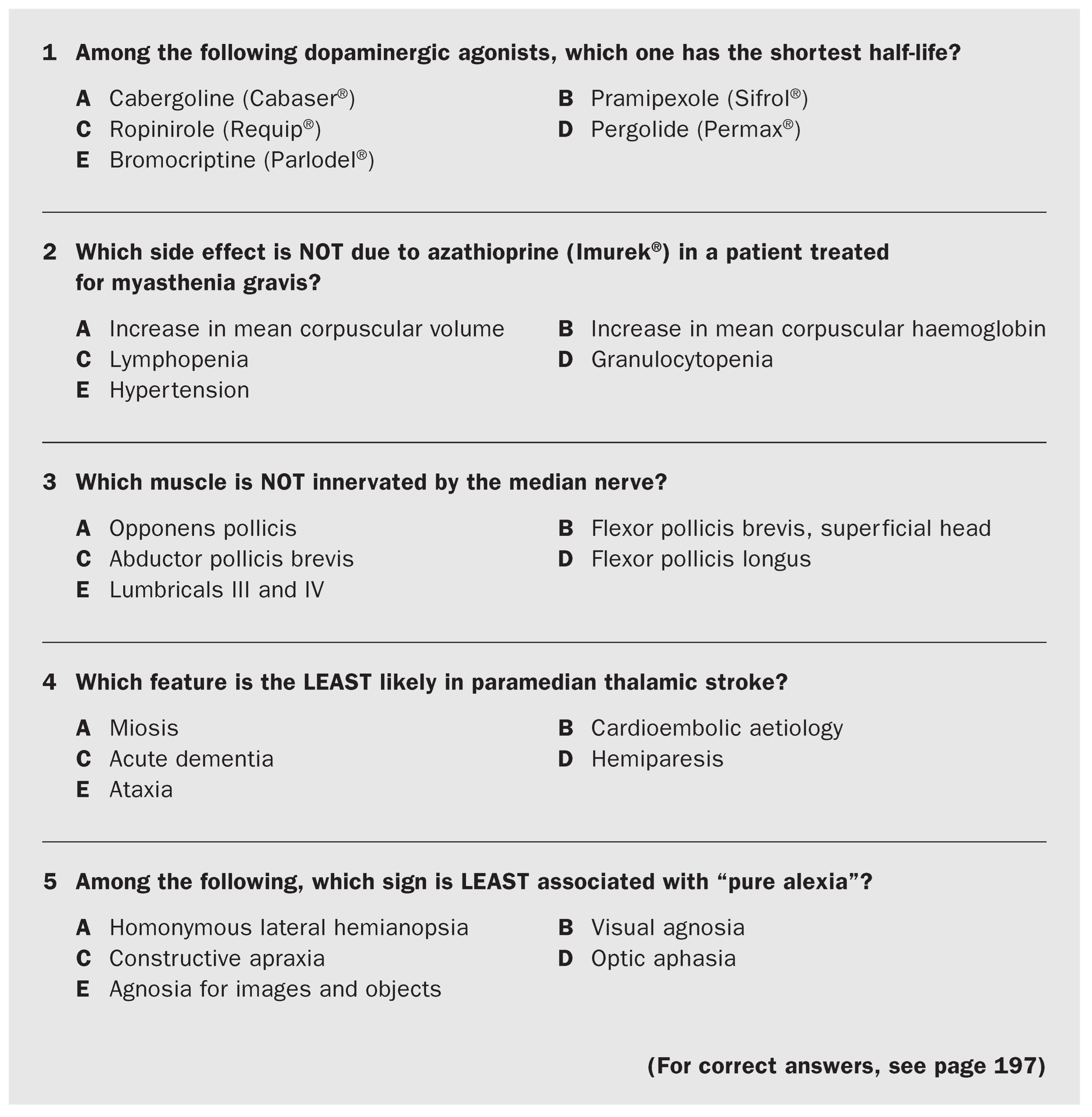
Select the one correct answer.
Neuroradiology/Neuroanatomy
P. Michel
Neurologie, CHUV, Lausanne
Read for you
A. Rossetti
Neurologie, CHUV, Lausanne
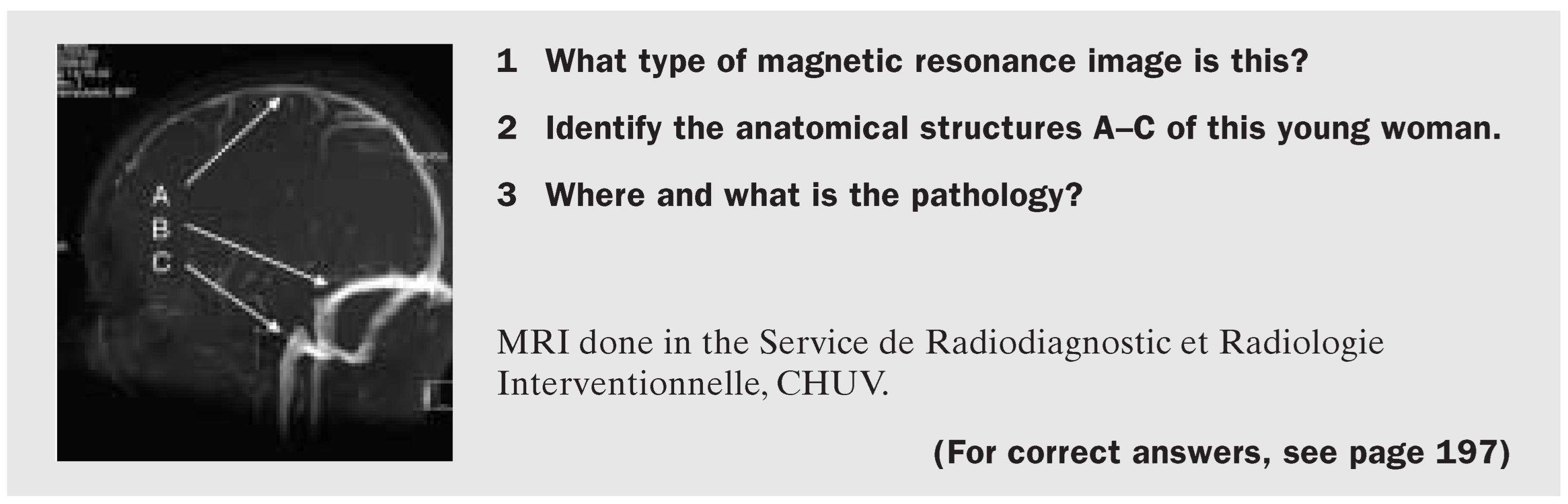
Cerebral venous thrombosis: of seizures and clinical outcome
Cerebral vein and sinus thrombosis is a serious condition, with mortality rates at about 10%. Some papers have recently been published about prognostic factors.
A French study including prospectively 55 patients [1] isolated the presence of a neurological deficit at presentation and a malignant haemopathy as predictors of bad outcome (death or dependence); conversely, only a trend but no statistically significant association was found between impaired consciousness or seizures and an unfavourable prognosis. Seizures were observed in the acute phase in 50% of patients, a 1⁄4 of them suffered from recurrence.
In Berlin 79 subjects were analysed retrospectively [2]. Only depressed vigilance but not focal neurological deficits or seizures correlated with fatal outcome. Seizures were found acutely in 58% of patients.
The Portuguese VENOPORT study prospectively included 91 patients [3,4]. Consciousness impairment together with worsening after admission were predictors of death or dependency. Early seizures, occurring in 34% of patients, were not associated with a bad outcome on multivariate analysis. Late seizures developed in 9.5%, and 1⁄3 of them did not experience acute seizures ...
The summary is a bit puzzling at first sight, but some conclusions may be drawn. First, consciousness impairment seems to constitute the most important unfavourable prognostic sign. Possibly, focal neurological signs may act similarly. Second, seizures do not predict death or dependency and recur in about 10% of patients (only 1⁄4 of those having acute fits).Thus, prophylaxis of late seizures by treating patients with early seizures does not seem adequate. Third, apart from differing methods among them, the studies are probably insufficiently powered to present consequent results. We look forward to reading the results of the international cerebral venous thrombosis study, which is currently running.
- Breteau G, Mounier-Vehier F, Godefroy O, Gauvrit JY, Mackowiak-Cordoliani MA, Girot M, et al. Cerebral venous thrombosis 3-year clinical outcome in 55 consecutive patients. J Neurol 2003;250:29–35.
- Mehraein S, Schmidtke K, Villringer A, Valdueza JM, Masuhr F. Heparin treatment in cerebral sinus and venous thrombosis: patients at risk of fatal outcome. Cerebrovasc Dis 2003;15:17–21.
- Ferro JM, Lopes MG, Rosas MJ, Ferro MA, Fontes J; Cerebral Venous Thrombosis Portuguese Collaborative Study Group. Long-term prognosis of cerebral vein and dural sinus thrombosis. Results of the VENOPORT study. Cerebrovasc Dis 2002;13:272–8.
- Ferro JM, Correia M, Rosas MJ, Pinto AN, Neves G; Cerebral Venous Thrombosis Portuguese Collaborative Study Group (Venoport). Seizures in cerebral and dural sinus thrombosis. Cerebrovasc Dis 2003;15:78–83.
This is an open-access article distributed under the terms of the Creative Commons Attribution Non-Commercial No Derivatives (CC BY-NC-ND) 4.0 License.