


Summary
Bühler K-E, Land T. Burnout and personality in extreme nursing: an empirical study. Schweiz Arch Neurol Psychiatr 2004;155:35–42.
Previous research into the causes of burnout has mainly been concerned with external triggers, such as onerous work criteria or organisational or social influences. On the other hand, the question repeatedly posed is why, under the same working conditions, one individual burns out, while another shows no symptoms at all. It seems fair to assume that other causes such as personality may also play a role but such factors as individual reactions and personality have largely been ignored as a possible aetiology of burnout development.
In preparation of a long-term study, this general cross-sectional study investigates the relationship between burnout and personality variables. The different personality variables having a possible impact on burnout were determined in a number of prestudies. The scales of these prestudies were selected according to their relevance for descriptive theories reported in scientific literature. The data were gathered from 119 people working in intensive care units. The Maslach Burnout Inventory (MBI) was used as well as certain subscales of the following personality questionnaires: Eysenck Personality Inventory (EPI), Inventory of Aggressivity (IA),Trier Personality Questionnaire (TPQ), Scales of Control (SC), Locus of control (LC) and the Logo-test (LOGO).All these aspects were descriptively but not yet quantitatively reported in scientific literature.
Although multiple regression does not show all the personality variables as predictors for the burnout dimensions, the research hypothesis is confirmed: personality is significantly related to certain aspects of burnout. “Neuroticism”, “extraversion”,“ external locus of control”,“job-distance inability”, “existential frustration” and “ability of love” prove to be personality traits with an impact on the development or the presence of burnout.
The evaluation of our data shows that the factor “Mental Health” or “Psychoprotection” is important for all the burnout variables. It measures personality traits such as a high self-esteem, efficient coping strategies and autonomy.
The results of this study identifying mental health as a consequence of a meaningful life as a protective factor, and an external locus of control, neuroticism and extraversion as factors promoting burnout, might in future both be used to predict and prevent a burnout syndrome. As a consequence of our results individuals can use their knowledge of their own personal disposition to avoid the development of burnout; for example, by regulating their motivation and their engagement and enthusiasm for the job, and by seeking sensible leisure activities. On the other hand, the empirically established association between personality and burnout can be used as a basis for personality questionnaires to identify people susceptible to burnout.
Introduction
Mental and physical states of exhaustion have been known for a long time, but it was Freudenberger in 1974 who first coined the term “burnout” for the mental and physical exhaustion of voluntary workers in various social fields [1].The term “burnout syndrome”, mainly applied to the caring professions, defines the breakdown of energy resources and adaptability as a reaction to chronic stress [2,3,4]. It is generally conceptualised as a syndrome with three dimensions: emotional exhaustion, depersonalisation and reduced feelings of personal accomplishment [4]. We consider the burnout syndrome to be a subclass of affective disorders, either as an abortive form of minor depression or dysthymia depending upon duration. In severe cases a burnout syndrome can become an exhaustion depression, i.e. a major depression.
American burnout research, dominated by social psychologists, for a long time favoured the organisational and institutional aetiology hypothesis of burnout being, among other things, a reaction to chronic stress, job dissatisfaction [5] and an increasing loss of idealism and energy as a result of working conditions [6].The environment was considered to be the principal trigger for the burnout process [7,8,9].
On the other hand, the question repeatedly posed is why, under the same working conditions, one individual burns out, while another shows no symptoms at all. It seems fair to assume that other causes such as personality may also play a role. There is evidence, such as the long-term study of teachers by Jackson, Schwab and Schuler that could not establish any connection between working conditions and burnout [10], that working conditions are not the only reason.
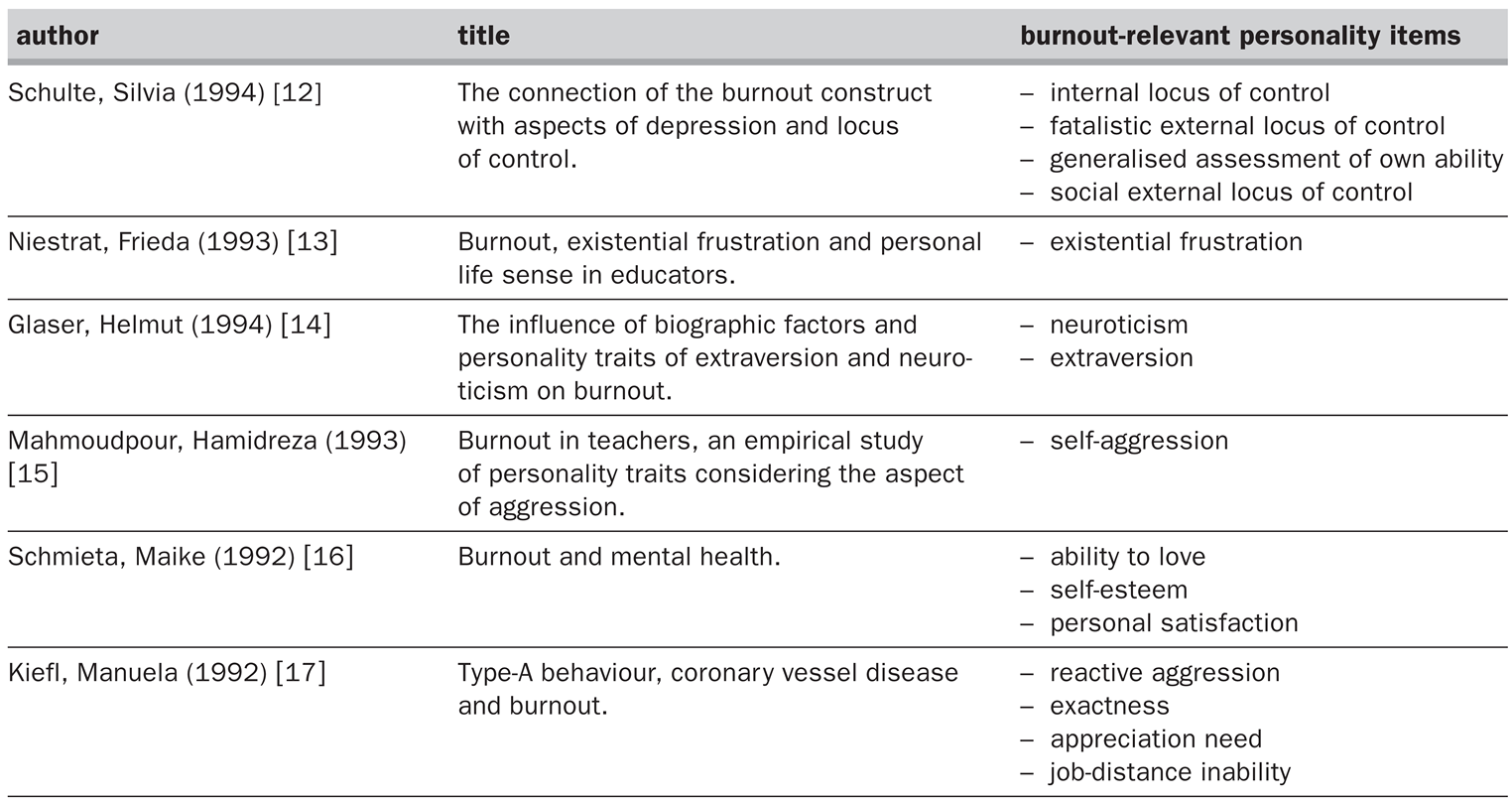
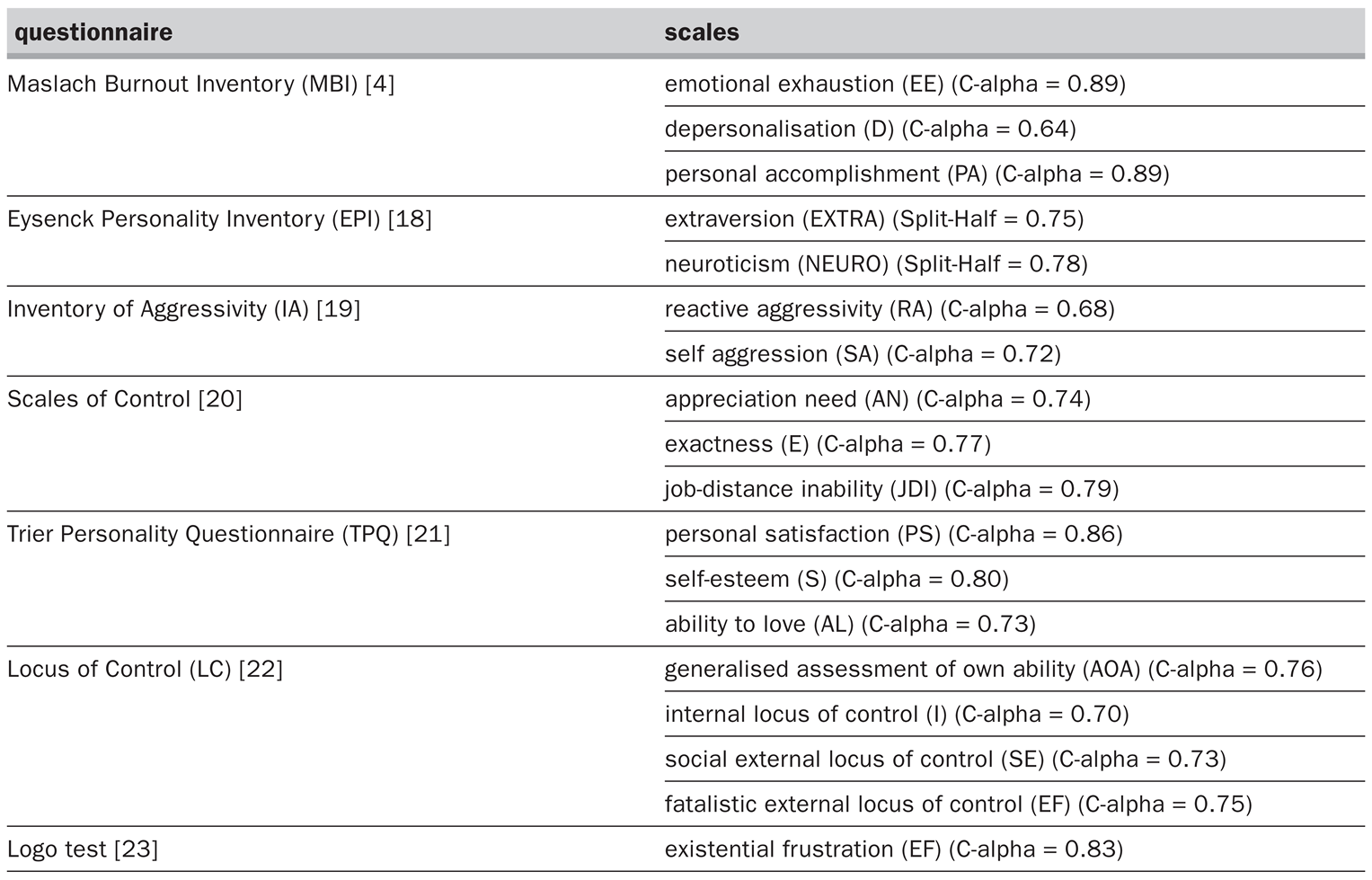
Perlman and Hartman criticise the lack of studies dealing with the connection between burnout and personality [11].The lack of research studies in this field leaves the concept of burnout as a descriptive term with little insight into the basic causes and effects. For this reason, we wanted to investigate the influence of personality dimensions on burnout. As an empirical approach, several prestudies aimed at a reduction of personality variables relevant for burnout (see Table 1). The scales of these prestudies were selected according to their relevance for descriptive theories reported in scientific literature. In detail these aspects were: locus of control, sense of life, neuroticism, extraversion, introversion, aggression, mental health and type-A behaviour. All these aspects were descriptively but not yet quantitatively reported in scientific literature. These prestudies empirically and quantitatively showed the questionnaires and the scales in Table 2 to be important for the assessment of personality traits influencing burnout.The aim of the present study is to confirm the impact of selected personality variables on burnout in a cross-sectional design.

Table 1.
Previous studies.
Table 2.
Questionnaires and scales.
Methods
Subjects
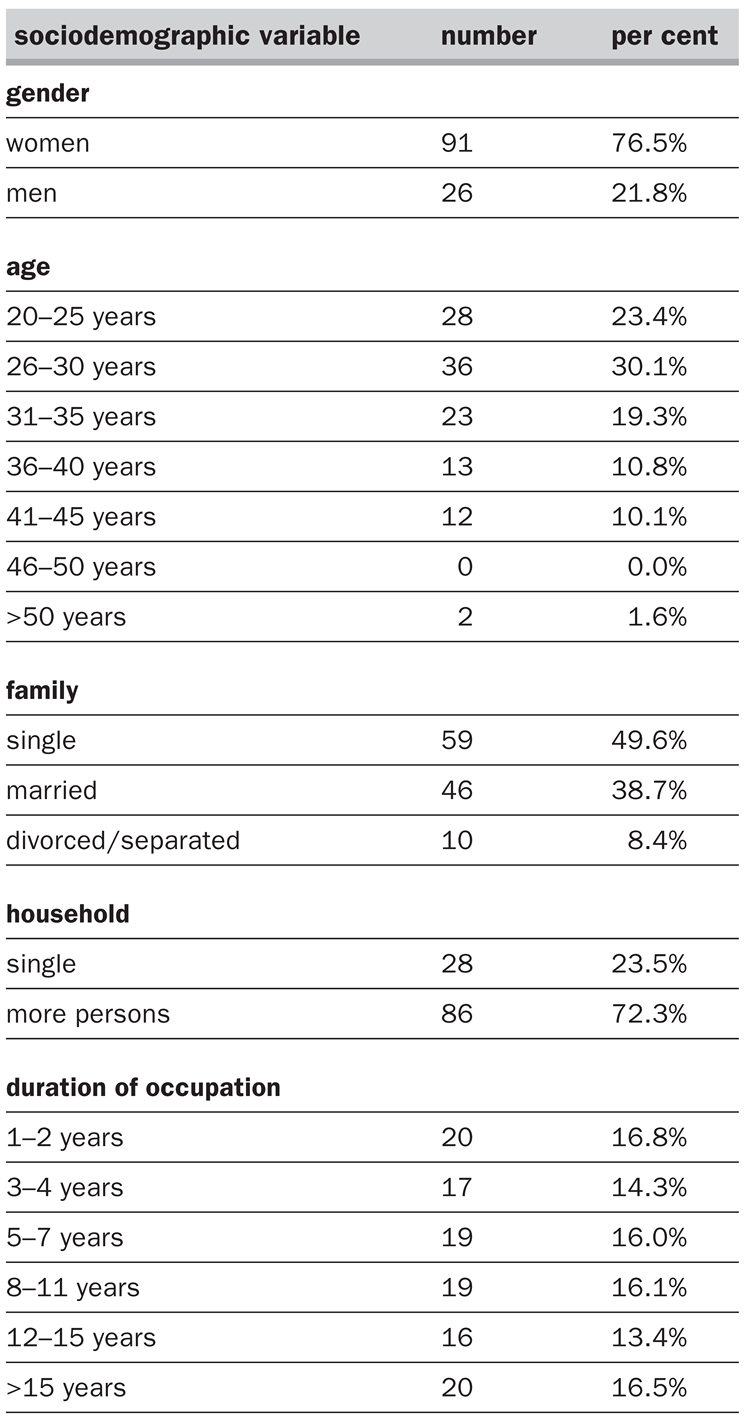
The investigation was carried out using questionnaires and based on a random sample of nursing staff in intensive care units of 10 German hospitals. Other caring personnel were not included in the analysis of data. The usable response rate was 63% and thus comparable to other surveys with response rates of 57% [24] and 72% [25]. The questionnaires were anonymously answered by N = 117, i.e. N = 91 women (76.5% of the total) and N = 26 men (21.8% of the total) of the nursing staff. For further sociodemographic data see Table 3.
Table 3.
Sociodemographic data of the participants.
Instruments
The instruments that were used are listed in table 2.
Statistical Analysis
First, stepwise multiple regression analyses were done to assess the predictivity of personality variables on burnout and partialise out intercorrelations. The subscales of the personality scales were taken as predictors to determine whether they made significant independent contributions to the three dimensions of burnout. Only predictors with p <0.5 were taken into account.
<0.5 were taken into account. Then, factor analysis was used to establish connections between all the individual scores of the assessed personality scales (concerning the individual scales see table 2) as subordinate items and superordinate personality factors. The purpose of factor analysis is to reduce variables to common dimensions, i.e. factors, to improve the perspicuity of the data.The weighting of the factors is arranged in descending order. On the basis of the screeplot a factor model has been chosen with factors having an eigenvalue >1. Only variables with factor loadings >0.5 were taken into account. The superordinate factors were again correlated with the MBI variables (Spearman correlation).
All statistical procedures were performed by the Statistical Package for Social Science (SPSS) for Windows.
Results
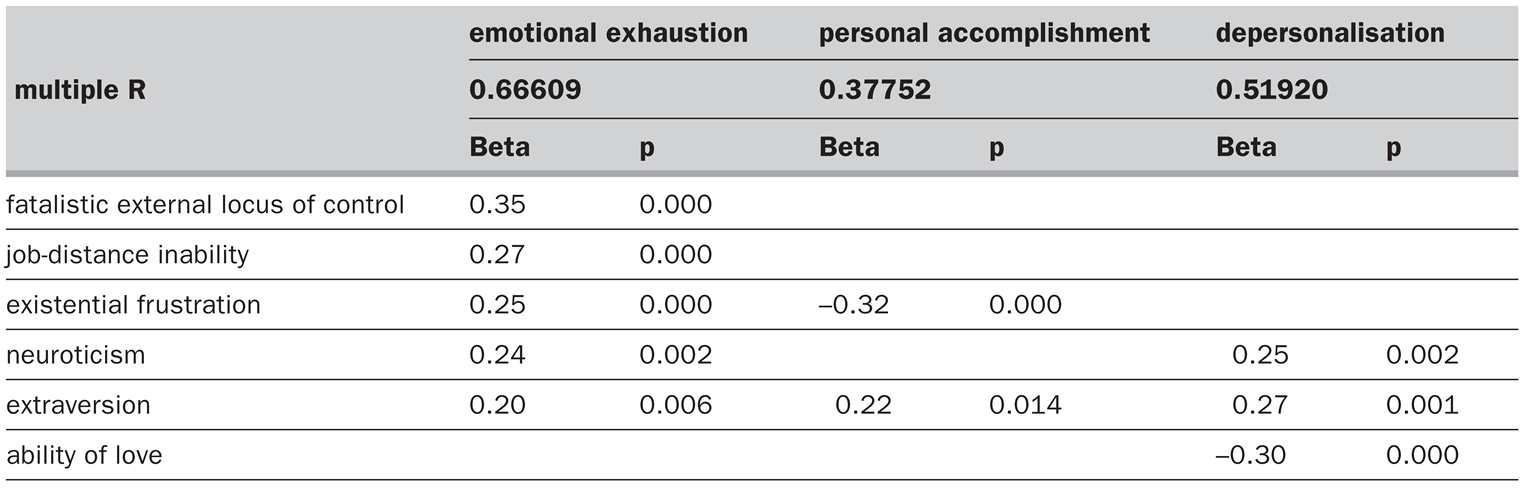
The following personality variables proved to be significant predictors of the criteria variable “emotional exhaustion” (EE) (Table 4): “fatalistic external locus of control” (FE) p = <0.0001; “jobdistance inability” (JDI) p = 0.0003; “existential frustration” (EF) p = 0.0008; “neuroticism” (NEURO) p = 0.0002; “extraversion” (EXTRA) p = 0.0006. With an adjusted R-square (0.42, p <0.0001) 43% of the variance is explained.
Table 4.
Multiple regression.
With regard to the criteria variable “personal accomplishment” (PA) (Table 4) the two predictors – “existential frustration” (EF) p = 0.0004 and “extraversion” (EXTRA) p = 0.00145 are of significance. With an adjusted R-square (0.13, p = 0.0002) 15% of the variance is explained.
The variable PA is inverted, where a low value means good capability.
With regard to the criteria variable “depersonalisation” (D) (Table 4), the variables “ability to love” (AL) = 0.0004; “extraversion” (EXTRA) p = 0.00018 and “neuroticism” (NEURO) p = 0.0025 are significant predictor variables. With an adjusted R-square (0.24, p <0.0001), 12% of the variance is explained.
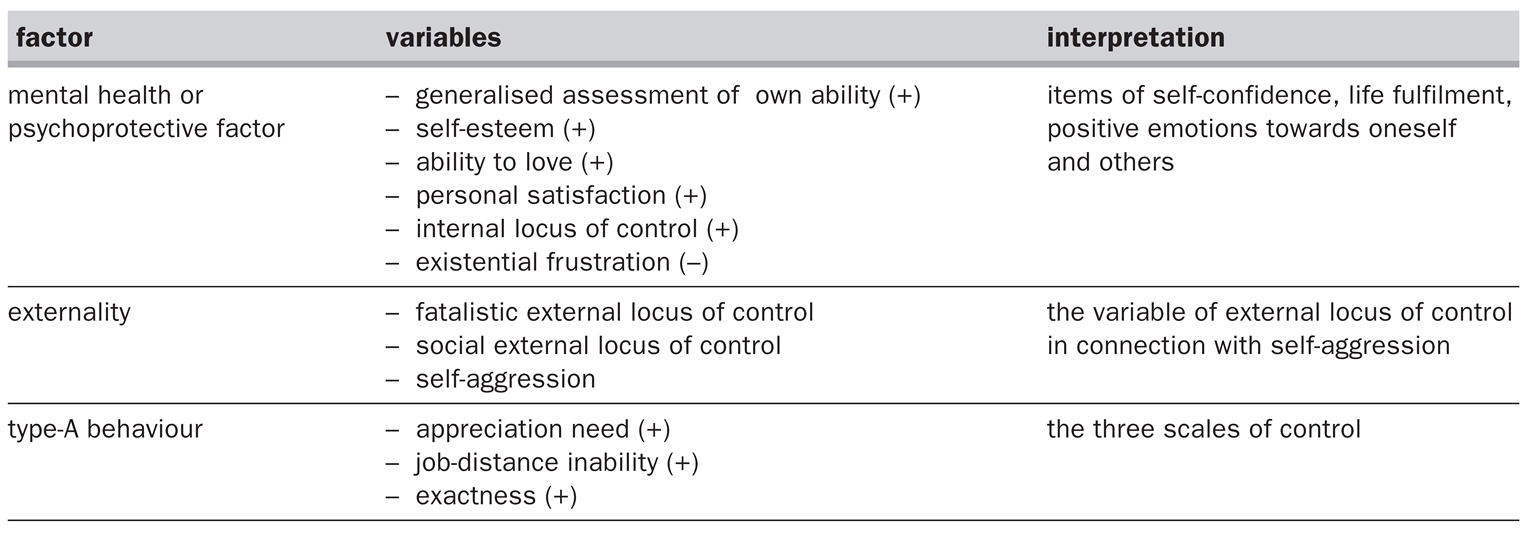
Table 5 shows the results of the factor analysis. On the basis of the screeplot a three-factor model has been chosen with eigenvalues >1.
Table 5.
Factor analysis.
- −
- Factor 1 “mental health” or “psychoprotection” comprises items for self-confidence, life fulfilment, positive emotions towards oneself and others, and negatively weighted existential frustration.
- −
- Factor 2 “external locus of control” connects the two variables for external locus of control and the aggression variable “self-aggression”.
- −
- Factor 3 “type-A behaviour” represents type-A behaviour with strongly defined control ambitions such as the need for recognition, exactness and job-distance inability.
As only variables with factor loadings >0.5 were taken into account, the variables “reactive aggression” (factor 2), “neuroticism” and “extraversion” (factor 3) do not appear in this factor model because of their low loading on the respective factors. Furthermore, the authors consider the variables “neuroticism” and “extraversion” as individual personality factors already confirmed by different personality factor models [26]. As both variables turn out to have an impact on at least two of the three burnout variables in the multiple regression, their role in the burnout process will be discussed.
Table 6 shows the correlation results between the three personality factors of the factor model and the burnout variables of MBI. The factor “mental health” or “psychoprotection” shows a significant negative correlation to all three burnout variables (inversed sign for “personal accomplishment”). The factor “external locus of control” correlates significantly positively with the burnout variable “emotional exhaustion” and positively with the variable “depersonalisation”. The personality factor “type-A behaviour” shows no significant correlation to the burnout factors.
Table 6.
Spearman correlation of the 3 factors and the MBI-variables.
Discussion
Although multiple regression does not show all the personality variables as predictors for the burnout dimensions, the research hypothesis is confirmed, personality is significantly related to certain aspects of burnout. “Neuroticism”, “extraversion”,“ external locus of control”,“job-distance inability”, “existential frustration” and “ability of love” prove to be personality traits with an impact on the development or the presence of burnout.
Neuroticism and burnout
Empirical connections between neuroticism and burnout were found in 1978 [27]. Our investigations confirm the results of Piedmont, who found that people with high neurotic values also show higher values for the burnout variables “emotional exhaustion” and “depersonalisation” [28]. Neuroticism is sometimes described as a superordinate for characteristics of general personality, needs and motives that predispose burnout [29]. It is a factor of psychological vulnerability which is probably made up of several subfactors. Anxiety, diminished self-esteem, feelings of guilt and compulsive tendencies, as well as the tendency to worry, irritability and depression are all part of a neurotic personality [29].Various authors confirm the direct influence of neuroticism on psychological indisposition [24,25,26,30,31]. In spite of normally conformist social behaviour, a basically neurotic personality displays neurotic behaviour mainly in stress situations. Subjectively, these persons experience more lack of success in what they set out to do, and stress is experienced more negatively, independent of type and time of the stress situation. Because of misinterpretation of subjective and objective stress these individuals are significantly less able to deal adequately with stressors, as is particularly notable in fields of work where situational stress is unavoidable, e.g. in intensive care units. As subjective or objective stress is often described as a basic prerequisite for burnout [29], neuroticism accelerates the burnout process through a disproportionally pronounced feeling of stress.
Extroversion and burnout
In contrast to the general statements of personality literature, which evaluate extraversion as a psycho-protective factor and equate it with happiness [26], our results show a positive connection between “extraversion”, “emotional exhaustion” and “depersonalisation”. This might be due to the weighting of the subdimensions of the extraversion scale. Piedmont was able to show that the sub-variable “excitement seeking” of the extraversion scale correlates positively with the burnout variable “emotional exhaustion” [28]. The search for something new, adventurousness and impulsiveness characterise the extrovert. Individuals seeking excitement and deliberately taking risks have a greater tendency to become emotionally exhausted. Under the title “First inflamed then burnt out”, Schwanold, Anderson and Sachse describe the process of emotional exhaustion [32] of caring people changing from highly motivated beginners to resigned, unfeeling and callous professionals. Freudenberger and Richelson write in the same vein: “Burning out is confined mainly to dynamic and ambitious men and women, who, in all that they do, give of their best and with heart and soul” [33]. Emotional exhaustion and depersonalisation are here to be seen as the end of a process that takes place in people who have battled on to the end of their emotional strength [25].
External locus of control and burnout
In agreement with the general literature,our results show a clear prognosis value of the personality factor “external locus of control” for the burnout process [34,35,36]. Of great significance for the burnout process is whether the individual believes that his or her own behaviour determines what he or she encounters [29]. People scoring high in “external locus of control” generally expect that important events in their lives are determined by forces beyond their control (i.e. powerful others, chance, luck).
The factor “external locus of control” correlates positively with the burnout variables “emotional exhaustion” and “depersonalisation”. This confirms an association between externality, helplessness and self-aggression as a consequence of frustration [23]. Longer periods of helplessness and frustration diminish emotional resources and may therefore lead to emotional exhaustion. Depersonalising behaviour can be interpreted as a protective reaction to the emotional overload.
The variable “locus of control” appears to be influenced by one’s coping strategies. Distress increases when emotion-focused coping strategies are used with stressors perceived as controllable or when problem-focused strategies are used with uncontrollable stressors [36]. Individuals with high scores on “external locus of control” attempt to use emotion-focused coping strategies even with stressors basically perceived as controllable, such as time pressure, staff management or schedule. This mismatch increases the subjectively experienced emotional stress and leads to emotional exhaustion. There are studies which substantiate that emotionalism is in general more unstable in individuals with high scores on “external locus of control” than those with high “internal locus of control” [37,38].
The evaluation of our data shows that the factor “mental health” or “psychoprotection” is important for all the burnout variables. It measures personality traits such as high self-esteem, efficient coping strategies and autonomy. A person is mentally well to the extent to which he or she succeeds in dealing with internal and external demands [39]. Internal demands are for example daily needs, while external demands, in the field of caring professions, are for example dealing with patients. Anticipated or actual failures are accompanied by negative emotions which lead to physical and psychological withdrawal from patients. The successful mastering of work demands or personal aims lead to positive emotions [40]. These emotions develop a certain regulating behavioural character and in a feedback process influence the personality.
“Ability to love” can be seen as a universal indicator for mental health [41]. Low scores for “ability to love” have an influence on the strength of the burnout factor “depersonalisation”. It describes people who are in general indifferent towards other people, having difficulties in empathising, being neither very helpful nor considerate. Since they generally show little interest in the lives of friends, they form fewer friendships and appear unsociable and introverted. An inability to perceive that other people have similar feelings, impulses and thoughts as oneself is caused by a basic inability to love. Although the variable “ability to love” is not explicitly mentioned in association with burnout, the literature describes different personality types susceptible to burnout whose common factor is the inability to express emotions [42]. The protective function of mental health for the prevention of burnout is well known [41]. Burnout may also be described as a state of “mental illness” as opposed to mental wellness.
The results of this study, identifying mental health as a consequence of a meaningful life as a protective factor, and an external locus of control, neuroticism and extraversion as factors promoting burnout, might in future both be used to predict and to prevent a burnout syndrome. As a consequence of our results individuals can use their knowledge of their own personal disposition to avoid the development of burnout; for example, by regulating their motivation and their engagement and enthusiasm for the job, and by seeking sensible leisure activities. On the other hand, the empirically established association between personality and burnout can be used as a basis for personality questionnaires to identify people susceptible to burnout.
The present cross-sectional study of course cannot claim any direct causality between the variables. Personality variables might change as a response to life events.As St-Yves suggests, further longitudinal examinations should establish a personality profile at the beginning of employment and then follow this up over a longer period of time in correlation with burnout status, coping strategies and specific occupational stressors [36].
References
- Freudenberger HJ. Staff burn-out. Journal of Social Issues 1974;30:159–65.
- Daley MR. Preventing worker burnout in child welfare. Child Welfare 1979;58:443–50.
- Cherniss C [Interview with]. “Job Burnout”: Growing Worry for Workers, Bosses. U.S. News & World Report, Inc.; 1980.
- Maslach C, Jackson SE. Maslach Burnout Inventory Manual. 2nd ed. Palo Alto, CA: Consulting Psychologists Press; 1986.
- Harrison WD. Role strain and burnout in child-protective service workers. Social Service Review 1980;54:31–44.
- Edelwich J, Brodsky A. Burn-Out. Stages of Disillusionment in the Helping Professions. New York: Human Sciences Press; 1980.
- Aronson E, Pines AM, Kafry D. Ausgebrannt: Vom Überdruss zur Selbstentfaltung. Stuttgart: Klett-Cotta; 1983.
- Karger HJ. Burnout as alienation. Social Service Review 1981;55:271–83.
- Maslach C. Burned-out. Human Behaviour 1976;5:16–22.
- Jackson SE, Schwab RL, Schuler RS. Toward an understanding of the burnout phenomenon. J Appl Psychol 1986;71:630–40.
- Perlman B, Hartman EA. Burnout: summary and future research. Human Relation 1982;35:283–305.
- Schulte S. Der Zusammenhang des Konstruktes Burnout mit Aspekten der Depressivität und der Kontrollüberzeugungen. Diplomarbeit, Philipps-Universität Marburg; 1994.
- Niestrat F. Burnout, existentielle Frustration und persönliche Sinnfindung in der Heimerziehung [Diplomarbeit]. Marburg: Philipps-Universität Marburg; 1993.
- Glaser H. Der Einfluss von biographischen Faktoren und den Persönlichkeitsmerkmalen der Extraversion und des Neurotizismus auf den Ausprägungsgrad des Burnout [Diplomarbeit]. Marburg: Philipps-Universität Marburg; 1994.
- Mahmoudpour H. Burnout bei Lehrern, eine empirische Untersuchung von Persönlichkeitsmerkmalen unter besonderer Berücksichtigung des Aggressionsaspekts [Diplomarbeit]. Marburg: Philipps-Universität Marburg; 1993.
- Schmieta M. Burnout unter differentialpsychologischen Gesichtspunkten mit besonderer Berücksichtigung des Konzeptes seelischer Gesundheit – eine Vergleichsstudie [Diplomarbeit]. Marburg: Philipps-Universität Marburg; 1992.
- Kiefl M. Typ-A-Verhalten, Koronare Herzerkrankung und Burnout – auf der Suche nach einem Zusammenhang [Diplomarbeit]. Marburg: Philipps-Universität Marburg; 1992.
- Eggert D. Eysenck-Persönlichkeits-Inventar Manual. Göttingen: Hogrefe; 1974.
- Hampel R, Selg H. Fragebogen zur Erfassung von Aggressivitätsfaktoren. Handanweisung. Göttingen: Hogrefe; 1975.
- Siegrist J, Dittmann KH, Matschinger H. Fragebogen zur Messung von Kontrollambitionen. Veröffentlichung und erste Anwendung. In: K. H. Dittmann, H. Matschinger. Untersuchungen zur Bedeutung psychosozialer Risiken bei der Entstehung von Herzinfarkt. Abschlussbericht an die DFG zu Si 236/4. 1982.
- Becker P. Der Trierer Persönlichkeitsfragebogen TPF. Handanweisung. Göttingen: Hogrefe; 1989.
- Krampen G. Fragebogen zu Kompetenz- und Kontrollüberzeugung (FKK). Handanweisung. Göttingen: Hogrefe, Verlag für Psychologie; 1991.
- Lukas ES. Logo-Test. Test zur Messung von “innerer Sinnerfüllung” und “existentieller Frustration”. Handanweisung. Wien: Deuticke; 1986.
- Amstutz MC, Neuenschwander M, Modestin J. Burnout bei psychiatrisch tätigen Ärztinnen und Ärzten. Psychiatr Prax 2001;28:163–7.
- McCranie EW, Brandsma JM. Personality antecedents of burnout among middle-aged physicians. Hosp Top 1989;67:32–7.
- Costa PT, Mc Crae RR. Influence of extraversion and neuroticism on subjective well-being: happy and unhappy people. J Pers Soc Psychol 1980;38:668–78.
- Kahn R. Job Burnout – Prevention and Remedies. Public Welfare 1978;36:61–3.
- Piedmont RL. A longitudinal analysis of burnout in the health care setting: the role of personal dispositions. J Pers Assess 1993;613:457–73.
- Burisch M. Das Burnout-Syndrom. Theorie der inneren Erschöpfung. 1. Auflage 1989. Berlin: Springer; 1994. S. 176ff.
- Ormel J, Wohlfarth T. How neuroticism, long-term difficulties and life situation change influence psychological distress: a longitudinal model. J Pers Soc Psychol 1991;60:744–55.
- Modestin J, Lerch M, Böker W. Burnout in der psychiatrischen Krankenpflege. Berlin, Heidelberg, New York: Springer; 1994.
- Schwanold B, Anderson S, Sachse U. Erst Feuer und Flamme – dann ausgebrannt? Deutsche Krankenpflegezeitschrift (Beilage Dokumentation und Ausbildung) 1987;40:6–20.
- Freudenberger HJ, Richelson G. Burn-Out. The High Cost of High Achievement. Garden City, N.Y.: Anchor Press; 1980.
- Foqua R, Couture K. Burnout and locus of control in child day care staff. Child Care Quarterly 1986;15:98–102.
- Mc Intyre TC. The relationship between locus of control and teacher burnout. Br J Educ Psychol 1984;54:235–8.
- St-Yves A, Freeston MH, Godbout F, Poulin L, St-Amand C, Verret M. Externality and burnout among dentists. Psychological Reports 1989;65:755–8.
- Krampen G. Differentialpsychologie der Kontrollüberzeugungen. Göttingen: Hogrefe; 1982.
- Johnson JH, Sarason IG. Life stress, depression and anxiety: internal-external control as a moderator variable. J Psychosom Res 1978;22:205–8.
- Becker P, Minsel B. Psychologie der seelischen Gesundheit. Band 2: Persönlichkeitspsychologische Grundlagen, Bedingungsanalysen und Fördermöglichkeiten. Göttingen: Hogrefe; 1986.
- Becker P. Prävention von Verhaltensstörungen und Förderung der psychischen Gesundheit. In: W. Wittling, Hrsg. Handbuch der klinischen Psychologie. Bd. 2: Psychotherapeutische Interventionsmethoden. Hamburg: Hoffmann & Campe; 1980. S. 477–8.
- Kohnen R, Bahrth A. Burnout bei Grund- und Hauptschullehrern – ein gesundheitliches Risiko? Lehrer Journal-Grundschulmagazin 1990;5:55–8.
- Maslach C. A social psychological analysis. In: Jones JW, editor. The Burnout Syndrome. Park Ridge, III.: London House; 1982. p. 30–53.

This is an open-access article distributed under the terms of the Creative Commons Attribution Non-Commercial No Derivatives (CC BY-NC-ND) 4.0 License.