


Simple Summary
Despite numerous studies indicating that a significant proportion of students suffers from serious psychological difficulties, a widespread idea about those requesting assistance in a university-based counselling clinic is that they are by no means comparable to patients seen in other settings. The aim of this exploratory study was to address this contention and examine symptom severity and social adjustment in N = 16 students seen in a university-based counselling service and N = 19 students seen in an outpatient psychiatric clinic. Symptom severity was assessed using the SCL-90R. Social adjustment was assessed using the Social Adjustment Self-rated Scale. Results show that students requesting help in the universitybased clinic do not present less psychological impairment than those seen in the psychiatric outpatient setting.These findings indicate that university-based counselling services are needed in order to allow students to seek professional help on their own grounds. Because no significant difference in symptom impairment and in social adaptation was found between the two groups, it is imperative that therapists providing therapeutic help to students on the university campus have solid professional training.
Introduction
Despite numerous studies indicating that some students suffer from serious psychological difficulties requiring therapeutic help [1,2] , a widespread idea about those requesting assistance in a university-based counselling clinic is that they are by no means comparable to patients in various other settings. Hence few theoretical frameworks have been developed for working with students in such settings, and resources invested in providing services to students on campus grounds have been somewhat limited [3,4] . It is often thought that students requesting assistance at such a counselling clinic are not greatly impaired and do not require help from trained, and costly, mental health professionals. On the other hand, those students who are seen in an outpatient psychiatric clinic are often considered to be more serious clinical cases and suffering from greater psychological impairment.
However, to our knowledge, the greater impairment of students seen as psychiatric outpatients when compared to students seen in a university counselling service has never been empirically examined.This exploratory study aims at addressing this question by comparing students from both settings in terms of symptom severity and social adjustment.
Method
Subjects
The complete sample included a total of N = 35 university level students.The first 19 students were seen at an outpatient psychiatric clinic affiliated to the Adult Psychiatry Department of the University of Lausanne. These students were either selfreferred or referred by their family physician.The other 16 students were seen at the student counselling service situated on the grounds of the University of Lausanne. These last students were self-referred to the counselling service. The mean age of both groups considered together was 23 years of age (SD = 2.59). No difference was found between the two groups in terms of age (t(33) = 0.36, n.s.).
Instruments
The students from both the counselling service and the outpatient psychiatric clinic were evaluated as part of a routine psychological assessment before therapy.These assessments were done at the counselling service and at the outpatient psychiatric clinic, respectively.
Written informed consent was obtained from all participants following a detailed explanation of the aims of the study. All participants were then required to fill out the SCL-90R [5] which includes 90 items addressing various somatic and psychological signs of distress. Although the instrument includes 10 subscales, this study only considered: (1) the Global Severity Index (GSI) which refers to the mean rating across all items; (2) the Positive Symptom Total (PST) which refers to the total number of symptoms presented by a patient; and (3) the Positive Symptom Distress Index (PSDI) which refers to the severity of the symptoms presented by the patient.
The participants were also required to fill out the Social Adjustment Self-rated Scale (SAS-SR) [6] which includes 54 questions addressing a patient’s interactions with his or her environment. The scale assesses an individual’s functioning and level of satisfaction in various social roles including work, leisure, family, children, intimate relationships and material situation. A score ranging from 0 (good adjustment/satisfaction) to 5 (bad adjustment/satisfaction) can then be calculated for each of those 6 subscales. However, as few patients in this study had children or a spouse, we examined all subscales individually with the exception of the ones related to children and to intimate relationships. The Global Adaptation Score was also computed as a mean across all items.
Results
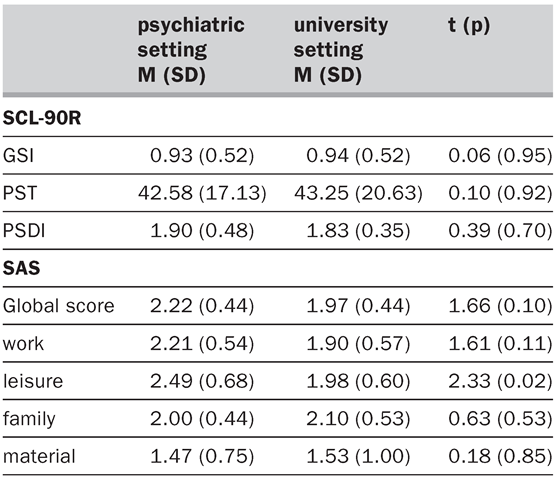
Comparison between the students from the counselling service and those from the outpatient psychiatric clinic was done using t-tests with appropriate Bonferroni corrections. No significant difference was found between both groups on the SCL-90R Global Severity Index (t(33) = 0.06, n.s.), Positive Symptom Total (t(33) = 0.10, n.s.) and Positive Symptom Distress Index (t(33) = 0.39, n.s.; see table 1 for detailed results).
Table 1.
Means, standard deviations and t-tests for students seen in a psychiatric outpatient setting and those seen in a university-based counselling service.
No significant difference was found between both groups on the SAS Global Adaptation Score (t(33) = 1.66, n.s.). A trend was found on the Leisure subscale of the SAS (t(33) = 2.33, p = 0.02), with the students from the psychiatric outpatient clinic (M = 2.49, SD = 0.68) having less satisfaction in regard to leisure than the students seen on the university campus (M = 1.98, SD = 0.60). However, this finding was non-significant following Bonferroni corrections (p <0.006 for α = 0.05). No significant difference was found on all other SAS subscales (work: t(33) = 1.61, n.s.; family: t(33) = 0.63, n.s.; material situation: t(33) = 0.18, n.s.).
Discussion
These results do not support the idea that patients seen in a university-based counselling service present less psychological impairment than students seen in an outpatient psychiatric clinic. Students from both groups were comparable in terms of the general severity of their symptoms (GSI), the total number of symptoms (PST) and the severity of these symptoms (PSDI). Furthermore, no significant difference was found in terms of general social adjustment nor on specific SAS subscales.
These findings support the idea that some students suffer from psychological impairment [1,2]. As such, university-based counselling services are certainly needed in order to allow students to seek professional help on their own grounds or “territory”. As many students need to move to larger cities to undertake university studies, they may not be familiar with the mental health system or services provided in the city in which they now study and live. A university-based clinic can provide them with the opportunity to have access to mental health services and insure that those in need are properly taken care of. Furthermore, studies on university-based counselling clinics have shown that they are often better adapted than general psychiatric services to meet the needs of the student population [7,8] . As the severity of the difficulties presented by students in a counselling service is similar to that presented by psychiatric outpatients, it is also imperative that the therapists have solid therapeutic training.
This study is exploratory and has its limitations, particularly in terms of sample size. As such, these findings must be understood as preliminary. However, such results also demonstrate the need for further empirical investigation of psychopathology in students and the necessity to have licensed therapists available to them.
References
- Etter, JF; Pemeter, TV. Etat de santé, habitudes et préoccupations liées à la santé chez les jeunes genevois. Präventivmed 1997, 42, 195–203. [Google Scholar] [CrossRef] [Scilit] [PubMed]
- Grace, TW. Health problems of college students. J Am Coll Health 1991, 45, 243–50. [Google Scholar] [CrossRef] [Scilit] [PubMed]
- Pinkerton, RS; Rockwell, WJK. Very brief psychological interventions with university students. J Am Coll Health 1994, 42, 156–62. [Google Scholar] [CrossRef] [Scilit] [PubMed]
- Michel L, Drapeau M, Despland JN. Using the four session Brief Psychodynamic Investigation with university students. 2002. Manuscript submitted for publication.
- Derogatis LR. Symptom Checklist-90-Revised: administration, scoring, and procedures manual. 3rd edition. Minneapolis, MN: National Computers Systems; 1994.
- Weissman, M; Bothwell, S. Assessment of social adjustment by self-report. Arch Gen Psychiatry 1976, 33, 1111–5. [Google Scholar] [CrossRef] [Scilit] [PubMed]
- Federman, R; Emmerling, D. An outcome survey of mergers between university student counseling centers and student mental health services. J Coll Student Psychotherapy 1997, 12, 15–27. [Google Scholar] [CrossRef] [Scilit]
- Pace, D; Quinn, L. Empirical support of the overlap between career and mental health counseling of university students. J Coll Student Psychotherapy 2000, 14, 41–50. [Google Scholar] [CrossRef] [Scilit]

Disclaimer/Publisher’s Note: The statements, opinions and data contained in all publications are solely those of the individual author(s) and contributor(s) and not of MDPI and/or the editor(s). MDPI and/or the editor(s) disclaim responsibility for any injury to people or property resulting from any ideas, methods, instructions or products referred to in the content. |
This is an open-access article distributed under the terms of the Creative Commons Attribution Non-Commercial No Derivatives (CC BY-NC-ND) 4.0 License.