


Summary
Objective: The aim of this survey is to explore the differences in certain salient aspects of the practice of group therapy between psychiatrists and psychologists and between the two cultural regions of Switzerland. Psychiatrists and psychologists, who differ in their training and forms of professional activity, might also differ in their practice of group activities and their theoretical orientations. In the same way, with the probable existence of diverse schools of thought according to region, group therapists might present differences according to whether their cultural heritage is Germanic or Latin. Methods: A brief questionnaire, comprising questions concerning the therapists and the main group they were handling, was sent to the members of the Swiss Psychiatric Association and the members of the Swiss Federation of Psychologists. This survey covers the therapists who indicated that they practised group psychotherapy (n = 533). Results: Psychologists constitute three-quarters of group therapists, while psychiatrists only represent a quarter. Two-thirds of these therapists live in the German-speaking region and one-third in the French- or Italian-speaking region. The overall results show that there exists a sort of basic practice and common theoretical reference in both the professions considered herein and in both cultural regions of Switzerland. The groups that these therapists are handling are mainly small, made up of adults, with diagnoses of depressive, anxiety or personality disorders, and often taking place in psychiatric institutions. Questioned about their principal theoretical orientation, group therapists first mention a psychodynamic approach, then systemic and cognitive-behavioural orientations. Beyond this set of features which are common to both professions and both regions, the main differences appear between psychiatrists and psychologists. Psychiatrists, who are in the majority men, more frequently conduct adult, long-term groups, in private practice. They have a more marked psychodynamic profile than psychologists. In contrast, psychologists, who tend to be younger, are mainly women.They spend more time on group therapies than psychiatrists and they more frequently deal with children and adolescents, sometimes in non-medical settings. More eclectic in their theoretical references, they more often endorse systemic and/or humanist orientations. There is little differentiation between the two cultural regions, nevertheless eclecticism and the choice of a systemic orientation appear more frequently in the German-speaking region of Switzerland than in the region where French and Italian are spoken. Conclusion: Several of the features described for the groups handled by psychologists indicate the practice of family therapies. Thus, it seems that this form of therapy is currently more the domain of psychologists than of psychiatrists. Psychiatrists more often practise a type of group therapy which has been used since the end of the Second World War (with adults, a longer duration, in private practice and with a psychodynamic orientation). In the future, new norms for training, growing economic pressure and a tendency to favour shortterm therapies rather than long psychodynamic therapies will undoubtedly influence the evolution of these different care models and the practice of group therapists, be they psychiatrists or psychologists.
Introduction
A survey which we have carried out and whose overall results will be published shortly, furnishes information on the group practices of Swiss psychotherapists [1]. As psychiatrists and psychologists differ in their basic training, functions and forms of professional activity, they might also differ in their practice of group activities and their theoretical orientations in this area. In the same way, given the cultural diversity of Switzerland, it is probable that traditions exist, schools of thought, diverse affiliations according to region, and that group therapists would therefore present differences according to whether their cultural heritage is Germanic or Latin.
Several studies have examined psychotherapeutic practice in certain regions of Switzerland as well as in Germany and Austria, shedding light on the characteristics of therapists (whether or not they be doctors), their formation, psychotherapeutic activities and clientele. Even though these studies have at times determined the place of group therapy, their authors were not specifically interested in modes of practice. Thus a study effected in the German-speaking region of Switzerland by Hutzli and Schneeberger (not published, Institut für Psychologie, Bern, 1995) with psychotherapists (doctors, psychologists or others) has shown that 22% of clients were treated in a setting other than individual (group therapy 6%; couple or family therapy 8%; different settings 8%). There were no notable differences between the categories of therapists but more cases were found in institutions than in private practice. A survey carried out among Swiss psychiatrists showed that, according to a typology based on their clinical practices, the systemic psychiatrists were to be found slightly more often in German-speaking Switzerland, whereas the biologists were more densely located in the French-speaking part of the country [2]. The proportions of psychoanalysts, cognitive-behaviouralists and generalists were the same in the two regions.
After a brief description of the study sample, the aim of this article is to see if differences exist in group therapy between psychiatrists and psychologists, the characteristics of their identity and training, specifics of their groups and their theoretical orientations. We will also look into possible differences between the Germanic and Latin regions.
Methodology
A brief questionnaire was sent, in 1999, to psychiatrists who were members of the Swiss Psychiatric Association and to psychologists who were members of the Swiss Federation of Psychologists. It was comprised of questions concerning the therapists (identity, profession, specific training and theoretical orientation in regard to group therapy) as well as the main group they were handling at the time of the study (duration and size of the group, location, age and type of patients/clients and theoretical orientation).
More than 1100 therapists returned the questionnaire (response rate: 18%) and 533 of them (54%) indicated that they practised group psychotherapy. This exploratory survey covers these therapists. The previous study carried out among Swiss psychiatrists [3] showed that for those practising group therapies, the differentiation of the groups according to their theoretical orientation (psychodynamic or other) corresponded to that which is reported herein. Our data thus seem to reflect the group practice of psychiatrists, but we do not have similar data for psychologists.
In the comparisons between psychiatrists/psychologists and Germanic/Latin regions, the χ2-test was used for dichotomic or dichotomicised variables, whose results are shown in percentage, and the Student’s t-test was used for continuous variables. To simplify, the significance of statistical differences is indicated as follows: * = p <0.05, ** = p <0.01, *** = p <0.001.
Results
Overall Results
Therapists
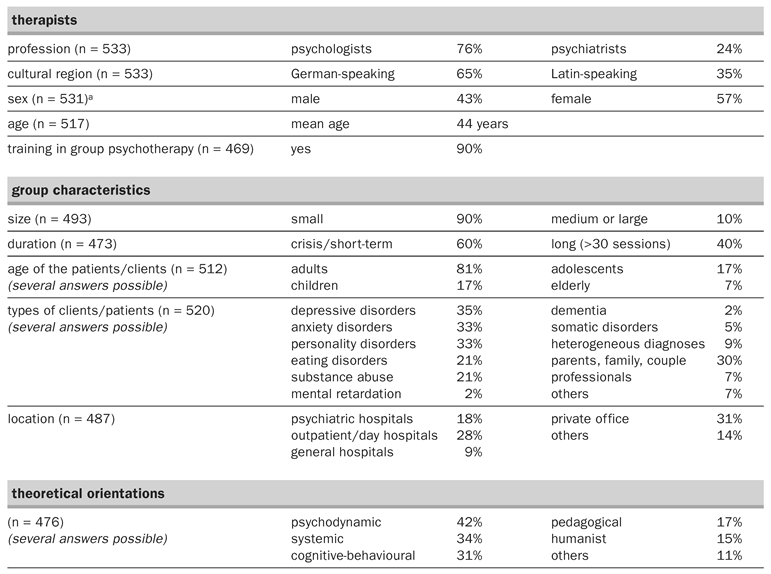
Psychologists constituted three-quarters of group therapists, while psychiatrists only represented a quarter (table 1). Two-thirds of these therapists lived in the German-speaking region and one-third in the French- or Italian-speaking region. Women were slightly over-represented (57%). Average age of the subjects was 44 years and the length of their professional experience approximately 14 years. Most of the group therapists had had training in this field (90%), lasting more than four and a half years on average.They spent, on average, approximately three and a half hours a week on group therapies.
Table 1.
Main characteristics of the sample.
Group characteristics
Groups were almost always small (90%), of a rather short duration (60%), made up of adults (81%), more rarely children or adolescents, and exceptionally by the elderly. Concerning the group participants, the diagnoses most frequently mentioned were those of depressive, anxiety or personality disorders (more than 30% each), followed by eating disorders and substance abuse. A group could include patients of varying ages and with similar or different diagnoses. In three cases out of ten, these groups were intended for parents or families. Didactic groups with professionals were rare. Group activities took place principally in psychiatric institutions (46%): hospitals, outpatient services and day hospitals. Three groups out of ten took place in private offices. Other settings, such as general hospitals, social or educational services, appeared less frequently.
Theoretical orientations
Questioned about their principal theoretical orientation as group therapists, 42% of them preferred a psychodynamic approach. Ranked after this were systemic and cognitive-behavioural orientations; each was chosen by approximately one-third of subjects. The pedagogical and humanist orientations (into which we have regrouped transactional analysis, Gestalt, Rogers, bioenergetics, for example) were only adhered to by approximately one subject out of six for each. The category “others” was a minority. It was interesting to observe that though the question covered the principal theoretical orientation of therapists, 38% did not limit themselves to a single orientation, manifesting thus an eclectic approach.
Professional status and cultural background
Comparison between psychiatrists and psychologists
Group psychotherapists belonged to two professional categories which carried distinguishing characteristics. Psychologists worked more on group activities each week than psychiatrists did (on average 3.9 hours for 2.7***). Among psychologists, women represented two-thirds of therapists (65%) whereas two-thirds of the psychiatrists were men (66%). The average age of psychiatrists was slightly higher (45.8 years/43.8*) and the length of their professional experience longer (16.7 years/13.0***). For both professions, the duration of training in group therapy was the same.
In the groups they directed, psychologists intervened more often with adolescents (19%/10%*) and especially children (21%/3%***) while psychiatrists more often treated adults (91%/78%**). The groups conducted by psychiatrists were often longer than those led by psychologists (>30 sessions: 49%/37%*) and more often took place in private offices (39%/28%*) or in general hospitals (15%/7%**). Psychologists more frequently worked in non-medical settings, such as educational or social services (18%/3%***).The types of patients/ clients represented in groups conducted by either were, however, similar.
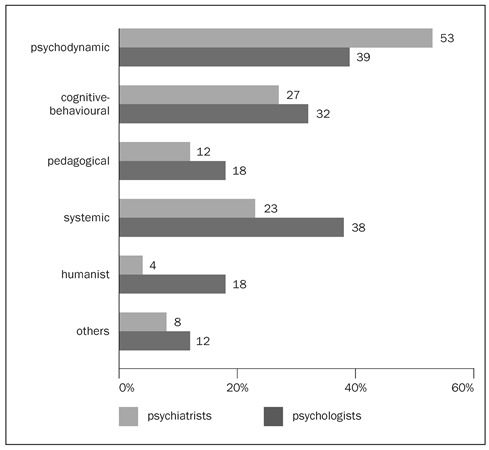
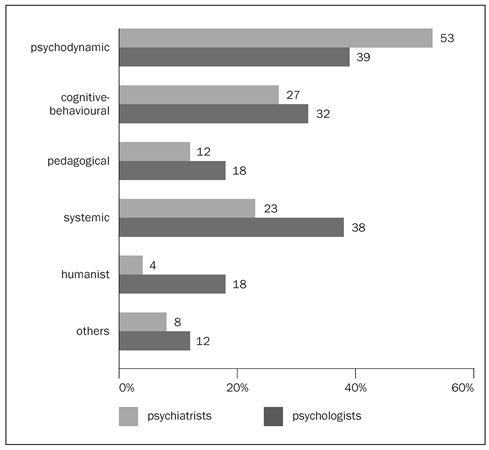
In their general theoretical orientations, psychiatrists had a more marked psychodynamic profile than psychologists (53%/39%*) (fig. 1) and they more often mentioned only one theoretical orientation (76%/57%***). Psychologists identified themselves mainly as following a systemic (38%/23%**) and/or humanist orientation (18%/ 4%***).
Figure 1.
General theoretical orientations concerning group psychotherapies according to profession. Percentage of subjects having mentioned the following orientations (multiple answers).
Comparison between cultural regions
Two-thirds of group therapists, as we have seen, lived in the German-speaking region of Switzerland and one-third in the region where Romance languages are spoken, principally in the Frenchspeaking region, to which we have added a few questionnaires which were filled out in Italian. Comparing the distribution of the general population between these two regions and that of the questionnaires mailed, there was a slight overrepresentation, in our sample, of the French- and Italian-speaking region, which could signify either a more important practice of group therapies in that region, or that psychotherapists participated slightly more often in the survey than did their German-speaking counterparts.
The group therapists in both regions seemed similar in most of their characteristics, but psychologists were still more over-represented in German-speaking Switzerland than in the other region (79%/70%*).
In the German-speaking region, groups were slightly more often set up for adults than in the Romance language region (84%/74%**); their duration was shorter (≤30 sessions: 66%/48%***) and they took place less often in psychiatric services (42%/55%**). The diagnoses mentioned were similar, with the exception of personality disorders, more uncommon in German-speaking Switzerland (29%/41%**).
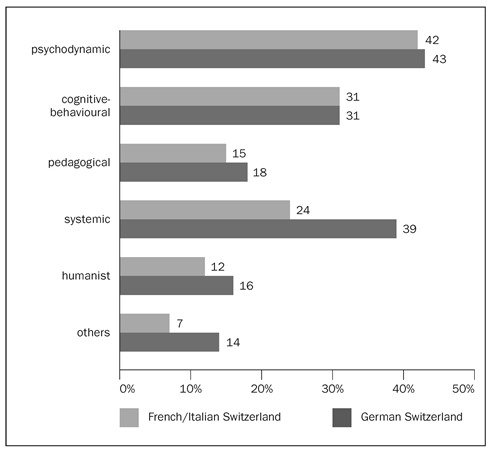
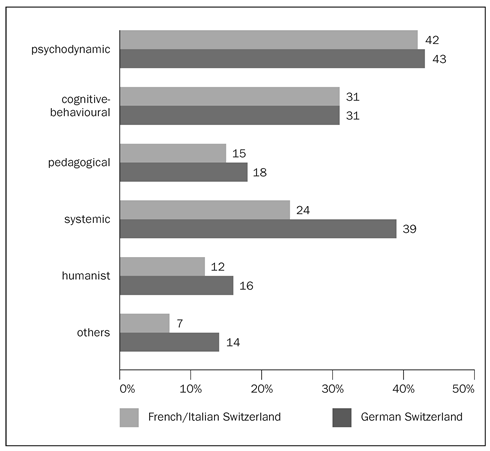
The importance of the great psychodynamic and cognitive-behavioural orientations was found in the same proportion in both regions (fig. 2). The proportion of pedagogical and humanist orientations did not show significant differences either. In contrast, the choice of the systemic orientation (39%/24%**) and that of “other” orientations (14%/7%*) were more frequent in the German-speaking region. The tendency towards eclecticism was also much more marked there (44%/27%***).
Figure 2.
General theoretical orientations concerning group psychotherapies according to cultural region. Percentage of subjects having mentioned the following orientations (multiple answers).
Professions and regions
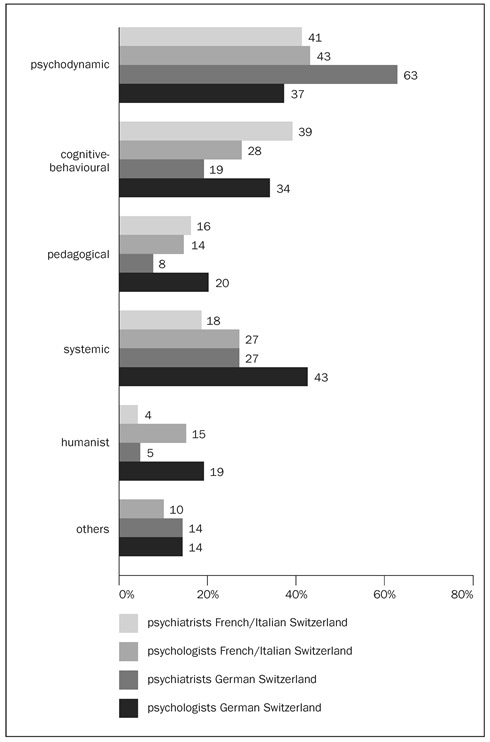
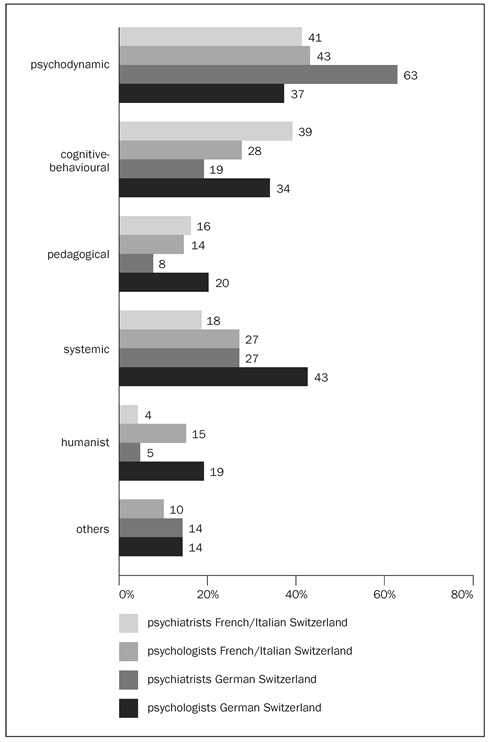
A major part of the characteristics put forward concerning the comparison between psychiatrists and psychologists were found in both cultural regions. Nevertheless, certain differences mentioned appeared principally in the German-speaking region: psychiatrists were older than psychologists; they endorsed more strongly a psychodynamic orientation (fig. 3); the groups they led lasted longer and more often took place in private offices. This appeared as a strongly linked set of features. Psychiatrists and psychologists in French- and Italian-speaking Switzerland had more in common.
Figure 3.
General theoretical orientations concerning group psychotherapies according to profession and cultural region. Percentage of subjects having mentioned the following orientations (multiple answers).
Finally, insofar as the theoretical orientations of group therapists were concerned and if we take into consideration both the professional and cultural background of the therapists, we observed an increase in the tendency towards eclecticism when we compared psychiatrists in French- and Italianspeaking Switzerland (of whom 14% can be considered to be eclectic) to psychiatrists in Germanspeaking Switzerland (31%), when we compared psychologists in the French- and Italian-speaking region (33%) to those in German-speaking Switzerland (48%).
Discussion
The objective of our survey was to furnish some information on certain salient aspects of the practice of group psychotherapists in Switzerland, taking into consideration possible differences between therapists belonging to both professions, psychiatrists and psychologists, and living in both of the different cultural regions, German-speaking Switzerland and French- and Italian-speaking Switzerland.
Limitations
This exploratory survey, which does not aim at describing the entirety of the group activities in an exhaustive fashion and with the objective of a quantitative representation, presents certain limitations. We only surveyed psychiatrists or psychologists; other professionals, however, also practise group activities. We interviewed therapists on the characteristics of the principal group they led, but certain conduct several groups which might present features other than those of the principal group. Another limitation is to be found in how groups were defined. Though we specified in this survey that family therapies and didactic groups with professionals were an integral part of group therapies, certain therapists did not follow these criteria. This brings to the fore the question of representations that the different group therapists might have of what a group actually is. In our first global approach, both these therapies were considered groupal as compared to individual therapy. It is obvious that further studies would shed light on their specificity (aims, participants, therapist training, etc.).
Finally, our survey included very few indications on training in group therapy. It only gives us an overall estimation on its duration, which is similar for both psychiatrists and psychologists, but does not inform us either of the real time spent on it, or on its content and follow-up. Forms of training may respond to precise criteria defined by specialised or professional associations, but they may also result from criteria arising out of sensitivity to different approaches. With regard to the training of psychiatrists, the FMH (Swiss Medical Association) recently set up specialised teaching concerned with three models: psychodynamic, systemic, cognitive-behavioural. There will be, therefore, in the future three coded references in training; however, the importance given to group therapies is not currently stated. The norms of associations of psychologists can probably be superposed onto those of the FMH. Insofar as therapies with a humanist orientation are concerned, we do not know the criteria of the training of therapists.
Differentiation of group therapists
This descriptive and exploratory survey allows us, nevertheless, to report several points and make hypotheses on the evolution of group therapies. There exists a sort of basic practice and common theoretical reference in both the professions considered herein and in both cultural regions of Switzerland (small-sized groups, which mainly deal with adults and often take place in psychiatric services, with a predominance of the psychodynamic, cognitive-behavioural and systemic orientations). Differences appear, however, as much between psychiatrists and psychologists as between therapists belonging to the two cultural regions.
Psychiatrists and psychologists
Psychologists, who form the greater part of group therapists, are younger than psychiatrists and they are mainly women.They spend more time on group therapies than psychiatrists. In the groups they conduct, they more frequently deal with children and adolescents, often in non-psychiatric settings. More eclectic in their theoretical references, they more often accentuate a systemic orientation, as well as a humanist approach. Several of these features seem to indicate the practice of family therapies. Thus, we can question whether this form of therapy is not currently more the domain of psychologists than of psychiatrists and how this will evolve with the new FMH norms for training.
Insofar as psychiatrists are concerned, they were in the majority men. They more often practised in groups with adults, with a longer duration, in private practice and with a psychodynamic orientation. This type of group, well documented in the literature and which has been in practice since the end of the Second World War, is not directed at a population of patients with a clearly determined diagnosis [4,5]. This care model could in the future be subjected to economic pressure brought to bear in particular by insurance companies. At a time of cost limitation, the questions on the efficacy and cost-effectiveness of diverse forms of therapy take on a greater importance. The evaluation of group psychotherapies is particularly difficult due to the multitude of intervening factors.These factors are relatively easier to control in short therapies, which are favoured at present, than in long psychodynamic therapies [6].
Cultural differences
Group therapists living in the two cultural regions of Switzerland are very similar. It is mainly in their theoretical orientations that interesting dissimilarities appear: therapists in the Germanspeaking region differentiate themselves from those in French- and Italian-speaking Switzerland by a more pronounced eclecticism and a more marked reference to a systemic approach. These two characteristics were already manifested in the survey carried out among Swiss psychiatrists [2,7]. Interviewed about their theoretical model, psychiatrists in German-speaking Switzerland more often chose an eclectic model than did their colleagues in the other region (45% versus 25%***). In addition, the proportion of systemic psychiatrists was greater in the German-speaking than in the French-speaking region (17% versus 10%**). In their previously cited study, Hutzli and Schneeberger show that the majority of therapists in German-speaking Switzerland are eclectic in their psychotherapeutic approach no matter what their profession. It would, therefore, seem that these two features differentiate therapists living in the two cultural regions.
A similar survey carried out in Spain among members of the Spanish Federation of Psychotherapists furnishes still more elements pointing to the existence of cultural differences in the practice of group therapies [8]. Spanish group therapists appear much less eclectic than their Swiss counterparts: only two Spanish psychotherapists out of ten chose several theoretical references, as opposed to less than three out of ten in Frenchspeaking Switzerland and more than four out of ten in German-speaking Switzerland. In Spain, the psychodynamic reference occupies a predominant position: it is mentioned by 69% of group thera-pists, as opposed to 42% in Switzerland. The systemic reference is chosen a little less often than in Switzerland (25% versus 34%), and the cognitivebehavioural reference is rarely presented (6% as against 31%). Even if the sample of the surveys in both countries is not the same and comparison cannot be understood other than as an indication, it does seem that important ideological differences exist concerning group therapies, among the therapists of the different regions.
Conclusion
The survey undertaken among psychiatrists and psychologists in Switzerland shows that there exists, beyond a set of common traits, a certain number of differences as much between the members of the two professions concerned as between the regions. Our data, however, do not tell us the origin of these differences. It is probable that they can be explained in part by different schools and different traditions in thought, but also by factors such as the state of the market for psychological and psychiatric care which is indigenous to each region, the place of group therapies in the overall therapeutic services offered, the proportion of the different professionals and the positions they may occupy, the necessity of differentiation between therapists in competitive situations. One may also assume that the pressure to limit costs, implying a choice in matters of treatment, will be put into practice differently in various countries, or regions, and differently be applied to the professions using group therapies.
References
- Ehrensperger S, Goerg D, Fischer W, Zbinden E, Guimón J. Psychothérapies de groupe: étude exploratoire en Suisse. Ann Med Psychol (in press 2002).
- Guimón J, Fischer W, Zbinden E, Goerg D. Therapeutic practice profiles, work settings and activities of Swiss psychiatrists. Schweiz Arch Neurol Psychiatr 1998;149:9–39.
- Guimón J, Fredenrich A, Tissot S, Ehrensperger S, Vucetic V, Goerg D, et al. La formation de psychothérapie de groupe au département de psychiatrie de l’Université de Genève. Cah Psychiatr 2000;28:89–109.
- Bion WR. Recherches sur les petits groupes. Paris: Presses Universitaires de France; 1965.
- Foulkes SH. Psychothérapie et analyse de groupe. Paris: Payot; 1970.
- Guimón J. Introduction aux thérapies de groupe. Paris: Masson «Pratiques en psychothérapie»; 2001.
- Guimón J, Fischer W, Zbinden E, Goerg D. Therapeutic practice profiles, theoretical models and representations of the psychiatry of Swiss psychiatrists. Schweiz Arch Neurol Psychiatr 1998;149:41–50.
- Ehrensperger S, Goerg D, Fischer W, Fredenrich A, Guimón J. Práctica de grupo entre los miembros de la Federación Española de Psicoterapeutas. Intersubjetivo 2001;3:89–96.

This is an open-access article distributed under the terms of the Creative Commons Attribution Non-Commercial No Derivatives (CC BY-NC-ND) 4.0 License.