


Simple Summary
Few studies have taken up therapeutic practices in psychiatry and different aspects related to them on an empirical basis. Hence a typology of practices (psychoanalytic, biological, systemic, cognitivebehavioural and general) and their conformity with the underlying theoretical models (psychological, medical-biological, social, eclectic) is demonstrated. Overall these relationships are close; differences between types of therapeutic practices and models of reference are nevertheless frequent. Other aspects related more or less directly to these theoretical references are analysed from the same perspective:the degree of information psychiatrists possess in the different domains of psychiatry,their interests, the professional reading matter which they prefer and their membership of learned societies or professional and social associations. If on these subjects significant differences distinguish the therapeutic profiles, this cannot be said of replies to questions concerning the stakes in psychiatry (training, priorities and future development). The consequences of these results on the collaboration between representatives of the different therapeutic profiles are discussed,as well as questions related to eclecticism and the integration of different models in an new conceptual synthesis.
Résumé
Profils des pratiques thérapeutiques, modèles théoriques et représentations de la psychiatrie des psychiatres suisses
Peu d’études ont abordé sur une base empirique les pratiques thérapeutiques en psychiatrie ainsi que les différents aspects qui leur sont liés. Partant d’une typologie des pratiques (psychanalytique, biologique, systémique, cognitivo-comportementaliste et général), leurs correspondances avec les modèles théoriques sous-jacents (psychologique, médico-biologique, social, éclectique) sont mises en évidence. Dans l’ensemble, ces relations sont étroites;des discordances entre types des pratiques thérapeutiques et modèles de référence sont néanmoins assez fréquentes.Dans la même optique sont analysés les autres aspects liés plus ou moins directement à l’orientation théorique: le degré d’information des psychiatres dans différents domaines de la psychiatrie, leurs intérêts, le genre de lecture professionnelle qu’ils privilégient et les sociétés savantes ou associations professionnelles et sociales auxquelles ils appartiennent. Si sur ces plans des différences significatives caractérisent les profils thérapeutiques, il n’en est pas de même des réponses à la question concernant les enjeux de la psychiatrie (formation, problèmes prioritaires et développement futur). Les conséquences de ces résultats dans la collaboration entre représentants des différents profils thérapeutiques sont discutés, de même que les questions liées à l’éclectisme et à l’intégration des différents modèles dans une synthèse conceptuelle nouvelle.
Mots clé: psychanalyse, psychiatrie biologique, psychiatrie systémique, thérapies cognitivo-comportementales, pratiques thérapeutiques, modèles théoriques, éclectisme, représentations de la psychiatrie
Introduction
In the preceding article, we have presented the results of the survey carried out among Swiss psychiatrists [1]. Data analysis was centred on therapeutic practice.These data showed up great diversity and demonstrated that each psychiatrist very frequently resorts to a multiplicity of techniques. Four therapeutic profiles were differentiated: psychoanalytic, biological, systemic and cognitivebehavioural,to which was added a fifth profile,described as generalist.It included those psychiatrists whose practices did not match any of the four predominant references which have been mentioned. These therapeutic profiles were significantly related to the type of clinical work (individual, couple, family, groups) carried out by the psychiatrists, to their work settings (private,public sector) as well as to other activities (supervision, consultancy, teaching, research, administration, etc.) they take on.
If Swiss psychiatry overall is envisaged, the principal facts to emerge from the results are: the coexistence of therapeutic practices rooted in different references as well as a very clear tendency towards the practice of combined therapies, an important diversification of activities and work settings, an institutional and university status occupied preponderantly by psychiatrists of a biological orientation and a very original position held by psychoanalyst psychiatrists of which a considerable number are situated as much within the public sector as in the private sector. Situated at this interface, these last constitute the guarantors, both theoretical and therapeutic, of the principles of psychoanalysis and thus contribute to the renewal of future generations of psychiatrists with a psychoanalytic orientation.
The therapeutic profiles which we have drawn up implicitly refer to different theoretical models which underlay practice and which, according to country and historical circumstances, represent highly variable strengths and shares in the field of psychiatry. Comparing different training programs, Mombour [2] noted that to the difference of other countries where more sociotherapeuticrehabilitation (United Kingdom, Sweden) or pedagogic-suggestive (East European countries) or multidisciplinary (Netherlands) aspects have marked psychotherapy, psychoanalysis has exercised a predominant influence on psychotherapy in the USA,in Canada,in Norway and in Switzerland. As far as this last is concerned, the double specialisation in psychiatry and psychotherapy has without doubt contributed to the pre-eminence of psychotherapy, above all of psychoanalytic inspiration, until today, whether it is psychiatry exercised in private practice or in institutional settings, both university an non university. As in other countries as well, psychiatry with social inspiration developed rapidly during the period from the Sixties to the Eighties,and has been overtaken by the advance of the medical-biological reference.
Few surveys have studied the relationship between, on the one hand, therapeutic practices and on the other,the theoretical models as well as other aspects connected to them, on an empirical basis: degree of information in the different domains, particular interests for these last, as well as the more general orientations (professional and ideological) concerning psychiatry in general. Specifically, as far as theoretical models are concerned, most authors distinguish the following principal models:psychological or psychoanalytical,biological or medical and eclectic. If Brook et al. [3] limit themselves to these three models, other authors also take into consideration models which generally attract less frequent adherence: cognitivebehavioural [4], systemic [5]. In their study on the theoretical references of psychiatrists in Spain, Guimón et al.[6] introduced a medico-psychological combined model as well as the social model. This is the only publication which demonstrates the statistical relationship between the reference to theoretical models and psychiatrists’ characteristics such as their interests, the degree of information in different domains of psychiatry,the site and framework of therapy as well as socio-demographic characteristics.As far as Switzerland is concerned, Guimón et al. [7] have analysed the four theoretical orientations: psychoanalytic, biological, social and systemic which are at present prevalent in the psychiatric field.
In this article we will first focus on an analysis of the relationship between therapeutic profiles and the theoretical models to which psychiatrists adhere. We will then attempt to reply to the following questions: How do psychiatrists evaluate their degree of information on the various fields of their profession and their professional interests? What societies do they belong to and what is their specialist reading in terms of the therapeutic profiles which characterise their practice? And lastly, are these profiles linked to specific commitments and attitudes concerning the training of psychiatrists, psychiatry’s present problems and its future development?
Material and methods
The methodological aspects of the study as a whole and the typology of the therapeutic profiles have been treated in the preceding article [1]. It should be briefly recalled that the results come from a survey of all the psychiatrists in Switzerland conducted by Geneva University’s Department of Psychiatry in conjunction with the Swiss Psychiatry Society and the Swiss Society of Child and Adolescent Psychiatry. A questionnaire was mailed to about 2300 graduate psychiatrists established in private practice or working in institutions. There was a response rate of 44%, and 971 out of the 1000 questionnaires returned (between November 1994 and January 1995) were used for this analysis.
One of the objectives of the study of Swiss psychiatrists was to elucidate their reference models and theoretical orientations. There were five questions on this subject: their adherence to theoretical models, their degree of information, their interests in different fields of psychiatry, their reading of specialist journals and their participation in learned societies and professional associations. The replies to the first question provide indications of explicit adherence to theoretical models, while the other four give more indirect indications of implicit theoretical orientations. The survey was also intended to answer questions on training,main problems and directions of development.
Results
The first section on the results show how the five therapeutic profiles relate to psychiatrists’ theoretical references, their interests, degree of information, reading, and professional memberships. We shall then go on to describe their positions on major issues for contemporary psychiatry.
1. Profiles of therapeutic practices, theoretical models and orientations
- 1.1. Explicit theoretical models
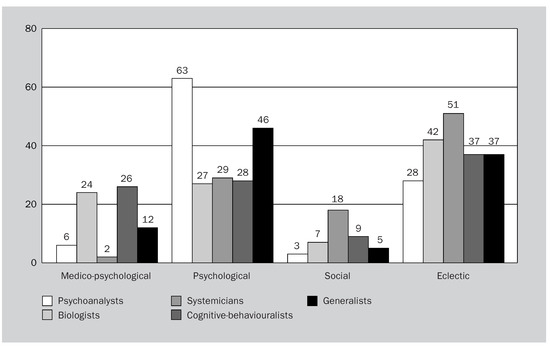
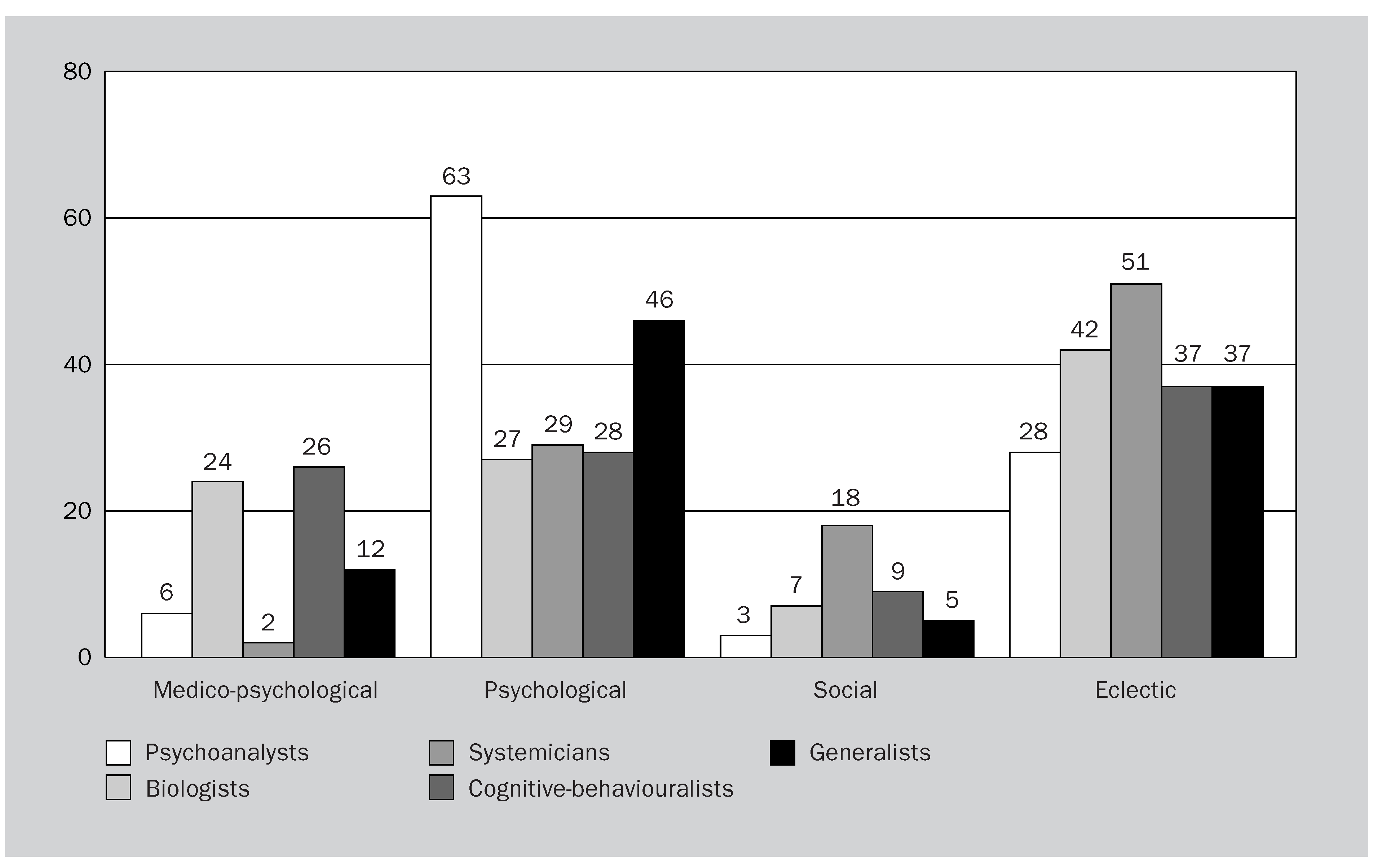
– So far as explicit theoretical reference is concerned, Swiss psychiatry is largely dominated by two models: the psychological model, espoused by 41% of psychiatrists, and the eclectic model, followed by 39%. The others are only in a minority: social model 7%, medical model 7% and medico-psychological model 6%. Figure 1 clearly shows that except in the case of the generalists most of the therapeutic profiles are significantly associated with theoretical models. As one might expect, most of the psychoanalysts (63%,p <0.001) refer to the psychological model whilst distancing themselves from the medico-psychological, social and eclectic models. The medico-psychological model is primarily espoused by biologists and cognitive-behaviouralists, with about a quarter (p <0.01) of them quoting it as their principal model. Lastly, the greatest following for the eclectic model (51%, p <0.01) and the social model (18%, p <0.001) is to be found among the systemicians.They distance themselves (p <0.001) – as do the biologists and cognitivebehaviouralists – from the psychological model.
Figure 1.
Distribution of adherence to theoretical models according to therapeutic practice profiles.
But Figure 1 also shows that therapeutic profiles and theoretical models do not correspond exclusively. Thus, more than a quarter of psychiatrists who through their practices would appear biological, systemic or cognitive-behavioural, nevertheless refer to the psychological model. Inversely, more than a quarter of psychoanalysts also refer predominantly to the eclectic model.
- 1.2. Degree of information in different areas of psychiatry
– The degree of information in different areas of psychiatry (cf. Table 1) has been ascertained by a precoded question about the degree of information at four levels.By attributing a score of 1 to 4 to these four levels indices have been calculated both globally, i.e. for the psychiatrists as a whole, and according to their therapeutic profiles.
Table 1.
Degree of information: averages for each of the areas according to therapeutic practice profiles.
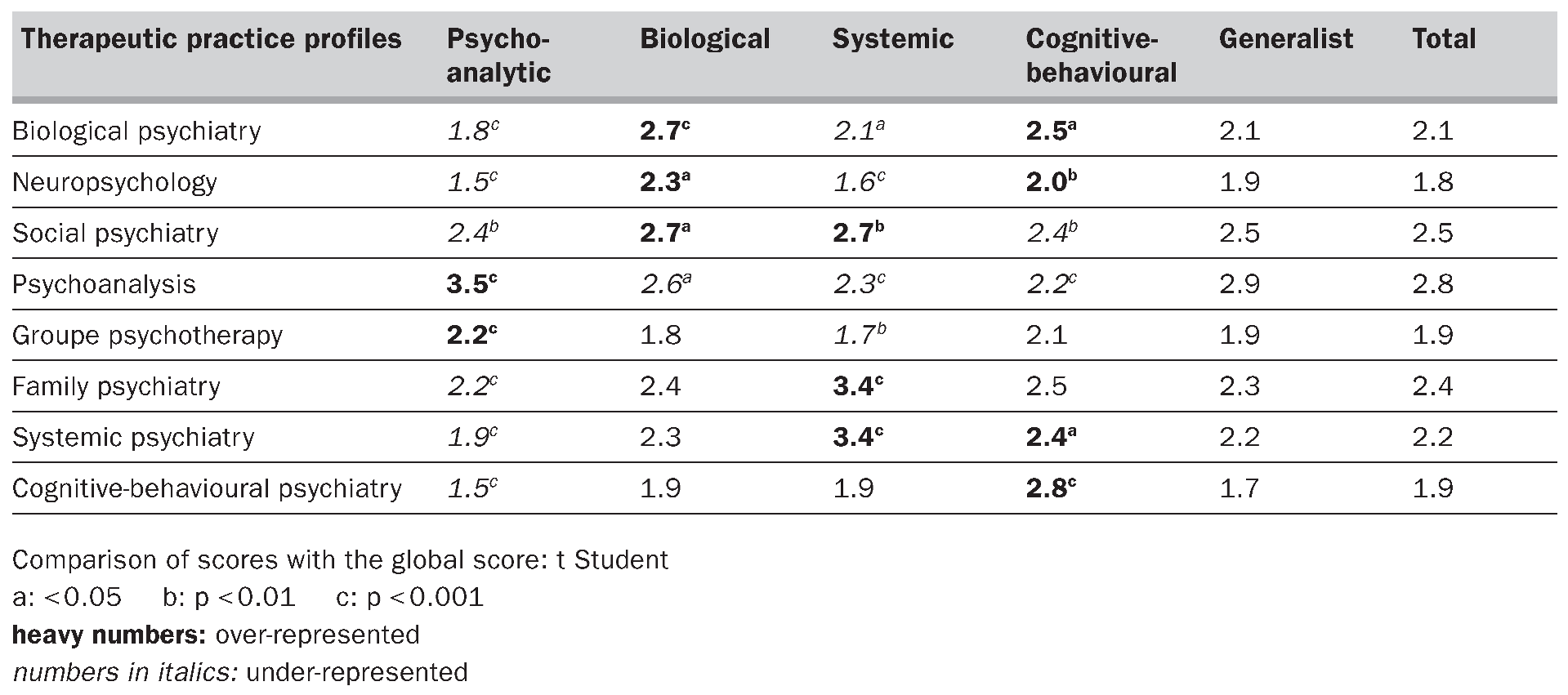
At the global level the psychiatrists are found to be best informed in the fields of psychoanalysis, social psychiatry and family psychiatry, with an average knowledge of systemic and biological psychiatry. Neuropsychology, group psychotherapy, phenomenology and behavioural psychiatry,on the other hand, appear to be areas where their knowledge is weaker. Needless to say, analysis of the data according to therapeutic profiles demonstrates that psychiatrists are best informed in the fields most directly linked to their practices – psychoanalysts in psychoanalysis and group psychotherapy, biologists in biological psychiatry and neuropsychology, etc. – and least informed on the aspects which are further removed from their clinical activity.
But the relation is not always as direct. Thus both the biologists and the systemicians are significantly better informed on social psychiatry than the others.There also appears to be a certain similarity between the biologists and cognitivebehaviouralists: both are better informed on biological psychiatry and neuropsychology than the others. Lastly, two therapeutic profiles are quite distinctly marked by very clear-cut positions. On the one hand you have the psychoanalysts who, as we have pointed out, are better informed on psychoanalysis and group psychotherapy, but at the same time are significantly less well informed in all the other areas.The systemicians,on the other hand, are better informed on systemic psychiatry, family psychiatry, and social psychiatry but less informed in all the other areas.
- 1.3. Interests in different fields
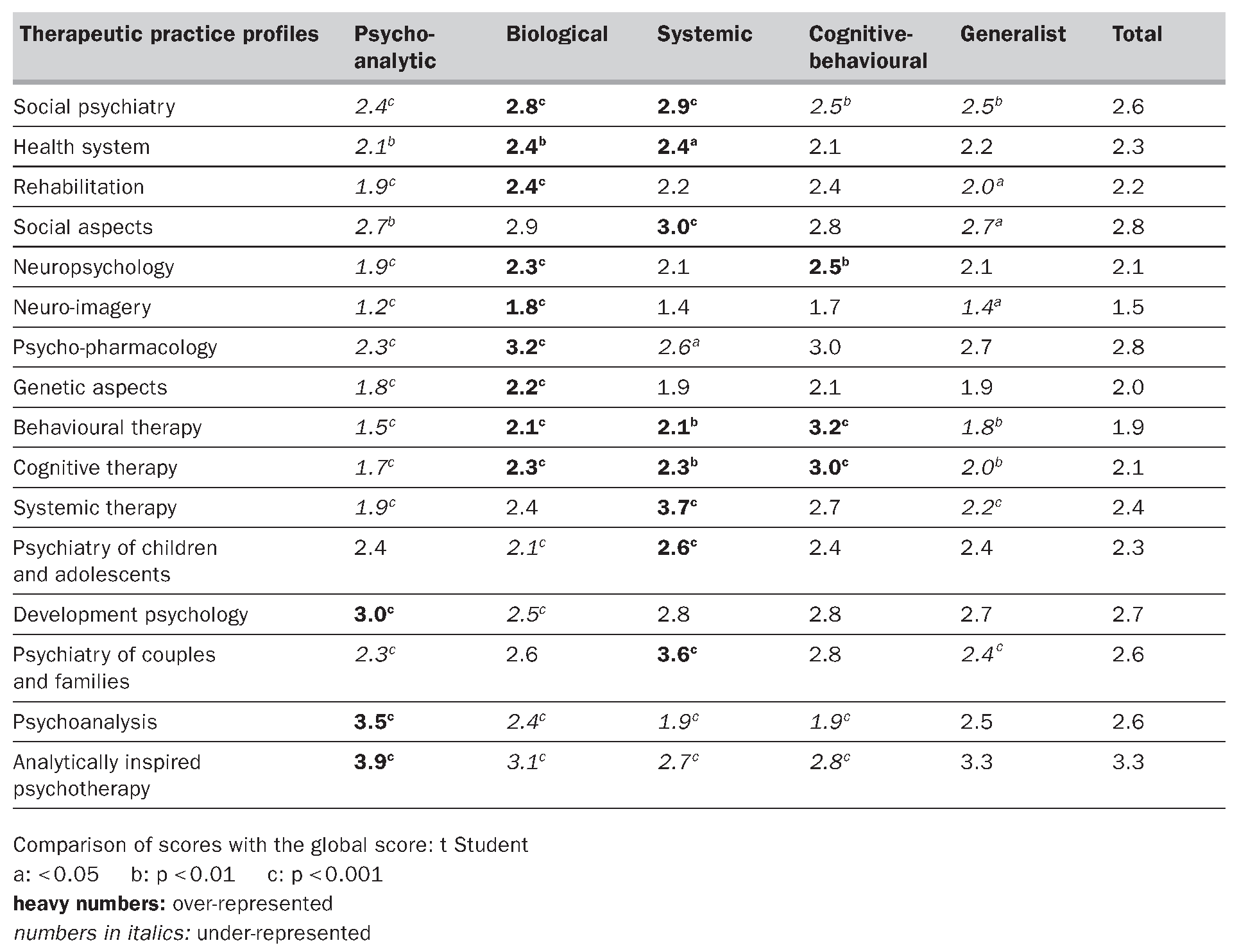
– Interests are another indirect indicator of theoretical orientation. Respondents were asked to rank their interest in the fields given in the questionnaire on a continuum from 1 (none) to 4 (in depth). As with the degree of information, indices were calculated globally and according to therapeutic profile.Swiss psychiatrists as a whole most highly rate the following fields of interest: psychoanalytically inspired psychotherapy, psychopathology, psychosomatics, short-term psychotherapy, the social aspects of psychiatric disorders, psychopharmacology and development psychology. They show little or hardly any interest, however, in neuroimagery, mental deficiency, epidemiology and research methods, humanist psychology and behavioural and group therapies.
By only taking the fields where there appear to be significant differences according to therapeutic profiles, one obtains a highly diverse picture (cf. Table 2). The findings largely confirm the trends we outlined for the degree of information. Again one finds similarities between the cognitive-behaviouralists, who are more interested in neuropsychology, and the biologists who are extremely interested in cognitive and behavioural therapies. The latter have the broadest range of interests. In fact their interest scores are higher not only for the last two areas and for specifically biological aspects but also for the social dimensions associated with psychiatric disorders. Systemic psychiatrists also instance quite a broad range of interests. They make greater mention of a keen interest in social psychiatry, cognitive-behavioural therapies and the psychiatry of children and adolescents and couples and families. The interests of the psychoanalysts,on the other hand,are much more limited and they only have significantly higher scores in their own field: psychoanalysis, analytically inspired psychotherapy and development psychology. They are significantly less interested in almost all the other fields. The generalist psychiatrists do not mention a major interest in any of the fields investigated.
Table 2.
Interests in different fields: average scores according to therapeutic practice profiles.
- 1.4. Reading of reviews and scientific journals
– A fifth (20%) of Swiss psychiatrists do not read any scientific reviews on a regular basis.The average is between 3 and 4.Regular readers of Englishlanguage publications are more uncommon:almost two-thirds (63%) do not read any on a regular basis and the average is one review.
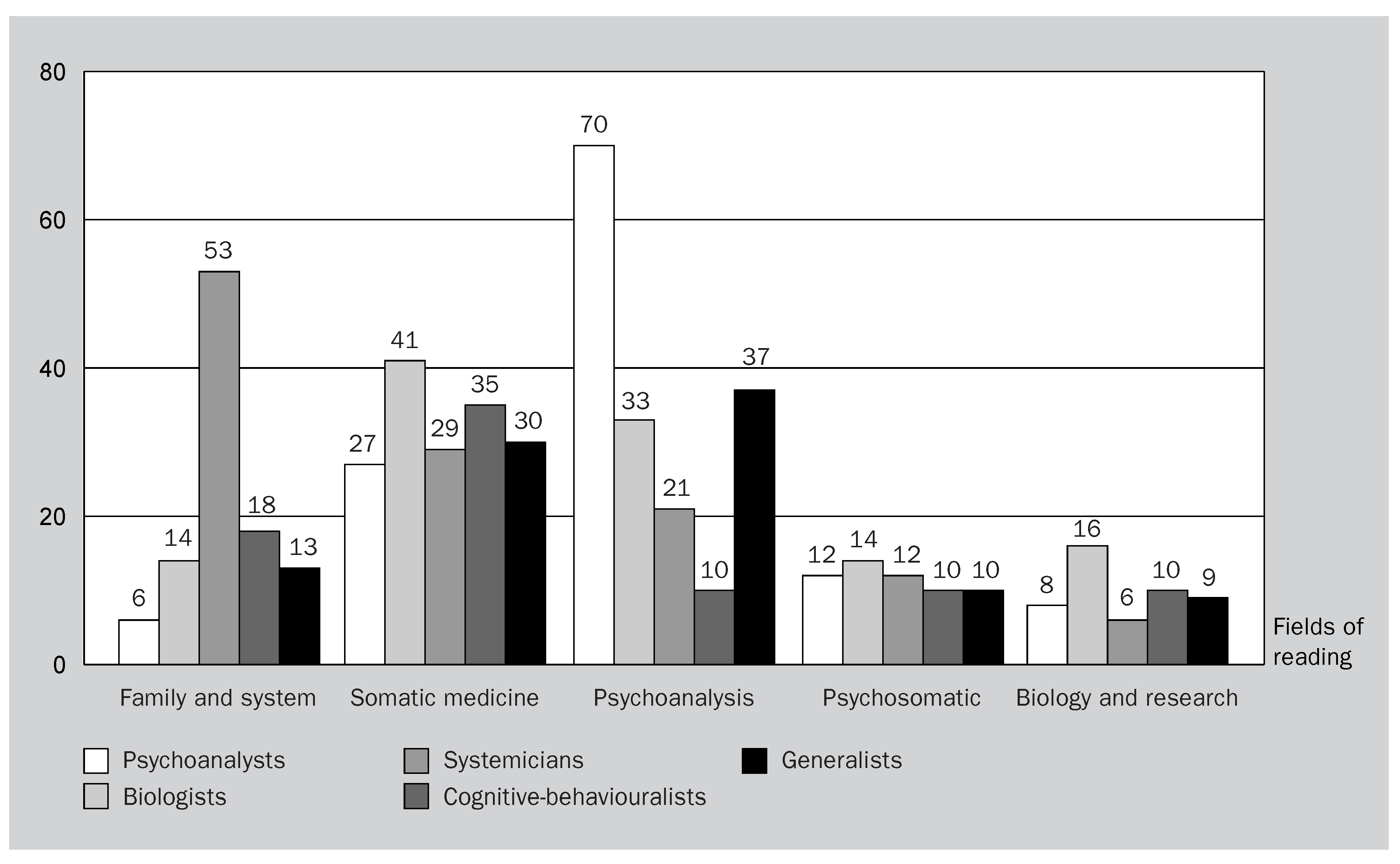
From a breakdown of the results according to subject area it appears that the most popular publications are what could be termed the “generalist” psychiatric journals (regularly read by 49% of Swiss psychiatrists),with psychoanalysis reviews in second place (40%) and journals of somatic medicine coming third (33%). The other fields enjoy a less frequent regular readership: 18% of psychiatrists read family or systemic psychiatry reviews and about a tenth keep regularly up to date in their reading on issues of psychosomatics, paediatric and adolescent psychiatry, research, neurology, pharmacology or neurosciences.
Analysed according to therapeutic practice profiles (Figure 2) the reading of scientific journals clearly appears to be highly differentiated, with psychoanalysts preferring to read psychoanalysis reviews, biologists journals of neurology, pharmacology and somatic medicine, and systemicians publications on the family and the system.
Figure 2.
Percentage of psychiatrists who regularly read scientific journals in different fields according to therapeutic practice profiles.
- 1.5. Membership of learned societies and professional and social associations
– Nearly 9 in 10 Swiss psychiatrists (89%) belong to at least one learned society or national association and about a sixth (16%) are members of international or foreign societies. The average membership is of three societies or associations.Fifty per cent belong to the Swiss Psychiatry Society, 22% the Swiss Medical Psychotherapy Society, 15% the Swiss Child and Adolescent Psychiatry Society, 10% the Swiss Social Psychiatry Society, and 10% the Swiss Psychoanalysis Society. There is minority membership of the other national learned societies (biological psychiatry, psychosomatics, psychosocial medicine, geriatric psychiatry). Membership of foreign societies follows the same pattern.
Membership of professional or social societies and associations ranks as quite an important activity for Swiss psychiatrists. Over a third (38%) belong to cantonal or regional psychiatric societies. More than a tenth participate in medical societies. They are active, on the same scale, in social policy and environmental societies and in groups working in the psychiatric or social sphere.
Membership depends broadly on therapeutic practice profile. It is worth noting, however, that biologist psychiatrists are more frequently members both of biological and social psychiatry societies,and systemic psychiatrists prefer belonging to psychiatry and psychotherapy societies as well as to the professional organisations. But irrespective of therapeutic profile, all of them broadly participate in the societies which cater for psychiatry in general.
2. Representations of psychiatry and ideological orientations
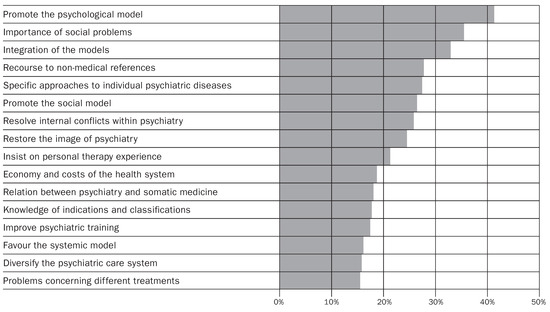
Concerning the major issues of Swiss psychiatry (training, problems, future development), Figure 3 gives the most frequent proposals in descending order.
Figure 3.
Psychiatrists’ proposals for training, the present problems and future development of psychiatry (percentages of psychiatrists).
These are diverse and heterogeneous and vary only slightly according to therapeutic profiles. We shall confine ourselves here to highlighting some major themes. Thus proposals aimed preferably if not exclusively at promoting a particular theoretical model are made very broadly and do not necessarily represent the importance of the inherent trends (41% of psychiatrists for the psychological model, 27% for the social model, 16% for the systemic model,14% for the medico-biological model and 7% for the cognitive behavioural model). Clearly most psychoanalysts favour the psychological model,but,surprisingly,psychiatrists from all the other therapeutic profiles opt by more than a third for this model,while otherwise favouring their own theoretical references but in lower percentages than those obtained by the psychological model.
Despite this model’s pre-eminence in the proposals for training and the development of psychiatry, and despite the considerable diversity of the different theoretical references, a movement towards integration of the different models appears to be taking shape. In the opinion of a third of the psychiatrists (33%) this integration should be actively sought, and more than a quarter (26%) of them deplore the existence of internal conflicts within psychiatry. Quite a number of those polled (28%) who favoured recourse to references other than the strictly medical or psychiatric – philosophy, sociology, anthropology, ethnology, etc. – stressed the desirability, if not the need, to open it up to other perspectives of thought and action. Other responses follow the same line, with comments on the urgent need to restore the image and credibility of psychiatry, both with somatic medicine and public opinion in general.
Some proposals focus more directly on clinical activity. Almost a fifth of the psychiatrists want a greater depth of knowledge in the field of therapy classifications and indications.More than a quarter (28%) emphasise the need to find responses to particularly persistent problems posed by patients who present chronic psychiatric disorders (psychoses,narcissistic pathologies),severe personality disorders (borderline personality),dependence on toxic substances, severe and repetitive depressive episodes. And a high proportion (35%) underline the importance of social and economic problems for the growing incidence and prevalence of psychiatric disorders as well as their effects on treatment in general and rehabilitation programmes in particular.
The last two notable aspects of the psychiatrists’ proposals are concerned, firstly, with the improvement of psychiatric training (18%), especially the demand for personal therapy experience and supervision (21%), and, secondly, with proposals for psychiatry at the institutional and systems level: 16% want psychiatry to be more diversely structured, 18% call for redefinition and improved relations between psychiatry and somatic medicine, and 21% raised the question of the economy and the costs of the health system. On the other hand, only a minority mentioned the following aspects: legal medicine (7%), competition with other therapists (8%), prevention (9%), research (12%), and evaluation of the quality of treatment (14%).
Discussion
Therapeutic practices, theoretical models and orientations
Analysis of explicit adherence to theoretical models and of indirect references to theoretical orientations has enabled us to firm up the contours of the main movements in the therapeutic practices of Swiss psychiatrists.Firstly,so far as their explicit adherence to models is concerned, 41% of them give the psychological model, which thus scores the highest. This sets Switzerland apart from the other countries it has been compared with since the psychological model does not score as highly in any of the other studies that have been quoted: it is mentioned by 36% of the psychiatrists in the Jensen et al. study [5], 30% of the British psychiatrists [3], 26% of the Spanish psychiatrists [6] and 20% of the members of the Washington State Psychiatric Association studied by Beitman et al. [4].
The second important reference is the eclectic model with 39%. Beitman et al. [8] mention an entirely comparable figure of 38%,but in the studies conducted by Brook et al. [3] and Jensen et al. [5] this was the model for a large majority – 65% and 59% respectively – of their psychiatrists. The medical or biological model, in third place, is the chief reference for only 7% of the psychiatrists. It does not get a more frequent mention in any of the other countries apart from Spain, however, where it is the major model for 43% of the psychiatrists [6]. And lastly, 7% of Swiss psychiatrists say they adhere to the social model. The percentage of Spanish psychiatrists is slightly higher at 11%.
As we have noted, a predominant therapeutic practice does not imply that the corresponding theoretical model is exclusively adhered to. A quarter of psychoanalysts refer to the eclectic model and amongst the non-psychoanalytic psychiatrists, the same proportion mention the psychological model, thus testifying that this last is still an important theoretical reference [7].Bodkin et al. [12] have noted the same tendency. The correspondence between practices and models here is clearly stronger: 96% of psychiatrists with a psychoanalytic orientation adhere to the psychological model and 13% also mention the biological model. 66% of biologist psychiatrists indicate the biological model as being their main reference and 26% the psychological model.
But explicit adherence to models only reveals one aspect of theoretical orientation.By also taking into account the responses on degree of information, chief interests, reading of scientific journals and membership of professional and scientific associations, we can get a better picture of how the different therapeutic profiles relate to one another. Compared with the four therapeutic profiles of a particular type, each of which is singularized by its original references, the generalist profile is clearly situated at the midpoint of Swiss psychiatry,effectively representing the “average” Swiss psychiatrist.
The theoretical orientation of the psychoanalyst psychiatrists concentrates almost solely on psychoanalysis: almost two thirds adhere to the psychological model; they are better informed than the others on psychoanalysis and group psychotherapy; their interests revolve around psychoanalysis, analytical psychotherapy and development psychology; nearly three quarters read articles on psychoanalysis and almost half belong to psychoanalytical societies or groupings while participating to the same extent as the others in the general societies. This is not so much a matter of simple preference as of outright exclusion since the psychoanalysts do not set a positive value on any other area of psychiatry.Thus,aside from their specific field, they consider themselves generally less well informed and with fewer interests, they only occasionally read up on other areas and have little to do with societies which are not psychoanalytic or generalist. Even if this quasi-dogmatic restriction to nothing but psychoanalysis cannot be interpreted as opposition to the other movements in psychiatry,it has to be said that they do set themselves quite apart on that score. Their stance does not endear them to the representatives of the other therapeutic profiles.
This quasi-exclusive reference to psychoanalysis is without doubt related also to their position of interface between the public sector and the private practice that over half of them possess: to be the theoretical and therapeutic guarantors of the principles of psychoanalysis in order to perpetuate its pre-eminence and thus to assure the renewal of generations of psychoanalysts and psychoanalytic psychiatrists [1].
The theoretical positions adopted by the biological psychiatrists are much broader and more diversified.They obviously prioritise the biological and neuropsychological point of view, usually coupled with research, but they are also better informed on the social aspects of psychiatric disorders and on social psychiatry, have more than average interests and are often members of social psychiatry societies. While setting most store on being identified as biologist psychiatrists they have an affinity with the systemic psychiatrists on the one hand, through their reference to the social aspects of psychiatric disorders and treatments, and with the cognitive-behaviouralist psychiatrists on the other by the fact that they are particularly interested, as moreover are the systemicians, in cognitive-behavioural therapies. The representatives of these three therapeutic profiles also share the same propensity to distance themselves from psychoanalysis and are virtually unanimous in according it an entirely secondary role. This configuration of traits is probably the product of its position in the psychiatric field. In fact, biological psychiatrists are the most frequently found in institutional and university work settings.They are frequently highly placed. They also assure, more than the others, teaching, training and research activities which imply recourse to varied theoretical references. Bodkin et al. [12] have also demonstrated that biological psychiatrists are more than four times more numerous than psychoanalysts to carry out research as a principal or secondary activity.
A significantly greater number of the systemic psychiatrists adhere to the social and eclectic models. They are more interested than the others in family psychiatry,systemic and social psychiatry, as well as being better informed and more often belonging to learned societies concerned with these particular areas. While sharing an affinity with biological psychiatry they distinguish themselves from it by the major emphasis they systematically place upon reference to the family and the system. The biologist psychiatrists, on the other hand, distance themselves from the systemic model as such whilst not categorically excluding it.
Lastly, the cognitive-behaviouralist psychiatrists obviously give priority to their own reference. But they are close to the biologist psychiatrists in their adherence to the medico-psychological model and their degree of information and interests in biology and neuropsychology. They also share an affinity with them,as do the systemicians, in according a minor role to psychoanalysis. They distance themselves,however,from those same biologists by not taking psychiatry’s social dimensions into consideration.
Professional orientations and representations of the future of psychiatry
We have outlined the main themes which emerge from the many proposals put forward in response to our questions about the priorities for psychiatry, training, present problems and future developments. These proposals and desiderata appear to differ little in relation to the therapeutic profiles. Obviously the representatives of various therapeutic practices are chiefly concerned with promoting their own model and their own interests when it comes to training. But there is very broad agreement on all the other aspects which have been broached. We noted that very few proposals were received for a number of areas. This was the case with the development of research (mentioned by only 12% of the psychiatrists), evaluation of the quality of treatment (14%), greater efforts at prevention (9%), and relations with other professionals working in the psychotherapy field (8%). Even though slightly more of those polled were concerned about redefining and improving the relations between psychiatry and somatic medicine (18%),or referred to the growing problems linked to the economy and the costs of the health system (19%), the present difficulties and their continuation into the future do not seem to loom very large with Swiss psychiatrists. At any rate, there was little mention of them amongst the concerns that were expressed.
The conclusions drawn by Beitman et al. [8] from a study of psychiatrists in Washington State closely support our findings, namely that some areas of intrinsic importance only meet with tenuous interest and minor consideration. As Fenton et al. [9] have already pointed out, this absence of interest and information is disturbing, given the changes that have been occurring in the recent past – a substantial increase in the number of psychiatrists, greater diversification of practice settings and clienteles, extension of the psychiatry sector and modification of its relations with somatic medicine, together with the changes in the insurance system and in the health system generally. One must add to these the changes since the Eighties described by Langsley et al.[10] and which have a more direct bearing at the therapeutic level: the breakthrough by biological psychiatry, the greater number of psychotherapy approaches, a new emphasis on briefer treatment and crisis intervention, and the arrival of other professionals in the psychotherapy field. These changes obviously impact on training at every level [11], but they also affect the activities of psychiatrists, including clinical work as such, and alter relations with their environment: medicine, social services, sociopolitical agencies and the social system as a whole.
From the coexistence of theoretical and therapeutic profiles to their integration?
Do some of the tendencies which we have examined indicate that Swiss psychiatry finds itself, from the point of view of its practices and its theoretical references, at a turning point at present? If one excludes theoretical models, a wide consensus exists between the different theoretical and therapeutic trends concerning the priorities for training,the problems with which psychiatry is faced and desiderata concerning its development. What is more,each of the therapeutic profiles draws on different theoretical models. And the eclectic model is the theoretical reference for many psychiatrists. Does this signify that eclecticism will in the future be the main theoretical model in Swiss psychiatry?
Based on the distinction introduced by Lazarus [13], Beitman et al. [14] clearly distinguish the two notions:integration and eclecticism.The aim of the first is the conceptual synthesis of different systems or theoretical models. The second, in contrast, is principally atheoretic insofar as it is founded in the empirical and pragmatic application of methods and practices inspired by different theoretical models. These authors believe that, for many reasons, eclecticism is more and more widely practised in fact. Post [15] et Heim [16] would agree with this. In comparison with other studies, our results indicate that in Switzerland, eclecticism is above all predominant in three of the four theoretical orientations: biological, social and systemic.The institutional situation,as well as the diversity of therapies in this work setting have without doubt favoured, even rendered necessary, these eclectic positions, to the detriment of an unilateral defence of one model in particular. On the other hand, the psychoanalytic reference is from this aspect the most partisan and the least eclectic from the point of view of reference to the psychological model and therapeutic practices.
But the integration of theoretical models,in the sense of a new conceptual synthesis, is still at the level of research for possible common denominators [14,16] and no new integrated theoretical outline exists for the moment,even if around one third of psychiatrists would like an integration of models. Reciprocal tensions and exclusions between the different trends persist. The denunciation of biological dogmatism, above all by psychoanalysts on one side, and the anathema cast by biological and systemic psychiatrists against psychoanalytic dogmatism on the other side, are indications among many others that each of the theoretical references seeks firstly the primacy of its theoretical and conceptual supremacy.An important discrepancy can be noted between, on one hand, therapeutic practices which have a number of aspects in common and, on the other hand, assertions concerning the pre-eminence of one particular theoretical model. The discourse concerning the defence of this last must be analysed more as taking the position of a religious or prophetic type: “You have been told that...; but I am telling you that ...” rather than as a scientific fact.Beitman et al.[14] have drawn up six factors which have helped to advance the idea of eclecticism and the conceptual integration of theoretical models: the proliferation of multiple therapies,the inadequacy of each of these theories taken alone,the absence of superior efficacy of one therapy with regard to others,the search for therapeutic factors common to different therapies, the importance attached to the characteristics of patients and the patient-therapist relationship, as well as sociopolitical circumstances.These last (reduction of material resources, the influence which is exercised by the system of health insurances,the crisis in the workplace,increase in competition,etc.) will probably increase their pressure on the mental health system. A deeper examination of aspects such as the quality of care, the length of periods of remission of mental disorders and the efficacy of therapies could favour a more scientific debate between those who hold to different theoretical models and convergence towards a critical synthesis and its probable limits.
References
- Guimón J, Fischer W, Zbinden E, Goerg D. Therapeutic practice profiles, work settings and activities of swiss psychiatrists. Schweiz Arch Neurol Psychiatr 1998;149:29–39.
- Mombour W. Comparison between different systems of psychiatric education including some aspects on the ideology of different mental health systems. López Ibor Alino JJ, Lenz G (editors). Training and education in psychiatry. Wien: Fakultäts-Verlag; 1984. p. 306–17.
- Brook P, Wakeford R. Continuing Medical Education. A survey of consultant psychiatrists' attitudes and practices. Bull R Coll Psychiat 1987;11:38–42.
- Beitman BD, Chiles J, Carlin A. The pharmacotherapypsychotherapy triangle: psychiatrist, non-medical psychotherapist, and patient. J Clin Psychiatry 1984;45:458–9.
- Jensen JP, Bergin AE, Greaves DW. The meaning of eclecticism: new survey and analysis of components. Professional psychology: research and practice 1990;21:124–30.
- Guimón J, Azkunaga D, Sacanell E. Orientación teórica de los psiquiatras españoles. Actas Luso-Esp Neurol Psiquiatr 1987;15:173–83.
- Guimón J, Fischer W, Goerg D, Zbinden E. Orientations théoriques des psychiatres suisses. Archives MédicoPsychologiques 1996;155:184–201.
- Beitman BD, Maxim P. A survey of psychiatric practice: implications for psychiatric training. J Psychiat Educ 1984;8:149–53.
- Fenton WS, Leaf PJ, Moran NL, Tischler GL. Trends in psychiatric practice, 1965–1980. Am J Psychiatry 1984;141:346–51.
- Langsley DG, Yager J. The definition of a psychiatrist: eight years later. Am J Psychiatry 1988;145:469–75.
- Kane FJ, Harper RG. Psychotherapy: past training and current practice. Gen Hosp Psychiatry 1992;14:131–4.
- Bodkin JA, Klitzman RL, Pope HG. Treatment Orientation and Associated Characteristics of North American Academic Psychiatrists. J Nerv Ment Dis 1995;183:729–35.
- Lazarus AA. Multimodal therapy. In: Corsini RJ, editor. Current psychotherapies. 3rd ed. Itasca: III. FE Peacock; 1984.
- Beitman BD, Gordfried MR, Norcross JC. The movement toward integrating the psychotherapies: an overview. Am J Psychiatry 1989;146:138–47.
- Post RM. Research advances in psychiatry: an update for a clinician. APA, Congress 1990; New York: Mobiltape, Valencia, CA, 35; 1991.
- Heim E. Integration oder Polarisierung der Psychiatrie. Nervenarzt 1992;63:143–8.
This is an open-access article distributed under the terms of the Creative Commons Attribution Non-Commercial No Derivatives (CC BY-NC-ND) 4.0 License.