


Abstract
Background: Clostridioides difficile infection (CDI) in liver transplant (LT) recipients often occurs during complex postoperative care. We compared clinical characteristics and total hospital length of stay (LOS) between LT-CDI and non-LT CDI records. Materials and Methods: We analyzed 562 CDI-associated hospital records from 2014 to 2024 (35 LT-CDI; 527 non-LT CDI). The primary endpoint was total hospital LOS; LOS > 30 days was the main secondary endpoint, and >60 and >90 days were post hoc exploratory thresholds for very prolonged stays. LOS was available in 35 LT-CDI and 521 non-LT records. Results: Median LOS was 59 versus 20 days. The crude median difference was 39.0 days (95% CI, 7.0 to 64.0), and the care/antimicrobial-adjusted difference was 28.5 days (95% CI, 0.5 to 50.3). Median LT-to-CDI time was 13 days [IQR, 7 to 36; n = 34]; in 25/35 records (71.4%), infection occurred within 30 days. The adjusted RR for LOS > 30 days was 1.15 (95% CI, 0.85 to 1.55); exploratory RRs were 2.33 (95% CI, 1.45 to 3.73) for >60 days and 2.28 (95% CI, 1.11 to 4.67) for >90 days. Conclusions: LT-CDI records had longer total LOS, clustered early after transplantation, and had a clinically complex course. These findings provide a same-center benchmark for overall hospitalization burden among CDI records by transplant status; estimating CDI-attributable LOS would require an LT group without CDI.
1. Introduction
CDI remains a major healthcare-associated infection among hospitalized and immunocompromised patients. Recognized risk factors include antibiotic exposure, recent healthcare stay, serious underlying illness, gastrointestinal surgery or manipulation, advanced age, and immunocompromising conditions [1,2,3]. LT recipients often accumulate several of these exposures during the early post-transplant period, when antimicrobial pressure, immunosuppression, intensive care, renal dysfunction, graft or biliary complications, and infection burden may overlap.
Prior LT studies have described early post-transplant clustering of CDI, antimicrobial and healthcare exposures, and associations with adverse outcomes, while broader solid-organ transplant studies have shown substantial variation in timing and outcome across organs and study designs [4,5,6,7,8,9]. A 2024 LT-focused review confirmed that the evidence base remains dominated by retrospective, heterogeneous cohorts and highlighted antimicrobial exposure, healthcare contact, proton-pump inhibitor exposure, chronic kidney disease, and higher pre-transplant illness severity as recurring risk factors [10]. Post-LT hospitalization research also identifies infection, renal failure, and perioperative complications as major contributors to prolonged stays [11]. This study addresses a focused question: among same-center records involving CDI, how do the clinical context and total LOS differ by LT status?
Total LOS captures the full hospitalization containing CDI, including transplant recovery, pre-CDI complications, CDI diagnosis and treatment, and post-CDI care. Studies of healthcare-associated infections show that infection timing can bias LOS estimates when treated as a fixed exposure [12,13,14]. We therefore use total LOS as a measure of overall inpatient burden; an LT group without CDI would be needed to estimate LOS attributable specifically to CDI.
The objectives were to compare total LOS between verified LT-CDI and non-LT CDI records from the same center, describe LT-CDI timing and clinical context using transplant clinical records, and explore differences in very prolonged hospital stays. The comparison was designed to describe differences among CDI-containing records by transplant status.
2. Materials and Methods
2.1. Study Design and Data Sources
This single-center retrospective cohort study used routinely collected clinical records. CDI diagnosis dates in the study dataset spanned 10 December 2014 through 16 October 2024. The primary comparison was verified LT-CDI records versus non-LT CDI records from the same center.
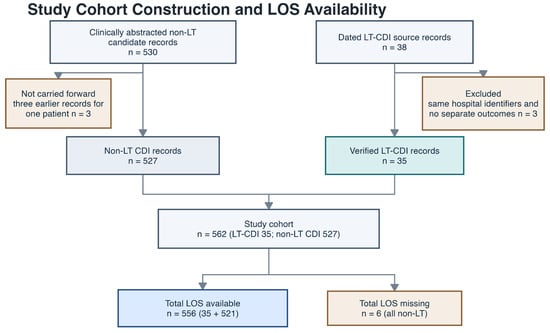
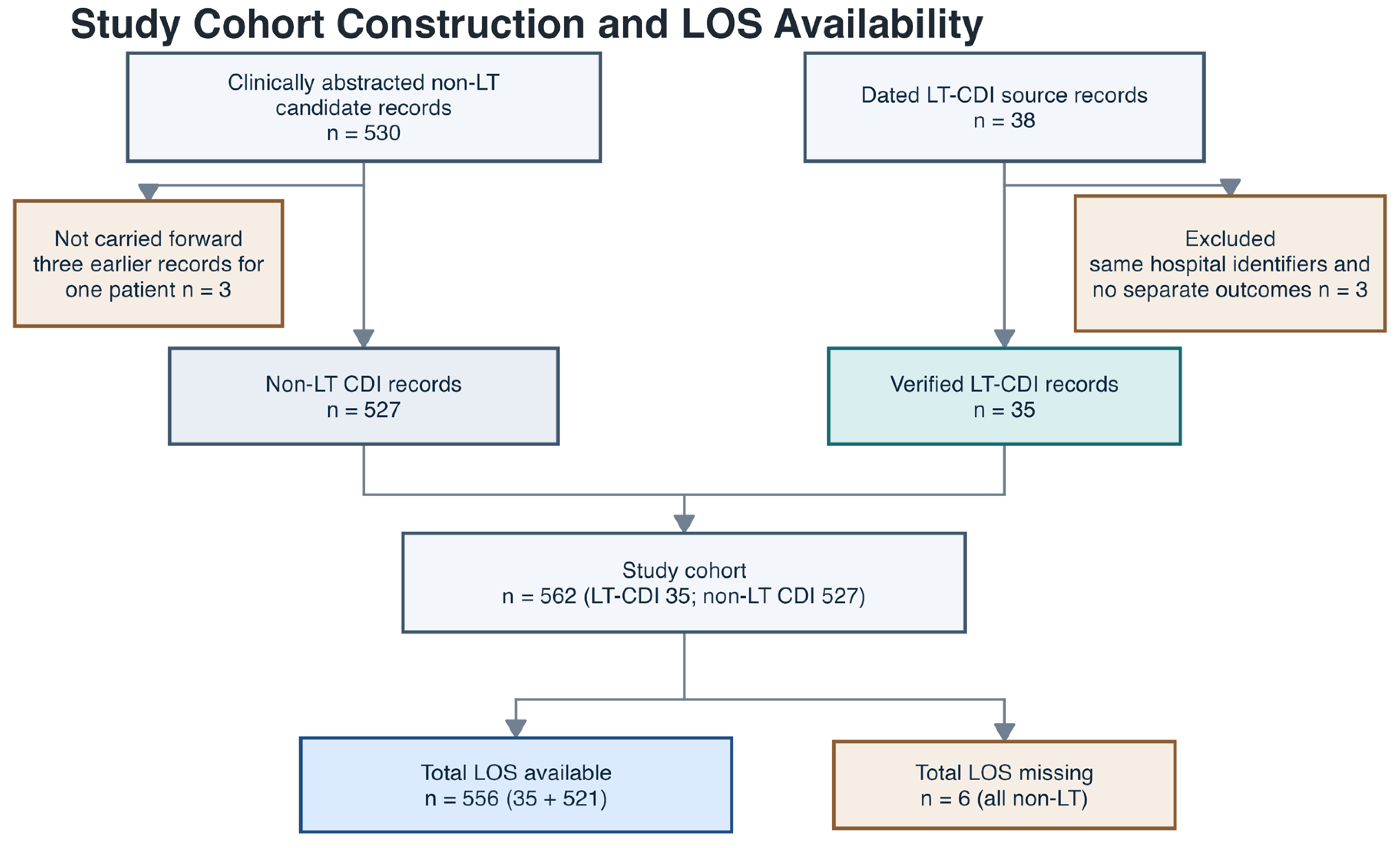
The non-LT source contained 530 clinically abstracted candidate CDI records. During the original data assembly, 527 records were carried forward; the three records not carried forward represented repeat laboratory tests during the same hospitalization for one patient rather than separate admissions. The LT source contained 38 dated records. Three records shared hospital identifiers with retained LT records and did not contain separate LOS or 30-day outcome information; these were excluded, leaving 35 verified LT-CDI records.
The study dataset comprised 35 verified LT-CDI records and 527 non-LT CDI records. LT status was verified from transplant clinical records and transplant-date fields. The analytic unit was the distinct hospital record containing a confirmed CDI diagnosis. An individual patient could contribute more than one record if separate, distinct CDI episodes occurred across hospitalizations (in the non-LT group, 482 unique patients accounted for 527 records, including 442 [91.7%] with a single recorded admission and 40 with repeat admissions; in the LT group, 35 verified records corresponded to 35 unique patients). Non-LT denotes the comparison category in this dataset; other immunocompromising conditions and non-liver transplant-related therapies could be present. LOS was available for 35/35 LT-CDI records and 521/527 non-LT CDI records, yielding 556 records for the primary LOS analysis (Figure 1 and Table 1).
Figure 1.
Flow diagram of cohort construction and LOS availability.
Table 1.
Cohort record counts and availability of LOS data.
The Clinical Research Ethics Committee of the First Affiliated Hospital, Zhejiang University School of Medicine approved the retrospective use of de-identified clinical records from CDI patients during the study period (Approval No. 2025-0273) and waived the requirement for informed consent.
2.2. CDI Definition
Eligible records had clinically documented unexplained diarrhea together with laboratory evidence of toxigenic C. difficile, including a positive stool toxin A/B test or toxigenic culture. This definition is consistent with the 2024 Chinese guideline and the IDSA/SHEA 2017 definition of compatible symptoms plus detection of C. difficile toxin, toxigenic C. difficile, or pseudomembranous colitis [2,15]. The 2024 Chinese guideline recommends testing symptomatic patients and, where available, a stepwise diagnostic strategy using a sensitive screening assay such as GDH or NAAT followed by toxin A/B testing for specificity [15]. Patient-level GDH/NAAT/toxin sequences were unavailable for modeling; diagnostic method was therefore used as a cohort eligibility criterion rather than an analytic variable.
2.3. Outcomes
The primary endpoint was total hospital LOS for the record containing the CDI diagnosis. LOS > 30 days was the main secondary endpoint and was anchored to prior post-LT hospitalization research [11]. LOS > 60 and >90 days were post hoc exploratory thresholds used to describe very prolonged stays; neither is an established clinical cutoff. Thirty-day mortality was measured from the CDI diagnosis date.
For LT recipients, admission and discharge date pairs were available in hepatobiliary clinical records for 34/35 records. These dates supported two distinct LT-only analyses: validation of recorded total LOS and descriptive calculation of CDI-to-discharge LOS.
2.4. Clinical Variables and Timing
Variables were considered in two groups. Variables available in both LT-CDI and non-LT CDI records were used for cross-group modeling. Transplant-specific variables were used for LT clinical description and exploratory within-LT analyses.
In this study, clinical acuity denotes a descriptive profile of peri-diagnostic organ-function abnormalities and selected clinical events during the symptomatic CDI episode, rather than a validated CDI severity classification. Post-CDI infections are described separately as features of the subsequent hospital course.
Shared variables included age, sex, comorbidity count, diabetes, malignancy, prior hospitalization, prior antibiotic class count, prior carbapenem exposure, prior antifungal exposure, immunocompromising therapy, selected laboratory variables, bloodstream infection, hypotension, shock, ICU-level care, total LOS, LOS thresholds, and 30-day mortality where available. The shared ICU variable included all documented ICU care, including routine postoperative monitoring. The LT-specific variable “ICU care for infection or organ support” excluded routine postoperative monitoring when the clinical record allowed this distinction.
Exposure variables used for adjustment were assessed before or on the CDI diagnosis date. Prior hospitalization referred to hospitalization within 90 days before CDI diagnosis. Prior antibiotic class count, prior carbapenem exposure, prior antifungal exposure, and immunocompromising therapy were assessed within the same 90-day window, including the portion of the hospitalization before CDI diagnosis. Exposures occurring only after CDI diagnosis were excluded from adjustment covariates. Detailed comorbidities and pre-diagnosis antimicrobial groups are reported in Table S1.
For LT-specific clinical abstraction, laboratory values were taken from examinations performed within three days of CDI diagnosis. Shock and ICU care for infection or organ support were recorded when they occurred after CDI diagnosis and before diarrhea resolved, defined clinically by return of formed stool. Hypotension was recorded as a post-diagnosis event. The analysis file contained the resulting values and indicators, but exact dates for individual events were unavailable. These variables therefore describe the stated abstraction windows and could not be ordered more precisely within them.
Post-CDI new infection was defined as a clinically documented bacterial, fungal, or viral infection newly appearing after CDI diagnosis and before hospital discharge. Domains included bloodstream infection, multidrug-resistant organism (MDRO) bacterial infection, fungal infection, viral infection, and polymicrobial or multidomain infection; these domains could overlap. Bloodstream infection required a positive blood culture with clinical documentation of bloodstream infection during the post-CDI-to-discharge interval. Culture results identified as contamination in the clinical record were not counted. Because these infections could arise after the peri-diagnostic window, they were treated as descriptors of the subsequent hospital course rather than baseline predictors.
The following numerical cutoffs were investigator-defined for exploratory description of laboratory abnormalities: total bilirubin (TBil) > 100 µmol/L, serum creatinine (SCr) ≥ 132.6 µmol/L (1.5 mg/dL), estimated glomerular filtration rate (GFR) < 60 mL/min/1.73 m2, platelets < 50 × 109/L, and albumin < 35 g/L. The cutoffs were selected during variable coding before the LOS models were fitted and were not selected based on observed associations with LOS. Their use in this analysis was descriptive; they were not intended as validated CDI- or LT-specific severity criteria.
An exploratory six-item LT clinical-course score assigned one point each for shock or hypotension; ICU care for infection or organ support or renal replacement therapy; TBil > 100 µmol/L; renal dysfunction (SCr ≥ 132.6 µmol/L or GFR < 60 mL/min/1.73 m2); platelets < 50 × 109/L; and high-risk post-CDI infection (bloodstream infection, MDRO bacterial infection, or fungal infection). Equal weighting provided a simple count of the six component domains, without implying equal clinical importance. The investigator-defined category of ≥3 was a pragmatic descriptive grouping denoting the presence of at least three of these six domains, not a validated clinical cutoff. Because the score combines peri-diagnostic findings with later events, it describes the observed hospital course rather than baseline severity and has not undergone prognostic validation.
Drug exposures were grouped as antimicrobial exposure, CDI-directed treatment, transplant immunosuppression, and antineoplastic or other immunocompromising therapy. Carbapenems were classified as systemic antibacterial exposure or treatment for a non-CDI infection.
2.5. Statistical Analysis
Continuous variables were summarized as medians and interquartile ranges. Categorical variables were summarized as counts and percentages with variable-specific denominators. Baseline, care-context, and LT clinical tables were descriptive; p-values were not used to rank baseline imbalance or within-LT features. Statistical inference focused on the primary median LOS models and the main secondary LOS > 30-day models. The >60- and >90-day models were interpreted as exploratory sensitivity analyses. No multiplicity adjustment was applied.
Median LOS differences were estimated using quantile regression with 500 bootstrap repetitions and percentile confidence intervals. Binary LOS endpoints were modeled using modified Poisson regression with robust HC0 sandwich variance, reporting risk ratios (RRs) and 95% confidence intervals [16]. Analyses used complete cases for the variables in each model; no outcome or covariate values were imputed.
Primary models used all non-LT CDI records. The baseline model adjusted for age, sex, and comorbidity count. The care/antimicrobial model additionally adjusted for prior hospitalization, prior antibiotic class count, and prior carbapenem exposure. We limited the main analysis to these adjustment sets because the LT-CDI group contained 35 records.
The manuscript was checked against STROBE reporting items [17]. Analyses were conducted in R version 4.5.2 using data.table 1.18.0, quantreg 6.1, sandwich 3.1.1, and lmtest 0.9.40. The bootstrap seed was 20260509. Because a small minority of patients had repeat hospital records corresponding to distinct CDI episodes, sensitivity analyses accounting for potential intra-individual correlation were performed using patient-clustered bootstrap (50,000 resamples) for median regression, cluster-robust sandwich variance for modified Poisson models, and restricting the cohort to the first-recorded CDI episode per patient. Across specifications, effect directions, confidence intervals, and inferential conclusions remained consistent with the primary models (Supplementary Table S3).
3. Results
3.1. Cohort Construction and LT-CDI Timing
The finalized non-LT analytic dataset contained 527 of 530 clinically abstracted candidate records. The three records not carried forward during the original data assembly were earlier records for one patient who was represented by a retained record. The LT branch retained 35 of 38 dated source records after three records that shared hospital identifiers with retained LT records and did not contain separate LOS or 30-day outcome information were excluded. The resulting cohort contained 562 CDI-associated hospital records. Numeric LOS was available for all 35 LT-CDI records and 521/527 non-LT CDI records, yielding 556 records for the primary LOS analysis (Figure 1 and Table 1).
Transplant-to-CDI timing was evaluable for 34/35 LT-CDI records. Among these 34 records, median time from LT to CDI diagnosis was 13 days [IQR, 7 to 36]. Using the full LT denominator and retaining the single missing value, CDI occurred within 7 days after LT in 9/35 records (25.7%), within 30 days in 25/35 (71.4%), and within 90 days in 27/35 (77.1%). The mutually exclusive timing strata were 0–7 days in 9 records, 8–30 days in 16, 31–90 days in 2, 91–365 days in 4, >365 days in 3, and timing unavailable or indeterminate in 1 (Figure S1).
3.2. LT-CDI Clinical Context
Median prior antibiotic class count was 4 [IQR, 3 to 5] in LT-CDI records and 2 [IQR, 0 to 4] in non-LT CDI records. Prior carbapenem exposure was present in 21/35 LT-CDI records (60.0%) and 119/527 non-LT CDI records (22.6%). Prior antifungal exposure was present in 30/35 LT-CDI records (85.7%) and 139/527 non-LT CDI records (26.4%). All LT-CDI records had immunocompromising therapy (Table 2). Table S1 reports the detailed pre-diagnosis antibiotic groups and comorbidity domains in both cohorts.
Table 2.
Baseline, care-context, and clinical descriptors.
Peri-diagnostic laboratory abnormalities included TBil > 100 µmol/L in 12/35 records (34.3%), platelets < 50 × 109/L in 15/35 (42.9%), albumin < 35 g/L in 18/35 (51.4%), and GFR < 60 mL/min/1.73 m2 in 8/34 records with GFR available (23.5%). During the symptomatic CDI episode, ICU care for infection or organ support was documented in 12/35 records (34.3%), and shock or hypotension was documented in 10/35 (28.6%).
Features of the subsequent hospital course were also common. New infection after CDI diagnosis was documented in 19/35 LT-CDI records (54.3%), bloodstream infection in 11/35 (31.4%), MDRO bacterial infection in 10/35 (28.6%), fungal infection in 7/35 (20.0%), viral infection in 6/35 (17.1%), and polymicrobial or multidomain infection in 14/35 (40.0%) (Table 3). These events characterize the post-diagnosis course and were analyzed separately from peri-diagnostic acuity.
Table 3.
LT-CDI timing, peri-diagnostic clinical status, and post-diagnosis course.
3.3. Total LOS
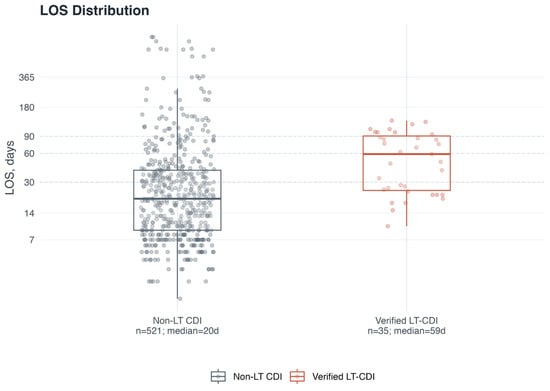
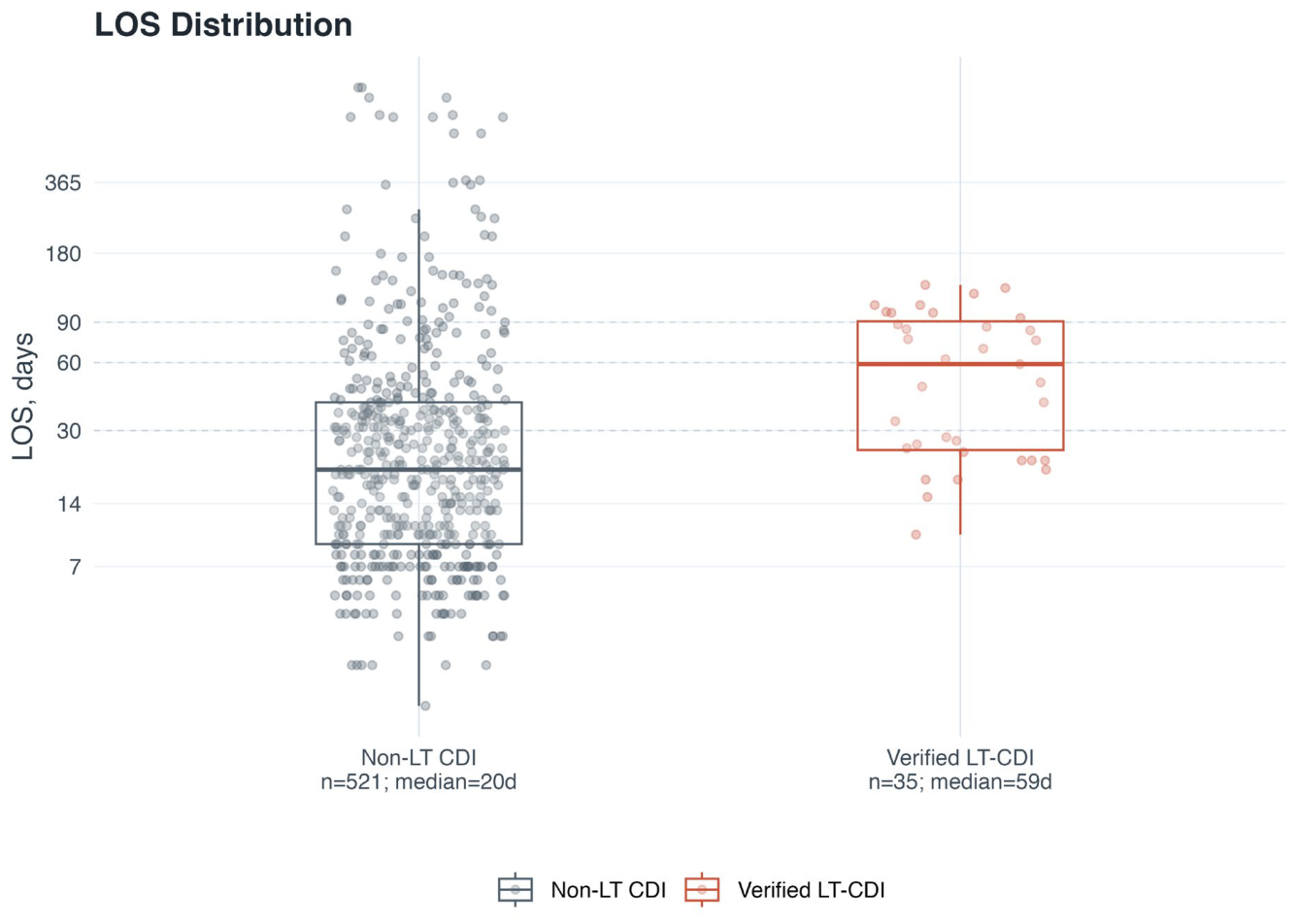
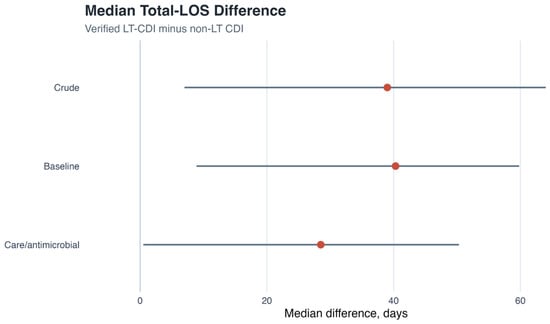
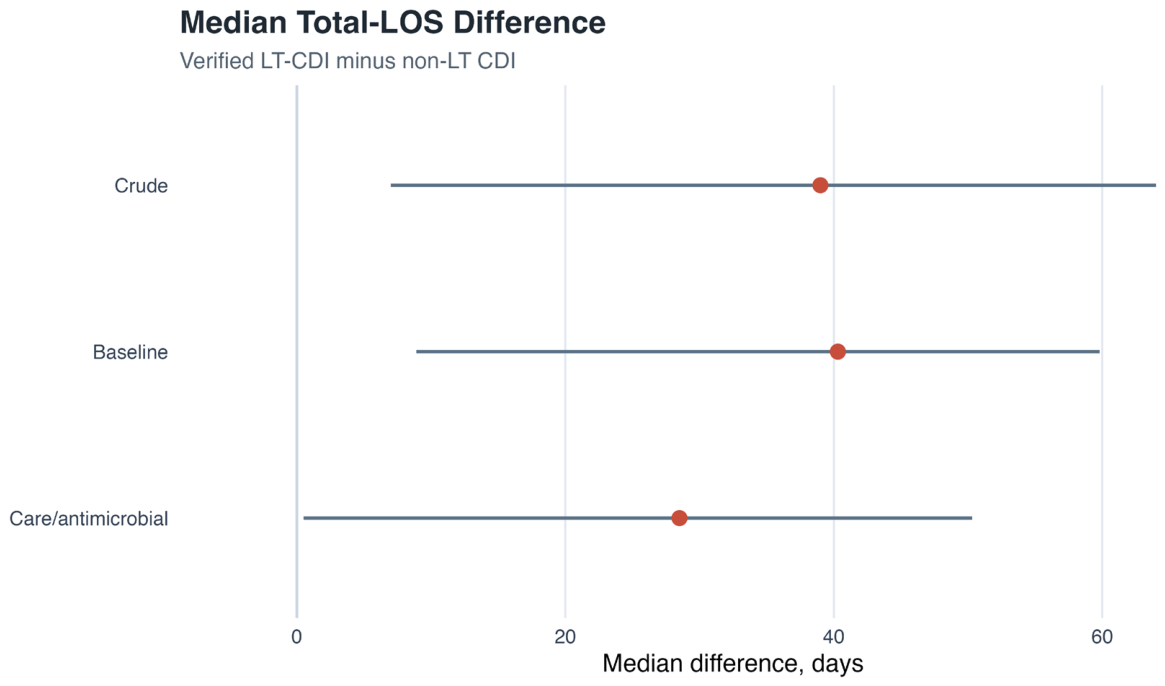
Observed median total LOS was 59 days [IQR, 24 to 94] among all 35 LT-CDI records and 20 days [IQR, 9 to 40] among 521 non-LT CDI records with LOS (Figure 2). The crude median difference was 39.0 days (bootstrap 95% CI, 7.0 to 64.0). The baseline-adjusted median difference was 40.3 days (95% CI, 8.9 to 59.8), and the care/antimicrobial-adjusted median difference was 28.5 days (95% CI, 0.5 to 50.3) (Table 4 and Figure 3).
Figure 2.
Observed, unadjusted total LOS for the hospital record containing the CDI diagnosis in verified LT-CDI and non-LT CDI groups.
Table 4.
Quantile-regression median LOS models and observed group medians.
Figure 3.
Median total-LOS differences across the three main model sets. The figure shows attenuation and uncertainty; group medians in Table 4 are observed and unadjusted. Red points indicate estimated median LOS differences (LT-CDI minus non-LT CDI), and horizontal bars indicate 95% bootstrap confidence intervals.
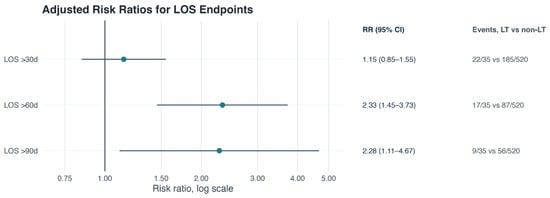
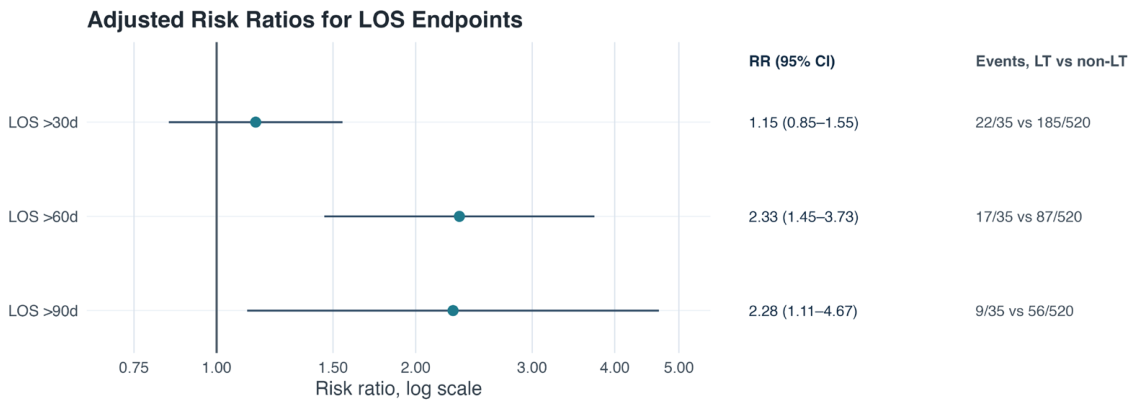
LOS > 30 days occurred in 22/35 LT-CDI records (62.9%) and 186/521 non-LT CDI records (35.7%). The crude RR was 1.76 (95% CI, 1.33 to 2.33); the care/antimicrobial-adjusted RR was 1.15 (95% CI, 0.85 to 1.55). Exploratory very prolonged LOS estimates remained elevated after care/antimicrobial adjustment: RR 2.33 (95% CI, 1.45 to 3.73) for LOS > 60 days and RR 2.28 (95% CI, 1.11 to 4.67) for LOS > 90 days. The >90-day estimate was based on nine LT events and had wider uncertainty (Table 5 and Figure 4).
Table 5.
LOS endpoint hierarchy.
Figure 4.
Adjusted risk ratios for LOS endpoints. LOS > 30 days is the main secondary endpoint; LOS > 60 and >90 days are post hoc exploratory thresholds for very prolonged stays.
3.4. LT-Only LOS Validation and Post-CDI Interval
Admission and discharge dates were interpretable for 34/35 LT-CDI records. Within this 34-record validation subset, the recorded LOS value had a median of 59.0 days [IQR, 24.5 to 91.0], while total LOS calculated from admission and discharge dates had a median of 58.0 days [IQR, 23.5 to 90.5]. The all-LT estimate of 59 days [IQR, 24 to 94] uses 35 records, whereas the validation estimates use 34; this accounts for the small difference in IQRs.
Among the 34 records with an evaluable CDI-to-discharge interval, median post-CDI LOS was 23.5 days [IQR, 11.5 to 49.2]. Longer intervals were observed in records with infection/support ICU care, shock or hypotension, post-CDI new infection, or an exploratory clinical-course score ≥ 3. These descriptive comparisons involve clinical events and follow-up time from overlapping portions of the same hospitalization (Table S2).
4. Discussion
In this same-center CDI cohort, LT-CDI records had longer total LOS than non-LT CDI records, and most LT-CDI diagnoses occurred during the first month post-transplant. Peri-diagnostic organ abnormalities, symptomatic-episode ICU care or shock, and subsequent infections were common. Early post-LT clustering and longer LOS by transplant status were separate findings; the study did not compare LOS between early and late LT-CDI.
The same-center non-LT CDI group provides a clinical and LOS benchmark within the institutional CDI population. LT-CDI records had longer total LOS after parsimonious adjustment, although the contrast reflects the full hospitalization, including transplant recovery and pre-CDI care. Estimating incremental LOS attributable to CDI after LT would require LT recipients without CDI.
The early clustering of LT-CDI is consistent with single-center LT studies reporting CDI near transplantation and with perioperative antimicrobial, biliary, hemorrhagic, and infectious complications [4,5]. Population-based SOT research also shows variation in post-transplant CDI timing [8]. The 2024 LT-focused review reports variation in incidence and risk factors across diagnostic methods, study periods, and centers [10]. This study adds clinical detail from recipients whose LT status was verified in transplant records and compares total LOS with same-center non-LT CDI records.
Clinical acuity around CDI diagnosis can be difficult to interpret after LT. Laboratory abnormalities may reflect graft or biliary dysfunction, renal dysfunction, cytopenia, infection, and perioperative care. ICU documentation can include routine post-transplant monitoring, which is why the LT-specific infection/support ICU indicator excluded routine monitoring when records allowed. These findings support contextual interpretation of familiar CDI severity markers. Formal CDI severity criteria were not evaluated in this study.
The care/antimicrobial model used hospitalization and antimicrobial exposure during the 90 days before CDI diagnosis, including the pre-diagnosis portion of the same hospitalization. New infections after CDI diagnosis, subsequent antimicrobial treatment, ICU/support care during the symptomatic episode, and later clinical events were not baseline adjustment covariates. Their frequencies characterize the subsequent hospital course; longer stays also increase the time at risk for such events.
The continuous primary LOS analysis showed a care/antimicrobial-adjusted median difference of 28.5 days, with a wide confidence interval. The main secondary LOS > 30-day association attenuated after the same adjustment, and its confidence interval included 1. In post hoc exploratory analyses, LT-CDI records were more common among stays longer than 60 and 90 days. At these exploratory thresholds, the baseline-adjusted RRs were higher than the crude RRs, reflecting adjustment for age, sex, and comorbidity count in the complete-case sample, whereas the care/antimicrobial-adjusted estimates were attenuated. Neither threshold is an established clinical cutoff. The estimates show concentration of LT-CDI records among very prolonged stays, with less precision at >90 days.
Prevention in transplant units can build on established CDI guidance and the exposure profile observed here [3]. Relevant measures include diagnostic stewardship for patients with new unexplained diarrhea; timely isolation and contact precautions; hand hygiene and sporicidal environmental cleaning; review of unnecessary systemic antibiotics and acid-suppressive therapy [10]; and antimicrobial de-escalation when clinically feasible. For LT recipients, these measures require coordination with transplant and infectious-diseases teams because broad-spectrum therapy and immunosuppression may be essential for competing indications. The early timing and exposure profile observed here identify the first month post-transplant as a practical period in which to evaluate these established measures.
Several limitations should guide interpretation. The LT-CDI group included 35 records, which limited model complexity and precision, particularly for LOS > 90 days. The study lacked an LT group without CDI, total LOS included pre-CDI hospitalization, and post-CDI LOS was available only for LT recipients. The non-LT flow begins with the clinically abstracted candidate file used to assemble this analysis rather than the full laboratory-testing registry. Fourth, the primary analytic unit was the hospital record containing CDI rather than unique individuals. Although most patients had a single recorded admission (442/482 [91.7%] non-LT patients and 35/35 [100%] LT patients), a small proportion of complex non-LT patients contributed repeat records for recurrent or subsequent CDI episodes. Sensitivity analyses with patient clustering confirmed that intra-individual correlation had negligible impact on model estimates and confidence intervals. Exact dates for individual laboratory, shock, hypotension, and ICU events were unavailable beyond the stated abstraction windows. Some transplant-specific variables lacked comparable non-LT detail. The exploratory clinical-course score combines peri-diagnostic findings with later events and is not a baseline severity measure. Longer stays provide more opportunity for some components, particularly post-CDI infections, to occur; LOS differences between score categories may therefore partly reflect unequal observation time. These comparisons describe the observed clinical course and do not establish prediction or causation; the score has not undergone prognostic validation. CDI treatment, recurrence, antimicrobial duration, and diagnostic assay sequences were recorded inconsistently. Retrospective abstraction remains susceptible to under-documentation, residual misclassification, and unmeasured confounding. Future multicenter studies should include LT recipients with and without CDI and collect consistent admission-to-CDI timing, post-CDI LOS, recurrence, treatment, microbiology, antimicrobial duration, and graft-specific complications.
5. Conclusions
Within a same-center cohort of records involving CDI, verified LT-CDI records clustered early after transplantation, had longer total LOS, and showed a clinically complex peri-diagnostic and subsequent course compared with non-LT CDI records. The primary adjusted median LOS difference remained positive, whereas the LOS > 30-day association attenuated after care/antimicrobial adjustment. Post hoc exploratory analyses showed greater representation of LT-CDI among stays longer than 60 and 90 days, with less precision at >90 days. These estimates provide a same-center benchmark for overall hospitalization burden among CDI records by transplant status; estimating CDI-attributable LOS would require an LT group without CDI.
Supplementary Materials
The following supporting information can be downloaded at: https://www.mdpi.com/article/10.3390/germs16040027/s1, Table S1: Detailed comorbidities and pre-CDI healthcare and antimicrobial exposures by liver transplant status; Table S2: LT-only CDI-to-discharge LOS by descriptive clinical stratum; Table S3: Sensitivity analyses for primary total LOS and prolonged LOS models accounting for patient clustering and first-episode selection; Figure S1: Time from liver transplantation to CDI diagnosis in 35 verified LT-CDI records. Timing was evaluable for 34 records; one timing value was unavailable or indeterminate.
Author Contributions
Conceptualization, P.W. and Y.C.; methodology, S.D.; software, S.D.; formal analysis, S.D.; investigation, P.W. and M.X.; data curation, P.W., M.X. and S.D.; resources, D.Z.; visualization, S.D.; writing—original draft preparation, P.W. and S.D.; writing—review and editing, M.X., D.Z. and Y.C.; supervision, D.Z. and Y.C.; project administration, Y.C.; funding acquisition, Y.C. All authors have read and agreed to the published version of the manuscript.
Funding
This study was supported by the National Key Research and Development Program of China (Grant No. 2024YFC2309902) and the Research Project of Jinan Microecological Biomedicine Shandong Laboratory (Grant No. JNL-2025004B). The funders had no role in study design, data collection, analysis, interpretation, manuscript writing, or the decision to submit the article.
Institutional Review Board Statement
The study was conducted in accordance with the Declaration of Helsinki. The protocol was approved by the Clinical Research Ethics Committee of the First Affiliated Hospital, Zhejiang University School of Medicine (Approval No. 2025-0273; approved on 10 March 2025).
Informed Consent Statement
The requirement for informed consent was waived due to the retrospective design and use of anonymized clinical data. No organs were procured from executed prisoners. All organs were procured after informed consent or authorization.
Data Availability Statement
The de-identified derived analysis tables that support the findings of this study are available from the corresponding author upon reasonable request, subject to institutional review board approval and applicable privacy regulations. Patient-level source files are not publicly available due to patient privacy restrictions.
Conflicts of Interest
The authors declare no conflicts of interest.
References
- C. diff: Facts for Clinicians. Available online: https://www.cdc.gov/c-diff/hcp/clinical-overview/index.html (accessed on 11 May 2026).
- McDonald, L.C.; Gerding, D.N.; Johnson, S.; Bakken, J.S.; Carroll, K.C.; Coffin, S.E.; Dubberke, E.R.; Garey, K.W.; Gould, C.V.; Kelly, C.; et al. Clinical practice guidelines for Clostridium difficile infection in adults and children: 2017 update by the Infectious Diseases Society of America (IDSA) and Society for Healthcare Epidemiology of America (SHEA). Clin. Infect. Dis. 2018, 66, e1–e48. [Google Scholar] [CrossRef] [Scilit] [PubMed]
- Kociolek, L.K.; Gerding, D.N.; Carrico, R.; Carling, P.; Donskey, C.J.; Dumyati, G.; Kuhar, D.T.; Loo, V.G.; Maragakis, L.L.; Pogorzelska-Maziarz, M.; et al. Strategies to prevent Clostridioides difficile infections in acute-care hospitals: 2022 update. Infect. Control Hosp. Epidemiol. 2023, 44, 527–549. [Google Scholar] [CrossRef] [Scilit] [PubMed]
- Albright, J.B.; Bonatti, H.; Mendez, J.; Kramer, D.; Stauffer, J.; Hinder, R.; Michel, J.A.; Dickson, R.C.; Hughes, C.; Nguyen, J.; et al. Early and late onset Clostridium difficile-associated colitis following liver transplantation. Transpl. Int. 2007, 20, 856–866. [Google Scholar] [CrossRef] [Scilit] [PubMed]
- Sullivan, T.; Weinberg, A.; Rana, M.; Patel, G.; Huprikar, S. The epidemiology and clinical features of Clostridium difficile infection in liver transplant recipients. Transplantation 2016, 100, 1939–1943. [Google Scholar] [CrossRef] [Scilit] [PubMed]
- Gomez-Simmonds, A.; Annavajhala, M.K.; Nunez, M.P.; Macesic, N.; Park, H.; Uhlemann, A.C. Intestinal dysbiosis and risk of posttransplant Clostridioides difficile infection in a longitudinal cohort of liver transplant recipients. mSphere 2022, 7, e00361-22. [Google Scholar] [CrossRef] [Scilit] [PubMed]
- Mullane, K.M.; Dubberke, E.R.; AST ID Community of Practice. Management of Clostridioides (formerly Clostridium) difficile infection (CDI) in solid organ transplant recipients: Guidelines from the American Society of Transplantation Community of Practice. Clin. Transplant. 2019, 33, e13564. [Google Scholar] [CrossRef] [Scilit] [PubMed]
- Hosseini-Moghaddam, S.M.; Luo, B.; Bota, S.E.; Husain, S.; Silverman, M.S.; Daneman, N.; Brown, K.A.; Paterson, J.M. Incidence and outcomes associated with Clostridioides difficile infection in solid organ transplant recipients. JAMA Netw. Open 2021, 4, e2141089. [Google Scholar] [CrossRef] [Scilit] [PubMed]
- Ali, H.; Patel, P.; Pamarthy, R.; Fatakhova, K.; Bolick, N.L.; Satapathy, S.K. Comparative analysis and trends in liver transplant hospitalizations with Clostridium difficile infections: A 10-year national cross-sectional study. Transpl. Infect. Dis. 2022, 24, e13985. [Google Scholar] [CrossRef] [Scilit] [PubMed]
- Laeeq, T.; Tun, K.M.; Vongsavath, T.; Singh, A.; Manne, V. Incidence and risk factors of Clostridioides difficile infection in liver transplant recipients: A comprehensive literature review. Clin. Liver Dis. 2024, 23, e0131. [Google Scholar] [CrossRef] [Scilit] [PubMed]
- Smith, J.O.; Shiffman, M.L.; Behnke, M.; Stravitz, R.T.; Luketic, V.A.; Sanyal, A.J.; Heuman, D.M.; Fisher, R.A.; Cotterell, A.H.; Maluf, D.G.; et al. Incidence of prolonged length of stay after orthotopic liver transplantation and its influence on outcomes. Liver Transpl. 2009, 15, 273–279. [Google Scholar] [CrossRef] [Scilit] [PubMed]
- Barnett, A.G.; Beyersmann, J.; Allignol, A.; Rosenthal, V.D.; Graves, N.; Wolkewitz, M. The time-dependent bias and its effect on extra length of stay due to nosocomial infection. Value Health 2011, 14, 381–386. [Google Scholar] [CrossRef] [Scilit] [PubMed]
- Wolkewitz, M.; Schumacher, M.; Rücker, G.; Harbarth, S.; Beyersmann, J. Estimands to quantify prolonged hospital stay associated with nosocomial infections. BMC Med. Res. Methodol. 2019, 19, 111. [Google Scholar] [CrossRef] [Scilit] [PubMed]
- Hazard, D.; Grodd, M.; Walzer, D.; Biever, P.; Rieg, S.; Wolkewitz, M. How to avoid time-related types of bias in the analysis of clinical infectious diseases: Demonstration and methods. Clin. Microbiol. Infect. 2025, 31, 1467–1474. [Google Scholar] [CrossRef] [Scilit] [PubMed]
- Chinese Society of Surgery of Chinese Medical Association; Infectious Diseases Society for Evidence-Based and Translational Medicine of Chinese Research Hospital Association. Guidelines for diagnosis, treatment and prevention of Clostridium difficile infection in China (2024). Zhonghua Wai Ke Za Zhi 2024, 62, 893–908. [Google Scholar] [CrossRef] [PubMed]
- Zou, G. A modified Poisson regression approach to prospective studies with binary data. Am. J. Epidemiol. 2004, 159, 702–706. [Google Scholar] [CrossRef] [Scilit] [PubMed]
- von Elm, E.; Altman, D.G.; Egger, M.; Pocock, S.J.; Gøtzsche, P.C.; Vandenbroucke, J.P.; STROBE Initiative. The Strengthening the Reporting of Observational Studies in Epidemiology (STROBE) statement: Guidelines for reporting observational studies. PLoS Med. 2007, 4, e296. [Google Scholar] [CrossRef] [Scilit] [PubMed]

Disclaimer/Publisher’s Note: The statements, opinions and data contained in all publications are solely those of the individual author(s) and contributor(s) and not of MDPI and/or the editor(s). MDPI and/or the editor(s) disclaim responsibility for any injury to people or property resulting from any ideas, methods, instructions or products referred to in the content. |
© 2026 by the authors. Published by MDPI on behalf of the Infection Science Forum. Licensee MDPI, Basel, Switzerland. This article is an open access article distributed under the terms and conditions of the Creative Commons Attribution (CC BY) license.