


Abstract
Introduction: Improving adult pneumococcal vaccination is a public-health priority in Romania, and evidence regarding patient-level outcomes following different approaches to physician training remains limited. Materials and methods: This non-randomised, multicentre, quasi-experimental implementation study examined patient-level changes across three geographically distinct Romanian settings between August and November 2025. Physicians in Iași and Dolj counties received in-person training combining medical content with communication techniques based on motivational interviewing, whereas physicians in the webinar group received online medical training without a dedicated communication module. Eligible adult patients completed questionnaires before and after counselling and reported whether they had been vaccinated or had scheduled a vaccination appointment. Results: The analysis included 295 questionnaire pairs from patients nested within 29 physicians. Baseline attitudes differed markedly across settings (composite score of 5.64 in the webinar group, 5.29 in Dolj County, and 4.09 in Iași County; p < 0.001), as did strong baseline vaccination intention (75.6%, 48.1%, and 27.2%, respectively). Using a composite score comprising all seven attitude items, with item 7 reverse-coded and vaccination intention analysed separately, the cluster-robust group-by-time model indicated different mean changes between settings (global p = 0.001): +0.28 in the webinar group, +1.02 in Iași, and +0.60 in Dolj. Strong vaccination intention increased within each setting, but the magnitude of change did not differ between settings (group-by-time p = 0.929). The combined self-reported vaccination-or-scheduling outcome was observed in 81.5% of patients in the webinar group, 49.4% in Iași, and 73.3% in Dolj; after adjustment for baseline intention, there was no longer evidence of an overall group difference (p = 0.651). Discussion and conclusions: Because training approach, delivery modality, geographical setting, physician cohort, and patient population were not independently allocated, and because baseline levels differed markedly between settings, the findings should be interpreted as exploratory implementation patterns rather than causal comparative effects.
1. Introduction
Invasive pneumococcal disease and pneumococcal pneumonia remain important causes of morbidity and mortality in adults, particularly among older people and those with chronic comorbidities or immunosuppression. Pneumococcal infection may cause community-acquired pneumonia, septicaemia, and meningitis. Childhood pneumococcal vaccination reduces vaccine-type disease in children and provides indirect protection through reduced transmission [1]. In adults aged 65 years or older, randomised evidence has shown that pneumococcal conjugate vaccination reduces vaccine-type community-acquired pneumonia and invasive pneumococcal disease [2,3]. In the United States, current ACIP guidance recommends a pneumococcal conjugate vaccine for all pneumococcal-conjugate-vaccine-naïve adults aged 50 years or older and retains risk-based recommendations for adults aged 19–49 years [4].
In Romania, the 13-valent pneumococcal–polysaccharide conjugate vaccine was introduced into the National Immunisation Calendar in 2012 and became routinely available to infants from 1 October 2017. From 1 December 2023, a reimbursement mechanism expanded access for defined risk groups, including adults aged over 65 years and people with specified chronic conditions. Eligible patients may receive a reimbursed prescription from their family physician or another contracted physician, a mechanism intended to facilitate targeted protection of vulnerable populations [5,6,7].
Although reimbursed pneumococcal vaccinations have been available to eligible risk groups in Romania since December 2023, national administrative reports provide counts of reimbursed doses rather than denominator-based coverage estimates for the eligible adult population [8]. Adult uptake therefore cannot be quantified as vaccination coverage from these data alone. Vaccine hesitancy and limited demand nevertheless remain relevant implementation concerns.
In the Romanian health system, the family physician is the principal vaccinator of adults and, consequently, the main point of contact for recommending and administering vaccines. The physician’s ability to inform and communicate effectively with hesitant patients may therefore influence vaccination decisions. Vaccine hesitancy is a complex phenomenon situated on a continuum between acceptance and refusal and influenced by trust, risk perception, and contextual factors. The literature on health-behaviour change suggests that information alone is often insufficient and that relational approaches, including motivational interviewing, may support informed decision-making [9,10,11,12,13,14,15].
Evidence remains limited regarding patient-level changes observed after different approaches to physician training in routine vaccination practice. We therefore examined changes in patient attitudes, vaccination intention, and self-reported vaccination or appointment scheduling across three Romanian settings in which family physicians had received one of two training approaches. Because training approach, delivery modality, geographical setting, participating physicians, and patient populations were not independently allocated, the study was designed to describe implementation patterns and generate hypotheses rather than to estimate the causal comparative effectiveness of the training formats.
2. Materials and Methods
2.1. Study Design and Setting
We conducted a non-randomised, multicentre, quasi-experimental implementation study in Romania between August and November 2025. The study included three groups defined by geographical setting and the training previously received by participating family physicians. Physicians in Iași County and Dolj County received a 6 h in-person training combining 3 h of medical content with 3 h of communication training based on motivational interviewing, whereas physicians in the webinar group received a 3 h online medical training course without a dedicated communication module. Neither physicians nor study settings were randomly allocated. The medical content was delivered by the same trainers in both formats; the motivational interviewing component in Iași and Dolj counties was delivered by the same trainer. Both formats used presentation and brainstorming; the in-person format additionally used role play. Because training content, delivery modality, and geographical setting coincided, their independent contributions to the observed patient-level outcomes could not be disentangled.
2.2. Intervention
The curriculum was developed in a participatory manner by the Centre for Health Policies and Services (CPSS) together with the Vaccinology Group of the Romanian National Society of Family Medicine and was accredited for continuing medical education. Separate in-person courses were delivered in Iași and Dolj counties. These courses combined updated medical content on adult pneumococcal vaccination (3 h) with a dedicated communication component addressing motivational-interviewing principles (3 h), open questions, reflective listening, empathic exploration of hesitancy, patient autonomy, and clinical scenarios. The available records did not include the exact dates and duration of the two in-person courses. The webinar was delivered on 11 November 2025 and lasted 4 h and 20 min, of which 3 h comprised the dedicated educational programme. The programme covered pneumococcal disease burden, risk groups, available vaccines, vaccination schedules, adverse-event management, common misconceptions, and integration of vaccine recommendations into routine practice, with group discussions and pre- and post-course assessment but no dedicated motivational-interviewing module. No consultation recordings, structured observation checklists, or independent adherence assessments were collected; the use of the communication techniques in clinical practice was not formally evaluated.
2.3. Participants
The available course records listed 18 physicians in the Iași in-person course, 10 in the Dolj in-person course, and 18 in the webinar course. The patient-level analysis included physicians who subsequently provided matched pre- and post-consultation questionnaires: 8 in Iași, 9 in Dolj, and 12 in the webinar group. Physicians were asked to enrol approximately the first 10 adults eligible for reimbursed pneumococcal vaccination who agreed to participate and provided written informed consent. The target of 10 patients was an implementation target rather than a strictly enforced maximum. In the webinar group, 10 physicians contributed 10 questionnaire pairs and 2 physicians contributed 12 pairs each; the additional patients were not recruited according to a different selection rule. In Iași County, seven physicians contributed 10 pairs and one contributed 11; the reason for the additional pair was not documented. Each physician in Dolj County contributed 10 pairs. No screening log was maintained for approached patients, refusals, or eligible non-participants; no data were collected on trained physicians who did not contribute patient questionnaires. The final dataset comprised 295 matched questionnaire pairs: 124 in the webinar group, 81 in Iași, and 90 in Dolj. Item-level missingness was limited but not zero. In the webinar group, one response was missing for each of pre- and post-counselling item 4, item 5, and vaccination intention. In Iași, one response was missing for baseline item 2, one for baseline item 5, and one for post-counselling item 6. In Dolj, vaccination intention was missing for seven patients before counselling and nine after counselling. The combined vaccination-or-scheduling and satisfaction items were complete in all groups.
2.4. Assessment Instruments
The analytical dataset contained paired pre- and post-counselling responses to the same study-specific seven-item attitude block. The post-counselling assessment additionally included vaccination intention, the combined vaccination-or-scheduling outcome, and consultation-experience items. The instrument was informed by the 7C model of vaccination readiness [16] but was not a direct administration of the complete validated 7C scale. The Romanian-language items addressed vaccination in general rather than pneumococcal vaccination exclusively. They were rated from 1 to 7 and covered institutional trust (item 1), perceived risk of infection (item 2), personal prioritisation of vaccination (item 3), conditional vaccination beliefs (item 4), collective responsibility (item 5), support for sanction-type measures (item 6), and beliefs about vaccine-related risk or harm (item 7). Operational scoring followed the analytical convention used during the study, whereby item 7 was reverse-coded and item 4 was retained in its original direction. This convention was retained for the principal analysis because it corresponded to the original analytical workflow and because the wording of item 4—vaccination only when the benefits clearly outweigh the risks—does not have an unequivocally unfavourable direction within this study-specific instrument. Changing its direction after inspection of the reverse-item marker would therefore have constituted a post hoc alteration of the principal composite score. Nevertheless, because the source questionnaire displayed a reverse-item marker beside item 4, creating genuine ambiguity regarding its scoring direction, the alternative convention in which both items 4 and 7 were reverse-coded was examined as a sensitivity analysis. The composite attitude score was the mean of all seven attitude items; vaccination intention was analysed separately and was not included in the composite. Under the operational scoring, internal consistency was high before counselling (Cronbach’s α = 0.886) and after counselling (α = 0.849), although these coefficients do not constitute formal validation of the study-specific instrument. Strong agreement or intention was defined as a score of 6–7; for item 7, scores of 1–2 represented the favourable response category. After counselling, patients reported, through a single yes/no item, whether they had been vaccinated or had scheduled a vaccination appointment. The source data did not distinguish these two components. Patients also rated consultation satisfaction, perceived duration, and remaining questions.
2.5. Ethics
The study instruments and procedures were reviewed and approved by the Ethics Committee of the University of Medicine and Pharmacy of Craiova before implementation. Participation was voluntary, and all patients provided written informed consent. Patient initials were used to link pre- and post-consultation questionnaires within practices; the data should therefore be described as pseudonymised rather than anonymous. The data was obtained and held solely by CPSS, and it was delivered to the research team without any link to the individuals interviewed. The analytical file contained patient initials and physician codes but no names, contact details, national identification numbers, or medical-record identifiers.
2.6. Statistical Analysis
Analyses followed an available-case approach, without imputation. Questionnaire pairs were retained in the dataset even when individual items were missing, and the valid denominator is reported for each analysis. No single primary outcome had been prospectively specified; for the revised exploratory analysis, the seven-item composite attitude score and strong vaccination intention were treated as the principal analytical outcomes, whereas individual attitude items and satisfaction indicators were treated as secondary exploratory outcomes. The composite was calculated as the mean of all seven attitude items after reverse-coding item 7; vaccination intention was excluded from this score. To account for patients nested within physicians, continuous composite scores were analysed using linear models with physician-clustered Huber–White standard errors and a finite-sample correction. Binary outcomes were analysed using logistic models with the same physician-clustered variance estimator. Pre–post models included study group, time, and the group-by-time interaction. A baseline-adjusted sensitivity analysis modelled the post-counselling value as a function of its baseline value and study group. The combined vaccination-or-scheduling outcome was analysed both without adjustment and after adjustment for baseline vaccination intention. The individual relationship between post-counselling strong intention and the combined outcome was examined using cross-tabulations and cluster-robust logistic regression. Results are reported as mean differences or odds ratios with 95% confidence intervals. Benjamini–Hochberg false-discovery-rate correction was applied separately to the seven item-level interaction tests and the six satisfaction comparisons. Data were entered and organised using Microsoft Excel, and preliminary statistical analyses were conducted using IBM SPSS Statistics for Windows, version 26.0. The revised cluster-robust analyses reported in this manuscript were performed in Python 3.12, using pandas 2.2.3 for data handling and purpose-written routines based on NumPy 2.3.5 and SciPy 1.17.0 for model estimation and inference. No separate off-the-shelf regression package was used for these models. Physician-clustered Huber–White sandwich covariance estimates were multiplied by the CR1 finite-sample factor [G/(G − 1)] × [(N − 1)/(N − K)], where G denotes the number of physician clusters, N the number of observations included in the respective model, and K the number of estimated regression coefficients. Coefficient-level confidence intervals and tests used normal-based Wald inference, whereas multi-parameter global tests used the chi-squared reference distribution. A scoring sensitivity analysis repeated the composite-score models after reverse-coding both items 4 and 7.
3. Results
3.1. Characteristics and Baseline Attitudes
Group characteristics and baseline attitude levels are presented in Table 1. The mean baseline composite attitude score, calculated from all seven attitude items and excluding vaccination intention, was 5.64 in the webinar group, 4.09 in Iași, and 5.29 in Dolj. Baseline distributions differed markedly across settings (Kruskal–Wallis H = 49.44; p < 0.001), with the least favourable baseline profile observed in Iași. Strong baseline vaccination intention was reported by 75.6% of paired respondents in the webinar group, 27.2% in Iași, and 48.1% in Dolj. These differences describe the study populations but should not be interpreted as effects of the training formats.
Table 1.
Study-group characteristics and baseline attitudes.
3.2. Pre–Post Changes in Patient Attitudes
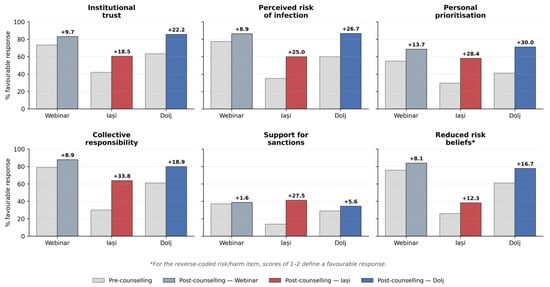
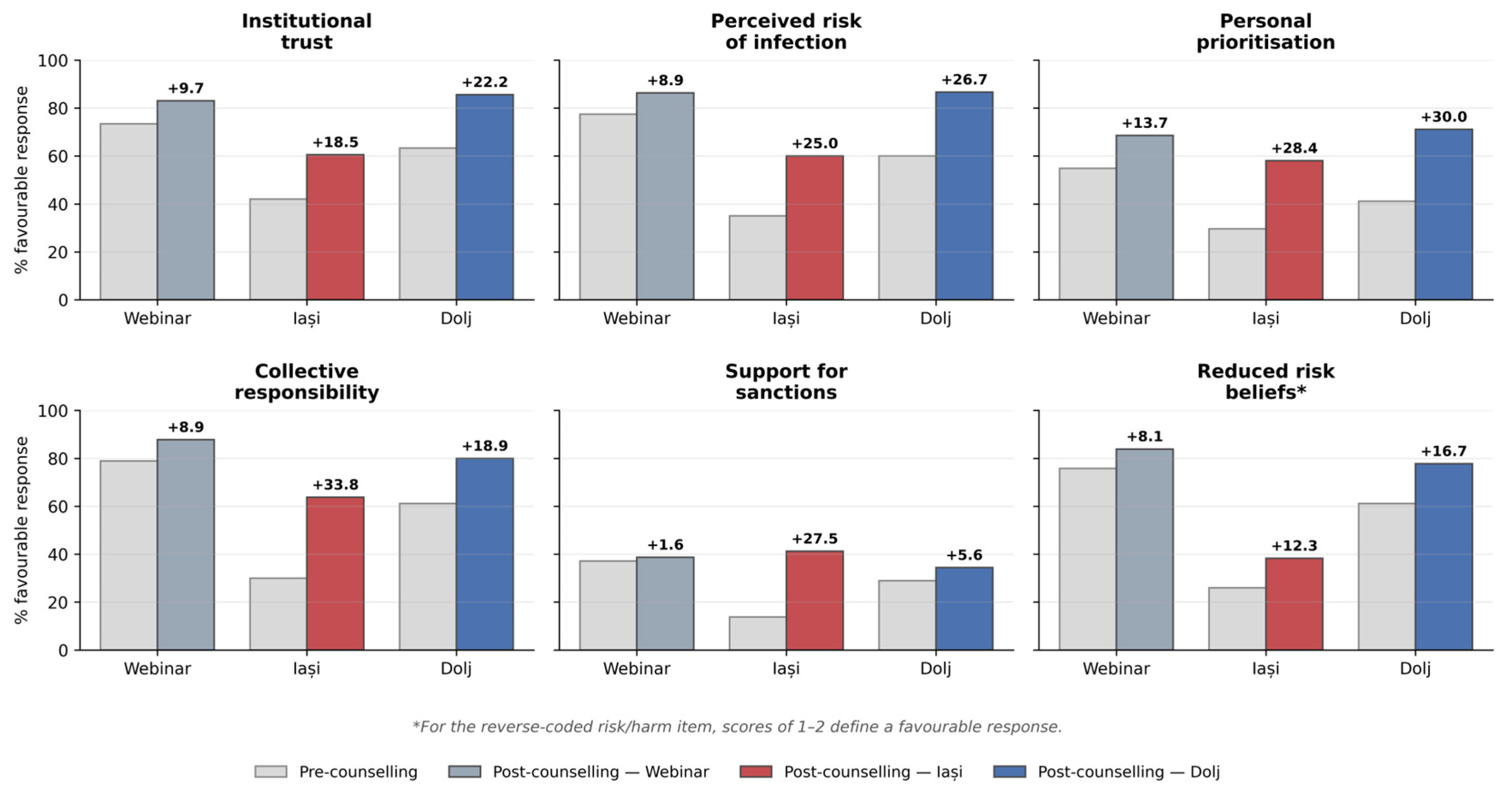
Pre–post changes in favourable responses are presented descriptively in Table 2, with six attitudinal domains displayed in Figure 1. In the principal cluster-robust model, mean composite attitude scores increased by 0.28 points in the webinar group (95% CI 0.09 to 0.47; p = 0.004), 1.02 points in Iași (95% CI 0.66 to 1.37; p < 0.001), and 0.60 points in Dolj (95% CI 0.30 to 0.90; p < 0.001). The global group-by-time interaction was supported (p = 0.001). Relative to the webinar group, the change was 0.74 points greater in Iași (95% CI 0.34 to 1.14; p < 0.001), whereas the difference for Dolj was 0.32 points (95% CI −0.04 to 0.68; p = 0.081). In the baseline-adjusted sensitivity analysis of post-counselling composite scores, the overall group effect was not supported (p = 0.080), indicating that the change-score comparison remains sensitive to the marked baseline imbalance. When both items 4 and 7 were reverse-coded in the additional scoring sensitivity analysis, the composite score still increased within the webinar (+0.22), Iași (+0.68), and Dolj (+0.47) settings; the global group-by-time interaction remained supported (p = 0.005), whereas the baseline-adjusted group comparison was not supported (p = 0.384). The overall interpretation was therefore unchanged.
Table 2.
Percentage of paired patients with a favourable response before and after counselling, by attitudinal domain and study setting (change in percentage points).
Figure 1.
Favourable patient attitudes before and after counselling across six attitudinal domains and three physician-training settings. For items 1–3, 5, and 6, scores of 6–7 define a favourable response; for item 7, scores of 1–2 define the favourable response category. Values above the post-counselling bars indicate within-setting changes in percentage points. Grey bars denote pre-counselling values; post-counselling values are shown in slate grey for Webinar, red for Iași, and blue for Dolj. Percentages are based on patients with valid paired responses for the respective item.
At item level, favourable-response percentages increased descriptively in most domains. The largest increase in support for sanction-type measures occurred in Iași, while changes were small in the webinar and Dolj groups. For the reverse-coded risk/harm item, the proportion with favourable low scores of 1–2 increased from 75.8% to 83.9% in the webinar group, from 25.9% to 38.3% in Iași, and from 61.1% to 77.8% in Dolj. However, none of the seven global item-level group-by-time interactions remained statistically significant after false-discovery-rate correction (all q ≥ 0.135); item-level findings should therefore be regarded as exploratory.
3.3. Vaccination Intention and the Vaccination-or-Scheduling Outcome
Strong vaccination intention increased within each setting. The physician-clustered odds ratio for the pre–post change was 4.64 in the webinar group (95% CI 1.98 to 10.86; p < 0.001), 3.90 in Iași (95% CI 2.22 to 6.86; p < 0.001), and 3.77 in Dolj (95% CI 1.79 to 7.92; p < 0.001). However, the global group-by-time interaction was not supported (p = 0.929), indicating no evidence that the magnitude of change in strong intention differed between settings. A baseline-adjusted sensitivity analysis similarly found no overall group association with post-counselling strong intention (p = 0.207).
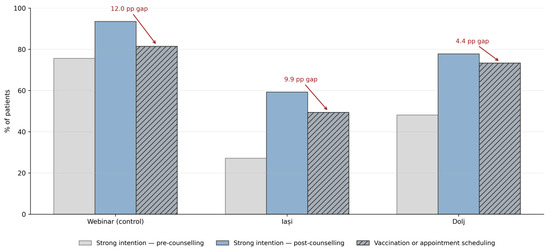
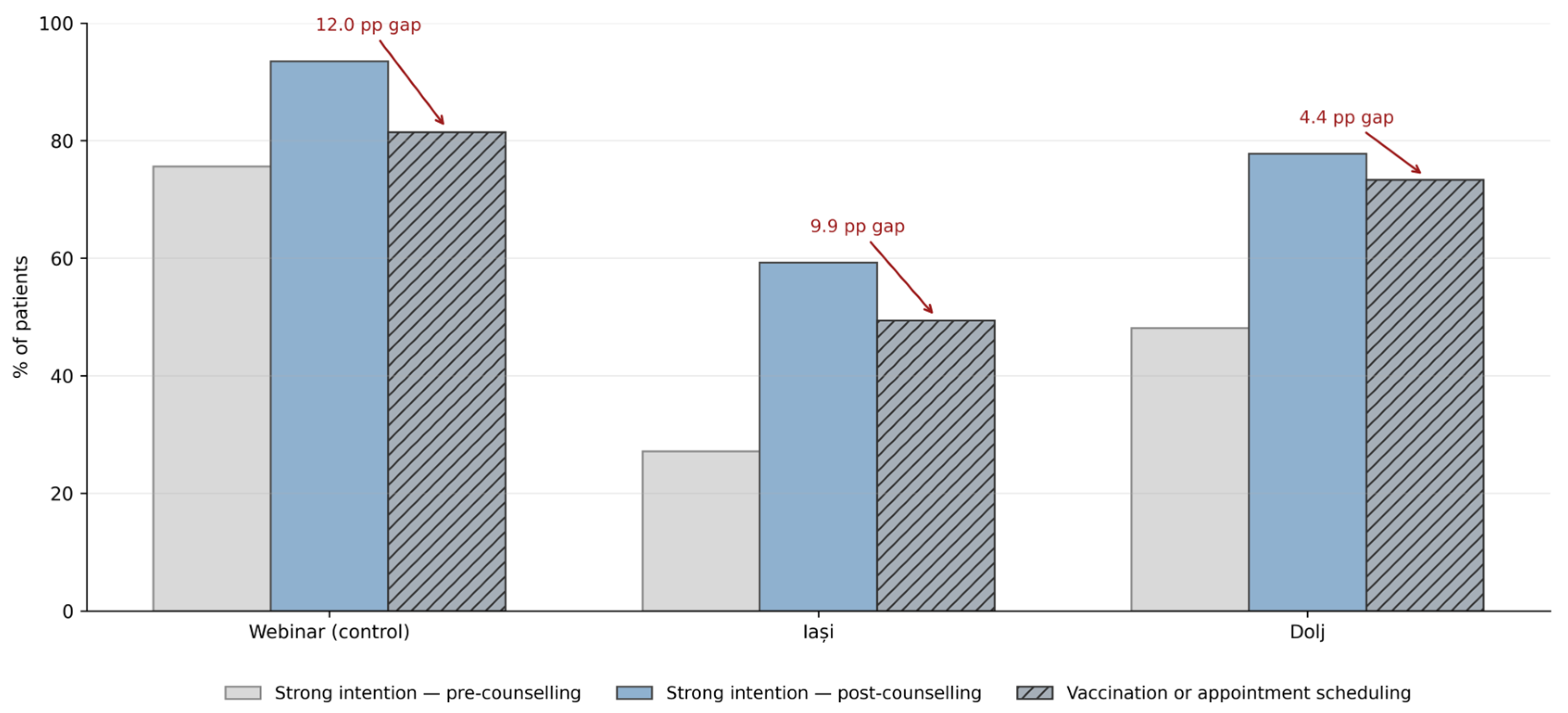
The combined self-reported outcome of vaccination or appointment scheduling was recorded for 101/124 patients in the webinar group (81.5%), 40/81 in Iași (49.4%), and 66/90 in Dolj (73.3%). In an unadjusted logistic model with physician-clustered standard errors, the overall group comparison yielded p = 0.045. After adjustment for baseline vaccination intention, the overall group association was not supported (p = 0.651). Because the source questionnaire captured vaccination and appointment scheduling in a single yes/no item, the two components could not be separated retrospectively, and the outcome should not be interpreted as verified vaccination coverage (Figure 2).
Figure 2.
Strong vaccination intention before and after counselling and the combined self-reported vaccination-or-scheduling outcome, by physician-training setting. Light grey bars indicate pre-counselling strong intention, blue bars indicate post-counselling strong intention, and grey hatched bars indicate the combined outcome. Red annotations show the percentage-point difference between post-counselling strong intention and the combined outcome. The combined outcome does not distinguish completed vaccination from appointment scheduling.
Individual-level cross-tabulation showed that the combined vaccination-or-scheduling outcome was reported by 98/115 patients with strong post-counselling intention in the webinar group (85.2%), 36/48 in Iași (75.0%), and 52/63 in Dolj (82.5%). Among patients without strong post-counselling intention, the corresponding counts were 2/8, 4/33, and 5/18. After adjustment for study setting and clustering by physician, strong post-counselling intention was associated with higher odds of reporting vaccination or appointment scheduling (OR 16.69; 95% CI 5.39 to 51.68; p < 0.001). This association does not establish temporal progression from intention to completed vaccination, because the behavioural item was self-reported and included appointment scheduling.
3.4. Satisfaction and Consultation Quality
Corrected satisfaction indicators are presented in Table 3. Favourable responses were defined strictly as “Yes” or “To a large extent, yes”; responses indicating “To a large extent, no” were not classified as favourable. The webinar group had the highest descriptive percentages for a pleasant consultation, willingness to recommend the consultation, feeling respected, usefulness, and appropriate duration, whereas Iași had the highest percentage reporting no remaining questions. In physician-clustered models with false-discovery-rate correction, evidence of a group difference was retained only for willingness to recommend the consultation (q = 0.041); all other corrected comparisons had q ≥ 0.091. Satisfaction was therefore generally high but not equivalent across settings.
Table 3.
Satisfaction and consultation-quality indicators by training format.
3.5. Distribution of Attitude and Intention Scores
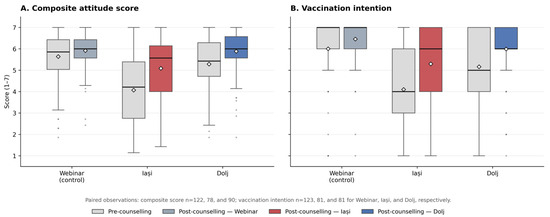
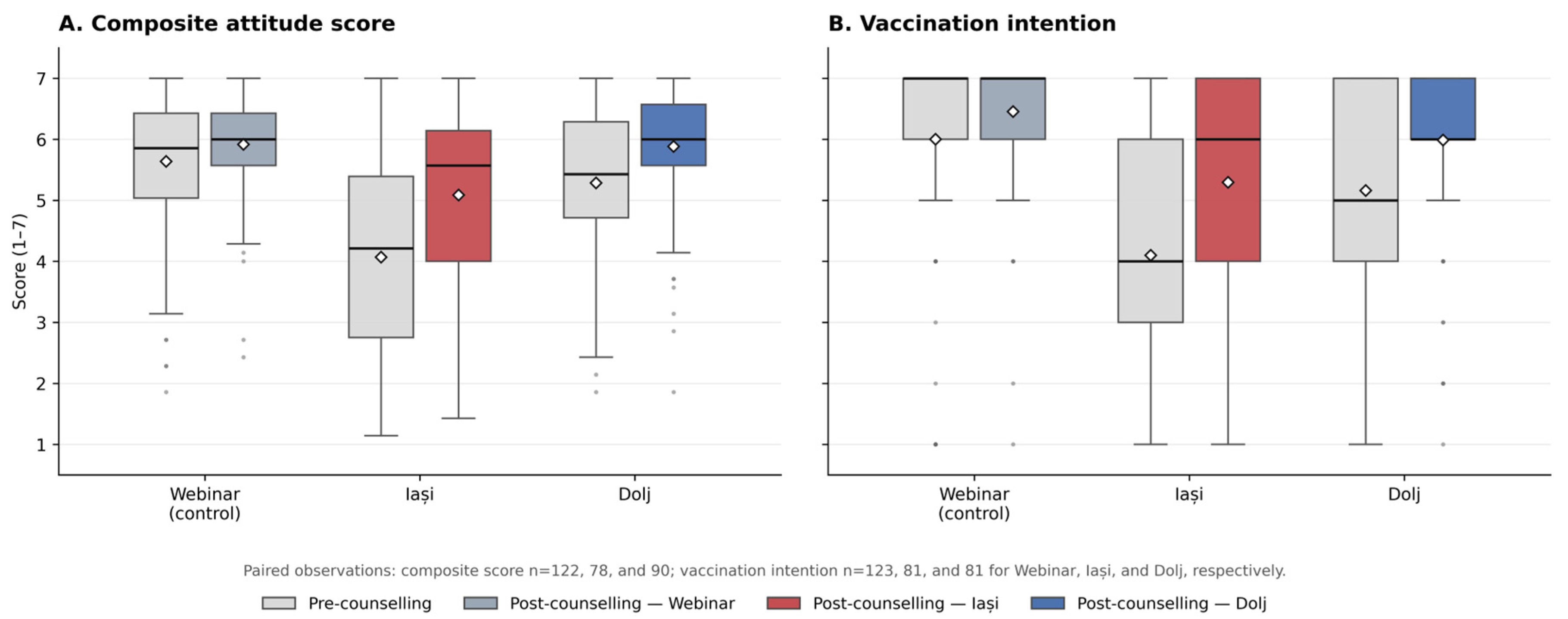
Figure 3 presents boxplots of the composite attitude and vaccination-intention scores before and after counselling. The distributions illustrate substantial baseline differences, particularly for Iași, together with upward within-setting shifts after counselling. The boxes represent interquartile ranges, centre lines represent medians, and diamonds represent means; no kernel-density estimation was used.
Figure 3.
Distribution of composite attitude (A) and vaccination-intention (B) scores before and after counselling, by physician-training setting. Boxes represent interquartile ranges, centre lines represent medians, whiskers extend to 1.5 times the interquartile range, points beyond the whiskers represent outlying observations, and diamonds indicate means. Grey boxes denote pre-counselling values; post-counselling values are shown in slate grey for Webinar, red for Iași, and blue for Dolj. Composite-score distributions include 122, 78, and 90 paired patients, and vaccination-intention distributions include 123, 81, and 81 paired patients in the Webinar, Iași, and Dolj settings, respectively.
4. Discussion
This non-randomised implementation study examined patient-level changes across three geographically distinct groups whose physicians had received one of two training approaches. The analyses support within-setting increases in the composite attitude score and in strong vaccination intention. Changes in the composite score differed between settings in the group-by-time model, although the baseline-adjusted post-counselling comparison was not statistically supported. By contrast, there was no evidence that the magnitude of change in strong vaccination intention differed between settings. The combined vaccination-or-scheduling outcome also showed no overall group association after adjustment for baseline intention. These results do not establish the comparative effectiveness or causal superiority of either training approach. The webinar setting began with strong vaccination intention in 93/123 patients (75.6%), leaving less room for further increase than in the other settings; a ceiling effect is therefore plausible, although it was not formally tested.
4.1. Possible Mechanisms
The observed patterns are compatible with, but do not demonstrate, several established models of health-behaviour change. For example, increases in perceived infection risk could reflect changes in perceived susceptibility within the Health Belief Model [17,18], while changes in institutional trust could be compatible with source-credibility and interpersonal-engagement mechanisms [19]. However, susceptibility, reactance, trust as a mediator, moral framing, and cognitive reinforcement were not measured directly. These concepts should therefore be regarded as possible explanations for future testing, not as mechanisms established by the present data. Mandatory policies may elicit psychological reactance in some contexts [20], whereas explanations of herd immunity address a distinct communication mechanism [21].
The findings can nevertheless be situated within the broader literature on motivational interviewing in vaccinology. PromoVac and related studies reported reduced hesitancy and improved vaccine uptake after interventions based on motivational interviewing [9,10,11,22]. A Romanian field study also found favourable patient-level outcomes following physician training in motivational interviewing or empathetic refutational interviewing [13]. Those studies provide external plausibility for communication-focused approaches, but they do not resolve the confounding between training format and setting in the present study.
4.2. The Intention–Behaviour Gap
The individual-level analysis provides more direct evidence of an association between post-counselling intention and the combined vaccination-or-scheduling outcome than the original comparison of aggregate percentages. Among patients with strong post-counselling intention, the combined outcome ranged from 36/48 (75.0%) in Iași to 98/115 (85.2%) in the webinar setting. Strong intention was associated with substantially higher odds of this combined outcome after accounting for study setting and physician clustering. Nevertheless, the analysis cannot determine whether intention resulted in completed vaccination because scheduling and vaccination were recorded together and no longitudinal verification was performed. The result is therefore consistent with, but does not by itself demonstrate, an intention–behaviour pathway [23,24].
Previous Romanian research reported that communication-focused physician training was associated with a greater proportion of vaccination appointments [13,25]. These findings support further investigation of how communication and structural facilitation may act together. In the present study, however, logistical barriers, access, reminders, and completed vaccination were not measured separately, so their contributions cannot be estimated.
4.3. Policy Implications
The observed patterns may inform hypotheses regarding context-sensitive physician training. Communication-focused training merits further evaluation in populations with less favourable initial attitudes, whereas medical updating may have a different role in settings where baseline intention is already high. The present study cannot determine which training approach should be selected for a particular population, because the approaches were not evaluated within comparable settings. A stratified implementation strategy should therefore be regarded as a hypothesis for future evaluation rather than as a recommendation established by these findings. Satisfaction was high overall, but the lower values for several indicators in Iași also argue against assuming equivalent acceptability. Feeling respected was reported by 119/124 patients (96.0%) in the webinar setting, 71/81 (87.7%) in Iași, and 84/90 (93.3%) in Dolj. These high proportions are consistent with a broadly favourable relational experience, although they cannot be attributed causally to the training.
Romanian research has documented heterogeneity in vaccination attitudes and differences between rural and urban settings [14], while vaccination-related myths remain common in family-medicine practice [15,26]. National administrative reports provide dose counts but not a denominator-based estimate of adult pneumococcal coverage [8]. Against this background, locally evaluated instruments and rigorously designed cluster-randomised studies are needed before training can be tailored confidently to community hesitancy profiles. Family-medicine settings, particularly rural practices, may have distinct implementation constraints that warrant explicit consideration [27,28,29,30].
4.4. Limitations
This study has several limitations. First, physicians and settings were not randomised, and training content, delivery modality, geographical setting, physician cohort, and patient population were completely aligned. Their independent contributions cannot be disentangled, and residual confounding is likely. Second, baseline attitudes and intention differed markedly, creating susceptibility to regression to the mean; the discrepancy between the change-score and baseline-adjusted analyses illustrates this sensitivity. Third, although revised models accounted for clustering by physician, only 29 physicians contributed data, with 8–12 physicians per setting, resulting in imprecise estimates. Fourth, patient demographic, clinical, geographical, and previous vaccination characteristics were not collected, and physician characteristics or differences between contributors and non-contributors were unavailable. Fifth, no screening or refusal log was maintained, so selection bias cannot be quantified. Sixth, fidelity to motivational interviewing techniques was not assessed through recordings, checklists, or independent observation. Seventh, the study-specific questionnaire addressed vaccination attitudes in general and was informed by the 7C model but was not formally validated for this application; internal-consistency estimates do not replace validation. The operational analyses reverse-coded item 7 only, whereas the source form also displayed a reverse-item marker beside item 4. Both scoring conventions were therefore examined, and neither supported a baseline-adjusted between-setting difference. Eighth, vaccination and appointment scheduling were captured as one self-reported outcome without record verification or follow-up, and completed vaccination cannot be inferred. Finally, the analyses were exploratory, no single primary outcome was prospectively specified, and multiple item-level analyses increase the possibility of chance findings despite false-discovery-rate correction.
5. Conclusions
In this non-randomised implementation study, favourable within-setting changes in patient-reported attitudes and vaccination intention were observed after counselling. Changes in the composite attitude score differed between settings in the group-by-time analysis, but this finding was sensitive to baseline adjustment, and changes in strong vaccination intention did not differ between settings. The combined self-reported vaccination-or-scheduling outcome was strongly associated with post-counselling intention, but it did not permit confirmation of completed vaccination. Because training approach, delivery modality, geographical setting, participating physicians, patient populations, and baseline hesitancy were not independently controlled, the results should be interpreted as exploratory and cannot establish the causal superiority of either training format. Future studies should use cluster randomisation, prospective outcome specification, validated instruments, fidelity assessment, and objective verification of vaccination.
Author Contributions
Conceptualisation, R.S. and G.G.D.; methodology, I.V., D.F., V.-M.R. and M.M.; validation, R.S., G.G.D., V.-M.R. and A.D.; formal analysis, G.G.D., V.-M.R. and A.A.D.; investigation, A.D., A.L. and D.F.; data curation, I.V., A.L. and M.M.; writing—original draft preparation, R.S.; writing—review and editing, G.G.D., V.-M.R. and A.A.D.; supervision, G.G.D. All authors have read and agreed to the published version of the manuscript.
Funding
This research was funded by PFIZER, grant number 98594877, awarded to CPSS following a competitive call for proposals, which covered logistical costs.
Institutional Review Board Statement
The study was conducted in accordance with the Declaration of Helsinki and approved by the Ethics Committee of the University of Medicine and Pharmacy of Craiova, Romania (no. 118/10.02.2025).
Informed Consent Statement
Written informed consent was obtained from all participants before completion of the study questionnaires.
Data Availability Statement
The study questionnaire, data dictionary, de-identified analytical dataset, and analysis code are available from the corresponding author upon reasonable request. Access to participant-level data is subject to institutional approval and applicable ethical and data-protection requirements; these data are not deposited in a public repository.
Conflicts of Interest
The authors declare no conflict of interest. The funder had no role in the conception of the project and the study design including research protocol; in the selection of participants, or scientific content of the educational materials; in the selection of trainers; in the collection, management, analysis, or interpretation of data; in the preparation, review, or approval of the manuscript; and in the decision to submit the study results for publication. The funder did not review the educational materials at any stage, for scientific content or for any other purpose, including regulatory or compliance review, and never had access to data and study results, in either identifiable or aggregated form; no representative of the funder saw the manuscript prior to submission.
References
- World Health Organization. WHO Position Paper: Pneumococcal Conjugate Vaccines in Infants and Children Aged < 5 Years—September 2025. Available online: https://www.who.int/publications/i/item/who-wer10039-411-437 (accessed on 28 June 2026).
- World Health Organization. Considerations for Pneumococcal Vaccination in Older Adults. Available online: https://www.who.int/publications/i/item/WER9623-217-228 (accessed on 28 June 2026).
- Bonten, M.J.M.; Huijts, S.M.; Bolkenbaas, M.; Webber, C.; Patterson, S.; Gault, S.; van Werkhoven, C.H.; van Deursen, A.M.M.; Sanders, E.A.M.; Verheij, T.J.M.; et al. Polysaccharide conjugate vaccine against pneumococcal pneumonia in adults. N. Engl. J. Med. 2015, 372, 1114–1125. [Google Scholar] [CrossRef] [Scilit] [PubMed]
- Kobayashi, M.; Leidner, A.J.; Gierke, R.; Xing, W.; Accorsi, E.; Moro, P.; Kamboj, M.; Kuchel, G.A.; Schechter, R.; Loehr, J.; et al. Expanded Recommendations for Use of Pneumococcal Conjugate Vaccines Among Adults Aged ≥ 50 Years: Recommendations of the Advisory Committee on Immunization Practices—United States, 2024. MMWR Morb. Mortal. Wkly. Rep. 2025, 74, 1–8. [Google Scholar] [CrossRef] [Scilit] [PubMed]
- Ministerul Sănătății. Ordin nr. 3987/1156/2023 Din 22 Noiembrie 2023 Privind Protocoalele Terapeutice; Monitorul Oficial: Bucharest, Romania, 2023. [Google Scholar]
- Ministerul Sănătății. Ordinul nr. 3.278/804/2023 Privind Completarea Anexei nr. 1 la Ordinul Ministrului Sănătății și al Președintelui Casei Naționale de Asigurări de Sănătate nr. 564/499/2021 Pentru Aprobarea Protocoalelor Terapeutice. Available online: https://legislatie.just.ro/Public/DetaliiDocument/274834 (accessed on 17 July 2024).
- Ministerul Sănătății. Ordinul nr. 3120/2023 Pentru Aprobarea Segmentelor Populaționale Care Beneficiază de Prescrierea, Eliberarea și Decontarea în Regim de Compensare a Medicamentelor Imunologice Folosite Pentru Producerea Imunizării Active. Available online: https://legislatie.just.ro/public/DetaliiDocument/274488 (accessed on 2 February 2025).
- Institutul Național de Sănătate Publică (INSP). Vaccinări Grupe la Risc, Trimestrul I 2026; INSP: Bucharest, Romania, 2026.
- Gagneur, A. Motivational interviewing: A powerful tool to address vaccine hesitancy. Can. Commun. Dis. Rep. 2020, 46, 93. [Google Scholar] [CrossRef] [Scilit] [PubMed]
- Lemaitre, T.; Carrier, N.; Farrands, A.; Gosselin, V.; Petit, G.; Gagneur, A. Impact of a vaccination promotion intervention using motivational interview techniques on long-term vaccine coverage: The PromoVac strategy. Hum. Vaccin. Immunother. 2019, 15, 732. [Google Scholar] [CrossRef] [Scilit] [PubMed]
- Gagneur, A.; Lemaître, T.; Gosselin, V.; Farrands, A.; Carrier, N.; Petit, G.; Valiquette, L.; De Wals, P. A postpartum vaccination promotion intervention using motivational interviewing techniques improves short-term vaccine coverage: PromoVac study. BMC Public Health 2018, 18, 811. [Google Scholar] [CrossRef] [Scilit] [PubMed]
- Turcu-Stiolica, A.; Boicea, A.; Nechita, F.; Surugiu, R.; Dumitra, G.G.; Oancea, C.; Pîrlog, M.C. Development and validation of a questionnaire to measure COVID-19 vaccine hesitancy within the Romanian industrial laborers. Front. Public Health 2025, 13, 1482778. [Google Scholar] [CrossRef] [Scilit] [PubMed]
- Fasce, A.; Mustață, M.; Deliu, A.; Holford, D.; Karlsson, L.; Gould, V.; Dumitra, G.G.; Farcasanu, D.; Vișinescu, I.; Verger, P.; et al. A field test of empathetic refutational and motivational interviewing to address vaccine hesitancy among patients. npj Vaccines 2025, 10, 142. [Google Scholar] [CrossRef] [Scilit] [PubMed]
- Dumitra, G.G.; Alexiu, S.A.; Sănduțu, D.; Berbecel, C.; Curelea, M.; Barbu, C.V.; Deleanu, A.; Grom, A.; Lup, M.; Budiu, I.; et al. Segmenting attitudes toward vaccination—Behavioral insights into influenza vaccination refusal in Romania. Germs 2024, 14, 362–374. [Google Scholar] [CrossRef] [Scilit] [PubMed]
- Dumitra, G.G.; Dogaru, C.A.; Alexiu, S.A.; Sănduțu, D.; Berbecel, C.; Curelea, M.; Barbu, C.V.; Deleanu, A.; Grom, A.; Lup, M.; et al. HPV vaccine-related myths encountered in Romanian clinical practice: A cross-sectional survey of family doctors. Germs 2025, 15, 37–55. [Google Scholar] [CrossRef] [Scilit] [PubMed]
- Geiger, M.; Rees, F.; Lilleholt, L.; Santana, A.P.; Zettler, I.; Wilhelm, O.; Betsch, C.; Böhm, R. Measuring the 7Cs of vaccination readiness. Eur. J. Psychol. Assess. 2021, 38, 261–269. [Google Scholar] [CrossRef] [Scilit]
- Rosenstock, I.M. Historical origins of the Health Belief Model. Health Educ. Behav. 1974, 2, 328–335. [Google Scholar] [CrossRef] [Scilit]
- Champion, V.L.; Skinner, C.S. The Health Belief Model. In Health Behavior and Health Education: Theory, Research, and Practice, 4th ed.; Glanz, K., Rimer, B.K., Viswanath, K., Eds.; Jossey-Bass: San Francisco, CA, USA, 2008; pp. 189–193. [Google Scholar]
- Dube, E.; Pistol, A.; Stanescu, A.; Butu, C.; Guirguis, S.; Motea, O.; Popescu, A.E.; Voivozeanu, A.; Grbic, M.; Trottier, M.; et al. Vaccination barriers and drivers in Romania: A focused ethnographic study. Eur. J. Public Health 2023, 33, 222–227. [Google Scholar] [CrossRef] [Scilit] [PubMed]
- Sprengholz, P.; Betsch, C.; Böhm, R. Reactance revisited: Consequences of mandatory and scarce vaccination in the case of COVID-19. Appl. Psychol. Health Well Being 2021, 13, 986–995. [Google Scholar] [CrossRef] [Scilit] [PubMed]
- Betsch, C.; Böhm, R.; Korn, L.; Holtmann, C. On the benefits of explaining herd immunity in vaccine advocacy. Nat. Hum. Behav. 2017, 1, 0056. [Google Scholar] [CrossRef] [Scilit]
- Fărcășanu, D.; Mustață, M.; Gagneur, A.; Dumitra, G.G. Metode de Comunicare Interpersonală și Interviu Motivațional Pentru Creșterea Acoperirii Vaccinale la Copii: Curs Pentru Personalul Medical—Ghidul Facilitatorului; Centre for Health Policies and Services: Bucharest, Romania, 2021; Available online: https://cpss.ro/assets/files/reports/reports-21/Ghidul%20facilitatorului.pdf (accessed on 10 August 2026).
- Brewer, N.T.; Chapman, G.B.; Rothman, A.J.; Leask, J.; Kempe, A. Increasing vaccination: Putting psychological science into action. Psychol. Sci. Public Interest 2017, 18, 149–207. [Google Scholar] [CrossRef] [Scilit] [PubMed]
- Sheeran, P.; Webb, T.L. The intention–behavior gap. Soc. Personal. Psychol. Compass 2016, 10, 503–518. [Google Scholar] [CrossRef] [Scilit]
- Holford, D.; Schmid, P.; Fasce, A.; Lewandowsky, S. The empathetic refutational interview to tackle vaccine misconceptions: Four randomized experiments. Health Psychol. 2024, 43, 426–437. [Google Scholar] [CrossRef] [Scilit] [PubMed]
- Achimaș-Cadariu, T.; Pașca, A.; Jiboc, N.M.; Puia, A.; Dumitrașcu, D.L. Vaccine hesitancy among European parents—Psychological and social factors influencing the decision to vaccinate against HPV: A systematic review and meta-analysis. Vaccines 2024, 12, 127. [Google Scholar] [CrossRef] [Scilit] [PubMed]
- Dascalu, S.; Raiu, C.V.; Olteanu, E.; Comanici, A.V.; Comanici, M.M.; Toma, T.P.; Robu, B.I.; Mihailov, R.; Mina-Raiu, L.; Dumitra, G.G.; et al. The deadly triple M (mistrust, misinformation, and missed opportunities): Understanding Romania’s COVID-19 vaccination campaign and its lasting impact on public health. Front. Public Health 2025, 13, 1631799. [Google Scholar] [CrossRef] [Scilit] [PubMed]
- Kurpas, D.; Stefanicka-Wojtas, D.; Soll-Morka, A.; Lomper, K.; Uchmanowicz, B.; Blahova, B.; Bredelytė, A.; Dumitra, G.G.; Hudáčková, V.; Javorska, K.; et al. Vaccine hesitancy and immunization patterns in Central and Eastern Europe: Sociocultural, economic, political, and digital influences across seven countries. Risk Manag. Healthc. Policy 2025, 18, 1911–1934. [Google Scholar] [CrossRef] [Scilit] [PubMed]
- Dumitra, G.G.; Camen, A.R.; Nechita, F.; Pîrlog, M.C.; Kamal, C.; Dogaru, C.A.; Radu, M.; Gheorghe, E.C.; Dumitrescu, E.M.; Dinescu, V.C.; et al. Effectiveness of group and individual counselling interventions on COVID-19 vaccination intention among industrial employees in Romania. Patient Prefer. Adherence 2025, 19, 907–919. [Google Scholar] [CrossRef] [Scilit] [PubMed]
- Piccoliori, G.; Barbieri, V.; Wiedermann, C.J.; Engl, A. Special roles of rural primary care and family medicine in improving vaccine hesitancy. Adv. Clin. Exp. Med. 2023, 32, 401–406. [Google Scholar] [CrossRef] [Scilit] [PubMed]

Disclaimer/Publisher’s Note: The statements, opinions and data contained in all publications are solely those of the individual author(s) and contributor(s) and not of MDPI and/or the editor(s). MDPI and/or the editor(s) disclaim responsibility for any injury to people or property resulting from any ideas, methods, instructions or products referred to in the content. |
© 2026 by the authors. Published by MDPI on behalf of the Infection Science Forum. Licensee MDPI, Basel, Switzerland. This article is an open access article distributed under the terms and conditions of the Creative Commons Attribution (CC BY) license.