


Abstract
Owing to COVID-19, the world has advanced faster in the era of the Fourth Industrial Revolution, along with the 3D printing technology that has achieved innovation in personalized manufacturing. Three-dimensional printing technology has been utilized across various fields such as environmental fields, medical systems, and military materials. Recently, the 3D food printer global market has shown a high annual growth rate and is a huge industry of approximately one billion dollars. Three-dimensional food printing technology can be applied to various food ranges based on the advantages of designing existing food to suit one’s taste and purpose. Currently, many countries worldwide produce various 3D food printers, developing special foods such as combat food, space food, restaurants, floating food, and elderly food. Many people are unaware of the utilization of the 3D food printing technology industry as it is in its early stages. There are various cases using 3D food printing technology in various parts of the world. Three-dimensional food printing technology is expected to become a new trend in the new normal era after COVID-19. Compared to other 3D printing industries, food 3D printing technology has a relatively small overall 3D printing utilization and industry size because of problems such as insufficient institutionalization and limitation of standardized food materials for 3D food printing. In this review, the current industrial status of 3D food printing technology was investigated with suggestions for the improvement of the food 3D printing market in the new normal era.
1. Introduction
The product development and service industry is increasing to meet personal needs as COVID-19 has made social distancing a mandatory practice. In the post-corona era, called the new normal era, the era of the Fourth Industrial Revolution is approaching much faster. Among the personalized production process technologies required in this era, 3D printing technologies are increasingly being highlighted. Three-dimensional printing technology is a technology created by stacking plastic in three dimensions [1] and is known as additive manufacturing or rapid prototyping, whereby products are built on a layer-by-layer basis through a series of cross-sectional slices [2]. Three-dimensional printing technology was invented in 1986 by Chuck Hull in the USA. It is a technology that produces three-dimensional objects using stacked layers using a computer model program and was invented to produce a complex structure of high polymer materials. In the past, it mainly produced expensive equipment such as automobiles, aviation, and medical care, owing to the advantages of high-speed production, and has recently expanded the scope of application of technology [3].
The representative use of 3D printing techniques in medicine has been applied to the use of robotic exoskeletons based on the principles of private motor learning, which is greatly beneficial for generating private space for the rehabilitation of a patient, a critical part of patient rehabilitation [4]. Furthermore, 3D printing and robot support are actively applied in connecting processes through patient-controlled polysensory stimuli and transport experience useful for nerve plasticity modification, which were successfully achieved by two analyses of patient-generated biometric signals and artificial intelligence. Three-dimensional printing techniques have been applied to new materials, classifications, and controls to suit the characteristics of a personal skeletal framework [5,6]. Patient-tailored solutions are difficult to be solved because they are dependent on individual health conditions, functional skills, support requirements, and body dimensions [7] Material research in a wide range of 3D printing technologies is critical for the development of patient-therapeutic rehabilitation devices. The number of outbreaks of various diseases is increasing in many countries regardless of the country’s health infrastructure. Medically customized solutions are critical for neurological rehabilitation, especially for stroke, brain damage, spinal cord damage, neurodegenerative elderly care diseases (MCI), Alzheimer’s disease, Parkinson’s disease, and others. Adaptive treatment, rehabilitation, and management forms are important when the levels and types of functional disorders vary significantly. Three-dimensional printing and reverse engineering (scanning) techniques can easily produce personalized designed artificial medical products (e.g., exoskeletons) through detailed morphological analysis using products and materials tailored to body components [8]. The problem with existing medical technologies is the relatively long training time for a small number of experts, including engineers. The time required for development of a new solution/personalized therapy needs to be shortened [9]. Therefore, artificial intelligence-based semi-computerization combined techniques are required, and AI/CI design systems and new multimaterial 3D printing technologies can help patients with emergency management and rehabilitation. Skills are needed to closely examine the body, nervous system, types, and levels of dysfunction [10]. Auxiliary technologies with a variety of features are currently being studied to improve marginal departure time and poor movement patterns that exclude extensive use, such as high energy demand, long-term wear, and use [11]. Importantly, the intensity, complexity, and specificity of the robot motion can be supported by patient-tailored 3D printing solutions [12]. Three-dimensional printing technology is characterized by additive manufacturing, which is equivalent to three-dimensional printing, and is controlled by computer programs used to create it. It accumulates biological materials and is made of products with accurate geometric shapes. Among the 3D printing technologies commonly used in medicine, mainly layer processing and other removal of surplus materials are suitable for medical applications [13,14]. This is suitable for biomedical applications but does not cover all possible clinical domains. Additional research, development, and commercialization are required to expand its applications. One of the methods proposed by researchers to apply 3D printing to medicine is to develop an advanced exoskeleton with 3D printers by introducing an innovative approach. The developed medical products are converted to computer intelligence (CI) utilized for rare 3D printed exoskeleton subjects. Personalized medical services are expected to expand further in the Fourth Industrial Revolution era, which is rapidly approaching due to COVID-19, and 3D printing technology is expected to emerge as a key technology in the field.
In addition to medical applications, the 3D printing process has been adapted to various industries such as aerospace, automotive, fabric and fashion, and electric and electronic industries. Three-dimensional printing technology is an eco-friendly technology for manufacturing buildings that are difficult to make geometrically feasible. In the construction sector, 3D printing technology has been used to build entire buildings or to produce the necessary construction parts. Building information modeling (BIM) is increasingly applicable to architecture and can share information and knowledge about 3D buildings using BIM, a digital representation of functional and physical characteristics. Information about initial planning to construction completion and reliable decision sources can be formed over the lifecycle of the building [15,16]. These 3D printing technologies are innovative, collaborative, and can support more efficient ways to design, create, and maintain buildings. Buildings with 3D printing technology can reduce construction time and costs and communicate efficiently and clearly with construction engineers. Examples of 3D printed buildings are the Apis Cor Printed House in Russia [16] and the Canal House in Amsterdam [17].
Food 3D printing technology is gaining attention [18]. Three-dimensional food printing technology can process and produce different designs using ingredients such as meat, chocolate, candy, pizza dough, cotton, and sauce, which have been mainstream in the restaurant industry [19]. Three-dimensional food printing technology can control the type and amount of ingredients that can determine the amount, nutrient, and flavor characteristics of ingredients, enabling personalized food production [20]. A personalized service delivery industry is expected to become more active in an environment that minimizes personal contact due to social distancing in COVID-19. In the post-corona era, 3D food printing technology is expected to increase demand for the development of customized personal foods for special diets such as athletes, children, pregnant women, patients, etc. [21]. Therefore, customized foods require a very delicate and creative process, which best suits the 3D food printing technology. Three-dimensional food printing technology requires food design programs before manufacturing. This program enables the design and implementation of the procedure algorithm. The food design order is automatically recognized by the printing device. A 3D food printer creates a layer-by-layer process with continuous printing for layer accumulation [19]. These 3D printing techniques allow the process to proceed with the structure and shape of personalized foods by adding specific ingredients selected by personal preferences [22]. Food substrates, especially chocolate, but not limited to (i.e., jelly and dough) are traditionally cast in molds or manually shaped to obtain desired shapes when processed into personal products. However, flat foods such as sugar, chocolate, pasta, pizza, and biscuits, which are stereotyped by molds, can be new and exciting 3D foods using 3D printing technology. Therefore, although 3D food printing technology is difficult to consider as an energy-efficient technology for eco-friendly, good quality control, and low-cost food production, it enables the creation of new processes for food customization with satisfaction of individual preferences and needs. Furthermore, 3D food printers enable a healthy diet food design with proper nutrition automatically regulated by personal medical information data [19].
In this review, we discuss the current and future outlook of the technology of food 3D printing containing the types of personalized 3D food printing technology, the development of food materials suitable for the 3D printing process, and the application of 3D food printers to various food industries for the new normal era.
2. 3D Food Printer Technology and the Trends
An inkjet printer receives digitized files and moves the ink injection nozzle to the x- and y-axes before spraying ink onto paper to print 2D images [23]. In addition, 3D printers add a z-axis orientation to create a three-dimensional model. There are various 3D printing technologies, such as binder jetting, directed energy deposition, material extrusion, material jetting, powder bed fusion, sheet lamination, and vat photopolymerization. Among them, 3D food printing technology is based on a three-dimensional design (CAD) or a 3D scanner, applied to the ratio of food composition and nutritional data before stacking the raw materials in three dimensions. Three dimensional printing technology usually enables the division of ink materials into the process of cutting (subtractive) or additive (stacking) types. The cutting type is a method of carving raw materials with sharp blades, while the additive type is a method of stacking materials. The cutting type is usually placed in a 3D printer range similar to that of computer numerical control (CNC). It has the disadvantage of a large loss of materials because of the method of cutting materials, while the additive type has relatively less loss of materials. Therefore, currently, most 3D printers have an additive manufacturing system with a design program. Additive manufacturing technology provides a major competitive advantage because it enables the adaptation of the geometrical complexity required by the customized design [24].
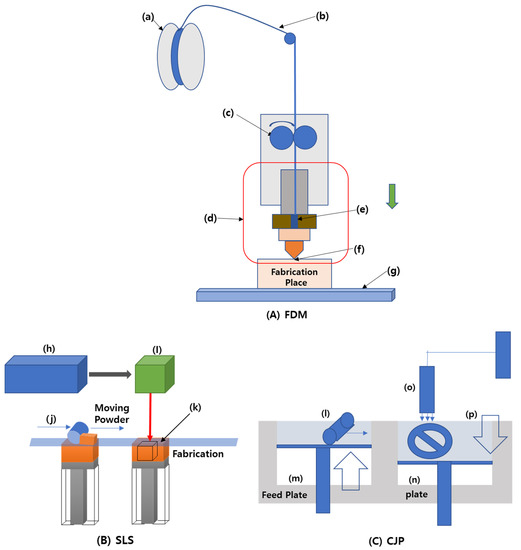
As shown in Figure 1, the main 3D printing technologies are fused deposition modeling (FDM) [25], selective laser sintering (SLS) [26], and color jet printing (CJP) [27]. FDM (Figure 1A) as one of the extrusion technologies is a method of pushing materials into holes at high temperatures and high pressures and stacking them one layer at a time. It is the cheapest technology among 3D printers, and because of its low price, it is also the most widely used among small businesses and households. Extrusion-based printing was first developed for the modeling of plastics but now has been adapted for use in the food sector [28]; it involves a liquid or a semisolid material being extruded through a nozzle.
Figure 1.
Scheme of main 3D printing technologies. (A) Fused Deposition Modeling (FDM): (a) Coil reel; (b) Plastic filament; (c) Driving motor; (d) Extruder; (e) Molten paste chamber; (f) Nozzle tip; (g) FDM printer bed, (B) Selective laser sintering (SLS): (h) Laser; (i) Scanner system; (j) Roller; (k) Power bed, and (C) Color-jet printing: (l) Roller; (m) Powder; (n) Build; (o) Color binder header; (p) Modeling part.
Extrusion-based printing has a wide range of food materials that are simultaneously extruded to create an entire meal [29]. However, it requires a material with the capability to easily extrude out of the nozzle tip and support the weight of the next printed layers without deformation [30]. The SLS method refers to a technique in which powder-type materials are applied to the bed, and then the laser is illuminated to solidify only the desired part. As only the part, exposed to the laser, hardens, it forms a shape. Typical powder materials include thermoplastic, metal, and ceramic powders. It is a method of thinly layering powder-type raw materials and shooting laser or resin onto them before the hardening process. Thermoplastics, metals, ceramics, etc., are used as ordinary powder raw materials in extrusion-based printing technology. In the case of food, powder ingredients such as sugar and starch are used in the SLS method, and the output of various colors and flavors can be produced by adding food additives such as artificial pigments and fragrances. The principle of operation of a printer using the SLS method is shown in Figure 1B [23]. The color jet printing (CJP) method uses a print head to selectively distribute the binder into a powder layer. This technology is cheaper than other 3D printers and utilizes rollers to spread thin powders on the tray, as in the SLS system (Figure 1C). The print head scans the powder tray and provides a continuous dispensing solution to the powder solution while touching the powder particles. Supporting structures are not required during prototyping because the surrounding powders support unconnected parts. Then, the remaining ambient powder is inhaled, and the cyanoacrylate-based material penetrates the prototype surface before hardening [31]. CJP printing technology enables the manufacture of complex geometries, such as partitioning inside cavities without artificial support structures [27,32].
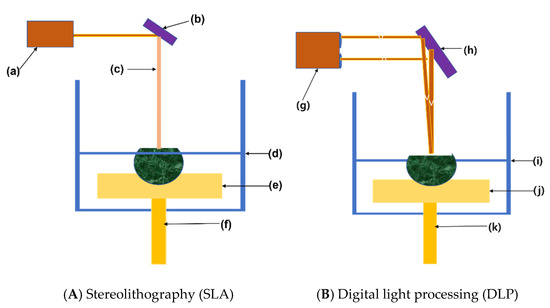
There are two other methods, as shown in Figure 2: stereolithography (SLA) and digital light processing (DLP), and additive manufacturing using photopolymers [33]. Photopolymerization processes use liquid photocurable resins and perform chemical reactions during light irradiation to produce solids [34]. SLA can use laser beams to scan the surface of the photopolymer mixture for high resolution and excellent surface quality components, while DLP uses a projector to selectively expose and cure the crosssectional slice of the resin for photopolymerization at a given time [35,36,37]. As the platform seeps continuously into the resin tank, the uncured photo-reactive mixture crosses over the previous cured layer; thus, all the next layers are polymerized by light again and continue until a complete product is formed [38]. Three-dimensional printers using these photocurable resins require dedicated hardening resins and cannot manufacture the product in a large size compared to other 3D printing methods. Therefore, it is a method that is usually used to create small models that require high precision, such as in the jewelry industry.
Figure 2.
Scheme of stereolithography (SLA) and digital light processing (DLP). (A) SLA: (a) Laser source; (b) Scanning mirror; (c) Laser beam; (d) Liquid resin surface; (e) Platform (f) Piston, and (B) DLP: (g) Projector; (h) Scanning mirror; (i) Liquid resin surface; (j) Platform; (k) Piston.
2.1. FDM, SLS, and CJP for 3D Food Printing
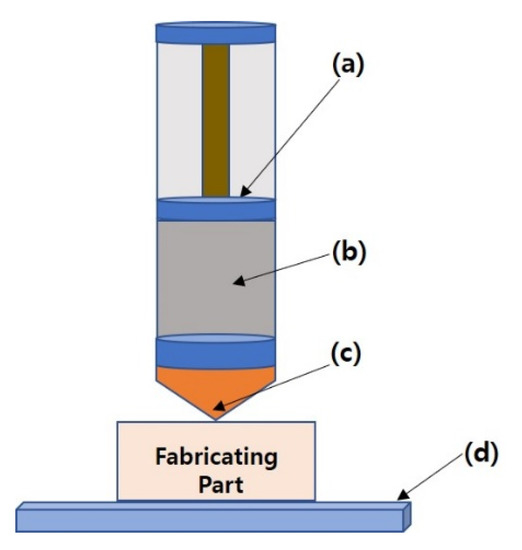
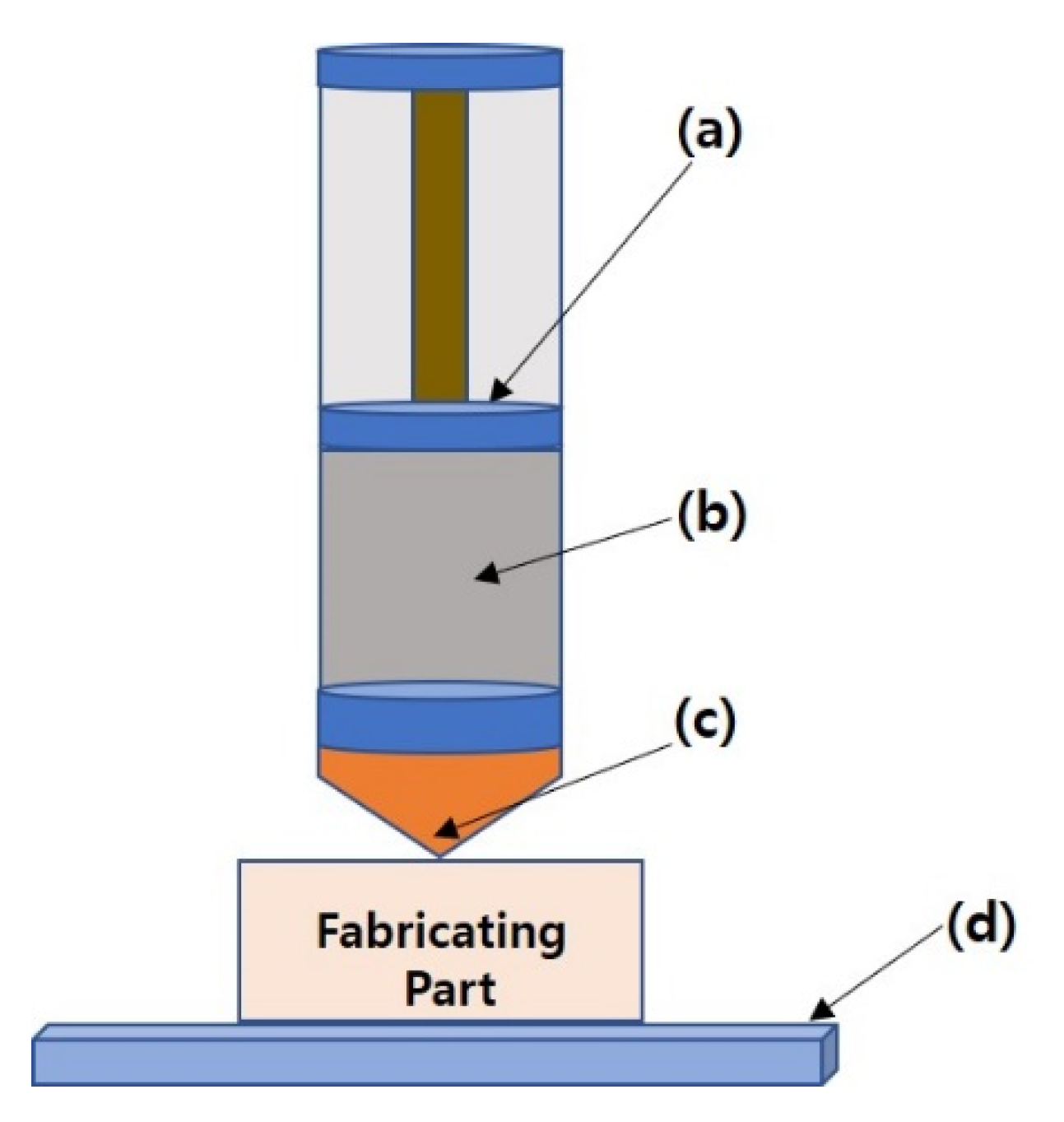
Depending on the additive method of 3D food printing technology, it can be divided into material extrusion or powder bed fusion. The extrusion method includes fused deposition modeling (FDM)/fused filament fabrication (FFF), while powder-bed technology uses multi jet fusion (MJF) or selective laser sintering (SLS) [39]. FDM/FFF requires thermoplastic material to be heated up to the processing temperature, while the extrusion technique from Figure 3 [28] resembles more liquid additive manufacturing (LAM), especially if materials such as mashed potatoes or meat paste are considered.
Figure 3.
Scheme of extrusion-based 3D printing (a) Piston; (b) Formulated “food ink”; (c) Deposition of self-supporting layers; (d) Printer bed.
Fused deposition modeling (FDM) 3D printing technology is currently widely used in 3D food printers, where slurry, such as liquid materials or paste, is continuously protruding from the moving nozzle and stacked while cooling. Extrusion-based printing technology mainly uses soft ingredients such as chocolate, dough, mashed potatoes, cheese, and meat paste [40]. Although FDM technology has been applied to the deposition of various soft materials, it is limited to deposition in complex and delicate forms because it is inherently prone to distortion. The extrusion process using soft materials should print delicate and complex forms with additional structures that support the product geometry. However, it is a time-consuming process to manually remove support components at the last stage, slowing down printing, and increasing material costs. Therefore, it is necessary to increase the printing precision and accuracy by considering the extrusion mechanism, material properties, extrusion speed, and machining factors such as glass transition temperature (Tg), nozzle height, and nozzle diameter. The extrusion mechanism applied to 3D printing technology consists of screw-based extrusion, pressure-based extrusion, and syringe-based extrusion. In the screw-based extrusion process, food materials (3D printing inks) are inserted into the sample supply unit and transported to the nozzle tip by moving screws. During the extrusion process, food materials can be continuously injected into the hopper, allowing continuous 3D food printing process to be performed. However, screw-based extrusions are not suitable for high-viscosity and high-mechanical-strength food slurry, so printed samples do not reach the appropriate mechanical strength required to support the sedimentary layer and reduce compression deformation and resolution [30]. In air-based extrusion, food ingredients are pushed into the nozzle by the air pressure. These methods are suitable for printing liquids or low-viscosity materials [41]. Syringe-based extrusion devices are suitable for printing highly viscous and mechanical-intensity food materials. Therefore, they can be used to produce complex 3D structures with high resolution. However, barometric pressure-based extrusion, such as syringe-based extrusion, makes it difficult to continuously supply food materials during printing. As described above, it is a type of compression method, and in the case of food, it is suitable for printing viscous materials such as dough.
Selective laser sintering (SLS) can be easily printed in foods with more diverse colors and flavors by using sugar-like powders and adding food additives such as artificial pigments and fragrances. SLS for 3D printing can successfully form complex-shaped products by selectively sintered powders, controlling laser irradiation locations using computers, and successfully sintering powders layer by layer [42]. The SLS method is carried out by melting powder particles, which can be formed and bound by forming a solid layer using fresh food material powder until the desired structure is created. For example, an SLS-type 3D food printer, called Candy Fab, selectively sintered and melted a layer of sugar using a flow of slow heat. Though there are several obstacles to using SLS in the food sector, the SLS procedure was carried out by creating a colorful and detailed edible object with a laser spot diameter of 0.6 mm and specific process parameters, i.e., 0.1 mm layer distance, 1250 mm/s writing speed, 50 mm laser power, and 0.3 mm layer thickness. [43,44]. The SLS method is dangerous when exposed externally because of machine operating errors during the process. There are four major hazard classes (I to IV) of lasers according to the Food and Drug Administration (FDA), including three subclasses (IIa, IIIa, and IIIb) (Table 1). The higher the class, the more powerful the laser, and the potential to pose more danger if used improperly. The labeling for Classes II–IV should include a warning symbol stating the class and output power of the product. Approximate IEC equivalent classes are included for products labeled under the classification system of the International Electrotechnical Commission. However, it is difficult to find any regulations in the FDA for the safety of food products using a 3D food printer (SLS) using a laser beam, even if a high class of laser beam could lead to chemical reactions or transformation of the food ingredients.
Table 1.
Laser Hazard Class.
Color jet printing (CJP) uses food ingredients (powder) and adhesives (liquids) with various edible colors. Sugar powder and food ingredients mixed with sugar and starch can be utilized as powder-conditioned ingredients. Liquid food adhesives have been developed with many colors and flavors. CJP is usually applied to the field of surface filling and decoration in the case of low-viscosity materials. In standard binder injection technology employing color jet printing in 3D systems, each layer of powder is evenly sprayed on the manufacturing platform, while liquid binder spray combines two consecutive layers of powder [45]. Powder materials are usually stabilized by water mist to minimize the disturbance caused by binder spraying. In the Edible 3D Printing Project, Walters used a mixture of sugar and starch as a powder material and used a Z corporation powder/binder 3D printer as a platform to create a customized product with complex structures [46]. Sugar Lab used sugar and various flavoring binders to create custom cakes for special occasions such as weddings [47]. Binder dispensing has the disadvantages of rough surface finish and high cost of printing facilities, although it has the advantages of requiring less production time and the low cost of food ingredients. Post-treatment is required, such as curing at high temperatures, to strengthen the bonding. Inkjet food printing sprays streams/droplets from syringe-type printing heads in an on-demand manner, which is layered for customized food products and includes pre-patterns of food items in multilayer processing. For example, FoodJet Printer, an inkjet food printer, used pneumatic membrane nozzle jets to deposit selected material drops on pizza bases, biscuits, and cupcakes. The ejected stream/drop was then dropped by gravity, impacting the substrate, and dried through solvent evaporation. Finally, the drop enables the formation of a two-dimensional image to fill the decoration or surface [48].
Table 2 lists the food material conditions according to the 3D printing method [49]. Printing methods include FDM, CJP, stereolithography (SLA), SLS, digital light processing (DLP), and multi jet modeling (MJM). As explained above, FDM is a method of dissolving and stacking a filamentous thermoplastic in a nozzle. CJP uses an inkjet method of adhesive over the plaster powder material and mixes it to cure it before stacking it. SLA is layered with an ultraviolet (UV) laser, hardened, and stacked. SLS layers the powder material by sintering the laser in a layered shape. DLP uses UV DLP to project layer images onto resin-state materials and layers them after curing them. The final MJM sprays resin or wax in a layer using a piezo print head and then hardens and stacks with UV.
Table 2.
Food material conditions according to 3D printing method.
2.2. Selection of Edible Ingredients for 3D Food Printing
It is important to select food ingredients in a 3D printable state and explore the information of the ingredients [50,51,52,53,54]. Materials treated as spares, such as grinding, denatured starch, and separating proteins, are appropriate for 3D food printing and increase thermal stability. In the 3D food printing process, the raw materials are supplied in liquid or solid powder conditions with flowing properties and cooled to a heat-induced plasticization or melting state to maintain the flowing properties during printing.
Three-dimensional printed food forms can be maintained by reversible processing, changing the printing temperature, and using additives. Because food is a multicomponent substance, the composition ratio of protein, carbohydrates, and fat components affects the melting behavior, glazing, and plasticization of 3D printed foods during the 3D printing process. Plasticity, adhesion, and shape maintenance are required for basic ingredients applicable to 3D food printers. Basic materials with plasticity should be available in 3D printers. The fact that the basic material with adhesive properties of the bed is well attached to the material to be emitted first enables it to stack with each other. Maintaining the shape of the basic material is necessary to maintain shape without collapsing after injection. Basic ingredients to which this material is applied include all categories of wheat, rice, corn powder, and sugars such as chocolate and sugar. All categories are popular food ingredients and have the property of applying water with heating that produces viscosity and does not collapse easily. All categories have the characteristic of being able to adhere and maintain their shape for a long time. Sugar dissolves by heating and is thermoplastic, which is sintered by cooling, which is advantageous for shaping.
Food material called as “food ink” is one of the most important factors in the 3D food printer industry. The properties of food materials should flow through a nozzle but are then set after being deposited on the surface. Therefore, food materials for food inks can be controlled by their viscosity and taste [55]. Materials that are added to the basic ingredients to increase their physical properties or enrich nutrients can be divided into carbohydrates, proteins, fats, and food viscosity agents (Table 3). Both carbohydrates, including agar, gelatin, flour, potato starch, rice starch, maltitol/xylitol, and isomaltose, and proteins with petty, surimi, edible insects, protein extracted from bean, pectin, pea protein, whey protein, and egg protein, as shown in Table 3, contain their types and characteristics for 3D printing food. Agar is easily melted at high temperatures to form a gel, while gelatin melts in water [56,57]. It is also easy to form a gel during cooking. Rice starch is less viscous than potatoes or flour, but it has a crispy texture when cooked [58,59]. Maltitol and xylitol are used as sucrose replacements, which reduce the risk of obesity caused by high-calorie chocolate [60]. Isomaltose can prevent the contraction of Cordyceps flower powder molecules and decrease the formation of a rigid network structure [61].
Table 3.
Various nutrients and food viscosity agents utilized for 3D printing food.
Some types of proteins include patty, surimi, edible insects, bean protein, pectin, pea protein, whey protein, and egg protein attracting attention as future food for 3D printing materials. Petty can improve adhesion by mixing mashed meat and starch-like edible substances [62]. Surimi uses a crushed fish for fishcakes and feed [63]. It is easy to mix with starch. Edible fish has recently emerged as a food item because it contains crushed insects. Edible insects or crushed insects are used as alternative to animal protein and have recently emerged as a future food item [64,65]. There are also many environmental benefits of the reduction in energy losses due to the low quantity of greenhouse gases significantly less than those of emissions caused by the livestock industry. In addition, small land spaces are required for breeding, fast growth, and breeding cycles. Proteins separated from soybeans are vegetable proteins that have been recognized for their nutritional value for the recently emerging vegan diet [66]. Pectin produces pectin-based food simulants, while pea protein is used for whey protein isolate (WPI)-content on the printing performance of milk protein concentrate [67,68]. Gel-like emulsions were prepared from WPI and soy oil using a microfluidization processing technique [69,70]. In addition, egg protein can be added to improve the rheological and textural properties of the mixture system [71].
The types and utilization of fats, including butter, margarine, and cooking oil, are shown in Table 3. Butter is an animal fat from milk containing vitamins such as vitamin K2, in addition to vitamin A, vitamin B, vitamin E, and vitamin D, which are good for health [72]. Margarine is a substance made of vegetable oil and animal fat that resembles butter and is used as a substitute for butter by adding salt, pigment vitamin A, and vitamin D to taste butter-like. However, it can produce trans-fat, which is carcinogenic and banned in several countries [23]. Cooking oil smooths the dough and increases the ease of the lamination layer [73].
Food viscosity agents are used to improve the stability of basic ingredients and to supplement carbohydrates with viscosity effects. Examples include gum, such as small-tank and Arabic gum, and carnauba wax, shellac, and carboxymethyl cellulose (CMC), as shown in Table 3. Some types of food viscosity agents include xanthan gum, Arabic gum, kappa carrageenan, carnauba wax, shellac, and CMC. Xanthan gum, Arabic gum, and kappa carrageenan are used as food stabilizers owing to their stickiness quotient [74]. Carnauba wax is used as a coating agent for chocolate and candy with automobiles [75]. Shellac is commonly utilized as a furniture finish as well as a food product, while CMC is an edible substance that increases the emulsifying properties and stickiness [76,77]. Various functional incremental agents are applied to basic materials through continuous research.
Table 4 shows various food ingredients used in extrusion-based 3D printing [78]. Vegetables with fruits are utilized as basic ingredients to provide minerals and vitamins. Parts of vegetables and fruits homogenized by a mixer machine are applied as food printing materials in solid or liquid form. Among them, liquid phases that reduce viscosity are removed, and the remaining solid vegetables and fruits are homogenized again, which can be used as basic ingredients. Moreover, the available ingredients enable variation of the form and taste of the injected food depending on the mixing ratio. Though the same ingredients are utilized, the density and materiality of the 3D print would change depending on the injection process. Therefore, 3D food printers enable to produce numerous foods depending on the combination of different ingredients and set of different conditions. The study of food ink required for 3D food printing focuses on carbohydrate-based food matrices. Studies involving printability of lipids and proteins are also making significant progress in analyzing rheological and physicochemical properties together.
Table 4.
Various food materials utilized for extrusion-based 3D printing.
2.3. Trends in 3D Food Printers
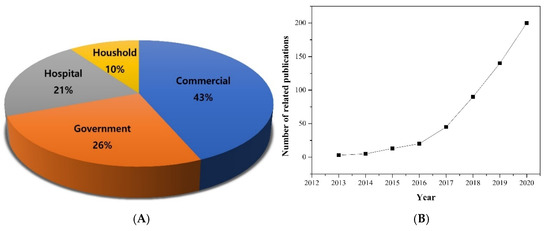
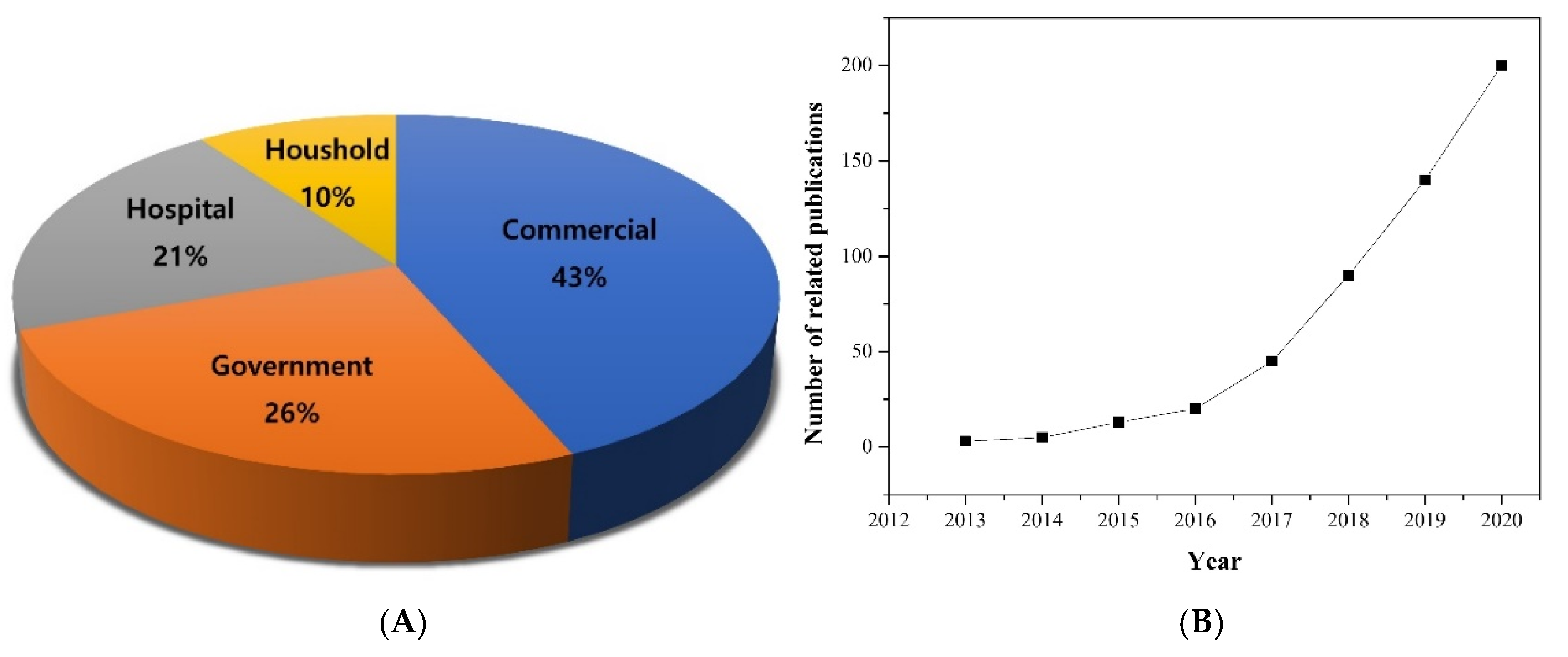
Research into the food industry using 3D food printers and efforts to apply them continue, but achieving safety, productivity, and economic feasibility remains an important issue. The global 3D food printing market is expected to grow to $525.6 million, 46.1% annually, by 2023. The global market size for each type of 3D food printing service is the largest for commercial (43.5%), followed by government (25.8%), hospital (20.8%), and household (9.9%). Biopolymer 3DP has been an emerging field, which can be demonstrated by an increasing number of related articles published from 2013 to 2020 [92] (Figure 4).
Figure 4.
Statistical data of (A) The global market size for each type of 3D food printing service. 3D Bioprinting market size, share & trends analysis report by technology market analysis report, available online: https://www.grandviewresearch.com/industry-analysis/3d-bioprinting-market (accessed on 12 August 2021). (B) Research articles on the topic of 3D bioprinting technology published during 2013–2020.
Table 5 represents the global 3D food printing market. In detail, the market share in 2018 was 39% for confectionery, 22.4% for dough, 16.5% for dairy products, 10.5% for fruits and vegetables, 7.1% for meat, 4.4% for other (source, supplement, and snack), and 61.4% for confectionery and dough. The reason for this ratio is that confectionery and dough are easier to print in various shapes than other products. The average annual growth rate of each product from 17 to 23 was high in the order of meat (49.5%), confectionery (48.1%), dough (46.1%), dairy products (43.0%), fruits and vegetables (42.5%), and others (40.8%). In the food industry, 3D food printers include processed food manufacturing, raw material production, and special-purpose foods. The global 3D food printing market is expected to grow by an estimated $78.8 million in 2018 and 46.1% annually from 2019 to 2023, reaching $525.6 million. This is because factors such as increased demand for customized food, ease of transportation, extended shelf life, and large-scale investments in government and food manufacturing around the world are expected to boost future growth. Currently, the market share of the world’s 3D food printing technologies is high in the order of FDM (64.3%), selective sintering (19.0%), inkjet printing (11.5%), and powder bed binder spraying (5.1%). As of 2018, the global 3D food printing market size was large in the order of North America (35.7%), Europe (31.4%), Asia and the Pacific (21.5%), and other (11.3%).
Table 5.
Market size by 3D printing around the world. Unit: Million dollar.
Among them, the North American market has the largest 3D food printing market, with 35.7% of market share due to its aggressive acceptance of 3D printed food through efforts to revise food safety regulations and increased demand for customized food at bakeries and restaurants. Therefore, the market has grown rapidly over the past few years due to increased technology development, increased participation of food technology research institutes, and increased government financial support, and is being used to provide customized nutrition for athletes, astronauts, and patients. The Asia–Pacific region expects the 3D food printing market to grow the fastest with an annual average growth rate of 49.0%. This is because of the rapid growth of the commercial food industry, improved living standards, increased awareness of sustainable 3D printing technology, and support for the growth of the 3D food printing market.
The advantages and disadvantages of 3D food printing in the food industry are listed in Table 6. Efforts to research and apply future food industry using 3D printers continue but securing safety and productivity economics remain an important issue [93].
Table 6.
Advantages and disadvantages of 3D food printing in food industry.
Food manufacturing using 3D printers has the advantage of not only being able to create the desired shape but also being able to precisely control the details of shapes, colors, scents, textures, and nutrients, from small and personalized orders to food industry-scale manufacturing processes [94,95,96]. However, to benefit from these advantages, the food industry in 3D printing needs to develop and be commercially viable. Several problems in the food industry today include consumer awareness, lack of information, skills, manpower, education, copyright, and standards [97]. If these problems are resolved, the development of the 3D food industry would be successful with the affirmative awareness of consumers. The most important aspect to consumers when purchasing food is the taste. However, since these taste evaluations are not made public at present, popular taste evaluations are urgently required. This is also related to the stability of food 3D printing technology. Moreover, since social awareness of new technologies is still limited, changes in perception should be made through academic research, such as biotechnology and food nutrition, in addition to food engineering technology. If there is a change in perception and if 3D printing technology is developed, expert professional manpower with an updated curriculum and investment at the same time is required for utilization of the updated technology of 3D food printing. The first technology introduced is always evolving. Therefore, the capacity of experts should be upgraded accordingly. Three-dimensional food printing technology is the leader of the fourth industry, and experts’ ability should also follow the evolution of technology. Therefore, 3D food printing companies should have a well-planned educational curriculum to train experts. Three-dimensional food printing technology is a special technology that implements two-dimensional production with three dimensions, enabling customized foods to suit one’s personal taste. With COVID-19 affecting the economic situation, the global market for 3D food printing is estimated at $475 million in 2020 and is expected to reach a revised scale of $1.3 billion by 2027 due to its versatility in processing various food ingredients and increasing demand for food manufactured using this technology [65].
Table 7 shows various companies of 3D food printers. The history of 3D food printing products begins with FoodInk company, the first 3D printed pop-up store to serve meals using a 3D food printer. Varya, an Italian food company, developed a variety of 3D printed pasta prototypes for customer demands. Current commercial extrusion-based 3D food printers including Foodini, ByFlow, Procusini 3.0, etc., are able to print savory and sweet food. In addition, Choc Creator V2.0 Plus and BeeHex Robot pizza printer can make sweet-printed chocolate and pizza [28]. Space food printed by the 3D Food Printer can be useful for eating in space, and the Systems and Metallic Research Corporation (SMRC) in Austin, Texas, has developed a 3D printer for space food under the auspices of NASA. In 2017, NASA spin-off company BeeHex developed a 3D printer called “Chef 3D” that can make a pizza in six minutes using that principle.
Table 7.
Various companies of 3D food printers in food industry.
Health food is an aged, visually pleasing, age-friendly food developed by the German food company Biozoon with €3 million research funds from the EU. In addition, puree-type foods were made for patients with difficulty chewing, however, they reduced appetite causing a decrease in nutrition. Using a 3D food printer, visual effects can increase appetite and thus increase nutrition. Customers should consider their health when selecting special-purpose foods with raw material production. Typical products of raw material production include insectivorous and structured meat. According to the Food Science Director of Press Food, a research company on fish food, there are ways for structured and unstructured cultured meat through 3D printers to make structured cultured meat such as steak. Many researchers are currently studying how to use unstructured cultured meat as a material for 3D food printers [18,65,68]. Among them, insect-based products are highly nutritious in high-protein foods. However, their appearance reduces appetite and are rejected. Therefore, attention is being paid to how to process insectivores into 3D printers and reprocess them into edible forms [65]. Table 6 shows the various 3D food printers that use food materials.
The FDM process was adapted in Choc Creator v2.0 Choc or Creator v2.0 Plus from Choc Edge LTD., USA, and the Hershey company developed a CocoJet 3D printer cooperating with 3D system LTD. The 3D Cummy Candy Printer from Katjes Magic Candy Factory, UK is the first 3D candy printer with the customization capacity of shaping, writing a message, and drawing on the candy. Print2Taste LTD., Germany supports product-specific cartridges for special cartridges of chocolate, candy, sugar, and jelly, while Procusini 3.0 & Procusini 3.0 Dual have a computer system with a wireless local area network (WLAN). Natural Machines Ltd., Spain developed a Foodini 3D food printer with Internet of Things (IoT) for manufacturing chocolate and cake using fresh food materials and the extruder from Zmorph, the Republic of South Africa, decorates cakes with the 3D process.
XYZ Printing Ltd., Taiwan developed the first 3D food printer manufacturing cookies and cakes. Pixel 3D Food Printer from Open Meal LTD., Japan was the first printer for a sushi restaurant [68]. AlgaVia, located in San Francisco, USA, is a company that develops food that can supply alternative protein sources using marine microalgae and has extracted and developed alternative protein sources useful in food function and nutrition [43]. When developing products using such raw materials, consumers’ resistance to microalgae is being studied through the formation of chicken nuggets or alternative livestock products with similar texture to steak using 3D printing technology. Diet is inextricably linked to the relationship between food and modern people. Although the components of eating food are important while exercising, it is difficult to personalize diet food with proper nutrition. In addition, it is expensive to use diet foods that have recently been promoted. This disadvantage can be improved by using a 3D printer diet. A study suggests that 3D printers can change the shape, intensity, and size of food and lead to a significant impact on the person eating it. At the same time, because it is not a frozen or dried food, nutrients also have the same advantage as conventional food. Therefore, it can provide greater satisfaction and results for the dieters.
2.4. 3D Food Printing Technology for New Normal Era
During COVID-19, self-service has become important because of the physical distance between the customer and clerk. The demand for personalized 3D food printing services manufacturing individual food design is increasing, while non-contact production services are receiving more attention. Blue Rhapsody, a spinoff, introduced customized pasta made according to customers’ preferences as an online product that enables electronic transaction services. The online market, which has become more active with COVID-19, is increasing the market share of innovative 3D printed foods. Similarly, Nourished is a British company selling customized foods under the theme of health, nutrition, and well-being, utilizing pre-packaged products with an online sale system. In addition to the 3D food printing industry, the global market for fermented foods and health food ingredients is expected to grow 15.5 times, from $56.59 billion in 2019 to $875.21 billion in 2027 [98]. Today, the preference for fermented foods is also increasing with the recognition of personal healthcare. The beginning of fermented foods usually has its origin in a traditional cooking process. It is very important to market share to develop fermented foods as processed foods to make it easier for customers to accept new traditional foods [99,100,101,102].
Accordingly, 3D food printing can be utilized to create a customized diet based on personal health by adding the value of fermented food and malt foods. Therefore, 3D printed foods with personalized health functional ingredients are also being applied to functional foods [103]. NASA’s space food development project plans to develop pizza products using 3D printing technology and extend the shelf life to 30 years [94]. For various materials used in 3D printing technology, sugars, complex carbohydrates, proteins, etc., in organic molecule units, which are preserved for more than 30 years, can be stored in powder form for longer. Developed as a Food Synthesizer, Anjan Contractor presented personalized nutrition for individual situations, for example, men and women, age, race, vital, various patients, etc. Furthermore, it is expected that the government will be able to solve the problem of reducing food waste and starvation, which is becoming a social problem. It is expected that food problems will be solved because of population growth, which will ultimately set a turning point for the entire agricultural and fisheries industry.
2.5. Limitations and Future Perspectives for Food 3D Printing
Many scholars predict a new era following the COVID-19 pandemic. In particular, efforts to reduce personal contact as much as possible by social distancing further accelerated the Fourth Industrial Revolution, where digital automation emerged as key. In addition, 3D printing technology is gaining popularity among consumers as a personalized technology, especially because it can implement a variety of flavors, colors, and complex textures. Three-dimensional printing technology is a typical technology in the Fourth Industrial Revolution because it can efficiently reduce time and cost compared to traditional food manufacturing methods and it enables customized production. However, despite the unique advantages of 3D printing technology and many large corporations having research and development facilities with various 3D printing equipment, food 3D printing has not yet been activated in the industrial field and is being used for prototyping or training purposes. Industrial sites provide evidence for this, and the main reason is that it is not suitable due to high production costs and mass production.
Various solutions have been proposed to solve these problems, such as lowering the high production costs. It is expected that production costs will be reduced by developing efficient parts for manufacturing and improving food materials for 3D printing and simplifying equipment for 3D printing. In addition, instead of aligning the 3D printing application to mass production, we should focus more on creating high-value-added products with the original personalized model. Development of personalized functional foods, milk kits for diets tailored to personal health, and personalized space food should be developed to establish a place in the industrial field of 3D food printing. In addition, food 3D printers, which can be used in wide range of areas, will develop over time to enable more diverse and sophisticated injection forms, and need to explore the various materials that can be used. In particular, because each material has different physical properties and nutritional content, the more diverse the material is applied, the more productive the food will be, so it will be more important to study the properties and mixing methods of each material [23].
Over the past three years, the global food 3D printing market has seen an average annual growth rate of 31.5% and an industry size of approximately $9.46 billion. It is currently producing food 3D printers to produce prototypes of foods that utilize the advantages of food 3D printing in various fields such as combat food, space food, restaurants, liquid food, elderly food, patient food, and baby food. Moreover, as we enter the New Normal era, the 3D printing market is likely to grow and become an ocean.
3. Conclusions
Three-dimensional food printing technology, first introduced by Hod Lipson at Cornell University in 2006 [104], is recognized for its potential and is expected to be invaluable in a variety of ways. Concurrently, many companies and researchers worldwide have researched it to secure original technologies and have developed various food printing technologies in the global market. Pretreatment technology with the formulation of food printing materials has also been developed to make various 3D foods per customer demand. The 3D food printer will supply a health food diet for personal healthcare and art with taste in an individual-designed food schedule in the near-coming new normal era called the fourth industrial age. In addition, numerous ways to deal with food, such as increasing choices in the use of flour and dried wheat worms instead of rice, will greatly help future food and environmental problems. The food industry is a very sensitive area followed by system limitations and problems. To solve such problems, the field of application should be specified, while sufficient technical skills in the field should be secured. If optimized technology is secured for a specific group, it can solve social and environmental problems by contributing to the creation of new values. Therefore, 3D food printing will be continuously advanced by customer demand and come closer to home-kitchen places as personal helpers for cooking.
Funding
This research was funded by a 2019 Research Grant from Sangmyung University.
Institutional Review Board Statement
Not applicable.
Informed Consent Statement
Not applicable.
Data Availability Statement
The data presented in this study are available on request from the corresponding author.
Conflicts of Interest
The author declares no conflict of interest.
References
- Kim, C.T.; Meang, J.S.; Shin, W.S.; Shim, I.C.; Oh, S.I.; Jo, Y.H.; Kim, J.H.; Kim, C.J. Food 3D-printing technology and its application in the food industry. Food Eng. Prog 2017, 21, 12–21. [Google Scholar] [CrossRef]
- Gu, Z.; Fu, J.; Lin, H.; He, Y. Development of 3D bioprinting: From printing methods to biomedical applications. Asian J. Pharm. Sci. 2020, 15, 529–557. [Google Scholar] [CrossRef]
- Kim, S.H. Technology opportunities in 3D printing. Korean Ind. Chem. News 2015, 18, 11–26. [Google Scholar]
- Rojek, I.; Mikołajewski, D.; Dostatni, E.; Macko, M. AI-Optimized Technological Aspects of the Material Used in 3D Printing Processes for Selected Medical Applications. Materials 2020, 13, 5437. [Google Scholar] [CrossRef] [PubMed]
- Molteni, F.; Gasperini, G.; Cannaviello, G.; Guanziroli, E. Exoskeleton and nd-Effector Robots for Upper and Lower Limbs Rehabilitation: Narrative Review. Phys. Med. Rehabil. 2018, 10 (Suppl. S2), S174–S188. [Google Scholar]
- Palermo, A.E.; Maher, J.L.; Baunsgaard, C.B.; Nash, M.S. Clinician-Focused Overview of Bionic Exoskeleton Use After Spinal Cord Injury. Top. Spinal Cord Inj. Rehabil. 2017, 23, 234–244. [Google Scholar] [CrossRef] [PubMed]
- Torres, F.; Puente, S.; Úbeda, A. Assistance Robotics and Biosensors. Sensors 2018, 18, 3502. [Google Scholar] [CrossRef] [PubMed] [Green Version]
- Jiang, M.; Zhou, Z.; Gravish, N. Flexoskeleton Printing Enables Versatile Fabrication of Hybrid Soft and Rigid Robots. Soft Robot. 2020, 7, 770–778. [Google Scholar] [CrossRef] [PubMed]
- Mohammadi, A.; Lavranos, J.; Choong, P.; Oetomo, D. Flexo-glove: A 3D printed soft exoskeleton robotic glove for impaired hand rehabilitation and sssistance. In Proceedings of the 40th Annual International Conference of the IEEE Engineering in Medicine and Biology Society (EMBC), Honolulu, HI, USA, 18–21 July 2018; pp. 2120–2123. [Google Scholar]
- Yoo, H.J.; Lee, S.; Kim, J.; Park, C.; Lee, B. Development of 3D-printed myoelectric hand orthosis for patients with spinal cord injury. J. Neuroeng. Rehabil. 2019, 16, 162. [Google Scholar] [CrossRef] [PubMed] [Green Version]
- Heung, K.H.L.; Tang, Z.Q.; Ho, L.; Tung, M.; Li, Z.; Tong, R.K.Y. Design of a 3D printed soft robotic hand for stroke rehabilitation and daily activities assistance. In Proceedings of the 16th International Conference of the IEEE Rehabilitation Robotics (ICORR), Toronto, ON, Canada, 24–28 June 2019; pp. 65–70. [Google Scholar]
- Xing, F.; Xiang, Z.; Rommens, P.M.; Ritz, U. 3D Bioprinting for Vascularized Tissue-Engineered Bone Fabrication. Materials 2020, 13, 2278. [Google Scholar] [CrossRef]
- Kruth, J.-P.; Leu, M.C.; Nakagawa, T. Progress in Additive Manufacturing and Rapid Prototyping. Ann. ClRP 1998, 47, 525–540. [Google Scholar] [CrossRef]
- Campbell, I.; Bourell, D.; Gibson, I. Additive manufacturing: Rapid prototyping comes of age. Rapid Prototyp. J. 2012, 18, 255–258. [Google Scholar] [CrossRef] [Green Version]
- Shahrubudin, N.; Lee, T.C.; Ramlan, R. An Overview on 3D Printing Technology: Technological, Materials, and Applications. Procedia Manuf. 2019, 35, 1286–1296. [Google Scholar] [CrossRef]
- Sakin, M.; Kiroglu, Y.C. 3D printing of building a: Construction of the sustainable houses of the future by BIM. Energy Procedia 2017, 134, 702–711. [Google Scholar] [CrossRef]
- Hager, I.; Golonka, A.; Putanowicz, R. 3D printing of building components as the future of sustainable construction? Procedia Eng. 2016, 151, 292–299. [Google Scholar] [CrossRef] [Green Version]
- Park, H.J.; Kim, H.W. Global Food 3D Printing Technology and Industry Trends and Future Prospect. World Agr. 2017, 2020, 147–168. [Google Scholar]
- Lili, L.; Yuanyuan, M.; Ke, C.; Yang, Z. 3D Printing Complex Egg White Protein Objects: Properties and Optimization. Food Bioprocess Technol. 2018, 1, 1–11. [Google Scholar]
- Singh, P.; Raghav, A. 3D Food Printing: A Revolution in Food Technology. Act. Sci. Nutr. Health 2018, 2, 1–2. [Google Scholar]
- Dankar, I.; Pujola, M.; Omar, F.E.; Sepulcre, F.; Haddarah, A. Impact of Mechanical and Microstructural Properties of Potato Puree-Food Additive Complexes on Extrusion-Based 3D Printing. Food Bioprocess Technol. 2018, 1, 1–11. [Google Scholar] [CrossRef]
- Liu, Z.; Zhang, M.; Bhandari, B.; Wang, Y. 3D printing: Printing precision and application in food sector. Trends Food Sci. Technol. 2017, 69, 83–94. [Google Scholar] [CrossRef] [Green Version]
- Kim, M.J.; Kim, M.K.; You, Y.S. Food 3D Printing Technology and Food Materials of 3D Printing. Clean Technol. 2020, 26, 109–115. [Google Scholar]
- Jiménez, M.; Romero, L.; Dom-nguez, I.; del Mar Espinosa, M.; Dom-nguez, M. Additive Manufacturing Technologies: An Overview about 3D Printing Methods and Future Prospects. Complexity 2019, 2019, 1–30. [Google Scholar] [CrossRef] [Green Version]
- Jin, Y.A.; Li, H.; He, Y.; Fu, J.Z. Quantitative analysis of surface profile in fused deposition modelling. Addit. Manuf. 2015, 8, 142–148. [Google Scholar] [CrossRef]
- Turunen, S.M.; Melchels, F.P.W.; Kellomaki, M. A review of rapid prototyping techniques for tissue engineering purposes. Ann. Med. 2008, 40, 268–280. [Google Scholar]
- Kim, G.B.; Lee, S.; Kim, H.; Yang, D.H.; Kim, Y.H.; Kyung, Y.S.; Kim, C.S.; Choi, S.H.; Kim, J.B.; Ha, H.; et al. Three-Dimensional Printing: Basic Principles and Applications in Medicine and Radiology. Korean J. Radiol. 2016, 17, 182–197. [Google Scholar] [CrossRef] [PubMed] [Green Version]
- Godoi, F.C.; Prakash, S.; Bhandari, B.R. 3d printing technologies applied for food design: Status and prospects. J. Food Eng. 2016, 179, 44–54. [Google Scholar] [CrossRef] [Green Version]
- Lanaro, M.; Forrestal, D.P.; Scheurer, S.; Slinger, D.J.; Liao, S.; Powell, S.K.; Woodruff, M.A. 3D printing complex chocolate objects: Platform design, optimization, and evaluation. J. Food Eng. 2017, 215, 13–22. [Google Scholar] [CrossRef]
- Liu, Z.; Zhang, M.; Yang, C. Impact of rheological properties of mashed potatoes on 3D printing. J. Food Eng. 2018, 220, 76–82. [Google Scholar] [CrossRef] [Green Version]
- Silva, D.N.; Gerhardt de Oliveira, M.; Meurer, E.; Meurer, M.I.; Lopes da Silva, J.V.; Santa-Bárbara, A. Dimensional error in selective laser sintering and 3D-printing of models for craniomaxillary anatomy reconstruction. J. Craniomaxillofac. Surg. 2008, 36, 443–449. [Google Scholar] [CrossRef]
- Raphael, O.; Hervé, R. Clinical applications of rapid prototyping models in cranio-maxillofacial surgery. In Advanced Applications of Rapid Prototyping Technology in Modern Engineering; Hoque, M., Ed.; InTech: Rijeka, Croatia, 2011; pp. 173–206. [Google Scholar]
- Krkobabi’c, M.; Medarevi’c, D.; Peši’c, N.; Vasiljevi’c, D.; Ivkovi’c, B.; Ibri’c, S. Digital Light Processing (DLP) 3D Printing of Atomoxetine Hydrochloride Tablets Using Photoreactive Suspensions. Pharmaceutics 2020, 12, 833. [Google Scholar] [CrossRef]
- Gibson, I.; Rosen, D.; Stucker, D. Additive Manufacturing Technologies, 2nd ed.; Springer: New York, NY, USA, 2015; pp. 63–103. [Google Scholar]
- Schmidt, J.; Colombo, P. Digital light processing of ceramic components from polysiloxanes. J. Eur. Ceram. Soc. 2018, 38, 57–66. [Google Scholar] [CrossRef]
- Patel, D.K.; Sakhaei, A.H.; Layani, M.; Zhang, B.; Ge, Q.; Magdassi, S. Highly Stretchable and UV Curable Elastomers for Digital Light Processing Based 3D Printing. Adv. Mater. 2017, 29, 1–7. [Google Scholar] [CrossRef] [PubMed]
- Choong, Y.Y.C.; Maleksaeedi, S.; Eng, H.; Su, P.C.; Wei, J. Curing characteristics of shape memory polymers in 3D projection and laser stereolithography. Virtual Phys. Prototyp. 2017, 12, 77–84. [Google Scholar] [CrossRef]
- Varghese, G.; Moral, M.; Castro-García, M.; López-López, J.J.; Marín-Rueda, J.R.; Yagüe-Alcaraz, V.; Hernández-Afonso, L.; Ruiz-Morales, J.C.; Canales-Vázquez, J. Fabrication and characterisation of ceramics via low-cost DLP 3D printing. Bol. La Soc. Esp. Ceram. Y Vidr. 2018, 57, 9–18. [Google Scholar] [CrossRef]
- Schirmeister, C.G.; Hees, T.; Licht, E.H.; Mülhaupt, R. 3D printing of high density polyethylene by fused filament fabrication. Addit. Manuf. 2019, 28, 152–159. [Google Scholar] [CrossRef]
- Yang, F.; Zhang, M.; Bhandari, B. Recent development in 3D food printing. Crit. Rev. Food Sci. Nutr. 2017, 57, 3145–3153. [Google Scholar] [CrossRef] [PubMed]
- Sun, J.; Zhou, W.; Yan, L.; Huang, D.; Lin, L. Extrusion-based food printing for digitalized food design and nutrition control. J. Food Eng. 2018, 220, 1–11. [Google Scholar] [CrossRef]
- Noort, M.W.J.; Diaz, J.V.; Van Bommel, K.J.C.; Renzetti, S.; Henket, J.; Hoppenbrouwers, M.B. Method for the Production of an EDIBLE object Using SLS. WO Patent 2016085344, 2 June 2016. [Google Scholar]
- Singhal, S.; Rasane, P.; Kaur, S.; Garba, U.; Bankar, A.; Singh, J.; Gupta, N. 3D food printing: Paving way towards novel foods. An. Acad. Bras. Cienc. 2020, 92, 1–26. [Google Scholar] [CrossRef] [PubMed]
- Jandyal, M.; Malav, O.P.; Nitin, M.; Chatli, M.K.; Kumar, P.; Wagh, R.V.; Kour, S.; Tanwar, T. 3D Printing of Meat: A New Frontier of Food from Download to Delicious: A Review. Int. J. Curr. Microbiol. App. Sci. 2021, 10, 2095–2111. [Google Scholar]
- Sachs, E.; Cima, M.; Cornie, J. Three-dimensional printing: Rapid tooling and prototypes directly from a CAD model. CIRP Ann. Manuf. Technol. 1990, 39, 201–204. [Google Scholar] [CrossRef]
- Southerland, D.; Walters, P.; Huson, D. Edible 3D printing. In Proceedings of the 27th International Conference on Digital Printing Technologies, Minneapolis, MN, USA, 1 January 2011; pp. 819–822. [Google Scholar]
- Yang, J.; Wu, L.; Liu, J. Rapid Prototyping and Fabrication Method for 3-D Food Objects. U.S. Patent No. 6280785, 28 March 2000. [Google Scholar]
- Sun, J.; Peng, Z.; Zhou, W.; Fuh, J.Y.H.; Hong, G.S.; Chiu, A. A Review on 3D Printing for Customized Food Fabrication. Procedia Manuf. 2015, 1, 308–319. [Google Scholar] [CrossRef] [Green Version]
- Yoon, H.S.; Lee, M.; Jin, X.; Lee, S.; You, Y.S.; Rhee, J.K. 3D printing technology and its applications in the future food industry: A review. Food Sci. Ind. 2016, 12, 64–69. [Google Scholar]
- Bhandari, B.R.; Howes, T. Implication of Glass Transition for the Drying and Stability of Dried foods. J. Food Eng. 1999, 40, 71–79. [Google Scholar] [CrossRef]
- Bhandari, B.R.; Roos, Y.H. Dissolution of Sucrose crystal in the Anhydrous Sorbitol Melt. Carbohyd. Res. 2003, 338, 361–367. [Google Scholar] [CrossRef]
- Haque, M.K.; Roos, Y.H. Differences in the Physical state and Thermal Behavior of Spray-Dried and Freeze-Dried Lactose and lactose/Protein Mixtures. Innov. Food Sci. Emerg. Technol. 2006, 7, 63–73. [Google Scholar] [CrossRef]
- Roos, Y.H. Glass Transition Temperature and its Relevance in Food Processing. Annu. Rev. Food Sci. Technol. 2010, 1, 469–496. [Google Scholar] [CrossRef]
- Slade, L.; Levine, H. Water and the Glass Transition-Dependence of the Glass Transition on Composition and Chemical Structure: Special Implications for Flour Functionality in Cookie Baking. J. Food Eng. 1995, 22, 431–509. [Google Scholar] [CrossRef]
- Zhang, J.Y.; Pandya, J.K.; McClements, D.J.; Lu, J.; Kinchla, A.J. Advancements in 3D food printing: A comprehensive overview of properties and opportunities. Crit. Rev. Food Sci. Nutr. 2021, 3, 1–18. [Google Scholar]
- Gholamipour-Shirazi, A.; Norton, I.; Mills, T. Designing hydrocolloid based food-ink formulations for extrusion 3D printing. Food Hydrocoll. 2019, 95, 161–167. [Google Scholar] [CrossRef]
- Liu, L.; Meng, Y.; Dai, X.; Chen, K.; Zhu, Y. 3D printing complex egg white protein objects: Properties and optimization. Food Bioprocess Technol. 2019, 12, 267–279. [Google Scholar] [CrossRef]
- Yang, F.; Zhang, M.; Prakash, S.; Liu, Y. Physical properties of 3D printed baking dough as affected by different compositions. Innov. Food Sci. Emerg. Technol. 2018, 49, 202–210. [Google Scholar] [CrossRef]
- Theagarajan, R.; Moses, J.A.; Anandharamakrishnan, C. 3D extrusion printability of rice starch and optimization of process variables. Food Bioprocess Technol. 2020, 13, 1048–1062. [Google Scholar] [CrossRef]
- Xiao, J.Y.; Zhan, M.Q.; Cong, R.H.; Hua, M.H.; Ma, F.L.; Wan, Y. Study on the 3D printing formability of chocolate with Chinese medicine functional factor. Sci. Technol. Food Ind. 2019, 40, 77–82. [Google Scholar]
- Teng, X.; Zhang, M.; Bhandri, B. 3D printing of Cordyceps flower powder. J. Food Process Eng. 2019, 42, e13179. [Google Scholar] [CrossRef]
- Ramachandraiah, K. Potential Development of Sustainable 3D-Printed Meat Analogues: A Review. Sustainability 2021, 13, 938. [Google Scholar] [CrossRef]
- Dong, X.; Pan, Y.; Zhao, W.; Huang, Y.; Qu, W.; Pan, J.; Qi, H.; Prakash, S. Impact of microbial transglutaminase on 3D printing quality of Scomberomorus niphonius surimi. LWT-Food Sci. Technol. 2020, 124, 109123. [Google Scholar] [CrossRef]
- Severini, C.; Derossi, A.; Ricci, I.; Caporizzi, R.; Fiore, A. Printing a blend of fruit and vegetables. New advances on critical variables and shelf life of 3D edible objects. J. Food Eng. 2018, 220, 89–100. [Google Scholar] [CrossRef]
- Severini, C.; Azzollini, D.; Albenzio, M.; Derossi, A. On printability, quality and nutritional properties of 3D printed cereal based snacks enriched with edible insects. Food Res. Int. 2018, 106, 666–676. [Google Scholar] [CrossRef] [PubMed]
- Vakevainen, K.; Ludena-Urquizo, F.; Korkala, E.; Lapvetelainen, A.; Peraniemi, S.; von Wright, A.; Plumed-Ferrer, C. Potential of quinoa in the development of fermented spoonable vegan products. LWT-Food Sci. Technol. 2020, 120, 108912. [Google Scholar] [CrossRef]
- Vancauwenberghe, V.; Delele, M.A.; Vanbiervliet, J.; Aregawi, W.; Verboven, P.; Lammertyn, J.; Nicolaï, B. Model-based design and validation of food texture of 3D printed pectin-based food simulants. J. Food Eng. 2018, 231, 72–82. [Google Scholar] [CrossRef]
- Feng, C.; Zhang, M.; Bhandari, B. Materials properties of printable edible inks and printing parameters optimization during 3D printing: A review. Crit. Rev. Food Sci. Nutr. 2019, 59, 3074–3081. [Google Scholar] [CrossRef]
- Liu, C.; Ho, C.; Wang, J. The development of 3D food printer for printing fibrous meat materials. In Proceedings of the IOP Conference Series: Materials Science and Engineering, Kuala Lumpur, Malaysia, 13–14 August 2018; Volume 284, pp. 12–19. [Google Scholar]
- Liu, Y.; Zhang, W.; Wang, K.; Bao, Y.; Mac Regenstein, J.; Zhou, P. Fabrication of gel-like emulsions with whey protein isolates using micro fluidization: Rheological properties and 3D printing performance. Food Bioprocess Technol. 2019, 12, 1967–1979. [Google Scholar] [CrossRef]
- Liu, L.; Yang, X.; Bhandari, B.; Meng, Y.; Prakash, S. Optimization of the formulation and properties of 3D-printed complex egg white protein objects. Foods 2020, 9, 164. [Google Scholar] [CrossRef] [Green Version]
- Lipton, J.I.; Cutler, M.; Nigl, F.; Cohen, D.; Lipson, H. Additive manufacturing for the food industry. Trends Food Sci. Technol. 2015, 43, 114–123. [Google Scholar] [CrossRef]
- Andrianaivo, M.R.; Graciela, W.P. Effects of Lamination and Coating with Drying Oils on Tensile and Barrier Properties of Zein Films. J. Agric. Food Chem. 2001, 49, 2860–2863. [Google Scholar]
- Pant, A.; Lee, A.; Karyappa, R.; Lee, C.; An, J.; Hashimoto, M.; Tan, U.; Wong, G.; Chua, C.; Zhang, Y. 3D food printing of fresh vegetables using food hydrocolloids for dysphagic patients. Food Hydrocoll. 2021, 114, 106546. [Google Scholar] [CrossRef]
- Puttalingamma, V. Edible Coatings of Carnauba Wax—A Novel Method for Preservation and Extending Longevity of Fruits and Vegetables A Review. Int. J. Food Saf. 2014, 16, 1–5. [Google Scholar]
- Derry, J. A Study on the Processing Methods of Shellac, and the Analysis of Selected Physical and Chemical Characteristics. Master’s Thesis, University of Oslo, Oslo, Norway, 2012. [Google Scholar]
- Shahbazi, M.; Jäger, H. Current Status in the Utilization of Biobased Polymers for 3D Printing Process: A Systematic Review of the Materials, Processes, and Challenges. ACS Appl. Bio Mater. 2021, 4, 325–369. [Google Scholar] [CrossRef]
- Péreza, B.; Nykvist, H.; Brøgger, A.F.; Larsen, M.B.; Falkeborg, M.F. Impact of macronutrients printability and 3D-printer parameters on 3D-food printing: A review. Food Chem. 2019, 287, 249–257. [Google Scholar] [CrossRef] [PubMed]
- Yang, F.; Zhang, M.; Bhandari, B.; Liu, Y. Investigation on lemon juice gel as food material for 3D printing and optimization of printing parameters. LWT-Food Sci. Technol. 2018, 87, 67–76. [Google Scholar] [CrossRef] [Green Version]
- He, C.; Zhang, M.; Guo, C. 4D printing of mashed potato/purple sweet potato puree with spontaneous color change. Innov. Food. Sci. Emerg. Technol. 2020, 59, 11020. [Google Scholar] [CrossRef]
- Dankar, I.; Haddarah, A.; El Omar, F.; Sepulcre, F.; Pujolà, M. Assessing the microstructural and rheological changes induced by food additives on potato puree. Food Chem. 2018, 240, 304–313. [Google Scholar] [CrossRef] [Green Version]
- Chuanxing, F.; Qi, W.; Hui, L.; Quancheng, Z.; Wang, M. Effects of pea protein on the properties of potato starch-based 3D printing materials. Int. J. Food Eng. 2018, 14, 20170297. [Google Scholar] [CrossRef]
- Vancauwenberghe, V.; Katalagarianakis, L.; Wang, Z.; Meerts, M.; Hertog, M.; Verboven, P.; Moldenaers, P.; Hendrickx, M.E.; Lammertyn, J.; Nicolai, B. Pectin based food-ink formulations for 3-D printing of customizable porous food simulants. Innov. Food Sci. Emerg. Technol. 2017, 42, 138–150. [Google Scholar] [CrossRef]
- Derossi, A.; Caporizzi, R.; Azzollini, D.; Severini, C. Application of 3D printing for customized food. A case on the development of a fruit-based snack for children. J. Food Eng. 2017, 220, 65–75. [Google Scholar] [CrossRef]
- Lipton, J.; Arnold, D.; Nigl, F. Multi-Material Food Printing with Complex Internal Structure Suitable for Conventional Post-Processing; Solid Freeform Fabrication Symposium: Austin, TX, USA, 2010; pp. 809–815. [Google Scholar]
- Lille, M.; Nurmela, A.; Nordlund, E.; Metsä-Kortelainen, S.; Sozer, N. Applicability of protein and fiber-rich food materials in extrusion-based 3D printing. J. Food Eng. 2018, 220, 20–27. [Google Scholar] [CrossRef]
- Kim, H.W.; Bae, H.; Park, H.J. Reprint of: Classification of the printability of selected food for 3D printing: Development of an assessment method using hydrocolloids as reference material. J. Food Eng. 2018, 220, 28–37. [Google Scholar] [CrossRef]
- Wang, L.; Zhang, M.; Yang, C. Investigation on fish surimi gel as promising food material for 3D printing. J. Food Eng. 2017, 220, 101–108. [Google Scholar] [CrossRef]
- Le Tohic, C.; O’Sullivan, J.J.; Drapala, K.P.; Chartrin, V.; Chan, T.; Morrison, A.P.; Kerry, J.P.; Kelly, A.L. Effect of 3D printing on the structure and textural properties of processed cheese. J. Food Eng. 2018, 220, 56–64. [Google Scholar] [CrossRef]
- Lee, H. 3D printing technology and food industry in future. Food Preserv. Process. Ind. 2017, 16, 24–28. [Google Scholar]
- Sun, J.; Peng, Z.; Yan, L.; Fuh, J.; Hong, G.S. 3D food printing-An innovative way of mass customization in food fabrication. Int. J. Bioprint. 2015, 1, 27–38. [Google Scholar] [CrossRef]
- Li, N.; Qiao, D.; Zhao, S.; Lin, Q.; Zhang, B.; Xie, F. 3D printing to innovate biopolymer materials for demanding applications: A review. Mater. Today Chem. 2021, 20, 100459. [Google Scholar] [CrossRef]
- Weller, C.; Kleer, R.; Piller, F.T. Economic implications of 3D printing: Market structure models in light of additive manufacturing revisited. Int. J. Product. Econ. 2015, 164, 43–56. [Google Scholar] [CrossRef]
- Van Bommel, K.; Spicer, A. Hail the snail: Hegemonic struggles in the slow food movement. Organ. Stud. 2011, 32, 1717–1744. [Google Scholar] [CrossRef] [Green Version]
- Park, M.; Lee, Y.; Kim, K.; Park, S.; Han, J. Actual Conditions of the Food industry’s Application of Food Tech and Its Tasks: Focusing on Alterative Livestock Products and 3D Food Printing; RI-879; Science Report from Korea Rural Economic Institute (KREI): Naju, Korea, 2019; pp. 61–72. [Google Scholar]
- 3D Food Printing-Golbal Market Trajectory & Analytics. Available online: https://www.researchandmarkets.com/reports/5301799 (accessed on 24 July 2021).
- Food Ink Ltd. Available online: http://foodink.io/ (accessed on 24 July 2021).
- Global Fermented Food and Ingredients Market, Emergen Research. Available online: https://www.emergenresearch.com/industry-report/fermented-food-and-ingredients-market (accessed on 24 July 2021).
- Adebiyi, J.; Obadina, A.; Adebo, O.; Kayitesi, E. Comparison of nutritional quality and sensory acceptability of biscuits obtained from native, fermented, and malted pearl millet (Pennisetum glaucum) flour. Food Chem. 2017, 232, 210–217. [Google Scholar] [CrossRef]
- Torrico, D.; Fuentes, S.; Viejo, C.; Ashman, H.; Dunshea, F. Cross-cultural effects of food product familiarity on sensory acceptability and non-invasive physiological responses of consumers. Food Res. Int. (Ottawa Ont.) 2019, 115, 439–450. [Google Scholar] [CrossRef] [PubMed]
- Tuorila, H.; Hartmann, C. Consumer responses to novel and unfamiliar foods. Curr. Opin. Food Sci. 2020, 33, 1–8. [Google Scholar] [CrossRef]
- Krishnaraj, P.; Anukiruthika, T.; Choudhary, P.; Moses, J.; Anandharamakrishnan, C. 3D extrusion printing and post-processing of fibre-rich snack from indigenous composite flour. Food Bioprocess Technol. 2019, 12, 1776–1786. [Google Scholar] [CrossRef]
- Lin, C. 3D Food Printing: A Taste of the Future. J. Food Sci. Edu. 2015, 14, 86–87. [Google Scholar] [CrossRef] [Green Version]
- Malone, E.; Lipson, H. Fab@Home: The personal desktop fabricator kit. In Proceedings of the 17th Solid Freeform Fabrication Symposium, Austin, TX, USA, 14–16 August 2006; pp. 1–14. [Google Scholar]



Publisher’s Note: MDPI stays neutral with regard to jurisdictional claims in published maps and institutional affiliations. |
© 2021 by the author. Licensee MDPI, Basel, Switzerland. This article is an open access article distributed under the terms and conditions of the Creative Commons Attribution (CC BY) license (https://creativecommons.org/licenses/by/4.0/).