


Abstract
Ti-6Al-4V internal flow channels are difficult to finish because direct liquid metal-driven abrasive slurry polishing is constrained by both the limited driving capability of the liquid metal and the continuous formation of a dense surface reaction layer in alkaline electrolytes. In this study, the direct polishing behavior of Ti-6Al-4V flow channels was first investigated, and a distinct polishing capability boundary was identified through the evolution of surface morphology and areal roughness . Although decreased with polishing time, the reduction rate gradually diminished and eventually approached a plateau, indicating pronounced attenuation in effective material removal. Mechanistic analysis revealed that this limitation was governed by the dynamic formation and disruption of the oxide/reaction layer, which progressively shields the metallic substrate from direct abrasive action. To address this issue, an electric-field-assisted chemical pretreatment was introduced prior to the liquid metal-driven abrasive polishing stage, forming a two-step route (AB + P). Comparative experiments among direct polishing (P), chemical pretreatment followed by polishing (B + P), and electric-field-assisted chemical pretreatment followed by polishing (AB + P) showed that AB + P produced more homogeneous surface morphologies, lower , and a significantly weaker plateauing tendency than direct polishing. In addition, the attainable limiting surface quality was shifted to a lower level, indicating an extension of the polishing capability boundary. The influence of pretreatment electrification time further revealed the existence of an effective time window, beyond which the polishing improvement gradually saturated. These results demonstrate that electric-field-assisted chemical pretreatment is an effective strategy for mitigating polishing attenuation and enhancing the finishing capability of liquid metal-driven abrasive slurry polishing for Ti-6Al-4V internal flow channels.
1. Introduction
Flow-channel structures are widely used in mold manufacturing, engineering equipment, energy systems, and aerospace components, where the internal surface condition critically affects flow resistance, heat-transfer efficiency, fatigue performance, and service reliability. In particular, previous studies have demonstrated that the surface roughness of internal flow channels can significantly influence pressure drop, heat transfer, and the functional performance of additively manufactured Ti-based channel structures [1,2]. However, the polishing of internal flow channels remains a major manufacturing challenge because of confined accessibility, geometric complexity, and the difficulty of achieving uniform material removal on enclosed inner walls [3,4]. Several techniques, including magnetorheological finishing, abrasive flow machining, electrochemical polishing, and ultrasonic vibration-assisted polishing, have been investigated for inner-surface finishing. Nevertheless, each of these methods suffers from inherent limitations. Magnetorheological finishing relies on conformal tool heads and is therefore restricted by tool size and poor adaptability to complex internal geometries. Electrochemical polishing is mainly applicable to conductive materials and may suffer from insufficient finishing uniformity and environmental concerns. Conventional abrasive flow machining can be applied to internal channels, but the high pressure required to drive the abrasive media may induce deformation in thin-walled or compliant structures [5,6,7,8,9]. These limitations become more pronounced in complex flow-channel systems, where local curvature, confined sections, and structural variations often result in low polishing efficiency, poor controllability, and non-uniform surface quality. Accordingly, the development of an efficient and precise finishing strategy for internal flow channels remains of considerable practical importance.
Gallium-based room-temperature liquid metals, such as EGaIn and Galinstan, have received extensive attention because of their high surface tension, fluid deformability, high electrical and thermal conductivity, and relatively low toxicity compared with mercury [10,11,12,13,14,15,16]. Their unique interfacial and electrohydrodynamic properties have led to broad applications in microfluidics, microactuators, flexible electronics, soft machines, and reconfigurable functional systems [17,18,19,20,21,22,23,24,25,26,27,28,29,30]. In particular, the motion and deformation of liquid-metal droplets can be manipulated by external electric fields, chemically induced surface reactions, and ionic concentration gradients [17,18,30,31,32,33,34]. On this basis, Yapeng Ma et al. [35] proposed an electrically induced liquid-metal-driven abrasive slurry polishing method for the internal channels of additively manufactured components, providing a new route for the finishing of confined and geometrically complex inner surfaces. Compared with conventional pressure-driven abrasive flow, this method offers advantages such as lower mechanical loading, flexible actuation, and potentially improved compatibility with narrow or enclosed channels.
Despite these advantages, the polishing efficiency of direct liquid metal-driven abrasive flow remains limited, especially for hard-to-finish materials. Under an externally applied electric field, the driving force generated by the liquid metal is still relatively weak, and the resulting abrasive entrainment capability is insufficient in confined channels where viscous drag, interfacial resistance, and local flow damping significantly suppress droplet mobility. Consequently, the kinetic energy transferred to the abrasive particles and the effective particle–wall collision intensity remain limited, resulting in relatively low polishing efficiency. This problem becomes more severe for Ti-6Al-4V flow channels. In alkaline electrolytes, titanium alloys readily form a dense and chemically stable oxide/passivation film, which continuously regenerates during polishing. As a result, abrasive particles increasingly interact with the reaction layer rather than directly with the metallic substrate, leading to a gradual decay in effective material removal. Therefore, direct liquid-metal-driven abrasive polishing of Ti-6Al-4V flow channels is restricted not only by the insufficient driving capability of the liquid metal, but also by the persistent formation of a mechanically resistant surface layer. These coupled effects eventually cause the polishing rate to decrease with time and lead to a practical finishing limit.
To address these limitations, this study proposes an electric-field-assisted chemical pretreatment strategy for Ti-6Al-4V internal flow channels, followed by liquid-metal-driven abrasive polishing. The underlying rationale is that, before the abrasive stage, the surface state of the titanium alloy can be regulated through the synergistic action of an external electric field and a reactive chemical medium, thereby transforming the original dense and stable surface layer into a more removable reaction layer. Such pretreatment is expected to reduce the resistance of the wall material to subsequent abrasive action, improve the utilization efficiency of the limited liquid-metal driving force, and prolong the effective material-removal stage during polishing. Therefore, the present study aims to establish a surface-state-regulated finishing strategy for Ti-6Al-4V internal flow channels by coupling electric-field-assisted chemical pretreatment with subsequent liquid-metal-driven abrasive polishing. The specific objectives are to: (i) identify the practical capability boundary of direct polishing; (ii) clarify the role of passivation-layer evolution in polishing attenuation; (iii) evaluate the effectiveness of electric-field-assisted pretreatment in enhancing surface finish; and (iv) determine whether an effective operating window exists for the pretreatment duration and establish an experimentally validated process route for improving the polishing performance of Ti-6Al-4V internal flow channels.
2. Materials and Methods
2.1. Workpiece, Experimental Design, and Process Routes
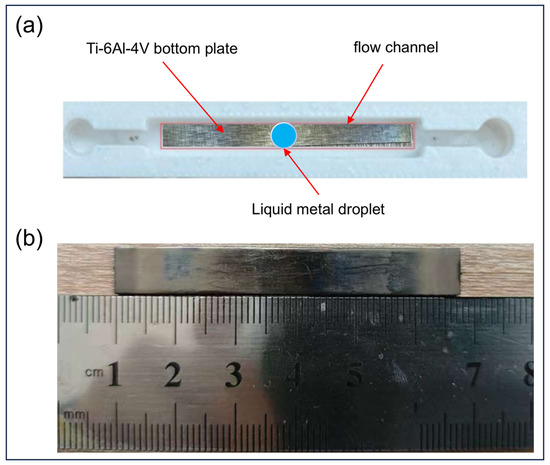
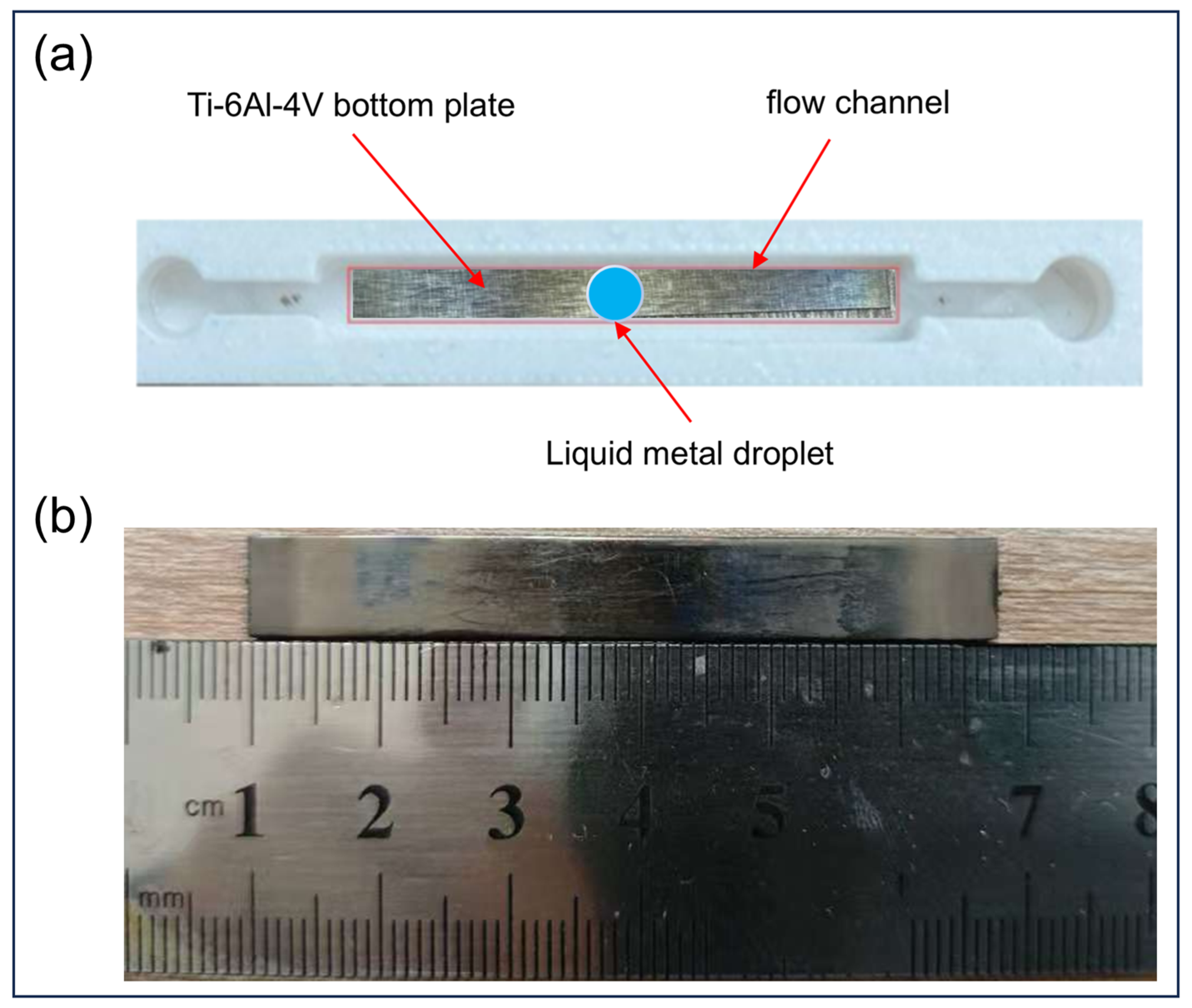
Ti-6Al-4V was selected as the target material in this study because titanium alloys are well known for their high chemical reactivity and the persistent regeneration of surface oxide/reaction layers in electrolyte environments, which makes them difficult to finish by direct liquid metal-driven abrasive slurry polishing. According to our previous study [35], the liquid metal-driven abrasive action inside the channel is exerted predominantly on the channel bottom wall rather than uniformly over the entire inner surface. Therefore, instead of replacing the entire flow-channel structure with titanium alloy, only the bottom wall of the channel was replaced by a Ti-6Al-4V plate so that the present study could specifically focus on the polishing behavior and surface-state evolution of the channel bottom surface. As shown in Figure 1, the experimental specimen consisted of an assembled flow-channel structure, in which the Ti-6Al-4V plate served as the channel bottom wall and corresponded to the main polishing region investigated in this work. The dimensions of the Ti-6Al-4V plate used as the channel bottom wall were 58 mm in length, 8 mm in width, and 1.5 mm in thickness.
Figure 1.
Experimental specimen used in this study: (a) photograph of the assembled flow-channel specimen; (b) schematic illustration of the specimen structure, showing the Ti-6Al-4V plate serving as the channel bottom wall and the main polishing region.
Based on this specimen configuration, three process routes were designed for comparative investigation. The first route, denoted as P, represents direct liquid-metal-driven abrasive slurry polishing without pretreatment. The second route, denoted as B + P, consists of chemical pretreatment followed by liquid-metal-driven abrasive slurry polishing. The third route, denoted as AB + P, consists of electric-field-assisted chemical pretreatment followed by liquid-metal-driven abrasive slurry polishing. Among these routes, AB + P constitutes the core two-step process proposed in this work.
The purpose of introducing these three routes was to distinguish the respective roles of direct polishing, pure chemical pretreatment, and electric-field-assisted chemical pretreatment. Specifically, the P route was used to identify the intrinsic polishing capability boundary of direct polishing on the Ti-6Al-4V bottom surface. The B + P route was employed to evaluate the contribution of the chemical environment alone, whereas the AB + P route was used to verify whether electric-field-assisted pretreatment could further regulate the initial surface state and thereby improve the continuity and effectiveness of the subsequent polishing process. In this way, the independent contribution and necessity of electric-field-assisted chemical pretreatment could be systematically assessed.
2.2. Experimental Design for Identifying the Capability Boundary of Direct Polishing
To clarify the processing capability boundary of Ti-6Al-4V internal channels under direct liquid metal-driven abrasive slurry polishing, single-step direct polishing experiments were first conducted. During these experiments, the key processing parameters, including the externally applied electric-field conditions, abrasive concentration, and liquid-metal size, were fixed at the optimal values previously determined through orthogonal experiments, as summarized in Table 1. By maintaining these parameters constant, the influence of process-variable fluctuations was minimized, thereby allowing the effect of material properties on the polishing behavior to be examined more reliably. The experimental parameters listed in Table 1 were determined based on a combination of preliminary trials and orthogonal experimental optimization. Specifically, the applied voltage, abrasive volume fraction, liquid metal droplet radius, and electrolyte concentration were selected within ranges that ensure stable droplet actuation, effective abrasive activation, and measurable material removal behavior. The final parameter set corresponds to the optimal condition identified from orthogonal experiments, under which the LM-AF process exhibits stable operation and reproducible polishing performance. By fixing these parameters, the influence of process fluctuations is minimized, thereby allowing the intrinsic capability boundary of direct polishing to be evaluated more reliably.
Table 1.
Experimental parameters.
By setting different polishing durations (8–16 h), the surface morphology and areal surface roughness of the specimens were characterized separately, and the temporal evolution of roughness, together with its late-stage plateauing behavior, was systematically analyzed. The purpose of this experimental series was to identify the “capability boundary” of Ti-6Al-4V channels under a single-step direct polishing mode, namely, the limiting surface quality that can be attained under a given set of process conditions, and to provide a reference basis for the subsequent development of the two-step process.
2.3. Two-Step Process: Electric-Field-Assisted Chemical Pretreatment Followed by Liquid Metal-Driven Abrasive Slurry Polishing
The two-step process proposed in this study consists of two sequential stages: an electric-field-assisted chemical pretreatment stage and a subsequent liquid-metal-driven abrasive slurry polishing stage.
Previous studies have demonstrated that chemical or electrochemical pretreatment can effectively modify the surface oxide/reaction layer and thereby influence subsequent polishing behavior, especially for titanium and titanium alloys [36,37,38].
- (1)
- Pretreatment Stage (A + B)
In this stage, an external electric field (A) is applied between platinum electrodes, while only a NaCl-NaNO3 pretreatment electrolyte is introduced into the internal channel. Neither liquid-metal droplets nor abrasive particles are added at this stage. It should be emphasized that the Ti-6Al-4V channel itself is not directly connected as an electrode in the circuit; rather, it is placed within a system simultaneously subjected to the externally applied electric field and the chemical environment. Through this process, the migration behavior of ions in the solution and the local chemical environment near the channel surface are altered, thereby inducing surface oxidation, localized dissolution, and repassivation processes. As a consequence, the originally dense and stable surface layer is regulated and gradually transformed into a reaction layer with a relatively looser structure, lower mechanical strength, and greater susceptibility to subsequent mechanical removal.
- (2)
- Polishing Stage (P)
After completion of the pretreatment stage, the electric-field conditions are kept unchanged, and both the liquid metal droplet and abrasive slurry are introduced into the system, thereby entering the liquid metal-driven abrasive slurry polishing stage. Under the externally applied electric field, the liquid metal undergoes reciprocating motion, and its leading-edge pushing effect, trailing-edge disturbance, and hydrodynamic coupling with the surrounding fluid collectively drive the abrasive particles to form multidirectional and randomized trajectories. During repeated impact and sliding, the abrasive particles continuously disrupt the surface reaction layer and expose fresh substrate material, thereby enabling sustained material removal through the synergistic action of chemical and mechanical effects.
Compared with conventional simultaneous chemical–mechanical polishing approaches, the proposed method separates surface-state regulation and material removal into two sequential stages. This design is particularly suitable for confined internal channels, where direct polishing is often limited by the formation of a dense and mechanically resistant reaction layer [36,39].
2.4. Experimental Parameters and Controlled Comparison Scheme
It should be noted that Table 1 and Table 2 correspond to two different experimental purposes. Table 1 is used to identify the capability boundary of direct polishing under its optimized baseline conditions, whereas Table 2 is established for validating the pretreatment-assisted two-step process under the operating conditions required by the coupled pretreatment–polishing system. To validate the feasibility and superiority of the proposed two-step process for polishing Ti-6Al-4V internal channels, a unified set of process parameters was employed throughout the pretreatment-assisted experiments. In contrast to Table 1, the experimental parameters in Table 2 were designed for the controlled evaluation of the pretreatment-assisted two-step process (AB + P). A unified set of baseline conditions, including channel geometry, abrasive characteristics, and liquid metal properties, was maintained to ensure comparability. The electrolyte composition (NaCl and NaNO3) and electrical conditions were adjusted to simulate the coupled pretreatment–polishing environment. These parameters were selected to ensure sufficient electrochemical activity while maintaining stable droplet motion and abrasive interaction, enabling a fair and reliable comparison between direct polishing and the proposed two-step process.
Table 2.
Basic experimental parameters.
In addition, to verify the necessity of the electric-field-assisted step, a strictly controlled comparative design was adopted. In the comparison between B + P and AB + P, the two groups were subjected to identical polishing conditions during the subsequent polishing stage, including electrolyte composition, abrasive concentration, liquid-metal size, electric-field parameters, and polishing duration. Therefore, the only difference between the two routes lies in whether an external electric field was applied during the pretreatment stage. This design establishes a clear causal inference framework: if B + P and AB + P yield similar results, the enhancement in polishing performance can be primarily attributed to the chemical environment; conversely, if AB + P significantly outperforms B + P, the improvement can be ascribed to the electric-field-assisted pretreatment process.
2.5. Parametric Study on Pretreatment Electrification Time
To further evaluate the tunability and stability of the proposed two-step process, a parametric study was carried out in which only the electrification time during the pretreatment stage was varied, while the electrolyte composition, abrasive concentration, electric-field parameters, and subsequent polishing duration were kept constant. Under these controlled conditions, the polishing results obtained at different pretreatment electrification times were comparatively analyzed.
This experiment was designed to reveal the influence of pretreatment duration on the degree of surface-state regulation and to determine whether an effective operating window exists.
2.6. Surface Characterization and Evaluation Metrics
In this study, three-dimensional surface morphology and areal surface roughness, , were adopted as the primary evaluation metrics to characterize the polishing performance under different process routes and pretreatment conditions. Surface morphology was used to evaluate the attenuation of the original machining texture, the variation in local height fluctuation, and the overall uniformity of the polished bottom surface. In parallel, the evolution of was used to quantitatively assess the efficiency, continuity, and attainable limit of material removal under different processing conditions.
Surface topography measurements were conducted using a 3D surface profilometer (UNI-T UTG932E/962E, Dongguan, China). For each specimen, the entire effective polishing region of the Ti-6Al-4V flow-channel bottom surface was scanned, instead of selecting several discrete local areas, in order to obtain areal roughness data representative of the overall internal surface condition. The reported values were directly calculated from the corresponding three-dimensional topography data. Each experimental condition was independently repeated three times to ensure statistical reliability. The surface roughness (Sa) values reported in this study represent the mean of these repeated measurements. The corresponding standard deviations were calculated and are presented as error bars in the figures where applicable. To ensure consistency and comparability among different experimental groups, the same measurement region, magnification, resolution, and data-processing settings were used for all tests. In addition, when post-processing was required, the measured surface data were analyzed using the built-in software of the instrument under identical filtering and surface reconstruction conditions. In addition, when post-processing was required, the measured surface data were analyzed using the built-in software of the instrument under identical filtering and surface reconstruction conditions. Prior to Sa calculation and topography visualization, the raw surface data were subjected to standardized topography preprocessing, including reference-plane leveling/tilt correction and unified height-scale rendering for cross-group comparison, following the general surface-topography image-processing practice reported in the literature [40]. For each experimental condition, repeated measurements were carried out to ensure data reliability, and the average values were used for analysis.
Accordingly, the analysis in this work focused on two complementary aspects. The first was the morphological response of the surface, including the weakening of directional texture, the reduction in local asperity prominence, and the improvement in topographic uniformity. The second was the roughness evolution behavior, including the rate of reduction with polishing time, the emergence of a plateauing tendency in the later stage, and the corresponding attainable limiting surface quality. Through the combined use of these indicators, the influence of electric-field-assisted chemical pretreatment on polishing continuity, process stability, and long-term finishing capability could be systematically evaluated.
3. Results and Discussion
3.1. Surface Evolution Characteristics and Capability Boundary of Direct Polishing for Ti-6Al-4V Flow Channels
To clarify the processing capability boundary of the Ti-6Al-4V channel bottom surface under direct liquid metal-driven abrasive slurry polishing, single-step direct polishing experiments were first conducted. In these experiments, key process parameters, including the externally applied electric-field conditions, abrasive concentration, and liquid metal size, were maintained to be consistent with those used in the preceding study, so as to minimize the interference arising from parameter variations and to isolate the influence of material properties on the polishing behavior.
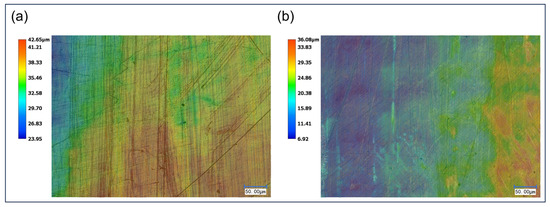
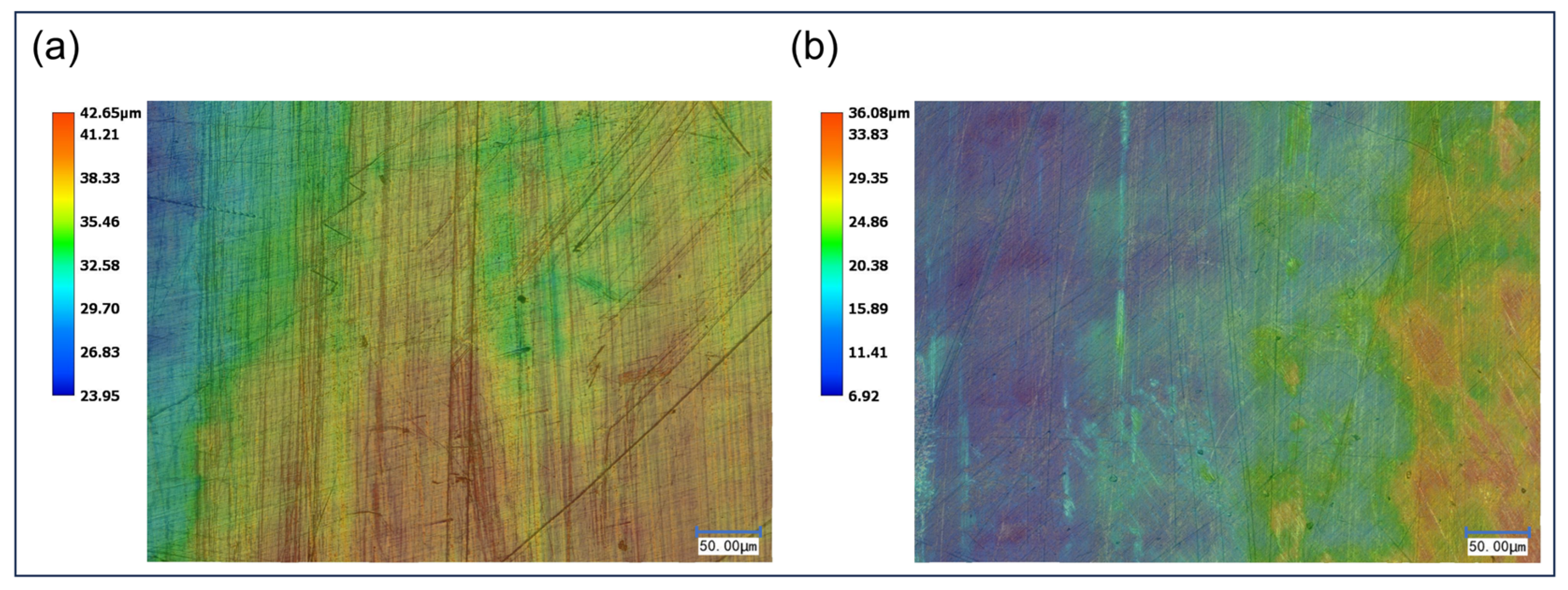
As shown in Figure 2, after a certain polishing duration, the original machining textures on the Ti-6Al-4V surface became partially blunted, and local asperity peaks were reduced to some extent. This indicates that liquid metal-driven abrasive slurry polishing is capable of removing material from the Ti-6Al-4V surface. However, from the overall topographical characteristics, the polished surface still retained relatively pronounced directional textures, suggesting that although the process can achieve preliminary surface leveling, its ability to continuously perform deep and uniform finishing on Ti-6Al-4V flow channels remains limited. In other words, direct polishing can improve the surface quality, but it is insufficient to sustain a strong and stable material-removal effect over prolonged polishing durations.
Figure 2.
Surface morphologies of the flow channel before and after polishing: (a) before polishing; (b) after polishing.
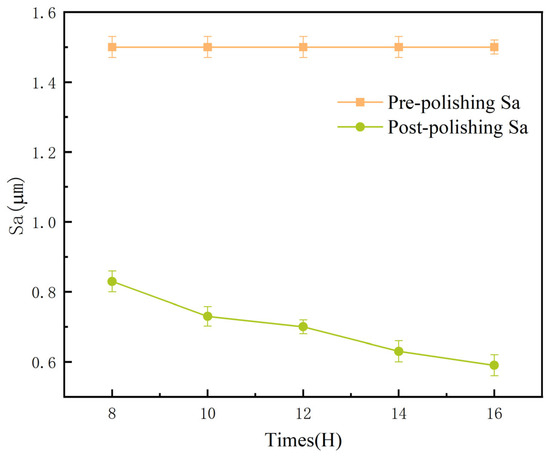
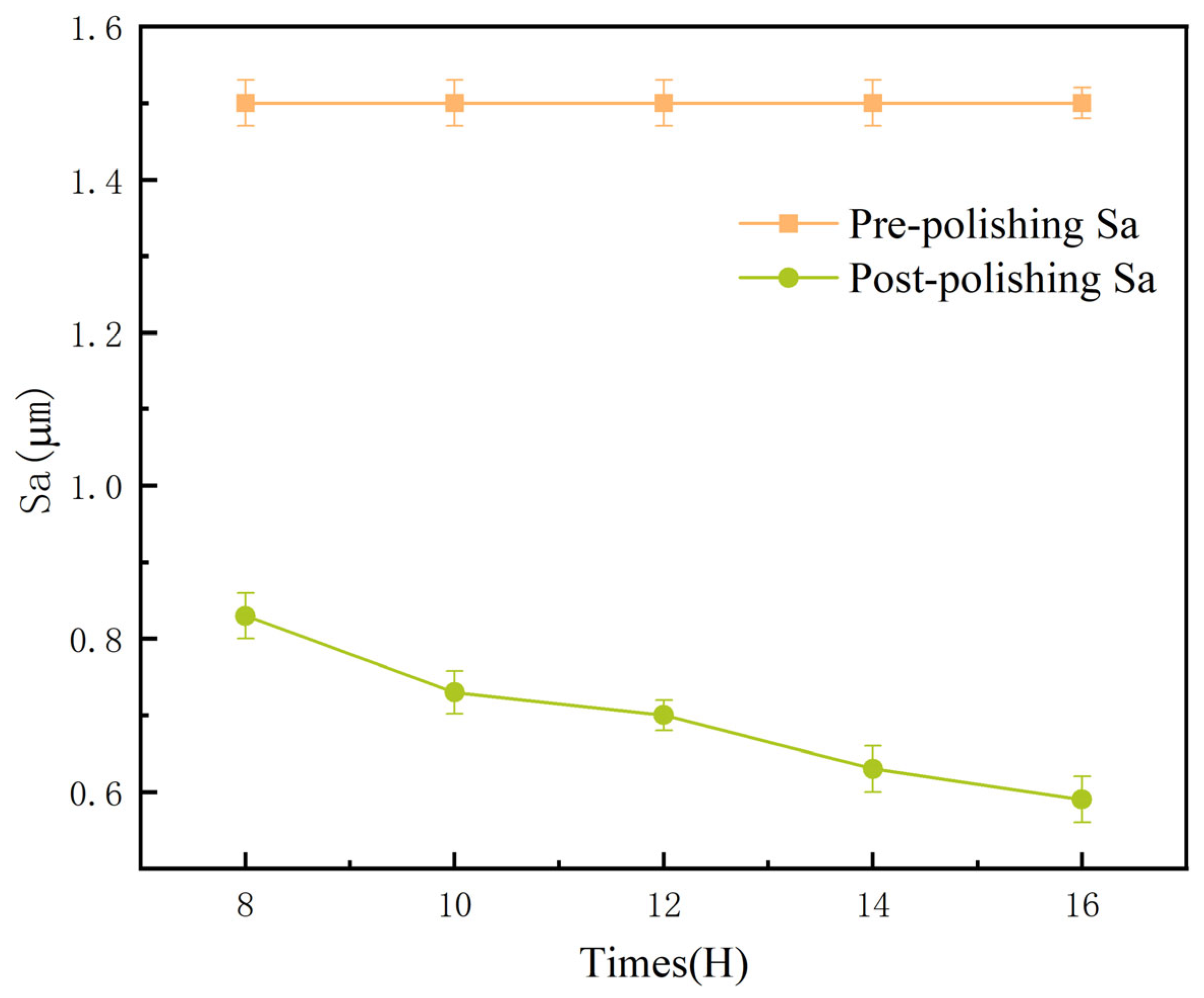
The roughness results further reveal the capability-boundary characteristics of the direct polishing process. As presented in Figure 3, when the polishing time increased from 8 h to 16 h, the areal surface roughness continuously decreased overall, indicating that liquid metal-driven abrasive slurry polishing indeed possesses a sustained material-removal capability under direct polishing conditions. However, it is noteworthy that the reduction rate of was not constant. During the initial polishing stage (8–10 h), the roughness decreased more markedly, whereas in the later stage (after 12 h), the variation in gradually diminished and eventually approached a stable value. This result indicates that, although the polishing process continued, the effective material-removal capability decayed significantly with time, thereby exhibiting a typical “efficiency attenuation–plateau approach” behavior.
Figure 3.
Evolution of areal surface roughness with polishing time for Ti-6Al-4V flow channels.
From the perspective of process capability, the plateauing trend shown in Figure 3 implies that, under a given set of process parameters, direct polishing of Ti-6Al-4V flow channels possesses a distinct attainable surface-quality boundary. In other words, although the surface quality can be continuously improved with increasing polishing time, once the surface evolution reaches a certain stage, the time and energy required for further roughness reduction increase substantially, while the actual improvement becomes marginal. This suggests that, for Ti-6Al-4V internal flow channels, it is difficult to realize sustained and efficient deep-level finishing solely through single-step direct liquid metal-driven abrasive slurry polishing, and the late-stage processing capability is clearly constrained.
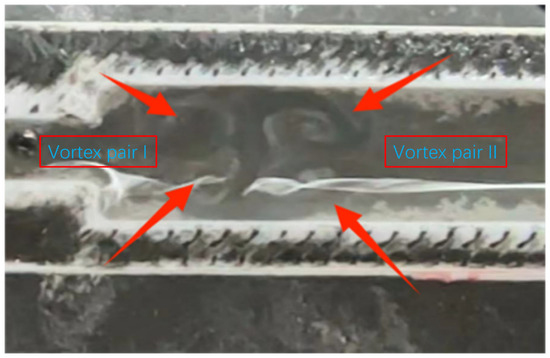
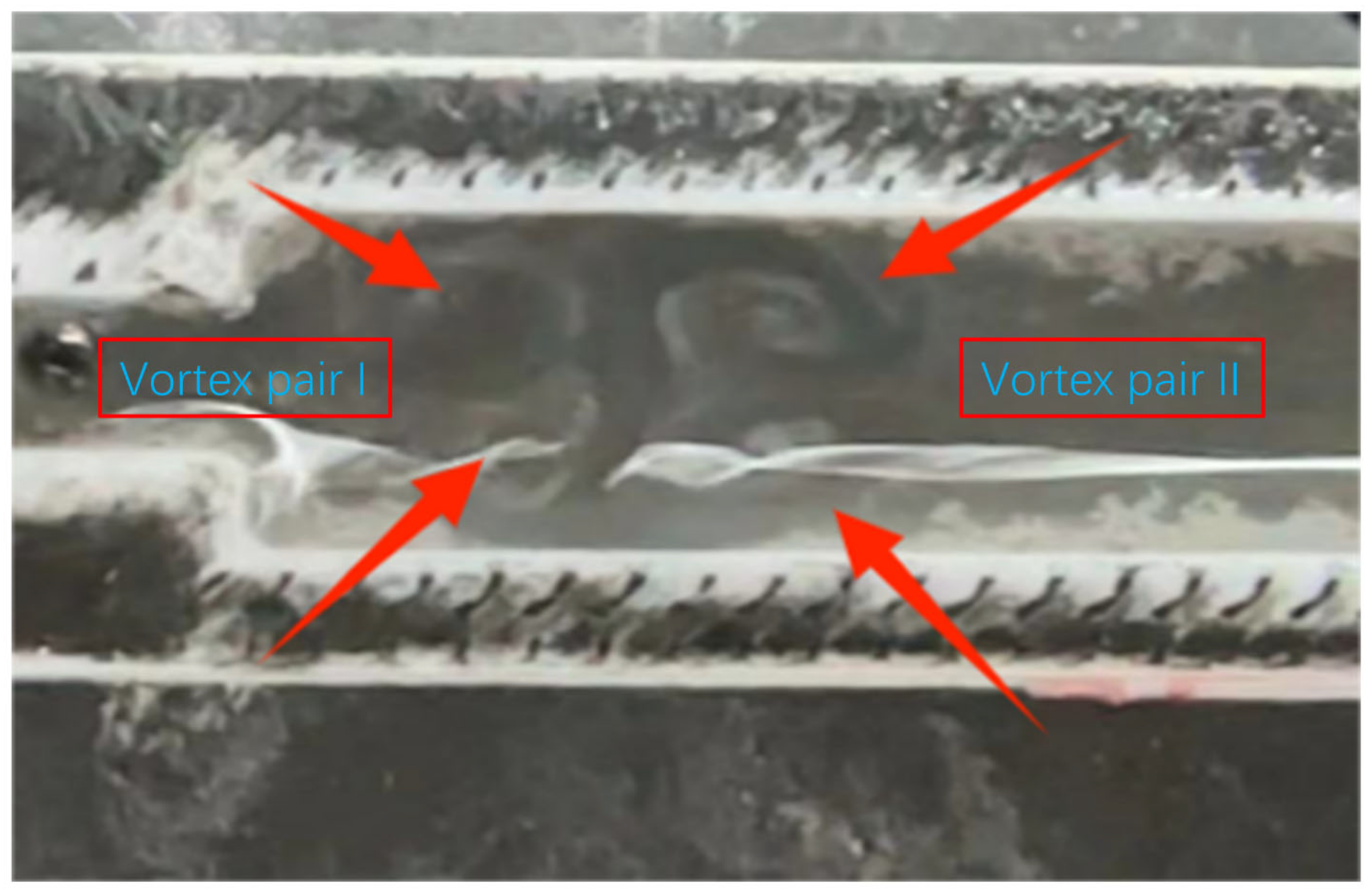
Further observations of the polishing process indicate that, as illustrated in Figure 4, the reciprocating motion of the liquid-metal droplet within the channel induces a four-vortex recirculation structure around the droplet, which can be interpreted as two pairs of counter-rotating vortices. These vortices enhance the local entrainment, redistribution, and disturbance of surrounding abrasive particles. However, the abrasive-particle impacts on the channel wall remain noticeably intermittent and unstable, making it difficult to sustain strong and effective mechanical interaction throughout the entire polishing process. This suggests that the material-removal behavior during direct polishing does not remain persistently efficient, but is instead relatively strong at the initial stage and gradually weakens thereafter. It can therefore be inferred from the motion characteristics shown in Figure 5 that, although the liquid metal is capable of initiating abrasive-driven material removal, its ability to maintain continuous effective removal on Ti-6Al-4V surfaces is insufficient, which constitutes one of the main reasons for the subsequent roughness plateauing.
Figure 4.
Two pairs of symmetric counter-rotating vortices formed around the moving liquid-metal droplet, promoting abrasive-particle entrainment and particle–wall interaction within the channel.
Figure 5.
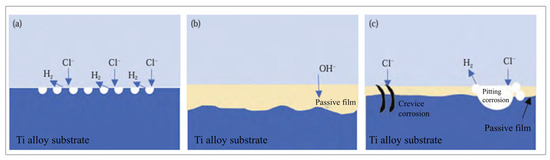
Schematic illustration of the corrosion/reaction mechanisms of titanium alloy in different solutions: (a) HCl solution; (b) NaOH solution; (c) NaCl solution.
In summary, as evidenced jointly by the morphology comparison in Figure 2, the roughness evolution in Figure 3, and the particle-motion characteristics in Figure 4, Ti-6Al-4V channel bottom surfaces exhibit a pronounced polishing capability boundary under direct liquid metal-driven abrasive slurry polishing. As polishing proceeds, the material-removal efficiency gradually decreases and the surface roughness approaches a plateau, indicating that single-step direct polishing is unable to further reduce roughness beyond its attainable surface-quality limit.
3.2. Reaction-Layer-Controlled Mechanism Governing the Limitation of Direct Polishing
To further elucidate the fundamental origin of the efficiency attenuation observed in the later stage of direct polishing, it is necessary to analyze the surface reaction behavior of titanium alloy in the electrolyte environment. Previous studies have shown that titanium alloys readily form a dense and stable oxide/passivation layer in alkaline or electrolyte-containing media, as schematically illustrated in Figure 5 [41,42,43]. This oxide film is mainly composed of TiO2, and its formation and stability are closely related to the intrinsic passivation behavior of Ti and Ti-6Al-4V alloys in chemically aggressive environments [39,44]. Notably, recent advances in reversible metal electrodeposition for dynamic surface modulation further highlight the potential of electrochemical methods to actively control surface reactivity and oxide layer evolution [45]. Moreover, previous studies have shown that such a dense passivation layer can significantly hinder further material dissolution [44], while its removal and regeneration during electrochemically assisted polishing strongly influence the efficiency and continuity of material removal [39].
This behavior is also consistent with previous studies on titanium-alloy polishing, which reported that the formation and regeneration of a dense oxide/passivation layer can gradually reduce the effective interaction between abrasives and the metallic substrate, thereby lowering the material-removal efficiency during prolonged processing [37,40,42]. In addition, electrochemical- or chemical-assisted polishing studies have shown that, once the surface film formation rate approaches the removal rate, the polishing process tends to enter a lower-efficiency regime, in which further roughness reduction becomes increasingly limited [38,40]. This explains why direct liquid-metal-driven abrasive slurry polishing can improve the surface quality at the early stage but cannot maintain a strong and stable material-removal effect over prolonged polishing durations.
In an acidic HCl solution, the passive oxide film on the Ti-6Al-4V surface tends to dissolve under the synergistic action of high-concentration and , thereby exposing the metallic substrate to continuous dissolution. The main reactions can be expressed as follows:
In addition, the minor alloying elements Al and V may also undergo acidic dissolution accompanied by hydrogen evolution:
In contrast, in an alkaline NaOH solution, the Ti-6Al-4V surface can spontaneously form a dense and stable passive film. Under such conditions, the film formation rate is generally much higher than the film breakdown rate, and only at sufficiently high concentration or under local disturbance can partial film rupture and substrate dissolution occur. The corresponding reactions may be described as:
In a neutral NaCl solution, corrosion mainly originates from the local penetration and adsorption of on the passive film. As a result, only local dissolution and -itting tend to occur at film-defect sites. The relevant reactions can be written as:
As indicated by the reaction pathways summarized in Figure 5, the Ti-6Al-4V surface film possesses relatively high hardness and good chemical stability, and therefore tends to act as the preferred interaction interface under mechanical loading. Consequently, during direct liquid metal-driven abrasive slurry polishing, the impact energy of abrasive particles is largely consumed in disrupting the surface reaction layer, rather than being continuously transferred to effective substrate removal. Once the formation and removal of the oxide film gradually approach a dynamic balance, the material removal rate decreases significantly, thereby restricting further improvement in surface quality.
When interpreted together with the roughness evolution presented in Section 3.1, this mechanism explains the characteristic transition from rapid initial roughness reduction to subsequent plateauing behavior. At the early stage of polishing, the dominant surface asperities are preferentially removed, and the abrasive particles can still interact relatively effectively with the substrate, thereby leading to a noticeable decrease in . However, as polishing proceeds, the continuous regeneration of the oxide/reaction layer increasingly shields the metallic substrate from direct abrasive action. Consequently, the abrasive particles progressively shift from cutting the substrate to repeatedly disturbing and removing the surface reaction film, which significantly reduces the effective material-removal rate. Once the rates of film formation and film disruption approach a dynamic balance, the polishing process enters a quasi-steady regime in which further improvement in surface quality becomes increasingly difficult.
From a mechanistic perspective, this indicates that the limitation of direct polishing is not solely attributable to the finite driving capability of the liquid metal but is more fundamentally governed by the dynamic evolution of the surface reaction layer. Because the liquid metal-driven abrasive flow is characterized by multidirectional, intermittent, and stochastic particle–wall interactions, its polishing effectiveness is highly sensitive to the initial and evolving mechanical state of the wall surface. When the surface is covered by a dense and stable reaction layer, the abrasive particles are unable to sustain efficient micro-cutting over prolonged polishing durations, even though the liquid metal continues to move within the channel. Therefore, the late-stage decline in polishing efficiency should be interpreted as a surface-state-controlled limitation rather than a simple kinematic weakening of liquid metal motion.
This analysis further implies that any effective strategy for improving the polishing performance of Ti-6Al-4V flow channels must address the evolution of the near-surface reaction layer. In other words, enhancing the polishing efficiency cannot rely exclusively on increasing the duration of direct polishing, but instead requires a means of regulating the surface state prior to or during polishing so as to reduce the mechanical resistance imposed by the dense reaction film. This consideration provides the mechanistic basis for introducing an electric-field-assisted chemical pretreatment step before the liquid metal-driven abrasive polishing stage.
3.3. Improvement in Surface Response Induced by Electric-Field-Assisted Pretreatment
Based on the above analysis, the key to improving the polishing performance of Ti-6Al-4V internal flow channels lies in regulating the initial surface state prior to the abrasive action, so that the near-surface layer becomes more susceptible to subsequent mechanical removal. To achieve this goal, an electric-field-assisted chemical pretreatment step was introduced before the liquid metal-driven abrasive slurry polishing stage, thereby forming the proposed two-step route, namely AB + P.
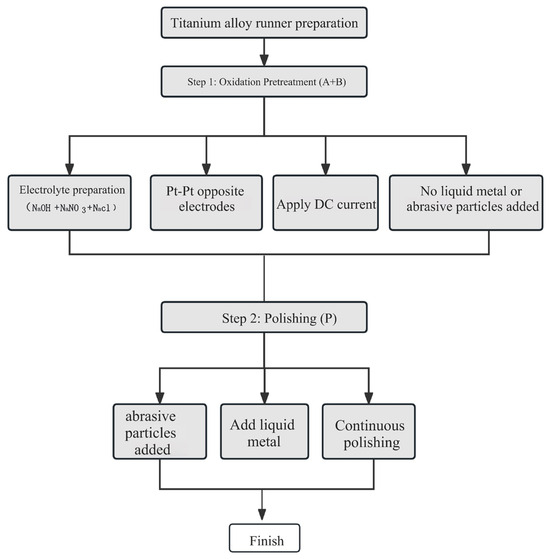
As illustrated in Figure 6, the proposed two-step process consists of an electric-field-assisted chemical pretreatment stage followed by the conventional liquid metal-driven abrasive polishing stage. During pretreatment, the synergistic action of the externally applied electric field and the alkaline chemical environment modifies the interfacial reaction conditions near the channel wall. Instead of directly removing bulk substrate material, this stage primarily acts to regulate the evolution pathway of the surface layer. As a consequence, the originally dense and mechanically resistant surface film is progressively transformed into a relatively looser and more removable reaction layer, which is more favorable for the subsequent impact, sliding, and micro-cutting actions of abrasive particles. In this sense, the pretreatment step does not directly replace the polishing process itself but rather establishes a more advantageous initial interfacial state for the following liquid metal-driven abrasive action.
Figure 6.
Schematic illustration of the electric-field-assisted chemical pretreatment and subsequent liquid metal-driven abrasive polishing process.
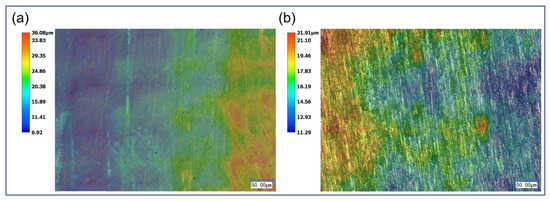
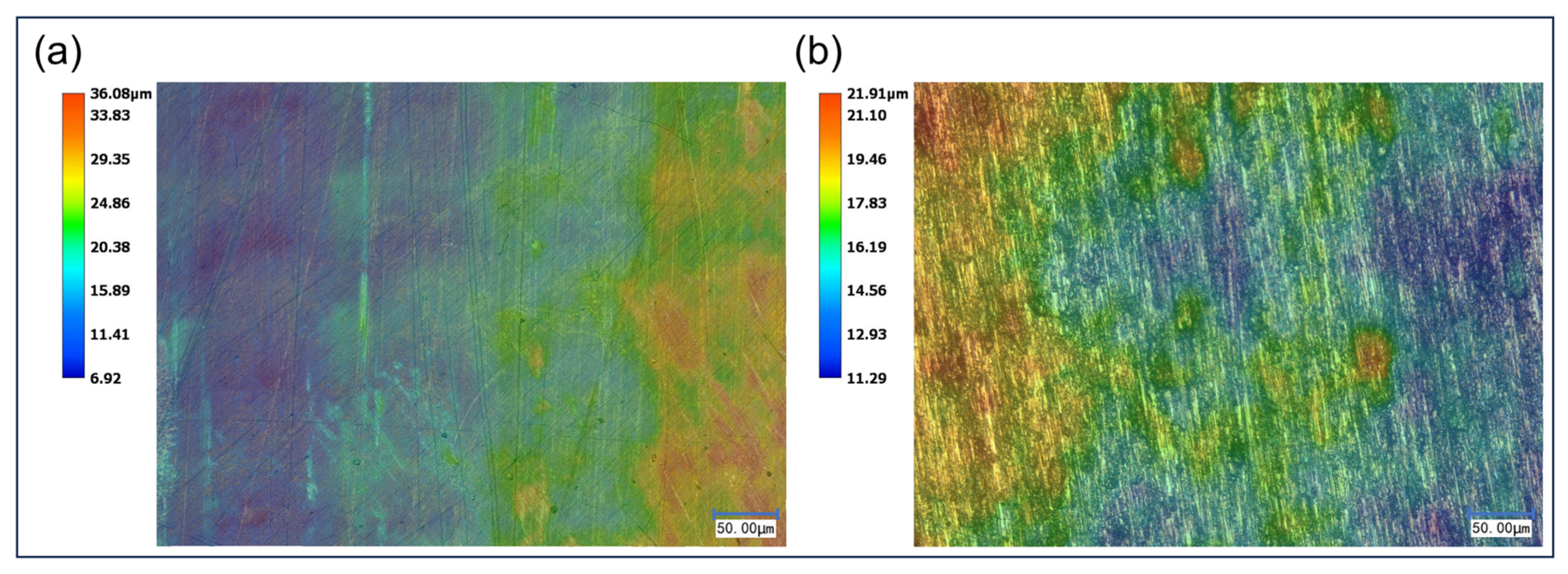
The experimental results demonstrate that the introduction of electric-field-assisted pretreatment leads to a clear improvement in the polishing response of the Ti-6Al-4V channel bottom surface. As shown in Figure 7, compared with the directly polished surface, the surface treated by the AB + P route exhibits a more homogeneous topography, weaker residual directional textures, and reduced local height fluctuations. These morphological differences indicate that the pretreatment step enhances the effectiveness of the subsequent abrasive–wall interaction and suppresses the persistence of the original surface features. In other words, the polishing action after pretreatment is not only stronger in magnitude but also more spatially uniform.
Figure 7.
Comparison of surface morphologies after polishing. (a) Surface morphology after direct polishing (P); (b) Surface morphology after electric-field-assisted pretreatment followed by chemical polishing (AB + P).
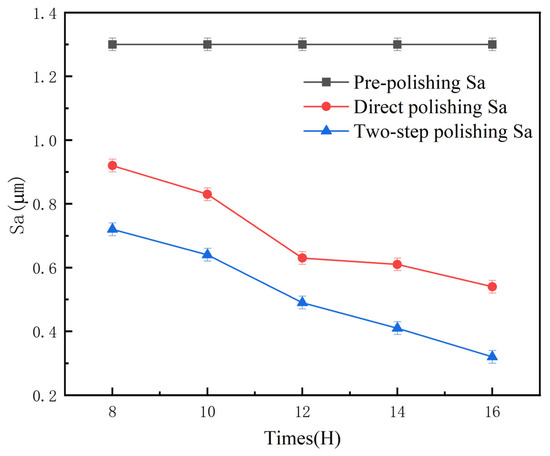
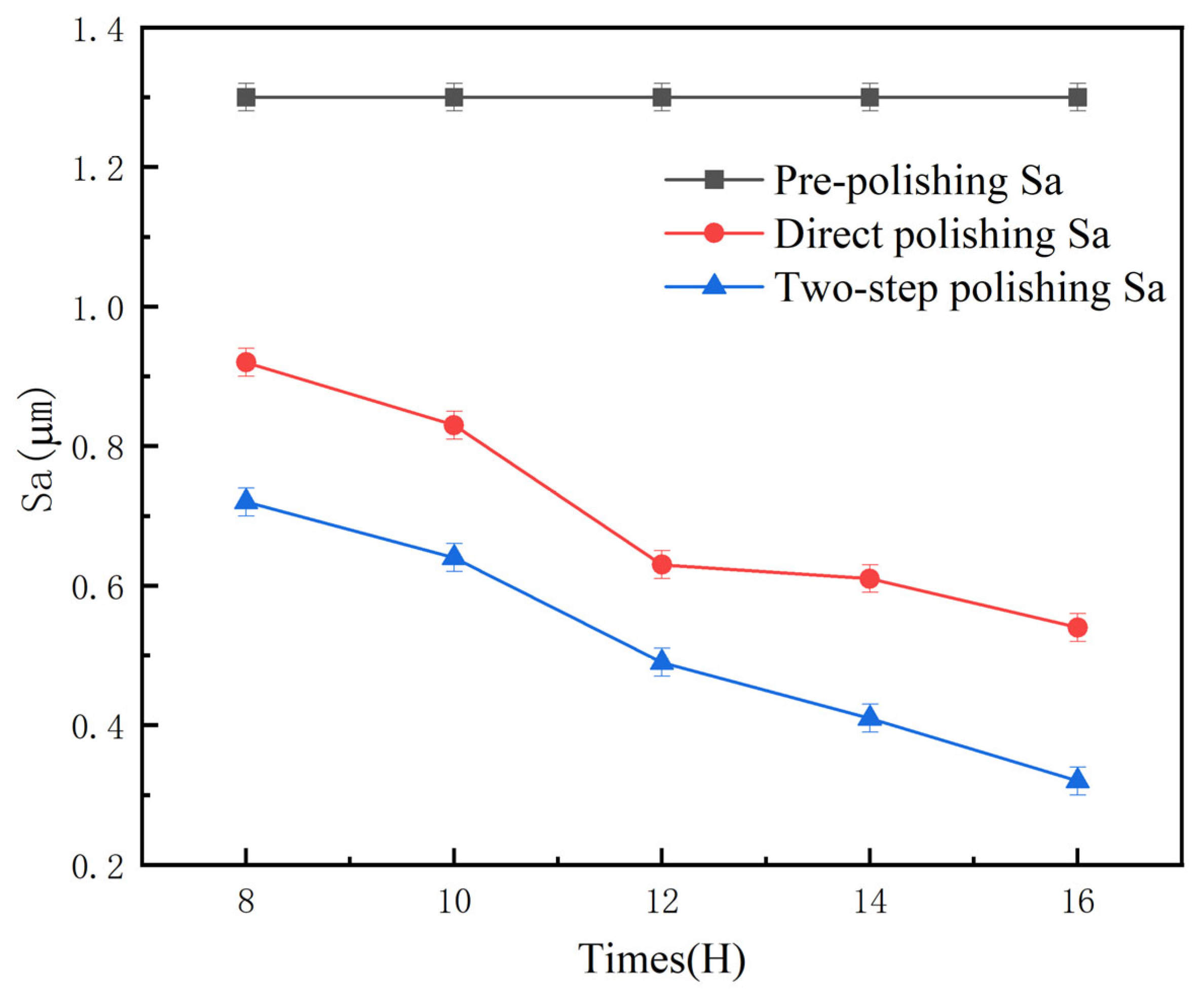
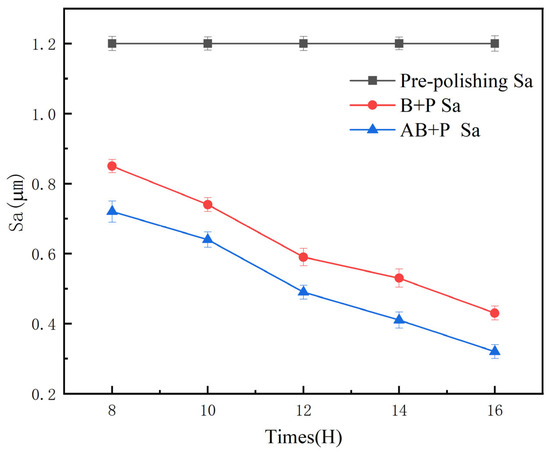
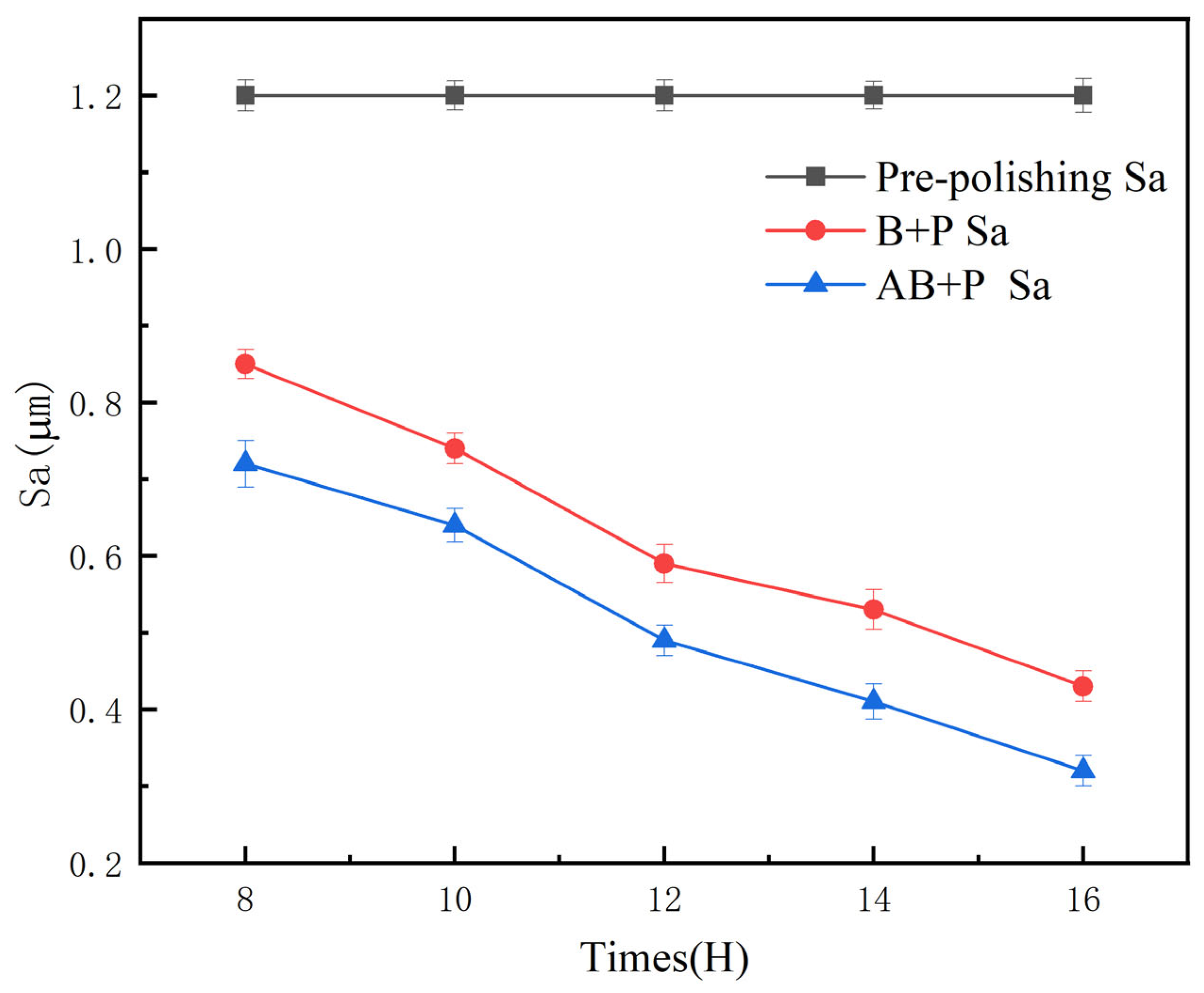
The roughness evolution further confirms the beneficial effect of the pretreatment step. As presented in Figure 8, under the same polishing duration, the AB + P route consistently yields lower values than the direct polishing route. The error bars shown in Figure 8 represent the standard deviation calculated from three independent measurements. More importantly, the superiority of AB + P becomes evident already at the early stage of polishing, suggesting that the pretreatment improves the initial interaction condition between the abrasive particles and the Ti-6Al-4V wall. As a result, the process enters an effective and relatively stable material-removal regime earlier than in the direct polishing case. This behavior is particularly important for titanium alloys, for which the direct polishing route is strongly affected by rapid surface-film regeneration and therefore suffers from early efficiency attenuation.
Figure 8.
Evolution of areal surface roughness for different process routes under identical polishing durations. Error bars represent standard deviation (n = 3).
From a mechanistic point of view, the advantage of AB + P should not be interpreted merely as an increase in chemical activity or a simple strengthening of the polishing environment. Rather, its essential effect lies in altering the initial surface-state evolution pathway. As suggested by the process mechanism in Figure 6, the pretreatment stage preconditions the wall surface into a more mechanically accessible state, thereby allowing the abrasive particles in the subsequent polishing stage to spend a larger proportion of their kinetic energy on effective removal instead of repeatedly overcoming a highly stable passive layer. Correspondingly, the morphological improvement shown in Figure 7 and the lower roughness evolution in Figure 8 together indicate that the continuity of material removal is improved and that the overall polishing response becomes more stable and sustained. These results demonstrate that surface-state preconditioning is a feasible and effective strategy for mitigating the polishing limitation of Ti-6Al-4V flow channels under liquid metal-driven abrasive slurry finishing.
Mechanistically, the beneficial effect of surface-state pretreatment can be understood as a preconditioning process that alters the initial interfacial reaction pathway of Ti-6Al-4V before abrasive action. Under the combined action of the external electric field and the pretreatment electrolyte, ion migration, local oxidation, partial dissolution, and repassivation are actively regulated near the channel wall, so that the originally dense and mechanically resistant passive layer is transformed into a relatively looser and more removable reaction layer. As a result, during the subsequent LM-driven abrasive polishing stage, a larger fraction of abrasive kinetic energy can be used for effective substrate-oriented removal rather than being repeatedly consumed in overcoming a highly stable surface film. This mechanism explains why the AB + P route exhibits improved polishing continuity, a weaker plateauing tendency, and a lower attainable roughness level compared with direct polishing.
3.4. Extension of the Attainable Surface-Quality Limit by the Two-Step Process
In evaluating a polishing strategy, it is not sufficient to consider only the initial roughness reduction rate; more importantly, the attainable surface-quality limit under prolonged processing must also be assessed. As discussed in Section 3.1, under direct liquid metal-driven abrasive slurry polishing, the surface roughness of Ti-6Al-4V flow channels decreases continuously but gradually approaches a plateau at extended polishing times. This behavior indicates that the process progressively evolves into a low-efficiency removal regime governed by the resistance of the surface reaction layer, thereby imposing a practical limit on the minimum achievable roughness.
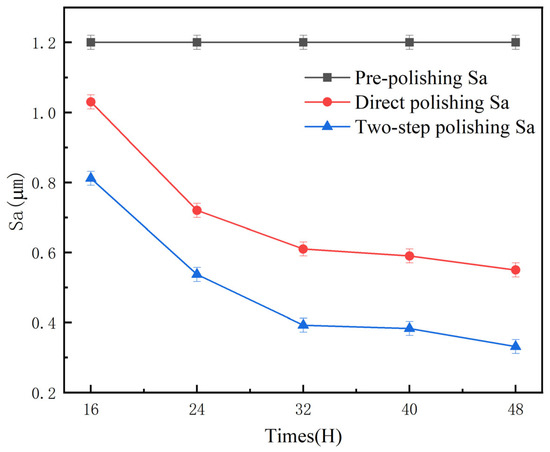
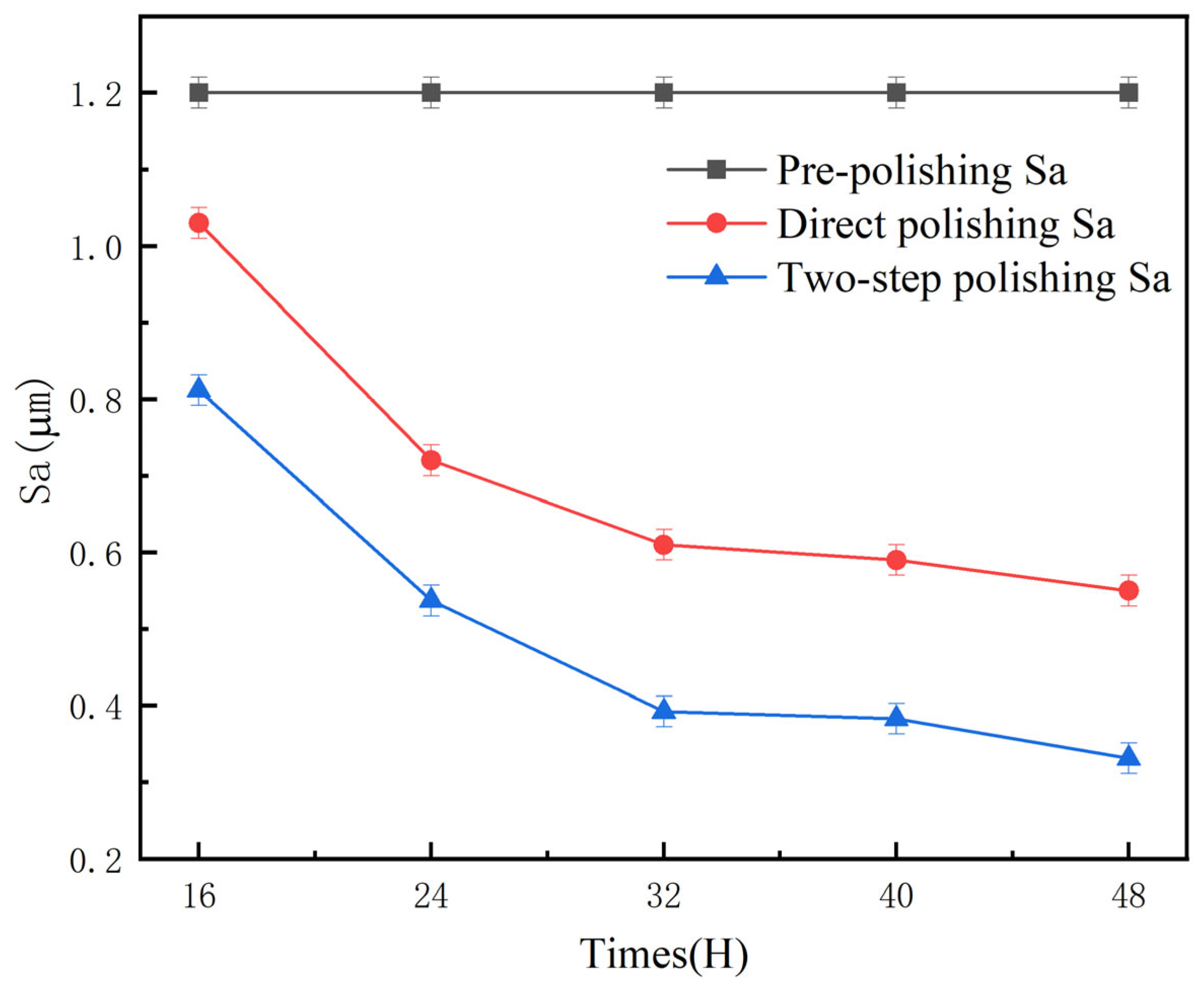
As shown in Figure 9, the AB + P route exhibits a distinctly different long-term polishing response from that of direct polishing. The error bars shown in Figure 9 represent the standard deviation calculated from three independent measurements. Although the rate of roughness reduction in the two-step process also decreases to some extent with polishing time, the corresponding stable-stage remains significantly lower than that obtained by direct polishing. In other words, the two-step process effectively shifts the roughness plateau downward, indicating that a lower ultimate surface-quality level can be reached under otherwise comparable polishing conditions. This result demonstrates that the role of electric-field-assisted pretreatment extends beyond merely enhancing the early-stage polishing response; it also fundamentally changes the long-term evolution of the finishing process.
Figure 9.
Comparison of the limiting behavior between direct polishing (P) and electric-field-assisted pretreatment followed by chemical polishing (AB + P). Error bars represent standard deviation (n = 3).
From the perspective of process capability, the downward shift in the limiting roughness level observed in Figure 9 implies that the proposed two-step strategy expands the attainable surface-quality boundary of the Ti-6Al-4V channel bottom surface under the present specimen configuration. Under direct polishing, the continuous regeneration of a dense reaction layer gradually suppresses the effectiveness of abrasive action, causing the process to approach a quasi-steady state in which further roughness reduction becomes increasingly difficult. In contrast, after electric-field-assisted pretreatment, the surface enters the polishing stage in a more favorable condition, which reduces the mechanical resistance associated with the surface layer and allows the abrasives to remain effective over a longer polishing duration. As a consequence, the period of meaningful material removal is prolonged, and the final attainable surface quality is improved.
Therefore, the advantage of the AB + P route should not be understood simply as “faster polishing” at the beginning of the process. Rather, its more important contribution lies in modifying the surface-state evolution pathway and sustaining the effectiveness of the chemical–mechanical interaction over time. The limiting-behavior comparison in Figure 9 thus confirms that the proposed two-step process not only enhances the transient polishing efficiency but also substantially improves the ultimate finishing capability of the liquid metal-driven abrasive slurry process for Ti-6Al-4V flow channels.
3.5. Influence of Pretreatment Electrification Time and Identification of an Effective Time Window
In the proposed AB + P route, the effectiveness of the pretreatment stage is directly governed by the electrification time; therefore, it is necessary to further clarify how the pretreatment duration influences the subsequent polishing response. To this end, a parametric investigation was conducted in which only the electrification time during the pretreatment stage was varied, while the electrolyte composition, abrasive concentration, electric-field parameters, and polishing duration in the subsequent stage were kept unchanged.
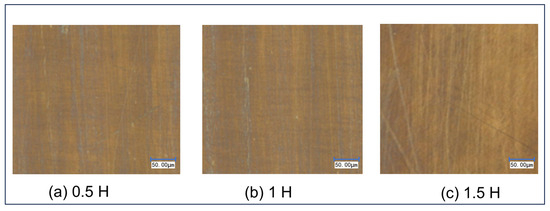
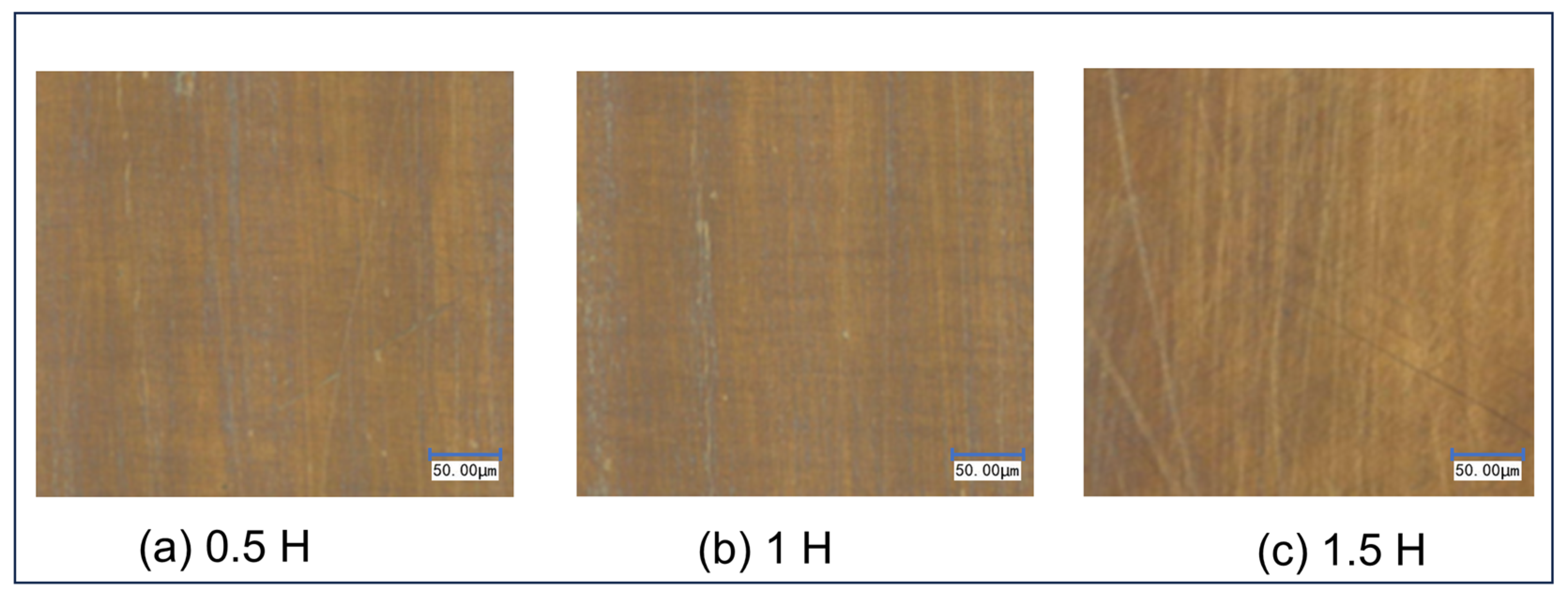
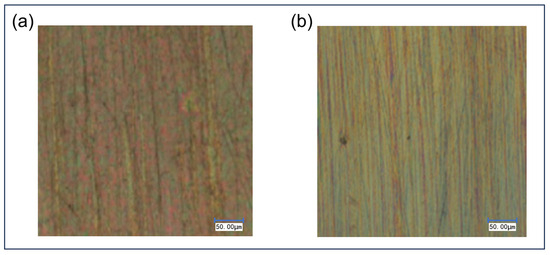
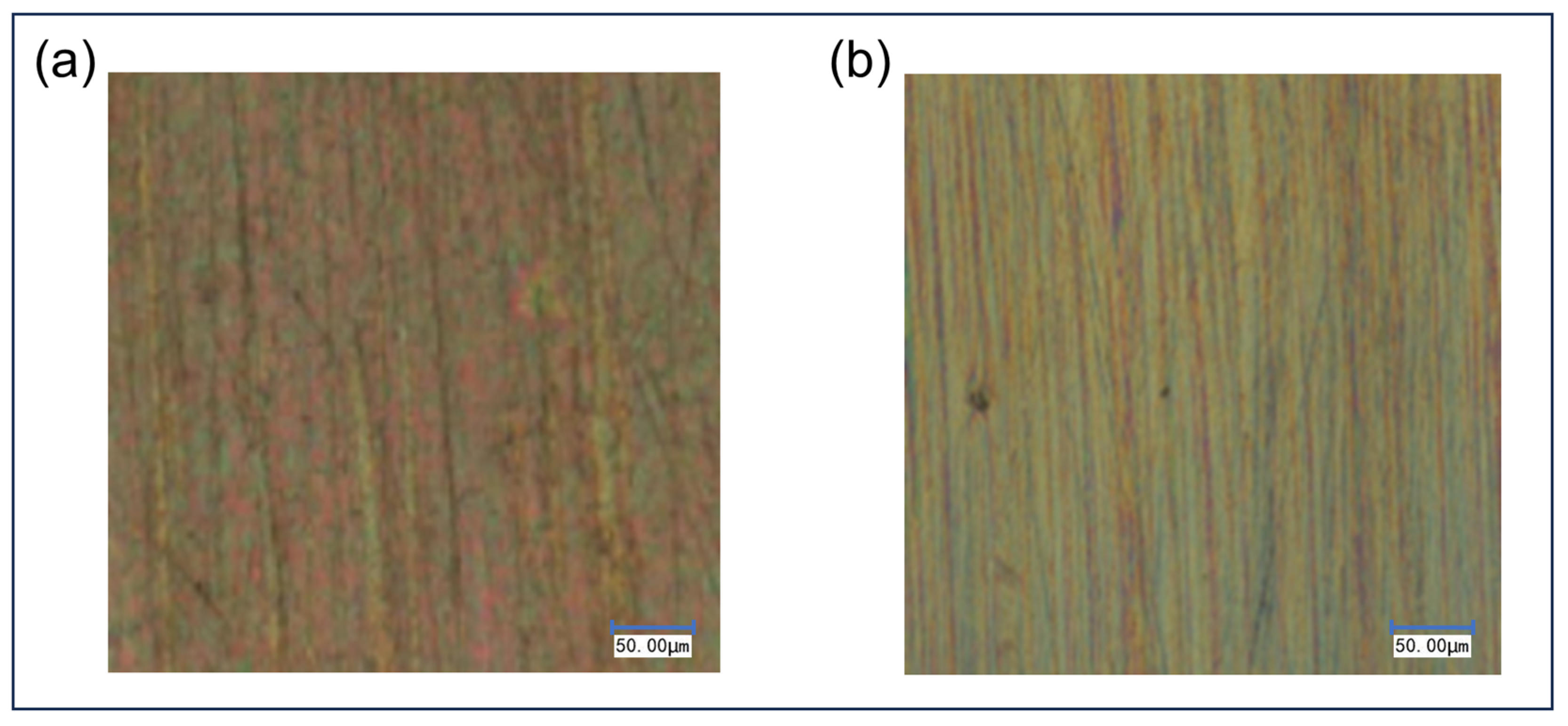
As shown in Figure 10, the pretreatment duration has a pronounced influence on the final polishing outcome. When the electrification time is relatively short, the polished surface still exhibits noticeable residual textures and local height fluctuations, indicating that the pretreatment is insufficient to adequately regulate the near-surface reaction layer. As the electrification time increases, the overall surface morphology becomes progressively more uniform, and the original machining marks are gradually weakened. This trend suggests that a longer pretreatment duration facilitates a more effective modification of the initial surface state, thereby creating a more favorable interfacial condition for the subsequent abrasive action.
Figure 10.
Surface morphologies obtained under different pretreatment electrification times. (a) 0.5 H; (b) 1 H; (c) 1.5 H.
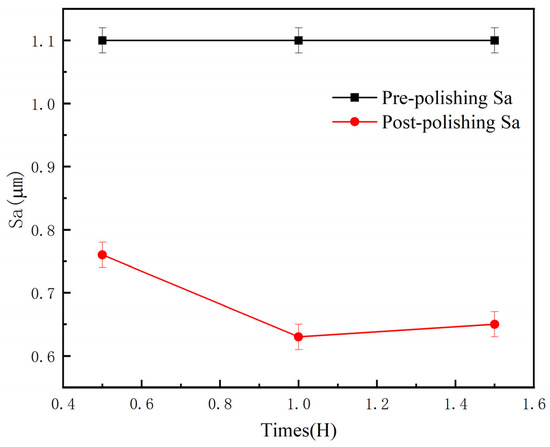
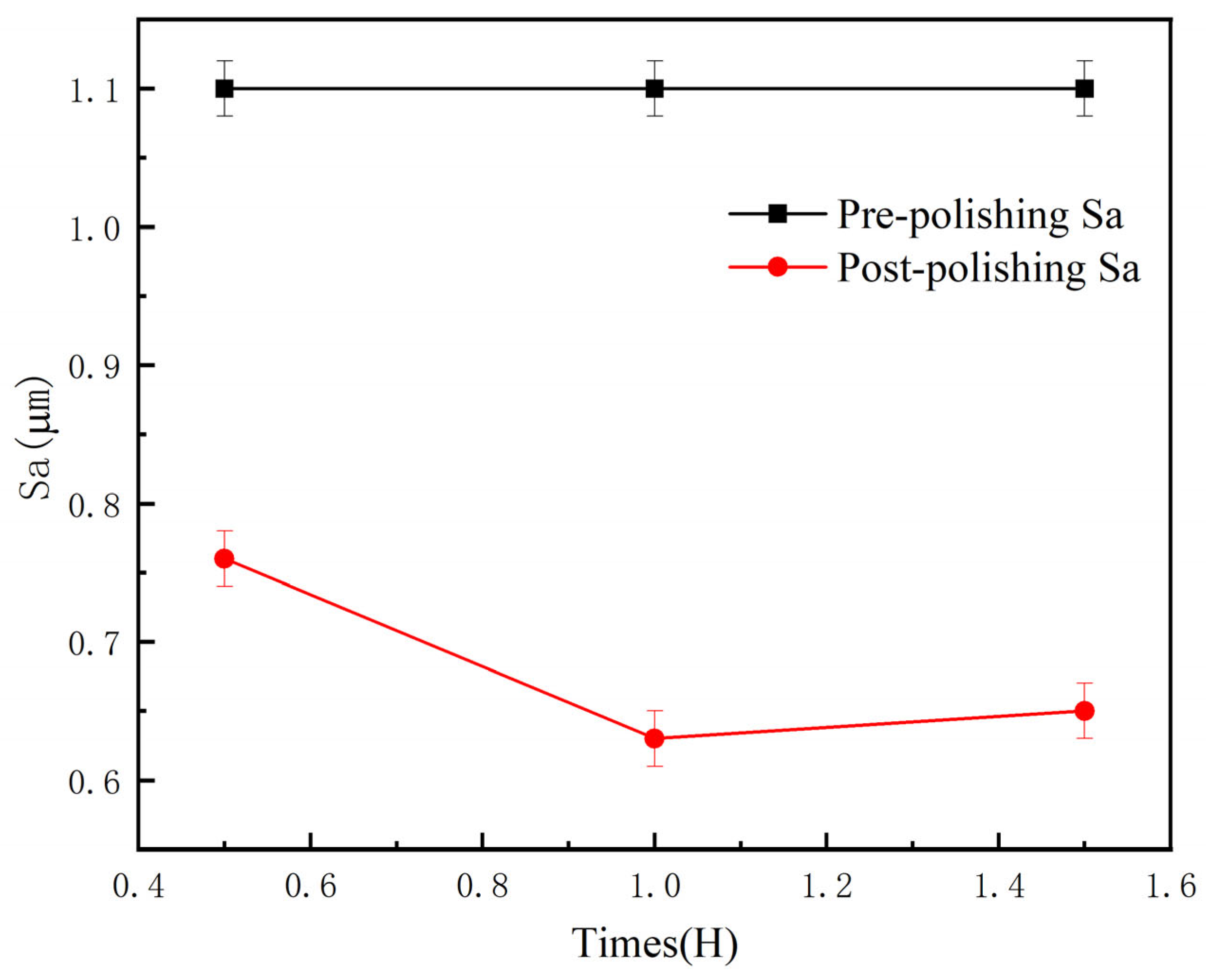
The corresponding roughness results further confirm this tendency. As presented in Figure 11, the final decreases markedly with increasing electrification time at the beginning, demonstrating that the extension of pretreatment duration can significantly improve the subsequent polishing performance. However, once the electrification time exceeds a certain range, the rate of roughness improvement gradually diminishes and the curve approaches a stable trend. This indicates that the beneficial effect of pretreatment does not increase indefinitely with time; instead, the process exhibits a characteristic “rapid improvement followed by gradual saturation” behavior.
Figure 11.
Variation in the final areal surface roughness as a function of pretreatment electrification time.
From a mechanistic standpoint, the morphology evolution in Figure 10 and the roughness trend in Figure 11 can be understood in terms of the progressive regulation of the surface reaction layer. At insufficient pretreatment durations, the original dense and mechanically resistant surface state is only partially modified, so the subsequent polishing stage still suffers from a strong surface-layer constraint similar to that observed in direct polishing. With increasing electrification time, the near-surface state is more effectively transformed into a relatively loose and removable reaction layer, thereby facilitating more sustained and efficient abrasive–wall interaction. Nevertheless, once the surface-state regulation approaches a quasi-steady condition, further prolongation of the pretreatment stage contributes only marginally to the improvement in polishing performance, because the surface has already reached a sufficiently favorable preconditioned state.
Therefore, the pretreatment electrification time should not be regarded as a parameter that simply needs to be maximized. Instead, the present results clearly demonstrate the existence of an effective time window, within which the pretreatment can efficiently improve the subsequent polishing response, whereas beyond this window the marginal gain becomes increasingly limited. This finding highlights the tunability of the AB + P route and provides an important basis for optimizing the pretreatment parameters in practical applications.
3.6. Independent Contribution and Necessity of Electric-Field-Assisted Pretreatment
To further clarify the origin of the performance enhancement achieved by the proposed two-step process, a controlled comparison was conducted between the B + P route and the AB + P route. In this comparison, all processing conditions in the subsequent polishing stage were kept strictly identical, including the electrolyte composition, abrasive concentration, liquid metal size, electric field parameters, and polishing duration. Therefore, the only difference between the two routes lies in whether an external electric field was applied during the pretreatment stage. Such an experimental design provides a clear causal framework for distinguishing the respective roles of the chemical environment and electric-field assistance in the overall polishing performance.
The surface morphology results reveal a distinct difference between the two pretreatment strategies. As shown in Figure 12, after the B + P route, the polished Ti-6Al-4V surface exhibits a certain degree of smoothing, indicating that the chemical pretreatment alone can modify the initial surface condition to some extent. However, noticeable directional textures and local height fluctuations remain on the surface, suggesting that the effect of pure chemical pretreatment is limited and insufficient to generate a sufficiently uniform and easily removable surface layer. In contrast, the AB + P route produces a much more homogeneous surface morphology, with significantly weakened residual textures and a more continuous topographical distribution. This comparison indicates that the introduction of electric-field assistance substantially improves the effectiveness of the pretreatment stage.
Figure 12.
Comparison of surface morphologies after different pretreatment routes: (a) B + P; (b) AB + P.
The roughness results further support the morphological observations. As presented in Figure 13, although both B + P and AB + P outperform the direct polishing route to different extents, the AB + P route consistently yields lower values than B + P under the same subsequent polishing conditions. More importantly, the roughness evolution of B + P still exhibits a relatively pronounced plateauing tendency at the later stage, whereas AB + P maintains a more sustained improvement and eventually reaches a lower stable roughness level. This result demonstrates that chemical pretreatment alone is unable to fully eliminate the polishing limitation associated with the Ti-6Al-4V surface state, while the introduction of the electric field can significantly strengthen the surface regulation effect achieved during pretreatment.
Figure 13.
Comparison of the roughness evolution and final values between B + P and AB + P.
From a mechanistic perspective, the difference between B + P and AB + P indicates that the improved polishing performance of the two-step process cannot be attributed solely to the chemical environment. As evidenced by the contrast between Figure 12 and Figure 13, under purely chemical pretreatment conditions, the surface reaction behavior is governed mainly by spontaneous solution–surface interactions, whose regulating effect is relatively weak and spatially less controllable. In contrast, when an external electric field is introduced during pretreatment, the interfacial reaction conditions near the channel wall are actively modified through field-assisted ion migration and localized electrochemical response. This promotes the formation of a more favorable preconditioned surface layer, which can be more effectively disrupted and removed during the subsequent abrasive polishing stage. As a result, the abrasive particles can interact more continuously and efficiently with the wall, thereby mitigating the polishing attenuation induced by the persistent reaction layer.
Previous studies have shown that electrochemical- or chemical-assisted polishing of titanium alloys can improve surface quality by modifying the oxide/passivation layer and facilitating its subsequent removal [36,37,39]. However, these studies have been mainly focused on open surfaces or conventional simultaneous electrochemical–mechanical interactions, rather than confined internal channels. In comparison, the present results demonstrate that the proposed AB + P route is not only capable of reducing the Sa value more effectively than direct polishing, but also of shifting the roughness plateau to a lower level and prolonging the effective material-removal stage. These features indicate that the electric-field-assisted pretreatment in the present work provides a more favorable initial surface state for subsequent LM-driven abrasive action. Therefore, compared with previously reported electrochemical-assisted polishing strategies, the present method extends the applicability of surface-state-regulated polishing to Ti-6Al-4V internal flow channels under liquid-metal-driven conditions.
Therefore, the present comparison confirms that the electric-field-assisted pretreatment step provides an independent and indispensable contribution to the enhancement of Ti-6Al-4V flow-channel polishing. Its role is not merely auxiliary, but mechanistically essential for transforming the surface-state evolution pathway and enabling the subsequent liquid metal-driven abrasive slurry process to operate in a more sustained and effective material-removal regime.
4. Conclusions
In this study, the applicability, polishing capability, and underlying mechanism of an electric-field-assisted chemical pretreatment combined with liquid metal-driven abrasive slurry polishing were systematically investigated for Ti-6Al-4V internal flow channels. Based on the experimental results, the main conclusions are as follows:
- (1)
- Direct liquid metal-driven abrasive slurry polishing can improve the surface quality of Ti-6Al-4V internal flow channels, as confirmed by the morphology evolution and the continuous decrease in Sa with polishing time. However, the reduction in Sa becomes progressively smaller in the later stage, and the roughness evolution curve gradually approaches a plateau, indicating that the effective material-removal capability decays significantly during prolonged polishing.
- (2)
- The experimental observations, together with the reaction analysis, indicate that the attenuation of direct polishing is closely associated with the dynamic evolution of the surface reaction layer. During prolonged polishing, abrasive particles increasingly interact with the dense and mechanically resistant oxide/reaction layer rather than directly with the metallic substrate, so that the material-removal process gradually shifts from a relatively effective substrate-removal regime to a lower-efficiency film-dominated regime.
- (3)
- Compared with direct polishing, the proposed AB + P route yields more homogeneous surface morphologies, consistently lower Sa values, and a weaker plateauing tendency under the same polishing duration. In particular, the roughness plateau is shifted to a lower level, demonstrating that the two-step process not only improves the transient polishing response but also extends the attainable surface-quality boundary of Ti-6Al-4V internal flow channels.
- (4)
- The pretreatment electrification time has a significant influence on the final polishing performance. With increasing pretreatment duration, the final surface morphology becomes more uniform and the Sa value decreases markedly at the beginning; however, the improvement gradually saturates after a certain duration. This result confirms the existence of an effective operating window for pretreatment time rather than a simple “the longer, the better” relationship.
- (5)
- The controlled comparison between B + P and AB + P shows that the performance enhancement cannot be explained by the chemical environment alone. Under identical subsequent polishing conditions, AB + P achieves a more uniform morphology, lower roughness, and a weaker late-stage plateauing tendency than B + P, indicating that the electric-field-assisted pretreatment provides an additional and indispensable contribution to the improvement of polishing continuity and effectiveness.
Overall, the present results demonstrate that electric-field-assisted chemical pretreatment is an effective strategy for mitigating polishing attenuation and improving the finishing capability of liquid metal-driven abrasive slurry polishing for Ti-6Al-4V internal flow channels. Future work will focus on quantitatively distinguishing the respective contributions of liquid-metal driving capability and surface reaction-layer evolution, extending the proposed method to more complex three-dimensional internal channel geometries, and optimizing electrochemical–mechanical coupling conditions to further improve process controllability and polishing efficiency.
Author Contributions
Conceptualization, Y.M. and B.F.; investigation, Y.M., K.L. and B.F.; methodology, Y.M., B.F. and L.Z.; software, K.L. and B.F.; formal analysis, B.F. and L.Z.; writing—original draft preparation, Y.M. and B.F.; writing—review and editing, K.L. and L.Z.; visualization, Y.M. and L.Z.; funding acquisition, L.Z.; supervision, L.Z. All authors have read and agreed to the published version of the manuscript.
Funding
The research work was funded by the National Natural Science Foundation of China (No. 52275456).
Data Availability Statement
The raw data supporting the conclusions of this article will be made available by the authors upon request.
Conflicts of Interest
The authors declare no conflicts of interest.
References
- Islam, S.A.; Hao, L.; Javaid, Z.; Xiong, W.; Li, Y.; Jamil, Y.; Chen, Q.; Han, G. Surface Roughness of Interior Fine Flow Channels in Selective Laser Melted Ti-6Al-4V Alloy Components. Micromachines 2024, 15, 348. [Google Scholar] [CrossRef] [Scilit]
- Lu, H.; Xu, M.; Gong, L.; Duan, X.; Chai, J.C. Effects of Surface Roughness in Microchannel with Passive Heat Transfer Enhancement Structures. Int. J. Heat Mass Transf. 2020, 148, 119070. [Google Scholar] [CrossRef] [Scilit]
- Huissoon, J.P.; Ismail, F.; Jafari, A.; Bedi, S. Automated Polishing of Die Steel Surfaces. Int. J. Adv. Manuf. Technol. 2002, 19, 285–290. [Google Scholar] [CrossRef] [Scilit]
- Cheung, C.F.; Wang, C.J.; Cao, Z.C.; Ho, L.T.; Liu, M.Y. Development of a Multi-Jet Polishing Process for Inner Surface Finishing. Precis. Eng. 2018, 52, 112–121. [Google Scholar] [CrossRef] [Scilit]
- Alam, Z.; Iqbal, F.; Ganesan, S.; Jha, S. Nanofinishing of 3D Surfaces by Automated Five-Axis CNC Ball End Magnetorheological Finishing Machine Using Customized Controller. Int. J. Adv. Manuf. Technol. 2019, 100, 1031–1042. [Google Scholar] [CrossRef] [Scilit]
- El Khalick Mohammad, A.; Wang, D. Electrochemical Mechanical Polishing Technology: Recent Developments and Future Research and Industrial Needs. Int. J. Adv. Manuf. Technol. 2016, 86, 1909–1924. [Google Scholar] [CrossRef] [Scilit]
- Tiley, J.; Ii, K.S.; Viswanathan, G.B.; Crouse, C.A.; Shiveley, A. Novel Automatic Electrochemical–Mechanical Polishing (ECMP) of Metals for Scanning Electron Microscopy. Micron 2010, 41, 615–621. [Google Scholar] [CrossRef] [Scilit]
- Jain, V.K.; Adsul, S.G. Experimental Investigations into Abrasive Flow Machining (AFM). Int. J. Mach. Tools Manuf. 2000, 40, 1003–1021. [Google Scholar] [CrossRef] [Scilit]
- Kenda, J.; Duhovnik, J.; Tavčar, J.; Kopač, J. Abrasive Flow Machining Applied to Plastic Gear Matrix Polishing. Int. J. Adv. Manuf. Technol. 2014, 71, 141–151. [Google Scholar] [CrossRef] [Scilit]
- Michael, D. Dickey Stretchable and Soft Electronics Using Liquid Metals. Adv. Mater. 2017, 29, 1606425. [Google Scholar] [CrossRef] [Scilit]
- Liu, T.; Sen, P.; Kim, C.-J. Characterization of Nontoxic Liquid-Metal Alloy Galinstan for Applications in Microdevices. J. Microelectromech. Syst. 2012, 21, 443–450. [Google Scholar] [CrossRef] [Scilit]
- Michael, D. Dickey Emerging Applications of Liquid Metals Featuring Surface Oxides. ACS Appl. Mater. Interfaces 2014, 6, 18369–18379. [Google Scholar] [CrossRef] [Scilit]
- Tang, S.-Y.; Ayan, B.; Nama, N.; Bian, Y.; Lata, J.P.; Guo, X.; Huang, T.J. On-Chip Production of Size-Controllable Liquid Metal Microdroplets Using Acoustic Waves. Small 2016, 12, 3861–3869. [Google Scholar] [CrossRef] [Scilit]
- Kazem, N.; Hellebrekers, T.; Majidi, C. Soft Multifunctional Composites and Emulsions with Liquid Metals. Adv. Mater. 2017, 29, 1605985. [Google Scholar] [CrossRef] [Scilit] [PubMed]
- Daeneke, T.; Khoshmanesh, K.; Mahmood, N.; de Castro, I.A.; Esrafilzadeh, D.; Barrow, S.J.; Dickey, M.D.; Kalantar-zadeh, K. Liquid Metals: Fundamentals and Applications in Chemistry. Chem. Soc. Rev. 2018, 47, 4073–4111. [Google Scholar] [CrossRef] [Scilit]
- Yan, J.; Lu, Y.; Chen, G.; Yang, M.; Gu, Z. Advances in Liquid Metals for Biomedical Applications. Chem. Soc. Rev. 2018, 47, 2518–2533. [Google Scholar] [CrossRef] [Scilit]
- Tang, S.-Y.; Khoshmanesh, K.; Sivan, V.; Petersen, P.; Mitchell, A.; Kalantar-zadeh, K. Liquid Metal Enabled Pump. Proc. Natl. Acad. Sci. USA 2014, 111, 6–41. [Google Scholar] [CrossRef] [Scilit]
- Wu, J.; Tang, S.-Y.; Fang, T.; Li, W.; Li, X.; Zhang, S. A Wheeled Robot Driven by a Liquid-Metal Droplet. Adv. Mater. 2018, 30, 1805039. [Google Scholar] [CrossRef] [Scilit]
- Bartlett, M.D.; Kazem, N.; Powell-Palm, M.J.; Huang, X.; Sun, W.; Malen, J.A.; Majidi, C. High Thermal Conductivity in Soft Elastomers with Elongated Liquid Metal Inclusions. Proc. Natl. Acad. Sci. USA 2017, 114, 2143–2148. [Google Scholar] [CrossRef] [Scilit]
- Shu, J.; Tang, S.-Y.; Feng, Z.; Li, W.; Li, X.; Zhang, S. Unconventional Locomotion of Liquid Metal Droplets Driven by Magnetic Fields. Soft Matter 2018, 14, 7113–7118. [Google Scholar] [CrossRef] [Scilit] [PubMed]
- García, M.; Orozco, J.; Guix, M.; Gao, W.; Sattayasamitsathit, S.; Escarpa, A.; Merkoçi, A.; Wang, J. Micromotor-Based Lab-on-Chip Immunoassays. Nanoscale 2013, 5, 1325–1331. [Google Scholar] [CrossRef] [Scilit] [PubMed]
- Darabi, J.; Ohadi, M.M.; DeVoe, D. An Electrohydrodynamic Polarization Micropump for Electronic Cooling. J. Microelectromech. Syst. 2001, 10, 98–106. [Google Scholar] [CrossRef]
- Lin, Y.; Cooper, C.; Wang, M.; Adams, J.J.; Genzer, J.; Dickey, M.D. Handwritten, Soft Circuit Boards and Antennas Using Liquid Metal Nanoparticles. Small 2015, 11, 6397–6403. [Google Scholar] [CrossRef] [Scilit]
- Lu, T.; Markvicka, E.J.; Jin, Y.; Majidi, C. Soft-Matter Printed Circuit Board with UV Laser Micropatterning. ACS Appl. Mater. Interfaces 2017, 9, 22055–22062. [Google Scholar] [CrossRef] [Scilit] [PubMed]
- Ilyas, N.; Cook, A.; Tabor, C.E. Designing Liquid Metal Interfaces to Enable next Generation Flexible and Reconfigurable Electronics. Adv. Mater. Interfaces 2017, 4, 1700141. [Google Scholar] [CrossRef] [Scilit]
- Ozutemiz, K.B.; Wissman, J.; Ozdoganlar, O.B.; Majidi, C. EGaIn–Metal Interfacing for Liquid Metal Circuitry and Microelectronics Integration. Adv. Mater. Interfaces 2018, 5, 1701596. [Google Scholar] [CrossRef] [Scilit]
- Matsuzaki, R.; Tabayashi, K. Wearables: Highly Stretchable, Global, and Distributed Local Strain Sensing Line Using GaInSn Electrodes for Wearable Electronics. Adv. Funct. Mater. 2015, 25, 3797. [Google Scholar] [CrossRef] [Scilit]
- Palleau, E.; Reece, S.; Desai, S.C.; Smith, M.E.; Dickey, M.D. Self-Healing Stretchable Wires for Reconfigurable Circuit Wiring and 3D Microfluidics. Adv. Mater. 2013, 25, 1589–1592. [Google Scholar] [CrossRef] [Scilit] [PubMed]
- Kelley, M.; Koo, C.; McQuilken, H.; Lawrence, B.; Li, S.; Han, A.; Huff, G. Frequency Reconfigurable Patch Antenna Using Liquid Metal as Switching Mechanism. Electron. Lett. 2013, 49, 1370–1371. [Google Scholar] [CrossRef] [Scilit]
- Tang, S.-Y.; Sivan, V.; Khoshmanesh, K.; O’Mullane, A.P.; Tang, X.; Gol, B.; Eshtiaghi, N.; Lieder, F.; Petersen, P.; Mitchell, A.; et al. Electrochemically Induced Actuation of Liquid Metal Marbles. Nanoscale 2013, 5, 5949. [Google Scholar] [CrossRef] [Scilit]
- Cumby, B.L.; Hayes, G.J.; Dickey, M.D.; Justice, R.S.; Tabor, C.E.; Heikenfeld, J.C. Reconfigurable Liquid Metal Circuits by Laplace Pressure Shaping. Appl. Phys. Lett. 2012, 101, 174102. [Google Scholar] [CrossRef] [Scilit]
- Tang, X.; Tang, S.-Y.; Sivan, V.; Zhang, W.; Mitchell, A.; Kalantar-zadeh, K.; Khoshmanesh, K. Photochemically Induced Motion of Liquid Metal Marbles. Appl. Phys. Lett. 2013, 103, 174104. [Google Scholar] [CrossRef] [Scilit]
- Zhang, J.; Yao, Y.; Sheng, L.; Liu, J. Self-Fueled Biomimetic Liquid Metal Mollusk. Adv. Mater. 2015, 27, 2648–2655. [Google Scholar] [CrossRef] [Scilit] [PubMed]
- Zavabeti, A.; Daeneke, T.; Chrimes, A.F.; O’Mullane, A.P.; Ou, J.Z.; Mitchell, A.; Khoshmanesh, K.; Kalantar-zadeh, K. Ionic Imbalance Induced Self-Propulsion of Liquid Metals. Nat. Commun. 2016, 7, 12402. [Google Scholar] [CrossRef] [Scilit] [PubMed]
- Ma, Y.; Feng, B.; Li, K.; Zhang, L. Application of Liquid Metal Driven-Abrasive Flow to Material Removal for the Inner Surface of Channel. Powder Technol. 2025, 452, 120487. [Google Scholar] [CrossRef] [Scilit]
- Tsuji, A.; Jia, P.; Takizawa, M.; Murata, J. Improvement in the Polishing Characteristics of Titanium-Based Materials Using Electrochemical Mechanical Polishing. Surf. Interfaces 2022, 35, 102490. [Google Scholar] [CrossRef] [Scilit]
- Deng, C.; Jiang, L.; Qin, N.; Qian, L. Effects of pH and H2O2 on the Chemical Mechanical Polishing of Titanium Alloys. J. Mater. Process. Technol. 2021, 295, 117204. [Google Scholar] [CrossRef] [Scilit]
- Zhang, L.-C.; Chen, L.-Y.; Wang, L. Surface Modification of Titanium and Titanium Alloys: Technologies, Developments, and Future Interests. Adv. Eng. Mater. 2020, 22, 1901258. [Google Scholar] [CrossRef] [Scilit]
- Liu, J.; Wang, Z.; Xu, Z. Electrochemical Polishing of Ti6Al4V Alloy Assisted by High-Speed Flow of Micro-Abrasive Particles in NaNO3 Electrolyte. Materials 2022, 15, 8148. [Google Scholar] [CrossRef] [Scilit] [PubMed]
- Chen, L.; Li, S.-Y.; Zhu, S.-Y.; Wang, T.; Huang, Q.-X. Physicochemical Co-Evolution of SUS304 Ultra-Thin Steel Foils Induced by Laser and Its Effect on Interface Bonding of Steel/CFRP Joints. J. Iron Steel Res. Int. 2026, 33, 80. [Google Scholar] [CrossRef] [Scilit]
- Song, Z.; Wang, D.; Zhu, D. Achieving Favorable Surface Quality of Titanium Alloy during Electropolishing Process with Recyclable Alcohol-Based Electrolyte. Chin. J. Mech. Eng. 2025, 39, 100047. [Google Scholar] [CrossRef] [Scilit]
- Wang, Q.; Huang, F.; Chang, H.; Wu, J.; Zhang, H.; Wang, W.; Zhu, X.; Wang, Y.; Tokushima, T.; Sun, D.; et al. In Situ Passivation Monitoring of Ti-6Al-4V in 3.5 wt% NaCl Solution Using ECAFM. Corros. Sci. 2025, 255, 113102. [Google Scholar] [CrossRef] [Scilit]
- Lv, Z.; Wang, L.; Hu, X.; Bu, Z.; Li, Y. Leveling Mechanism of Plasma Electrolytic Polishing of Titanium Alloy with Aqueous Fluoride-Type Solution. Int. J. Electrochem. Sci. 2024, 19, 100749. [Google Scholar] [CrossRef] [Scilit]
- Mani, G.; Ornberg, A.; Shulfer, R.; Kamberi, M. Chemical Passivation of Titanium and Ti-6Al-4V Alloy and Impact on Biocompatibility: A Comprehensive 50-Year Review and Best Practice Guidelines. J. Biomed. Mater. Res. Part B Appl. Biomater. 2025, 113, e35626. [Google Scholar] [CrossRef] [Scilit] [PubMed]
- Wang, W.; Wang, L.; Jin, S.; Wang, L.; Liu, G.; Zhang, H.; Pang, Y.; Wu, W.; Guo, R.; Liu, T.; et al. Dynamic Spectral Modulation Devices Based on Reversible Metal Electrodeposition: Principles, Modification Strategies, and Applications. Prog. Mater. Sci. 2026, 159, 101664. [Google Scholar] [CrossRef] [Scilit]

Disclaimer/Publisher’s Note: The statements, opinions and data contained in all publications are solely those of the individual author(s) and contributor(s) and not of MDPI and/or the editor(s). MDPI and/or the editor(s) disclaim responsibility for any injury to people or property resulting from any ideas, methods, instructions or products referred to in the content. |
© 2026 by the authors. Licensee MDPI, Basel, Switzerland. This article is an open access article distributed under the terms and conditions of the Creative Commons Attribution (CC BY) license.