Article

Behavior and Microstructural Evolution of Welded AISI 304 Steel Exposed to Solar Salt Under CSP-Relevant Conditions

1
Centro de Desarrollo Energético de Antofagasta, Universidad de Antofagasta, Av. Universidad de Antofagasta 02800, Antofagasta 1271155, Chile
2
Departamento de Ingeniería Mecánica, Universidad de Antofagasta, Av. Universidad de Antofagasta 02800, Antofagasta 1271155, Chile
3
Departamento de Física, Universidad Técnica Federico Santa María, Valparaíso 2390123, Chile
4
Thin Films and Electrochemical Process Laboratory, Department of Materials Engineering, Universidad de Concepción, 270 Edmundo Larenas St., Concepción 4070411, Chile
*
Authors to whom correspondence should be addressed.
Processes 2026, 14(9), 1407; https://doi.org/10.3390/pr14091407
Submission received: 5 February 2026 / Revised: 13 April 2026 / Accepted: 15 April 2026 / Published: 28 April 2026
(This article belongs to the Special Issue Advances in Solar Energy and Heat Storage Systems)

Abstract

While cost-effective austenitic stainless steels like AISI 304 are utilised in intermediate-temperature concentrated solar power (CSP) components, autogenous welding can compromise their structural integrity. This work investigates the corrosion behaviour of autogenous TIG-welded AISI 304 joints exposed to commercial molten solar salt at 550 °C for up to 1350 h under static conditions. Gravimetric and microstructural analyses revealed a stochastic bimodal breakaway oxidation mechanism. After an initial transient passivation regime (0–650 h) attributed to the formation of a protective Fe3O4/FeCr2O4 bi-layer, a sharp kinetic acceleration occurred. This localized breakdown was synergistically catalysed by trace chloride impurities, which triggered deep pitting along the microsegregated dendritic networks of the weld metal. Furthermore, due to severe X-ray attenuation under massive late-stage oxides, definitive proof of sensitisation was established using the standardised ASTM A262 Practice A topographic evaluation. The appearance of continuous ditch structures only in the heat-affected zone (HAZ) suggests severe intergranular anodic dissolution. This failure is thermodynamically driven by unmitigated residual tensile stresses, highlighting that the long-term reliability of these components is interpreted to be dictated by the localised, asymmetric breakdown of the weldment rather than uniform global oxidation.

1. Introduction

The world’s reliance on fossil fuels for energy production has resulted in substantial environmental consequences, primarily the escalation in greenhouse gas (GHG) emissions, including carbon dioxide (CO2) [1,2,3]. The utilization of these non-renewable resources has given rise to concerns regarding pollution and the depletion of natural resources. The evidence indicates that human activity is the primary cause of climate change, as consistent with the significant increase in global CO2 emissions from fossil fuels, which reached approximately 10.0 GtC in 2022. This has led to a substantial rise in the atmospheric concentration of CO2, exceeding 50% above pre-industrial levels. IPCC reports underscore the imperative need for a rapid transition to carbon-neutral energy sources to mitigate global warming and its potentially catastrophic consequences [4,5,6,7,8].
Consequently, numerous governments and global actors have proactively promoted the development of technologies that harness renewable energy sources, particularly concentrated solar power (CSP) systems. CSP is recognized as one of the most viable and promising renewable technologies for large-scale electricity generation, with significant growth projections [9,10].
Concentrated solar power (CSP) systems are distinguished by their ability to integrate thermal energy storage (TES) technologies, which enable constant electricity generation by mitigating the intermittent nature of solar energy. These TES systems generally utilize molten salts as a storage medium, with solar salt (60% NaNO3 and 40% KNO3) being particularly noteworthy for its exceptional thermophysical properties, despite having a freezing point of approximately 240 °C, which is higher than the eutectic mixture. Operating temperatures in commercial CSP plants range from 293 °C to 565 °C, limited by the thermal stability and corrosiveness of the salt [11,12]. However, continuous exposure to these molten salts at high temperatures poses significant corrosion challenges for metal components. These challenges are exacerbated by the thermal decomposition of nitrate salt and the presence of impurities such as chlorides. This corrosion manifests itself in the formation of non-protective oxide layers, affecting the structural integrity and service life of materials. As a result, there is a significant increase in maintenance and operating costs, long-term performance issues, and even plant shutdowns. Therefore, it is imperative to develop and implement mitigation strategies to ensure the long-term reliability and economic viability of CSP plants [13,14,15,16,17,18].
Austenitic stainless steels, including 347H, 316L and 304, are frequently used in critical components of concentrated solar power (CSP) plants due to their overall corrosion resistance and high-temperature performance [19,20,21]. However, the selection process requires a strict comparative techno-economic framework. The premium-grade AISI 347H, stabilised with niobium (Nb), prevents chromium sequestration and maintains a highly stable spinel passive layer, exhibiting minimal corrosion rates of approximately 10.4 μm/year at 600 °C after more than 3000 h of exposure [22]. Despite its proven performance in high-temperature domains, such as hot thermal energy storage (TES) tanks operating at 565 °C, its high capital expenditure (CAPEX) restricts its total economic viability for the entire plant [23]. Conversely, AISI 316L offers intermediate resistance; its molybdenum (Mo) addition enhances resistance to localized chloride-induced corrosion [24]. However, its performance is significantly reduced when welded without over-alloyed filler material, as it retains delta ferrite, preventing the formation of a homogeneous protective layer and doubling its corrosion rate due to spallation [25]. Consequently, AISI 304 remains a cost-effective alternative for moderate-temperature zones, such as cold tanks operating at approximately 290 °C, and subsidiary piping to optimise the overall plant budget. While the Cr-Ni formulation lacks Mo and Nb, rendering it susceptible to chromium carbide sensitization at temperatures between 538 °C and 850 °C, it is essential to recognise the importance of understanding its thermal vulnerability as a fundamental aspect of reliability engineering. Accurately characterising its asymmetric failure mechanisms, particularly in the heat-affected zone (HAZ) of welds, is crucial for predictive maintenance and estimating the service life of these critical intermediate components [26,27].
Despite the significant research that has been conducted on uniform corrosion in stainless steels exposed to molten salts, there is a paucity of research on corrosion in welded joints. This is of particular concern given the critical nature of these components in large structures. Welding is known to cause localised microstructural changes. These include sensitisation (the process of chromium carbide precipitation), delta ferrite formation and the generation of residual tensile stresses. These changes significantly increase susceptibility to localized corrosion and stress corrosion cracking (SCC) [27,28]. Results from a study by Devendranath Ramkumar et al. [29] are consistent with the fact that the use of an over-alloyed nickel-based filler material (ERNiCrMo-3) in AISI 316L(N) welds provided excellent resistance to severe high-temperature corrosion, exhibiting almost zero spallation in a mixture of molten salts at 650 °C. However, the use of such highly alloyed consumables has a significant impact on the manufacturing costs of CSP components.
When Tungsten Inert Gas (TIG) welding is carried out without the addition of filler material, the weld bead strictly retains the chemical composition of the base metal. This is consistent with Vilchez et al. [25]: in AISI 316L joints exposed to solar salt at 565 °C, the absence of chemical stabilisation during cooling leads to a corrosion rate more than double (54 μm/year) that of the unwelded material. In the case of AISI 304 stainless steel, autogenous TIG welding intrinsically couples three critical metallurgical factors: the retention of skeletal delta ferrite ( δ ), constitutional microsegregation of chromium, and generation of high residual tensile stresses due to unmitigated thermal gradients. Chromium has a partition coefficient that strongly favours its concentration in the body-centred cubic (bcc) lattice of the δ -ferrite. This causes a subtle chromium depletion in the adjacent austenite matrix. The dual microstructure ( γ + δ ) and the lack of interfacial chemical homogeneity prevent the formation of a continuous, protective FeCr2O4 spinel layer. Furthermore, the microsegregated inter-dendritic spaces and Cr-depleted interfaces act as anodes in local galvanic micro-cells. When coupled with the accumulated elastic energy from residual tensile stresses, this metallurgical triad directly destabilises the passivating spinel and establishes the preferential galvanic routes that govern pit initiation and accelerated intergranular corrosion in the heat-affected zone (HAZ) [25,30].
The issue of corrosion of austenitic stainless steels (ASSs) in high-temperature molten salt environments is a critical challenge in technologies such as concentrated solar power (CSP) plants, where they are used as heat transfer and storage fluids [21,28,31]. ASS alloys, which have an iron–chromium–nickel base, are of particular interest due to their excellent combination of corrosion resistance, ductility, toughness, and weldability [32]. However, it should be noted that there are significant variations in corrosion performance between different grades [33,34].
AISI 316L stainless steel is widely recognised for its improved corrosion resistance, particularly to localized pitting corrosion, compared to other austenitic steels [23,24]. This superiority is attributed to the presence of molybdenum (Mo) in its composition, typically in concentrations of 2 to 3 wt%. Mo has been shown to mitigate corrosion and modify the passive layer of stainless steel, making it more stable. Furthermore, the addition of Mo and N has been shown to enhance resistance to halide pitting corrosion. Research has shown that 316L is more resistant to corrosion than 304 in solar salt mixtures. This is due to the greater thickness of the internal FeCr2O4 spinel layer containing Mo. Conversely, studies have shown that stabilized steels, such as AISI 347H, are well-suited for applications in more extreme service conditions. 347H is a material that is considered for use in pipes and tanks in hot salt applications. SS347H has been reported to have a low corrosion rate, reaching 10.4 μm/year at 600 °C after more than 3000 h of exposure [26,27]. This information corroborates the suitability of this material for use in high-temperature molten salt environments with limited Cr and Fe depletion.
Despite the proven performance of advanced alloys, AISI 304 stainless steel remains a cost-effective structural material with excellent mechanical properties, making it a subject of significant interest in CSP system research [23,24]. The corrosion resistance of AISI 304 in molten salts is achieved by the formation of a protective surface oxide layer with a multilayer structure. This protective mechanism is primarily based on the growth of a dense inner layer of Fe–Cr spinel (composed mainly of FeCr2O4 or a mixture of Fe and Cr oxides) and an outer layer rich in iron oxide (Fe2O3). The Fe–Cr-rich inner layer acts as an effective barrier against the diffusion of ions and oxidants, controlling the corrosion process under parabolic kinetics. However, despite this passivation mechanism, AISI 304 exhibits critical susceptibility to microstructural degradation at elevated temperatures. AISI 304 is susceptible to sensitization and IGC (intergranular corrosion) when exposed to temperature ranges from approximately 538 °C to 850 °C. Sensitization is defined as the precipitation of chromium carbides (Cr23C6) at grain boundaries, resulting in adjacent areas depleted of Cr. It has been documented that 304 is susceptible to the formation of Cr-rich nitrides below the oxide/substrate interface at temperatures of 565 °C and 600 °C. The formation of these phases can compromise the integrity of the alloy under stress and corrosion, making the evaluation of its behaviour crucially important, especially in systems where the operating temperature approaches the sensitization range [23,24,27].
The corrosion resistance of welded AISI 316L austenitic stainless steel is significantly influenced by its composition, which provides better protection against localised corrosion and high temperatures. Specifically, in molten salt environments, such as solar salt at 565 °C, the corrosion rate of unwelded 316L is low [23,24]. However, welding compromises this resistance; welded joints (WM) of 316L exposed to solar salt at 565 °C revealed a corrosion rate of 54 μm/y after 1008 h, more than double the expected rate for the unwelded base material under similar conditions. This increased susceptibility in the weld zone is attributed to the microstructure of the weld bead, which often contains a small amount of delta ferrite ( δ -ferrite) that prevents the formation of a homogeneous, protective FeCr2O4 spinel layer [29]. Additionally, the heat-affected zone (HAZ) of untreated 316L samples showed intergranular corrosion after prolonged exposure to solar salt. The presence of this dual microstructure ( γ + δ ) and the lack of chemical homogeneity at the interfaces can exacerbate the susceptibility to localised or pitting corrosion in 316L weld metals (WMs) [25,30].
The weld zones of AISI 304 stainless steel are highly susceptible to stress corrosion cracking (SCC) due to their austenitic structure. The microstructure of the fusion zone (FZ) of 304 typically solidifies with an austenite structure containing skeletal δ -ferrite, resulting in lower SCC resistance [33,35]. SCC growth occurs preferentially along dendrite boundaries due to the preferential dissolution of δ -ferrite in the weld metal (WM). In particular, the fusion boundary (FB), especially under deformation, may exhibit an almost continuous ferrite phase, which is highly detrimental to corrosion and SCC resistance [33]. This weld zone also forms more stress-induced α -martensite than 316 SS, and the dissolution of this martensite is detrimental to SCC and pitting corrosion resistance. Under continuous tensile loads (SSRT) in solar salt, corrosion cracks initiate and propagate along the grain boundary (GB) in both 304 and 316L due to the GB’s higher corrosion rate and incremental oxide breakdown [23,24]. Additionally, the presence of chloride impurities significantly accelerates the corrosion rate in 304, thereby increasing the corrosion rate [24].
Although the corrosion of AISI 304 base metal in molten salts has been extensively studied, there remains a significant knowledge gap regarding the performance of welded joints, which represent critical potential failure points in large concentrated solar power (CSP) plant structures. The inherent microstructural heterogeneity introduced by welding, comprising the base metal (BM), heat-affected zone (HAZ), and weld metal (WM), creates differences in microstructure, such as sensitization, which can accelerate corrosion, with the HAZ being particularly prone to intergranular corrosion. Therefore, the objective of this study is to conduct a comprehensive investigation of the degradation mechanisms in these specific zones. The results obtained will provide crucial guidance for material selection, welding procedure optimisation, and the development of effective maintenance strategies, directly contributing to improved reliability and reduced long-term operating costs in CSP plants.

2. Experimental Procedures

2.1. Materials Selection and Welding Process

For this research, AISI 304 austenitic stainless steel tubes with an outer diameter of 101.6 mm (4 inches) and a wall thickness of 2 mm were used. The chemical composition of the material was determined using arc spark optical emission spectroscopy, and the results are presented in Table 1.
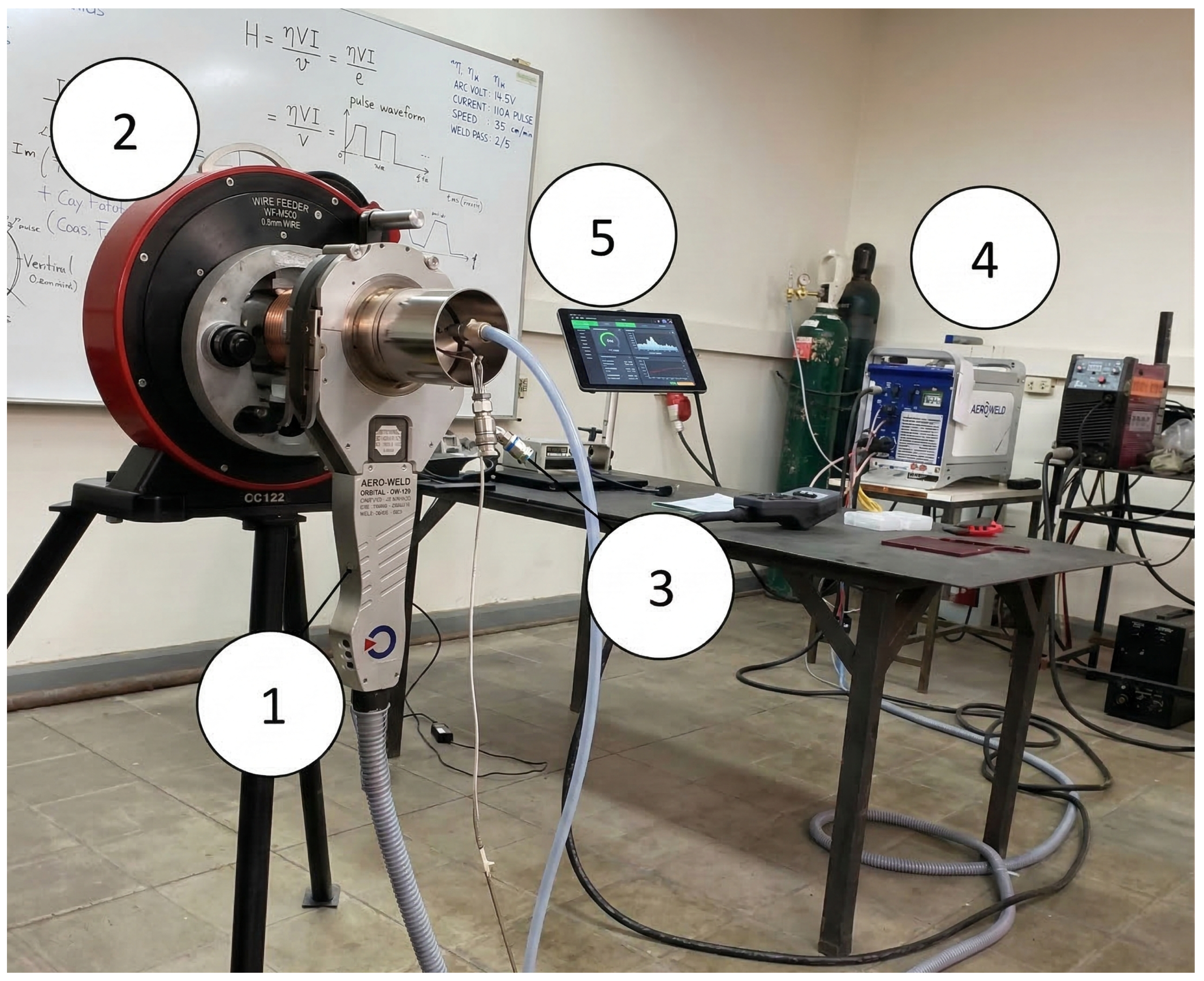
The welding was performed using a Tungsten Inert Gas (TIG) autogenous method with pulsed direct current, without the addition of filler material. This process was carried out at the Welding Processes Laboratory (LPS) of the Department of Mechanical Engineering at the University of Antofagasta. The welding setup included an AXXAIR CC122 pipe cutter and an MW115 orbital welding head with clamps adapted to 101.6 mm pipes to ensure uniform application of the weld and adequate clamping (Figure 1).
A Polysoude P4-3 welding machine was utilized, equipped with a lanthanated tungsten electrode (AWS WL20, ANSI/AWS A5.12M-98) with a diameter of 2.4 mm and a length of 30.7 mm. The arc energy was measured at 3.4 kJ/cm, with an average arc voltage of 9.59 V. The precise welding parameters are outlined in Table 2. AXXAIR purge membranes and argon gas were used as shielding gas to protect the weld root, with flow rates of 15 L/min for the welding head and 9 L/min for the inside of the tube. The pre- and post-purge times were set at 40 and 60 s, respectively.

2.2. Preparation of the Salt Mixture and Corrosion Testing

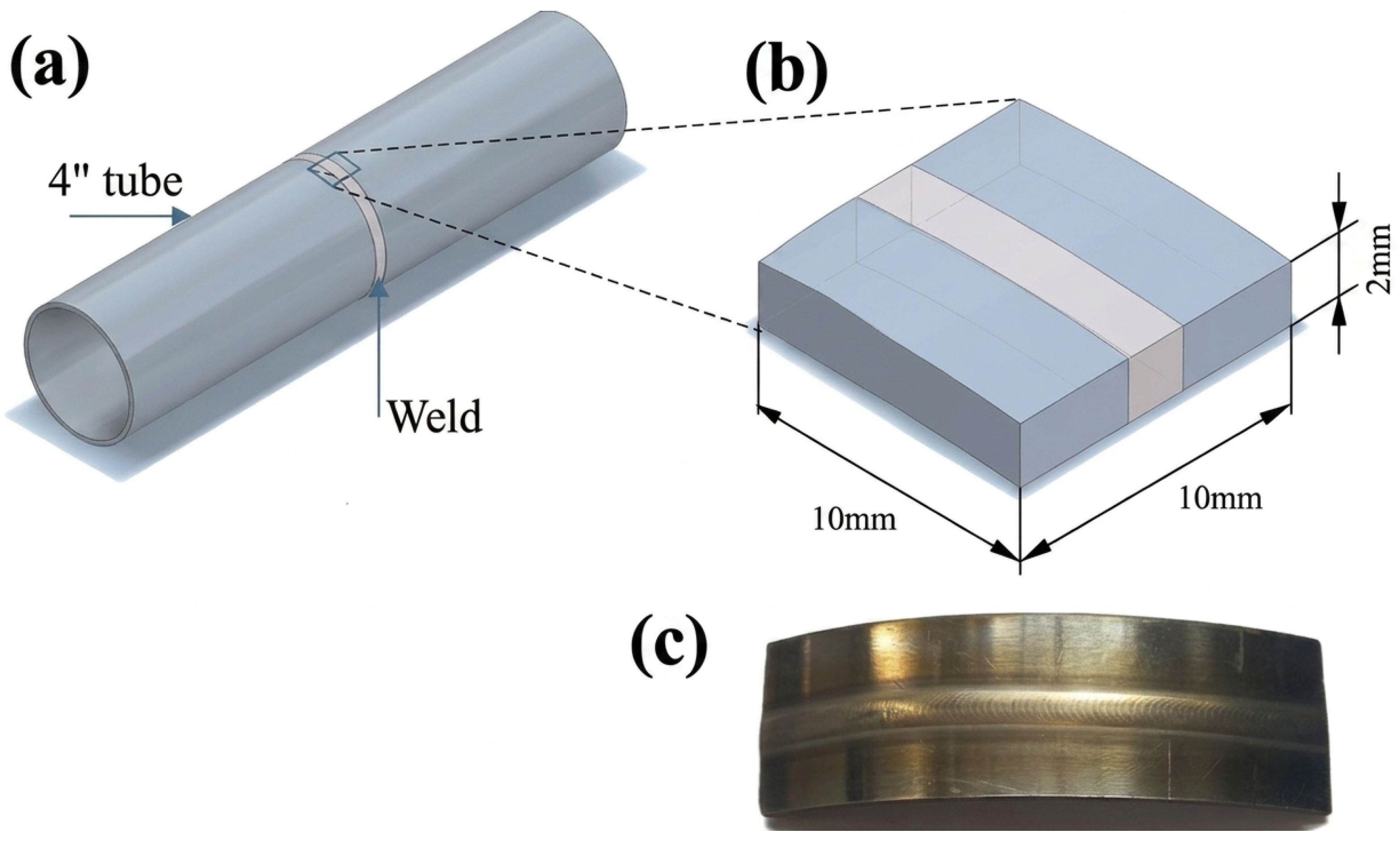
Following the welding process, the tubes were precisely cut into 10 × 10 mm test pieces using the AXXAIR FS29 precision saw. As shown in Figure 2, each sample was precisely centred on the weld bead. This configuration guarantees that each specimen contains three contiguous metallurgical zones: the weld metal (WM), the heat-affected zone (HAZ), and the unaltered base metal (BM). Consequently, the BM at the extremities of the coupon serves as an identical internal control, subjected to the exact same thermodynamic conditions as the welded zones.
A eutectic mixture, commonly referred to as solar salt, was prepared, consisting of 60% by weight of NaNO3 (99.5% purity) and 40% by weight of KNO3 (99.28% purity), supplied by SQM Chile. Although these salts are of a commercial grade, the supplier’s data and the relevant literature suggest that they contain the usual trace impurities of chlorides, ranging from 0.04 to 0.056 by weight. The salt was weighed in alumina crucibles using a METTLER TOLEDO precision balance (model ML 802E, accuracy: ±0.1 mg).
The mass gain due to the formation of corrosion products was measured using Equation (1):
Δ m S 0 = m f m i S 0
where mi is the initial mass of the specimen, mf is the mass of the specimen at time t, and S0 is the initial area of the specimen.
Corrosion tests were carried out by subjecting the specimens to immersion in molten salt within a high-temperature furnace at temperatures of up to 550 °C for durations of up to 1350 h under static air conditions. The use of a static environment allows for the precise simulation of the headspace chemistry and static gradient zones within unpressurised commercial TES tanks. In addition, at 550 °C, the solar salt functions as a self-buffering system due to the inherent thermal decomposition of nitrates into nitrites and oxygen. This reaction dictates the oxygen partial pressure at the salt/air interface, providing a consistently oxidising environment. In order to guarantee the statistical reliability of the process, a sacrificial batch extraction method was employed. For each predefined exposure interval, an independent batch of three replicates (n = 3) was extracted. In order to prevent thermal shock and premature artificial spallation, it was necessary to refrain from reintroducing the samples into the furnace.

2.3. Surface Preparation and Microstructural Analysis

Following each exposure period, the extracted samples were allowed to cool to room temperature. In order to remove any residual solidified salt, each sample was immersed in 200 mL of deionised water and stirred at 300 rpm for 30 min, followed by an ethanol rinse. This physical cleaning procedure, which is in accordance with ASTM G1-03, exploits the high aqueous solubility of nitrates to selectively dissolve the salt without exerting chemical attack or abrasive force on the adherent oxide layers. Consequently, no oxide mass loss is induced [36].
Due to the highly hygroscopic nature of nitrate salts and the porosity of the corrosion products, the samples were initially dried using a thermal dehydration method. This process involved subjecting the samples to an oven temperature of 80 °C for a duration of one hour. To guarantee gravimetric accuracy, it is vital that samples are stored in a sealed desiccator. This is to prevent atmospheric moisture from being absorbed. The samples should be weighed repeatedly until a constant mass is achieved. This is defined as mass variations falling below the balance’s resolution threshold.

2.4. Morphological and Phase Characterization

To analyse the morphology of the corrosion products, a SU3500 scanning electron microscope SEM (Hitachi High-Tech Corporation, Naka, Japan) equipped with an energy-dispersive X-ray spectroscopy (EDS) system for elemental analysis was used. X-ray diffraction (XRD) analysis was performed using a Bruker D8 ADVANCE diffractometer (Bruker AXS, Karlsruhe, Germany) with Cu-K α radiation. The scans were performed in the 2 θ range from 20° to 85°, utilizing a precise step size of 0.02° and a scan rate of 2°/min. No additional surface preparation was performed prior to SEM/EDS or XRD analysis, to preserve the integrity of the corrosion products.

3. Results and Discussion

3.1. Gravimetric Behavior and Kinetic Transitions

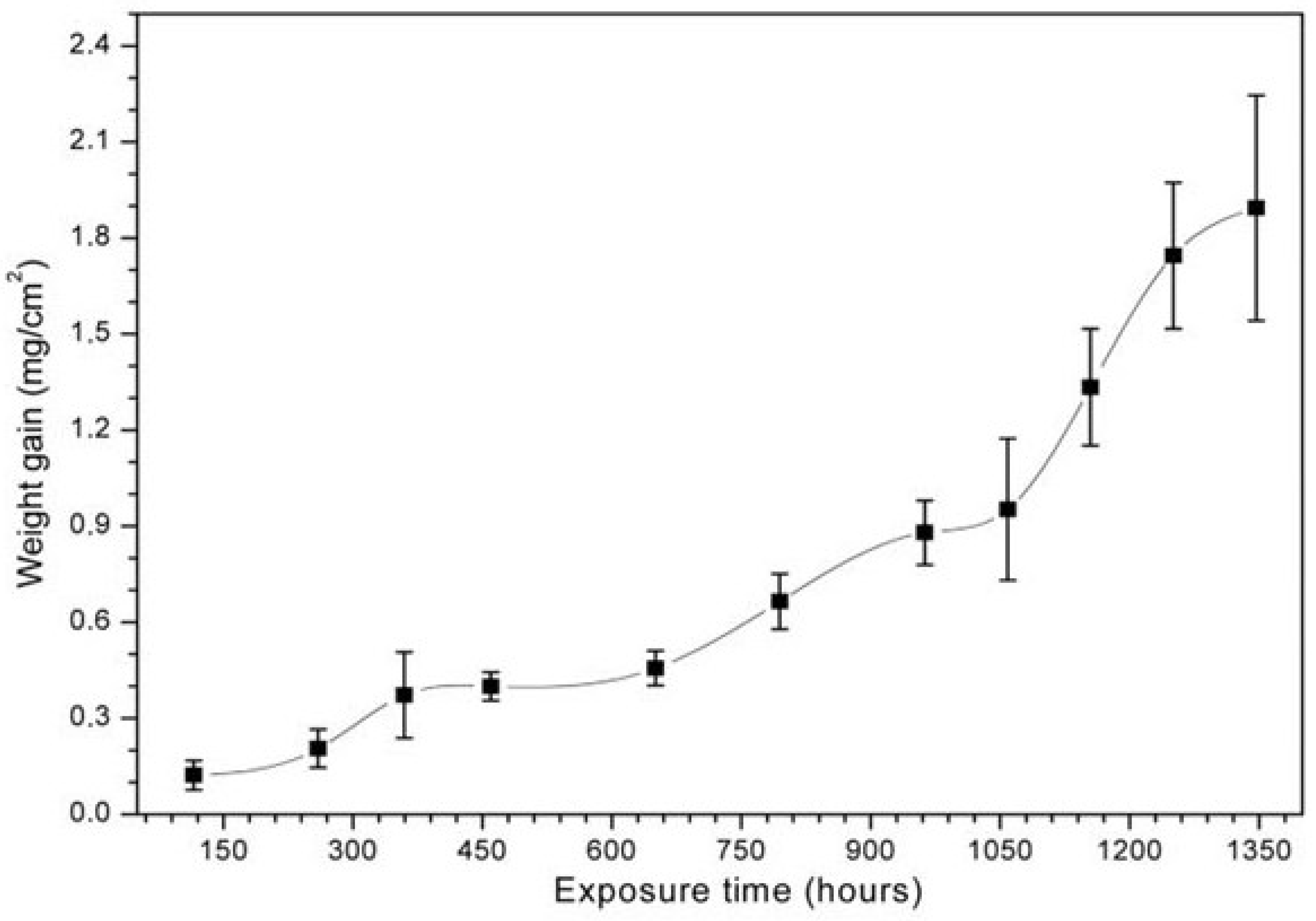
As illustrated in Figure 3, gravimetric mass gain measurements under static conditions showed a systematic build-up of corrosion products in welded AISI 304 stainless steel. Instead of dividing the curve into several separate plateaus, the kinetic behaviour is more accurately described by a classical high-temperature bimodal breakaway oxidation model, divided into two distinct regimes.
  • Regime I: Transient Passivation (0–650 h)
    During this initial stage, the mass gain exhibits a quasi-parabolic growth trend, where solid-state diffusion acts as the rate-limiting mechanism for the formation of a protective bi-layer oxide scale.
    Please note that minor gravimetric fluctuations within this period are of little statistical significance. These fluctuations overlap with the standard deviation of the replicates, and thus represent a single continuous phase of general passivation. This early stability is linked to the development of transient protective normal spinel-structured oxides, such as FeCr2O4, which act as an effective barrier against ionic species in the molten salt [23,37,38].
  • Regime II: Breakaway Oxidation and Stochastic Failure (650–1350 h)
    A critical kinetic transition occurs at approximately 650 h, where the curve deviates from the parabolic law, displaying a pronounced acceleration in mass gain accompanied by a significant divergence in standard deviation (larger error bars). The gravimetric evolution reveals a dynamic corrosion regime modulated not only by the molten salt interaction but also by the metallurgical heterogeneities inherent to the welded joint. This acceleration is not a homogeneous oxidation process; rather, it is the macroscopic reflection of stochastic breakdown events, such as localized spallation, oxide cracking and salt penetration. Although global mass gain provides valuable insight, it does not inherently resolve the specific contributions from the weld metal (WM), heat-affected zone (HAZ), and base metal (BM), as each exhibits distinct thermal histories and microstructural characteristics. However, microstructural observations indicate that the unaffected bond metal (BM) maintains a relatively stable structure during advanced stages. This indicates that the sharp kinetic shift towards breakaway oxidation is driven by the mechanical and electrochemical failure of the oxides in the most vulnerable domains (WM and HAZ). The HAZ is particularly vulnerable to localised degradation due to weld-induced residual stresses, sensitisation phenomena and chromium depletion, which can severely compromise passivation. The transitions observed in the mass gain curve—especially the acceleration after 650 h—are therefore the direct macroscopic reflection of the localized failure of protective oxides in these regions. To elucidate these localized mechanisms and spatial effects driving the global mass increase, detailed microstructural and compositional characterisations are presented in the following sections.

3.2. Early-Stage Microstructural Stability (Up to 360 h)

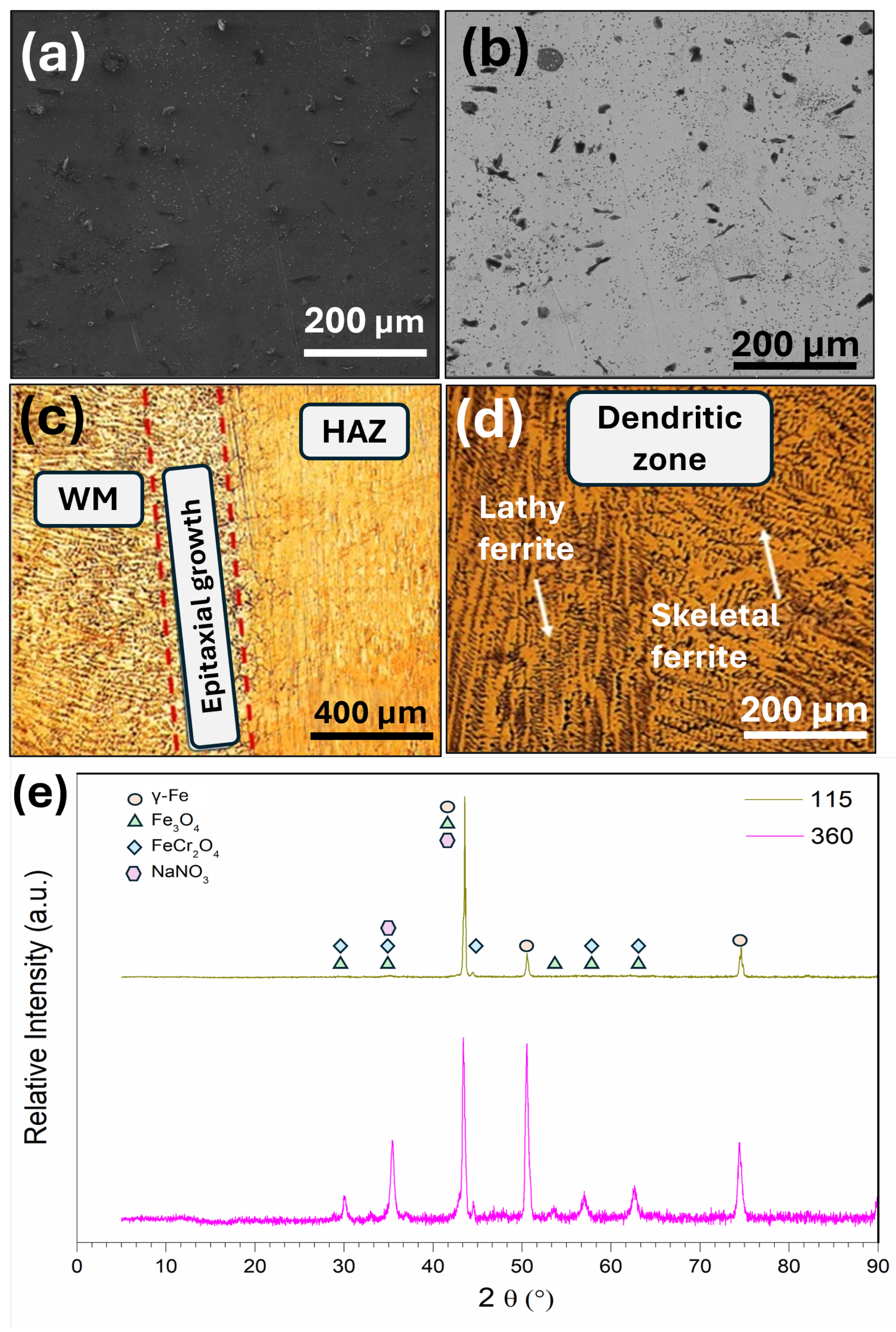
SEM micrographs of the surface at 115 and 360 h (see Figure 4a,b) showed a continuous and adherent oxide layer, with no evidence of cracking, delamination, or pitting. EDS point and area analyses indicated the presence of Fe and Cr oxides at the surface, suggesting the formation of a passivating bi-layer. The Cr enrichment is especially notable, as it is a key factor in stabilising the inner oxide scale and limiting ionic diffusion [38]. XRD analysis (Figure 4e) showed magnetite ( F e 3 O 4 ) as the primary crystalline oxide phase. Minor peaks were also detected, which, when combined with the surface Cr enrichment observed via EDS and the established thermodynamic literature, are interpretatively attributed to normal iron–chromium spinels ( F e C r 2 O 4 ). This specific oxide stratigraphy is directly governed by the oxygen partial pressure ( p O 2 ) profile inherent to the experimental conditions. In a static air environment at 550°C, the thermal decomposition of the nitrate salt ( N O 3 N O 2 + 0.5 O 2 ) generates a self-buffering, consistently oxidising melt. At the deeper metal/oxide interface, where the oxygen potential is limited by solid-state diffusion, the thermodynamic formation of the F e C r 2 O 4 spinel is favoured. Conversely, the outer surface that is exposed directly to the oxygen-rich melt stabilises F e 3 O 4 . The absence of N a F e O 2 or hematite phases supports the hypothesis of an early passivation phase [18].
Additionally, optical microscopy of cross-sections at 360 h (see Figure 4c,d) revealed intact grain boundaries across the BM, WM, and HAZ, with no observable intergranular attack. Although the weld metal exhibits clear microstructural heterogeneities, such as epitaxial growth and dendritic zones retaining skeletal ferrite (see Figure 4d), these regions have not been addressed at this stage. This indicates that the thermal cycle associated with welding did not induce immediate microstructural destabilization or early sensitization. Taken together, these results suggest that a transient passivation regime governed the corrosion process during the first 360 h of exposure.
It is important to note that this behaviour is in perfect correlation with Regime I (transient passivation) observed in the gravimetric curve (Figure 3), which further reinforces the idea that the initial solid-state diffusion and bi-layer oxide formation provide effective short-term protection, temporarily delaying the onset of more aggressive localized corrosion mechanisms in the heterogeneous weld structures.

3.3. Onset of Localized Corrosion: Pitting and Oxide Breakdown (650–960 h)

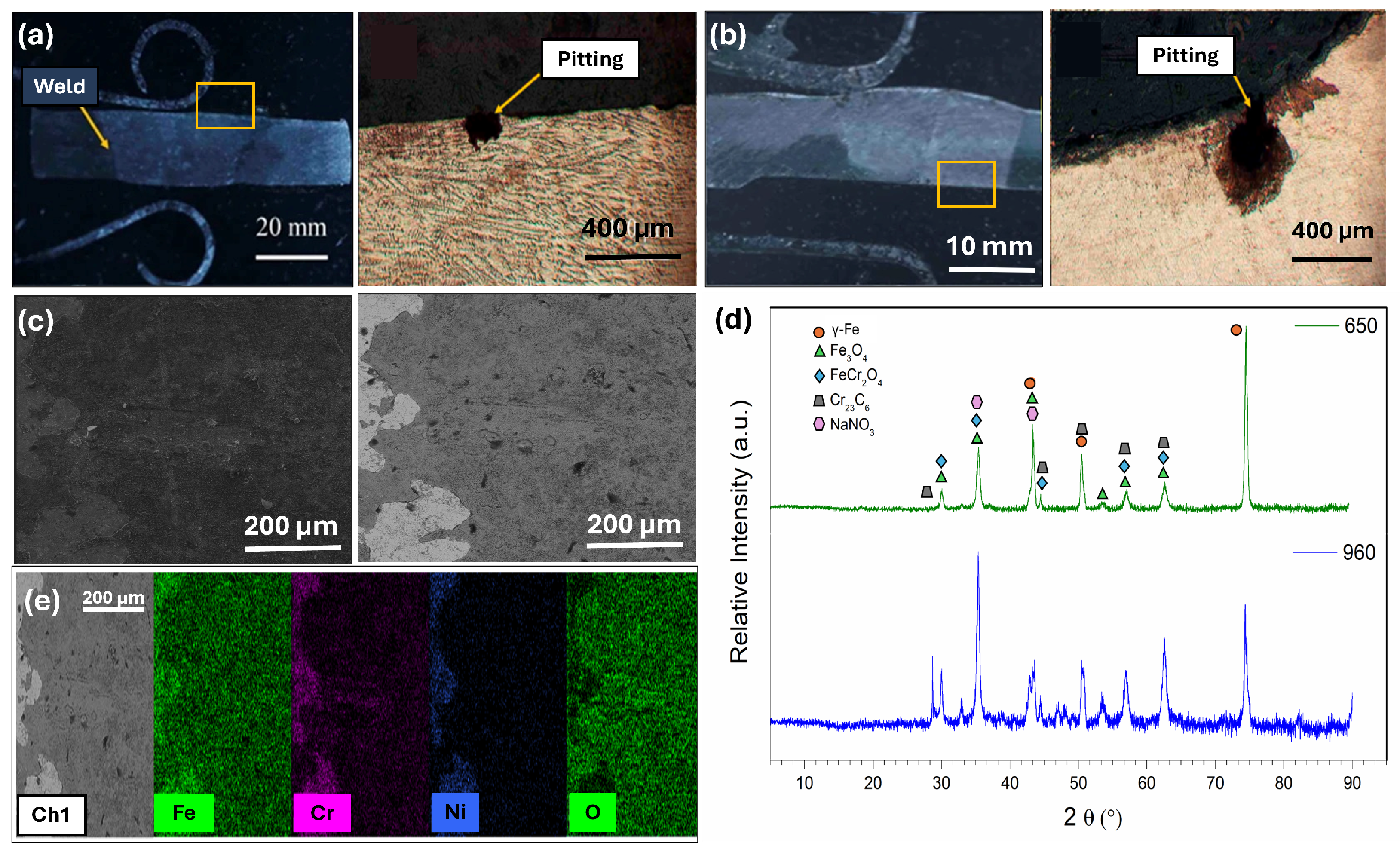
As exposure time increased beyond 650 h, the corrosion behaviour transitioned into the breakaway oxidation regime (Regime II), dominated by stochastic localized attack and the progressive destabilization of the protective oxide layer. This is evidenced by the marked acceleration and dispersion in the gravimetric curve (Figure 3), and corroborated by morphological features consistent with oxide scale failure.
Cross-sectional images at 650 h and 960 h (see Figure 5a,b) revealed incipient localized damage, specifically deep pitting corrosion. It is important to note that within the WM, pit nucleation occurred preferentially along the dendritic structures and epitaxial boundaries (previously identified in Figure 4d). This localized attack is fundamentally driven by the constitutional microsegregation induced during the rapid solidification of the autogenous weld. The dendritic cores stabilise austenite, while the inter-dendritic spaces retain skeletal δ -ferrite and concentrate chromium-depleted zones, effectively creating local galvanic micro-cells. Although chloride impurities are present in only trace amounts (0.04–0.056 by weight), they act as severe catalysts for this degradation. Due to their high electronegative charge density and small ionic radius, chlorides are able to penetrate defects and thermal micro-cracks in the bi-layer oxide. Upon reaching the metallic substrate, they accumulate differentially in these anodic inter-dendritic regions, locally depressing the pitting potential and triggering an aggressive autocatalytic dissolution. This synergistic mechanism explains why pitting propagates preferentially along the dendritic boundaries in the WM and the widened interfaces of the HAZ, exacerbated by the localized relaxation of residual tensile stresses [25].
SEM surface images at 960 h (see Figure 5c) suggested that severe superficial breakdown had begun, characterized by the appearance of craters, porous oxide structures, and partial spallation. BSE contrast revealed compositional inhomogeneities associated with selective dissolution. XRD patterns (Figure 5d) showed magnetite persistence, accompanied by initial indications of hematite (Fe2O3). The formation of hematite is a direct result of the oxide breakdown process. As the protective spinel fractures, the underlying iron-rich layers are exposed to the highly oxidising bulk melt environment (high pO2), leading to the formation of this less protective and more brittle phase. Furthermore, EDS analysis (Figure 5e) showed significant chromium depletion in the remaining oxide scale, which supports the hypothesis of selective Cr-leaching and loss of barrier integrity. This localized failure and incipient microstructural destabilization set the stage for more advanced degradation phenomena, particularly in the HAZ, as discussed in the following section.

3.4. Advanced Sensitization and Intergranular Corrosion (1160–1350 h)

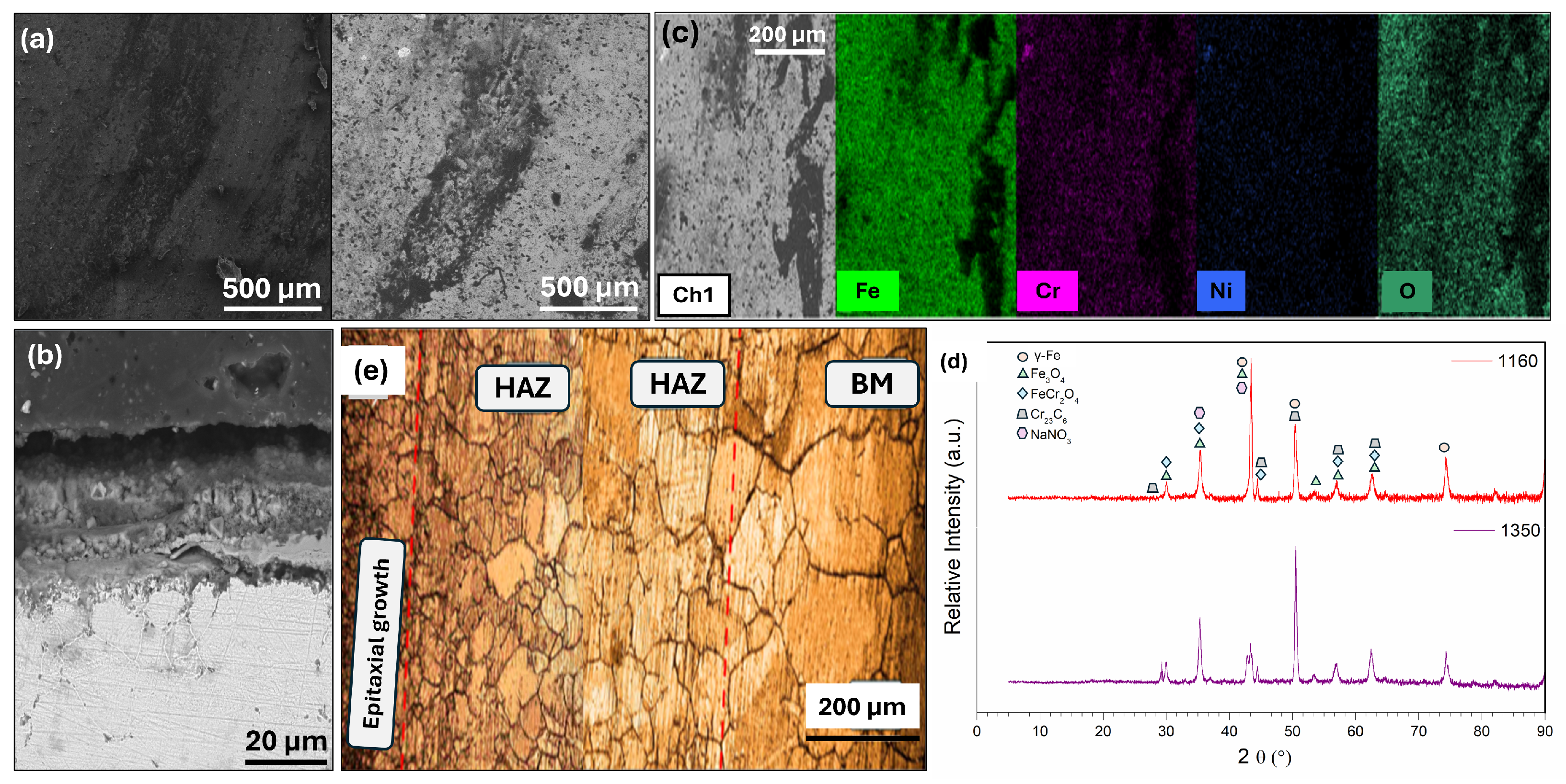
In the final stage of exposure (1160–1350 h), the degradation of the welded AISI 304 stainless steel becomes markedly more severe, entering an advanced state of breakaway oxidation. SEM micrographs obtained at 1350 h (see Figure 6a,b) reveal a highly porous and heterogeneous surface morphology, characterised by partial detachment of the corrosion layer. Cross-sectional scanning electron microscope (SEM) images (Figure 6b) show that the oxide does not thicken uniformly. Instead, it exhibits severe localised stratification and loss of adhesion. The EDS mapping of the cross-section reveals a marked predominance of Fe and O in the corroded layer, along with a significant decrease in Cr and Ni content. This indicates selective leaching and the complete loss of protective barrier functionality.
It is important to acknowledge the physical limitations of instrumental techniques when conducting the crystallographic evaluation of sensitisation in this advanced regime. As illustrated in Figure 6d, the characteristic Cr23C6 carbide reflection at approximately 2 θ = 29 °—which significantly overlaps with the (220) planes of FeCr2O2 spinels—shows a substantial attenuation at 1160 and 1350 h. This does not indicate the thermodynamic dissolution of carbides, but rather a dynamic masking by absorption. The rapid development of substantial, permeable iron oxide scales functions as an X-ray absorption shield, impeding the penetration of incident photons into the underlying heat-affected zone (HAZ) matrix and preventing their return to the detector. XRD alone cannot unambiguously resolve Cr23C6, due to peak overlap and attenuation effects. Furthermore, EDS carbon mapping lacks the spatial resolution and reliability required due to the reabsorption of ultra-light element X-rays by the dense Fe/Cr matrix and inevitable vacuum-chamber hydrocarbon contamination. Consequently, it is explicitly acknowledged that the phase assignments presented herein, particularly those relating to specific spinels and carbides, should be considered as indicative interpretations rather than as definitive crystallographic identifications. Verifying the phases definitively would require high-resolution techniques such as transmission electron microscopy (TEM) with selected-area electron diffraction (SAED), which fall outside the scope of this study. Therefore, to provide conclusive proof of macroscopic sensitisation without relying solely on diffractometric inference, this study bases its findings on the standardised topographic evidence required by the ASTM A262 Practice A protocol (oxalic acid etch) [39].
Consequently, definitive and conclusive proof of sensitisation abandons diffractometric inference and relies on the standardised topographic evidence mandated by the ASTM A262 Practice A protocol (oxalic acid etch). Optical metallography at 1350 h (see Figure 6e) reveals the undeniable topographic fingerprint of intergranular attack. While the unaffected base metal (BM) retains a stable “step” structure at its grain boundaries, the HAZ exhibits a clear transition toward deep, continuous “ditch” structures. These ditches are the direct macroscopic manifestation of the anodic dissolution of Cr-depleted zones flanking the dense networks of precipitated carbides. This accelerated and asymmetric sensitisation is fundamentally driven by the autogenous TIG welding process: the extreme thermal gradients and subsequent rapid volumetric contraction induce high residual tensile stresses in the HAZ. This stored elastic energy acts as a thermo-mechanical driving force, drastically lowering the activation barrier for atomic diffusion and catalysing premature carbide precipitation. This renders the HAZ critically susceptible to intergranular failure.

3.5. Integrated Phenomenological Framework of Degradation

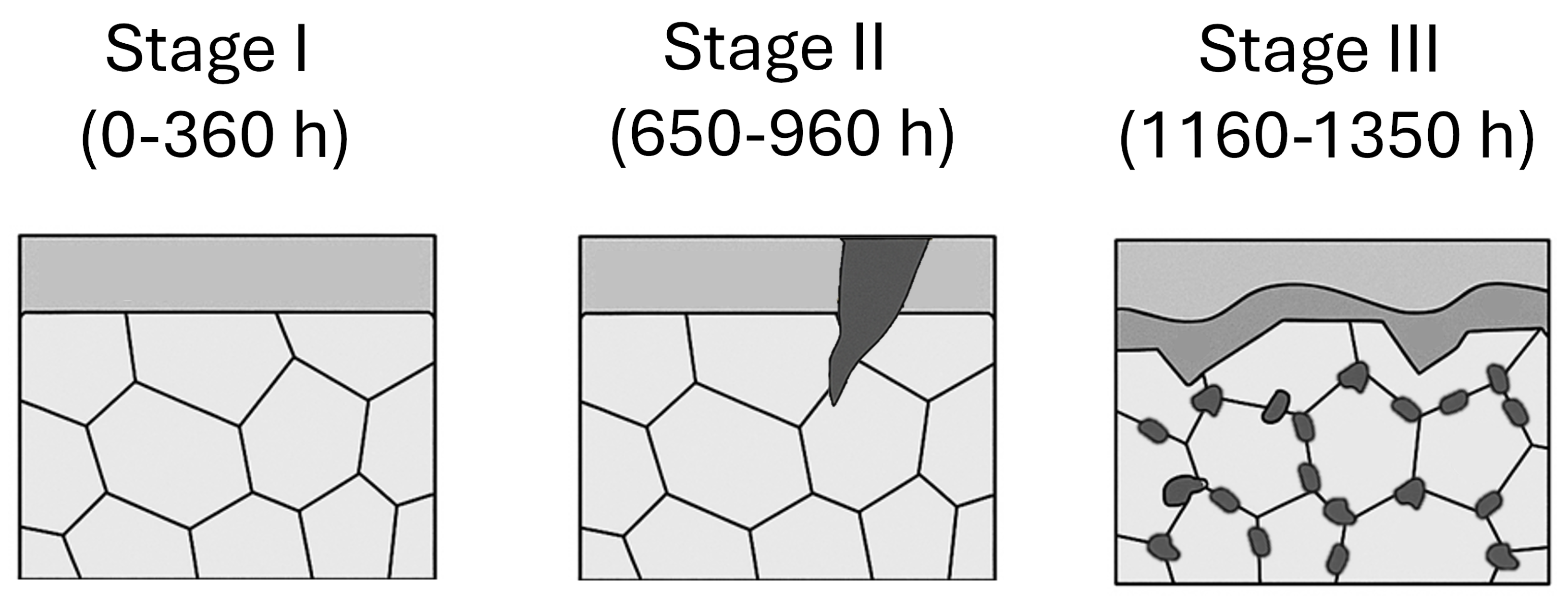
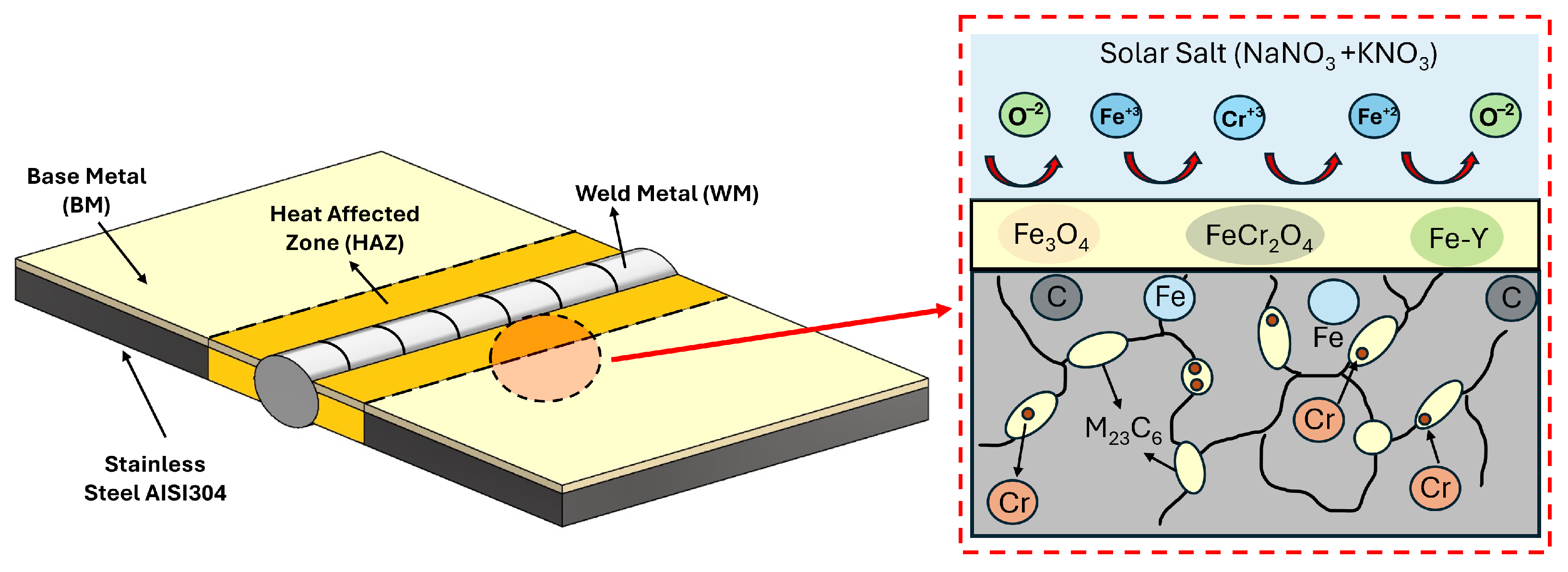
Following a detailed review of the experimental results, it has been determined that the degradation mechanism of autogenous TIG-welded AISI 304 stainless steel in solar salt at 550 °C cannot be accurately described as a homogeneous, continuous thickening of an oxide scale. Instead, it follows a stochastic, spatially heterogeneous evolution. To avoid misinterpreting specific phase formations or nanometric oxide stratification in the absence of multi-temporal TEM/SAED cross-section validation, the degradation sequence is conceptualised through an Integrated Phenomenological Framework (see Figure 7 and Figure 8). Rather than acting as a fully validated mechanistic phase model, this framework synthesises the available multiscale evidence, separating direct macroscopic empirical observations from deductions based on the thermodynamic literature:
  • Stochastic Oxide Breakdown: SEM cross-sections and gravimetric variance (Regime II) suggest that the failure of the oxide is highly localised and characterised by structural delamination, significant porosity and superficial spallation, rather than by uniform scale growth.
  • Dendritic Pitting: Deep localized pitting nucleates preferentially along the microsegregated dendritic networks within the weld metal (WM) and HAZ.
  • Intergranular Ditching: Standardisation according to the ASTM A262 shows the presence of continuous ditch structures exclusively in the HAZ, which directly verifies the onset of severe intergranular attack.
The observed macroscopic damage is thermodynamically driven by the synergistic interaction between the molten salt impurities and the unmitigated weld-induced defects. During the initial transient passivation phase (Regime I, 0–650 h), solid-state diffusion establishes a protective inner layer of FeCr2O4. However, the autogenous weld retains skeletal δ -ferrite and localized residual tensile stresses. Once the protective scale has fractured due to stress relaxation or thermal cycling (Regime II, >650 h), trace chloride impurities inherent to the commercial solar salt will penetrate the defects. These highly electronegative ions accumulate in the Cr-depleted inter-dendritic spaces and tensioned grain boundaries, depressing the local pitting potential and creating active galvanic micro-cells. Concurrently, the residual tensile stresses in the HAZ reduce the activation energy for solid-state diffusion, thereby promoting the rapid precipitation of Cr23C6 carbides and subsequent intergranular corrosion. This phenomenological framework highlights that the structural integrity of CSP welded components is ultimately dictated by the localized, asymmetric breakdown of the passive layer rather than uniform global oxidation.
Figure 7. Schematic representation of the corrosion degradation framework in welded AISI 304 stainless steel exposed to solar salt (NaNO3 + KNO3) at 550 °C.
Processes 14 01407 g007
Figure 8. Temporal evolution of the corrosion degradation framework in welded AISI 304 stainless steel exposed to molten solar salt at 550 °C, illustrating the three progressive stages: Stage I (0–360 h), Stage II (650–960 h) and Stage III (1160–1350 h).
Processes 14 01407 g008

4. Conclusions

The behaviour of AISI 304 stainless steel in terms of corrosion was evaluated when exposed to commercial molten solar salt at 550 °C. Instead of a homogeneous degradation process, the kinetic and microstructural results revealed a stochastic, time-dependent corrosion mechanism that can be accurately described by a classical high-temperature bimodal model:
  • Regime I (Transient Passivation, 0–650 h): During the initial exposure stage, solid-state diffusion governs the formation of a relatively protective oxide scale. This is interpreted as an outer magnetite layer (Fe3O4) layer and an inner normal spinel (FeCr2O4) barrier. This regime provides temporary global stability and effectively delays aggressive attack across all weld zones.
  • Regime II (Breakaway Oxidation and Stochastic Failure, >650 h): A sharp increase in the rate of mass gain indicates the localised macroscopic failure of the passive film. Pitting corrosion is known to occur along the microsegregated dendritic networks (retaining the delta-ferrite) in the weld metal (WM) and the heat-affected zone (HAZ). This highly localized breakdown is synergistically catalysed by trace chloride impurities (0.04–0.056 by weight) in the salt, which penetrate oxide defects to act as galvanic micro-cells in Cr-depleted inter-dendritic spaces.
  • Sensitization and Intergranular Attack: Due to the severe X-ray attenuation (dynamic masking) caused by the substantial and porous stratification of late-stage oxides, instrumental diffractometry is not a viable option. Instead, definitive proof of sensitisation was established using the standardised ASTM A262 Practice A topographic evaluation. The presence of continuous ‘ditch’ structures within the HAZ alone suggests severe intergranular anodic dissolution. This phenomenon is thermodynamically driven by the unmitigated residual tensile stresses from the autogenous weld, which drastically lower the activation barrier for Cr23C6 precipitation.
These empirical observations and thermodynamic deductions are synthesised into an Integrated Phenomenological Predictive Model. The findings show that using cost-effective, non-stabilised alloys such as AISI 304 for intermediate-temperature CSP components necessitates rigorous predictive maintenance. This is because their long-term service life is ultimately determined by the asymmetric, localised breakdown of the heat-affected zones rather than by uniform, generalised oxidation.

Author Contributions

A.M. and F.P.: Conceptualization, Formal Analysis, Investigation, Methodology, Writing—Original Draft Preparation. J.N. and C.C.: Conceptualization, Formal Analysis, Investigation. C.P., M.L. and G.V.: Methodology, Formal Analysis. V.V.: Methodology, Writing—Review and Editing. M.L.: Writing—Review and Editing. A.M. and F.P.: Conceptualization, Project Administration, Supervision, Resources, Writing—Review and Editing. All authors have read and agreed to the published version of the manuscript.

Funding

This research was funded by the National Research and Development Agency (ANID), grant numbers 1523A0006, 1241151 and 13240066.

Data Availability Statement

The data presented in this study are available on request from the corresponding author. The data are not publicly available, due to privacy restrictions.

Acknowledgments

The authors would like to acknowledge the financial support provided by the National Research and Development Agency (Anid), ANID/FONDAP/1523A0006 “Solar Energy Research Center—SERC-Chile”. F. Pineda gratefully acknowledges the financial support of ANID-Chile within the projects Fondecyt Regular 1241151 and Fondecyt de Exploracion 13240066.

Conflicts of Interest

The authors declare no conflicts of interest.

References

  1. Pinto, J.T.M.; Diemer, A. Supply chain integration strategies and circularity in the European steel industry. Resour. Conserv. Recycl. 2020, 153, 104517. [Google Scholar] [CrossRef] [Scilit]
  2. Nuss, P.; Blengini, G.A. Towards better monitoring of technology critical elements in Europe: Coupling of natural and anthropogenic cycles. Sci. Total Environ. 2018, 613–614, 569–578. [Google Scholar] [CrossRef] [Scilit] [PubMed]
  3. Friedlingstein, P.; O’sullivan, M.; Jones, M.W.; Andrew, R.M.; Gregor, L.; Hauck, J.; Le Quéré, C.; Luijkx, I.T.; Olsen, A.; Peters, G.P.; et al. Global Carbon Budget 2022. Earth Syst. Sci. Data 2022, 14, 4811–4900. [Google Scholar] [CrossRef] [Scilit]
  4. Keyßer, L.T.; Lenzen, M. 1.5 °C degrowth scenarios suggest the need for new mitigation pathways. Nat. Commun. 2021, 12, 2676. [Google Scholar] [CrossRef] [Scilit]
  5. Kim, S.K.; Park, S. Impacts of renewable energy on climate vulnerability: A global perspective for energy transition in a climate adaptation framework. Sci. Total Environ. 2023, 859, 160175. [Google Scholar] [CrossRef] [Scilit]
  6. Lenton, T.M.; Xu, C.; Abrams, J.F.; Ghadiali, A.; Loriani, S.; Sakschewski, B.; Zimm, C.; Ebi, K.L.; Dunn, R.R.; Svenning, J.C.; et al. Quantifying the human cost of global warming. Nat. Sustain. 2023, 6, 1237–1247. [Google Scholar] [CrossRef] [Scilit]
  7. Mayer, A.; Smith, E.K. Can solar energy become polarized? Understanding the role of expressive and negative partisanship in support for solar tax credits. Energy Res. Soc. Sci. 2024, 113, 103545. [Google Scholar] [CrossRef] [Scilit]
  8. Jie, H.; Khan, I.; Alharthi, M.; Zafar, M.W.; Saeed, A. Sustainable energy policy, socio-economic development, and ecological footprint: The economic significance of natural resources, population growth, and industrial development. Util. Policy 2023, 81, 101490. [Google Scholar] [CrossRef] [Scilit]
  9. Güney, T. Solar energy, governance and CO2 emissions. Renew. Energy 2022, 184, 791–798. [Google Scholar] [CrossRef] [Scilit]
  10. Khan, M.I.; Asfand, F.; Al-Ghamdi, S.G. Progress in research and technological advancements of thermal energy storage systems for concentrated solar power. J. Energy Storage 2022, 55, 105860. [Google Scholar] [CrossRef] [Scilit]
  11. Steinbrecher, J.; Hanke, A.; Braun, M.; Bauer, T.; Bonk, A. Stabilization of Solar Salt at 650 °C—Thermodynamics and practical implications for thermal energy storage systems. Sol. Energy Mater. Sol. Cells 2023, 258, 112411. [Google Scholar] [CrossRef] [Scilit]
  12. Prieto, C.; Lopez-Roman, A.; Cabeza, L.F. Experimental evaluation of the thermal degradation of solar salt under different gas covers. J. Energy Storage 2023, 72, 108412. [Google Scholar] [CrossRef] [Scilit]
  13. Caldwell, A.S.; Itskos, G.; Sandhage, K.H. Air-stable, earth-abundant molten chlorides and corrosion-resistant containment for chemically-robust, high-temperature thermal energy storage for concentrated solar power. Mater. Today 2021, 46, 9–17. [Google Scholar] [CrossRef] [Scilit]
  14. Gomez-Vidal, J.C. Corrosion resistance of MCrAlX coatings in a molten chloride for thermal storage in concentrating solar power applications. npj Mater. Degrad. 2017, 1, 7. [Google Scholar] [CrossRef] [Scilit]
  15. Fernández, Á.G.; Cabeza, L.F. Molten salt corrosion mechanisms of nitrate based thermal energy storage materials for concentrated solar power plants: A review. Sol. Energy Mater. Sol. Cells 2019, 194, 160–165. [Google Scholar] [CrossRef] [Scilit]
  16. Mallco, A.; Pineda, F.; Mendoza, M.; Henriquez, M.; Carrasco, C.; Vergara, V.; Fuentealba, E.; Fernandez, A.G. Evaluation of flow accelerated corrosion and mechanical performance of martensitic steel T91 for a ternary mixture of molten salts for CSP plants. Sol. Energy Mater. Sol. Cells 2022, 238, 111623. [Google Scholar] [CrossRef] [Scilit]
  17. Pineda, F.; Mallco, A.; De Barbieri, F.; Carrasco, C.; Henriquez, M.; Fuentealba, E.; Fernández, Á.G. Corrosion evaluation by electrochemical real-time tracking of VM12 martensitic steel in a ternary molten salt mixture with lithium nitrates for CSP plants. Sol. Energy Mater. Sol. Cells 2021, 231, 111302. [Google Scholar] [CrossRef] [Scilit]
  18. Mallco, A.; Portillo, C.; Kogan, M.J.; Galleguillos, F.; Fernández, A.G. A Materials Screening Test of Corrosion Monitoring in LiNO3 Containing Molten Salts as a Thermal Energy Storage Material for CSP Plants. Appl. Sci. 2020, 10, 3160. [Google Scholar] [CrossRef] [Scilit]
  19. Orlikowski, J.; Jazdzewska, A.; Mazur, R.; Darowicki, K. Determination of pitting corrosion stage of stainless steel by galvanodynamic impedance spectroscopy. Electrochim. Acta 2017, 253, 403–412. [Google Scholar] [CrossRef] [Scilit]
  20. Shi, F.; Wang, H.; Shen, J.; Mehra, V.; Ahmad, T.; Agrawal, A.; Wang, J.; Xu, Z.; Liu, J.; Sandoval-Amador, A.; et al. 316L stainless steel corrosion in molten salts NaNO3 KNO3 NaNO2 simulating storage conditions. J. Phys. Conf. Ser. 2019, 1159, 012011. [Google Scholar]
  21. Liu, Q.; Barker, R.; Wang, C.; Qian, J.; Neville, A.; Pessu, F. The corrosion behaviour of stainless steels and Ni-based alloys in nitrate salts under thermal cycling conditions in concentrated solar power plants. Sol. Energy 2022, 232, 169–185. [Google Scholar] [CrossRef] [Scilit]
  22. Trent, M.C.; Goods, S.H.; Bradshaw, R.W. Comparison of corrosion performance of grade 316 and grade 347H stainless steels in molten nitrate salt. AIP Conf. Proc. 2016, 1734, 160017. [Google Scholar] [CrossRef] [Scilit]
  23. Li, H.; Yang, X.; Yin, X.; Wang, X.; Tang, J.; Gong, J. Effect of Chloride Impurity on Corrosion Kinetics of Stainless Steels in Molten Solar Salt for CSP Application: Experiments and Modeling. Oxid. Met. 2021, 95, 311–332. [Google Scholar] [CrossRef] [Scilit]
  24. Li, H.; Feng, X.; Wang, X.; Yang, X.; Tang, J.; Gong, J. Impact of temperature on corrosion behavior of austenitic stainless steels in solar salt for CSP application: An electrochemical study. Sol. Energy Mater. Sol. Cells 2022, 239, 111661. [Google Scholar] [CrossRef] [Scilit]
  25. Vilchez, F.; Pineda, F.; Walczak, M.; Ramos-Grez, J. The effect of laser surface melting of stainless steel grade AISI 316L welded joint on its corrosion performance in molten Solar Salt. Sol. Energy Mater. Sol. Cells 2020, 213, 110576. [Google Scholar] [CrossRef] [Scilit]
  26. Zhao, Y.; Bowers, R. Re-Designing the CSP Thermal Energy Storage System to Enable Higher-Temperature Performance at Reduced Cost: Final Technical Report. 2023. Available online: www.nrel.gov/publications (accessed on 4 February 2026).
  27. Handbook of Comparative World Steel Standards, 5th ed.; ASTM International: West Conshohocken, PA, USA, 2016.
  28. Du Toit, M.; Van Rooyen, G.T.; Smith, D. Heat-Affected Zone Sensitization and Stress Corrosion Cracking in 12% Chromium Type 1.4003 Ferritic Stainless Steel. Corrosion 2007, 63, 395–404. [Google Scholar] [CrossRef] [Scilit]
  29. Devendranath Ramkumar, K.; Pavan, B.; Chandrasekar, V. Development of improved microstructural traits and mechanical integrity of stabilized stainless steel joints of AISI 321. J. Manuf. Process. 2018, 32, 582–594. [Google Scholar] [CrossRef] [Scilit]
  30. Varmaziar, S.; Atapour, M.; Hedberg, Y.S. Corrosion and metal release characterization of stainless steel 316L weld zones in whey protein solution. npj Mater. Degrad. 2022, 6, 19. [Google Scholar] [CrossRef] [Scilit]
  31. Prieto, C.; Gallardo-González, J.; Ruiz-Cabañas, F.J.; Barreneche, C.; Martínez, M.; Segarra, M.; Fernández, A.I. Study of corrosion by Dynamic Gravimetric Analysis (DGA) methodology. Influence of chloride content in solar salt. Sol. Energy Mater. Sol. Cells 2016, 157, 526–532. [Google Scholar] [CrossRef] [Scilit]
  32. Kutz, M. Handbook of Environmental Degradation of Materials, 2nd ed.; Elsevier Inc.: Amsterdam, The Netherlands, 2012. [Google Scholar]
  33. Kang, C.Y.; Chen, T.C.; Tsay, L.W. Effects of Micro-Shot Peening on the Stress Corrosion Cracking of Austenitic Stainless Steel Welds. Metals 2022, 13, 69. [Google Scholar] [CrossRef] [Scilit]
  34. Zhao, C.Y.; Wu, Z.G. Thermal property characterization of a low melting-temperature ternary nitrate salt mixture for thermal energy storage systems. Sol. Energy Mater. Sol. Cells 2011, 95, 3341–3346. [Google Scholar] [CrossRef] [Scilit]
  35. Kellai, A.; Kahla, S.; Dehimi, S.; Kaba, L.; Boutaghou, Z. Effect of post weld heat treatment on the microstructure and mechanical properties of a gas-tungsten-arc-welded 304 stainless steel. Int. J. Adv. Manuf. Technol. 2022, 121, 8171–8186. [Google Scholar] [CrossRef] [Scilit]
  36. ASTM G1-03; Standard Practice for Preparing, Cleaning, and Evaluating Corrosion Test Specimens. ASTM International: West Conshohocken, PA, USA, 2011.
  37. Gomez-Vidal, J.C.; Fernandez, A.G.; Tirawat, R.; Turchi, C.; Huddleston, W. Corrosion resistance of alumina-forming alloys against molten chlorides for energy production. I: Pre-oxidation treatment and isothermal corrosion tests. Sol. Energy Mater. Sol. Cells 2017, 166, 222–233. [Google Scholar] [CrossRef] [Scilit]
  38. Castro-Quijada, M.; Jullian, D.; Walczak, M.; Pineda, F.; Videla, Á. Quaternary nitrate and chloride molten salts for the next concentrating solar power plants: Corrosion considerations for the use of AISI 304L steel. Sol. Energy Mater. Sol. Cells 2024, 274, 112971. [Google Scholar] [CrossRef] [Scilit]
  39. ASTM A262; Standard Practices for Detecting Susceptibility to Intergranular Attack in Austenitic Stainless Steels. ASTM International: West Conshohocken, PA, USA, 2021.
Figure 1. Experimental setup used for the welding test bench: (1) MW115 orbital welding head, (2) pipe support, (3) inert gas purge membrane, (4) Polysoude P4-3 power source, and (5) control unit.
Processes 14 01407 g001
Figure 2. (a) Representative image of the welded stainless steel tube, showing the uniformity of the weld seam; (b) sectioned sample ( 10 × 10 mm) centered on the weld bead for corrosion testing; (c) 304 stainless steel welding section.
Processes 14 01407 g002
Figure 3. Gravimetric evolution of welded AISI 304 stainless steel exposed to solar salt at 550 °C under static conditions for up to 1350 h.
Processes 14 01407 g003
Figure 4. Characterization of corrosion performance during the early-stage exposure regime (115–360 h) in welded AISI 304 stainless steel exposed to solar salt at 550 °C. (a,b) SEM images of the sample surface after 115 h; (c,d) optical micrographs of the cross-section after 360 h; and (e) XRD patterns after 115 and 360 h, identifying Fe3O4 and (Fe,Cr)3O4 as the dominant crystalline oxide phases.
Processes 14 01407 g004
Figure 5. Characterization of corrosion performance during the intermediate exposure regime (650–960 h) in welded AISI 304 stainless steels exposed to solar salt at 550 °C. (a,b) Cross-sectional micrographs showing the onset and progression of pitting corrosion in the WM and HAZ. (c) SEM surface images at 960 h revealing porous oxide morphology and surface roughening 960 h. (d) XRD pattern for 650–960 h. (e) EDS elemental profile or map at 960 h.
Processes 14 01407 g005
Figure 6. Characterization of corrosion behavior during the advanced-stage degradation (1160–1350 h) in welded AISI 304 stainless steel exposed to solar salt at 550 °C. (a) SEM images at 1350 h, (b) cross-sectional SEM at 1160 h, (c) EDS mapping at 1350 h, (d) XRD patterns, and (e) optical micrographs.
Processes 14 01407 g006
Table 1. Elemental composition (wt.%) of the AISI 304 stainless steel used in this investigation, as determined by arc spark optical emission spectroscopy.
% By WeightCMnSSiCrNiOthers
AISI 304 sample0.0690.8860.0370.52818.637.584Fe: Balance
Table 2. Parameters used for the autogenous pulsed direct current Tungsten Inert Gas (TIG) welding procedure.
ParameterUnitValues
Pulse currentA81
Base currentA30
Pulse timems149
Base timems260
Welding speedmm/min85
Electrode tip angle°15
Arc lengthmm1.8
PolarityDirect
Disclaimer/Publisher’s Note: The statements, opinions and data contained in all publications are solely those of the individual author(s) and contributor(s) and not of MDPI and/or the editor(s). MDPI and/or the editor(s) disclaim responsibility for any injury to people or property resulting from any ideas, methods, instructions or products referred to in the content.