


Abstract
The combined effects of organic pollutants and vertical soil gradients on microbial community assembly in long-term contaminated sites remain insufficiently understood. In this study, high-throughput sequencing was employed to characterize prokaryotic communities across depth-resolved soil profiles at a contaminated site in Tianjin, China. Microbial diversity, taxonomic composition, and predicted functional traits varied significantly with soil depth and pollutant distribution. Surface soils exhibited higher richness and diversity, with Shannon, Sobs, and PD indices decreasing with depth (p = 0.020, p = 0.002, and p < 0.001, respectively). Redundancy analysis showed that the first two axes explained 89.91% of the total variance, indicating strong associations between microbial community structure and environmental variables. Community differentiation was related to pollutant type, with aromatic hydrocarbons more strongly linked to surface assemblages and chlorinated compounds associated with deeper horizons. Although the overall abundance of predicted metabolic genes decreased with depth, the distribution of major functional categories, including pathways related to organic matter degradation, remained comparatively stable. Co-occurrence network analysis revealed a progressive decline in network connectivity and complexity along the vertical gradient, with the number of edges decreasing from 853 (L1) to 447 (L3) and average degree decreasing from 16.404 to 9.122. These findings highlight depth-related environmental filtering as a key mechanism structuring microbial communities under long-term organic contamination and provide a scientific basis for optimizing depth-specific in situ bioremediation strategies, such as targeting aromatic hydrocarbon degradation in surface soils and chlorinated compound remediation in deeper layers.
1. Introduction
Soil pollution has become a major environmental concern in China, evolving from single-source contamination to increasingly complex and mixed pollution scenarios. Rapid industrialization and urbanization have contributed to the accumulation of pesticides, fertilizers, and industrial wastes in soils [1]. More than 100,000 contaminated sites have been identified nationwide [2]. Although inorganic pollutants remain widespread, organic contaminants pose substantial ecological and human health risks due to their toxicity, persistence, and bioaccumulation potential [3]. However, effective remediation strategies for complex organic-contaminated sites remain limited, highlighting the need for improved understanding of ecological processes underlying in situ bioremediation.
Microbial remediation is based on the metabolic capacity of indigenous microorganisms to transform and degrade contaminants [4]. Soil microbial community structure is influenced by multiple environmental factors, including pH, C:N ratio, nutrient availability, and soil moisture [5,6,7,8,9,10]. In addition, soil depth represents a critical dimension of environmental heterogeneity, with pronounced vertical variation in microbial composition and function observed along soil profiles [11,12]. For example, Proteobacteria are often reported to dominate deep contaminated layers [13], and vertical differences have been linked to gradients in soil organic matter, moisture, and temperature [14]. Organic pollutants are not static within soils. Many compounds exhibit mobility and can undergo vertical transport through diffusion, leaching, and physicochemical redistribution [15]. Their migration and transformation may alter microbial metabolic processes and community structure [16,17]. Previous studies have shown that specific pollutants can differentially shape microbial assemblages across surface and subsurface horizons. For instance, Liu et al. reported more complex bacterial interaction networks in heavily contaminated subsurface soils compared with less impacted surface layers [18].
Despite these advances, most studies have focused primarily on depth-related variation in microbial communities [19], while relatively few have examined the combined effects of vertical gradients and pollutant distribution in long-term contaminated sites [20]. In such environments, continuous diffusion and vertical migration of organic contaminants may interact with depth-dependent environmental filtering, jointly influencing microbial taxonomic composition and functional potential. Therefore, investigating depth-resolved microbial community structure and predicted functional traits in organically contaminated soils is essential. Clarifying how microbial assemblages respond to spatial gradients of pollutant type and concentration can improve the ecological basis for selecting indigenous microbial consortia in in situ bioremediation, thereby enhancing remediation specificity and long-term sustainability.
In this study, microbial community structure and environmental variables were examined along a depth-resolved soil profile at an organically contaminated site in Tianjin, China, using 16S rRNA gene high-throughput sequencing. The objectives were to (1) characterize vertical patterns in microbial composition and predicted functional potential; (2) evaluate co-occurrence network structures across soil depths; and (3) assess the relationships between microbial community assembly and environmental stressors under organic contamination. The results provide insight into depth-related differentiation of microbial communities and contribute to the development of depth-specific in situ bioremediation strategies for organic-contaminated soils.
2. Materials and Methods
2.1. Study Site
The study was conducted at a former chemical manufacturing site in Tianjin, China (116°42′93″ E, 38°35′94″ N), covering approximately 451,492 m2. The site was used as farmland prior to the 1990s and was subsequently converted for intensive industrial production, resulting in subsurface soil and groundwater contamination. Until 2008, the facility primarily produced flavors and fragrances. During operation, chlorobenzene, an important intermediate compound, was released into the environment, likely due to leakage or spillage during storage and transportation, leading to localized contamination. The main indicator pollutants identified at the site include benzene-series compounds and chlorinated hydrocarbons. The contamination characteristics are representative of legacy industrial brownfield sites in northern China. The study area is situated on an alluvial–marine plain characterized by stratified sediment deposits and shallow groundwater systems. Subsurface layers consist predominantly of silty and clay-rich sediments with low permeability, which can influence both the vertical accumulation and lateral redistribution of organic pollutants. Therefore, the site provides an appropriate case for examining the relationships among soil depth, organic pollutants, and microbial community structure in long-term contaminated environments.
2.2. Soil Sample Collection
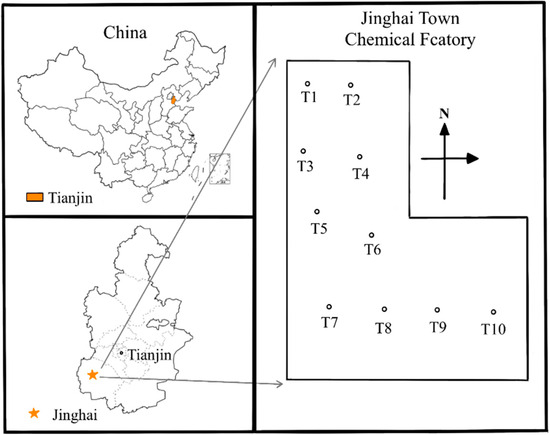
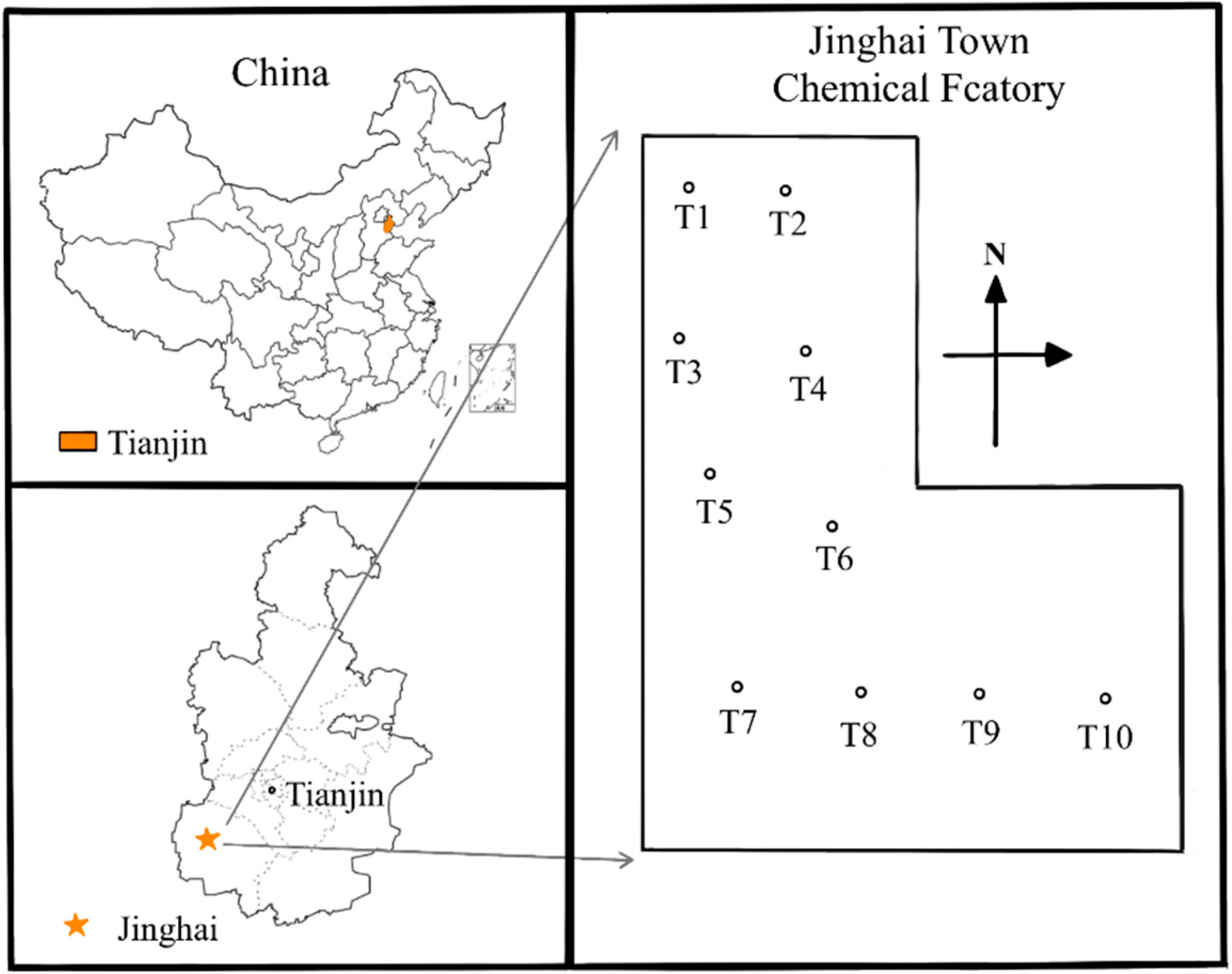
Soil sampling was conducted in accordance with the Technical Specifications for Soil Environmental Monitoring and the Survey Guidelines for Key Industries issued by the Ministry of Ecology and Environment of China. A hybrid sampling design integrating zoned sampling and systematic random sampling was applied. As shown in Figure 1, ten sampling points (T1–T10) were established within key contamination areas, including production workshops, raw material storage tanks, solid waste storage zones, and wastewater discharge areas, to ensure adequate spatial coverage.
Figure 1.
Locations of ten sampling points in a controlled organic chemical plant in Tianjin province, China. (T1–T10 represent ten sampling points, with samples collected from three depths at each point).
Stratified sampling was performed in September 2021. According to site investigation data, the subsurface profile consists of stratified alluvial-marine sediments, including fill (upper ~1.5 m), silty soils (1.5–3.5 m), and clay layers (3.5–7.5 m), which remain unconsolidated rather than bedrock. Shallow groundwater occurs at approximately 2–3 m depth and flows predominantly from northwest to southeast under low-permeability conditions. To capture vertical pollutant migration and soil stratification characteristics, samples were collected at three depths: surface (L1, 0–0.5 m), intermediate (L2, 2.5–3.0 m), and deep (L3, 5.5–6.0 m). At each sampling point and depth, five soil cores (2.5 cm diameter) were randomly collected and composited into a single homogenized sample, which was treated as one biological sample for subsequent analysis. Composite samples were placed in sterile polyethylene bags, transported to the laboratory under refrigerated conditions (4 °C), and stored at −80 °C within 12 h prior to DNA extraction for prokaryotic community analysis [21]. Field quality assurance and quality control (QA/QC) procedures included one field blank per sampling campaign and duplicate samples at one site (approximately 10% of total samples) during each campaign to evaluate analytical precision [22].
2.3. Geochemical Analysis
2.3.1. Soil Physicochemical Properties
Soil physicochemical properties and organic contaminant concentrations were analyzed by the Key Laboratory of Environmental Engineering, Jiangsu Environmental Protection Industry Technology Research Institute. Soil pH was measured using a pH meter (S470, Mettler Toledo, Shanghai, China). Soil moisture content was determined according to the gravimetric method for dry matter and moisture in soil (HJ 613-2011) [23], using an analytical balance (Model YP2002N; Shanghai Yueping Scientific Instrument, Shanghai, China) and a vacuum drying oven (Model DZF-6050MBE; Shanghai Jinghong Instrument, Shanghai, China) [24].
2.3.2. Organic Contaminant Analysis
Four representative organic contaminants, including benzene, ethylbenzene, chlorobenzene, and 2-chlorophenol, were selected for analysis. Volatile organic compounds (VOCs; benzene and ethylbenzene) and semi-volatile organic compounds (SVOCs; chlorobenzene and 2-chlorophenol) were quantified using gas chromatography-mass spectrometry (GC-MS; 8890B–5977B, Agilent Technologies, Santa Clara, CA, USA).
VOCs were analyzed using the purge-and-trap GC-MS method (HJ 605-2011) [25], while SVOCs were determined according to HJ 834-2017 following appropriate solvent extraction procedures [26]. Multi-point calibration was conducted using certified reference standards (R2 ≥ 0.995).
2.3.3. Quality Assurance and Quality Control (QA/QC)
Quality assurance and quality control procedures included baked glassware, method blanks, certified reference materials, and duplicate analyses. Multi-point calibration curves showed good linearity (R2 ≥ 0.995). Limits of detection (LOD) were 1.2–1.9 µg/kg for VOCs and 0.06 mg/kg for 2-chlorophenol. The recoveries of target compounds ranged from 78% to 105%, and the relative standard deviations (RSDs) were below 10%, indicating good analytical precision and accuracy. All analytical procedures complied with relevant environmental monitoring standards.
2.4. Microbial Community Analysis
Total genomic DNA was extracted from 0.5 g soil samples utilizing the E.Z.N.A.™ Soil DNA Kit (Omega Bio-Tek, Norcross, GA, USA). The V3-V4 hypervariable regions of the 16S rRNA gene were targeted for amplification using the barcoded universal primers 341F (5′-CCTACGGGNGGCWGCAG-3′) and 806R (5′-GGACTACHVGGGTATCTAAT-3′). Following PCR amplification, the resulting amplicons were purified, ligated with sequencing adapters, and prepared as sequencing libraries. Sequencing was performed on the Omicsmart platform at Guangzhou Kedi’ao Biotechnology Co., Ltd. (Guangzhou, China).
2.5. Post-Sequencing Data Analysis
Raw paired-end reads were quality-filtered using FASTP (version 0.18.0). Overlapping reads were merged using FLASH (version 1.2.11). The resulting sequences were further filtered to remove low-quality reads and chimeras. High-quality sequences were clustered into operational taxonomic units (OTUs) at 97% similarity using the UPARSE algorithm (version 9.2.64) within the USEARCH software package (version 7.0) [27]. Representative OTU sequences were taxonomically annotated and used to assess community composition, diversity patterns, and predicted functional potential.
2.6. Statistical Analysis
Experimental data were initially processed in Microsoft Excel, and key indicators were visualized through the Omicsmart platform. All statistical analyses were performed in R (version 4.1.0) unless otherwise specified. Alpha-diversity indices, including Sobs, Shannon, Faith’s phylogenetic diversity (PD), and Pielou’s evenness, were calculated using the vegan (version 2.6-4) and picante (version 1.8.2) packages. Associations between alpha-diversity indices and environmental variables were evaluated using Mantel tests [28].
Community composition differences were visualized using Venn diagrams and ordination analyses, including Principal Coordinate Analysis (PCoA) based on weighted and unweighted UniFrac distances and Non-metric Multidimensional Scaling (NMDS). Taxonomic composition was compared at the phylum and genus levels. Redundancy analysis (RDA) and Spearman correlation analyses were performed to assess relationships between microbial community structure and environmental variables. Microbial phenotypic and functional traits were predicted using BugBase (version 1.1) and PICRUSt2 (version 2.6.3).
Co-occurrence networks were constructed using the ggClusterNet (version 0.3.0) package based on OTUs with mean relative abundance >0.1%. Significant correlations were defined as Pearson’s correlation coefficients (|r| > 0.6) with false discovery rate (FDR)-adjusted p values < 0.05. Network topology metrics were calculated, and networks were visualized using Gephi (version 0.10.1). Keystone taxa were identified based on within-module (Zi) and among-module (Pi) connectivity [27].
3. Results and Analysis
3.1. Characteristics of Organic Pollution in Soil
The study site was contaminated by four primary organic pollutants: benzene, ethylbenzene, chlorobenzene, and 2-chlorophenol. Their concentrations across three depths: L1 (0–0.5 m), L2 (2.5–3.0 m), and L3 (5.5–6.0 m) are summarized in Supplementary Table S1. Compared with international soil quality guidelines, the measured concentrations of several pollutants were substantially elevated. For example, benzene concentrations in this study reached up to 17.3 mg/kg, which far exceeds typical soil guideline values reported in international standards (e.g., 0.0068–0.03 mg/kg in Canadian soil quality guidelines [29]), indicating a high level of contamination. Benzene concentrations showed marked spatial variability. The highest concentration (17.3 mg/kg) was detected at sampling point T8 in the L1 layer, whereas comparatively lower levels were observed at T7, T1, and T3. Collectively, benzene concentrations tended to be lower in surface soils than in subsurface and deep layers, indicating depth-related differentiation. Ethylbenzene reached a maximum concentration of 2140 mg/kg in the L2 layer at T10. Chlorobenzene and 2-chlorophenol were mainly detected in subsurface and deep layers (L2 and L3). The highest chlorobenzene concentration (674 mg/kg) was recorded at 3 m depth at T6. Similarly, 2-chlorophenol exhibited elevated concentrations at T6, T7, and T8.
Overall, all four pollutants displayed depth-dependent distribution patterns, with higher concentrations generally observed in subsurface and deep soils. Among them, chlorobenzene was the dominant contaminant across the site.
3.2. Analysis of Microbial Diversity in Soil Vertical Profiles
3.2.1. α-Diversity
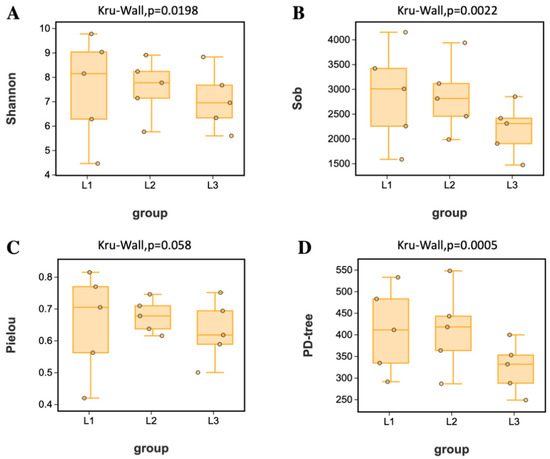
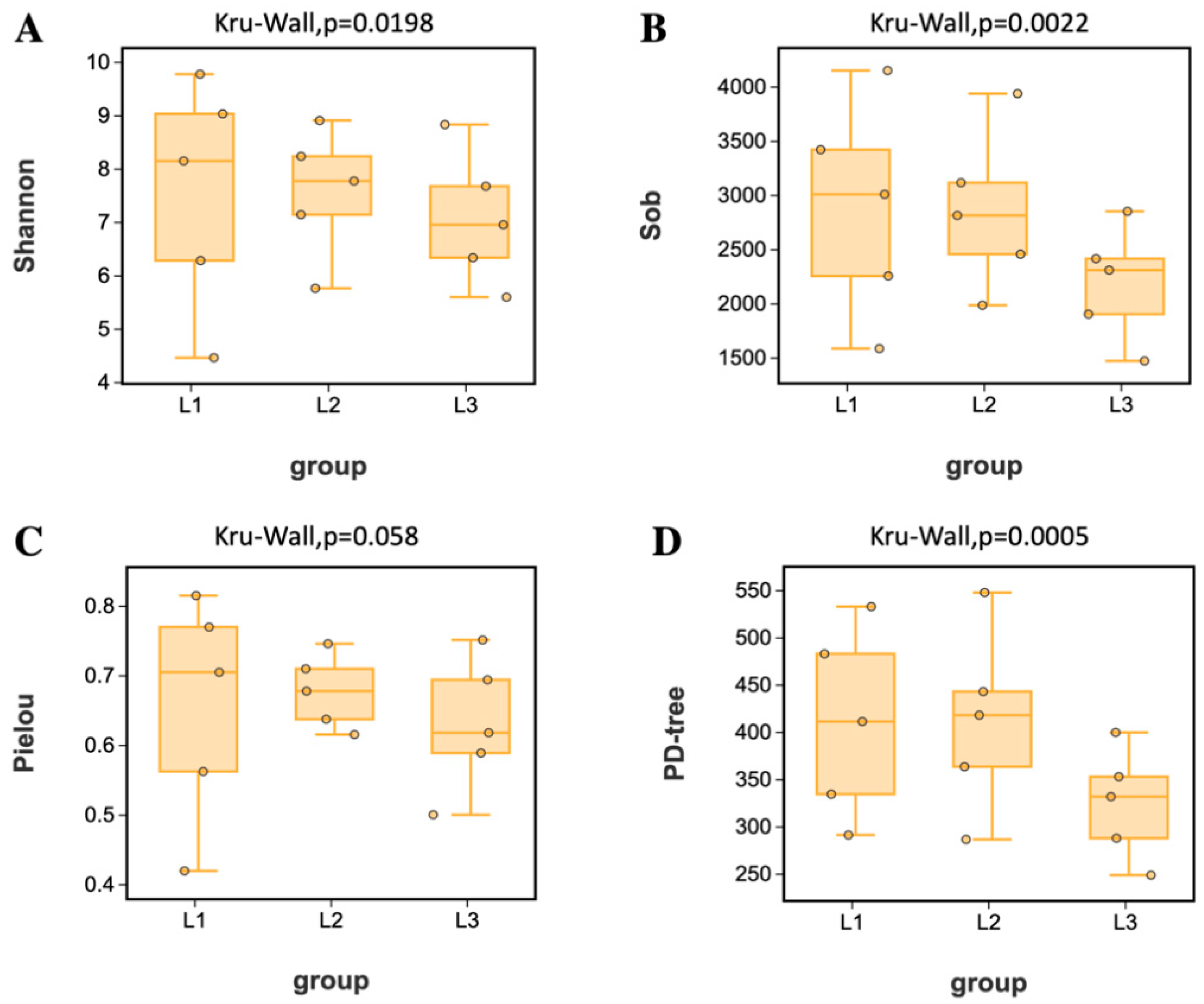
Alpha-diversity indices varied among soil depths (Figure 2). Shannon, Sobs, and Faith’s phylogenetic diversity (PD) indices differed across layers (p = 0.020, p = 0.002, and p < 0.001, respectively). Median values of these indices generally decreased from the surface (L1) to the deep layer (L3). The Sobs index showed a consistent decline with increasing depth, and Shannon diversity was higher in surface soils than in subsurface layers. Similarly, the PD index showed greater phylogenetic diversity in L1 compared with L3. In contrast, the Pielou evenness index showed no statistically significant difference among depths (p = 0.058), although a decreasing trend was observed, suggesting that community evenness remained relatively stable despite reductions in richness and phylogenetic diversity. Overall, these results indicate a depth-related reduction in microbial richness and phylogenetic diversity across the soil profile.
Figure 2.
Shannon Index of prokaryotes across different soil layers (A). Sobs Index of prokaryotes across different soil layers (B). Pielou Index of prokaryotes across different soil layers (C). PD-tree Index of prokaryotes across different soil layers (D). (Surface-layer: L1; Intermediate-layer: L2; Deep-layer: L3).
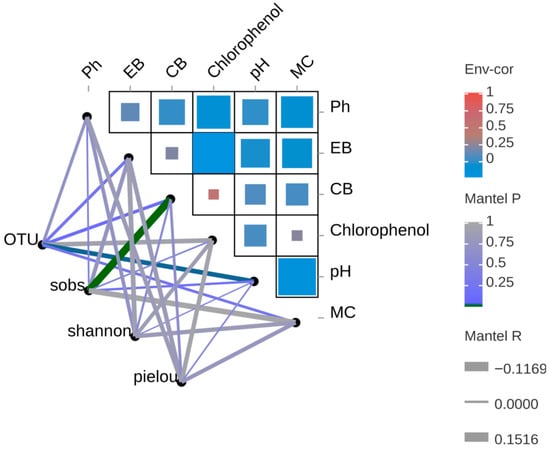
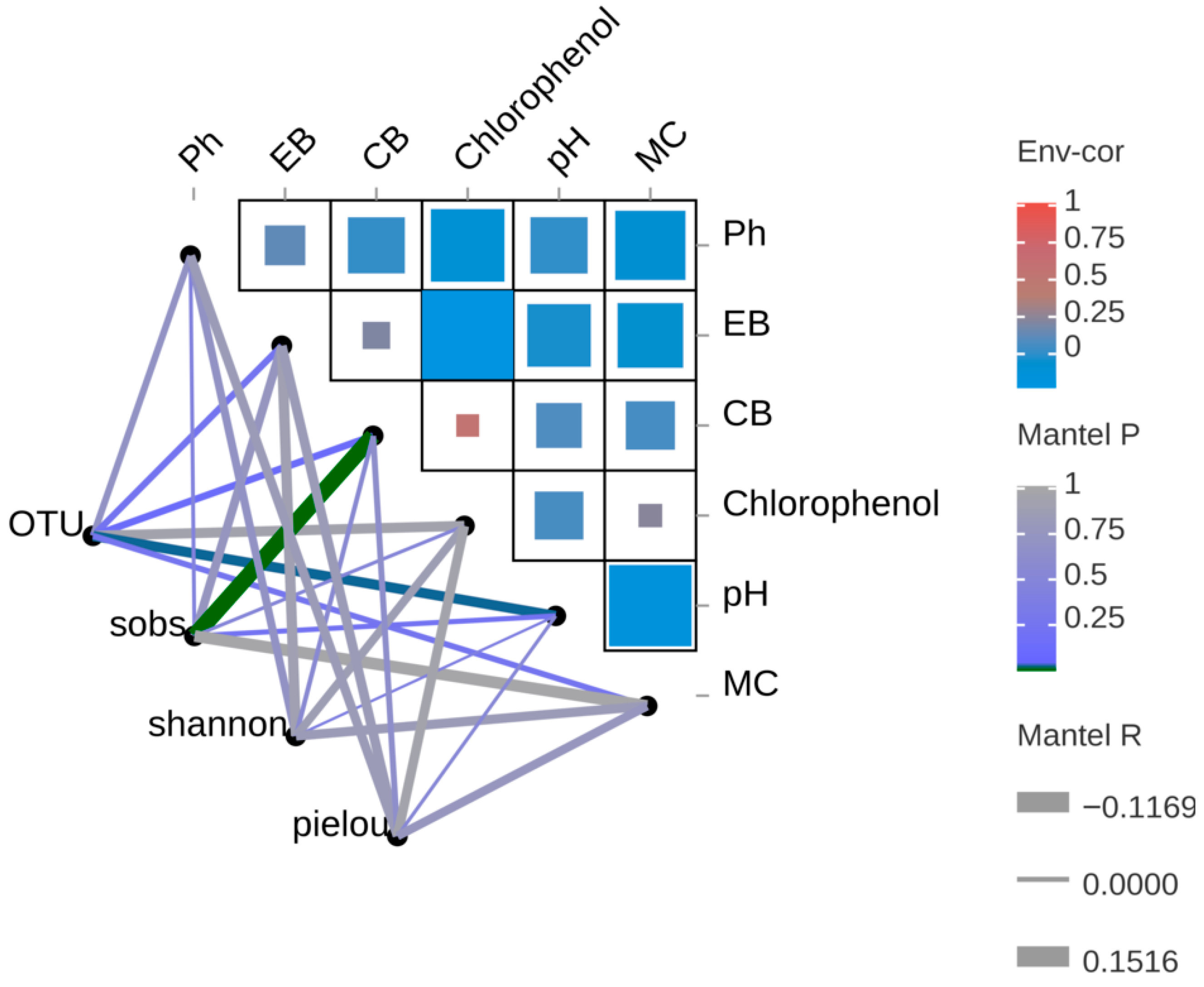
Mantel tests were conducted to evaluate associations between microbial alpha-diversity indices (Sobs, Shannon, Pielou, and PD) and environmental variables (Figure 3). Among the tested environmental variables, chlorobenzene showed positive correlations with both Sobs (r = 0.264, p = 0.002) and PD (r = 0.313, p = 0.004), indicating that chlorinated compounds may be associated with variations in microbial richness and phylogenetic structure. In contrast, no significant correlations were observed between Shannon diversity and any of the measured environmental variables (p > 0.05), suggesting that overall diversity remained relatively stable under varying environmental conditions. Similarly, most environmental factors, including benzene, ethylbenzene, pH, and moisture content, showed no significant associations with Sobs or PD (p > 0.05).
Figure 3.
Alpha Mantel test of alpha diversity indices against environmental factors (Ph means total benzene; EB means ethylbenzene; CB means chlorobenzene; chlorophenol means 2-chlorophenol; MC means moisture content).
These results suggest that chlorinated compounds, particularly chlorobenzene, were strongly associated with variations in microbial richness and phylogenetic diversity. Collectively, these findings suggest that specific pollutant types may be linked to differences in microbial community structure, although causal relationships cannot be inferred from correlation-based analyses.
3.2.2. β-Diversity Analysis
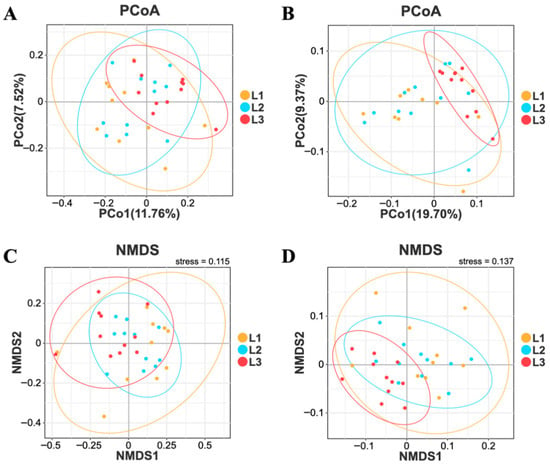
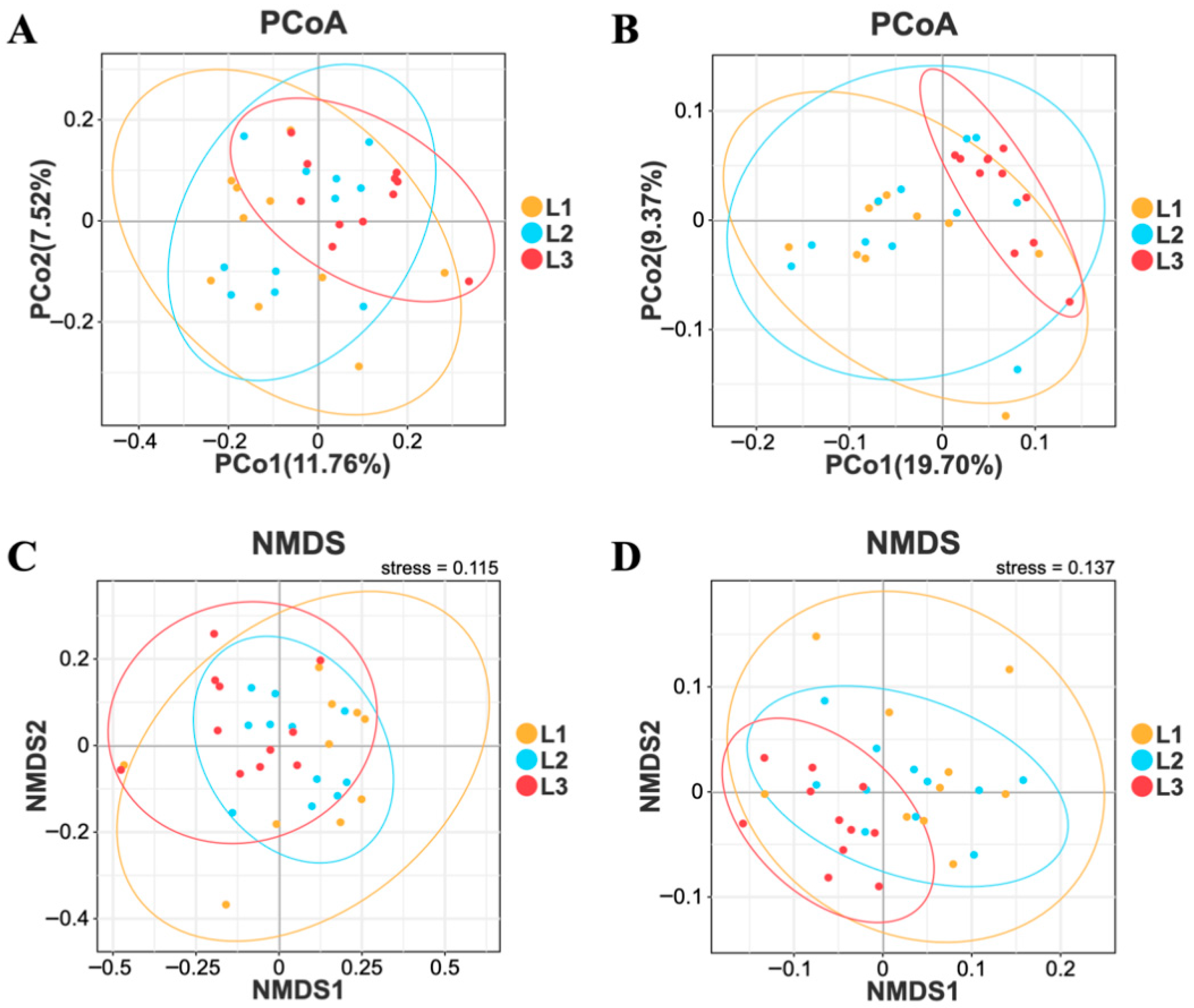
Unweighted UniFrac-based PCoA (Figure 4A) revealed depth-associated differences in prokaryotic community composition driven by phylogenetic presence–absence patterns. Surface soils (L1) exhibited greater within-layer dispersion, intermediate soils (L2) showed transitional positioning, and deep soils (L3) formed a relatively compact cluster. Weighted UniFrac-based PCoA (Figure 4B) demonstrated a clearer separation of L3 from L1 and L2, indicating that shifts in the relative abundance of dominant taxa contributed to the distinct community structure observed in deep soils.
Figure 4.
Principal Coordinate Analysis (PCoA) of different layers based on unweighted-unifrac distance (A). Principal Coordinate Analysis (PCoA) of different layers based on weighted-unifrac distance (B). NMDS analysis of different layers based on unweighted-unifrac distance (C). NMDS analysis of different layers based on weighted-unifrac distance (D). (Surface-layer: L1; Intermediate-layer: L2; Deep-layer: L3).
NMDS ordinations based on unweighted and weighted UniFrac distances (Figure 4C,D) yielded stress values < 0.2, indicating acceptable ordination fit. Weighted NMDS showed stronger depth-related separation than unweighted NMDS. This pattern indicates that variation in dominant taxa abundance contributed to community structuring along the vertical gradient. Overall, these analyses demonstrate that microbial community composition varied with soil depth, with deeper layers exhibiting more distinct assemblages relative to surface soils.
PERMANOVA analysis based on UniFrac distance matrices further supported these observations. For unweighted UniFrac distances, no significant difference was observed between L1 and L2 (p = 0.425), whereas significant differences were detected between L2 and L3 (p = 0.013) and between L1 and L3 (p = 0.008). Similarly, weighted UniFrac analysis showed no significant difference between L1 and L2 (p = 0.341), while L2 vs. L3 and L1 vs. L3 comparisons were significant (p = 0.001). These results indicate that microbial communities in surface and intermediate soils are relatively similar, whereas deep soil communities are significantly differentiated.
Collectively, analyses of α- and β-diversity revealed pronounced vertical stratification of prokaryotic communities in organically contaminated soils [30]. Soil depth emerged as the primary determinant of community structure, with richness, diversity, and evenness progressively declining from surface to deeper horizons. This depth-related pattern reflects the inherent spatial heterogeneity of soil environments, including gradients in organic matter content, oxygen availability, porosity, and redox potential [31]. Such stratification indicates that community patterns were likely associated with environmental gradients, with additional contributions from dispersal and stochastic processes.
We propose that surface soils receive greater organic carbon inputs from litter than deeper layers. Together with higher organic matter concentrations, these conditions provide abundant carbon and nitrogen resources that sustain microbial growth and activity [32,33]. In addition, surface soils exhibit higher porosity and oxygen availability. This promotes the formation of metabolically favorable niches that support diverse microbial processes [34]. Consequently, surface and deep horizons exhibited significantly distinct community compositions, whereas intermediate layers displayed transitional assemblages.
In deeper soils, microbial communities showed greater taxonomic similarity and simplified structural organization. This pattern likely results from relatively homogeneous microhabitats and limited resource heterogeneity. The observed variation in the PD index further supports increased phylogenetic convergence in deeper layers. These trends are consistent with decreasing organic matter inputs, reduced nutrient availability, and greater environmental homogenization with increasing soil depth [35]. Accordingly, microbial communities shifted from high diversity and high variability in surface soils to lower diversity and reduced variability in deeper horizons [36]. Overall, these findings demonstrate that organically contaminated soils exhibit marked vertical microbial stratification, likely associated with soil depth and gradients in organic pollutant distribution.
3.3. Composition of Prokaryotic Community
3.3.1. Venn Diagram
A Venn diagram based on OTU-level classification (Supplementary Figure S1) illustrates the distribution of unique and shared microbial taxa across soil layers under organic contamination. The surface layer (L1) contained the highest number of unique OTUs (1688), whereas the intermediate layer (L2) exhibited the lowest unique richness (764). A total of 1317 OTUs were shared among all three layers, indicating the presence of a core microbial assemblage throughout the soil profile. Pairwise comparisons further revealed depth-dependent differences in community overlap. The number of shared OTUs between L1 and L2 (735) was substantially greater than that between L1 and L3 (325) or L2 and L3 (254), suggesting that the intermediate layer harbors a community composition more similar to the surface horizon. In contrast, the deep layer (L3) retained a considerable proportion of unique OTUs (934), implying the formation of distinct ecological niches under deeper soil conditions.
Overall, these results indicate that although a core microbiome is distributed across the site, vertical environmental gradients associated with organic contamination contribute to the differentiation of microbial communities, particularly in deeper soil horizons.
3.3.2. Phylum-Level Composition of Prokaryotic Communities
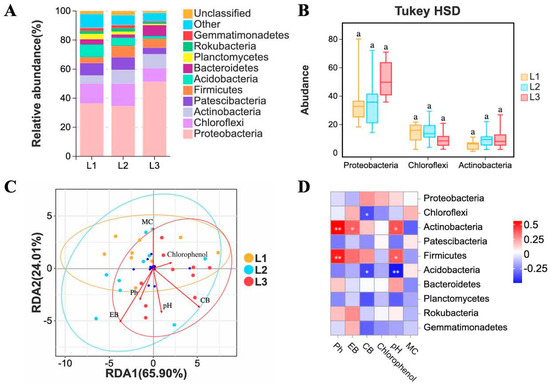
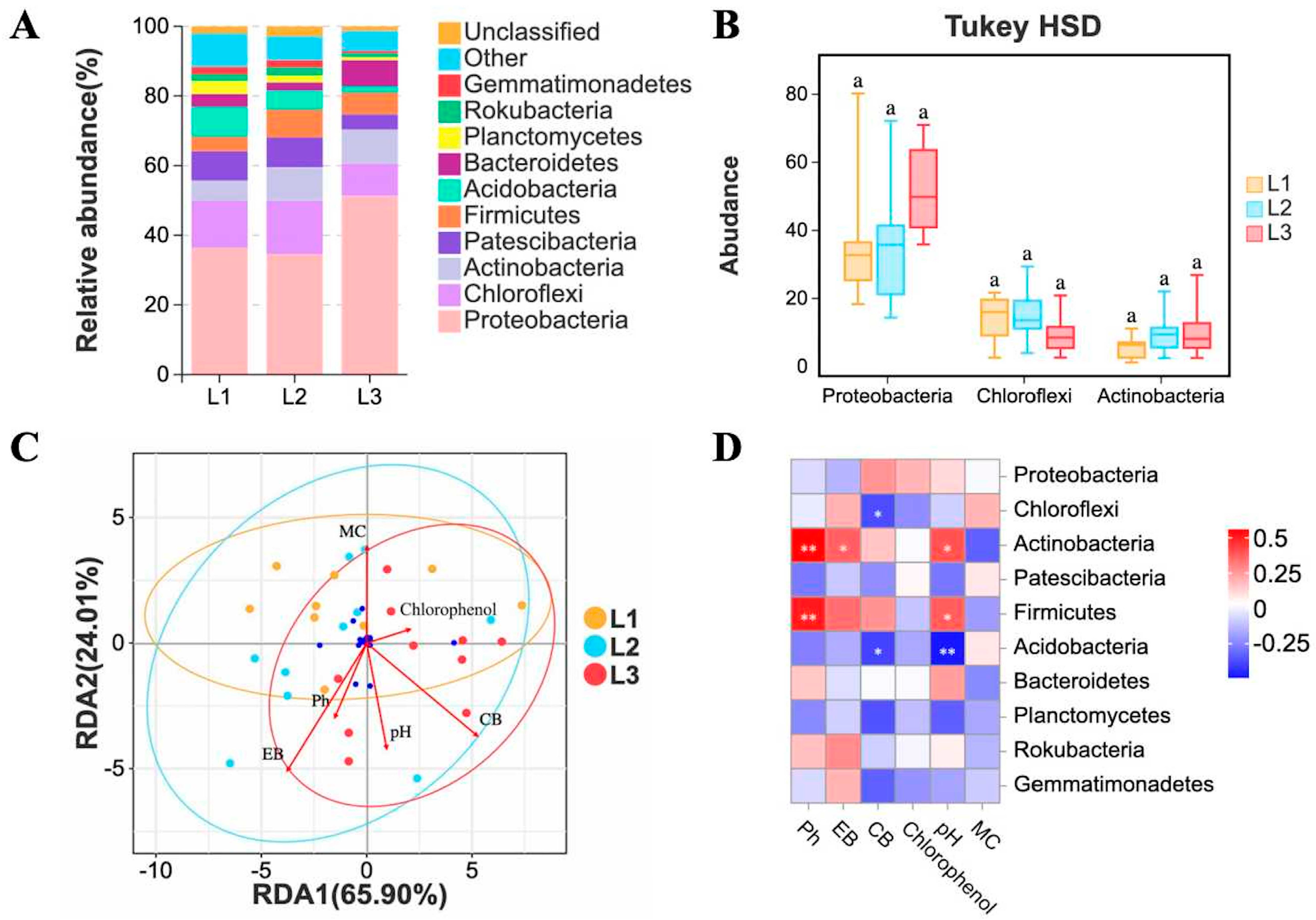
At the phylum level, Proteobacteria dominated all soil layers, with relative abundances ranging from 34.58% to 51.27%, reaching the highest proportion in the deep layer (L3) (Figure 5A). Chloroflexi displayed markedly lower abundance in L3 compared with L1 and L2. Together, Proteobacteria, Chloroflexi, and Actinobacteria constituted the predominant phyla across the soil profile. Tukey’s honestly significant difference (HSD) test performed on the three most abundant phyla (Figure 5B) showed that although Proteobacteria tended to be more abundant in L3 than in L1 and L2, these differences were not statistically significant, indicating limited vertical differentiation at the phylum level.
Figure 5.
Stacked bar chart of relative species abundance at the phylum level (A). Differential analysis of the top three phyla across soil layers (B). RDA plot of microorganisms versus environmental factors at the phylum level (C). Spearman correlation heatmap of the top 10 phyla with environmental variables (D). (Surface-layer: L1; Intermediate-layer: L2; Deep-layer: L3. Ph means total benzene; EB means ethylbenzene; CB means chlorobenzene; chlorophenol means 2-chlorophenol; MC means moisture content; Different lowercase letters indicate significant differences among groups (p < 0.05), while asterisks indicate significant differences between groups (* p < 0.05, ** p < 0.01)).
Redundancy analysis (RDA) was conducted to assess relationships between phylum-level community composition and environmental variables, including benzene, ethylbenzene, chlorobenzene, 2-chlorophenol, pH, and moisture content (Figure 5C). The first two RDA axes explained 89.91% of the total variance, indicating potential associations between microbial community structure and measured environmental factors. Samples from different soil layers were clearly separated in ordination space. Surface-layer (L1) samples were distributed along the negative axis of RDA1 and positively correlated with benzene, ethylbenzene, and moisture content. In contrast, deep-layer (L3) samples clustered along the positive axis of RDA1 and were primarily correlated with chlorobenzene, 2-chlorophenol, and pH. Intermediate-layer (L2) samples were located near the origin, reflecting intermediate community composition and weaker associations with the measured variables. Overall, these results suggest depth-related differences in the relationships between microbial communities and organic pollutants.
Correlations between the ten most abundant phyla and environmental variables were further evaluated (Figure 5D). Actinobacteria were positively correlated with benzene (r = 0.57), ethylbenzene (r = 0.38), and pH (r = 0.41), whereas Firmicutes showed positive correlations with benzene (r = 0.52) and pH (r = 0.39). In contrast, Chloroflexi exhibited a negative correlation with chlorobenzene (r = −0.37), and Acidobacteria were negatively correlated with both chlorobenzene (r = −0.39) and pH (r = −0.48). These patterns suggest differential associations between aromatic and chlorinated pollutants and dominant bacterial phyla along the vertical soil gradient.
Proteobacteria, characterized by metabolic versatility and documented capacities for the transformation of recalcitrant organic compounds [37], exhibited the highest relative abundance across all soil layers. Spearman’s correlation analysis revealed associations between Proteobacteria and chlorobenzene as well as 2-chlorophenol, while RDA indicated enrichment of these chlorinated pollutants in deeper soils. Consistently, Proteobacteria reached their highest relative abundance in L3, which may reflect adaptation to deeper-soil conditions characterized by lower oxygen availability and reduced nutrient inputs, where organic pollutants can serve as alternative carbon and energy sources [38,39].
In addition to Proteobacteria, Actinobacteria and Chloroflexi maintained relatively high abundances throughout the soil profile, indicating persistence under long-term organic contamination [40]. Actinobacteria are widely reported to participate in the degradation of complex organic matter through extracellular enzymatic processes, generating smaller metabolites that can be assimilated into central metabolic pathways [41,42]. Chloroflexi were positively correlated with ethylbenzene and moisture content, consistent with their higher abundances in surface and intermediate soils. Conversely, Chloroflexi and Acidobacteria were negatively correlated with chlorobenzene and pH and exhibited lower abundances in deep soils, suggesting potential sensitivity to chlorinated pollutants and associated environmental conditions.
Collectively, these findings revealed that vertical stratification of microbial communities is closely linked to soil depth and pollutant gradients. This pattern is consistent with heterogeneous environmental conditions across soil layers. Aromatic hydrocarbons were preferentially correlated with phyla commonly involved in hydrocarbon transformation (e.g., Proteobacteria and Actinobacteria), whereas chlorinated pollutants showed negative associations with several dominant groups (e.g., Chloroflexi and Acidobacteria), reinforcing depth-related differentiation in community structure. The stronger separation of deep-layer communities observed in abundance-weighted ordination analyses further suggests that environmental selection may be associated with patterns observed in dominant lineages rather than driving extensive turnover across the entire community.
From an applied perspective, these results provided a conceptual basis for designing site-specific microbial remediation strategies in organically contaminated soils. In addition, vertical differentiation of microbial communities was observed. These patterns highlight the importance of considering soil depth and contaminant composition when selecting or stimulating functional consortia. Previous studies have demonstrated that engineered remediation approaches can enhance the removal of organic contaminants by improving microbial habitats and promoting pollutant degradation processes [43]. Surface soils dominated by aromatic hydrocarbons may preferentially support taxa associated with hydrocarbon transformation. In contrast, deeper soils enriched in chlorinated compounds may require approaches compatible with communities tolerant to chlorinated stress. In mixed-contamination scenarios, staged or depth-targeted remediation strategies may reduce antagonistic interactions among pollutants and microbial groups. Moreover, depth-resolved changes in key microbial taxa may serve as potential biological indicators for monitoring remediation progress.
3.3.3. Genus-Level Composition of Prokaryotic Communities
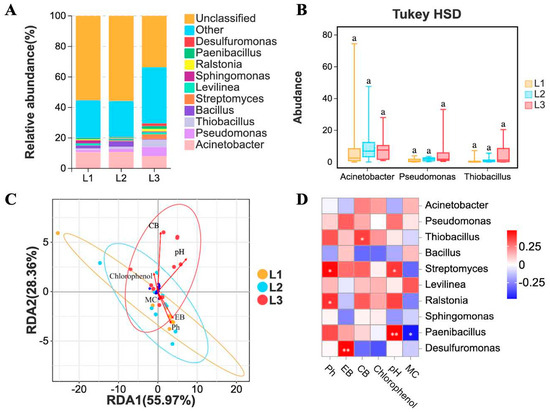
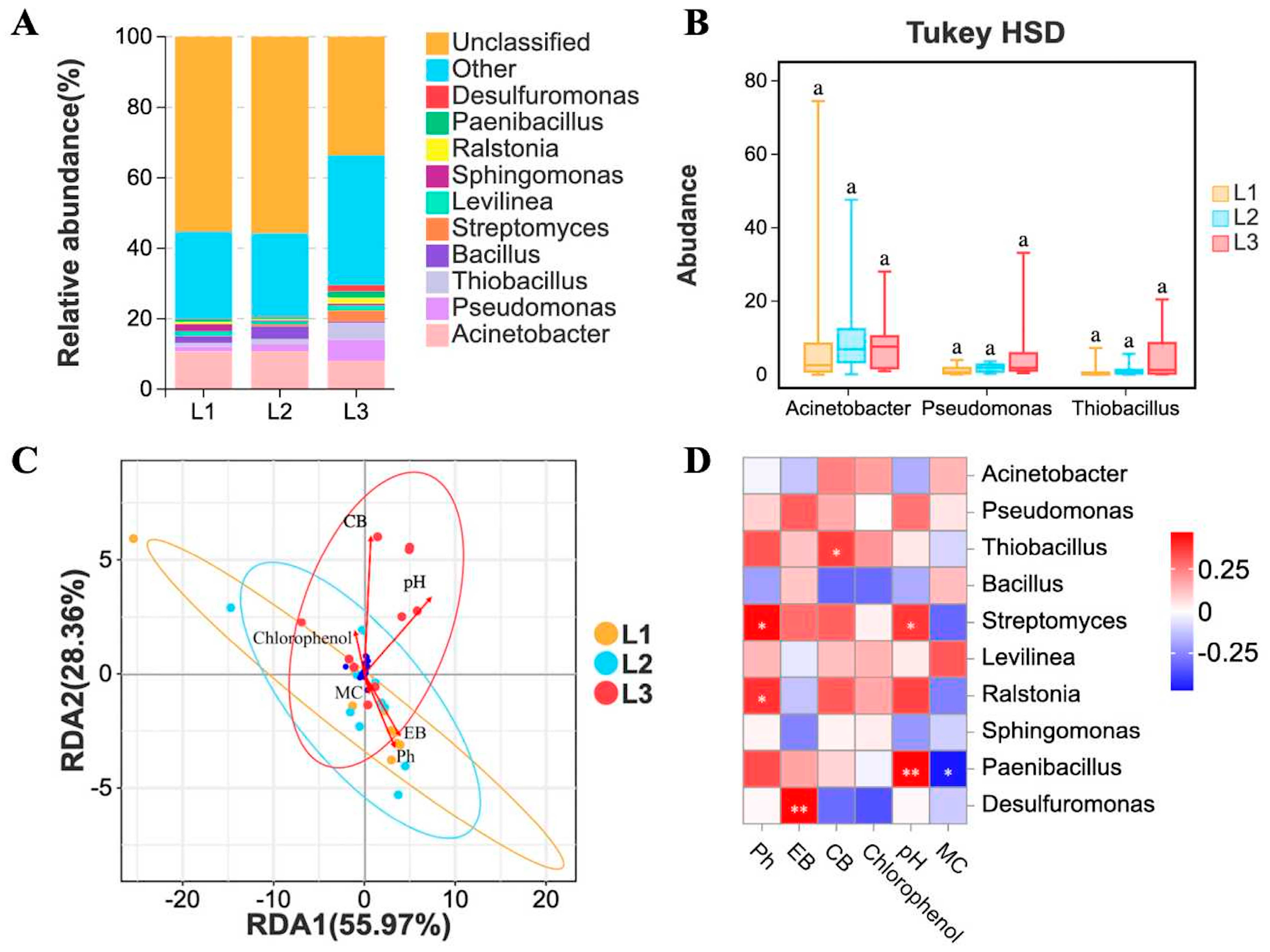
To further resolve taxonomic variation along the soil profile, genus-level community composition was analyzed across soil layers (Figure 6A). The most abundant genera overall included Acinetobacter, Pseudomonas, and Thiobacillus. In L1, the dominant genera were Acinetobacter (10.72%), Sphingomonas (2.04%), and Bacillus (1.88%). In L2, Acinetobacter (10.82%), Bacillus (3.59%), and Pseudomonas (1.96%) predominated. In L3, Acinetobacter (8.12%), Pseudomonas (5.86%), and Thiobacillus (4.84%) were most abundant. Tukey’s HSD test applied to the three dominant genera (Figure 6B) revealed no statistically significant differences in relative abundance among soil layers, indicating that these dominant taxa were broadly distributed throughout the vertical profile.
Figure 6.
Relative abundance stack-plot of genera at the genus level (A). Differential analysis of the top three genera across soil layers (B). RDA plot of microbial genera versus environmental factors (C). Spearman correlation heatmap of the top 10 genera with environmental variables (D). (Surface-layer: L1; Intermediate-layer: L2; Deep-layer: L3. Ph means total benzene; EB means ethylbenzene; CB means chlorobenzene; chlorophenol means 2-chlorophenol; MC means moisture content; Different lowercase letters indicate significant differences among groups (p < 0.05), while asterisks indicate significant differences between groups (* p < 0.05, ** p < 0.01)).
Genus-level RDA analysis (Figure 6C) further indicated that soil depth was associated with shifts in organic pollutant distribution and environmental variables, which were associated with vertical differentiation in microbial community structure. Correlation heatmap analysis of the ten most abundant genera (Figure 6D) identified several significant associations with environmental factors. Thiobacillus was positively correlated with chlorobenzene (r = 0.37). Streptomyces showed positive correlations with benzene (r = 0.47) and pH (r = 0.39). Ralstonia was positively correlated with benzene (r = 0.40), whereas Paenibacillus was positively correlated with pH (r = 0.47) and negatively correlated with moisture content (r = −0.46). In addition, Desulfuromonas exhibited a positive correlation with ethylbenzene (r = 0.48).
Among dominant genera, Acinetobacter maintained relatively high abundance across all soil layers, consistent with its reported capacity to transform aromatic compounds, including chlorinated hydrocarbons, through lytic or cometabolic pathways [44]. Thiobacillus has been reported to tolerate and transform toxic organic compounds [45], and its positive association with chlorobenzene aligns with its higher relative abundance in deep soils. Streptomyces has demonstrated degradation potential for organochlorine compounds [46], supporting its potential ecological relevance in chlorobenzene-impacted environments. Metagenomic studies have also shown that Pseudomonas and Paenibacillus possess metabolic pathways involved in the transformation of diverse organic pollutants [47]. Consistent with these reports, several of these genera exhibited positive associations with aromatic hydrocarbons or chlorinated compounds in the present study and were detected across all soil layers.
3.4. Functional Prediction of the Prokaryotic Community
3.4.1. Prediction of the Prokaryotic Community’s Potential Phenotype
BugBase phenotype prediction (Supplementary Figure S3) revealed depth-related shifts in predicted microbial functional traits. In L1, Gram-negative bacteria were enriched, whereas Gram-positive taxa were comparatively less abundant. In contrast, L2 was characterized by a higher relative abundance of Gram-positive bacteria and a reduction in Gram-negative taxa, indicating a transition in dominant cell-wall phenotypes from surface to subsurface layers. In L3, multiple functional groups exhibited relatively high predicted abundances, including aerobic, anaerobic, facultatively anaerobic, stress-tolerant, biofilm-forming, and mobile element–associated bacteria, as well as potentially pathogenic taxa. These patterns correspond to environmental conditions typically observed in deeper soils, such as lower nutrient availability, reduced oxygen concentrations, and increased physicochemical stress. Under such conditions, microbial communities are often enriched in taxa exhibiting stress tolerance, metabolic flexibility, facultative anaerobiosis, and enhanced biofilm-forming capacity [48,49]. Biofilm formation can facilitate adhesion to soil particles, improve resource acquisition efficiency, and increase resistance to environmental stressors [50]. In summary, the results indicate a vertical shift in dominant functional strategies, from surface-associated communities characterized by decomposer activity to deeper communities exhibiting greater stress tolerance and metabolic versatility [51]. This depth-related differentiation likely reflects variation in resource gradients, with functional traits showing stronger sensitivity to environmental conditions than taxonomic composition, while other assembly processes cannot be excluded [52].
3.4.2. Functional Prediction of Prokaryotic Communities
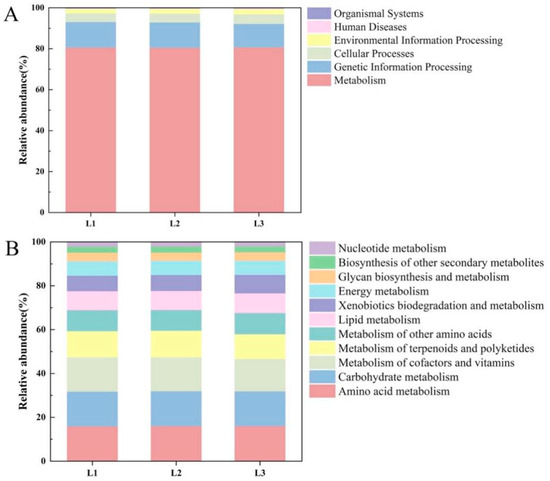
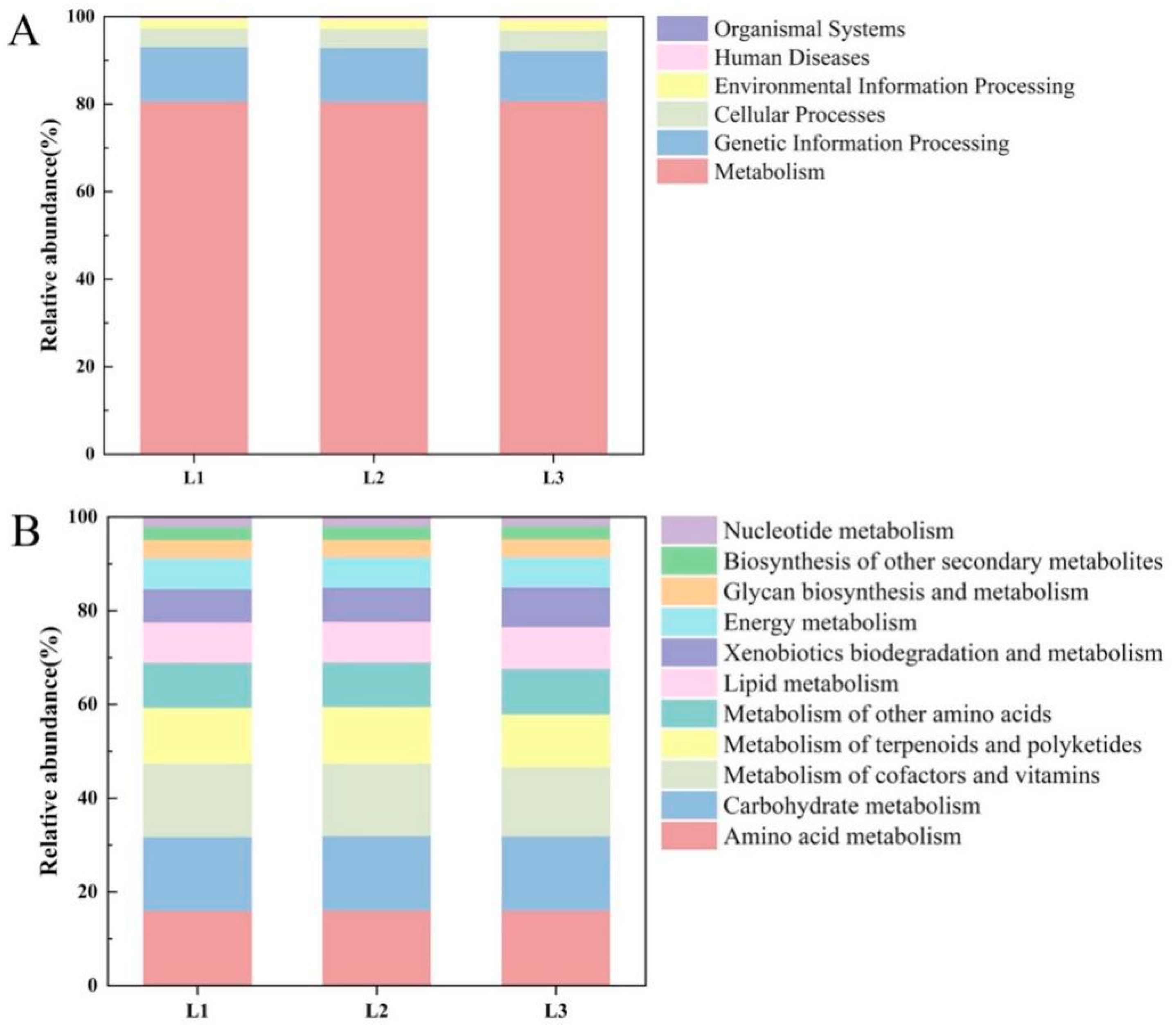
Functional profiles of soil microbial communities were predicted using PICRUSt2 (Figure 7A). Although the number of predicted functional genes decreased with increasing soil depth, the overall functionality remained relatively stable [53], including metabolism, genetic information processing, cellular processes, environmental information processing, organismal systems, and human diseases. Among these categories, metabolism-related genes exhibited the highest relative abundance. Subsequent analyses therefore focused on the ten most abundant metabolic pathways (Figure 7B), including amino acid metabolism, carbohydrate metabolism, and cofactor/vitamin metabolism. To improve the visualization of depth-related functional variation, selected metabolic pathways were further illustrated separately (Supplementary Figure S5). Notably, genes involved in xenobiotic biodegradation and metabolism and lipid metabolism showed increased relative abundance in the deep layer (L3). In contrast, pathways related to the metabolism of terpenoids and polyketides, cofactors and vitamins, and other amino acids exhibited relatively lower abundance in L3 compared with L1 and L2. Differential abundance analysis (Supplementary Figure S2) identified significant differences between L3 and the upper layers (L1 and L2), whereas no significant differences were observed between L1 and L2. The higher relative abundance of genes associated with amino acid, carbohydrate, and cofactor/vitamin metabolism in L3 suggests functional adjustment of microbial communities to deeper-soil conditions characterized by lower nutrient availability, reduced oxygen concentrations, and elevated pollutant levels.
Figure 7.
Functional characteristics of prokaryotic communities in different soil layers predicted by PICRUSt2 (A). Top ten most abundant functional genes related to metabolism predicted by PICRUSt2 (B). (Surface-layer: L1; Intermediate-layer: L2; Deep-layer: L3).
In addition, genes related to heterotrophic biomass degradation and organic compound metabolism were relatively enriched in deep soils, indicating potential links to the downward migration and accumulation of organic pollutants and their use as alternative carbon sources. Analysis of the ten most abundant degradation-related genes (Supplementary Figure S4) further demonstrated the widespread presence of pathways involved in aromatic hydrocarbon and chlorinated compound degradation across all soil layers, with comparatively higher predicted abundances in L3.
Collectively, degradation- and metabolism-related functional genes were consistently detected throughout the contaminated soil profile. Their relative enrichment in deeper layers corresponded to elevated concentrations of organic pollutants. BugBase and PICRUSt2 infer functional potential from phylogeny and reference genomes rather than direct measurements, and thus reflect potential rather than actual activity. Their accuracy depends on database coverage and may be biased in deep soils, where microbial taxa are underrepresented [54]. Amplicon-based approaches further lack resolution for strain-level functions and novel genes. Future validation using shotgun metagenomic or metatranscriptomic approaches is needed to confirm these predictions. Despite these limitations, the results provide indicative insights into functional variation along soil depth gradients.
3.5. Symbiotic Network of the Prokaryotic Community
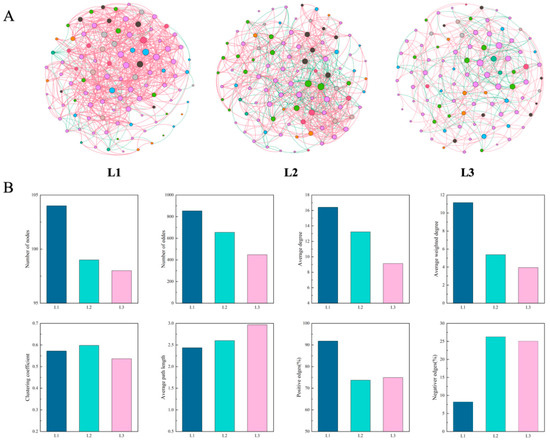
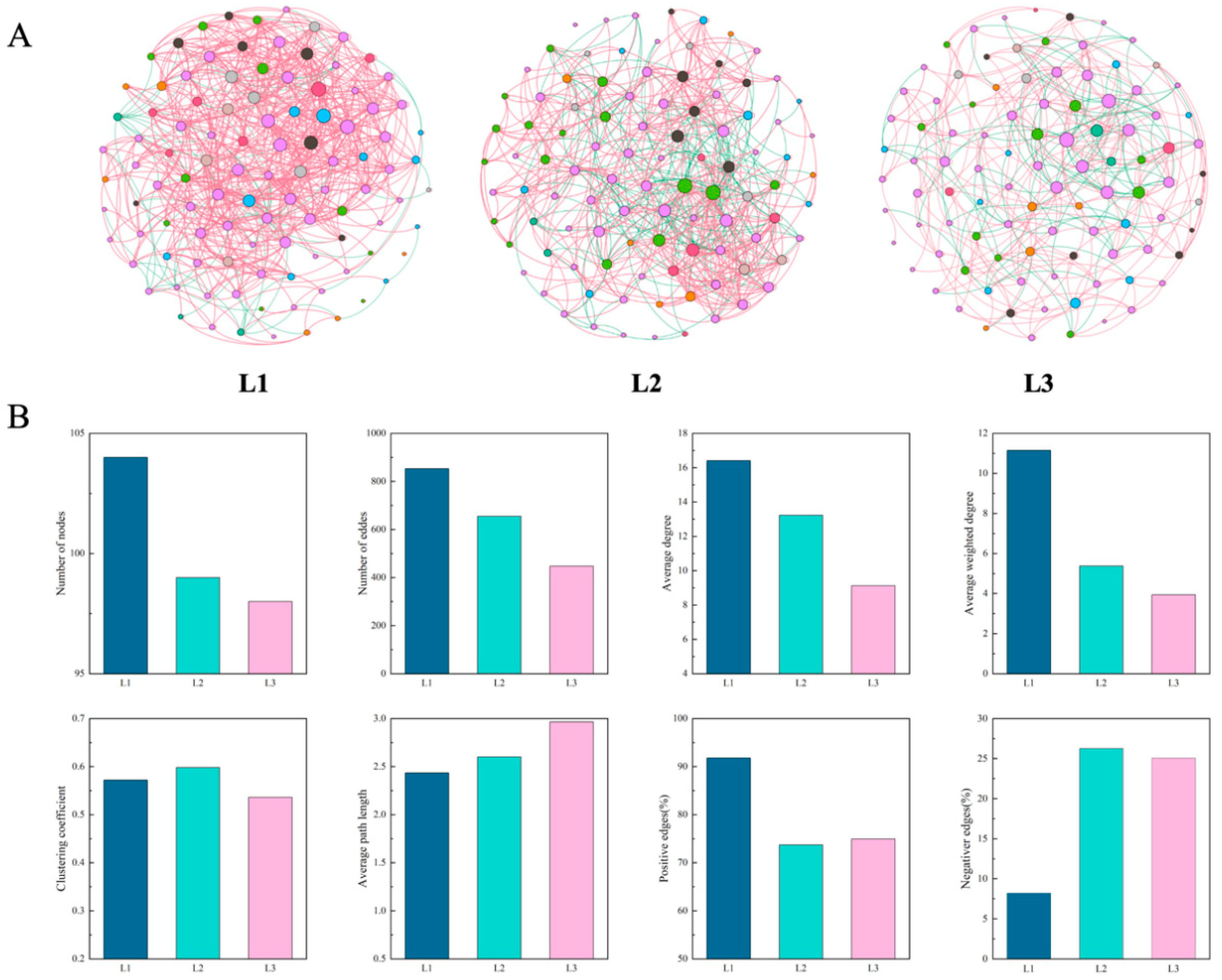
Co-occurrence network analysis revealed depth-associated differences in microbial association patterns across the contaminated soil profile (Figure 8). To construct robust and biologically meaningful networks, only strong and statistically significant correlations were retained using thresholds of |r| > 0.6 and FDR-adjusted p < 0.05. This threshold is widely adopted in microbial co-occurrence network studies to reduce spurious correlations and ensure comparability across networks [55]. It should be noted that the inferred networks are based on correlation analyses and therefore represent statistical co-occurrence relationships rather than direct biological interactions. A total of 104, 99, and 98 nodes and 853, 655, and 447 edges were identified in the L1, L2, and L3 layers, respectively, indicating a progressive decline in network connectivity with increasing soil depth. Correspondingly, overall network complexity decreased along the vertical gradient [56]. The average degrees of L1, L2, and L3 were 16.404, 13.232, and 9.122, respectively, while the average weighted degrees were 11.149, 5.378, and 3.937. These results imply that microbial taxa in surface soils exhibited more densely connected association patterns compared with deeper layers [57]. The L2 layer displayed a relatively higher clustering coefficient (0.598), indicating a more locally clustered network structure that may reflect greater sensitivity to environmental fluctuations. The average path length, which represents the mean shortest distance between nodes in the network, increased with depth (L1: 2.434; L2: 2.602; L3: 2.964). This pattern may correspond to reduced connectivity and greater structural simplification under depth-related environmental constraints.
Figure 8.
Co-occurrence networks of prokaryotic microbial communities across different soil depths in the organically contaminated site (A). Network topological features of different soil layers; Positive and negative cohesion for different soil layers (B). (Surface-layer: L1; Intermediate-layer: L2; Deep-layer: L3; blue, green, and pink indicate L1, L2, and L3, respectively).
Across all layers, positive correlations substantially outnumbered negative correlations (L1: p = 91.79%, N = 8.21%; L2: p = 73.74%, N = 26.26%; L3: p = 74.94%, N = 25.06%), suggesting that co-occurrence or co-tolerance relationships were more prevalent than antagonistic associations under long-term organic contamination [58]. Previous studies have reported that higher proportions of positive interactions under environmental disturbance may decrease network stability, whereas negative interactions can contribute to enhanced structural stability [59,60]. Accordingly, the relatively low proportion of negative correlations observed here may indicate limited stabilizing interactions within the contaminated soil networks. Nodes with degrees exceeding 90% of the maximal degree were defined as keystone taxa or network hubs [61]. At the genus level, different taxa served as central nodes in each layer: Acinetobacter, Bacillus, and Sphingomonas in L1; Acinetobacter, Bacillus, and Pseudomonas in L2; and Acinetobacter, Pseudomonas, and Thiobacillus in L3. Collectively, dominant nodes primarily belonged to Proteobacteria, Firmicutes, Actinobacteria, and Acidobacteria, underscoring their central roles in structuring microbial association networks across soil depths.
Overall, variation in microbial association patterns and network complexity was strongly related to soil depth and organic pollutant gradients, supporting the role of depth-related environmental filtering in shaping community structure.
4. Conclusions
Microorganisms play central roles in soil ecosystem functioning, including organic matter turnover and biogeochemical cycling. This study demonstrates that both the taxonomic composition and predicted functional potential of prokaryotic communities vary along vertical soil gradients and organic pollutant distributions, particularly for chlorinated compounds such as chlorobenzene. Alpha-diversity indices (Shannon, Sobs, and PD) decreased with depth (p = 0.020, p = 0.002, and p < 0.001, respectively), accompanied by reduced predicted metabolic gene abundance and lower co-occurrence network complexity. In contrast, the relative distribution of major functional categories remained comparatively stable, suggesting the persistence of core metabolic functions despite structural simplification. Overall, these patterns indicate depth-related shifts in microbial community structure and potential functional traits under long-term organic contamination. From an applied perspective, remediation strategies should consider depth-resolved microbial characteristics, with aromatic hydrocarbon degradation preferentially targeted in surface soils and chlorinated compound remediation emphasized in deeper layers. These findings provide a basis for optimizing in situ bioremediation strategies in contaminated soils. However, future studies incorporating parallel analyses of uncontaminated soils from the same region would help disentangle the relative contributions of soil depth and pollutant stress to microbial community assembly and identify taxa specifically responsive to contamination.
Supplementary Materials
The following supporting information can be downloaded at: https://www.mdpi.com/article/10.3390/pr14071083/s1, Table S1. Concentration Table of Environmental Factors at Each Monitoring Site; Figure S1. OTU-Level Venn Diagram; Figure S2. Differential Analysis of the Top Ten Metabolic Functional Genes Across Three Soil Layers; Figure S3. Heatmap of predicted prokaryotic phenotypic abundance across different soil layers based on Bugbase; Figure S4. Top ten most abundant functional genes related to heterotrophic biomass biodegradation and metabolism predicted by PICRUSt2; Figure S5. Relative abundances of selected functional pathways predicted by PICRUSt2 across different soil layers, including xenobiotic biodegradation and metabolism, lipid metabolism, metabolism of other amino acids, metabolism of terpenoids and polyketides, and metabolism of cofactors and vitamins.
Author Contributions
W.Z.: Conceptualization, Methodology, Formal analysis, Writing—original draf. Z.Z.: Supervision, Funding acquisition, Resources, Writing—review and editing. L.X.: Writing—review & editing. B.T.: Writing—review and editing. Y.W.: Investigation. J.C.: Investigation. Y.Y.: Writing—review and editing. All authors have read and agreed to the published version of the manuscript.
Funding
This work was supported by the National Natural Science Foundation of China (Grants No. 52070072, 51879080, and 51509129) and the National Key Research & Development Program of China (No. 2019YFC1804303).
Data Availability Statement
The data presented in this study are available on request from the corresponding author.
Acknowledgments
The Priority Academic Program Development of Jiangsu Higher Education Institutions (PAPD) and the Top-notch Academic Programs Project (TAPP) of Jiangsu Higher Education Institutions supported this work.
Conflicts of Interest
The authors declare no conflict of interest.
References
- Zhao, T. Study on Soil Pollution Control Technology of Land Remediation Project. Acad. J. Sci. Technol. 2022, 3, 132–133. [Google Scholar] [CrossRef] [Scilit]
- Ding, D.; Song, X.; Wei, C.; LaChance, J. A review on the sustainability of thermal treatment for contaminated soils. Environ. Pollut. 2019, 253, 449–463. [Google Scholar] [CrossRef] [Scilit]
- Shi, L.; Yang, L. Review on the research progress of physical remediation technology for organic contaminated sites. IOP Conf. Ser. Earth Environ. Sci. 2021, 781 , 052024. [Google Scholar]
- Delgado-Baquerizo, M.; Maestre, F.T.; Reich, P.B.; Jeffries, T.C.; Gaitan, J.J.; Encinar, D.; Berdugo, M.; Campbell, C.D.; Singh, B.K. Microbial diversity drives multifunctionality in terrestrial ecosystems. Nat. Commun. 2016, 7, 10541. [Google Scholar] [CrossRef] [Scilit] [PubMed]
- Oro, C.E.D.; Saorin Puton, B.M.; Venquiaruto, L.D.; Dallago, R.M.; Tres, M.V. Effective microbial strategies to remediate contaminated agricultural soils and conserve functions. Agronomy 2024, 14, 2637. [Google Scholar] [CrossRef] [Scilit]
- Huang, L.; Wang, N.; Deng, C.; Liang, Y.; Wang, Q.; Liu, M.; Chen, Y. Interactive effect of carbon source with influent COD/N on nitrogen removal and microbial community structure in subsurface flow constructed wetlands. J. Environ. Manag. 2019, 250, 109491. [Google Scholar] [CrossRef] [Scilit] [PubMed]
- Gagnon, V.; Rodrigue-Morin, M.; Tremblay, J.; Wasserscheid, J.; Champagne, J.; Bellenger, J.-P.; Greer, C.W.; Roy, S. Vegetation drives the structure of active microbial communities on an acidogenic mine tailings deposit. PeerJ 2020, 8, e10109. [Google Scholar] [CrossRef] [Scilit]
- O’Brien, S.L.; Gibbons, S.M.; Owens, S.M.; Hampton-Marcell, J.; Johnston, E.R.; Jastrow, J.D.; Gilbert, J.A.; Meyer, F.; Antonopoulos, D.A. Spatial scale drives patterns in soil bacterial diversity. Environ. Microbiol. 2016, 18, 2039–2051. [Google Scholar] [CrossRef] [Scilit]
- Rasmussen, P.U.; Bennett, A.E.; Tack, A.J. The impact of elevated temperature and drought on the ecology and evolution of plant–soil microbe interactions. J. Ecol. 2020, 108, 337–352. [Google Scholar] [CrossRef] [Scilit]
- Gao, D.; Hagedorn, F.; Zhang, L.; Liu, J.; Qu, G.; Sun, J.; Peng, B.; Fan, Z.; Zheng, J.; Jiang, P. Small and transient response of winter soil respiration and microbial communities to altered snow depth in a mid-temperate forest. Appl. Soil Ecol. 2018, 130, 40–49. [Google Scholar] [CrossRef] [Scilit]
- Tripathi, B.M.; Kim1, H.M.; Jung, J.Y.; Nam, S.; Ju, H.T.; Kim, M.; Lee, Y.K. Distinct taxonomic and functional profiles of the microbiome associated with different soil horizons of a moist tussock tundra in Alaska. Front. Microbiol. 2019, 10, 1442. [Google Scholar] [CrossRef] [Scilit]
- Brewer, T.E.; Aronson, E.L.; Arogyaswamy, K.; Billings, S.A.; Botthoff, J.K.; Campbell, A.N.; Dove, N.C.; Fairbanks, D.; Gallery, R.E.; Hart, S.C. Ecological and genomic attributes of novel bacterial taxa that thrive in subsurface soil horizons. mBio 2019, 10, e01318-19. [Google Scholar] [CrossRef] [Scilit]
- Li, S.; Zhao, B.; Jin, M.; Hu, L.; Zhong, H.; He, Z. A comprehensive survey on the horizontal and vertical distribution of heavy metals and microorganisms in soils of a Pb/Zn smelter. J. Hazard. Mater. 2020, 400, 123255. [Google Scholar] [CrossRef] [Scilit]
- Leewis, M.-C.; Lawrence, C.R.; Schulz, M.S.; Tfaily, M.M.; Ayala-Ortiz, C.O.; Flores, G.E.; Mackelprang, R.; McFarland, J.W. The influence of soil development on the depth distribution and structure of soil microbial communities. Soil Biol. Biochem. 2022, 174, 108808. [Google Scholar] [CrossRef] [Scilit]
- Malik, A.; Abdieva, G.; Ualieva, P. Microbial diversity of soils contaminated with persistent organic pollutants and POP-degrading strains. Water Air Soil Pollut. 2023, 234, 290. [Google Scholar] [CrossRef] [Scilit]
- Li, W.; Siddique, M.S.; Liu, M.; Graham, N.; Yu, W. The migration and microbiological degradation of dissolved organic matter in riparian soils. Water Res. 2022, 224, 119080. [Google Scholar] [CrossRef] [Scilit] [PubMed]
- Huang, Y.-H.; Liu, Y.; Geng, J.; Lü, H.; Zhao, H.-M.; Xiang, L.; Li, H.; Mo, C.-H.; Li, Y.-W.; Cai, Q.-Y. Maize root-associated niches determine the response variation in bacterial community assembly and function to phthalate pollution. J. Hazard. Mater. 2022, 429, 128280. [Google Scholar] [CrossRef] [Scilit] [PubMed]
- Liu, Y.; Wang, F.; Wang, Z.; Xiang, L.; Fu, Y.; Zhao, Z.; Kengara, F.O.; Mei, Z.; He, C.; Bian, Y. Soil properties and organochlorine compounds co-shape the microbial community structure: A case study of an obsolete site. Environ. Res. 2024, 240, 117589. [Google Scholar] [CrossRef] [Scilit]
- Naylor, D.; McClure, R.; Jansson, J. Trends in microbial community composition and function by soil depth. Microorganisms 2022, 10, 540. [Google Scholar] [CrossRef] [Scilit]
- Mejia, M.P.; Rojas, C.A.; Curd, E.; Renshaw, M.A.; Edalati, K.; Shih, B.; Vincent, N.; Lin, M.; Nguyen, P.H.; Wayne, R. Soil microbial community composition and tolerance to contaminants in an urban brownfield site. Microb. Ecol. 2023, 85, 998–1012. [Google Scholar] [CrossRef] [Scilit]
- Chen, Z.; Li, S.; Sun, X.; He, L.; Zhou, W.; Zhao, G.; Yu, J.; Bai, X.; Zhang, J. Characteristics of bacterial communities under different tree species and their response to soil physicochemical properties. Forests 2024, 15, 740. [Google Scholar] [CrossRef] [Scilit]
- Reyes-Toscano, C.A.; Cortés-Martínez, R.; Vázquez-Mejía, G.; Fonseca-Montes-de-Oca, R.M.G.; Fuentes-Rivas, R.M.; Zanor, G.A.; Alfaro-Cuevas-Villanueva, R. Hydrogeochemical analysis and water quality assessment of the Duero River in an agricultural region of Mexico. Environ. Geochem. Health 2026, 48, 43. [Google Scholar] [CrossRef] [Scilit] [PubMed]
- HJ 613-2011; Soil-Determination of Dry Matter and Water Content-Gravimetric Method. Ministry of Ecology and Environment of the People’s Rebublic of China: Beijing, China, 2011.
- Yang, B.; Feng, W.; Zhou, W.; He, K.; Yang, Z. Association between soil physicochemical properties and bacterial community structure in diverse forest ecosystems. Microorganisms 2024, 12, 728. [Google Scholar] [CrossRef] [Scilit] [PubMed]
- HJ 605-2011; Soil and Sediment. Determination of Volatile Organic compounds. Purge and Trap Gas Chromatography/Mass Spectrometry Method. Ministry of Ecology and Environment of the People’s Rebublic of China: Beijing, China, 2011.
- HJ 834-2017; Soil and Sediment-Determination of Semivolatile Organic Compounds-Gas Chromatography/Mass Spectrometry. Ministry of Ecology and Environment of the People’s Rebublic of China: Beijing, China, 2014.
- Qin, Z.; Zhao, Z.; Xia, L.; Wang, S. Pollution pressure and soil depth drive prokaryotic microbial assemblage and co-occurrence patterns in an organic polluted site. J. Hazard. Mater. 2022, 438, 129570. [Google Scholar] [CrossRef] [Scilit] [PubMed]
- Crabot, J.; Clappe, S.; Dray, S.; Datry, T. Testing the Mantel statistic with a spatially-constrained permutation procedure. Methods Ecol. Evol. 2019, 10, 532–540. [Google Scholar] [CrossRef] [Scilit]
- Potter, K. Canadian Soil Quality Guidelines for the Protection of Environmental and Human Health: Benzene; Environment Canada: Ottawa, ON, Canada, 2005. [Google Scholar]
- Ji, L.; Yang, Y.; Yang, L.; Zhang, D. Effect of land uses on soil microbial community structures among different soil depths in northeastern China. Eur. J. Soil Biol. 2020, 99, 103205. [Google Scholar] [CrossRef] [Scilit]
- de la Garza Varela, A.; Aguirre-Macedo, M.L.; García-Maldonado, J.Q. Changes in the rhizosphere prokaryotic community structure of Halodule wrightii monospecific stands associated to submarine groundwater discharges in a karstic costal area. Microorganisms 2023, 11, 494. [Google Scholar] [CrossRef] [Scilit]
- Li, W.; Kuzyakov, Y.; Zheng, Y.; Li, P.; Li, G.; Liu, M.; Alharbi, H.A.; Li, Z. Depth effects on bacterial community assembly processes in paddy soils. Soil Biol. Biochem. 2022, 165, 108517. [Google Scholar] [CrossRef] [Scilit]
- Picariello, E.; Baldantoni, D.; Izzo, F.; Langella, A.; De Nicola, F. Soil organic matter stability and microbial community in relation to different plant cover: A focus on forests characterizing Mediterranean area. Appl. Soil Ecol. 2021, 162, 103897. [Google Scholar] [CrossRef] [Scilit]
- Khan, M.B.; Cui, X.; Jilani, G.; Tang, L.; Lu, M.; Cao, X.; Sahito, Z.A.; Hamid, Y.; Hussain, B.; Yang, X. New insight into the impact of biochar during vermi-stabilization of divergent biowastes: Literature synthesis and research pursuits. Chemosphere 2020, 238, 124679. [Google Scholar] [CrossRef] [Scilit]
- Whalen, E.D.; Grandy, A.S.; Geyer, K.M.; Morrison, E.W.; Frey, S.D. Microbial trait multifunctionality drives soil organic matter formation potential. Nat. Commun. 2024, 15, 10209. [Google Scholar] [CrossRef] [Scilit]
- Álvarez, V.E.; El Mujtar, V.A.; Falcão Salles, J.; Jia, X.; Castán, E.; Cardozo, A.G.; Tittonell, P.A. Micro-Environmental Variation in Soil Microbial Biodiversity in Forest Frontier Ecosystems—Implications for Sustainability Assessments. Sustainability 2024, 16, 1236. [Google Scholar] [CrossRef] [Scilit]
- Singh, A.K.; Nakhate, S.P.; Gupta, R.K.; Chavan, A.R.; Poddar, B.J.; Prakash, O.; Shouche, Y.S.; Purohit, H.J.; Khardenavis, A.A. Mining the landfill soil metagenome for denitrifying methanotrophic taxa and validation of methane oxidation in microcosm. Environ. Res. 2022, 215, 114199. [Google Scholar] [CrossRef] [Scilit] [PubMed]
- Zhang, X.; Wu, N.; Ke, Z.; Shi, J.; Wang, L.; Yuan, C.; He, J. Anaerobic degradation of dicamba via a novel catabolic pathway by a consortium enriched from deep paddy soil. J. Agric. Food Chem. 2024, 72, 1035–1043. [Google Scholar] [CrossRef] [Scilit] [PubMed]
- Qiu, X.; Ma, S.; Pan, J.; Cui, Q.; Zheng, W.; Ding, L.; Liang, X.; Xu, B.; Guo, X.; Rillig, M.C. Microbial metabolism influences microplastic perturbation of dissolved organic matter in agricultural soils. ISME J. 2024, 18, wrad017. [Google Scholar] [CrossRef] [Scilit] [PubMed]
- Geng, S.; Cao, W.; Yuan, J.; Wang, Y.; Guo, Y.; Ding, A.; Zhu, Y.; Dou, J. Microbial diversity and co-occurrence patterns in deep soils contaminated by polycyclic aromatic hydrocarbons (PAHs). Ecotoxicol. Environ. Saf. 2020, 203, 110931. [Google Scholar] [CrossRef] [Scilit]
- Van Leeuwen, J.; Djukic, I.; Bloem, J.; Lehtinen, T.; Hemerik, L.; De Ruiter, P.; Lair, G. Effects of land use on soil microbial biomass, activity and community structure at different soil depths in the Danube floodplain. Eur. J. Soil Biol. 2017, 79, 14–20. [Google Scholar] [CrossRef] [Scilit]
- Han, Y.-H.; Cui, X.-W.; Wang, H.-Y.; Lai, X.-B.; Zhu, Y.; Li, J.-B.; Xie, R.-R.; Zhang, Y.; Zhang, H.; Chen, Z. Recruitment of copiotrophic and autotrophic bacteria by hyperaccumulators enhances nutrient cycling to reclaim degraded soils at abandoned rare earth elements mining sites. J. Hazard. Mater. 2025, 488, 137351. [Google Scholar] [CrossRef] [Scilit]
- da Silva Medeiros, D.C.C.; Usman, M.; Chelme-Ayala, P.; El-Din, M.G. Biochar-enhanced removal of naphthenic acids from oil sands process water: Influence of feedstock and chemical activation. Energy Environ. Sustain. 2025, 1, 100028. [Google Scholar] [CrossRef] [Scilit]
- Duc, H.; Thanh, N.; Thuy, N.; Vu, H.H.; Xuan, T. Chlordimeform Degradation by a Mixed Culture of Bacillus sp., Acinetobacter sp. and Rhodococcus rhodochrous. Appl. Biochem. Microbiol. 2025, 61, 92–100. [Google Scholar] [CrossRef] [Scilit]
- Liu, J.; Chen, X.; Shu, H.-Y.; Lin, X.-R.; Zhou, Q.-X.; Bramryd, T.; Shu, W.-S.; Huang, L.-n. Microbial community structure and function in sediments from e-waste contaminated rivers at Guiyu area of China. Environ. Pollut. 2018, 235, 171–179. [Google Scholar] [CrossRef] [Scilit]
- Sineli, P.E.; Herrera, H.M.; Cuozzo, S.A.; Costa, J.S.D. Quantitative proteomic and transcriptional analyses reveal degradation pathway of γ-hexachlorocyclohexane and the metabolic context in the actinobacterium Streptomyces sp. M7. Chemosphere 2018, 211, 1025–1034. [Google Scholar] [CrossRef] [Scilit]
- Lepcha, A.; Kumar, R.; Dindhoria, K.; Bhargava, B.; Pati, A.M.; Kumar, R. Metagenomic insights into the functional potential of non-sanitary landfill microbiomes in the Indian Himalayan region, highlighting key plastic degrading genes. J. Hazard. Mater. 2025, 484, 136642. [Google Scholar] [CrossRef] [Scilit] [PubMed]
- Yang, X.; Yue, L.; Wu, Y.; Wang, B.; Wu, L.; Liu, S.; Chen, H.; Chen, D. The validity of ecological hypotheses concerning aboveground organisms for soil microbial biomass and diversity across soil depths on the Mongolian Plateau. Appl. Soil Ecol. 2023, 181, 104679. [Google Scholar] [CrossRef] [Scilit]
- Xu, T.; Chen, X.; Hou, Y.; Zhu, B. Changes in microbial biomass, community composition and diversity, and functioning with soil depth in two alpine ecosystems on the Tibetan plateau. Plant Soil 2021, 459, 137–153. [Google Scholar] [CrossRef] [Scilit]
- Zhang, B.; Hu, X.; Zhao, D.; Wang, Y.; Qu, J.; Tao, Y.; Kang, Z.; Yu, H.; Zhang, J.; Zhang, Y. Harnessing microbial biofilms in soil ecosystems: Enhancing nutrient cycling, stress resilience, and sustainable agriculture. J. Environ. Manag. 2024, 370, 122973. [Google Scholar] [CrossRef] [Scilit]
- Behera, S.; Das, S. Potential and prospects of Actinobacteria in the bioremediation of environmental pollutants: Cellular mechanisms and genetic regulations. Microbiol. Res. 2023, 273, 127399. [Google Scholar] [CrossRef] [Scilit]
- Ivashchenko, K.; Sushko, S.; Selezneva, A.; Ananyeva, N.; Zhuravleva, A.; Kudeyarov, V.; Makarov, M.; Blagodatsky, S. Soil microbial activity along an altitudinal gradient: Vegetation as a main driver beyond topographic and edaphic factors. Appl. Soil Ecol. 2021, 168, 104197. [Google Scholar] [CrossRef] [Scilit]
- Tu, Q.; Yan, Q.; Deng, Y.; Michaletz, S.T.; Buzzard, V.; Weiser, M.D.; Waide, R.; Ning, D.; Wu, L.; He, Z. Biogeographic patterns of microbial co-occurrence ecological networks in six American forests. Soil Biol. Biochem. 2020, 148, 107897. [Google Scholar] [CrossRef] [Scilit]
- Douglas, G.M.; Maffei, V.J.; Zaneveld, J.; Yurgel, S.N.; Brown, J.R.; Taylor, C.M.; Huttenhower, C.; Langille, M.G. PICRUSt2: An improved and extensible approach for metagenome inference. BioRxiv 2019, 672295. [Google Scholar] [CrossRef] [Scilit]
- Guo, B.; Zhang, L.; Sun, H.; Gao, M.; Yu, N.; Zhang, Q.; Mou, A.; Liu, Y. Microbial co-occurrence network topological properties link with reactor parameters and reveal importance of low-abundance genera. npj Biofilm. Microbiomes 2022, 8, 3. [Google Scholar] [CrossRef] [Scilit]
- Huang, W.; Kuzyakov, Y.; Niu, S.; Luo, Y.; Sun, B.; Zhang, J.; Liang, Y. Drivers of microbially and plant-derived carbon in topsoil and subsoil. Glob. Change Biol. 2023, 29, 6188–6200. [Google Scholar] [CrossRef] [Scilit]
- Zhao, Y.; Weng, Q.; Hu, B. Microbial interaction promote the degradation rate of organic matter in thermophilic period. Waste Manag. 2022, 144, 11–18. [Google Scholar] [CrossRef] [Scilit]
- Qin, Z.; Zhao, Z.; Xia, L.; Ohore, O.E. Unraveling the ecological mechanisms of bacterial succession in epiphytic biofilms on Vallisneria natans and Hydrilla verticillata during bioremediation of phenanthrene and pyrene polluted wetland. J. Environ. Manag. 2022, 321, 115986. [Google Scholar] [CrossRef] [Scilit]
- Gou, Y.; Song, Y.; Yang, S.; Yang, Y.; Cheng, Y.; Li, J.; Zhang, T.; Cheng, Y.; Wang, H. Polycyclic aromatic hydrocarbon removal from subsurface soil mediated by bacteria and archaea under methanogenic conditions: Performance and mechanisms. Environ. Pollut. 2022, 313, 120023. [Google Scholar] [CrossRef] [Scilit]
- Yuan, Q.; Wang, P.; Wang, X.; Hu, B.; Tao, L. Phytoremediation of cadmium-contaminated sediment using Hydrilla verticillata and Elodea canadensis harbor two same keystone rhizobacteria Pedosphaeraceae and Parasegetibacter. Chemosphere 2022, 286, 131648. [Google Scholar] [CrossRef] [Scilit]
- Mu, X.; Zhang, S.; Lv, X.; Ma, Y.; Zhang, Z.; Han, B. Water flow and temperature drove epiphytic microbial community shift: Insight into nutrient removal in constructed wetlands from microbial assemblage and co-occurrence patterns. Bioresour. Technol. 2021, 332, 125134. [Google Scholar] [CrossRef] [Scilit] [PubMed]
Disclaimer/Publisher’s Note: The statements, opinions and data contained in all publications are solely those of the individual author(s) and contributor(s) and not of MDPI and/or the editor(s). MDPI and/or the editor(s) disclaim responsibility for any injury to people or property resulting from any ideas, methods, instructions or products referred to in the content. |
© 2026 by the authors. Licensee MDPI, Basel, Switzerland. This article is an open access article distributed under the terms and conditions of the Creative Commons Attribution (CC BY) license.