


Abstract
The pyrometallurgical reprocessing of spent fuel developed by the United States is currently one of the most promising nuclear fuel reprocessing methods. The electroreduction, electrolytic refining, and electrodeposition processes involve electrochemical research in high-temperature molten chloride systems. In recent years, much progress has been made in simulating and studying molten-salt systems from a microscopic perspective using the first-principles molecular dynamics (FPMD) simulation technique. Using this method for simulation calculations is more conducive to analyzing the microscopic action mechanism and microscopic mechanism in the system from the atomic level and explaining the internal reasons for various electrochemical behaviors and phenomena. This opens up a new path for the study of molten-salt electrochemical systems. However, there are still a few systematic reviews of simulating work in first-principles computation. Therefore, this work summarizes the theoretical calculation work on molten-salt electrochemical systems of recent years, focusing on the research progress in computational aspects such as coordination properties, physical properties, and electrode behavior, which has good guiding value for the application of FPMD in molten-salt electrochemistry.
1. Introduction
First-principles computation is a theoretical and computational chemistry method used to investigate and predict the properties of molecules and materials without relying on empirical or experimental input parameters. The method is grounded in the fundamental principles of quantum mechanics. Solving the Schrödinger equation describes the behavior of electrons in atoms, molecules, and condensed-phase materials. Using specific equations of motion, computers can calculate the trajectories of particles within the system, obtain their dynamic evolution paths, and analyze the transport and structural characteristics of individual components. The application of first-principles methods enables researchers to model experimental phenomena from a microscopic perspective, interpret complex electrochemical behaviors, and predict properties under extreme conditions [1,2,3,4]. Such methods are particularly suitable for molten-salt electrochemical studies involved in nuclear fuel pyroprocessing [5]. In typical chloride molten-salt systems, the operating temperature is maintained above 500 °C. Under such high-temperature environments, experimental measurements of fundamental physical and chemical parameters, including redox potentials of key elements, become extremely difficult due to technical limitations and radiological constraints [6,7].
First-principles computation, in contrast, allows investigations at the atomic level and can effectively compensate for the lack of experimental data. It helps researchers gain deeper insight into molten-salt systems and establish more comprehensive and integrated understandings [8]. Moreover, simulation calculations can be used to predict electrochemical behaviors of various components in high-temperature molten-salt electrolytes, rapidly generate large quantities of parameter data, and avoid complex radioactive operations. This review aims to summarize and provide an outlook on the latest developments and trends in computational studies of molten-salt systems, offering a comprehensive understanding of the field’s history and achievements, and providing insights for further in-depth exploration and explanation of the electrochemistry of molten-salt systems.
2. Methodology of First-Principles Computation
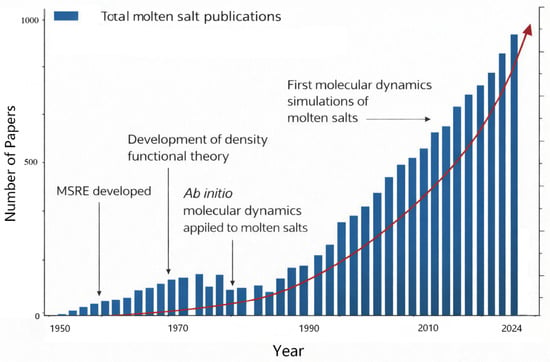
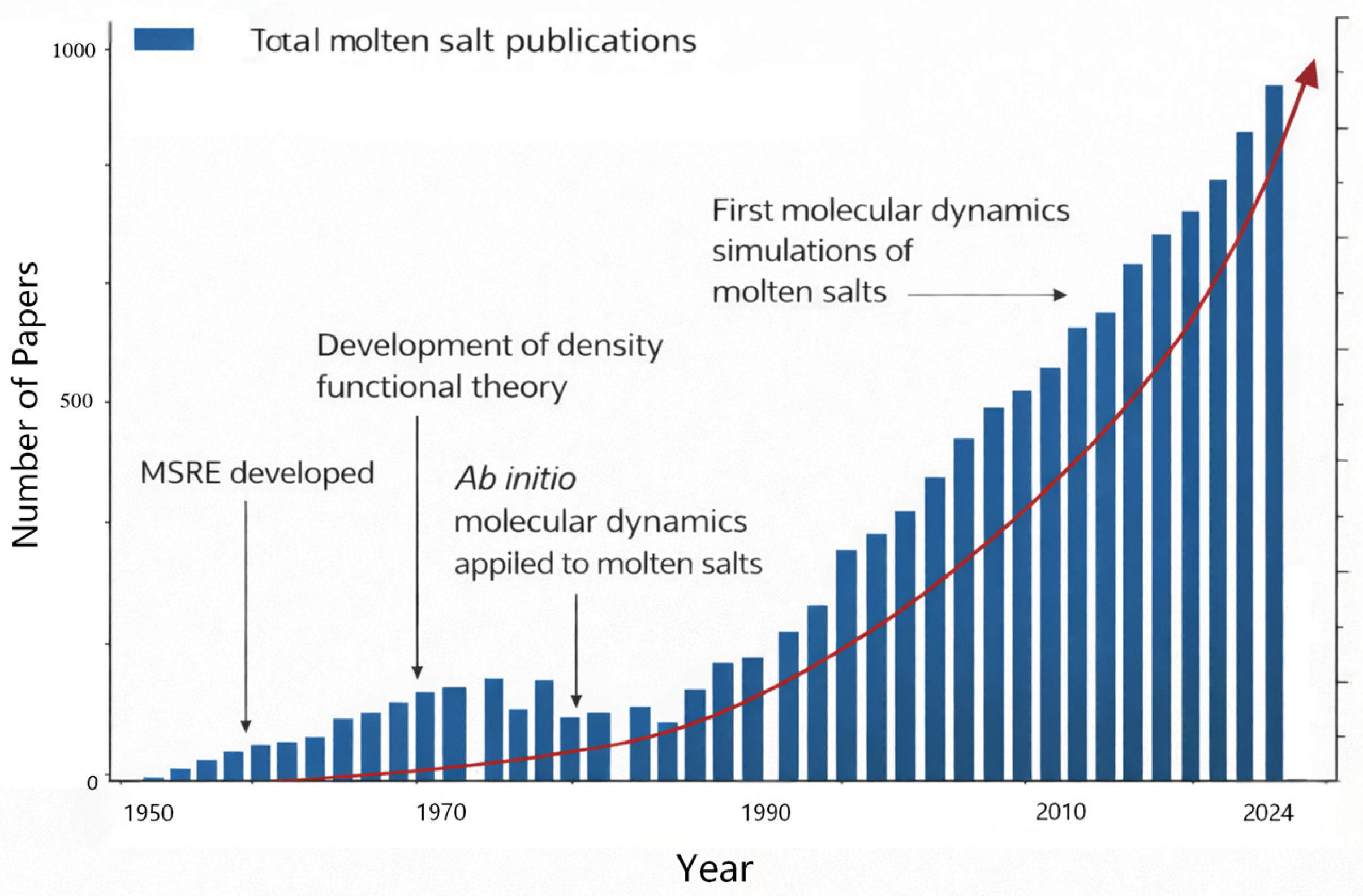
As shown in Figure 1, since the 1950s, the number of studies on molten-salt electrorefining and its underlying mechanisms has increased steadily. Meanwhile, many key technologies related to molecular simulation calculations have developed rapidly and have been widely applied in this field. Based on the intrinsic differences in the descriptions of interparticle interactions, molecular dynamics methods can be mainly divided into two categories: ab initio molecular dynamics (AIMD) and classical molecular dynamics (CMD). AIMD is often referred to as first-principles molecular dynamics (FPMD). In CMD, the interactions between particles are described by empirical force fields, while in FPMD, interatomic forces are directly derived from quantum mechanical calculations, typically using density functional theory [9].
Figure 1.
Schematic diagram showing the year-over-year increase in the number of papers published on molten-salt chemistry.
The theoretical foundation of first-principles computation dates back to 1926, when the Schrödinger equation was proposed, marking the beginning of quantum mechanics. The general form of the Schrödinger equation is as follows:
where H is the Hamiltonian operator of the system, Ψ is the wave function, and E represents the total energy. Solving this equation yields the electronic structure and energy distribution of the system [10].
In the 1950s, the Hartree–Fock method initiated the era of quantum chemistry by providing approximate solutions to many-electron systems [11]. In the 1960s, Kohn and Hohenberg proposed the density functional theory (DFT), and the Kohn–Sham equations were developed to simplify complex many-electron problems into single-electron forms [12]. This greatly expanded the computational capability and applicability of first-principles methods.
With the rapid increase in computational resources after 2000, first-principles methods began to be applied to larger and more complicated systems such as nanomaterials, biomolecules, and functional materials. Widely used computational software packages—including VASP 6.0, Quantum Espresso 3.2, Gaussian 16, and ABINIT 10.0—have provided powerful tools for these studies [13,14,15,16].
Around 2020, machine learning techniques began to be integrated with first-principles calculations, forming a new interdisciplinary trend. The combination of machine learning potentials with molecular dynamics simulations has been demonstrated to be particularly useful for optimizing molten-salt compositions and predicting ideal mixtures for reactors. This emerging approach is expected to further enhance the safety and efficiency of molten-salt reactor systems and represents a highly promising research field [17,18,19].
3. Microscopic Structure Analysis of Molten Salts via First-Principles Methods
Among the structural information obtainable from FPMD simulations, the radial distribution function (RDF) is the most important. RDF describes the probability of finding another atom at a distance r from a selected reference atom under the assumption of uniform spatial distribution. From RDF curves, the local atomic arrangement and coordination structures in molten salts can be quantitatively analyzed [20].
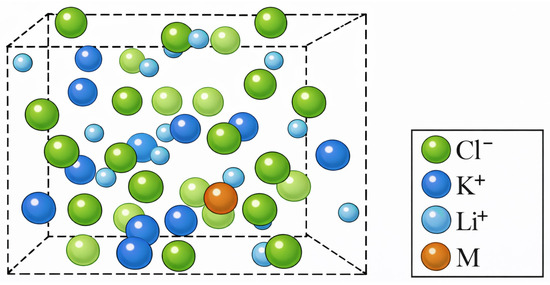
Song et al. used classical molecular dynamics and FPMD to simulate molten-salt mixtures and predicted the differences in various properties of different elements in molten LiCl-KCl eutectic [21]. The simulated structure of molten LiCl-KCl-MCln mixture is shown in Figure 2. The structure was analyzed to obtain its RDF and compared with the literature values extracted from the experimental study, and many valuable results were obtained. For example, the positions of the first peaks of Ag+–Cl− and Cu+–Cl− obtained by neutron diffraction experiments of pure molten salt were 2.62 Å (773 K) and 2.34 Å (778 K), which are consistent with the FPMD simulation values of 2.572 Å and 2.167 Å [22,23]. Furthermore, the first peak positions of La3+–Cl−, Ce3+–Cl−, and U3+–Cl− in the X-ray diffraction of molten chloride are 2.85 Å (1150 K), 2.81 Å (1173 K), and 2.85 Å (1200 K), respectively, which are in good agreement with the corresponding FPMD simulation values of 2.812 Å, 2.770 Å, and 2.689 Å [24,25,26], as shown in Table 1. In addition, the first peak position of molten PuCl3 was simulated to be 2.687 Å, which is also consistent with the literature value of 2.80 Å [27].
Figure 2.
Schematic diagram illustrating the modeling of LiCl–KCl–MCln molten-salt mixture (M = La, Ce, U, or Pu).
Table 1.
First peak positions of Mn+–Cl− in molten LiCl-KCl-MCln eutectic.
Similarly, RDF peak positions for trivalent actinide and lanthanide chlorides such as La3+–Cl−, Ce3+–Cl−, and U3+–Cl− obtained from X-ray diffraction experiments are highly consistent with corresponding FPMD results. These comparisons confirm that FPMD methods can reliably reproduce short-range structures in high-temperature molten-salt systems [28].
Zhang et al. further investigated the structural characteristics of actinide elements (Th, Pa, U, and Np) in molten LiCl–KCl eutectic using FPMD simulations [29]. The results show that with increasing atomic number, the An–Cl first peak distance decreases, following the well-known actinide contraction trend. As shown in Table 2, the predicted coordination numbers and bond distances also exhibit good agreement with EXAFS and XRD measurements [30,31,32].
Table 2.
First peak positions RAn-Cl (Å) and coordination numbers CNs for AnCl4 in molten.
Overall, RDF and coordination number analyses are the most widely adopted computational strategies in molten-salt microscopic studies. These methods provide essential theoretical support for understanding local structures and solute speciation behaviors in reprocessing-related molten salts.
4. Calculation of Physical Properties Using First-Principles Methods
4.1. Viscosity
Viscosity measurements are extremely important for molten-salt electrochemical systems because viscosity directly reflects the fluidity of the electrolyte and strongly influences ion diffusion and migration. Experimentally, viscosity can be measured by shear cell, capillary, neutron scattering, or electrochemical methods [33,34,35,36,37]. However, such measurements become challenging at temperatures above 800 K or in systems containing radioactive elements.
First-principles methods provide alternative computational routes. Based on the Stokes–Einstein–Sutherland relation [38], viscosity η can be correlated with the self-diffusion coefficient D as follows:
where T is the absolute temperature, kb is the Boltzmann constant, and R is the hydrodynamic radius, often approximated as half of the first coordination distance.
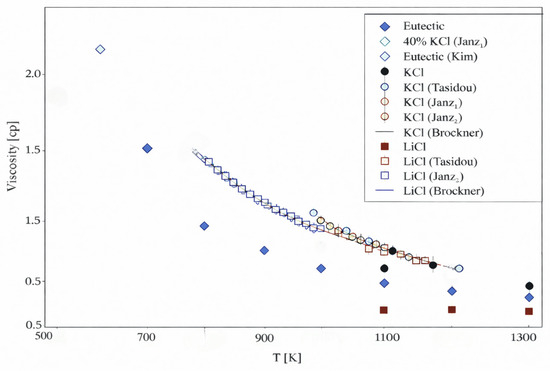
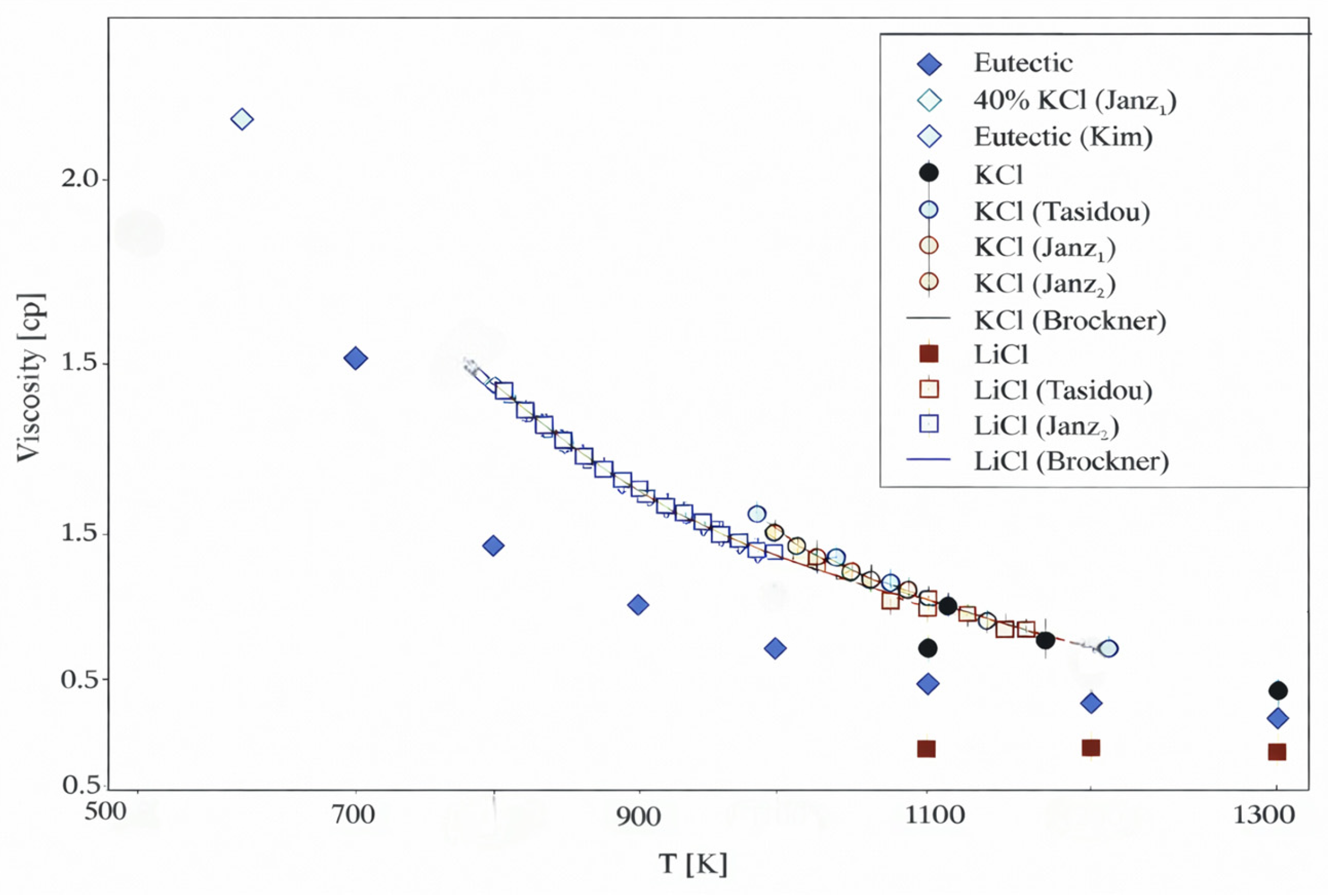
Various methods have been proposed in the literature for predicting the viscosity of molten salts based on microscopic structural parameters. Duemmler suggested during data processing that the solvent kinetic radius can be approximated as half of the first coordination distance [39]. This approximation is typically implemented by defining the kinetic radius R as half of the distance corresponding to the first peak position on the RDF curve, followed by calculation of viscosity using the Stokes–Einstein–Sutherland relationship. However, this method relies on a series of idealized assumptions, and systematic deviations between predicted and experimental results are frequently observed. As shown in Figure 3, viscosities calculated using this relationship are generally lower than the experimental values reported by Janz [40]. It should be noted that the data from Janz were obtained for a system containing 40% mol KCl, whereas the work of Kim et al. focused on eutectic compositions [41]; such compositional differences may represent a major factor limiting direct comparison. A similar trend has also been found for LiCl: the viscosities derived from theoretical calculations are significantly lower than the experimental results reported by Tasidou, Janz, and the measurements of Brockner et al. [39,42,43,44]. Nevertheless, in the case of pure KCl, the prediction method exhibits relatively high reliability, with calculated values in good agreement with experimental data. However, for LiCl–KCl mixtures, the predicted viscosities remain consistently lower than experimental measurements. Overall, the applicability of Stokes–Einstein-type relationships appears to be inconsistent between single-component and mixed molten-salt systems, indicating that existing models still require further improvement for the quantitative prediction of viscosity in molten-salt mixtures.
Figure 3.
The relationship between viscosity and temperature for the LiCl-KCl eutectic mixture, KCl, and LiCl. Solid markers represent FPMD calculation results, and hollow markers represent experimental data.
Unlike Duemmler’s group, Yan [21] chose the first coordination distance as an approximation of the solvent kinetic radius; the calculated viscosity of the molten-salt mixture is also summarized in Table 3. For the molten LiCl-KCl-UCl3 mixture, the calculated viscosity is consistent with the dynamic viscosity value of 2.44 × 10⁻³ N·s·m−2 studied by Choi between 750 and 800 K [45].
Table 3.
Transport properties derived from FPMD simulations, including self-diffusion coefficients, ionic conductivities, and viscosities (NVT ensemble, 723 K).
The Dewan research group at MIT adopted a different strategy for viscosity calculation, employing an integration method based on the stress tensor autocorrelation function to simulate the viscosity of molten-salt systems [52]. The corresponding formula is expressed as follows:
where σαβ represents the independent components of the stress tensor. In the calculation, the stress autocorrelation function is obtained by averaging five independent components (σxy, σxz, σyz, σxx−yy, and σ2zz−xx−yy), and this averaged autocorrelation function is integrated over time. The viscosity of the system is determined from the plateau value of the running integral after it reaches a stable state. At present, only a limited amount of experimental data describing the viscosity of LiF–ThF4 mixtures is available for validating these simulation results. Benes, Konings, and Chervinskii [53,54] reported that the viscosity of a molten salt with a composition of 78 mol% LiF–22 mol% ThF4 at 1273 K is 3.13 Pa·s. In comparison, the simulation results of Dewan et al. indicate a predicted viscosity of 3.49 Pa·s at the same temperature, which is in reasonable agreement with the experimental measurements. This suggests that the integration method based on stress tensor autocorrelation functions is capable of providing a relatively reliable description of the viscosity characteristics of LiF–ThF4 mixed molten salts.
In summary, viscosity is an important parameter that reflects the transport properties of molten-salt systems, and the corresponding calculation methods have been extensively investigated in this research field. At the present stage, simulation of viscosity mainly relies on the Stokes–Einstein–Sutherland equation. Under the specified theoretical conditions and parameter ranges, the predicted results generally exhibit a reasonable degree of agreement with experimental values. However, for certain molten-salt compositions, discrepancies between simulated and experimentally measured viscosities still remain, with maximum deviations of up to approximately 0.5 N·s·m−2.
The discrepancy between viscosities predicted by FPMD simulations and experimental measurements for molten salts can be attributed to several factors. First, viscosity is a collective transport property that depends on long-time stress autocorrelation functions. Due to the high computational cost of FPMD, simulations are typically restricted to relatively small system sizes and short simulation times, resulting in finite-size effects and limited statistical sampling, which undoubtedly leads to deviations in the results [39]. Second, the accuracy of FPMD simulations is fundamentally limited by the approximate nature of exchange–correlation functionals employed in density functional theory. Commonly used generalized gradient approximation (GGA) functionals, such as PBE, may inadequately describe short-range repulsion and long-range dispersion interactions, which can lead to an underestimation of ionic correlations and, consequently, an overestimation of ionic mobility and an underprediction of viscosity [17,55]. In addition, experimental viscosity data for molten salts are themselves subject to considerable uncertainties arising from high-temperature measurement conditions, impurity effects, container–melt interactions, and differences in experimental techniques [56]. As a result, reported experimental viscosities often exhibit significant scatter, making direct quantitative comparison with simulation results challenging.
Nevertheless, viscosity simulations are capable of providing valuable insights into the transport behavior and kinetic characteristics of different elements in molten salts, and they serve as a useful approach for correlating microscopic structural features with macroscopic transport properties. Therefore, these research outcomes possess significant relevance and practical importance for mechanistic studies and process optimization in molten-salt electrochemical systems.
4.2. Self-Diffusion Coefficient
The diffusion coefficient is a key parameter for characterizing mass transport behavior in molten-salt electrochemical systems, and its investigation is of great importance for a comprehensive understanding of transport mechanisms. The diffusion rate of ions or molecules in the electrolyte directly affects the performance and operational stability of batteries, electrolyzers, and other electrochemical devices. Accurate knowledge of ionic diffusion coefficients in electrolytes contributes to a deeper understanding of electrode reaction kinetics, thereby providing a theoretical basis for the optimization of electrode materials and the regulation of reaction conditions [57,58,59,60].
Besides experimental methods, the diffusion coefficient of a liquid can also be obtained through molecular dynamics simulations. The principle is summarized as follows: By statistically calculating the trajectories of particle motion, and based on the Einstein–Smoluchowski equation [61],
The mean square displacement (MSD) as a function of time can be obtained using this equation, where ri(tj) is the position of atom i at time t [62]. Therefore, according to the equation,
Based on the MSD curves of all particles, the ionic self-diffusion coefficient D of the molten-salt system can be calculated. It can also be expressed in the following form:
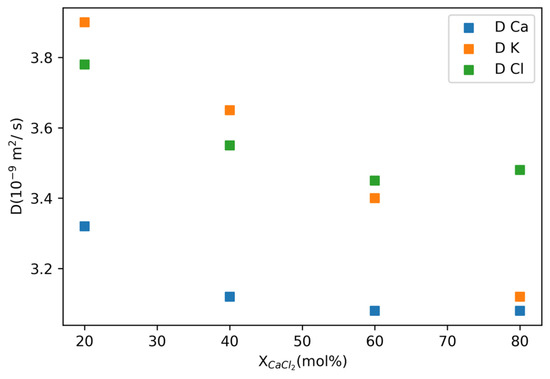
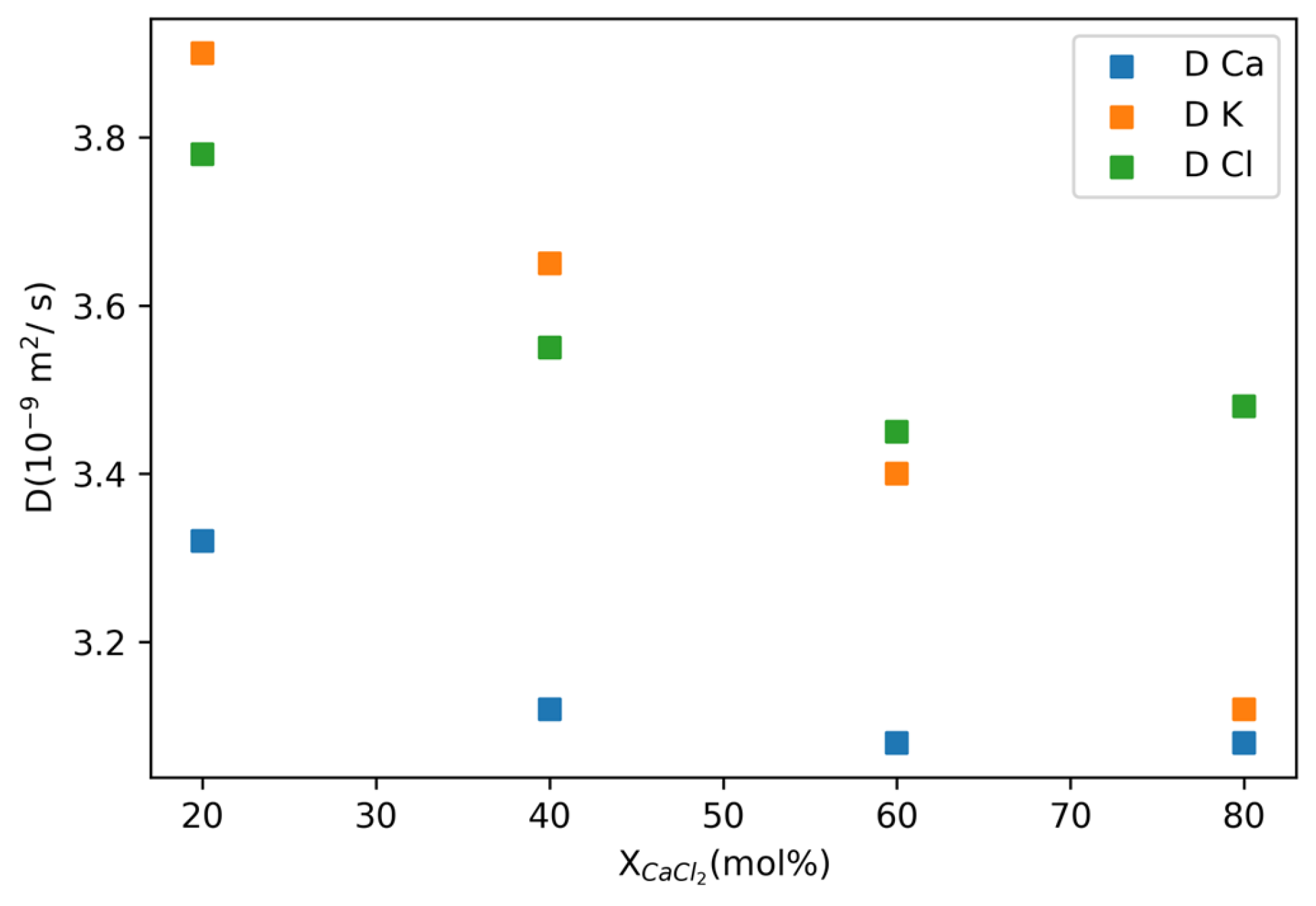
Bu et al. calculated the self-diffusion coefficients of Ca2+, K+, and Cl− ions in KCl–CaCl2 molten salts with different CaCl2 mole fractions at 1100 K and analyzed the results in terms of steric hindrance effects (Figure 4) [63]. The self-diffusion coefficients exhibit clear composition-dependent trends. As the CaCl2 mole fraction increases from 20 to 80 mol%, the self-diffusion coefficient of K+ decreases from 3.910 × 10⁻⁹ to 3.116 × 10⁻⁹ m2·s−1. This behavior is mainly attributed to the gradual replacement of K+ by Ca2+ ions and the formation of network structures through Ca2+–Cl− bridging, which enhances steric hindrance and restricts K+ mobility. For Ca2+ and Cl− ions, their self-diffusion coefficients decrease as the CaCl2 mole fraction increases from 20 to 40 mol%, while the rate of decrease becomes smaller upon further increase to 60 mol%. At higher CaCl2 contents (up to 80 mol%), a slight increase in the self-diffusion coefficients of Ca2+ and Cl− is observed. These results indicate a competition between the strengthening steric hindrance associated with network formation and the enhanced ionic mobility arising from increasingly dynamic Ca2+ coordination environments, which together govern the diffusion behavior of the system.
Figure 4.
Effect of CaCl2 mole fraction on the self-diffusion of Ca2+, K+, and Cl− ions in KCl–CaCl2 molten salts at 1100 K.
4.3. Density
Density measurements play an important role in molten-salt electrochemical research, as density is one of the fundamental physical properties of molten-salt systems and directly influences electrochemical reactions, transport properties, and material performance. Density data can be used to determine the concentration and composition of individual components in molten salts, which is essential for understanding the concentration and solubility of dissolved species. These factors, in turn, affect the rate and equilibrium of electrochemical reactions. Moreover, variations in density with temperature or composition can provide valuable insights into electrochemical reaction mechanisms. Therefore, systematic investigation of density variations is beneficial for achieving a deeper understanding of reaction mechanisms in molten-salt systems [64].
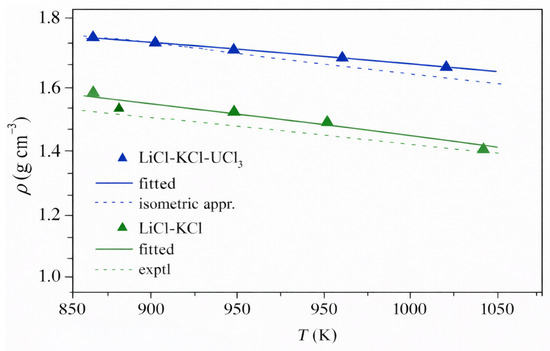
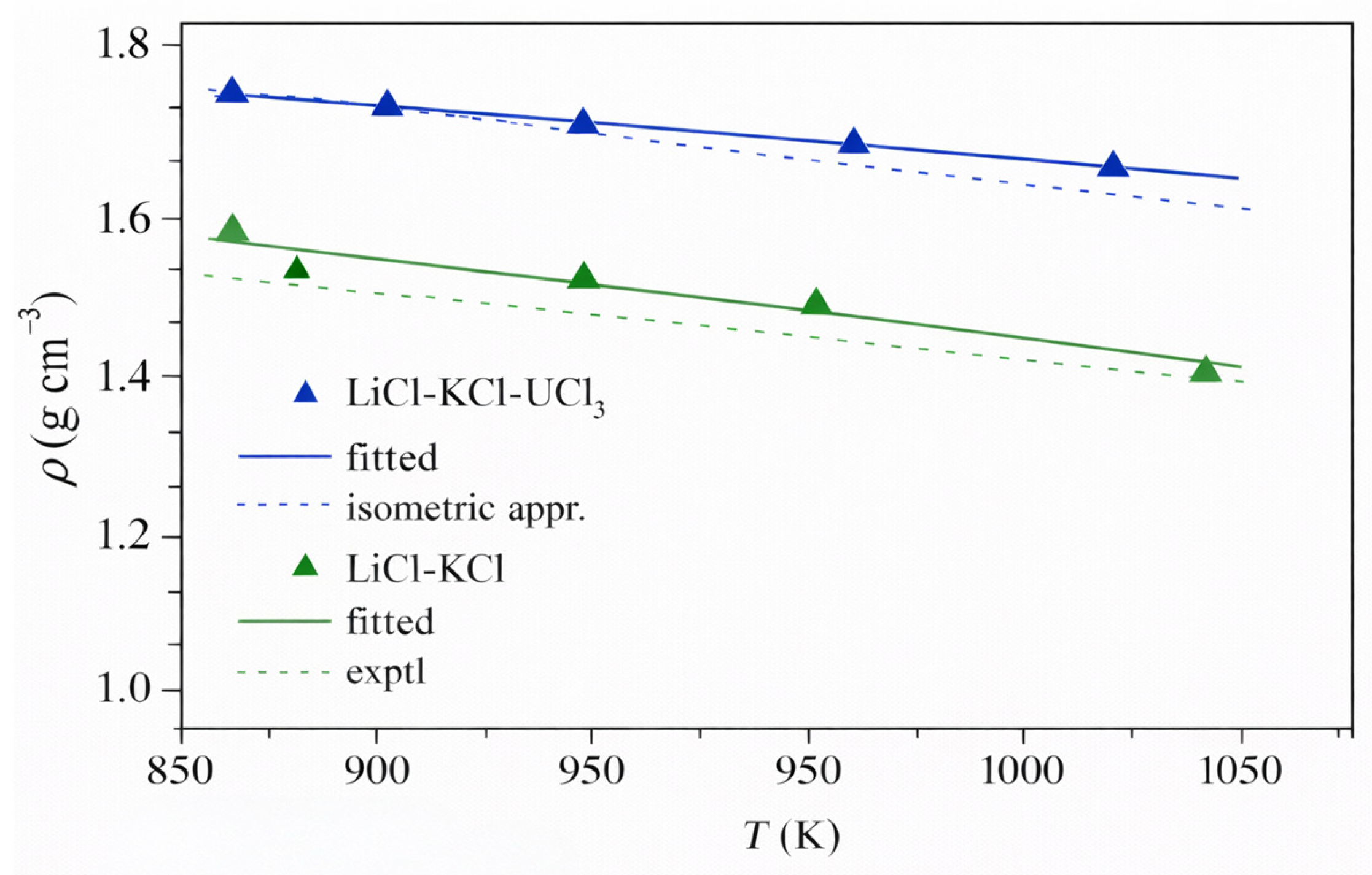
Song et al. performed molecular dynamics simulations to evaluate the density of molten-salt mixtures and found that the temperature dependence of density can be well described by a linear relationship [65]. As shown in Figure 5, when the temperature increases from 858 K to 1019 K, the density of molten LiCl–KCl mixtures decreases from 1.630 to 1.497 g·cm−3. In comparison, experimental data reported by van Artsdalen and Yaffe show a decrease in density from 1.575 to 1.486 g·cm−3 over the same temperature range [46]. Compared with the experimental values, densities obtained from FPMD simulations are slightly higher, with relative deviations ranging from 0.33% to 3.13%. Overall, the temperature dependence of density for this system can be accurately fitted using a linear function, as expressed below.
Figure 5.
Temperature dependence of the density of LiCl–KCl and LiCl–KCl–UCl3 molten salts and their fitting curves.
The experimental results for a and b are 2.029 g·cm−3 and 5.274 × 10⁻⁴ g·cm−3·K−1, respectively, while the calculated results are 2.217 g·cm−3 and 6.892 × 10⁻⁴ g·cm−3.
Numerous simulations show that the density of molten salt has a clear linear relationship with the temperature of the system, which can undoubtedly play a good predictive and guiding role in density measurement in high-temperature molten-salt system experiments [66,67,68,69,70,71].
5. Calculation of Electrochemical Properties Using First-Principles Methods
5.1. Redox Potentials
Redox potential is a critical parameter in molten-salt electrochemistry because it determines the thermodynamic feasibility of electrode reactions. Measuring redox potentials experimentally in high-temperature radioactive molten salts is complicated and sometimes infeasible [72].
Nam et al. employed FPMD-based ensemble averaging to calculate the redox potential of the U4+/U3+ couple in LiCl–KCl eutectic. The electrode reaction can be expressed as follows [73]:
The corresponding computational formula for redox potential is as follows:
where M represents the molten salt, E is the ensemble average of the total energy calculated by FPMD, e is the absolute value of the electron charge, G(Cl2) is the Gibbs free energy of chlorine gas, and CS represents entropy corrections. The redox potentials of several redox couples in molten LiCl-KCl salt at 773 K, calculated by FPMD simulation, were compared with the experimentally measured redox potentials (Cl2/Cl− as a reference). Table 4 summarizes the calculated redox potentials and their contributions to the mean standard error, experimental measurements, and entropy correction term, and predicts the potentials of other redox couples [74,75,76,77,78,79,80,81,82,83,84,85].
Table 4.
Comparison of calculated redox potentials of several redox couples in molten LiCl–KCl at 773 K (vs. Cl2/Cl−) with thermodynamic database predictions.
By deriving theoretical expressions for the standard redox potentials of solute species in molten salts, it is possible to predict the redox potentials of a wide range of species in the LiCl–KCl molten-salt system. The calculated values generally show good agreement with experimental data, with deviations typically within 0.5 V. The remaining discrepancies may arise from unavoidable experimental uncertainties as well as other factors such as differences in measurement techniques and reference electrode selection. Overall, current models are capable of reasonably describing redox behavior in molten-salt systems; however, there remains considerable potential for improving predictive accuracy. Consequently, further optimization of experimental measurements and refinement of simulation and calculation methods continue to be of significant research interest and practical importance.
5.2. Electrical Conductivity
Electrical conductivity is one of the main indicators for evaluating electrolyte performance. By measuring conductivity, the ionic conductivity of an electrolyte system can be determined. High conductivity usually means better ion transport and higher reaction rates [86].
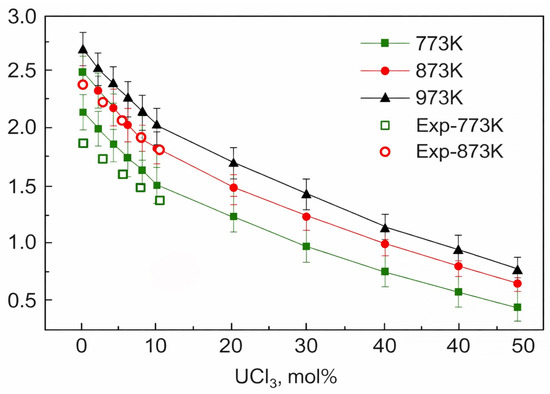
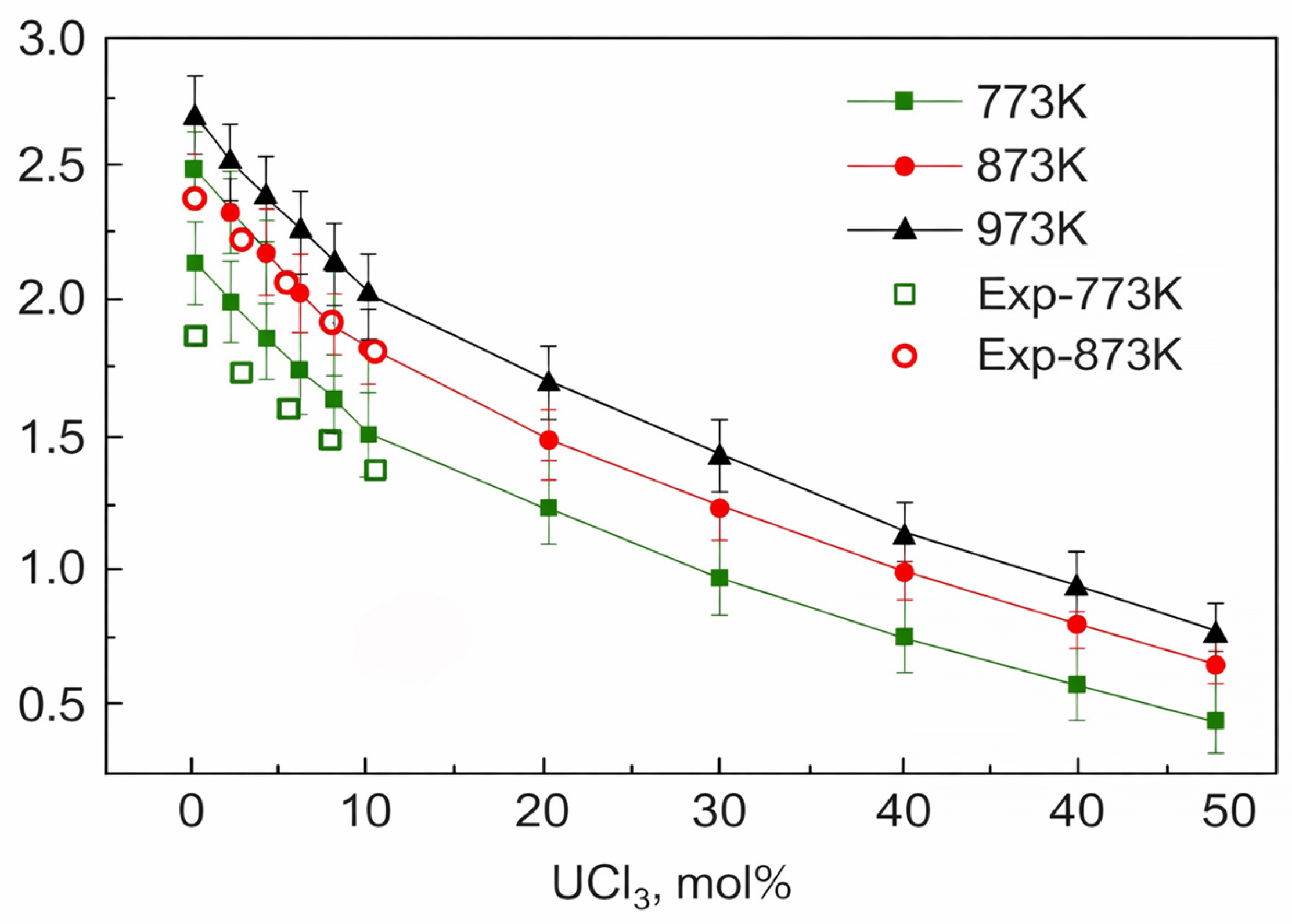
Deng conducted a systematic simulation study on the electrical conductivity of various molten-salt mixtures [87]. Specifically, simulated conductivities for LiCl–KCl eutectic systems containing UCl3 are presented in Figure 6, together with experimental conductivity data for LiCl–KCl eutectic melts containing U3+. Overall, a good agreement between simulation results and experimental measurements is observed. Both simulation and experimental results indicate that, at the same temperature and UCl3 mole fraction, the electrical conductivities of LiCl–KCl–UCl3 systems are nearly identical. This behavior suggests that, in the high-viscosity region associated with network formation, U3+ cations are strongly constrained by the molten-salt network, and their direct contribution to the total electrical conductivity can be considered negligible. Consequently, the overall conductivity is dominated by Li+ and K+ ions, whose contributions are nearly the same due to their similar mobilities in the different molten-salt systems. In the dilute regime (UCl3 content below approximately 10 mol%), the electrical conductivity decreases almost linearly with increasing UCl3 concentration. Experimental observations report a similar trend, showing that when the trivalent cation concentration is below approximately 12 mol%, the conductivity is nearly a linear function of trivalent ion content in LiCl–KCl–UCl3 systems. In contrast, in the viscous regime (UCl3 content above approximately 10 mol%), the electrical conductivity exhibits an approximately exponential decrease with increasing UCl3 concentration. The distinct trends observed between the dilute and viscous regimes are fundamentally attributed to concentration-induced structural transformations in the molten-salt network [88,89,90].
Figure 6.
Electrical conductivity of different trivalent cations in LiCl-KCl mixture, including a comparison of FPMD calculations and experimental values.
Overall, the simulated electrical conductivities are in close agreement with experimental data, and the nearly identical conductivity values obtained for systems containing different trivalent cations demonstrate the high accuracy and reliability of the simulation approach in describing charge transport in LiCl–KCl–MCl3 molten-salt systems.
5.3. Electrochemical Interfaces
With the continuous deepening of research into the electrochemical mechanisms of molten-salt electrolytic refining, first-principles calculations will undoubtedly demonstrate increasing application value in this field [91,92,93,94]. The study of electrochemical interfaces is essential for achieving a deeper understanding of electrochemical behavior in materials, including charge transfer, ionic diffusion, and interfacial reactions. Such knowledge not only helps elucidate interfacial mechanisms but also provides theoretical guidance for the selection and optimization of electrode materials, as well as for the systematic evaluation of electrochemical properties in experimental systems [95].
Kwon et al. investigated the thermodynamic stability of uranium electrodeposition on a Mo(110) surface in LiCl–KCl–UCl3 molten-salt mixtures by means of simulation, and determined the ground-state structures of the Cl/U/Mo(110) surface as a function of adsorbate (U, Cl) coverage [96,97]. However, the constructed model system does not fully account for the influence of the LiCl–KCl molten-salt environment, as it neglects the electrical double-layer structure at the electrode/electrolyte interface. In this sense, the model effectively describes gas-phase adsorption on a metallic solid surface rather than a realistic electrode–molten-salt interface. To date, studies that comprehensively incorporate electrode/molten-salt interfacial effects remain relatively limited.
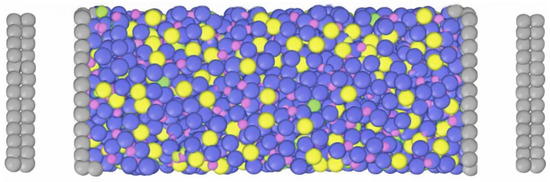
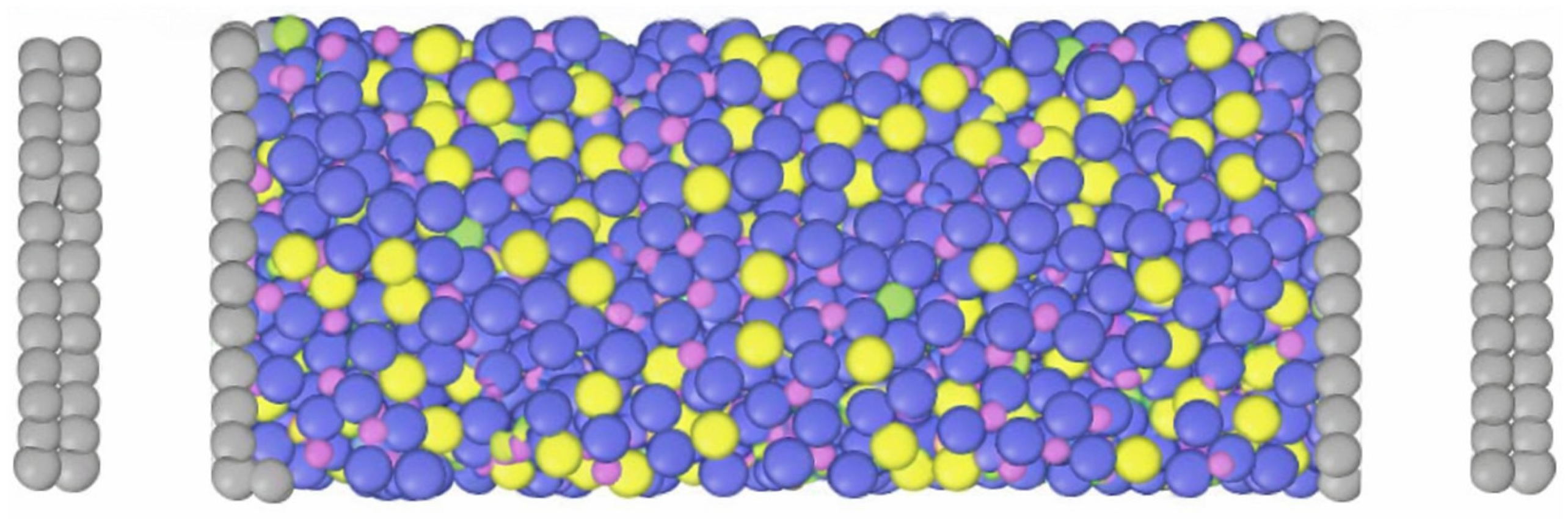
To address this limitation, Yang et al. examined the interfacial properties between metal electrodes and molten LiCl–KCl–UCl3 mixtures, with particular emphasis on the distribution and dynamics of U3+ ions in the interfacial region [98]. In their work, a constant-charge model was employed to represent the electrodes in order to reduce computational cost. Figure 7 illustrates a periodic simulation snapshot of the molten mixture confined between two planar interfaces along the z direction. To characterize ionic distributions at the interface and their response to electrode charge, Yang et al. studied the variation curves of ion number density with distance from the electrode under different surface charge conditions. The results show that a single ionic layer composed of Li+, K+, and Cl− consistently exists between U3+ ions and the electrode surface. This interfacial layer may hinder electron transfer from the electrode into the molten mixture, thereby slowing interfacial charge-transfer kinetics. Compared with a neutral electrode, the density maximum of U3+ shifts closer to positively charged electrodes and farther away from negatively charged electrodes. This behavior arises from the combined effects of electrostatic screening and Coulomb interactions: excess anions in the first layer near the anode exert an attractive force on U3+, whereas excess cations near the cathode induce Coulombic repulsion. When the surface charge density σs = 0, K+ ions are more enriched near the electrode than Li+. Calculations of the interaction energies in the first ionic layer show that Li+–Cl− interactions (−5.63 eV·atom−1) are significantly stronger than K+ interactions (−2.96 eV·atom−1), which restricts the migration of Li+ toward the interface and renders K+ more mobile. Consequently, as the magnitude of electrode surface charge increases, the concentration of K+ near the anode decreases markedly, while that near the cathode increases.
Figure 7.
Representative periodic snapshot of the molten mixture confined between two planar interfaces along the z direction.
Although FPMD has been successfully applied to investigate the bulk structure of LiCl–KCl molten salts and the coordination behavior of selected metal ions, its application to electrochemical processes at liquid metal cathode/molten salt interfaces remains highly limited. From a mechanistic standpoint, future FPMD studies should move beyond static structural characterization toward a detailed understanding of potential-dependent separation and transport mechanisms [99,100,101]. In LiCl–KCl systems coupled with liquid Bi, Cd, or Pb cathodes, systematic investigations are needed to clarify how applied potential affects the interfacial enrichment, desolvation behavior, and transfer thermodynamics of fission product ions such as Cs and Nd. On the other hand, in terms of engineering relevance and multiscale modeling, the role of FPMD is expected to evolve from a direct predictive tool toward a high-fidelity data generator. Interfacial structures, charge distributions, and reaction free energies obtained from FPMD can be used to train machine-learning interatomic potentials (MLIPs), enabling simulations of liquid metal cathode/molten salt interfaces at larger spatial and temporal scales [102,103,104]. Such a hierarchical FPMD–ML–continuum modeling framework would provide key parameters for macroscopic electrochemical models, including interfacial transport coefficients, separation selectivity trends, and cathode degradation mechanisms, thereby enhancing the practical value of atomistic simulations for pyroprocessing system design. Future studies may increasingly account for the complexity of realistic cathode conditions, such as variations in liquid metal composition, competitive dissolution of multiple species, the presence of impurities (e.g., oxygen or moisture), and the dynamic evolution of the cathode–salt interface. Incorporating these factors into FPMD models will not only improve agreement with experimental observations but also facilitate the transition of atomistic simulations from mechanistic interpretation toward process optimization in electrochemical pyroprocessing.
6. Conclusions
First-principles calculations originated from fundamental concepts in theoretical physics and have undergone several key stages of development, gradually becoming indispensable tools in modern scientific and engineering research. Numerous studies have demonstrated that FPMD can be effectively employed to simulate the structural, dynamic, and thermodynamic behavior of solute species in molten-salt systems. With a favorable balance between accuracy and computational cost, FPMD offers a powerful approach for exploring and developing new molten-salt systems.
For high-temperature molten salts such as LiCl–KCl and LiF–KF, first-principles calculations, through appropriate parameter selection and the combined use of advanced computational software, can yield a wide range of key properties, including microscopic structural information, transport characteristics, and electrochemical properties. These insights are of significant value for advancing molten-salt electrochemistry research. A comprehensive review of previous studies indicates that computational results generally exhibit good agreement with experimental validations in terms of overall trends and demonstrate high reliability for most systems, although noticeable deviations remain for certain properties, such as viscosity. With continued advances in computational methodologies and experimental measurement techniques, these limitations are expected to be progressively overcome.
First-principles molecular dynamics still holds significant potential for development in molten-salt electrochemistry research. In the future, machine learning potential functions, multiscale simulations, and coupling methods of first-principles and classical molecular dynamics can be used to overcome limitations in computational scale and time scale, and to improve the accuracy of predicting key physical properties such as viscosity and conductivity. Further application of this method to complex multicomponent molten salts and interface reactions in engineering-related problems is expected to drive the transformation of first-principles calculations from mechanistic research to material design and performance prediction, playing a more crucial role in molten-salt electrochemistry and related high-temperature technologies. As a powerful theoretical tool, first-principles calculations are poised to play an increasingly important role in promoting the development and practical implementation of molten-salt electrochemical technologies, thereby contributing to the advancement of pyroprocessing technologies.
Author Contributions
Investigation, writing—original draft preparation, Y.W.; formal analysis, Y.J.; methodology, B.Y.; resources, investigation, Y.X.; project administration, supervision, writing—review and editing, H.H. All authors have read and agreed to the published version of the manuscript.
Funding
This research received no external funding.
Data Availability Statement
No new data were created or analyzed in this study.
Conflicts of Interest
The authors declare no conflicts of interest.
References
- Gonze, X.; Beuken, J.-M.; Caracas, R.; Detraux, F.; Fuchs, M.; Rignanese, G.-M.; Sindic, L.; Verstraete, M.; Zerah, G.; Jollet, F.; et al. First-principles computation of material properties: The ABINIT software project. Comput. Mater. Sci. 2002, 25, 478–492. [Google Scholar] [CrossRef] [Scilit]
- Meng, Y.S.; Dompablo, M.E.A.-d. First principles computational materials design for energy storage materials in lithium ion batteries. Energy Environ. Sci. 2009, 2, 589–609. [Google Scholar] [CrossRef] [Scilit]
- Hautier, G.; Jain, A.; Ong, S.P. From the computer to the laboratory: Materials discovery and design using first-principles calculations. J. Mater. Sci. 2012, 47, 7317–7340. [Google Scholar] [CrossRef] [Scilit]
- Nisan, N.; Schocken, S. The Elements of Computing Systems: Building a Modern Computer from First Principles; MIT Press: Cambridge, MA, USA, 2021. [Google Scholar]
- Noh, S.; Kang, J.; Kwak, D.; Fischer, P.; Han, B. First principles thermodynamic studies for recycling spent nuclear fuels using electrorefining with a molten salt electrolyte. Energy 2014, 68, 751–755. [Google Scholar] [CrossRef] [Scilit]
- Bengtson, A.; Nam, H.O.; Saha, S.; Sakidja, R.; Morgan, D. First-principles molecular dynamics modeling of the LiCl–KCl molten salt system. Comput. Mater. Sci. 2014, 83, 362–370. [Google Scholar] [CrossRef] [Scilit]
- Duemmler, K.E. First Principles Investigation of the Thermophysical and Transport Properties of Molten Chlorides; North Carolina State University: Raleigh, NC, USA, 2023. [Google Scholar]
- Yang, B. On the Design of Molten Salt Chemistry for Different Industrial Applications. Master’s Thesis, Polytechnique Montréal, Montreal, QC, Canada, 2024. [Google Scholar]
- Wendji, S.D.W. First-principles and machine learning atomistic modeling of disordered systems for energy applications. Ph.D. Thesis, Université de Strasbourg, Schiltigheim, France, 2024. [Google Scholar]
- Berezin, F.A.; Shubin, M. The Schrödinger Equation; Springer Science & Business Media: Berlin/Heidelberg, Germany, 2012; Volume 66. [Google Scholar]
- Bartlett, R.J.; Stanton, J.F. Applications of Post-Hartree—Fock Methods: A Tutorial. In Reviews in Computational Chemistry; John Wiley & Sons, Inc.: Hoboken, NJ, USA, 1994; pp. 65–169. [Google Scholar]
- Bickelhaupt, F.M.; Baerends, E.J. Kohn-Sham density functional theory: Predicting and understanding chemistry. In Reviews in Computational Chemistry; John Wiley & Sons, Inc.: Hoboken, NJ, USA, 2000; pp. 1–86. [Google Scholar]
- Hafner, J. Ab-initio simulations of materials using VASP: Density-functional theory and beyond. J. Comput. Chem. 2008, 29, 2044–2078. [Google Scholar] [CrossRef] [Scilit]
- Giannozzi, P.; Baroni, S.; Bonini, N.; Calandra, M.; Car, R.; Cavazzoni, C.; Ceresoli, D.; Chiarotti, G.L.; Cococcioni, M.; Dabo, I.; et al. QUANTUM ESPRESSO: A modular and open-source software project for quantum simulations of materials. J. Phys. Condens. Matter 2009, 21, 395502. [Google Scholar] [CrossRef] [Scilit]
- Weedbrook, C.; Pirandola, S.; García-Patrón, R.; Cerf, N.J.; Ralph, T.C.; Shapiro, J.H.; Lloyd, S. Gaussian quantum information. Rev. Mod. Phys. 2012, 84, 621–669. [Google Scholar] [CrossRef] [Scilit]
- Gonze, X.; Amadon, B.; Anglade, P.-M.; Beuken, J.-M.; Bottin, F.; Boulanger, P.; Bruneval, F.; Caliste, D.; Caracas, R.; Côté, M.; et al. ABINIT: First-principles approach to material and nanosystem properties. Comput. Phys. Commun. 2009, 180, 2582–2615. [Google Scholar] [CrossRef] [Scilit]
- Porter, T.; Vaka, M.M.; Steenblik, P.; Della Corte, D. Computational methods to simulate molten salt thermophysical properties. Commun. Chem. 2022, 5, 69. [Google Scholar] [CrossRef] [Scilit]
- Zhou, Z.-H. Machine Learning; Springer Nature: Berlin/Heidelberg, Germany, 2021. [Google Scholar]
- El Naqa, I.; Murphy, M.J. What is machine learning? In Machine Learning in Radiation Oncology: Theory and Applications; Springer: Berlin/Heidelberg, Germany, 2015; pp. 3–11. [Google Scholar]
- Levine, B.G.; Stone, J.E.; Kohlmeyer, A. Fast analysis of molecular dynamics trajectories with graphics processing units—Radial distribution function histogramming. J. Comput. Phys. 2011, 230, 3556–3569. [Google Scholar] [CrossRef] [Scilit] [PubMed]
- Song, J.; Li, X.; Shi, S.; Yan, L.; Jiang, T.; Peng, S. Towards the calculations of redox potentials in molten LiCl-KCl eutectic by ensemble averages based on first principles molecular dynamics. Electrochim. Acta 2017, 248, 462–469. [Google Scholar] [CrossRef] [Scilit]
- Shirakawa, Y.; Saito, M.; Tamaki, S.; Inui, M.; Takeda, S. Structures of Molten CuCl, CuBr and CuI. J. Phys. Soc. Jpn. 1991, 60, 2678–2683. [Google Scholar] [CrossRef] [Scilit]
- Inui, M.; Takeda, S.i.; Shirakawa, Y.; Tamaki, S.; Waseda, Y.; Yamaguchi, Y. Structural study of molten silver halides by neutron diffraction. J. Phys. Soc. Jpn. 1991, 60, 3025–3031. [Google Scholar] [CrossRef] [Scilit]
- Matsuura, H.; Watanabe, S.; Sakamoto, T.; Kanuma, T.; Naoi, K.; Hatcho, M.; Kitamura, N.; Akatsuka, H.; Adya, A.; Honma, T.; et al. Short-range structure of molten CeCl3 and NdCl3 determined by XAFS. J. Alloys Compd. 2006, 408–412, 80–83. [Google Scholar] [CrossRef] [Scilit]
- Okamoto, Y.; Madden, P. Structural study of molten lanthanum halides by X-ray diffraction and computer simulation techniques. J. Phys. Chem. Solids 2005, 66, 448–451. [Google Scholar] [CrossRef] [Scilit]
- Rollet, A.-L.; Salanne, M. Studies of the local structures of molten metal halides. Annu. Rep. Sect. C 2011, 107, 88–123. [Google Scholar] [CrossRef] [Scilit]
- Sooby, E.; Baty, A.; Beneš, O.; McIntyre, P.; Pogue, N.; Salanne, M.; Sattarov, A. Candidate molten salt investigation for an accelerator driven subcritical core. J. Nucl. Mater. 2013, 440, 298–303. [Google Scholar] [CrossRef] [Scilit]
- Çepelioğullar, Ö.; Haykırı-Açma, H.; Yaman, S. Kinetic modelling of RDF pyrolysis: Model-fitting and model-free approaches. Waste Manag. 2016, 48, 275–284. [Google Scholar] [CrossRef] [Scilit]
- Zhang, Y.; Song, J.; Li, X.; Yan, L.; Shi, S.; Jiang, T.; Peng, S. First principles calculation of redox potential for tetravalent actinides in molten LiCl–KCl eutectic based on vertical substitution and relaxation. Electrochim. Acta 2019, 293, 466–475. [Google Scholar] [CrossRef] [Scilit]
- Mucker, K.; Smith, G.; Johnson, Q.; Elson, R. Refinement of the crystal structure of ThCl4. Struct. Sci. 1969, 25, 2362–2365. [Google Scholar] [CrossRef] [Scilit]
- Bohres, E.; Krasser, W.; Schenk, H.-J.; Schwochau, K. Schwingunsspektren und kraftkonstanten der actinid(IV)chloride ThCl4, PaCl4, UCl4 und NpCl4. J. Inorg. Nucl. Chem. 1974, 36, 809–813. [Google Scholar] [CrossRef] [Scilit]
- May, I.; Volkovich, V.A.; Sharrad, C.; Bhatt, A.; Kinoshita, H.; Koster, A.; Chamock, J.; Griffiths, T.; Lewin, B. An EXAFS spectroscopy study of speciation of uranium and some fission product elements in chloride melts. ECS Proc. Vol. 2004, 2004, 814. [Google Scholar] [CrossRef] [Scilit]
- Viswanath, D.S.; Ghosh, T.K.; Prasad, D.H.; Dutt, N.V.; Rani, K.Y. Viscosity of Liquids: Theory, Estimation, Experiment, and Data; Springer Science & Business Media: Berlin/Heidelberg, Germany, 2007. [Google Scholar]
- Nachtrieb, N.H.; Petit, J. Self-diffusion in liquid mercury. J. Chem. Phys. 1956, 24, 746–750. [Google Scholar] [CrossRef] [Scilit]
- Tanigaki, M.; Toyota, Y.; Harada, M.; Eguchi, W. Mutual diffusion coefficient in molten lead-bismuth mixtures. J. Chem. Eng. Jpn. 1983, 16, 92–98. [Google Scholar] [CrossRef] [Scilit]
- Dahlborg, U.; Besser, M.; Calvo-Dahlborg, M.; Janssen, S.; Juranyi, F.; Kramer, M.J.; Morris, J.R.; Sordelet, D. Diffusion of Cu in AlCu alloys of different composition by quasielastic neutron scattering. J. Non-Cryst. Solids 2007, 353, 3295–3299. [Google Scholar] [CrossRef] [Scilit]
- Oakeson, D.; Virkar, A.V. Determination of diffusivity of sodium in liquid tin using Na-ß″alumina. J. Mater. Sci. 1984, 19, 213–222. [Google Scholar] [CrossRef] [Scilit]
- Sutherland, W. LXXV. A dynamical theory of diffusion for non-electrolytes and the molecular mass of albumin. Lond. Edinb. Dublin Philos. Mag. J. Sci. 1905, 9, 781–785. [Google Scholar] [CrossRef] [Scilit]
- Duemmler, K.; Woods, M.; Karlsson, T.; Gakhar, R.; Beeler, B. First-principles-derived transport properties of Molten chloride salts. J. Nucl. Mater. 2023, 585, 154601. [Google Scholar] [CrossRef] [Scilit]
- Janz, G.J. Molten salts data as reference standards for density, surface tension, viscosity, and electrical conductance: KNO3 and NaCl. J. Phys. Chem. Ref. Data 1980, 9, 791–830. [Google Scholar] [CrossRef] [Scilit]
- Kim, J.-Y.; Bae, S.-E.; Kim, D.-H.; Choi, Y.S.; Yeon, J.-W.; Song, K. High-temperature viscosity measurement of LiCl-KCl molten salts comprising actinides and lanthanides. Bull. Korean Chem. Soc. 2012, 33, 3871–3874. [Google Scholar] [CrossRef] [Scilit]
- Brockner, W.; Grjotheim, K.; Ohta, T.; Øye, H. High-Temperature Viscometer for Fluid Liquids Part II: Viscosities of the Alkali Chlorides. Berichte Der Bunsenges. Für Phys. Chem. 1975, 79, 344–347. [Google Scholar] [CrossRef] [Scilit]
- Kock, I.; Edler, T.; Mayr, S.G. Growth behavior and intrinsic properties of vapor-deposited iron palladium thin films. J. Appl. Phys. 2008, 103, 046108. [Google Scholar] [CrossRef] [Scilit]
- Janz, G. Data from: NIST Properties of Molten Salts Database (Formerly SRD 27); National Institute of Standards and Technology: Gaithersburg, MD, USA, 1992. [Google Scholar]
- Choi, S.; Park, J.; Hoover, R.O.; Phongikaroon, S.; Simpson, M.F.; Kim, K.-R.; Hwang, I.S. Uncertainty studies of real anode surface area in computational analysis for molten salt electrorefining. J. Nucl. Mater. 2011, 416, 318–326. [Google Scholar] [CrossRef] [Scilit]
- Van Artsdalen, E.R.; Yaffe, I. Electrical conductance and density of molten salt systems: KCl–LiCl, KCl–NaCl and KCl–KI. J. Phys. Chem. 1955, 59, 118–127. [Google Scholar] [CrossRef] [Scilit]
- Janz, G.J. Molten Salts Handbook; Elsevier: Amsterdam, The Netherlands, 2013. [Google Scholar]
- Okamoto, Y.; Kobayashi, F.; Ogawa, T. Structure and dynamic properties of molten uranium trichloride. J. Alloys Compd. 1998, 271, 355–358. [Google Scholar] [CrossRef] [Scilit]
- Yamada, D.; Murai, T.; Moritani, K.; Sasaki, T.; Takagi, I.; Moriyama, H.; Kinoshita, K.; Yamana, H. Diffusion behavior of actinide and lanthanide elements in molten salt for reductive extraction. J. Alloys Compd. 2007, 444, 557–560. [Google Scholar] [CrossRef] [Scilit]
- Janz, G.J.; Bansal, N. Molten salts data: Diffusion coefficients in single and multi-component salt systems. J. Phys. Chem. Ref. Data 1982, 11, 505–693. [Google Scholar] [CrossRef] [Scilit]
- Zhang, J. Electrochemistry of actinides and fission products in molten salts—Data review. J. Nucl. Mater. 2014, 447, 271–284. [Google Scholar] [CrossRef] [Scilit]
- Dewan, L.C.; Simon, C.; Madden, P.A.; Hobbs, L.W.; Salanne, M. Molecular dynamics simulation of the thermodynamic and transport properties of the molten salt fast reactor fuel LiF–ThF4. J. Nucl. Mater. 2013, 434, 322–327. [Google Scholar] [CrossRef] [Scilit]
- Beneš, O.; Konings, R. Thermodynamic properties and phase diagrams of fluoride salts for nuclear applications. J. Fluor. Chem. 2009, 130, 22–29. [Google Scholar] [CrossRef] [Scilit]
- Chervinskii, Y.F.; Desyatnik, V.; Nechaev, A. Molar Viscosity of Lithium and Thorium Fluoride Melted Mixtures. Zhurnal Fiz. Khimii 1982, 56, 1946–1949. [Google Scholar]
- Shah, T.; Fazel, K.; Lian, J.; Huang, L.; Shi, Y.; Sundararaman, R. First-principles molten salt phase diagrams through thermodynamic integration. J. Chem. Phys. 2023, 159, 124502. [Google Scholar] [CrossRef] [Scilit] [PubMed]
- Zhao, D.; Yan, L.; Jiang, T.; Peng, S.; Yue, B. On the viscosity of molten salts and molten salt mixtures and its temperature dependence. J. Energy Storage 2023, 61, 106707. [Google Scholar] [CrossRef] [Scilit]
- Every, H.; Bishop, A.; Forsyth, M.; Macfarlane, D.R. Ion diffusion in molten salt mixtures. Electrochim. Acta 2000, 45, 1279–1284. [Google Scholar] [CrossRef] [Scilit]
- Salanne, M.; Simon, C.; Turq, P.; Ohtori, N.; Madden, P. Modeling of molten salts. In Molten Salts Chemistry; Elsevier: Amsterdam, The Netherlands, 2013; pp. 1–16. [Google Scholar]
- Mantina, M.; Wang, Y.; Arroyave, R.; Chen, L.; Liu, Z.-K.; Wolverton, C. First-principles calculation of self-diffusion coefficients. Phys. Rev. Lett. 2008, 100, 215901. [Google Scholar] [CrossRef] [Scilit]
- Protopapas, P.; Andersen, H.C.; Parlee, N. Theory of transport in liquid metals. I. Calculation of self-diffusion coefficients. J. Chem. Phys. 1973, 59, 15–25. [Google Scholar] [CrossRef] [Scilit]
- Islam, M. Einstein–Smoluchowski diffusion equation: A discussion. Phys. Scr. 2004, 70, 120. [Google Scholar] [CrossRef] [Scilit]
- Ernst, D.; Köhler, J. Measuring a diffusion coefficient by single-particle tracking: Statistical analysis of experimental mean squared displacement curves. Phys. Chem. Chem. Phys. 2013, 15, 845–849. [Google Scholar]
- Bu, M.; Liang, W.; Lu, G.; Yu, J. Local structure elucidation and properties prediction on KCl–CaCl2 molten salt: A deep potential molecular dynamics study. Sol. Energy Mater. Sol. Cells 2021, 232, 111346. [Google Scholar] [CrossRef] [Scilit]
- Jacob, H.-E. Chapter IV redox potential. In Methods in Microbiology; Elsevier: Amsterdam, The Netherlands, 1970; Volume 2, pp. 91–123. [Google Scholar]
- Song, J.; Shi, S.; Li, X.; Yan, L. First-principles molecular dynamics modeling of UCl3 in LiCl-KCl eutectic. J. Mol. Liq. 2017, 234, 279–286. [Google Scholar] [CrossRef] [Scilit]
- Qiao, G.; Alexiadis, A.; Ding, Y. Simulation study of anomalous thermal properties of molten nitrate salt. Powder Technol. 2017, 314, 660–664. [Google Scholar] [CrossRef] [Scilit]
- Gheribi, A.E.; Chartrand, P. Thermal conductivity of molten salt mixtures: Theoretical model supported by equilibrium molecular dynamics simulations. J. Chem. Phys. 2016, 144, 084506. [Google Scholar] [CrossRef] [Scilit] [PubMed]
- Guo, Y.; Wen, Y.; Chen, F.; Zheng, Y.; Wang, S.; Yang, L.; Zhang, M. Effect of physical properties of liquid phase by MD simulation on NaCl separation behavior during the phase transition of molten salt chloride slag. Sci. Rep. 2025, 15, 23269. [Google Scholar] [CrossRef] [Scilit]
- Qiao, G.; Lasfargues, M.; Alexiadis, A.; Ding, Y. Simulation and experimental study of the specific heat capacity of molten salt based nanofluids. Appl. Therm. Eng. 2017, 111, 1517–1522. [Google Scholar] [CrossRef] [Scilit]
- Kim, H.; Kwon, C.; Ham, S.; Lee, J.; Kim, S.J.; Kim, S. Physical properties of KCl-UCl3 molten salts as potential fuels for molten salt reactors. J. Nucl. Mater. 2023, 577, 154329. [Google Scholar] [CrossRef] [Scilit]
- Duemmler, K.; Woods, M.; Karlsson, T.; Gakhar, R.; Beeler, B. An ab initio molecular dynamics investigation of the thermophysical properties of molten NaCl-MgCl2. J. Nucl. Mater. 2022, 570, 153916. [Google Scholar] [CrossRef] [Scilit]
- Calle-Vallejo, F.; Koper, M.T. First-principles computational electrochemistry: Achievements and challenges. Electrochim. Acta 2012, 84, 3–11. [Google Scholar] [CrossRef] [Scilit]
- Nam, H.O.; Morgan, D. Redox condition in molten salts and solute behavior: A first-principles molecular dynamics study. J. Nucl. Mater. 2015, 465, 224–235. [Google Scholar] [CrossRef] [Scilit]
- Plambeck, J.A. Electromotive force series in molten salts. J. Chem. Eng. Data 1967, 12, 77–82. [Google Scholar] [CrossRef] [Scilit]
- Johnson, K.; Mackenzie, J. Samarium, Europium, and Ytterbium Electrode Potentials in LiCl-KCl Eutectic Melt. J. Electrochem. Soc. 1969, 116, 1697. [Google Scholar] [CrossRef] [Scilit]
- Shirai, O.; Yamana, H.; Arai, Y. Electrochemical behavior of actinides and actinide nitrides in LiCl–KCl eutectic melts. J. Alloys Compd. 2006, 408, 1267–1273. [Google Scholar] [CrossRef] [Scilit]
- Sridharan, K.; Allen, T.; Anderson, M.; Simpson, M. Thermal Properties of LiCl-KCl Molten Salt for Nuclear Waste Separation; DOE/NEUP--09-780; University of Wisconsin: Madison, WI, USA; Idaho National Lab.: Idaho Falls, ID, USA.
- Masset, P.; Bottomley, D.; Konings, R.; Malmbeck, R.; Rodrigues, A.; Serp, J.; Glatz, J.-P. Electrochemistry of uranium in molten LiCl-KCl eutectic. J. Electrochem. Soc. 2005, 152, A1109. [Google Scholar] [CrossRef] [Scilit]
- Castrillejo, Y.; Bermejo, M.; Arocas, P.D.; Martínez, A.; Barrado, E. Electrochemical behaviour of praseodymium (III) in molten chlorides. J. Electroanal. Chem. 2005, 575, 61–74. [Google Scholar] [CrossRef] [Scilit]
- Roy, J.; Grantham, L.; Grimmett, D.; Fusselman, S.; Krueger, C.; Storvick, T.; Inoue, T.; Sakamura, Y.; Takahashi, N. Thermodynamic properties of U, Np, Pu, and Am in molten LiCl-KCl eutectic and liquid cadmium. J. Electrochem. Soc. 1996, 143, 2487. [Google Scholar] [CrossRef] [Scilit]
- Lantelme, F.; Cartailler, T.; Berghoute, Y.; Hamdani, M. Physicochemical properties of lanthanide and yttrium solutions in fused salts and alloy formation with nickel. J. Electrochem. Soc. 2001, 148, C604–C613. [Google Scholar] [CrossRef] [Scilit]
- Masset, P.; Konings, R.J.; Malmbeck, R.; Serp, J.; Glatz, J.-P. Thermochemical properties of lanthanides (Ln = La, Nd) and actinides (An = U, Np, Pu, Am) in the molten LiCl–KCl eutectic. J. Nucl. Mater. 2005, 344, 173–179. [Google Scholar] [CrossRef] [Scilit]
- Baboian, R.; Hill, D.; Bailey, R. Electrochemical Studies on Zirconium and Hafnium in Molten LiCl-KCl Eutectic. J. Electrochem. Soc. 1965, 112, 1221. [Google Scholar] [CrossRef] [Scilit]
- Hoover, R.O.; Yoon, D.; Phongikaroon, S. Effects of temperature, concentration, and uranium chloride mixture on zirconium electrochemical studies in LiClKCl eutectic salt. J. Nucl. Mater. 2016, 476, 179–187. [Google Scholar] [CrossRef] [Scilit]
- Caravaca, C.; Córdoba, G.; Tomás, M.J. Electrochemical study of europium trichloride in molten eutectic LiCl-KCl. In Actinides and Fission Product Partitioning and Transmutation; OECD: Paris, France; NEA: Boulogne-Billancourt, France, 2005; pp. 293–303. [Google Scholar]
- Koishi, T.; Kawase, S.; Tamaki, S. A theory of electrical conductivity of molten salt. J. Chem. Phys. 2002, 116, 3018–3026. [Google Scholar] [CrossRef] [Scilit]
- Wang, S.; Xiao, S.; Hu, W.; Deng, H. Effect of MCl3 (M = La, U or Sc) component on the local structures and transport properties of LiCl–KCl–MCl3 eutectic: A molecular dynamics study. Electrochim. Acta 2019, 306, 366–376. [Google Scholar] [CrossRef] [Scilit]
- Salyulev, A.; Potapov, A.; Khokhlov, V.; Shishkin, V. The electrical conductivity of model melts based on LiCl-KCl, used for the processing of spent nuclear fuel. Electrochim. Acta 2017, 257, 510–515. [Google Scholar] [CrossRef] [Scilit]
- Gheribi, A.E.; Machado, K.; Zanghi, D.; Bessada, C.; Salanne, M.; Chartrand, P. On the determination of ion transport numbers in molten salts using molecular dynamics. Electrochim. Acta 2018, 274, 266–273. [Google Scholar] [CrossRef] [Scilit]
- Wasse, J.C.; Salmon, P.S. Structure of molten trivalent metal chlorides studied by using neutron diffraction: The systems TbCl3, YCl3, HoCl3 and ErCl3. J. Phys. Condens. Matter 1999, 11, 9293. [Google Scholar] [CrossRef] [Scilit]
- Zhang, M.; Tong, X.; Zhu, L.; Liu, F.; Jia, Y.; Xiao, Z.; Fu, D.; Han, K.; Wang, Y.; Zhang, H. Selective facet etching enables dendrite-less molten salt aluminum metal batteries. Natl. Sci. Rev. 2025, 12, nwaf233. [Google Scholar] [CrossRef] [Scilit]
- Shen, X.; Shen, D.; Zhu, J.; Duan, X. Erecting Stable Lithium Metal Batteries: Comprehensive Review and Future Prospects. Adv. Funct. Mater. 2025, 35, 2504990. [Google Scholar] [CrossRef] [Scilit]
- Liu, J.; Wu, Y.; Chen, Z.; Xu, Z.; Zhu, J.; Zhuang, X. In situ polymerization-driven quasi-solid electrolytes for Li-metal batteries. Mater. Chem. Front. 2025, 9, 1971–1996. [Google Scholar] [CrossRef] [Scilit]
- Lee, J.; Park, Y.; Choi, J.W. Navigating interfacial challenges in lithium metal batteries: From fundamental understanding to practical realization. Nano Converg. 2025, 12, 25. [Google Scholar] [CrossRef] [Scilit]
- Merlet, C.; Rotenberg, B.; Madden, P.A.; Salanne, M. Computer simulations of ionic liquids at electrochemical interfaces. Phys. Chem. Chem. Phys. 2013, 15, 15781–15792. [Google Scholar] [CrossRef] [Scilit]
- Kwon, C.; Kang, J.; Kang, W.; Kwak, D.; Han, B. First principles study of the thermodynamic and kinetic properties of U in an electrorefining system using molybdenum cathode and LiCl-KCl eutectic molten salt. Electrochim. Acta 2016, 195, 216–222. [Google Scholar] [CrossRef] [Scilit]
- Kwon, C.; Noh, S.H.; Chun, H.; Hwang, I.S.; Han, B. First principles computational studies of spontaneous reduction reaction of Eu (III) in eutectic LiCl-KCl molten salt. Int. J. Energy Res. 2018, 42, 2757–2765. [Google Scholar] [CrossRef] [Scilit]
- Yang, Y.; Lan, J.; Liang, B.; Wang, D.; Chen, L.; Zhang, M.; Jiao, C.; Wang, G.; Geldiyev, R.; Li, Y. Molecular dynamics simulations of metal electrode/molten LiCl-KCl-UCl3 mixtures interface. J. Electrochem. Soc. 2022, 169, 032503. [Google Scholar] [CrossRef] [Scilit]
- Langford, L.; Winner, N.; Hwang, A.; Williams, H.; Vergari, L.; Scarlat, R.O.; Asta, M. Constant-potential molecular dynamics simulations of molten salt double layers for FLiBe and FLiNaK. J. Chem. Phys. 2022, 157, 094705. [Google Scholar] [CrossRef] [Scilit]
- Groß, A. Challenges for ab initio molecular dynamics simulations of electrochemical interfaces. Curr. Opin. Electrochem. 2023, 40, 101345. [Google Scholar] [CrossRef] [Scilit]
- Sundararaman, R.; Vigil-Fowler, D.; Schwarz, K. Improving the accuracy of atomistic simulations of the electrochemical interface. Chem. Rev. 2022, 122, 10651–10674. [Google Scholar] [CrossRef] [Scilit] [PubMed]
- Jacobs, R.; Morgan, D.; Attarian, S.; Meng, J.; Shen, C.; Wu, Z.; Xie, C.Y.; Yang, J.H.; Artrith, N.; Blaiszik, B.; et al. A practical guide to machine learning interatomic potentials—Status and future. Curr. Opin. Solid State Mater. Sci. 2025, 35, 101214. [Google Scholar] [CrossRef] [Scilit]
- Mortazavi, B.; Zhuang, X.; Rabczuk, T.; Shapeev, A.V. Atomistic modeling of the mechanical properties: The rise of machine learning interatomic potentials. Mater. Horiz. 2023, 10, 1956–1968. [Google Scholar] [CrossRef] [Scilit] [PubMed]
- Liu, Y.; Mo, Y. Learning from models: High-dimensional analyses on the performance of machine learning interatomic potentials. npj Comput. Mater. 2024, 10, 159. [Google Scholar] [CrossRef] [Scilit]

Disclaimer/Publisher’s Note: The statements, opinions and data contained in all publications are solely those of the individual author(s) and contributor(s) and not of MDPI and/or the editor(s). MDPI and/or the editor(s) disclaim responsibility for any injury to people or property resulting from any ideas, methods, instructions or products referred to in the content. |
© 2026 by the authors. Licensee MDPI, Basel, Switzerland. This article is an open access article distributed under the terms and conditions of the Creative Commons Attribution (CC BY) license.